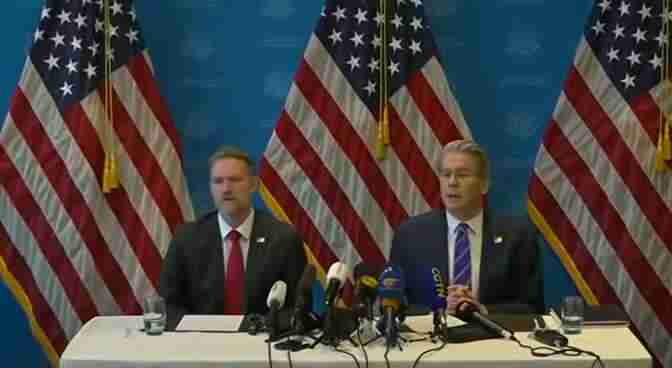
Read the full transcript of US Treasury Secretary Scott Bessent and US Trade Representative Jamieson Greer holds press conference on trade talks between U.S. and China in Geneva on May 12, 2025.
Listen to the audio version here:
SCOTT BESSENT: Good morning, everyone. Thank you for being with us.
First of all, again, we want to express our great thanks to the Swiss government for facilitating this trade meeting here in Geneva. We had very productive talks, and I believe that the venue here in Lake Geneva added great equanimity to what was a very positive process. We have reached an agreement on a 90-day pause and substantially moved down the tariff levels. Both sides on the reciprocal tariffs will move their tariffs down 115 percent.
We had very robust discussions. Both sides showed great respect. It was a chance for me to meet the Chinese delegation. The Vice Premier, I had previously had only a video call with. Ambassador Jamieson was familiar with two of the other leaders on the delegation from his previous time, so there was very good personal interaction.
Both countries represented their national interests very well. We concluded that we have shared interests, and we both have an interest in balanced trade. The U.S. will continue moving towards that. I will let Ambassador Jamieson talk about the President’s initiatives that began on a historic trade announcement on January 20th, which no other President has ever done, following to April 2nd when we implemented the reciprocal tariffs.
JAMIESON GREER: Thank you, Secretary, and I will echo your thanks to the Swiss government and Swiss officials for hosting us this weekend. The atmosphere was very conducive to discussions, and thanks to them, we were able to have very constructive and positive conversations with our Chinese counterparts, who clearly came to deal this week. The rapid nature that we were able to conduct and conclude these discussions is a testament to mutual understanding and mutual respect between the Chinese and U.S. sides.
With respect to the U.S. trade position, our interactions with China and the agreement today, please keep in mind that the United States trade deficit has ballooned over the past several years, ending up at a $1.2 trillion deficit in goods as of the end of last year, which was an approximately 42 percent increase over a few years prior when there was an $850 billion trade deficit at the beginning of the Biden administration.
So, it’s a rapid and expansive increase in the trade deficit, and our view is that this is driven in large part by non-reciprocal trade, among other things, and the result has been offshoring of manufacturing and other negative impacts on the U.S. economy.
And so, on January 20th, when the President was inaugurated, he released the America First trade policy, which was comprehensive, and flagged that he – well, and actually directed agencies, including U.S. Trade Representative and others, to research this issue and to provide options, which we did, and the President elected to impose reciprocal tariffs on April 2 to address this national emergency of the trade deficit.
There was a global baseline tariff accompanied by higher reciprocal tariffs for each country, depending on the level and intensity of their trade surplus with the United States. In all of this, China was assigned a reciprocal tariff rate of 34 percent.
China was the only country that chose to implement retaliation against the United States for this reciprocal tariff. All other countries, you know, withheld and decided that they wanted to negotiate with the United States or simply not retaliate, and so we’ve been in detailed discussions with other countries for several weeks at this point.
China, as you know, retaliated not only with tariffs but with disproportionate and asymmetrical non-tariff measures. In order to maintain the effectiveness of the reciprocal tariff measures, the President increased our tariff rates to offset Chinese retaliation, and as you know, this escalated to a point where both sides had added 125 percent tariffs and with the Chinese side additional non-tariff measures, amounting to an embargo in some senses on trade, an effective embargo, which of course is not a sustainable practice for either side.
And so today, with this agreement, we come to agreement that our reciprocal tariff rate will go down to 10 percent on the United States side, so it goes down 115 percent. We enter into a 90-day pause period for negotiations, which both the Chinese and the United States are very committed to, and the Chinese on their side also go down 115 percent to 10 percent, and they removed the countermeasures that they have in place.
To be very clear, other measures that the United States has put in place in the past, whether it’s, you know, tariff measures from 2018 or since, tariffs under other statutory authorities, tariff rate to fentanyl, those remain unchanged for now to the side. I’ll just make one point, is that both the Chinese and the United States agreed to work constructively together on fentanyl, and there’s a positive path forward there as well.
MODERATOR: Okay, great. So let’s start with some questions.
SCOTT BESSENT: Well, just if I may make one final, a few final remarks to give you framing and context. I think throughout the trade process, we have had a plan, we have a process in place, and now with the Chinese after this weekend, we have a mechanism for continued talks. So process, plan, and mechanism.
I would say one of the big takeaways from this weekend, the United States will continue a strategic rebalancing in many areas that were exposed as supply chain weaknesses during COVID, whether it’s medicines, whether it’s semiconductors, steel, the other, we’ve identified five or six strategic industries and supply chain vulnerabilities, and we will continue moving toward U.S. independence or reliable supplies from allies on those.
But the consensus from both delegations this weekend is neither side wants a decoupling.
And what had occurred with these very high tariffs, as Ambassador Greer said, was the equivalent of an embargo, and neither side wants that. We do want trade. We want more balanced trade. And I think that both sides are committed to achieving that.
We would like to see China open to more U.S. goods. We expect that as the negotiations proceed, that there will also be a possibility of purchase agreements to pull what is our largest bilateral trade deficit into balance that has gotten out of balance. And much of this has happened through neglect over the past four years, as the previous administration did not engage on this issue. That was put forward to us by the Chinese, in fact, and we can see it in what happened to the phase one agreement. We are only looking forward, and we look forward to very good discussions now that we have the mechanism created in Geneva this weekend for talks.
MODERATOR: Great. And with that, let’s get off questions. I’ll start in the front row. Jenny Lutter, Bloomberg.
REPORTER: Thank you so much. Going into these talks, the President posted on his social that he believes that 80 percent of tariffs on China seems right, but obviously went down substantially more. How did you end up going to 30 percent? Was that the President pushing you, or the Chinese not budging before you went down? And then secondly, you have a 90-day pause now, as you have with other countries. What specifically do you want to see in those 90 days? What kind of progress do you want to see in those 90 days, and have agreed to by then, to not ratchet up the tariffs? Because it is just a pause, right?
SCOTT BESSENT: Yes, so I’ll —
REPORTER: What is the tariffs that are set back, basically, if you don’t have something agreed upon that is substantive?
SCOTT BESSENT: So the Chinese April 2nd number was 34, continues to be 34 percent. I’ll let Ambassador Greer answer the first question. And just like with all our other trading partners, as long as there is good-faith effort, engagement, and constructive dialogue, then we will keep moving forward.
AMBASSADOR GREER: I would just say, Jenny, with respect to the President’s message and ultimate rates, I mean, everything is a negotiation, right? And the President, he gives the Secretary of the Treasury and I and other members of the Cabinet direction and advice on how to proceed. And we ended up at a result that is very good for the United States, very good for China as well. We retain our 10 percent global baseline tariff, which we have on other countries. We have, in addition to that, previous measures that we’ve retained, which have been, frankly, effective in reducing the U.S. bilateral trade deficit with China over the past few years. So that leaves us in a very good position, all in with respect to measures on Chinese imports, but more importantly, leads us in a constructive path forward to have a positive conversation with the Chinese on how to rebalance and have more constructive trades.
MODERATOR: Great. In the back, Associated Press.
REPORTER: Hi. I’m Jamie from Associated Press. We just heard our colleague talk about 30 percent tariffs. I’m just trying to understand these numbers here because they’re all over the place. We were at 145 before, apparently, and 125 at least on the Chinese side. So can you say clearly now that the question was, right now, for a 90-day period, the U.S. tariffs on Chinese goods will be down to 30 percent? Is that correct? So 30 percent?
JAMIESON GREER: So again, this agreement is really about the reciprocal tariff, which was imposed by the United States on April 2nd, and the escalatory steps which followed. Those on each side, the Chinese side and U.S. side, ended up at 125 on each other. The Chinese had additional non-tariff countermeasures. That has all come down by 115 percent to 10 percent each. The United States, earlier this year, imposed 20 percent related to fentanyl. That still exists. So if you’re looking at Trump Term 2 tariffs on China, right now, effective, it’s 30 percent. There are prior measures which change by product, by sector, by level, et cetera. You can’t really give a specific number on that right now. What matters for the agreement today is that we each agree to come down on the reciprocal tariff and related retaliation to 10 percent. So a reduction of 115 percent down to 10 percent. Fentanyl is on its own track, but on a very positive track where we’re having very constructive conversations with our Chinese counterparts.
SCOTT BESSENT: And I would add a couple of things. This does not include any sector-specific tariffs that have been put across all of our trading partners. And as the ambassador said, I think he would agree with me that the upside surprise for me from this weekend was the level of Chinese engagement on the fentanyl crisis in the United States. They brought the Deputy Minister for Public Safety, who is not traditionally part of the trade team or the negotiating team, and he had a very robust and highly detailed discussion with someone from the U.S. National Security Team.
REPORTER: Great. John, how do you feel about doing that to me?
REPORTER: Mr. Secretary, will there be any immediate impact that U.S. consumers will see from this? And what was the toughest part of the talks, the Chinese are notorious for being very difficult negotiators. Was there any moment that you felt the talks could break down? And as far as the fentanyl, I’m sorry, I know there’s some questions here, but what are the Chinese willing to do in terms of the fentanyl crisis? Did they make any promises or any agreements to combat fentanyl?
SCOTT BESSENT: Okay. Well, there’s a lot to unpack there. So let me recap that. So you’re asking U.S. consumers, the last one was fentanyl, and what was the second question? How was part of the negotiation? Well, I’ll start there first. Both sides represented their national interests well, but we also concluded that we had shared interests and that neither side was interested in a decoupling. And again, a lot of back and forth on various differences in views on fair trade. We informed them. I had a discussion that trade deficits are a result of three things. One, terms of trade. Two, currency. And then three, the United States fiscal position. We informed them that Trump administration is working very hard on containing this out-of-control fiscal deficit that we inherited from the previous administration. Two, there was no discussion on currency. And one, it was on terms of trade.
On fentanyl, again, for the first time, there was engagement between two teams with detailed knowledge. And I think for the first time, the Chinese understood the magnitude of what is happening in the US. In 2018, in Buenos Aires, they did a good job of banning the actual fentanyl. But what we have seen is substantial interaction between bad Chinese actors and many North American drug dealers, especially Mexican cartels. Treasury has designated several of the Mexican cartels as foreign terrorist organizations. We made that clear to the Chinese. They were very receptive. As you may or may not know, the Chinese have very draconian measures for the sale of illicit narcotics in China. And we have asked them to be equally as draconian with the people who are poisoning Americans.
JAMIESON GREER: Let me make a point. Your question about what was the toughest part of the negotiation, I would submit it was actually, in the lead up to the negotiation, trying to repair the channels of communication that had atrophied under the last administration, where our office, for example, the Office of the United States Trade Representative, had had almost no substantive discussions with the Chinese side on trade. And although we have significant differences with the Chinese on trade and economics, and we have major complaints, you have to discuss these complaints. You have to have a channel for discussions. And overcoming that was a substantial challenge. And a lot of work went into that over the past several weeks, so that by the time we got here, we were able to be very pragmatic with each other and to be sure.
There were tough things to deal with on the level of removal, the timing for implementation, managing each side’s domestic policies, et cetera. And I won’t go into too much detail. But I would say the toughest part was simply getting to the position where we could, in good faith, both sides work with each other. And once we did, we were able to do this in a couple of days. This is not the first time I’ve done trade negotiations with the Chinese. And sometimes it can take a very, very long time to overcome misunderstandings. We were able to do that effectively over the past few weeks, which enabled us to be very pragmatic and effective this weekend.
SCOTT BESSENT: And I think we leave with a very good mechanism to avoid the unfortunate escalations, as we saw after April 2nd, from happening again.
What had been very unusual about the relationship was that President Trump, Party Chairman Xi, have a good relationship, but that the nature of what has happened since April 2nd could have been avoided if we had had this kind of mechanism in place. And I believe it is in place now. I think we leave today with a process that will move forward. And again, great mutual respect for our Chinese counterparts. I believe they showed us the same.
REPORTER: And the impact on US consumers, will US consumers see any result in any of this?
JAMIESON GREER: I mean, you’re the Treasury Secretary, so you’re better suited. But I would say on the front end, there’s been a lot of talk about impact on consumers. That just never really translates to the numbers. Consumption remained high, et cetera. And so I think what we’re going to see is that we’re going to have our economy continue taking off as we put structure around these negotiations and get global trade into a better place.
SCOTT BESSENT: And as I reiterated last week, the Trump economic plan is three pieces, trade, tax, and deregulation. Trade has been implemented first, and that process is occurring. We believe that the tax portion is going very well. Speaker Johnson, Leader Thune, who I am in constant contact with, believe that mid-summer we will pass, as the President likes to call it, his one big, beautiful bill. And we believe that that will provide a substantial relief for American households. And then deregulation, a hidden and pernicious tax on American households is regulation. We believe that the last administration added several thousand dollars a year to American families’ costs. And that we will be not only cutting those substantially, rolling that back, but cutting those substantially.
MODERATOR: I think we have time for about maybe two or three more questions, but most in terms of name outlet, please.
REPORTER: Yeah, it’s Injun Votes, CDC. It’s very heartening what you’re telling us. I’m wondering whether you think it might have been a better idea to start at this point of negotiations rather than start with the tariffs and all the global turmoil that that caused and the fear, frankly, in some countries around the world. How about, do you think, in hindsight, it might have been better to start, reach out and say, we want to talk to you guys about this?
JAMIESON GREER: I disagree entirely. We have spent decades at the World Trade Organization in multilateral and bilateral negotiations trying to get other countries to reduce their tariffs and non-tariff barriers to be more reciprocal with the U.S. We’ve had one of the most open economies for decades. The promise of the WTO and the multilateral system is that everyone was going to come down. It turns out the U.S. went down significantly. There were other economies that had low tariffs as well, but retained very high non-tariff barriers. We have tried really hard to work within the system. And the net result is a $1.2 trillion deficit in goods. The net result is manufacturing went to China, East Asia, Mexico, et cetera. So we’ve tried all of that. So the idea that we can just keep saying, well, why don’t we just talk a little bit more, we’ll have a different outcome, I think just is totally detached from reality.
SCOTT BESSENT: And I would add a couple of things that as our 18 important trading partners come to us, many with very good deals, as the UK, who skipped to the front of the line as our oldest ally, as Ambassador Greer and I look at their proposals, again, to lower tariffs, to lower the non-tariff trade barriers. Obviously, UK does not have a currency manipulation problem. And the subsidies for labor and industry, we look at these and I think, how did we get here? How did we get here?
And I echo part of what President Trump said, that he doesn’t blame the other economies for taking advantage of a fluid, taking advantage of the situation when they were allowed to do it. He blames previous US leaders. So we are just trying to restore a healthy equilibrium that the US economy has become very unbalanced.
On one side, we have a forward leaning, the deepest and widest financial markets in the world. We have financial innovation. We have the tech sector that is the envy in the world. On the other side, we are a natural resources economy led by energy. So it is a barbell, but in between precision manufacturing, especially precision manufacturing has been wiped out. And it is our intent to bring that back.
So we want to rebalance. And I think that there is a big opportunity. If I think about this weekend, the Chinese, they have gone the other way. They are unbalanced in terms of overproduction in the manufacturing sector. They have stated, but have not yet rebalanced toward a more consumption oriented economy. And there is a chance if we can open up trade to China, have more fair trade toward the US that we could rebalance together. So I reject the notion that business as usual would have worked.
MODERATOR: Great. And I think this will be our last question. We’re just about out of time. That’s what’s out there. Eris, Gary.
REPORTER: Yes. I have a question in regards to the setting of these very successful talks that we did. Switzerland has been in the center for international conferences for many decades. In recent times, we’ve been under tremendous pressure, the ambassador of Joe Biden to Switzerland called Switzerland a hole in the government. My question is, how high does your administration value reliable Swiss neutrality for conferences or meetings as we just went this weekend?
SCOTT BESSENT: Well, I won’t speak for the previous ambassador. My neighbor in Charleston, South Carolina was the ambassador under President Trump, Ambassador Ed McMullin, who was highly respected here. He continues to engage with the Swiss American Foundation. And he has led this administration’s effort to re-engage with Switzerland after the past four years.
So we value the relationship. I believe Switzerland is now one of the, maybe the sixth largest investor in the US, which is incredible for an economy with 9 million people. We hope that Switzerland will bring some of its very robust trade training programs to the US as we re-engage the manufacturing sector, because I believe the US has a lot to learn from Switzerland. And again, the UK and Switzerland have moved to the front of the queue for the trade deals, whereas the EU has been much slower. So we value that also.
JAMIESON GREER: And I would say with respect to the negotiating dynamics, and this may not seem important to those not involved in this, but the atmospherics provided by the Swiss government were incredibly conducive to the conclusions we had this weekend. They allowed us to use the grounds of the residence of the Swiss ambassador to the United Nations, which had a very intimate, internal rooms, and importantly for us, where a lot of the key negotiations happened. We’re outside under a large, beautiful tree on a set of patio sofas, frankly, where we had the most important discussions on the most challenging issues.
And having this setting, as opposed to, no offense to the intercontinental, which has been great, as opposed to a sterile hotel conference situation or conference rooms, I think let us develop personal relationship with our counterparts and lead to the successful conclusion we had.
MODERATOR: Great, thank you so much, everyone. I think that’s it for us in time today. Thank you so much for coming out, and okay, are we in? Thank you.