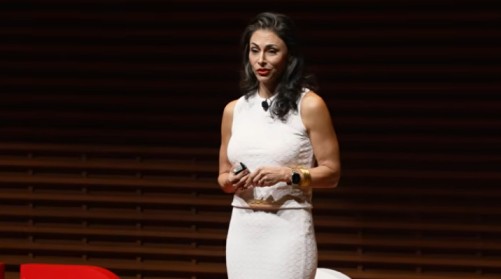
Editor’s Note: In a world where artificial intelligence is rapidly leveling the playing field, everyone is just one prompt away from producing fast, high-quality work. However, former Chief AI Officer Sol Rashidi warns that while technology simplifies our tasks, outsourcing our thinking risks causing “intellectual atrophy”—the slow erosion of our critical thinking and problem-solving abilities. In this insightful talk, she explores how to use AI as a tool for acceleration rather than a replacement for mastery. Discover how to protect your cognitive strength and stand out in the workforce by prioritizing comprehension over convenience.
Following is the full transcript of Sol Rashidi’s TEDxStanford presentation:
The Growing Reality of AI in Our Lives
SOL RASHIDI: Imagine waking up one day and not being able to tell the difference between your work and that of a machine’s. Not your boss, not your customers, not even you can tell the difference. Because the way we’re going with artificial intelligence and based on its current capabilities, it can solve some really complex business problems through data analysis and reasoning. It can generate creative content that some say rival human ingenuity. It can even adapt in real time, which frankly most of us struggle with.
Now, many think that artificial intelligence is remarkable and I’m one of them. It’s pretty crazy what these advancements are right now, but I’m not here to celebrate AI’s achievements. I’m actually here to warn you, to talk about something that’s happening to us as individuals, us as a society, and us as a community that we’re not talking about yet. But we’ll get to that later. What I do want to do is set some context for you all.
Did you know that one in five Americans use some form of artificial intelligence? By the end of 2025, 1 billion will be leveraging some form of artificial intelligence. That’s an eighth of the world’s population. AI can now match the intelligence of a college grad, a third year law associate, and get near perfect scores on the MCATs, the LSATs, and the SATs. Markers we use to determine human intelligence.
What Will Make You Stand Out?
So have you thought lately? With artificial intelligence leveling the playing field because everyone is technically one prompt away from a subject matter expert that’s going to help them do the work, faster and cheaper. What is going to help you stand out? How will you be distinguishable? How are you going to differentiate yourself?
Think about it. There’s no doubt that we live in a world of overreliance on technology. And now with the adoption of AI, what’s happening is that what we think is simplifying our lives is actually complicating our future. These short term exchanges that we’re making for conveniences are actually creating long term disasters. Statistics say that by the end of this year, most of what we will read, see and experience will either be AI powered or AI generated.
Think about that. So if you use artificial intelligence to write for you, how do you avoid your voice from fading away? If you use artificial intelligence to think for you, are you giving yourself choices and options? If you use artificial intelligence to make decisions for you, how do you avoid not losing your power and ability to discern?
The Real Threat: Intellectual Atrophy
This, this is the real threat of artificial intelligence and what I call intellectual atrophy. The slow, sneaky, silent erosion of our ability to think deeply, think critically, and think independently. The very things that are needed for us to stay cognitively strong and with mental dexterity. The things that power our ability to create, invent, and solve problems. And if we don’t course correct ourselves, we are going to experience intellectual weakening while the machines experience intellectual strengthening.
My name is Sol Rashidi, and I was the world’s first chief AI officer appointed nearly a decade ago. I’ve been both a practitioner and a C-suite executive, and I’ve worked with some wonderful brands and Fortune 100 companies. And my scope was always to build products and capabilities, leveraging the advancements in data, advanced analytics, robotics, and artificial intelligence. And boy, did we have fun. We built some really, really cool things.
And I’m very fortunate and grateful that, yes, I have patents and I’ve written a book. But the best part of it was, I was there when IBM launched Watson and we took it to market. The first product the world had ever seen in the workforce. And now I’m here today and this is what I’m seeing.
For those of us that are in this space, we are experiencing whiplash because the pace of change and innovation is so fast we can barely, barely keep up with it. And then there are those who are dabbling with it and they are excited and in awe and rightfully so. It’s kinda cool. And then of course there are those that are just avoiding it. They’re overwhelmed, they don’t know what it is, or they think it’s not relevant to them.
But what I’m here to tell you is whether you’re leaning in, dabbling, or avoiding it, AI is here. AI has happened. The genie is out of the bottle. So we now have an opportunity to decide how we’re going to leverage artificial intelligence for good as a way to amplify us, accelerate our geniuses, and facilitate our superpowers. We have a conscious choice today to make sure that artificial intelligence happens with us and not to us.
A Tale of Two Analysts
And if you’re still not convinced, let me share an example that just recently happened. I was working with a brand and I was partnering with the Chief Marketing Officer and they were going to launch a very big product. And so we were going to help them with their marketing strategy. And so we were going to leverage my four C’s framework.
Which customers are we going to market to? What’s the cadence? What’s the communication? And which channels?
So I had assigned two people on my team this task, a junior analyst and a senior analyst. Now the junior analyst was about five, six years outside of school, so maybe not junior, maybe mid analyst. The senior analyst was about sixteen years out of school. So I gave them both the assignment.
The junior analyst submitted his work within a week. Woah. The senior analyst took three weeks. At the end of the day, my leadership team and I, we reviewed both deliverables, both work products, and they were awesome. They were amazing. Very well presented. Lots of great quotes and stats and facts to the point where we almost thought we had a prodigy in our hands. Until we got into a room and we started asking questions.
Tell us about consumer behavior, consumer preferences. What’s the market share like? What are the barriers to entry? The junior analyst did not have the answers to the question. My senior analyst did because she had learned. She had done the forensics and the research. So while both work products were beautiful and pretty, one was superficial and one had depth.
So as a leader in my group who believes in these capabilities, I had to let everyone on the team know and I had to institute a new policy. Of course, leverage artificial intelligence and use it to execute your work. But you are not allowed to use it to do your work, to think for your work. One expedites and the other one does. There’s a difference.
So when you have the choice, whether you’re leaning in or dabbling, do me a favor. Please always prioritize prudence over pace, comprehension over convenience. Do not outsource your critical thinking, outsource the tasks. Because we are right now experiencing some form of intellectual atrophy. And the real threat of artificial intelligence is that slow degradation in our ability to think creatively, our craftsmanship, our comprehension and our mastery.
Five Ways to Stay Remarkable in an AI World
So what do we do about it?
First, master your craft. No shortcuts and no superficial knowledge because your future in the workforce in the next three to five years depends on your ability to leverage artificial intelligence while knowing your space and field. That’s where the magic happens. I mean, you think about it, Warren Buffett, one of the world’s famous billionaires, he spends 85% of his day reading. He doesn’t outsource it to his team. He takes the time to learn. And then he takes the learnings and applies it to his day to day life and his mental models. That keeps you cognitively resilient and strong.
Second, develop your cross disciplinary strengths. Connect the dots where AI can’t. Have you ever had an “aha” moment? Came to you while running, while lifting, while in the shower? This is where your subconscious and your conscious is connecting facts and information that you have absorbed because you have taken the time to reflect and understand. And that moment is beautiful. AI can’t do that. Steve Jobs did not invent the computer, but he revolutionized the way we interact with technology because he combined cross disciplinary fields, technology, psychology, and product design.
Three, be an AI collaborator, not an AI consumer. That means don’t copy and paste and move on to the next task. Instead, use it as your first draft. I always tell my teams, it’s easier being an editor rather than an author. If you’re going to use artificial intelligence, which you should, I’m a big fan of it. Use it as your first draft forward and then let your mind wander from there. That’s what’s going to strengthen your ability to stand apart.
Fourth, keep humans in the decision making loop. Never let AI be the sole decision maker where it matters. AI is flawed just like us. But unlike us, its education came from the World Wide Web. And as we all know, there’s biased data, there’s incorrect data, there’s conflicting data. Too much is at risk. And guess what? You can’t question the results if you don’t know your field. Ever get that feeling where something is off? It matters.
And the fifth one, choose to be remarkable, not reliant or routine. What on earth does this mean? Well, I think in the future, there’s going to be those individuals that are going to use artificial intelligence as a convenience tool, not as a comprehension tool. And they’re going to short circuit and bypass the process of learning, understanding, comprehending, failing, succeeding. Are they really going to have a place in the future in the next two to three years with the pace of change right now?
Then you’re going to have those that are going to fall into the routine category. They know their space, but they never have enough time. So they’re going to leverage artificial intelligence to expedite a lot of their work, but they’re going to be in a game of copy and paste and move on to the next. Well, you get hundreds, then thousands, then millions of individuals using AI and copying and pasting and moving on to the next task, that work is routine. It’s repeatable. It’s redundant. It’s not going to stand on its own.
Choose to Be Remarkable
So instead, choose to be remarkable. And what that means is, do not be defined by AI. Use it to amplify your superpowers and your geniuses, not to replace or displace them. Use it to accelerate your thinking, but not to outsource your thinking.
All this is to say, AI is a powerful ally and it can be a wonderful copilot, but the future I see, the one that I so desperately desire is a future where AI serves us and not numbs us. Is a future where it amplifies us and not displaces us.
So if you get a moment, take a second and reflect and think what is your relationship right now with advanced technologies, your phone, and artificial intelligence? Are you using it as a crutch or as a ladder to reach new heights? Because our future, our future, civilization, humanity, our society, our communities, is going to be dependent on not the pace of a machine, but the power of our minds.
Thank you.
Related Posts