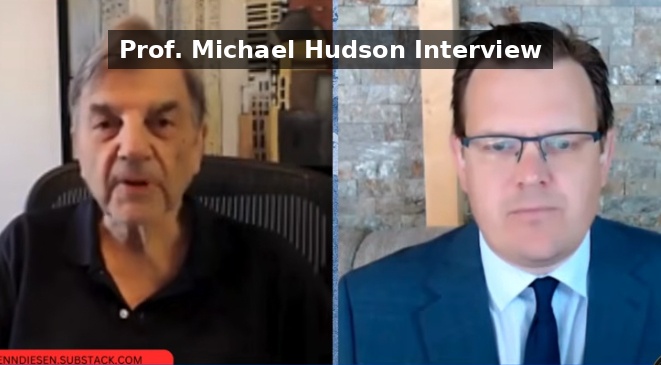
Editor’s Note: In this insightful interview hosted by Glenn Diesen, renowned economist Michael Hudson breaks down the U.S. strategy to revive its geoeconomic dominance through financial, technological, and maritime monopolies. Hudson analyzes the broader geopolitical conflicts in the Middle East and Ukraine, discussing how the U.S. leverages economic warfare and foreign policy to maintain global hegemony. They also explore the immense pressures placed on international allies and the potential global fallout, including looming food and energy crises. (July 23, 2026)
Following is the full transcript of Prof. Michael Hudson’s interview:
Introduction
GLENN DIESEN: Welcome back. Professor Michael Hudson joins us today, and I would advise everyone to follow his work. I have left a link in the description. So yes, at least this is what I read to stay up to date. So thank you for coming back on, Michael. It’s great to see you again.
PROF. MICHAEL HUDSON: It’s good to be here with all of these news happening. The stock market’s up. Everybody seems confident that there’s not going to be much of a disturbance in world inflation or exchange rates from all of this. It’s just amazing. Well, we’re talking about the war that’s going on. The market is as if, well, it’s really not going to matter.
Is There a Plan Behind U.S. Economic Warfare?
GLENN DIESEN: I’m wondering if they’re delusional or if it’s market manipulation or how to explain this. Anyways, that’s some of the things we’re getting to today.
And because what is happening, I mean, it’s quite remarkable. After decades of globalization, that is the integration of markets, and also a buildup of huge unsustainable debt, we now see that this US-centric format for globalization, that is integrating the world organized around the United States, this model has seemingly exhausted itself, that is organized around US financial markets, the US dollar, US-controlled transportation corridors. All of this is now being dismantled by economic warfare and even war.
And you’ve probably seen the interview with Scott Bessant where he makes the point that the wars on Iran, Venezuela, even Russia, they all have an economic function to strengthen the US dollar. So it is, I thought it was interesting because it does beg the question, to what extent is anyone behind the wheel or do you see a plan here of the United States?
The U.S. Plan to Revive Geoeconomic Dominance
PROF. MICHAEL HUDSON: Well, there has been a long plan and it’s very easy to dismiss Trump and say, well, Trump’s losing the war with Iran. The whole memorandum of understanding was in effect seemed to be a capitulation to Iran. And you can see that it seems futile for Trump to try to get in deeper and deeper and deeper. So the assumption is since he’s getting the US in deeper and deeper, he must not have a plan because it’s not working.
But there is a plan, and not only Trump, but especially his Secretary of the Treasury, Bessent, have been very openly expressing what this is. And Trump himself was outlining the plan already in his first administration, way back in 2018. He said that the number one aim was that he saw that America’s military spending abroad, an attempt to enforce a US-centered world order, dollarization, US financial markets, had been since 1950 the main balance of payments drain on the United States. And it was foreign military spending that forced the United States off gold in 1971.
From Gold to Dollar Recycling
Well, from 1971 till very recently, what took the place of gold? The US spent money into foreign markets. Foreign markets were recycling this to the United States. At first, local recipients of dollars, companies, economies, governments would turn over the dollars to the central bank. And what would the central bank do? Well, as we’ve discussed it before, and as I discussed in my book, Superimperialism, foreign central banks bought US Treasury IOUs, treasury bonds, securities, notes, short-term.
And then in the last few years, instead of this intergovernmental central bank recycling, you had foreign private investors buying US stocks, US bonds. All of this money was recycled into the US stock market that was mainly being driven up on debt.
Well, all of this means of somehow maintaining America’s domination is now called into question. What Trump had said is, well, the first thing we want to do is stop all of this military spending we’re doing abroad. He’d talked about withdrawing his troops from NATO already in his first administration, and he’d singled out OPEC. He said, we’re spending a lot of money in defending the Middle East, West Asia, and they really have to somehow end up paying us.
Well, of course, that was the whole idea of the petrodollar agreement of 1974, 1975, that OPEC could charge whatever it wanted for its oil and it would reinvest its oil earnings in the US financial markets, stocks and bonds.
America’s New Rentier Strategy
Well, all of that was working, but still the United States had, in the interim since the 1970s, lost its industrial power. It’s lost its creditor power, turning into a debtor country. It needed a new strategy. And last year at the end of 2025, the US spilled out the strategy and it was, well, we can’t support our control of the world economy anymore by industry or by even our financial markets. We have to establish a series of monopolies to make America a rentier economy.
And the 3 sectors that the United States wanted to control have been, number one, the longstanding sector of oil. We’ve discussed that before. America wants to control the oil trade so that its allies cannot deal with other producers of oil that would interfere with the US monopoly.
Targeting Russian and Iranian Energy
So while almost all the attention of the shows that you’ve been doing and that have been in the media have been focused on the fighting against Iran and isolating Iranian oil, especially Iranian oil exports to China, there’s been a similar US attack bombing Russian oil refineries and gas refineries through Ukraine.
The United States has been providing Ukraine with guidance and missiles to show just exactly where to bomb so that Russia will not be the beneficiary of this rising, the imminent rise in oil prices that’s going to result from closing of the Strait of Hormuz for 20% of the world’s oil trade. And now another 5% of the world’s oil trade as the Yemenis have cut back Saudi Arabia’s West Coast export facilities.
So the world is facing a very sharp rise in oil prices. And this is essentially the United States wanting to be the beneficiary of this, especially through the exportation of natural gas, liquefied natural gas. So it wants to make sure that it will be the beneficiary of this rise in oil prices as a result of the war in West Asia, not Russia, and it still wants to be able to isolate China from receiving this.
Tolls on the Strait of Hormuz
Well, what Trump has done — he said early this year, repeatedly, what he really wants to do is make the Arab or OPEC countries pay for America’s military costs there. Well, suddenly Trump was inspired by the fact that Iran now wants to impose tolls on traffic through the Strait of Hormuz that Iran has estimated will yield it about $40 billion a year.
Well, Trump finally has found a way to charge the OPEC countries for the costs of the military. He calls it defense or guardian angel of defending these countries from Iran and any other attacker. And he said a few days ago, there are going to be tolls in the Strait of Hormuz. Forget international law about no tolls being allowed to be imposed on international waters — there are going to be tolls. We will get them, not Iran.
Well, immediately Secretary of State Rubio said, wait a minute, if you’re saying that America will get the tolls instead of Iran, then that justifies Iran’s claim that the United Nations Conference on the Law of the Sea is dead. The UN rules that international waters cannot have tolls unless they’ve been grandfathered in by signatories to the UN agreement, such as Turkey with access to the Black Sea, Egypt with its canal, the Panama Canal. Unless they’ve grandfathered these in, international waters can’t have tolls.
Well, Rubio said, you can’t say this. We don’t want to give in anything on international law that we can still use to try to prevent Iran from getting the tolls. So Trump then backpedaled and a few days ago gave a press conference saying, all right, we’ve made a new agreement with the OPEC Arab countries. They are going to pay us for the cost of our defending them as their guardian angel, but not through tolls. They’re going to invest in the United States, just as way back after 1975, Saudi Arabia and the OPEC countries invested their oil export earnings here. They’re going to invest in US industry as partners.
The Second Monopoly: Information Technology
And already this had begun to take form. Amazon, for instance, had made a huge investment in Bahrain in artificial intelligence — these huge fields of computers that are using energy. And that is the second element of what the US wants to monopolize.
In addition to controlling the oil trade and essentially obtaining all of the recycled oil export revenues for its own economy, the US wants to control a monopoly in information technology and associated computerization and the internet. And this is why what has been stabilizing the US balance of payments has been a huge private foreign investment and government investment, including the United Arab Emirates, the UAE and Saudi Arabia and Bahrain, into the US Golden Seven stocks of information technology, computer chips, and Amazon and Google and all of the internet and public discussions — X, Facebook, all of these.
Well, the problem is now that these stocks are going down because analysts have found out, well, in order for these companies to make this vast increase in earnings, in monopoly rents that they’ve expected as a result of building huge information technology centers, we can’t do that in the United States because we don’t have the electricity. And we don’t have the water to cool the chips that make all this intelligence.
So just as the United States has offshored its manufacturing industry, it’s now offshoring its artificial intelligence monopoly. Where is it going to offshore it to? Well, to the OPEC countries, especially to the Arab OPEC countries. That’s why, as I said, Amazon and Bahrain. And in the last 2 days, the United States has made a deal with the Arab Emirates saying, well, you can be partners with us in huge US investments in building these industries, this information technology where you are. You will provide your energy domestically to power this huge American investment in information technology.
Iran’s Counter-Strategy
Well, a few days ago, Iran focused its bombing on Amazon’s investment in information technology in Bahrain. Iran’s position is, well, what’s our strategy? Number one, we want to drive the United States out of the whole West Asian region. The first thing we’ve got to do is drive out the military bases. It’s done that — through all the military bases except Israel. It’s bombed them. And the United States military is in complete agreement. Okay, we’re going to withdraw our military bases there. We can’t afford them anymore, mainly because we can’t protect them from the Iranian missiles that have shown that they can penetrate our defense at will. And Iran has just finished in the last 3 days bombing what’s left of the American military bases.
But Iran then says, well, in driving the United States out of West Asia, it can’t just be the military bases. We have to end the whole economic and financial symbiosis between the United States and these local monarchies there. And under this symbiosis of investing their oil export proceeds in American stocks and bonds and partnerships with American AI industry, their hearts are going to follow where the money is. We’ve got to prevent this economic symbiosis so there’s not going to be any linkage at all between the US economy and these economies, so that we can then essentially free the region away from the United States.
Well, that means that the bombing is going to prevent all of this. This is really what the war is all about.
The Venezuela Playbook and the Iran Endgame
And it’s been depicted as an existential war on Iran’s part because the United States wanted to do to Iran just what it did to Venezuela. It wanted a very quick war — you kidnap the president, you have a regime change that agrees to turn over its oil to the United States. All of Venezuela’s oil export revenues are put into a US bank account that’s run by the US Treasury.
Well, a few months ago, the Secretary of the Treasury, Bessent, said we’re going to do the same thing in Iran once we defeat it. And just before the June 17th memorandum of understanding was signed, Hegseth came out and said, well, what we’re going to do, we’re going to conquer Iran and we’re going to have a regime change that will put all of Iran’s oil revenues in a Treasury account, and this account will have to be spent in the United States to buy US exports and US goods.
Well, then the negotiators worked out this memorandum of agreement, and it looks obvious Iran has just withdrawn from that agreement a few days ago, because it became apparent that the United States never had any intention at all of actually meeting the terms of the agreement.
The $12 Billion Betrayal
For one thing, the whole agreement was to be put in motion by this payment of at least a token sum of $12 billion of the $100 billion of Iranian savings that the United States has told its allies, especially in the Emirates and the Arab OPEC countries, to confiscate. Well, Hegseth said he’s worked with the Emirates to say, don’t give them a penny. And so now the Emirates and Bahrain and other countries have said, we’re not going to return any of this $12 billion, much less $100 billion, to Iran.
We’re going to say, Iran, you’ve attacked us. When we attack you, you fought back. Your fighting back is an attack on us. We want reparations for the cost that we’ve had to suffer from your defending yourself against the US and Israeli and our own military attacks on you.
And Hegseth had spilled all this out just before — actually on July 11th, when the negotiators drafted the agreement that was signed on the 17th. Well, it’s obvious this wasn’t going to be enacted.
The Strait of Hormuz: A Legal and Military Battleground
And regarding letting Iran administer trade in the Strait of Hormuz, the United States never had any intention at all of letting Iran charge any tolls or even administrative fees for registering the ships, for coordinating the ships, anything that administration of a strait would do. The US Navy came in and protected ships to try to break the Iranian control by turning off their transponders and sailing close to the Oman shore and saying, well, the strait — even though the memorandum of understanding said Iran will govern all shipping through the Strait of Hormuz — this doesn’t apply to Iran’s own territorial waters.
So there are going to be 2 routes through the Strait of Hormuz. There’s going to be the Iranian shore route that’s not in international waters, and as for the in-between international waters, that doesn’t apply because the United Nations Conference on the Law of the Sea, UNCLOS, prevents any country from charging tolls that isn’t already grandfathered into the clause.
And Iran said, well, we never signed that agreement. And Iran is in a state of war with us. And anyway, this law of the sea does not preclude us and other countries from defending ourselves in a state of war. Oman is in a state of war with us because Oman is hosting US military bases from which missiles and bombs are being sent into our territory. So of course we have control over the strait.
An Existential Conflict for Both Sides
Well, this is what Trump is all about. So Iran is claiming the right — when the 60-day ceasefire period was to have been over, Iran had planned to impose these tolls. Trump said, no, you’re not going to impose the tolls. We’re going to impose the tolls to reimburse ourselves for all of the costs. And we’re going to get 20% of the oil export proceeds of the Arab countries who export this oil. 20% of the value of this is all going to be paid to us as a toll.
Well, that’s what immediately the legal fight is about. There goes the international law of the sea. There goes the memorandum of understanding.
And so you see that when this is the aim of Trump, you could say that he’s attacking Iran not simply because he’s deluded by his belief that somehow we can destroy Iran’s military, we can destroy their defenses, we can destroy their missiles, we can hit the civilians and the hospitals and the schools and demoralize the population so much that they will want to put a US regime in so we’ll stop making them so unhappy. This is all an illusion.
But for the US, this fight against Iran is existentialist for the United States plan of how to control the world economy, just as it is for Iran to defend its own sovereignty and its own existence against the United States attempt to invade it, break it up, by trying to get the invasions from Balochistan, from the Kurds and others.
So this is really what the fight is all about and why it’s going to go on and on. And in the process of going on and on, it will block the oil trade, leading to a stoppage of oil, leading to the world production crisis and financial crisis that we’ve discussed in our earlier shows.
The U.S. Strategy for Restoring Geoeconomic Dominance
GLENN DIESEN: Well, I’m thinking if I was in Washington advising Trump how to restore US geoeconomic dominance, I would probably advise what they’re doing now to a large extent. That is, for the US to revive its technological dominance, for it to control international transportation corridors, that is the maritime corridors. Restore, yeah, third, restore America’s financial dominance with this currency. You know, you want to keep rivals of the United States weakened, you want to keep the rivals divided, prevent them from integrating, and also keep the vassals dependent. If you do want to have a new formula for American dominance, that seems to be a good pathway.
Now, as you say, they do very often make comments that support this logic though. That is the idea that all international waterways must remain under US control, even through piracy. We see now part of the way they measured success in Venezuela was, according to Bessent, that they will now have to sell their oil in dollars. Their proceeds will have to be invested into the United States. Trump himself bragged about how much money they’ve been able to extract from Venezuela.
We see the same with Russia, how much they had comments about torching Russian oil refineries through their Ukrainian proxy. Bessent made the comment that after the war, the Russians will probably be forced to start selling their oil and gas in dollars again. And yeah, Iran, as Lindsey Graham made the point, that yes, Iran is oil rich and this will now fall under US control when it’s over.
We had all these American leaders at some point making the same chant, that is, you know, this short-term pain for long-term gain. We’re going to get it under our control, not just American control, but the oil would have to be sold. Well, the part of the deal the Americans wanted, which were quite open, was that whatever the Iranians make of oil, which should be sold in dollars, should be used to, well, give the US exclusive right to sell agricultural products to Iran. So again, selling in dollars, used to buy US products.
And at the same time, when the Americans are punishing Iran, they’re torching all the bridges and the things which are used to connect the Eurasian landmass, that is part of the Belt and Road Initiative that connects Iran to Russia, China, and so forth. We see that the allies or vassals of the United States in the Middle East and Europe, they are now asked to increase their dependence on the US. And the US will also monetize this. That is, they have to now pay for all “protection.”
We see the same with all these wars on Iran, for example, that China should be cut off from a key supplier of oil. It should also, of course, be— its tech development should be scaled back to restore US tech dominance. So I see what they’re going for, and it’s, you know, if we throw all the morals out the window and global hegemony is the key objective, all of this makes perfect sense. The fact that they’re saying it out loud as well is quite interesting.
Can the U.S. Actually Succeed?
But I guess my question is, what is the likelihood of the US succeeding in these objectives? And what could go wrong? Because, you know, the US wanted to break Chinese tech dominance. It proved that that wasn’t really feasible. They also see that Russia is, well, willing to go all the way. Essentially, Iran isn’t being defeated. They’re not giving up. They see what the Americans are doing.
The Iranians, as you said, are willing to destroy data centers of the United States in the Middle East. They’re willing to knock out— I think they took out the desalination plant in Kuwait, which means they can actually, you know, make this country cease to exist. You know, they’re willing to go up that escalation ladder because it’s all or nothing for them.
So I guess, yeah, my question is, to what extent do you see the US being able to control the economic consequences of these conflicts, that is, these wars, be it economic or actual wars against China, Russia, Iran? Because a lot of things can go wrong. And at the same time, the US economy isn’t doing that well either. I mean, yes, the stock markets are up, and if that was the only indicator for economic health, wonderful, America would be back. But many things can go wrong here.
U.S. Control Over Oil, Transportation, and Financial Systems
PROF. MICHAEL HUDSON: Well, you’re right to have mentioned transportation. And to answer your question, in order to impose the US control of the world oil trade to get its income for itself, and the artificial intelligence computer technology trade, the US does need to control shipping and international transportation as well. Because the way that — how can you export your oil without doing it by ships or by overland means such as pipelines?
Well, the very first fight that Trump picked with Europe. And most of America’s main — I won’t say enemy, but its main opponent — is of course Europe, its allies, Europe, Japan, and its other allies. Before it fights its real enemies, Russia, China, and Iran, and the global majority, it wants to tighten its control over Europe and make sure that Europe is locked into dependence on America’s liquefied natural gas and transportation.
And so this required 2 things. Number one, the blowing up of the Nord Stream pipeline, as we’ve discussed. But number two, what you’re seeing now, the constant bombing of Russian shipping through the Baltic. For a long time, Russia exported its oil through the Latvian east coast Ventspils that went through the Baltic. Russia’s now still exporting oil through the Baltic, and you have Estonia and Latvia permitting NATO to basically stop Russian oil exports through the Baltic. Well, all of that violates the UN Law of the Sea. That’s not free trade.
The United States objective now is saying, in 1945, we supported free trade because we were the beneficiaries. When England promoted free trade in the 19th century, that was called free trade imperialism. Well, that’s what America did after 1945, but now we’re not for free trade anymore. Because if we can’t have free trade of other countries trading among themselves and being independent of the United States, if we can’t control foreign oil as a rival, we will destroy that oil. We will destroy Russian ability to refine its oil. We will destroy Russian ability to transport its oil to other countries. We will destroy its pipelines.
And the same with Iran. We will destroy Iranian ports and Iranian shipping, as we’ve been doing, so that it can’t export either to China or to India or anywhere else. So the control of oil and control of transportation goes together.
Greenland, the Arctic, and the Belt and Road Initiative
Well, that’s why the first fight Trump had with Europe was over Greenland. We’ve got to take control of Greenland because then if we can have a link from Greenland to Iceland to Britain, then we can block access from the North Atlantic Ocean into the Arctic. And if we can block that access, then Europe and West Asia won’t have access to the Arctic trade to avoid having to go around through South Africa or having to go around the US-controlled Panama Canal. We’ve been able to block the oil trade and any other trade from there.
Well, I’m a little surprised Russia has been trying to arrange with China the Power of Siberia pipeline to say, well, look, the United States is trying to, in violation of the Law of the Sea, in violation of all of the free trade rules, prevent us from shipping our oil. So the only way to get around it is through a pipeline. And that’s what, of course, what China has been trying to do through its Belt and Road Initiative — essentially integrate Eurasia, the whole Asian continent, so that it doesn’t need to have the Mackinder strategy of controlling the periphery.
But China and Russia have argued over what’s going to be the price for the oil. Well, Russia quite correctly says, well, we can see that the price of oil is going to go up because it looks now like the United States is goading Iran and the Arab OPEC countries to destroy each other’s oil production while NATO is fighting against Russia to destroy its oil export capacity. And without OPEC oil, there’s going to be a huge oil shortage. And the United States will supply this basically through shipping gas to countries that need this energy.
This is why Trump has fought against alternatives to oil in the form of wind energy and solar energy, which China has dominated in. So that’s the link between transport.
Europe’s Economic Subordination and the Helium Monopoly
And now for your question, how can this succeed? Well, it can only succeed by — let’s start with the America fight against Europe to subordinate its allies, Europe and Japan, to the United States. The whole assumption, the materialist approach to history, is that countries are going to act in their economic self-interest. Well, Europe isn’t acting in its economic self-interest. That would be to get inexpensive energy to power its industry and avoid the deindustrialization that you’re seeing in Germany and other NATO countries.
It can’t afford the higher prices of oil, and its chemical industry can’t afford to operate at a profit when there is an interruption of the derivatives of the oil trade — sulfur to make sulfuric acid for mining, and fertilizer made out of natural gas, not to mention helium. One of the first production sites that Iran hit was in Qatar’s helium production, that was itself 20% of the world’s helium trade, totally destroyed. It cost, I think, $5 billion to install originally and took a number of years to install. All of this is unavailable for the next few years, causing a helium shortage.
China and the United States are major producers of helium. China has stopped its helium exports, and the United States now is using its helium monopoly as a lever of international control.
The Fourth Monopoly: Dollar and Financial System Control
So the United States retains a lot of levers and control. And the ultimate, the fourth monopoly that we didn’t discuss, is the US dollarization, the financial system monopoly. This is what we’ve been discussing for the last few shows that you’ve had me on.
The United States tried to exclude its rivals from the SWIFT bank clearing system. China set up an alternative to that. Everything the United States has done by imposing financial sanctions on other countries — to try to say, well, we can cut off your financial payments — without, how can there be an oil trade? How can there be a trade in industrial products if you can’t process the payment for it? You not only need to transport this trade, you need to transfer the monetary payments. So we’re controlling that system too.
The whole American strategy is no longer a win-win strategy between it and the rest of the world. It’s what choke points can we use to control the world economy — the choke point of whether they can get oil and energy to power their factories and light their homes and supply their chemical and fertilizer industry, the information technology and the grain.
Can the U.S. Strategy Succeed?
To answer your question, the American strategy can only succeed as long as the United States can impose choke points on the entire world, either by imposing sanctions that other countries will not have an alternative means of becoming independent with — their own alternative to the sanctions, their own payment system such as China has been developing, their oil production like Russia and Iran, their transportation like the Arctic route of transport, and the Russian ability to fight NATO military attacks on Russian shipping through the Baltic and other areas, and US attacks on shipping through the Indian Ocean that it’s been doing.
So the answer to whether the US can maintain its control and its new, almost neocolonial imperialism, depends on its ability to impose, to make a win-lose trade on the world, saying: if you want oil, you’ll have to pay our monopoly oil prices, and the profits that the oil producers make will all be invested in the United States or spent on US exports. To ship, you’ll have to submit to US permission to use US-controlled ports or routes that we’re closing off. If you’re not subordinate to us for information technology, we’ve imposed sanctions.
Well, just yesterday, the United States has lifted sanctions on exporting the most advanced computer chips to the Emirates, and it’s done that so that the Emirates can invest with the United States. This is tens of billions of dollars to create these new computer chip transfer centers like the cloud — Amazon Cloud investment in Bahrain was supposed to have done. All of the idea is that somehow they’ve convinced the Emirates to throw in their lot with the United States. And the United States gave the Emirates this permission in exchange for its agreement to itself help the United States bomb Iran.
Political Upheaval in the Arab World
Well, all of this — one of the successes of this US policy depends on how long can the Arab Middle East be ruled by these rotten semi-feudal monarchies? How long can the Emirates survive? How long can Jordan, Bahrain, Saudi Arabia itself survive, when most of the population is either Palestinian or Indian, where you have a very unequal society by Emirates who basically control the economies and have thrown in their lot with the United States?
This is going to — almost every war, the backwash of a war has been settled by huge political upheavals. World War I saw the end of many European monarchies and the transition to some sort of constitutional monarchy or quasi-democracy. The Ottoman Empire was broken up and made into colonies of Britain and France, and basically that redrew the map, carved up the Ottoman Empire.
Well, the question is, now that this war is over, is there going to be a similar political revolution going throughout West Asia, establishing economies that actually use their oil — not to recycle their economic surpluses to the United States, not to fall into the position that countries like Germany or Britain are in as just being satellites of the United States, and certainly not Japan, that America is trying to get rearmed to serve the United States?
Are they going to go down the same route as Japan, Britain, and Germany? Or is there somehow going to be a social revolution there, like America feared would be the case after World War II? Are we finally going to see the carve-up that occurred after World War I with the Sykes-Picot Plan to redraw the lines and put in British and French-installed local monarchies? Are we finally going to see them brought into the modern progressive era?
That’s going to be part of the question — is whether the United States plan can stop progress. Can the United States stop the rest of the world from acting in its own economic self-interest, to promote its own development instead of being subservient to promote the US economy, which will not use this income for its own development, but really just to increase its monopoly control and military threat to other countries? That’s really the question.
Europe’s Legitimacy Crisis and the Rise of Political Alternatives
GLENN DIESEN: Yeah, well, that’s a good point. That is, the ability of the US to restore its dominance doesn’t only depend on the ability of its rivals to fight back, which they are, but indeed of its allies to accept a very destructive vassalage, as you see in the Middle East. I mean, they’re paying a high price for their partnership with the US now.
And it’s quite different, the relationship with the United States, than in the past, because after World War II, the US free trade empire — I mean, yeah, for example, the Europeans were completely subordinated to the US. However, at least it was beneficial to some extent. The US was considered a benign hegemon. That is, we made sure that its frontline states were prosperous. That is, that the West Germans were more prosperous than East Germans, the South Koreans were more prosperous than North Koreans, Taiwanese Chinese were more prosperous than mainland Chinese. So the frontline states were thriving.
But now, as the US can’t afford this format for its dominance anymore, it begins to cannibalize its rivals, demand excessive vassalage. And as you said, I think the core is how do you make states not act in their own interest? This is important because if you look at the European case study now, I mean, they’re not acting in their own interest. Their economies are getting weaker, they’re politically getting weaker, they’re having a legitimacy crisis because, in a redivided Europe, it’s not in Europe’s interest anymore. They create conflicts and war with the Russians, which enhances the dependence on the US, makes them economically weak.
And if you see the leadership across Europe, I mean, it’s like a competition — how unpopular can you possibly get? And in this legitimacy crisis, you will inevitably see new political alternatives emerge. The good example is Germany with the AfD, growing out of nothing to becoming the most popular party. Well, what are they saying? They’re saying we should act in our interest. And what is that? We’ll have to diversify energy supplies, have to make peace with Russia. And other interests will be in diversified technology, work with China as well, and diversified transportation corridors, diversified finance. In other words, don’t tie yourself only to the United States.
And I think it’s going to be hard for the United States to continue this position, because as long as vassals conduct themselves in their own interest, the whole thing becomes very, very shaky, and at some point, something cracks. Anyways, Michael, I thank you so much for taking the time.
The Escalating Conflict and Its Global Consequences
PROF. MICHAEL HUDSON: Well, I want to say one thing. We still have a little bit of time. You mentioned war with Russia. That’s really the key. How long will Russia stand? Will Putin essentially prevent the military in Russia from responding to the NATO attacks on its territory, the missile and drone attacks on its territory that are just hitting its refineries and now hitting civilian targets, hitting the drone attacks on Moscow, St. Petersburg, and the attempt by NATO to put more weapons in Finland and other — the Baltic countries.
How long will Russia refrain from responding by saying, doing what Putin had threatened to do. “We’re going to respond by bombing the factories that make the missiles that are bombing us, the factories in Germany or France or Britain that are providing the missiles.” How long? At some point, Russia is now realizing this is not, it’s not fighting against Ukraine. Ukraine is the arena for this fighting. The fight is with NATO and Ukraine just doesn’t matter.
The Russian troops are moving westward in Ukraine. They’re moving towards taking over Odessa. They’re blocking Ukrainian access to Odessa and to export their own grain and sunflower oil and other materials. But this doesn’t prevent the NATO countries from just sending missiles from Ukraine into Russia. And the enemy isn’t really Ukraine any longer. It’s Germany, France, and Britain that are acting as US satellites in attacking Russia, and letting the United States plans — I think it’s in Wiesbaden and other cities where they are guiding the missiles that are hitting the — I’m sorry, the Ukrainian missiles that are hitting Russia.
The fact that they’re doing that is one reason that Russia is in a tit-for-tat response saying, “All right, we’re going to help provide Iran, if it needs it, with the satellite guidance for its bombs to fight you.” So that’s the escalation that’s occurring. And I say this escalation is, if it really is existential on both sides, then it’s going to continue to be very destructive.
And the collateral damage will be the world economy, the Asian economy, Africa and the Global South that is not going to get the fertilizer that’s going to reduce their crop, their ability to feed themselves, and they’ll essentially subject them to famine. This year, 2026, is going to be a world historical year for the showdown when the dynamics that we’ve been discussing — yeah, I was going to say interesting times.
GLENN DIESEN: Well, even if all these wars ended now, it’s hard to see it not being a food crisis this autumn. So, well, anyways, as I was going to say, I always feel a bit wiser talking to you. So thank you so much for your time.
PROF. MICHAEL HUDSON: Well, thank you for having me on, Glenn.
Related Posts