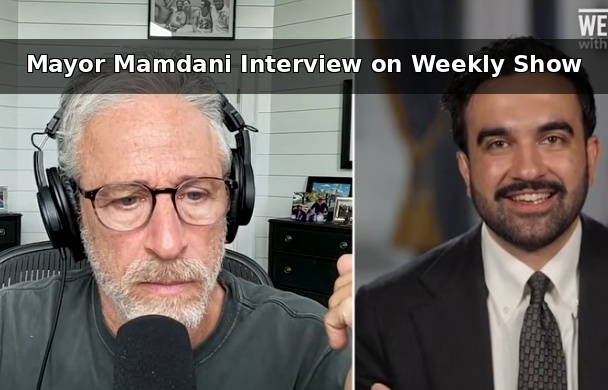
Editor’s Note: In this episode of The Weekly Show with Jon Stewart, Jon sits down with New York City Mayor Zohran Mamdani to discuss his first six months in office. The conversation explores the reality of governing as a democratic socialist compared to the political rhetoric and media caricatures. They dive into practical city issues, including addressing the city’s fiscal deficit, tackling the affordability and housing crisis, and expanding public services like universal child care. (July 22, 2026)
Following is the full transcript of Mayor Zohran Mamdani interview with Jon Stewart: Socialism, Politics & NYC:
Welcome to The Weekly Show
JON STEWART: Ladies and gentlemen, welcome once again to The Weekly Show podcast. My name is Jon Stewart. Today is Tuesday, July 21st. We are coming off of the beautiful World Cup that was held in Canada, Mexico, and the United States. And what a treat that was. And it’s over now. And I do hope that the enthusiasm and the love that Americans showed for the game of football and for the countries that were playing — I hope this isn’t like we had a foreign exchange student come live with us for 6 weeks and got along great, but now that they’re gone and every now and again we’ll check back in by text. No, I hope that it’s a lasting relationship and one that we value.
But in these times, post-World Cup, there’s a period of reflection. And we’re going to do that on today’s podcast — not reflecting on the world, but reflecting on one of the cities that was central to the World Cup experience, which was New York City. And who better to check in with on New York City and how things are going at that time than His Honor, for God’s sakes, the mayor of New York City. Let’s talk to the mayor.
ZOHRAN MAMDANI: Why not?
JON STEWART: Why not us? Let’s talk to the mayor of New York City. Ladies and gentlemen, we have the distinct honor and pleasure today to be welcoming the mayor of the great, great city that is the one that never sleeps, the biggest apple of them all, New York City. Mayor Zohran Mamdani is joining us. Mayor, Mr. Mayor, Your Honor, His Honor, Your Honor, how are you?
ZOHRAN MAMDANI: I’m doing well, man. Thank you for having me. It’s a pleasure to be back.
The Knicks Championship and City Hall
JON STEWART: Are you still feeling the afterglow, the joy of the halo effect of the New York Knickerbockers’ incredible run to the championship this year? Do you still feel it?
ZOHRAN MAMDANI: 100%. “Knicks 5” has become a greeting in New York City.
JON STEWART: It’s the most beautiful. One question, sir. At City Hall at the end of the Canyon of Heroes parade, there was a great deal of Knicks memorabilia that was hung up around — in decorative fashion. Giant Knicks caricatures, Knicks jerseys. I guess my question to you is, may I have those?
ZOHRAN MAMDANI: You know what? I’ll ask the team where they are.
JON STEWART: I don’t know if there’s a shed behind City Hall where they keep them, but if they’re still there, I will get back to you, brother. I appreciate it.
Seven Months In: The Reality of Governing
JON STEWART: How are you feeling now? So you have been the mayor for — you started January 1st, it is now July, 7 months. What’s the reality of being the mayor? What is the difference between the rhetoric of running for mayor and the reality of governing as mayor?
ZOHRAN MAMDANI: There’s often a lot made of a campaign as if it is easier and governing as if it is a harder experience. Yes, I think both are challenging. I think what is lost, though, is that governing comes with the opportunity to deliver. When you’re campaigning, you’re asking people to believe. You’re asking them to put their trust into a politics that’s often disappointed them. And when you’re governing, you can earn their trust by what you deliver.
And so it is much easier to have a conversation about this vision today when we’ve been able to pave 175,000 potholes, put the city on a path to universal childcare, win more than $60 million for tenants whose landlords made negligence into a business model. When we have that conversation now, you can point to what these last 6 months have looked like under democratic socialist principles. When you have it during the campaign —
JON STEWART: Sir, what? We’re being recorded right now. What are you doing?
ZOHRAN MAMDANI: Apologies.
JON STEWART: You’re throwing in the S-word.
ZOHRAN MAMDANI: I didn’t mean to use a slur.
JON STEWART: Throw in the S-word.
ZOHRAN MAMDANI: I didn’t mean to use a slur live on this podcast.
JON STEWART: Son of a bitch. What?
ZOHRAN MAMDANI: I just wanted to make sure that we’re going to be together in the cell when we’re all rounded up.
Democratic Socialism: Caricature vs. Reality
JON STEWART: All right, fair enough. So that’s the interesting thing. There’s a caricature of democratic socialism, and there’s a reality of democratic socialism, and then there is just governing that has very little to do with democratic socialism. Can we tease those apart a little bit? In your mind, what is governing by the principles of democratic socialism? What does that entail?
ZOHRAN MAMDANI: It means making the choice every day to fight for working people. It means that you believe that everyone in your city deserves to live a dignified life, no matter how much money is in their pocket. And what we’ve found is that this city is many things all at once. It’s both the wealthiest city in the wealthiest country in the history of the world, and it’s also a city where 1 in 4 people are living in poverty.
And so you’ll often hear the phrase, “don’t sweat the small stuff.” To me, being a democratic socialist is also sweating the small stuff, because for a lot of New Yorkers, it’s those things that are the measure of how difficult or easy their life is — whether they’re able not only to pay for their rent or their childcare, but whether they’re able to also rely on city government to get around their city, to breathe in their city, to experience life in their city.
And I think that we’ve forgotten that at the heart of what we want to deliver is not just the existence of a public sector, it’s also the excellence and efficiency of a public sector.
JON STEWART: To me, though, that statement — if a Democrat was running or even a Republican to some extent — that feels like something that everybody would say. “We want everybody to be able to thrive in this city.” Is there something about democratic socialism as a theory that brings those to bear? In other words, is it about the safety net? The caricature is you’re a communist who’s going to nationalize the industries. You’re going to take over Goldman Sachs.
ZOHRAN MAMDANI: I’m actually coming on this podcast to let you know that it’s now my podcast.
JON STEWART: Wait, what? Here’s what I love about that. You walk the walk. That’s the important thing. Somebody had to seize the means of this production.
ZOHRAN MAMDANI: It was this specific production that I was talking about.
JON STEWART: Wait, I’m doing this in Jersey. I’m out of your jurisdiction, man. I’m not even around there.
ZOHRAN MAMDANI: You were doing this in Jersey.
JON STEWART: Wait, you’re moving me? Damn you, Stalin.
Universal Childcare and the Fight for Revenue
ZOHRAN MAMDANI: I think that to your point, there are a lot of politicians of a variety of ideologies who will speak about housing as a human right, for example, or healthcare as a human right, or they’ll talk about dignity. I think that where the rubber meets the road is, are you actually willing to ensure that that which no one should be priced out of, no one is in fact priced out of it? So I’ll give you an example.
JON STEWART: Okay.
ZOHRAN MAMDANI: Childcare. It’s hard to find a politician who’ll say childcare should be more expensive. They’ll generally say it should be more affordable.
JON STEWART: Right, right.
ZOHRAN MAMDANI: But are you willing to take the step to provide childcare as something that is guaranteed to New Yorkers regardless of how much money they have in their pocket? So one of our focuses has been universal childcare. Take the successes of free childcare for 3-year-olds, of Pre-K, and extend it to 2-year-olds. Now, it’s not just as simple as saying, “Oh yes, I want to do that.” You have to also be willing to fight for the revenue you need to do that.
And so day 8 of our administration, we secured an agreement with the governor for $1.2 billion that unlocks free childcare for 2-year-olds for the first time in New York City. And our dream is that this will extend not only to the 2,000 2-year-olds this year or the 12,000 next year, but every single 2-year-old by the end of 4 years. And it’s not just a dream, it’s a promise and it’s a commitment.
Labels, Ideology, and Democratic Socialism
JON STEWART: So in some respects, is it about the priorities that you have being about quality of life for those — because universal Pre-K or universal childcare or those kinds of things, de Blasio might have brought that up. It’s not something that I think the caricature of democratic socialism is — that you are a completely different ideology than those that we have seen. Or is it perhaps just a different nomenclature than we’ve seen?
ZOHRAN MAMDANI: I think part of it is that words have lost their meaning over time.
JON STEWART: There we go. That’s where I’m getting to — is it really about the labels? That’s my point.
ZOHRAN MAMDANI: I think if you go back to some of the Democrats that we most admire — FDR, LaGuardia — you will see a lot of democratic socialist principles in their vision. And if you think about a lot of what we’ve come to accept as just the facts of life across our country, a lot of it is also still driven by democratic socialist principles.
Now, if today you and I were to introduce the idea of a building that lends out books for free, we would be slandered in the same way that so many new ideas are slandered today. And yet that’s the library. And the same thing with the fire department, the same thing with public schools. And it’s to say that a lot of politics has been a debate about who deserves what. And I would prefer a politics that debates how we can deliver that to everyone — and to deliver it at a standard that is so good that no matter how much money is in your pocket, you opt for that.
And I think at its best, the New York City subway is an illustration where no matter how much money you have in your pocket, you understand that if you want to get from point A to point B, the best way is to get on that train.
Why Take On the Label?
JON STEWART: That’s for sure. So to that end, was there ever a consideration for you — because of the priorities that you have — why take on the label of democratic socialist, knowing that it comes with a lot of other baggage that may not be helpful to you in your pursuit of these goals? What was it about what they were saying that drew you, as opposed to running as the things that you’re suggesting to me? If you ran on these as a Democrat, it’s not — I wouldn’t say, “What the heck?” It sounds very much in line with that. It sounds like what you are doing differently is you are being competent or ruthlessly pursuing those goals and chipping away at them. So why take that on?
Democratic Socialism in Practice
ZOHRAN MAMDANI: I want to be honest with people about what it is that I actually believe in. And I also think what we’ve seen over many decades is a fearmongering in our politics where anything that we disagree with, or anything that portends significant change is described as if it is socialist, at times as if it is communist. And the intent of that is to end the conversation there and then.
And it especially happens when you’re talking about something that would disproportionately benefit working people. And I think it’s important because we keep speaking about some of the inequities and inequalities that we see in our city as if they are bugs in a system as opposed to features in them. And if we truly want to reckon with 1 in 4 New Yorkers being in poverty, we have to also ask ourselves about if it’s important to change the framework with which what we determine success to be. And also, being a Muslim democratic socialist, I thought it would be pretty straightforward.
JON STEWART: You just saw like, what if I label myself something that scares people the most? I’m a Muslim democratic socialist.
ZOHRAN MAMDANI: If you’re scared of— if you’re scared of drugs.
JON STEWART: And I’d like to run your public transportation system. So is there in some regard, is this a— is the idea being if I can show myself to be a competent steward of the day-to-day functioning of maybe one of, certainly one of the most complex city systems in the world. I can demystify, I can take these labels that are so loaded with fear and I can maybe take a little bit of that caricature out of them.
ZOHRAN MAMDANI: I mean, my true goal is to deliver for the people of the city. And if in the process of doing so, we can demystify so much of the fear that has become the norm in our politics, I welcome it. And I also think that for a long time we’ve discussed democratic socialism as an intellectual debate. We haven’t been able to point to what examples look like of it delivering for people.
JON STEWART: Right.
ZOHRAN MAMDANI: And now we have that just over 6 months. And I think that it’s an incredibly exciting opportunity because there’s a reason so many New Yorkers lost faith in city government. And the political impulse of lecturing someone as to why they should believe and why they should vote, as opposed to asking yourself, why is it that they lost that faith? When you’re governing, you have the opportunity to not just listen, but also then respond in action, not in words.
And I think that what’s been so exciting is to see that New Yorkers understand that some things will take time and some things that can be done immediately. And if you’re able to show that you’re doing both, then it is exactly the kind of extension of an arm to say, “Would you like to join this movement?” And I’ve just heard from so many that they would.
Capitalism, Reform, and the New Deal Legacy
JON STEWART: It’s such an interesting thing because when you talk about the demonization, I always think people always say, “Oh, that’s anti-capitalist.” And in some respects I think it’s the opposite. Capitalism, I think, would’ve faced a much stiffer opposition from communism and socialism in the 1930s if the New Deal hadn’t been instituted. If we hadn’t created a more robust social safety net, revolution would’ve been much more on the table without Social Security, without better housing for people. And I wonder if that’s similar today, that in some respects what you’re doing is actually a reform movement for capitalism to some extent.
ZOHRAN MAMDANI: I mean, some of the things that you’ve said, Social Security, if you go back and see how that was treated when it was first introduced, it was described as the “Sovietization of America.”
JON STEWART: Medicare.
ZOHRAN MAMDANI: And now it is thought of as one of the most American things that we could ever be talking about. And I think about, when you go around New York City and you see these monuments to FDR, to the New Deal, you go to Four Freedoms Park on Roosevelt Island. It is a sad reflection of the state of the Democratic Party that a lot of what is said in those programs and those visions today would sound as if it is a bridge too ambitious for the party that we belong to.
And I think that’s part of my hope as a Democrat — how do we ensure that New Yorkers and Americans don’t have to look to the history books to be able to find a party platform that speaks about a freedom from want and a freedom from fear?
A Workmanlike Agenda
JON STEWART: I think it’s a question of also how you’re going to get there, because if I may, and you tell me if you think this is wrong, as I watch you pursuing your agenda, it doesn’t seem radical. It seems workmanlike. You know, when you talked about the universal childcare, you didn’t seize the means of childcare and create a Soviet-style system where they all get the same little uniform and they all come in at 4 years old. And they pray to the gods of socialism. You didn’t even really raise taxes. You went to the governor and she was able to help fill in a little bit of the financial gap. You created a pied-à-terre tax for second homes of over $5 million in value. Is that correct? These are not particularly radical reinventions. It feels like smart prioritizing, if I may.
ZOHRAN MAMDANI: Well, I think that a lot of it comes back to how do you judge the success of your work? And I think you have to judge it by what you deliver. And one of the cornerstones of our campaign was universal childcare, given the fact that in a cost of living crisis, childcare is the second highest expense for families in New York City. We’re talking about $20,000 a year for a single child. And in this city, you have to make $334,000 to be able to afford that kind of expense. And to me, it is, how do we move as quickly as possible?
JON STEWART: Is that all over the city or does that vary in boroughs? That’s the average for all 5 boroughs?
ZOHRAN MAMDANI: That’s the measure across the 5 boroughs — that’s how much your family would have to earn to be able to absorb that kind of a hit. And people earn less than that and they find ways to make it work, but not without it being to the detriment of themselves and their financial situation.
JON STEWART: Right.
ZOHRAN MAMDANI: And I think that, you know, I never thought that I’d be the guy making it easier for aunties at the family function to pressure you into having a kid, but here we are.
JON STEWART: So in some respects, Zohran Mamdani’s mayoralty has been an aphrodisiac for New Yorkers to begin to repopulate this grand experiment.
ZOHRAN MAMDANI: I can see the attack ads now.
JON STEWART: Exactly. Zohran Mamdani, the aphrodisiac. So what about what you’re trying to deliver has been slightly more complicated than what you thought it would be? We can walk through it. Housing. So you were able to get through a rent freeze, a 2-year rent freeze, yes?
ZOHRAN MAMDANI: Yeah, the Independent Rent Guidelines Board established a 2-year rent freeze for over 2 million New Yorkers who live in rent-stabilized housing.
JON STEWART: Right. And again, people immediately cried communism. It’s not unprecedented. The 2 years is unprecedented, but this has been done for 1 year by other mayors.
ZOHRAN MAMDANI: Yeah, they have done it in the past.
JON STEWART: Yeah. What about in terms of housing? What have you been able to deliver? What’s frustrated you? What’s the next step?
The $12 Billion Fiscal Deficit
ZOHRAN MAMDANI: Well, I think I’ll just take a step back to tell you, Jon, that the most challenging thing overall was when I came into this position, I expected that it would be difficult in terms of the finances of the city, especially given my predecessor’s approach to those finances. What I did not expect was $12 billion worth of difficulty. And that’s—
JON STEWART: And you’re the fiscal conservative. Like even with the city council, you’ve got, what is her name? Menin?
ZOHRAN MAMDANI: Julie Menin. Speaker Julie Menin.
JON STEWART: Julie Menin. Upper East Side, wealthy Upper East Side lady. We all know the caricature. They don’t pick up after their dogs. You know what I’m talking about? You are the fiscal conservative in that relationship. Did that surprise you?
ZOHRAN MAMDANI: When I’ve talked about wanting city government to be remade in the image of a struggling New Yorker, one aspect of it is that we be as careful with our money as working New Yorkers are with theirs. And one of the many reasons for that is that this is their money.
And when we looked at that fiscal deficit, what was hard — one of the many things that was challenging about it — is that you couldn’t blame it on an external reality. You couldn’t say, “Oh, it’s the fiscal crisis of 2008.” Everyone can see what’s going on across the country and the world. This was in many ways purely of City Hall’s doing. It was mismanagement and underbudgeting, and it had been building for years.
And I think that one of my goals is how do we right the ship, not just in a 12-month interval, but frankly on a medium and a long term. Because if you’re just trying to survive on a calendar year basis, you’re in many ways going to have to rob Peter to pay Paul. And that bill is eventually going to come due. And the thing that I’m looking forward to next year is that we’re not going to have to inherit a $12 billion fiscal deficit no matter how tough it is.
JON STEWART: Right, right. Although, what do you do with — they sort of call them gimmicks as you start to balance the budget. And a lot of the mayors have done that. There’s sort of these things that they pass along to others — I think Bloomberg was one of the ones who did it. How do you straighten that out without pulling from different pension funds that are going to mature in 2032? How do you begin to straighten those finances out without having to use kinds of — in some ways it’s like you’re the GM of a football team that’s got a salary cap. You don’t want to go into that second apron for New York City, man. And so how do you begin to do that in a manner that is more objectively grounded and not really budgetary magic?
ZOHRAN MAMDANI: Well, first, you brought it up, so I just got to say I’m already missing Mitch.
JON STEWART: It’s very hurtful. It’s very hurtful.
ZOHRAN MAMDANI: We’ll continue on. Did you see his comment on the Boston Celtics Instagram page?
JON STEWART: What? No. Oh, when he went after the Celtics fans, when he said, “I own you.” Yeah.
ZOHRAN MAMDANI: Yeah. God bless.
JON STEWART: Can I tell you something? There is a monster truck-sized hole in my heart.
ZOHRAN MAMDANI: Yes, it’s one of the best TikTok pages to go to.
JON STEWART: He’s the best. So funny.
ZOHRAN MAMDANI: I never appreciated those cars until I saw those videos.
JON STEWART: I know, seeing him — I think that was his truck in the parade, by the way. I don’t even think that was — I think that was actually — he just drove. He drove there that day and just got in the back of it. I think that’s how it worked.
Balancing the Budget: Savings, Revenue, and Accountability
ZOHRAN MAMDANI: God bless.
JON STEWART: Yeah.
ZOHRAN MAMDANI: But to your actual question, I think one of the key things is you have to ask yourself, is this arbitrary or does this have a rationale?
JON STEWART: Okay.
ZOHRAN MAMDANI: And what I mean by that is, for example, with the pension system, we had a deferred payment that was spread out over about 22 years or so. And every year the cost to the city was increasing and then it was going to just fall off a cliff in terms of the city. It was going to go up about maybe $6 billion a year and then the next year is going to be $0.
And some of the challenges that we’re facing are challenges of this moment specifically because of just how much underbudgeting there was, how much money the city was spending but not showing on its books for a lot of its different social programs and services. And so when we looked at that and we said, if you just spread what had already been 22 years, if you just extend it by a few years, you would then be able to take savings that you will get the year after as you’re scheduled to. But instead spread them over, then you can actually make sure that you’re able to steward this in a way that’s more healthy in a medium-term level.
Now, I know that there are others who’ve seen municipalities move around their pension obligations, and there’s a worry of what does this mean for, are you going to honor that, this, that, and the other? The thing that’s different in New York City is that we are not only funding our pension systems at a much higher level than many of the other municipalities that are being cited. But also that it’s not a question of if we’re going to get to 100% funded. It’s just a question of when in the 2030s we would do so.
JON STEWART: And then do you have to look at it? Because I guess there’s sort of different areas, like we’ll spend less here, but we need to raise more revenue here. Is there a kind of interplay between the kinds of taxes? Because Albany, I imagine, is not going to go along with really raising taxes in the same way that you might want to.
ZOHRAN MAMDANI: I think what you’ll find actually is there are a lot of people in Albany who do agree with the vision of raising taxes a little bit more on the wealthiest so that everyone can afford life in New York City. And what it is, as you said, is it can’t just be one thing. It has to both be a conversation about revenue and a conversation about savings.
So we actually created something called Chief Savings Officers for the first time, where we had them in every single agency and department.
JON STEWART: Oh sure. CSOs.
ZOHRAN MAMDANI: CSOs. Come on.
JON STEWART: CSOs.
ZOHRAN MAMDANI: You’re at the water cooler. You know, you’re talking to your friend, you’re like, “Hey, have you heard about the CSOs? What do you think about the CSOs?”
JON STEWART: “Hey, do you know the CSOs coming in here? Yeah, got like 5 CSOs over here.”
ZOHRAN MAMDANI: “Me and my CSOs were hanging out, catching up.”
JON STEWART: Beautiful.
ZOHRAN MAMDANI: And the CSOs, they found about $1.7 billion in savings across city government, and they’re actually going to continue that work. Because when you look at the size of our budget and you also look at what the approach has been to the finances of our city, we know that there are more savings to be had. And sometimes these are the efficiencies that come from when you’re actually pressure testing how we’ve been doing things. There’s savings to be had when you actually say, could that contract that you’re giving to a consultant actually be done in-house? And it can be, a lot of times.
JON STEWART: Were there stuff in the budget as you went through that you’re like, “$100 million on mittens? What is this?” Like, did you find things that you couldn’t believe? You were just like, “Where’s these loveseats? What’s going on?”
ZOHRAN MAMDANI: I haven’t seen that specific example.
JON STEWART: You don’t comb it through like that. It’s not—
ZOHRAN MAMDANI: We do comb through. And there were a number of things where you can’t provide a justification for it. And if you can’t provide one, then why should the city be spending that money? A lot of times it comes from a vision of government where you want to hollow out its capacity and privatize much of its responsibility. And oftentimes it’s done in the name of fiscal prudence. And yet what you find is you end up overpaying for that external capacity than what it would look like if you invested internally.
I mean, we’ve talked about in the past, the previous administration had an AI chatbot that cost hundreds of thousands of dollars that was not even usable.
JON STEWART: Or is it just like the Microsoft paperclip that just pops up? “What can I do for you today?”
ZOHRAN MAMDANI: It’s like, “I thought you lost your job.” It’s just Ask Jeeves. He’s just back.
JON STEWART: Right. That’s all they do is they just run it through that.
ZOHRAN MAMDANI: And you look at that and it’s not just the amount of money. It’s also the number of vendors that we went through to get to that point. It just speaks to an approach to contracting that does not actually save you money and it doesn’t build any kind of long-term fluency. What it does is just lock you into commitments that will cost you money and oftentimes won’t even perform those services.
Cutting Through the Noise: Criticism, Caricature, and Accountability
JON STEWART: The contrast between the caricature of you — if you spend any time speaking to you, there’s a grounded seriousness and reality to the way that you’re approaching these problems. Look, there’s going to be mistakes. There’s going to be — first snowstorm is not going to be the same as the second snowstorm, as Fat Joe has in his song. Today’s snowstorm is not tomorrow.
ZOHRAN MAMDANI: But that was the first draft of that.
JON STEWART: That was the first draft of that song. But the caricature — so Trump will tweet out “communist lunatic.” And are there criticisms that bother you? Are there ones you laughed off? The city tweeted out during the heat wave, “put your thermostats to 78,” and immediately Ted Cruz from Texas is like, “So the warmth of collectivism.” Meanwhile, Texas tweets out the same thing, and so does the Energy Department of the United States of America, which they pull off of their website out of fear that now they will be associated with this.
Do any of those criticisms permeate? Do any of them land? Have you heard any of the criticisms where you thought to yourself, “Actually, that’s constructive, and I will think about how to make adjustments to that”? Any of that.
ZOHRAN MAMDANI: Look, I took offense when they came for socialist icon Rudy Giuliani’s energy pumps.
JON STEWART: I said, “You say what you want about me, but nobody puts Rudy in a corner.”
ZOHRAN MAMDANI: Let’s not go there.
JON STEWART: Let’s not go.
ZOHRAN MAMDANI: Let’s not. But I think it is easy when there is this much noise to tell yourself that all of it is exactly that. Tune it all out. But that’s also what will leave you in an echo chamber. You cannot have it that you are only surrounded by people who agree with you. You might as well just stay home at that point.
And I think that the job that I have, that my team has, that our administration has, is how do you listen to all of it and then separate out what is actually worth engaging with? And what is just driven by the algorithm and written in response to what the algorithm responds to and rewards.
And I think that the other part of this is, no matter how good we may feel about whatever achievement we have or how this 6 months has gone, you always have to push yourself because every day is an opportunity to do better for New Yorkers. And I think that’s something that I love about this city — you especially see it in sports culture, but I would say even in the cultural aspect of the city, there is this sense of having to be the best, of driving yourself each and every day.
And yet in our politics, that often feels as if it’s missing. There is somehow, in a city that is the best in the world at so many things, mediocrity has come to be accepted as the standard in our politics. And I think that’s something that we shouldn’t accept any longer.
Affordability: New York’s Greatest Challenge
JON STEWART: And it was one of the things that I think drew people to you, if I may, is there was a — it didn’t just feel like platitudes. There was a specificity to the affordability argument. I see a lot of politicians that they perform the rhetoric of that argument. “We need to get back to kitchen table issues,” and all that, rather than going out to a halal food truck and going, “Why is this $14? There’s like 3 pieces of chicken in here.” It’s about, why does that cost that way? Is affordability the toughest challenge that you think you’ll face?
ZOHRAN MAMDANI: I think so. Because it is.
JON STEWART: Could this still be a middle-class city?
ZOHRAN MAMDANI: That is what it has to be. And I think if we allow it to continue on the path it’s been for many years, it will become a museum of where working-class people once lived. And we don’t want this to be something that people can visit to pay tribute to what it once was. We want it to be a living, breathing testament to that energy.
And I think what is one of the most concerning things that I hear is when I turn to someone who is working as hard as they can for the city, and I ask them how long their commute home is. And they tell me it’s hours because they’re going to another state or another city. That’s a reflection of a failure to ensure that those who build the city can live in the city.
And the reason I think that affordability will be our greatest challenge and also our greatest opportunity is this is what is pushing people out of this city. You cannot disentangle the cost of housing, of childcare, of groceries from the exodus of working-class people from out of the city. Some of these things are New York City specific. Some of them are true across the entire country. And we have to finally change direction so that people can actually afford to live here.
JON STEWART: See, that I think is such — it brings up such an interesting point. And you don’t get sick. I don’t know what they’re doing. You protect — get this man some Purell and you do not get sick, brother.
ZOHRAN MAMDANI: No. I’m on that emergency every day. I take that vitamin C.
JON STEWART: You’re shaking too many hands. I see it every day. But the big talking point is, “My God, this communist lunatic is going to drive out our billionaires,” as though that is the reason that people are drawn to New York, that tourists come here and go, “Let’s go down to Little Billionaire.” And it’s the area of New York where the billionaires live, and we can enjoy a small slice of how they live.
But the real danger to New York is not the couple of billionaires who feel as though taxing their second home is too burdensome for that, but the exodus of essential workers who can no longer afford to be anywhere near this area. Wouldn’t that be much more devastating?
The Housing Crisis and Building for the Future
ZOHRAN MAMDANI: What you’re saying speaks to the fact that for all of the conversation about an imagined capital flight, there already is a flight. It’s just of working class people. And we know that the racial dynamics of this are also immense, right? We’ve seen over the past few decades, our city has lost 200,000 Black New Yorkers. From 2010 to 2019, the population of Black children and teenagers declined by 19%. And you can feel that in this city, in neighborhoods that are shells of what they once were, and small businesses that don’t have those same customers coming through that came in for years, and classrooms that are a little less full.
If we want to be honest about what it’s going to take, it’s not just going to be one day to the next. It’s also going to have to be a complete shift. I mean, I’ll give you an example of this. When we talk about housing, since the early 1960s, New York City started to make decisions that would render it unable to build the level of housing it needed to, to keep up with demand.
JON STEWART: What were those? Are those zoning decisions?
ZOHRAN MAMDANI: A lot of those are zoning decisions. They’re decisions around capacity and also around size of building, scale of building. And you’ll walk around the city, you’ll see buildings that are incredible that we associate with our city, yet you could not build them today because they were built prior to those zoning changes having happened, right?
And one of the critical things here is we have to treat the cost of living crisis as both a short-term crisis and a long-term crisis. We have to take immediate action, and then we have to do the long-term work of being able to build 200,000 new affordable homes over 10 years. Because if you do not have a city that is growing, a city that is building, then what you have is a city that is dying.
JON STEWART: And it’s difficult because now here’s your dilemma.
ZOHRAN MAMDANI: Hit me.
JON STEWART: You make this place too nice, then rents are really going to— then the whole— then you’re— because you are, you’re in a vicious cycle in some respect. Look, we joke about it, but there are a lot of people in Brooklyn that are resentful. As Brooklyn started to change and develop, it gentrified, and suddenly the people that lived in Brooklyn, as my family did when they came here, couldn’t afford to live there anymore. It’s as though when they finally came in and made the neighborhoods more livable, that drove out the people that had been living there. And I imagine that’s a difficult problem to solve as well. It’s this strange trap.
Gentrification, Displacement, and Tenant Protections
ZOHRAN MAMDANI: And I think anyone growing up in this city has gone through the experience of looking at a construction site in their neighborhood and asking themselves, is this for me or is this going to push me out? And one of the key things here is that we have to both build more housing than we’ve ever seen in our city in a long time and do it while strengthening the tenant protections that we have in this city so that we’re not forced to choose between the tenants of today and the tenants of tomorrow.
And I think to what you said, there are a lot of New Yorkers who rightfully associate even just investments in their own neighborhood as if it is the appetizer to displacement, right? And we have to show that these things are not in fact tied together, that you do not need new residents to invest in that old park. You can do that.
And I think when we go back to this conversation around the fiscal deficit of the $12 billion, it is all too easy to say, my only focus right now is to get out of this fiscal crisis and then everything else, we’ll figure it out next year. We wanted to also use it as an opportunity to show that we mean what we say. That you do want to still fund your parks, your libraries, your cultural institutions, and do it in a way that annualizes that funding as opposed to making it subject to every single year’s budget dance with the city council. And that’s also to me what is a critical part of earning those New Yorkers’ trust back is that they see those investments in their neighborhood and they see it before anyone’s ever going to talk to them that you may have to leave. We want them to stay.
Small Wins, Big Signals: The Scaffolding Story
JON STEWART: And sometimes it’s a small thing. I tell you, this seems like a ridiculous thing. One of the most important things you did was getting people to take some of that scaffolding down. The scaffolding is so a part of the landscape that I almost thought of it as like, oh, that’s how buildings are. Like they’re built and people just hang scaffolding like Christmas lights and just never take them down. Like that’s just a crazy weird thing. And when you start taking them down, you’re like, oh wow, New York’s beautiful.
ZOHRAN MAMDANI: Yeah, we treated it as if it was part of the physical landscape of the city, right? So much of what the approach has been is it is what it is, this is how it’s always been, and that’s just not acceptable. And I think to your point, when you are able to change these kinds of ways that New Yorkers measure their quality of life, it gives them an invitation to hope and believe. But if you don’t change those things, then why should they take that step?
Democratic Socialism, Public Safety, and Political Disagreement
JON STEWART: And so getting back to the original idea of redefining what democratic socialism can do for a city this complex and this size and the realism that has to go along with it and the budgetary restrictions and things that you have to get there. Do you in any way have that conversation with— so now democratic socialism is considered the hottest trend in the Democratic Party and there’s energy, grassroots energy and all, and these democratic socialist candidates are popping up and you are having to answer for every one of their policy positions.
And there are some, look, maybe I’m an old man or a shitlib or whatever they want to call me, but if someone says we’re going to abolish all prisons and borders, I do go, I don’t think that’s a good idea. It feels like order and security is also a progressive value. Why shouldn’t people in neighborhoods with less resources have the same safety and security that neighborhoods with lots of resources? So are there tenets of those that are kind of following in the wake of Zohran Mamdani’s success that you are not comfortable with or that give you pause?
ZOHRAN MAMDANI: If you have more than one socialist in a room and there isn’t disagreement, then you don’t have more than one socialist in a room.
JON STEWART: Are you allowed to have more than one socialist in the room?
ZOHRAN MAMDANI: We’re actually just trying to change that law. We’re trying to get it to 2.
JON STEWART: It’s sort of like how soccer used to be. In the NASL in the ’80s, there had to be 2 Americans on every team. So there’s got to be 2 socialists in every room.
ZOHRAN MAMDANI: Well, look, man, now we have quarters, and I didn’t think that day was going to come with the World Cup.
JON STEWART: That’s what I’m talking about. So, but you’re comfortable with those kinds of discussions?
ZOHRAN MAMDANI: I’m comfortable with disagreement, and I’m comfortable with disagreement that doesn’t end a conversation entirely, because I think what motivates a lot of people is how do you deliver public safety. And the thing that I’ve said time and again is we cannot have New Yorkers choose between safety and justice.
And yes, I am doing the work with our police department, and we have been able to deliver the lowest number of murders and shootings in recorded history. And at the same time, I’m doing the work to close down Rikers Island and ensure that we are actually building the 4 smaller borough-based jails that brings an end to a horrible chapter in New York City history.
And I think to your point, when we’re thinking about safety, there cannot be a hierarchy of safety where you experience it more or less depending on where you live in our city or how much money is in your pocket. And there also can’t be a definition of safety that is purely after the fact, meaning how you respond to violence. We also have to do the work of investing so that we prevent violence.
The Department of Community Safety and Mental Health Response
JON STEWART: To that point, the Department of Community Safety, which is one of those things that you had ran on, which I think was sort of reprioritizing some of those assets so that not necessarily police were the first responders to everything. There was also social— how has that come? I know the money for it didn’t exist. You had to do an executive order, I believe. What’s the status of that? How has that grown?
ZOHRAN MAMDANI: So we’ve created that Office of Community Safety. We have, for the first time in New York City now, a deputy mayor for community safety, Rita Francois, who’s doing great work in putting together what is right now a quarter of a billion dollar budget in a lot of the very kinds of things that you’re talking about.
And I think one of the clearest examples to me is we have asked police officers to do almost everything we can think of when it comes to dealing with the failures of not just the social safety net, but also violent crime and also across the 5 boroughs. And what we found time and again is that these same officers who signed up to join the department to respond to violent crime, to prevent violent crime, are also being tasked with responding to a mental health call. And this is the kind of work that undermines both our ability to deliver on public safety as a whole, and it shows that we need to develop a new model here.
And so one of the focuses coming out of the Office of Community Safety is how do we provide the investment and the support so that when a New Yorker calls for help with a mental health crisis, that they can also receive that help from mental health professionals as well. And that’s something that continues alongside the incredible work that the office is doing with gun violence prevention, which is work that we always need to do more and more of because we know it’s an epidemic in this city and across this country.
And a lot of that prevention work also comes with investing in gun violence interrupters, in the crisis management system. And I’ve had the privilege of meeting a number of young people who themselves have been victims of gun violence, and they’ve told me how organizations like the ones that New York City invests in are the ones that will respond to them in the moment and make sure that retaliation isn’t something they’re thinking about, but rather recuperation is what they’re focused on.
Reaching Across the Divide: Police, Billionaires, and Trump Supporters
JON STEWART: Right. So there’s a wide variety of interdictions that you can do in those various situations, not just after the fact, make those arrests. So there’s a whole cadre of groups that stood in opposition to you. There was a great amount of fear and we can run through them from the police department. I think there was a lot of fear there. And I know, listen, the cops in this city, they do incredible work. And they don’t necessarily get the recognition and the care. I think there was a lot of hostility to them for a lot of years. And I think that’s unfortunate. I think they’re, like you say, that’s something that you have to battle with. There’s Trump supporters, New York City has everything. There’s the billionaire class. We got it all. What’s your outreach like to those communities? What have you learned from those communities? What have you learned from those people? How do you interact with them and how do you take in their criticisms of you or their fears?
ZOHRAN MAMDANI: I think that the first thing you have to do is walk into those conversations without having already made a judgment. And when you walk into it with an open mind, then it means that you can actually have a conversation and make a decision as to how you feel after you have that conversation. And I think in a lot of our politics, we label people and then disregard them entirely. We treat them as if they’re not even people worth engaging with.
And look, I’ll have conversations with more billionaires that oppose my fiscal policies than those that don’t, but there’s still more things to actually be discussed about with them. And similarly, what I’ve also found is to our benefit, the caricature of me and what our administration would mean was so immense. When I walk into a room and I don’t immediately strangle 3 people that are in front of me, people are taken aback that it might not actually be as bad.
Caricatures and Common Ground
JON STEWART: Slightly low bar for a conversation. Now, what about— did you have caricatures of them? Are there— you know, look, I saw when you tried to go to Staten Island, that was a rough ride. But are there caricatures that you’ve had of those folks that have been shattered when you’ve spent time with them?
ZOHRAN MAMDANI: When we talk about Staten Island, you know, what comes to mind for me is when I went there, I was being protested outside by a number of Staten Islanders who were very supportive of the president, deeply opposed to me. And then when I went inside the restaurant, there were other Staten Islanders who were very excited about me coming there. And to me, it also shows me that you can’t just paint a broad brush and say, you know what, I’m not going.
It’s actually funny that you mentioned it because right after this, I’m going to Staten Island. I didn’t plan that.
JON STEWART: Have a caprese salad for me, my friend.
ZOHRAN MAMDANI: I got you, brother.
JON STEWART: Beautiful thing.
ZOHRAN MAMDANI: But yes, you grow up in this city, you have caricatures of so many people. And you have to leave those at the door. And you also have to be willing to move beyond them. And for some of those conversations to be actually good faith ones, to offer people the ability to critique you to you. And I think, sometimes when you’re the mayor, you’re in a position of power, you want people to just tell you, “Oh, you’re incredible. Here’s what I love most about your agenda.” It’s like you’re not actually going to get anything done if that’s how you want to be treated.
The Netanyahu Question
JON STEWART: We do have some leaders in this country who appreciate that work. And I’m cognizant of your time and I really appreciate you spending here. So, the final question, which I have to ask you because it’s dominating the news today. The question to you is the Netanyahu thing and arresting Netanyahu, understanding where you’re coming from there. Is there a sense you have that maybe, is that a distraction from all these other things that you want to do? Is that taking a little bit more of the media space than you realized?
ZOHRAN MAMDANI: Well, I think I have a responsibility to be honest with New Yorkers. And when I’m asked a question, to answer it honestly.
JON STEWART: So that was brought up to you? That was brought up to you?
ZOHRAN MAMDANI: Yes. And yet I know for many New Yorkers, when they see a clip, it doesn’t begin with the question, it begins with the answer. And I think the focus always has to be on the work that you’re doing and how you find a balance between not giving a classic political deflection where you don’t want to answer any of those questions, and focusing on the work and still finding that together.
JON STEWART: And are there any other leaders that you would also like to arrest? Because I have a list of just—
ZOHRAN MAMDANI: Brother, anybody who the ICC has called for, I think we should be honoring.
JON STEWART: All right, 7 or 8. All right, very, very good. Mr. Mayor, thanks so much for joining us, and keep going, and we’ll check back in— every Knicks championship, you’ll come on this show.
ZOHRAN MAMDANI: See you next year.
JON STEWART: Fantastic. Enjoy Staten Island. Have a great day.
ZOHRAN MAMDANI: Thank you, my friend. Thank you, guys.
Related Posts
- Transcript: Tucker Interviews Dr. Chris Martenson on Global Energy Crisis
- Transcript of Arnab Ray Interview: ANI Podcast with Smita Prakash #EP-433
- Transcript of Pink Floyd’s Roger Waters Interview: Tucker Carlson Show
- Tony Robbins Interview: Secretary Kennedy Podcast (Transcript)
- Transcript: Tucker Carlson Interviews Benn Jordan on the Coming Slave State