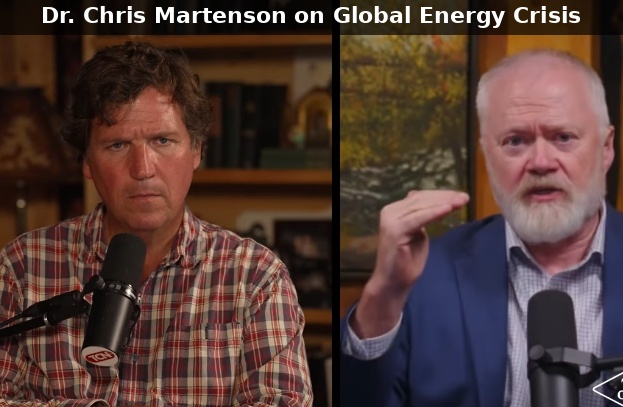
Editor’s Note: In this episode of Tucker Carlson’s program, the discussion focuses on how current global conflicts, particularly involving Iran and Russia, are fundamentally tied to energy and economic prosperity. The guest, Chris Martenson, breaks down the iron law connecting energy consumption to national wealth and human survival. Furthermore, they examine how supply disruptions and managed commodities markets impact everyday consumers at the gas pump. Finally, the conversation touches on broader fiscal concerns, including the devaluation of fiat currency and the long-term value of investing in gold.
Here is the full transcript of Chris Martenson’s interview (July 23, 2026):
Tucker Carlson on the Global Energy Crisis
TUCKER CARLSON: The first thing to know about the 2 wars now in progress in Ukraine and in Iran is that they’re about energy, because Iran and the countries around Iran produce about 20% of global oil supply. Russia, meanwhile, produces about 12% of global oil supply. So these are the biggest energy-producing regions in the world, and the wars have gravely affected their ability to produce that energy and to ship it anywhere else and to refine it for that matter.
So that’s the first thing to know.
Energy Equals Prosperity
TUCKER CARLSON: The second thing to know is that energy is the same as prosperity. The more energy a country uses, the richer it is. There is a one-to-one correlation between energy use and the size of your economy, GDP roughly measured. I mean, look at the list of the countries that consume the most energy and put it side by side the richest countries, and they are directly connected.
The country that uses the most energy per capita on the planet is Qatar, which is also, by most measures, the richest country. Tiny population, 350,000, massive natural gas supplies, huge per capita wealth in that country, and huge per capita energy use, about roughly 19,000 kilowatt hours per citizen. On the other end, the poorest country in the world, arguably South Sudan. Their energy use per capita, 51 kilowatt hours. United States, by the way, about 12,000 kilowatt hours.
Now, for the past 15 or 20 years, maybe 25 years, elements of the American leadership class have been scolding this country and the West for using too much energy. “We use too much energy. We’re destroying the Earth by using energy.” By the way, bombing civilian populations somehow does not destroy the Earth, but turning on the lights or having an MRI or driving a Suburban, that destroys the Earth, say the people who put solar farms in the woods.
But that propaganda, as absurd as it is, has effectively hidden from many Americans the direct correlation between the amount of energy they use and the lives they live. And that would include their life expectancy and the likelihood their children will survive infancy. And everything that is good or considered progress in our society, all of it derives from one simple fact: we consume an awful lot of energy. And to the extent we consume less energy, those facts will change. In other words, we will become poorer.
Again, energy is the same as wealth. So when a country uses less energy, or when energy prices become unaffordable for the majority of the population, that country by definition becomes poorer. There’s no debate about this. This is the iron law of economics, of reality, of civilization. Energy equals prosperity.
The US at War on Two Fronts
TUCKER CARLSON: So if you take 2 steps back and you see one country, the United States, waging 2 simultaneous wars, one against Iran and the other against Russia — and make no mistake, the United States is at war with Russia. The Trump administration’s intelligence from the CIA and other intel agencies is being used by the Ukrainian government to target drones and missiles. So the US government, us, your tax dollars, is at war with the government of Russia, whether you’re aware of that or not, whether you wanted it or not. And of course, most Americans don’t.
And the effect of that is what? To destabilize the Russian regime, break up Russia into 15 separate republics? Well, no, not yet. The effect is to hike global energy prices because once again, Russia is the producer of about 12% of global oil supply and about 5% of refined petroleum products. And the war the United States is waging against Russia at this stage through its proxies in Western Europe and Ukraine is a war against energy. About half of Russian refineries have been hit by missiles or drones targeted by the United States.
So at some point you have to ask, why would we do that? Why would the United States under the previous president blow up the Nord Stream pipeline, which was the source of cheap energy from Russia into Western Europe, our allies in Western Europe, countries that are occupied still by American troops 80 years later, our closest allies on the globe? Why would we deprive them of cheap energy? Who knows? There’s a story here, though, and someone should tell it.
The Strait of Hormuz and the Iran War
TUCKER CARLSON: And then in this war, which began February 28th. Of course, the central fact of Iran is not whether it has an active nuclear program or how many missiles it has or how many crowds in downtown Tehran chant mean things about Israel or the United States. I mean, those are interesting data points, but they’re not really the core fact of Iran.
The core fact of Iran is its geography and the fact that it sits on the northern side of the Strait of Hormuz, which is the opening famously at the eastern end of the Persian Gulf through which 20% of global energy flows. And then if you look at a map, it curves around into a thing called the Red Sea, and the Red Sea is the waterway over which another big percentage of global energy flows.
Without getting too boring about it, Saudi Arabia, which is probably still the largest oil producer in the world, kind of thought ahead.
And the main thing to know about energy shipping is it is very expensive. A supertanker full of petroleum, of crude oil, is worth about $350 million. So you don’t have to sink too many of these, maybe any. You basically have to set a couple on fire or just threaten them, and there’s no insurance underwriter in the world who’s going to guarantee to pay back the owner of that ship if it sinks. So you can’t get insurance for your cargo and ship worth a total of $350 million, you’re probably not going to set sail.
So in other words, instability itself, even if no shots are fired or drones launched, is enough to end the flow of energy out of the strait, through the Red Sea, and to the rest of the world, primarily to Asia, but also to Europe, especially to Europe, and to the United States.
The Largest Energy Disruption in History
TUCKER CARLSON: And so what you’re looking at is the single largest disruption in energy markets since energy markets began. Nothing like this has ever happened. It began February 28th. The people who had thought about this ahead of time, very much including people around the president, his advisors, analysts at various intel agencies, they all knew this was going to happen. And it did.
This war, combined with the war that we are waging against Russia in Eastern Europe, have completely shut down probably a quarter of the world’s energy. And what does that mean? Well, it means poverty and disaster and almost certainly famine in some places in Africa, because, of course, half of all global fertilizer is derived from natural gas. Etc., etc., etc. It means a readjustment downward of the standard of living of people, certainly in Europe, almost certainly in the United States, and definitely in parts of Asia.
So that is the main fact of these wars. That’s the fact that will affect the most number of lives. That’s the fact that will precipitate shifts in power, the fall of governments. That’s the main thing to know about these wars. And yet it’s the one thing that almost nobody ever mentions.
And to the extent public officials, not just in this country but in Europe, talk about this war, they talk about the threat posed by Islamic radicalism because there’s really no religious extremism in the United States. Just pride flags everywhere. You can turn a person from a girl into a boy just by wishing it so. But we’re not religious extremists. In any case, they tell you that this is really a war about ideology, but its net effect is on energy, which is to say GDP.
VIDEO CLIP: Secretary of Defense Pete Hegseth on Energy
TUCKER CARLSON: So when asked about this, it’s interesting how they respond. So take a look at the Secretary of Defense. This is in June on a network Sunday show, is asked about energy and the effect of this war on energy. And here’s how the secretary — I beg your pardon — of war responds to the question. Watch.
VIDEO CLIP BEGINS:
PETE HEGSETH: We have a totally different energy dynamic around the world, by the way. The way energy flows today, the Straits will be nowhere near as relevant 1 to 2 years from now because of the foresight of President Trump. He’s made us energy independent at home. We’re a net exporter now. Venezuela, through our partnerships. Now we’re killing foreign terrorist leaders who have terrorized the American people. The amount of drugs and gangs that came from —
INTERVIEWER: Yeah, energy, energy prices are pretty high right now.
PETE HEGSETH: It’s a huge deal. So I don’t know that the independence is coming down. They are.
VIDEO CLIP ENDS:
Unpacking the Secretary’s Claims
TUCKER CARLSON: So there’s a lot in that paragraph. We started out with energy and then we got immediately to foreign terrorist leaders who are terrorizing Americans. Not clear who they are. Not clear who the foreign terrorist leaders are. Also not clear who the Americans who were terrorized by those foreign terrorist leaders were. If you live in this country, it’s probably been a long time since anyone in line at the grocery store mentioned foreign terror leaders. But in any case, it sort of jumped around.
But let’s move to the beginning of that short speech. And there was a very specific point in there, and it was, look, the Strait of Hormuz is effectively closed. Like, that’s measurable. Everybody knows that it’s been closed since April. You kind of can’t lie about that. But it doesn’t really matter because the Strait of Hormuz is basically becoming irrelevant. Like, really, who cares about the Strait of Hormuz? It’s just 20% of global energy. No one really cares because the energy dynamic is changing. Because we arrested Maduro and his wife and put them in a cell in New York. And so the energy dynamic is changing.
So of course, in real life, it doesn’t mean anything because it was spoken by someone who doesn’t know anything. But let’s just take it seriously for one moment.
The Numbers Don’t Add Up
TUCKER CARLSON: So pre-war, which is to say on February 27th of this year, about 20 million barrels of oil, not even including LNG. But let’s just stick to petroleum oil. About 20 million barrels per day were moving through the Strait of Hormuz, and that number is zero in that range right now and has been pretty much since April. So that’s a huge amount of energy to make up for. How are you going to do that?
Well, of course, with Venezuela, which we know from listening to the president has the largest oil reserves in the world, like dwarfing Saudi Arabia, which is why Venezuela is just so darn rich and why most Venezuelans have their own private 747. Oh wait, just kidding. But in any case, we’ve been told that Venezuela has the most oil of any country in the world, and I guess technically that may be true, but does it matter? Well, it doesn’t matter if the oil’s still under the ground.
So how much oil is Venezuela exporting now? Well, the good news is the number is up, up from what it was a year ago. More oil is leaving Venezuela. That is absolutely right. Than left a year ago. What’s the number? Well, it’s a little over 1 million barrels a day. 1 million barrels a day.
Now, keep in mind, the Strait of Hormuz allowed 20 million barrels a day to go through before the Trump administration decided to kill the elderly religious leader of Iran. So that leaves 19 million barrels of oil, not including natural gas, which is also kind of shut down in the Persian Gulf, mostly from Qatar, but not only. But let’s just stick to oil. Where do we get the extra 19 million barrels per day to make up for what we’ve lost in the Strait of Hormuz, which apparently no longer really matters?
No hint, because there’s no answer. Because the real answer is we’re not. As long as the strait stays closed, the rest of the world is going to have to readjust to a deficit of at least 19 million barrels per day. And that’s just oil.
Trump’s Candid Admission at the G7
TUCKER CARLSON: Okay. So that was the secretary of war’s position. And again, we are often to killing foreign terrorist leaders who are terrorizing Americans, the danger of Islamic jihad or Hamas. Hezbollah. America’s greatest problems. Not the drug cartels that control New Mexico, but Hamas.
So what’s interesting is that 3 days later, that man’s boss, who would be the president of the United States, was over in Europe at the G7, was asked about the Strait of Hormuz. This was, you may recall, last month. You may recall at that moment, he was in the middle of explaining that we were going to sign a memorandum of understanding, perhaps we already had. But basically a framework that would get us to a peaceful, nonviolent settlement of this war.
And he, because he is Donald Trump, whatever you think of him, he has these moments of kind of amazing candor. And it’s refreshing candor. Again, whatever you think of the guy, he sort of says things that are obviously true from time to time. And he said this 3 days after Pete Hegseth said that. Trump said this:
“If I went out and continued to bomb them for another 4, just bomb the hell out of them, I’d get bad press on that. No, there’s nothing I can do. But what this does is it allows the ships to go. If we keep bombing, those ships won’t be going. And you’re talking about $500, $600, $700 million a day. It’s a lot of money. A lot of money. That’s why the world is okay. It’s liquid.”
TUCKER CARLSON: Also, we run out of reserves in about 4 weeks. You know, there are reserves all over the world and we would really run out. And there’ll be a time when you wouldn’t be able to get it.
And you want to see bedlam?
The Strategic Petroleum Reserve and the Reality of the Oil Crisis
TUCKER CARLSON: Wait a second. 3 days after the secretary of war— not defense, war, helpfully direct war— 3 days after he told us on CBS that actually, who cares what the State Department moves? There’s the president of the United States saying, actually, we’ve got 4 weeks to go until we run out of oil. You can’t get any. And then there’s, quote, “bedlam.” People are just eating each other. It’s out of like a medieval woodcut. People are just fighting in the street because they have no oil. Bedlam. Craziness.
Now, probably both of these are an exaggeration, but the latter, the president’s assessment, is, of course, obviously closer to the truth. And we know that because for the duration of this war, a war over a strait that apparently doesn’t matter— well, then why are we fighting over it?— the United States has been in the process of draining its Strategic Petroleum Reserve, something like 172 million barrels taken out of the SPR since this war began.
Now, why would we do that? If we didn’t need the energy, if it didn’t matter, if energy flows were changing in the world and the Strait of Hormuz was becoming irrelevant, probably wouldn’t be drawing down the Strategic Petroleum Reserve. In fact, we probably wouldn’t be fighting this war in the first place. We probably wouldn’t even be talking about a humiliating MOU with Iran in which we admit we’re powerless. Why would we go through any of this if we didn’t very desperately need to keep that strait open?
Well, of course, the answer is we wouldn’t. So if you ignore what people say, as always, and watch what they do, a very clear picture emerges. And of course, it’s the picture of desperation. It’s the picture of a group of people who went into a war with certain expectations, hopes, anyway, delusions. They told themselves certain things were going to happen. Those things didn’t happen, and now they’re desperate. It’s all very obvious.
Again, you probably wouldn’t drain your Strategic Petroleum Reserve and get 18 million Americans killed and go through the whole drama of all of this if you didn’t have to.
Are Oil Markets Being Manipulated?
All of which leads to maybe the most interesting fact of this entire exercise, which is oil markets. Now, if you grew up in the United States, you have learned the hard way that a lot of the things you were taught as a child were not true. Diversity is not our strength, actually. The government is not necessarily on your side, etc., etc., etc. But one thing you likely still believe is that markets are real. And you have every reason to believe that because markets as conceived, or as sold to the American public, are completely transparent.
We can watch them on a ticker. We know exactly what the price of shares in any publicly traded company is doing at any moment. And in commodities, whether it’s oil or gas or soybeans or wheat, doesn’t matter. We can watch it. And we know that fluctuations in price are driven, maybe not exclusively, but in the end, primarily by the supply of whatever’s being traded.
The principle of supply and demand governs markets. If something is scarce and much sought after, it’s expensive— diamonds. If something is abundant and has limited use— sand on your beach— it’s cheap. Supply and demand govern price. Very few people, from Keynesians to Austrians— it doesn’t matter what kind of economic theory you buy into, it doesn’t matter if you’re a DSA member or a neocon or a Newt Gingrich Republican, you can understand how markets work because it’s very, very simple. And you see that principle reflected in daily life from the minute you wake up to the minute you go to bed.
So it hasn’t dawned on most people to suspect that commodities markets are rigged. How could you rig a commodities market? An international commodities market is not controlled by any one person, you don’t think. So how could that happen? Well, it’s time to start thinking deeply about this.
And by the way, for those who are interested in exploring this, we recommend so strongly a piece by Ron Unz. Came out a couple of days ago in the Unz Review. You can find it online. Last name is U-N-Z. One of the deepest and most interesting thinkers in the United States wrote a piece about what is happening in oil markets. And again, it’s worth the read.
The Brent Crude Benchmark and the Price Anomaly
But to summarize it in 4 sentences: the price of oil that the consumer understands mostly, if you’re a CNBC watcher, you judge it by something called the price of Brent crude. Brent crude. There’s a Brent oil field near the Shetland Islands in the North Sea. It’s actually, I don’t think, operating anymore. But Brent crude is the name that oil traders use for sweet, light crude. That means less viscous, lower sulfur content, easier to refine into gasoline and diesel. The majority of oil traded in the West is light sweet crude. We call it Brent crude.
So if you want to know what oil prices are, you look up something called the price of Brent crude. And it’s kind of a commonly agreed upon measure in the West for what oil costs. And you can look it up on your phone. It’s like the price of gold or silver or any other commodity.
And so when this war started, the price was maybe $70, something like that. I think it was about $70, $72, something like that. That would be the end of February. So again, the war is taking place at the center of the global oil trade, which is the Persian Gulf. And so naturally the price went up. And then in April, the strait is closed and oil predictably shoots up to— maybe getting the number wrong, but maybe $118 a barrel. For Brent crude.
And that seemed honestly a little bit low considering that 20% of global oil just got taken off the market, just wasn’t flowing out of the Gulf. And there was also extensive damage to oil extraction facilities, to oil refineries, to petrochemical plants. There’s a lot of damage, not just to the oil wells but to all the downstream machinery involved in refining oil.
So anyway, it seemed a little bit low, but at the end of April, it reached what turned out to be its highest point. And then it did something quite amazing. It went down. There was a time this month with the strait basically still closed when oil, as priced on the Brent crude market, was cheaper by a few cents per barrel than it was before the war started, even though the strait was closed.
Now, you don’t have to be Larry Summers or a Harvard-trained economist to wonder, like, what the hell is that? How could that possibly be? You take 20% of the supply offline and the price goes down. And you hear people say, well, China stopped importing a lot of oil. True. But this is a market, and the people investing are basically making a bet on what’s going to happen in the future. These are futures. So China can’t stop buying Gulf oil forever. And there aren’t an extra 20 million barrels a day of oil anywhere on the planet that we could just fire up and be like, okay, we’ll just replace the oil with this.
So there’s a global shortage of this commodity, and the price goes down. And the Ron Unz piece has all kinds of different potential explanations for this that are very interesting. It’s not clear that we can settle on any one of them, but we can say unequivocally at this point that oil markets, at least the Brent crude market, do not reflect reality, which is to say they’re fake.
AI Trading and the Manipulation of Oil Futures
And they’re either being manipulated by people. And as Ron points out in his piece, that’s not a crazy idea. I mean, GameStop, famously a publicly traded company that was tanking, became an incredibly valuable company because a bunch of guys in their boxer shorts in the rec rooms decided to spike the price by buying shares. Same with Hertz during COVID. So we have precedent for determined small groups of people manipulating public markets. That happens. Could it happen in a market this big and this closely watched? Who knows?
Another possible explanation is AI. So it turns out one of the many facts that you learn in watching this war is that the majority of oil futures trading, I think about 70%, is done by machines. It’s done by AI. There are no people. Done automatically in the way that we target drones and missiles now. We just let the machine decide who to kill. So apparently, in futures markets, oil futures markets, the machine decides when and how much to buy.
How does the machine make that decision? Well, of course, the same way that AI makes all decisions, with use of language. And so one theory is that by making public statements that the Strait of Hormuz is irrelevant, and the US government, President Trump, have this completely under control, and that energy prices are not actually rising— in fact, they’re going down— when you look around, they are rising.
And by the way, if you try to buy a barrel of oil on the internet, it tells you they’re priced at $72 or $84. I think it’s $84 today. Can you actually buy a barrel of oil for $84? If I want to buy a barrel of sweet light crude for $84, where would I find that? And no news organization has bothered to actually call the biggest retailers around the world and ask, what are you actually selling a barrel of oil for? No one’s decided to do that for some reason, probably because they all support this war.
But if you were to do that, you probably wouldn’t find anybody who would sell you a barrel at the price listed on the internet. So the internet price is not the real price, by definition. But how did they get to that fake price in the first place?
It may be that the AI traders read news stories about the price of oil, and prominent in those news stories are statements from American officials saying, actually, prices are down, they’re never going to go up, this Strait of Hormuz is irrelevant. And they calculate their decisions about the future price of oil based on those statements, which of course are not only lies, but probably made in the first place in an effort to influence AI trading in oil futures, if that makes sense.
In other words, you can speak the truth into existence because AI, far from being smarter than people, is actually dumber even than Kamala Harris. That’s possible, though it sounds kind of shocking.
VIDEO CLIP BEGINS:
So if you were going to do that, what would you say? Well, here’s the Secretary of Interior, Doug Burgum. And by the way, in the executive branch, Secretary of Interior has more day-to-day authority over oil questions than Secretary of Energy, who— most Americans think the Secretary of Energy is about energy. It’s really about nukes. But the Secretary of Interior has jurisdiction over a lot of federal lands that produce oil and gas. And we have a Secretary of Interior who’s pretty knowledgeable on energy questions, again, Doug Burgum of North Dakota.
And with that in mind, the idea that it’s possible that Trump and those around him are trying to influence computer-driven futures trading by making false statements about energy. Watch this.
DOUG BURGUM: Every barrel that goes out now gets replaced by 1.2. So think of if 10 barrels go out, 12 barrels are going to come back in for the same price. Already saving Americans billions of dollars because we’ve got business leaders like President Trump driving our energy policy.
VIDEO CLIP ENDS:
The Energy Crisis and Market Manipulation
TUCKER CARLSON: Right. Okay. So energy prices have gone way down. You may have noticed that. Oh, wait, no. The price of gasoline and diesel fuel and jet fuel and, by the way, electricity have all gone up a lot in the last year. A lot. Not a little bit. A lot. Way outpacing inflation. And of course, in the end, driving inflation. So energy prices have not gone down.
And for every barrel that goes out, we get 2 back or whatever. What does that even mean? Well, not explained. And it probably doesn’t need to be explained because it may be read by these machine futures traders as good news. That they factor into their calculation about the future price of oil, thereby keeping the present price down, at least on paper, and thereby creating a feedback loop where the people making decisions keep the price artificially low, not the actual price at which you can buy or sell the product, but the price reflected in markets, which we thought were real but aren’t.
And then those same decision makers read the markets, which they’ve manipulated, and believe them. Oh yeah, and believe them. So if you’re Trump, last month you were saying we’re about to run out of oil, the SPR is almost dry. These are salt caverns and we’re getting to the salt part of the oil, like we can’t even refine it, it’s too salty. That was last month.
But subsequent to that, oil prices have gone up and down like they always do, but they’ve gone pretty low. Because the markets have been manipulated. And it’s entirely possible that Trump and those around him are looking at this and being like, wow, I thought this war was going to cause massive spikes in the price of energy. And because they’re not calling around and asking people, hey, are gas prices up? Like, what are you paying per kilowatt hour at home? Have you noticed a change in the price of everything? All of which is affected by the price of energy.
Instead of doing any of that, they’re just looking at this one number, Brent crude, pulling it up on their iPhone and being like, everything’s fine. It’s possible that’s what’s happening. The dumbest and most dangerous feedback loop of all time. And then in effect is to get us back into not just a war, but a ground war with Iran. It looks like that is happening.
Israel’s Candid Admission
TUCKER CARLSON: It’s so crazy. It’s so crazy that even the Israelis, who are world famous for reckless, bloodthirsty behavior — and they’re our partners in this venture, keep in mind — are now saying, I don’t know, I’m out. And if you don’t believe it, watch this. This is the Secretary of Finance, Finance Secretary of Israel. He’s in the Netanyahu cabinet, very famous man. Mr. Smotrich, basically saying it looks like America’s going back in this war, but we’re out because you know what? Even I don’t want to die for Israel. Watch this.
VIDEO CLIP BEGINS:
BEZALEL SMOTRICH: כרגע למדינת ישראל אין אינטרס להצטרף למערכה. המצב הנוכחי שבה יש מערכה מתוחמת בין איראן לארצות הברית הוא הנכון והטוב ביותר לנו. צריך לזכור שמטרת העל שלנו במערכה וזה לאו דווקא משותף עם ארצות הברית, זה לערער, להחליש עד כדי הפלת המשטר. אנחנו לא יודעים להשלים עם קיומו של משטר שחותר להשמדת מדינת ישראל.
VIDEO CLIP ENDS:
TUCKER CARLSON: It takes a lot of, well, חוצפה to say something like that in public if you were a cabinet minister in the government that the U.S. military is partnering with in this war, because you just saw what he said. If you don’t speak Hebrew, you could read the subtitles. He said, yeah, what the US is doing is helpful to us. We have no interest in like a liberal government or a pro-Western government in Iran. We don’t care about the protesters we were weeping about, you know, oh, they’re killing protesters. We never cared about that.
We want the country in a bloody generational civil war so we don’t have to deal with it, so we can take southern Lebanon and parts of Egypt and kill the rest of the people in Gaza or whatever. We don’t want to be constrained by this country on the other side of the Persian Gulf. So we want the United States to take them out. And we’re happy about that. It serves our interests. He just said it. But the one thing we’re not going to do is die for it. Yes, this is for Israel. This war is for Israel. But I’m not dying for Israel.
Amazing. You could say something like this. It’s unclear that there’s a single American leader this honest. Hopefully not this evil, but leaving moral judgments aside, this honest, this direct. When was the last time an American leader said anything that straightforward in public ever? It never happens. And this laser-focused on his own country’s interest.
Now, that’s a criminal country that’s committing genocide. You know, you don’t want to be that country, obviously. But you would like leaders who are willing to say unapologetically, I’m in this for my team.
Congress Votes to Merge U.S. and Israeli Military
TUCKER CARLSON: Meanwhile, the entire House of Representatives, every Republican but 7 today, minutes ago, just voted to merge, merge the US military, the $1.5 trillion a year US military with the tiny reserve force IDF. Does that help us? No, of course it helps them. Merge American intelligence, the 19 intel agencies with Mossad. What? Of course. Basically a humiliation ritual. Whatever you want, Israel. If it hurts us, that’s fine. Actually, it feels good to sacrifice for you. It’s like everyone in the entire government is Mike Huckabee now. Craven, self-hating.
So there is something sort of nice about seeing a government minister say, yeah, my people are not dying for this. But as Smotrich just said, happy to see Americans die for it. And of course they are. And more will, apparently, because the president appears to have convinced himself completely that because he arrested Maduro in January, we don’t need — well, what’s the real number? If you combine Persian Gulf and the Saudi pipeline into the Red Sea, both of which could be closed, 25% of all global energy offline. We don’t need it. Here’s Trump today.
VIDEO CLIP BEGINS:
DONALD TRUMP: In fact, if you combine us and Venezuela, we have about 62% of the world’s oil market. So we don’t need straits. We don’t need anything.
VIDEO CLIP ENDS:
TUCKER CARLSON: There’s no measurement by which — I mean, it’s crazy. If you combine America and Venezuela, we have 62% of the world energy market. It’s not even clear what that means. But in no sense is that true. Venezuela and the United States don’t produce 62% of the world’s oil. They don’t buy 62% of the world’s oil. Nothing. I mean, nothing about that is real.
Once again, Venezuela exports as of right now a little over 1 million barrels a day. 20 million barrels a day went through the Strait of Hormuz out of the Persian Gulf. That no longer happens. We’re 19 million barrels of oil short just in the Persian Gulf. That does not include what’s happening in Eastern Europe. That does not include apparently the now the closure of the Red Sea.
So this is a crisis and every American will feel it. Europe will be crushed when winter comes and there’s not enough natural gas to heat London, which is exactly where we’re moving thanks to the Trump administration and the Biden administration before it. It’s going to be impossible even to care what the AI-generated Brent crude futures say. No one will care because reality itself will intervene. And in the end, always, that’s what matters.
Introducing Dr. Chris Martenson
TUCKER CARLSON: Chris Martenson deals in reality full-time. He is a reality-based energy researcher, one of the most respected in this country, one of the most honest, and we are grateful to have him join us now to give us an overview of where exactly we are. Chris, thanks so much for doing this. I got a little excited there, and I wonder if you think I overstated the case. You have much more knowledge on the subject than I ever will.
DR. CHRIS MARTENSON: Well, Tucker, thanks so much for the opportunity to come here. And yeah, this is my passion, it’s my mission, because if anything, you understated it. Okay, energy is life. Energy is our economy. The path we’re on is headed for complete disaster at this point in time. And the people who are driving us there, as you hinted at, not my first rodeo. I’ve seen these people in operation, what they did to Libya, what they’ve done to the Middle East generally. They don’t do consequences. And unfortunately, this is reality we’re talking about.
And you’ve been talking about the markets, and there’s these narratives that they push, and if they can just pretend for a little bit longer, it’ll all sort of sort itself out. But this is different. These are molecules. This is physics. This is very simple stuff.
Energy Is Physical Reality
TUCKER CARLSON: Exactly, exactly. But it’s all — physical reality is so unfashionable. It’s so — well, it’s so unfashionable you got transgenderism. But I think since the invention of the internet, people just imagine that things happen. Electricity is created, dams are built, the world just sort of moves, supply chains organically organize themselves or whatever. Like, they have no sense of how things actually work. So you do. What does this mean for the life of Americans and Europeans?
DR. CHRIS MARTENSON: Well, it unfortunately means the same thing it kind of always means. They’re going to have these people who are going to accidentally wreck some stuff, and energy costs will go through the roof. And then it’s going to be the poor people, the poor countries are going to have the worst run of that as they start out. But we’re looking at something here that could very easily upend our economy in a big, big way.
So you mentioned in your intro there’s a sort of straight-line relationship between how much energy an economy uses and how big it ends up being. It’s like a straight line on this chart.
TUCKER CARLSON: Yes.
DR. CHRIS MARTENSON: And that’s a really powerful chart because we’ve all grown up in an age of amazing energy abundance. I’m absolutely thrilled with it. I’m a conservative. I would love for us to keep this prosperity we have, but I fear that the people who are making decisions, they’ve lost that grounding. They don’t understand that. I don’t know, they’re like 3 generations from anybody who had dirt under their fingernails, right? It’s been too long.
So once we get grounded back in that though, here’s a simple thing. The world was consuming just oil, just crude oil. That’s the tasty stuff. We turn that into jet fuel, diesel, kerosene, and gasoline. And so we were burning about — consuming, burning 86 million barrels a day before the war started. And now we’re missing for sure about 12. That’s just missing, missing because they did some workarounds here and there.
Well, the question is, when was the last time the world globe was burning 12 million barrels a day less? That brings us to 74. So we go on our little chart, we look back, we find out that number is 2011. The world was burning 74 million barrels a day. Problem: the world’s economy was 36% smaller back then.
The Energy Goggles Framework
DR. CHRIS MARTENSON: And so this is what I work really hard at, because I do what I call put on my energy goggles, and it means when I go out, I don’t just see a maddening, infuriating traffic jam. I just see energy. I see people burning oil, gasoline. I see cars that took oil and diesel to manufacture them. I see jets flying. I see bridges that need to be repaired. And all of this is just energy, right? And it just sort of makes sense, right?
So the economy requires people to do things like we all have to do some work. Even if we have a service job, we’re still doing work. Well, work requires energy. And so therefore the economy requires energy. We can just put those pieces together. And so when you have less energy flowing through an economy, by definition it starts to skinny down, it gets simpler, which is a euphemism for it craters.
And so we’re actually risking the cratering of the world economy. Trump saying, oh, we’re insulated, I know we broke that stuff over there, but we’ll be fine over here. I just — how’s that going to play in diplomatic circles as it goes on?
We, the United States, with Israel, we’re about to unleash the worst catastrophe on economies, financial markets, and potentially because of the impact on fertilizers and other stuff, maybe even food, maybe even famines, things like that. This is what’s at risk. And I wish we were having serious conversations, not Hegseth jokingly saying we don’t even need a state. It’s so cartoonish. I don’t even know how to form words sometimes.
Energy Independence: Myth vs. Reality
TUCKER CARLSON: So let’s just assess specifically what that would mean for the US. You often hear the president, but not just the president, politicians going back at least 10 years say this country is energy independent. It’s a net exporter of oil. So if the country’s a net exporter of oil, what is— is that true? I don’t think it is true, but I’ll defer to you. And what does that mean? Does it mean we can set the price of oil? Like, why is that relevant? Will you explain the system for people who might be confused?
DR. CHRIS MARTENSON: Yeah, this detail’s important. So when I was growing up, petroleum and oil were synonyms. You could use them interchangeably and nobody would get confused. And remember under COVID, suddenly the CDC lost the thread on what’s herd immunity or a vaccine.
TUCKER CARLSON: Yes.
DR. CHRIS MARTENSON: They started changing definitions. So sometime about 10, 12 years ago, our DOE, Energy Information Administration, decided, you know what, we’re just going to change the definition here a little bit. We’re going to call petroleum anything that comes out of the ground that you can set on fire.
TUCKER CARLSON: Right.
DR. CHRIS MARTENSON: So oil is the thing we really care about now because we’re doing all this shale oil drilling, very exciting, and doing all this shale gas extraction. We have a lot of this stuff called natural gas liquids.
TUCKER CARLSON: Okay.
DR. CHRIS MARTENSON: That’s propane. Works great in my grill. I love it. Butane, it’s good in a lighter. Ethane turns into plastics, all that. But they lumped all that together and said, oh, when you put all of this stuff in one pile on a net basis, we’re an exporter.
Problem: these aren’t fungible. You don’t decide one day I’m going to put gasoline in my car or maybe I’ll put butane in my car, right? They just don’t have very different purposes. Those natural gas liquids, they’re industrial. We use them. They’re fantastic. They’re industrial. We have way too many of them. We export a ton of them because we can’t use them. Fine. We’re still a net importer of crude oil.
And even more to the point, we get all this stuff out of the shale basins, right? You got the Permian, you got places like that, the Bakken in North Dakota. So that stuff that comes out is really light and it’s really sweet and it doesn’t go into our refineries. So we package that up in ships and we send a good chunk of that away. And then we import heavier stuff from Canada, from Venezuela, but also the world.
And so to your point, this idea that we’ll just insulate ourselves from the world is untrue. Whatever we’re paying for jet fuel here has a big relationship to what they’re paying for jet fuel in Europe because it’s open to the highest bidder. And if it’s worth it to put it on a ship and sell it to Europe, that’s exactly what’s going to happen unless we do something really catastrophic, which is close down our borders to exports. That would be a bad idea for a country with a $100 billion last month trade deficit because now we’re going to keep all our good stuff, we’re going to send you our treasuries. It’s going to be a terrible idea.
What Would Happen If the US Stopped Petroleum Exports?
TUCKER CARLSON: What would happen if we did that? I mean, at some point there will be pressure because the public has been told for a generation that we have an abundance of petroleum. As you said, the definition is not what they thought it was. But we’re an exporter. So people are going to say, well, it’s $8 for a gallon of unleaded. Why are we selling this abroad? Why can’t we just keep it here? So if politicians decided, okay, we’re going to do that, we’re going to stop petroleum exports, what would that mean?
DR. CHRIS MARTENSON: Well, first off, you’d have a heck of a legal battle on your hands because that would sort of break the fundamental contract that we have with how business operates. Second, we have legitimate contracts for LNG, for other petroleum products, things like that, that would have to get broken.
But more to the point, it would isolate us really badly in a time when we need this, at least the appearance, if not the reality of free trade happening where things go freely across our borders. To take one portion of that and shut it down, I think would be as damaging as when in— was it February 2022 when the United States Treasury under Biden decided to freeze Russia’s sovereign assets reserves? They’re neither sovereign nor reserves under that scenario. And that kicked off a whole lot of things where people started walking away from the dollar. We started to see the Treasuries weren’t getting bid. Gold started to spike. There are real consequences to actions like that. And so I just think that would be very destabilizing — that would be the kindest term I could put here.
TUCKER CARLSON: So that’s not likely to happen, you think?
DR. CHRIS MARTENSON: Hope not.
How High Could Gas Prices Get?
TUCKER CARLSON: How high could gas get?
DR. CHRIS MARTENSON: There’s a little thought experiment. Imagine I’ve got a Nissan Pathfinder. It’s totally dry. I put a gallon of gas in there and then I drive it until it runs out, and then I have to turn around and push it home. Question, how much is that worth? Because I’m about 22 miles away from home. Probably take me, I don’t know, 3 weeks to do that. So people will pay a lot for gasoline. People will pay a lot for diesel. It could easily get to $300, $400 a barrel. And people who are riding little scooters all over Bangkok, they’re still going to be paying that because they’re using it so efficiently in their markets. But it’s worth every penny of that.
I have a farm, I have a tractor, I’m hay baling. I would really rather not go back to hand hay baling. I would pay a lot personally for a gallon. So the question is, what’s it worth? It’s severely underpriced at this point in time in terms of its actual worth. That’s okay. We’ve had a lot of it. Got a little lazy with the whole thing. But would people pay $200 easy a barrel? $300 easy? $400? Yes, absolutely.
TUCKER CARLSON: What would that mean for gasoline and diesel prices? Like, how would that be reflected at the pump? The fabled pump.
DR. CHRIS MARTENSON: The pump. Well, this is interesting because we have the quoted price of oil, the futures price, right? $85-ish now for WTI, maybe $95 for Brent. But on the other end of that, I don’t put oil in my car, I put gasoline in my car. So the question is, after it goes through the refiner, how much are those products worth right now?
If you in Rotterdam this morning wanted to buy a barrel of jet fuel, you had to pay $158. If you want to buy a barrel of diesel, same market, about $148. So that’s what it’s actually selling for.
The Futures Market and Narrative Control
TUCKER CARLSON: Well, what’s the point of having Brent market, WTI, West Texas — what’s the point of those numbers if they don’t correspond to reality?
DR. CHRIS MARTENSON: It’s narrative control. It’s really — I think that’s what we’re down to at this point in time. So I’ve been watching markets for a long time, and I used to trade futures, and my specialty was gold, also silver, and I didn’t dabble in oil all that much, but they all operate kind of the same.
The futures market was this awesome invention that allows speculators to really be very dominant in setting the price for things, not discovering the price. I’m using this terminology carefully. They set the prices for things. So right now on a daily basis in the oil market, you’re a producer, I’m a consumer, you’re an oil company, I’m a refinery, right? That would be the actual price discovery mechanism. We come to some agreement. That would be a 1-to-1 relationship.
However, on top of that, we’ve allowed — because our regulators fell asleep at the wheel — we’ve allowed the speculators in that story to become 50 times larger on a signal basis than the actual deal that happens at the bottom. So when you have a 50-to-1 margin, it’s the paper that’s setting the price up there right now.
And we’ve watched this for years. 1:30 in the morning — and this is happening with oil now constantly — 1:30, 2 o’clock in the morning when there’s almost no trading happening, everybody’s asleep. And all of a sudden somebody will come in and suddenly sell 1.5 million barrels of oil in a single 1-minute window and it just crushes the price. And they do this over and over again. And then of course you have all these algos and they’re mostly momentum algos. And so they’re like, oh look, prices are falling. So they pile on and you get the whole sort of herd moving in a direction and it’s just completely fake.
It’s been this way for a while. And I think it’s because — you’ve probably seen the same clips, right? Trump comes out, he’s like, “Oh, people told me oil was going to be $300. It’s only $70 and the stock market’s up.” Those are really important narrative moments for him to be able to say, “Look, I did this thing and markets approve of it. If they didn’t, stocks wouldn’t be so high and oil wouldn’t be so low.” I think that’s the point of this stuff. It’s political narrative shaping right now.
TUCKER CARLSON: So it’s lying, because the price of something is the point at which the transaction occurs. What’s it worth? What will you pay for it? That’s what a market — I mean, correct me. I’m not the economist here. You are. But if I say the price of something is $5, but nobody would buy it for $5, it’s not worth $5. This is so nuts. It’s just not real at all.
DR. CHRIS MARTENSON: It’s a lie.
TUCKER CARLSON: So why isn’t there an effort among policymakers or even the media to discover and publicize the price of oil? The price of oil is what people are buying it for.
Running Down Stockpiles Toward a Crisis
DR. CHRIS MARTENSON: Yeah, it’s a big mystery. So here’s the thing. You mentioned the most important thing. If you take economics, there’s one chart they call the PQ chart — price, supply, demand, right? There’s a curve. You can point to it. That’s how it’s supposed to work. Right now we’re holding the price lower than actual supplies. So what’s happening is demand is too high, and we’re burning through our stockpiles right now.
And if you want to see something alarming, just look at the actual amount of crude oil we have stored in the United States. That would be the SPR plus commercial inventories. Or we could look at how much diesel do we have in tanks kicking around. Or how much gasoline do we have in tanks? And all of these are just powering low. Now, why is that? Because the price is too low. The only way you can get price, supply, and demand matched again is you have to use prices. So prices rise enough, people decide, “I’m not going to drive my car today, we’ll take a lesser vacation,” whatever. That’s how this thing sorts itself out.
Alternatively, and I’m really worried about this in a post-COVID CISA “telling us who’s essential and not” environment, that we’re just going to run this down, Tucker, until we get to scary minimums and then we’re going to have government rationing. They’re going to try and decide who gets it. “You’re not important. You are.” Imagine that amongst California Democrats. That’ll be amazing.
But I think this is where this is going — we’re actually just going to sail into absolute minimum, and then the crisis comes out. And I’m starting to wonder if that hasn’t been the point all along.
Is Energy Scarcity Being Engineered?
TUCKER CARLSON: Flesh that out. So the point of this — destroying global energy supplies and capacity, including refining. The point of that — I mean, clearly there’s a point. The United States is fighting a war against Russia aimed at Russia’s energy sector, and the United States is doing that. The Trump administration is fighting a war against Russia, against Russia’s energy sector, and knowing what it’s doing. And then it started this war knowing what would happen, that the LNG ports in Qatar would be hit, etc., etc., etc. So like, you think the US government, the Trump administration, wants rationing?
The Economic War on Russia and Its Consequences
DR. CHRIS MARTENSON: Maybe, maybe that— I’m not sure if that’s the ultimate end goal, but so February 28th, we conduct this decapitation strike, right? Kill Iran’s version of the Pope, and that somehow is going to work out, right? So we do that.
On the 2nd of March is when Ukraine, with some help obviously, started really dialing in on Russian refineries and oil depots. And this is very poorly reported, I feel, in our country. But it’s all over Twitter and other places. You can see they were very effective — they were blowing up all kinds of refineries and big black smoky things. They had even struck right downtown in Moscow and took out their main refinery. And as of 3 days ago, every single major refinery in Russia had been attacked at least once. None had been missed. And this is very effective. Some of them were 1,500 miles all the way inland. And that’s not something Ukraine could do all on its own because Russia has mobile air defense units. And so you have to thread all these needles to get your little buzzy drones all the way over there. But they’re getting that targeting information.
And so all that’s going on. And then also poorly reported, probably the single greatest loss of merchant marine vessels in the Sea of Azov and the Black Sea because of drone attacks by Ukraine on Russian shipping. Any kind of ships — ferries, little merchant barges, oil tankers, whatever. If it’s a ship, it’s getting hit.
And then of late we’ve really stepped it up because Russia has their version of Amazon, called Wildberries, and they have these huge distribution warehouses. They have 6 massive distribution warehouses. Oops, now they have 4, because 4 of them have been completely attacked. This is an economic attack.
And of course the scary part with this is that Russia just, a few months ago, revamped their nuclear doctrine to say it used to be we would only respond if attacked with nukes, but we’re widening that to say we can use them if we’re facing an existential threat. And the thing that drives me nuts is, as we’re poking the bear, nobody’s bothered to come out and explain to me what’s the upside here? What do we get out of this? What’s the point of this?
Tucker Questions the Trump Administration’s Strategy
TUCKER CARLSON: Why is the Trump administration doing this? They told us they were going to end the war. They told me they were going to end the war. And the CIA and NSA are providing targeting to warehouses and refineries. What is the point? I don’t know the answer. Do you know?
DR. CHRIS MARTENSON: It seems to be to provoke a reaction. I just have to speculate like anybody, but I know it’s dangerous. I know that if those things were happening to us, we would respond pretty vigorously, muscularly, I bet. So that feels dangerous.
But it’s just the timing of it — A, the strait gets closed down, the Strait of Hormuz. B, Russia really starts to get dialed up. Now C, we’ve pushed it all the way to the point that the Bab-el-Mandeb Strait there on the Red Sea is now closed.
And so you said it before, I no longer trust a thing anybody says. What are they doing? They’ve said, oh, we’ve tried to get this memorandum of understanding, which is an understanding about how you’re going to get to an understanding. It’s not even a thing. And we couldn’t even abide by that. So what are we doing? Everything we’ve been doing is to further inflame this war, get caught in a little bit deeper.
Trump has been talking about escalating constantly at this point in time — oh, if you strike a ship, we’ll blow up a plant. And so the actions are, they’re trying to keep it closed. And here’s the part that I’m worried about: I don’t think they understand the relationship between how an economy is undergirded by energy. I think they just think it’s all intangible. It’s all narratives. I truly feel like there are people who live in a world of reality.
TUCKER CARLSON: Oh yes.
DR. CHRIS MARTENSON: And then there are these abstractionists and they live in an abstract world. The Twitter world.
TUCKER CARLSON: Yeah.
DR. CHRIS MARTENSON: And so what happens if we push down that abstract world? Well, as Ayn Rand said, you can ignore reality, but you can’t ignore the consequences of ignoring reality. And I almost have to have a little chuckle because it’s really dark. What they’re doing, if I could communicate to people clearly, is they are risking everything — everything that we hold dear about our way of life, about the ease of our lives, about the jobs we do, where the future is going, what we tell our children. And we’re not having really any serious conversations outside of, say, this podcast and others like it.
Venezuela’s Oil: No Silver Bullet
TUCKER CARLSON: I don’t think there are any. And people throw this stuff out unchallenged. “No, actually, we have Venezuelan oil now. So we have more than enough oil.” And by the way, if you wouldn’t mind explaining why that probably isn’t true — what does that mean when they tell us that we now have all of Venezuela’s oil, so we don’t need oil from the Persian Gulf?
DR. CHRIS MARTENSON: Yeah, so oil is not the same like water. Water’s kind of water — maybe saltwater and freshwater, so we understand those are different. Well, oil has like 900 different flavors, right?
TUCKER CARLSON: Yes.
DR. CHRIS MARTENSON: And Venezuela has a lot of oil, but it’s — and you’re going to use the little quotation marks in the air — “oil.” And the reason for that is that they have 2 fields. They have the Mary field, which we’re currently drawing from. It’s nice, it’s very heavy, it’s sour, which means it has sulfur in it. Actually, sulfur sounds bad because we call it sour, but it’s actually tasty in the sense that we use it for all kinds of things. So yes, that’s actually high-value oil.
The rest of it is in this stuff called the Orinoco Belt. It’s a big belt, but it’s not oil. The easiest way to get it out of the ground is with a spatula — it just doesn’t flow. It’s really tar. It’s basically like a really hot road on an August day.
TUCKER CARLSON: It’s like asphalt. Yep.
DR. CHRIS MARTENSON: Yeah, it’s pretty much asphalt and it’s packed with asphaltenes, a component of that. So it’s hideously expensive to get that stuff out of the ground. You have to do all kinds of very fun things. You have to either use steam — which means you have to create steam, so you have to build a power plant on site and inject it down there — or you have to put a diluent down, some kind of solvent that you just inject in the ground and suck it back out again. It’s tricky.
So remember, Trump goes down there and brings in all the Exxon people and gets mad at them because he said, “Go down there and get that oil, boys.” And they said it’s uninvestable because there’s probably $100 to $150 billion that would have to be invested down there. And defending oil infrastructure in Iraq is relatively easy because it’s all flat desert. Defending oil infrastructure in the jungle is a whole different beast if things go south on you.
So they said, “You can’t do that unless you give us security guarantees.” And that’s awkward — how do we do that? So they couldn’t come to any agreement and Trump just got mad at Exxon. But it’s not trivial and it’s very expensive. And if we started today with complete security guarantees and also contract guarantees in a socialist regime — they took Maduro out, but the whole rest of the structure remained intact, so I’m not real clear what happened there — it would still take 5 to 10 years to get that flowing. And we don’t have 5 to 10 years. We’ve got like 2 or 3 more months here.
The Math Doesn’t Add Up
TUCKER CARLSON: Would it, if it was flowing at full force, compensate for the 19 million missing barrels of oil a day through the strait?
DR. CHRIS MARTENSON: Hard to imagine. Here’s as close a comparable as there is — the bitumen, the tar sands. Canada has rebranded it “oil sands,” but all that beautiful stuff up in Alberta is very capital intensive. Over the past 15 years, they’ve managed to bring that up to a very respectable 4.67 million barrels a day of flow, but it took tens if not hundreds of billions of capital. It takes a long time. You don’t just turn a tap on and it comes out. You have to — each chunk of the field has to have pipes put in it and infrastructure and steam and all kinds of stuff.
If that’s comparable, I would say if you could be as stable as Canada, I would imagine in the next 15 years you could probably get that up to 4 or 5 million barrels a day if they’re comparable. And listen, I’m simplifying a lot. I’ll have some oil people calling me up and yelling at me, but just to keep it sort of roughly comparable.
TUCKER CARLSON: 4 or 5 million barrels a day under best-case circumstances — with political stability, security, and massive $100 billion infrastructure investments — you could get it to 5 million barrels a day. We’re 20 million barrels a day offline. So there’s kind of no way around it — I don’t care what Doug Burgum or the Secretary of War says. There’s no way around the reality that we are short an awful lot of oil in the global markets. Am I misreading this? That’s the fact, right?
China’s Role and the Coming Reckoning
DR. CHRIS MARTENSON: Yeah, that’s the fact. And I guess again, the administration officials I’ve seen kind of keep shrugging and going, “Well, we’ll be relatively okay.” But what they’re really saying is the country we’re going to hit the most is the largest importer of oil — China. And China may decide it has to say something about this at some point in time. They’ve been very quiet so far, which is pretty suspicious.
But I think it was May 13th, Trump goes over and brings Tim Cook and Elon Musk and all these other CEO types. And it was shortly after that that they really dialed back their imports. So I’m pretty sure there’s a quid pro quo. The quid was, “We’ll stop importing for a while.” I don’t know what the pro quo was. Was it Taiwan? We don’t know. We’ll have to figure that out later.
But China can’t do that forever. They’ve been a little fairly gracious so far, but they are starting to reimport and bring their imports back up. And they can’t have this area shut down for the next year. They’re going to have to intervene in some meaningful way, I would imagine, because again, energy is everything and they know that.
They’ve got these beautiful 5-year plans and their energy policy — actually, when I read it, I weep because I wish my country had one. It was so comprehensive. It’s very thoughtful. It only brings on alternative energy slowly up to a certain percentage, and they’re pursuing nukes and alternative nukes and small nukes and thorium reactors. And a plank of their energy policy is to have good relations with the people they get their oil from. Germany could take a lesson from that book, right?
So they’re obviously dialed in on energy. They know its importance, and eventually they’re going to have to intervene here, I think, if we continue to mess this up.
TUCKER CARLSON: How long till American consumers are shocked by what they see because of rising oil energy prices?
The Coming Energy Shock and Its Economic Consequences
DR. CHRIS MARTENSON: Well, we’re going to be shocked here. I think we both live in New England. Heating oil is up 84% from this time last year. And I live around people who are going to be very hurt by that. And it’s — that’s going to be tough. It’s going higher than that. New York Harbor is a place where we have — they sell in 5 districts. The New York Harbor District for diesel just hit its all-time high just last week. So we’re going to be seeing $5.50 a gallon diesel again here very shortly. Those numbers are just going to keep going up.
TUCKER CARLSON: Yeah. And keep in mind, there’s been an organized and concerted effort to discourage the use of wood stoves for the last 25 years. Don’t have a wood stove. It pollutes, just heating oil. That’s the answer. LP gas. Wow. Okay. So do you think gasoline, which is the, I think the most common retail measure of energy prices — are you going to see $6 a gallon gasoline before Labor Day or this year, do you think?
DR. CHRIS MARTENSON: Yeah, I really do. So I’m tracking these every week. We got another raft of numbers, if you can believe them. I’m not sure what I can believe anymore, Tucker. Honestly, I don’t know. Would it be beyond this administration to fudge the numbers and say we have more gasoline in storage than we do? Sure, well within the realm of possible.
But if we can believe the numbers as they are, we see that all of our actual stocks and inventories are going down. Now, this was tragically comical when Trump came out and said, we’re going to go after the retailers for gouging on gas. Like, oh dude, that’s not how this market works at all. The 7-Eleven is a price taker. The guy with the big tanker shows up, tells him what that costs, and he’s also a price taker. He goes to the distribution center, and they’re price takers. So there’s no one person you can say is gouging. The refiners sell to the highest bidder. The highest bidder has the need to buy at that price so that they can supply the people who are depending on them. And that’s how it works.
So there’s no gouging at this point in time, but we’re going to see a lot higher prices because, again, all those inventories are just screaming downwards. And so there comes a point where — like, how did Hemingway go broke? Slowly, then all at once. I think people are going to start waking up that there’s a real crisis here. These are shocking levels of inventory. And eventually there’s this mad scramble. And that’s the all-at-once part of this.
But in 2022, America imposed sanctions on Russia, Russian tankers and all that stuff. And so there was the thought that maybe 3 million barrels a day might come offline. And that was enough to send oil from then about $80 to $120 where it stood for 5 months. And then it turned out, after the news settled in, they’re like, ah, that wasn’t such a big deal because Russia ended up using shadow tankers and selling it to India.
TUCKER CARLSON: Yeah, exactly.
Comparing Today’s Crisis to the 1973 Oil Embargo
DR. CHRIS MARTENSON: Yeah, it’s no big deal. So actually there wasn’t any real impact to the oil markets. And here we are now today with inarguably not just the largest energy shock ever, but by literally whole factors. So we had the oil embargo starts in October 1973, runs till March of ’74. And what they did was they didn’t stop selling to the whole world. They said — I don’t know why Norway’s wrapped up in this, but they said — we’re not selling oil to the US or Norway. I just don’t know how Norway got tangled up in that.
And then what they did was they agreed as a group of OPEC nations, or Arab nations at that time, that they were going to reduce their production by 5% per month. So by the end of the whole thing, the world was short 9% of its oil. And that was enough to take oil basically from $3.70 a barrel to $33. It was a 10-bagger. And that created a huge shock. And then we had the double wave of inflation that happened in the ’70s. And it took Paul Volcker coming out and ramming interest rates to 21% in order to pinch that second hump of inflation. I mean, can you imagine what would happen if we had to fight inflation that way?
So there was a huge learning from that. And I believe that the lesson was, oh, if we can just keep the price of oil down, we can minimize the shock. And so they’re doing that. And the problem is, while they’re doing that, the price is too low. Even though it feels high, it’s still too low to truly match supply and demand. And so supplies are just being run down.
So now we’ve run through — the IEA said, go ahead, release 400 million barrels, all you G7 countries. And we were a big chunk of that, almost half of that. We had all this stuff that Iran had stored up in tankers that they suddenly released to the world. We had all the Russian stuff that suddenly got released, all those tankers. We had all these tankers that were in motion at the time the war started. It took them a month or two to get to where they were going. So we had all of that to sort of work through. Now that’s all gone.
And even if the strait opened up right now, we would not get to 21 million barrels a day again till probably a year from now, for 3 separate reasons, which you mentioned. One, there’s unknown damage to the actual oil fields because they just had to shut them off. And that’s bad. That’s not how you treat oil wells. So we’ll see when they turn them back on how much damage happened. Two, they’ve got to fix all the stuff that got tuned up — refineries got hit, and loading docks got hit, and oil platforms and all that. And probably one of the biggest things is just unbollocksing all the shipping, because it wasn’t just oil tankers coming out. There were cargo containers and bulk carriers and all this stuff. And that whole perfectly choreographed just-in-time symphony of thousands of ships going hither and yon — that all got completely shredded.
So that all has to sort of be reformulated and rebuilt. Shipping experts I talked to say minimum 3 to 4 months just to sort of uncork that and figure out where things are. And that’s if and only if my magic finger snap made things stable and insurable and, believably so. And I don’t think we’re anywhere close to that.
TUCKER CARLSON: Literally nowhere close to that. Now, I feel like many Americans recall or have read about the oil shock of 1973, which, as you just said, had downstream consequences that lasted almost a decade and changed the country — changed how we manufacture cars, changed the culture, changed the birth rate. Like, it really was a big deal, though it was much smaller than what we’re facing now. Very few people remember why that happened. Do you remember why? Do you remember why OPEC shut us out and Norway?
DR. CHRIS MARTENSON: Norway? Well, guess what? I think Israel was involved.
TUCKER CARLSON: Yeah, that’s exactly right, because we sided with Israel in the Yom Kippur War of 1973. That’s exactly why. So we paid a huge price in 1973 for our support for Israel, which was not to our strategic benefit. It was for sentimental or other reasons, maybe darker reasons, but it wasn’t like we’re getting anything out of it. We didn’t. We lost. And once again, 50 years later, it’s a replay but 10x. I just can’t help but notice that.
Debt, Derivatives, and the Risk of Financial Collapse
DR. CHRIS MARTENSON: Yeah, even then though, I feel like there was more reality sort of in the system. We live in a super unreal time right now. I can’t believe — Trump can just say things like, oh, we’ve completely beaten them militarily. Well, then why can’t we stop any of those missiles or drones? It’s just —
TUCKER CARLSON: Then why are we drawing down the SPR if the Strait of Hormuz doesn’t mean anything?
DR. CHRIS MARTENSON: Yeah, it’s just — and where are the journalists? Just ask a follow-up question. I did see Pete Hegseth, Department of War — I struggle with that too — saying, but prices are high, lady. You ain’t seen nothing yet. We are just getting started on this. This could get a lot higher.
And here’s my concern. The destination doesn’t bother me. If you said, hey, we have to find out how to live with 13% less energy and we’ve got 5 years to sort it out and prices will climb to give us — that’s fine. The destination doesn’t bother me. We’ll sort it out. But it’s the pace of change that gets you. And so if we just slam into this and oil or gasoline suddenly goes from $5 to $15 or whatever it’s going to do suddenly — that’s where the shock happens. That’s where the damage happens. That’s where the uncontrolled things happen.
And this is why I research and I look at neither of these 2 things independently. I always look at energy and the economy. And so here’s what we have to understand. The United States in 1973 had some debt, not $39 trillion of debt, with a structural deficit of $2 to $3 trillion per year for the next 10 years. Just by law, nothing we can do about that. It’s all baked in the cake.
With derivatives numbering $1 to $2 quadrillion depending on how you count these things — nobody knows what they are, don’t ask me, but literally nobody understands how the whole thing operates. But what they do is they provide insurance, Tucker, at a moment when you don’t really need it. But if things get a little out of parameters, as they say — like if interest rates suddenly do something really crazy like they did in the Long-Term Capital Management — they had all these fancy derivatives and all of a sudden, oops, Russian bonds went a little further than they thought in the wrong direction, and boom, $6 billion out the window and Alan Greenspan had to fix it.
If these derivative markets freeze up, what we’re going to see is the complete freezing of our financial system and markets, and that’d be very bad. And my dark horse candidate for kicking all this off is going to be Japan. Their yen is weakening really a lot right now, and they’re trying hard to make that not happen. And also they’ve lost control of their bonds and the yields are spiking higher. And that’s a very rare combination.
TUCKER CARLSON: Yeah.
Japan’s Vulnerability and the Threat to US Treasuries
DR. CHRIS MARTENSON: So you lose control of both the price of your money and your interest rates — that’s a situation where if that really starts to spiral out of control, they’re going to have to do something. And that would mean closing markets, shutting things down. What would that look like? We’ll wake up one day and they’ll say, oh, terrible things happened at Nomura Bank, but don’t worry, it’s very temporary. Oh, actually Japan’s going to have to shut their Nikkei down for just a couple days. Actually, hang on, we’re going to have to shut down one of our banks over here for a little while. And then it’ll be Wednesday and they’ll be like, we can’t open it. This is how this is going to sort of play out at some point.
But that’s because we allowed — we had the great financial crisis and they’re like, oh, that was a terrible idea. We had all these collateralized debt obligations and all that stuff. We shouldn’t have done that. So learned our lesson. Today, derivatives exactly like that are still saturated through the market. They’re twice as large as they were back then. No lessons learned, except they did write some laws that if the banks get in trouble, they’re going to take your bank account to help make them whole again. They did write some laws, so they got that done.
TUCKER CARLSON: It’s of course theft at scale. Let me just ask though — Japan is the biggest, or one of the biggest, holders of US Treasuries. So what effect does that have on treasuries?
DR. CHRIS MARTENSON: Well, it has a lot. So Japan is going to have to sell those treasuries just to begin defending its currency, because they’re going to need to — that would be part one. But part two is Japan imports 100% of its hydrocarbons. It has no domestic reserves. So as the price of oil goes up and oil products goes up, they’re going to have to buy those at higher and higher and higher yen costs.
So the poor people of Japan are getting hit with a double whammy. First, their yen is weakening. That imports inflation. Second, when they have to buy oil that’s also going up in price, it’s with a weaker currency. So they’re going to be feeling it at a 2x rate of speed. And that creates social unrest, creates political problems. It’s going to create a lot of pressure to do something. And unfortunately, there’s not a lot that can be done for as long as the Strait of Hormuz remains closed.
The AI Economy and Energy Crisis
TUCKER CARLSON: I predict a bailout by China. Thereby neutralizing the Japan problem, which is one of China’s biggest problems. And they’re obviously historically Japan occupied a huge part of China for a long time, and Chinese haven’t forgotten it. And they’re concerned about Japan. They don’t want American troops in Japan. They don’t want Japan to have a nuclear weapon. And a desperate Japan is good for China. That’s just my guess.
Yeah. Let me ask you about— and I hate— I don’t want to get too dark with this, but like the hope of the US economy at this point, the entire future of the state of California is all predicated on the success of AI. And AI doesn’t famously produce anything. You don’t make anything with AI. You really just consume energy. And AI, like Bitcoin mining, is just a function of energy. Like, what’s the price of energy? How in the world are you going to transform our economy from a manufacturing economy to an AI cryptocurrency economy with energy prices like this? How does that work?
DR. CHRIS MARTENSON: This is one of these big sour notes. I can’t figure this one out, Tucker. But I just wrote a huge report on AI. My most recent one, I call it the Renaissance Report, which is overselling myself. I just have unmanaged adult ADHD.
Yeah, but AI itself is very concerning because we’ve thrown trillions of dollars of CapEx at this. So it’s kind of all in. We have to beat China, right? Okay. That’s the story. But if we were really serious about this, let’s say we’ve got some idea that what we’re going to do is we’re going to get God in a box, right? And we have to get God in a box first and then we’ll be able to run this whole thing. But the implicit assumption baked in there is we’re going to have these data centers and they’re now a permanent part of our architecture going forward.
They take a lot of energy, right? I call them toasters that don’t make toast. You know, they make cat videos, but they just basically turn natural gas into waste heat. That’s what they do. And so you would think if you had a comprehensive, beautiful 5-year plan of energy strategy, somebody would be going, “Where’s the energy for that coming from?”
Well, now wander with me over to the world where actually our own Energy Information Administration, the EIA, says we’re kind of at peak oil right now, that the shale beds have all sort of done what they can. They don’t go to zero by Tuesday. But we’re not going to be putting more on going forward. And similarly, natural gas, there’s a lot there, but it’s kind of bumping along.
And okay, so you would think somebody would be saying, “Look, we need these boxes permanently. This can be part of our control grids, how we conduct business. It’s going to be woven into everything. We’re all going to have digital IDs.” And if this AI system goes down, wow, we’re really screwed. We won’t know how to get people on flights. We won’t know how to distribute lorries to Walmart. Everything breaks, right?
So you’d think, wow, we should have a comprehensive plan. Well, first, we’re not going to have natural gas forever. It too, like all good things, runs out. So we would be doing something smart. You would know that they were serious about this if they were slapping in small modular nukes and nuclear plants all over the place, because that’s the answer for that. Nukes make beautiful electricity. I’m a big fan of them. But we’re not doing that, right? Not at scale. And we haven’t even figured out where we’re going to get the uranium from to continue operating our own.
So it’s almost this very unserious thing, Tucker, which I can’t figure out. It feels like they don’t care about the future. There’s some goal line they’re trying to just furiously cross over with the football. I don’t get it.
The Iran Regime Change and the Question of Intent
TUCKER CARLSON: I feel that way too. I felt that way since, really since Trump’s inauguration. And then I realized the goal line was the Iran regime change effort. Like, that’s everything in retrospect about the staffing of the administration, the transition, all of it was designed to make February 28th possible. But what I haven’t figured out is what the point of that was.
DR. CHRIS MARTENSON: Do you have a thought? I wrestle with this all the time. Yeah, what do you do? It’s either really rank incompetence or it’s malevolence.
TUCKER CARLSON: But malevolence on a scale that doesn’t have a lot of precedent in history. I mean, that we know of. I mean, a lot of history, most history is unrecorded, but to the extent that we know what previous empires did and why, nothing like this has ever happened at this scale, including in the 20th century, where clearly the US government or elements within the US government are trying to destroy global energy markets, which, as you said at the very outset, is a one-to-one correlation to the strength of the economy, GDP. So like prosperity— why would you wipe out civilization? Why are you trying to do that? Like, what is this?
The WEF 2016 Video and the Attack on Western Values
DR. CHRIS MARTENSON: All right, well, for what it’s worth, my ponderings— and I reserve the right to change this in 10 minutes— but here’s what I came up with. So back in 2016, there was this cheesy little WEF video, right? And the first thing was “You’ll own nothing and be happy,” and that got a lot of airtime.
TUCKER CARLSON: Famous, right? Yes.
DR. CHRIS MARTENSON: Yeah. Number 4 was “You’ll eat less meat,” you know, and here we are with alpha-gal ticks running around and hamburger at $7 a pound. But number 8 was the one that caught me the most because this one really bothered me. And number 8 was “By 2030, Western values will have been tested to the breaking point.”
Now, why Western values? Why not Chinese values? Why not African values? And ever since then, I’ve had this strong sense that my country is under attack. Kids don’t know. They’re confused about gender. We don’t even have a border anymore. The pillars of everything— like morality— like Pete Hegseth saying it’s totally okay to take boats in the Caribbean as long as we suspect they’re running drugs, just summarily execute them. These are not Christian values. They’re not my Western values.
TUCKER CARLSON: They’re not Western values. We only punish the guilty. Period. I mean, that’s the essence of Western values. You punish the guilty, you spare the innocent. You don’t kill innocent people. That’s why we’re different from Stalin’s Russia and from the Mongols. And that is the West. That’s why we’re different from Israel, which is not part of the West.
So yeah— I’ve never heard that before. Can you restate that? In the World Economic Forum 2016, they put this little video up. Yep, yep. And it’s “Western values will be tested to the breaking point.” Mm-hmm.
DR. CHRIS MARTENSON: And so, I’m this kind of a guy— if somebody says they’re going to do something and then it happens, I’m thinking maybe they did it. You know, it’s just how I’m constructed in this story.
TUCKER CARLSON: So that’s a legal principle.
The Easy-Hard Framework
DR. CHRIS MARTENSON: Yeah. Well, it’s something I live by. But this has been, you know, just watching this unfold. So on the one hand, this is all just errors of judgment and late-stage empire and things rot and fall apart. Okay. On the other hand, you say it’s just too deliberate.
So in my community at Peak Prosperity, we have a framework we use. We call it the easy-hard framework, right? Developed by one of my subscribers. And so here it goes like this. If something’s easy, well, the elites want it. And if it’s hard, they don’t really want it.
So I’ve been astonished at how easy it was for these flock cameras to suddenly appear everywhere— 100,000 of them, every one of them requiring municipal decisions. I work on the local town offices down here in my spare time. Nothing’s easy at this level, but somehow 100,000 cameras went up, and that’s all about invading our right to privacy, right? Our sense of privacy, Fourth Amendment, you know, to be secure in my person from searches and seizures. And somehow that was easy.
Now, if on my farm I wanted to dig a pond which would support life— and if you dig a hole in the ground and water goes in it, everything shows up magically— that would be very hard. It’d be super hard, right? But if I want to go down to Home Depot and buy pesticides and spray them all over my property, yeah, go for it. How much? Have at it.
So I kind of feel like this easy-hard framework, when I start looking at it this way, the easy stuff is the stuff that’s not affirming of life, liberty, pursuit of happiness, everything I hold dear. And the hard stuff is stuff that actually makes life better, right?
I was in the COVID thing. I was full-on warrior. I worked with Pierre Kory and Paul Merrick and the FLCCC, and I’m still on the board at the IMA. And the people are just like, “Look, I just use this repurposed cheap, very safe drug, like doctors have always used. If they choose to use something off patent, fine.” And that was very hard. I mean, the whole weight of the system came down on them.
“Oh, you want to put people on ventilators and give them remdesivir with upwards of 85% kill rate?” Easy, rewarded. And so you just notice this over and over again.
And then you finally get to, I think, the last great thing to skewer here. Is that we have markets. They’re free, they’re fair, they’re trustworthy, maybe imperfect, but they’re where honest participants come to set prices amongst each other in a fair and open way. And that’s just not the case anymore, and it hasn’t been for a while.
The Death of Free Markets
TUCKER CARLSON: That’s the final black pill for me. I mean, it was one thing to discover that Building 7 probably didn’t just fall in on itself because it had airplane parts on the roof, or that multiple people were involved in the Kennedy assassination. Okay, you know, those truths dawned gradually for me. But markets?
I mean, markets take place on the basis of the most simple and self-evident principle in life. It’s almost like a principle of nature— supply and demand. And they take place transparently, or so I thought. I mean, it’s really hard as an American to accept the fact that markets— and I think I speak for many when I say this— are fake. Mm-hmm.
DR. CHRIS MARTENSON: I would agree. I would agree. You want to think of something that’s hard? You know what’s hard? Getting the gold at Fort Knox audited. Oh my gosh, that’s so hard.
TUCKER CARLSON: Yeah, I wonder why that is. Because it’s not there.
Final Advice: Personal Finances in Turbulent Times
My last question to you is, what counsel would you give— if people have made it this far into the conversation, they, I’m certain, agree with the way that you think, you know, putting truth at the center of your decisions. It’s the only way to think. What advice would you give to people about their personal finances in a moment of turmoil like this?
DR. CHRIS MARTENSON: Well, this is the—
TUCKER CARLSON: Excuse me.
DR. CHRIS MARTENSON: Woo!
TUCKER CARLSON: Woo!
DR. CHRIS MARTENSON: Because tonight it got a little cold.
TUCKER CARLSON: Sorry.
Wealth, Buffers, and Building a Life Rooted in Reality
DR. CHRIS MARTENSON: Good to get those out. Just let them go. Well, this is— so I don’t do what I do, Tucker, so that I can make people feel anxious. I don’t like stirring things up. I really don’t like that at all. What I want to do is find enough truth where I go, look, if we put these dots in a row, what conclusions do you come to? And sometimes they’re not easy conclusions. And I understand I’m not really in the data business. I’m in the belief-challenging business.
So you mentioned the redpilling, right? So when I say the whole thing that happened with COVID is kind of like, look, there’s this really awkward stuff that’s happening. But for people to accept that, they had to give up some really important things, maybe like faith in authority, right? A belief that the medical system is there to help them. These are powerful beliefs. And that’s an emotional process.
So I understand I put up pretty hard information for people because it challenges big beliefs, but I’ve gotten very good at it. And if you can get through that, then you get to some conclusions, which is like, oh, maybe I should be a little bit more responsible for my own outcomes in the future, right? Maybe I should grow a little bit of my own food, not 100%, but maybe 3%. And going from 3% to more is easier than going from zero, right? Zero’s a hard place to start from.
Maybe I should be responsible for my own safety and security. Maybe once I understand how the markets actually work, that in fact, yeah, everybody should understand completely how the money system works, right? I got an MBA. They taught me how to compete for dollars. I was in the arena and then finally I read Creature from Jekyll Island. I was like, that can’t be true how money is made. And you find out banks make money out of thin air. That’s what they do.
TUCKER CARLSON: Yes, they do.
DR. CHRIS MARTENSON: And there’s no limit on it. And when you figure out, wow, humans with no limits and perverse incentives, we’re going to get more money printing. So I’m like, great, what do you do with that conclusion? Nothing I can do about that. Oh, well, I can hold some gold, some silver, land, like things that stand the test of printing over and over again in history.
And so my counsel to people is, get in as much context as you need and no more to begin to figure out if you have to make some changes in your life. And for a lot of people, they come to conclusions like, oh, I should safeguard my wealth a little bit more, which means you have to actually understand what wealth is. Hint, it’s not dollar bills.
Primary, Secondary, and Tertiary Wealth
DR. CHRIS MARTENSON: So once you figure out where wealth originates from, you can start to make different decisions. And the way I think about it is there’s primary wealth. So if you live on a rocky stretch of New Mexico desert, you’ve got very little primary wealth. But if you’re on 18 feet of Iowa topsoil, you got a lot of wealth, right? So the primary wealth is in the land itself, right? Oil in the ground, coal, all that stuff.
Secondary wealth is what happens when humans bring that stuff to market, right? So trees become lumber, fish get to market. So secondary wealth is the means of production. And then tertiary wealth is dollars. It’s representations that point to that, but money itself, currency, has no value if you can’t buy something with it.
So what do you do with it? Almost everybody’s been marketed to incessantly that they have to have all their money in this little tertiary system. All has to be here. You should have stocks and bonds, diversified currency, big bank accounts. But if you don’t have a lot of stuff underneath that, I submit you have very little actual wealth. Because this stuff is a claim on wealth, right? It’s like, what do you do with dollar bills on a deserted island? Start a fire with them, I guess.
But so once we start to understand where real wealth comes from, this is how I think people protect themselves. You move— if you’re 100% exposed in tertiary, get down into primary, secondary wealth forms as much as you can. For me, that’s meant I live on a farm. I know not everybody can do that. And I have a lot of the ability to sort of attend to my own energy, food, water needs here. Not all of them, but a significant proportion. And because of that, I’ve built up a buffer in my life.
And so that’s what I tell people: start building buffers. Not crazy bunker Idaho guy who’s going to survive forever on his own wits and skills and beans. Nobody can do that. But again, remember the pace of change. If big shocks are coming— and I’m convinced they are— you want to have as many buffers out there in your system as you can so that you can absorb that shock as much as you can. I think that makes for a happier life.
And I started all this because I was a little worried that things could break apart at any moment. Turns out they’re more durable than I thought. But now that I’m here, Tucker, I realize this is such a— this is how I was meant to be living anyway, in much more close connection with nature, feet on the ground, having real relationships with our cows and our chickens and all that other stuff, and also deeper relationships with my neighbors.
So, A, everything’s going to get local, right? B, you’re not going to have to do everything, but you’re going to have to find out what you’re good at and bring that to your community. C, I just— if I could counsel, this is the deepest thing I want to counsel: whatever we’re about to go through, I don’t want the people I love to have to accidentally lose their humanity.
TUCKER CARLSON: What does that mean?
The Spiritual Dimension: Losing Our Humanity
DR. CHRIS MARTENSON: Hard decisions are probably going to have to be made at some point in this particular story. And I feel like everything that my culture is pushing towards is asking us— asking me— to be inauthentic, disconnected from self, and capable of doing really horrible things.
This has become— I didn’t start out this way. This was crazy, Tucker. It was actually a tweet that did it for me. Grew up Protestant. I think church was Easter Sunday and Christmas. That was the whole game. Been there and hadn’t read the Bible at all. And I saw this tweet that said, “I’ve turned to God not because he spoke to me, but because evil made itself known.”
TUCKER CARLSON: Exactly.
DR. CHRIS MARTENSON: And man, it landed on me. I got goosebumps. I was like, oh, that’s kind of true, isn’t it? And that’s my— that’s the organizing principle that everything fits in right now. Because to me, what’s evil? That’s a short word, but it means something that revels in and promotes death, destruction, debauchery, demoralization, decay, just anything that it can do like that.
And so the number one way that evil has its way, of course, is by distracting us and keeping us hopelessly, endlessly distracted with things. And if the other side of that is good, well, good’s hard, right? Good takes conscious decision-making and you have to keep practicing it and you fail at it.
And so that’s when I first started reading the Bible, just a few years ago. It was such a page-turner. I’m reading it out to my wife, Evie. I’m like, hey, humans have done this before. Look at Romans— exactly what— there’s nothing new under the sun.
And so I honestly truly believe that this AI thing, this is our Tower of Babel. It’s a device by which we’ve convinced ourselves we can finally get that exalted seat next to God, even parity. We are God now. We can be one of the team. And of course, that lack of humility, that pride, that arrogance has always backfired, and I’m convinced it’s going to backfire again. And I just— while that backfiring is happening, I don’t want the people I love to have to lose their humanity, which means engage in the destruction as it unfolds around them.
TUCKER CARLSON: I couldn’t agree more. I had a path so similar, it’s almost identical. But it was seeing evil that drove me to God and to the Bible and to the realization that we’ve done this before. In fact, it’s on a loop, and the root of it is man’s desire to be God, which is an evil but also fruitless quest. I mean, it results in the Tower of Babel. I couldn’t agree more.
So, but when you say lose their humanity, what do you mean? Participate in a system that strips them of their humanity?
DR. CHRIS MARTENSON: Yeah.
TUCKER CARLSON: Yeah.
DR. CHRIS MARTENSON: I feel like pretty much everything that’s easy that’s arrayed around us are just invitations to begin losing our morality. They’re invitations to betray ourselves and our sense of integrity. Because they never just ask you one day to just line up and shoot somebody in the back of the head and push them in a ditch. There’s a long series of mini usurpations along the way, and it all begins with the small things, and that’s where they start.
And so I’ve completely changed my opinion about all kinds of things— pornography and how easy that is, right? And you’re only 5 minutes away from an alcohol store in any community. Everything that’s easy is just something that’s, I think, designed to pull us off of our game. And our game is— it’s a short life. We’re all here for a reason. And I think the reason is to find out what you’re really good at and bring that to other people and to make everything around you better.
And honestly, I’m here talking to you— long story— but the thing that gives me the most grief is that I can open a window now on a July night, leave a light on, and in the morning there’ll be one little desultory white moth flapping about. And when I was a kid, if I had done that, it would have been this frightening menagerie of rhinoceros beetles and Luna moths and giant walking sticks. And it’s all gone. It’s gone.
We are destroying life. And I’m really clear about this. We’re here to shepherd this. And it’s not just about humans. If we improve life for everything around us, humans are part of that. And I think it’s our job to be conscious of that and treat that as well as we can. And we’re just not. And that’s— yeah.
The Gold Market and the Shift from West to East
TUCKER CARLSON: Though I have to say, I cleaned bugs off windowsills this morning. Fortunately and unfortunately, that’s not true where I live. We still have a lot of insects.
Let me ask you one final specific question about markets, and it’s about the gold market as measured by the famous spot price that you pull up on your phone. Beginning with the 2022 Ukraine war, it was really clear to me that the US dollar was on a course toward irrelevance and that we would lose our status as the holder of the world’s reserve currency. I mean, it’s just very obvious based on what the Biden administration did. I think it was going to happen anyway, but it was accelerated with that, with kicking Russia out of SWIFT. That was my opinion.
So I start buying gold and I saw it go up, up, up, up and up. This war starts in February. It goes up over $5,000 an ounce and then it drops. And I’ve never understood why that happened. It doesn’t make any sense to me. I’m still a gold buyer. We have a gold company— I mean, I believe in it, a non-scammy gold company. I’m still buying gold, but I don’t understand its movement. Do you?
DR. CHRIS MARTENSON: I don’t think anybody actually really does. But even before 2022, there was this giant tectonic thing that was happening where gold was really just going from west to east, right?
TUCKER CARLSON: Yeah.
DR. CHRIS MARTENSON: So I used to track very, very carefully some of the big Swiss refiners, right? They would just report how many kilobars and where are they going? They were all headed east. They were all headed to China. And this is way before 2022, which is why I wonder how much gold actually sits in London or in New York.
And so for a long time it was like, oh, nobody cares, right? Because gold at that time was $1,000, $2,000 an ounce or something like that.
TUCKER CARLSON: So nobody cared.
Gold, Markets, and the Future of Fiat Money
DR. CHRIS MARTENSON: So then the war happens. And obviously what should have happened was gold should have just absolutely skied on all that uncertainty. And silver as well, and oil and all that. The exact opposite of all those things happened.
So markets, right? But our trade data just came out, and so for January and February and for March, we’ve never exported more gold ever in our history, probably representing 10 to 11 million ounces depending on how you score the spot price during that period. And that’s a huge number. And where did that go? That was actually our number one export, even more than oil. It’s a pretty big deal.
So we’re hemorrhaging our gold as if we don’t care. And I— you get back to China, I wonder if that wasn’t the quid pro quo. “Hey, you know, you’re going to do this war thing, we’ll help you, but we don’t want to pay $5,000 an ounce for your gold. We’ll give you $4,000 or something like that.” That could be part of the deal.
TUCKER CARLSON: So this is gold held by the federal government?
DR. CHRIS MARTENSON: This is called non-monetary gold. And so that’s something— non-monetary gold’s held in COMEX, for instance. It’s not the stuff held at the Federal Reserve. We think. I’d also love an audit of the Fed. Can we get one of those? That would be a fine thing to see what’s going on there.
But the flow of gold around the world, it’s kind of— it’s a funny thing. If you really want to get into gold statistics, it’s very hard because they’re super opaque and they just— they tell you it’s a barbarous relic, it’s not important. But no, you can’t see any of this data. The London data is really hard to get. You can more easily find instructions on how to build nuclear devices on the internet. It’s just like— it’s this weird thing.
So I know it’s important because they won’t tell me how much we have, they won’t let me see the statistics, but they say it’s not that important. So we know it’s important. And we also know that central banks around the world have been accumulating to the point now that gold is actually a larger holding in central banks around the world than treasuries. Big crossover moment there.
So my sense of gold is somebody’s working extra hard to just keep it tamped down because it would be really awkward right now if it went up in price and signaled something inappropriate. And so that’s what I’ve learned about our markets. They’re actually signaling devices. They’re not legitimate places of inquiry and price discovery between honest buyers and sellers. They’re often used to set prices.
Markets as Signaling Devices
TUCKER CARLSON: So they’re like cable news that way. They’re not there to tell you the news. They’re there to shape your opinion about the news.
DR. CHRIS MARTENSON: Yeah.
TUCKER CARLSON: Yeah, of course. Please tell me a story. I would love it.
DR. CHRIS MARTENSON: This is a great story. So gold was illegal from 1933 to 1973. And then, okay, so there was a lot of concern they’re going to make it legal for US citizens to own it again. So they were very concerned that it was going to go up in price, maybe a lot, and that would send the wrong signal. And of course, they just spent 1968-69 with the London Gold Pool surreptitiously batting all the— London and New York just working extra hard to keep the price of gold down for reasons. And so all of this was going to be very awkward. They just didn’t want gold going up in price.
So we have, because of WikiLeaks, a cable that went between New York and London, and they said, “Hey, here’s our plan. The primary gold dealers tell us that if we start this thing called futures for gold, we can so overwhelm the actual real price of gold with this paper price that we will create enough volatility and that people will lose interest in it, and we can diminish their desire,” they said, “to hoard gold.”
So they just conceived it right away. They’re like, “Look, if we can make this paper price thing, we can wang the price around until people get frustrated or lose interest.” And that’s how we can control this. So that’s how it started.
Think of a Bakelite phone, the phone connected to the curly cord in 1973. Think how much more sophisticated the application of these algorithms are today to manage prices. And they did that for optics. They did that for political reasons. Is it any less important today? No, of course not. Spiking price of gold signals a loss of confidence in our fiat debt-based money, which is fundamentally a faith-based currency. You can’t have something poking needles at your faith.
Is Now a Good Time to Buy Gold?
TUCKER CARLSON: But one faith that’s never dimmed is in gold. So the Chinese believe in it, the Brits believe in it, we believe in it, the Germans— I mean, everyone believes in it. That’s interesting to me. So as a store of value for the average American family, because the price is down relative to what I think it ought to be, what it was 6 weeks ago, is it a good time to buy it now?
DR. CHRIS MARTENSON: I’ve been a consistent buyer of gold for 25 years now, and I’ll tell you this, every time I’ve bought it, it’s hard. It was really hard when I first bought it at $300, and $500 was extra hard. $800 was super hard. It’s always been a hard decision, but over the long haul, gold has performed better than the stock market over that entire period by a wide margin.
And I can see it will continue to do so because we’re going to print and we’re going to print more money and we’re going to print a lot of it coming up. The Fed’s already printing money right now, $200 billion over the last 6 months. The US government effectively prints because we send out right now $1.2 trillion of interest payments, which is cash that goes back to the market that we have to then borrow more, which the Fed enables. So this is all— we’re just going to print and print more. And that’s the game.
And to put a story on this, the United States, it took all the way to 1990 before we accumulated our first $3.5 trillion of federal debt. So from the founding of the country to 1990, $3.5 trillion. And what did we do with that first $3.5 trillion? Well, we built interstate road systems and every bridge, schoolhouse, and we did a lot. The US government’s tacked on $3.5 trillion of debt in the last 12 months.
TUCKER CARLSON: And did we build a lot of interstate highway systems and new schools?
DR. CHRIS MARTENSON: I can’t name one thing, to be honest.
TUCKER CARLSON: Howard Lutnick. Yeah, right.
The End of the Gold Standard and the Road Ahead
DR. CHRIS MARTENSON: Yeah. And foreign wars. And yeah, it’s just that— that’s the thing. But you know that on that basis though, that’s going to be $3.5 trillion every 6 months. And someday we’ll wake up, it’s every 1 month, and then it’s $3.5 trillion every week. And this is just how the story of fiat money has gone literally hundreds of times throughout history— best of intentions, but you lose the brakes. We lost our brakes on August 15th, 1971 when we severed from the gold standard. And ever since then, it’s been sort of like Dick Cheney growling at us that debts don’t matter, but they do and they will.
TUCKER CARLSON: Yeah. Chris Martenson, thank you for that, for the clarity and the honesty and the wisdom. I appreciate it. I hope you come back.
DR. CHRIS MARTENSON: Thank you. Me too.
TUCKER CARLSON: That’s it for us tonight. We will see you tomorrow and next Wednesday, 6 PM. Thanks.
Related Posts
- Transcript of Arnab Ray Interview: ANI Podcast with Smita Prakash #EP-433
- Transcript of Pink Floyd’s Roger Waters Interview: Tucker Carlson Show
- Tony Robbins Interview: Secretary Kennedy Podcast (Transcript)
- Transcript: Tucker Carlson Interviews Benn Jordan on the Coming Slave State
- Transcript of JD Vance Interview: Joe Rogan Experience #2526