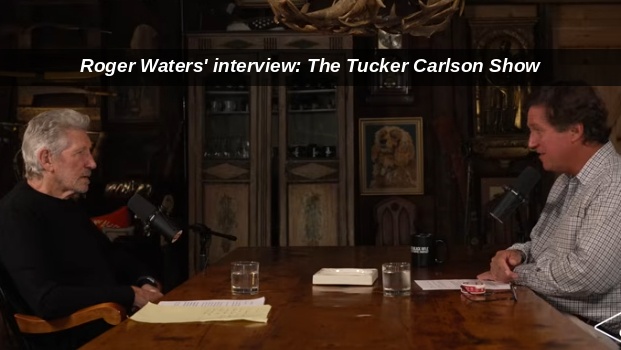
The following is the full transcript of English singer-songwriter Roger Waters’ interview on The Tucker Carlson Show, July 17, 2026.
Editor’s Note: In this wide-ranging interview, Pink Floyd co-founder Roger Waters joins Tucker Carlson to discuss a variety of controversial topics, including the 25th anniversary of 9/11 and the lack of a formal judicial inquiry into the event. Waters candidly shares his views on global geopolitics, criticizing mainstream media narratives regarding foreign policy, war, and the ongoing conflict in Gaza. Throughout the conversation, the pair also explores themes of human empathy, the influence of political lobbyists, and the power of collective action among ordinary people to effect change.
September 11th, 2001 — Where Were You?
TUCKER CARLSON: Roger Waters, thank you for doing this. Let’s just go back to the beginning, to that day, September 11th, 2001. Where were you when that happened and what did you think?
ROGER WATERS: I was in Island Studios in London making a record. And what did I think? I thought, can I use the F word?
TUCKER CARLSON: Yes, you may.
ROGER WATERS: I thought, f* me, what? What? Okay, because somebody turned the TV on. So we stopped working almost immediately, and I almost immediately called my then-wife Laurie, who was in New York at the time, and I was on the phone with her for the next 2 hours, sort of watching it develop and unfold before our very eyes in a state of shock like everyone was all over the world.
What did I think? I mean, that’s a very long and complicated answer to that because I haven’t stopped thinking ever since really. And it was 25 years ago. I could actually, you know, I wrote something down, but I know part of what I want, there’s one sentence in what I wrote down here was that I thought to myself, “If this is an attack by foreign people on the United States of America, will the American people notice that some people are pissed off.”
TUCKER CARLSON: Yes.
ROGER WATERS: With American foreign policy and that this is a result of it. And I did think that. And in a way, that was the only positive thing I could think was maybe, maybe now the war’s come home. Now it’s, you know, now something has happened on American soil. Maybe that.
And it didn’t happen. And I was surprised, which shows how naive I was, I guess. That nobody even ever started to think that or to allow that to color what happened afterwards. So that’s how it felt to me. Am I making any sense?
Cause and Effect — A Shared Thought
TUCKER CARLSON: You’re making a lot of sense. And I had a similar thought at the time, which is not obviously to justify it or any act of violence, but cause and effect is real. So I had the same thought and I had a huge contretemps with my employer over at CNN at the time because I made that point and they attacked me for it.
ROGER WATERS: What a surprise.
TUCKER CARLSON: Yeah, what a surprise. But I kept working there, to my shame. But anyway, then there was the investigation into 9/11, the 9/11 Commission, which was impaneled by the then-President George W. Bush, headed by a guy called Philip Zelikow. And it produced a report which was then bound into a book that you could buy at the bookstore. Did you assess that? What did you think of the inquiry?
The 9/11 Commission Report and Controlled Demolitions
ROGER WATERS: I did not read that book, I confess. I did wonder why there wasn’t a more thorough investigation or any real investigation into what had actually happened, because in the aftermath of it, we all watched the same images again and again and again, and it became evident — well, not necessarily evident, but it looked likely. The whole story of controlled demolitions of buildings came up very quickly, not least because Building 7, which was obviously a controlled demolition, its collapse was announced on the BBC in England half an hour before it happened.
TUCKER CARLSON: That’s a sign that it’s not entirely organic, what you’re watching.
ROGER WATERS: Exactly. And we could laugh about it, but we can’t because it’s too tragic. But it was quite clear from the very beginning that the, “Oh, bin Laden got together with some terrorist Arabs and they’ve done this and isn’t it awful? And now let’s start World War III.” There was more to the whole thing than met the eye.
And, well, I, to my eternal shame, had misgivings that I didn’t immediately express about what had actually happened because the atmosphere was appalling around the time that if you did express any misgivings at all about the result of the 9/11 inquiry, you were labeled a madman. And you would lose any voice that you had about any subject on Earth forever just by questioning it.
As we all know now, the people who did start to ask the questions were correct to do so. But, and I know this is part of the reason that you and I are having this conversation today because of my friend Matt Campbell, that was a terrible mistake that the questions never got to any court of law or to any place where you could actually listen to the evidence and look at the evidence and try and figure out what actually happened, if I could put it like that.
Matt Campbell and the Fight for an Inquest
TUCKER CARLSON: Who is Matt Campbell, for people unfamiliar?
ROGER WATERS: Okay, Matt Campbell is an Englishman, and he’s been involved since the day it happened because his brother, Geoffrey Campbell, was in one of the Twin Towers and was killed on the day it happened. And eventually there was a cursory inquest into his death, which listened to no evidence about anything and didn’t come up with any answers.
And Matt Campbell, to his eternal credit, has for the 25 years since then tried to get a proper inquest into his brother’s death. And it is law in the UK where I’m from that a citizen is allowed, if there’s anything unusual at all about the death of any person, you are allowed to demand an inquest, i.e., a judicial inquiry into why the person died, who was responsible, and so on and so forth. And he is still trying to get that right for his brother Jeff.
Now, he’s managed to get it all the way to the Supreme Court. It’s been turned down by several British Attorney Generals who’ve said, “We’re not reopening any inquest, you can’t do it.” And he said, “But that’s unlawful. This is completely against all the laws of the land in England.” You don’t have inquests in North America, been told, but we do, and they’re kind of important.
So he’s managed to get a hearing in the Supreme Court in England on October 14th and 15th coming up this year to try and persuade the Supreme Court to countermand the Attorney General’s decision not to allow an inquest. This will mean that evidence can be heard for the first time in a court of law anywhere in the world. Anywhere. There hasn’t been one in America and there hasn’t been one.
TUCKER CARLSON: I didn’t realize that. How can that be?
ROGER WATERS: How can it be what?
TUCKER CARLSON: That 3,000 people die, that the investigation, the official investigation into it, is revealed as false.
ROGER WATERS: Yeah.
TUCKER CARLSON: The 9/11 Commission Report was written before the inquest into what happened on 9/11, so it’s fake. Philip Zelikow did that. We know that. And yet there’s been no legal inquiry into it since then.
ROGER WATERS: None. Which is why I’m supporting Matt Campbell, which I am, and why if we could on this program — there is a crowdfunder as well. I’ve given him a lot of money in order to fight this case, but we need about twice what I’ve already given. I’ve given him $100 grand. We need about that much again. So if there’s anybody out there — we should give them the — if you wouldn’t mind.
TUCKER CARLSON: Oh, I’d be happy to. And his name is Matt Campbell.
ROGER WATERS: Of course, I didn’t write it down on my notes, but we can find it and we can —
TUCKER CARLSON: And it can be found easily. Matt Campbell, 9/11. And you’ve given him $100 grand in order to force the inquest into this?
ROGER WATERS: No, in order to pay the lawyers who are representing him and his brother before the Supreme Court in England on the 14th and 15th of October. If they are successful and the Supreme Court overturns the decision by the Attorney General not to proceed, then there will be an inquest, which will be a separate occasion. But that will give you and me and all the people all over the world who are interested to know what actually happened on September 11th, 2001 in New York.
Who Demolished the World Trade Center?
TUCKER CARLSON: From what would be the justification? What was the given justification for not allowing an inquest into 9/11? Do you know, like, what was the excuse?
ROGER WATERS: I think the powers that be have decided that would be inconvenient for them. The buildings, 1 and 2, World Trade Centers 1 and 2 and Building 7, given all the evidence that exists, and there’s an awful lot, not just of eyewitness testimony, but the films. If you look at the film of the North Tower collapsing, you can see all the explosions in the controlled demolition of that building happening in front of your very eyes. And there is no other explanation as to how the North Tower of the World Trade Center fell down.
It didn’t fall down because it was burning aircraft fluid or because an airplane flew into it. It fell down because it was demolished. And the question is, who placed the explosives in it? Who pressed the button? Who demolished the World Trade Center and Building 7 and the South Tower? Who did it and why? And those are the questions that we need a proper judicial inquiry to find answers to.
It’ll be very inconvenient to lots of people, not least the security company — I think they were called Securicat or something — who did all the security in the building. Because if this is true that they were controlled demolitions, that must have meant that there were people working in there putting nanothermite or whatever the explosives were that brought the buildings down. In the evenings when the workers weren’t there, behind everybody’s back, surreptitiously. It’s a huge, huge, huge operation. Must have been known by hundreds and hundreds and hundreds of people.
Funnily enough, Piers Morgan, who I spoke to last week about this, came out and said, “Well, if it was anything to do with the government or this or that or anything, thousands of people would have known about it and they would have all come out and spoken.” No, they wouldn’t. You may well find that if there is a proper judicial inquiry, people will start coming out of the woodwork and go, “Actually, it’s funny you should say that because —” and this, and it will. But we the public have a right to know what happened. That’s all we’re asking. What happened?
And nobody has given us an answer. Who was it? What’s your theory? I’d be fascinated to hear.
Tucker’s Theory — The Security Services Knew
TUCKER CARLSON: What is my theory? Yeah.
ROGER WATERS: I haven’t the faintest idea.
TUCKER CARLSON: I think it’s very obvious that elements of the American security services knew that there was a plot. Obviously they did know there was a plot. I mean, I think the evidence shows that conclusively.
ROGER WATERS: You mean the — you mean the part — the Atta and the other?
TUCKER CARLSON: That’s correct. The other and the other 18 in the United States were being followed around both by American government CIA, and the FBI, and also by the Israelis. I mean, these Israelis knew they were there. And a bunch of the Israelis who knew what was going to happen got arrested, actually.
ROGER WATERS: Well, they were dancing around, correct? Sort of congratulating themselves or whatever it was they were doing.
9/11, Building 7, and the Question of Accountability
TUCKER CARLSON: So, the question is, did the Americans and the Israelis have a hand in doing it? Did they allow it to happen? Did they have a complex sting operation that went wrong and it happened despite their best efforts? Because this does happen where the FBI, for example, will be following somebody and everyone around him will be an informant, and the idea is to gather the evidence on him, and then he goes and shoots somebody, and the FBI says, well, we didn’t want that. Is it that? I mean, I don’t know the answer.
But I also know, or I believe, that the Building 7 story doesn’t make any sense at all. And I don’t know why you would attack people who raise questions about something that doesn’t make any sense, but they have. That’s not a sign of innocence, right? At all.
ROGER WATERS: Well, I must have heard somewhere, and maybe it was on one of the grapevines of the conspiracy theorists out there questioning, that a couple of the floors in Building 7 were CIA offices.
TUCKER CARLSON: I think that’s true.
ROGER WATERS: I’ve certainly heard that.
TUCKER CARLSON: Well, there was a field office and an FBI field office and I think a bunch of different government agencies. I think that’s—
ROGER WATERS: Well, there’s conclusively— well, no, what we do know, we do know certain things that happened because there is evidence. So for instance, General Wesley Clark’s stories about visiting the Pentagon and his meetings in the offices either of Paul Wolfowitz or somebody close to Wolfowitz at the time. Where they described the plan, the American plan, the Pentagon plan, the government plan. Whose plan was it to destroy 7 countries in the 5 years that followed?
TUCKER CARLSON: Yes.
ROGER WATERS: Of those 7 countries, 5 have gone. There’s only Lebanon and Iran left.
TUCKER CARLSON: Yes.
ROGER WATERS: Standing out of those 7 countries. And Wesley Clark, he always seems like a fairly kind of down-to-earth, straightforward kind of a guy and a very fine professional soldier and somebody who would be unlikely to make this stuff up.
But in order to fulfill those ambitions for the new American century, as it was known by the neocons, they needed a Pearl Harbor. But who’s the “they”? Who’s the “they”? Israel possibly got something to do with it. Elements possibly in the United States government. It must have been— it’s a big, big thing to pull off.
And I can sense people now watching this going, “But pull off what? They didn’t. It wasn’t— it just planes flew in and the buildings fell.” No, they didn’t. That’s the one thing that we know for absolute sure, because every single physicist or engineer or architect in the world, they all agreed there is no way the North and South Towers and Building 7 came down because of airplanes hitting them. Just not possible.
Donald Trump’s Early Doubts and the Structural Engineers
TUCKER CARLSON: The first person I ever heard say that, that this doesn’t make any sense just as a structural matter— can the building come down because of an airplane strike? The first person to say that that I know of is Donald Trump, who said that on a morning show. He called in the morning of 9/11 and said, “I was there, I’m a builder, I know how those buildings were built. That doesn’t make any sense.” He said that on there. You can pull up the tape.
I think it just happened to be Trump. I mean, it could be anybody with knowledge of building. But that has kind of gotten lost over the years, that structural engineers said this is impossible. What happened? There was a report by a bunch of structural engineers who said that. What happened to them?
ROGER WATERS: Well, nothing happened to them. They still exist. They’re all still alive. They’re all still perplexed. They’re all still wondering why nobody took them seriously, as we all are. We’re always like this thing that I showed you earlier where I wrote down that how—
TUCKER CARLSON: Can you read that and tell us what it is?
ROGER WATERS: Sure. Yeah, I’d be delighted to.
TUCKER CARLSON: So this is a note that you wrote yourself? Wrote to yourself.
Roger Waters Reads His Personal Note from January 2, 2019
ROGER WATERS: Yeah. This is— it just says— it says “a note from Roger.” So it was from and to me. I’ll read it to you, if I may. And I wrote this on the 2nd of January, 2019.
“Okay, so this is a couple of months. So I’ve been in Gstaad, Switzerland, since the 29th of December, 2018. Only 3 days. But in these 3 days, something has crystallized. I will tell you what it is. I’ve been wondering somewhat excitedly about a forthcoming event in New York City, the convening by US Attorney Geoffrey Berman of a special grand jury in the South Circuit of New York City to consider, even at this distance in time, the events of September 11th, 2001. At the instigation of the Lawyers Committee for a 9/11 Inquiry.
‘We have received and reviewed the Lawyers Committee for 9/11 Inquiry Inc.’s submissions of April 10th and July 30th, 2018. We will comply with the provisions of 18 USC blah, blah, blah, as they relate to your submissions.’
That’s saying that they’re going to have the inquiry. And I wrote, my heart is beating almost out of my chest. All the families, all the victims, all our brothers and sisters, all the criminals who might be brought to justice. Tears stained my eyes on September 11th, 2001, that terrible day when America was attacked. And the whole world recoiled in horror.
I was in London making a record and watched it all unfold on TV, transfixed and recoiling in horror too. Almost immediately, I couldn’t help thinking to myself, this is so shocking that maybe the American people will ask themselves, why would anyone from another land want to do this to us?”
ROGER WATERS: According to the American mainstream media, the American people didn’t ask themselves that question. They accepted the received wisdom of the “they hate our freedom” narrative. And in spite of massive and commendable protests, invaded Iraq. End of story.
Well, that’s not actually the end or the whole of the story. Within days, sensible, concerned American citizens started to question the narrative that 19 young Arab terrorists hijacked 3 US American airplane flights and attacked the Twin Towers at the World Trade Center. Leveling 3 multi-story steel frame buildings.
Informed architects and civil engineers backed up by decades of professional experience pointed out that the officially accepted 9/11 narrative was physically impossible, that it defied the laws of physics. The Twin Towers could not possibly have been razed to the ground by fires caused by the impact of 2 airplanes. Something else must have brought them down.
By the way, when I talk of architects and engineers, I mean thousands of professional engineers and architects, not one or two cranks or conspiracy theorists. The list comprises almost everyone with any expert knowledge of steel-framed buildings and how they react to fire.
Within a week or two, the evidence that the Twin Towers were not downed by Mohammed Atta and his friends was unassailable by anyone with an IQ above room temperature. Enter the mainstream media.
Let us not underestimate the less than honourable influence and connivance of the mainstream media at this point. To a man, and maybe the odd woman also, not to let you ladies off the hook, the mainstream media decided to look the other way. They allowed the 19 young Arab terrorists narrative to proceed unchallenged through the charade of the official investigation.
What official investigation? The 9/11 Commission? No real evidence was heard. The official government narrative was simply rubber stamped with no real investigation.
So today, January 2nd, 2019, I have to make an apology. I knew what was happening. I have an IQ above room temperature. I was cowed enough by the suffocating weight of society’s pressure to pretend that the emperor was wearing clothes. And to keep my misgivings to myself. I am ashamed of my silence down all these years.
I challenge the United States government to have a real investigation now. The convening of this special grand jury in New York City is a start. We can’t bring back our brothers and sisters, but we can say non commis. We must have a full, full, open judicial inquiry into the events of September 11th, 2001. We owe it to all the victims of that dreadful crime and also to their families.
The powers that be, blah, blah, blah. And it goes on. Sisters of Mercy, better join with your brothers. Put an end to the soap opera of state. They say the toothless get ruthless. Better run home before it’s too late,” which is a quote from one of my songs from 1987.
Those Who Ask Questions Quietly Disappear
ROGER WATERS: The point is, this man disappeared without trace. Well, he was fired, funnily enough, by Trump a few years later, who was the attorney, the US attorney in the Southern District of New York, who said he was going to bring it before a grand jury. Nothing happened. It disappeared, as did the investigation suggested by— who was the fire chief from Queens? I’ve got his name down here. [Chris Giorno].
He was a commissioner of police from Queens, New York, who lost brothers. His firemen died in 9/11. He had an IQ above room temperature. He knows that the buildings didn’t fall down because airplanes flew into them. He tried to open— he’s disappeared.
Anybody who makes any suggestion that this didn’t— that this was what the official narrative, they quietly disappear. They lose the next election, they lose their job, they get fired. So this is really, really, really, really important.
TUCKER CARLSON: The only member of Congress I’m aware of to say anything like this was Curt Weldon from Pennsylvania, who was a committee chairman and a powerful incumbent. And he began asking questions about 9/11, and then right before the election, the FBI raided his daughter’s business. Never filed charges, right? She was never charged, but they raided the business to throw the election, and he lost.
So that raises the question, why would you, since you are a famous person, successful person, a rock star, why would you weigh in on this knowing what’s going to happen when you do?
Why Roger Waters Speaks Out
ROGER WATERS: Well, I sincerely care about right and wrong. I sincerely care about human rights, all human rights for everyone all over the world. And whoever perpetrated this crime doesn’t. They didn’t even care for the human or for the right to life of the 3,000 people they murdered in the Twin Towers that day. So for it to never be investigated is beyond the pale for me.
And I care about Matt Campbell, and I care about his dead brother Geoff, and I care about his mum and dad and their family. But they’re just one family. But to his eternal credit, Matt has put 26 years of effort into this. And I know a number of the other peers— Robinson, and others who’ve put time and energy into all of this stuff for all of these years, and they’ve done the right thing.
These are the people doing the right thing. People doing the wrong thing are anybody who tries to stand in the way of there being a judicial inquiry with evidence so that we find out what happened.
Because it’s never— and in America, it’s very, very difficult to do it. Did Lee Harvey Oswald pull a trigger from 200 yards away and somehow blow Kennedy’s head off the back of his— No, we know that’s nonsense as well. The Warren Commission, that one was called, headed by one of the Dulles— wasn’t it Foster Dulles who was in charge of that? And we all know it’s nonsense. We all know that we’ve never— nobody’s ever got to the bottom of what actually happened.
TUCKER CARLSON: They can’t release the files 63 years later. They have not released every JFK assassination-related file. The CIA still has them.
The Human Race and the Responsibility to Care for One Another
ROGER WATERS: It’s crazy. Exactly. And we all have to remember that JFK, love him or not, he made that incredible speech at the University of Massachusetts in front of the— it’s called a commencement speech, isn’t it? And it’s for graduating students. I’m getting chills remembering what he said. You know what he said? “We must make peace with the Russians. They’re our brothers and sisters.” And look where we are now. They’re desperate to have a war with Russia. That’s what the whole Ukraine nonsense is all about.
Kennedy was right and they killed him. And so it doesn’t suit whoever it is who makes all the profit out of war. They want wars to happen. They couldn’t care less about the human rights of ordinary people anywhere. It doesn’t matter if you’re an American or a Russian or Chinese or Indian or any national or English. It doesn’t matter. They couldn’t care less. All they care about probably is profit and power.
Well, we care about something different than that. We care about one another. And we, as I said in that little thing I gave to you earlier, we try and develop our capacity for empathy with our brothers and sisters in other countries across national borders or religious differences or whatever. No, we’re all human beings. There is only one race, the human race. And we’re all part of it. We have an absolute responsibility to try and help one another.
The Questions About 9/11
TUCKER CARLSON: So once you raise these questions in public, what was the response?
ROGER WATERS: Which question? What, this?
TUCKER CARLSON: The questions about 9/11. Why can’t we have an inquiry?
ROGER WATERS: Hey, Tucker, we’re doing it. This is us doing it today. We’re doing it together.
TUCKER CARLSON: I’m a sympathetic ear on this question, but not everyone is.
ROGER WATERS: I know. No, I do understand that, but that’s what we’re doing. That’s why I’m here. And that’s why I’m so grateful for you to be having this conversation with me about this because you have a huge audience and when your audience hear this, maybe they’ll go, “You know what? Yeah, why don’t we have an investigation?”
TUCKER CARLSON: Well, we made a whole documentary on the subject, multi-part, and I didn’t know until right now that there had never been an inquiry, an independent inquiry.
ROGER WATERS: Never.
TUCKER CARLSON: By court into 9/11. I just, I’m a little bit shocked to hear that.
ROGER WATERS: Isn’t that bizarre? So thank you, Matt, and God bless you, Geoff, and your family and all the other families and all the families of all the firefighters who lost their lives in this.
TUCKER CARLSON: Yes.
ROGER WATERS: They’re the eyewitness and the ear witness report. Boom, boom, boom, boom. They all heard it. They all know it. Everybody knows it. And you open your eyes and the story of the BBC and Building 7. What? They tell you that it’s fallen down half an hour before they demolish it. It’s bizarre.
So yeah, this conversation between you and me could be a turning point for the whole human race. I often say this in other contexts, but we’re right in it now. You and I are right in the middle of a battle, an existential battle for the soul of the human race. Can we empathize with one another or not? Or will we allow the oligarchs and sometimes people in our governments to keep us at each other’s throats over dimes and groats when we should be giving one another a helping hand?
And communicating and cooperating across national boundaries, particularly with the Russians and the Chinese and the Iranians. Let us not forget. I’ve got another piece here which I won’t read you, but where I— on the same day, I wrote another note where I said, how bizarre is it that they’re suggesting that we should invade Iran? This was 8 and a half years ago. That I was responding to that. And then Russia. Are you insane? Do you know who the Russian people are?
And you do know, do you not, that they won the Second World War before you lot got involved in it? 20 million Russians died saving this planet from the Nazis. 20 million. And we want to have a fight with them? It’s just— I’ve been there. They’re lovely people. I agree. You’ve been there. I saw your thing about the underground station.
TUCKER CARLSON: Yeah.
ROGER WATERS: Yeah, it was very moving. I found that moving because it’s such a surprise to people. “Oh really? No, no, no. Russians are monsters. They’re communist monsters. They would destroy us all.”
TUCKER CARLSON: That’s a civilized country. If there’s a definition of civilized, it’s that.
ROGER WATERS: And it’s many, many different groups, ethnic groups from all, everything from the Chinese borders to the Ukraine. So it’s all very, very difficult.
The Threat of War With Russia
TUCKER CARLSON: But are you worried that the West is moving toward an actual war with Russia, not just Ukraine against Russia, but Western Europe, US against Russia?
ROGER WATERS: I’m worried that some of the people in the governments of the United States of America and the UK and the European Union are making blood-curdlingly bloodthirsty noises about the possibility of fighting, particularly in Germany, by the way. They’re trying now to get 5% of the GNP of all the European countries to be put into a big piggy bank in order to fight the Russians. The Russians don’t want to invade Europe. What are they talking about?
But they’re saying that, and they’re saying it publicly. And who knows why they do it? They do it because maybe they’re asked to say those things by whoever it is that is paying them. It’s still a bit of a business, politics in Europe, and definitely in the United States of America. There’s a ruling elite with a lot of money. And so they pay politicians to do their bidding and what they want because it suits them, because they make money basically. It’s greed. They’re greedy in my view. That’s my view. Maybe I’m wrong.
TUCKER CARLSON: I don’t think there’s any question you’re right. I mean, it’s obviously true. It’s obviously true. It’s just that when you push an entire continent into a war that it cannot win by definition, you risk the lives of millions of people. I mean, that’s a big step to do something like that.
ROGER WATERS: It sure is. Yeah. And it’s crazy. Now we have to be cooperating with the Russians.
TUCKER CARLSON: Of course.
ROGER WATERS: Particularly. Yes. And they’re good people. You’ve been there.
TUCKER CARLSON: You’ve met them.
ROGER WATERS: A couple of times. Me too. I’ve worked there a lot in my life. I do interviews with them whenever I can. It sort of half breaks my heart that I can’t watch RT anymore because it’s banned. You can’t watch Russia Today. We used to be able to in America up until 2022, when the special military operation, as the Russians call it, started because the Minsk Accords were not adhered to. But that’s another conversation.
Growing Up in Post-War England
TUCKER CARLSON: But may I ask, so you grew up in England. Your father was killed fighting the Nazis in the Second World War. You grew up in a victor country that congratulated itself on its freedoms. “If we hadn’t sacrificed, we’d all be speaking German and marching in rows.” They always said that. Is it strange to live in a world where you’re not allowed to watch a certain TV channel?
ROGER WATERS: Yeah. Of course it is. And I did grow up in post-war England, and we suddenly had a National Health Service because we had a Labour government after the Second World War. And then weirdly enough, it all turned to rat shit with Tony Blair and Margaret Thatcher and all that right-wing stuff coming back in again, which it did.
And interestingly enough, I wrote The Wall in 1979. I wrote a song in that called Goodbye Blue Sky. And it’s a beautiful song, but it goes, “Did you hear the frightened ones? Did you see the falling bombs? Did you ever wonder why we had to run for shelter when the promise of a brave new world unfurled beneath a clear blue sky?” That is a lament for the fact that the Second World War was not the war to end all wars like the First World War was meant to be, that we suddenly realized that this idea that we had, that we could live in a socialist future where we looked after one another and also a future where we didn’t have wars nation against nation, was a pipe dream because it didn’t suit the oligarchs.
Who, whenever it was in 1948 for the Declaration of Human Rights, had their fingers crossed behind their backs because they never believed in human rights at all. They believe in profit and that’s all there is to it.
So we live in a very difficult time where it may be unless you with your audience or me with my tiny voice can join with our brothers and sisters and pull together the ordinary working people all over the globe. And we can make the voice of the choir so loud that we can drown out the propaganda of the ruling class, particularly in the United States, because ordinary people have been so hoodwinked by them. And they believe, “Oh, we’re the greatest country in the world.” No, you’re not. And anyway, even if there was a great country and they’re not great, it’s not important. What’s important is, are you kind? Can you be kind to people? That’s what’s important, because that’s what brings joy to your life.
Charlie McKeezy, who’s an artist I know in England, he wrote a great book. It’s a sort of cartoon, but it’s a book, and it’s called The Boy, the Mole, the Fox and the Horse. Check it out because on page 3— and I know this because I knew him and he gave me a copy and he signed his name— the mole and the boy who’ve made friends are sitting on a branch of a tree. And the mole says to the boy, “What do you want to be when you grow up?” And the boy says, “Kind.”
I’m sorry to be sort of sentimental, but that’s what I want to be too. And that’s what I want all my brothers and sisters. Kind. Be kind to one another, then you can’t have a war. War is a really, really bad idea, Donald. It’s a terrible idea.
TUCKER CARLSON: Yeah, for everyone.
ROGER WATERS: For everyone, yeah.
Speaking Out on Gaza and Palestine
TUCKER CARLSON: You have been vocal in your criticism of the killing in Gaza.
ROGER WATERS: Yep.
TUCKER CARLSON: And of the treatment of the Palestinians over a number of years, probably last 20 years. And it’s exactly 20.
ROGER WATERS: Yeah.
TUCKER CARLSON: Why did you decide— I mean, you must have known that saying something about that, you were going to forfeit some of your hard-earned rock star privileges. I mean, right?
Roger Waters on Israel, Palestine, and the Israeli Lobby
ROGER WATERS: Yeah. I went there. I did a gig in a place called Nevis Shalom. In Arabic, which was a peace village halfway between Tel Aviv and Jerusalem where they grew chickpeas. And I did a gig in the open air, and I did it after I’d canceled a gig in Tel Aviv in a football stadium called — I can’t remember what it’s called — it’s called Hayakon Park, and it’s built on the ruins of a destroyed Palestinian village.
So I’d never been anywhere near Israel, and I’d believed all the propaganda of, the socialist Israelis with their democratic ways rolling their sleeves up and creating all this, a wonderful country. And then I went there and I saw the apartheid. I saw what was happening.
And I went back again. I went back 2 years later, and I drove all over the West Bank with UNRWA and with a woman from UNRWA called Allegra Pacheco. And I’ll never forget, we were driving north towards Jenin one day, and I went, well, at least they have nice roads, because it was a nice 2-lane blacktop tarmac road. And Allegra looked at me like I was daft or something, and she said, “Yeah, if you’re Jewish.”
I went, “What are you talking about?” She said, “You’re not allowed to drive on this road unless you’re Jewish.” I said, “Don’t be silly.” Can you imagine going, you want to drive to Pennsylvania or somewhere, Philadelphia, and you go to get on the I-95 and they go, “You’re a Christian, aren’t you? Because if you’re not, you can’t go on the road.” And you go, “What? Don’t be daft.”
Well, that’s it. It’s a completely apartheid society. If you’re an Arab, you’re not allowed on the road. I didn’t believe it, but I did after a bit. And it was just hell on earth. They’ve created hell on earth.
And in those visits that I made, I decided that I would be vocal and do anything that I could to help my Palestinian brothers and sisters to achieve equal human rights with their Jewish brothers and sisters between the Jordan River and the sea. I’m not asking anyone to kill anyone. But you have to have equal — you can’t have apartheid. You cannot allow apartheid societies to spring up in the world. That is not a way to encourage one another to be kind, in my view.
TUCKER CARLSON: So you see this, you’re stunned by it, moved by it, outraged by it. When do you decide to talk about it? Did you think about it?
ROGER WATERS: Immediately.
TUCKER CARLSON: Immediately?
ROGER WATERS: Yeah.
TUCKER CARLSON: And what was the response you got?
ROGER WATERS: Well, the Israeli lobby in America particularly were not best pleased. And they have ever since then done everything that they can to destroy my career. They have failed. I fight back.
TUCKER CARLSON: What have they done?
The Israeli Lobby’s Campaign Against Roger Waters
ROGER WATERS: Well, one thing they did — and it’s almost the most criminal thing in my view that they did — was I used to work for an organization called Stand Up for Heroes, and it’s helping wounded American servicemen, limbs missing, whatever. Bob and Lee Woodruff are the people who run a foundation called the Woodruff Foundation. And Bob called me up one day and said, “There’s this thing we do called Stand Up for Heroes where comics perform and somebody plays and Springsteen comes and sings a song and auctions a guitar. We raise money for these wounded men. Would you come and sing a song?”
And he said, “We’re doing a thing at the National History Museum in a week’s time. Would you come? It’s just a glass of champagne, meet some of the men and see what you think.” And so I did. I went to this thing and I was wandering around with my glass of champagne, and there were a number of men in uniform around. One of them was in a wheelchair. He’d got no legs and only one arm, and he was in his dress blues, so he’d got all the kit on. And he was sitting on his own, so I thought, well, in for a penny. And I went over and started talking to him.
And I’m smiling now because he’s a friend of mine now. This was in 2013, so that’s 13 years ago now. And he looked up at me, sort of to be polite. And then his eyes opened wide and I realized that he recognized me. And then he said, “I play the guitar too.” He was a Latino guy. And I looked at him — he’s got no legs and only one arm — and I’m thinking, that’s a bit of a stretch playing the guitar. And he could see the look in my eye, and bless him, his name’s Dom. So he looked at me and he went, “Oh yeah, well, I don’t play the guitar anymore.” And he went, “Now I play the drums.” And he does, and he’s a bloody good drummer as well.
So that was the start. I went back to Bob and Lee Woodruff and said, “I’d feel a bit funny getting up there with all my arms and legs singing a song, however worthy it is. What if I go down to Walter Reed? Because that’s where a lot of these guys were. Bethesda, it was called then, I think, the Naval Hospital. What if I find — there’s a bloke down there called Arthur Bloom who’s running a therapeutic rehabilitation music program. What if I went down there and started a band and we played?” And they went, “Don’t be daft.” And I went, “I’m not being daft, I’m being serious.” Anyway, they said yes and we did it. And we did it in 2013 in the Beacon Theatre and 2014 at Madison Square Garden.
But then — and this is to answer your question — 2015 was coming. And I was in the Hamptons in the summer, and I suddenly thought, hang on a minute, it’s August, I haven’t had the phone call, because the show would be in November. So I called the producer, a lovely guy called Andrew Fox, and I went, “Andrew, I haven’t had the phone call.” Silence. I went, “Get over here.” And he did. And we sat outside with a glass of wine. I said, “Come on, cough. What’s going on?” And he told me it was the Israeli lobby who had decided that I can’t do it anymore. What? What about the men? No, the men can’t either, because if the men do it and I’m not there, people will ask questions.
TUCKER CARLSON: So you’re not allowed to help veterans if you criticize Israel?
ROGER WATERS: That’s correct. Yeah, you’re not allowed to help veterans. Or I was involved in other charities which were distributing food from restaurants, posh restaurants in New York. It’s called City Harvest.
TUCKER CARLSON: Yes.
ROGER WATERS: They told City Harvest the same thing. “Not a single cent from any of us if you go on dealing with Roger Waters.”
TUCKER CARLSON: In other words, accepting help from you.
ROGER WATERS: Yeah.
TUCKER CARLSON: You were just a volunteer, just giving.
ROGER WATERS: Well, I was a friend of the people running it as well. But no, you can’t. So all I’m saying is it’s disgusting beyond any imagination. And for what? For being critical of an apartheid state, which is what it was. I am very critical of the state of Israel. I’ve got nothing against Jewish people. Nothing. I couldn’t care less what religion anybody is, as anybody who knows me will tell you. So yeah, it is what it is.
Banned from Hotels Across the World
TUCKER CARLSON: It got so intense at one point — I was reading that you were banned from certain hotels because the hotel — is that true?
ROGER WATERS: Yes. Yeah. That didn’t start happening until 2023, which was the last big tour I did. And both in Europe and in South America particularly, I couldn’t find a hotel to stay anywhere in Buenos Aires or in Colombia or in Ecuador.
TUCKER CARLSON: In Ecuador?
ROGER WATERS: Yeah. Well, it had just been taken over by Noboa, who, as we know, is a gangster from Miami. Who knows what his issues are?
TUCKER CARLSON: Yeah, you couldn’t stay in a hotel in Ecuador, Colombia, or Argentina because you criticized Israel?
ROGER WATERS: Yes. Oh, Uruguay. Montevideo. Yeah, I couldn’t stay in Montevideo. We did actually stay in a hotel in Quito in Ecuador for one night, but they had to pretend I wasn’t there. You couldn’t make it up, could you?
TUCKER CARLSON: That’s a long way from Israel. What does Quito, Ecuador, or Montevideo, Uruguay, have to do with Israel?
ROGER WATERS: There’s an Israeli lobby that is very organized in all of those places, and there may well be in other cities in the world as well. Certainly in many other cities. Frankfurt. They tried to cancel my gig in Frankfurt. They did cancel my gig in Krakow in Poland in 2023.
TUCKER CARLSON: On what grounds?
ROGER WATERS: On the grounds that they wanted to cancel me because I was critical of the apartheid, of the genocide, because I’m against genocide and they’re not. They’re in favor of it. That’s why they’re all quiet. They’re silent. They all keep silent. They close their mouths. They won’t speak because they know that they’ll get the treatment that I get if they open their mouths.
There is a very powerful lobby. And it wants Israel to go on being a genocidal apartheid state and to expand and to take over Lebanon and Syria and Jordan. Greater Israel. It’s the whole plan. It’s not a secret. Netanyahu and Ben-Gvir and — who’s the ambassador there?
TUCKER CARLSON: The U.S. ambassador is called Mike Huckabee.
On Christian Zionism and Usury
ROGER WATERS: Mike Huckabee. Excuse me for laughing, but yeah, crazy Christian Zionist, right? And maybe at the bottom of it all is they’re all waiting for the coming of the Messiah. They don’t care. Well, Mike Huckabee obviously hopes it’ll be Jesus because then he can go to heaven with Mike Pence and the other Christian Zionists. I’m sorry to —
TUCKER CARLSON: No, no, no. I couldn’t agree more. That’s not Christianity, just for the record. It’s not even a close facsimile of Christianity.
ROGER WATERS: As I recall, you’re a Christian, right?
TUCKER CARLSON: Yes, I am.
ROGER WATERS: As I recall, Jesus threw the moneylenders out of the temple.
TUCKER CARLSON: Yes.
ROGER WATERS: Or tried to. Yeah, that’s probably why they crucified him.
TUCKER CARLSON: Braided a whip.
ROGER WATERS: There you go. And I’m not making a joke about that. That bit of history really impresses me because usury — one of the things that the US government and other governments, particularly the Israeli government, have got against Iran is that lending money for profit is illegal in Iran.
TUCKER CARLSON: Really? I didn’t know that.
ROGER WATERS: It’s against the law. Usury is against the law in the Islamic Republic of Iran, in Persia. It’s illegal.
TUCKER CARLSON: Why would that offend other governments?
ROGER WATERS: Yeah, it’s the basis of the way everything works — that you get control over a government by lending them money. And once you’ve lent them the money or given them the money — I mean, don’t look at me with your brow furrowed like that. You’ve seen the Congress of the United States and the cash that they’ve got.
TUCKER CARLSON: I’ll admit, of course I know what you’re saying. Again, I agree with you completely. I didn’t know that usury was banned in Iran though.
ROGER WATERS: Yeah.
TUCKER CARLSON: Or I’d forgotten. When you saw the United States go to war with Iran, what did you think? United States and Israel.
ROGER WATERS: Well, it’s despicable, obviously, to attack Iran. Why? They’ve done nothing. What have they done? Nothing. Certainly posing no threat to anyone in the United States of America or Israel, as far as we can tell.
TUCKER CARLSON: None.
War, Media, and the Hope for Peace
ROGER WATERS: They’re in the way because they have a different view. For instance, usury is illegal under their system. Whether it’s anything to do with Islam or whether it’s just to do with their form of socialism, I’ve no idea, but it goes against the grain in a big way.
But why have another war? Because it’s part of Wesley Clark’s prediction as well. You go, oh my goodness, it’s only Iran and Lebanon are the only 2 countries on the list that have not been totally destroyed, including Syria and Lebanon, Somalia and Sudan, and blah and blah and blah. This was the plan of the neocons all along. The New American Century.
I’m sorry to sound as if I’m banging on about, because my mum came over here before the war as well. And she did say to me, she used to say to me, because she was very left-wing, her politics, she said, the people I met in America, darling, were very nice people. Many, many of them, very kind and very hospitable. You know, and blah blah blah. But she would lower her voice a bit. They’re very, very naive.
And I know we could — we can laugh, but it’s like to be suckered into the state you’re in now, as you are the absolute devil as far as the rest of the world, obviously, because you wage war ferociously in order to line your own pockets and in ways that the rest of the world finds despicable. Look at what’s happening in Venezuela now. And there’s no pretense made about it. Oh, we’re going to go in and just steal all the oil and anything of any value under there. And that’s now the model.
So that might be the reason to have a war with Russia. Then we could steal whatever’s under the ground because we haven’t got it. Or the Chinese, even worse. They’ve got even more rare minerals if you want to make, I don’t know, little computers and things. We’re getting away from Matt Campbell and his brother Jeff, but I don’t mind.
TUCKER CARLSON: No, I’m just —
ROGER WATERS: this is an interesting conversation.
TUCKER CARLSON: It is interesting. And it’s — you probably don’t read a lot of what’s written about you, but you are described as a hater and a dangerous man. And I have listened for the last hour as you’ve inveighed against war in favor of kindness. Said, “I don’t recognize ethnic or religious distinctions, I just love people.” These are not words of hate, these are the opposite.
ROGER WATERS: Correct.
TUCKER CARLSON: How exact — I mean, I’m just taking you by your own words.
ROGER WATERS: Thank you.
TUCKER CARLSON: How is it that you have been slandered by the media as the opposite of what you say you are?
On Being Called a Hater
ROGER WATERS: Well, it’s like, how is it that in England over the last year they’ve been describing pro-Palestinian marches that are anti-genocide as hate marches. Not my friends who are out in the streets protesting against the actual genocide that’s going on now of the Palestinian people. And yet the British media call those hate marches. It’s bizarre. There’s no hatred involved in those marches. It’s pure love. Pure.
It’s exactly what I’m proposing. It’s exactly what I support with all my heart and have done all my life. It’s like me, like the thing, little thing I gave you, saying every word I’ve ever written in all my rock and roll writing, okay, is about that, is about encouraging empathy for others in myself and in others. That’s all I write about because it’s what I care about. It’s what my mum and dad instilled in me. My father, who was killed by the Nazis, and my mother, who with every bone in her body believed in the inherent goodness of the human race and believed in the possibility of, what was it? “Why we had to run for shelter when the promise of a brave new world unfurled beneath the clear blue sky.”
Okay, my mum believed in the brave new world unfurling, and we’re not talking Aldous Huxley now. No, right, not that brave new world, but an actual real world where people love one another and help one another and get back what it is.
It’s like there’s a poem I wrote years ago. There’s something — the doctor’s note from ages gone or something. “Good friends to help rebuild the barn.” I was thinking of it as I drove through the countryside coming up here through Maine and seeing all these houses dotted. They’re all the same. They’re all exact. They’re all cardboard, you know, copies of one another. They’re all clapboard. They’re all white or brown or whatever. But you can imagine people living in them, human beings, and you can imagine people, look, his barn’s fallen down. Let’s go and help him rebuild it. “Good neighbors to help rebuild the barn.” That’s what we need, not war. War is the absolute worst possible thing. And yet they’re the biggest industries in the developed Western countries.
The Media’s Role in War
TUCKER CARLSON: And the most zealously defended, I will say that. You’ve been doing media interviews for 50 years more. How would you describe the media’s role in war?
ROGER WATERS: Well, sadly, it’s holding it up. More war is basically what the Western media now is sort of more or less saying, more war. They’re certainly not going, I think we should go and stand outside Raytheon and stop it. You know, or can I? No, well, let’s all go to Washington, D.C. and say, if you drop another bomb on Iran, you won’t be anywhere to do with any government that represents me because it’s the worst possible thing that you could be doing.
Or going and kidnapping Nicolás Maduro and Celia Flores from Caracas where they live, where he’s the president of the country and the head of state, just because you’ve got helicopters and morons with guns who’ll do anything they’re bloody well told. You know, it’s awful. Obviously, this is even worse than the Biden administration or Bush before that. It’s gone. You’ve gone downhill in a big way, haven’t you? I mean, it feels like it to me.
TUCKER CARLSON: I mean, I think it’s going to be hard to emerge from this Iran thing intact. I mean, I think it’s very destructive.
ROGER WATERS: Well, it’s so self-destructive as well.
TUCKER CARLSON: Entirely. Entirely.
ROGER WATERS: Anyway, yeah, it’s —
TUCKER CARLSON: Yeah, I’m still trying to figure out why we did it, exactly the mechanics of it. But yeah, no, it’s worse, even than I worried it would be for us and for the world. So I completely agree. So when you go do interviews, or how do people respond to you? How does the media respond to you?
ROGER WATERS: Well, the media doesn’t speak to me.
TUCKER CARLSON: What do you mean?
ROGER WATERS: Well, they don’t. They don’t. I don’t do any mainstream media. The closest I come to mainstream media is Piers Morgan, who shouts at me for half an hour, and you, who have, I have to say, a very nice host. Give me a sandwich, for God’s sake. Which was very nice.
TUCKER CARLSON: But you don’t do morning shows on network television? No one asks you to come and talk, or —
ROGER WATERS: No, I’m — no, I’m persona non grata out there in media land. You think the New York Times would print an article if I wrote it? I’ve sent umpteen articles to big newspapers all over. I don’t anymore. More because I know that nothing will ever get printed, not a single word. I’m verboten and I’m proud of it. I sort of am proud of it because I’m preaching kindness. Yes. Thank you, Charlie Mackesy, by the way. I hope you see this and you get your name thing because it’s such a beautiful little book. The Boy, the Mole, the Fox and the Horse. “What do you want to be when you grow up?”
TUCKER CARLSON: Kind. Last question.
ROGER WATERS: Thank you for this.
Hope for Peace
TUCKER CARLSON: Go on then. Where does this go, do you think? So we’re on the precipice of a deepening Iran war, a total explosion in Russia. Do you have any hope at all that this can be resolved peacefully, these 2 conflicts?
ROGER WATERS: Samud is an Arabic word that means steadfast perseverance in resistance, particularly to the occupation of your homeland. So it’s a very well-used and well-worn Arabic word, and it moved me when I first heard it, what it is. And I’ve written a song called Samud, and I won’t try and remember all the lyrics because I can’t, but I know how it finishes up, it finishes up when we — with me talking about all the ordinary people all over the world standing shoulder to shoulder from the river to the sea, from every river to every sea, all over everywhere. Okay. And raising their voices together as one ordinary people.
Okay, and it goes — I’m not going to try and remember the exact form of the words, but it ends up with this idea: when they do that with sumud, with steadfast perseverance, all together, they can turn this ship around. But it will take them to do it. They will have to do it. The people standing shoulder to shoulder arm in arm. It will take that kind of force to turn this ship around from its path to the ultimate destruction of the human race, imminent destruction of the human race. This could end in a nuclear conflagration at any minute with the way —
TUCKER CARLSON: Very easily.
ROGER WATERS: Very easily. And people who do speak to me, right? Like USB speak to me. Who’s USB? USB is the dockworkers union in Italy. They revere me. I’m a hero.
TUCKER CARLSON: So at least you got the dockworkers union.
ROGER WATERS: Exactly. And that — and oh, that makes me so happy. You know, the thought that ordinary people may hear my voice and may go, you know what? He makes a lot of sense. That’s how I feel too. Oh, do we really all have? Yes, you do. You all got to come together and raise your voice whenever you get the chance to do it, because we are many and they are few.
The enemy is a very few, very, very rich oligarchs, probably 1,000 or 2,000 of them in the whole world. And they run the whole thing. They keep the wars going and they do it because they’re greedy. They are Noboa in Ecuador or this new woman who’s just been — who’s just stolen the election in Peru, Fujimori or whatever her bloody name is. And there’s somebody else just come in and Kast in Chile. Unfortunately, there’s a big move to the right politically in South America, which I follow quite a lot. So you have to stand up, people, and you have to organize.
You know, it’s back to listening to what our friend Malcolm X had to say back in the ’60s. We have to organize. We’ve been out-organized. We’re not outnumbered or out-thought or out-felt, but we have been out-organized.
And so is there any hope? Yeah, there is. I wrote an opera about the French Revolution called Ça ira, which is the future tense of ça va. Ça va means that’s it or that’s — Ça ira means that will be. So it’s a sort of full —
TUCKER CARLSON: I’m sorry, you wrote an opera about the French Revolution?
ROGER WATERS: Yes, I did. Okay.
TUCKER CARLSON: Something I’ve never done.
“I Was Here, I Felt Something”
ROGER WATERS: No. Okay. But hang on. So I just want to say this. The guy who wrote the libretto mainly, who was a Frenchman called Étienne Rodégil. He said something to me one day. We were walking down 54th Street. It was early in the morning. He’s an alcoholic, so he had to stop for a couple of large scotches, and I had a cup of espresso anyway. And he was doing that French thing that they do with this, you know, and looking —
TUCKER CARLSON: Loved it.
ROGER WATERS: And I asked him, I said something to him, I said, what gives you hope, Etienne? You know, and he went — and he thought about it, and then he lit another Benson Hedges and had another whiz. And then he went and he started to speak, and he wrote, I was here. I beg your pardon, I was here. Ah, oui. I felt something.
TUCKER CARLSON: Yeah.
ROGER WATERS: And perhaps I was not alone. I wrote it on a piece of paper and it’s been in my back pocket ever since. And you may have to think about it for a bit. “I was here, I felt something, and perhaps I was not alone.” It gives me hope too. You could use it to describe our conversation. “I was here, I felt something, and perhaps I was not alone.”
TUCKER CARLSON: I don’t think we’re alone.
ROGER WATERS: Good.
TUCKER CARLSON: Roger Waters, thank you for that.
ROGER WATERS: Not at all. Thank you.
Related Posts
- Tony Robbins Interview: Secretary Kennedy Podcast (Transcript)
- Transcript: Tucker Carlson Interviews Benn Jordan on the Coming Slave State
- Transcript of JD Vance Interview: Joe Rogan Experience #2526
- Transcript of James Holland Interview: Why Hitler Failed – TRIGGERnometry
- Transcript: Forensics Expert Joseph Scott Morgan on Charlie Kirk: Julian Dorey Podcast