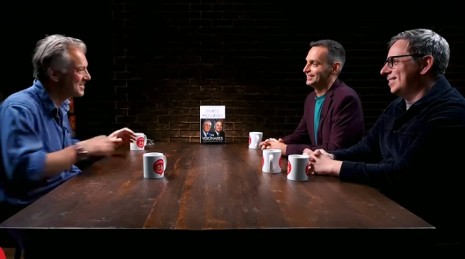
Read the full transcript of historian James Holland’s interview on TRIGGERnometry podcast, July 8, 2026.
Editor’s Note: In this episode of TRIGGERnometry, historian James Holland joins the hosts to delve into the early life and political ascent of Adolf Hitler, exploring how a failed artist rose to power by exploiting a broken, post-World War I Germany. The conversation examines the parallels between the economic instability of the era and modern times, contrasting Hitler’s path with the leadership of Franklin D. Roosevelt and Harry S. Truman. Ultimately, Holland provides historical perspective on how societal grievances were weaponized, offering lessons on the importance of learning from past patterns to navigate contemporary challenges.
James Holland on Hitler’s Early Life and World War I
KONSTANTIN KISIN: James Holland, welcome back to TRIGGERnometry.
JAMES HOLLAND: Well, thank you for having me on.
KONSTANTIN KISIN: Oh, it’s great to have you back. Last time we talked about the kind of big picture World War II. That episode absolutely smashed it, as of course it would do. Today we really want to focus on Adolf Hitler and his journey through life, if I can say it like that. Before we start, for people watching, I want to make clear we have your book, a Sunday Times bestselling, The Visionaries on the Table. Yes. Let’s be very clear, Hitler is not part of that. We’re not saying he’s a visionary.
JAMES HOLLAND: He features quite heavily in the book. Yeah, I think it’s fair to say. But the visionaries in that case very much at the forefront are Franklin D. Roosevelt and Harry S. Truman, the 2 presidents that kind of served during the Second World War. And they’re kind of an antidote to Hitler, you know, they’re different worldviews because both America and Germany are experiencing very, very similar things in terms of Spanish flu, post-First World War, Wall Street crash, global trade war, etc., etc. And they don’t go down the route that Nazi Germany goes down. And why is that? And I think that’s very interesting. So it’s a sort of study of contrast. There’s a right way to go about things and a wrong way to go about things. And those guys kind of, I would say, nailed it.
FRANCIS FOSTER: Yeah.
JAMES HOLLAND: And Hitler, maybe, maybe not.
Hitler’s Background Before the War
KONSTANTIN KISIN: Well, it’s a relief you take that position. But before we get to that, and we will get to that, actually, Francis and I thought the most interesting thing to start with would be just to understand a little bit about the background of Hitler before he becomes the Hitler of history. Like growing up, his experience serving in World War I, and his political career prior to becoming chancellor and the Führer. Tell us about him.
JAMES HOLLAND: Well, so he’s brought up near Linz and then, as he grows up, he sort of matures and goes to art school in Vienna where he’s a failed artist. You know, everything he touches goes wrong. And that’s because he’s an extremely gauche young man. He’s angry. I think he feels that he’s for better things, but he’s definitely a kind of on-the-spectrum character. He doesn’t make friends easily. He doesn’t interact with people easily.
Resentment is just absolutely broiling inside him. His chance for deliverance from this ordeal of successive failures comes with the First World War, where he gets consumed by a sense of patriotic fervour and wants to do his bit and joins up and really embraces it, spends most of his war on the Western Front, where he is a runner. And by all accounts, he does this very well, you know, he’s conspicuously courageous, but never gets beyond lance corporal, Gefreiter basically, in German terms. Everyone always says he’s the corporal, but he’s only half corporal, lance corporal, you know, he’s a one-stripe man.
Hitler’s Experience in World War I
And the exaltation that he felt in joining up, that patriotic fervour, being suddenly belonging, being part of something, the comradeship of the trenches, of fighting alongside fellows for a common cause, all this kind of stuff, that dissipates as the war progresses. And then there is the terrible shock of 1918 because it looks like they’ve turned this corner, because at the beginning of March they signed the Treaty of Brest-Litovsk, which is Russia’s exit from the First World War. And it’s a huge victory. And suddenly, you know, that reclaims the Baltic States, Ukraine, parts of Poland, all from part of the Russian Empire. And it’s a huge victory.
And it also means, of course, that the Germans don’t have to fight on 2 fronts. And it’s Germany that is shouldering the burden of the Western Front and the Eastern Front, where Austria is shouldering the burden down in the Alps against Italy and so on. So it feels like this should be a huge release, and this should be the kind of impetus that spurs them on to the final victory on the Western Front.
And they launch this great offensive in March 1918, and it’s what ends the deadlock of stationary, static trench warfare. But it also offers an amazing lesson for the Western Allies, particularly the British, which is in their sector where the main thrust of this offensive comes. And what the British discover is, as they’re pushed back, they can actually afford to trade space for time. And as they go further and further back, so the German lines get more and more extended. And as they get more and more extended, they become less effective.
And so what they realised is there’s a certain point you reach where your attackers, when you’re on the defensive like this, have reached their culmination point, where they can no longer achieve what they need to achieve with the kind of speed and tactical flexibility they would like, because they’re so overextended.
And the truth is, financially, economically, and in terms of war production, they are suffering harder than France and Britain are. And so they are no longer able to absorb that. And it comes to a point where they just can’t go on any longer. And then you start to have the communist revolt in the mutiny in the German Navy, and so on and so forth. The whole thing crumbles down.
And this is also presaged by a slight belief that the peace that comes is not going to be too bad, because President Wilson of America has come up with his very idealistic 14 Points and everything. And the Germans think, well, okay, maybe we can sort of get away with this. Austria has already bugged out in October. And so that’s what prompts them to sue for peace.
The Aftermath of World War I and the Versailles Treaty
And then there is this terrible disappointment because the 14 Points don’t quite end up being the 14 Points. And you have the Paris peace talks, which ends up with the Paris Peace Treaty of late June 1919, where Germany gets frankly absolutely — I mean, it gets a total shellacking. And then you get this sort of terrible, absolute gut-wrenching disappointment. So you have the terrible disappointment of the end of the war and ending up on the losing side, but then you get the sort of grinding down into the dust. You know, you’re on your knees, we’re going to kick you into the mud with the peace treaty. And that’s what is just so hard to stomach for so many of the people who’ve been on the front.
And Hitler ends the war in hospital. He’s been blinded by a gas attack. And it seems quite clear that he’s blind beyond purely the gas, that there is a sort of psycho trauma going on in his head. And he comes out of it, he emerges out of it, and he’s sort of okay. But it is clear that it is deeply, deeply traumatic.
And for Hitler, at the end of the First World War, you know, what were you going to do? You know, he didn’t have any job beforehand. Now he’s in a defeated nation, which has just been kicked into the mud by the Versailles Treaty. You know, the reparations are obviously terrible, there’s a diktat which says that they have to kind of sign off that it was their fault in the first place, blah blah blah.
KONSTANTIN KISIN: Was it their fault in the first place?
JAMES HOLLAND: Well, you know, that’s an entirely different podcast. I mean, short version, it’s more nuanced than just one. This is so complicated because the tangle of diplomatic alliances is such that it kind of escalates really, really badly, very quickly in 1917.
KONSTANTIN KISIN: Blaming Germany unilaterally is overdoing it a little bit is what I’m reading from you.
JAMES HOLLAND: Unilaterally, yes.
Hitler’s Pre-War Political Views and Antisemitism
KONSTANTIN KISIN: Okay, fine. Before we carry on with the story, which you’re tailoring in a fascinating way, can we just come back to before World War I. You said that he’s this angry man, a bit spectrum-y, can’t make any friends. At this point, has he already formed his political views? Is he ranting about the Juden at this point, or he’s just angry like many young men are angry?
JAMES HOLLAND: No, no, no. And there’s evidence that he has equated his sort of friends in the loosest sense who are Jews. And no, it hasn’t come to the forefront at this point. But antisemitism is absolutely rampant across Europe at this time. You know, you’ve obviously had all the pogroms in Russia as well before that. You know, there’s an unhealthy dose of antisemitism in Britain, for example, certainly in France. I mean, you’ve only got to look at the Dreyfus Affair at the turn of the century, etc., etc. So it is absolutely there. I suspect he probably was antisemitic, but not rabidly so at this stage. And it’s certainly not a part of his worldview — he hasn’t thought through his ideology at this point.
At this point, before the war, he’s a young man who is disappointed by life. He has a very close affection and relationship with his mother, a very bad relationship with his father. As I say, you know, life hasn’t been good to him. You know, he’s impoverished. His artwork, you know, he tries to make it as an artist, but his art is terrible. I mean, technically it’s sort of okay. I mean, if he were to become an architect or something, his sort of draftsman-like pictures of buildings would be all right. But he’s terrible at human figures. There’s no soul in them at all. There’s just nothing there.
I mean, have you ever seen any of his paintings? Yes, I have. They’re totally dead. I mean, there is just no vitality, no life in them whatsoever. And they are nothing more than kind of cheap postcards. I mean, you know, that’s what they are. And he gets into disagreements with people. He’s constantly let down. He sort of ends up in a garret in Vienna. You know, it’s just, his life is going absolutely nowhere.
Salvation comes with the First World War because it gives him this sense of belonging and comradeship, which is something he’s never really experienced before because he’s always been this outsider. This sort of angry young man.
FRANCIS FOSTER: But the problem then comes with the First World War ending. All of a sudden, that sense of camaraderie, belonging — I mean, that’s gone.
JAMES HOLLAND: So big time.
FRANCIS FOSTER: So where does he go from there?
Hitler’s Rise: From Beer Cellars to the Beer Hall Putsch
JAMES HOLLAND: Well, one of his former officers takes pity on him and asks him to help do some sort of propaganda courses to try and sort of bash Bolshevism out of young Germans. And he finds out he’s actually a really good orator. And he finds he’s rather good at it. And he can just stand up and just deliver.
And as he’s thinking about this and thinking about trying to sort of dissuade people from Bolshevism, his own thought starts to sort of coalesce. And he’s gravitated to Munich as well, because although he’s Austrian, Munich is where he ends up. And so he’s living in Munich, he’s got a job, he’s got digs, he’s meeting people, and suddenly he’s meeting people who have the same ideas as him that are starting to emerge.
And he goes to a meeting in a beer cellar of the Deutsche Arbeiterpartei, which is the German People’s Party, which has been set up by Anton Drexler, who is friends with people like Rudolf Hess and various others who have been part of the Thule Society, which is a sort of woo-woo kind of, where do we all come from, sort of ancient Aryan myths kind of vibe with some antisemitism thrown in. And they’ve all sort of merged into the DAP, the Deutsche Arbeiterpartei, the German Workers’ Party.
And he goes there and he stands up and speaks and everyone goes, “Wow, who is this guy?” And he’s really good at it. And he starts to speak more and more and he suddenly becomes a star. And I can’t remember if it was 1920 or 1921 that Drexler changes the name to the National Socialist Workers’ Party, the Nazis. Germans, by the way, don’t do acronyms, they do abbreviations. So the Stuka, for example, is an abbreviation. Nazi is an abbreviation rather than an acronym.
And Hitler then just takes over. And it’s just completely obvious that he should take over because he is the leading light. He’s the person that everyone listens to. And suddenly he can hold a room. And he finds this incredibly liberating, this ability to stand in a beer cellar, stand in a room, and hold everyone’s attention with his rhetoric. And he can just speak in fully formed paragraphs and sentences.
And all his speeches follow exactly the same pattern. They start off, “We were robbed, we were stabbed in the back,” which is Hindenburg’s line from spring of 1918. This idea that it wasn’t the fault of the generals and the commanders in the First World War, they were stabbed in the back by the politicians and by commies and Bolsheviks and so on. When it was entirely their fault. I mean, they were party to going to war in the first place, they were egging on the Kaiser, they were promising military miracles that couldn’t be achieved and all the rest of it.
So if anyone in any war, there’s always a combination of people that are responsible for what happens, but they had as much blood on their hands as anyone — the Ludendorffs and Hindenburgs and all the other senior commanders. So to kind of try and absolve themselves and pass the blame on something else was cowardly and ridiculous and not true.
But it tapped into a kind of a need of a lot of these veterans who were coming back, who were angry, disappointed. “We’ve just fought through this, we’ve seen hell, we’ve seen our comrades blown to smithereens, we fought in the mud, and this is the thanks we get for our sacrifice and for all that we were — all our shattered dreams and aspirations and hopes and all the rest of it.”
And so Hitler, in his speeches, is able to tap into that anger. But he would always then end his speeches with hope. “We can rise again. The German people can be great again.” But part of this reaching this point of hope was also about setting up the enemy. And so what he does is this us and them.
Volksgemeinschaft: The Politics of Us and Them
And “us” is Volksgemeinschaft and Frontsgemeinschaft. And there’s no literal translation for Volksgemeinschaft at all, but it is a sense of “we as Germans are linked inextricably by culture, by race, by being Northern Europeans, by being at heart German Christians, even if you don’t believe in it, by a sort of a heritage and inheritance that we instigate.” It’s a bit like the Pashtunwali Code or something to Pashtuns in Afghanistan. It’s something you’re born with, and either you’re part of this gang or you’re not part of this gang. And if you’re not part of this gang, it’s because you’re a Slav or a Bolshevik or a Jew.
One of the things — the mistake they make is assuming that the Jews are racial rather than a religion. It’s religion, not racial.
So Volksgemeinschaft is this us and them, is buying into that us and them. “We are the true inheritors of our land of Germany, the northern Aryan people.” It goes back millennia to ancient times, which is again tapping into the slightly sort of woo-woo Thule Society kind of nonsense. This is the notions of an ancient Christ-like figure with a K who’s — it’s the Atlantic Ice Theory, it’s all this kind of just nonsense, sort of runic, kind of ancient Nordic races, kind of heritage stuff that the Nazis get into.
And then the Frontsgemeinschaft is the same as Volksgemeinschaft, but it’s people who’ve served at the front. And despite the fact that obviously Jews have been integrated into German society and Prussian society and the German peoples for centuries and millennia is neither here nor there. The fact that they’ve been hugely successful compatriots is neither here nor there. The fact that they fought alongside each other in the trenches is neither here nor there.
And one of the reasons why Hitler gets into this in the first place is because when he gets to Munich, there is a very brief Soviet Republic which is announced in Munich, I think in 1919 or 1920. And it is organised by Munich Jews predominantly. The leadership is Jews. So suddenly he thinks, “Ah, I’ve got this opposition — there is us, true Aryans, true Germans, the Volksgemeinschaft. Then there is them, which are Bolsheviks, Slavs, and Jews. They’re the enemy. And there is this international plot of Bolshevism and Jewry which is trying to undermine us, the true inheritors of Europe and Germany and all the rest of it.”
And of course, it’s totally, totally bogus. But when you’ve just been defeated and you’re trying to work out what it is you stand for, it’s quite potent. And I remember when, sort of 15 years ago, wondering how on earth could people fall for this total nonsense? And then you see what’s happened in the world in the last, particularly in the Western world, in the last sort of 15 years. And you kind of think, “Okay, I kind of get this now.”
So that’s what he’s able to tap into. And he just gets this growing, growing movement. But it’s tiny. It’s totally fringe. I mean, it’s more fringe than Tommy Robinson. I mean, it really is. Nothing. It doesn’t make a dent, but it has its supporters. And with it comes this sort of paramilitary side of it — they all wear uniforms, they have the swastika.
The Origins of the Swastika
KONSTANTIN KISIN: And where does the swastika come from?
JAMES HOLLAND: Well, that is debated, but my understanding of it is it’s Göring. Göring certainly believed it was him that had done it. And this was because he became friends with some Swedish aristocrats and went to visit a castle there. In fact, his first wife was a Swedish aristocrat. And on the fireplace where he was staying at this castle in Sweden was the swastika.
I mean, the swastika is old as the hills. You get it in India and Sanskrit and all over the place. And generally, it means it’s a peaceful kind of warm, fluffy sign rather than something that’s completely toxic. And what they do is they turn it on its side.
Göring is very, very important in this. And of course, he is reasonably aristocratic, he’s well-to-do, he’s been a fighter pilot, he’s commanded the Richthofen squadron at the end of the war, he’s got 40-plus kills to his name — he’s a very, very talented pilot. He’s also super smart, really, really clever. Again, another really, really good orator. And he quickly unveils his way into the Nazis and does well because he’s this larger-than-life character. He’s quicker-witted than almost all the others, and he can run rings around them, and he’s a great orator.
Göring: Lost Without Purpose After the War
FRANCIS FOSTER: Can I just point something out, James? Isn’t it also quite interesting that he was somebody who had a lot of purpose in the First World War? He was sort of a mini celebrity, wasn’t he, with being a fighter pilot? The First World War ends, he’s kind of left without purpose as well.
JAMES HOLLAND: Yeah, and he ends up being a sort of a bit of a barnstormer and flying commercially and just lost. I mean, all these people, they’re just lost. There’s no money, there’s no jobs, there’s nothing — society has broken down completely.
Now, by the back end of 1923, which coincidentally is exactly the same time as the Beer Hall Putsch, things are starting to get better, which is one of the reasons why the Beer Hall Putsch fails. Because actually there is a shaft of sunlight on the uplands again. And Germany is starting to get out of the mire, which isn’t very convenient for the Nazis, because they’re all about anger. They are very much the sort of politics of division and the us and them and all this kind of stuff. So suddenly, as Germany is emerging out of the economic mire, just at the same moment as the Nazis are doing this play for trying to take over Munich and Bavaria, and then let’s see where it all goes. So it doesn’t work.
From Fringe Movement to the Beer Hall Putsch
KONSTANTIN KISIN: James, sorry to interrupt. It just strikes me we’ve skipped a bit which may be worth delving into just for people who are far less familiar with this than you. So you mentioned how they’re really fringe. It’s a few people meeting and—
JAMES HOLLAND: Based in Munich.
KONSTANTIN KISIN: Based in Munich. How do you go from that to try and take charge of a whole part of Germany?
The Beer Hall Putsch and Hitler’s Early Vision
JAMES HOLLAND: Well, it’s a long and difficult process. And to start off with, I mean, these early years, sort of 1920, ’21, ’22, ’23, up to the Beer Hall Putsch, which is where they try and take over Munich. And indeed Bavaria and the whole country, in November 1923. It’s super small scale. So this is lots of angry young men drinking beer, drinking their Steins, working themselves up into a lather. Hitler kind of compelling them with his oratory, others compelling them with their oratory. And for lots of lost souls, this is the light and they are the moths. Coming towards it because this is offering answers to the anger, the anger and the resentment and the rage.
I mean, this is what happens time and time again through history when people are reduced in status, when they are forced to cast aside the things that they held dear and the things that they thought were sure and solid and the foundations of their existence. Suddenly they’re looking for answers. And there’s a lot of pent-up anger, which is made worse by the experience of the First World War, the trauma of the First World War. And don’t forget, no one’s really understanding battlefield trauma in those days. There’s no kind of understanding of PTSD. You know, you need to come back, you just need to decompress, and we need to give you kind of 2 weeks on Cyprus, and then sit on the beach and have a good time and have some sort of Aperol Spritz, and then come back and slowly bring you back into society. There’s none of that.
You know, you’re back to a broken Germany where people are wheeling around wheelbarrows of money and there’s hyperinflation. And bread is going from kind of 10 million in one day to 100 million marks by the end of the day. It’s totally bonkers. So how do you make sense of that? Well, you make sense of that by holding on to the things that you do know. And if there’s a bunch of lads who’ve all been through the same experience as you, and they’ve got some finger-pointing to do, whether it be to Jews or Bolsheviks or global capitalism or whatever it might be. Suddenly you’ve found your tribe and you’ve found your people.
So those are the people they’re attracting, but it is super small scale, and there is this paramilitary wing to it which enables people to still wear uniforms and feel in touch and connected to their military past so that the kind of military training they experienced, the experience they brought from being on the Western Front or even the Eastern Front or wherever it was, counts for something. And so they start to introduce ranks and all the rest of it in different orders. So you have the SA, the Sturmabteilung, and then you have the SS starts coming into being. And for lost souls, this gives you a gang, it gives you a tribe. And for some people, it’s a football club. For other people, it’s a knife gang in South London. For people in Germany, it’s the Nazis or whatever, or the communists who are far more to the forefront than the Nazis are at this time in Germany.
So it’s about focusing one’s anger, focusing one’s resentment, trying to find a sense of brotherhood, trying to tap into that sense of Volksgemeinschaft and Frontsgemeinschaft. And that is what Hitler is tapping into, and that’s how he’s presenting it. It’s us who are together, we’ve had this experience, this bonding life experience of being — of surviving the First World War. We didn’t fight for nothing, all this kind of stuff. We didn’t fight to come back to a broken Germany. We need to make Germany great again. And how are we going to do this? By getting rid of the bad elements, we’re going to just make it a true Aryan thing, and then we can rise up again and harness our Germanic brilliance and reclaim our rightful place as a preeminent military nation in Central Europe, blah blah blah blah blah.
FRANCIS FOSTER: Because it sounds very grandiose, but when we look at the Beer Hall Putsch, I mean, it was a complete failure. Yes, it was a disaster.
Hitler’s Imprisonment and the Writing of Mein Kampf
JAMES HOLLAND: Yeah. It’s badly planned, badly executed. Shots are fired. Hitler gets away with it, but gets arrested. He doesn’t get shot. But Göring, who’s by this point one of the leading lights, gets shot in the groin very badly, nearly dies, is rescued by his — by his then — I don’t think they’re married at this point — by Carin, and ends up recuperating in northern Italy, which is where he becomes addicted to morphine. Hitler is sentenced — I mean, he could have had life imprisonment. He could have been executed for that. He isn’t. He’s just given a couple of years in Landsberg Prison where he writes the first part of Mein Kampf, which is his kind of mission, my struggle, his vision for the world.
And I don’t know if either of you have ever bothered to read it. I mean, I don’t recommend it, but it’s quite — you don’t need to put it this way. You don’t need to read it cover to cover, even if you do look at it a bit. But it is interesting. It is an absolute dump of ideas and anger and resentment and so on. And at its core is a vision for the future of how Germany gets out of this and what Germany needs.
And part of the reasons why it gets stuck, caught in the First World War is because it’s too isolated in Central Europe. It hasn’t got access to the world’s oceans. It’s got the Baltic, it’s got a little bit of the North Sea, but the British, the Royal Navy is too dominant. What we need is living space, Lebensraum, where we can expand. And we need to expand our own racial identity of Aryans beyond the borders of the existing Germany into the lands of the East, where there’s going to be this huge struggle, but we need to defeat the Jews, we need to defeat the Slavs, we also need to defeat the political concept of communism, Bolshevism. And then we’ve got this terrible struggle that we’re going to have to go through, and it’s going to be a terrible burden for a generation of Germans. But afterwards, we can have the Thousand-Year Reich and live forever peacefully, having created this new order. And this is where we need to go. So it is a manifesto, but it’s a very disturbed one, to put it mildly.
Dietrich Eckart and the Ideological Shaping of Hitler
And then he gets out of prison. And Dietrich Eckart is one of the guys who is one of his sort of gurus, really, one of the people who has a huge influence on him. And Eckart is a dissolute and a drunk, but he’s a man of ideas. He’s very, very bright. He’s a drunkard. But he really helps to hone Hitler’s political manifesto and his ideological ideas — antisemitism, place of Germany in the world, this constraint, this problem that Germany has of being in the center of Europe where you can be attacked from all sides. You can be attacked from the west, from the north, from the east, from the south. So how do you get around this?
And one of the problems with Versailles is those buffer states have been stripped away. We just got those buffer states when we had the Treaty of Brest-Litovsk against the Russians, because suddenly we had the Baltic states, which rightfully should feel in the sphere of Germany rather than Russia. We got Ukraine, we got Poland, and we had Alsace-Lorraine and the Rhineland. And suddenly that’s been taken away. And so we are now kind of bald and exposed and vulnerable once again. And our first job is to get Germany’s safety buffers again. And this is why we need Lebensraum. This is why we need these buffer states back again, because we’re geographically resource poor. Germany doesn’t have iron ore. It has coal, but the coal is not of great quality. It doesn’t have access to the world’s oceans. Its overseas territories were stripped away with the Treaty of Versailles in 1919. So it doesn’t even have that anymore.
So how are we going to do this? Well, maybe we shouldn’t bother with the whole overseas stuff. Maybe we should just push eastwards. The British Empire has its empire and it has its extra imperial assets in South America and elsewhere around the world. We won’t bother with that. What we’ll do is we’ll spread eastwards and then we’ll have the buffer, but then we’ll have the living space. We’ll have the resources and the space in which we can create a buffer and we can get all the resources we need. Oil from the Caucasus, wheat from the Ukraine, shipping from the Baltic, blah, blah, blah.
And so, all this — you just imagine you’re Hitler and you’re thinking about all this and you’re thinking, God, yeah, there’s the vision. That’s how we do it. This could be amazing. This will ensure that we never get ourselves into this terrible situation, this invidious situation that we found ourselves in. And you start to convince yourself that this is the only course and that it’s a terrible job, but this is a dog-eat-dog world. And people are going to get killed. But then from thereafter, subsequent generations can live peacefully, happily together, Aryans one and all, with this lovely buffer and having all the resources we need. And it’ll be this kind of utopia, this Eden, where proper true Aryan ways of thinking about life can live in peace and families can be happy and kinder can laugh and cry and grow up with their mooties and their fatties and all the rest of it. Total fantasy, but you can see how you can sort of escalate this.
Hitler at Berchtesgaden and the Writing of Mein Kampf’s Second Part
And one of the things that Eckart does is he takes him to Berchtesgaden and to the Bavarian Alps near Salzburg, right on the Austrian border in southeast Bavaria. And that is where Hitler falls in love with the Obersalzberg, this area of hills overlooking Berchtesgaden. And eventually he buys a house there which becomes the Berghof. And from the sales of — ultimately, I’m jumping the gun here, but into the 1930s — sales of Mein Kampf are such that with the royalties, he’s able to buy this amazing house and completely convert it and turn it into the Berghof and all the rest of it.
But he very much — Eckart, and in turn Hitler, very much buy into the view that it is when you’re surrounded by nature that you have your greatest thoughts and the beauty of the Alps. And this is a true German land of mountains and fresh air and Edelweiss and babbling brooks and mountain springs and Wagner playing over the top of the Untersberg and so on and so forth. And that is where he has his political coalescing. Because the second part of Mein Kampf is written in what’s known as the Kampfhäusl, which is this sort of wooden shack which Hitler rents, buys on the Obersalzberg in the trees. And you can still see the remains of it in the woods to this day.
And he gets up and he walks to a place every day — this lovely little sort of mountain cafe place where he has hot chocolate and Windbeutel, which is a sort of pastry dish with berries of the forest with cream and so on. It’s very kind of Bavarian. It’s like, think sort of Black Forest gateau but with pastry.
KONSTANTIN KISIN: It sounds rather lovely. I would have thought he would chill me out, but apparently —
JAMES HOLLAND: No, no, no. But this is — so he does this literally every day. He gets into this routine. And there we go. Hitler has a massively sweet tooth, by the way. Yeah, really does. I mean, he’s vegetarian, doesn’t smoke, but he’s got a very sweet tooth. So he goes there every day and he goes back to the Kampfhäusl, his little wooden hut, and writes this great work.
KONSTANTIN KISIN: You’d think you’d just write books about nature and do your shitty paintings and just enjoy life.
JAMES HOLLAND: But it’s very much part of this. The reason I’m telling you all this is because it’s not just about wacko antisemitism, anti-Bolshevism. There is a bigger picture here, which is healthy Germans strapping their thighs, wearing lederhosen, walking over the Alps, breathing the air. This is what Germans should be doing, and sort of health and happiness.
FRANCIS FOSTER: So what you’re saying is he’s not all bad, right?
The Nazi Party’s Marginal Status in the Late 1920s
JAMES HOLLAND: No, I’m absolutely saying he’s all bad. But he’s bringing — because if you’re going to sell this, you’ve got to sell a vision. And the vision is coalescing in the second half of the 1920s. But meanwhile, the second half of the 1920s are the Goldene Zwanziger, the Golden Twenties, because Germany, Weimar Republic — a democracy, how ghastly — is actually doing really rather well. And so therein lies the rub.
So he’s sort of politically neutered after the Beer Hall Putsch and his time in Landsberg. So by this time, we’re talking about sort of 1926, ’27, ’28. The Nazi Party is nothing. In the elections of 1928, they win 2.6% of the vote. I mean, it’s not quite Monster Raving Loony Party kind of levels. But it’s not far off it.
KONSTANTIN KISIN: So he’s neutered by the fact that his message is essentially one of doom and despair and therefore the need for recovery, while the country is actually doing fine effectively at this point.
JAMES HOLLAND: Can I just ask—
KONSTANTIN KISIN: Exactly that.
JAMES HOLLAND: But it gives it— because that isolation, no one’s interested in Nazis, no one’s interested in Hitler. He’s the forgotten man, the failed putsch, spent his time in prison. He’s on his own in the Obersalzberg having these sort of great thoughts, going for his Windbeutel and his hot chocolate every day. You know, breathing in the air and dreaming of idle vice. But he’s— that is his time to really coalesce from— it’s not just, “I hate Jews, I hate Bolsheviks, I hate Slavs.” This is where he’s applying that to this bigger vision of where Germany needs to get to, how he can create a Germany that is going to last 1,000 years.
The Threat of Communism and Bolshevism in Europe
KONSTANTIN KISIN: Before we go on chronologically, I want to take one detour, which I think is really important, which is to talk about communism and Bolshevism in Europe at this time. Because those of us who are not historians like you and who were not taught history very well, which I would put pretty much everybody, there’s a sort of like, World War I, Treaty of Versailles was not very fair. And then, suddenly the Nazis appear and then we’ve got the Holocaust. But really, I mean, I think the Bolshevism threat and the threat of communism in Europe at this time, from the perspective of many people who were not on board with it, is actually massive, isn’t it? Like, it’s a real concern.
JAMES HOLLAND: It is absolutely massive. And you’re absolutely right to bring that out and to raise that, because Imperial Russia is imperial and it’s part of the Ancien Régime. It’s a royal house, it’s a royal family, and it has its own empire. And the network of alliances which causes the First World War mean that Russia is interlinked with France and Britain, they’re cousins, they all have the same beards, they all look pretty much the same, and so on and so forth. So this interconnection of royal dynasties throughout Europe is very, very tight.
And what the First World War does, it’s so cataclysmic and it’s so changing. The Ancien Régime is thrown out, the peasants’ revolt has happened. And the point about the peasants’ revolt in England, for example, in 1381, is that it doesn’t work. And royalty reasserts itself. The Republic of Britain of the 1650s is a brief kind of turn of the winds before it goes back to royalty again. France is a republic, and that was pretty, pretty shocking. But let’s face it, Napoleon is an emperor, and so are those who follow. And it is still— France is stuffed full of aristocrats even into the 20th century, and so on. And it rules, although it is a republic, it revolves around the old ways, even though it is democratic.
And suddenly you’ve got the proletariat rising and communist farms and cooperatives and so on. And all the flim-flam of royalty and regalias and gold and the brightness of the palace ball and waltzes and all the rest of it, that’s all gone in favor of drab kind of working-class people all kind of working together and all the rest of it.
But of course, that’s where Marxism, where communism comes into it. But of course, what those who are against communism haven’t worked out is that communism is going to take many different forms. And to completely jump the gun, one of the reasons why America and the West gets involved in a series of wars after the Second World War, such as Korea or Vietnam or whatever, is because they’re worried about the westward spread of communism. But what they don’t realize is that Mao’s communism is not the same as Lenin or Stalin’s communism, and ditto in North Korea and so on. And that Ho Chi Minh’s communism isn’t the same either. And communism takes different forms.
But if you’re in the 1920s and you’re European, what you’re seeing is a new political movement which seems to threaten everything that the Western world stands for, whether it’s the ancient royal imperial world or whether it’s just the democratic world, because communism is not democratic. And of course communism, as it turns out, is every bit as autocratic as a dictatorship. It’s just got a different kind of—
KONSTANTIN KISIN: To put it more crudely—
JAMES HOLLAND: Well, just one thing I would say is, left and right, we think of it as right here, left here, centrists in the middle. In fact, it isn’t. It’s the horns of the buffalo. And the extremes are kind of unbelievably close.
KONSTANTIN KISIN: Exactly. So to put it crudely, if you are in the interwar period in Europe and you’re not a communist, what you really fear is the great unwashed overthrowing everything in society.
JAMES HOLLAND: Damn right you do.
KONSTANTIN KISIN: Yeah.
JAMES HOLLAND: Yeah, you do.
KONSTANTIN KISIN: That’s what you’re seeing.
JAMES HOLLAND: And you’re also saying, if you’re from a democracy, you’re saying, “Hang on a minute, we’ve just given women the vote, we are progressing. We don’t want all this threatened by some new movement, which is even worse than the kind of sort of imperialist shower of Imperial Russia. The last thing we want is Europe and its democracies and its progression and its modernity being overrun by this totally awful, oppressive proletariat movement.”
Nazism vs. Communism: The Horseshoe Theory
KONSTANTIN KISIN: And so on the communist piece, before we get back to the story, the second thing I want to ask you is something you just pointed out, which is about the horseshoe theory of political convergence. If you told me that there was a party which had the word socialist and workers in it, I’d say that’s a far-left party. And when we had the philosopher of history, Stephen Hicks, on the show, who we love, and we talked about Nazism, he talked about the fact that if you look at the economic program, there’s not a jot of difference between that and communism, actually, in terms of the economic side of it. And I now see sometimes people on the internet arguing about whether Nazis were actually left or right wing, which is a conversation that I think hard for people to understand. How much of—
JAMES HOLLAND: I just think it’s the wrong way to look at it.
KONSTANTIN KISIN: Sure. But how much of a difference and how much similarity was there between National Socialist and Communist Bolshevik socialists? Maybe this is the wrong framing.
JAMES HOLLAND: Correct me if I’m wrong. There is a— the communism that emerges from Lenin in the first part of the 1920s, although there is a communist leadership, it is supposed to be more egalitarian and it is, one rule for all and everyone wears the same drab uniforms and outfits and the rest of it.
KONSTANTIN KISIN: Sure, sure.
JAMES HOLLAND: Nazism never pretends to do that. Nazism always wants elites. And so that’s— and it doesn’t pretend anything else. It wants the German race to be emboldened, empowered. It wants everyone to be wealthy, but then so do capitalists. You know, capitalists aren’t trying to kind of put the working classes— the whole point of 1920s America is that everyone gets rich and has a Ford Model T. So there’s no conflict there at all. Communism and Nazism are radically different because of that.
And I mean, if you look at what the Nazis are doing when they finally do get into power in January 1933, they’re tapping into a much earlier imperialist Russia. A lot of the uniforms are very, very similar. There’s still an imperial eagle, even though now it’s a Nazi eagle. The head is pointing a different way than it was when it was imperial, but it’s still an eagle. Why is that? Because what they’re doing is they’re saying, “We can make Germany great again. Germany was brilliant because it had Frederick the Elector and it had Frederick the Great, and we were really good at military stuff and we were the top dogs militarily. And we’re still a militaristic society and you can wear uniforms that will make you feel cool and proud like we were in the 1870s under Bismarck and following the Franco-Prussian War and the unification of German peoples and all the rest of it. We can hark back to that again, and we can wear lots of leather and look shiny, and you can be part of our club and wear cool uniforms and look the business and get the fro line. Come on in, the water’s warm.” That’s what it is. That’s what it’s saying.
You do not get that in communist Russia. You don’t get that in the Soviet Union. It’s not until 1943 that the Red Army reintroduces collar taps, shoulder taps. Because that’s not proletariat enough to have that. And then they think, oh, f* it anyway. They just think, sod it.
So it is really, really different. And I would be very, very wary about saying that actually they’re closer than you think. They are closer in so much that the two, the horseshoe, the horns, whatever analogy you want to use, are coming towards each other. But they are fundamentally different. That’s why they hate each other’s guts.
But where they are similar, I think, is in that they’re offering a gang, they’re offering a part of a club. What you get in Europe is these little pockets of communism. “Well, yeah, we want to be free. We don’t want these aristocrats. Look what they did to us last time. Even in democracies, whether in France or Britain or whatever, it’s still the ruling classes who’ve got us into war. And if only the working people could stand on their own two feet, then we wouldn’t have had a global conflict. Why can’t everyone just sort of be happy together and be equal and share the spoils and all the rest of it?”
I mean, I’m a capitalist, so I don’t believe that works. And the history of communism would show that communism in its purest form doesn’t work. It’s a bit like Brexiteers — you never quite get the perfect Brexit. You never quite get the perfect communism either, because you’re always striving for this utopia, which obviously doesn’t exist because it can’t. And if you ever want to doubt this, just read Animal Farm by George Orwell.
FRANCIS FOSTER: Absolutely.
JAMES HOLLAND: “Some people are more equal than others.”
The Golden Twenties and the Rise of Nazi Germany
FRANCIS FOSTER: So it’s the Golden Twenties. We’ve got the Weimar Republic.
JAMES HOLLAND: Yes.
FRANCIS FOSTER: The cabaret portrayed so famously, the Kit Kat Club, women with their nipples out.
KONSTANTIN KISIN: All of that.
FRANCIS FOSTER: Gay clubs, everything that Hitler hated, ostensibly. How did we go from the glory days of that to the rise of Nazi Germany?
The Myth of Weimar Decadence
JAMES HOLLAND: Well, yeah, again, can I just point out something? You’re right in that Germany is the most— or certainly Berlin is the most liberal city on the planet in the late 1920s. But that view of Weimar is pure Nazi propaganda which endures to this day. Ah, yes, there is the KitKat Club, you know. Yes, there is Salon Kitty and all the rest of it. And, you know, if you want to be gay and take lots of drugs, nowhere better to be in the world in 1929 than Berlin. But that is not defining Weimar.
Weimar is defined by democratic political processes, by a growing economy, and the notion that Germany can rebuild itself and its fortunes by its immensely capable and competent technological and industrial output. And so it’s growing as a major, major exporter of fine stuff. I mean, German engineers are known the world over as the best. You know, these are the people that create the Möhne Dam and the Eder Dam and these huge works projects before the First World War. You know, these German scientists are absolutely cutting edge of medical science, of astrophysics, of all sorts of things, of engineering. And leading engineers in Weimar are absolutely household names. You know, it’s not football players that people are collecting cards of, cigarette cards of. It’s engineers and great men of letters and musicians and artists and so on.
And Germany is able to do this through a series of help projects that have really come from the United States above anywhere else. I mean, it is the Dawes Plan of late 1923, which really kickstarts this, where France and Britain are paying back war loans to the United States. The United States, and this is obviously massively simplified, but in its basic form, are then funneling those repayments back to Germany, which is then getting enough. They create this temporary currency to sort of get rid of the mark, the Deutsche Mark rather, which is the one that’s having hyperinflation.
KONSTANTIN KISIN: The temporary currency.
JAMES HOLLAND: Yes. The temporary currency is stabilizing things in conjunction with these loans which are coming in. Then comes the Young Plan at the beginning of 1929. Which enables— and this is Owen Young, who is the chairman of General Electric in America, and Dawes, Charles G. Dawes, is a banker from Chicago. And the two of them work together under the auspices of the American government to try and alleviate the problems of America and try and alleviate the harshness of the terms of the Versailles Treaty.
So you first of all have the Dawes Plan, which is money, a massive injection of cash, and helping stabilise the currency. Then you have the Young Plan of the early part of 1929, which reassesses the repayments and reestablishes it so that instead of paying it, you know, X by X, it’s now going to be— the final loans will be paid in 1988. So it’s so far off that you might as well just actually forget about it. And basically, there are gaps in the loan payments which are sanctioned, and you know, Germany is able to basically see off the worst of the financial burden of the Treaty of Versailles. And that happens at the beginning of 1929.
So by the summer of 1929, Germany’s in a really pretty good position. You know, Weimar is flourishing, exports are on the rise to a massive extent, the factories are working, people are employed, it’s all really good, which is why the Nazi Party is just, you know, absolutely kicked into the long grass — because all of that anger and resentment and that vision is meaningless because we’re actually doing just fine, thanks very much.
But that view of a sort of drug-addled, sex-obsessed, kind of ultra-liberal Weimar of Salon Kitty — that is 100% pure Goebbels propaganda.
FRANCIS FOSTER: That’s good to know.
JAMES HOLLAND: And it is amazing that it’s still in journalism.
KONSTANTIN KISIN: That’s good to know whose podcast you’ve been listening to, mate.
FRANCIS FOSTER: Yeah, exactly. That’s what I come on this show to do, James, spread Nazi propaganda.
The End of the Golden Period
FRANCIS FOSTER: So, but then you had this amazing time, this golden period in German history, but it all ended rather quickly, didn’t it?
JAMES HOLLAND: Because yes, it does.
FRANCIS FOSTER: It didn’t take long for Hitler to ascend to power.
The Rise of Hitler and the Economic Collapse
JAMES HOLLAND: Well, this goes back to the United States, and America has been getting drunk on illegal hooch in the 1920s, but also drunk on money. It’s the wealthiest nation in the world. It’s the one nation that emerges out of the First World War in sort of economic, fairly stable condition, and wealthier than anyone else. It’s been supplying, propping up the Western Allies with arms and with money and all the rest of it, all being paid back.
And then suddenly there is this, as well as having that kind of kickstart into the 1920s in a way that others haven’t, which means its exports can be massively increased because everyone else is short of everything. It discovers oil, and oil is suddenly — there’s suddenly the oil boom and oil goes hand in glove with the development of the automobile industry and the development of the assembly line, which although this happens at Ford’s factory is developed by a guy called Bill Knudsen, who is a first-generation Dane who’s come over to the United States in 1900.
And he comes up with the concepts of assembly line, this idea that you have one person doing the doors, another person putting on the fender, another person putting on the lights. And at the end of it, you’ve got a Model T. And this means that you can have huge economies of scale onto something which is very much only for the elites. And suddenly you can make it affordable to the masses. You can make it affordable to the masses because banking is very unregulated in this time. So you just borrow it on the never-never. It’s like the guy with the proverbial credit card, he’s just absolutely crushing it and then worrying about how he pays it back later.
And so this all comes to a head. And of course, what that means is you’ve suddenly got this huge expansion in the 1920s of America. You’ve got population expansion, but you’ve also got an expansion of building and construction work because with oil and cars comes construction because suddenly you can travel. So you can then expand your towns, and you can build up towns because you can now drive from A to B rather than have to walk with your horse and cart. And that also means you need roads. And then on roads, because you’re now going to be going 150 miles, you need somewhere to stay overnight. So you develop hotels for motor cars, which are called motels, and so on and so forth.
And so suddenly, America’s absolutely booming, and it’s got Hollywood, and it’s got skyscrapers, and it’s got everything, and it’s all absolutely fine. And they, for the first time, they’ve really started to curb the amount of immigrants. So there’s these quotas per country, and they’re very, very strict quotas. You know, to say you’ve got fewer Austrians than you have Czechoslovakians, you can’t sort of take the Czechoslovakian quota and add it onto the Austrians. It’s all very strict. And you’ve also got the first part of tariffs coming on, which is one of the reasons why Europe is developing its own automobile industry — and that’s why you haven’t got that many Model T Fords in Europe, because they’re keeping it internally because of tariffs.
The Wall Street Crash and Its Global Consequences
But then comes the Wall Street Crash of October, end of October 1929, where $810 billion is wiped from the stock exchange in New York in 5 days. And $810 billion is a huge sum now. It’s a vast sum in 1929. And it is an absolute catastrophe. Everyone’s just suddenly upset, and banks are going bust. And there’s more paper money in America than there is actually gold. And so people are just being ruined. Millionaires are becoming impoverished, paupers just overnight. And it is an absolute catastrophe.
And it is exacerbated by an existing piece of legislation which is then passed, which had been lined up before the Wall Street crash. So in the spring and summer of 1929, two senators, Smoot and Hawley, come up with this idea to be more protectionist and try and impose greater trade tariffs on other nations because they could see that Germany and France, particularly France, had increased its exports by 50% in the last couple of years, try and protect itself against that, against cheaper labor in Europe, and protect Americans. So we’ll have this Trade Act.
Once the Wall Street Crash happens, Smoot and Hawley think, well, let’s push ahead with this Tariff Act because that will protect us even more. Particularly, it will protect American farmers. And what we can do is we can make sure that we try and blunt the kind of awfulness of the Wall Street crash by protecting ourselves. But of course, it’s a terrible, terrible idea because tariff wars only end up with everyone getting poorer. And again, human behavior — there’s patterns of human behavior that prove that this is the case. And patterns of the ebbs and flows of financial cycles show that this is the case, regardless of President McKinley and his tariffs in the start of the 20th century.
And so it’s passed by President Herbert Hoover on the 28th of May, 1930, despite the fact that over a thousand economists in the US write to him and say, “Please, please, please do not do this. This is what’s going to happen if you do it.” And Hoover is instinctively against signing it, but feels compelled to do it because it is voted for by the Republicans in Congress. And so it goes into being.
And what starts off as a really, really bad knock-on effect for Europe and America with the Wall Street crash becomes a catastrophe as a result of it, because suddenly there’s a global trade war. And it leads directly to the collapse of the National Bank in Vienna, and indeed in Berlin. And so suddenly, Germany, which has been doing very nicely, thank you very much, thanks to the loans it’s getting from the United States, and to its growing, burgeoning export trade, is suddenly smashed, because the tap of loans from America is cut off — inevitably, because America can’t afford to give them anymore. And its export market just goes boom.
And so what you suddenly get is lots of Germans within a generation — within 10 years, 8 years, 9 years — have suddenly already been through this catastrophe once, and they don’t want to go through it again. And what you find in democracies is when the traditional ways or the existing ways of politics seems to be failing the working classes and the middle classes, they get unhappy about it.
The truth is, the very rich are usually okay, because after all, if you’ve got $5 million and you lose a million, you’ve still got $4 million. If you’ve got $10 billion and you lose $2 billion, you’ve still got $8 billion. If you’re on a salary of today’s money, $500,000, and you suddenly get out of a job, you’ve got nothing. If you’re a working-class, blue-collar worker in the steelworks in Pittsburgh, and you get laid off, you’ve got nothing.
So that’s the same with the Weimar Republic. And this catastrophe, this economic catastrophe, which envelops Germany just at the point where they’re kind of emerging quite successfully — the fact that it’s been successful makes it doubly worse. And so the president, who by this point is Hindenburg, is desperately trying to sort it out and has this series of elections, and then imposes his own chancellor, who’s Heinrich Brüning, who’s one of the leading lights behind the creation of the different currency in the back end of 1923, who’s done great works for stabilising the German economy at the height of the awfulness of the early 1920s.
Brüning is an economist, comes in, takes control, and he goes, “There’s only one way we’re going to do it. We have to tighten our belts. We’ll have to impose a whole load of austerity measures.” And the voting people of Germany don’t like this because they don’t want lower wages. They don’t want to be out of a job. They don’t want unemployment. They don’t want higher rents. They don’t want a higher cost of living. They’re very angry about this. And so suddenly you have a political void because the existing politics in a democracy isn’t working. So what are the alternatives? Well, the alternatives into that void are communism or National Socialism.
Hitler’s Path to Power
FRANCIS FOSTER: And the interesting thing is you also have an Adolf Hitler who tried to gain power through physical force, but he also learned his lesson and thought to himself, let’s go the legitimate route.
JAMES HOLLAND: Let’s go the legitimate route. And let’s also try the modern way. Let’s actually reach as many people as possible. Let’s tap into the farmers, for example — absolutely vital part of the voting public in Germany. Let’s tap into the farmers. Let’s also use air power to visit and travel around the whole of Germany delivering speeches.
And people are mesmerized by that because in the early 1920s before the Beer Hall Putsch, only a small number of people are hearing him, largely because radio as a means of public address is in its infancy. It’s not by 1931, ’32, ’33 — many more people have radios. And speaking to people, suddenly people go, “Oh my God, who is this?” And of course, he’s tapping into the same themes of anger and resentment and disgust that he was doing so in the early 1920s. But where that anger and that cause were dissipated by the Golden Twenties, suddenly that anger and that disgust and disappointment with the existing status quo has come to the fore again.
So suddenly he’s got people who are receptive to his more outlandish ways, and he’s doing the same speeches that he did before, starting with, “We were stabbed in the back, we’ve been shafted, traditional elites can’t deliver us, what we need to do is create this new broader vision, this kind of Greater Germany that’s going to bring back all the ills of the end of the First World War. It’s going to make us great again. We’re going to be militarily strong. We’re going to have Lebensraum. We’re going to have this new utopia.” And enough people are going, “Sure, I like the sound of that.”
It’s 33%, it’s 32% — the Nazis actually go down in the January election compared to the November election of 1932, compared to the summer election of 1932. So they’re actually losing votes. But the political elites in Germany think they can manipulate Hitler. The Nazis were offered a place in the government in the summer of 1933, but turned it down, because Hitler said, “No, no, no, the only way I’m going to be involved in this is if I’m the top dog.” And so they go, “Okay, well, you can be the top dog in January 1933.” Because it’s him or the communists. And none of these politicians want the communists in — that’s even worse than the Nazis. And, “Don’t worry about him, we’ll blunt that particular sword, we’ll probably get rid of him in a couple of months and get someone else in.”
But it doesn’t happen, because suddenly there’s this surge and he gets rid of, with the Enabling Act, he gets rid of all political parties, gets rid of democracy in summer of 1933, and that is that. And suddenly he’s no longer the chancellor, he’s the Führer.
Hitler’s Racial Ideology and the Road to the Holocaust
KONSTANTIN KISIN: Before we get to the Führer part, which we’re excited about — not in that way, kind of — another quick detour, which is, is he selling the racial and extermination message at this point?
JAMES HOLLAND: No, no.
KONSTANTIN KISIN: In 1933, he’s doing the racial one, but not the extermination. He’s not saying we must eliminate the enemies of Germany, the Slavs, the Bolsheviks, the Jews.
JAMES HOLLAND: No, he’s saying we need to have conquest, we need to get buffer zones, we need to move into these things. So that is inevitably going to involve conflict. And we need to expunge the German state of Jews and Judaism and all its influences and its culture because it’s not the true German way. It’s not the Volksgemeinschaft, even though it is part of it. So we need to change that. But no one’s thinking in terms of exterminations and Zyklon B.
KONSTANTIN KISIN: He hasn’t got a postcard of Auschwitz behind them saying, “This is what we’re going to do.”
JAMES HOLLAND: Absolutely not. No, no, no, no. That’s not even a hint on the horizon.
KONSTANTIN KISIN: And is he thinking it at this point? Do we know? He’s not even thinking about it. So by the time he comes to power in 1933, he doesn’t have the Holocaust as what he intends to do. No. How do we know? How are we certain about this?
JAMES HOLLAND: Because he doesn’t specify that. He never talks in terms of that. No, he doesn’t. He doesn’t in Mein Kampf either. He talks about, “We’ve got to get rid of the Jews,” but he doesn’t say we’ve got to exterminate them all. He’s thinking of shoving them to Israel or to Madagascar or just pushing them somewhere else, just getting them out of Germany. But how you do that is by making them political and cultural pariahs. So you take away the vote, you take away their rights — you make it so uncomfortable for them to live here that they’ll go.
KONSTANTIN KISIN: What about like the same way —
JAMES HOLLAND: — so that we don’t have to do it —
KONSTANTIN KISIN: — and gypsies and so on?
Hitler’s Rise: Economic Promise and Political Manipulation
JAMES HOLLAND: Yeah, the same. That’s all tied up into the same thing. And so for a lot of Germans, you know, a lot of Germans sort of go, well, I’ve never had anything against the Jews, you know, all right, you know, one of my neighbours, one of my best mates is a Jew, all this sort of thing. But, you know, on the other hand, you know, Hitler is promising this. And Hitler’s very lucky because he comes into time as a chancellor just at the moment where the economy is just starting to take a dip for the better, a rise for the better. And so he’s able to exploit that.
And so very quickly, he borrows a lot of money. And, you know, this is basically done on IOUs. It’s basically the same as selling government bonds. It’s the same principle. And so what he’s able to do is say, right, I’m going to give you—
FRANCIS FOSTER: get—
JAMES HOLLAND: bring everyone jobs. And he’s absolutely implicit that the economy, right from the word go, is going to be directed towards a military economy, right from the word go. There’s no doubt about it. He says, you know, “Our state is at war, we’re going to have to go to war. We’re not going to do it yet, we’re going to build up our strength, we’re going to get great again, then we’re going to crush all our enemies. We have to do this because there’s no other way of getting back our buffers and our strong position, and we need to make our position in Central Europe much stronger.”
And everyone’s going, well, you know, new jobs, get back all the places that we lost in 1919, you know, what’s not to like?
KONSTANTIN KISIN: And how much—
JAMES HOLLAND: And okay, so the whole Jewish thing, you know, I don’t quite agree with him on that, but you know, not everyone’s perfect, right? You can sort of sweep it under the carpet and justify it.
And what happens is, because he’s more and more successful, and because visually it’s so stunning, because he’s so good at manipulating the media, and he’s got Goebbels, Joseph Goebbels, who’s the head of the Ministry of Propaganda, to help him with this. The image is relentlessly one of the same, and the message is relentlessly the same. “Jews are bad, Slavs are bad, Germans are brilliant, Aryans are brilliant, we’re the militaristic best in the world, we’re fantastic engineers, we can conquer all of Europe, we can be the masters of Europe and indeed the world, we can get this living room, living space, we’re going to be the absolute daddy men, we’re all going to get rich, it’s going to be a thousand-year Reich, what’s not to like?”
And, you know, if you’ve been browbeaten and you’ve just lost a catastrophic war, then you’ve recovered only for that to be snatched away from you again. This is quite attractive kind of rhetoric. This is the kind of stuff where you think, yeah, okay, I’ll buy into that.
The Versailles Treaty and the Promise of German Reunification
KONSTANTIN KISIN: And also, there’s another thing that I wanted to ask about, which is obviously after World War II, we talk about the treaty, the various treaties, but the Treaty of Versailles in particular, the punitive sanctions on Germany, reparations and so on. But isn’t one of the things that genuinely happened is a large number of Germans, German-speaking people, ended up outside of the borders of Germany. And this is one of the powerful messages that Hitler sells to the German people, which is we will be united again.
JAMES HOLLAND: Absolutely. Yeah. Because that was the whole point of 1871, was to unify the German-speaking peoples of the world, you know. And so, yes, absolutely. That’s completely— you know, and you have to remember that Czechoslovakia is a completely new state. 1919. And yes, most Czechoslovaks are quite happy with that, but there are lots of German-speaking people, you know. Sudetenland is not really— it’s not a territory, it’s not a specific area. It’s more a concept than a kind of a place with a kind of clear border and stuff.
And, you know, there are huge problems with the Danzig Corridor because Poland hadn’t been Poland since 1795. So it’s not a brand new country in the same way that Czechoslovakia is. But Czechoslovakia used to be, you know, Bohemia and Moravia and so on. And, you know, western Ukraine used to be Galicia, and Lviv used to be— Lvov used to be Lemberg, which is part of Austria. And Poland had been divided between Austria and Russia and Germany, or Prussia before that, before 1871.
And so, yeah, I mean, you know, they’re mainly German-speaking, particularly in the western half of Poland. And in the north, there is still East Prussia, which is this enclave of Germany, East Prussia, which is then land, you know, is separated from the rest of Germany by the Danzig Corridor, which is this strip of land where Poland goes up to the Baltic coast, because otherwise Poland wouldn’t have any coastline. And they kind of, you know, in the planners of 1919, again, well, that doesn’t seem fair, it needs to get the access to the sea and all the rest of it. But obviously, if you’re German, you kind of think, well, no, I don’t buy that, I want to get it back.
And I think it’s entirely understandable why most Germans want to get back Poland, because it hasn’t been Poland in living memory, it’s been German, that part of it. Certainly the western part of Poland. Now, that doesn’t mean to say that it’s the right thing to do, and they’re entirely justified to go and invade on the 1st of September 1939. They’re not at all, because it’s a different country by that stage. But you can see how there might be a lot of people which are quite sympathetic to that notion.
I mean, just say, I don’t know, Cornwall became part of Ireland or something. There’d be lots of people in England who’d say, well, no, we can’t have that. Want to get it back again, you know. So it’s a similar sort of thing.
So I think, you know, one has to kind of, from that perspective, park one’s disgust at Nazism and all that it stands for, and say, it’s no good just sort of going, Hitler was awful, and it was terrible. You have to understand why it happened. So the rise of the Nazis come into being because of the Versailles Treaty, and because of the terrible trauma of the end of the First World War. They come into power because of the Wall Street crash and the Smoot-Hawley Tariff Act. It’s Americans.
The Six Years Between Power and War: 1933–1939
KONSTANTIN KISIN: And that happens in 1933. He launches World War II in 1939. That’s a crucial 6-year period in which it seems to me a hell of a lot happens within Germany, but also within Hitler’s mind as well. Take us through that period of time.
JAMES HOLLAND: Well, yeah, so for him, this is sort of ground zero for the start again, to rebuild Germany as a modern militaristic state. The problem he’s got is, to a large extent, it’s a massive sham, because they don’t have the resources still. You know, they don’t have access to the world’s oceans. The moment they go to war with, you know, if they go to war, and they end up in war with Britain, there’ll be an economic blockade. So one of the big things that Hitler has to avoid is going to war with Britain. Because Britain has the world’s largest navy by a comfortable margin, and the world’s largest merchant fleet. The last thing they want to do is be cut off from global supplies until he’s done what he needs to do, which is get into the East and all the rest of it.
What he does is he clandestinely starts building up an air force again, and the army, and a navy. But it’s sort of slowly but surely. And then he announces to the— he starts testing the water, you know, he announces to the world the existence of the Luftwaffe, knowing that no one in the West is, you know, the old peacemakers of 1919, they haven’t got the stomach for it anymore.
KONSTANTIN KISIN: Even though it’s an open violation of the Treaty of Versailles.
JAMES HOLLAND: Yeah, they’re not going to do it. And Britain goes, well, okay, well, let’s do a naval treaty with Berlin, we’ll restrict their naval power. And that will sort of get— and Germany sort of goes, okay, fine, because they’re never going to get a navy that’s going to compete with the Royal Navy. And if they’ve got a naval treaty, that sort of suggests that they’ve got a sort of quasi-form of alliance, which is going to, you know, that means that Britain’s sort of more kind of simpatico, kind of, you know, they might not need to, you know, they’re not antagonising Britain into kind of taking sides in any future conflict.
And then of course, they move into the Rhineland, which is the sort of, you know, old traditional part of their land, which has been occupied by the French since the early 1920s. And not a shot has been fired. The French just go, okay, fine, and bug out. And then, you know, you go into Austria and take and unite with the Anschluss. And so that happens. And then you go into Sudetenland, and not a shot has been fired. You know, this is by the autumn of 1938.
So suddenly you’ve got marching bands, and you’ve got swastikas everywhere, and everyone’s in uniform, and you’ve got tanks, and you’ve got the Luftwaffe flying over, and you’re hosting the Olympics in 1936, and everything’s looking shiny and colorful and bright, and the Führer seems to do no wrong because everyone’s got jobs and there’s autobahns and, you know, they’ve rekindled their pride and their chests are out and they’re wearing snappy uniforms, and this actually all seems pretty cool, doesn’t it? And, you know, we’ve taken back some of the wrongs of— we’ve righted the wrongs of Versailles without a shot being fired. Again, you know, there’s not much to dislike about all this.
Hitler’s Fatal Overreach: Narcissism and Miscalculation
The problem is, is that he goes too far too quickly because he’s a narcissist. And because he’s a megalomaniac and everyone’s telling him, “Oh, you know, my Führer, you know, you’re so wonderful, you’re so marvelous.” And he starts to believe it. And for someone who’s been like that, before 1914, and he’s emerged out of the Second World War blind and broken and beaten. “Right, I’ve shown you bastards.” And he’s just lapping it up, you know, he’s absolutely loving it.
And everyone’s telling him how marvelous he is, and he thinks, right, you know, this is the time, you know. And he sees the purges that are going on in the Soviet Union, 1937, 1938, where they’ve got rid of 22,500 officers in the Red Army, he thinks, now’s the time, I need to push it, I need to push on with this, I need to get Poland, I need to get the Danzig Corridor back, you know, I need to strike while the iron’s hot. And I know I said originally we weren’t going to go to war till kind of 1944, but you know, sod it.
And okay, so our navy’s not fine, but the British aren’t going to get a war over Poland, why would they? They didn’t get a war over Czechoslovakia, why would they get a war over Poland? It’s not their fight. They don’t care.
And of course, what he’s doing is he’s doing the classic thing which autocrats and dictators do, which is viewing the war as you want it to be, which is your own narrow worldview, rather than going, hang on a minute, I need to put myself in the shoes of my potential enemies and potential people that might disagree with me. He doesn’t do that. And so he hustles into war in September 1939. Much quicker than Germany is ready for. It’s just not ready.
And the truth is, for all the Chinese hostages, for all the glitz and glamour of the Olympic Stadium, for all the leather and shiny boots and goose-stepping and, you know, Leni Riefenstahl films and Triumph of the Will and Nuremberg rallies, it is built on the absolute flimsiest of foundations because it has to be, because Germany was kind of broken and busted at the end of 1932, and you can’t recover that quickly, and you certainly can’t recover on the foundations of the Nazi state, which are fundamentally flawed and corrupt.
FRANCIS FOSTER: But for the first couple of years at least, I mean, he seemed to be smashing it, didn’t he?
Germany’s Military Strategy and the Road to Defeat
JAMES HOLLAND: Well, he does, but it’s kind of 50% Germans doing well and 50% everyone else cocking it all up, to be perfectly honest. And one of the things where the Germans are able to really take advantage is in their communications.
So one of the lessons from the First World War is, when you exploit a breakthrough, you need to be able to exploit it to the full. And one of the problems with March 1918 and previous breakthroughs that they had along the Western Front is that they’re not able to do that exploitation. And the reason is because they can’t communicate with their troops quick enough.
So you suddenly had this breakthrough, but you’re dependent on runners coming back, and then he gets knocked over by a shell, and so you then have to send another one. And by the time it reaches people you need to do, it’s kind of 9 o’clock at night, and he left at 6 that morning. And then you’ve got to disseminate that through all your troops, and then they’ve got to move them up, and it all just takes too, too long.
The Power of Radio Propaganda
But what the Germans have realised in the 1920s is that we’ve got to send out this single message. And this single message is the Nazi message of, we can be great again, we hate Jews, we hate Bolsheviks, we hate Slavs, and we are the rightful inheritors of Europe, blah, blah, blah, blah, blah, the Aryan master race, etc., etc.
And how do they do this? They do this by swamping the radio network, this new technology of radio broadcast, and they do that by making them cheap. So first of all, you get the Deutsche Fanger, which is a German radio, and then you get the Deutsche Kleine Fanger, which is a German little radio. And the German little radio is Bakelite. It’s not walnut veneer, it’s not wood, it’s not aspirational. It’s as universal as the Model T Ford is to Americans in the 1920s. And it’s about 9 inches by 4 inches by 4 inches, and everyone can have one.
And even if you can’t have one, don’t worry about that, because in apartment blocks the stairwells will have speakers with this stuff blaring out. We’ll put it in squares, we’ll put it in restaurants and bars, and it’s the same old stuff. It’s partly Hitler ranting and raving with halitosis and spittle. It’s light music, it’s comedy shows, it’s all sorts of stuff, but it is fundamentally the same message. We Aryans, we true Germans are the greatest, we’re the best. Hitler, our Führer, is a demigod, blah blah blah. It’s the same message, fundamental same message.
And this is because Goebbels recognizes that the best propaganda is one that you just repeat. You just say the same thing over and over and over again, and people start to believe it. It’s the same conspiracy theory, of course. Enough people get enough people talking about it on X or on Instagram or TikTok or whatever, everyone starts to believe it. And it’s the same principle.
The Birth of the Panzer Division
But what the Wehrmacht do, the German armed forces, is they suddenly think, hang on a minute, we’ve got radios and they’re really cheap, and hang on a minute, we put them in our Panzers and our tanks, and we can put them in our trucks. We can even put them in our rather groovy motorbikes with sidecars, our reconnaissance troops, and everyone can communicate.
And here’s an idea, you can have a new formation called a Panzer Division. And a Panzer Division is not a 15,000-strong unit of troops all beetling around in Panzers, tanks. It is an all-arms, combined arms motorized unit of motorized infantry, of motorized artillery, of anti-tank artillery, of field artillery, of howitzers that can lob at long distance, of anti-aircraft artillery, of reconnaissance troops, of engineers, and of course people in tanks, Panzers. That’s the Panzer Division.
And the great thing is, a fire pack can blast their way through, and then the infantry can move forward and cross over the river with the help of the engineers, and they can all be communicating like Billy O because they’ve all got radios. And then once we’ve got the bridge over, then we can pour over our panzers and our motorized anti-tank guns. And so when the enemy turn up, we can blast them to hell, and then we can push on foot forward. What a great wheeze! And that’s how they win the Blitzkrieg.
Bewegungskrieg: Germany’s Ancient Art of War
And the weird thing is, it’s basically exactly the same way that the Germans have always fought. And actually, it’s not called Blitzkrieg, it’s called Bewegungskrieg. And this is this idea that you absolutely hammer the point of impact, the Schwerpunkt, and you create a Kesselschlacht, which is a cauldron war. So you envelop your enemy in a massive great sweep, and you do it by off-balancing your enemy by being quicker and faster than them.
And they’ve always done this. This is exactly what Frederick the Elector did, it’s exactly what Frederick the Great would always do, and they would always do this because Germany knew that fundamentally it’s at the heart of Europe, it doesn’t have lots of resources. If you’re going to win a war, you’ve got to do it quickly. And so you need to work out how you can defeat your enemies very fast.
And so the operational art, that ability to manoeuvre swiftly and in an envelopment, a Kesselschlacht, this cauldron war, this encirclement, is key to the whole thing. And it’s what they’ve always been doing. It’s what they do in 1864 against Denmark. It’s what they do in 1866 against Austria. It’s what they do in 1870 against France. It’s what they try and do in 1914, but it doesn’t work. And it’s what they do again in 1940, both in Scandinavia, but in Poland — Poland doesn’t quite count in the same way because they’re trying a lot of their things and they’re not very good at it actually. It’s just that they’re much, much better than the Poles who are, militarily, quite weak.
KONSTANTIN KISIN: Well, and they have help from the Soviets, don’t forget.
JAMES HOLLAND: And they have help, then they have the Soviets coming in from the east, which means that the Polish are sort of very much the meat in a kind of massive military sandwich between the Nazis and the Red Army.
Case Yellow: The Invasion of France
But what they do in 1940, the big one, the daddy, which is Case Yellow, the invasion of the Low Countries and France, is they do a Kesselschlacht. They attack with Army Group B, a group of armies coming through the north into the Low Countries of Holland and Belgium, and then around the back door through the Ardennes, the wooded, hilly, river-strewn back door of the Ardennes, they come with Army Group A. And that’s where most of their mobile forces are, their panzer forces.
They can bring to bear 135 divisions to Case Yellow, the invasion of the Blitzkrieg in the West. And a division is the unit by which we judge the scale of armies in the Second World War. And if you think 15,000 men for a division, you’re not far off it. Some are a bit more, some are a bit — a lot of them are substantially less. But as a rule of thumb, that’s kind of roughly where you’re thinking.
And out of that, they only have 10 panzer divisions and 7 further motorised divisions out of 135. And it is those 17 divisions which are doing 80% of the work. And they’re able to succeed because they’re able to communicate.
So the big breakthrough happens on the River Meuse. They come through and sweep through the Belgian Ardennes. They merge out of this big wooded area, storm down to the town of Sedan, where they cross in exactly the same point that they cross in 1870 and where they cross in 1914. It is amazing.
And the French defences there are really poor. So on the other side of the river where they’ve entered, there’s no mines because the mines have been laid originally at the beginning of the war and they’ve gone a bit mouldy and a bit rusty and they need to be checked and they haven’t been relaid. There’s no machine guns. There are bunkers and stuff, but they’re not at the actual crossing point where they come across. And the French aren’t very well trained. They’re very well trained at kind of building bunkers, but not very well trained at defending against the enemy.
And France doesn’t do radios. They do old-school stuff. They do hold the ground, hold the enemy by kind of weight of fire, wait for the reinforcements to come up, then do the counterpunch. But everything happens at a snail’s pace compared to what the Germans are doing. And that’s how the Germans are able to win in 1940. They’re able to do it by defeating the French in penny packets rather than as a mass.
And then subsequent battles that they’re fighting against the Balkans and Yugoslavia and Greece and stuff — it’s just not comparable. You’re talking about a military nation which is just better trained, just better equipped than the Greeks or Yugoslavs can ever hope to be. And so they win.
Hitler’s Fatal Overconfidence: The Invasion of the Soviet Union
But then comes the invasion of the Soviet Union, and they’ve completely been hoisted by their own petard because they started to believe their own military genius. And Hitler begins to believe his own military genius, and everyone tells him he’s a genius. And all those aristocratic military elites that are in the German Army, particularly, who had been very sceptical about these panzer mobile warfare thrusts that were going to be carried out through the Ardennes in 1940, have now completely come over to the other side. “We were wrong, Hitler was right, he was the genius, he got it right, we got it wrong.”
And so they’re so enthralled to this that they stop checking themselves and going, hang on a minute, how are we actually going to do this? And have we got the logistics to support such an enormous invasion along a 1,200-mile front? And the answer is no, they haven’t, and they haven’t thought it through properly, and so they get defeated. That’s the end of it. A long story short.
KONSTANTIN KISIN: A very long story, very short.
America Enters the War
FRANCIS FOSTER: But it’s also as well the involvement of the Americans. I mean, how much did Hitler and Nazi Germany have to do with the bombing of Pearl Harbor? Because you look back at that and you go, if there’s one country in the world that you didn’t want to piss off, it’s, as my family would say, the gringos.
JAMES HOLLAND: Yeah, it’s almost none at all. It’s more to do with the Soviet Union. So Soviet Union as traditional enemies of Japan, and they’ve been fighting each other for kind of 35 years. And the border disputes up in Manchuria ever since Japan invades Manchuria in 1931, Manchukuo. There’s been these border disputes, and they’ve been fighting each other. And a reasonable-sized proportion of the Red Army is on the Japanese-Chinese border, and they’re fighting each other.
And Stalin, very shrewdly, in the spring of 1941, does a deal with the Japanese, where they’ve got a neutrality pact in place for 5 years. And he goes, “You know, I think what you should do is just head south. That’s where you want to be. If you’re not getting what you want here, don’t look to the north, go south.” So he’s egging him on.
And there’s negotiations going on between the Japanese and Americans throughout 1940 and into 1941 about Japan’s imperial ambitions, about what it can do, about America trying to kind of withhold that and draw back from that. And say to the Japanese, no, you can’t just go in and kind of take what you want. And you’ve made your bed, and you can’t just kind of conquer the whole of China and all the rest of it, and imposing sanctions. And the sanctions, rather than driving Japan to the negotiation table, actually drives Japan to war. So it’s really more Stalin and the Japanese themselves which are driving themselves into conflict with the United States.
FRANCIS FOSTER: Because the moment the Americans get involved, I mean, that is endgame, really.
Britain’s Crucial Role
JAMES HOLLAND: Well, yeah, although don’t discount the huge impact that Britain has, because the reason why Germany goes into the Soviet Union in June 1941 is because it hasn’t won the Battle of Britain in the summer of 1940. The Luftwaffe’s attack is a catastrophe for Germany. Because suddenly they’ve still got Britain in the fight. And Britain’s got the world’s largest navy, and it’s got the world’s largest merchant fleet.
And paradoxically, the loss of Europe on one level helps Britain, because many of the merchant fleets of the mercantile nations, the Dutch, the Norwegians, and so on, comes over to Britain. So suddenly, where Britain has 33% of the world’s merchant fleet in September 1939, by July 1940, it’s got access to 80-85% of the world’s merchant shipping.
KONSTANTIN KISIN: Wow.
Germany’s Fatal Overreach: Resources, Logistics, and the Eastern Front
JAMES HOLLAND: And that’s kind of useful in a global war. Hitler knows, and all his generals know, that they can’t afford to fight a long protracted war, because Germany never has been able to do that, because it doesn’t have the resources. And even less now, in the 1940s, does it have access to the world’s oceans. So what are you going to do? You’re going to take it from the Eastern bearers.
But the problem is, all these conquests they’ve had in 1940, they’ve been like kids in a sweet shop, and they’ve blown it all. And so, you know, for example, you look at France. France is one of the most industrialised nations on the planet in 1939, even though it’s had these sort of terrible political upheavals in the 1930s and gone through 19 different changes of Prime Minister. I mean, you think Britain’s bad. I mean, look at France in the 1930s. But it is still an industrial powerhouse. And it is the most automotive society in Europe.
In 1939, for example, there are 8 people for every motorised vehicle in France. Whereas I think it was 47 in Germany, and 106 in fascist Italy, for example. Whereas 3 in America. Probably no surprise, but so it is very industrialised, very motorised. By the 31st of December 1940, France has 8% of the vehicles it had on the 1st of January 1940. So 92% of its motorised vehicles have gone. And where’s it gone? It’s been half-inched by the Germans. Or production stopped.
So it’s all very well going, “Oh, that’s great, we’re Germans now, we’ve gone into France and we can overtake their industry,” but you’ve got to let the industrial workers work in that industry. But if you take away all their cars and they can’t get to work anymore, and if you steal all their coal, then the power stations don’t work and the industry doesn’t work and so on and so forth. And there’s nobody to work in the mines. And so everything just grinds to a halt.
So suddenly Germany’s got the problem of having to administer and look after France and keep its Atlantic coastline. That requires manpower, but it hasn’t got that much manpower. And because they’ve stolen everything, and because these countries where they’ve now invaded and now occupied are no longer functioning in the way that they were, they’re no longer functioning very efficiently, they’re running out of everything.
So even though they’ve become victorious, and they’ve had these huge sweeping successes, it’s masking the fundamental flaws of the Nazi state in the 1930s, which is it’s built on these incredibly thin foundations, and they haven’t got anything. There’s rationing in Germany in the summer of 1939, because they’re really short of food. And one of the reasons they’re really short of food is because agriculture is really inefficient. And one of the reasons it’s really inefficient is because they don’t have very many motorized vehicles. And the reason they don’t have many motorized vehicles is because in the 1920s, when everyone’s becoming motorized, they’ve got wheelbarrows and money and they’re impoverished. So they’re playing catch-up.
And what that means is by 1939, yes, you’ve got Mercedes-Benz and Audi and Hawk and BMWs, but they’re the elites. And that means you haven’t got many factories making cars or ships or whatever because their industry’s been run down and you’re playing catch-up. And that means you haven’t got many people buying cars, which means you haven’t got many garages maintaining those cars, which means you haven’t got much fuel and oil, and you don’t have that many people who know how to drive. So suddenly when you then want to kind of expand that, you can’t just click your fingers and suddenly be super mechanized.
The German army uses 2.5 million horses in the Second World War and only 1.5 million horses in the First World War. Most of their military units are not mechanized. We always talk about the Nazi war machine, but the point is that it’s not much of a machine. That’s the whole point. They want it to be, but it isn’t. And so that’s the problem. So it’s smoke and mirrors. They’re conveying the impression of screaming Stuka dive bombers and Panzers and all the rest of it. But actually, it’s bullsh*t.
The Battle of Britain and the Illusion of German Invincibility
KONSTANTIN KISIN: The bulk of the army is not like that. And it’s interesting you make the point about the Battle of Britain, because I think most people think of the Battle of Britain as being really important for Britain, obviously. But your point is—
JAMES HOLLAND: It’s pretty important for the world.
KONSTANTIN KISIN: Well, quite, because what you’re saying is Operation Sea Lion, the Nazis want to invade Britain.
JAMES HOLLAND: Yeah, which is never going to happen in a million years.
KONSTANTIN KISIN: Well, they’ve got to destroy the British Air Force, the Royal Air Force.
JAMES HOLLAND: Well, yeah, then they’ve got to destroy the Royal Navy, which is the world’s largest. Then they’ve actually got to get across when they haven’t got any landing aircraft.
FRANCIS FOSTER: Yeah.
JAMES HOLLAND: And they’ve never really thought about that. They’ve never done an amphibious operation in their lives before, ever. And they don’t have the equipment for it, and they’re not set up for it, and they’ve never planned for it. And you can’t just do that in a couple of months. It takes, you know, June to September, which is when Operation Sea Lion is sort of pencilled in for. I mean, that is just nothing for the scale of the operation. It literally has not a chance in hell.
And they’ve never ever come up against a coordinated air defence system before. So they’ve got a massive problem on their hands. So very quickly, even Hitler, who’s a numpty, realises that this isn’t going to happen. So, you know, we’ve got into this situation, I’ve gone into war, my bluff has been called, Britain and France have entered it, I’ve got rid of France, I’ve got rid of everything else, but the pantry is already half bare by late summer of 1940. I’m running out of everything.
This sort of smoke and mirrors show of kind of military grandioseness is going to get called out if I’m not careful. I know the Red Army is a bit rubbish because it’s just gone to war with Finland and got humiliated. And I know they’ve had the purges in 1937, 1938. So this is the time they’re weakest. We’ve just overrun France. Let’s go into the inferior Soviet Union with its lack of infrastructure and its backwardness. How hard can it be?
But what they’re doing is they’re taking the wrong lessons. The reason why they’re able to win in France is because there are petrol stations in France. So when their Panzer runs out of fuel, they can go into a petrol station and fill her up. That isn’t the case in the Soviet Union, which has extremely threadbare infrastructure and operates at a different railway loading gauge, for starters, and there aren’t many roads.
And so they come up with this madcap idea that, “Oh my God, what we’ll do, we’ll park Britain for the moment. What we’ll do is we’ll go into the Soviet Union, we’ll get all the goodies we need and riches we need, then we can come back and confront Britain with America hovering in the background.” But it’s bonkers. I mean, it is so la-la land.
And the problem is the lessons are already there. The hubris behind the decision-making, the lack of — what they’re not doing in their planning is going, “Well, we’re really great, so we can do this, and we’ll do this, and it’s going to be fine.” What they’re not doing is going, “Hang on a minute, what’s the enemy going to do? And how does this work?”
And so the intelligence picture on the RAF in the summer of 1940 is terrible. I mean, they just get it completely wrong. And so they’re really shocked when they don’t have the same walkover that they do against Poland, against Scandinavia, against Holland, the Low Countries, and France — countries that don’t have air defence systems.
An air defence system means that you can see when your enemy is coming, you can make sure that your aircraft aren’t on the ground when they come over to that airfield in Biggin Hill or wherever it might be, and they can be airborne. And not only that, you can control them and attack the Luftwaffe when they come over on your terms rather than on their terms. But that hasn’t been the case in aerial warfare up to that point in the Second World War.
So the Germans just go, “Well, slam dunk, it’s just easy, we’ll go over and destroy them all on the ground, then we’ll run in and drop some paratroopers and all the rest of it. Job’s done.” And they have this terrible shock.
Operation Barbarossa: Hubris Meets Reality
JAMES HOLLAND: And it’s the same when they go into the Soviet Union. They think it’s going to be easy peasy, and it isn’t, because it’s vast, and they’ve completely underestimated the strength of the Soviet Union. And they can see from their own intelligence picture that the bulk of the Red Army is along the western border, and that’s largely because Stalin is thinking of invading into Europe, into Romania and Bulgaria from the southwest anyway. So that’s why they’re all there ready for their own attack, which is probably going to begin on the 25th of July. Might not, but that’s what they’re kind of working towards.
So they’re all massed, so it feels like a really easy victory because there they all are. There’s lots of aircraft and new airfields that the Russians have built on the border. And so it’s easy peasy. So again, they kind of think that they’ve got this easy victory, but then suddenly there’s a whole new wave of new divisions and new armies which are appearing, and the vast mass of military superiority in terms of numbers that suddenly appears on the battlefield slows the Germans down.
This is compounded by the fact that they’re now operating 500, 750 kilometres from their start place, and from their railheads, and from where their supply chain’s starting. And they can’t do it, they just can’t maintain it. They have also reached their culmination point where they can no longer operate at the level they want to operate because their supply chains are so long.
So if you’re 500 kilometres from your start line to your front panzer troops, that’s 1,000 kilometres, because you’ve got to go there, then you’ve got to go back again. And you’ve got to extend the railway line, you’ve got to change the loading gauge all the time. Now, you can do that at a rate of about 20 kilometres a day, but you’re talking about 750 kilometres.
Hitler’s State of Mind: From Triumph to Doubt
KONSTANTIN KISIN: James, I want to talk about Hitler’s state of mind because up until this point, I imagine putting myself in his position, as one ought to do, he’s crushing it. He’s absolutely crushed. Like you said, under the thumb, failure, went from struggle to struggle. Then he goes into World War I. He’s finally got this comradeship and a sense of purpose, but he comes out and things are bad. He builds this thing up and now he’s the Führer. Now he is—
JAMES HOLLAND: He’s a demigod.
KONSTANTIN KISIN: He’s a demigod.
JAMES HOLLAND: Maybe just got Führer weather in Germany.
KONSTANTIN KISIN: Yeah.
JAMES HOLLAND: When it’s sunny, it’s Führer weather.
KONSTANTIN KISIN: Exactly.
JAMES HOLLAND: He can do no wrong.
KONSTANTIN KISIN: And it’s always Führer weather because no matter what he does, everything is going great.
JAMES HOLLAND: Yeah.
KONSTANTIN KISIN: And then there’s the first moment of doubt. Is it doubt after the battle?
JAMES HOLLAND: Well, I think the greatest moment for him is at the beginning of July when he returns to Berlin. There’s this huge triumph, quarter of a million people out in the streets, there’s swastikas everywhere. He’s in his fancy 6-wheeled Mercedes doing all this kind of stuff. And everyone’s cheering and it feels like the war is over. He’s won against the odds. No one can believe this victory, the scale of the victory. This is a strategic earthquake that no one had anticipated.
When they go to war in 1939 and France and Britain call Germany’s bluff, everyone’s just thinking, “Oh my God, how are we going to get out of this mess?” And he has. And it feels certain that Britain’s going to follow. But Britain doesn’t, because—
KONSTANTIN KISIN: Does he try to negotiate with Britain at this point?
Hitler’s Indecision and the Road to Barbarossa
JAMES HOLLAND: Well, he makes them an offer, an offer to reason on the 19th of July. Does a speech at the Sportspalast in Berlin, says, appeals to reason. Says, well, no, we’re not interested in Britain. We want to let you carry on as you are. All the rest of it, and we should be friends. And it’s an incredibly weak speech, an uncharacteristically feeble speech.
And in the couple of weeks before that, he’s been down to the Berghof, his beloved place in Obersalzberg, in the Berchtesgaden, in the southeastern Bavarian Alps. And he’s brought in, even though they’ve created the OKW, the Oberkommando der Wehrmacht, which is an inherently sensible idea, which is a combined services general staff. It’s really just his court, his mouthpiece.
And what he does is he gets the Kriegsmarine and the Navy in and says, okay, so what’s your plan for the invasion of Britain? They go, well, mein Führer, I think we should do this. And then he gets in the Army and they go, well, mein Führer, I think we should do this. And they’re completely different plans. So the Navy is like, it’s got to be on as narrow a front as possible. The Army is sort of going, well, I think let’s land in Lyme Regis and also deal in Kent. And it’s like, well, that’s like 90 miles.
KONSTANTIN KISIN: I mean, what?
JAMES HOLLAND: And no, there’s no joined-up thinking whatsoever. Then he goes and delivers his speech to the British at the Sports Palace, and then he goes back to Beirut to go to the Wagner Festival. And he just sits and waits.
And one of the interesting things about Hitler is he does prevaricate a lot. But at the same time, once he gets an idea into his head, he then tries to find the reasons to support the theory, which is exactly the wrong way to go about war. You should never be fighting the war as you imagine it, you should be fighting the war as it is in front of you. And this is the big fatal error.
But because he seems to produce this miracle, the senior Wehrmacht commanders are now enthralled to him, and they feel he can do no wrong. And they think, well, he’s got us this far. What am I to doubt it? So they’re now these converts to it.
So even at comparatively early on in July, certainly by the end of July, he’s thinking about an early invasion of the Soviet Union. Obviously, at this point, Soviet Union is an ally. They signed this deal in August 1939, 21st of August, which is going to give them this sort of breakup of Poland, and give them a mutual alliance, which means sharing parts and technology, but also resources. So Germany hands over details of engines and certain expertise, and in return, Soviet Union gives Germany oil and fuel and bauxite and coal and grain.
So it is largely Soviet fuel that is powering the Luftwaffe as they bomb Britain in the Blitz, for example, which is something that’s often forgotten or not appreciated or realised. So once he’s crossed that psychological Rubicon, it’s very, very difficult then to budge Hitler’s mind. So he might change the methodology, but the seed is there. So once it’s, “I’m going to invade the Soviet Union,” there’s no going back on that.
The Battle of Britain and Hitler’s Unwavering Confidence
KONSTANTIN KISIN: But come back to the Battle of Britain, because the Luftwaffe tries to destroy the Royal Air Force and the Navy. It doesn’t happen, utterly defeated in that battle. They give up, they abandoned the idea of Operation Sea Lion. Does Hitler think at this point, oh, maybe I’m not the demigod, maybe I need to be—
JAMES HOLLAND: No, he never doubts his own genius at all. He’s constantly got people doing this. But what he does is he prevaricates over the decision-making process. So from the summer of 1940, before the Battle of Britain has played out, he’s already in his head going into the Soviet Union the following year.
KONSTANTIN KISIN: Okay.
JAMES HOLLAND: And that’s scheduled for May 1941.
KONSTANTIN KISIN: So he goes into the Soviet Union. Everything initially goes—
Planning Operation Barbarossa
JAMES HOLLAND: Just very briefly, just to tell you about the planning for the Soviet Union. The directive for the Soviet Union for Operation Barbarossa, as it becomes known, is signed off in December 1940. So the Heidelberg Blitz, all the rest of it, and the hope is, well, we’ll just keep hammering the British and reduce their ability to do much and make life difficult for them. So that when we do turn back, there’ll be an easier— there’s no real sense that they’re going to— maybe we can so badly hit Britain that they’ll come to terms, but more likely we’ll just damage their infrastructure, make it difficult for them.
But of course, they’re not without their own attrition. Luftwaffe bombers are getting shot down, their numbers are getting lower, they’re losing loads and loads of highly experienced aircrew, in bombing Britain. It’s not an entirely one-sided thing. And obviously, it doesn’t bring Britain to its knees by any stretch of the imagination. In fact, the numbers of factories grows exponentially rather than decreasing with the Blitz.
Although it is very traumatic for Britain, and it is the first mass sustained bombing attack on a nation ever in the history of the world. And it causes untold damage and untold problems, but not insurmountable ones, because Britain’s inherent strength, its global reach, its friends, its allies, its dominions, its empires, its extra-imperial assets, such as owning most of Argentina’s assets, for example, and its huge amount of shipping. All those are hugely to its advantage.
And the truth is, Germany’s naval strategy is completely cockeyed. The idea was to create a surface raiding force, but also one that could take on other fleets. Well, they’re never going to compete to that. Originally, the Z Plan, which is a big Naval Expansionism, which is signed off in 1938, that’s under the impression that the war is going to start in 1944. So they think they’ve got a bit more time than they actually have. And of course, it starts in 1939.
But the surface raider idea is, on one level, sensible, because it’s more efficient to destroy shipping with other ships than it is submarines, because a submarine is small and only has a few torpedoes, whereas a light cruiser, for example, is 9,000 tons and has huge guns and huge firepower, and you only need a small force of those to cause absolute mayhem. The problem is, they don’t create enough of those small cruisers. They start creating battleships and heavy cruisers and pocket battleships, which are much bigger than light cruisers. And they don’t have very many when the war starts.
And what that means is they also haven’t got very many U-boats. And the U-boats are the bits that really could have made the difference. But because the U-boat arm is so small in 1939, that means the numbers of experienced personnel is also really, really small. So that’s also a problem, which means throughout 1940, where Britain is quite vulnerable in terms of its convoy system and how their defences of those escorts, there aren’t very many U-boats.
So in January 1941, the total number of U-boats in the entire Atlantic is 6. And that’s not very many. And consequently, they don’t sink a huge amount of shipping. And even when they’re doing quite well in the autumn of 1940, where most of the Navy is defending the coastal waters of Britain, so isn’t defending convoys, they’re still not even getting close to sinking the amount of tonnage that they need to sink to have a dent on Britain.
So in the total war, I think it’s something like 1.4% of shipping is sunk by U-boats, and 80% of all convoys get through unscathed. So in other words, they have this opportunity to make a blow on Britain and they squander that because all their priorities are completely the wrong way around.
Wargaming Barbarossa — Ignored Warnings
When it comes to planning for Operation Barbarossa, the invasion of the Soviet Union, they do various plans. And one of the guys who’s in charge of the plans is a staff officer at the OKH, which is their Oberkommando des Heeres, which is the Army General Headquarters, a guy called General Paulus, who ends up surrendering at Stalingrad. But at the time, he’s a staff officer. And he does all these plans, and he does all this wargaming, and he goes, “This isn’t going to work.” And they go, “No, no, no, no, no, go away and do it until it does work.” And he goes, “All right,” and goes off and produces nothing. “Yeah, that’s much better.”
And then they also look at the economic benefits and the economic costs of going into the Soviet Union. And the person in charge of this is General Georg Thomas, who is in charge of the economic division at the OKW, which is Oberkommando der Wehrmacht, the German General Staff. And he comes back and goes, “This isn’t looking very good, to be perfectly honest. We’re not going to get the grain we want, it’s going to be much more difficult than we want, the benefits of going to the Soviet Union are not going to become apparent anything like as quickly as you think they’re going to, even if we win quickly.” And they go, “No, no, no, no, no, go off and do another one.” So in the middle of February he produces another one, which goes, “Yeah, it’s going to be great.” And they go, “Good, okay, let’s go then.” And I mean, it is that bad.
Why Hitler Never Stopped — All or Nothing
KONSTANTIN KISIN: And all I’m trying to get at, James, is one of the things that’s always struck me about World War II is that Hitler ultimately not just allows, but creates a situation where his own country is flattened to the ground, hundreds of thousands, if not millions of civilians, killed, burnt alive, women raped en masse, all of this. And as I understand it, it’s because he never had the realization like, okay, we’re losing here, we need to adjust, right?
So Operation Barbarossa, they go in initially very successful, they’re destroying army after army after army on the Eastern Front. But then by the time of the Battle of Moscow, the tides start to change, and eventually there comes a point where it’s very clear America’s entered the war. Britain is now at its peak. The Soviet Union has recovered from its early defeats, is ramping up production, working together with Lend-Lease, building everything up. Germany isn’t going to win the war, but he just doesn’t stop. Why is that?
JAMES HOLLAND: Because Hitler’s worldview is this: it’s a very black and white one, it’s not got a lot of grey area, and it’s either a Thousand-Year Reich or it’s Armageddon, and the choice is up to people. And what he does is, part of his rhetoric, part of his ideology, is destiny and will. “The Triumph of the Will” — it’s the famous, or infamous depending on which way you look at it, film by Leni Riefenstahl about the Nuremberg rallies made in 1934, 5, I think it is. And it is the will of the German people. Are they man enough to be able to pull us through and win this great victory that’s going to secure our prosperity and our futures forevermore? Or they’re not.
So whenever there’s shortcomings, the shortcoming gets— the infill comes from our head, our superiority as soldiers, our superiority as Aryans, as people. And either we’re up to it or we’re not. It’s all or nothing.
And so such is his grip on German society. So to start off with, everyone’s in thrall to him because, “Führer weather.” He’s got all these lands back without a shot being fired. Then he’s brought it in and then, he’s done it again. He’s got Poland. We were all very sceptical and we didn’t think that was going to work, but he has. He’s got Poland back.
FRANCIS FOSTER: Phew.
The Trap of Their Own Victories
JAMES HOLLAND: You know, and then he was going into France. Is he mad? Crazy? He can’t possibly be going into France. We’ll never defeat France. And then guess what? He wins. Who’d have thought it? And then he goes into the Balkans and Yugoslavia, and it seems like he can do no wrong. And then he goes into the Soviet Union, and the first 2 weeks is like an absolute slam dunk, they’re just crushing it. Thousands of Soviet aircraft destroyed, tens of thousands of prisoners captured, the whole Western Front, the Western Soviet border crushed.
All the territories which Stalin had taken in the summer of 1940, the Baltic States for example, which everyone forgets, that he does that in June 1940, while, you know, France and war in France is playing out. That’s just gone in a trice, you know, how can anyone doubt him?
And then suddenly, there is this realisation that, oops, we’ve gone too far, we’ve overextended, but they’ve gone too far in. And the irony is, the terrible irony of this whole situation, is that by the spring of 1942, end of 1940, spring of 1941, he has no choice. He’s got no choice. He’s got no choice but to invade the Soviet Union. Because what’s the alternative? You can’t sit on the border and wait for the Soviet Union to attack, because that is what they’re going to do, by the way.
Because every month that passes, Soviet industry is building more KVs, heavy tanks, and T-34s, and more aircraft. The Red Army in June 1941 is the largest military in the world by a huge proportion. And it may be that the Germans launch Operation Barbarossa with the largest invasion force the world has ever seen, but that doesn’t mean to say that the force they’re attacking isn’t bigger, because it is. They’ve got 5 and a half, you know, 20 times the amount of mortars and artillery pieces that the Germans have. They’ve got 2.5 times the amount of tanks. They’ve got 5 times the amount of aircraft that the Germans have. They’ve got God knows how many more men than the Germans have. So Hitler, if he’s going to win, he’s got to strike while the Soviet Union is still weak. But what I’m saying is the task is just too big for the Soviet Union.
Why Not Negotiate?
KONSTANTIN KISIN: What I’m saying is you’ve struck, you had a good go, you failed. Why don’t you try and find— give back, you know, western Ukraine, give back the Baltic states, agreed to reparations. Why fight? Because Stalin—
JAMES HOLLAND: Stalin’s going to invade you and crush you. And he will. I mean, the absolute one thing that is completely certain the moment that Hitler takes power in January 1933 is that at some point there is going to be a massive clash between the Soviet Union and Nazi Germany. And when that happens and how it pans out and what form it takes, that’s all up for grabs. But the one thing that isn’t up for grabs is that it’s going to happen. And it absolutely is.
And I think you can argue, there’s a very, very strong case for thinking that the Soviet Red Army was going to go and invade in Romania and Bulgaria in July 1941. The problem is, is because he started the war, because he hasn’t won the Battle of Britain, he’s got no letout. He’s got no alternative. And because he’s running out of resources, because there’s an economic blockade by the Royal Navy, because they’re pegged in into the center of Europe, he’s got no means of getting the resources he needs. And because they don’t have the wits to kind of galvanize the French and the Dutch and everything else to operate to their advantage.
And they don’t have oil. The biggest oil producer in the world in the 1940s is the United States. The second biggest is Venezuela. The third biggest is Azerbaijan, Uzbekistan, the Caucasus. So within the sphere of the USSR. And some way behind that is the oil fields of the Middle East. Germany doesn’t have any connection to any of those. So it’s dependent on its alliance with the Soviet Union, in fact, getting its oil, which the Soviet Union is going to break if Germany doesn’t break it. Or it’s dependent on the oil fields of Romania at Ploiești, which the Soviet Union have all but kind of surrounded by June 1941. So to get to Germany, that oil from Romania has to cross through Soviet-controlled territory. So it’s unsustainable.
And so without fuel, a modern army— we’ve gone from being a coal nation world to an oil-based world. The moment you’ve crossed that threshold from coal to oil, the country that has the most oil is going to come out on top. And Germany doesn’t have it, and that’s the problem. So by going into Poland in September 1939 before they’re ready, he has brought upon nothing but ruin.
The High-Water Mark and the Beginning of the End
JAMES HOLLAND: I think from the moment that they lose the Battle of Britain, they’re stuffed. I think you can argue, and argue really convincingly, that they’re now in a trap of their own victories. And this is the irony, at the moment where, in many ways, it looks like the apogee of the Nazi state, you know, the conquest of Yugoslavia and Crete and Greece and you know, going up to the end of May 1941, with all those, you know, 3 million troops poised on the Soviet border in the first weeks of June 1941. Beginning of June 1941, that’s the high-water mark. But actually, they’ve got themselves in a situation where they’re stuffed already, because they can’t sustain it.
And you can say, yes, before Moscow in December 1941 is where it all really, really unravels. But actually, it really unravels in the Battle of Smolensk, because Smolensk in Belarus, well, it’s now Belarus, but was Byelorussia, is captured by Guderian’s leading panzer unit, the Panzer Group 2, on the 15th of July 1941. But the ongoing Battle of the Smolensk Pocket, which is a pocket of 3 Soviet armies, the 18th, 19th, and 20th I think it is, they are to the east of Smolensk. And that pocket is not completely closed until the very end of July, beginning of August.
And by that point, all the Panzer Groups, the 2 Panzer Groups, the Panzer divisions in Panzer Group 2 and Panzer Group 3, which are leading Army Group Centre, which is the main thrust into the Soviet Union. There’s also Army Group North and Army Group South going to Ukraine. Army Group North going to the Baltic States and on to Leningrad. But the main effort, the main, the prime panzer units, mobile forces of the Wehrmacht is in Army Group Centre going on this thrust through Belarus towards Moscow. It’s stuffed, it’s absolutely stuffed. They’ve reached their culmination point. Their panzers have been destroyed, their motorised vehicles have been destroyed.
And they’re being destroyed as much just by Soviet roads and by the huge stretches and the fact that they’ve— a lot of, you know, they go into the Barbarossa with 2,000 different motorized vehicles. 2,000, each of which has a slightly different distributor cap and slightly different gasket and slightly different kinds. And there’s only so much you can feed from Peter to feed Paul. And of course, the wheels literally and metaphorically come off the whole process.
And so they have this huge leap forward of sort of 500 kilometres in the first couple of weeks, 3 weeks of the campaign. And thereafter, they do about 100 kilometres in the next month and a half. And so suddenly, that USP, driving fast, the Kesseltracht, the kind of lightning war, all the rest of it, they can’t do it anymore. And the only reason that they get as far as they do in December is because of the encirclement of Kyiv, as it is now. And that— the only reason that happens is because Stalin refused to countenance the advice of his own military commanders, which is to fall back behind the Dnieper. And they don’t, so they get beaten in— they get encircled in front of the Dnieper, and the giant encirclement continues.
But that doesn’t really help Germany because they still haven’t got Leningrad. A lot of the factories have been moved east to the Urals, which are 400 miles beyond, or 400 kilometres or whatever, beyond Moscow. And they still can’t get to Moscow, and they can’t sustain this fight because they don’t have enough of anything.
You know, this is what one has to get one’s head around, is that yes, they have these encirclements, and yes, they have this great victory in the summer of 1941 on paper, but they are winning themselves to death in the process. Because they’re fundamentally not big enough to be able to compete on a geographical scale of the Soviet Union, or on the material scale of the Soviet Union. They just can’t compete.
And you’re absolutely right to point out that, you know, if you take an arbitrary date such as, let’s say, the 15th of June 1941, Nazi Germany has got one enemy, which is Great Britain, albeit Great Britain plus Dominion and Empire, and extra imperial assets. Fast forward 6 months to the 15th of December 1941, and it’s got 3 enemies. It’s got Great Britain plus Empire and Dominions, and extra imperial assets. It’s got the United States of America and it’s got the USSR. It is not going to win.
The Holocaust: Ideology at the Heart of Nazism
FRANCIS FOSTER: And whilst all this is happening, if we focus on Germany, at home there is the awful spectre of the Holocaust. So when did that start? When did it go from—
JAMES HOLLAND: Which completely shoots them in the foot, by the way.
FRANCIS FOSTER: Okay.
JAMES HOLLAND: Because it ties up vast amounts of resources, it ties up all sorts of time. It doesn’t work. It denudes them of talent and souls and people that could be doing other stuff. I mean, it is— but you can’t say, I mean, you can say that and you can point that out. But that is to misunderstand the ideology at the heart of Nazism, at the heart of Hitler’s mind, which is the crushing of Judaism and Bolshevism, the Judeo-Bolshevik yoke.
FRANCIS FOSTER: So when did— how did it go from, look, we don’t like Jews, they’re kind of responsible for what’s happening, but we’ve got bigger fish to fry here, to, right, we’re going to exterminate the entire population?
From Persecution to Extermination
JAMES HOLLAND: Well, it really moves as they move into Poland, because Polish are Untermenschen, and Jewish Poles are even more Untermenschen, i.e., they’re kind of lowlifes, they’re kind of— they’re below us as Aryans. Whereas in Europe, they’re kind of sort of integrating into kind of modern societies, and it’s sort of— it’s not okay, but, you know, we can put up with them, put them in ghettos, or, you know, we can encourage them to get exit visas and move to Israel or the United States or wherever, just shut them down culturally and societally.
But suddenly in Poland, you know, we’re going to get rid of the intelligentsia, we’re going to get rid of the Jews, we’re just going to shoot them. Anyone who resists Germany in any way is to be regarded as a partisan. And resisting Germany in any way, it can be anyone who just says, I’m not going to do what you ask me to do, pamphleteering, whatever it might be, they are enemies of the Nazi state.
And there is an ideological aspect to the invasion of the Soviet Union, which is spelt out very implicitly at a conference in early March 1941, and which is then reiterated at the beginning of June 1941, where Hitler basically says, if you do excessive measures, no one’s going to be hauled over the coals for that. And this is an ideological war, and this is about— this is more than just a war of conquest, this is a war of annihilation. We have to annihilate the Soviet state, and we also have to annihilate Judaism within that state.
So you suddenly start having kind of burning of villages, rounding up people and just shooting them willy-nilly. And there’s a point at the end of July 1941, where Himmler, the head of the SS, visits the front up in the Baltic States and sees a mass execution. He goes, oh, that’s horrible. You know, our guys didn’t have to be doing that. It’s absolutely ghastly. I don’t want my men having to kind of shoot people in the back of the head. It’s really grotesque.
And it’s really interesting, I think, that his concern is not over the victims, obviously, it’s over the perpetrators, it’s over his men having to do something as horrible as witness brains being splattered all over the place and blood going everywhere. Because there’s got to be a more humane way of doing this. And when he means humane, he means humane for the perpetrators.
And so this leads directly to the development of gas chambers and Zyklon B. And this Zyklon B has been developed as a pesticide and for agricultural processes. And it’s very effective. And so they think, well, okay, well, we can do that. And then what we do is we shove them all in a room, they get gas, and we just dispose of them, we incinerate them. No one has to look at blood and brains. And, you know, it can be a bit more remote and a bit more kind of distance between it, and it’s not so traumatic. And that’s how it develops.
And, you know, Hitler never kind of, never says, “I want you to murder all these millions of Jews.” It’s just, it’s all done with, again, with smoke and shadows and euphemism, you know, “the final solution to the Jewish problem.” The final solution to the Jewish problem is, what do we do with all these Jews? How do we get rid of them all?
And, you know, you have to remember that out of the 6 million Jews that get killed in the Holocaust, 3 million of them are shot in the back of the head or similar means, and 3 million are gassed. And so when they die of, you know, malnutrition or abuse or whatever.
The Holocaust: Mechanisation, Allied Knowledge, and the Camps
FRANCIS FOSTER: And so when did they open the camps? When did they start to actually mechanise the process? Well, 1942.
JAMES HOLLAND: I mean, one of the delays for Auschwitz, for example, is because the people that are developing the mechanism for the gas insist on patenting it, and the patentee takes a little bit of time to come through. Yeah, I kid you not.
FRANCIS FOSTER: That— so from 1942, and I— the question that people always ask is, were the Allies aware of it? If they were, how much were they aware of it?
JAMES HOLLAND: Yeah, yeah, they do know what’s going on by the middle of the war, but what can you do? I mean, you know, it’s in Poland. What happens if you go and bomb it? I mean, that’s not going to work. I mean, you’re going to just kill lots of Jews, you know, you’re going to bomb the camp, the people you’re trying to save.
I can’t really see — I’ve never really understood this argument that people have, you know, we knew about it, it was disgraceful, we, you know, we didn’t go and rescue them. We’re trying to rescue them. I mean, you know, the Soviet armies are coming from the east, we’re coming from the west. I mean, what are you supposed to do?
FRANCIS FOSTER: Because did it influence their thinking at all, or was it just something that was—
JAMES HOLLAND: Well, I think everyone, you know, we knew about concentration camps, we knew about, we did know about the death camps, you know, people who escaped and not a word about it. But, you know, we knew about Auschwitz. We didn’t know about all of them. We don’t know about the details of it. We didn’t know the extent of it. We knew that people were being gassed for sure. We knew that lots of people were being executed, of course.
But again, you know, what do you do? You can’t go, you know, can you go and bomb Auschwitz? We could, but then you just build one camp, you know, got the patent now and just build another one. I mean, you know, that’s not going to end the Holocaust.
So, you know, they tried to warn the Hungarians about it and the Hungarians chose not to, the Hungarian government chose not to act on that warning. So, because again, they’re in an obvious situation where, what can you practically do about it? I mean, it’s really difficult.
I think what people hadn’t appreciated was that the concentration camps, by the end of the war, were in such a bad state. Now, you have to remember, the concentration camps are there for people to be workers, and they’re not all Jews by any stretch of the imagination. They’re political enemies, they’re people who’ve done the smallest infringements, but you’re using them as forced labour, slave labour.
But Germany’s really short of food. I mean, that’s why it’s going to the east in the first place, to get the breadbasket of Ukraine. Where Hitler is actually right, and compared to— I mean, so the— I’m jumping the gun here, but one of the big arguments with his commanders was, do you go straight for Moscow and decapitate the machine, and then everything else follows? Or do you go straight to Leningrad and get the Baltic states and get the seaports? And do you go into Ukraine and get the breadbasket first, and then Moscow as a secondary target? Or which way do you do it?
But fundamentally, the reason for going to the Soviet Union is to crush Bolshevism and Judaism, and this Judeo-Bolshevik plot. But it’s fundamentally to try and get the resources that you don’t have yourself, whilst at the same time denying them to your Bolshevik enemy.
So Germany is always short of food, right from before the war even begins. I mean, I’ve already mentioned that they have rationing in Germany in the summer of 1940. France doesn’t have rationing by the time it’s invaded in May 1940, for example, because it’s land of plenty, etc. So that only gets worse as the war progresses.
So by the end of the war in 1945, where the Reichsbahn is completely crushed, from February 1945, there’s nothing left, all the cities are in ruins. You know, what little food they’ve got, they’re not going to be giving them to the prisoners, which is why they’re so emaciated, in such a bad state by the time camps are being liberated in, you know, March and April 1945, or in the case of Auschwitz, from January 1945. So they’re extra emaciated.
But I don’t think the West had been expected quite such horrors, you know, whether it be Dachau, whether it be Belsen, whether it be Sachsenhausen, whatever it be, you know, to see piles of starved, emaciated corpses to come to these camps, absolutely riven with typhus and typhoid and cholera and all the rest of it. I mean, it was a horror beyond horrors and I don’t think the West knew about that, not to that extent. They knew there were camps, they didn’t realise the state they were in to that degree.
The Final Phase: Escalation and the Hungarian Jews
FRANCIS FOSTER: Because, and correct me if I’m wrong, when the Nazis knew that the game was up, they essentially doubled their efforts, didn’t they?
JAMES HOLLAND: Yeah, they do. I mean, we’ve all seen the famous picture of the, or infamous picture of the huge great entrance block of Auschwitz. Or when we talk about Auschwitz, we’re talking about Birkenau, now, which is Auschwitz III. And because the first camp was the old original Polish army camp.
And you see the railway line, the sort of, you know, monochrome railway line going straight through the middle of it. That was built in May 1944 to accelerate it because they were coming to a platform about a mile and a half away, and then they’d have to walk across this open ground and then go into the camp. Now they had platforms that were just going straight down to the gas chambers, effectively. And that was to accelerate it, to get rid of the Hungarian Jews.
KONSTANTIN KISIN: So this brings us back—
JAMES HOLLAND: It’s absolutely insane. I mean, it’s just bonkers.
KONSTANTIN KISIN: Well, this is what I’m trying to ask you about, because in 1933, in your telling of it, Hitler says literally nothing about this. Nothing.
JAMES HOLLAND: Well, they haven’t worked it because it— because they’re all making up as they go along. This is— he’s come fully formed with his overall ideology, but the mechanism of government, the mechanism of operating this new La La Land. And you have to think of the Nazi state as La La Land. It’s a warped, black, deeply malevolent fantasy world, but it’s a fantasy world. And everyone who’s involved in it, the Nazi elites through to the military commanders, they’ve all bought into and complicit in the creation of this La La Land.
So the whole thing about the Jews and everything, and the anti-Judaism and anti-Bolshevism, it’s not fully formed. It’s, it’s, we have to get rid of the Jews in Germany, but how we get rid of them is, it escalates. It escalates.
And this is where Kristallnacht is so important, because Kristallnacht, in November 1938 is a testing ground. It’s like, what can the German people put up with? What can the rest of the world put up with? What can we get away with here? How far can we push this? And it’s a signifier. And Kristallnacht is a big escalation. Jews being beaten up, synagogues being burned, you know, bricks through windows of Jewish properties and enterprises, and so on and so forth. And they get away with it. The nation takes it. They accept it. The world accepts it.
And there are just these forks in the road all the time that the Nazis keep coming to. It’s like, okay, so we don’t really like Jews, but how far do we push this? Well, first of all, well, let’s just sort of make them difficult for them. We’ll delegalise them. We’ll try and encourage them to go off under their own steam. But they’re still here. So now what do we do? Well, let’s up it a bit more. Let’s make the laws even more stringent. They’re still here. Let’s do another whack. Let’s have Kristallnacht. Let’s have a night of marauding militias where thugs are kind of beating them up, and then let’s see what happens. And it just escalates.
And then they’re going into the eastern territories where there’s intervention. And so they’re extra kind of Western. So it’s far from prying eyes, it’s far from Western eyes, we can get away with stuff. It’s an ideological war suddenly, where anyone’s a partisan, so you round people up and you shoot them. And the Wehrmacht are every bit as responsible and complicit in this as the Einsatzgruppen of the SS, for example. The Einsatzgruppen, these action squads, that are especially designed to kind of come up behind the advancing German front lines and, you know, clear out people and burn villages and, you know, shoot Jews and what have you.
The German Generals: Blame, Complicity, and Hitler’s Failures
KONSTANTIN KISIN: One other question before we head to questions from our supporters that I wanted to ask, I’ve always wanted to ask someone with your expertise, is after the war, the surviving German generals as one, well, there’s some exceptions, but as sort of basically say, oh, Hitler was actually an idiot, he messed this up, he messed that up, we told him this. These are mostly people who followed him, you know, with burning eyes through thick and thin. How much of that is deflecting blame for their own responsibilities? Or how much of it is it what you said earlier, which is, I think you called Hitler a numpty. Yeah. You know, he makes mistakes. Everyone makes mistakes. But he makes some catastrophic mistakes. Where does the blame for Germany’s failure in the war lie with respect to generals and Hitler himself?
JAMES HOLLAND: They’re absolutely up to their neck in it. And don’t fall for that crap trap ever. They absolutely believed it, they fell in with it, they condoned the antisemitism. There’s examples of, literally count them on one hand, German commanders that don’t buy into this. They’re so few and far between. Most of them are completely guilty. And you know, they bought into it, they swallowed it, they were excited by it, they were driven by a desire to make Germany great again. Yes, absolutely, all of that. And their grievances were, to a certain extent, justified. But the whole thing just got out of hand. They got themselves into a mess in which they couldn’t get themselves out of it.
And their earlier theories, which were proved correct, mobile armoured theories and all the rest of Guderian and Manstein and so on and so forth, that seemed to kind of be playing out to their advantage in 1940. By the time they get into the Soviet Union, it’s a different, different ballgame. And this is not a war of conquest, it’s a war of annihilation. And that’s a game changer. And they’ve all got blood on their hands.
And the truth is, they all believed it, they believed the miracle of Hitler and what they were doing. They weren’t asking the right questions, they weren’t going, hang on a minute, we’re just assuming that we’re going to be brilliant and better than the Red Army. We’re just assuming that we can beat them all within 500 kilometres and annihilate the Red Army within 500 kilometres. What if we can’t? You know, what happens if we go in with this ideological war and actually we don’t win? You know, and then suddenly violence begets violence, and suddenly you’re in this doom loop of extreme violence that you can’t get out of.
And so at the end of the war, you can say, oh, it wasn’t me, I was just obeying orders and all that sort of stuff. But no, you know, you could have assassinated Hitler, you could have said no, you could have had a coup, you could have done anything. You could have said this isn’t going to work. You could have actually had the moral balls to stand up to this nonsense, but they don’t.
Albert Speer: The Architect of the Third Reich
FRANCIS FOSTER: Quick question before the end. I always find the character of Albert Speer fascinating.
JAMES HOLLAND: Yeah, me too.
FRANCIS FOSTER: Particularly when it comes to this. Could you very just quickly explain to your audience who Albert Speer is and why his story is one of the more fascinating ones to come out of Nazi history.
JAMES HOLLAND: Yeah, so he’s a young architect, he catches Hitler’s eye in the 1930s, becomes his favourite, you know, he’s a good tall strapping good-looking lad. Hitler does like kind of younger guys who, you know, he doesn’t feel threatened by him because he’s not of the same age, he’s obviously much younger, he’s very obviously enthralled to Hitler. So Hitler gets him on these big projects and Hitler likes big stuff, and he wants to completely rebuild Berlin and turn it into Germania. And he gets Speer to design a new Reichskanzlei, a new government building, which he does and does brilliantly, and Hitler loves it.
And then, you know, he comes up with these designs for Germania, and suddenly he’s kind of the golden boy, and he’s there in the court of Hitler, he’s a leading Nazi and all the rest of it. And then Fritz Todt, who’s the Armaments Minister, gets killed in a plane crash in February 1942. And Speer takes over. And because he’s young and dynamic, and all the rest of it, he can sort of make certain miracles happen, even though the miracles, again, are kind of sort of paper thin and not good enough. I mean, you know, their stopgap is sort of paper over cracks, that kind of thing. And somehow he managed to wriggle out of it at the very end of the war. You know, he gets put on trial at Nuremberg, and he doesn’t get hanged, he gets put in prison and gets released.
Albert Speer and Historical Parallels
KONSTANTIN KISIN: Well, the narrative about him is, he wasn’t a real Nazi. Like, he built nice stuff, and he managed the Munitions Ministry very well. But he didn’t, you know, he wasn’t a fan of the Holocaust. And he wasn’t—
JAMES HOLLAND: Yeah, no, no, that’s all nonsense. He’s absolutely up to his neck in it, and completely complicit in it.
And, you know, Gitta Sereny, who wrote a series of very, very good books, not least on Franz Stangl — was he Sobibor or Treblinka? He’s one of them, commandants of the death camps. Wrote a brilliant book called Into That Darkness, which is a fantastic book about him, a series of interviews that she did with him in his prison cell about his journey to becoming a terrible, terrible death camp commandant. And who recognises what he’s done and sort of feels regret. And then kills himself after, in his prison cell after she’s finished her interviews.
And then she did a book on Speer. And Speer actually was doing an interview in London the night before he died and actually had been sleeping with one of his mistresses. And it sounds like he died on the job, to be perfectly honest. Anyway, the annoying thing is, the BBC have lost the transcript of this interview that he did the night before he died. Yeah, it’s somewhere in an archive in a basement somewhere in Croydon or something, but no one can find it.
But anyway, I mean, you know, he was rotten to the core. Absolutely, you know, despicable individual and requires no sympathy. And, you know, it is not possible to be in the court of Hitler and amongst the Nazi elites and not be completely complicit with blood on your hands and totally up to your neck in it. It’s just not possible.
KONSTANTIN KISIN: One more pre-final question. What did you — what was your take on Nuremberg? The film, not the trial.
JAMES HOLLAND: Oh, actually, I thought the film was pretty good.
KONSTANTIN KISIN: It was great, wasn’t it?
JAMES HOLLAND: I was just, you know, I see anything to do with the Second World War, and I’m expecting it to be completely awful. And just — where it wasn’t like that. And that didn’t happen. That’s not right. That’s wrong. But actually, I thought it was pretty good. I thought Russell Crowe was fantastic.
Historical Parallels: Then and Now
FRANCIS FOSTER: He was indeed. When we ever — we talk about World War II now, it’s this very simplistic way of speaking about it, you know, and we compare it to modern times. “He’s a Nazi, they’re worse than Hitler,” blah blah, all the usual stuff. But if we look at 2026 and we look at that period of time and just before — what comparisons can we make that are actually valid? And what are some of the myths that need exploding?
JAMES HOLLAND: Yeah, lots actually. And I think it’s really interesting because if you think about it, sort of 100 years ago, there’s certain things that happened which have a sort of weird mirror with what’s happened in the last 25 years.
So first of all, there was a massive pandemic, global pandemic. There was a catastrophic war, which quite apart from the tragedy of lost lives was economically ruinous — in a way that to America and Britain and the Western world, Iraq and Afghanistan were economically ruinous. There was then a huge financial crash in 1929, as it was in 2008. And there was also a trade tariff war in 1930, as of what has been, you know, with the advent of Trump in his second term. So there’s lots and lots of parallels.
And one of the things I think is really interesting is that history doesn’t repeat itself, because it can’t possibly, because that was then and this is now, and we’re constantly living in a constantly evolving world. But patterns of human behaviour don’t change at all. I mean, one of the reasons why Shakespeare is still relevant is because he’s dealing with fundamentals of human character, which are as relevant today as they were in, you know, 1592.
So fundamentally, we don’t change. And where you can apply economic theories — which is why someone like John Maynard Keynes, the great economist, is so important, and still so valid — is that you can see how people respond to economic crisis and the ebbs and flows of economies. And, you know, 1929 wasn’t the first crash. It wasn’t the first economic global crisis. And obviously, it wasn’t the last either.
And you can see how things develop. And there were plenty of crises in the 19th century. For example, there were plenty of theories about free trade and open seas and free markets and all the rest of it. You know, the Hardys — the novels of Thomas Hardy, for example — are set to the backdrop of agricultural decline as a result of free trade and cheaper grain coming from the Americas and meat coming from the Argentine and refrigeration and all the rest of it. That’s the backdrop to Jude the Obscure and Tess of the d’Urbervilles and all the rest of it.
So, you can see how patterns of human behaviour behave, and follow one after the other, which means from an economic point of view, you can actually plan and theorize fairly accurately. And one of the things you can theorize about is how people will respond to massive dips.
And in a democracy, you will always have the same thing. Economic decline leads to political unsettlement and dislocation in a democracy. And when you have economic decline and political dislocation together, you’re that much closer to war. And the converse is also true. So when you have economic growth and economic stability, you tend to have political stability and you tend to have peace.
So that’s why the age we’re living in now is quite worrying. And what you see is that people respond in pretty much the same way. So why is it that Hitler comes into power in 1933? It’s because the established political democratic order in Germany isn’t working. And people are poorer. And they’re having higher costs of living. And wages are going down as costs are going up. And rents are going up. And their standard of life and chances of employment and future prosperity are declining.
So this existing political system isn’t working. So I’m going to go to the extremes to see an alternative. Because although the wrecking ball is offering something quite wacky, the conservative view isn’t working either. So I might as well give the wrecking ball a chance. If people can’t see the comparisons now, then they’re obviously not thinking about this in the right way. And this is why history is there to help us.
Economics, Austerity, and the Lessons of History
And if you can predict these things — one of the things that I find so frustrating about the current state in the UK at the moment, for example, is it’s all very well saying “we can’t afford it, we can’t afford it, we need to be stringent, we need to tighten our belts, we can’t afford defence,” blah, blah, blah, whatever it might be. Debt as a percentage of GDP is 93% in this country at the moment. It is not going to get better until you start investing in the country.
Stagnating austerity measures don’t work, just as they didn’t work for Heinrich Brüning in 1931, ’32, they’re not going to work for Rachel Reeves in this country now. And Maynard Keynes, for example, came up with this idea of countercyclical economics, which is this idea that in times of plenty, you tax harder and you tighten the belts. And in times of hardness, you actually spend more.
And that’s what we need to do. And this idea that you can’t spend and also invest and improve your economy and make yourself safer is clearly absurd, because that’s exactly what America did in the 1940s. As it was emerging out of the Great Depression in 1940, it was not by any stretch of the imagination out of the woods. Borrowing to invest in the armaments industry in 1940 and into 1941 and ’42 was considered a massive risk. But countercyclical economics, as laid out by economists such as John Maynard Keynes, suggested that this was all going to work out okay in the long run.
And I would argue that this is exactly what Britain needs to do right now. And this is exactly what Germany’s been trying to do. The moment that, you know, Merz came into power, he put in a huge €100 billion investment into defence. There’s no accident, I think, that Poland has one of the fastest growing economies in Northern Europe, and is doing so by spending on defence. So this idea that it’s either/or is just clearly nonsense.
And what we have to do is we have to look at history and go, okay, what are the warnings from similar patterns of behaviour and similar experiences that have happened before? And then preempt that and work out a plan of how to get around that.
KONSTANTIN KISIN: Well, the one thing you said is you borrow to invest in things rather than wasting it or spending it on welfare. It’s not necessarily wasting it, but it’s not—
JAMES HOLLAND: It’s not wasting it on welfare, but it’s not productive. Okay, so how you reduce your welfare bill is by getting more people employed.
KONSTANTIN KISIN: That’s right.
JAMES HOLLAND: And by making people feel better about themselves. And there’s nothing like being part of a gang and a national movement and a sense of national urgency to get you into that sense of purpose. And the moment you’ve got a sense of purpose, you stop feeling blue and down in the dumps and you think, actually, no, I’ve got a reason to be getting on with things. Oh, and by the way, I’ve got a salary now, which means I’m now contributing to the tax coffers, which is bringing more money in, which means that less money is going out — everyone’s a winner. I mean, I make it sound very, very simple. Actually, it is quite simple.
KONSTANTIN KISIN: Not easy, but it is simple.
JAMES HOLLAND: It is simple. And there are really, really simple solutions. It’s just the current government and recent governments don’t seem to want to be able to take those solutions.
Closing Remarks
KONSTANTIN KISIN: James, that was the perfect answer to the question we normally ask but didn’t need to, which is what’s the one thing we’re not talking about. What a pleasure it’s been to have you on to talk about this. Thank you so much. People should read all your books. They should listen to your podcast with Al Murray, of course. And you are now going to join us on Substack where we’ll put a few questions from our audience too. So thank you so much.
JAMES HOLLAND: Yeah, yeah, please do.
KONSTANTIN KISIN: Thank you for watching. Head on over to triggerpod.co.uk. If Hitler had been accepted into the Academy of Fine Arts in Vienna and did not become the leader — would another version of World War II have still been inevitable?
Related Posts
- Transcript: Forensics Expert Joseph Scott Morgan on Charlie Kirk: Julian Dorey Podcast
- Transcript of Jay Dyer Interview: Tucker Carlson Show
- Transcript: “India Lacks the Ambition to Achieve Viksit Bharat by 2047” – Economist Surjit Bhalla
- Transcript: Mara Brock Akil Interview on Her New Novel: Oprah Podcast
- Transcript: Tucker Carlson Interviews USS Liberty Survivor Bryce Lockwood