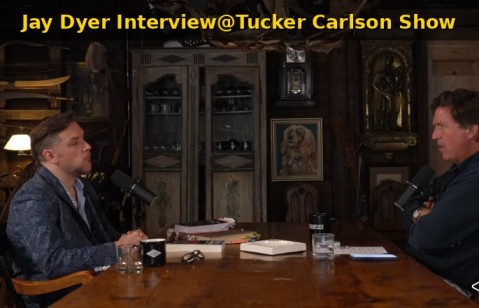
The following is the full transcript of author Jay Dyer’s interview on Tucker Carlson Show, July 13, 2026.
Editor’s Note: In this episode of his show, Tucker Carlson sits down with Jay Dyer to explore the deep theological roots of Christian orthodoxy and its historical significance. Dyer explains his personal journey toward the Orthodox Church, contrasting its teachings with Western theological developments and discussing the historical “black hole” regarding the first thousand years of Christianity. Together, they examine how certain philosophical shifts—like nominalism—have influenced modern society and address misconceptions surrounding faith, marriage, and the role of the church in contemporary life.
Jay Dyer on Orthodox Christianity, Byzantine History, and the Church
TUCKER CARLSON: Jay Dyer, thank you very much for doing this. I have a lot of questions to ask you, but I want to begin with Orthodoxy. You are one of the most visible and maybe effective evangelists for Orthodoxy, Christian Orthodoxy, certainly in your age cohort, maybe in the country. You’re Orthodox. Why are you Orthodox? What is Orthodoxy?
Jay Dyer’s Journey to Orthodox Christianity
JAY DYER: I’m Orthodox because I went through a long journey trying to figure out what authentic Christianity is. And so I was raised Baptist. That took me eventually into Catholicism when I was about 20, 21. I think I read St. Augustine’s City of God. I read a bunch of his other works, and I thought, well, Baptist isn’t right because I’m finding in the Church Fathers all these teachings that are not Baptist. And so that kind of gradually took me in the realm of traditional Roman Catholicism. I did that for a long time. And as you get into, I think, the more recent problems of Vatican II, post-Vatican II theology, that led me to the question of how do I reconcile this with what I know the first 1,000 years of Christianity teaches? So long story short, it took me about 8 or 10 years. I finally came to the Orthodox Church about 10 years ago.
TUCKER CARLSON: So that’s the simplest, quickest reason is because I think the first 1,000 years of Christianity, I think to most modern Christians, certainly American Christians, that’s like a black hole. What does that even mean, the first 1,000 years of Christianity?
JAY DYER: It’s an area that we’re not taught. I know that when I went to college, the only thing that we talked about from that whole period was Augustine’s Confessions and maybe one other book or two.
TUCKER CARLSON: Then we have something called the Dark Ages and nothing happens.
JAY DYER: Nothing about Byzantium.
TUCKER CARLSON: Didn’t even exist. And then these people called the Medicis make a ton of money in Italy and start funding beautiful art, and that’s the beginning of civilization.
JAY DYER: I remember at college, I was pressing the department, like, why don’t we study some medieval stuff, some Byzantine stuff? And they were like, why should we? We don’t care about that Christian stuff. So yeah, I think there’s probably a little bit of an intentional desire to suppress that. American education, I think, is pretty much brainwashing.
The Byzantine Empire and Christian Civilization
TUCKER CARLSON: But yeah, one sentence, this might take— between Constantine in the 4th century and the Renaissance, you had Christian civilization.
JAY DYER: The most successful empire in history is the Byzantine Empire, from Constantine all the way up until the fall of Byzantium to the Muslims.
TUCKER CARLSON: So why do you say it’s the most successful?
JAY DYER: That’s a common sort of academic assessment just in terms of their— they flourished on a gold standard for a really long time. They started clipping the gold, money clipping, like the Roman Empire in the West had done before them and other empires. So they fell prey to usury as well. They fell to a lot of the same issues that empires tend to fall to—
TUCKER CARLSON: Human weakness, like recognizable stuff, degeneracy, all of that.
JAY DYER: Also, rabid nationalism had a tendency to break down empires as well. I like Spengler, and I think if you read Oswald Spengler, he talks about how there’s kind of a life cycle. But I think the unique aspect of the Byzantine Empire was that it was explicitly Christian, based on Orthodox Christianity. And so in many metrics of what it is to be successful or flourishing, it flourished. But it did fall. And I think, again, I’m not trying to measure Christianity just on worldly success, but I do think it does play out in that way at times, right? If you’re really based around Christ, if your theology or civilization is logocentric, then it’s going to play out that way. You’re just going to prosper because you’re aligned with what’s true. You’re aligned with that transcendent source. So anyway, for me, that journey ended up being eventually Orthodox Christianity.
TUCKER CARLSON: So, but just really quick, back to the Byzantine Empire. Did you know it existed before? How many people are aware that there was a Byzantine Empire and know anything about its outlines?
JAY DYER: Not many people in the West. Again, there is a very clear, especially if you take humanities courses, the way they’re constructed in college and maybe even younger private type schools, you go from, you do the pre-Socratics, you do Plato and Aristotle, and then you do Augustine, maybe a Stoic or two, and then you jump to Descartes. So you skip that whole period.
And not just to say Byzantium, but also the Latin West was explicitly Christian as well. I think it’s intentionally overlooked. They don’t want people reading what brilliant thinkers were doing in the Middle Ages because this is where we get universities. Universities come out of Byzantium, they come out of the West, so do hospitals. So some of these very fundamental— science itself actually comes out of that whole period.
But we are taught, we think that no, these are all post-Enlightenment, post-Scientific Revolution developments.
TUCKER CARLSON: I mean, medieval is an adjective, but also an epithet that’s medieval by design. Drawing and quartering somebody, it’s Dark Ages. They were dark.
JAY DYER: That’s all Voltaire. That’s all sort of an atheistic French Revolutionary attack on what came before. By design.
TUCKER CARLSON: When did you learn that?
JAY DYER: Well, I was really interested in medieval thought, scholastic theology in college in my 20s. And so I was reading Aquinas and reading all these guys as I had all these atheist professors who were constantly debating with them. I even did a public debate my sophomore year with the atheist professor. So I would be reading all those guys, studying philosophy and history, and then debating with those guys, and then coming to my own conclusions about that stuff through just reading.
The Path to Orthodoxy and the Church Fathers
TUCKER CARLSON: Interesting. I keep interrupting your story. So that led you to Orthodoxy?
JAY DYER: Long story short, yeah. Roundabout way, I went from traditional Catholicism in my 20s to eventually, I took about 8 to 10 years to study Orthodox stuff pretty intensely. I’d put a lot of time into reading the Latin Church Fathers. So I was reading Jerome and Ambrose, and a lot of Augustine’s works. And then I realized I’ve never actually read the Eastern Church Fathers.
And if you get into church history in that first millennium that you talked about, you realize that all the 7 or 8 ecumenical councils of that first millennium, they’re actually all had in the East. They’re all called by the emperors, the Byzantine emperor. They’re not called by the Pope. Certainly the Pope was either there or had legates there, so the West was represented, but it was in its ethos, it was essentially Eastern and Eastern in its Orthodox theology.
So I just decided to go on a long reading track of reading all those guys as best I could for many, many years. So that would be like the Cappadocians, that would be Basil, the 2 Gregories, St. Cyril of Alexandria, St. Maximus Confessor, St. John of Damascus. Those are some of the key figures in that milieu of the first 1,000 years that set the tone of all of Christianity in terms of its most fundamental doctrines, the Trinity and Christology, right? That’s what Christianity is. Those 2 doctrines are the key sort of linchpin that it all hangs on.
So the first 1,000 years is dominated by those topics. And that, in a roundabout way, a lot of people don’t realize this either, that actually conditions what type of Christianity you’re going to have, how it’s going to affect society, how it’s going to affect your life. So for example, if you have a very truncated version of, say, evangelicalism that’s only based around just how you’re saved, right? That’s not going to affect society.
And so those types of Christianities, or I would say deviations, they’re also very susceptible to being used by other groups. I know you just had a guy on talking about evangelical Zionism and dispensational theology, because that theology is sort of based around an imminent, end of the world type scenario, you sort of retreat and you’re not able to create a vibrant cultural effect of Christianity. That’s by design. People figured that out. They were very cunning a few centuries ago. They realized that that’s the kind of Christianity that can be useful.
Thin Theology and Susceptibility to Subversion
TUCKER CARLSON: So that theology, which I’m not an expert in but have heard a lot about in the last couple of years, is so totally incompatible with what the New Testament actually says. That it makes you wonder, like, what kind of church could fall for that? And it would be a church with a pretty thin theology. And exactly right. And a structure that couldn’t do anything about apostasy.
JAY DYER: And it’s also antithetical to the Christianity of the first 1,000 years. And the reason I keep saying the first 1,000 years is that that’s not just where we get these doctrines of the Trinity and who Jesus is formulated, but we also get the Bible. The Bible itself comes out of decisions of church fathers centuries after the apostles.
TUCKER CARLSON: Yes.
JAY DYER: So if we’re going to have a church or a religion based on the Bible, we really already truncate Christianity because the Bible itself in our ethos is a liturgical document. It’s actually part of a liturgy. It’s not a personal devotional book primarily. So divorce it from that context, divorce it from the community that produced it, is what produces sort of aberrant truncated versions of the religion that make it susceptible to princes, foreign governments, NGOs, think tanks, foundations. They become essentially tools of soft power, which is what I think much of the evangelical Protestant world today— not indicting the individuals, but the groups, the denominations— they’re very easily bought off.
For example, very wealthy families in the West about 100 years ago were able to buy off many of the mainline Protestant denominations and turn them into effectively NGOs. Just one example, the Rockefellers, and they’re not the only family, but they’re one of the families that invested very heavily in not just the UN but also the World Council of Churches to create a sort of a supra-international version of the UN that would be for religions. And they were very explicit in their biographies about how this was to basically make it kind of an NGO, so make Christianity into kind of a form of soft power for American interests, really oligarchical interests.
And that’s one of the weak points, I would say, of Protestant theology, evangelical theology, is that it’s very susceptible to that. Not to say that the Roman Catholic Church or even amongst the Orthodox Church, there aren’t people that are susceptible to the same types of subversion, but I think it’s a lot more difficult when you have an ancient historic type of church that has certain structural integrity and normativity to it, right, that Billy Bob Strip Mall Church, right, doesn’t have.
TUCKER CARLSON: Because unlike Billy Bob’s strip mall church, the 2,000-year-old church can say, wait a second, we’ve never believed this. We’ve never done this. Why would we be changing? There is a sense of continuity.
Calvinism, Iconoclasm, and the Orthodox View of Salvation
JAY DYER: There is. There’s also, if you have the attitude of a standard sort of Protestant evangelical person, there’s nothing in history settled because every generation kind of has to reinvent the wheel. They have to redo all the same controversies and crises all over again. Because they could have all been wrong. Nothing is settled, right?
Because for Protestant evangelical Christianity, the Bible and the apostles are kind of like the end. I know that a lot of Protestants would say, “Well, we like Athanasius, we like Saint Augustine or whoever.” But when you actually go and read them, they have bishops, they have relics, they have the Eucharist, they have all these elements that don’t align with the Protestant Reformation.
So I was an avid Calvinist. I was super into John Calvin and all that stuff when I was a younger guy. And it was unsettling to read these guys and realize, well, they don’t teach Calvinism. So what am I going to do here? Either not be a Christian, or I can align myself with whatever the first 1,000 years of Christianity actually is.
And I say the first 1,000 years too, because Catholics and Orthodox share that first 1,000 years. So we both have that in common. So I think that narrows it down. It’s either going to be Roman Catholicism or it’s going to be Orthodoxy because—
TUCKER CARLSON: But what about Orthodoxy struck you as non-Calvinist? Like, what are the differences, the big differences?
JAY DYER: So Calvinism is not just predestination and the sort of strict soteriology or salvation doctrines. It’s also iconoclasm, which ends up, I think, affecting one’s view of art and aesthetics.
TUCKER CARLSON: Idol smashing.
JAY DYER: Correct. And I was a very avid sort of iconoclastic Calvinist when I was young. It’s also very rigid in terms of its view of social structure, church and state. The more I read the church fathers, the more I got into that kind of a theology, I realized that Calvinistic sort of republicanism doesn’t really match up with Byzantine imperialism or monarchy, the traditional views of the church’s take on governance.
TUCKER CARLSON: The Byzantine Empire was a theocracy. Yeah.
Church and State: Byzantine Symphonia vs. Calvinist Republicanism
JAY DYER: Well, yeah, pretty much. What’s interesting is that there are spheres, right? So you have basically, if you think about the Byzantine double-headed eagle, that symbol is one body of the people, but church and state as 2 separate heads. So there’s spheres of authority, but one body that they share, which is the people.
And then the West to a degree had this until the Middle Ages, when you get sort of a rise of the 11th century papacy, which becomes also the state. So you get papal states, and the famous document called Dictatus Papae says the church is also a state now. But until that time, the norm was church and states were working in unison — symphonia, is what it’s called in the Greek.
So that’s what I had to grapple with. But Calvinism really doesn’t see it that way. It’s more like — it favors republicanism. There were famous battles in England, for example, between the Presbyterians and the monarchists. So they actually had a huge fight within the history of the English Reformation as to whether they would be Anglican sort of monarchists or whether they would be Presbyterian Republican Calvinists. So that was a famous Reformation battle.
But long story short, Calvinism I think is just antithetical to the first 1,000 years of Christianity, not so much because of those aesthetic or cultural issues. It’s also Christologically errant in that the whole idea of what salvation is, is ultimately one’s legal standing in terms of what’s called justification by faith alone, or penal substitutionary atonement — this idea that you’re justified by God through a sort of notional acceptance of a set of ideas, and then God’s attitude towards you changes. So it’s dispositional, but it’s not focused on an actual ontological change in the person.
Orthodox theology is very different. God’s disposition is based not on purely a legal stance, but on your actual ontological change. So a metaphysical change in you versus a dispositional attitude. Maybe we don’t get too heavy into philosophy, but I do want to.
TUCKER CARLSON: What’s the difference between the two?
Nominalism and Its Consequences: From William of Ockham to Postmodernism
JAY DYER: Basically, there’s an idea in the Middle Ages called nominalism. Have you heard of that?
TUCKER CARLSON: Yes.
JAY DYER: Okay, so nominalism is the idea that there are only names to things, not essences. So there’s no human nature. There’s no dog nature. When we talk about natures or classes or sets of things, we’re not giving an ontological or metaphysical status. We’re just simply classing things together linguistically in a set.
The Middle Ages and the ancient world — the time of Paul or the church fathers — they thought very differently. They thought that things have natures, they have essences. And so the words aren’t just terms or nominal nameism. They actually describe what’s really there in them metaphysically. So there is human nature. And in Orthodox theology, Christ assumes—
TUCKER CARLSON: Who would deny that?
JAY DYER: In the Middle Ages, it begins with people like William of Ockham. So Ockham is the first nominalist.
TUCKER CARLSON: The man with the razor.
JAY DYER: Exactly. He’s known for that. And he challenges some established ideas of essentialism — that things have essences. And so he also goes up against this idea of universals, that there’s no such thing as a universal class or essence of a thing. And that had been kind of the norm since Plato and Aristotle as well.
But so you get a denial of essentialism and essences, and then you get another guy named Gabriel Biel, and he’s very influential on Martin Luther. And so when the Reformation kicks off, there’s this debate about: how could you be called righteous if you’re not in fact righteous? So if as a human being you are “menstrual rags,” as Isaiah says, as the Reformers said, then how could God call you righteous without being a liar?
Well, enter in nominalism, and nominalism is able to say, “Ah, because things don’t actually have essences, they just have names. And so if God calls you that, you are that legally” — even though in actual fact you’re wicked. And Luther was very happy to utilize that nominalistic approach.
By the way, this is not just my theory. There are famous Lutheran scholars. There’s a book called Harvest of Medieval Theology by Heiko Oberman, and the whole thesis of that book — by a Lutheran — is that Luther had to use nominalism.
So we’re also moving away not just from theological squabbles, but from the idea that things have natures. And this is how we get to David Hume and Kant and these Enlightenment figures, which give us the Scientific Revolution, supposedly. This is how we get to “there’s no male and female.” So you can see kind of the logical train here. If things don’t have essences, well, then they don’t actually have genders objectively, because everything is just a name. So I can just name myself he/him/zir/zee/it.
I’m not trying to go too fast or too far in the sense of ideology, but I’m saying there is an ideological sort of progression that you can get from nominalism to where we are now with postmodernism, and then with essentially—
TUCKER CARLSON: It’s interesting that an adult could believe in something like that. I mean, having lived your life, known people, known animals, seen nature, and arrive at the conclusion that nothing has an essence, everything is just what we call it — that flies in the face of your experience. It has to, right?
JAY DYER: What’s that saying — “You have to be an academic to be really stupid”?
TUCKER CARLSON: Yeah, I mean, I guess that’s right.
JAY DYER: Yeah, to be indoctrinated into believing some sort of — I remember Terence McKenna. Do you remember the psychonaut Terence McKenna? I remember reading him one time and he said something like, “This is all just magical thinking. If you take the shroom, you’re going to see that things don’t have essences, that things just have names and you just change the name.” And I’m like, that’s the gender idea right there.
Luther, Nominalism, and the Doctrine of Salvation
TUCKER CARLSON: Yeah, and that’s just its kind of apogee. The gender insanity is just the most obvious.
JAY DYER: But it has a precedent in this theology, this theology debate we’re supposed to be talking about.
TUCKER CARLSON: That’s amazing. I’ve never heard that before. Huh. I’m sorry to hear that about Luther, who I’ve always loved. There’s a lot to love about Luther. He’s a character for sure. Quite—
JAY DYER: He would actually chase the devil away with farts, which I think is great.
TUCKER CARLSON: Quite a robust man and a happy family life and everything about him I like. But that is impossible to defend. It just flies in the face of reality.
JAY DYER: Yeah. And even modern scholarship in the Protestant world, there’s a great book by Alister McGrath out of England — I think he’s Anglican — it’s called Iustitia Dei. And his book was kind of a landmark in Protestants coming to the table and saying, “Okay, look, Luther’s doctrine of salvation is not in the first 1,500 years, unfortunately.”
TUCKER CARLSON: So the understanding of salvation that preceded the Reformation was that people had to be changed in their essence in order to be saved.
Theosis: Participation in the Divine Nature
JAY DYER: Yes. So there’s an actual participation in what Orthodox theology calls the uncreated energies. So we believe that God has infinite divine energies and operations — attributes, as it’s called in the West. And for Orthodox theology, and this is the patristic teaching as well, we participate in that. So we’re not just changing a legal status, we’re actually participating in the life of God himself.
Which, when you go back and you read the New Testament, you’re like, “Oh, actually, well, that makes more sense,” because Jesus says in John 17 that he came to give us a share in the glory that he had with the Father before the foundation of the world. So divine glory can’t be a creature. And so Jesus is equating grace with divine glory. So unless you think God has created parts — which would be polytheism or some form of idolatry — uncreated grace has to be a reality that’s a participable thing.
TUCKER CARLSON: Well, Jesus promises that the Holy Spirit will flow into people and change them.
JAY DYER: Right.
TUCKER CARLSON: And that happens.
JAY DYER: The Spirit’s not a creature, because then you would be anti-Trinitarian. So absolutely, this is why Peter says in his epistle that we become “partakers of the divine nature.” So very strong language in the New Testament, in the epistles, for what we call theosis in the Orthodox Church.
Paul says, for example, in Thessalonians, that it is the dunamis, or the power of God, that is at work in him. So the actual power of God, which can’t be a created thing or created grace — which unfortunately, even in the Latin Roman Catholic Church in the Middle Ages, created grace becomes a normative thing where what you’re getting is just another form of created.
The Orthodox Church is saying, “No, no, the incarnation itself tells us that the uncreated united itself to human nature in incarnation, and that Jesus deified the human nature that he assumed with his own immortality, grace, and uncreated energy.”
The Bible as Liturgical Document in Orthodox Christianity
TUCKER CARLSON: The role of the Bible in the Protestant world versus the Orthodox world — you described it this way. I think you said in Protestant Christianity the Bible is seen as a tool, as a guide — of course, the guide, the only guide really — and it is a devotional.
JAY DYER: Yeah.
TUCKER CARLSON: But in the Orthodox Church, it’s a liturgical document.
JAY DYER: Correct.
TUCKER CARLSON: What does that mean?
The Liturgy, the Reformation, and Rosicrucian Influence
JAY DYER: Liturgos has to do with the Greek word of offering or offering of thanks, offering of praise. But it’s also in the Hebrew tradition, we think that that was proto-Christianity, the ancient Hebrew texts. It was part of, for example, David’s Psalms. Those were Psalms that David wrote to be sung at the temple liturgy.
TUCKER CARLSON: Right.
JAY DYER: So liturgy is a sort of structured form of worship that Orthodox, Roman Catholics, Anglicans, Episcopalians, they have a very structured form of worship that is called liturgy. But originally it just means sort of offering. And even in Pauline epistles like the book of Hebrews, towards the end of it in chapter 13, Paul talks about Christians have an altar that they eat from that the Jews that serve at the tabernacle have no right to eat from. Because our altar is the true altar, which is thus a liturgical altar. That very chapter he discusses the liturgical thanks and offering at that altar.
So from the earliest days, Christianity had this sort of altar-based form of worship. Again, another Reformation distinctive is that they begin to move away from the idea of an altar towards a table, right? So you have a sort of a desacralizing of the worship space to not be a Eucharistic offering, but a shared meal, which— and we’re not totally opposed to the idea of it being a shared meal, but it’s first and foremost a worship offering.
If you go back to Abraham, Abraham built an altar. God is always worshiped at an altar, at least the biblical God. So for us, the Reformation then represents a form of turning away from that. It’s a form of sort of Judaizing. It’s a form of returning to a form of rabbinical theology. And many of the Reformers were actually very influenced by rabbinic theology, by the Talmud even. So the Reformation has a stream of influences, Renaissance humanism, all those things play into that. And it’s just very—
TUCKER CARLSON: Well, Luther was not in that category though. No?
JAY DYER: He was not interested in rabbinic theology, but he was influenced by what’s a text called the Theologia Germanica, which was a Neoplatonic text. And so there was also some— there’s also some evidence that scholars have pulled up that suggests that Luther might have had an interest in Hermeticism. I’m not saying that that dominates his idea, but more so with Calvin and some of the Swiss Reformers, they were a little more directly influenced by rabbinic theology and Talmudism, but not so much Luther, no.
Luther was very anti— I mean, he didn’t even like Moses. He said, “I’d like to punch Moses’ teeth out.” So Luther didn’t even like the Old Testament at times. But again, he’s a boisterous sort of—
TUCKER CARLSON: He certainly was.
JAY DYER: Satirical character at times. So it’s hard to know exactly.
TUCKER CARLSON: The most hilarious theologian in history.
JAY DYER: He was very hilarious. So it’s hard to know exactly when he’s always being literal. He might just be joking around. But no, I don’t mean to mischaracterize, because I know Luther wrote about the Jews and their lies. That’s a famous text that he wrote. So I’m aware of that. But just in terms of the general trends of the Reformation outside of Luther with Calvin, Zwingli, Melanchthon, even later Lutherans were very involved in the founding of Rosicrucianism. Johann André is believed by some scholars to be the author of the Rosicrucian Manifesto. I forget exactly what it’s called. But so that is there, and a lot of that has to do with Kabbalistic ideas.
The Rosicrucians and Secret Societies
TUCKER CARLSON: Who were the Rosicrucians?
JAY DYER: This was an Enlightenment-era secret society of sorts, which in the 1600s, 1700s, there was a lot of these that were popping up everywhere because you still had in Protestant countries, you had certain laws that would— and in Catholic countries as well, they would forbid participation in secret societies. They would forbid practicing of the occult in various ways. But you also had court alchemists and people that would kind of, like John Dee, he was the court astrologer to the queen. So they would kind of do these things on the down low secretly.
And so you get a rise of these secret societies. This is where some of the first speculative Masonic lodges start to pop up in the 1500s, 1600s in Europe. But you also had a very interesting confluence of Hermetic and Kabbalistic groups that were popping up, particularly Spanish rabbis that were very popular in Spain seemed to be involved in some of the rise of Kabbalistic influence in the West. And that, I think, contributes in part to the Rosicrucians who, according to— there’s a great book by Dame Frances Yates called Rosicrucian Enlightenment. She actually argues that the Enlightenment itself was heavily influenced by Rosicrucian ideology.
So they were Neoplatonists, they were into magic, alchemy. So they were really interested in the idea of transmuting metals into the Philosopher’s Stone, which some people thought was a real thing you could do, and others thought, well, that’s just an allegory for how to undergo transformation into your better self or to become God in a literal sense. Not in the sense of Orthodox theology, but so all of these, there’s sort of different strains and strands, but basically in the hermetic world, witchcraft. Yeah, you could say that.
TUCKER CARLSON: Yeah. Huh.
JAY DYER: A form of it. But again, that’s all very diverse. I mean, I think in the case of John Dee, for example, he’s the first 007. Did you know that?
TUCKER CARLSON: No.
JAY DYER: Yeah, so the 007, which is 2 balls and a cane which is 2 bull cane. That’s how John Dee would sign his secret letters to the Queen, because he was one of the influences on James Bond. So that’s where we get 007 from. And Ian Fleming consciously took that from John Dee. But my thesis, and other people think this as well, is that when he created this sort of magical angel language that he called Enochian after Enoch. It was just a way to do spy codes and ciphers, wasn’t it? I mean, he might have actually done some rituals, but it was also very useful as a tool for sending messages to Elizabeth that other people couldn’t decode.
The Bible in the Orthodox Tradition
TUCKER CARLSON: So in the Orthodox tradition in the church, the Bible is read aloud. Are Orthodox encouraged to read the Bible on their own?
JAY DYER: Sure. I mean, St. John Chrysostom actually said famously that the laity have more need of reading the scriptures than even the monks or the priests because monks and priests live in the liturgy, which for those that don’t know, in the Orthodox Church, basically every aspect of the liturgy and the liturgical calendar is Bible. It is scripture constantly. It’s like every aspect of it.
And so, Chrysostom’s argument was, laity need to be in the Bible more than they do because they live it. So, if you’re not in the liturgy all the time like those people are, the best substitute is the little church, which Chrysostom calls the house. So, the household is, in the Orthodox idea, kind of a little mini church. So, absolutely, we got to be in the Bible all the time. And that shows that we’re not anti-Bible like a lot of sort of Protestant evangelicals think.
Luther, the Vernacular Bible, and the Orthodox Church
TUCKER CARLSON: So one of the reasons there was a Reformation in the first place is because the Catholic Church over time began to hide the Bible from Christians. And it was not published in the local language in Europe. It was in Latin. It was the Vulgate. And Luther’s great breakthrough was to publish it in German, to translate it himself into German. Did the Orthodox Church do the same?
JAY DYER: Yes. In fact, this is one of the differences between the pre-Vatican II Roman Church and the Orthodox Church is that the Orthodox always put it in the vernacular. Everything. The liturgy, homilies, they’re supposed to be in the vernacular of the people. In fact, the Vulgate itself was originally the vulgar Bible. It was the Bible of the people.
And so yeah, I think there was an element to where the Latin Church, the Roman Church, had just sort of solidified into a kind of a tradition. And it’s not inherently wrong to maintain that linguistic heritage, but it’s also possible to put it in the vernacular for the people. I mean, that’s the whole idea behind translating the Bible into the languages of the people so that they can understand it. But that is one of the differences pre-Vatican II. But interestingly, after Vatican II, there were both Protestant and Orthodox influences on the reforms of the Roman Catholic Church, and thus Rome then became emphasizing— they began to emphasize the vernacular after Vatican II.
Icons and the Orthodox Tradition
TUCKER CARLSON: You said you were an iconoclast, a smasher of idols. Orthodoxy famously incorporates icons, paintings on wood, into its worship. What is that?
JAY DYER: This is again a huge misunderstanding that we would argue, we believe, is part of proto-Christianity. It’s part of Hebrew proto-Christianity. So when you go back to the Book of Kings, when you go to the Book of Exodus, and you see the way that the tabernacle and then later the temple are described, they are tremendously ornate. You’ve got gold images of angels, and you’ve got the Ark of the Covenant with angelic imagery on it. So we don’t believe that real Old Testament Christianity or Old Testament Judaism, you could say, not rabbinic Judaism. We think that’s something different that developed in the 4th and 5th century.
TUCKER CARLSON: Well, it is something different.
JAY DYER: Yeah. But proto-Christianity or the Hebrew tradition was not iconoclastic. They were against idols, but not all imagery. In fact, and this is something that really changed my mind when I was Calvinist, if you think about it, the Bible is a book, but words are just iconographic versions of images. They’re a type of image.
TUCKER CARLSON: Of course.
JAY DYER: And so the more I thought about—
TUCKER CARLSON: The written word. Yeah.
The Role of Icons and the Orthodox Church’s Foundation
JAY DYER: The more I thought about that, it’s like, well, you can’t actually say all images are bad because capital F-A-T-H-E-R, that’s a type of an image. In the Orthodox Church, we don’t typically image God the Father. We think that, as Jesus says in the book of John to the Pharisees, he says, “No one has seen the Father at any time.” And he’s quizzing the Pharisees there because he’s saying, so who do you think Moses was interacting with on Mount Sinai if no one saw the Father? Because it says Moses saw God face to face. Jesus is basically saying, “I was talking to Moses. I’m God.” That’s why the Pharisees want to stone him in that chapter, because he’s saying he’s the face of God that was interacting with Moses.
So this is why the book of Colossians, the book of Hebrews call Jesus the icon, I-K-O-N in the Greek, the image of the Father. This enrages the Pharisees. So we think that iconography directly flows out of the incarnation, the Son being the image of the Father. Thus, throughout the early church, you have the development of the liturgy, even in the 1st and 2nd century. And this has been shown through archaeological evidence, through people who study liturgy, they’re called liturgists. Even Protestant Anglican liturgists note that the early church had altars, they had imagery, even synagogues in the 1st and 2nd century.
One of the famous cases is the Dura-Europos Synagogue in Syria. I think it’s from the early 200s. It’s lined with images, paintings of Old Testament scenes and imagery. So the Orthodox Church, if you look at the Dura-Europos Synagogue, is the most natural development of if Christianity was going to open up to the Gentiles and it was coming out of the temple, and synagogue liturgical system is exactly what it would look like. It would look like an Orthodox church. And lo and behold, that’s what Orthodox churches look like.
And by the way, I remember in 2023, my priest, who’s a great Russian Orthodox priest, Father Vladimir, he took us on a pilgrimage to Italy. And I was like, why are we going to Italy? That’s not Rome. Well, there’s 1,000 years of Christianity prior to the rise of the medieval papacy. In Italy. There’s tons of Orthodox places that you could go to, right, in Italy. And so we went to the catacombs in Rome, and lo and behold, when the Christians were persecuted and they’re underground in the catacombs in the 1st, 2nd, 3rd century— by the way, you can never see all the catacombs. We spent a whole day just in one of the catacombs in Rome. There’s altars, there’s images that they painted in the 1st, 2nd, 3rd century. So even the catacomb church had liturgy, had imagery. Plenty of examples of this. The church fathers also write about it as well.
So those are huge, I would say, differences between— and remember, people couldn’t read back then. Most of the Roman Empire was illiterate. So when they would go to these services in the catacombs or wherever, they would be hearing the word of God. That’s why Peter says, “This is the word of God which was preached to you.” Paul says to Timothy, “Pass on all the things that you heard from me in the presence of many witnesses.” So that oral teaching, that oral hearing of the liturgical worship was the norm.
And then one of the things that really cracked it for me as a Protestant when I left Protestantism was when I learned that— by the way, I learned this from evangelical scholars— one of the things that developed the canon of the scripture itself in terms of how the church decided what books go in and which ones don’t was what’s called the lectionaries. Lectionaries are the daily liturgical readings in the churches. So when the church fathers were having these councils and they were meeting, and the canon of scripture doesn’t actually get solidified, at least for the Orthodox Church, until the 6th and 7th century, they would say, “Okay, which ones do we have a tradition that says Paul wrote or Matthew wrote? Which ones are in the daily lectionaries?” And if you’re a Protestant, you believe in sola scriptura, the idea that liturgy and liturgical tradition play this huge role in the determination of the canon make it very difficult to say that we’re based on scripture alone, sole scripture.
Is Orthodoxy Based on the Bible Alone?
TUCKER CARLSON: So Orthodoxy is not based on just the Bible?
JAY DYER: No, we would say the Orthodox Church is based on the idea of apostolic succession, that the apostles appointed successors in various bishoprics and sees throughout the Roman Empire. It’s based on the tradition, which could include the lives of the saints. It could include liturgy. It could include all kinds of writings of the church fathers, canons of the councils. Those are traditions and the Bible. So all of those elements go into what the basis of the Orthodox Church is. Whereas in the Protestant world, you have elected elders or something like that, but you don’t have this sort of 3-tiered stool of apostolic succession, tradition, and Bible altogether.
Practical Differences: Orthodox vs. Catholic vs. Protestant
TUCKER CARLSON: What are the practical differences? As a weekly communicant in an Orthodox Church, how is that different from being a Catholic or Protestant?
JAY DYER: Well, certainly we would have more similarities to a Roman Catholic than most Protestants or evangelicals. There might be a high church Protestant or Anglican communion that would have some similarities with Orthodox Church. But for the Orthodox world, fasting is a lot more integrated into what we do than most people.
TUCKER CARLSON: Fasting?
JAY DYER: Yeah, there’s a lot of fasting days in the Orthodox Church calendar.
TUCKER CARLSON: What does that mean for you?
JAY DYER: Oh, just abstaining from certain foods. Lent is a little more rigorous for the Orthodox than it is for—
TUCKER CARLSON: Why fasting?
JAY DYER: Well, we think that Jesus and the apostles and people like John the Baptist kind of set the tone for retaining an element of asceticism in the church. So obviously some people could take that to the extreme. We’re not Hindu yogis sitting out under a tree trying to roll around and poop or whatever, but we do think there is virtue in training the body to be subject to the will so that the body’s desires and passions don’t control us. So that’s why fasting has an important role. Basically, learning to control the passions is what that’s part of.
TUCKER CARLSON: How often do you fast?
JAY DYER: I am not the best at fasting because I have really weird gut biome issues. So I don’t fast as much as I should. It’s very challenging. But there’s also people that there’s nuances for medical issues. But the Orthodox Church fasts quite a bit, usually from various meats and stuff like that.
But it’s not just fasting that’s different. I think for the Orthodox Church, it’s not just about food. Fasting is also almsgiving because you’re sort of— it’s self-denial that’s not just about diet. It’s also, for example, during Lent, it would be appropriate to confess more. It would be appropriate to give more than you normally would. So we make a pretty big deal about things like almsgiving, whereas, and I’m not saying that other groups don’t give, but I think that’s stressed a lot more in the Orthodox Church than it is perhaps in Protestant churches or other domains.
But I mean, there’s immense differences, I would say, between just the— communion is a lot more serious in the Orthodox Church. You don’t commune unless you’re Orthodox. We don’t have what’s called open communion. So a Roman Catholic can’t come, or a Protestant can’t come and just commune. Most churches are way more open about that. It’s very strict in the Orthodox Church in terms of communion. And usually within the liturgy, the priest says, “All who are baptized Christians who have prepared themselves through confession may approach the table,” because we take it very seriously. We think it is actually the body, blood, soul, and uncreated energy of Christ. So we don’t want to treat that lightly. And I’m not saying that Protestants don’t have a reverence for their version of the sacrament, but it’s just a lot more serious, I think, in the Orthodox Church than it is elsewhere. But we do have some of the sacramental principles like confession to a priest that Protestants don’t have. So again, there’s a whole milieu of wide scope of differences between—
Orthodoxy and Views on Government
TUCKER CARLSON: How is it, since the religion you described was originally tethered to a government, an empire, how has becoming Orthodox changed your view of government and its role?
JAY DYER: That’s an interesting question. When I was a Calvinist, I was more like a sort of a libertarian, you know, get the state out of everything type of—
TUCKER CARLSON: It is the religion of libertarianism, isn’t it?
JAY DYER: But as I got more into historic Christianity, I started to realize that, well, maybe republicanism isn’t like the highest form of government. Maybe it’s not necessarily the best. And I’d never read any critiques of republican governance and whatnot, but it turns out there have been quite a few people, especially after the Scientific Revolution, there were conservatives and right-wingers who were writing pretty, I would say, substantial critiques of republicanism. I think even members of royal families were writing pretty good critiques of— well, naturally, yeah, they have a vested interest there, probably.
TUCKER CARLSON: But I mean, no, but there were liberal in the best sense-minded people, people who believed in inalienable rights who argued that a republican form of government, self-government, democracy, would devolve into tyranny.
JAY DYER: True. Plato wrote even back in his day that— and he was of course a proponent of republicanism, but he wrote that the more decentralized in the sense of democracy, he didn’t like democracy at all. He thought that that would eventually lead to mobocracy and the rule of the passions. Because the oligarch in that type of a democratic setting has the incentive to appeal to the biggest number at the lowest basis, lowest common denominator. And then it becomes incumbent upon him to really play on the passions of the mob. So why not debase the people because they’re easier to control, the mob? So there’s an incentive that even Plato noticed back then.
TUCKER CARLSON: I think he writes in The Republic, “If this happens, they’re going to legalize weed.”
JAY DYER: They’re going to legalize everything to do with butt stuff. Yep. So it becomes fake and gay. So he sought, I think, in various ways, even as a pagan philosopher, to try to figure out some way to have a society based on sort of objective, almost mathematical principles. By the end of The Republic, it’s sort of like you get the impression that he thinks that you need to go study mathematics on the top of a mountain for 20 years, and then you come back and then you sort of instantiate mathematical forms into the society.
And it’s interesting because later on, by the end of his life, he seems to progress towards more of like a secret society type of governance because he has this— I’m going from memory— maybe the Symposium or the other one, but he argues that there’s this Council of Night, N-I-G-H-T, which is a governance board of like spy chiefs.
TUCKER CARLSON: Yep.
JAY DYER: And so they meet at night because the public’s too stupid to know what’s going on. Which is just weird because it reminds me of— I remember reading something about Kissinger talking about the wise men, and it’s like Plato’s talking about like Henry Kissinger’s form of like secret government.
TUCKER CARLSON: And we devolve to the level of Jeffrey Epstein.
JAY DYER: Yeah, exactly.
TUCKER CARLSON: Coney Island.
JAY DYER: Exactly.
The Decline of Liberal Democracy and What Comes Next
TUCKER CARLSON: Yeah, but it’s all the same thing. It’s just— I mean, Jeffrey Epstein was an idiot, which no one wants to say, but he was, obviously, when you read his writing. And so it’s sort of our version of that. So I notice that the enthusiasm for liberal democracy, whatever that is, but our system of government that has produced our culture, enthusiasm is waning for that. I don’t know many people who— I don’t know anyone who wants dictatorship, just to be clear. But I don’t know anybody. I literally don’t know anybody who thinks the current system is working. So that suggests it probably won’t last. So what comes next and what should come next?
JAY DYER: Yeah, there’s no easy answer to that. I mean, I think again, when you look at Christian history, even in the West or in the Orthodox East, you have a pretty normative tradition of kings and queens, preferably kings. And that happens through a semi-sacramental service called a coronation service. So the Orthodox Church always coronated emperors, czars, kings. Some of the most famous kings in the history of the Orthodox Church fought massive battles. They went to war.
So I think one thing that ties into this idea of a de-Christianizing of the state, which is part and parcel with that sort of tendency in the Calvinist libertarian type of tradition, the classical liberal ethos, is there was a famous Russian statesman, Pobedonostsev, who wrote a book, Reflections of a Russian Statesman, around the 1890s. And he said, when you de-Christianize the state, you don’t get liberty. You get another cult that runs the state.
TUCKER CARLSON: Exactly.
JAY DYER: And he noticed that when—
TUCKER CARLSON: Before— I have too.
JAY DYER: Before the Bolsheviks, right?
TUCKER CARLSON: Really? Yeah.
JAY DYER: He had looked at the French Revolution and prior examples, and he said, you just get another cult that steps in and runs things. And you’re always going to be governed by religious fanatics.
TUCKER CARLSON: So the question is, which religion?
JAY DYER: Some good ones, or at least some nicer ones, or—
TUCKER CARLSON: Yeah, I’ve noticed that just from knowing people who run countries. Like, they’re all deeply religious people. Most won’t admit it.
JAY DYER: Yeah.
TUCKER CARLSON: Macron is not religious? Oh, he’s very religious. It’s just not your religion.
JAY DYER: Some other Luciferian.
TUCKER CARLSON: Yeah, exactly.
The Reformation, Church and State, and the Funding of Revolution
JAY DYER: I don’t know what. Yeah, so I think the Reformation, whether it intended to or not, ultimately kind of severed the relationship that the church had already sort of normalized between church and state, that symphonia that we talked about. And then you get— and it’s a confluence of interest. It’s not just ideologues like Martin Luther or whatever. In fact, many of the reformers had very powerful— like, for example, Luther’s Reformation wouldn’t have succeeded without the German princes being behind it.
TUCKER CARLSON: Of course, they were resentful because they didn’t want to spend the money.
JAY DYER: They didn’t want— and they didn’t want to be under the Pope. They were tired of the faith.
TUCKER CARLSON: Of course. And Germany was emerging as the great power in Europe. But why would you want to be ruled by Italy?
JAY DYER: Exactly. So there was a lot of resentment, papal stuff going on. Same with Henry VIII. He didn’t want to be under the Pope’s rules about his ladies.
So those combinations of interests— by the way, there’s also a Jewish influence on the Reformation as well. In fact, there were, according to Carroll Quigley, even Protestant and Jewish banking interests funded the French Revolution massively. And he’s got a great chapter on the rise of the Paribas system in France, which is the Rothschild banking system.
And then I just read in the Rothschilds biography the fact that they had a long-term vendetta with the czarist attitudes towards Russians, towards Russian Jews. And Lord Rothschild wired 1 million rubles to Lenin. I knew about other, like the Warburgs and the Schiffs, they had funded Lenin and Trotsky, but I did not know that according to Morton, they had actually wired Lenin a million dollars, so to speak, and he was supposed to pay it back, but he never did.
TUCKER CARLSON: Well, I think the Bolshevik Revolution was ideological, but I think it was also ethnic conflict to some extent. Obviously.
JAY DYER: Lord Rothschild said that. He said, “We’ve got to— we will make the Russian Christians pay for what they did.” For many centuries in his mind.
TUCKER CARLSON: Yep. Well, and they did. They made him pay. No one’s paid more dearly, actually.
The Rise of Orthodoxy in the West
TUCKER CARLSON: So Orthodoxy— I mean, a lot you just said I didn’t know because I know so little about Orthodoxy. I knew nothing about it 3 or 4 years ago. Now it seems— I don’t know, ascendant, but it certainly seems popular. Why is that?
JAY DYER: The internet has an interesting positive and negative effect it can have on all these domains. So I think in one way, I started looking at apologetic stuff around 2000, 2001, and back then it was you would listen to people’s cassette tapes, you would listen to a little MP3 on Windows Media Player or whatever. But now it’s everywhere.
The debate sphere, which is something that kind of grew not just from me, but other people like— well, Crowder used to go do this sort of “come convince me” debate people. And then Ben Shapiro would go debate the college kids, the purple-haired weirdos. So that’s a lot of low-hanging fruit that Ben Shapiro would do. But there also sort of accidentally almost came about a pretty intense 10 years or so of online religious debating.
Which again, it just sort of happened. It wasn’t something that I planned to do or anyone planned. It was just, I remember years ago somebody said, “Hey, would you debate this atheist guy?” He was a libertarian guy. “Yeah, sure.” So we did it on a whim. Then another guy, “Hey, would you debate this other French-Canadian atheist guy?” “Yeah, sure.” And then it sort of snowballs into a pretty regular thing of doing online religious political debates.
It’s gotten very popular throughout many outlets, and I think that is a huge contributor because especially if you’re a young guy who’s interested in ideas, you want to debate your ideas, you want to have them challenged, you want to know if your position is solid or if it’s weak. The older you get, the less you want to do that. People tend to be sort of solidified into their views, but younger guys are more interested in that.
TUCKER CARLSON: So that’s when you buy a cable package.
JAY DYER: And I think that it’s very natural, I think, to people in the West to do that, to debate their ideas. It’s not a feature necessarily of every other society to debate their ideas.
TUCKER CARLSON: No, that’s for sure. And increasingly it’s not a feature of our society.
JAY DYER: Exactly.
The Death of Debate Culture
TUCKER CARLSON: We were talking at breakfast, you were a debate participant champion in school. I was too. That was normal. I know it was normal, but it wasn’t as weird.
JAY DYER: It wasn’t seen as weird. Yeah.
TUCKER CARLSON: No. Now I don’t even know that that exists.
JAY DYER: I don’t think it exists on the internet. So people are gunning to—
TUCKER CARLSON: Kids in schools are not encouraged to debate, right?
JAY DYER: No. In fact, I remember years ago when I was doing undergrad and then grad school, they were already sort of trying to phase that out because we had a debate team when I was in undergrad. And then by the time I was in grad school, there was no debate team anymore. It didn’t exist.
TUCKER CARLSON: Right. Because the premium was on obedience at that point.
JAY DYER: Yeah, because they don’t want you critically thinking through your positions because then you might notice patterns which are not amenable to the status quo.
TUCKER CARLSON: Nicely put. That’s absolutely right. So, but people have been on the internet debating religion and Orthodoxy’s gotten a hearing for the first time maybe ever in American history. Yeah.
JAY DYER: And the result is— I think, I mean, it’s not the only contributor, but it did play a huge role in the rise of Orthodox converts in the last 5, 6, 7 years for sure. And again, it just, all of that, I guess, is providential because again, nobody in our sphere, our circles planned to do this. We thought it would be fun to do. I do a lot of different things. I don’t just debate. So it’s just sort of one of the side things I enjoyed to do at times. And that ended up, for whatever reason, being a lot more popular than I would’ve expected.
So we’ve debated many of the top atheists, Muslims. Jews are not huge on doing apologetics. It’s not— they don’t evangelize. So there’s only been a few Jewish guys that even wanted to debate. We’ve done a lot of political debates, feminist debates that have been pretty big, in terms of viewership. So I think that—
TUCKER CARLSON: Who were the most fun if you had to pick— a Muslim, atheist, feminist?
Debating Atheists, Muslims, and Cult Leaders
JAY DYER: They actually have a lot of similarities, believe it or not, between— Muslims are not very fun to debate. I wouldn’t say that they’re the most fun. I mean, atheists can be fun because they get really triggered with certain entailments, but probably the funnest debates are some of the more idiotic cult types of people. They actually end up being very comedic. So I do a lot of comedic stuff. So when we debate cult leaders, which we’ve debated several, those tend to be really funny. So they’re the most entertaining.
TUCKER CARLSON: Are there any atheists left in the United States? Is that— there wasn’t, you know, he is a movie.
JAY DYER: There was a period that was very popular in the 2000s, and I kind of think they ran out of steam. The worse things got in the West, the less appealing atheism was because it has no explanatory power. So when people start— especially after COVID and all that psyop— people noticed, okay, there’s some really evil s* going on in the world. I mean, like, we need some explanation, and these guys are basically saying there is no explanation, nothing means anything, right? So atheism kind of loses steam.
A lot of the YouTube atheists that were big YouTubers just kind of petered out. One of them was sticking bananas in his butt, and they just like— who cares? That’s gross. Weird stuff. And then other ones end up like marrying dudes that are women. So people begin to see, like, this has nothing to offer.
TUCKER CARLSON: I remember vividly someone telling me that Sam Harris, the famous atheist, was, like, really, really smart. “He’s really smart.” And I listened to Sam Harris once. I thought, that guy is not smart at all. Like, if that’s your ver— like, our standards, I think, have changed, maybe. And I think they’ve gotten higher.
JAY DYER: Yeah.
TUCKER CARLSON: Well, I think when people said Sam Harris was smart—
The Collapse of Atheism and the Jordan Peterson Effect
JAY DYER: Oh, yeah. In fact, I think the tail end of that period was those debates with Jordan Peterson, and Peterson was really critiquing atheist presuppositions. I think he— I felt like he could have even gone harder on those guys because they were already sort of losing the ground publicly. But even Jordan Peterson’s just sort of simple lines of questioning, “Well, how do you know that?”
TUCKER CARLSON: What’s that mean?
JAY DYER: Even that wasn’t enough really to help. Like, the atheists didn’t have even enough response to sort of basic internal critiques, which is a very effective way of debating and doing worldview debates, is to do an internal critique where you show the fundamental contradictions within another person’s worldview. That is one of the most devastating ways to go about debates. And I think Peterson was aware enough to do that with those guys, whether it’s Sam Harris or Matt Dillahunty or any of the atheists. That was kind of the nail in the coffin for the atheists.
Then we had COVID, and then people were just like, “All right, we need an explanation for freaking demons.” These guys say there aren’t demons. Obviously there’s Epstein demonic level s* going on, so probably God exists, right?
TUCKER CARLSON: I think that’s literally the path for a lot of people. I mean, I think that’s actually what happened for a lot of people.
JAY DYER: And isn’t it interesting that some of these high-level so-called atheists are flying with Jeffrey Epstein? And going to—
TUCKER CARLSON: Sure, and have religious-level devotion to all kinds of stupid causes. So like, they’re the most religious people of all.
JAY DYER: Exactly. But I also wonder at times, like, are they even atheists? Maybe they have other kinds of commitments. Of course not.
Sam Harris, Religious Fanaticism, and Worldview Analysis
TUCKER CARLSON: I mean, I don’t— I look at Sam Harris infrequently, but whenever I run across Sam Harris, he seems like a full-blown religious fanatic to me. His religion is whatever it is, humanism or Zionism or whatever, but his commitment to it is instantly recognizable as religious faith to me, right?
JAY DYER: Yeah, the approach that I take to a lot of those debates is worldview-based, and what that means is that it’s not primarily one side stacking up evidences versus the other side stacking evidences and which one— it’s more so analyzing our fundamental commitments or our paradigm through which we interpret the world. That’s a lot more effective if you can destroy the person’s paradigm for getting them to actually change their mind.
Everything Is a Manifestation of Religious Faith
TUCKER CARLSON: Right. So one of the threads that connects everything you’re— well, first I would say you’ve been thinking about faith in a serious way much longer than most people your age. I think this was a pretty secular country, or I thought it was, but you were thinking about this stuff early, and maybe that’s why you have an advantage over a lot of us.
But I’ve now concluded that everything is a manifestation of religious faith, and it just goes by different names. And so we missed it. We thought we lived in a secular country. We actually live, like all countries, it’s a very religious country.
You wrote a book called Esoteric Hollywood, which is basically revealing, analyzing, and revealing the religious symbolism within popular art.
JAY DYER: Yes. Why?
TUCKER CARLSON: What is— tell me the thesis, tell me why you wrote it, and give me some examples.
Esoteric Hollywood: Intelligence, Propaganda, and Film
JAY DYER: Well, when I was doing undergrad and grad work, I had multiple interests, not just philosophy and religious stuff, but also I’ve always been interested in film, love movies. Grew up in a small town, so we didn’t have much to do other than drugs and movies. So I always just gravitated towards that, towards the arts. I enjoy performing, doing comedic type stuff. Always wanted to be involved in some way in media.
So it was only natural, I think, to also take a lot of film classes, study a lot of lit, and then sort of bring them all together, synthesize all these ideas. For a long time I was just blogging for fun as I was doing undergrad and grad school. I would blog about movies I was watching. And I was also studying propaganda, psychological warfare, how that overlaps with intelligence agencies and how that overlaps with Hollywood.
So the book ended up being the product of just a lot of college and grad school research, particularly about figures like Ian Fleming, how he would take sort of his own personal experiences in black ops and intelligence and then put that into the character of James Bond. I mean, he’s not the only influence, but he’s one of the main influences on his character. And then how Bond was such a powerful iconographic image to do Cold War propaganda.
So I just always found that relationship fascinating between all these domains. You’ve got literature, you’ve got movies, you’ve got intelligence stuff, all kind of playing together, and how they use that as a kind of tool of Western propaganda during what I think is a dialectical, false Cold War dialectic.
But it’s very instructive on many levels. We were talking about icons earlier, but Bond is a kind of icon of sort of Western nihilistic Nietzschean Uberman that was used in the Cold War to contrast against Soviet ideas of the collective man— the new man versus the individual man. You’ve got capitalistic sort of self-gratification on one side, and then over here you’ve got this idea that you are a property of the state. Both of these are dialectical opposites, right?
And usually the way dialectics work in terms of big-term strategy is to synthesize these. So I was also studying Hegel and Hegelian dialectics in college, and he does say that there’s thesis, antithesis, synthesis. There’s good academic research which I think demonstrates that Hegel was also influenced by Kabbalistic ideas. So you have the 2 pillars of mercy and severity, and then you have the synthesis of those 2 extremes that can be a way of managing and controlling. And people have got this down to a science. It’s not just my speculation. You can read global elite writers like Jacques Attali. He’ll talk about the Cold War being 2 pillars of 2 sides of the dialectic that you sort of manage the middle ground and you can synthesize and bring them together.
So essentially what I argue in that book is just through a lot of different essays analyzing Kubrick and Spielberg and David Lynch and Hitchcock, a lot of different directors in the first book. Not all negative, just sort of doing analysis. I’m not saying that everybody’s involved in a grand conspiracy. It’s more of concentrated essays on different themes and topics relating to sex cults and symbology in film, and how powerful, at least in the last century, Hollywood was for giving us our religiosity, whether we knew it or not.
We mentioned the myth-making and we mentioned Plato, and Plato talked about the noble lie in The Republic. We thought we were in a secular society, but we were actually given an entire religious mythology through Hollywood. Edward Bernays said Hollywood is the greatest engine of propaganda the world had ever seen, at least up until that time.
Hollywood as Religious Propaganda
TUCKER CARLSON: And that was obvious to me even as a child in the ’70s. What was not obvious was that it was religious propaganda.
JAY DYER: Yeah.
TUCKER CARLSON: I didn’t realize this was our religion.
JAY DYER: I mean, maybe not overt, but it’s there, right? It’s a subtle way to indoctrinate people into various types of basically just anti-Christian ideology. I mean, the book is not just like a low-tier thing saying that Hollywood’s evil and it’s anti-Christian. Everybody knows that. This is more of an analysis of, like, was Eyes Wide Shut perhaps a window into something like Epstein before we knew about Epstein? That kind of stuff. I think that that’s fascinating to me. I’m not saying that that was Kubrick’s intention, but sometimes the arts— this is really, really crucial with like Dostoevsky— the arts can predict things even ahead of time. I’m not—
TUCKER CARLSON: With such recurring frequency that you think, is this— what is this?
JAY DYER: This is almost a kind of a prophetic spirit, almost.
Art as Prophecy and Conditioning
TUCKER CARLSON: Yes, or it suggests that we’re just acting in a drama whose script has been written. I don’t know. I mean, I’ve literally no idea, but— just as a statistical matter— it’s outside the realm of chance. For example, how many times The Simpsons predicted coming events? Like, what is that? I have known writers on The Simpsons. They’re not yogis. They’re not mystical figures. I have no idea what that is, but I just noticed that it’s happened.
JAY DYER: It does happen. Two different phenomena— for one, if you read Dostoevsky and some of his novels, he would write almost with precision. I think not because he was in on it, but because he was actually kind of a genius. Like, he would write about—
TUCKER CARLSON: He was a genius.
JAY DYER: He would write about, years before, what the Bolshevik Revolution would do and what the socialists would do in Russia, almost with accuracy in terms of the number of skulls that would be mounted up. That I think is prophetic.
In the case of a lot of what went on in Hollywood in the last several decades, that’s more so propaganda that’s intentionally conditioning us. Especially with a lot of tech gadgetry. The Bond films actually introduced a lot of people to sort of spy world gadgetry that would then become day-to-day normal American living, right? I mean, even cell phones. The internet itself is just old-school Cold War cryptography that turned into everybody’s form of communication.
A lot of the spy surveillance gadgetry that you see going on in James Bond begins to be a thing that conditions people to getting used to being surveilled, getting used to having all their lives on the internet livestreamed. I’m saying that there are broader components to these types of stories that do condition us.
I don’t mean to go full schizo here. I’m not saying that everything in Hollywood is planned. I’m just saying that the deeper you go into it, you do realize, for example, that the CIA has consulted on movies forever. Forever. All the way back to even before— you had famous actors and actresses that were spies. A lot of people don’t know this stuff. That’s just kind of level one of this stuff.
But it even gets more sophisticated into studying the effects of early slasher films that it had on people. It would put people in a catatonic state to make them more suggestible. Everybody’s probably heard about subliminals. All of that is related to or adjacent to the type of things that we’re discussing here. It’s a very niche but well-studied branch of how to use fiction to condition people.
And one element that might be a little more accessible to people is that if you go back to the turn of the century, last century in the UK, especially as they eventually had the Official Secrets Act, you couldn’t say what you did when you worked for British intelligence or whatever, but you could write fiction novels that kind of loosely told those stories. And so a lot of British authors that are now famous formerly worked in British intelligence. William Somerset Maugham and these different characters, Graham Greene— they would go on, and then of course Ian Fleming— they would write into the stories what they’d actually been up to.
TUCKER CARLSON: You could write Our Man in Havana, but you couldn’t actually write what you did in Havana.
JAY DYER: Exactly. And then you’ll find these fascinating nuggets. Joseph Conrad’s The Secret Agent, which was one of the first— there was one revolutionary era spy story, I forget the name of it, but his is sort of the most well-known, The Secret Agent. And you’ve got the states using anarchists, there’s a false flag event. You’ve got these principles in these fiction stories which seem to match up to reality.
So I just found that fascinating that you would have all this in fiction, and then that sort of blurs the line between reality and fiction, sometimes intentionally, because audiences will watch things and it will sort of embed in the subconscious. I’m not being schizo about it. You’re getting programmed whether you know it or not, but I don’t think all plays and fiction are bad. I’m just saying people don’t go to Argo to realize they’re watching propaganda, but they’re watching propaganda. Does that make sense?
False Flags, Mind Control, and the Lone Gunman
TUCKER CARLSON: Of course. And that’s why it’s effective. So one question that appears in fiction and raises speculation in real life— it’s a very specific question and you may know the answer: is there evidence that intelligence agencies of any country have used, or criminal organizations in any country have ever successfully carried out assassinations using crazy or suggestible people who don’t know they’re participating in it?
Which is to say, like, a lone gunman shoots a public figure. The lone gunman is actually a tool of some other organization, doesn’t know he’s a tool of the organization. He committed the murder, but he did so maybe unbeknownst to him at the urging of some other group. Sirhan Sirhan, for example. Is there any evidence? Do we know that’s actually happened ever?
JAY DYER: I think it’s very obvious that it has happened. I don’t know what the standard of evidence would be to say with absolute certainty in a specific case. People talk about Marius van der Lubbe, that he was used for the Reichstag. People talk about, as you said, Sirhan. I mean, you could say Oswald perhaps was. There is such a thing as false flag recruitment, which is where people are recruited into thinking that they’re working for this group, but they’re actually working for this group, right?
TUCKER CARLSON: That’s correct.
The CIA, Deep State, and the Epstein Network
JAY DYER: So that does occur. And I think that if you study assassinations and how they’re conducted, they don’t happen often, but they do tend to use crazy people or people that are very suggestible. So I think that’s definitely probably 100% goes on.
I mean, we had Shinzo Abe, who was one of the most recent assassinations — there were some weird things with that — in terms of usually political ideologues or religious ideologues are very useful for these types of operations.
So yeah, I think especially with JFK even, you’ve got significant evidence. If you look at the person of Angleton, if you look at what came out in the JFK files, he was literally just passing all kinds of information to the Mossad. It’s in the JFK files. There are like 4 pages about his secret relationship with the Mossad. And I think there was a confluence of interests, as you said, with organized crime, CIA, and Israeli interests all sort of had the motive in regard to JFK.
But I think that’s a recurring pattern — to absolutely contract it out to either organized crime. I mean, Murder, Inc. began as a Jewish assassination squad that was used by not just Sicilian Mafia, but also at times the US would contract out and use these people for operations. If you want to get rid of somebody, just use the gangsters. You’re not going to do it yourself. So yeah, that’s well known, I think, if you look at Operation Underworld, where the CIA was using organized crime for many years.
TUCKER CARLSON: How much evidence is there that the CIA, do you think, has an active role in American politics now?
JAY DYER: My research has mostly been past decades of that relationship, so I’m not the most up to date on present, but I would imagine—
TUCKER CARLSON: But past is prologue. How certain are we that United States politics has been influenced by intel?
JAY DYER: I mean, I think when people talk about the deep state, we’re talking about a sort of breakaway national security apparatus that has a tremendous amount of influence and control on domestic and foreign policy. Absolutely, 100%.
I think that superstructure that is international — people talk about the Five Eyes and all that kind of stuff — I think that they do coordinate. I think it’s very clear when you get up into that level, even above intelligence and CIA, when you get up into that level of steering committees and the CFR, the Trilaterals. It’s not accidental that Epstein was literally David Rockefeller’s legate on the Trilateral Commission. He was a commissioner for it.
I mean, they created that for Brzezinski, right? It was Kissinger who went to David Rockefeller and said, “We do have this guy Brzezinski, he would be great for Trilateral.” They created it for him. And so for Epstein to essentially be at that level — no, I don’t think we knew that until that Bannon interview came out and Jeffrey Epstein said, “Yeah, I was on the Trilateral Commission.”
TUCKER CARLSON: “I was up there with David Rockefeller.” Yeah, that’s one of those details that’s— I mean, do you ever suspect that the sexual components of the Epstein story, which I don’t want to minimize because they’re awful, but do you ever suspect that maybe they’re also a distraction from bigger—
The Epstein Network: Blackmail, Weapons, and Financial Manipulation
JAY DYER: It’s much bigger than that. Yeah, I mean, in a lot of those emails and text messages and things that came out, there are so many crazy examples. You’ve got high-level finance, money laundering is part of that. You’ve got weapons trafficking, which is a huge part of that.
Because if you read Whitney Webb’s book, it’s the Adnan Khashoggi operation, which also included filming people on that yacht. That becomes kind of a pattern for also the way that Epstein would do his stuff. So you’ve got weapons trafficking, you’ve got high-level blackmail, you’ve got human trafficking, you’ve got money and finance, and you’ve also got planned chaos in certain areas that you move money to prior to the chaos to benefit from the destruction.
Which is something that Ian Fleming had Spectre doing all the time. So I suspect Ian Fleming was talking about the sort of Epstein-level, Rothschild-level gaming of different markets, because that’s a huge part of what they were doing. He’s basically emailing Ariadna de Rothschild and saying, “There’s going to be a huge conflict over here, move in early, buy up resources,” et cetera. Because the conflicts, the chaos, is coming. They did it about Somalia. There were emails about how to do this with the Greek debt crisis when that happened — to buy up after it collapsed.
So that’s a huge component. And we know that’s nothing new because the Rothschilds biography that I was just finished reading by Morton brags about how they did the same thing at Waterloo. They crashed the London stock market on the basis of false information and then bought it up when it crashed when they figured out that the information was false. So that’s exactly the same thing that Jeffrey Epstein was doing in the emails with Ariadna de Rothschild.
TUCKER CARLSON: It’s funny that they called the 1,000 years after the fall of Rome the Dark Ages as compared to this.
JAY DYER: It’s also crazy that we think that there’s no religious component to the world today when we seem to have all kinds of very demonic activities going on, which suggests secret societies, cults, you name it. So I think that the world really operates in this way versus the sort of secular mythology that we were taught.
The Religious Fervor Behind Modern Ideological Movements
TUCKER CARLSON: Yeah, I mean, I don’t see anything secular happening really in the United States at all. And if you— I mean, I just first noticed this on the LGBTQ — I can barely pronounce it — agenda question, where the commitment to that was like more than just compassion for discriminated against gays. It was like this religious fervor.
JAY DYER: Yeah.
TUCKER CARLSON: And that was the first sign to me that actually I think we’re dealing with a faith here.
JAY DYER: Yeah. And you find elements of these types of ideas in various Talmudic texts. For example, the idea of aliens. I’m not saying that there might not be unexplained phenomena — I think there is. I think there’s a demonic component to it. But specifically, there’s one of the tractates that discusses the 18,000 worlds. So it’s an older Talmudic idea that there are these other life forms.
And I think that recent films like Disclosure Day, Spielberg’s ethos, that kind of thing — I think that plays into that idea that no, there’s not demonic stuff. Because if you watch that movie, the whole thing was like, “No, they’re actually your friends. They’re sort of alien saviors.”
TUCKER CARLSON: Disclosure Day makes that case.
JAY DYER: Yeah, it’s kind of like, “Don’t think it’s demonic, this is more of a salvific type of thing.” So I think that’s propaganda.
TUCKER CARLSON: So we welcome our new alien overlords, much like Childhood’s End.
JAY DYER: And if you’ve read Childhood’s End, you know that Arthur C. Clarke, who was butt buddies with Crowley, right, they’re actually promoting this idea that Karellen — who looks like a demon — is our alien savior. He comes to Earth and gives medical advances and technological advances, and then he says, “Oh, by the way, I need your first generation of your children.” And then he takes them off and nukes Earth. So it’s like, “I’m going to save you by taking your kids and destroying the rest of you because you’re all going to kill yourselves if we just let you be.” And I’m just giving that as one example of famous propaganda in sci-fi.
TUCKER CARLSON: H.G.—
JAY DYER: Wells was a huge propagandist about the same stuff too. He was a high-level — he described himself as a Luciferian. He says in his book, God the Invisible King, “You might think that in the coming technocracy” — see Brave New World — “you’re going to be atheist.”
TUCKER CARLSON: No, no, no.
JAY DYER: “So we have a different deity. His name’s Lucifer. He will be the deity of the future.” So he’s a Promethean, you could say. But he was also one of the chief propagandists for the sort of Rothschild, Milner, Fabian circles that were promoting socialism and technocracy back in the late 1800s and early 1900s.
The Consistent Lies of Elite Propaganda
TUCKER CARLSON: What are the consistent lies that this propaganda tells? What connects all of the— one of them, I’ll just start by saying, one of the main lies that they’re committed to convincing you of is that all this is secular, it’s all science-based, it’s materialism. Like, there’s no spooky supernatural. I noticed that.
JAY DYER: Yeah, one of the things I’ve done on my YouTube channel the last 10 years is what I call the Global Elite Book Series. All we do is pick various Brzezinski, H.G. Wells, Jacques Attali, Carroll Quigley — I mean, you just go down the line — and we read through the texts and then I do a talk on them. And what we’ve noticed, having done dozens of these, is there’s a consistent pattern. I say there are like 5 or 6 commandments of the elite.
TUCKER CARLSON: Yeah.
JAY DYER: That you have to be on board with. And there seems to be a recurring pattern — because humanity’s overpopulated, we must have global governance. We must have a united world religion eventually. We must have full spectrum dominance, control of every area of life. Everything’s surveilled — all the way up to — we even did Klaus Schwab’s Fourth Industrial Revolution book. That whole book that came out right before COVID was about how the coming crises will bring about this sort of globalized one world order ruled over by Internet of Things, Skynet type stuff. And that leads to rationing and austerity, all that kind of stuff that we’ve seen pushed by these people for so long.
But I think some of the most telling books are like Jacques Attali’s book, A Brief History of the Future. That book was written in 2006, and he was the sort of Kissinger to the presidents of France — Macron and people like that, maybe even Mitterrand. I forget who he was consultant to, but he was the Kissinger of France. A huge neocon type person.
And in that book, he says towards the end of it, “We’ve progressed to the point where we’re going to have a global brain.” It’s the Golem. He calls it the Golem. “We’re all going to be linked in. You’ll lose your individuality when you’re linked into the global brain.” At the spearhead of all of this is the transhumanists. Transhumanism is, as Julian Huxley coined the term, the future that we’re going into.
And so those are the elements: one world religion, one world currency, one world brain, everything sort of unified. And if you read Huxley — I read a bunch of Huxley’s books — he says, not just in Brave New World, but he wrote another book people don’t know about called The Perennial Philosophy, and he says, “People don’t realize that any theology or ideology that allows you to have a significant degree of individuality has to be erased so that we can create the blob — the big amorphous blob where we’re all sort of blended into one giant thing that’s controlled.” The exact same thing that 100 years later Jacques Attali says in his books about the global Golem. That’s the goal — to create this sort of homogenized, controllable—
TUCKER CARLSON: And the goal of that — and of course that’s the point of mass migration, eliminate distinctions — but the goal of all of that is what? The destruction of people?
The Technocratic Eschatology: Technology, Transhumanism, and the Occult
JAY DYER: I do think that there’s a pretty consistent pattern of belief amongst a lot of these people who are technocrats and transhumanists, they think that technology will— even to go back to Arthur C. Clarke, like everybody remembers 2001: A Space Odyssey, and he co-wrote that, and helped that come to the big screen. But he also wrote another book that was also a movie, which is very enlightening, called 2010. It’s not as good of a movie, but in 2010 it becomes more explicit that the Cold War was about producing a dialectical synthesis where the scientific elite from the Soviets and the West come together and they create the technocratic scientific priest class that rules us, that allows us to achieve apotheosis.
And then in 3001, that apotheosis happens through union with AI and tech. So basically the idea is presented, I think, in those books that we become God through technology. Ray Kurzweil, where he’s even said this kind of stuff. So the singularity, all that kind of ideology, which is not new to Kurzweil actually. Hegel had a version of this that he called the Omega Point, where all the dialectical oppositions eventually synthesize into everything, in his view, becoming spirit, which is everything becoming some sort of transcendent unified reality.
It’s Huxley’s Blob. And who’s that crazy Teilhard de Chardin, the excommunicated Jesuit guy? He talked about everything becoming the noosphere, and that actually influenced some of the early developers of the internet. They talked about creating this hybridized, merged idea where everything becomes essentially the net, basically.
So I think that that’s how they see these things, because they worship this idea of evolution. And I’m not saying there’s not degrees of adaptation in nature, but this idea that there is a determined, controllable priest class that can steer us towards some sort of transcendent singularity omega point — that’s their eschatology. So they have, like you said, a competing eschatology.
TUCKER CARLSON: That’s right. It’s a competing eschatology. That’s nicely put. But the goal of — so the Christian eschatology is God returns. In the pagan eschatology is I become God.
JAY DYER: Exactly. And now some of those writers will actually revise and reinterpret Christianity. And you mentioned earlier Rosicrucians. Some of those Hermetic groups actually had this idea that Christianity is just sort of an allegory for immortality and resurrection through some sort of gnosis or knowledge or technology.
TUCKER CARLSON: It’s replaced man with God, with yourself.
Crowley, Blavatsky, and the Satanic Component
JAY DYER: Yeah, Crowley. Crowley’s a great example of this because he’s a figure who, by the way, was also working for British intelligence. Aleister Crowley was a huge proponent of this idea of man achieving apotheosis through not just tech but through a sort of magical view of tech, which Isaac Asimov expresses in his 3 Laws of Magic or whatever, magic and technology. Arthur C. Clarke, same ideology. He’s hanging out with the Crowleyan Circle.
So I think there’s also an overlooked sort of satanic component to a lot of this ideology that people don’t think about. But if you look at, for example, the Milner, Fabian, Rothschild circles, they were promoting Madame Blavatsky heavily. She was a Fabian socialist, and Crowley was a huge fan of hers. In fact, he told people to read her writings to understand—
TUCKER CARLSON: Founder of Theosophy.
JAY DYER: Yes. So Theosophy is another great example of this kind of religion of the future that Father Seraphim Rose talked about. In fact, he highlights Theosophy as one of the key elements in his famous book, Orthodoxy and the Religion of the Future, Saint Seraphim Rose. But very predictive, very accurate that this is essentially demonic. He wrote that in the ’70s, basically saying where this H.G. Wells sort of idea would eventually take us by our day. And he was spot on. The book’s kind of amazing if you read it, literally predicting everywhere that we’re at.
But he says this Blavatsky satanic type ideology is what, for example, popularized yoga throughout the West. We wouldn’t have yoga everywhere, every Instagram chick doing yoga if it wasn’t for Madame Blavatsky and Crowley.
TUCKER CARLSON: With respect, Madame Blavatsky from the surviving photographs does not look like she practiced yoga.
JAY DYER: I would not want to see her in yoga pants.
TUCKER CARLSON: No, sorry, I couldn’t resist. I am a nasty person. But why yoga?
Yoga, Tantra, and the Principle of Inversion
JAY DYER: Well, there’s a lot of different reasons. And my wife just did a whole bunch of podcasts on her YouTube channel about yoga and tantric Buddhism. There’s a lot of reasons why Eastern philosophy — and I’m not saying everything about Eastern philosophy is necessarily bad — but elements of Eastern philosophy is a lot more collectivist in the way that they approach who man is and what he is in the world.
So yoga I think is a way to — if you take it seriously, I’m not talking about people that just sort of stretch and do Pilates, but the actual process of yoga is intended to initiate you. And basically your base of your spine, your chakras and all that, that’s supposed to essentially possess you. Now, I’m not saying everybody who does yoga is possessed. I’m saying that that’s the purpose of it — you’re invoking entities to begin at your butt stuff and go up and open up your third eye. So it’s essentially an initiation process, what it’s supposed to be. That’s what it is in the Hindu and the tantric tradition. But in the tantric tradition, it’s actually a lot of really gross stuff, which people don’t know about.
TUCKER CARLSON: But what does that mean?
JAY DYER: Like really gross sex stuff? But actual Tantric Buddhism, when you get into the depths of what that’s about — and Crowley absolutely just borrowed this for his whole process of pushing yoga — you have to do all of the worst possible actions to kind of get beyond good and evil. So it’s kind of a Nietzschean idea. The worst thing you could think of. You got to eat like feces, you got to do incest, you do all the worst things to not just balance the good side but also the evil side. So it’s the left hand and the right hand path have to be transcended, right? And so their idea—
TUCKER CARLSON: This is a common idea, not just—
JAY DYER: No, this is the inner teaching of Tantric Buddhism. Like if you were to—
TUCKER CARLSON: But not just Tantric Buddhism, I mean, there are other groups that have adopted this.
JAY DYER: Yeah, absolutely. You can see why Crowley saw that as applicable. Exactly.
TUCKER CARLSON: Kabbalistic echoes there too. But the core idea is you have to go as far out as you can.
JAY DYER: Yes. Inversion, the principle of inversion. And we talk about this a lot of times, and my buddy Mark Hackard, he’s written a bunch of articles about Orthodox theology and philosophy and Soviet history. And he’s talked about some of the early Bolsheviks — one guy named Gleb Bokii. He was very interested in sort of Eyes Wide Shut inversion stuff as a way to revolutionize society. In terms of the Bolshevik Revolution, there was—
TUCKER CARLSON: So commit atrocities.
JAY DYER: But not just killing, but also to promote in society degeneracy because that can revolutionize society.
TUCKER CARLSON: But that’s true.
Sexual Revolution as a Tool of Social Control
JAY DYER: It is. In fact, one of the key ’60s countercultural revolutionaries, Wilhelm Reich, actually had the idea that in order to have a successful cultural revolution, you would have to have total open sexual pan relationships because that would remove patriarchy. And then with the rise of the goddess and the feminine principle, that would allow the actual socialist revolution. That was his idea.
TUCKER CARLSON: It’s a very common — it was a very common idea. So the old-fashioned communists, the Stalinists, were prudish.
JAY DYER: They were against the gay stuff, totally against it.
TUCKER CARLSON: But the Bolsheviks had been — the pre-Stalin period had embraced that. Stalin pushed back against it. And then in the United States in the late ’50s and ’60s, a bunch of revolutionary movements believed that. The SLA.
JAY DYER: Yep, yep.
TUCKER CARLSON: Charles Manson.
JAY DYER: There was all orgies and — but that ethos of the ’60s counterculture stuff wasn’t just Ginsberg and people coming up with crazy ideas to party. There was an earlier idea that some of the key Fabian socialists — for example, in the 1890s, some of the Fabian socialists like Beatrice Sidney Webb — they actually understood that if you promoted, for example, bestiality in public art, this could undermine and destroy the UK’s sexual ethos at that time. So they were way ahead of the curve, like in the 1890s.
Bertrand Russell was famously pansexual. Terence McKenna, a big open relationship. So they’ve always understood that to remove those boundaries is actually a way to invert and then change society on a mass scale, to unleash power. Exactly.
TUCKER CARLSON: Power that comes from that, from transgression. It’s demonic. Exactly. But they never called it that. But it’s clearly true.
JAY DYER: But the tantrics understood that. They actually understood that you’re actually sort of taking on more and more demonic energy versus God’s uncreated energy.
TUCKER CARLSON: But it’s still energy.
JAY DYER: Yeah.
TUCKER CARLSON: So when Satan promises Jesus that he can have the kingdoms — he could deliver the kingdoms. Like he had the power to bestow on those who worshiped him. Like it’s real.
JAY DYER: There is a real demonic power that can, yes, be tapped into.
TUCKER CARLSON: Yep. So that’s what makes it even more compelling. There’s a reason people — it’s like cigarette smoking. It’s bad, but people do it. Because they get something out of it. There’s a reason that people worship demons, not just because they’re inherently perverse, but because it works short-term.
JAY DYER: Yeah.
TUCKER CARLSON: Right?
JAY DYER: Yeah, absolutely. And again, that principle of inversion is well known way back into ancient—
TUCKER CARLSON: That’s why you sacrifice — the Incas sacrificed children, so the Mayas and the Aztecs and the Vikings. And when you sacrifice a virgin to the rain god, it actually rains.
Michael Aquino, the Occult, and Military Psychological Operations
JAY DYER: Well, you probably heard of Michael Aquino, right? Yeah. You might have heard of his — he wrote that Mind War to Psy War document, which is the Army’s doctrine of psychological warfare back in the ’80s or whatever it was. And he wrote that, but he wrote another book called Black Magic. And the whole book is basically — I remember reading this years ago — it’s basically taking the principles of Egyptian sorcery but applying it to military psychological operations.
So yes, actually people do study ancient sorcery and magic and that kind of — the CIA even had a whole program, I want to say in the ’70s, kind of adjacent to Project Stargate where they were studying Satanism and the occult to sort of weaponize and try to understand these ideas and see how far they could go with them.
TUCKER CARLSON: Where did nuclear technology come from, do you think?
JAY DYER: I mean, Oppenheimer described himself as, to a degree, sort of engaging in — I mean, I don’t know how serious he took it. And I’ve also read some interesting critiques of Oppenheimer that argue that he was perhaps more of a propagandist than an actual scientist. So in a lot of these domains of high esoteric science — I don’t claim to be a scientist, I’m more of a philosophy guy — but he could have been much more of a propagandist than he was an actual scientist.
TUCKER CARLSON: That was true of a lot of the scientists involved in this. It’s not clear what they were creating, right? It’s very clear that they were used to create the illusion that they were creating something.
JAY DYER: Yeah.
TUCKER CARLSON: But it may have pre-existed them. I’m just throwing that out.
JAY DYER: Well, one thing that’s interesting is that the way that some of the early people involved in those chemical sciences — you’ve probably heard of Jack Parsons, he was Crowleyan — they would sometimes describe what they were doing as a kind of ritual. So they saw the idea that you could split the atom as kind of a ritualistic principle, that by doing this you release energy, which is a very type of thing you were talking about with the demonic aspect of it releasing and trying to control the energy, basically.
TUCKER CARLSON: Well, it raises a question, which is like, where does the act of creation come from? So the act of creation is God’s doing.
JAY DYER: God’s grace. And Satan’s destruction.
The Nature of Inspiration and Spiritual Sources
TUCKER CARLSON: Right. And Satan’s destruction. But the act of creation, every person who’s ever— every person really who’s ever engaged in any creative activity knows that there’s what we call this moment of inspiration where the idea, the notion comes to you. But where does it come? And people don’t explore that question for some reason, but it’s an open question. Where does that come from? Ideas pop into your mind, thoughts pop into your mind that you’ve never considered before, but that are just there. And so you’re not really coming up with them so much as you’re summoning them, I guess is what I’m saying.
JAY DYER: Yeah.
TUCKER CARLSON: And that’s true for good things, but it’s also true for bad things, is it not? I mean, does any living person not know what I’m talking about?
JAY DYER: Well, so in the Orthodox tradition, we have this idea that your thoughts come from one of 3 sources. It either comes from you and your own sort of innate spirit and creativity, which God gave you, or it comes from God, or it comes from the angelic or demonic realm. So there’s 3 possible ways that you could get that inspiration. The term that’s used in the Greek is logismoi, which is sort of thought forms that can sometimes occur. Usually those are in the Orthodox tradition spoken of as demonic influences.
But you’re right too that I think that idea of inspiration and then putting it into your work, if you look at it from the evil perspective, that’s the whole thing that Crowley talked about in Magic Theory and Practice, is that all you’re doing is— he says the world and all of its actions are equalized. Everything in the world is equal. There’s nothing good or bad. And the true magician is the one who takes the matter or the things in the world and puts his will and intention into it and then affects an energetic change in the world. And whichever one is successful and takes on, that’s the true magician.
Now, I mean, Crowley is a liar and a deceiver, so I’m not trying to give him too much credit, but that is the attitude I think that a lot of people who engage in that type of an idea have — that principle that they think that they’re doing sort of magic workings in the world to affect change, and that makes them the magus. Does that make sense?
TUCKER CARLSON: It does make sense. I just, as I get older, I have come to believe that we’re really kind of a pass-through a lot of the time, that we’re subject to all these external forces that we don’t acknowledge, we don’t perceive most of the time, but that those are really the defining moments of our lives. Like we either accept or reject things presented to us from outside of us, I guess is what I’m saying.
Orthodox Spiritual Psychology and the Charismatic Movement
JAY DYER: Yeah. I mean, really, I didn’t find any significant deep analysis of this type of spiritual psychology, I guess you could say, until I got deeper into Orthodox tradition where they go pretty deep into understanding this kind of stuff. Because if you think about it, I don’t want to degrade the office too much, but a priest, an Orthodox priest, they’re masters of human psychology. That’s not all they are, but if you hear for decades people’s confessions, you’re going to be a very good psychologist if you’re good at it.
TUCKER CARLSON: Right.
JAY DYER: So you’re going to understand not just human weaknesses and stuff like that, but you’re going to understand these other influences and hopefully have the discernment to know when the influences might be from the divine or when they might be from something else.
One of the things that Father St. Seraphim Rose talked about in his book, Orthodoxy and the Religion of the Future, is that he warned about coming mass delusions and what would sort of dupe large amounts of people. And one of the things that he tied into Hinduism and New Age type stuff was also not just yoga, but the charismatic movement. And he was very insistent that this charismatic movement will continue to grow because it stresses the direct existential ecstatic experience as if that’s necessarily from God, when it could very easily be from the demonic.
I think when you look at the manifestations in the domain of charismaticism and how that’s now crept into the Roman Catholic Church, it’s crept all into the Protestant evangelical world. And it ties it very closely into ancient sort of Hindu practices. That’s the type of Christianity that’s growing in Africa, Latin South America. It’s rampant. It’s a massively powerful delusion because it replaces traditional Christianity with the idea that something akin to voodoo, basically. If you study voodoo, it’s very, very similar to charismaticism in the way that anything that you experience trumps what’s in divine revelation or what’s in church tradition. It’s all about the direct sort of ecstatic experience.
And so it doesn’t matter what happened or came before. That might sound like it’s not that big of a deal, but take for example Ann Lee, the founder of the Shakers. Ann Lee thought that her ecstatic experiences were God telling her that women should be pastors, women should be prophetesses, women should run the church. Sex is bad. She’s a proto-feminist. She’s a proto-women bishop pastor person. She started a cult. Her cult didn’t grow. It’s about to die out. I think there’s only 3 Shakers left. But it’s a great example of the type of delusion that Western religionists have fallen into, which is that—
TUCKER CARLSON: You’re talking about the Shakers, not the Society of Friends that, you know, that would—
JAY DYER: So she comes out of the— right, she’s a schism out of the Quaker Society of Friends.
TUCKER CARLSON: But Shakers, yeah, they were big and then they didn’t reproduce.
JAY DYER: Yeah, exactly. So that’s one of the downsides — not a long-term strategy. But it’s an attack on not just patriarchy but also an attack on good sexuality in terms of producing.
TUCKER CARLSON: Yes.
JAY DYER: But it’s also massive proto-feminism. So it might sound counterintuitive to say that that’s very similar to the ’60s counterculture revolution, but it’s not, because the whole idea of gay bishops or gay priests or women bishops, women priests, women pastors, it’s all sterility. And so the more sterility that you get, the more your cult dies out. That’s the end goal of all that — sterility. In fact, one of the minor prophets, I want to say it’s like Amos or Hosea, there’s actually a mentioning that the curse that you will get is the sterility that you desire. Does that make sense?
TUCKER CARLSON: Yes.
Inversion, Destruction, and Oligarchical Control
JAY DYER: So what I’m saying here is that, like you were talking about destruction, these actions, these inversions, they are a releasing of destructive power. And the way to do that is to always invert the existing natural order. And that has a powerful effect in terms of not just creating destruction, but also creating a scenario that’s then more easily manageable and controllable from cunning oligarchical types of elites.
TUCKER CARLSON: And it also infuses them with dark spiritual powers. There’s just no question about it. It’s not just the desire to get rich or the desire to control other people. It’s that they are filled.
JAY DYER: Yes.
TUCKER CARLSON: I mean, when Justin Trudeau systematically destroys his nation, which he did.
JAY DYER: Yes.
TUCKER CARLSON: You know, he gets something out of that, and it’s not just like the consulting contract that comes after. It’s more than that.
JAY DYER: This is what annoys me about Con Inc. and sort of the fake conservative side — those who are unable to diagnose what’s really going on because, number one, they don’t have the right spiritual component, but they’re also averse to all ideas of subversion and conspiracy. “Oh, that’s all crazy.” But it’s like, isn’t that a much better explanation of Justin Trudeau or these kind of— they’re not just dummies who are liberal, they’re actually perhaps consciously malicious.
TUCKER CARLSON: Of course. Or they’re tools of higher, malicious powers, right? But it’s not a joke. It’s not that they’re just stupid, they’re all just lame — effeminate, closeted gay guy runs Canada. The second largest country in the world with the most natural resources of any place on planet Earth. I don’t think that’s an accident.
JAY DYER: Well, when you read a lot of these global technocratic oligarchical elites, they’re a lot smarter than people think.
TUCKER CARLSON: And much more faithful. Yeah. They’re not agnostics, that’s for sure.
Orthodox Eschatology vs. Christian Zionism
So I want to wrap this up to go back to Orthodoxy and its view of the future, its eschatology. So a lot of, and this is directly related to the power, I think, of Christian Zionism, because that derives from the Christian Zionist belief about the end times. And given recent events, I think a lot of people are starting to think about history as a linear track, as like, there’s a beginning and end to history. Like everyone feels that that’s true and there’s going to be an end to all this. Who knows when it comes? But there are a lot of people who are very focused on that. I don’t know what I think of it. Probably bad, but whatever. Leaving my thoughts aside, what is the Orthodox view of the end times?
JAY DYER: Yeah, one of the crucial components to contrast the Orthodox perspective to those sorts of dispensational Christian Zionist perspectives is that they’ve missed what the first advent, in our view, did. So we don’t believe that the kingdom of God is postponed to the end of the world. We think that at the first advent, as Christ says many times in the gospel, the kingdom is here, the kingdom is in your midst, the kingdom is the presence of the Holy Spirit.
TUCKER CARLSON: “This generation will not pass away before I come back.”
JAY DYER: And we believe in what’s called partial preterism. Many of the church fathers, especially Chrysostom, emphasized in his sermons on Matthew 24 and Luke 21 that the destruction of the temple in 70 AD was the finalizing of the reality of the kingdom coming into fruition. So in other words, it’s appropriate that the temple would pass away now that what the temple was a type of, which is the church, is here. So now that the church, which is the true temple, has come, that is the surpassing from type to antitype, right? So you wouldn’t go back to types now that the reality has come.
So much of what’s in the Old Testament, whether it’s the temple administration with the showbread and the lampstand and all that, those things are fulfilled in, in our view, what the Orthodox Church is. The Orthodox Church possesses those things in the here and now. So sometimes in theology it’s called the already-not-yet principle. So the kingdom of God, the end times are here now. They began at the first advent.
So for us, for example, the book of Revelation — most people, most evangelicals say, “Oh, that’s the end of the world.” And that’s John Hagee and the 7 blood moons of Israel. No, no, it’s now. We live in the eschatological reality. When you go to the divine liturgy, that is heaven on earth now. It’s not a postponed end of the world. There is an end of the world, but Jesus brought the end of the world at his first advent. And one way that we know this is that most of the time when you ask that type of an evangelical Zionist or whatever, “When does the reign of Christ begin?” — “Oh, when he comes back.”
TUCKER CARLSON: Back.
JAY DYER: But every time Psalm 110, which is, “Sit thou at my right hand until I make your enemies your footstool,” every time that’s cited in the New Testament, it’s cited about his ascension, which happened after he died and was resurrected. It’s not about the end of the world, it’s about the ascension. So the church is the kingdom.
And if you go back and read the prophecies in Isaiah, in the Psalms, that talk about the conversion of the Gentiles, that began when Jesus sent his apostles out throughout the Roman Empire. You have this prophecy in Daniel 2 that the empire under which this Messiah is born eventually becomes the kingdom of the Messiah. Within 3 centuries, the Roman Empire becomes essentially the Orthodox Catholic Church. So we see all of that as fulfilled when he ascended and began his reign in his church.
Thus, there is an end of the world. But we don’t sit around speculating about news headlines about when that’s coming because we’re already in the end of the world now when we go to the Divine Liturgy. That is the eschaton in the here and now. Does that make sense?
TUCKER CARLSON: It does make sense. It does make sense. So that kind of changes your responsibility as a Christian living in the world.
JAY DYER: Exactly. And it also doesn’t make us worship some atheist nation-state in the Middle East that was created by the Rothschilds and the UN in 1948.
TUCKER CARLSON: Oh, that’s not in your liturgy?
JAY DYER: No, I’m saying my duty is not to— yeah, John Hagee’s shofar and the blood moons or whatever. Blood moon pies.
TUCKER CARLSON: What are blood moons?
JAY DYER: You know who John Hagee is? Yeah, yeah. Well, he—
TUCKER CARLSON: I don’t—
JAY DYER: they— he always tries to play on whatever.
TUCKER CARLSON: I can never be mad at John Hagee because he just seems so lost. Sad, but he’s a deceiver.
JAY DYER: Yeah, but I mean, he was doing this big thing a couple years ago about the blood moons of Israel. The end times are signified by the blood moons. So I just made the joke of blood moon pies because if you know what a Moon Pie is, it’s like, because he’s a portly fellow. But he is.
TUCKER CARLSON: Yeah, he said the Moon Pies. So does that— but it means then the Orthodox are not waiting for the next life. They’re engaged in this one?
Orthodox Christianity: Many Goods, Not Just Good or Evil
JAY DYER: Well, it’s a both/and, right? So it’s not that we focus all of our time and energy on here and the now or politics or the social order. We have sort of, I guess, tiered responsibilities. I mean, obviously for us, kingdom of God would come first. The church is what comes first, but that doesn’t negate the goodness of this life. So we believe in many goods, not just good or evil, right?
Like you might have in the history of the, say, Middle Ages, the Latin Church, this idea that, well, to be celibate and single is good, but if you’re married, that’s somehow bad or lesser, right? We would say there’s many goods versus this idea of a sort of a strict good or evil that comes out of the dialectics that Augustine— Augustine had a very specific idea that, just as an example, he said that marital sex in his mind, St. Augustine said, could never be, even though he admitted it’s a sacrament, he never understood how it could be a sacrament because for him it always involves some degree of venial sin because in his view, man’s will is either enraptured with God or with some created thing.
And if it’s enraptured with a created thing, like in the moments of sexual release, then you’re in some way not focused on God. So he had a dialectical view of sin and good and evil and of the will. The Orthodox view doesn’t have that view. In fact, we think that there’s the possibility of many different goods. So married life is good and has graces, and there might be certain advantages to living a single celibate life, but it’s not inherently somehow holier than if you’re married.
And a lot of more Orthodox monastics will even admit that. That a lot of married people can achieve a higher level of sanctity even than some monastics because just sacrifice in itself is not— I mean, “I desire mercy, not sacrifice,” right? So just sacrificing itself doesn’t necessarily equate to a more holy status in the Orthodox perspective. Although you might be able to do certain things that you can’t do if you’re married. But that’s a very different attitude from sort of like medieval Roman Catholic attitudes of like sex and marriage.
TUCKER CARLSON: What a conversation. Thank you very much.
JAY DYER: Yeah, thank you very much.
Related Posts
- Stephen Semler Interview: Poverty and Inflation Crush Americans – Tucker Carlson Show
- Transcript of President Zelenskyy Interview: Diary Of A CEO Podcast
- Transcript of Megyn Kelly Interview: Cornell 7 Case on Tucker Carlson Show
- Transcript: Suhel Seth Interview – WTF Is Going On With India? – Azzallure Podcast
- Transcript: TRIGGERnometry Interview w/ Historian Andrew Roberts on Napoleon