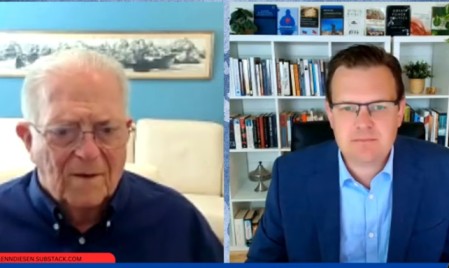
Read the full transcript of former ambassador Chas Freeman’s interview on Greater Eurasia Podcast, July 13, 2026.
Editor’s Note: In this insightful interview, former U.S. Ambassador Chas Freeman joins Glenn Diesen to analyze the deteriorating situation in the Middle East and the escalating conflict between the United States and Iran. Freeman provides a critical perspective on the breakdown of diplomatic efforts regarding the Strait of Hormuz, the limitations of U.S. strategic objectives in the region, and the growing isolation of Israel. The discussion offers a deep dive into the shifting geopolitical landscape, highlighting how regional powers are increasingly seeking strategic autonomy as the influence of traditional Western patronage wanes.
Introduction
GLENN DIESEN: Welcome back. The great Ambassador Chas Freeman joins us, who held key roles such as the US Ambassador to Saudi Arabia and Assistant Secretary of Defense. So thank you for coming back on. As always, it’s a great privilege.
CHAS FREEMAN: Always a pleasure, Glenn.
The Strait of Hormuz and the Breakdown of the Ceasefire Framework
GLENN DIESEN: So I just saw a few minutes ago that Trump posted on Truth Social that the Strait of Hormuz is now open and the US will reinstate its blockade on Iranian ships in the Strait of Hormuz. And he said, from now on, the US will be known as the guardian of the Hormuz Strait, which was an interesting—
CHAS FREEMAN: It’s very entertaining, really.
GLENN DIESEN: Yeah, he’s got the entertainment value. But what does this mean? I mean, why is the US going back to war with Iran now? What happened, in your view?
CHAS FREEMAN: Well, I think it’s fairly simple. Iran did achieve control of the Strait of Hormuz. The United States basically reinforced that with the blockade. The Memorandum of Misunderstanding that was signed acknowledged that Iran had control of the strait in effect and put the burden on Iran to arrange for its opening to traffic by ships for a period of 60 days, during which the two sides would negotiate on various issues — Lebanon, ceasefire, the release of some blocked Iranian assets, and eventually the nuclear program and some understanding on that.
So this was a framework for a negotiation, which immediately broke down because it turned out that the United States was not reconciled to Iranian control of the Strait of Hormuz and immediately began to try to open a second route, not under Iranian control, off the coast of Oman, which is relatively shallow water. They began to sneak ships through on that route with their transponders turned off, so they were dark to the Iranians.
The Iranians responded by reasserting control, namely firing at the ships to tell them that they could not go through on an unapproved route. That led to American reprisals against Iran, which went on and are still going on. The entire Memorandum of Understanding has broken down. There have been no negotiations. We’re 3 weeks into the 60-day period. Not a single thing has been achieved. The entire process has broken down.
So where we are really, Glenn, I think is in a pattern that is going to persist. That is to say, the United States, for as long as it can, and Israel will continue to contest Iranian control of the Strait of Hormuz. Iran will continue to assert that control. We will have periodic exchanges of fire. At some point there will be an escalation. I would expect the Iranians at some point to oblige the Israelis, who very much want to be part of the American war on Iran, by attacking Israel again. For the time being, they’re not doing that, I think mainly because they understand that it would please Prime Minister Netanyahu if they were brought back into the war in some manner.
In the meantime, however, they are attacking what remains of US bases in the region, in Kuwait and Bahrain and in Jordan. And aiming at — not apparently the United Arab Emirates, not Qatar anymore. They did attack one Qatar on the airbase at Al Udeid, which apparently had been partially reconstituted after having been attacked earlier. That’s in Qatar near the Saudi border. But they also focused in all these locations on radars, support equipment, and ammunition dumps. In the case of Kuwait, they claim they knocked out some long-range howitzers, HIMARS, as well.
So both sides are trying to attrit the ability of the other to conduct reprisals, to engage in warfare. And in this contest, Iran very definitely has the upper hand. First of all, it is on its own home ground. It is not projecting force 9,000 miles away from its homeland. So it has an innate ability to outlast the United States. Second, it’s in far better condition in terms of the depletion of its weaponry.
It doesn’t have a capability to intercept American missiles and bombs. It just has to take that punishment. On the American side, it takes a lot longer to build a missile interceptor of one sort or another — 2 or more years — than it does for the Iranians to build missiles. So they’re actually increasing their supply of missiles and drones while the US is depleting its. And the depletion of these weapons on the part of the United States weakens the United States in every other theater, whether it’s the European theater with supplies via European buyers for Ukraine, or whether it’s some Taiwan contingency in Pacific Asia.
The final note I would make is that the clock is ticking. Oil supplies are being drawn down. They’re not being replenished at an adequate rate. And we are up against, particularly, a shortage of sour crude in the United States, which will lead to the halt in production of both jet fuel and diesel fuel, which will cripple our domestic transportation system.
Donald Trump has opted for the continuation of the war he foolishly began with Israel.
But there’s a real question about how long he can sustain that as the world economy and the American economy feel the brunt of the shutdown of the strait, which, far from being open as he claims, is effectively closed. And if indeed he’s reinstated the US blockade, then it’s closed at both ends — by the Iranians and the United States. So I guess we can expect higher energy prices — good for Norway — for quite a while to come.
GLENN DIESEN: Well, yeah, that’s the silver lining.
CHAS FREEMAN: But it’s a limited one.
Iran’s Military Options and the Question of Escalation
GLENN DIESEN: Yeah, very limited. Well, how — again, the United States, as you said, it decided it’s going back to war. It might decide to reduce the war again if things go bad, perhaps start talks again, then go back to war. They might consider escalating, but the assumption all along here is that the Iranians will be passive and will allow the United States to take the wheel and essentially give them this escalation control.
Although I’m not saying that that’s what you’re saying, it just seems like this could be an assumption by Washington. But I’m thinking if I was in Iran, I would suggest that this is a dangerous thing — to see this kind of control — and that they could at least consider escalating if they choose. They can target US tankers in the region, the bases, economic assets. I mean, there’s a lot they can go after. I assume they don’t want to trigger any US retaliation against Kharg Island or any of the important critical energy facilities. But still, what do you think Iran could do besides taking this passive role and just allowing the US to decide when to bomb, when to start talks?
CHAS FREEMAN: Well, I don’t see any basis at present for a resumption of talks. The talk out of Washington and the Trump administration is really a rather plaintive and pathetic statement that they expect Iran to capitulate. It’s very clear that what the Trump administration means by bringing Iran to the negotiating table is bringing Iran to the table to sign an instrument of surrender or capitulation. And that is absolutely not going to happen.
Iran has many military options, including shooting at the ships that are sitting off in the Gulf of Oman and the Arabian Sea, which it hasn’t really done except in a symbolic way. It can up the ante. And as I mentioned, it can re-escalate in attacks on Israel, which is after all the main motivator of this whole thing.
One thing’s very clear, and that is with 3 weeks of the 60 days now gone, we’re headed toward August 21st, which is the end of the 60-day period. There are no negotiations and there will be no negotiations about the nuclear issue, which is the thing that Israel claims to care about. Everyone else cares about the Strait of Hormuz, and as I indicated, that is not going to get opened this way.
We basically have a situation where neither side has the ability to do a knockout blow on the other or bring this to a conclusion. Neither side has the ability to prevent the other from interfering with traffic in the Strait of Hormuz. But the Iranians are in a better position because of their geographical position and their inventory of cheap drones and effective missiles than the United States is. They are building their forces as the United States is drawing them down.
So how long can this go on? This is a contest, with both sides figuratively underwater, to see who can hold his breath longest. And I think the answer is very likely Iran.
Donald Trump, to make a pun, is in a straitjacket. He has put a straitjacket on himself. He cannot move. He’s politically barred — or psychologically barred — from accepting the reality, which is that we have not won, that the strait is not open, that Iran’s missile inventory is intact, that Israel still is at jeopardy, that very likely Iran will build a nuclear weapon, and there’s nothing we can do about it.
You mentioned Kharg Island and other Iranian installations. These are extremely hard to get to. I think people think about the German assault on Crete in World War II. But this sort of thing is almost impossible. I suspect the Iranians discount all the bluster and intermittent threats from the United States and from Donald Trump, which, by the way, of course, violate the MOU — not that that matters at all now. The MOU commits both sides to refrain from threats of the use of force or the use of force. And it says nothing about the United States having a role in managing the Strait of Hormuz. That was to be a topic of discussion during the 60 days.
So this is really bad. It’s just going to go on, and more people will die and more damage will be done and more expenses will be incurred. The latest estimate of American expenses in this war is well over $100 billion, with more yet to come because there are always additional expenses afterwards — to take care of veterans, to repair damaged equipment, worn out equipment. No end is in sight. And the world’s supply of petroleum and gas is in jeopardy.
Is There a Strategy? The US Position vs. Iran’s Taoist Approach
GLENN DIESEN: Well, what is the purpose then? As you said, neither side can do a knockout blow against the other. Is this simply trying to degrade the other side and negotiate for more favorable terms, or is there no strategy?
CHAS FREEMAN: I think there’s no rational strategy on the US side. The Iranians have a rational strategy, which is just to stay in place. Their strategy is a very Taoist one: do nothing and you will accomplish everything. The US eventually — the Iranians can’t drive the US away from their shores or the Strait of Hormuz — but sooner or later the US is going to have to leave because we can’t sustain this, and the cost in terms of the depletion of equipment and interception capabilities is just too high.
Iran’s Nuclear Calculus: Threshold State or Full Deterrent?
GLENN DIESEN: You mentioned that Iran might acquire a nuclear weapon. I always thought that the main reason why they wouldn’t would be that it would spread nuclear weapons across the region and it would end up undermining Iranian security. I always thought that they would just position themselves as a threshold state — just have all the material, the know-how — and essentially signal clearly to the Israelis and Americans that if they would ever think about doing a nuclear strike on Iran, then Iran could essentially assemble 10 or 20 nuclear weapons by the weekend and then retaliate. But don’t cross that line, because you don’t want the Saudis or Turks to acquire this kind of weapons.
But on the other hand, they do need a deterrent, because otherwise this can go on for years, just randomly attacking the Iranians at any point.
Iran’s Nuclear Dilemma and Regional Consequences
CHAS FREEMAN: I think you correctly defined the choice. I agree with you that the Iranians have to be concerned that if they go nuclear, others in the region who are, have already said they will follow this. I mean, after all, Iran is sitting in between nuclear powers. Israel is a nuclear power. The mediator for this is a nuclear power, Pakistan. It was attacked by a nuclear power, the United States and Israel, two nuclear powers. And we wiped out the entire echelon of leadership that was most opposed on religious grounds to the development of weapons of mass destruction.
In the new government, the new regime or the revised regime in Iran is much more militarist and nationalist and less religious in character, notwithstanding the use of religion in the spectacular funeral arrangements for the murdered Supreme Leader. I don’t think the inner circle who are making policy are doing it on religious or theological basis, but rather on the basis of pragmatic decisions.
So, on the one hand, they obviously have to confront the reality that if they go nuclear, so will the Saudis, so will the Turks, so will the Egyptians very likely, and so they will have a less secure nuclear environment than they do now. So will Israel. But on the other hand, as you know, the rational approach would be exactly the one you outline, that is to demonstrate a capacity to go nuclear but not to do it. And in effect, that is what India did with its explosion, its first explosion, and was basically, look, we have the capability to build a nuclear weapon. And then, of course, it went ahead and did that, did the actual building of a weapon, which Pakistan immediately followed.
And so, there’s a strong possibility that even setting off a test nuclear blast somewhere in the desert in Iran would provoke its neighbors into doing what it doesn’t want. So it faces some hard choices, but those choices are heavily influenced by the fact that it’s being savaged by the United States and earlier was savaged by both Israel and the United States.
We don’t look at Iran and see a conciliatory mood at all. In fact, part of the funeral arrangements included pictures of Donald Trump and Laura Loomer and other people with targets on their heads. And I think it’s very clear that the Iranian public, much of it, perhaps almost all of it, wants revenge for what it has experienced in the loss of its leaders, the savaging of its installations, military installations, and threats to destroy civilian infrastructure — partially fulfilled.
So, you know, here we are. If you may remember the saga of Salman Rushdie, who was declared to be an apostate and worthy of death and had to live basically under wraps for years, because of a fear of assassination. This is something different. I mean, the targets of assassination include Benjamin Netanyahu. Well, in the past, Iran has suffered multiple assassinations at the hands of the Israelis, but it has never carried out assassinations of Israelis, as far as I know. And now it apparently regards this as a legitimate policy. So this is an unfortunate change, that may or may not be permanent, but I think it probably is.
And so anything that the United States or Israel do to Iran is going to be retaliated against, and not just proportionately, but disproportionately, because the Iranians have accepted the Israeli standard of disproportionate retaliation as their own. This is, of course, contrary to international law, but one never hears about international law these days.
You know, the idea that having conducted a war of aggression, which is the supreme violation of international law, the United States would turn around and cite the Law of the Sea, the UN Convention on the Law of the Sea, on the management of straits when we haven’t even managed to ratify that convention, that treaty, is quite remarkable. It does remind you of the famous story of the boy who killed his parents and then asked the court for mercy because he was an orphan. You know, this is just preposterous. Has no appeal at all.
Israel’s Strategic Objectives in the Region
GLENN DIESEN: Well, one of the key — it seems like, of course, Israel is one of the main obstructions to find some peace. I’m not saying the US doesn’t have its own interests in knocking out Iran and reasserting its dominance of the region, but obviously the Israelis are, well, a further obstruction to finding, well, to implementing the MOU. But how do you see then the role of Israel now? Is this essentially just a goal, get the US back into the war, or will they seek to take out Hezbollah while the Iranians are distracted? Or what is it that the Israelis are doing here?
Because again, if you would go to rational strategy, I mean, if I was Israeli, I would look towards the declining relative power, at least, of the United States in the region, and reached the conclusion that the past 30 years of, well, essentially being able to do whatever I want because the US stands behind me, that this time is coming to an end. So this is the time to find a good diplomatic deal so you don’t end up standing there surrounded by enemies who are angry, without any political settlements, but it doesn’t seem that’s the direction they’re headed.
CHAS FREEMAN: Well, it’s fairly obvious you’re not Israeli if you’re thinking that way about non-aggression pacts and peace and diplomacy and other strange aspects of non-military policy. I mean, the basic problem is Zionism is essentially incompatible with non-aggression. From the very beginning, it has been an aggressive belief and a movement dedicated to the removal of an unwanted population from the territory it covets. And I don’t see any change.
What is happening now is Israel has multiple objectives. Minimal objective is to ensure that there’s no American agreement with Iran, no acceptance by the United States of the enhanced role in regional affairs that the war has bestowed on Iran. That is a minimal objective. Of course, the Israeli objective in subjugating or destroying Iran, whichever is most feasible, is to eliminate the principal obstacle to the greater Israel project.
And to that end, they have invaded Lebanon and propose essentially to annex southern Lebanon, first with a security zone in which all the structures have been abolished and demolished and the population has been expelled. And then gradually, of course, to settle out and expand their frontiers further. And I think they are under some constraints in terms of bombing Beirut, for example. The United States has apparently pulled them up short on that. But they’re conducting very savage warfare in Lebanon, and they are confronting effective resistance from Hezbollah, which has not been defeated and probably won’t be.
The Lebanon Ceasefire and Risk of Civil War
They have done, well, of course, one of the central problems in the Memorandum of Understanding’s survival, and the reason it hasn’t survived, was that what J.D. Vance did in the Memorandum of Understanding was undone by Marco Rubio in a Memorandum of Understanding between the Lebanese government and Israel, by which the Lebanese government, which had not been defending Lebanon. You know, there’s the famous joke, how many Frenchmen does it take to defend Paris? And the answer is nobody knows because they’ve never tried. But you could apply the same to the Lebanese government. How many Lebanese army troops does it take to defend Lebanon? Answer, nobody knows because they’ve never tried.
So you have a ceasefire between two non-belligerent parties, leaving the one defender of Lebanon’s sovereignty, Hezbollah, out of it. And of course, the Lebanese constitution is organized confessionally, an artifact of French logic, trying to establish a Christian enclave which they could control in the Levant, splitting it off from Syria. So you have a Christian president, a Sunni premier, and a Shiite speaker of the parliament. And the speaker of the parliament, Nabi Berri, who represents Amal, a different Shiite faction from Hezbollah, is aligned with Hezbollah and totally rejecting this rather strange agreement of the Lebanese government to combine forces with Israel to knock out Hezbollah and reduce Shiite influence.
There is a very strong danger, a risk of a civil war in Lebanon, which Israel would be delighted to see. And I think probably there hasn’t been a civil war precisely because nobody wants to gratify Israel in that regard. So that is a total mess. And I don’t think Israel, which has several times tried to conquer southern Lebanon, is going to succeed this time.
Israel’s Broader Ambitions and the Incompatibility of Zionism with Peace
You know, we have elections coming up in Israel in October. Obviously, there’s been a rupture between the United States and Israel. The various objectives that I outlined that Israel is pursuing, whether they’re preventing an agreement with Iran or ensuring that Iran is removed as an obstacle to territorial expansion and subjugation of neighbors, or that Iran is excluded from any role in Lebanon. Additionally, we have the Israelis saying that after they’ve knocked out Iran, they’re going to go after Turkey, basically on the premise that we’ve discussed before, that they need absolute security and they can only have this by military means.
And I go back — Zionism is as incompatible with non-aggression as Nazism was incompatible with non-aggression. The whole philosophy is built on aggression. And so there is a fundamental incompatibility between the idea of any kind of peaceful order in West Asia and Israeli aspirations. And this is becoming more and more apparent. I don’t know what to do about it. I mean, I think Israelis have to fix their own politics. Maybe they will, but at the moment, the polls show that about 3/4 of Israelis are strongly behind the policies of belligerence that they’re following. There are protesters, but they are a minority.
Turkey as Israel’s Next Target
GLENN DIESEN: Well, I’m glad you mentioned Turkey. That was one of my questions here. That is, we heard growing hostility, especially from the Israelis, about the potential for conflict with Turkey. They’re seen now, according to some, as a greater threat than —
CHAS FREEMAN: Iran, you mean?
GLENN DIESEN: Yes, sorry, as a greater threat than Iran. And well, by the way, correct with the assessment of Lebanon as well, the way I see it, because when the Israelis got this deal with the government of Lebanon, the Israeli media was very open. Oh, this is a possibility of instigating a civil war between the Lebanese government and Hezbollah. So make the Lebanese take this fight for us, essentially. So that was kind of the goal with this peace agreement was war.
But how do you make sense of Turkey? Because for many people, this comes as a bit of a surprise, that is, with making enemies out of a lot of the Arabs, of course, war with Iran, and all of this building up, the Gaza conflict isn’t finished off, so why start a conflict with Turkey? This seems — I mean, the Turks, yes, they can be hostile towards Israel, but again, Erdoğan has shown he’s willing to sit on the sideline and do absolutely nothing during the destruction of Gaza. So how, I mean, why is Turkey such a threat now to Israel?
The Israeli State, Victimhood, and the Future of Israel
CHAS FREEMAN: I think this is more, not really a short-term projection of policy. It’s more a long-term and strategic vision, and it rests, of course, on several bases. One is simply the essence of the Israeli state, which has been built on the myth of the Holocaust. And I say myth — of course the Holocaust occurred, but I’m talking about the myth as an organizing principle for a nation, the origin of the nation.
And so you have basically the idea that the entire world wants to kill Jews. Everyone is the enemy of Jews. And the Jews who live outside Israel in places like the United States are fools to put themselves at jeopardy because at any moment, other Gentiles can turn on them and murder them. This is the basic ethos of the Israeli state, and they forcefully reinforce this in the schools and in every way they can.
So if you think the whole world is against you, then you look at who might really hurt you, and Turkey has to be at the top of the list. The second reason is obviously that Turkish public opinion polls show that 97% of Turks are violently against Israel because of what Israel has done — its genocide in Gaza, its murder of Turks on the flotillas that have tried to provide humanitarian aid to Gaza, its actions in Syria where Turkey is a major factor, its actions elsewhere in the region.
And of course, Turkish opportunism comes in here. The Turks have been using the threat from Israel very effectively to rebuild their relationships with the Arabs, most of whom are very suspicious of Turkey because of its democratic system — however flawed that may be under Erdoğan — and its association with the Muslim Brotherhood, which is a democratic Islamic movement in the Arab world that is anathema to autocratic rulers.
So you’ve got all that. And Turkey has the largest army in Europe — or in Eurasia, I guess — other than the Chinese. So it is a formidable force, and it’s very anti-Israeli. And so you get Naftali Bennett, who’s a candidate to succeed Benjamin Netanyahu as Prime Minister in Israel, using the Turkish issue to whip up Israeli paranoia.
And of course, as I’ve said before, even the paranoid do have enemies. And they’re particularly good at making new enemies. They’ve successfully made an enemy of Turkey, which historically had reasonably agreeable, not terribly cordial, relations with Israel, but which is now a very openly declared opponent of Israel in every sphere.
So that’s why this matters, but I don’t think it means anything imminent. Of course, Donald Trump has proposed that the Turks and al-Sharaa, the self-proclaimed president of Syria, make common cause in wiping out Hezbollah for the benefit of Israel, which is kind of a wacky idea which isn’t going to go anywhere. I don’t detect any enthusiasm on the part of anyone for this idea. In fact, to the contrary, al-Sharaa has said he’s willing to sit down and talk to Hezbollah. So Israel has succeeded in making the entire region its enemy, not excluding Turkey.
GLENN DIESEN: Yeah, I think the goal of probably instigating a civil war in Lebanon — that’s a better possibility than getting the Syrians to fight Hezbollah on Israel’s behalf. But there seems to be a problem. Again, I don’t want to belittle, as you said, the Holocaust, but when you have an identity of victimhood, it can often fuel very aggressive policies, because not just the leaders but also society itself will always interpret current events through the lens of past suffering.
That is, everything becomes seen as self-defense when you look at it in the historical context. There will be a moral justification for any atrocity. You will have often reduced empathy for others because you will see victimhood comparably — what oneself has suffered. And as you said, the national unity will then have an inclination towards basing itself only on external threats. And if the historical narrative is what shapes your identity, it’s very difficult then to find compromise, because this would be seen in the same context — it would be dangerous, and it would appear you didn’t learn from history.
So essentially, “we’re surrounded by evil because that’s essentially who we are — we’re victims.” When you’re surrounded by evil, there cannot be any compromise. That’s appeasement. You have to defeat all your opponents.
It starts to sound as if this has had a bit of an impact on Israel. But how do you see the future of Israel? Because, if one is — we often talk in this language of being pro or against this or that — but if Israel starts to have a major meltdown, this could be extremely dangerous for everyone. So I was just wondering, how do you see it? Because it looks like they might go off a cliff at some point. Is it political instability at home, something bordering on civil war? Is it economic collapse? Is it being militarily overstretched?
There seems to be a lot of problems, and they have isolated themselves very unnecessarily over the past few years especially. They’re losing friends, not just in Europe, but in the United States of all countries. I thought not in my lifetime would I see such a huge pushback against Israel. This is quite unique. I mean, if I were Israeli, I would be very worried by now.
Israel’s Path Forward — or Toward Collapse
CHAS FREEMAN: I think they are very worried, and they’re pouring a lot of money into hasbara — meaning exculpatory propaganda. I want to make one sort of tangential point, and that is the irony that Shi’ism is also a cult that celebrates victimhood. Hezbollah came into being when Israel invaded Lebanon in 1982. It is a direct result of the need for resistance to Israeli violations of Lebanese sovereignty and the rights of Lebanese. It began as a militia and later grew a political function, which is very powerful and associated with Shi’ism. And it, like Israel, celebrates the memory of atrocities that were committed against its believers.
As far as the future of Israel is concerned, I think that is really a very difficult question to address now. Clearly, if Israel continues on the current path, it’s in grave jeopardy. It could well follow the Christian Crusader kingdoms of the 11th and 12th century, which collapsed — basically evaporated — after they lost the support of their foreign backers in Europe. And Israel is in danger of losing all support internationally, including in the United States, not as a result of any sort of antisemitism, but as a result of reactions to Israeli behavior.
I would say that if Israel were to embrace the values of Judaism as opposed to Zionism, I think people would strongly support it. But it is not following Jewish theology except in a very distorted version. The version it puts forward resembles exactly the Islamic State’s perversion of Islam. This is a perversion of Judaism.
If you talk to Jews in the West, they’re not interested in murdering people. They’re not interested in grabbing other people’s land. They may be supportive of the state of Israel out of a sense of kinship and responsibility, but they don’t feel insecure. And the whole Israeli abuse of the charge of antisemitism has in fact revived antisemitism, because some of it is so outrageous. “Self-hating Jews” is what they call anybody who criticizes Israel who is Jewish. Anybody who isn’t Jewish and criticizes Israel is, by their definition, an anti-Semite.
Well, this is really remarkable. I mean, if I were to criticize Norway because it still does some whaling, nobody would say that I was viscerally anti-Norwegian. That’s an issue. And will it do Norway any good to alienate a friend? I don’t think so.
Anyway, Israel has made enemies everywhere and no friends. And the myth of Israel now — talking not about the one that the Israelis have invented for themselves, based on celebration of their suffering as a people in Europe, not in the Arab world, by the way. Arab Jews were fine until Israel was established, and that put them in jeopardy, and now they had to ingather in Israel. This is a European colonial project of European Jews, by European Jews, for the benefit of other Europeans who wanted to get rid of Jews in their midst.
And if Israel wants to be part of the region in which it has implanted itself, there are proposals out there which would satisfy that. I was very interested to hear the speech that Rahm Emanuel — former mayor of Chicago, former chief of staff in the White House, a very tough-minded, intelligent man — made in Israel. He said, “Well, the solution is the 23 Arab states making common cause with Israel, resolving the Palestinian question and moving forward.”
And I thought to myself, did you pay any attention when, in 1982 at Fez, the Saudis put forward exactly that proposal? Or in 2002 at Beirut, when the late King Abdullah reiterated this, committed Saudi Arabia to be the first to normalize relations with Israel in this context, and to bring with it all 57 members of the Organization of Islamic Cooperation to make peace with Israel?
If Israel were respectful of anyone other than its Jewish population, if it didn’t practice apartheid domestically, if it weren’t engaged in ethnic cleansing and genocide, if it did not commit aggression against its neighbors — people are ready to make peace with it. And the main obstacle to this is the paranoia that has been inculcated into Israelis as a result of their embrace of their horrible history in Europe as the central element in their identity. So that’s got to change. Can it change? If it doesn’t, I would expect Israel gradually to wither away, as the Crusader kingdoms did.
The Abraham Accords, Iran, and a New Regional Order
GLENN DIESEN: It seems that a lot of these attempted deals to bring the Arabs and Israelis together would often have this bloc politics function — that is, to create an anti-Iranian alliance. It would be interesting though — do you think, just as a last question, if the war now ends, will the US at some point just have to accept that the Iranians are controlling the Strait of Hormuz, that’s just the way it is? And the Arab states would then have to readjust, recognizing perhaps they can’t put all their eggs in the American basket — perhaps they should improve their ties with the Iranians.
Do you think under such conditions, Israel would be under pressure to try to normalize relations with its neighbors, as opposed to having this maximalist position of either defeating or destabilizing all competing powers in the region?
CHAS FREEMAN: I’m glad you mentioned this, because in effect, the Abraham Accords were an effort by the United States and Israel to build a regional order around a coalition against Iran, bringing in Bahrain — which has a very tangled history with Iran — and the UAE, which has both close economic ties and territorial disputes and animosity toward Iran and the Iranian Revolution.
That is dead. The Abraham Accords are essentially on life support. A new order is really in the process of being formed, and that order will not include American bases in the Persian Gulf, because the Persian Gulf Arab countries have learned that the United States not only will not but cannot defend them against Iran.
In fact, at the moment, they are probably grateful that it is the United States bases on their territory — not their own facilities — that are being attacked by Iran in reprisal for American provocations. They are hostage to American unilateralism and they don’t like it. So all of them are in dialogue with Tehran about a post-war order.
We have the grouping of Pakistan, Egypt, Saudi Arabia, and Turkey, which has emerged as a core group for a future security architecture in the region. It’s not clear what the relationship between that group and Iran will be. It will probably include some balance of power elements, but it certainly will not include an embrace of Israel as proposed in the Abraham Accords.
So I think we’re seeing the emergence of a new security order in the region, which is based on strategic autonomy. It will not accept the importance of having a foreign patron, whether it’s the United States, China, Russia, India, or whoever it might be. I don’t include Europe in that, because Europe continues to be so divided as to be ineffectual as a great power in every sense except the economic one.
One of the Israeli objectives is to hold on to the potential regional order represented by the Abraham Accords, and I don’t think that is feasible. So we are seeing that replaced by something else, willy-nilly. And you’re quite right — at some point the United States is going to go away. And interestingly, the United States continually says it wants to go away. It wants to pivot to Asia. It wants to get out of Europe. It wants to get out of West Asia. It wants to focus on China as a peer competitor — which is another problem we ought to discuss, because I don’t think there’s much rationality to that either.
But in any event, we’re seeing the slow emergence of a potential new order in the region, which would be quite different from the one that existed before the war.
GLENN DIESEN: Well, next time we should definitely discuss China. Again, you were there with Kissinger in the ’70s, and now I would like to pick your brain about China as well. But yeah, we have to do that next time. So thank you so much for taking time.
CHAS FREEMAN: Well, thank you for doing what you do.
Related Posts