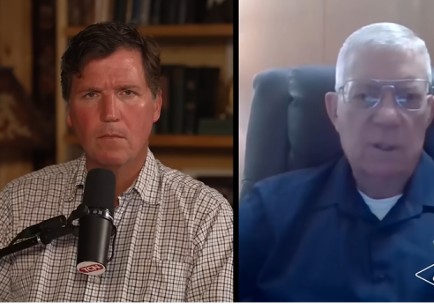
The following is the full transcript of Marine Staff Sergeant Bryce Lockwood’s interview on The Tucker Carlson Show, July 10, 2026.
Editor’s Note: In this compelling interview, Bryce Lockwood, a survivor of the 1967 USS Liberty attack, recounts the harrowing details of the day his intelligence ship was struck by Israeli forces. Lockwood challenges the long-standing narrative of “mistaken identity,” arguing instead that the assault was a deliberate, well-planned operation that the U.S. government ultimately covered up. He calls for a long-overdue, open Congressional investigation to finally uncover the truth behind the incident that claimed the lives of 34 Americans.
INTRODUCTION
TUCKER CARLSON: Mr. Lockwood, thank you very much for joining us.
BRYCE LOCKWOOD: My pleasure.
TUCKER CARLSON: Tell us, the USS Liberty — many people have heard the name, they’re aware there’s a controversy about what happened to the ship in 1967. If you wouldn’t mind starting at the beginning and telling us the story of the USS Liberty.
The USS Liberty: Background and Mission
BRYCE LOCKWOOD: USS Liberty was a spy ship back in the 1960s. Several of the sub-Saharan African countries had just won their independence from Great Britain, Germany, Belgium, France. There was a heavy influence both from the Soviet Union and from Cuba. Cubans had a lot of troops around the area. That entire area is very wealthy in natural resources, precious metals, and the United States wanted to keep track of what was going on over there. Mind you, this is when satellites were pretty rudimentary, so the best way to gather that information is get close.
The USS Liberty was a World War II Victory-class freighter. She was originally commissioned as the SS Simmons Victory. She saw service as a cargo carrier during the Second World War, mothballed, brought back out of mothballs for the Korean War, ammunition carrier for the Korean War, back into mothballs. And in 1965, when the National Security Agency decided they needed vessels of that type, her hull was probably in the best condition of almost any of them that were in the ghost fleet or the mothball fleet.
She was brought out of commission. The U.S. government spent $26 million in 1965 money equipping her with the latest in intelligence collection. We could suck up literally every frequency that was being used. We had aboard her the world’s largest mobile computer — the Univac 500, at that time the world’s largest. You could likely do about as much with your cell phone now, but technology has come a long ways in the last 60 years. She was equipped with linguists, cruised up and down the west coast of Africa, listening in on to whatever was going on.
The Lead-Up to the Attack
As war appeared to be imminent between Israel and her neighbors in 1967 — the neighbors included what was then called the United Arab Republic, primarily Egypt, Syria to a lesser extent, some influence from Jordan and Libya — the administration sent some F-4 photograph planes, high-performance photo intelligence planes, to a Torreón Air Base in Spain. Those markings were obliterated. The pilots were given neutral uniforms and neutral identification and set to overfly Israel’s neighbors.
When hostilities broke out, June of 1967, Israelis had intelligence courtesy of the US administration locating every aircraft revetment, every tank location of personnel, where they were riveted up, where they were based, and so forth. Hostilities broke out on the 5th of June, 1967.
The National Security Agency had ordered USS Liberty to proceed from her cruise up and down the west coast of Africa with all due speed to Rota, Spain, take on stores, refuel, pick up 6 additional linguists, and proceed with haste to the eastern Mediterranean where they could monitor what was going on. She was stacked with linguists. Out of a crew of 294 aboard the ship, roughly 190 were intelligence personnel — linguists, codebreakers, manual Morse operators, voice intercept operators, and so forth.
Soviet Intelligence Operations in the Area
The Soviets had a group of Tu-95 long-range bombers equipped for intelligence collection at Alexandria, Egypt. They told the world that they’d given those planes to Egypt and that they were manned by Egyptian troops. Such was not the case. They were Soviet troops wearing Egyptian uniforms.
The task that we were given as linguists — there were 3 of us Russian linguists aboard her. We had 3 watch sections rotating 8 hours each. The 3 of us Russian linguists that were assigned as voice intercept section supervisors, our primary task was catching those Soviet Tu-95 intelligence aircraft at Alexandria. The aircraft would communicate in plain language Egyptian until they were airborne and over the Mediterranean Sea, change frequencies and go to plain language Russian.
It was ironic that while we were under attack, my relief came into the processing and reporting room where I was and said, “Hey, Sarge, I got him, I got him.” Says, “You got who, Jim?” “The Ruskies.” “Really?” Said, “Yeah, plain language Russian.” He went back into the room where he was copying the intercept and a torpedo struck him, killed him.
The Day of the Attack
Hostilities broke out on the 5th of June, 1967. We arrived on station on the 7th of June. Throughout the day of the 7th and in the early morning hours of the 8th of June, we were overflown by several different Israeli aircraft. They flew very close to us. We could plainly see the pilots. Fellows that were off duty and sunning themselves on the decks would wave to the pilots. The pilots waved back.
We had a drill general quarters at noon on the morning of the 8th. The captain came on the address system aboard the ship, the 1MC, and told us that there were a few things he wanted us to improve — get to our general quarters stations a little more rapidly, get the watertight doors closed a little more rapidly.
I was at my berthing spaces in the after part of the ship. I heard a tremendous noise roughly 2 o’clock local time. I had never been under hostile fire before, but I knew that we were in trouble. Immediately dropped what I was doing, headed for my general quarters station, which is below decks.
The Attack Unfolds
Mind you, the cargo spaces in the forward part of the ship was where all of our intelligence people were — roughly 190 men. The only way out was a narrow, steep ladderway about 2 feet wide with a railing. The ship would ring whenever a projectile struck it. There were 826 large caliber strikes from aircraft aboard her — 40mm cannon fire, 30mm cannon fire, heat-seeking rockets, napalm.
On either side of the ship, port or starboard, there were racks that contained life rafts with a charge. You jerk on it hard and the charge would go off and fire these life rafts into the sea. Both of those were napalmed. The Captain’s gig was riddled with rocket fire. The Liberty launch was riddled with rocket fire. Basically no means of getting any survivors off.
The Israelis were jamming our distress frequencies, which was a violation of international law. They were using unmanned aircraft, which is a violation of international law.
The Israeli Explanation
During the court of inquiry which was conducted after the attack was over with, ordered by the Johnson administration, conducted by 3-star Admiral Isaac Kidd, the Israelis said that they had mistaken us for an Egyptian ship — the El Quseir. The El Quseir was a World War I horse transport. Her only armament was a 4-inch muzzle-loading cannon. Israelis claimed that they were being shelled from the sea. We were the only ship in the vicinity. We had no capacity of shelling anything.
The bottom line was the Israelis had captured an entire Egyptian brigade. They were blowing up the captured ammunition, and that’s what the explosions were that they claimed was fire from the sea. Quite obviously, that was not possible from the El Quseir or from us.
TUCKER CARLSON: Let me ask you — when you come under fire around 2 o’clock, how long does it last?
The Torpedo Strike and Survival
BRYCE LOCKWOOD: There are various testimonies about that. The claimed air attack lasted about 25 minutes, but of course when you’re under fire and trying to survive, it seems a lot longer. And as I mentioned earlier, the entire ship would ring with each shell struck her.
The captain came on the 1MC and said, “Brace yourselves, torpedo attack starboard side.” Well, that’s where I was located. My friend Ronnie Campbell was sitting there at a desk and he said, “Well, they hit us with everything else, what else can they hit us with?”
The division officer, Lieutenant Bennett, stuck his head in the hatchway and he said, “Sergeant Lockwood, would you come here a minute, please?” I stepped out into the passageway. I ran down the center of the ship and he got me in a conversation with Lieutenant Commander David Lewis, who was a senior research officer aboard the ship, about getting these ditching bags topside pitched over in the sea.
We had large canvas bags, brass furrows in the sides, lead weight in the bottom. The idea was all the classified information we had, get them into these ditching bags, topside, pitch into the sea. Should they be recovered by the time they could be, any information in them would be useless.
When there was a sudden blinding flash of flame, tremendous loud noise, knocked me to the deck. I was kind of semi-conscious. I’m thinking to myself, “Well, Lord, I guess this is it. I guess I’m coming home. At least Lois and kids are taken care of.” Oh, that’s my wife.
I felt something cold. I looked down and water was gushing in. I didn’t find out what had actually taken place until so many years later. Some of the sailors told me that when the torpedo struck, it literally lifted the ship out of the water and set her back down. When she came down, rolled towards the starboard side, there was a roughly 40-foot hole in the side that water was gushing in.
Rescuing the Wounded Below Deck
I heard a moan behind me, struggled to my feet. There was a sailor trapped there in the wreckage. His name was Joe Lentini. I didn’t know who that was until 25 years later. Joe was one of the communicators that worked with the teletype equipment. We weren’t getting anything out, couldn’t understand why we weren’t getting a Mayday out and weren’t getting any aid.
A piece of shrapnel from a rocket had penetrated the ship and struck him in the left thigh. Joe was bleeding profusely, sat there on the deck and leaned up against the ladderway, the only way out. I was putting a tourniquet on that wound when the torpedo struck.
Our office spaces were separated by sheet steel bulkheads. That bulkhead just mushroomed out, caught him in his left knee upturned, and literally made toothpicks out of his femur bone. I’m trying to pull him loose. The water was coming up pretty rapidly, and I said, “Come on, you got to help me, I can’t do it by myself. Come on, get your legs on you and push.”
Well, I didn’t realize his left leg was smashed, but I felt him get his right leg under me, push just enough where I could free him, though he was still partially tangled up in that wreckage. By that time, the water was within a foot and a half of the overhead. There were some pipes that carried cabling and power and so forth that was hanging from the overhead. I said, “Here, get a hold of these pipes.”
About that time, I saw a body floating out towards a hole. I reached down with my right arm and got an arm around him, tried to hold his head above water. I heard the division officer, Lieutenant Bennett, at the top of the ladderway say, “This is Mr. Bennett, open this hatch.” There was a lot of confusion. You can imagine roughly 190 people crammed into that space in fear of their lives. A lot of shouting.
I hollered as loudly as I could, “Knock it off! If y’all don’t settle down, none of us will get out of here alive!” That was the last thing I remember. I apparently passed out.
Escaping the Flooding Compartment
The next thing I recall was being alone with the unconscious sailor and nobody there but me and the sea and him. The ship was rolling. The torpedo had ruptured one of the fuel tanks, which is there on the starboard side. That was the heavy oil that powered the ship. It’s a stinking oil. That oil was everywhere. And oil and water don’t mix. Of course, you can imagine just about everything was coated with it.
I tried to start up the ladderway with this unconscious sailor, slipped, dropped him. He’s going back out the hole — wait, got him, got back, started back up the ladderway. About half or two-thirds of the way up the ladderway, a piece of shrapnel from the torpedo had bent in the railing, so there’s only a space, roughly a foot wide. Got to that point, slipped, dropped him again, going back out the hole, and got him back up the ladderway again.
Got up to the top and the hatch was sealed shut. Trying to hold his head above water, pound on the hatch, and a fellow named Bobby Schnell — there were dogs that held the hatch seal shut around a rubber gasket and about an 8-inch high metal seal, and I’m guessing probably a dozen large bolts that bolted it down. He got a wrench, knocked those nuts loose and opened the hatch, let me out.
I tried to drag this sailor out, dropped him, tried to drag him again, can’t quite get him out, tried to turn him over. His foot caught in the chain that was holding the prop for the hatch open, and literally I was trying to drag his leg off. Phil Turney was one of the damage control people who was standing there. He said, “Wait a minute, he got his foot caught.” He freed his foot.
He said, “The captain has ordered to prepare to abandon ship. You need to get a life vest on.” There had been life vests there. And I said, “Get a life vest on, put one on him. And they’re doing triage at the mess decks and the afterpart of the ship, so I need to get him back there, triage.” I tried to pick him up, pretty weak, dropped him, tried to pick him up again, dropped him again.
Reuniting with the Survivors Years Later
Years later, when I found out who he was — it was some 30 years before I even found out who he was. We were sitting in his kitchen Sunday morning in Chicago and his family is gathered around. They want to know what had happened to dad. I’m trying to tell him, and his name was Dave McFagan, and he kind of blurted out, said, “I wouldn’t be hurt nearly as bad if you wouldn’t have dropped me so many times.”
He had been topside when a rocket from one of the air attacks exploded very close to him and flung him back into the bulkhead. He’s wounded from that. He’s in a lot of pain. He’s thinking, “I’ve got to get to my GQ station.” His GQ station was down below decks. He gets down there just as they slam the hatch shut and bolt it down. He’s sitting on the ladderway with his head in his hands, hurting badly, when the torpedo struck. Slammed him back into the ladderway and made a mess out of his spine. He’s still alive, but barely, and confined to a wheelchair now.
Joe Lentini passed away from a heart attack some 3 years ago. The book Assault on the Liberty credits me with diving underwater and freeing Joe Lentini’s leg. That was actually a sailor named Bobby Snell that did that. Freed his leg, carried him topside.
There was some conversation that I carried a man out, went back down. Senior enlisted man, Stan White, said, “Sarge, you can’t go back down there.” Stan has since passed away too, but he told me, he said, “You gave me a kind of a blank stare and went back down.” I don’t recall any of that. I think there’s a good possibility I was confused with someone else, but the Navy and Marine Corps uniforms are different colors.
The Mayday Call and the Life Rafts
We were told to go to the radio room on the port side of the ship. I was lying on the deck in the radio room and I couldn’t understand why we weren’t getting any aid. There was machine gunning going on. The motor torpedo boats were circling the ship, riddling us with heavy machine gun fire. There were 3,100 heavy caliber machine gun strikes on the ship.
One of the radiomen figured out that when they were shooting rockets at us, they couldn’t jam our distress frequencies because the jamming would screw up the flight of the rockets. In a brief period when those rockets were being fired, this Mayday went out: “Firefox, Firefox, this is Rockstar, Rockstar, under attack by unidentified surface and air units, require immediate assistance.”
As soon as that Mayday was acknowledged, the shooting stopped. I saw some sailors carry 3 inflatable life rafts through the radio room, heard them fall into the sea. There were lines attached to keep them from floating away. I heard a revving of engines and more machine gun fire. One of those sailors came back through the radio room and he said, “I don’t know what we’re going to do now. They’ve riddled what we had left.”
It is my understanding that that machine gun fire severed the line that was holding one of those life rafts. The torpedo boat came in, picked it up, plainly labeled US Navy. Can’t be proven. I have no idea, but I heard a rumor that that life raft and the ship’s wheel from the torpedo boat that fired the fatal torpedo are in the Israeli Naval War Museum at Haifa as trophies of war.
Did the Israelis Aid the Survivors?
TUCKER CARLSON: So did at any point did the torpedo boats come to the aid of survivors? When the Israelis stopped firing on the Liberty after your Mayday call was received, did they help in any way the survivors?
BRYCE LOCKWOOD: Actually, we heard some helicopters overhead. I did not see them myself, but the deck crew told me that 2 large armored helicopters came over fully loaded with armed troops, automatic weapons, hand grenades. It seems fairly obvious the idea was: sink the ship, kill everyone aboard it, no survivors.
We think there’s a very good possibility that we were set up by our own government. The president, Lyndon Baines Johnson, was very friendly towards Israel. His predecessor, John F. Kennedy, had actually given a speech about the necessity for discourse between the Palestinians and Israelis about getting some 700,000 refugees from the so-called War of Independence, Israel, 1947-48. They were driven from their homes. The Israelis said they voluntarily left. My personal opinion is there was nothing voluntary about it. They were told to leave or be destroyed.
Kennedy’s conversation was to have at least a portion of those refugees be allowed to return to their ancestral homes. As a result of our Congress and our president doing nothing about the attack on the USS Liberty, the Court of Inquiry accepted the Israelis’ excuse that it was a case of mistaken identity. Case was closed.
As a result of our doing nothing, Israel realized they could do whatever they wanted. The United States Congress, United States administration would say nothing, do nothing.
Why Would Johnson Allow the Attack?
TUCKER CARLSON: I’m sorry to interrupt. Why? I just want to go back to what you said about your belief that the Johnson administration knew that this attack was coming on the Liberty. Why do you think they would have allowed that?
The Cover-Up: McNamara’s Orders and the False Flag Theory
BRYCE LOCKWOOD: Commander Lewis, who was a senior intelligence officer aboard the ship, and I both had pretty much the same wounds. My glasses protected my face from debris. His eyes were sealed shut. We were both medevaced off to the carrier America.
Admiral Lawrence Larry Geis, who was the Task Force 6 commanding officer that included the carriers USS Saratoga, USS America, and the guided missile cruiser the USS Little Rock, asked for Commander Lewis to come to his stateroom. This is several days after the attack had taken place. He swore Mr. Lewis to secrecy until after his death, told him that he had ordered aircraft to come to our aid.
Planes were launched from the USS Saratoga. They had nuclear weapons aboard them. Secretary of Defense Robert McNamara ordered them returned. Both Admiral Geis and skipper of the Saratoga, Captain Joseph Tully, figured out that that was probably because there were nuclear weapons aboard them. They were recovered. Conventional aircraft with conventional weapons were relaunched to come to our aid. Captain Tully re-notified Washington. Secretary of Defense McNamara came on the circuit again and ordered those aircraft returned.
Admiral Geis said, “I want to exercise my authority and hear that from higher authority.” Well, the only higher authority was the president. This is the conversation that was related to David Lewis from Admiral Geis. The president said, “Get those aircraft back. I will not have my allies embarrassed.”
They were using unmarked aircraft and we did not know who was attacking us. How did the president know? The number 2 man in the USCIA at the time was a gentleman named James Angleton. James Angleton was not only the number 2 man in the US Central Intelligence Agency, he was a double agent with Israeli Mossad.
Many of us survivors believe that we were set up by our own government. False flag operation, sink the ship, no survivors, blame it on Egypt, get the United States involved on the side of Israel against her neighbors. And excuse me, Tucker, what’s happening now?
TUCKER CARLSON: The head of counterintelligence that you mentioned, James Jesus Angleton, was also clearly involved in the Kennedy assassination, the beneficiary of which was, of course, Lyndon Johnson and Israel.
BRYCE LOCKWOOD: That’s beyond my comprehension, Tucker. Yeah, I don’t doubt that.
TUCKER CARLSON: Yeah, well, it’s pretty clear, I think, from documents that have subsequently been released. So how many — just to wrap up the story of what actually happened that day — how many Americans were killed in the attack?
The Casualties: 34 Killed, 175 Wounded
BRYCE LOCKWOOD: There were 34 Americans killed, one civilian, Allen Blue. He was an Arabic linguist from the National Security Agency. The other two Marines were both killed, Sergeant Jack Raper, Corporal Ed Rehmeyer. They were both Arabic linguists. And the balance of the 31 were all sailors. They were all linguists, manu-morphs intercept operators.
34 killed. There were 208 Purple Hearts awarded, 175 were wounded. Several of the crewmen that were wounded were never awarded Purple Hearts. Jack Beatty, he was a machinist mate who was working on the — he was changing oil on the Liberty launch, the enlisted launch, when the air attack took place. He had shrapnel in the back of his head. He didn’t find out about it till many years later when the Veterans Administration performed an X-ray on his skull.
There was another Navy chief, Joe, last name slips from mind right now. He had one of those heavy caliber strikes in his left calf. He was a Boy Scout instructor. Knew first aid, took that projectile out of his leg himself, wrapped himself up. He was never awarded a Purple Heart. There were others.
Identifying the Attackers
TUCKER CARLSON: When did you find out it was the Israelis who had attacked the ship?
BRYCE LOCKWOOD: Not until the next morning, in my own recollection. The aircraft were all unmarked. The torpedo boats were flying the Star of David. One of the officers that was on the deck happened to be Jewish. When he saw the Star of David flag, I understand he broke out in tears.
TUCKER CARLSON: The torpedo boats that fired machine guns at the Liberty — I mean, they must have been close enough to see the American flag flying over the ship.
BRYCE LOCKWOOD: Yes. Our initial flag was flying from the flagstaff at the back of the main mast that was knocked down in one of the first air attacks. Our seagullman ran that back up again. It was knocked down again. And then he ran up the holiday flag, which is 5 feet by 8 feet. It’s the largest flag we had aboard ship. That flag was literally riddled with shrapnel. He ran that up on one of the port signal arms, which is on the port side. But we had a good breeze blowing that day. The flag was out there, pretty obvious.
Egyptian ships are painted black with hull markings in Arabic script. Every highway sign in Israel is in Hebrew, Arabic script, and English lettering, so that excuse falls away. US ships are painted gray with hull markings and English lettering. Our hull marking was GTR-5, which stands for General Technical Research, the fifth and newest of her class. General Technical Research means that she’s a non-combatant. It’s a violation of international law to fire on non-combatants.
The Israelis were riddling our life rafts with machine gun fire. That’s a violation of international law. The irony of that is that came about as a result of refugee ships being machine gunned by Nazi wolfpacks during World War II.
Silence and Reconnection: Years of Unanswered Questions
TUCKER CARLSON: What did your commanding officers tell you about the motive for this attack? So you’re lying, recovering, you’ve got wounds to your face and your hands, and someone at some point explains to you why this happened. What did that person say?
BRYCE LOCKWOOD: Honestly, I didn’t hear anything. Years later when I reconnected with some of the crew — and it was well over 20 years later before I reconnected with any of the crew — I say it was 1982 before I reconnected with any of the crew, so this is what, 15 years afterwards? I honestly didn’t know.
Most of us were pro-Israel that were aboard the ship. It’s kind of ironic that one of our analysts was processing the United Arab Republic traffic that we were getting. He made a small UAR flag and had that stuck in his outbasket. Most of the crew were smoking back then. They’d walk by and say, “Hey, Rich, your herbs aren’t doing so well,” and they set fire to his flag. He said, “No, cut that out, put it out.” One of the sailors had made a huge Star of David out of teletype paper. That was pasted up on the starboard bulkhead. That Israeli torpedo struck within a few feet of that Star of David flag.
TUCKER CARLSON: Did you talk about this after? Did you do interviews with the media? Did you tell your friends, your family? How did you respond to this once you recovered?
BRYCE LOCKWOOD: My situation was a little different. I was on temporary assignment from my home base in Bremerhaven, Germany. It was 10 days aboard the carrier America, flown back to Lucca, Malta, where the ship was dry docked. I was one more day aboard her there.
That’s kind of ironic. I didn’t have a place to sleep, and one of the sailors said, “I’ll go up to sick bay and talk to Dr. Van Lane. He’ll find you a place to sleep up there.” We were kind of chatting. It was getting along late in the afternoon, and he said, “You’re welcome to sleep in whichever one you want.” I said, “I hope that doesn’t get to stinking then.” What’s that, Tom?
There was a box in the corner, roughly 18 inches square. It was labeled “unidentified human body parts.” That’s what’s buried in the mass grave in Arlington National Cemetery. Slept over that night. Two of the men that worked for me were in that box, what was left of it.
TUCKER CARLSON: Were you told by the US military, by the Marine Corps, by the Navy, not to talk about this?
The Long Silence and Its Breaking
BRYCE LOCKWOOD: Well, mind you, we’re in intelligence business, saying just don’t talk about it. There’s an old saying, what you see here, what you say here, when you leave here, leave it here. I did not talk about it outside of secure spaces. When I got back to my home base in Bremerhaven, I was put on 12-on, 12-off watch. I talked about it rather freely in the secure spaces. My wife didn’t know what happened to me.
I was not supposed to tell anyone I was aboard the ship, but no one bothered to tell me I wasn’t. When I first got aboard her, the petty officer of the deck was a longtime friend of mine, Ronnie Campbell. I said, “Ronnie, I need to let Lois know where I’m at. Can you give me the address of the ship?” Well, he gave me the FBO address and I got a postcard, wrote it on, told my wife I’d be aboard her, don’t know how long, I’ll let you know sometime in the future, dropped it in the mail. She’d received that card, knew I was aboard it.
On the 9th of June, a dear friend of hers that lived across the street in Bremerhaven waved to her to come over. She went over, said, “Did you hear about that US ship being attacked?” She said, “Ja, the USS Liberty.” My wife said, “I think Bryce is aboard that ship.” Well, that set a panic button.
Returning Home
When I got back home, I was a mess. I had to borrow a uniform from one of the Marines aboard the Carrier America. There happened to be an African-American Marine, same build that I was, real gentleman, same rank as I was, loaned me a khaki uniform. Well, I had to wear that uniform the next 5 days. Part of that was when I got back to the ship, that oil was everywhere. Everywhere you went, you get drops of that oil all over you. So I stunk from that. I had fever blisters in my face and this yellowish pus was oozing out, dripping over the front of me.
The morning I got back, couldn’t get in the apartment, second floor apartment. The neighbor, Betty Bryant, came to the door. Said, “Ho Bryant, said the law officer went out to the base. Get the mail. I said, come on in, I’ll get you a cup of coffee.” She sent me around behind the door, gave me a cup of coffee. A while later she said, “Oh, here she is now.” Well, she just got in the mail and she’d just gotten a letter from her mother that her grandfather passed away. My wife didn’t get along very well with her mother, but she was her grandfather’s pride and joy. She’s all broken up about that. Betty says, “Loris, you need to come in here.”
The 3 kids are there. See, Marsha, our oldest one, was 6, Dorothy was 4, John was 3. And I was the ugliest mess, stunk to high heavens. Kids are screaming, my wife crying. The Marine commander calls me to his office the next day and says, “Best thing for you to do to forget about this is go to work.” Put me on 12 hours on, 12 hours off watch standing. I had to go to the doctor on my time off, get my wounds taken care of.
The Navy sent a JAG officer, Lieutenant Commander, all the way from Washington with a sheaf of papers for me to sign. He never bothered to tell me personally, you are not to talk about this. I talked about it freely in secure spaces because these fellows, many of them had been aboard the Liberty or ships of her class doing the same task. If they weren’t, they would be in the near future likelihood. So they all were aware of it. So I talked freely about it, but I did not tell my wife anything. She had no idea what was wrong with me. I’d wake up screaming and crying, and she had no idea.
The Truth Comes Out
And it wasn’t until, I think, it was January of 1981, I was in Bible college in Springfield, Missouri. Class was broken up over the Christmas holidays. I’m sitting in homiletics class waiting for the class to start on Monday morning, and one of my classmates comes in. He says, “Bryce, were you aboard a ship that was torpedoed?” I said, “How would you know about that?” Well, he had been in Texas over Christmas holiday. He was on his way back late in the evening listening to National Public Radio program used to run called Radio Reader. They were reading a book by James M. Ennis Jr., Assault on the Liberty, and it was on page 86, the narration about what I had done that day, and my name was there.
And it wasn’t until, I think, the following year — I’d taken a position as assistant pastor in a church in Key West and the city library librarian was a member of the church, and I asked her if she had a copy of that book. She said, “Yeah, but there’s a 6-month-long waiting list for it.” Well, put me on the list. When it became available, I immediately wrote a letter to Random House Publishers and said, “I’d like to get a hold of the author, James Addis.” They said, “Well, we can’t give you his information, but we’ll forward your letter to him.” Just a few days after that, I got a thick packet of mail from Mr. Ennis. Had copies of the — the ship had a newsletter that they put out and mailed to all the crew, but they didn’t know where I was until then. Back issues and a list of survivors, their contact information. Immediately started calling the crew, but it wasn’t until, I think, 1986 we had a reunion in Milwaukee, Wisconsin. That was the first one that I went to.
The USS Liberty Memorial Library
There was a library in Grafton, Wisconsin, about 30 miles north of Milwaukee. The town had built a new high school. The old high school was an old building roughly a century old but perfectly serviceable. And the town wanted to make that a public library, so they had a committee to raise funds. There are a couple industrial donors. Grove Brothers — Ted Grove was one of them — gave a six-figure donation, mind you, 40 years ago. Pretty high sum of money. So the committee said, “Well, we’ll give you the privilege of naming the library.” And he said, “Well, I’d like that to be named the USS Liberty Memorial Library.”
Well, during World War II, not far from Grafton, Wisconsin, was a Nazi youth camp. Could you imagine what that implied for the Jewish population of the city of Milwaukee? That raised a firestorm, but it went forward, and to the best of my knowledge, there was no violence at all. And to this day, it’s still the USS Liberty.
TUCKER CARLSON: So that was 19 years after the attack. And I remember 1986, ’87, that at that time the consensus was that this was an accident. Like, if you learned about the USS Liberty at school, which you probably didn’t, but if you did, you would be taught that this was a case of mistaken identity, that the Israelis thought it was an Egyptian ship.
BRYCE LOCKWOOD: Well, I suppose you could claim that the Israeli pilots were colorblind. The Egyptian ships are painted black and ours are painted gray. You can’t jam distress frequencies by accident. You must know your target. So that falls by the wayside. The machine gunning of the life rafts, that’s pretty obvious. That’s a violation of accepted law.
TUCKER CARLSON: How did it make you feel as a survivor of the attack to hear people dismiss it as a case of mistaken identity?
Dismissal and Denial
BRYCE LOCKWOOD: Well, at that time I had a small trucking company and it was — you pretty well had to work around the clock. I had a grain hauling business, 2 trucks, 3 trailers. When I wasn’t booking loads, I was hauling loads. So if I wasn’t booking or hauling loads, I was under changing the oil or fixing this or fixing that. I barely had time to think. It really wasn’t till sometime after that where I happened to get a job with a union company, had a little more income coming in. We were able to attend a reunion in Washington, D.C., and that’s where I began to really find out about what all had taken place. That was later in the 1980s, early 1990s.
TUCKER CARLSON: And what did you find out?
BRYCE LOCKWOOD: I didn’t know the names of any of the fellas that I pulled out or was credited with saving their lives. Joe Lentini, even though I kept him from drowning, I didn’t actually get him out of there. Dave McFagan. It was not until 1997, a reunion in 1997, I found out who that was. It’s pretty ironic. He was in the hospital at Naples, Italy. He’d taken some shrapnel in his privates. Doctors told him he’d probably never have any more children. Well, he did have — he had a boy and a girl.
At that reunion, one of the other fellows that I thought that I had brought out of there was Harold Six, Gene Six. Gene was his nickname. He and I were having a beer, kind of joking around, and someone else came in. The tub in the bathroom was full of ice water and beer. We were in there yakking, and someone came in and said, “Hey, Sarge, there’s another guy here too who saved his life.” Really? Went out into the other room and there’s Dave McFagan in a wheelchair with his daughter, born later after the attack, pushing him in a wheelchair.
TUCKER CARLSON: Now, the anniversary, the 59th anniversary of the attack on the Liberty was just the other day, within the last week, and it was a topic that was discussed in public. And you heard people defend the Israeli government by saying they didn’t know it was an American ship and anyone who says otherwise is an antisemite, hates Jews. How would you respond to that?
A Deliberate Attack
BRYCE LOCKWOOD: Anyone who knows anything about international recognition of ships at sea would conclude differently, would have to conclude differently. It’s very obvious that it was a deliberate attack. Dave Lewis, prior to his death, was giving an interview and he said, “If it was an attack, it was the best planned attack in military.” The ammunition that they were using, targets that they were doing, heat-seeking missiles designed to knock out all of our transmitters, heavy transmitting antennas. It had to all be planned in advance.
The upshot, in my opinion, the whole thing — Israel is grabbing Palestinian lands. Gaza Strip in total rubble. 70,000 documented killed, probably twice that many buried in the rubble that could never be recovered for the time that’s elapsed. United States supplying the bombs. Israel invading their neighbors to the north, Lebanon. There are a million Palestinians in the Gaza Strip homeless as a result of Israel’s actions. Lebanon, southern Lebanon, whole towns destroyed and leveled, a million Lebanese refugees without a home. Where is the humanity? Should that be on the conscience of every American that we’re supplying the bombs, that we’re supplying Israel with $3.8 billion a year in foreign aid. Shouldn’t that shake our conscience?
TUCKER CARLSON: Well, if our leaders were able to ignore an attack on an American vessel, the Liberty, almost 60 years ago, clearly this is not a normal relationship between the United States and Israel. What country ignores an attack on its own navy?
Who Runs America?
BRYCE LOCKWOOD: Tucker, in 2005, Stephen Rosen, who was then a senior official with the American-Israeli Political Affairs Committee, was dining with Jeffrey Goldberg. At that time, he was with The New Yorker magazine. I believe he’s with Atlantic magazine now. He said to Jeffrey, “You see this napkin? In 24 hours, I can have the signature of 70 senators on this napkin.” Does that tell you something about who runs America?
TUCKER CARLSON: How does that make you feel as someone who was wounded in the service of the US military, in the service of the United States?
Thomas Massie and the Fight for Justice
BRYCE LOCKWOOD: Disgusted. Yeah. Why are you thinking about this? Thomas Massie, his political career was over. The president and his political affairs supporters literally threw millions of dollars at Thomas Massie’s primary campaign. And got him pitched off the ballot. And Congressman Massie stuck his neck out by speaking publicly from the floor of the United States Congress.
There were roughly 15, perhaps 17 of us survivors that were there, family members sitting in the gallery when he gave his 5-plus-minute speech on the USS Liberty. Urging Congress to take action. Article 1, Section 8, US Constitution — to — this is not exact wording — investigate acts of piracy on the high seas and offenses against the law of nations. And Congress has ignored that for the past 59 years.
Now here, Thomas Massie sticks his neck out. The gentleman took us all to lunch afterwards at the Bull Feather Restaurant there in Washington. I think that name is rather ironic, Bull Feathers. Treated us to lunch, personally met each one of us. While we were there, that day’s Speaker Pro Tem of the Congress, Darrell Issa, came in, personally shook hands with every crew member, introduced himself around, made a few jokes about that jarhead that was aboard her. Another congressman also came in, Congressman McGuire, same thing, introduced himself around. It left me with a wonderful feeling. Perhaps something can be done after 59 years to wake Congress up to their obligation to humanity to do the right thing.
TUCKER CARLSON: What would you like to see Congress do?
Closing Remarks
BRYCE LOCKWOOD: An open investigation while some of us are still alive to testify. Let all the dirty laundry hang out there. If there are charges to be charged, bring them forward. Just air it out and let the American people, the world’s public at large, make up their own mind when they see the facts laid bare.
It’s the same thing with the Epstein files. Hiding them. Let it hang out. Let us all look at it. If someone’s guilty, fine, charge them. Sure, there’s going to be some big-time names. Sure, there’s going to be some billionaires involved. I’m just a little guy. I’m not even a millionaire. Fine, come get me.
TUCKER CARLSON: Do you think that’ll happen?
BRYCE LOCKWOOD: I don’t know. Don’t care.
TUCKER CARLSON: Well, I’m grateful you did this interview, Mr. Lockwood.
BRYCE LOCKWOOD: Oh, Tucker, this is such an honor.
TUCKER CARLSON: It’s an honor for me.
BRYCE LOCKWOOD: Ray McGilbert’s a rascal, by the way.
TUCKER CARLSON: He’s a good man.
BRYCE LOCKWOOD: Thank you.
TUCKER CARLSON: Thank you for telling your story. And I hope that Congress listens.
BRYCE LOCKWOOD: The chain of events is kind of screwed up, Tucker. I couldn’t recall names today. I’m pretty tired for one thing. Did that interview yesterday with Rick Sanchez. Did an interview day before yesterday with Pedro Garros. KOOP Radio, Austin, Texas. By the way, he said to tell you his audience is a lot bigger than yours.
TUCKER CARLSON: He’s probably right. That’s amazing. How was Rick Sanchez?
BRYCE LOCKWOOD: Oh, he was such a gentleman.
TUCKER CARLSON: He is a nice man. Yeah.
BRYCE LOCKWOOD: He said you were friends, longtime friends.
TUCKER CARLSON: I’ve known him a long time. A long time. Oh, well, I hope this brings shame to the people who are denying it. I really do.
BRYCE LOCKWOOD: It should.
TUCKER CARLSON: I’m not sure how effective I was, but you were very effective and your recall is unbelievable. Are you still preaching?
BRYCE LOCKWOOD: No, I haven’t preached in 40 years. Preaching doesn’t pay very well when you’re honest.
TUCKER CARLSON: No. And you have a daughter called Dorothy?
BRYCE LOCKWOOD: Yes.
TUCKER CARLSON: I have a daughter called Dorothy.
BRYCE LOCKWOOD: She goes by Dee. She worked her way through Missouri State University as a speech pathologist. She waitressed in Red Lobster in Springfield, and she got a little tired of folks asking where Toto was. Started calling herself Dee. She has a garden gift shop in Knoxville, Tennessee. Tucker, you know you’re old when your kids are all retired.
TUCKER CARLSON: Yes, that is true. Are your kids really retired?
BRYCE LOCKWOOD: Yes, they are. My youngest is 62, medically retired. He had a terrible accident when he was in the Air Force. My oldest daughter, Marsha, has a doctorate in gifted children. She retired 3 years ago, I think. 30 years public school teacher, gifted children, middle school, Washington Irving Middle School.
TUCKER CARLSON: Well, thank you for taking the time to do this, Mr. Lockwood. That was great.
BRYCE LOCKWOOD: My privilege, Tucker.
Related Posts
- Transcript: World’s First AI Actress Interview on Piers Morgan Show: ft. Tom Conti, Tom Bilyeu & Prof Jiang
- In Vivo Podcast: w/ Cathy Tie and Prof. Jiang on Editing Embryos (Transcript)
- Transcript of Evy Poumpouras Interview: Read People, Spot Lies & More – FO563 Raj Shamani
- DOAC AI Emergency Debate: ft. Ed Zitron, Andrew McAfee, Nate Soares & Roman Yampolskiy (Transcript)
- Transcript of Norman Finkelstein Interview: Tucker Carlson Show