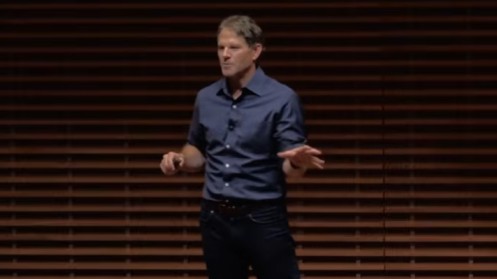
The following is the full transcript of Graham Weaver’s Last Lecture graduation speech to the Stanford Graduate School of Business Class of 2026.
Editor’s Note: In this deeply personal and reflective talk, Graham Weaver shares his journey of realizing that his relentless drive for external achievement was actually a way of running away from himself. He argues that true fulfillment and “winning without crushing your soul” requires shifting focus from the external game to the internal game through three metacognitive practices. Weaver ultimately encourages his audience to stop searching for happiness in the future and instead appreciate that they have already arrived, urging them to embrace the present moment.
The Illusion of “Arriving”
GRAHAM WEAVER: For a lot of my adult life, I didn’t like myself very much. And I was sure, though, that if I just achieved this one thing that was always out there on the distant horizon, this one more thing, then I would start to finally feel like I was enough. And it didn’t work. And I’m a little older than most of you here, so I will spare you the suspense. It’s not going to work for you either.
And maybe I’ll save you twenty years of your life. But there is a path forward that I’ve been spending a lot of time on over the last twelve years and it’s a path that you can win, which I know all of you want to do, without crushing your soul. And that’s the path that I want to share with you all today.
The Flight Story
Few months ago, I was on this flight and I’m sitting in first class and I’m banging away on my laptop and the flight’s boarding and people are walking by me. I have this little, as you often do, have this little ramekin of cashews sitting there.
And all of a sudden, looked down and there’s this little hand that reaches in and grabs my cashews and then disappears without a seat. I was like, what the? I looked down, there’s this little five year old girl. She has these pigtails on and she thinks we’re playing hide and seek. She jumps up and she stuffs the cashews in her mouth and she has this little rabbit, this stuffed animal, and it’s missing an ear.
I could tell this is our lovey. My kids all had these. And she says, hey, she says, “This is Roger.” She says, “I think you need Roger.” And she stuffs Roger in my face and I’m like, what is happening here?
And Roger smells like some combination of saliva and bleach. But he’s also kind of surprisingly soft. I was thinking, you know, she’s right. I kind of do need Roger at this moment. And just as I’m enjoying Roger, her mom comes next and sees what’s happening and panics and grabs the girl and they go in the back of the plane.
And then the next party in this parade is her younger brother. And he is like 18 months. He can hardly even walk but he has this little roller bag that’s about this big and he doesn’t understand how it works. He has it upside down. He’s not rolling. He’s dragging. He’s banging it into all the seats as he’s going but he’s wild. I mean, he’s amped up for this flight.
And then the final part of the parade is dad. Dad comes around the jet bridge and he’s walking down the aisle and dad is not amped for the flight. Dad is rough. He’s roughed up. In fact, it looks like dad hasn’t slept for like three years, probably because he hasn’t. And dad’s got this backpack with a car seat in it and he’s carrying another car seat and has a diaper bag wrapped around his head. And he just is like this and he’s walking through the aisle. He knows what he’s in for. And he gives me one of these and I kind of give him one of these and then he goes to the back of the plane.
Rushing Through Life
And I remember being that dad. It wasn’t that long ago that I had three kids, my wife and I had three kids under the age of five. And we took them everywhere. We took our kids everywhere. And the most common route that we had was from San Francisco to Detroit, which is about on a good day, four and a half, on a bad day, five and a half, six hours. And it’s a lot keeping three kids under the age of five occupied on a flight. And we didn’t have iPhones or iPads back then. And so we had to entertain these kids.
And so we had books and games and toys. We did magic tricks for them. And by the way, you ever want to feel like you’re good at magic, do tricks for two and five year olds because they kind of fall for everything. But I remember this one time we’re boarding a flight, and I knew I was in for a long flight. And I’m walking through the aisle to my row 32.
I walk through first class, and I see this guy sitting there. And he’s got this Wall Street Journal and a glass of champagne. And I just remember thinking, oh, man, I would love to trade places with that guy. And now I was that guy. And I remember thinking, I would give almost anything to go back and be in Row 32 with my wife and Chase, Blake, and Lily and try to entertain them on that flight. I’d give almost anything for that.
I rushed through a lot of my life. For about thirty years, really. I rushed through it. I was in high school. I didn’t really want to be in high school. I didn’t enjoy it. So I knew college would be better. So I just put my head down and cranked and got into college.
Then when I was in college, same thing. There was a lot of obstacles in front. I got to plow through those and did a lot of work, cranked, and cranked my way through college.
And then my reward was I got to Wall Street. I worked one hundred hours a week on Wall Street. I worked nights. I worked weekends. And I was trying to start my own company, which I ultimately did. And then when I started my company, we lost money on our first fund. I just had my head down, cranking, cranking, cranking.
And I want to be clear, I’m a huge fan of having aspirational goals as any of you know who’ve sat in my class. That’s not the problem and the hard work isn’t the problem. And yeah, sometimes you got to do stuff you don’t want to do, of course. None of that was the problem. The problem was that I wasn’t comfortable in my own skin and I just felt like I always wanted to be somewhere else.
The Day I Arrived
And I had this idea that there would be this day when I would arrive in the future. And once I got there, like everything would be fine. And then one day, I arrived. I arrived to that place, or at least I thought I did.
So what happened was our firm, after fourteen years of cranking, we finally had our first payday. And it wasn’t like life changing, never have to work again payday, but it was put some money away for my kids, for college, and I could exhale for the first time. And after that, I guess consciously or unconsciously, that was the moment that I’d really been kind of working toward this whole thirty year time.
And when that wire hit and a few days later, a really funny thing happened that I wasn’t expecting, which is nothing. Nothing happened. My life didn’t change. I didn’t change. My relationship with myself didn’t change. It wasn’t at all what I expected.
And about six months after that moment of that wire, I was completely lost. I didn’t know why I was really getting out of bed at that point. And I was exhausted many days I didn’t get out of bed. And there were times when I would go into work and I would just close the door and I would cry for no reason.
And what I realized is I hadn’t been running towards something. I’d been running away that whole time. I’d been running away from the fact that I just didn’t really like myself that much. And I’d been running away from this voice that for thirty years was telling me, “Graham, you’re not enough,” or some version of that.
And what I actually wanted during that time, it wasn’t I didn’t want more accolades or achievements. What I actually wanted was to like myself and what I really wanted was self love the whole time. Trying to find internal validation through external achievement is like drinking salt water to quench your thirst. It seems like it’s going to work, but it just makes you thirstier. And it didn’t work.
The Internal Game vs. The External Game
What I’ve realized, and I talk about a lot in class, is that at all times, we’re actually playing two games at the same time in parallel. We’re playing an internal game and we’re playing an external game. And the external game you’re all familiar with. We’re all familiar with. It’s where you’re going to go work. It’s who you’re going to do it with. It’s the trips you’re taking. It’s the money you’re going to make.
External game’s great, by the way, just to be clear. This isn’t going to be one of those speeches where I’m trying to talk you out of materialism or anything like that. It’s not that. What I’m trying to tell you is that there is another game that’s happening in parallel that you need to pay attention to, which is your internal game, and that’s what I had been avoiding.
And what’s ironic is that if you really think about it, most of your joy and your happiness and your relationship with yourself comes from the internal game, not the external one. And actually, everything that you create in this world starts with the internal journey that you’re on. So the path forward is to do internal work because life is an internal game that’s played in an external arena.
The Practice of Metacognition
And this took me a long time to figure this out. So there’s a technical term for this internal work. Don’t worry, this isn’t a woo woo speech. I’m going to actually give you some tangible things here. The technical term is called metacognition and what metacognition means is basically thinking about your own thinking. It’s reflecting on your own thoughts.
And think of metacognition as a muscle that you have that you can actually build. And ways to build the muscle are things you might think about like meditation or coaching, journaling, therapy or just really being alone with your thoughts. Anything like that you can build this muscle.
And here’s what I learned over the last twelve years of working on this muscle of metacognition. And this is what I want to share with you — you can have it all. You really can. You can build something that’s really meaningful and like yourself along the way. You can have white hot passion and ambition and still have peace. And yeah, you can also make money and still find meaning in your work. You can have it all, but it takes some work. In short, you can win without crushing your soul.
So what I want to do today is cut through the last twelve years of work that I did and I want to share with you the three most powerful practices of metacognition that I used to change my life and I think these things will change your life as well.
The Three Practices
So here they are. Here are the three practices.
# Practice #1: Fire Your Coach
So the first practice is fire your coach. A number of years ago, I watched this conversation unfold. And there was this eight year old boy who just had a really bad game, and there was this coach. And the coach said to the eight year old boy, he said, “Hey, look, kid. You’re not entitled to anything. You got to earn it every single day.”
Then I said, okay, well, it’s not that bad of a conversation. But he said, “Hey, look, your value is based on your performance. And when you perform, you have value. And when you don’t, you don’t. And by the way, right now, you don’t.”
And the hardest thing about watching this conversation was actually seeing the reaction of the eight year old boy because he didn’t yell or argue or start crying. You could just watch this boy internalize this coach’s words and it became his new operating system.
So the first time that I really started to spend a lot of time alone with my thoughts, I recognized that that conversation was the one I was having internally all day long. That inner coach was me talking to myself. That was the dialogue I was having. And I was also that eight year old boy absorbing that dialogue and telling myself that I had no value unless I was performing. And I’d been having that conversation for decades.
So we’ve had conversations with many of you about this and you’ve said, “Yeah, I understand. I’ve heard that voice. I know what you’re talking about. Sometimes I beat myself up. Yeah, I’m familiar with that.” And I knew that wasn’t the first time that I recognized that I was beating myself up.
So what I thought to myself at the time and I know what many of you have said when I’ve talked to you about this voice is, “Yeah, okay, I get it. Sometimes I’m hard on myself but that’s a good thing. That’s good because look, that’s where my motivation comes from and I need this voice to kind of keep me going.” And I thought the same thing.
So even though I observed this voice and had clear awareness of what was going on, I still didn’t let go of this coach until about six months later, something happened that would change my relationship with that coach. Which is at my firm, Alpine Investors, we had the biggest loss that we’d ever had and it was brutal. Like we lost money on this deal and it was the worst deal we ever did.
And this internal coach just went crazy. Just started berating me. “Graham, you’re an idiot. How could you let this deal happen? By the way, don’t know what you’re doing. Your investors are going to be so upset. You’re going to fail,” like just on and on and on as it did my whole life.
Only this time I had a little bit of space from this voice and I noticed something this time that I hadn’t noticed before, which is that voice, that coach that I had didn’t give me any advice or thoughts or ideas or solutions or really anything of value at all.
Firing the Coach: The Path to Self-Awareness
In fact, that coach just represented one single thing and that was fear. That internal coach that I’ve been listening to my entire adult life was just my own fears incarnated. And what I realized is that’s what I had been running from. I’d been running from fear. Fear that I wasn’t going to matter, fear that I wasn’t going to be enough, fear that I might fail.
I’d been running from that fear, from that coach, my whole life. And I know that many of you are running from that same fear. I know because I spent a lot of time with you in class and also in coffee chats. Here’s the other unfortunate bad news about this coach. It doesn’t just affect you and it doesn’t just stay in your head.
When I would berate myself, I would show up poorly with my family. When I would berate myself, I would bring that same negative voice to my team at work and my team would start second guessing themselves and then Alpine would freeze and people would feel bad about themselves. So your coach doesn’t just hurt you, your coach hurts everyone that’s depending on you. You can’t have a relationship with someone that’s better than the relationship that you have with yourself. The most loving thing that you can do for yourself is fire the coach.
If you want to win without crushing your soul, fire the coach.
Pull the Nails Out of Your Head
The second practice of metacognition that I started working on is pull the nails out of your head. So a number of years ago, there was a viral video about this woman, and she’s talking about this pressure she’s having, and she’s having headaches, and she’s really suffering, you can tell. And then the camera turns and you see she has a nail sticking out of her head. And she’s talking to her boyfriend and her boyfriend says, he’s a little bit like not sure quite what to say, so he’s like, well, he’s thinking how to word it and he’s like, “Well, have you thought about taking the nail out of your head?”
And she’s like, “Oh, no, no, no. It’s not about the nail.” And she goes on and talks about anything and everything except the thing that’s actually causing her the pain. And it’s a hilarious video. It’s about the breakdown in communication between couples.
And I remember thinking, okay, relate to that for sure. But the other thing that I related to in this video was when I watched it, I had a nail sticking, metaphorically had a nail sticking out of my head. And my nail was just as obvious and just as painful and I was avoiding it just as much as this woman was. And I wanted to talk about anything except the thing that was causing me the pain.
Thing is, like our life is really, really hard. We go through life and we accumulate these nails. Some we create ourselves, some we don’t, but we accumulate nails and we don’t pull them out for one simple reason, which is it hurts to pull out these nails. Something’s going to go bad first.
So your nail, if you’re wondering what it is, it’s the thing that you’re avoiding. It’s the thing you’re afraid of. It’s the thing you don’t want to talk about. It might be the thing at 2:00 in the morning that you ruminate on. Or it could be the relationship that you know has passed its course that you need to end. It could be the job that’s slowly draining or going to drain your energy. It could be a bad habit that’s taking a toll on your life that you know you need to end.
Your nail also could be something much deeper. It could be something from your past that you’ve stuffed down that you haven’t dealt with. As Carl Jung said, “Where your fear is, there is your task,” and this is your nail.
Olivia’s Story: The Cost of Leaving the Nail In
I have this friend of mine and I’ll call her, for the purpose of this story, I’ll call her Olivia. And Olivia got engaged to, we’ll call this guy Jim, about three months after she graduated from college. And once she got engaged, she and Jim moved in together. And once they moved in together, it was a lot harder for Jim to hide his drinking. And so Jim would get up drinking and he’d get upset and he would take that out on Olivia. He’d yell at her. Next day he would apologize. Three days later it would happen again and then that cycle would repeat.
So a little bit before the wedding, Olivia went to her friends and her family and she said, “Hey, look, I’m really having some second thoughts here.” And Olivia’s like, “Okay, I guess we already sent out the invitations and we paid the deposit.” But she had something in her gut that told her that this was the wrong thing for her. But she proceeded and she got married anyway.
About three months later, things got a lot worse. Jim’s drinking more. This behavior is getting a lot worse and now she knows she made a mistake. Then she gets pregnant and she has one kid and another one and another one. I’ve probably seen Olivia, talked to her once a year since she got married. Every time she tells me, she says, “Okay, this is what’s happened. This is what Jim’s doing. This is not going well at all. And I’m going to change. I’m going to make a change just as soon as I get on the other side of this thing.”
Well, that twenty-five year old girl who almost called off her wedding, she’s 62 years old now and she’s still married to Jim. And that nail, which is her marriage to Jim, has defined most of her life. Thirty-seven years. Thirty-seven years of leaving that nail in. Pulling out your nails hurts, but leaving them in is even more devastating.
How to Pull Out a Nail
How do you pull out a nail? It’s not easy all the time. So the first thing is you got to admit that you have one and that’s hard. So bring your nail out of the shameful shadows that it’s probably living in and start talking about it with people. That’s step one.
Then assemble a team that can help you so you don’t have to face the nail alone. Maybe that’s your friends, a therapist, an advisor, but get a team on your side. And then most importantly, resolve that you’re going to pull it out. Resolve that you’re going to pull it out even though your life is going to get worse first. And realize that’s the reason you’re not pulling it out in the first place. So prepare for that.
This chart is my best depiction on what your life looks like over a long period of time. It’s not linear, unfortunately. I wish it were. So what happens is in our life at times we reach kind of local peaks or plateaus and we hit this plateau and we get stuck. And the reason that we’re stuck at that plateau is because the path to get to the next peak involves first traversing down a valley. And we’re not willing to do that.
So if you want to leave a relationship, you might have a hard conversation, a hard breakup, and then you might be alone for a period of time. That’s your valley. Quit drinking and sobriety might seem boring. Your friends actually might seem boring. Hypothetically. Quit the job and you might be stressed for money. Quit a habit, it’s going to be hard first.
But if you can really internalize this graph and really take this in, it will change your entire life. It will change your entire life because everything that you want is on the other side of worse first. Facing your nails is a superpower. Facing your fears is a superpower. And it’s also the path to self love. And it’s a path to growth.
If you want to win without crushing your soul, fire the coach and pull out your nails.
Trust Your Second Voice
The third and final practice of metacognition that I want to talk about today is trust your second voice. So by now you might have realized something, which is that voice, that internal voice of fear isn’t the only voice that you have inside of you, thankfully. You have another voice and it’s your second voice and this voice goes by many names. It goes by the name intuition, your higher self, your soul, God, the universe, source. But unlike your negative coach, this voice doesn’t speak to you through fear. It speaks to you through energy.
Energy is the language of your soul. It’s that excitement you have. It’s the dread you had like Olivia had in her pit when something is off. Energy is the language of your soul.
I’ll give you a really common example of this at play, something you can all relate to. So I’ve taught here now at Stanford for twenty-four years and over that time, I’ve coached many of you in one on ones or in class, but the most common thing that I have is students will come in and they’ll have some dilemma. And I’ll just use a simple example. Say it’s a career and you have job A and job B. So the student comes in and they’re really torn. They’re not sure what they’re supposed to do.
So they tell me about job A and again, hypothetically, let’s say it’s the job you had before you came here, you’re going back there or it’s something in the same industry you’ve been in. Job A is like something that is very clear, you know what it is. And then job B might be this other job that you’re kind of scared of, or alternative B also might just be an idea. And so what I do is I just try to ask some questions, open ended questions. “Tell me a little bit about job A. Tell me a little bit about B. What’s exciting you about A? What’s exciting you about B? If you knew you wouldn’t fail, tell me about A. If you knew you wouldn’t fail, tell me about B.”
And in a short period of time, something in that room will shift. And it’ll be really obvious, typically. The energy in the room will change and we can both feel it, the student and I. There’s a heaviness when they talk about the thing that they really don’t want to do but they feel like they should do. There’s this heaviness and the energy lags. And then they have energy when they talk about the thing that they’re really excited about. And we both know that in a short period of time. And almost every time, the student knew the answer before they walked in.
So for all of you, as you’re thinking about a lot of the big decisions that you have coming up, my question for you is, are you unclear or are you afraid? And my guess is it’s the latter. Because often, your soul already told you and everything else is just a negotiation with your fear. And fear isn’t a good way to run your life.
The Wisdom of the Second Voice
So the wisdom contained in this second voice has been around and talked about for centuries. In Christianity, you pray and you get some download from God. In Buddhism, you meditate and you tap into source. Steve Jobs talked about this intuition. He said, “Have the courage to follow your heart and intuition. They somehow know who you truly want to become.”
And my favorite description of this comes from Rumi and he said, “Your heart knows the answer. Run in that direction.”
Hearing your soul is one thing, but following it is another. And there were years that I spent in a wrong relationship. There were years I spent at a job that I knew wasn’t right for me. There was a pit in my stomach, but I didn’t act because in short, I was afraid like many of you are at times.
So a very simple practical tool for overcoming your fear, I’m not saying this is easy, I’m saying it’s simple, is write your fears down. Fears are most dangerous when they’re lurking in your subconscious mind. That’s where they can have the most damage over you when you’re not even aware that you have them. That’s where they can really paralyze you.
Write your fears down. Put them on paper. And now all of a sudden, your fears aren’t this nebulous thing that’s going to keep you from living your life. Your fears become a problem to be solved. All of you are phenomenal at solving problems or you wouldn’t be here, so you can really make this a lot easier.
So if you have something like, “I can’t do this because I have loans,” it could become, “How do I reduce my burn, start this and still cover my loans?” I’m not saying the answer to this is easy. I’m downplaying how hard this is going to be, but I’m just shifting what you’re actually going to focus on, which is just a solution to a problem versus this nebulous fear. Fear in your head is paralyzing and fear on paper can just be a problem to be solved. I’ve used this tool so many times in my life and I think it’ll help you.
For a long time, I thought that life was really, really complicated and there were a lot of decisions that we needed to make all the time. And the longer that I’ve lived, the more that I’ve realized is that there’s really only one. And that is which voice will you listen to?
If you want to win without crushing your soul, fire the coach, pull out your nails, and trust your second voice.
Returning to 2014: What Actually Worked
So I want to go back to where I was in 2014. So I was at this low point, what I was doing was not working and I had to try some different stuff. So I tried all kinds of different things. And what I’m sharing today are the three things that worked the most for me, these three practices.
So first I started meditating. I started watching that voice and I realized I didn’t have to just meditate for those twenty minutes. I could meditate and watch that voice all day long. And I started to realize that internal coach for the fearmonger that he was and I started letting go of that coach.
The Path to Self-Love
I started basically giving myself permission to stop beating myself up and berating myself. And over time, and I’m still working on this to be clear, but over time, I’m shifting from being my harshest critic to my best friend. And it’s made a huge difference. I’ve shown up differently from my family, been more present. I’ve been more supportive of my team at work, but mostly been a lot more accepting of myself.
And the more that I sat with my thoughts quietly, the more that I just realized I had nails everywhere. I mean everywhere. I had things, conversations I was avoiding. I had people in my life that I needed to remove from my life. I had habits that were slowly draining my energy, alcohol, caffeine, sleeping pills. And I had some really deep things that I’d buried from my past that I hadn’t dealt with.
And I didn’t remove all these nails at once. I didn’t do it gracefully or quickly. I made excuses. I rationalized why I should keep these nails in place. But after a while, I started to realize what Carl Jung said, which is this was my task.
And so I pulled out the first nail and exactly what I thought would happen happened, which is my life did get worse first. But that valley that I was anticipating was a 100 times worse in my mind than it was in reality. And the peak was much higher also. In fact, I felt like I was a beach ball that had been held underwater and I let go and I shot like 30 feet in the air. And every time I pulled out a nail, I’ve had a similar experience.
And so over time, I’ve grown less fearful of pulling out these nails.
Trusting the Second Voice
But the biggest change by far in my life, and this will be true for you, is when you start trusting that second voice. And I’ll give you one example of this. So as I started sitting with my thoughts and working on myself, I started realizing that I really actually didn’t have energy for private equity, which was unfortunate because that’s the business I was in. So I struggled with that big time and I fought that and I wanted the answer to be really different, but I trusted that voice.
But what I did realize at the same time was that we had done these three deals where we had backed people just like all of you, a high attribute person, and we put them in to run companies. And when we did that, we basically gave these people permission to follow their second voice and find the thing that really lit them up. And those weren’t just our most fulfilling deals. Those actually were our highest performing ones too. And so over time, we shifted from being in the private equity business basically to being in the talent business.
But I just want this to sink in for a second, which is for you all, class of 2026, a high attribute person doing something that you love that lights you up over a long period of time is the most powerful formula that I’ve encountered. And so at some point in your life, give yourself that power.
I learned something else, which is I learned you can fake your way through something you don’t care about and something you’re not excited about for a little while, but you get burnout and you can’t do extraordinary work that way. Extraordinary work requires every part of you over a really long period of time. In short, extraordinary work requires you to tap into that second voice.
The Results of Letting Go
Since that day in 2014, at my firm Alpine, our assets have increased over 50x. To make that happen, what I needed to do is start letting go of my fears and trusting my second voice and I needed to give myself, my team permission to do the same thing, which is what we basically did.
But more important than any of that business success is what happened to me internally. It turns out that these three practices that I’ve been talking about today were really a gateway to something much, much bigger. Firing my coach and removing my nails and trusting my second voice was the path to the thing that I’d actually been searching for my whole life, which was self love. That was the path to me start loving myself.
You’re Already in the Good Old Days
There’s a quote from the Andy character in The Office and he says, “I wish there was a way to know you’re in the good old days before you’ve actually left them.” It’s maybe the most famous quote in the series. And I think back to being that young father with three kids in row 32. And I think, gosh, I wish I would have known I was in the good old days at that time because there are moments when I stepped over those days.
But I think there’s even a much deeper meaning to this quote. The more I reflected, the point of being a young dad was never to get my kids from first grade to second grade or even to get my kids into college. And the point of that flight was never to go from San Francisco to Detroit. The point of the flight is just the flight. The point of the flight was to build a racetrack with my boys on the tray table with a goldfish.
The point of the flight was to have my daughter fall asleep in my arms as I read Good Night Moon to her for the one hundred and thirty seventh time and realizing that there’d be a day when she’d be too old to fall asleep in my arms like that. The point of the flight is just the flight.
A Closing Message to the Class of 2026
So class of 2026, your path to the life that you want traverses through internal work. It traverses through these three practices.
Fire your coach. Give yourself permission to stop berating yourself and shift from being your harshest critic to your best friend. Remove the nails from your head. Move toward the thing that you fear and realize that everything that you want is on the other side of worse first. And most of all, trust that second voice. Pay attention to the things that give you energy and then give yourself the courage to go toward those things.
You can stop running. You’ve already arrived. You’re in the good old days now, and you always have been and you always will be. So go live them. Thank you.
Related Posts