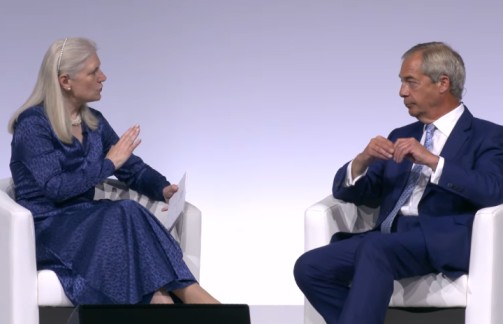
The following is the full transcript of British politician Nigel Farage’s interview at ARC 2026, June 24, 2026.
Editor’s Note: In this exclusive session at ARC 2026, Nigel Farage discusses his vision for the future of Britain, emphasizing the urgent need to defend Western civilization and the values of family, community, and nationhood. He addresses contemporary challenges, including the impact of mass migration on productivity and the need for a fundamental shift toward energy independence through nuclear power. Additionally, Farage explores the importance of restoring social cohesion and meritocracy, arguing for a more consistent approach to law and order across all communities.
Defending Western Civilization
PHILIPPA STROUD: Nigel, welcome to ARC. You were here last year as well. We are so grateful for you coming back this year. You have spoken about the importance of this cultural moment, of this civilizational moment. Why do you think we need to defend Western civilization today?
NIGEL FARAGE: Good morning, everybody. I’m amazed to see so many people here. Don’t you know there’s a red warning? We’re in the red zone. The schools have all closed. No one’s going to work. There’s a danger to life. I’m astonished you’re all here.
PHILIPPA STROUD: Oh, proud of a resilient bunch of people.
NIGEL FARAGE: Of course they are. I think that what we developed in Western civilization, the basis of which, of course, is Judeo-Christian culture. That’s undeniable at every level. And the way in which we developed it over centuries to become democratic, where we had the right to choose our leaders, to fire our leaders — I think in terms of the life of ordinary people, has produced the best civilization that humanity has managed in the 2 million years it’s been around. And it seems to me that’s something worth fighting for and worth defending.
And the extent to which Western leaders over the last few decades have lost sight of this, almost don’t care. I mean, it was interesting, wasn’t it? It was Alastair Campbell in the late ’90s, “We don’t do God.” Yeah. “We don’t do God.” And the promotion of every other culture and every other religion to kids at school. But no fundamental teaching of what we are and why what we’ve created has really been so wonderful.
So yeah, I think we’re in real danger. I think we’re in real danger of absolutely losing a sense of who we are. And really, when I came back into politics 2 years ago, having been out for a few years, it was really the values around family, community, country, and that’s why I came back. And I think there is an appetite, there is a thirst for this, and I’m also encouraged that despite the education system, it seems to me growing numbers of Gen Z are looking for a sense of purpose, looking for a sense of why are we here, and what does it mean.
Social Cohesion and Two-Tier Britain
PHILIPPA STROUD: And can I just pick you up on that family and community? Here in the UK, we’ve obviously had the murder of Henry Novak and then the riotings in Belfast as well. Can you just talk us through, in your mind, what is required to re-establish a sense of togetherness, of social cohesion once again?
NIGEL FARAGE: Well, we are living in two-tier Britain. We’ve got two-tier policing, we’ve got two-tier justice. And we’ve had two-tier care, but not for very much longer. Just look at Hampshire and the Isle of Wight. This appalling incident happened in Southampton. Just look at the Hampshire and Isle of Wight Race Action Plan put in place, whereby the most serious thing a police officer can be told is that somebody has committed an act of racial abuse, whether it’s true or not. And if the officer doesn’t take that accusation seriously, they will be suspended immediately.
So we’re not policing each group with colorblindness. We’re not treating everybody the same. And the police chiefs themselves admit we now police different communities and different groups in different ways. This is a road to disaster.
PHILIPPA STROUD: And what would you be doing to address that and to change that?
NIGEL FARAGE: I would say that we have to treat everybody exactly the same, whether you’re a police officer on the street, whether you’re a university admissions secretary. Everybody must be treated the same. We have to get back to some sense that we’re a meritocracy, because if we don’t, the level of division — and you saw those, I mean, you mentioned the riots. But if that sense of division grows deeper, we’re headed for very, very troubled times.
Strengthening Families
PHILIPPA STROUD: Yeah, and whilst we’re talking about our social fabric, we’re seeing across nations a declining in our demographic trends and also a declining in the resilience of families. You have right at the center of your mantra about Reform, family, community, nation. So when you’re looking at family, what is your approach to strengthening families and enabling them to thrive and flourish?
NIGEL FARAGE: Well, the tax system for years has actually counted against people getting married. It’s actually encouraged people — now look, I may not be the best advocate for marriage myself, track record’s a bit checkered, but I still think it’s a good thing, and there’s no doubt — all the evidence is there that children that are brought up in a married household have better life chances than those that don’t. It’s just as simple as that.
And the tax system has penalized people getting married. So I think there are incentives, there are things that can be done. And I also think that working couples who’ve got young families need some help, some incentive through the tax system to make their lives a little bit easier, and I really do.
PHILIPPA STROUD: So we have 1,000 young leaders here at this conference, and I know from speaking with many young people that it’s not so much about the tax system, it’s actually about something in the culture, something more profound — that they are reticent to go into a marriage setting, a committed relationship.
Or as we were hearing yesterday, there’s almost a breakdown in the communication between young people, between men and women. How would you influence culture in order to see a thriving family life within the UK?
NIGEL FARAGE: Look, it’s not going to be easy. Let’s be frank, we’ve gone so far away from the values that probably our grandparents would have been brought up with and thought normal and cherished. We’ve moved so far away from that. It’s actually part of — I think the family breakdown is pretty much the same as community breakdown.
When people live together in communities and they all speak the same language, and they all have something in common, and they all know their neighbors’ Christian names, and they take part in community events — when that starts to break down, what happens? People become individualized. They become more selfish. They don’t know the names of the next-door neighbors. And I think downstream of that, a similar thing has happened within families.
And I’m not pretending that government on its own can wave a magic wand, because it can’t. But we can at least start to make the argument that living in a family, living in a genuine sense of community, is a better way of life. And let’s start to unashamedly champion that.
I mean, I grew up in a village of the North Downs with just under 1,000 people. Everyone knew everyone. And if the milk wasn’t taken in from an elderly next-door neighbor, mum would go and knock on the door. People looked out for each other. And the church and the shop and the pub — this is where everybody met, and you know what, I look back on that, it was a great way to live.
Re-industrializing Britain: Energy and Productivity
PHILIPPA STROUD: Yeah, and if we move from thinking about social coherence and family to thinking about an economy that enables our young people to thrive and to flourish, obviously we’ve had stagnant productivity in this country for years, and I’m beginning to see the United States re-industrializing. What would be your strategy for manufacturing productivity, re-industrializing the UK?
NIGEL FARAGE: Energy, energy, energy, energy, energy. The idiotic path — “vote blue, go green.” Yeah, that was the Tories. They even wrote net zero into law, and they shouldn’t be forgiven for it, in my opinion. Set us on a disastrous path. Now we’ve got Labour, who are even worse.
We are going to be using hydrocarbons for many decades to come. We will need them — downstream chemicals, plastics, you name it. I would want us to become at least as self-sufficient in all energy as we possibly can, and to re-industrialize. Not only have we got the most expensive energy prices in the world, which has destroyed traditional manufacturing, we haven’t even got a hope in hell with AI, data centers. Forget it. We can’t even enter the 21st century.
And the only long-term solution for that — and let me tell you something, folks, it’s not wind turbines, all right? I may not be quite as outspoken as President Trump on this, but it’s not wind turbines. We do not need intermittent energy. We need baseload power. And if Reform win the next general election, the first phone call I’ll make is to South Korea to get their nuclear engineers over here, and they will deliver nuclear energy for this country on time and at 20% of the cost that we’re currently spending on Sizewell and Hinkley. We must go nuclear. We must do so in a very, very big way.
PHILIPPA STROUD: So that would be the strategy for manufacturing and re-industrializing. But productivity — where are we at with our productivity and why can we not get that moving?
NIGEL FARAGE: Mass migration of low, unskilled labor has destroyed UK productivity. There you are, I’ve said it. And it goes against everything the establishment have told us. When Tony Blair opened the doors in the late 1990s all the way through to the catastrophic Boris wave. Catastrophic. I mean, he let in 3.8 million people, only 17% of those on work permits, and only a fraction of the 17% in high-end jobs. Mass migration has destroyed productivity in the UK.
But also culturally we sort of moved to a place where we think hard work is bad, where we think success is bad, where we think making money is bad, and we have to reverse all of that. I always tell young people, I don’t know a single successful person, whether it’s in sport or science or business or politics, who hasn’t worked harder than all of his or her competitors. So a complete attitudinal change towards work.
And I would also say — I set my first company up in 1993. I’ve had a series of small companies. I’ve done my best to employ people, try and make money. And when I went to Brussels, I realized very shortly afterwards that everything government does or thinks about or legislates is effectively for giant multinational businesses. A piece of employment legislation that is there for Unilever also applies to the corner shop down the road employing 4 people.
There’s a complete lack of understanding that the real economic backbone of growth — and if you want wealth to be spread, it isn’t going to come from half a dozen big firms down, it’s going to come from hundreds of thousands or millions of people with their small businesses thriving. So a complete change in our thinking towards small business. Our 5.7 million small businesses and sole traders feel that no one’s been on their side forever and we need a complete change of culture.
And we start, for example — they’re now being told that they must put their tax returns online 4 times a year. Just one little example. Oh, and digital ID registration, amongst many other things.
America — the American economy, it’s fascinating. You take 2008, the global financial crash, American economy GDP, Eurozone GDP, exactly the same. Now America’s doubled in that time. But the only criticism I would have is that a lot of what’s happening in America is the upper layer progressively becoming even wealthier compared to those lower down. And that’s why I genuinely think what happened in the ’80s in the UK and America, in Thatcher and Reagan’s time, when we started to see entrepreneurship, we started to see small business thriving, there was a much greater spread of wealth and a removal of so much social inequality.
But it begins by making people understand that hard work’s vital, and that making money and success is good.
The Rise of Antisemitism
PHILIPPA STROUD: Nigel, as we come into land, I just want to ask you one question about what is happening culturally again in our nations across the West. Whilst there is much that’s good that’s taking place, there’s also the rise of antisemitism happening. And I’d love to know what you, as leader of Reform, would do to reverse that antisemitism. The reason why I want to ask this is because our next speaker is going to come and speak about this, and I think it would be great to have your views on it first.
NIGEL FARAGE: I’ve seen this firsthand.
PHILIPPA STROUD: Yeah.
NIGEL FARAGE: I saw it firsthand in Brussels and Strasbourg. The change over 20 years I was there — I don’t think anybody who’s Jewish now lives in central Brussels. And I saw, even a decade ago, kids going into school in Strasbourg, schools with quite a high Jewish population, with armed soldiers accompanying the kids into school every morning. Brussels — literally the only Jewish people that live in Brussels are wealthy ones living in gated communities with private security.
And I fear that London is going the same way. I genuinely fear that London is going the same way. A lot of Jewish people I’ve spoken to are seriously considering leaving the country.
PHILIPPA STROUD: And what would you do to reverse that?
NIGEL FARAGE: Well, again —
PHILIPPA STROUD: We want London to be a place that welcomes our Jewish community.
NIGEL FARAGE: But again, we’re back to where we started.
PHILIPPA STROUD: Yeah, exactly.
NIGEL FARAGE: We’re back to where we started. If you allow people to march through the streets of London, you know, who come from the Muslim community, or an element of the Muslim community, and you allow them to chant horrific slogans in the streets of London, and yet they do nothing. If anybody comes back and counters them, they probably get arrested. That is two-tier policing and justice.
And we’re not— and I’m afraid the whole establishment has run away from radical Islam. We don’t even try. I mean, you know, for example, the Muslim Brotherhood thrives in this country. It’s the main spreader of hate and extremism in Britain today, yet it has offices all over the country.
I mean, sensible, sensible Arab Muslim states prescribe those organizations and treat extremist terrorists for exactly what they are, and our gutless cowardly political class have done their best to turn a blind eye to all of it. And now we’ve got growing sectarianism. It’s even in our politics. Yeah, even in our politics. So we have to stand up and say no, sorry, we don’t operate like that here. If you don’t like it, tough.
PHILIPPA STROUD: Nigel Farage, I want to say a huge thank you to you for taking time out of your incredibly busy day at the moment and coming to join us at the ARC conference. Can we say a huge thank you to Nigel Farage, leader of Reform.
Related Posts