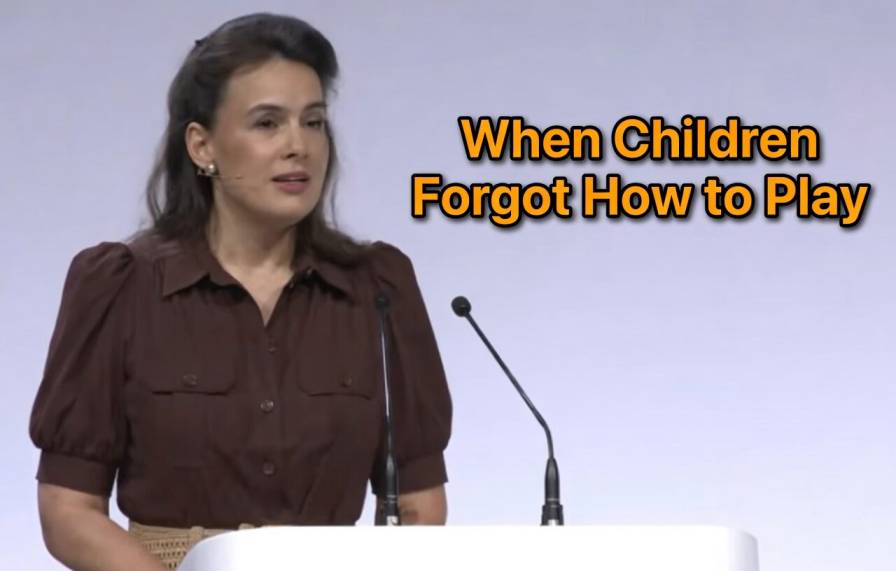
Editor’s Note: In this compelling talk from ARC 2026, Sophie Winkleman argues that the increasing integration of screen-based technology and AI into classrooms is detrimental to children’s cognitive development and imaginative capacity. She contends that “edtech” often prioritizes engagement through addictive design features over meaningful learning, while physical methods—like handwriting and reading from books—are essential for deep, embodied understanding. Ultimately, Winkleman calls for a return to analog education, urging society to protect children from the “civilizational earthquake” of AI and prioritize human-centered mentorship in schools.
TRANSCRIPT:
When Children Forgot How to Play
SOPHIE WINKLEMAN: Good afternoon, everyone. Lovely to be here. A few months ago, I was introduced to a headteacher, Justine, who works at a primary school in Hertfordshire. One sunny afternoon, Justine cancelled the lessons, opened the back doors and told the children to go and play. They looked at her confused and shuffled out to the grassy area outside the school. She watched them stand there awkwardly for a few minutes until they asked to come back in. She came to realise that these children did not have the capacity to go and play. They couldn’t create their own fun, their own entertainment. So accustomed were they to receiving their entertainment via their devices.
When we talk about children, social media, smartphones, iPads, we tend to frame the discussion around harmful material. But Justine’s children weren’t traumatised by harmful material. They were dazed, glazed and passive, their young minds deactivated by constant low-level stimulation.
Justine removed screen-based story time from the school’s timetable and encouraged parents to let their children read or just get bored at home. Boredom costs nothing and is a crucial catalyst for the imagination. A few weeks later, Justine tells me the children can’t be stopped from tearing outside at break time, their imaginations and their sociability blossoming beautifully.
The EdTech Sales Pitch Nobody Asked For
Teachers like Justine, along with parents, doctors, academics and neuroscientists around the world, feel confounded that the very machines destroying children’s imaginations, concentration spans and capacity to think at home are now the principal conduits for their education at school. Internet-enabled devices are being handed out in schools across the world on the pretext of delivering a future-proof education. One million children in Britain spend nearly every lesson on a screen. Welcome to the world of EdTech.
Many parents who see what screen-based learning is doing to their child are not buying this sales pitch. They write to each other in burgeoning online communities, where are the books? Why has my child’s education been reduced to a series of links, games and videos? Why is my child accessing obscene content on his school-issued iPad? The school filters don’t work. Where is my child’s private data going? Why is my child online for his homework every night? He’s getting headaches. He’s getting cranky. He keeps going off-task. He’s going to sleep later. And now he’s short-sighted. I did not sign up to this.
The Global Pushback Against Screen-Based Learning
A number of these parents are moving their online rage to real-world action. The US-based alliance Schools Beyond Screens recently persuaded the Los Angeles School District to approve the most sweeping pullback on screen time of any public K-12 system in the US. Anya Meksin, the Deputy Director, says, “Cognitive skills are declining. Attention spans are declining. Executive functioning skills are declining. Human brains don’t work well by learning from screens. All the research says one thing. Why are the schools doing another?”
Equivalent pushbacks are happening in Utah, Delaware and New York. Similar mass action has happened in Madrid, where under-12s no longer learn on devices. John McGhee, Director of Education in Glasgow, recently binned a huge maths app in schools, saying, “You can do the work on paper as well as you can on the app, and you’re just moving the teacher away from the child. That’s no way to teach.” Denmark and Sweden are spending hundreds of millions on the reintroduction of textbooks. These countries and cities are the first fish swimming away from a misdirected shoal.
Slot Machine Tactics Built Into the Classroom
The data from the last 15 years shows that as soon as devices entered the classroom, scores started plummeting around the world. Of course, that’s when social media exploded into children’s lives too. But social media, smartphones and EdTech are all fins and teeth of the same shark. The social media design features deemed harmful enough to restrict for children, the streaks, the daily rewards, the endless notifications, are the very same features found in EdTech apps. These are slot machine tactics, the same unpredictable reward which keeps an adult scrolling, now built into maths, languages and even reading apps. A reading app, has there ever been a more oxymoronic concept?
Engagement Over Learning: The Business Model Behind Educational Technology
Will Ellis from Reclaim Childhood says, “These features do not appear in educational products because they improve learning. They appear because they improve engagement, and engagement is what the business model requires.”
The Physical Act of Reading: Why Books Beat Screens
The distracting features are by no means the only downside. Material read from a page in a book implants in the brain more profoundly than the exact same material read from a screen. We are physical beings, we must learn physically. Reading from a page in a book, the feel of the paper, the design of the cover, the typeface, the smell of the pages, the spatial position of a phrase on a page, all of these things contribute to the holistic embodiment of learning.
Reading on a screen is both immaterial and aspatial. What you’re reading right now is in the same place as what you were reading 10 minutes ago, half an hour ago, yesterday. It’s flat, it’s unimpactful, the information won’t stick.
The neuroscientist Dr. Jared Cooney Horvath explains how, after learning something, the brain needs a spell of downtime, rather like a digestion period.
Calm, book-based learning provides this as a matter of course. But there is no downtime with screen-based learning for the simple fact that screens are stimulating in and of themselves.
The Neuroscience of Handwriting: Why Typing Falls Short
The neuroscientist Audrey van der Meer has spent the past 20 years charting the neurological differences between handwriting and typing. Her meticulous scans show the whole network of the brain lit up like a Christmas tree during handwriting and dark as a cellar during typing. The physical process of handwriting appears to trounce the ease of typing in every cognitive metric.
Handwriting is also slower than typing, meaning a student has to organise and prioritise what he’s listening to or reading, a process rendered unnecessary by transcriptive touch typing. It is also personal. A child’s handwriting connects him to the subject he’s writing about, where a sterile typeface neutralises that relationship before it’s even begun. The same is true of a teacher’s handwriting on a submitted piece of work. Receiving personal, not robotically generated feedback is essential for continued motivation. Handwriting must return to centre stage in the classroom.
Maths and Science: Paper Wins Again
It is not just the humanities which are better mastered on paper either. The legendary maths teacher Bill Hinckley has researched how working out maths problems on paper deepens mathematical understanding and confidence. The educational researcher John Jerram conducted a lengthy experiment which saw 3,000 pupils take PISA tests in maths, science and reading. Half the students conducted all their work on paper, half did all their work on a computer. The paper-based group scored 20 points higher, which is the equivalent of six months extra schooling.
Randi Weingarten, President of the American Federation of Teachers has said, “We need more paper and pencil, more hands-on learning and fewer screens.” Hear, hear.
Special Needs and the Limits of Assistive Technology
But what about the children with special needs? Well, some technology is very helpful. A speech generating device for a non-verbal child, an eye tracker for a physically impaired child, an audio book for a blind child. But the few children who are genuinely helped by assistive ed tech should not determine how the majority learn.
There’s also a question mark over whether tech actually does help children with milder learning needs. The speech and language therapist Denise Champney has found that these children are often disempowered by classroom tech, rendered dependent on it, when they should in fact be exercising the skills they find challenging. The push for everything to be easier is seductive, but it can often make things ultimately harder.
Teachers Who Are Pushing Back Against Screens
Some teachers with the heft to go against the screen-based grain are doing so. The renowned social psychologist and author Jonathan Haidt banned his MBA students from using devices in his classroom several years ago. He saw the laptops as distraction machines, the entire world available just one click away. He also believed in the power of his students’ eyes on him, the biological connection between teacher and student. Stanford professor Jim Steyer also bans devices from his classes, teaching only with books.
The Teacher-Pupil Relationship Cannot Be Replaced
McGill professor Adam Dube reports his colleagues going back to pen and paper for everything. Many tech giants send their own children to low-tech schools, aware that the most highly prized human capital in the coming era will be the ability to think deeply, knowledgably and originally, to be the best of what a human can be, not a pale imitation of AI.
This is a pattern worth keeping an eye on. A few years ago, I wrote an article based on a UNESCO report predicting that elite schools around the world would soon turn their back on screen-based learning and return to books, and the poorer children would be left with the digital slop. Sure enough, top schools like Winchester College are implementing a stringent paper-first policy, while Britain’s poorest children are given chatbot tutors. EdTech was meant to bridge the attainment gap, but it sadly seems to be doing the opposite.
The beating heart of the teacher-pupil relationship is one of the most important factors in academic success. The encouragement provided by a bouncing avatar makes a mockery of that relationship. As the writing teacher John Warner puts it, personalised learning programmes would be more honestly sold as “depersonalised learning.” A machine cannot be a mentor. It won’t wonder how you are when you switch it off. Children facing problems at home deserve more human contact in the classroom, not less.
Yes, this is expensive. But so is EdTech. It’s a multi-billion pound business. Governments, districts, councils and school boards have a duty to put their money in the right place. That place is human teachers, human examiners and physical textbooks. Where have all the textbooks gone? Bring them back.
The Civilizational Earthquake of AI in Education
So far, I’ve only spoken about the damaging tremor of EdTech. But now we are faced with the civilizational earthquake of AI. In its best form, AI is a supremely high-functioning tool, creating whatever you might need from metaphorical scratch or sifting through gigabytes of information and organising it into a cogent order. This can be pretty helpful if you’re a time-pushed adult and you’ve learned the hard way, that is how to read, think, analyse information, grasp a concept, then organise your thoughts about it.
But if you’re a child and you haven’t been through that lengthy, fibrous, but ultimately joyful journey of learning to do it yourself, then you’ve skipped a crucial part of cognitive development. The behavioural economist Richard Thaler observed that humans tend to default to low-effort choices. Hence the adoption of AI in schools, feeling so naive. However many lectures you give teens on how to use AI responsibly, as an intellectual sparring partner rather than a second brain, the vast majority will choose the shortest route to get the damn essay done. This is a totally natural biological response. Teenagers will push boundaries and test adults’ credulity and fallibility. Why are we setting up so many of these learners to fail?
Skipping the Crawling Phase of Learning
Jessica Winter writes in the New Yorker, “With its prettifying intrusions and impatient, lurking presence, AI blocks a young person’s natural, gradual progression towards cognitive maturity.” This is a fragile process and it’s one that’s being interrupted. We don’t say to parents of a baby, “Don’t let him crawl, it’s a useless phase.” With 80% of middle schools in America handing out Chromebooks with built-in AI offering prompts for spelling, editing, sentence structure and more, the current system seems designed to skip the crawling phase, the arduous phase.
Immediate relief in exchange for long-term dependency seems to be AI’s defining trade-off, an instant elevation of results twinned with a long-term dwindling of capability. Learning scientists at McGill question the AI mantra of “deploy now, test later.” Indeed, the tech world’s “move fast and break things” philosophy, arguably necessary in the competitive fields of industry and defence, feels dangerous in the area of education. These systems are unpredictable, they hallucinate, they present fabrication as fact in a way no child could possibly unpick. They are built to keep users coming back, to tell them what they want to hear, qualities which would be deemed manipulative in a human teacher.
Preparing Children for a Digital Future
Yet these are not teething problems to be patched in the next version, they are core properties of the technology. So how should we respond to this seismic change?
At a recent convention in Oxford, the technology futurist James Poulter was asked what schools should be teaching their pupils to prepare for their future. He replied, “Teach the subjects which form character — Classics, English, languages, history, philosophy. Skills can be acquired.”
Tech consultant Emily Churkin agrees that the best preparation for a digital future is an analogue education. Churkin’s motto is “Tech Ed, not Ed Tech” — that is, learning how technology works in technology lessons, and back to books for everything else.
Helpfully, most technology skills do not require an internet connection — safer and greener, what’s not to like? And on the green theme, many schools trumpet the virtue of removing books to save paper, then hand out electricity-guzzling devices wired to water-slurping data centres. A book which can be read, re-read and passed down till it falls apart seems evangelically green in comparison.
Amusing Ourselves to Death
I will conclude with a brief summary of the great polemic Amusing Ourselves to Death, in which Neil Postman weighed up two dystopias. In 1984, Orwell prophesied that we would be overcome by an externally imposed oppression. In Huxley’s Brave New World, no Big Brother is required to remove our autonomy, our maturity, our history. As he saw it, people would come to love their oppression, to adore the technologies that undid their capacity to think.
Orwell feared those who would ban books. Huxley feared there would be no reason to ban books, for there would be no one left who wanted to read one.
If we as adults choose to surrender our minds to technology, that’s our choice. But we must not inflict that surrender on our children. Let us give them knowledge, love, truth and beauty. They deserve nothing less. Thank you very much.
Related Posts