Read the full transcript of Dr. Jordan B. Peterson Podcast’s lecture titled “What to Do When Life Feels Empty”, July 5, 2026.
Editor’s Note: In this lecture, Jordan B. Peterson explores the biblical story of Abraham as a profound representation of the human journey from the safety of childhood into the uncertain “romantic adventure” of adult life. He argues that by choosing to aim toward a transcendent good rather than settling for infantile security, individuals can transform their lives into a meaningful, albeit challenging, pursuit. Ultimately, Peterson posits that answering this call—despite the inherent risks and the need for ongoing personal sacrifice—is the path toward becoming a person whose actions provide benefit to the world at large.
Dr. Jordan B. Peterson Lecture
Hello again, everybody. Today, we’re releasing the third lecture from my last tour. Each of them stands alone, but together, they provide a detailed analysis of the deepest, most meaningful, and most influential stories ever told. Our attention turns today from Cain and Abel and the discovery and significance of sacrifice to the conceptualization of life as romantic adventure. This is captured in the great account of Abraham who was called, as we all are, away from the security and familiarity of our childhood surroundings into the uncertainty and possibility of our adult lives.
What could we possibly become? What could we possibly offer if we swore above all to aim up regardless of the catastrophe and tragedy of our lives? Watch and see.
Introduction: The Story of Abraham
DR. JORDAN B. PETERSON: Thank you. Thank you. Thank you all for coming. So I’m going to jump right into the story and then elaborate on it as we proceed. I want to talk to you tonight about the story of Abraham. Not all of it, just because it’s a long story. We’ll see how much we can get through.
I guess I’ll start by telling you what a story is because that’ll lay open — thank you, thank you — that’ll lay open why I’m presenting the material that I’m presenting. I didn’t really expect when I first embarked on my career that I would become interested in biblical stories. It happened because I was fixated on the deepest problem that I could find, which was the problem of evil. I became aware of what had happened in Nazi Germany when I was about thirteen and it was shocking to me, and I started to study what had happened there at that point.
I didn’t really know how to go about doing that, but I had a librarian there who was quite literate and she pointed me in some useful directions. I read the first book by Alexander Solzhenitsyn when I was about thirteen. It was One Day in the Life of Ivan Denisovich, and it was the first book that had come out of the Soviet Union really during a period of thaw in the early 1960s that revealed what had happened under Stalin. Then I read 1984 by George Orwell and Brave New World, some Ayn Rand as well at that time, starting to wrestle with the problem of good and evil. It’s a variant of wrestling with God, I suppose, and that is a variant of wrestling with decision making in general.
The Moral Landscape of Decision Making
The landscape that you live in when you make decisions is the landscape that has good and evil as its far reaching borders. It’s good to understand that. Why would I say that? Well, you know that really because you know that you can make a good decision or a bad decision, and so the mere fact that you understand what that descriptive phrase means indicates that you understand at some level that when you’re making a decision, you inhabit a moral landscape. You know you can make decisions for good reasons or for bad reasons, and you also know that the consequences of your decisions can be good or not.
And so if you take that conceptualization and you just extend it to its ultimate reaches so that you’re characterizing the entire domain, you get the landscape of good and evil. And I was interested in the far reaches of the dark side of that continuum.
The problem with studying that for me eventually became — it was what knocked me out of my sort of rationalistic moral relativism. It wasn’t easy for me. I left the church when I was about thirteen. I went to church with my mother up till that point. It was just a kind of middle of the road Protestant, exactly the kind of Protestant church you’d expect to characterize Canadians. It was the United Church, which has got so woke you can’t believe it — it’s just done. I think the woman who runs it is an atheist, so that’s just not good.
Yeah, and they worship pride essentially. And that’s also really not good. It’s hard to go more wrong than that. You have to really work to go more wrong than that.
Studying Totalitarianism and the Psychology of Evil
Anyways, I studied totalitarianism for a long time, and even more specifically, because I didn’t really think that the totalitarian problem was the problem. That would be a political or economic or sociological problem in some sense. How do you characterize an authoritarian state or a totalitarian state? Maybe you’re interested in the economic conditions that might give rise to such a state, what it’s like politically. That’s descriptive in some ways. That isn’t really what I was interested in.
I was interested in the psychology of a totalitarian state, and interested not only in that but in the dark elements of the psychology of the totalitarian state, because I was very curious about how people could do terrible things to other people.
See, because to understand how that’s possible — this is the key thing — you have to understand how you could do it. Because until it’s you, it’s irrelevant. It’s not real. You come up with some explanation that divorces you from the phenomena. You’ll make the assumption, for example, if you’re watching Schindler’s List, that you would have been Oscar Schindler. It’s like, that’s just not how it would have worked out, ladies and gentlemen. You can tell that by watching what happened during the so called COVID pandemic. People who stand up against the pathological mob — they’re few and far between.
So how is it that you could participate in the ultimate atrocities that the worst possible state could promote? How is it that you would come to that? Could you? Could you come to that?
A Visit to a Maximum Security Prison
I didn’t really understand. I didn’t even understand exactly how you could come to that point until I visited a maximum security prison. I had this professor there at the University of Alberta. He was an odd character. He was an adjunct professor, so not a full time, part time professor. He was the head psychologist at this maximum security prison, and it was a nasty place. It was full of exactly the sort of people you’d put in a maximum security prison — repeat offenders. One percent of the criminals account for sixty five percent of the crime, say, so everything has its specialization and crime is like that.
There are criminals who are repeat offenders, and then there are criminals who are violent repeat offenders, and they’re the ones who generally end up in maximum security prisons. So they’re tough places. And I went to this prison a couple of times, and I met some people there that really made me think.
One time, I was in the gym in this prison. The prison looked like a high school, which I thought was kind of indicative of what high schools are like. It had a gym and an exercise yard, and in the gym, mostly the gym was taken up by weight benches. There were a lot of monsters in there — guys who’d been pumping iron pretty hard for a long time — and they were murderers and rapists and weightlifters, so a pretty intimidating bunch.
And I’d worn this preposterous get up. I’d gone to Portugal and I bought this cape. I went to this town that was basically a castle on top of a mountain, and the place hadn’t changed much since 1890 — this was back in the 1980s — and they sold these Dracula capes that were made out of wool, like Sherlock Holmes, from the Victorian era. So I bought one of those capes. I used to wear it around the university in Edmonton, and I wore it out to this prison, which might not have been the wisest choice.
Anyways, I was in the gym with these monsters, and the psychologist left — because he was an odd guy, which he didn’t have to be an odd guy to be, like, a psychologist for a prison full of murderers and rapists. It’s like, you’re not going to be your run of the mill person to end up there, and he definitely wasn’t. He was a great professor, very eccentric and interesting. Anyways, he left.
So I was in there with all these prisoners, and they surrounded me, and then they started to offer to trade their clothes for mine. And I didn’t like their clothes, but I wasn’t exactly sure how to say no, as you might imagine.
And then this little guy came up. He was, I don’t know, five foot six or something, and he said that the psychologist had sent him to get me, which was unfortunate phrasing as far as I was concerned. But I thought I must go with him because it’s like one of him and twenty of these guys. And so we wandered out into the exercise yard, and he was your normal sort of nondescript looking character. You wouldn’t have given him a second glance on the street.
We got about fifty yards out into the yard and then the psychologist showed back up at the doors to the exercise yard and motioned us back, and I was just relieved about that. And then we went to his office, and he said, “You know that guy that took you out into the yard?”
I said, “Yeah.”
He said, “He took two cops out. They stopped him on a road when he was driving. Stopped him, and he was armed, and he pulled a pistol on the guards, on the policeman, and he shot them both in the back of the head.” And one of them — well, he was describing the fact that he had two little kids.
The Juxtaposition of Normality and Brutality
And so that was rather shocking. The shock, I suppose, was not just the brutality of what he had done, although that was plenty brutal. It was the juxtaposition of that brutality with his apparent nondescript normality. This wasn’t a guy — there was nothing intimidating apart from the fact that he was in a maximum security prison. There was nothing about him that marked him out of the ordinary.
So that made me think a lot about the relationship between good and evil as it pertained to a single individual.
The Psychopath in the Prison Psychologist’s Office
And then I met this other guy. He came into the prison psychologist’s office one day when we were sitting there, and he was a real psychopath, real narcissist — interesting person to watch, as psychopathic narcissists are, and you can tell because there are so many movies about them. He knew everything as far as he was concerned. It was interesting to watch him because he’d been in prison for like twenty years, a long time. He didn’t really even know how the outside world worked anymore, but there was nothing you could tell him that he didn’t know, and he was just one hundred percent self centered.
So it was interesting to watch him. The psychologist was playing with a deck of cards, and the prisoner said, “Why don’t you give me those cards? I’ll show you a trick.” And so the psychologist — his name was Patrick Thawberger — handed him the deck of cards. He shuffled them and then he put the cards in front of me face down, and then he named the first card and flipped it, and he was right. And then he named the second card and flipped it, and he was right. And he went through like a third of the deck and got every single card.
And I thought, “How the hell did you do that?”
He said, “I memorized them when I was flipping them.” He said, “Don’t ever play cards with someone who’s been in prison.”
Confronting the Darkness Within
I found out later that this same man and one of his compatriots had identified someone in the prison they thought was a snitch — rightly or wrongly, I mean, could have been the case — and they took him out with a lead pipe. And what they did to him was lay him down and batter one of his legs into a pulp with a lead pipe.
And I thought about that. It really occupied my imagination for two weeks, I would say, and this was while I was reading Solzhenitsyn’s book on The Gulag Archipelago and various accounts of totalitarian brutality in Nazi Germany and so forth, and some psychoanalytic work. That’s where the story part emerges.
At the same time — this is a hard thing to relate, actually — at the same time, I had found myself possessed by some dark impulses that I didn’t understand. For example, when I was sitting in class, I would sometimes get the impulse to stick the person in front of me with a pen.
The Reality of Evil and the Human Capacity for Darkness
I’d never done anything violent in my life. You know, it was kind of an obsessive thought and I had no idea what to make of that thought at all and it was unsettling. It didn’t happen very often, wasn’t very powerful, but the mere fact that a thought like that could even enter my mind was upsetting. And that was happening at about the same time, and it was related to what I was assessing because I was trying to — I was actually trying to come to terms with the human proclivity for evil, and that means to come to terms with your own proclivity for evil. That’s what it means. If you really want the understanding, it’s personal, it’s not political, it’s not economic, it’s not sociological.
My first degree was political science and I was interested in economic determinants of behavior to begin with and political determinants, but I soon realized that that wasn’t where the action was. The action was in the soul. That’s a good way of thinking about it. The real answer to the deepest problems were psychological, and the deepest psychological problems are spiritual. That’s like a definition of deep.
And so all these things were tangled together and I thought about what had happened at that prison and I imagined myself doing it, which is — you have to break a barrier to do that, right? You have to break the barrier that’s the assumption that you aren’t the sort of person that could do that. But I wasn’t so sure of that because it looked to me from what I had read that if you put people in the appropriate circumstance, there’s very little they won’t do. It’s a rare person who won’t go down that road when the opportunity makes itself known, especially one little move at a time, which is how totalitarian states develop, right? It isn’t that you go from normal to Nazi in one leap.
It’s like, it’s ten thousand little steps and each step is a little farther into the abyss than the previous one and nowhere along the way do you ever wake up and say, “Well, that’s just too much.” Now, if you examine the whole pathway from beginning to end, you’d think, “Well, that was too much,” but each little nudge you can rationalize with your silence or with your acquiescence, with the fact that you’ll put up with it, with the fact that you don’t want to take the trouble, with the fact that you want to hide, with the fact that you want to maintain your own pristine view of yourself.
Anyways, I thought about it for about two weeks quite obsessively because I can — if I think about something, I tend to think about it like for sixteen hours a day. It’s just nonstop trying to crack the problem. That’s how you crack problems, I suppose.
And I had the realization one day that I could do that, and the impulses I had — the impulse that I mentioned — that went away. And so that impulse was part of something within me that was trying to make its presence known, my capability for participating in abysmal acts. People have dark fantasies, you know, and you can watch them in yourself if you’re willing to. If you get angry, especially if it’s resentful, you can watch the background fantasies that are associated with that and the temptations that are associated with that, and if you are honest, you can see that they’ll take you to some very dark places. And I think that’s true of everyone. It’s particularly true of the people who think that it’s not true of them.
The Individual Nature of Malevolence
So I realized that I could do that, and that helped make the problem that I was wrestling with real. So I became convinced of two things. I became convinced that the fundamental issue of malevolence was an individual issue. So the fundamental problem with Nazi Germany is the Auschwitz camp guard who’s a normal person who enjoys his work. That’s the problem.
If you boil it down and make it focal, that’s the problem. Now then the question is, is that you or is that someone else? If it’s someone else, that’s — if it’s a psychopathic deviant who’s barely human, you don’t have a problem. If that’s you and you think such things are a problem, you have a problem. And I thought I had a problem.
It’s like, okay. I see. So this is a psychological or spiritual problem. So I became convinced of the reality of evil because I think it’s very difficult to read accounts of the ultimately barbaric acts that people perpetrated in the twentieth century totalitarian states without believing in the reality of evil. I think if you read through those accounts, the summary of those accounts is something like an account of evil.
I don’t care what you call it. That’s what it ends up being. Is it real? Well, it’s real enough to kill millions of people and to torture millions more. It’s plenty real.
Is it relevant to you? It’s relevant to you if you’re capable of engaging in it. So then I became convinced that evil was real, and I became convinced that we had a personal responsibility for that. I became convinced at the same time that the pathway to the totalitarian state that motivates atrocity is associated with deception, with lie, with the lie — that a totalitarian state isn’t a top down oppression of freedom loving individuals by a small coterie of pathological elites, but the grip of every single person in this society by falsity and untruth.
So here’s a definition of a totalitarian state. A totalitarian state isn’t run by psychopathic thugs. A totalitarian state is the state that exists when every single person in this society lies to themselves and everyone else, including those they love, about absolutely everything they think, say, and do. And the more comprehensive that grip, the more thorough the totalitarian state. And when the grip of the lie is complete, there’s nothing that’s beyond you.
The Problem of Evil and the Question of Ultimate Good
Okay, so then I thought, well, how do you understand that proclivity for evil? Does it indicate that there’s an opposite proclivity, right? So Nietzsche announced so famously in the mid-1800s that God was dead. That didn’t get rid of the problem of evil. Quite the contrary, and he knew it wouldn’t, and one of his prophecies was that we would see the deaths of a hundred million people in the twentieth century as a consequence of the ideological possession that would flood in to supplant what the concept of God had protected us from, and that absolutely one hundred percent happened exactly the way he predicted it would. Same with Dostoevsky. Same prediction.
We’re left with the reality of evil, and we’re left with the question of ultimate good. The dissolution of God, the disappearance of God, the collapse of religious belief is something like the disappearance of the transcendent good. But if you’re stuck with evil — the abysmal evil that was on display in the twentieth century — the problem of good doesn’t go away. It’s even brought into more stark relief.
That’s partly why you like to go to movies that feature antiheroes, like really bad people. The reason you want to go watch that, unless there’s something off about you, is to flesh out what the most terrible pattern of action represents so that you can go the other way. The thing about coming to the realization of the existence of evil is that you’ve instantly, even if you don’t know it, come to the realization of a transcendent good because the transcendent good is whatever gets you the farthest possible away from that.
The Landscape of Stories and the Hierarchy of Depth
Okay. Then I started to understand landscape, which is the landscape of good and evil, was the landscape of stories. And then I started to understand that stories varied in their depth. Now we kind of know that, right? You know that you can watch a shallow story, you can watch a movie that’s just light entertainment, or you can read a book, you can watch a movie that moves you profoundly to the depths. And so you know there’s a hierarchy of depth that characterizes the literary world. As you’re more sophisticated, you read deeper books, they move you more profoundly, they shift the structure of your perception more comprehensively.
It’s effortful, like difficult things are effortful. The deepest stories are religious. Okay, that’s a definition, right? Because you could ask even as an observant scientist, what’s the domain of the religious? And it’s characterized by many features.
So the domain of the religious includes the experience of awe — that’s a good marker. The awe you experience when you look at the night sky or perhaps the Grand Canyon, or when you’re in love — that’s another indication of your ability to see what’s beyond. That’s not a proposition. It’s not a set of beliefs. It’s an experience.
So that’s part of the domain of the religious. Our stories are often about what inspires awe. People can inspire awe — if you admire someone deeply, that’s a form of awe, and it’s a compulsion to imitate. And that’s no different than the instinct to worship. Those are the same thing. That’s all the same thing.
The domain of literature is the landscape of good and evil, and the deepest literary stories are religious. So I started to analyze stories, and I started to find out who was good at that, and the people I found that were the best at that were the psychoanalysts. Freud initially and then his compatriot Carl Jung in the school that he established, and so then I started reading everything I could get my hands on from that school and as much mythology, religious story, as I could from all sorts of different cultures. I started as well walking through the biblical stories and starting to piece together what they mean and what they signify, and I started to understand that along the way, a few other things.
Attention, Value, and the Structure of Perception
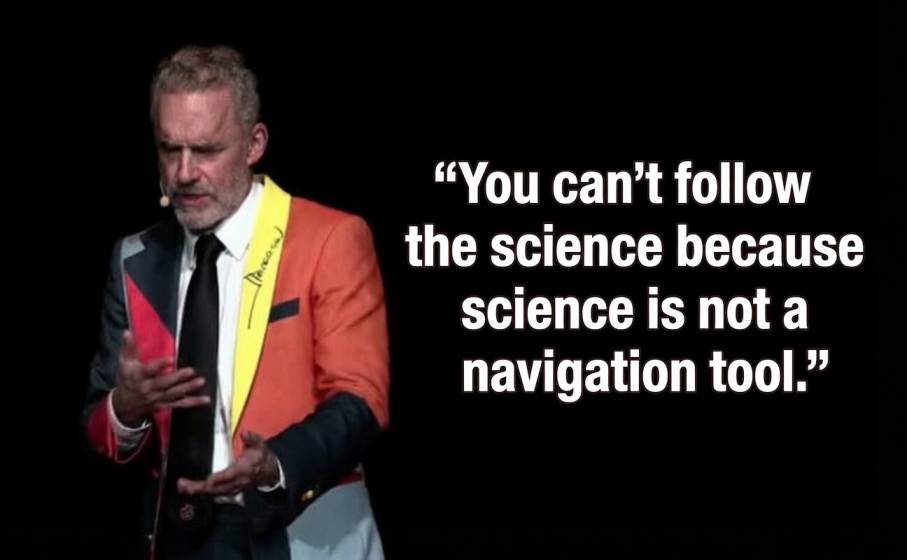
You know when you look at the world, you can’t see all the world. You understand that. The world’s insanely complex. This is why we can’t be guided by facts alone. People say “follow the science” because they don’t understand this. You can’t follow the science because science is not a navigation tool. Science is a descriptive enterprise, and describing the landscape and figuring out how to navigate through it are not the same problem. The facts alone can’t tell you what to do, no more than if someone drops you in a desert, the landscape around you can tell you what direction you should walk in.
When you are interacting with what’s real, you have to choose what to attend to, and you have to choose what to ignore. You have to prioritize your attention. There’s no difference between the universe of value and your prioritization of your attention.
Think about this, for example. You go on a date with someone for the first time, and you’re in a noisy restaurant, and there’s fifty conversations, and you could listen to any of them, or you could look at your phone because there’s a million conversations on there, but if you have any sense, that’s not what you do. What do you do? You prioritize the conversation that you’re having with the person that you’re having dinner with. That’s what you do with your guests.
What that means is that you, of all the things you could attend to, you focus on the interactions between you and the person that you’re attempting to shower with hospitality. You eliminate from your perception a multitude of potential phenomena, and you highlight a tiny proportion of what you’re offered. You do that all the time. Every time you focus your eyes, you do that. Every time you take a step forward, every glance you take, you sift the world through a structure of value.
The way you do that habitually — that’s your character, that’s your personality. A representation of that, a statable representation of that — that’s a story. The reason you like stories, the reason you need to hear them is because you want to know how people prioritize their attention and their perceptions, their attention and their actions. And the reason you want to know that is because there’s nothing more valuable to know than that.
That’s why when you talk to someone, you look at their eyes. You look at their eyes so you can see where they’re pointing their eyes. You look at their eyes so you can see what they’re attending to. You look at what they’re attending to so that you can understand what they’re prioritizing. You do that so that you can gain insight into their character and understand them. That’s how we do it.
Stories as Moral Abstraction
When you go see a movie, you watch someone act out the priorities of their attention and action, and that’s the characterization in the movie. And you do that so that you can benefit from observing the consequences of that characterization. The deeper the movie, the more general significance the characterization has.
So I could say that every decision you make reflects the decision between good and evil in an attenuated way such that your description of the micro decisions you make might not be that interesting. But if I took a set of decisions that people made — a set of people made — and I distilled those decisions to their essence and I extracted out a characterization in consequence, that distilled characterization would be of general utility and general interest, and that’s what a good storyteller does.
You know this because a good storyteller maybe writes a villain — a complex and compelling villain — and so that villain is, first of all, the distillation of everything that could be villainous about one person because the filmmaker will just show you the essence of that. But then even more than that, a very well developed fictional villain will be villainous in the way that ten villains in the world might be. It’s a distillation of the essence of villainy. It’s a purification. That’s what stories do. They distill and purify the moral landscape.
And you want to watch them because the representation of the distilled moral landscape is a powerful generalizable tool. It’s moral abstraction. And then we go again. Once again, the deepest distillations are religious characterizations. So the ultimate fictional character becomes a god.
Now you have to understand what I’m not saying. I’m not trying to reduce the domain of the religious to the fiction that people juxtapose against fact. I’m trying to make a claim for what we do when we fictionalize. What we do when we fictionalize is we abstract.
The Story of Abraham: A Call to Adventure
That’s not the replacement of fact with falsehood. That’s the sifting and winnowing of fact until nothing remains but the purified essence. It’s the most real, not the least. Now you know this already because you know if that wasn’t the case, then there’d be no such thing as deeply profound literature. Right?
Because if fiction was the falsification that bore no relationship to reality, then there’d be no such thing as deep literature. It wouldn’t have any bearing on the world, but we know that that’s the opposite of the truth. The deepest literature has the most bearing on the world. And again, even as a matter of definition, the deepest literature is religious. What happens in the biblical corpus?
It’s a series of characterizations. What are their characterizations? Well, twofold essentially. There’s a characterization of what should be put in the highest place. It’s an investigative inquiry into the nature of that which should be put in the highest place.
So that’s a series of characterizations, and then it’s a characterization of man’s character in relationship to that. That’s what the biblical corpus is, and it’s a distillation of such characterization that has made itself manifest over some tens of thousands of years, at least longer, at least that. At least that in story form, way longer in behavioral form, way longer than that. So let’s talk about this characterization.
Well, I’ll start with this story.
The Call of Abraham
“And the Lord said unto Abraham, get thee out of thy country and from thy kindred and from thy father’s house unto a land that I will show thee.”
Okay. So now that’s one line. Okay. So what happens in this line?
Well, we know some things about Abraham. He’s old. He’s like seventy-five. And where does he live? Well, he lives in his father’s house among his family in his country, and he’s seventy-five.
So what are we to make of that? Well, it’s a little old to be in your father’s house. Right? There’s a serious problem of failure to launch here.
Okay, so now we could delve into that and see what that signifies. We know that Abraham’s father is a wealthy man and what that means is that Abraham is provided with everything he needs.
Dostoevsky’s Critique of the Utopia
Okay, now imagine that you’re offered a political utopia. This is the standard political utopia offering. What did Dostoevsky say about the political utopians? Imagine we can arrange your life so — and this is Dostoevsky’s words — so that you had nothing, like a description of California. You had nothing to do except to sit in hot tubs of bubbling water, to eat cakes, and busy yourself with a continuation of the species.
So that’s Dostoevsky’s characterization of the utopia. And he analyzes this. He said, okay, well, imagine we could bring that about. What would human beings do in response?
And Dostoevsky’s answer — this is in Notes from Underground, a study of resentment — he said human beings would immediately do something destructive and insane just to break that utopia, that hedonistic utopia, just so something interesting would happen. And he said, and isn’t that for the best?
That’s a very interesting critique. It’s a very sophisticated critique. You know, often you hear critiques of utopian socialism, and the critique will be, well, what is on offer is impossible, and of course that’s true, but that’s perhaps not the deepest critique. The deepest critique is that’s not what you want. Or maybe even one level below that, that’s not what you should want.
And you might say, well, why wouldn’t I want to have everything I need delivered to me with no effort? And the answer is because you’re not an infant in a crib. And if you’re seventy-five years old and you’re living like that, it’s like something’s gone wrong and seriously wrong.
What We’re Actually Built For
Well, then you think, well, is that in accordance with your experience? Think about what we do when we go watch movies. We don’t watch people shop. We don’t watch people eat. We don’t watch people sleep, even in security and comfort. We’re not that interested in watching satiated people in their unconsciousness, which is an infantile existence.
What we want to see on the screen is romantic adventure. And so then you might think, well, that’s what we’re built for actually, that the ideal life isn’t the utopia of infantile satiation, but something like the life of romantic adventure. So let’s assume for a moment that that’s nurturing the hypothesis, and then we’ll add additional observation.
So now there’s a characterization of man that we already described. Abraham is living this life of infantile satiation, and at some point, it’s insufficient for him. A little late, but better late than never. And there’s actually an optimism in that because this story puts forward the claim that it is better late than never, and then maybe it’s never too late. And so even if you lived a life of infantile dependency, you could still wake up and go have your life, go have your adventure.
The Maternal Sacrifice
Now, you know, you think about what you do for your kids. If you have any sense — what did my mother say when I left home? I left home about sixteen. My mother’s a very nice person, and she said something. My life went better when I left home.
I was having some friction with my father for a variety of reasons, many of which had to do with me, many of which had to do with being sixteen, some of which had to do with it was time for me to go. And when I went, it was much better and I got along with my parents much better. And my mother, who’s a very nice person, said, “If things were too good at home, you’d never leave.”
And my mother, you know, she could strike with her tongue like a snake even though she’s a very nice person. And that was one of the times that I saw the stronger character in her underneath her maternal solicitude, because she was the kind of mother who wanted her kids to go, have your life. That’s the maternal sacrifice that a true mother is called upon to offer — her children to the world. And my mother was good at that.
And so if you’re treating your children properly, you don’t entice them into a prolonged state of dependency and infantile satiation. That isn’t good for them. You know it. That isn’t what you want for them, and that’s an interesting thing too because you could imagine that you want nothing more than to shelter your child from all possible harm and damage. But you don’t want that.
You don’t want to protect them from serpents. That’s a way of thinking about it symbolically. You want to make them into snake handlers. That’s a more profound form of security.
So if you encourage your child to become adventurous and alert and awake and undaunted and faithful and courageous, then that actually provides them with the best form of security possible because it means they’re going to be able and ready for whatever comes their way. And that’s way more secure in the final analysis than anything you could produce by maintaining them in a state of suspended infantile satiation.
Freud was very good at analyzing this. He characterized the mother who enticed her child into a relationship that was too close, let’s put it that way, as Oedipal and devouring.
The Characterization of God and Man
Okay, so what do we know from these first lines? We have a characterization of man and God. Man, as represented by Abraham, might fall prey to the temptation of infantile security, but will eventually become dissatisfied with that. What’s God in this characterization? God is the voice of adventure that calls even to the unwilling.
Okay, now what you have to understand — this is a definition. Okay? This is what modern people don’t understand about these stories. There are multiple characterizations of what God is in the opening stories of Genesis.
In the initial Genesis story, God is the spirit that brings order to chaos, which is what you do in your household. He’s the spirit that Adam walks with unselfconsciously in the garden, which is what you do when you’re attempting some recreation in your backyard. He’s the spirit that calls the unworthy out for the poor quality of their sacrifices. That’s the God that makes himself manifest in the story of Cain and Abel.
So these are definitions. So what the writers of the biblical stories are trying to wrestle with is what character should be placed in the highest place and how do you conceptualize that, and then how do you exist in relationship to that?
So there’s a hypothesis that underlies it, and the hypothesis is monotheistic. It’s that all these different characterizations are united in one thing that’s properly put in the highest place. And so the hypothesis would be that the spirit that makes order out of chaos, the spirit that punishes the prideful, the spirit that calls out those who make second-rate sacrifices, the spirit that warns of the impending flood — that’s the story of Noah — the spirit that punishes the tyrant — that’s the story of the Tower of Babel — those are all the same thing.
And that if you have any sense, you exist in relationship to that thing and devoted to it, devoted to its manifestation within your own life, devoted to allowing that to possess you in the course of your decisions.
And then that story is elaborated further in the story of Abraham. And so Abraham is living a semi-life and a voice comes to him, or an impulse or a feeling — doesn’t really matter — and says, get out there.
What Makes Abraham Faithful
Now what makes Abraham faithful? He listens.
Okay. So now you have to ask yourself this about your belief. That voice makes itself manifest to you all the time. Whenever you’re in a relatively comfortable situation and you could stay there, you could dwell there, you could rot there, you could cease moving forward — or you could hearken to the call of further adventure and then enact that.
Okay, so what are you doing in those two circumstances? Well, you’re placing faith in one spirit or another. One is a spirit of stasis and comfort, and the other is the spirit of adventure. So you might say, well, do you believe in that? It’s like the belief is represented in your decision. That’s the belief.
The belief isn’t your statement about whether or not you think that that voice exists. That’s a secondary concern. The primary concern is when something deep within you issues the command to move forward, do you attend?
And if the answer is yes, then the next thing happens. So God says, “If you hearken to the voice of adventure, I will make of you a great nation and I will bless you and I will make thy name great and thou shalt be a blessing.”
Now that’s quite an offer. So let’s see if we can take that apart. Well, nothing ventured, nothing gained — people certainly know that. It’s like, how is it that you begin the journey, let’s say, to greatness, to whatever greatness you might conceive of or manage? What would greatness be?
Well, in this story, it’s conceptualized as the founding of not only a nation but perhaps a multitude of nations, so that the actions that you undertake are the foundation of a great enterprise. How does that make itself manifest as the call to adventure?
Moses and the Burning Bush
So we might ask, well, how does that make itself manifest? Because it’s good to nail these things down so you really understand them. Well, there are other characterizations in the biblical corpus of the nature of God’s voice. So I’ll give you an example. This is a very good example.
So before Moses becomes a leader, like Abraham, let’s say, he encounters the burning bush. Okay, so what does that mean exactly? Well, he’s just going along his business. He’s a shepherd at this point, and a shepherd is the beginnings of a leader because a shepherd is a caretaker. And a shepherd in biblical times was also someone who was keeping the lions and the wolves at bay. It wasn’t a job for the faint of heart and you had to live off the land at the same time. It was a tough job.
He’s a shepherd and then that’s going pretty well, and he’s wandering around by Mount Sinai one day — which is the place of holy encounter, by the way — and something catches his attention out of the corner of his eye and he decides to leave the beaten track and go investigate.
Okay, so how does that work in your life? Well, are you interested in some things? Well, yes. Did you choose them or did they choose you?
Now that’s a weird question because my sense is that, well, try to make yourself interested in something you’re not interested in. Now that’s weird because if you were yours, you could just do that. You just say, look, I need to do this, so now I’m interested in it, and then away you’d go and there’d be no resistance. You just tell yourself what to do. That is not how it works, not in the least.
You can’t tell yourself what to do any more effectively than you can tell anyone else, maybe even less effectively. And that’s strange because it certainly indicates that you’re not under your own control. Then who controls you then? There’s a question for the ages. And more strangely even, if you can’t control what you’re interested in, what controls it?
It’s not random. It’s not random unless you’re insane. And even then, it’s not random. It’s more random, that’s for sure. But what calls you is not random.
What Calls You Is God
So what is it? Well, the biblical answer to that is what calls you is God. Definition. Okay, now you have to think about that in the context of your own life. Ask yourself, consider the success that you have insofar as you have success, and then ask yourself, what was the pathway to that success?
The Voice That Calls You Forward
How much of that was a consequence of following your calling? Now if you have a job that pays you well and you hate it, you’re not interested in it, well, that’s not exactly success. And the security that the money hypothetically provides, which would be part of that provision of infantile gratification, it’s insufficient. If you hate what you have to do to provide that, if you’re not engrossed by what you’re sacrificing, you know that you’re much more likely to commit to something if it grips you.
So then you have to ask yourself, what does that imply? I can tell you what it implies in the biblical context because the voice of God is characterized as the interplay between two forces frequently.
One is what pulls you forward. It’s an invitation. It’s a calling. It’s what makes itself manifest behind everything that interests you. You can think of everything that interests you as a portal through which the divine light shines. That’s a very good way of thinking about it.
And you know that the thing you’re interested in isn’t the thing itself because you can pursue something you’re interested in and then your interest will shift, which shows you that whatever it was that was pulling you forward was not that specific thing but that that thing was a pointer to something else. Interest is not enough because your interest can lead you astray, especially if you’re not disciplined, so you need conscience as well. And there’s ample characterization of God in the biblical corpus as the voice of conscience.
And so then you could imagine that what calls you forward is the interplay between calling and conscience. Conscience keeps you on this. Your calling attracts you forward and defines the path, and your conscience keeps you on the straight and narrow. And the interplay — it’s a definition again — the interplay between those two things, which aren’t exactly you. You’re subject to them. That’s why they’re not you. They have an autonomy, which is why they’re not you. You can’t tell your conscience what to do.
It tells you when you make a mistake. That’s not the same thing at all, and it’s akin very much to the phenomenon of interest. You can respond to what you’re interested in. You can even pervert what you’re interested in, but it’s very difficult to make it out of whole cloth. It’s something that you abide by or not.
The Deal That’s on Offer
The insistence in the first few sentences of this story is that if you follow the voice of adventure, the voice that calls you forward, if you commit yourself to that fully, fully, then you’ll become a great nation, blessed with a great name and someone that does nothing but good. That’s a pretty good deal. That’s a good deal, and that’s the deal that’s on offer.
And that’s a very strange thing to think — that that’s the deal that’s on offer — because maybe that is the deal that’s on offer. You could imagine, you can ask yourself this. This is a good question. You ask yourself, if you attended to everything that interested you, who could you become?
If you took it seriously, if you noticed that that was what was calling you forward, if you didn’t shrug off that opportunity and responsibility, which are exactly the same thing, if you were wholeheartedly committed to that, if you were willing to make the sacrifices necessary to walk that path no matter what, who could you become?
There’ve been studies of what people regret when they’re old. They don’t regret so much the mistakes they’ve made. They regret more the mistakes they didn’t allow themselves to make. They regret banal normality. And I think part of the reason they regret that is because life is too crucial to be satisfied with banal normality. It’s too difficult. There’s too much suffering intrinsic to it. The burden is too heavy.
What justifies the weight of life? Security? There are always times when people long for security, but security doesn’t secure you. You’re still faced with the problem of mortality. You’re still faced with the problem of malevolence. What can justify that? Well, how about a great adventure? You act like that’s the case because you’ll go watch people have a great adventure on a screen. So then you might ask, well, where do you find your great adventure? Well, that’s part of what the biblical stories are trying to represent. Calling.
Moses and the Burning Bush
So what happens to Moses is he goes off the beaten track. You can imagine this in your own lives. Maybe you have a job that’s providing for you and it’s providing a certain degree of stability, but you feel that something is missing. You’re in Abraham’s position. And you have these interests that have always lurked in the back of your psyche, and maybe you’ve been afraid to pursue them. You don’t think enough of yourself, maybe you think they’re a bit crazy, maybe they’re too daring, maybe you think people will laugh. God only knows what you think. You think whatever you think that stops you.
That’s plenty of things. It’s usually fear of failure, fear of success, fear of opinion, fear of the effort — who knows? But let’s say in the depths of your despair at your too constrained life, you allow yourself to be gripped by something that compels you. That’s what Moses does. He goes off the beaten track and he looks at what calls to him.
And what is it? It’s a burning bush. What does that mean? Well, the tree — it’s a tree of life. A tree is a symbol of life, and it’s burning because things that are alive burn. That’s metabolism. Everything that’s alive is on fire, and living things can make themselves manifest with hallucinogenic intensity. That’s what happens when you fall in love. That’s what happens when you have a child. You see the life burning in a manner that’s compelling.
So Moses goes to investigate this thing that calls to him, and he gets closer and closer to it, which means he interacts with it more. He approaches it, and then he realizes that he’s starting to tread on sacred ground.
What does that mean? It means if you follow your interest, it will take you down into the depths. No matter what the interest is, it will discipline you and broaden you and deepen you until you get to the bottom of things. He takes off his shoes, and he approaches closer. That’s a shedding of his old identity. Shoes are emblematic of identity. You can walk a mile in someone’s shoes, and then you can understand them. He takes off his shoes. He doesn’t know where he’s going. It’s a symbol of humility. It’s a symbol of willingness to learn more.
He takes off his shoes and continues his intense meditation, and the voice of God itself speaks to him from the midst of the bush, and it reveals itself as the spirit of being and becoming. “I am that I am. I will be what I will be.” It’s both of those. All the Hebrew in that announcement of God’s identity is without tense. “I am what I was. I am what I am. I am what will be.” That’s the spirit of being and becoming.
What does that mean? It means if you pursue whatever calls you with enough intensity, you’ll get to the bottom of things, and the voice of God itself, the spirit of being itself, will make itself manifest to you.
Becoming a Leader Despite Your Inadequacies
And what’s the consequence of that? For Moses, that’s when he becomes a leader. So here’s a question that pertains to our question at the beginning of the lecture. What’s the opposite path to the hellish abyss of totalitarian atrocity? You become the leader who can lead people out of tyranny and slavery across the desert to the promised land. And you become that by following the calling that takes you to the depths, that enables the structure of existence itself to reveal itself to you, that motivates you to become a leader despite your inadequacies.
Moses was a man who couldn’t speak. He had a speech impediment. There’s something wrong with his ability to communicate. And God basically says to him, that’s your problem. Sort it out. And that’s a fair statement because if you’re called upon to be a leader, there are going to be things about you that are inadequate. That’s your problem. Find someone to help you. Build a team. You don’t have an excuse.
And this is what Moses does — he allies himself with his brother, Aaron, who’s a public speaker, essentially a politician. Moses is a prophet, and Aaron is a politician. And that’s a nice dynamic because the prophet keeps the politician in line. But the politician gives voice to the prophet. It’s a good partnership, and it works out quite well for them and for the Israelites.
Moses asked, “Why will the Israelites listen to me?” And God says, “Tell them God sent you.” And you might say, well, why would someone believe that? And the answer is, it would depend on how you said it. And I’m dead serious about that. If what you said wasn’t a lie, maybe people would listen.
And you might say, well, how is it that God would speak to me? I know the answer to that. Listen. To what? To the voice of your own soul. How’s that? And what’s so terrible about that in a sense is that there’s nothing you want to do more than that.
The Offer of Abraham
And what’s the consequence? Well, the consequence for Abraham is: “I will make thee a great nation. I will bless thee and make thy name great, and thou shall be a blessing. And I will bless them that bless thee, and I will curse them that curse thee, and in thee shall all families of the earth be blessed.”
Wow, that’s quite the bloody offer. So imagine this. Here’s the deal. If you attended to what called you forward, hemmed in appropriately by your conscience, you would become the sort of person whose pattern of action would be so beneficial that every single person would benefit from it. It would be the best thing that could possibly happen to you, but simultaneously would be the best thing that could possibly happen to everyone else. That’s a good deal. You might think that’s worth taking some risks for.
Well, the funny thing about risks is — you’re taking risks. You walk across the street. You have children. You’re going to die. You’re in this. So the question of risk isn’t the issue. The risk is already there. The question is, what do you do with the risk? And you have an adventure with it, and maybe that’s in some perverse sense why the risk is there, because there’s no adventure without risk. And maybe you could have an adventure that was so glorious that it would justify the risk.
The secret to life is to have an adventure so superlative that you say to yourself, “That was difficult, but I’d do it again. It was worth it.” It’s what you want for your children. You see your children struggling forward, and that’s painful. And what you wanted for them is to have a life that’s so full and abundant and rich and varied and remarkable and miraculous that the price they have to pay for it — which is their mortality, let’s say — is something you could celebrate.
“And in thee shall all families of the earth be blessed.” It’s a lovely statement of the harmony that could obtain between the psyche and society. It’s a representation of the kingdom of heaven. The kingdom of heaven is a place where you’re doing exactly what you should do, and so things are good, but they’re getting better. And at the same time, what you’re doing is doing exactly that to everyone who’s around you.
So that’s a harmonious balance. It’s not a competition between you and everyone else because it’s not a zero sum game. It’s a game that returns more the more you give. That’s a sacrificial motif. Life is a game whose returns are dependent on your offering. Exactly that. That’s what God tells Cain and Abel. Your return is dependent on the quality of your sacrifice.
The Ultimate Sacrifice
What’s the ultimate sacrifice? That’s the question. What’s the ultimate sacrifice? The biblical corpus as a whole proceeds to that revelation. What’s the ultimate sacrifice? Child and self. That happens in the story of Abraham. Abraham is called upon to sacrifice his son. Why? Because you have to give up everything to what’s highest.
What happens when he decides to do that? He gets his son back, and it’s part of the process by which he establishes the great nation that’s blessed, that makes his name a blessing. The willingness to offer up everything, even what you love most dearly, to what’s properly highest, is the most abundant pathway forward. It’s a terrifying idea.
God approves of the proper sacrifice. I was thinking about this. Maybe I’ll close with this. God punishes Cain because Cain makes second rate sacrifices. That means that God is the agent who punishes the second rate sacrifice. It’s a definition. Do you believe in that?
Well, you can ask yourself these questions instead of assuming you know the answer. Do you believe that you can get away with second rate offerings? Has that ever worked for you? Or we could make the question more pointed. Have you ever got away with a second rate offering in a manner that makes you proud of what you did when you look back when you’re desperate?
Because I know what you look to when you’re desperate. You look back through the detritus of your life to see if there’s some evidence that at some point in your life you made a worthy offering that was accepted properly, that produced at least for some moment stability of your own psyche and the spread of what was good among the people around you. And that can get you through a dark night.
And so you can ask yourself, well, what would happen if you did that all the time? With full commitment. You’re fully committed anyways.
The Sacrificial Nature of Growth and the Story of Abraham
You’re that’s your destiny. Your destiny is to be fully committed in actuality, but perhaps not by choice. He might as well align the choice with the inevitability. Abraham has to offer his son. That’s what God himself does in the Christian venture.
Right? It’s an echo of that idea that the proper relationship between human beings and what’s highest is a sacrificial relationship and Christ is the icon of the offering of the self to God. And what does that mean? It means exactly that. It means that the offering that’s most pleasing to God is yourself.
Obviously. It’s obvious that that’s the case. It’s like you have to reveal everything that’s in you. You have to offer everything that’s in you, and you have to do that in a sacrificial manner. And so what do I mean by that?
Learning as Sacrifice: Letting the Wrong Parts of You Die
That’s a deeper level of sacrificial realization. You might think that when you learn, you’re ignorant and you learn. So you’re ignorant and something is added to you, but that isn’t how it works. The way it works is that you’re wrong. You run smack headfirst into that error.
A new realization reveals itself, and to accept that, you have to allow what you were wrong about to die. You wonder why people cling to their old habits even when they know that they’re destructive, and the answer is they don’t want to let go of what they’ve pathologically raised to the highest place. They’re not willing to offer the sacrifice of what’s unworthy to progress.
There’s an insistence at the end of the story of Adam and Eve. Adam and Eve were thrown out of paradise because of their pride, and God bars the gates of paradise. He puts an angel on each side, a cherub, and the cherubs hold a sword. The cherubs are accompanied by a sword that’s on fire that turns every which way. So what is that? What is a sword that turns every which way that’s on fire?
Well, fire burns. Fire burns away dead wood. A sword cuts. A flaming sword cuts and burns. A flaming sword that turns every which way is the sword that cuts and burns from which there’s no escape.
Well, that’s obviously what guards the pathway to paradise because in paradise, nothing that’s insufficient is allowed to exist. And so if you’re taking your steps towards paradise, you’re going to encounter the sword that burns and cuts, and you have to allow all of that that’s unworthy to be sacrificed, and that’s pleasing to God.
Why People Resist Enlightenment
You can see why people resist enlightenment. If it was a simple matter of incremental forward progression towards an ever more enlightened state, everyone would just do it. But there’s no cost. Well, what’s the cost? Well, maybe you’re ninety five percent dead wood. Right? And so that’s a lot to shed to move forward, especially when every cut is going to be painful.
You know that that’s the case. If you’re arguing with your wife, you’re arguing with your husband, and you come to the realization that you were wrong, you’ll dissolve in tears, and the reason for that is because you have to let that part of you — the tears are grief for the part of you that has to die. The stupid part of you that has to die. And you can easily get into a situation where that’s so much of you that you’re unwilling to undergo the winnowing process and then you live in purgatory.
Abraham’s Journey Into the Land of Canaan
So Abraham departed as the Lord has spoken unto him, which is what you did when you left home. However imperfectly. And Lot went with him, his nephew. And Abraham was seventy five when he departed out of Haran, and he took his wife and Lot his brother’s son, and all their substance they had gathered and all the souls that they had gotten in Haran, and they went forth to go into the land of Canaan, and into the land of Canaan they came.
What’s the land of Canaan? It eventually becomes the promised land, by the way, in the story of Exodus. Canaan is the land of the future. That’s a good way of — that’s where you’re headed, and Canaan is the land of the future that’s inhabited by the Canaanites. In the biblical tradition, they are descendants of Cain, and they’re citizens of the hedonistic and tyrannical society.
That’s what you’re headed towards when you move into the future. You know that because what you contend with when you’re moving forward to try to establish yourself is the occupancy of the place that you wish to establish by the forces that already rule there. It’s a universal story of mankind.
The impetus in the biblical corpus is that you’re to assume that if you abide by the dictates of the voice that calls you to adventure and you’re willing to make the proper sacrifices, that the inhabitants of Canaan will scatter as you approach.
The Sports Team Analogy: Character Over Skill
Let’s simplify that for a moment. Imagine you have a high school sports team. It’s the theme of every one in every ten American movies. High school sports team, and maybe there’s two characters on the sports team. There’s like these two skilled young men, one of whom is a great team player and the other who is maybe slightly more skilled but sort of narcissistic and arrogant. Right?
And the story lays out the triumph and the trials of the boy who is not only skilled at the requirements of the game, but skilled at lifting up the spirits of his teammates, playing the game fairly, and placing his athletic success in the proper context. So he’s playing a multitude of games, none of which are subsumed by the athletic contest. The plot, if it’s a comedy, a redemptive story, is that the good sport prevails.
Do you believe that? Imagine you have a son who’s playing on a sports team, and he’s highly skilled. Maybe he’s talented, spectacularly talented, but he’s kind of a prick. And so when he’s running down the soccer pitch with his scoring opportunity and one of his teammates has a stellar opportunity himself, he doesn’t pass. He takes the shot for himself.
And if he does score even in some spectacular manner, he has a celebration by himself, and after the game, he complains about his teammates. And you see this making itself manifest on the playing field, and he’s celebrated and rightly so for his skill, but you’re deeply ashamed of his conduct. Why? Because you believe that your son should act like — you believe that if your son acted properly, that the inhabitants of the land of Canaan would scatter as he approached.
And when you fail to see that make itself manifest, it makes your soul ache because you don’t want him merely to be skilled unless you’re a narcissist who’s collecting his trophies. You want him to be skilled in a way that makes him into a man, and that’s what you want, and that’s the call to adventure that Abraham undertakes.
And Abraham passed through the land unto the place of Sikhem, unto the plain of Morah, and the Canaanite was then in the land. And the Lord appeared unto Abraham, and he said, “Unto thy seed will I give this land.” And there builded he an altar unto the Lord who appeared unto him.
The Culminating Sacrifice and the Call to Adventure
I’ll close with this. Abraham advances in good faith. With each advancement, there’s this sacrifice. Have you ever advanced in your life without a sacrifice? Is it the case that if the sacrifices are of the highest possible quality, the advance is more rapid and aimed in a better direction?
If you’re called upon to do more than your discipline now allows you to do and you’re willing to sacrifice the bad habits that are holding you back, the painful sacrifice of your pride and your hedonism that that might entail, does that not make your pathway forward smoother? And isn’t it the case that you’re more in tune with your soul when you do that? And isn’t it the case that everyone around you is thrilled to death, if they’re not bitter and resentful, at the fact that you had enough character to drop the foolishness that was impeding your progress when the opportunity to be better presented itself? And isn’t that exactly what you want for your children and for those you love?
And that’s exactly what Abraham dramatizes. Each adventure he undertakes is slightly more difficult. The sacrifice he’s called upon to make slightly more profound. Well, it culminates in the necessity to sacrifice his only son despite the fact that he’s been promised the destiny of being the father of nations. He’s called upon to make the ultimate sacrifice, as we all are, by inevitability, voluntarily or involuntarily, in celebration or kicking and screaming.
And the notion, our fundamental notion, is that if it’s in celebration, then it doesn’t have to be kicking and screaming.
Recap: Character, Story, and the Infinite Destiny
Okay, so let’s recap. Stories represent characters in motion. Character is the pattern of attentional prioritization, action and attentional prioritization. It’s a representation of what’s important to that person. When you go watch a movie, you watch what it is that the lead character is aiming at, and you infer their character from your analysis of their aim, and you embody them to understand them when you understand their aim.
The deepest stories represent the most profound characterization. The character of what is to be put in the highest place and to be imitated is represented in the biblical corpus in a multitude of fashions that converge on a single characterization, one aspect of which is laid out in the story of Abraham, which presents man as the spirit that no matter how sheltered can still respond to the call of adventure and God as precisely that call. With the insistence underlying the narrative that the proper sacrificial heeding of that call makes of each man the master of an infinite destiny.
So that’s worth thinking about. There’s a Christian injunction that you’re to pick up your cross and carry it voluntarily. That’s the adventure of your life. That’s the possibility of your life. It’s the catastrophe of your life. They’re the same thing.
And in that catastrophe is the seeds of adventure. If the adventure is undertaken with sufficient faith, the catastrophe is forestalled. That’s a good place to end. Thank you.
Related Posts
- Transcript: Abdul El-Sayed’s 2019 Commencement Address At The University Of Michigan
- Transcript: The MOU Is Dead! Can a Blockade Save Us? with John Mearsheimer
- Transcript of Sanjeev Sanyal Interview on Education Crisis: ANI Podcast
- David Gibbs: How Intelligence Services Captured Academia & Journalism (Transcript)
- Transcript: Professor Brian Greene Interview on DOAC Podcast