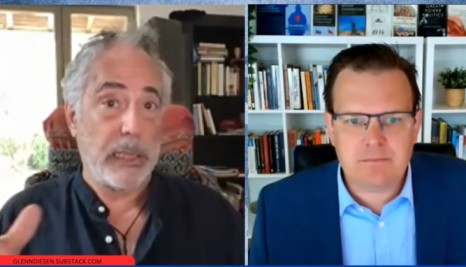
Read the full transcript of political analyst Pepe Escobar’s interview on Greater Eurasia Podcast, July 15, 2026.
Editor’s Note: In this interview, journalist and political analyst Pepe Escobar joins Glenn Diesen to analyze the rapidly escalating tensions in the Middle East, highlighting how American strategy has inadvertently unified the “Axis of Resistance.” Escobar discusses the strategic significance of the volatile situation involving Yemen, Saudi Arabia, and the closure of key maritime corridors like the Strait of Hormuz. Furthermore, he examines the shifting dynamics of the conflict and the potential for a new regional security architecture, suggesting that the current American approach is driving the world toward unprecedented instability.
Introduction: The Middle East on the Brink
GLENN DIESEN: Welcome back to the program. Today we are joined by Pepe Escobar, a journalist and political analyst, to discuss what appears to be the entire Middle East being thrown into a massive conflict. Thank you for coming back on.
We see now the US and Iran appear at least to be moving back towards all-out war. The Iranians are considering pulling out of the memorandum of understanding completely. Yemen is striking Saudi Arabia. Iran apparently is striking Saudi Arabia. Yemen might also shut down the Red Sea. Well, essentially the whole region appears possibly to be plunged into one big fire. And even now we see some attacks from Iraqi uprisings against Kuwaitis on the other side of the border.
I mean, this really doesn’t look good. What do you make of all of this? I’m sorry, that’s a lot of things at once, but how are you assessing the situation? We can go into the specifics.
PEPE ESCOBAR: Glenn, I love your diplomatic shorthand. It does not look good.
The Axis of Resistance and the Iranian National Consensus
PEPE ESCOBAR: We could expand this to the whole planet. I love it because this is the best definition of what lies ahead. Yes, it’s extremely distressing, predictable, but we knew this was going to happen because essentially the American strategy at the moment, they were trying to play divide and rule with the Axis of Resistance. And obviously you have the opposite effect. The Axis of Resistance is more and more well-coordinated, including, for instance, Iraq.
And we could see that in terms of last week, the most extraordinary funeral rites in living memory anywhere. And they were uniting Shiites in Iran and in Iraq. So the level of understanding, grief, respect, national solidarity that we saw in Najaf and Karbala — which are 2 places where you step in and you feel how powerful it is spiritually — was totally coordinated to what we saw in Tehran, in Qom, and in Mashhad. So over 40 million people altogether.
And this is something that I confirmed with some of our Iranian friends. And they all say the same thing. Now there is a national consensus, and it revolves around the notion, the concept — not necessarily in pedestrian terms — of revenge. Essentially, there is no possible accommodation with the Americans, period.
And that’s why if you talk to the average Iranian about the MOU, the memorandum of understanding, they all say, “No, they were trying to fool us.” And this consensus arrived at the top according to our best information. And this means the National Security Council. This means not only the political factor — includes President Pezeshkian, Araghchi, Ghalibaf, all these figures that are now well known all over the world — but the top IRGC commanders.
So what are they going to do about it? They’re playing Trump. And don’t mess with the Persians. They know how to play anybody considering their dynastic history, all the empires, all the invasions — how this national solidarity coalesces into something very, very strong and they get even more powerful.
So the most distressing aspect of it all for all of us who are following it is the escalation ladder is back. This is something you and myself and many others were predicting that it would happen. But how far will this go? And extra elements added one day after the other makes the whole thing even more volatile.
The Attack on Sana’a Airport: False Flag or Saudi Strike?
PEPE ESCOBAR: For instance, we cannot say with 100% certainty that Saudi Arabia attacked Yemen in Sana’a Airport. This could have been a false flag. This could have been a rogue organization, anything. And the Saudis have been extremely circumspect about it.
But what’s immensely interesting is that the Yemenis were waiting for it, essentially. A few days before, when that Mahan Air airplane was approaching Sana’a International Airport — which by the way is practically destroyed by the Israelis last year, it’s where I landed when I went to Yemen last year when the airport was still functioning — Yemen Airways still had 3 planes. These 3 planes were later bombed by the Israelis. They have 0 planes now.
So this was Iran breaking the siege imposed on Yemen by Saudi Arabia for 11 years. This was a huge, huge thing. So the first Mahan Air flight went there to collect a Yemeni delegation to take them to Tehran for the funeral ceremonies related to the burial of Ayatollah Khamenei. And then there was this flight back from Tehran to Sana’a, taking a lot of Yemenis, plus some other Yemenis who were in Tehran. 250 people more or less — an Airbus filled to the brim.
And when the Mahan Air flight was approaching Sana’a, there was a bombing of the runway. So the pilot, under extreme circumstances — the guy was, wow, amazing stuff — did a 90-degree turn before landing and landed in Hodeida, which is not an airport anymore because Hodeida was also bombed by the Americans last year. And by some, I would say, intervention from above, the runway of Hodeida was finalized only a few days ago. So that allowed the Mahan Air flight to land in Hodeida.
So it’s not established if this was really a Saudi attack.
The Yemenis identified a military base in Saudi Arabia, saying, “Look, the jets took off from this military base.” So they bombed a civilian airport and a military airport. So it’s 2 to 1, and that’s extraordinary, Glenn.
You remember that the Iranians took almost 2 months to do 2 to 1 against American attacks? The Yemenis took one day and everybody understood the message. If you mess with them, it’s going to be 2 to 1 everywhere. And obviously the Saudis are now terrified. They don’t know how to control that.
If this was really a Saudi initiative, they boxed themselves in. So this is beyond stupid geopolitically and geoeconomically for them. If it was not, who did it and what for? Well, of course, we know who might have done it. The usual suspects. To once again divide and rule all across the Arab world, which is what they do everywhere.
So this is just one detail among many, and one day after another we have these. And there is always this lingering impression in the background that the Iranians are looking at all that and they said, “Yes, we can go for it because we have all the time in the world. They — the Americans — don’t have it.”
Yemen, the Red Sea, and the Strait of Hormuz
GLENN DIESEN: Well, I remember the first time around when we were all in this war — and it was essentially an all-out war, it were still some steps up that escalation ladder. So people were questioning whether or not Yemen would join in on the fight because that would be quite detrimental. That is, if you close off the Red Sea.
PEPE ESCOBAR: Yeah, bubble the Red Sea, sure.
GLENN DIESEN: Yeah, but now of course this is what’s happening. And so it appears we might see an escalation far beyond what we saw last time. And I was just wondering, how do you see the significance of this?
And also, what is the American thinking here? Because now we’re blocking off the Red Sea, and the Americans are now reimposing their blockade on the Strait of Hormuz. They say Trump is a bit all over the place. He said all ships should pay 20% fees to the United States who wants to transit through the Strait of Hormuz. This is important for Trump because he wants to assert Iran doesn’t control it — America is, in his words, the guardian of the Strait of Hormuz. But now he’s coming back and he’s saying, “Well, we’re not going to put the 20% fee anyways.”
I mean, how is this from one day to another? Where’s the consistency? This can’t be on purpose because why would you say this on day one if you’re not going to follow through on day two? I mean, it’s quite wild. But how do you see this shutting down all these key waterways? These are the arteries of international trade. This is what keeps the global economy alive. What are they doing here?
Trump’s Strategic Incoherence and the Collapse of the MOU
PEPE ESCOBAR: Well, when it comes to the president of the United States, Glenn, he cannot follow what goes on in his brain from one second to another. He has no strategy, has no tactics. He doesn’t read. He doesn’t listen to anybody. He has no clue what he got himself in.
So it’s obvious that from one day to another, you have these completely absurd vociferations on Truth Social. And that’s a problem because he controls the news cycle. People read this in the middle of the Sahara Desert — literally everybody. And then the talk is about, “Wow, look at what he said today.” And he goes on and on. So he manipulates the news cycle everywhere, but nobody is basically pointing to the key, the heart of the matter, in fact. No tactics, no strategy. He’s cornered. He’s desperate. He knows it and there’s no way out.
And the only off-ramp that he had — which was offered by the mediators working 24/7 for weeks — was the MOU, which, by the way, he signed officially. His signature is there. He signed it in Versailles, not very far from where I am. Well, that was obviously — and that is now being identified for what it is by the Iranian leadership, civilian and military — he was just playing for time.
The problem is they cannot play for time any longer because all those numbers about strategic petroleum reserve, there are all sorts of projections. I received one report about 10 days ago or so. I wrote a column about that. And this report was basically saying that the ultra, ultra limit date for mega red lights appearing is mid-August. We are already mid-July. And there are some others who are saying this could be between end of July and beginning of August.
So he’s fighting against himself, against the American economy, and against the global economy at the same time because he simply cannot think strategically. And of course, there’s the ego element, which is absolutely the overarching imperative for Trump. He hates to be humiliated and he’s being humiliated by this strategic defeat, which is the result of the war that he ordered.
So can you imagine in the mind of a grown-up 4-year-old, how does that feel? And you can see in his inconsistencies, in the fits of childish rage. As you mentioned, no consistency whatsoever. Anything he writes, says, bragging — and of course rage. You can feel there’s so much rage behind it. He has threatened to exterminate Iranian civilization at least 4 or 5 times these past few weeks. Seriously, exterminate everything, literally. And where is this leading?
Iran’s Nuclear Option: Exiting the NPT
PEPE ESCOBAR: And everybody that has been trying — and everybody, I mean literally everybody, not only the Pakistani mediators, but the Qataris, the Turks, the Egyptians, the Omanis, everybody who’s been trying to say, “Okay, we cannot allow the MOU to be derailed. This is the last chance saloon. If this thing is derailed, then it’s all-out war.” And here we are again in another escalation ladder provoked by him, discarding the only possible mechanism that could give him a sort of a relatively dignified exit, if he follows at least the basic points of the 14-point MOU.
No, they broke almost everything. So the Iranians are looking at it and they said, “What’s the point?” And this is now — the commitments are bilateral. If they break it, we also break it. This is not unilateral anymore.
So that’s why there is practically a consensus among the top leadership in Tehran that there’s no point — the ceasefire has already been broken. The MOU is dead. That’s it. We should exit and do our own thing. But this is not a final decision. And we are expecting some extra information between today and tomorrow — exactly how much longer the Iranians will tolerate American attacks.
And this is a key, absolute key point, because publicly they have already said via members of the Majlis, some members of the Security Council: “If there is another American attack, we exit the NPT.” And we all know what that means if that happens.
So this is already being discussed and there is already a plan B for the Iranian leadership. “Okay, we exit the NPT. That’s it. And there’s nothing the Americans can do about that.”
So this is something that Larry Johnson and myself were trying to get this surefire confirmation of — maximum tomorrow or by the end of the week. It’s very complicated. The guy who passed this information to us is a guy that is in the inner circle of leader Mojtaba Khamenei. That’s why this is so, so important. But he told us via his intermediaries, “You should not publish this as a fact. This is being considered.” But it’s already in itself a bombshell, right?
And of course, this may have leaked to Mar-a-Lago and Washington. So can you imagine if that happens, Glenn? And in fact, the whole fiction that the Americans have been trying to sell domestically and to the whole world — which is about the Iranian nuclear program — collapses completely.
We all know the real reason for the war, especially since the war went downhill from the beginning. Control of oil checkpoints, which they already lost. The US will never control the Strait of Hormuz again. This is really Iran’s nuclear bomb. They don’t even need a nuclear program. They already have a nuclear bomb, which is the control of Hormuz. And that’s what makes the 40-year-old president of the United States even more desperate. He brought this on himself.
The Impossibility of Diplomacy and the Search for a New Security Architecture
GLENN DIESEN: This is the problem again. I know that this began as a war to topple the Iranian government, to destroy either Iran or just put in a puppet government. So something along the lines of Libya, Syria. But it’s changed fundamentally, as you said. Now it’s about who can control this key waterway, the Strait of Hormuz.
And it just seems like there could be win-win situations if there was some diplomatic efforts to establish some kind of administrative body. But it just seems to me, at least the impression I get from Iran these days, is that they don’t think diplomacy is possible anymore because, essentially, they’re dealing with savages. And I don’t use that word lightly. What I mean is their opponent — they’re doing mass murder of civilians. They backed essentially a world genocide in Gaza. As you said, they regularly threaten to exterminate a nation of 93 million people. This is quite extreme behavior.
And at the same time, there’s no possibility of actually talking and having diplomacy. I mean, they’ve made diplomatic deals. They had the JCPOA. The Americans didn’t implement their side, and then they walked away. Then they had 2 wars within 6 months, in which they were supposed to be close to a deal, which they just essentially used to trick the Iranians to put their guard down so they can do surprise attacks. Now you have the MOU. Even as it was signed, Trump suggested it wasn’t about any reparations, and he was threatening to attack them again. All these things which violated the MOU while he was signing it.
If you also put it in the wider context, what’s happening around the world — this is what you see with the war on Russia as well. In 2014, you saw the Europeans agreeing to a unity government. They just walked away from that hours later when they toppled the government. You saw them signing the Minsk Agreement, which was just an effort to buy time. Now they’re talking about let’s have a ceasefire to end the war. They’re already openly speaking among themselves: “Now we can replenish Ukraine with missiles, build up the military again, move NATO troops into Ukraine.” So no one’s looking for peace. It’s always — diplomacy is just a game.
So you have this savagery on a whole new level. Diplomacy is dead. Surely the Chinese must be observing this as well, reaching the conclusion that from now on, might is right. There is no international law. There’s no rules. There are no diplomatic deals we can sign which will actually lay the rules for how nations can interact. This is extremely dangerous, and it’s just hard to see how the world will look after this war.
But on that, do we see any pathway here? I mean, not with the Americans, because no one will trust what they’re signing anyway. I think everyone who looked when they signed the MOU and then read it, they knew that the Americans were not going to implement this. They weren’t going to pay $300 billion. They were not going to unfreeze the sanctions, unfreeze all the assets of Iran. I mean, it was nonsense.
But are there any other deals you see possible? Like, can after this war, Oman and Iran, for example, come to an agreement, or would they have to wrestle themselves out of the control of the United States first?
Pakistan as a Potential Security Guarantor and the Saudi-Yemen Complication
PEPE ESCOBAR: Well, there are, let’s say, not an overall overarching agreement. It’s impossible because that would involve the United States, and we both agree, according to our good friend Sergei Lavrov, that the United States is non-agreement capable, and they have been proving it over and over again.
But in West Asia, the main players want some sort of new accommodation. The problem is how they’re going to deal with the Americans. For instance, the Pakistanis — they are involved in the mediation for several reasons, but one of them is their own security from South Asia to West Asia and the possibility that they can be the providers of a new security umbrella to West Asia because of the military pact they already have with Saudi Arabia.
So a few weeks ago, Munir went to Riyadh to basically re-solidify their military pact, basically telling MBS in person: “Look, if you’re looking for a new security architecture in West Asia, we are your guys and you know it.” So how are they going to pull that off? And of course, to tell that to MBS, they had to tell the Iranians first — first of all, because they were intermediating between the Iranians and the Americans, and second, because there are very, very good relations between the top leadership in Islamabad and Tehran. For instance, when Munir goes to Tehran, he talks to Leader Mostafa Khamenei face to face. There are very few people anywhere, including from inside Iran, that can do that.
The Pakistanis, in the whole Switzerland kabuki, offered security for the Iranians. Larry and I reported about that in detail. And the information that we have from the people on the table — in fact, the mediators — is that everybody wants some sort of deal, whatever that is. The problem is, of course, how can you convince Trump that a deal is good for him because of his megalomaniac narcissism?
So if there is no deal with the Americans, there is quite possible that there will be a deal in terms of a new security architecture, which would involve Pakistan as the coordinator, Saudi Arabia, Qatar could jump in eventually later, some other GCC members. The UAE is a basket case. The mediators told us that the UAE — it’s going to happen, but it’s going to take at least a few months to convince them that this is the way history is going. And of course, Turkey supports that — very, very important. And Egypt could be part of that security umbrella as well.
So this is a possibility. And all these players involved in these negotiations — this is what they want. Everybody knows what that would entail: renewed American fury. But what would the Americans do? Bomb Riyadh? Well, they could. Nothing is outside of the realm of the possible when you’re thinking about Trump and CENTCOM at the moment. But this will depend on how Saudi Arabia will maneuver.
And now — coming back to the beginning of our conversation — we have this Saudi-Yemeni immense problem resurfacing in the middle of all that, which is the last thing that the Saudis need at the moment. And that’s why some of us were thinking this has to have been a false flag, because it goes against Saudi interests to go against Yemen now, knowing that Yemen has the missiles that count. They can block the Bab al-Mandeb. They can attack the Yanbu pipeline. They can block the Red Sea — you name it. So why do it now? It makes absolutely no sense.
Obviously, the American spin — which you see in those IDF Mossad things in the US posing as journalism — is that MBS was under pressure by Trump, or vice versa, MBS called Trump and said: “Look, there is a problem with Yemen. Do you allow me to bomb their airport?” Which is completely absurd.
So we still don’t know the origin of this bombing of Sana’a Airport, because this turns the whole thing upside down all over again, and to the detriment of Saudi interests. It makes no sense whatsoever. And considering that the Saudis from the beginning were part of this GCC bloc that wanted some sort of accommodation with Iran — you remember, Glenn, that the first Islamabad meeting, way before the actual Islamabad meeting where Vance came from the US and Ghalibaf came from Tehran, was Pakistan, Saudi Arabia, Turkey, and Egypt. This was the beginning of it all.
And then, of course, Pakistan went to China. They talked to Wang Yi. Wang Yi said: “Look guys, you have to do better than that.” And that culminated in the Islamabad 1.0 meeting, face-to-face — or almost face-to-face, because they never talked to each other. So Saudi Arabia has been involved from the beginning in, let’s call it, the peace process and the MOU. Why would they blow it up by attacking Yemen out of the blue like this?
GLENN DIESEN: Yeah, I know, it is strange.
PEPE ESCOBAR: Do you have a theory about that, or how would you interpret it?
Yemen’s Strategic Leverage and the Widening Regional Conflict
GLENN DIESEN: I don’t know, it is hard to see why it would make sense. I mean, when people look at the map of the Middle East, they see this huge Saudi Arabia and this tiny Yemen below. But again, that doesn’t mean anything. For first of all, Saudi Arabia — I think they have like 38 million people. Yemen has more than 40. So Yemen is actually a larger population, but in Saudi Arabia about 40% of those are foreign nationals — they’re not — yeah, so they’re the ones who can leave if things become too unstable. So really, the Saudis have like 23 million, the Yemenis have almost twice the population, and they also have a very young population. They’ve been massacred now since 2015. So they’re battle-hardened, they’re ready. And furthermore, as you said, it doesn’t make any sense for Saudi Arabia because all of their energy facilities, or many of them, are within reach of Yemen’s drones.
PEPE ESCOBAR: Yemeni missiles, yes.
GLENN DIESEN: And they can shut down the Red Sea. I mean, if you’re Saudi Arabia, you can transit through the Strait of Hormuz or the Red Sea. If you’re going to make an enemy out of both sides, shut down both of these maritime corridors — you can have your energy fields destroyed, you can have the arteries you need to sell your oil shut down. I mean, none of this makes much sense, so I don’t know why they would go all in on this war.
But the conflict is also taking a much wider scope — not just the conflict now between Yemen and Saudi Arabia. As I said, the whole region is being set on fire. But only within the last 24 hours we’ve seen Kuwait been hit, Qatar, Bahrain, Jordan. What we’re seeing is missile systems being destroyed, the radars, the drone command and control. It’s quite extensive what the Iranians are hitting now.
So how are you seeing the development on the battlefield? Because if the US decides, “Okay, this is too much, let’s go back to diplomacy” — I can’t imagine why the Iranians would accept this. They know what diplomacy means. It means the Americans string them along, build up some missiles again, prepare for another strike. It just seems that the hawks in Iran were proven right. There won’t be any peace. Any diplomacy is just a fraud, something to trick the Iranians so America can regroup and strike again from a more favorable vantage point.
How do you see this war possibly spreading? Because — sorry, there are a lot of questions here — but again, you see Saudi Arabia, you see Yemen. As I said earlier, you see now fighting of some Iraqi militia on the border of Kuwait. I’ve heard people like Marandi say that at the end of this war, Kuwait might not be an independent country anymore.
PEPE ESCOBAR: A lot of things will revert to Iraq, in fact.
GLENN DIESEN: Yeah, I’m just wondering — again, we don’t have a crystal ball, there are too many variables to make any clear predictions — but we do see some movements of possible directions that the region could shape by now.
Iran’s Strategic Position and the Strait of Hormuz
PEPE ESCOBAR: Well, what’s striking, Glenn, is how realist the Iranian top brass have been. There is a lot of spin in American media once again that there’s division at the top. Now, this is bullshit. This is something that we can reconfirm with our Iranian friends and sources.
No, there are 2 vectors. One is the diplomatic negotiations on the table vector where we find Pezeshkan, Ghaliba, Farakshi, etc. And of course, the IRGC vector, including old hardcore IRGC commanders and the new generation. The consensus between them is around the figure of Mostafa Khamenei. And that makes it even more intriguing because he’s the invisible leader. And that’s extraordinary because he’s commanding attention and respect all across Iran by remaining invisible. And it’s only some statements, the communications internally and with the few foreigners that he talks to. Everything is analog, face-to-face.
When something reaches him concerning, for instance, the MOU, then only a few days or weeks later, we actually know what happened. I have a very good example. For instance, we only learned a few days ago that when it comes to the MOU, from the beginning he said, “No, I don’t agree with it, but I will defer to a decision by the Supreme National Security Council.” There are 13 members. 2 or 3 are, let’s say, reformists or more liberal or whatever. Most of them are hardline. So Mostafa basically told them, “Look, if you reach a solid majority” — he was maybe thinking about, okay, 10 to 2, 11 to 3, something like that — “okay, I will give you the green light to go with the MOU.”
But this was not his decision from the beginning. From the beginning, he thought, like his dad, by the way, that it’s impossible to have any sort of agreement with the Americans. And he has been proven correct once again. So this is, for instance, nobody knew about this in the beginning. We only learned this only a few days ago.
So he is in full control. And the people that we have access to that pass information to us, Larry and myself, some of them have access to the inner circle of Mostafa, and they said he’s in total control of everything. So he is the decider.
And very important now, the Mostafa era started on Friday. Thursday was the burial of Ayatollah Khamenei. So his, let’s say, mandate for good, total, without even the ghost of his dad behind him, started only this past Friday. So he is going to imprint his mark immediately, and he has consensus. And the consensus is on the diplomatic political side and on the military IRGC side.
So what we are getting from people who have access to his inner circle is that it’s as if — okay, we cannot put this in 100% crystal clear terms — it’s as if the leadership in Iran is betting that Trump is so cornered that sooner or later he was going to have to come back to the negotiating table. But Iran wants to set the conditions for this return to the negotiating table. America is going to have to pay a price. We still don’t know what kind of price that is.
Destruction, total destruction of all American bases in West Asia — maybe this could be the price. Even more economic pain, because this could be organized closely with the Ansar Allah leadership in Sana’a. Okay, block the Bab el-Mandeb and block Saudi Arabia. That’s it in terms of oil reaching — and in fact, one of the leaders of Ansar Allah publicly, I think 2 days ago, he said, “What could happen if we did that? Well, oil will be 150, 200 — the sky is the limit, literally.” And then that’s the collapse of the global economy, no question about that.
So they don’t want to play this card yet, but they can. So the American plan, which was to divide and rule with the Axis of Resistance, is unifying the Axis of Resistance even more. Meanwhile, by the way, Hezbollah continues to kick IDF’s asses in Lebanon. The Iraqi militias are on the next level already. There you go.
So the Americans are isolated apart from the blockade. What are they going to blockade? Let’s see how Blockade 2.0 is going to work. And of course, in terms of disaster for the global economy, even more, because Iran said nobody transits through Hormuz if it’s not through our Persian Gulf Authority, combining with the IRGC Navy and in our territorial waters. Everywhere else, off-limits. How are the Americans going to interfere? They can’t.
Escalation Control and the Humiliation of American Power
GLENN DIESEN: Yeah, I would think — well, assume that if the Americans are forced back to the negotiation table, that the Iranians would insist on some buy-in. That is, for the Americans, for example, to release all Iranian assets only as the buy-in cost for sitting down and talking, because otherwise — yeah, you can’t just go back and forth like this.
And then they’re so open about this as well. I mean, JD Vance made a comment that, “Well, the MOU was good. We opened up the strait, we got some oil flowing again to the markets, which were starved.” So they’re quite open that it wasn’t meant to be peace. It’s, “We’re buying time here.”
So again, my impression from Iran is they’re not going to let the US have this escalation control — when they decide when the war starts, when we take a pause, when we go back in, at what intensity should the war be fought. This is a lot of — the Americans, they can’t fight the war in all conditions. So it’s very strange to allow, for the Iranians to allow the Americans this luxury of choosing how the war should be fought according to how it best suits the Americans.
But this must be frustrating for the Americans because a key strategy for maritime hegemons, be it Britain or the US thereafter, is always to control the main waterways. So when you contain Russia, you go after the Baltic Sea, which they did by expanding NATO. You control the Black Sea — again, that’s the NATO-instigated Ukraine war to get the Russians out of Crimea. The Arctic, of course, to cut off Russia there.
This is why after World War II, the US set up this dual island chains to blockade the Chinese. And suddenly to have this key water corridor, the Strait of Hormuz, under the control of the Iranians — which America, you know, thinks very little about the Iranians. They see them as backwards, almost. This is the idea that the Iranians would defeat America. This is very humiliating for them because, for them, they are the civilized ones. They are the superpower. And the Iranians — yeah, it’s quite fascinating to see that this is happening. I mean, I know that from Russia to China, even in Iran, they’re quite surprised how this has played out. It’s quite amazing.
PEPE ESCOBAR: It is. Glenn, can you imagine that a mid-ranking power under sanctions for 47 years managed to inflict a strategic defeat on the greatest armada in the history of Star Wars in a little over 2 months? Who could possibly imagine this, only a few months ago? And that’s exactly where we are now.
So it’s no wonder psychologically, for them, they simply cannot — they don’t even understand what happened and how could it happen. And now it’s practically irreversible because the Strait of Hormuz from now on is an Iranian choke point, period.
And even worse, this is a defeat of the petrodollar. This was a war also for controlling a key oil checkpoint and imposing the petrodollar, because the regime change in Iran — immediately after that — will be back to the petrodollar. So they lost on all fronts. They lost geopolitically, militarily, and geoeconomically. It’s too much for them to bear. It’s off the charts in terms of the trauma. They cannot possibly deal with it.
And I’m not even talking about Trump. Trump is a lowly emissary — he’s like a grifter, he’s like a pickpocket. I’m talking about the American elites. No wonder they are catatonic.
The Question of Assassination and Iranian Revenge
GLENN DIESEN: Yeah, that’s what I meant. It’s a hard situation because they’re in a position where they can’t win militarily, but also the peace which is forced upon them is something they can’t live with. It’s a death warrant for the American empire. So it’s quite — yeah, interesting times.
But let me just ask a last question though about this new obsession in Washington that the Iranians will kill Trump. I mean, I’m not sure if this is paranoia or if it’s real. One thing you can say for sure though is that if this is real, it’s certainly something that the Americans have helped to normalize themselves. That is, the way they go and assassinate foreign leaders, they’re kidnapping foreign leaders — for now them to suggest that, “Oh no, our leaders are somehow untouchable, you can’t harm them.” I mean, I think it’s a horrible, horrible development when political leaders are being targeted and killed.
But this is how the Americans measured success in Iran. “Look, we’re murdering all their leaders.” This is a very dangerous development, but of course it could turn around — that now the Iranians see the same: “Well, now we need vengeance. We’ll kill your political leaders.” But again, I’m not sure if this is even real, but that’s why I wanted to ask you — how are you reading this situation?
PEPE ESCOBAR: Well, there’s a metaphysical, spiritual, religious reading, and there is, I would say, a pedestrian everyday life reading. Well, the Americans normalize political assassinations — the Americans and the Israelis. So it’s absolutely — which, as you said correctly, it’s dangerous and frightening. In fact, it’s part of the no-rules international system, no rules whatsoever — international disorder. Let’s put it this way. The previous was the rules-based international order that “we can change anytime we want.” Now it’s absolute disorder, chaos, and involves political assassinations. And it’s completely normalized across the spectrum and sold by Western mainstream media as absolutely normal.
The Iranian mindset, which is conditioned by Shiite spiritual understanding and theology as well, it’s the notion of revenge. I was talking about this with people in Iran these past few days, and they say there is a universal consensus among Iranian society now that “we need revenge.” But this is a very, very large philosophical discussion. This could take years. This could take centuries. But it’s there — “We one day will have our revenge on the people who wronged us. And this particular character, whether he’s going to live a few more years or not, he killed our leaders and he killed our Supreme Leader. So obviously there’s got to be payback.”
So once again, this could take forever, or this could be — let’s say if we go on the Hollywood Netflix road — an infiltrated commando somewhere. No, no, the Iranians don’t do that kind of thing. But this is going to be, in the back of his mind, he knows that there is a death sentence against him. So this will turn — if he’s already discombobulated, Glenn, can you imagine from now on?
Which brings us to accidents. Maybe there’s going to be a sudden illness, a missile one day hitting him — who knows? Just like the one that landed in Kiev, and a certain warmonger from one day to another simply disappeared. So anything is possible. But the Iranians — they see this as a long-term battle and justice. For justice to prevail, there’s got to be revenge, and “we were wronged, and we will exercise our revenge according to when we decide to do it.”
The Lessons of History and the Cost of Ignoring Them
GLENN DIESEN: Yeah, I was going to say, of all countries for the US to go to war with, Iran can prove probably to be the worst one. For many reasons, as you said. Not only is it a country of 93 million people who has prepared itself for this war, you also have a country with the massive coastline and the mountain range, it’s built like a fortress. And also, as you just suggested, the whole Shiite martyrdom culture where they celebrate those who sacrifice themselves in the fight.
I mean, all of this should be accounted for. And also that they, as we often ignored, I think at least in the Western media, the fact that the Iranians see this as an existential threat. That is that if they do lose this, they will end up like Syria, they will end up like Libya, they will be destroyed. So they have everything to lose. But if they can win, they will essentially put Iran on top in the region. They will shake off the sanctions, countries of the region would have to readjust and accommodate Iran. It can essentially assert its own security, its own economic development. I mean, everything to lose or everything to win.
You have this massive incentive why they’re willing to absorb any pain in order to push back the Americans and to have the capabilities. It’s just so beyond absurd that the US even went to this war. And the fact that now the main objective for the Americans is to open the Strait of Hormuz, which was opened before the war, it shows what a disaster this has been. Yet there can’t be any admission of this, especially for Trump. I mean, he’s the strongman, but yeah, it’s a real mess they got themselves into.
And I just keep thinking back when they started bombing initially Iran, how the media narrative was all focused on, “Oh well, they’re liberating Iranians. Yes, there might be some killing, but at least now the regime is gone and the women will take to the streets and be free. The public will just rush out and topple their government, cheering, waving American flags,” whatever. It’s how ridiculous this was, and yet how every single news outlet was pushing the same stupid narratives. We do this every time. I mean, how many forever wars are we going to start? And now we’re going to go against the Iranians, the Russians, the Chinese. I mean, this is so suicidal. It’s very depressing. Very depressing.
PEPE ESCOBAR: It’s very depressing. I agree with you completely. And once again, if you don’t study history, you repeat historical mistakes over and over again. So we have an administration of lowlife grifters, illiterate people which never had the history of the Persian Empire, among other examples. They should have known that the Persians repelled anything that was thrown against them and emerged richer, stronger, and even more solidified. And this is a characteristic of top civilization states.
Same thing with Russia. Europe still has not learned the lessons over the past 300 years trying to subjugate Russia. They’re going to have to learn it again in the 21st century. It’s a story that we have been following closely for years. And once again, it’s Western civilization that still refuses to understand the lessons of history, and they’re going to pay a heavy price for it. They are already paying a heavy price for it. It’s going to be much worse.
GLENN DIESEN: Well, Pepe, thank you so much for taking the time on this hot summer day to speak with us for an hour.
PEPE ESCOBAR: Thank you, Glenn.
GLENN DIESEN: It was always a pleasure to talk to you. Absolutely.
PEPE ESCOBAR: Cheers. And let’s hope for, as our Chinese friends say, more auspicious times. But it seems that they are not around the corner early.
Related Posts
- Guermantes Lailari Interview: American Thought Leaders (Transcript)
- Chas Freeman: All-Out War With Iran & Dark Future for Israel (Transcript)
- Transcript: Theodore Postol Interview: Evidence of Patriot PAC-3’s Near-Zero Interception Rate
- Transcript of Talking Post: John Mearsheimer Interview: Making it Make Sense
- Douglas Macgregor: Disastrous NATO Summit – Renewed War on Iran & Russia (Transcript)