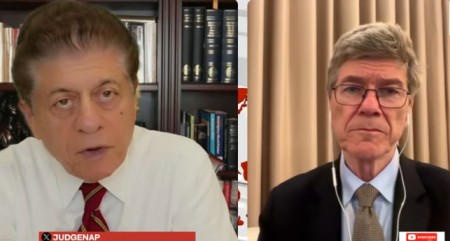
The following is the full transcript of economist and public policy analyst Professor Jeffrey Sachs’ interview on Judging Freedom podcast, June 22, 2025.
Editor’s Note: In this episode of Judging Freedom, Professor Jeffrey Sachs joins host Judge Andrew Napolitano to discuss the current geopolitical situation surrounding Iran, Israel, and the United States. Sachs analyzes the implications of the ongoing conflict, criticizing the “greater Israel” project and advocating for a two-state solution to secure long-term peace in the region. Additionally, he evaluates President Trump’s efforts to negotiate an end to the war with Iran, arguing that despite past criticisms of the administration, pursuing a diplomatic resolution is the correct path forward for American interests.
Iran, the Strait of Hormuz, and the Limits of American Diplomacy
JUDGE ANDREW NAPOLITANO: Andrew Napolitano here for Judging Freedom. Today is Monday, June 22nd, 2026. Professor Jeffrey Sachs joins us now. Professor Sachs, as always, it’s a pleasure, and I know you’re traveling and you’re on the other side of the world, so an extra thanks for sharing this time with us. Is the Strait of Hormuz open?
PROFESSOR JEFFREY SACHS: I’m not sure because I haven’t checked in the last 5 minutes, but I think it is going to be open in the coming days. Of course, Israel is doing everything it can to make sure that it doesn’t open and that the war continues. But Trump wants the strait opened. The Iranians want the strait opened. And I suspect they’re going to find a way to do that.
JUDGE ANDREW NAPOLITANO: It certainly will be open for Iranian tankers and probably open for tankers willing to pay a user fee, irrespective of what the President of the United States calls it. I mean, this is a significant revenue-generating factor for the Iranian government, is it not?
The Cost of American Sanctions on Iran
PROFESSOR JEFFREY SACHS: Well, if Iran were to charge a dollar a barrel for what passes through in a commodity that will be around $80 a barrel, first of all, this is not the end of the world. This is not a big deal.
Iran has suffered terribly at the deliberate economic destruction by the United States, which went out to break the Iranian currency, break the Iranian banks, break the Iranian economy. And it also suffered tens of billions of dollars of losses from Israeli-US aggression since February 28th. So charging a dollar a barrel, if it did that — I have no idea whether it’s actually going to do that — would make perfect sense.
If the United States had any manners at all — by that I mean the US government — first, it wouldn’t have bombed Iran. Second, it wouldn’t have tried to destroy the economy. And third, it wouldn’t make a big deal about this particular issue. This is a few billion dollars of revenue in the context of losing tens of billions of dollars and thousands of lives to a war of aggression, and losing a much, much larger sum through the deliberate actions to crush the Iranian economy.
And we’ll see what happens, but the US, one way or another, has basically — I wouldn’t say stolen, the term is frozen — but it has deprived Iran of its own money in many offshore banks. Because the way that the US sanctions system works is that it tells other countries, “You must freeze Iran’s assets no matter whether you have any kind of conflict with Iran, because if you don’t do it, we’re going to punish your banks.”
So all in all, the United States has inflicted probably hundreds of billions of dollars of losses on Iran. And then to huff and puff about whether there’s a fee in the Strait of Hormuz is hardly the point.
Netanyahu’s Debacle and Israeli Militarism
JUDGE ANDREW NAPOLITANO: Got it. Does the Israeli public recognize that the war was fruitless, that Iran is stronger now than it was a year ago, and that all of this is the fault of Benjamin Netanyahu?
PROFESSOR JEFFREY SACHS: I think in Israel there’s a lot of blame about a lot of things that Netanyahu has done. But basically, Netanyahu has led Israel into a terrible debacle, obviously, to say the least.
He was presiding on October 7th, 2023, when Hamas attacked. That by itself was enough of irresponsibility, though we don’t know every definitive fact about what failed on that day. But he was prime minister, and any normal prime minister would have taken responsibility. Of course, Netanyahu is not a normal prime minister. He has an arrest warrant for him by the International Criminal Court. And he has corruption charges at home. And he is not a nice man, let’s just put it that way.
So there are many complaints. The war with Iran has failed. Now, the point, though, about the Israeli public is they’re not protesting against Netanyahu necessarily because he has been too hard. There are attacks on him for being too soft — if you can imagine, for a genocidaire, for someone who has launched wars and invaded other countries. We have Naftali Bennett, one of the leaders of the opposition, saying that as soon as he becomes prime minister, as soon as Netanyahu is no longer prime minister, the war against Iran is going to start again.
So there’s a lot of very, very vulgar militarism in Israel, and it’s not limited to Netanyahu, Smotrich, and Ben-Gvir. And it’s not limited to the political class in the case of Israel.
And this, I want to draw a distinction with the American scene. In the United States, we have a political class which is basically pro-war. That’s true of the Republicans, it’s true of the Democrats. It is warmongering funded by the military-industrial-digital complex, which makes a lot of money from these wars and has other reasons as well. But the public in the United States is against all of this.
And bravo to the American people.
They knew that the Iran war was a hopeless, stupid, delusional mess. It never should have happened. They have recognized for years that Israel is committing massive war crimes, and the sympathies of the American people lie with the Palestinian people.
So unlike Israel, where the militarism is across the political class but also these days across most of the public, in the United States, the political class is acting against public opinion. And here, Trump, probably — and I credit him if he does it, and if he understands what it means to stick to something for a change — if he actually makes this agreement with Iran and stops the war, even with all the warmongers shouting at him and all the Zionist lobby shouting at him, he would then be on the side of the American people, and that’s the right side to be on.
Trump’s Threatening Language and the Limits of Diplomacy
JUDGE ANDREW NAPOLITANO: Can you put up the Trey Yingst full screen? So Trey is a reporter stationed in Israel for Fox News and a friend of mine, although I don’t work there anymore, as you know. Here’s what Trump said to him, referring to Iran: “You close it,” meaning Hormuz, “and you won’t have a country. You won’t even make it back to your blanking country.” So, Professor Sachs, how can the Iranians negotiate with the Americans when Trump is threatening to assassinate the negotiators? Like the Israelis have done.
PROFESSOR JEFFREY SACHS: First, the president should clean up his mouth. It’s disgusting. This is not the first time in recent days that we’ve had this kind of language. It’s been repeated. Just shame. We don’t need this from a president of the United States. And it’s no joke. It’s no sign of toughness. It’s just vulgar. That’s first.
Second, nobody in authority anywhere should threaten to exterminate another country or to kill other leaders, with or without the expletives. This is illegal. It is dangerous. It is absolutely vulgar. And what it is doing is taking away any of the limits that remain.
I acknowledge to everyone viewing and wondering what I’m talking about, but any of the vague limits of morality that still apply to the political class in the United States or Europe or Israel cannot open the doors to mass slaughter. And these words matter. These words matter because we’re living at a time of an actual genocide. And that genocide has been normalized in Israel. Normalized.
They just slaughtered tens of thousands of people, innocents. They do it every day, killing innocents. And it’s normalized. And one of the reasons it’s normalized is the kind of language that we just saw from the President of the United States. And he’s been saying this for months: “I’m going to bomb you till there’s nothing left. I’m going to destroy your civilization.” We haven’t heard talk like that since the Nazis.
Enough. Stop talking this way. If you have foreign policy demands, okay, I may not agree with them, but make your demands without the talk of extermination of other peoples, which is criminal behavior. Stop. You’re not a criminal. You’re president of the United States. So behave like one. We get a lot farther.
Now, what happened when he said this is the Iranians just shrugged their shoulders. They said, “Come on, stop.” They said the same thing, but they said it in a more deprecatory manner. They said, “We don’t even care what you say. You say this kind of thing all the time.” And that’s in a way very mature of the Iranians. But it’s not quite so simple, because if you have leaders that are talking about destroying civilizations and killing other people, murdering diplomats, whatever it is, that has an effect in the end. And we’ve seen it because we’re living at a time of a genocide by Israel. So it’s enough. Watch your mouth.
Ben-Gvir’s Call for War on Lebanon
JUDGE ANDREW NAPOLITANO: Here is Itamar Ben-Gvir. We all know that he’s one of the most extremist members of Netanyahu’s cabinet and coalition. He also happens to be the head of the rough equivalent of the FBI in Israel. Saying what he thinks should be done in Lebanon. Watch this.
VIDEO CLIP BEGINS:
ITAMAR BEN-GVIR: Lebanon, all of Lebanon should become our playground.
VIDEO CLIP ENDS:
JUDGE ANDREW NAPOLITANO: And people say to me, “Wait a minute, but there’s Lebanon and there’s Hezbollah.” I don’t accept this artificial distinction. Lebanon is a country. There are Hezbollah members in the Lebanese government, ministers on behalf of Hezbollah.
PROFESSOR JEFFREY SACHS: It has a revolving door policy.
JUDGE ANDREW NAPOLITANO: If this guy thinks he’s going to pressure Netanyahu into a full-scale invasion of Lebanon, what is Trump going to do about it?
PROFESSOR JEFFREY SACHS: This man also has an arrest warrant by the International Criminal Court. This man is a fascist. In another era, he would be a Nazi. He’s overtly calling for mass murder. He said, “Let all Lebanon burn,” and he remained in the cabinet.
This is simple. Where were all the voices in the United States of those people who are part of the Zionist lobby or who take money from AIPAC saying this is unacceptable, this is not what we support? I don’t know. I was away from the United States in the last couple of days, but I didn’t notice any such voices.
This is an out-and-out call for mass murder. This man should be before the International Criminal Court. He should not be in the cabinet. Anyone that says what he has said should be removed from power, maybe put under psychiatric examination or something quickly. The man is a danger to the Lebanese, to the Palestinians, and to Israel, which I believe is step by step destroying itself by normalizing this kind of behavior.
The Israeli Press Turns on Trump
JUDGE ANDREW NAPOLITANO: One of the most personally vicious and vituperative attacks on President Trump in the Israeli press came from the Hebrew newspaper owned by Mrs. Adelson. Are they trying to send the White House a message?
The Greater Israel Project and Its Consequences
PROFESSOR JEFFREY SACHS: It’s not subtle. The whole point of what is happening and what has happened for the last 30 years since Netanyahu became prime minister should be understood by everybody. Israel is on a kind of rampage, and this started 30 years ago.
The idea is that though there are 8 million Israeli Jews and 8 million Palestinian Arabs, the people that Netanyahu represents and what he himself believes is that those 8 million Jews should dominate everything. They should control all the territory. They should control the state. They should control all the laws. And people like Smotrich and Ben-Gvir believe the others should be killed or expelled, ethnically cleansed. Some of the more, “moderates,” and I use the term ironically, just believe in apartheid rule. That there will be two classes, a Jewish state ruling over these undesirables.
And this is what’s called the project of Greater Israel. Greater Israel. This is not Israel. This is what’s called Greater Israel, that Israel should have all sovereignty over all of the Palestinian lands, over all the land from the Jordan River to the Mediterranean Sea, and increasingly, in their vanity and vulgarity and fascism, frankly, it should control part of Lebanon, it should control part of Syria, it should overthrow the regimes in the region, including, of course, Iran, at will. It should bomb those who it wants to bomb. It should burn those cities that don’t submit to Israeli rule. That’s Greater Israel. That’s what they want the United States to underwrite.
And the United States has underwritten this almost without any restraint for 30 years. And the more they do, the more Palestinians they kill. The more countries they invade, the more countries they bomb. When the United States doesn’t oppose that, they feel that they can move even farther. And they went as far as to get the United States into a war of regime change against Iran that obviously failed in its first hours. And that has been a terrible blow for the whole world since basically March 1st, and a potential total economic disaster for the world, not to mention humanitarian disaster.
And this is the basic question: are the American people signed up to this agenda? And the vast majority of Americans find this Greater Israel agenda disgusting. It involves mass murder. It involves apartheid rule, which is repulsive. And it involves getting the United States into wars that are very expensive and very costly. And it involves $5 to $6 a gallon gasoline, not to mention that and all the other high costs which are hitting the American people who are feeling it very, very badly.
The Two-State Solution as the Alternative
So do we want to underwrite Greater Israel? Well, there is an alternative, and it’s been the stated alternative of our government, but our government has been too weak, too corrupted, too broken by the Zionist lobby to actually stand up for what we’ve actually said. Which is that there should be a state of Palestine alongside the state of Israel, with the two living in peace. And that’s international law. That is the overwhelming view of the international community. But that’s what the United States itself has blocked.
The US literally has been the single blockage of that, because there was a vote in 2024 at the United Nations in the UN Security Council: should Palestine be admitted to the United Nations as a UN member state? And this would be on the lines of the 4th of June, 1967, Israel’s legal borders as defined by the International Court of Justice. And the Security Council was unanimous yes, 2 abstentions, and 1 veto. The veto was the United States because the US was doing Greater Israel’s bidding.
But that doesn’t serve the American people. That doesn’t serve the American economy. That doesn’t address the cost of living crisis. That doesn’t address the genocide that Greater Israel meant for the people of Gaza. It doesn’t address the war in Iran that has been nothing but a debacle for every part of the world, the Gulf countries, the U.S. standing in the world, Iran itself, of course, every country that uses oil, which is every country in the world.
So we should just say to Israel, “Look, go back to your borders. Stop wrecking the Middle East. Live within your own borders. Stop all the wars.” And no, not Greater Israel, just Israel. Just Israel.
JUDGE ANDREW NAPOLITANO: Well, Professor Sachs, if—
PROFESSOR JEFFREY SACHS: survive as a state, but there should be a State of Palestine next door, right? Small part of the territory, by the way. Small part of what was once upon a time, the British Mandate. The Palestinian part would be something— I think it’s 22%, if I’m not mistaken, but I may have the number not exactly right. But Israel’s already taken the vast share. Just go home, live within your borders, and there can be peace. And the United States should say that. And maybe, maybe, maybe as haphazard as our governance is right now, maybe Donald Trump is actually figuring this out.
A U.S.-Iran Agreement and the End of Greater Israel
JUDGE ANDREW NAPOLITANO: If the United States enters into a normal relationship with Iran as a result of these negotiations triggered by the memorandum of understanding, wouldn’t that mean that the Greater Israel Project is over?
PROFESSOR JEFFREY SACHS: It would mean that the United States has finally, finally broken with this chokehold that this Greater Israel project has had on American foreign policy. It would be a tremendous advance. But then the next thing is clear. There should be a repeat vote in the UN Security Council, and Palestine should become the 194th member state, then we could actually have peace in the Middle East. Peace, not perpetual war, but peace.
Because when that happens, and when there’s a State of Palestine living next to the State of Israel— mind you, next to and peacefully— then Iran can stop whatever support it’s giving to the Palestinian resistance, and so can others that are supporting it. And the resistance will be ended and can easily be ended. And the Arab countries, just so everybody knows, because they don’t know from the propaganda in our media, the Arab countries have said since 2002 in what’s called the Arab Peace Initiative that if there’s a state of Palestine alongside the state of Israel, there can be normal relations with Israel for the Arab states in the region as well.
So come on, if you cut through all of the muck and the murk and these terrible statements about burning Lebanon and all the rest, we have a choice that’s very clear in front of us. This Greater Israel project has been a disaster, and America bought into it until maybe a couple of days ago. Donald Trump should explain it to the American people that he’s not buying into it. It’s over. He’s making peace with Iran, and he’s aiming for peace in the region through the two-state solution, which is ostensibly the policy of the United States dating back decades, but not the policy in reality.
Can Iran Trust Trump?
JUDGE ANDREW NAPOLITANO: Can the Iranians trust Trump? He has dispatched the naïve and inexperienced vice president to lead the negotiations, backed up by his two Zionist real estate agents. And remember, on two occasions when the Iranians thought they were going to negotiations, last June and last February, the United States bombed.
PROFESSOR JEFFREY SACHS: Well, no, they can’t trust Trump, but we can have peace without trust right now. In other words, there can be a ceasefire. Iran will stand ready, in case the United States and Israel attack again, to do what they can do, which is to retaliate effectively. And on that basis, there can be peace.
The truth is that a ceasefire and even a broader agreement is strongly in America’s interest. Strongly. The only interest that is violated by such an agreement is the Greater Israel Project. I happen to believe that Israel would be the great beneficiary of this peace because it will survive. Not as Greater Israel, just as Israel. And that will be very good. And it will be very good that there’s a state of Palestine. All of that can happen.
It doesn’t depend on trust. It does depend on the United States following through. But if the United States doesn’t follow through, I’d be surprised, frankly, if Iran lets its guard drop. They don’t trust anything from the United States. Why should they? But they don’t have to trust the US. At least have a ceasefire, open the Strait of Hormuz. Then it is up to the United States. Are they going to continue to back this reckless project of Israel, of Greater Israel?
Chris Christie on Trump’s Iran Strategy
JUDGE ANDREW NAPOLITANO: Well, I’m going to play a clip from former New Jersey Governor Chris Christie. It’s very bombastic. I think you’ll agree with much of it, maybe not the last two words. But much of what he says, some of it’s humorous because of his technique. Chris, cut number 2.
VIDEO CLIP BEGINS:
CHRIS CHRISTIE: He tells us this is about regime change, unconditional surrender, eliminate the nuclear threat, and eliminate their missile capability. That’s what he tells us. He then does 5 weeks of war, less than what the Pentagon wanted him to do. And then he stops. And he stops and fills the air with a whole bunch of empty threats about when he’s going to restart. Then he gets to the point where the Iranians have him in a corner because of the economic calamity that’s caused by something that apparently his geniuses in his national security team didn’t anticipate, that they would close the Strait of Hormuz. How they didn’t anticipate that, John, I don’t know.
So now he has to make a deal because he feels the economy in the United States crumbling beneath him. And what’s he do? He gives them the option of opening or closing the Strait of Hormuz based upon their interpretation of whether they have to work it out with Oman.
VIDEO CLIP ENDS:
JUDGE ANDREW NAPOLITANO: Right.
PROFESSOR JEFFREY SACHS: Us and Israel are complying. Us and Israel, not a party to the agreement. He gives them a $300 billion bribe offer. He unfreezes all of their assets. He gives them their oil profits back, which is $35 to $50 billion a year on top of it. He doesn’t prevent them from charging service fees to go through the Strait, which JPMorgan says could be $60 to $90 billion a year. And now, to end where you started— he hands over the negotiations to a naive and inexperienced vice president and two other guys who would be better buying you an office building in Alexandria than negotiating this. And let me say this: he’s gone from America first to Iran first?
No. Okay. Let’s say a couple things. The president is right to end this war and stop this. This was an Israeli-inspired debacle, and Trump is trying to end it. I don’t criticize Trump for trying to end it. In fact, I praise him for trying to end it. Of course, this was a useless war. I don’t praise him for having started it. I think the whole thing was a delusion of two people, Netanyahu and Trump.
But let’s be intelligent about this, please, which is: this war that never should have started should not go on just because it did start. The war should be ended now, and Trump is trying to end the war, and I support him for that, and I support Vance for that because I think Vance understands that his base doesn’t want the war. And they’re right. And his future depends on not having a global— his political future depends on us not having a global economic calamity.
So every week I come on and I have criticized Trump for getting us into this mess and many others, but I don’t want to criticize Trump for getting us out of this mess. I want to say he’s right to do it. And he has to face down 30 years of a Zionist lobby, which has been holding America to follow this absolutely disastrous Netanyahu-Smotrich-Ben-Gvir policy. And if Trump is trying to break that right now, I support Trump for doing that.
Breaking Free from the Zionist Lobby’s Grip
JUDGE ANDREW NAPOLITANO: You’re such a good man, Professor Sachs, because you’ve been such a harsh critic of the president, but when he’s right, you have the personal courage and intellectual honesty to acknowledge it. I don’t know where this is going to go. When I read the English translation of that Hebrew attack on him, I didn’t know that that was Mrs. Adelson’s newspaper.
PROFESSOR JEFFREY SACHS: It was vicious. Yes, this is— we’re really at the core of the politics right now because the US has been in the hands of Israeli extremism for decades. I’m not against Israel. I’m against the Greater Israel project. I’m not against Israel. I’m for peace and I’m for a state of Palestine. And I am for Israel living within its own borders and stopping making all these wars across the region. I happen to think that’s the best way for Israel to survive also, which I would like to see because there are 8 million people there. I’d like them to survive. And I’d like the Palestinian people to survive. There are also 8 million people there.
So we need to free ourselves from this hold that Miriam Adelson and her late husband and a number of others and a lot of the Christian Zionists and a lot of others have had their grip on American politics. And so we’re going to see a lot of reflexes right now attacking Trump for trying to do something different from what Israel is demanding. But he’s right to do so in this case. So we should keep clear that we want this war to end.
JUDGE ANDREW NAPOLITANO: Professor Jeffrey Sachs, thank you very much, my dear friend. Safe travels, and we’ll look forward to seeing you next week.
PROFESSOR JEFFREY SACHS: Absolutely. Thanks a lot.
JUDGE ANDREW NAPOLITANO: Thank you. Tomorrow, Tuesday, a full day for you, particularly at the very end. Well, we start out with Ambassador Freeman at 8:00. Professor Mearsheimer at 9, Matt Ho at 2, Colonel Kwiatkowski at 3, and at long last, back from 3 weeks in Russia at 3:30 in the afternoon, Scott Ritter. Just the Paul Tanner for Judging Freedom.
Related Posts