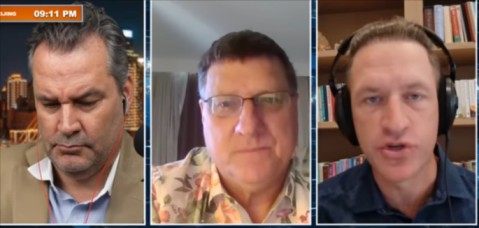
Read the full transcript of former UN weapons inspector Scott Ritter’s interview on Cyrus Janssen Show, May 10, 2026.
Editor’s Notes: Join hosts Cyrus Janssen and Alex for a deep dive into the Iran conflict as former UN weapons inspector Scott Ritter explains why the situation has entered its most dangerous phase. This episode explores the looming threat of a global energy catastrophe driven by the blockade of the Strait of Hormuz and its potential to destabilize the international economy. Ritter provides a critical analysis of the U.S. military’s failure to meet its strategic objectives, while highlighting Iran’s growing leverage and its strengthening ties with China and Russia. Additionally, the panel discusses the domestic political fallout for the U.S. administration and offers an expert update on the evolving conflict between Russia and Ukraine.
Welcome and Introduction
CYRUS JANSSEN: Well, everyone, welcome to Let’s Talk Geopolitics, and we have a special episode in store for you today as we are looking at the Iran conflict that continues to evolve. Man, it is just absolutely crazy. Alex, thank you for hosting today, and of course, Mr. Scott Ritter. Scott, welcome to the show.
SCOTT RITTER: Thanks for having me.
ALEX REPORTERFY: Scott, you look very relaxed today. Where are you, sir?
SCOTT RITTER: I’m in—
ALEX REPORTERFY: Well, all right, well, so we’ll hand it over to you, Cyrus. We got quite the weekend here. Still not sure if we have a peace deal in Iran with the United States, but I’ll hand it over to you, Mr. Janssen.
Where Is the Iran Conflict Heading?
CYRUS JANSSEN: Well, I think the thing that we need to discuss is really where is this conflict going? Because we hear, I mean, we’ve heard probably from the White House at least 40 times that the United States has already won this war. We heard it as early as March 3rd that the United States has won, the war’s over.
But of course, the Strait of Hormuz remains to be closed, or at least it’s under Iranian control. There’s a tremendous amount of tolls that are being charged. There’s a blockade from the United States as well. So we’re looking at the largest energy disruption in the history of our world.
And so again, despite Donald Trump’s claims and the Republicans’ claims that yes, we’re victorious, everything’s going amazing, I have yet to see anything actually achieved from a United States military perspective. Scott, would you agree with that statement? I mean, as we’re looking into the, what, 11th week of war now, I mean, where are we at as far as the United States military, the objectives? What’s really going on right now at this stage of the war?
Scott Ritter: None of the Objectives Have Been Achieved
SCOTT RITTER: Well, I think the first thing we have to understand is that we’ve accomplished none of the objectives of this conflict. We have the Strait of Hormuz, we haven’t toppled the regime in Tehran, we haven’t secured the Iranian nuclear program, and we haven’t eliminated the financial program of the United States and the international community.
So on the throat of— there are certain factors that are required to keep the system running. Lines, not just the oil production itself, the wells. And so the wells, in order to maintain the well, you have to have continued production and continue to maintain pressure. If you stop production precipitously, you can create issues with well maintenance.
So to maintain the wells, when you pump, you have to load it, store it someplace, and then take it to a refinery that refines— refineries have to be in constant motion. You don’t want them shut down. And then you have pipelines that need to be constantly streaming energy.
We’re at the point right now where by June we’ll start to see major disruptions in the energy supply chain. And by September, if we don’t resolve this, we’re going to see a total collapse of the global energy supply chain, meaning refineries are going to be shutting down. And when they shut down, they don’t just start up. Pipelines are going to be emptied. And wells are not going to be producing and are actually probably not going to be maintained consistently, which impacts future production capacity.
So we are literally looking at a global energy security catastrophe that will impact everybody. I know, Alex, you’re in China. China’s not immune to this. China is going to pay a very heavy economic price if this doesn’t get resolved, which is one of the reasons why I think China is heavily involved diplomatically.
The Russians too, while they won’t be involved in terms of their maintain and produce, Russia needs stability. Every oil-producing nation needs stability in the global markets. The last thing you want is an unstable global market. Even the United States, we claim to be energy self-sufficient, but the fact of the matter is it comes with a cost. You’re tied to a global market, and therefore when the price of oil goes up globally, it impacts us here at home. And one only has to look at— I don’t know what the price of gas is in Las Vegas right now, but I know in New York it’s gone up over a buck in the last week.
The Economic Pain Is Already Being Felt
CYRUS JANSSEN: Yeah, Vegas prices are consistently around $5.30, $5.40 a gallon. I mean, I would say since the start of the war, up at least $1.50 across the board. Diesel at one point was $6.75. It’s come down now closer to $6. So we’ve seen a little bit of relief there.
But I mean, it’s impacting a lot of people. And I think that one of the interesting things that I was doing some research on was actually the economic— every dollar of economic output towards GDP, even the United States economy is about 40% more oil dependent for every dollar of economic growth than both China and even Russia.
You know, it’s interesting, right? Because we hear Donald Trump, “Oh, wow, the stock market’s at an all-time high. Everything’s going great here.” And then I saw a great tweet where somebody said, “Yeah, it doesn’t matter if the stock’s all-time high, a sandwich and water costs me $23.” Inflation’s through the roof, costs are through the roof.
And I mean, also we have to take it with a grain of salt. I mean, it’s obviously these massive AI companies that are responsible for the massive gains of the S&P. So the S&P, great high, but it’s really driven by a couple of names that are just going bonkers, which we know is a bubble as well because the revenue doesn’t actually match. A lot of it is just expectations. So yeah, there’s a lot of pain coming. I think that’s something that Alex has been chatting about for a long time. Alex, anything that you’ve seen in the markets this week that you want to chat with our audience on?
Market Manipulation and the Coming Shock
ALEX REPORTERFY: Well, yeah, a lot of market manipulation is what I’ve been seeing, a lot of outside trading before the actual markets open and the markets close. This is starting to actually become common conversation with the average people that they know selective individuals are either leaking information prior to either having an agreement or making an agreement, which manipulates the price of oil.
But again, as Scott said, we haven’t seen the pain yet. We know it’s coming. I don’t run a shipping company, but I can tell you that the VLCC containers, they go about as fast as a bicycle. So imagine driving a bicycle all the way from the Strait of Hormuz to, let’s say, Louisiana, and bringing a container. How long does that take?
I mean, I’m more interested in how this world is going to deal with a shock like that. I mean, Scott, have we seen an example like this anywhere in history?
The Economic Fallout: A Crisis in the Making
SCOTT RITTER: Not in recent history. The oil economy, of course, back in the early ’70s, we had the oil embargo that led to an energy crisis here in the United States and the West. But linked to oil — look around your home, understand that almost everything in your house is produced using petroleum products, everything. And the food you eat, believe it or not — the urea that’s used to create the fertilizer that’s used to make the mass growth of food possible comes from oil products.
And it’s not just oil that’s not being shipped out of the Middle East. It’s urea. It’s fertilizer. It’s the fertilizer byproduct ammonia. It’s helium, which is an essential product in modern technologies. There’ll be a helium shortage. So the technology that we think we have that’s going to compensate for other things is going to come to — the entire world’s going to come to a standstill. This is the reality.
We haven’t had significant energy flow into the global system from the Middle East since February. Ships — container ships but tankers — updates last week. And there is going to be a shock, a tremendous crash that’s going to take place. It’s going to take place in June, July. It could extend into August if we don’t resolve this. We need to get the Strait of Hormuz open now.
But even if we get the Strait of Hormuz open, understand that oil production in the Persian Gulf region has come to a halt. It’s going to take some time. Qatari gas isn’t going to flow automatically. They have to repair pipelines and they have to get systems back up to liquefy the gas, to load it onto ships, to ship it. That’s going to take weeks if not months. So even if we resolve the political problem, the logistical problems are still there. This is going to be a very, very hard summer.
Lufthansa, Fuel Shortages, and the American Household
SCOTT RITTER: Take a look at Europe and commercial airline traffic. Lufthansa canceling 20,000 flights. They may have to shut down the totality of their operations because not only can they not afford the fuel, there is no fuel. There’s an aviation fuel shortage that isn’t going to be resolved because the Strait of Hormuz is closed. And this will have an impact on the United States. We may not have the same fuel shortage they have, but it’s going to cost us a heck of a lot more to travel this summer.
Early on in this conflict, it was estimated that this war was costing Americans $410 more a month. I think that number’s probably gone up to closer to $600. Americans are living paycheck to paycheck. There’s not a lot of extra cash floating around. And so when you start eating into incomes that significantly, you’re going to also create a crisis. What happens this summer when people are unable to pay their bills, pay their mortgages?
The Political Price to Pay
SCOTT RITTER: We have no clue what’s going on. And the president is lying to the American people. Congress is lying to the American people. And there will be a political price to pay come this summer. Bill Clinton warned us all back in 1992 with that little yellow sticker that somebody stuck on the door of the war room: “It’s the economy, stupid.” That is literally the only thing the American people truly care about. Everything else is peripheral. Guns, yes. Abortion, yes. War, yes. But the only thing that truly matters, the thing that drives Americans at the voting booth, is the economy.
And when this president crashes this economy and is unable to pull it out of a nosedive, there will be hell to pay at the polls come November. Trump and his advisors have no time left — zero time left — because, as Alex talked about, the time it takes for things to sail and get to where they want, even if we solved all the problems today, there’s still going to be a crash. It isn’t going to reverse itself till late July, and that’s almost too late for November. Almost too late.
This president has no time left, none whatsoever. And yet it doesn’t appear that he’s psychologically capable of doing the right thing. This is a man who continues to have conversations with himself, debates with himself. He lives in a fantasy world of his own construct, saying things are going to happen that just simply aren’t going to happen. Out of touch with reality 100%. And he’s surrounded by sycophants who only further this kind of warped thinking.
America’s Military Credibility Shattered
SCOTT RITTER: Pete Hegseth promoting the idea that America has a military capable of doing anything — I mean, we’re an embarrassment. This goes beyond Iran. This goes into China. China now today has answered some very fundamental questions. America sucks. China doesn’t have to worry about American air defense. It’s been demonstrated to be absolute crap. China doesn’t have to worry about American long-range strike weapons because they’ve learned the lesson from Iran that they’re not the invincible weapon they think they are, and there’s a finite amount of these, and they’ve been expended.
The irony is China’s in control of America’s ability to rearm, because much of the technology we need to acquire to produce these weapons that we’ve expended in large numbers comes from China. The Chinese actually hold the key to America’s ability to rearm. Most Americans have — that fact has escaped them.
In Europe today, if you think the Russians are now fearful of the United States — they’re not. Everybody’s concerned about nuclear weapons; that’s a different issue. But the United States, as the bulwark that supports Europe, is no longer there. It’s been exposed. It’s not a solid spine of steel, but a rusted, collapsing artifice. And Europe itself is nothing.
This Iran war has exposed the military fallacies that have been attached to the notion of Western military supremacy. It’s dashed forever. Russia and China today can rest easy knowing that their military capability is more than sufficient to defeat the United States in a stand-up conventional war.
The Stock Market, the Economy, and Political Credibility
ALEX REPORTERFY: Scott, you mentioned the economy and how important it is to Americans. I’m going to bring up a video here for our viewers, and I just want to explain what this video is. I’ve kind of designed a graph showing the average person what happens when the market reaches a high, which strangely enough it did last Friday and last Thursday. After the dot-com boom, we saw 14 years from the high of the dot-com boom to reset a new high. And what people didn’t take into consideration there was the erosion. Has this Trump administration dug a hole so deep that not only the midterms but the election after that — has this destroyed all credibility of the Republican Party?
SCOTT RITTER: It may have destroyed the credibility of all political parties, because the Democrats haven’t done anything to earn the trust and confidence of the American people. All that’s happened is that the Republicans are literally self-destructing before everybody’s eyes, and therefore the only viable alternative is the Democratic Party. But Hakeem Jeffries does not inspire confidence. He’s one of the most corrupt individuals out there.
You can show the stock market up, but the reality is that the stock market benefits the wealthiest at the expense of the average investor. The average investors’ portfolio — the gains that you’re talking about — because the average investor is treated as a sucker, or somebody who’s there to help underwrite, to help generate the money that is stolen by fund managers. And then the people who game the system more effectively through insider trading aren’t matching the results you see there — really weren’t matching those results.
The Derivatives Market and a Rigged Game
ALEX REPORTERFY: Yeah, let me bring up something, Scott. I just want you to have a look at this next slide, and you mentioned it, so I think it’s a great time to introduce this. These are the top banks that are making money on the average American person. This is the derivatives market. It’s estimated between $600 to $700 trillion — almost 10 times the global financial market. But have a look at the banks in there, the top 10 individuals here. We’ve got JP Morgan, we’ve got BNP Paribas, we have Citibank, we have HSBC. This is where the big money is made, and this is outside of the market. This is when mom and pop have gone home, they’ve hung up their phone with their broker maybe at 5 in the afternoon — and as you say, the game seems to be rigged. I’ve traded derivatives for 20 years, and that’s my way of beating the banks. But Scott, where’s the limit with this administration?
Trump, Narcissism, and the Breakdown of Constitutional Governance
SCOTT RITTER: When we speak of the Trump administration, we can no longer use the standard analytical framework that we would use, whether in geopolitics or finances or anything, because we’re not dealing with an administration that functions the way governments are supposed to function. We’re dealing with not a chief executive, but a cult of personality that has broken free of constitutional constraint and restraint, operates free of checks and balances in near dictatorial fashion to the whim of a man who is diagnosable as a malignant narcissistic personality disorder-stricken mentally ill person.
Now, this is where I got in trouble, because a person who I consider to be a very good friend said, “You have to stop saying this, Scott, because you’re not a psychiatrist or a psychologist and you’re not in a position to diagnose someone like this. And it just makes it sound like you’re angry and spiteful.” And I agree, I shouldn’t say that out of the blue.
But what I will say is this: I have worked very closely with psychologists and psychiatrists who have been focusing on Donald Trump. In fact, in 2019, I appeared on a panel on C-SPAN with Bandy Lee, who is a psychologist that was with Harvard Medical School. She has talked about the disease of narcissistic personality disorder and how it applies to Donald Trump in its malignant fashion. And she was supported by a whole bunch of other board-certified psychiatrists and psychologists. Now I will say that I pushed back in 2019 — I wasn’t buying into that, I believed that they were wrong to make a long-distance diagnosis.
But when I’m in Washington, D.C., this narcissistic son of a b is hanging banners with his face all over the city as if he’s some — today, as we speak, he has religious leaders in the United States, or Mar-a-Lago religious leaders, dedicating a golden statue? Not the Bible? Not —
ALEX REPORTERFY: Yes, Cyrus — let’s just take it over for a second. Scott’s feed has just closed up for a moment there, but I think we get the point of what Scott’s saying.
Trump’s Narcissism and the Path to a Deal
CYRUS JANSSEN: Well, I think I’ll just follow up on that. I mean, we’re talking about Trump, who is by far the biggest narcissist in the world. Like you said, we have gold statues being dedicated to him. We now have a new passport that’s coming out with Donald Trump’s image on it. He’s tweeted out that he believes that there should be a fifth face in Mount Rushmore. It should be his face. I mean, there’s been so many things.
And a classic example of the narcissist is any type of pushback, it’s responded with, “You’re a nasty person. What a horrible question you’ve asked me. You’re a nasty person.” And it just kind of lives in this fantasy world.
I don’t know if you guys saw the story about the Donald Trump golden phone that came out. I don’t know if you heard the story. It was trending on Twitter. Basically, they launched a Donald Trump gold phone. What you had to do is you had to go online, you had to put $100 to $500. The phone was going to be made in America. It was going to be a gold color. It was going to be amazing. It was going to cost $500. So they had 59,000 people deposit $100 for this phone. This was back in December. The launch date was to be in May or June. Of course, nothing, no updates or anything.
The only update is that this week the Donald Trump website for this phone has now updated the conditions that “We may not in fact actually release a phone.” That’s part of the terms and conditions. So although you’ve put down that $100 deposit, we now have no guarantee that we’re actually going to produce a phone. So you’re talking just absolute money extortion, right?
I mean, Alex, you’ve reported out that the Donald Trump stock, whatever this Donald Trump Media is, the Truth Social, any of these guys that are these diehard MAGA followers who would have bought in at the high right when that goes IPO — obviously down 95% now.
So I think, Scott, I agree with your sentiment here that the Republican Party has really lost it. I think the Democrats — I mean, this is a golden opportunity for them to step up. They also seem pretty incompetent as well. And that’s where we are in the United States. We’re told that we have the best government in the world. The United States democracy is incredible. You have this amazing two-power structure. I don’t know a US citizen personally in my circles that has any confidence in the US government, any trust in the US government. And that’s why our democracy is eroding, it’s falling apart.
And of course, I kind of want to get back to this conflict with Iran. Scott, I got a question for you. Now we’re seeing a story coming out that Iran could potentially seize control of these massive undersea internet cables and they potentially could take control of those, maybe charge a fee for those. I mean, I just see that we’re just going further and further down this escalation trap. Any news on that from your perspective or any thoughts?
Iran’s Submarine Threat and the Undersea Cable Strategy
SCOTT RITTER: Well, first of all, we’ve known the cables have been an Achilles heel for much of the world, especially the Middle East. We have these Gulf Arab countries that have built financial empires — United Arab Emirates, Kuwait, Bahrain — and everything they do is dependent upon data. And the data that flows in comes from these undersea cables. They’ve always been vulnerable to interdiction. One of the fears was that Iran could cut these cables.
Just today, Iran announced that — and I just have to laugh again because according to Donald Trump, there is no Iranian Navy — but according to the Iranians today, they are deploying for the first time a class of submarine. It’s a small submarine that operates in the shallow waters of the Persian Gulf. The American Navy can’t interdict them because our big submarines can’t come into those shallow waters. They’ll fall victim to this, and our ships can’t approach for ASW — anti-submarine warfare — operations because it’s shallow water and they’ll be sunk. And these subs are perfect for that kind of mission, to interdict the cables.
So I think it’s the greatest irony that Iran might now be in a position to replicate the tolling that it does for oil tankers and ships through the Strait of Hormuz and start charging an internet access fee. I just think it would be wonderful if Iran did that. Because I think the world miscalculated. I don’t view any of the Gulf Arab nations as victims. They’re all perpetrators. They were all active parties to this conflict, and they have no rights. They are defeated nations. They lost the war. They gambled. They chose the wrong side. And I just think it’s wonderful that Iran is in a position to make them pay.
Negotiations and What a Peace Deal Could Look Like
CYRUS JANSSEN: Yeah, absolutely. I mean, that’s been the theme for the past 2 months that we’ve seen. And I mean, we’ve heard Donald Trump admit this as well, right, that he didn’t think that the Gulf States would be attacked. He didn’t feel that Iran had the capability to do that. He didn’t feel that they could close the Strait. Of course, this was operating really intelligently, right? And Netanyahu sold him a war and said, “Look, we can probably knock him out in about 7 days, maybe 10. This will be quick, fast, efficient, kind of like Venezuela.” Trump took the bait. And of course, we’ve seen this has been nothing like that.
Scott, what about — it seems to be that there is some negotiations with the potential, I don’t know, peace deal, whatever that means. But we do hear that Iran state media has now responded within the last 40 minutes here that they have sent some information to the Pakistani media. I mean, what would a potential peace deal look like? I mean, are we going to see any real concessions from Iran, or does Iran hold the cards right now?
SCOTT RITTER: Iran holds all the cards. I mean, I think what we have to understand, though, is that Iran — it’s fighting for its sovereignty, but Iran in the long term, it can’t be a nation standing alone. They can’t go to war against the entire world.
This conflict wasn’t just about Israel urging the United States to go to war against Iran. This was a conflict that the United States made an independent assessment and said this furthers our strategic goals and objectives against China. China is very much a target of this war for the United States because just like we did with Venezuela, we were planning on taking control of the Iranian oil market and denying China access to it.
So Iran has to be careful because the Chinese have a vested interest in this conflict. And I think a lot of pressure is being put on Iran by China to find an off-ramp. That’s why you’re seeing the Iranians respond as they do — pound sand — because they do hold all the cards. But that’s the card game they’re playing with the Trump administration. They don’t want to be playing a card game with China. They want to make sure that the Chinese interests are respected. But China also acknowledges that there’s the issue of Iranian sovereignty that can’t be tread upon.
So a deal will not have Iran forego its right to enrich permanently. There may be a cap put on it, a time frame. There might be some restrictions put on it. But the idea that Iran is just going to give up enrichment altogether and give up its nuclear program altogether is absurd. Iran will not do that.
So I think there might be some movement on the nuclear side where Iran is willing to — Vladimir Putin the other day mentioned that Iran was willing to transfer the enriched uranium, the 60% enriched uranium, to Russian control to be disposed of in that manner. That may be back on the table. There might be other restrictions, maybe going back to the deal that the Omani government helped broker before this war began. So I see some flexibility there, but they’re not going to give up their nuclear program. That isn’t going to happen.
Ballistic missiles aren’t even on the table. Iran won’t even entertain that notion. In fact, today Iran came out and said if the United States attacks another Iranian tanker, then Iran is going to launch missiles at American bases and American ships. So Iran is the one setting the terms now. It was Washington, D.C. trying to box the Iranians in. The Iranians have countered and said, “No, we hold the cards and we will blow the hell out of you if you come at us.”
On the Strait of Hormuz, I don’t see Iran giving up control. Iran agreeing to maybe have a partnership with Oman on the Strait — some sort of partnership thing — but I don’t see Iran giving up their trump card. I do see Iran allowing compromises to be made on the nuclear side, giving the power to the Trump administration to claim they have a better deal than the JCPOA, which would be a political victory for Donald Trump. I do see Iran willing to make some compromises to get the Strait of Hormuz opened, which will again give Donald Trump the ability to declare a political victory.
But the United States has to lift the blockade. That can’t be allowed to happen. Iran’s not going to make concessions without that. And the other thing is the United States has to lift this and has to return the seized assets. And the United States keeps talking gradual. Well, that’s a word that means never when we talk about the United States. So these are things that have to be done up front.
The Trump-Xi Meeting and Iran’s Emerging Global Power
SCOTT RITTER: And this is where I think the upcoming visit between Donald Trump and Xi Jinping in China is going to be absolutely important. But the tone of this meeting is going to be completely different than Trump had anticipated. When he first planned on meeting Xi Jinping, I think last month, he wanted to bring both Venezuela and Iran with him and throw it all on the table and say, “We are in control here, we are in charge, you need to listen to us and bend to our demands.” That isn’t happening. And I think the Chinese are going to say, “Please, Mr. Trump, have a seat. Let’s have a conversation about what we can do to save your ass.” That’s the nature of the conversation.
CYRUS JANSSEN: Yeah, and that’s a good point because we’ve actually seen the United States government actually come out and advocate for China’s help in opening the Strait of Hormuz. And an interesting thing that they said is that Iran doesn’t actually have any allies — they’re alone, they’re isolated on the world stage. But yet you see that the United States is actually reaching out to China to talk to Iran. We’ve seen Pakistan obviously involved in the negotiation. So that proves that that claim is false. Obviously they do have allies and they do have interested groups.
I do like the point that you brought up as far as Donald Trump meeting with Xi Jinping. I think that’s going to be a very big, important meeting for the future. But I think, Scott, at the end of the day, it looks like we’re at a situation where both sides need a win. Iran has proven to themselves and to the world that this is something that Professor Robert Pape from the University of Chicago has been talking about — Iran emerging as a fourth global power.
SCOTT RITTER: Right.
CYRUS JANSSEN: You have the United States, China, Russia. These are all countries that can influence different regions of the world, whether that be politically, militarily, or economically. And while Iran does not have the military or economic capability as the United States, they do have leverage and they’ve proven that to the world, right? With certainly the Strait of Hormuz and being able to influence the global economy. So it’s almost that they found this new power or an ability to charge $1 million to go through the Strait of Hormuz. Or now we’re talking about the undersea cables — now we’re going to charge a fee for those. And so we have these leverage points that we didn’t have before, that we didn’t have on the table.
But I think honestly — is whatever deal that Donald Trump’s going to get, is this a worse deal than what Obama negotiated back in, I believe it was 2016? I mean, there’s nothing that’s going to be as good as that deal. Is that — am I correct in saying that?
The JCPOA’s Flaws and Iran’s Nuclear Reality
SCOTT RITTER: That deal had some problems as well from an optics standpoint. Understand that Iran has never been shown to have a desire for nuclear weapons or to have a program dedicated to producing nuclear weapons. Never. There’s been assessments from Israel and the CIA that talk about early on these programs existed, but it’s never been proven. And today, it’s pretty much demonstrated that Iran does not have a nuclear weapons program and is not seeking to do one. In fact, just the opposite, they don’t want one.
When you look at the JCPOA in 2015, it was predicated on the need to create a one-year breakout time. So the agreement was designed so if Iran decided they wanted a nuclear weapon and decided to violate the restrictions placed on them, it would take one year for them to acquire sufficient enriched material to produce a single nuclear weapon. That’s a flawed way of approaching Iran’s nuclear program, and that was proven because Iran was never going to allow permanent restriction of its ability to enrich.
The JCPOA had these sunset clauses that basically allowed these restrictions to ease over time. And by the time the final restriction eased, the notion of a one-year breakout window was laughable because Iran would be allowed to produce and deploy the most advanced centrifuges. There was no restriction on the amount of enriched uranium Iran could accumulate. And so therefore, the idea of a one-year breakout window is mooted. By the time the sunset clauses were lifted, the breakout window would be measured in terms of weeks.
So if you’re using a one-year breakout window as the benchmark upon which to judge the efficacy of the JCPOA, it was a joke. And Obama said so in April, before the agreement was signed. Someone said, “What happens with the sunset clauses?” And he said, “Well, we hope that the agreement actually provides enough time for Iran to reconsider their nuclear program in its totality, and so that this won’t be an issue when those come up,” meaning that Iran would voluntarily step down. “What if Iran doesn’t?” He said, “Well, then we will readdress this issue at that time,” which means the United States was never serious about implementing the JCPOA, even under Barack Obama. Invalidated.
Trump, the JCPOA, and the Path to a New Deal
So all Donald Trump did was fast forward that requirement. He said it’s a bad deal and he got rid of it. There can be no nuclear deal with the United States that allows Iran to accumulate vast quantities of enriched uranium. There can be no nuclear deal with the United States that allows Iran to have unlimited enrichment capability. So in order for there to be a deal, it’s going to have to be a better deal than the JCPOA. This is just a statement of fact. As long as we have this artificial benchmark of blocking a pathway to a nuclear weapon, the JCPOA was a fundamentally flawed deal, and there will have to be a new deal.
Now, I believe that Iran has every right to enrich uranium, that Article 4 of the Nuclear Non-Proliferation Treaty gives them that right, but we have to deal with realities. As long as Israel exists and Israel exerts influence on the United States, it’s politically impossible for any American president to allow an Iranian nuclear program that provides the theoretical pathway to a weapon. So there must be a deal that permanently shuts that pathway, that provides restrictions on Iran’s nuclear program, that prevents Iran from enriching uranium to a higher level and not allowing them to accumulate stockpiles of uranium and enriched uranium.
That deal was negotiated in February. For all the people out there saying, “Scott, who are you to tell the Iranians what to do?” I hear that all the time. “You ignorant son of a bitch. You’re just anti-Iranian,” and all that. Pound sand, puds. You don’t know what you’re talking about. The Iranians already agreed to this deal. What do you think the deal was that the Omani foreign minister was taking to Washington, D.C. on February 26th? So f* off.
The deal has been made. It exists. It’s reality. You guys live in a fictional world. The same people that say Iran must have a nuclear weapon — no, they mustn’t. They don’t want one. Why do people want to give Iran something they don’t want? Do they not understand that a non-nuclear-armed Iran beat two nuclear-armed powers? That the ballistic missile program of Iran and the ability to put the chokehold on the Strait of Hormuz gives Iran strategic leverage it needs against two nuclear-armed powers.
If Iran had a nuclear weapon, it would legitimize everything the United States and Israel has said about Iran and mobilize global support to take Iran down. So Iran doesn’t need a nuclear weapon, they don’t want a nuclear weapon, and nobody should be encouraging them to get a nuclear weapon. Iran got to the position they are today by not having nuclear weapons and not pursuing nuclear weapons. And they’re winning across the board.
Iran’s Strategic Future: Sanctions, BRICS, and the Eastern Pivot
So I do believe that on the nuclear side, there’s a deal to be made and it must be made because we have to deal with political realities, not the fake world that people want to live in where equities abound. We don’t live in that world. We live in a world where Israel is an illegally armed nuclear power — I get it. And I do think the world should spend more time talking about Israel’s nuclear weapons and how to get rid of them.
What we’re talking about now is present Iran. Iran will not be able to dictate Israel’s unilateral disarmament. That’s flawed thinking, a fantasy world you live in. What we can do is dictate the terms which allow the sanctions that have been imposed on Iran linked to a nuclear program to be lifted, empowering Iran to have an economy for the first time in 50 years.
You want to speak of Iran emerging as a global power? Watch. It’s not going to be from trick plays. Iran’s not going to become a global power because they can shut down the Strait of Hormuz or they can shut down cable. Those are trick plays. That’s like saying I’m going to win the Super Bowl because I’ve mastered the hook and ladder. Well, you can throw the hook and ladder one time, score a touchdown, and that’s it. The trick play’s done.
Iran has these little short-term trick plays. In the long term, Iran becomes a global power by integrating its economy into BRICS, the Shanghai Cooperation Organization, the Eurasian Economic Union, by bringing Russia and China so close that nobody will dare try to disrupt that. This is what needs to happen. The sanctions must be lifted so that Iran can hug Russia and Iran can hug China so tightly nobody will ever be able to come in and say we’re going to go to war against Iran again, because that means automatically going to war against Russia and China.
That couldn’t have happened earlier because the Iranians are reticent against that kind of relationship. Remember, the Russians negotiated a strategic framework agreement with the Iranians back in January and February of last year, but the Iranian parliament sat on it and didn’t ratify it — in June when Israel attacked and the United States attacked. Everybody’s like, “Where’s Russia? They’re a bad ally.” I’m like, no. The Iranians didn’t ratify the agreement. There’s no legal framework for Russia to support Iran on right now.
Now, the Iranians have rectified that, and since then Russia has been providing assistance. I don’t know what kind of framework agreement exists with China. I do know that the Chinese are providing assistance. But what I do know is once this war ends and the sanctions are lifted and restrictions are removed, you’re going to see Iran hug both Russia and China and draw them in. And Russia and China are going to do the same thing because Iran is essential to the future economic growth of both nations. The Russians need it for north-south connectivity from St. Petersburg to Chabahar, and the Chinese want to keep that New Silk Road going.
This is a game changer once you get Iran to hug Russia and China and make that pivot decisively. Again, one of the greatest strategic failures of the West was to fail to recognize that for a long time, up until recently, there were many Iranians that didn’t want to make that pivot to the East, that many Iranians wanted to continue to have good, sound relations with the West, that they believed in the economic potential of reopening relations with the West. That’s over. That’s the other thing that nobody talks about. That’s over.
Iran will never link itself to the West now. That day is finished. That boat has sailed. Iran has pivoted to the East. And now when sanctions lift, you’re going to see an economic embrace that’s going to make Iran the 4th most powerful nation in the world.
Russia-Ukraine: Reassessing the Special Military Operation
ALEX REPORTERFY: Scott, we’re getting a lot of questions from people in the comments section about the latest military parade in Moscow and some of the comments that came out from Vladimir Putin saying that potentially this war in Russia and Ukraine, or special military operation, could be coming to an end soon. You’re a guy that’s very knowledgeable about this stuff. A lot of people said it would have been over in 6 months, but you said it would be a long, drawn-out operation. What’s your assessment of the latest situation?
SCOTT RITTER: I went over very quickly. But I believe that’s because Russia was going to bring the totality of its military capabilities to bear on Ukraine, that they were actually fighting a war. Turns out they were fighting a special military operation that was designed to get Ukraine to the negotiating table. It’s something that everybody missed. I missed it, the director of the CIA missed it, the chairman of the Joint Chiefs missed it. Nobody in the world understood what a special military operation was.
Now that we’ve learned and we realize that this is about Russia fighting a long-term war of attrition, not just against Ukraine, but the collective West, we are looking at this long drawn-out affair. But when the United States made the decision to create the new Lend-Lease back in May of 2022, I called it a game-changing moment. I got in a lot of trouble there. People said, “Oh, you’re a flip-flopper.” No, I’m not a flip-flopper. I’m just a good analyst who is able to absorb new data and factor it into my assessments. That’s what good analysts do. And it was a game changer. It changed the nature of the game.
I have been saying that Russia is going to fight this long drawn-out war of attrition because all of the advantages accrue to them. The clock isn’t an issue. That’s no longer the case, and that’s why we’ve seen such a dramatic shift taking place here. Ukraine and its European allies have created a new reality, and that is that Ukraine — I had a strategic debate about this back in 2022. I said it’s very dangerous for NATO to become the logistics base of this proxy conflict because it’s just like in Vietnam. We talked about how Cambodia was used, how Laos was used as safe havens supporting South Vietnam. And what did the United States eventually have to do? Bomb the Ho Chi Minh Trail in Laos and Cambodia.
What we have here is that NATO has now not just become a logistics base sustaining the battle on the ground, which the Russians control. They’ve now turned into a launching pad for strategic long-range rockets and cruise missiles into the depth of Russia to do real harm. What’s happened is Russia has literally lost 20% of its economic export capacity. This is unsustainable. And so that’s why Russia is redefining the conflict. They call this a special military operation, but it’s important what happened. If you attack the parade —
Introducing Scott Ritter to New Viewers
ALEX REPORTERFY: Let’s just pivot for a second to Cyrus. Maybe you can explain to the audience — we’re just going to get Scott’s signal back here in a moment. We’ve had a lot of questions from viewers asking about the conflict in Russia. We brought Scott on this program as well because he’s been analyzing this for the last 4 years, at least we’ve had live streams for that long. And if you guys aren’t aware who Scott Ritter is, Cyrus, you can explain to our audience because we have a lot of new people in here that have been following our show over the last few weeks and seeing Scott for the first time. Maybe you can describe Scott to our audience and we can continue to move on with the assessment.
SCOTT RITTER: Well, make sure you say I’m extraordinarily handsome and well-spoken, Scott.
ALEX REPORTERFY: Before I get Cyrus on, are you taking fashion tips from Larry C. Johnson on shirts?
SCOTT RITTER: I brought this shirt specifically for Larry Johnson. I was on a panel with him, and I forgot to wear it. And so I’ve just put this on despite him. This is basically me telling Larry Johnson, “Na na na na na, I got one too.”
ALEX REPORTERFY: Cyrus, you’re muted, I think. No problem.
Independent Media and Staying Informed
CYRUS JANSSEN: Yeah, I think what’s been really great is being able to get access to guys like Larry Johnson, who is a CIA analyst. I mean, obviously Scott Ritter, former United Nations weapons inspector. I mean, guys like you guys are very hard to come by because we don’t— there’s a huge disconnect between the reality of what’s happening on the ground and certainly what our media tells us.
But I think this is why we’ve seen the rise of YouTube channels over the last years in this sphere of geopolitics, right? I mean, you look at somebody like Tucker Carlson, right? Tucker Carlson is one of the fastest growing geopolitical networks in the world where when he puts out an interview or a segment, it gets— I mean, it dwarfs anything else that is out there from mainstream media, whether CNN, CNBC, Fox News, combine them all together, they’re at a fraction of what Tucker Carlson is able to get.
And I think this is what really is a great opportunity for all of us is that we are doing these independent analyses. I mean, Scott, I know you were just in Russia recently, attending a forum there, I believe, or speaking with some type of organization. You’re again meeting with other influencers and basically people that are providing this independent analysis. I mean, my YouTube channel started 5 years ago talking about China because I said, look, I think a lot of people are missing the mark on what’s happening in China. So this is why we have these programs. And Alex and I started Let’s Talk Geopolitics to continue that conversation. But it’s always fascinating to chat with you and get these insights.
I mean, I remember, Scott, the first time we connected, we talked about the Israel-Palestine conflict. That was just a few weeks after the October 7th. That video went viral, tremendous success. And it just shows, I think, how hungry people are for the real information.
And that does leave me with a question for you, because I did have one of our long-term supporters say, “Scott, where are the best websites? Where are the websites that you use to really track this inside information?” If you had a couple— what are some websites or blogs or influencers, or where do you go to really get this inside information?
Scott Ritter’s Analytical Approach and Sources
SCOTT RITTER: I’m not an internet kind of person. I go direct to the source. I have connections that I’ve developed over time in Russia and throughout the world, people who were directly involved in things, who are influencers in their country— not influencers like we think of American social media, but people, for instance, who sit next to Vladimir Putin and have conversations with Vladimir Putin, people of that nature.
And then again, the main thing is my background as an analyst. I was very successful as an analyst. I’ve briefed presidents, I’ve briefed prime ministers, I’ve briefed secretary generals, I’ve briefed commanders-in-chief, generals in command of war zones, and everybody in between. And my job was to do predictive analysis by connecting the dots. So I don’t rely on anybody to tell me anything. My job is to connect the dots and then come up with my own independent assessment of what’s going on.
Russia’s Victory Day and the New Militant Mindset
That’s why, for instance, travel to Russia, or what I did this weekend— the reason why I’m in Washington, D.C. is Thursday night was the Victory Day celebration at the Russian Embassy, and I attended this. It’s an honor and a privilege to have been invited. It’s the fourth one that I’ve gone to. And I have to say that this one was different than all the others.
You talked about Vladimir Putin. I think Alex opened up his question about the potential of peace because of what Vladimir Putin said. But nobody listened to what he really said. He said, “This is the summer that we will strategically, decisively defeat the Ukrainians on the battlefield.” And he also said that there can be no discussion of peace until there’s been an agreed-upon framework of what peace looks like, that that has to be agreed upon first, that that’s not going to be negotiated. Russia has set its terms, and those terms must be adhered to.
And that’s why I was talking about the importance of what was happening in terms of the Kremlin’s new approach towards Kiev. The decision has been made to eradicate Ukraine’s decision-making capability. The Russians are just now looking for the excuse. Clearly, May 9th came and went, and the Ukrainians didn’t launch an attack. Now, people will say, “Well, that means the Russians are bluffing.”
We have the St. Petersburg International Economic Forum taking place early next month. If Ukraine attacks that, Kiev will disappear. If Ukraine continues to attack Russia’s oil production capability, Kiev will disappear. The bottom line is Russia is not playing games anymore.
And when you listen to the rhetoric coming out of Moscow, but also at the embassy function— understand, when the Russian ambassador speaks, he doesn’t speak off the cuff. He speaks with a speech that has been vetted through Moscow to make sure that it conforms with the messaging coming out of Moscow. This was a very aggressive speech. It spoke of the unconditional surrender of Nazi Germany and directly linking that to Ukraine. But it also spoke of the rise of Germany today as a new Nazi power that must be eradicated and defeated by Russia.
Russia is talking about war with Germany and saying that the Germans want this, and Russia is more than ready to have this. You have people advising Vladimir Putin, or talking about the necessity of a preemptive nuclear strike against Europe. I don’t know if Putin’s going to buy into that, but it’s now on the table. You have Dmitry Medvedev making the same claims in a very long essay published in RT. There is a new mindset in Russia that is very aggressive, very militant.
Returning to Russia: Reloading the Database
You said that I was in Russia. I was in Russia in March. I was there to participate in some forums, and I made a documentary film about Chechnya that hopefully will be coming out soon. But I’m going back to Russia in June.
One of the reasons why I’m going back to Russia is that the last time I had a big tour of Russia was over 2 years ago. Since then, I’ve been to Moscow and Saint Petersburg. But to see Russia, you have to be in Russia, you have to see the reality of Russia. And as an analyst who does connect the dots, I don’t like to be connecting the dots based upon 2-year-old foundational data. I’m going back to Russia in June to top off my database, to have a very extensive journey through Russia from the grassroots on up, to reload the database so that my analysis going forward will be even more accurate.
And I just would like to make a request. If people think that this kind of thing is valuable— and remember, one of the reasons why I do this is to get the reality of Russia and bring it back to provide an antidote to Russophobia. Russophobia is a disease that empowers people to think bad things about Russia and therefore support bad policy that could lead to war. If you believe in peace and you believe in the necessity of avoiding nuclear conflict, then you have to believe in finding the antidote, the vaccine to Russophobia.
I don’t claim to be the only source. You mentioned Larry Johnson— very credible source. He travels to Russia as well. Ray McGovern does so. Other journalists— Garland Nixon has accompanied me twice. There’s a lot of people trying to do this. But if you think that what I do is valuable, if you think I add something to the conversation, please go to my website. There’s a donate button. I am a fully self-funded independent journalist. That means when I travel to Russia, nobody pays for any aspect of my journey. I pay for my airfare, I pay for my hotel, I pay for my food, I pay for everything.
When I do an interview, I rent the studio, I hire the interpreters, I hire the videographers, I hire the editors, I hire the production staff, because this way I can guarantee the product you get is from me. You may not be happy with that product, and that’s your right, but at least you know it’s coming from me. You can’t say that I’m controlled by anybody or somebody’s pulling the strings.
ScottRitter.com: A One-Stop Shop
ALEX REPORTERFY: Scott, we’re showing the website here, so scottritter.com. What can people find on the website? What kind of information?
SCOTT RITTER: Well, you can find everything. For instance, I make sure that everything I do— all these interviews like this will be posted on there. My Substack page is there. It’s a free subscription, by the way, but again, if you want to help pay my salary— that means put the roof over my head, help me feed my dogs and keep my wife happy— a paid subscription pays my salary. The donations go purely to my work. The donations aren’t used to compensate me. The donations are used to make the travel and the work possible. A paid subscription is what, again, pays my salary and allows me to put the roof over my head and things of that nature. But the Substack is free. If you can’t afford it, or if you’re just not in the mood to pay, don’t. Read it.
I have a YouTube channel that they haven’t shut down yet, where I do Ritter’s Rant. It’s a short little— sometimes I try to get a couple out a week— just basically off-the-cuff monologue about a given situation that’s proven to be fairly popular.
I have a special podcast called The Russia House with Scott Ritter. This is unique. There’s nothing like it in the world today. This is where I go to Russia or I interview them via Zoom. I interview the decision makers in Russia, the very people who have their finger on the pulse, again, to get their insights. And I have to say, I’m a student of Russia. I consider myself to be a Russian specialist. I learn something every time I talk to these people, because it just opens up different doors, different windows, different venues of exploration. It gives you a more in-depth understanding of what Russia is, who the Russians are. And that’s The Russia House with Scott Ritter, a standalone channel.
I do something called The Spot Rep, which— I need to revive it, but it was basically a weekly roundup of the top news stories of the week. But the bottom line is I write for a number of publications. All of that gets published on— everything I do goes on that website. So scottritter.com is a one-stop shop for all of the work that I do. And like I said, it’s not behind a paywall. You can access it and gain access to that information and use it as you see fit.
ALEX REPORTERFY: Well, that’s terrific. We’ll put the links in our descriptions and for everyone.
Russia and China: A New Alliance Forged in Victory Day
SCOTT RITTER: Can I say one other thing, Alex? Just an exciting thing, just one thing. At the embassy function, and I’ve been to a number of them, not just for Victory Day but for other things, Russia Day, for Defender of the Fatherland’s Day, there’s always been a Chinese contingent that appears from the Chinese embassy, civilian and the military, and they always are there and they make their presence known and then they leave. They’re very discreet.
This celebration, the Chinese were there and they weren’t discreet. The messaging was different. For the first time, the Russians linked the 27 million Russian dead at the hands of Nazi Germany to the 40 million Chinese dead at the hands of Imperial Japan, and they made it a common cause.
There’s a table that the Russian officers put together once the civilians finish doing their diplomatic thing, where the military guys come together and bond as military people, giving toasts and all that. And every year I get invited to the table. It’s a great honor and a privilege. And you see generals and officers from other former Soviet — the Belarusians come, the Kazakhs come. This year the Chinese came. I stood side by side with the major general who’s the defense attaché in China. We had lengthy conversations.
And I’ve now been invited to the Armed Forces Day celebration at the Chinese Embassy, and it may even open up a door for me to start traveling to China, to do work on arms control. But it’s exciting for me to have that Chinese door open up for the possibility.
But as an analyst, the fact that the Chinese now are starting to become part of the Victory Day narrative means that when the Russians — for instance, Dmitry Medvedev talks about the enemy state status of Germany — Japan has the same enemy state status. And China has called that out. And now China and Russia are invoking their rights as the victors in World War II to hold to account the irresponsibly aggressive policies of both Germany and — and they’re coming together to say this.
These were dialogues that are always held separate if they were held at all. They were scenes, but now in a very public forum. For the first time, I saw the Chinese and Russians come and make cause about the linking of the horrible crimes committed by the Japanese against the Chinese people. This is a new world we live in where the Russians and the Chinese are starting to come closer together.
Closing Remarks
CYRUS JANSSEN: Yeah, absolutely. Well, Scott, I mean, I love how you answer the question because that is why your work is so important — because you do the actual analysis, right? You don’t rely on sites or other information. It’s like, no, I’m actually going to Russia myself, going to do a tour of the country, going to meet with people, going to do interviews. And I think that’s why your work is so credible and why we really value your input.
So I really want to say thank you so much for coming on the show. It’s been an absolute pleasure as always to sit here and talk with you. There’s a lot of things that we’re going to continue to analyze. As we’ve said in today’s video, the United States and Iran will continue to work to some sort of a deal. But honestly, it does look like Iran is certainly moving into a position of more power than they started the war with.
And I love the point — I think that was actually a really brilliant point that you said — is that Iran has no desire to have a nuclear weapon because it would prove everything that the United States and Israel has been basically saying, and they don’t need it.
SCOTT RITTER: Right.
CYRUS JANSSEN: They proved with their ballistic missile campaign, which obviously they needed to protect their sovereignty, proven very effective. They provided a tremendous amount of damage and they’ve withstood with their military arsenal. And so it’s just very important to get the truth out. I commend you for your work, Alex. It’s always a pleasure to share the screen with you. And gentlemen, I just want to say thank you both for this wonderful conversation that I know our audience extremely enjoyed.
Related Posts
- Transcript of Munk Debate: Russia-Ukraine War – Stephen Walt, John Mearsheimer v Michael McFaul, Radosław Sikorski
- Geopolitics, Iran and the World: Jeffrey Sachs with Karim Bettache & Peter Beattie (Transcript)
- Transcript: ‘A Man Like This Should Not Be President’: Jeffrey Sachs
- Transcript of John Mearsheimer Interview: Is Putin’s Patience Paying Off?
- Transcript: Dr Shashi Tharoor on India-China Relations – The Return of Chindia