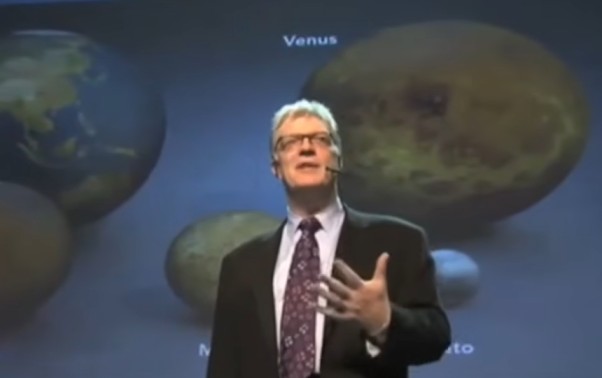
Read the full transcript of British orator Sir Ken Robinson’s keynote lecture at InnoTown 2008 in Stavanger, Norway.
Editor’s Notes: In this captivating keynote, Sir Ken Robinson addresses a “crisis of human resources,” arguing that our industrial-age education systems are systematically stifling the creativity needed to navigate a future shaped by AI and rapid technological change. He explores how the detachment of creativity from intelligence leaves many unaware of their true potential, drawing powerful parallels between the environmental climate crisis and the wasting of human talent. Using humorous stories and data on the decline of divergent thinking, Robinson advocates for a fundamental shift from a factory-style “conformity” model to an “agricultural” approach that focuses on creating the conditions for growth. Ultimately, he challenges the audience to rethink the purpose of education and “aim high” to unlock the extraordinary imaginative power inherent in every human being.
Introduction
SIR KEN ROBINSON: How many of you have got young children? Great. You know, of elementary school age? Okay. How about teenage children? How are you? Okay? I know.
Now keep the lights up, please. I thought that was me then. I thought I had gone out.
But think about this. Children starting school this year will be probably retiring, if you can imagine such a thing, round about 2070. Nobody I know has any idea what the world will look like in 2 years’ time or 5 years’ time or certainly not 10 years’ time. I mean, look at the turmoil that’s happened on Wall Street in the past 2 weeks. That very few people actually predicted, although a lot of people feared it.
Now, I’m saying this because the theme of this conference, business as usual, seems to me to be absolutely appropriate to the challenges that we face. And I think it’s even more appropriate that we have people from so many countries here and from so many different backgrounds and disciplines, because I believe in a way the conference exemplifies the sorts of issues we have to be confronting.
Three Key Ideas
I want to put 3 ideas to you pretty quickly.
The first is that we are caught up in a revolution, and I believe this is a full on, literal, no nonsense, not metaphorical revolution. A revolution in which many of the things that we think are obvious and that we take for granted are not true and will no longer be true, even if they’re true right now. So I hope part of your conversation in the conference will be to discuss what’s really going on. And I believe that part of the changes that we’re facing now have no historical precedent. You really can’t look back to any time in history and say, well, it’s like that all over again. I don’t think it is. I think there are forces at work now for which nobody really is properly prepared. So that’s the first thing.
The second thing is that if we’re to meet this revolution, we have to think differently about our own abilities, about our human abilities, about human resources. And creativity, to me, is the major theme that we need to address. It amazes me how many adults think they’re not creative. And since this conference is about innovation, understanding the nature of creativity seems to me to be fundamental.
A Connection to Liverpool
I wanted to congratulate Stavanger on being the European capital of culture. The other European capital of culture is Liverpool. And I think you have a memorandum of understanding, don’t you, between Stavanger and Liverpool? I am from Liverpool. In fact, I thought I was coming to Liverpool, frankly. Hence, this vague feeling of being disoriented. I’ve been searching this theater all day for members of my family, but they are nowhere to be seen.
But Liverpool is the other city of culture this year. In fact, I’m going to Liverpool shortly. I grew up in Liverpool, which is also a major port. In economic hard times, think, has been for a long time.
I went to school there, and across the street, across the city center, was another school, which is now the school for the performing arts, the Liverpool Institute for Performing Arts. One of the pupils there, a bit older than me, when I was at school, was Paul McCartney. You know who I mean? Paul McCartney of the Beatles, the popular music group.
And I helped to set up the Liverpool Institute for the performing arts to a degree. I helped with their examination systems early on. And because of that, I was given an honorary degree a couple of years ago. So I went back to Liverpool to get this degree from Paul McCartney.
So I was hanging out, chilling, so to speak, for a couple of hours with Paul McCartney. That’s it. Thank you. Thank you very much. Any questions about me and the Beatles generally, really? You know?
Creativity Overlooked in Education
Now Paul McCartney, or Paul, as I call him, was telling me, as we’re chilling, I asked him how he got on at music at school. Did he enjoy music at school? He said he hated it. He hated music at school. He said nobody at school thought he had any musical talent at all. Paul McCartney. His music teacher never spotted anything unusual about Paul McCartney’s musical abilities.
One of the other students in the same music class with him was George Harrison of the Beatles, and the music teacher didn’t spot that either. So this one music teacher had half the Beatles in his class, and he missed it.
Elvis Presley, born in Tupelo in America, was not allowed in the Glee Club at school. They said he would ruin their sound. Elvis. Well, we all know what great heights the Glee Club went on to once they’d managed to keep Elvis out.
John Cleese from Monty Python. Do you know who I mean? He’s got a very funny piece on YouTube at the moment about Sarah Palin, possibly our next president.
But anyway, John Cleese said that he went from kindergarten to Cambridge, and nobody ever thought he had a sense of humor. He does, doesn’t he?
Now I could multiply these examples, but there really isn’t time. The only point I want to make here, at this point, is that some of the most creative people in the world didn’t realize they were during the course of being educated.
But it’s not just about creativity. I think that many, many people never truly discover their talents, especially during the course of education, but sometimes never. I know all kinds of people who have no real sense of what they’re truly capable of achieving, what their real talents are, all kinds of people who go through their lives not really feeling they’re good at anything, just getting on, doing stuff that’s necessary, but not really feeling deeply fulfilled by anything. And I think this is a major problem that education contributes to.
The title I was given for this talk was to talk about education and creativity, not in the sense that education destroys creativity, but the fact it doesn’t help very often. And I believe we have to make it a systematic process now of developing creative capacity because I believe that there is a crisis of human resources.
The Crisis of Natural Resources
Let me just flesh this out a little bit. I spoke at a conference a couple of years ago with Al Gore, or Al. I shall keep dropping names, if that’s alright. I live in Los Angeles, you know, and I’ve been there 7 years.
When I arrived there a few years ago, well, 7, as a matter of fact. Let’s be specific. I was speaking at a conference, the Getty Center, and one of the other speakers was Arnold Schwarzenegger before he became the governor. And I was giving the keynote address at this conference. So I was walking around the platform to begin with, just saying hello to people. And I went over to him, and I said, hello. I’m Ken. And he said, “Hi. I’m Arnold Schwarzenegger,” which seemed to me to be completely redundant. I mean, who else was he going to be? You know? Danny DeVito.
Anyway, I acted surprised for social purposes. I said, “Oh, you’re Arnold Schwarzenegger. So I thought you were Dustin Hoffman. I do apologize.”
He sat on the front row while I was giving this talk, and it’s a bit spooky. I mean, I know he’s not the Terminator, but he looks an awful lot like him, when you do want the talk to go well, when you’ve got the end of days sitting right in front of you.
Anyway, he became governor and now presides over, among other things, the education system of California.
Now, when I say there’s a crisis in human resources, let me illustrate it this way. Al Gore gave the talk at the conference I attended, the talk that became the movie Inconvenient Truth. You know the movie. He’s arguing that there is a major crisis in the way we use the world’s natural resources. There is. I think it’s beyond question.
It infuriates me when people say, “Oh, we don’t know.” We know. I was in Salt Lake City recently, and I was talking to a number of people, and some of them, you know, strongly Republican. I remember this isn’t party political at all. I really don’t think it is. But I remember talking to somebody who was a prominent member of the Republican party there, and he said, I said, “What do you think about climate change?” He said, “No. No. We’re not interested.” He said, “It’s a democratic issue.” I said, “It’s what?” “No. It’s an issue for the democrats.” I said, “So what happens? When the earth dies, what are you going to do?” “I’m sorry. I’m a Republican. Leave me alone.”
“Nothing to do with me. The floods are going to go around my house. I’m a Republican. I’ll have a thing up saying I’m a Republican. Stop.” I mean, it’s ridiculous. But people do still question it. I don’t know how much more evidence they need, but they question it.
But the thing is Al Gore didn’t think of this. Rachel Carson was writing about this in the early 1960s, but she didn’t think of it. Benjamin Franklin was writing about this stuff in the eighteenth century, that there may be long term effects of industrialization. Well, there are, and we’re feeling them.
A group of geologists have recently said that they believe the world is in a new geological age. They call it the Anthropocene. What they mean is that the period up until 10000 years ago, the last and till 1800, that 10000 year period they refer to as the Holocene period, the period since the last ice age. They say there is evidence now that the Earth’s crust and its atmosphere and its oceans have been altered in a geological sense by the activities of human beings, that if a future generation of geologists would come to Earth, they would see the evidence in the carbon record, in the acidification of oceans, the evidence of extinction of species, that it’s undeniable that the planet has changed because of the activities of people. They call it the Anthropocene. I believe it, and we’re dealing with it now. And thankfully, people are waking up to some of the long term implications.
The Crisis of Human Resources
But I think that there is another climate crisis, which is just as important as that one, and it’s related. Now you may say, “Really, I’m fine. One climate crisis is enough. I’m good, really. Leave me with this one.” But I believe this one is as profound. It’s a crisis of human resources.
I believe that we have systematically wasted some of the best talents of our children and of ourselves, and we still do in our communities, and we spend enormous sums of money dealing with the damage, in just the same as we do in the world of natural resources. I believe the analogy is exact.
Now I don’t say education is the whole of it, but it doesn’t help. And it doesn’t help because it’s locked into an old model, the very model of social organization and economic activity that’s given rise to the crisis in natural resources, I mean industrialism, that we have modeled our education systems on the principles and processes and mindsets of industrialism. We see education as an industrial process, and it’s focused on producing certain types of people. And some of those people do very well, but most people don’t. And the byproducts, the social waste that results from this method of educating people is causing massive problems in many of our communities.
I’ll give you an example. Arnold Schwarzenegger presides over a government in California. He’s now the governor. Last year, on the published figures, the state of California spent 3 and a half billion dollars, we’re told, on the state university system. In the same year, they spent nearly 9 billion dollars on the state prison system. Now does that make any kind of sense?
And I mentioned it not just because I live in California, but because you see similar sorts of figures in other places. The problems of social exclusion, of dropout rates, of disaffection, of the use of chemicals to keep people balanced. The rate of suicides among young people has increased throughout this generation, actually since the 1960s. Some people are turning off. Some people are just checking out because, I believe, in part because they don’t find a sense of purpose and meaning. They find their communities often to be estranging, and they don’t, in many cases, find education the liberation it is intended to be.
Now I’m just saying this because I think this crisis of human resources is actual, real, and in every sense of the word, too expensive to tolerate. And I think we have to not change education, but do something different. So that’s my second proposition, that there is a crisis of human resources.
Putting Creativity at the Center
And the third is that if we’re to meet it, we have to do things differently. And in particular, I believe, we have to put creativity at the center of our enterprise.
Now it’s important here because what we’re concerned about in this conference is the whole field of business innovation. But that depends upon people coming through and finding lives that have purpose and meaning too.
I have 2 kids, so far as I know. And my son is 24. He’s about to leave college. He’s going to a totally different world to the one I graduated into. I was born in Liverpool in 1950. Now let me say immediately, I know you don’t believe that. I feel it. You know?
The Myth of the Linear Education Path
I am feeling the incredulity. You’re saying, can this be? You’re saying, he is so boyish. You’re saying, I understand. I understand.
You know? But I live in Los Angeles. You know? I’ve had work done. You know? What can I tell you?
But when I left college in 1972, I had a story in my head that was true, and the story was this. If you worked hard and did well, and got a college degree, you are absolutely guaranteed a job. Isn’t that correct? The idea, until relatively recently, that you would have a college degree but not be able to find a job was ridiculous.
It’s not ridiculous now. A lot of people are graduating from college and going home again to play computer games because the jobs for which they have been training may not be available, or there’s too much competition, but mainly because the world economies are moving in a totally different direction to the ones that those of us who are — how many of you here would think of yourself as baby boomers, by the way? The baby boomers. Come on. It’s more than 2 of us, shall we?
Okay. Alright. Let me put it differently. How many of you here are over the age of 40? Go on. I’m going to let you in on this. How many of you are under 30? Great. Okay. That’s it.
I’m not going to push you any further than that. I know you’re here for a couple of days, and you have an image to give up. But what I’m saying is the central story of education was if you go right through the system and qualify with a college degree, you are set for life. It’s not true. It’s one of the things that we take for granted that is no longer true, and it’s because of the shifts in the world economies.
The Case for Radical Transformation in Education
So what I believe is this, that we have to do something radical with education if we’re to cope with the challenges that we now face. And innovation and creativity should be central themes of the process. Every education system on Earth currently is being reformed, everyone. And it’s happening for 2 reasons. The first of them is economic.
Everybody’s trying to figure out how do we educate our kids to get jobs in these economies that we can’t predict. And I think we all believe that. I mean, we all want that. I mean, anybody who thinks education is not about the economy, I think, isn’t really listening. I mean, we do, don’t we? We all want our children, if they become educated, to become economically independent, don’t we?
I do. I can’t tell you how much I want my children to be economically independent and as soon as possible. But how? Just having a degree is no guarantee, and that’s as far as most people ever get.
A Lesson from USC: Following Your Instincts
My son started USC, which is a private university in California. And I was very struck when we went along to sign him up about 4 years ago. Costs a lot of money, you know, to get to a private university in America. It’s like 60,000 dollars a year, I think. I know. Trust me. I know.
It’s 30,000 dollars roughly for tuition fees. It’s about 10,000 dollars for accommodation, about 10,000 dollars for food and drink, and about 10,000 dollars for drugs. You know, for us, I mean, you know, to keep us balanced and keep us with the program.
But when we got there, one of the tutors we spoke to said — our kids were let off, you know, to have the academic orientation, and the parents were let off for financial counseling. And we spent an hour tearing up checks, you know, till it didn’t hurt anymore, really.
But he said — what this guy said to us — said, “Take some advice from me.” He said, “Now your kids have got to college, leave them alone.” I said, “How do you mean?” We all said. He said, “Let them make their own decisions now. Don’t tell them what courses to take. Let them follow their instincts.”
And I said I thought this was really good advice. He said his son had started USC about 20 years before, something like that, and he was going to take a degree in classics. And he said, “My wife and I were really depressed, you know, because we thought, what kind of a job will he ever get with a classics degree?”
He said, “So we were thrilled when a couple of years later, you know, at the end of the second year, he came home and he said, ‘Dad, mom and dad, I don’t think I’m going to do classics.'” He said, “Okay.” He said, “Why?” He said, “I don’t think it’s very practical.” He said, “We’re really excited. You know?” He said, “I think I’m going to do something more useful.” He said, “What’s that?” He said, “Philosophy.”
He said he tried to explain to him that none of the big philosophy companies were hiring at the moment. You know? International Philosophy, Inc. And he said he did it for a year, but he finally majored in art history.
And he said the result of this was, you know, here he is now, these years later. He’s the senior partner in an international auction house. He makes great money. He travels extensively. He has a wonderful network of friends and professional friends and colleagues, and he’s blissfully happy.
And he’s doing so well because of his knowledge of classical cultures, the intellectual training he got from philosophy, and his passion for art history. He said he’s ideally suited for this job, but he would never have found the job if he hadn’t done those things. He said, “If we’d started out saying, listen, my boy, in his first year, do philosophy, classics, and art history, and maybe an opening will turn up in the field of international auction houses. You know?”
The Factory Model of Education
Now the reason I’m saying this is that one of the ways our education system is out of date is it’s premised on a linear assumption of social planning. One that was never true, by the way. It’s a factory model. You go through the system, you qualify at the end, you go into this job that you are planning for all the time. I don’t think that’s true of most people.
I don’t suppose it’s true of many of you that you’re doing the thing that you thought you’d be doing at the age of 15, if you thought of anything at the age of 15. But it was never a linear process, but that’s the premise of the system.
One of the other premises of the current system is that it’s all about conformity. All the kids doing the same thing, with in many countries, supported by a system of standardized testing. And a third way in which it’s like a factory model is it’s all done according to ages. It still amazes me that we educate people by age group. Why? You know, all the 8 year olds together, all the 9 year olds together, all the 10 year olds together. Why?
It’s like the most important things kids have in common is their date of manufacture. You know? When we all know, if you’ve got kids, they’re all different, and they’re all different at different ages. So in other words, the system is based on conformity and based on linearity and based on standards. In most of our countries, that continues to be the case. And the reason is it’s locked into the industrial mindset.
The Cultural Dimension of Education Reform
Now one reason education is being reformed is economic. The second reason is cultural. Everybody’s trying to figure out how do we educate our kids so they have some sense of cultural identity and yet can be citizens of a globalized cultural world. Most countries are trying to do this.
It’s true all over America. It’s true in Europe. You know, the French — and I’m sure there’s some French people here — are in no rush to stop being French. You know, the Norwegians do not want to stop being Norwegian anytime soon, but we do all want our kids to learn our values, to understand them, where they come from, but also to have sympathy with global cultural values. That’s a hard challenge for education, but it’s an essential one.
Now I believe that the challenge for education is not to reform it, which is what most countries are doing. They’re changing bits and pieces here and there. It’s to transform it into something else. We have to have in hand a transformational process, one which has a different relationship with business, with the cultural sector, and with our communities, but it has to begin with a different conception of human ability. So I just want to flesh this out for a couple of minutes, and then we’re going to open this up for some conversation.
Creativity, Intelligence, and Human Ability
My impression of this is this, that most adults think they’re not creative. And yet all children think they are, don’t they, up to a certain age? Let me define creativity for you as time is short. I define creativity as the process of having original ideas that have value. And I say most adults, in my experience, think they’re not very creative.
So let me ask you this. How creative do you think you are personally? And this is rather important because if you’re interested in innovation, for reasons I want to explain in a minute, being creative is essential. So how creative do you think you are? On a scale of 1 to 10.
Now, where would you put yourself on a scale of 1 to 10? While you’re thinking about that, think about this question. How intelligent are you on a scale of 1 to 10?
Can we put the lights up a bit more, please? No. Is there any nonsense here? Just a bit more if you can. Now I’m going to ask you to put your hands up. You don’t have to. You can say, well, I’m sorry, I’m not going to, frankly. You know, this is Innotown. I didn’t come here to put my hand up. I was — I’m an adult person. You know? Came in here to hang out and hide.
It’s up to you. You don’t have to. You can sit and sulk if you wish. I don’t mind. I probably won’t see you again. I don’t mind. But let me assure you that if you do put your hands up, there are no social consequences, at least not from my point of view. You know? It may be social death for you, but not to me. I mean, what I mean is I’m not going to pull somebody out here and ask you to prove it.
Okay? Oh, 10. You think so? Well, do this. You know? You’re safe in your seats. Okay? It’s just for purposes of conversation. So with that in mind, with that encouragement, would you put your hands up if you’d give yourselves 10 for creativity? And do, if you would. I mean, a room like this, I would hope so. Thank you. Great. Thank you. 9, 8, 7, 6, 5. Come on. 4, 3, 2. Is that a 2 over there? Oh, you’re scratching your head. 2 or 1. I’m not sure yet. Okay. 1. Alright.
Where was the top of that curve, you say? I think so. Yeah. Right. How about intelligence? Now I know a certain social modesty comes into play here, but try and overcome that, would you, for the purpose of conversation. Be as honest as you can. How about 10 for intelligence? Wonderful. Thank you very much. Anybody else? Any other tens? Fantastic. Thank you very much. As intelligent as it’s possible to be. There she is. Fantastic. You cannot be more intelligent than this lady here. So thank you very much.
That’s great. Actually, you can go now if you’re ready. Honestly, we’re just wasting your time, frankly. I think so. Thank you very much. That’s great. Alright. 9. Any nines? 8, 7, 6, 5. Come. 4, 3. It’s getting tense, isn’t it? 2. Okay.
I never do 1, honestly. If you got 1, you’re not following this anyway, are you? I mean, really. You have no idea what we’re talking about here. Arnold Schwarzenegger. Okay.
Where was the top of that curve? 7. Okay. Here’s the question I find really interesting. Put your hands up if you gave yourself different marks. Different marks for both questions. Okay. What percentage of us is that roughly? Just do it again. Put your hands up. What percentage? A bit more, I think. Maybe 40, 50.
Now you may have given yourself the same marks, but for different reasons, so think about that. It’s worth asking, though, why you give yourself different marks, those who do. And often the majority of people do, by the way.
When Creativity and Intelligence Become Detached
The reason I ask is that if you’re interested in innovation, challenging business as usual, innovation depends upon the capacity for creative thinking, the capacity for having original ideas that have value. And the problem is that many people think they’re not very creative. One of the reasons I think is that creativity and intelligence have become detached as ideas.
I know people who think they’re very creative but not very intelligent, very intelligent but not very creative. And it’s because these ideas have become separate, I believe, in our culture, the idea that you can be one or the other.
Now my interest is in making creativity an operational, systematic idea that can be used reliably in schools, companies, and organizations. I mean, everybody has the occasional good idea. That’s not the point. The challenge is to have ideas reliably and systematically, to really develop this capacity. And I think of it as a comparison with literacy. You know, if you asked a room full of people who was literate and only half the room put their hands up, you’d be concerned about it. And you wouldn’t leave it to chance. You wouldn’t say, “Well, that’s too bad, you know, but we can get by with the ones who are.”
The Three Misconceptions About Creativity
Also, if somebody said they weren’t literate, you wouldn’t believe them to be saying they were incapable of it. You’d realize what they’re saying was they’d never learned how. Now I believe the beginning of learning how to be creative is to connect creativity back to intelligence.
There are 3 misconceptions about creativity. The first is it’s about special people.
It is not. In my experience, everybody has profound creative capacities, everybody. It’s in the nature of being a human being.
The second misconception is it’s about special things. It’s not. People think it’s about the arts, for example, or design or architecture. Well, all those things can be very creative. Not always, but they can be. But so too can anything. Some of those brilliantly creative people I know work in the sciences, or they work in mathematics.
Mathematics, Beauty, and Creative Thinking
I used to teach at the university in Britain, Warwick University. And I remember speaking to a senior professor of mathematics there. I was never very good at mathematics at school. It didn’t appeal to me. Actually, the teacher didn’t appeal to me, to be honest.
And my daughter, for a while, suffered the same problem. There was a point in her life when she thought I knew everything. She used to bring home maths homework and give it to me. And when she was in elementary school, this was great, because I could do it effortlessly, like 4 times 4. I was like a math god. I would say, “Kate, 16. Come on.” She would write it down. She thought I was the font of all wisdom.
And then when she was about 12, she brought home a page full of quadratic equations. And I remember the old familiar panic. So at this point, I introduced learning by discovery methods. I said, “Kate, there’s no point me telling you the answer. This is not how we learn. You have to find this out for yourself. I’ll be outside having a margarita. And even when you’ve got the answer, there’s no point showing it to me. This is what teachers are for.”
Anyway, a few weeks later, she brought me home this cartoon strip. It was great. It had 3 frames. It was a father helping a child with homework, a daughter. And in the first frame, he says, “What have you got to do?” And she says, “I’ve got to find the lowest common denominator.” And he said, “Are they still looking for that? They were trying to find that when I was at school.” That’s exactly how I thought.
Anyway, I asked this math professor, “How do you judge a PhD in pure maths?” And he said there were 2 criteria. I got really interested in this because I didn’t like math. So I said, “Well, how long is a PhD in pure math?” I didn’t know. And he said he’d seen one that was 24 pages of math, page after page after page of math with equals at the end.
I said, “Well, how do you assess a PhD in pure math? I mean, presumably, it’s right.” He said, “No. They’re normally right. Normally.” I said, “How do you judge them?” He said, “There are 2 criteria. The first is originality. It’s how creative it is. It has to break new ground conceptually. But the second fascinated me more, in a way.” He said, “It’s aesthetic.” I said, “Why does that matter?” He said, “Well, it’s the beauty of the proof. Among mathematicians, there’s a very strong belief or intuition that mathematics is the purest way we have of understanding the natural world. And since nature is inherently beautiful, there’s a powerful feeling that the more elegant the proof is, the more likely it is to be true. It’s an informal test of truth.”
That’s beautiful, isn’t it? He could have been talking about a sonata or a piece of poetry or a dance. And in a way, he was, because the truth of it is we have different ways of understanding what turn out often to be the same things. But we use different modes of understanding to understand things differently, and sometimes to understand different things.
I mean, if you want to understand quantum mechanics, you need mathematics. You can’t approach the complexities of quantum mechanics with poetry. You need mathematics. It’s the only way to really engage properly with that field. But if you want to tell somebody how much you love them, don’t give them an equation. It’s just a tip, really. “How much do you love me? Here. You work it out.” And give them a calculator. Because we use different ways of understanding the world to understand different sorts of thing. So it’s about everything.
You Can Become More Creative
And the third misconception about creativity is you either are creative or you’re not. And the truth is we can become much more creative by doing certain things. As I say, if somebody said they weren’t literate, you wouldn’t leave it there. What you’d understand them to be saying is they don’t know how to do it, and I think that’s true with creativity and innovation. The reason people say they’re not is because they haven’t understood how to do it.
Now I said to you that most adults think they’re not, and I think that’s kind of borne out by our show of hands here, and most children think they are. Those of you who’ve got young children know that. Young kids are tremendously confident in their own imaginations.
Finding Your Element
So I want to show you something. I came across a study that I find really interesting. Oh, by the way, some of these things I’m saying are in this book, which I wrote myself. This book, by the way, is terrific. You could not do better than buy this book unless you buy this book, which is coming out in January, which I’m really pleased with.
Do you know the expression to be in your element? I got very interested in this, because when I say most people I know don’t know the things they’re really good at, some people do. And I spent a lot of time talking with people who do the thing they love to do. And I realized that this expression of being in your element means 2 things. One of them is that you have a natural aptitude for something, that you know what this thing is, and you can do it.
I, for example, was given a guitar at about the same time that Eric Clapton was given a guitar. It worked out better for him, I feel. He got the hang of it. He understood what he was doing. I was still trying to blow into mine about the time he got his first record out. So having a natural aptitude is important.
One of the people in the book is a guy called Terence Tao who won the Fields Medal for mathematics. He was doing advanced mathematics at the age of 5 and 6 compared to the rest of us. He just knew what this was.
There’s a guy in the book called Bart Conner. Bart Conner, who lives in Oklahoma now, found when he was 6 that he could walk on his hands as easily as he could walk on his feet. He just tripped over one day and started walking on his hands. He said it was easy, as easy as walking on his feet. No use to anybody, but he could just do it. And the result was he became very popular, because at social gatherings, kids love that. And his parents used to encourage him. When conversation failed, they’d say, “Bart, do the hand thing, would you?” And then he found that he could walk up and down stairs doing it just as easily as standing on his feet. He said there didn’t seem any point in it. It was just a little entertainment.
But his mother thought more about it. And when he was 9, she took him to the local gymnasium. And he said, “I still remember the feeling I had when the door opened into this gymnasium. I’d never been in one before like this. It was a mixture to me of Disneyland and Santa’s Grotto. There were trampolines, trapezes, ropes, wall bars.” When I walk into a gymnasium, I need a drink. But Bart has a totally different feeling. He walked in and said, “Leave me here.”
Anyway, he started going regularly. He went every day for 9 years. And 9 years later, when he was 18, he walked onto the mat at the Montreal Olympics representing America in the male gymnastics team. And he became and remains the most decorated male gymnast in American history.
He now lives in Oklahoma City. He’s married to Nadia Comaneci. They run this extraordinary school in Norman in Oklahoma for gymnastics, and they’re both leading figures in the Special Olympic movement. They are wonderful people.
Now this happened mainly because his mother had the insight and the sense to see there’s just something special here and that should be encouraged. He said that she couldn’t have foreseen what my life would become, but she did have the insight to see what was unique about him.
So the book is full of stories of people who found their talent and how they found it, and what it really means if we’re interested in helping other people find theirs. Paul McCartney is in the book, and he talked about the impact it had on him of meeting John Lennon. What would have become of both of them if that hadn’t happened?
The Divergent Thinking Study
This study I mentioned was a study of divergent thinking. Divergent thinking is not the same as creativity or innovation, but it’s a fundamental aspect of every creative process. Divergent thinking is the ability to see lots of possible solutions to a problem, to see many possible answers, not just one. And it often involves thinking in metaphors or thinking visually or thinking analogically, not just logically, not just linear from A to B. It often involves reinterpreting the question.
There are some standardized tests for this stuff, and I’ll give you one basic example. You might be asked something like, “How many uses can you think of for a paper clip?” Averagely, people might think of 10 or 15, all involving paper, probably. People who are good at this might come up with 200, because they might say, “Well, what if it was 200 foot tall and made of rubber? You didn’t say it couldn’t be.” In other words, they don’t accept the question at face value. And a lot of really innovative thinking comes from not accepting the question at face value. It comes from reinterpreting the question and not taking anything for granted. That’s really the key to innovation, not taking anything for granted, not even the question.
So they gave these tests to 1500 people. And on the protocol of the test, if you scored over a certain level, you’d be considered to be a genius at divergent thinking. So my question to you is, what percentage do you think of the 1500 people scored at genius level for divergent thinking?
Oh, you need to know one more thing about them. They were kindergarten children. Ages 3 to 5. What do you think? What percentage? 98 percent. Genius level for divergent thinking.
I love this because what it illustrates is what I’m trying to say. We’re all born with this capacity to think broadly, imaginatively, and to make lots of connections.
What Happens Over Time
What was interesting about this particular study was that it was longitudinal. So they retested the same children 5 years later. These were all on the eastern coast of America, heading down towards the south. I spoke to the authors of the study a few years ago and got some more details, but this is essentially it.
Same kids, 5 years later. You can see a trend, can’t you? They tested them again 5 years later. Oh, by the way, they tested 200000 adults once, just as a control. 2 percent.
I often say to companies, “These are the people you’re hiring.” And it does add up to 100 if you add it to the 3 to 5 year olds.
Now a lot of things have happened to these children during the course of this study. They’ve gotten older. They’ve got hormones kicking in and so on. But one of the most important things that’s happened to them, I’m convinced, is that by now, they’ve become educated. They’ve spent 10 years at school being told there’s one answer, and it’s at the back. And don’t look, because that’s cheating. And don’t talk to anybody else while you’re doing the test, because that’s cheating too. Outside schools, that’s called collaboration. But inside schools, it’s thought to be cheating.
Now let me say immediately, I have spent my life working in education, and I don’t believe this is deliberate. I know wonderful teachers, wonderful school principals, wonderful college lecturers, professors. I don’t think it’s deliberate. People don’t set out to kill creativity. It’s not deliberate, but it is systematic.
The Hierarchy of Education and Its Impact on Creativity
Nonetheless, it’s routine and systematic, and it happens in several ways. One of them is the curricula of our schools — in all of our countries, for the most part — are built on a hierarchy of subjects, where some subjects are thought to be much more important than other ones. And the effect of that is to rule out a whole swathe of children who are attracted to those ways of working. You know what the hierarchy is. At the top are math, sciences, and languages, then the humanities, and then the arts.
And that’s true even here in Norway. You know, the arts are important, but not so much theater and dance, because there’s another hierarchy in the arts. Art and music are normally taught more commonly than theater and dance. I don’t know many school systems anywhere where dance is taught every day routinely to every child in the way we teach them mathematics. Why?
Why? We all love to dance, don’t we? Why isn’t it part of the education system? One reason — let me answer this — is because the system is founded on the interests of the industrial economy. So there’s an idea of utility built right in.
You know what it’s like. People say to you, “Don’t do art, you won’t be an artist. Don’t do music, you won’t be a musician.” So deep in the system, there’s this idea that some subjects are useful and some are useless. And the effect of that is to deny children, I think, access to some of their best talents, whether their interests are in science or art.
This is an argument for everybody.
The False Divide Between Arts and Sciences
The second way in which this happens is we divide these disciplines up, and we think that the arts are totally different from the sciences. They’re really not. One of the people I had on my commission in the UK — I led a whole strategy there that you heard about earlier — was a guy who won the Nobel Prize for chemistry. He also runs a design studio.
And I asked him one day what the difference is between the creative process in science and in art, in the studio and the laboratory. And he said, “There’s no difference whatever. It’s exactly the same process. The outcome is different, but the process is the same.” The closer you get to the arts and sciences, the more alike they are in many respects.
But we’ve built a system of education which divides them and then sets them up into a hierarchy.
Standardized Testing and the Loss of Confidence
The third way it happens is through this process of standardized testing, of only focusing on certain sorts of accomplishment for assessment purposes, mainly through letter grades and things of that sort. I remember talking to a kid years ago who’d done a five-year program in contemporary dance. And I said, “What did you get out of it?” And she said, “I got a B,” because that was the message of the system.
Anyway, you know what I’m talking about here. These things are built in systematically. That’s why I say we have to transform it, because we then get people coming through the system on whom we depend for innovation, but who have lost their confidence in it. And part of the job is to restore it.
The Tonsillectomy Analogy
How many of you here, again, are baby boomers? Just tell me again. Hands up. Alright. Over 40. How many of you have had your tonsils removed?
I don’t suppose you’ve been asked that recently, have you? Doesn’t come up socially, does it, very much, really? “You must be married. Do you have your tonsils?” It doesn’t — I’ve asked people all over the world this recently. People over the age of 40, and especially people over the age of 50, many of them — many of us — have had our tonsils taken out. Is this not the case?
Millions and millions of people in the fifties and sixties — the 1950s and 1960s — had their tonsils removed surgically. When I was a kid, you couldn’t afford to clear your throat in public for fear that somebody would take your tonsils out. If you so much as coughed, you’d be hospitalized. I know people who had their tonsils taken out, not because they had a sore throat, but because one of their siblings did. Parents would say, “Well, look, take ours out at the same time to save coming back.”
Millions of tonsils were removed in the fifties and sixties. What happened to them? We don’t know. It’s a scandal. It’s like Area 51, like one of those Rockwell things.
But my point is not that nobody needed to have their tonsils removed, but that it was routine for a while. These days, some kids will have their tonsils taken out because some people need them taken out — because they’re critically infected. Mainly, it doesn’t happen. It used to be routine. Doctors have thought better of it, and what seemed to be an epidemic is now recognized to be an occasional necessity. This generation of kids, our generation of kids these days, do not suffer from the plague of tonsillectomies.
The ADHD Epidemic
They suffer from this one. This is a map of America, as you can see. I don’t know what the equivalent is at the moment in Europe, and certainly I don’t know about Norway, but it’d be interesting to find out. This, I believe, represents the latest fictional epidemic that’s affecting our children — that they suffer from, that we didn’t — but they don’t suffer from tonsillectomies. They suffer from this one.
This is the alleged incidence in America of attention deficit disorder, of ADHD. Now I don’t mean to say that nobody has ADHD. Doctors believe there is such a thing. There are learned papers written about it. I’m sure there is such a thing, and that some people have it, and they probably need help and support.
What I can’t believe is that it’s an epidemic, that all our kids have got this. I don’t know what the situation is here now, honestly, and I don’t know what the European figures are. But in America, in the mid-1980s, it was estimated that half a million children suffered from ADHD, attention deficit disorder. The current estimate is 8 million. It’s a $3 billion bonanza for the drug companies, drugs like Adderall and Ritalin being handed out to our kids.
Now you can tell right away that this is nonsense. According to this map, the pale areas are where there isn’t much, and the dark areas are where there is more. So according to this map, there isn’t much ADHD in California. I live in Los Angeles. Trust me. People can’t listen for more than a minute in Los Angeles before losing interest. According to this, there isn’t much.
According to this map, people start losing interest roundabout Oklahoma. They completely lose it by the time they get to parts of the deep south. And when they get to Washington, they can’t listen at all, which may well, of course, actually be true.
What this is really showing is a map of prescriptions. And what we’re finding is that many schools’ teachers and parents are administering these drugs because it keeps kids focused on the program, but artificially.
Aesthetic Experience vs. Anesthetic Education
I have a big interest in the arts, and I’ve also mentioned the extent to which in science and mathematics, aesthetic experience is central to creative achievement. An aesthetic experience is one in which you are fully alert and living in the moment, where your senses are alive and you’re resonating with the present, where you’re kind of tingling with the excitement of the moment that you’re experiencing.
The opposite of an aesthetic experience — the opposite of aesthetic — is anesthetic. An anesthetic is where you close your senses down so you don’t feel the discomfort. And I think that’s what we’re doing with our kids. We’re anesthetizing far too many kids to keep them with the program. And the reason they’re not paying attention is because the program, too often, is boring, and their minds are working faster than the program. And this is an important generational shift.
Digital Natives and the Generational Shift
How many of you here today are wearing a wristwatch? Put your hand up. Ask a roomful of teenagers the same question. Kids don’t wear watches, not to the same degree.
When I said that innovation is about challenging what you take for granted, it’s hard to know what you take for granted because you take it for granted. One thing we take for granted is wearing these things. Did you think about that this morning? Was that a decision, putting the watch on? Was it a dilemma? “Shall I? Do I feel the time thing happening? I’ll put it on in case somebody asks me.” You don’t do it. You just put it on.
Kids don’t, and they don’t because for them, the time is everywhere. It’s on their iPhones. It’s on their iPads. It’s on their laptops. It’s everywhere. My daughter, who’s 19, never wears a watch. She can’t see the point of it. She says, “Why would you wear some separate device on your wrist just to tell the time? Like a one-function device. How lame is that?” I said, “No. No. It tells the date.”
This points to a distinction that a chap called Mark Pransky made between digital natives and digital immigrants. What he means is if you’re over 25, you were born before the digital revolution began. And we have learned, most of us, this digital culture secondhand, and we have a kind of passing relationship with it. We’re okay. But our children speak digital. They live in a digital culture. Their mind works at a digital speed. They multitask. They are using these technologies not just for information but to build their social networks, and the latest generation of the Internet isn’t just about passive reception, but active coproduction. This is a new world that they’re creating with the assistance of those who are driving technology forward. And it isn’t over.
The Technological Revolution and Population Growth
This is just what I want to quickly show you. When I said there’s a revolution, there are two big drivers. This is one. This is a brain cell, stylized, and this is a brain cell growing on a silicon chip. I was speaking to somebody recently from one of the main computer companies who said that the most powerful computer on earth at the moment has the processing power of the brain of a grasshopper.
Now I don’t know if that’s true, but it sounds great, doesn’t it? You should trot this out to your next dinner party and then look confident. That’s the key — to say, “Oh, no. No. No. I heard it at a conference. Innotown in Stavanger. The guy was an expert.” I don’t know if it’s true. You’ve got people talking here who know more about these things than I do, who will confirm it one way or the other.
But the point he was making is that even the most powerful computers on earth at the moment are impressive because of the speed at which they do things, not because they think. They just do something very quickly and impressively. But apparently, within a relatively short time, the most powerful computers on earth will have the same processing power as the brain of a six-month-old baby, he was telling me. People differ on how long that will take, but in the not too distant future. And he said, “And that’ll be a big shift.”
I said, “What’s this shift?” He said, “It’ll mean that computers will be capable of learning.” I said, “What does that mean?” He said, “It means they’ll be able to rewrite their own operating systems in the light of their experience.” Well, that’s Skynet, isn’t it? That is Terminator 3 at this point.
Apparently, in the not too distant future, according to people like Ray Kurzweil and others, for $1,000, we should be able to buy a laptop computer — if that’s what they are — with the same processing power as an adult human brain. So how’s that going to feel? You’re feeling pretty good at the moment with your iPhone. But in the not too distant future, maybe in your working lives, you may find yourself sitting in front of a computer, a laptop that’s as intelligent as you are. Not as attractive, not as in demand socially, but as smart as you are. You give this thing an instruction, and it hesitates. It says, “Well, I don’t know. Have you thought this through? I’m not sure you have, honestly.”
The technological innovations are moving faster than ever and becoming more encompassing. This is the other thing that’s going on. The world’s population has doubled in the past 30 years. It went from 1 billion at the beginning of the industrial revolution to 3 billion in 1970, then leapt up to 6 billion between 1970 and 2000, and it’s heading to 9 billion. We’re at about 6.5 billion now.
The dark bit at the bottom is the growth rate in the industrialized economies. So we are losing population while the rest of the world is growing faster than ever. So by the middle of the century, we may have 9 billion people on earth, but predominantly in the emergent economies and predominantly digital natives.
The other thing that’s happening is the world is becoming more and more urbanized — massive conglomerations of humanity in sprawling megacities, more than at any time in history. But they’re not going to be groovy cities like Stavanger, with Starbucks and information booths. They’d be more like this. This is Caracas in Venezuela, part of Caracas, anyway. The name of the architect is not known here, by the way. But Greater Tokyo at the moment, which does not look like this, has a population of 34 million people, which is greater than the entire population of Canada in one place.
So when I say there’s a revolution, there is. It’s huge. It’s gathering force. It’s driven by technology. It’s driven by population growth. Extraordinary demands on the earth’s resources, unprecedented in the whole course of human history.
The Three Parts of Creativity
And I believe to meet it, we have to think differently about every capacity of every person that we educate and that we work with. This will be a demand on human creative innovation like never before. And at the moment, we’re systematically stifling the very thing that we’re going to depend upon. So let me say a quick word about it.
I think if you’re interested in promoting it in education or in your business, it’s a 3 part thing. It’s about developing personal creativity. It’s about understanding how creative groups work, and it’s about knowing the cultural circumstance under which people are most likely to give the of their creative capacity. And I’ve done a lot of work on education systems to show how this might be.
The Scale of the Universe
Let me just quickly show you this. I think this is a great quote. It’s from Bertrand Russell, British philosopher. I pick it not because he’s British. I just happen to like the quote. But it seems to me to be the essential question of Western philosophy. Are we this or are we that? You know, is life meaningless and accidental and random, or is it full of purpose and importance?
I got interested in this first bit, the small and unimportant planet bit. And we know we’re a small planet, but how small are we? Do you know? I mean, it’s hard to get an idea, partly because you get things like this in the Hubble telescope.
This is an area called the Megalanic Cloud. Now we know that light travels that distance in space are measured in light years. Distance like light travels in the air. This is an area of the sky which is hundreds of thousands of light years across. I think it’s 700,000 light years from 1 side to the other. That’s big, isn’t it? I mean, what can you do with that information except go, really? Honestly, what is the cosmos like? You know, look at that. Look at the size of it. Huge. This is far. You know, this is far.
But how big are we in the middle of all this? Well, it’s very hard to know because of the distances involved. So I came across this great set of images on the Internet, which I want to show you very quickly, which I’ve had re-rendered for your pleasure and entertainment, which are an attempt to give a sense of the scale of the earth by taking distance out of the equation.
So what somebody had the brilliant idea of doing was essentially taking the earth out of the sky and putting it on the floor with some other planets. It’s like a team photograph, you know, of the solar system to start with. So here it is. Isn’t that fantastic? There is the earth looking groovy, I think, bigger than Venus.
And there are a couple of things to mention here right away. I mean, 1 of them is, I think, that we are less worried now than we were about being invaded by Martian armies. Don’t you feel? I mean, bring it on, I think. Don’t you? Try if you dare is what we’re feeling. Pluto, by the way, is no longer a planet, and frankly, we can see why now. It’s a boulder.
But pull back a bit more and bring Jupiter in. That’s a bit less encouraging, I feel. Don’t you? Right? Did you realize that’s how big Jupiter was? But how big is the sun compared to the Earth? I mean, is it twice the size of Jupiter, 3 times? Do you know? I didn’t know.
But bring the sun into the picture, and it’s altogether less encouraging. 1 thing I just want to say immediately, by the way — remember Thomas Edison said this — why can’t we derive all the power we need for this dinky little thing from that enormous thing? Why are we burning up the ground beneath our feet to keep the planet moving? You know? It’s a thought.
But keep your eye on the sun as you pull back a bit more. Arcturus is visible in the night sky. Jupiter’s 1 pixel. The earth is gone. And back 1 more to bring in Antares. The sun is about 1 pixel, and Jupiter’s invisible, and the earth has gone. So when you go back here, we are inconceivably, extraordinarily tiny.
That’s how America sees the cosmos. I know because I live there and enjoy living there, but I’m afraid there’s an awful truth in that.
The Power of Human Imagination
Now the first thing to say — and we’re going to stop in just a minute because we need to move on — but I just want to say a couple of quick things. The first is this. When you reflect on those images of the space, the size of the earth, whatever you woke up worrying about this morning, get over it. You know? Make the call, apologize, and move on, frankly. It was probably your fault. Okay?
But the second thing is this. We are, nonetheless, the species that produced Hamlet and the music of Mozart and quantum mechanics and the Internet and 6,000 languages currently spoken on Earth and telecommunications and all the extraordinary convoluted achievements of human culture. I can put it this way. We are able to conceive uniquely of our own insignificance. Other species are not bothered by these images. We are.
Because at the heart of this is this extraordinary human power of imagination and the process that derives from it of creative thinking. I think of creativity as putting your imagination to work and innovation as putting good ideas into practice. We all have this. It’s a natural human power, and it’s what’s taken us from caves to conference halls, from eating carrion to cuisine, and what’s produced all the extraordinary efflorescence of human thought.
And it’s the 1 thing that will take us safely into this future that we can’t predict, and cultivating it systematically in schools, in our businesses, and in our communities, and understanding that we are no longer dealing with business as usual is absolutely a fundamental challenge. It’s the challenge of our generations that we should do this. And understanding the processes and what will make creativity flourish and what will diminish it is, I believe, a matter of now high strategic priority.
From Industrial to Agricultural Models
I believe from the work I’ve done that this is a perfectly feasible proposition. It’s about changing institutions. It’s about changing our social systems out of the old model of industrial education and organization to a new model. Actually, it’s a more ancient model of agriculture.
Human organizations are not like machines, though they’re often represented that way. They are more like organisms. They thrive on feelings and sentience and aspirations and motivation. And like all organisms, they flourish under certain conditions, and they wilt under other ones.
Great leaders, I believe, are not like industrialists. They’re like farmers. Farmers know that you cannot make a plant grow. The plant grows itself. What you do is create the conditions under which it will do that, and it’s the same way in every human system as it is in nature.
The Death Valley Lesson
I live near Death Valley in California, and in 2004, something remarkable happened. It doesn’t normally rain in Death Valley, so nothing much lives there. It rained 7 inches for the first time in 100 years. In the spring of 2005, the whole floor of Death Valley was carpeted with its spring flowers. People came from all over the world to photograph this extraordinary phenomenon.
What it proved was that Death Valley wasn’t dead. It’s dormant. If you create the conditions for growth, the growth will come because it’s sitting there beneath the surface the whole time. And I believe it’s true with human systems too.
Every 1 of us has this extraordinary power for imaginative development and for creative contemplation. And if the conditions are right, we’ll give it. And if they’re wrong, we’ll hold it back and protect ourselves, which is what many people do in schools and many people do in our organizations.
A Hopeful Message
And I believe the challenge of the future is to understand these conditions and to make them available to all of us as humanity. And I believe there’s no less a challenge than that.
So I really want to applaud Stavanger for hosting the conference, for InnerTown for putting together this extraordinary dialogue, to encourage you above all to speak with each other freely about the experiences that you’ve had, but to realize at the heart of this is a hopeful message, that the crises that we face in the human and natural world have been brought about to a degree by our overreaching our own needs.
If we reconsider them and bathe them in the creative possibilities that as human beings we can create, something fresh will come of it. Michelangelo, I think it once was, who said, “the problem for human beings is not that we aim too high and fail, it’s that we aim too low and succeed.” And I believe in all of our lives, and collectively, the time now is to aim high and be sure of success. Thank you very much.
Related Posts
- Transcript: Abdul El-Sayed’s 2019 Commencement Address At The University Of Michigan
- Transcript: The MOU Is Dead! Can a Blockade Save Us? with John Mearsheimer
- Transcript of Sanjeev Sanyal Interview on Education Crisis: ANI Podcast
- David Gibbs: How Intelligence Services Captured Academia & Journalism (Transcript)
- Transcript: Professor Brian Greene Interview on DOAC Podcast