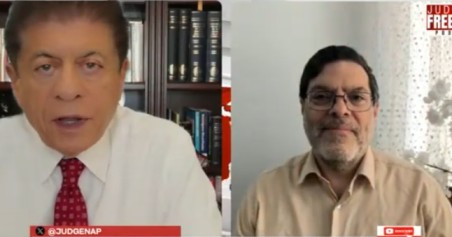
Read the full transcript of Professor Mohammad Marandi’s interview on Judging Freedom Podcast, June 11, 2026.
Editor’s Note: In this episode of Judging Freedom, Judge Andrew Napolitano speaks with Professor Mohammad Marandi from Tehran to discuss the ongoing tensions and recent military exchanges between the U.S. and Iran. The conversation explores the current status of diplomatic negotiations, the influence of the U.S.-Israel relationship, and Iran’s perspective on the regional conflicts in Gaza and Lebanon.
INTRODUCTION
JUDGE ANDREW NAPOLITANO: Hi everyone, Judge Andrew Napolitano here for Judging Freedom. Today is Thursday, June 11th, 2026. My dear friend, Professor Mohammad Marandi, joins us from Tehran. Professor Marandi, a pleasure. Thank you very much for joining us. Can you tell us what the U.S. bombed or attacked in the past 24 hours, and has it affected life in the capital of Iran?
Recent U.S. Attacks and Iran’s Response
PROFESSOR MOHAMMAD MARANDI: Thank you very much for inviting me, Judge. They did bomb areas near the Strait of Hormuz, and they also targeted places near Tehran, in the city of Karaj, which is a very large city that is close to Tehran. The damage was limited. I don’t think it was nearly as extensive as advertised. It was perhaps, they say, there was, I don’t know, 30% bigger in scope than the previous assaults. And the Iranian response was pretty heavy-handed as well.
Nothing has changed, of course. I heard that Western media claimed that there was a deal between Iran and the United States, an MOU, but that’s not true. The Iranians have said that their position on any potential agreement with the United States has not changed, and that Trump, if he wants a deal, he’ll have to accept those terms, which he almost did accept.
The negotiators, which sent messages back and forth, on paper have been acknowledging one thing, yet Trump in his public statements has been saying the opposite. On paper, they have more or less agreed to release Iran’s stolen assets, but Trump says he will not give Iran’s assets. On paper, they have more or less agreed, not in final, there’s no final text, but they more or less agreed to lift the siege. Trump says he’s not going to lift the siege. On paper, they more or less agreed that they would lift the sanctions for the period of the implementation of the agreement. Trump says he’s not going to do that.
So, his negotiators do one thing, he says something else, but until that framework, which both sides in general have agreed upon, until Trump acknowledges and accepts that framework, there won’t be a deal.
The State of Negotiations
JUDGE ANDREW NAPOLITANO: Are negotiations going on either as we speak or in general these days, and if so, does it consist in passing messages through the Pakistanis, or does it consist in anything else? It certainly doesn’t consist of what you observed when everybody was physically together in Islamabad.
PROFESSOR MOHAMMAD MARANDI: No, they’re not — their negotiations — all the messages go through Pakistan. I don’t think the Pakistanis really have a significant role to play because everything is written down. But recently, the Iranians have not responded because of the constant violations of the so-called ceasefire by the Americans over the past few weeks. They’ve been constantly bombing and raiding, and also because of the ongoing genocidal attacks in Lebanon.
So the Iranians have said that the Americans know their position. Their position is what was negotiated a few weeks ago, and it’s been discussed on your show by multiple guests. It’s nothing new that, as I said, the lifting of sanctions for the period of the deal, the releasing of Iranian stolen assets, a ceasefire in Lebanon and in Gaza, and an end to the war, and also the lifting of the siege. And Iran in return would allow and facilitate trade to normalize through the Strait of Hormuz. And also Iran would state that it does not pursue a nuclear weapon, which is something that Iran has always been saying. These, if I recall them all correctly, this is basically the framework, right?
Trump’s Bombing Strategy and Its Miscalculations
JUDGE ANDREW NAPOLITANO: Right. But Trump and his Secretary of Defense, who calls himself the Secretary of War, Pete Hegseth, are of the view that the resumption of bombing will affect Iran’s negotiating posture. Doesn’t that just manifest an abject ignorance of the way the Iranians think and the way the government operates?
PROFESSOR MOHAMMAD MARANDI: Yes, and it makes Iranians think that the United States is increasingly similar to the Israeli regime and that all it likes to do is just bomb and kill. And so you sort of see that the two look more like one another, sort of like the end of Animal Farm.
JUDGE ANDREW NAPOLITANO: Oh my God, you took the thought right out of my head. “And I looked from man to pig and pig to man and could hardly tell the difference.” I think that’s the way Animal Farm ends. That’s right. Yes, yes.
Has Iran altered its military strategy so as to become offensive preemptively and so as to respond with greater force than that which was visited upon it?
Iran’s Military Strategy and the Strait of Hormuz
PROFESSOR MOHAMMAD MARANDI: That’s a difficult question. In general, in order to initiate a war, the Iranians would never do that, and they would never start a war, and that goes against their religious principles. We are in war as we speak. The war has not ended. It’s over, well over 3 months. But I think the Iranians prefer not to initiate conflict. And every time it’s been the Americans who’ve broken the ceasefire.
In the case of this helicopter, the helicopter was in the Strait of Hormuz, which is, as you know, not international waters. It’s waters between Iran and Oman, and it’s not wide enough to be international waters.
But there are lots of drones.
JUDGE ANDREW NAPOLITANO: It’s Iranian waters even under U.S. law. The line goes out 12.5 miles halfway into the strait, covering —
PROFESSOR MOHAMMAD MARANDI: That’s right —
JUDGE ANDREW NAPOLITANO: — the groove through which these ships have to go. Sorry for interrupting.
PROFESSOR MOHAMMAD MARANDI: Go ahead, please. No, exactly. So the helicopter was in Iranian territorial waters. And because the ships can’t go from this side. And the helicopter, if it hit a drone, there are lots of Iranian drones monitoring the Strait of Hormuz day and night. They don’t have people rowing boats in the middle of the strait. They have drones to make sure everything is going as expected. So if a helicopter hit a drone, that is not the fault of the Iranian pilots. It could just be as much the fault of the American pilot.
But in any case, the Americans have constantly been very open about violating the ceasefire. They’ve been attacking Iran time after time. They murdered people, they killed sailors — well, just this morning, they struck a privately-owned ship, a container ship moving goods from Oman to Iran. And shamelessly, they struck an Indian tanker. And yesterday, I think they also struck another Indian tanker. So the United States is constantly killing and destroying and attacking. And then a helicopter, I don’t know whether it was mechanical or whether it had a drone, but it goes down, and then they want to launch a war against Iran, which is in its own home. Wow.
Who Controls Whom: Netanyahu and Trump
JUDGE ANDREW NAPOLITANO: Does the Iranian government believe that Trump controls Netanyahu or that Netanyahu controls Trump? I’ve been asking this all week, but now I’m not asking you, as brilliant as you are. I’m asking you to tell me what you think the government of your country believes.
PROFESSOR MOHAMMAD MARANDI: I think they believe that the Zionist lobby is the real entity that’s in charge and that it probably has differing factions, but ultimately that gives Netanyahu the upper hand and thus he is more powerful than Trump because they are behind him.
But also I think, and I may be wrong, but I believe that maybe part of the ruling elites in the United States, those who are really in control, the Israeli firsters — maybe they are coming to believe that Netanyahu is harming their interests. Because what Axios put out about Trump attacking Netanyahu, I think it says less about Trump than about the people who planted that story or who revealed that conversation, because that did hurt Netanyahu.
There have been many instances where Axios, which has no credibility, has lied and has pretended that Biden was against the genocide, which was fake, or where last year, because we’re on the anniversary of the 12-day war, that Trump didn’t want to attack Iran and Netanyahu did, and then they attacked. All that was fake. But in this case, the language was such that Netanyahu was hurt — well, not at home, it’s Palestine — but in the Hebrew media, they were attacking him, his opponents and even his political allies. I think it did hurt Netanyahu, or at least it was intended to hurt him.
But I do think that the United States and the Israeli regime are still very tight, very close, and I don’t think that Trump will do anything against Israeli regime interests.
Iran’s Conditions for Any Agreement
JUDGE ANDREW NAPOLITANO: Will the Iranian government — and I asked you this the last time we spoke. I don’t imagine your answer will be any different, but I’ll ask it again because of the heat visited on Netanyahu in the Hebrew press when he paused, just for about 24 hours, the slaughter in Lebanon. Will the Iranian government refrain from any meaningful agreement with the United States that fails to restrain Israel in Lebanon and elsewhere?
PROFESSOR MOHAMMAD MARANDI: No, this is just out of the question. The war in Lebanon has to stop and the ceasefire in Gaza has to be implemented as it was agreed upon. Of course, Iran is not in favor of the ceasefire that Trump imposed, but unfortunately, people like Erdoğan and Abdullah in Jordan and Sisi and the Prime Minister of Pakistan, I believe, and many others went to Egypt and endorsed Trump’s fake ceasefire and whitewashed his crimes.
So it’s difficult for Iran to do much for Gaza, but it wants to at least force the United States to force the Israeli regime to stop killing people. And to go back to the yellow line that was designated, because the Israeli regime is moving forward, and now they have plans to move even further and take 70% of Gaza, even though Trump’s ceasefire doesn’t allow that, but Trump doesn’t care. So, the Iranians feel obliged that they either have to stand up for the Palestinians and now the Lebanese, or that the West and regional countries will allow them to be exterminated.
Netanyahu’s Political Survival and the Calculation in Tehran
JUDGE ANDREW NAPOLITANO: Do the Iranians believe that Trump can actually restrain Netanyahu? I mean, if Netanyahu were — this is my view, you correct me if you see it differently — were to stop the invasion of Lebanon, the fanatical members of his government would leave. He’d be in a minority in the Knesset. His government would collapse. He’d have to run for reelection. He’d probably lose. Then he’s back in the dock as a criminal defendant in a case where the evidence against him is overwhelming. We all know this sort of domino effect that is likely to happen. Is he free, Netanyahu, to stop the killing in Lebanon? Or does he have no choice in order to stay in office and even out of jail?
PROFESSOR MOHAMMAD MARANDI: I think obviously Netanyahu will do anything to stay in office, and that’s why we’ve had almost 3 years of genocide, because he needs crisis after crisis after crisis to stay in power. And that’s why I think maybe some people in the United States, Zionists themselves, may be trying to weaken Netanyahu so that he would lose the election, and then someone from the opposition comes to power who’s just as genocidal, but they could sort of whitewash him and give the regime a facelift, and then show the prime minister with the cat in his hand or something and make him look more human, and then move on.
But I think the calculation in Tehran, Judge, is that the Iranians, through this siege, this Strait of Hormuz siege that we see is ongoing, want to build the pressure on Trump and his entourage to such a degree that they have to make a decision ultimately — whether they like it or not — to do something that is America First, and that is prioritize U.S. interests over Israeli interests. In order to prevent a global economic depression, or to prevent the economy from going off a cliff, that Trump would ultimately agree to a deal which is in the interest of the United States, rather than to continue pursuing the interests of the Israeli regime.
In other words, I think the Iranians want to inflict more and more pain on the United States, while Iran is also taking hits, and it’s also feeling pain, but it wants to increase the pain to such a degree that the White House finally says, “Here, we have to put aside our Israeli-first views and take America’s interests first and sign a decent deal.”
Why Iran Is Willing to Risk War Over Lebanon
JUDGE ANDREW NAPOLITANO: Why is Iran willing to risk war over the issue of Lebanon? Why is it willing to risk the killing of its people and destruction of its infrastructure and damage to its capital over Lebanon?
Iran’s Resilience and the Limits of US Military Power
PROFESSOR MOHAMMAD MARANDI: There are so many things I could say, Judge, and there’s not enough time. But the feelings for Gaza, the feelings for Palestinians in Iran have always been very sincere. Even though regimes in our region, the Arab regimes who’ve never done anything for Palestine, they’ve spent billions, many tens of billions of dollars over the decades. Trying to even turn Palestinians against Iran, say that they’ll help put out disinformation, slander Shia, say they’re non-Muslims, they’re evil, they hate you, they’re your enemies.
But Iran, despite all that, has always had a very— they’ve had very sincere feelings for the Palestinian people, even though at times it wasn’t necessarily a two-way affair for everyone. They can’t bear to see the genocide. It’s just, they can’t tolerate this. And it’s a sense of humanity.
And now the Lebanese, they are perhaps the great heroes of this whole 3 years because they have sacrificed their community because they wanted to stop the genocide in Gaza. They started fighting the Israelis on the border to draw away forces, Israeli forces, so that they would overrun Gaza and just wipe it out and to give the Palestinians in Gaza a chance, knowing that they would be targeted and bombed and slaughtered as we’re seeing today.
So, I think that morally, the Iranians feel that they have an obligation. But also, Judge, these are allies of Iran, and even if you don’t look at it from a moral and human perspective, or an ideological perspective, you need allies in this struggle against the empire. And the empire is ruthless, it’s powerful, and it has many proxies.
The entire region was collaborating against Iran, even the Republic of Azerbaijan. Even Türkiye is transporting oil to Israel, and U.S. bases there are being used against Iran, Jordan, the countries in the Persian Gulf. So when you have this huge force, and the Europeans that are against you, then these allies become more precious.
Can the US Achieve Its Goals Through Military Force?
JUDGE ANDREW NAPOLITANO: Can the US achieve its goals through military force?
PROFESSOR MOHAMMAD MARANDI: No, not with the forces that they have today, not with the capabilities that the United States has today. It’s not possible. Maybe if the United States had attacked Iran instead of Iraq after 9/11, we would have very different circumstances. I still think that they would have— the United States would not have succeeded, but Iran is simply too steadfast, too powerful, too determined.
They’re— it’s a country with thousands of years of civilization. The religious ideology, Shia Islam, makes them particularly resilient and resistant and steadfast against an oppressor. Oppression is— and defending the oppressed is something very important in Iranian religious culture.
So no, I don’t think that the United States has a chance in defeating Iran, and it’s in the interest of the United States to come to terms with Iran. And I talked about this on your show, and I’m sorry for repeating this, but there were people in the United States who were in power that were saying that the United States has to move towards rapprochement with Iran, and it’s in the interest.
And that book that I mentioned, Going to Tehran by the Leveretts, when they were talking to people of influence, and they were saying that if we don’t come to terms with Iran, first of all, Iran is not what you’re being told it is or what you’re saying it is, but if you don’t come to terms with Iran, ultimately, it’s going to lead to war and crisis. And this is where we are today.
And this is, of course, what the Zionists want, but the American people don’t need. But the American people have been so— their anti-Iranian views have been so entrenched, that it’s easy to persuade at least a segment of American society that we deserve being bombed.
Closing Remarks
JUDGE ANDREW NAPOLITANO: Wow. Professor Mohammad Marandi, a pleasure, my dear man. Stay well and safe. Thank you very much for these weekly visits. They are so profoundly informative and first-person and uniquely first-person, and we deeply appreciate them. Be well, Mohammed. We’ll look forward to seeing you next week.
PROFESSOR MOHAMMAD MARANDI: Thank you, Judge. It’s always an honor being on your show, and God be with you.
JUDGE ANDREW NAPOLITANO: Thank you. A full day coming up for you at 9 o’clock this morning, Joe Kent. Yes, that Joe Kent. At 10:30 this morning, the former British diplomat Ian Proud. At 2 o’clock this afternoon, Colonel Lawrence Wilkerson. At 2:30 this afternoon, the golden boy Max Blumenthal. At 3 o’clock, Colonel Douglas MacGregor. Justin Paul Tanner for Judging Freedom.
Related Posts