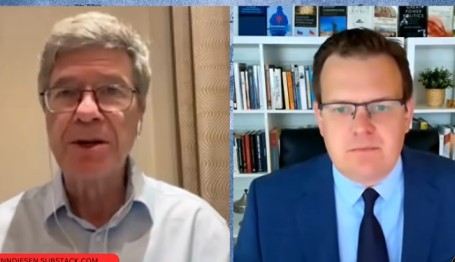
Read the full transcript of Professor Jeffrey Sachs’ interview on Greater Eurasia Podcast, July 20, 2026.
Editor’s Note: In this interview with Glenn Diesen, prominent economist Professor Jeffrey Sachs discusses the dangerous escalation of global conflicts, framing them as part of a long-standing U.S. strategy for Eurasian primacy. Sachs argues that despite changing presidential administrations, Washington’s core objective to weaken geopolitical rivals like Russia, Iran, and China remains unchanged. He also highlights how Silicon Valley and the military-industrial complex profit from utilizing modern AI-driven warfare on these battlefronts. Finally, he expresses hope that public dissatisfaction with these unending conflicts will eventually force a shift toward realism and peace.
Introduction
GLENN DIESEN: Welcome back. We have the great privilege of being joined today by Professor Jeffrey Sachs. So thank you for coming back on the program.
We’re observing a, I would say, a deeply troubling development now. That is, in Europe, there is a massive escalation and increase in the brutality of the NATO-Russia proxy war in Ukraine. In the Middle East, we’re also seeing a massive escalation, but also a widening of the war as it pulls in more states.
We could already have entered our Third World War, and you would think that diplomats would be working overtime to put an end to this, but they seem to be throwing more fuel at the flames. Forget about negotiations, we don’t even have diplomacy. So again, it seems predictable, the kind of disaster we’re heading towards. I was wondering, how are you reading this situation?
The U.S. War Strategy Behind the Diplomacy Facade
JEFFREY SACHS: Well, I’m reading it as indeed disaster. Everybody loves war. Nobody’s interested in peace.
I think one of the things that I’ve learned and that we’ve learned in some of the writing and disclosures of the last few weeks is that even during what was purportedly a period of diplomacy in 2025 and Trump II’s first year of the second term, beneath the surface, the CIA, Palantir, Trump were actively promoting a massive scaling up of the drone warfare, the targeting of places and sensitive infrastructure deep inside Russia.
Trump, in other words, for all of the talk about ending the war with the phone call or even the summit in Anchorage last year, behind the scenes never really deviated from the war strategy. And I think that that’s actually the point. For a while, it looked like that there was a serious divergence between the US and Europe on this question. But I think that that divergence really was greatly exaggerated.
If we look beneath the surface, maybe that was apparent all along. For me, it wasn’t so apparent because I met negotiators from both sides, and I thought that there was some negotiation being attempted by the United States. But we now know categorically that at the very time that these negotiations were supposedly taking place, Trump was giving the green light and the CIA was calling for greater freedom for providing intelligence for targeting and a greater scaling up of missile strikes and drone strikes inside Russia.
Palantir and the AI-Enabled War Machine
What’s also quite clear is an enterprise that really is very particular for our time, Palantir. It is at the core of the US war machine. And if you watch the head, the very visible CEO of Palantir, Alex Karp, he’s a blatant, very strange warmonger who thinks that he’s defending all of Western civilization and that it’s just necessary to kill lots of people using AI and using the Maven system, which is the Pentagon’s AI-enabled system run by Palantir.
And Palantir is all over Ukraine. Palantir is the big buddy of the Defense Minister, Fedorov, who was just seemingly fired by Zelensky, though everything happening in Ukraine remains opaque and uncertain. But Palantir has been all over this drone war. And Karp himself proclaimed that Palantir is choosing most of the targets that Ukraine is making.
So this is really a US war in which the Ukrainians die and Ukrainian territory gets burned up, but it’s really been a US-orchestrated war all along, and Trump didn’t really change any of it.
35 Years of U.S. Strategy to Defeat Russia
So we’re in a kind of madhouse that has been going on, by my estimate, for 35 years. Ever since 1991, the CIA has been out to defeat Russia. It’s been out to divide Russia. It’s been out to bring Russia to its knees. It’s all been spelled out if you look to the right places.
My favorite palimpsest for this is Brzezinski’s 1997 highly didactic tome, The Grand Chessboard, which is subtitled American Primacy in Eurasia, a strategy for primacy. And the whole point of Brzezinski’s text, but the whole point of American foreign policy, has been defeat Russia. And nothing has changed on that. It remains true.
Now, several things can be said about this. One is that the way that war is conducted now from an American point of view, and basically from a European point of view, is essentially costless for the politicians. Of course, unlike most of human history, our leaders don’t lead their armies into battle. They’re very safe and far away. So for them, war is a video game. Trump talks about bombing as a slap to the other person. It’s all great fun.
It’s not paid for by taxation, it’s paid for by debt. So basically you can run up the debt till you wreck the economy, which is what the US and Europe are doing, but you don’t have to pay for it by justifying it.
Secrecy, Unaccountability, and the Role of the CIA
So in the short term for these politicians, war is favored by their intelligence agencies. The CIA, I do believe, is really at the core of most of American foreign policy because it’s convenient, it’s secret, it’s deniable. You don’t have to explain anything to the public.
We didn’t really know that Trump was giving green lights to targeting deep inside of Russia at the same moment that he was talking about diplomacy to end the war and how important it was for peace and so forth.
So secrecy is a big part of the game. They call it a game, by the way. It’s not a game. It’s a disaster that can lead to a World War I destruction of civilization or to nuclear war and the end of civilization. But for them, it’s not a risk. It’s unaccountable. It’s mostly done in secret. It’s done on debt. And so from the US point of view, this can go on a long time.
And then you have the particular lobbies that want this to continue. And lobby number one, of course, is the military-industrial complex itself. And probably the biggest lobbyist for war right now is Silicon Valley — the lead being Palantir, SpaceX, and others — because they’re testing their weapon systems in real time, in real battlefield conditions. Rapid advances, turnover of generations of technology, all in weeks or months. What could be better?
And Alex Karp tells us this, how wonderful the advances of killing Palestinians in Gaza, in targeting sites of infrastructure destruction in Iran, of hitting deep inside Russia. This is all the Pentagon Maven system, and think how much it’s been improved, quote unquote, in recent months.
The Public Wants Peace, But No One Is Asking Them
So all of this is to say, Glenn, there’s no real check on this. In Ukraine itself, recent Gallup polls and other polls show an overwhelming proportion of Ukrainians want the war to stop, and even with concessions, but no one asks them. No one asks Americans. No one asks Europeans.
If you look at the approval ratings of these politicians, or what the public say about war and peace, the public say these politicians are awful. They don’t represent us. Merz, Macron. Well, Starmer is gone, but his last act was to go to Kyiv again because for him the war was the biggest thing of his prime ministership, no doubt because MI6 told him so.
So the public doesn’t like this. The public wants the war to stop. The public doesn’t like these politicians. But it doesn’t matter. It’s so easy for the CIA and others to continue all this great fun and how exciting it is that we’re developing a new generation of AI-enabled weaponry and the Ukraine war is enabling us to do it.
Brzezinski’s Grand Chessboard: Ukraine, Iran, and Geopolitical Pivots
That is my take on this, which is very little constraint and a very deep program that goes back 35 years that was spelled out explicitly in the 1990s how it was going to work.
And I would just add one more point that I’d like people to be aware of and to deepen the discussion about. Brzezinski, in The Grand Chessboard, explains the aim is American primacy. The threats are the big powers, Russia and China. The solution is to weaken or defeat them or replace their regimes one way or another. The way to do that, in part, is by what Brzezinski called geopolitical pivot states. And a geopolitical pivot is a place, as Brzezinski explains, that doesn’t matter to Americans except that it’s useful leverage against the big powers.
And Ukraine is number one on Brzezinski’s list. Brzezinski spelled out in 1997, “We will take Ukraine, and thereby Russia will no longer be a major power.” So geopolitical pivot number one is we will take Ukraine. Well, the idea was spelled out decades ago. They keep trying, and millions of people are killed and wounded in the process. Ukraine is destroyed as a state in the process. Doesn’t matter. Easy to keep fighting. And how exciting now that we can fight with the Maven system. We can improve our AI capabilities. We can have a major initiative on advanced drone technologies and all the rest. It’s just wonderful.
So the geopolitical pivots remain. What was number two on Brzezinski’s list in 1997? Iran. Well, lo and behold, Iran, he explained, that’s the pivot for the Gulf region, for the Mideast energy resources, and for the Caspian Sea region. Control Iran, you control all of that.
A Bipartisan Perpetual War: From Clinton to Trump
So all of this is deeply seated. Little of it has to do with Trump, actually. He does express the venality and the corruption of all of it perfectly. He channels the greed, the corruption, the violence. But it’s not really him because this is how it was with Biden, and it’s how it was with Trump I when he helped Ukraine to build its million-person army. And that’s how it was with Obama, with the many wars that Obama prosecuted and with the coup in Ukraine in 2014. And it’s how it was with Bush I, and it’s how it was with Bill Clinton, who started this whole process when the Soviet Union ended.
Clinton was the president beginning in 1993 that set the path that our goal is now primacy. Actually, the idea was even at the end of the Bush Senior presidency in the 1992 strategy of the Pentagon, written by Wolfowitz, but it was Clinton that set us on the way.
So to my mind, Clinton, Bush Jr., Obama, Trump 1, Biden, Trump 2 — it’s been pretty much all the same perpetual war. Always a good reason to continue. Never give up. Why give up? No real constraints. Someday we’ll win, and in the meantime, you don’t have to count the dead. It’s somebody else’s dead.
The Wolfowitz Doctrine and the Roots of U.S. Hegemony
GLENN DIESEN: It’s kind of incredible that only a few weeks after the collapse of the Soviet Union, you had the Wolfowitz Doctrine essentially outlining the policies of today, that is, perpetuate global primacy by knocking out Eurasian rivals. I thought that was interesting, the Wolfowitz Doctrine, simply because it also identified countries like Japan and Germany as possible threats to US hegemony. This is again weeks after the Soviet Union was gone.
The Collapse of American Primacy and the Eurasian Alliance
JEFFREY SACHS: And what’s so interesting, I was quite deeply involved in those days on the economic issues of what was a state of collapse, a financial crisis, a systems change and transformation, and everything signaled in the brightest possible blinking lights, we can have peace now. We can achieve generations of peace because the Russians want peace. They want normalcy. Everyone wants peace, time to build.
And I put forward specific proposals, help the Russian economy, help them to stabilize financially and so forth, all of which were rejected by the US government because the US government didn’t want peace. It wanted primacy. It didn’t want Russia to get back on its feet. The opposite.
And Brzezinski said it. “Maybe Russia will break apart into 3 different weak states, a European Russia, a Siberian Russia, and a Far East Russia,” he said, “and there’ll be a loose confederation.” What a great vision, but it was all in the service of American primacy.
And we just had Rutte, this fool, who purports to somehow represent the security of the West but is a complete disaster. But he says, yes, what is NATO? NATO is in the service of American power projection. Yes, well, that’s true. That’s literally true. So he at least said it right. It’s not about security. It’s about power projection.
And the American idea has not changed to this moment, which is that America works for primacy. And primacy says it’s not good enough to be safe. It’s not good enough to have security. It’s not good enough to have prosperity. You have to dominate. And the rest of the world doesn’t want to be dominated this way. And Russia doesn’t want to be dominated by the United States. And China certainly doesn’t want to be dominated by the United States. And Iran doesn’t want to be dominated by the United States.
Brzezinski’s Fatal Miscalculation
And what Brzezinski got completely wrong, totally wrong — he’s a very clever person and a very influential person. And his book was not only putting his own views, he was explaining the Washington point of view. After all, it was a textbook for his students explaining how Washington thinks about these problems.
But his point, which is the single biggest mistake of all, he said America will succeed in primacy because it’s basically unchallenged economically and technologically, and no one can come close to it. And that is simply false. And it was falsified over the next 30 years, especially but not only by the rise of China.
And what the United States got completely wrong about Iran and continues to get wrong is that it thought Iran is some medieval — not empire, I’m trying to think of the right word — some medieval failed state that will crumble when American military technology hits them. And Iran, of course, is quite the opposite. It is a highly technologically sophisticated state that has worked for decades now to prepare a defense against American war on Iran. And the results are there for all to see. But it doesn’t stop the American war machine.
The Primacy Bubble
And I think that there’s another point, Glenn, that’s probably quite obvious to everybody. But if you’re running this primacy strategy, then part of your game is creating the primacy bubble. You have to have everyone, to the extent possible, believe that you are the unchallenged power. Even the Athenian generals explained this to the Melians in the famous dialogue, that they couldn’t let Milos be neutral because that would show weakness by the Athenians towards others within the Athenian camp.
Well, the Americans cannot admit defeat. They can’t. Defeat only is admitted in very strange circumstances. Usually, for example, the Vietnam War ended after Nixon resigned. That’s what enabled it to finally end because the next president, Ford, said, okay, we’re basically closing shop. It wasn’t his.
Trump had that opportunity to end this debacle in Ukraine. That’s why some of us thought that he would actually try to do so, but he’s too weak, too inconsequential, too ignorant, and basically too beholden to the Palantirs of the world to do any such thing. And so already at the same moment that he was talking about negotiations, he was following the CIA playbook.
But my point is something slightly different, which is that America cannot admit any kind of setback or defeat. So it has to constantly proclaim, “We’re winning, we’re winning, we’re winning.” Not that I could care less, but if they actually were shown, “No, Iran held you to a draw after a lot of blood and destruction” — yes, that would weaken America’s further pretensions of primacy in other places. I say bravo. The whole idea is crazy, but from the advocates of primacy, it’s a disaster.
So as long as they can have budget deficits, as long as they can do their operations with as much deniability and no accountability to Congress or to public opinion, they’re going to continue to do it. And that’s basically where we are. And when the Democrats win part of Congress in November, it may not change anything because this isn’t really at all a partisan issue. This is a Washington mindset and debacle that’s gone on with both parties for the last 6 presidents.
GLENN DIESEN: Well, with Brzezinski, because geopolitics is about territory and he made it very clear that Eurasia is where most of the territory, the population, the resources is located. So you would have then 3 frontlines. You would have the western parts of Eurasia, which would be Russia, the east, which would be China, and the south, which would be Iran. Those are the 3 main countries you have to defeat. These are the main 3 countries the US happens to be in conflict with.
But towards this end, the frontline states have a very specific purpose. As you said, some can be disposable. And of course, if you’re fighting Iranians, you would traditionally be using Iraqis or Kurds. Similarly, if you’re going to fight Russia, use Ukrainians, or in East Asia, of course, the US also has its proxies.
But as Ukraine is essentially bleeding out, it begs the question whether or not the Europeans will be thrown into the fight. Because this is called the global primacy. For Brzezinski, he said it rested on 3 pillars. That was to maintain security dependence among the vassals — that would be the Europeans and all its frontline states — keep tributaries protected and keep the barbarians from coming together. That would be America’s adversaries.
But the whole point here would be America seems to have gone all in because if it fails to defeat these countries, it essentially pushed the Russians, Iranians, and Chinese closer together. So it seems like an all-or-nothing moment, which is always dangerous because countries will be willing to take huge risks.
How do you see this playing out? I mean, of course, we don’t have a crystal ball, but do you think — just a last question — do you think the United States will be willing to throw the Europeans into this as well? Because a lot of the fake diplomacy of Trump appears to have simply been outsourcing the war to the Europeans. I mean, if you see how much more hawkish the Europeans have become since Trump took over, it would be a reasonable hypothesis.
The Natural Complementarity of Eurasia
JEFFREY SACHS: Yeah, so it’s interesting. Brzezinski again spelled everything out very clearly. Exactly as you said, it’s Russia, Iran, and China as the 3 potential blockages to American primacy in Eurasia. And then all of these geopolitical pivots around each of them, so that they can be somehow brought down with regime change or crippled or defeated in war if it happens to be.
And I mentioned one of the big mistakes that Brzezinski made, a fundamental flaw of the whole analysis. He said Russia will never be able to resist this because American technological dominance is so secure, unchallenged. So ultimately, Brzezinski thought American power — not soft power, not propaganda power, not the info wars or narrative power — but the fundamentals of industrial production and technology in the end will dominate. And that we know is not true.
But the second point that he made was the big risk is that China, Russia, and Iran will get together. And then he says in 1997, “No American will let that happen. No American strategy would be so stupid as to push Russia, China, and Iran together.” And of course, that’s exactly what America has done.
I think it’s deeper than just a tactical response of the 3 of them facing this American hubris. I actually think that the fit in Eurasia is a very good fit. China and Russia have a natural economic complementarity. By the way, just like Europe and Russia have a natural economic complementarity. Europe is resource poor and highly densely populated. Russia is low population density and resource rich, and that means a great complementarity to put the two together. Europe could have thrived on that basis. Europe has cut itself off exactly from that.
So the same complementarity applies with Russia and China, and that relationship is not going away. It’s not just a tactical relationship. It is a deep, mutually beneficial economic relationship. And the same is true with Iran and China. And the alliance of the 3 therefore makes very big sense.
And then even more than that, if you look at Eurasia east of that line, basically from the longitudes of the Middle East all the way to the Pacific — with a bit of complexity, not for this talk, but maybe for another one about India and its place in the global geopolitics — all the rest will coalesce into an economic unity of Eurasia that makes a lot of sense.
Europe’s Geopolitical Corner
And Europe will find itself out on the far western periphery, cut off from its natural trading partners, Russia and China, because it’s cut itself off, and finding that the United States ain’t no friend. And that’s what Europe doesn’t understand also, that Europe has put itself so squarely into a corner. It’s geographically in a kind of corner, but it put itself geopolitically into a corner by its naïveté and kind of corrupt vassalage to the United States. And if the Europeans would read Brzezinski, they would see that they were already regarded as vassals back 30 years ago. And they have become even more so today.
So where is it all heading? The biggest hope is that the publics of the US and Europe are sick of this. It’s not their game. It’s not to their advantage. Our societies are hurting. They’re divided. There are so many problems. Our infrastructure doesn’t work in the United States. It’s failing even in Europe where it was always kept to a higher standard. But now apparently — I haven’t ridden on German rail recently, but people are telling me that it’s unimaginable what is happening right now to even basic services in the European side — as these fools like Merz proclaimed that the goal is to prepare for war.
So I think the publics are disgusted, and I don’t give up. Maybe it sounds naive, but I don’t give up on democracy being able somehow to choose a different course. And this, I think, is our biggest hope. Europe — Europeans in daily life do not want a war, and they’re talking big and talking nonsense and filled with bravado and delusions. But if the shots started to be fired, I think maybe, just maybe, there would be some quick sobering up.
A Reckoning on the Horizon
But even before that, the publics know this is completely wrongheaded. And to maybe conclude on my part, Glenn, all of this was premised on American primacy, and on getting the European vassal states to buy into that and to pursue that against the big adversary so that the US could dominate Eurasia. Everybody can see this is impossible. So if people would open their eyes, it’s a failed venture that’s leading us closer and closer to war.
It is true that when the bubble bursts of this delusion, it’s going to change a lot, actually. And it’s actually going to burst a financial bubble that the US rides on as well, because a lot of the US stock market boom of the last 20 years is a primacy bubble in some sense as well. So there’s going to be a reckoning, and it’s going to not be pleasant entirely, but it could save us to have a realism that arises from all of this.
But right now, don’t count on the realism coming from Washington or Brussels or Berlin. But if it comes at all before mass destruction, it will come from the general public.
GLENN DIESEN: Well, on that slightly optimistic note, yeah, we can leave it. So I know it’s later in China, so thank you very much for your time.
JEFFREY SACHS: Great to be with you. Good. Thanks a lot.
Related Posts