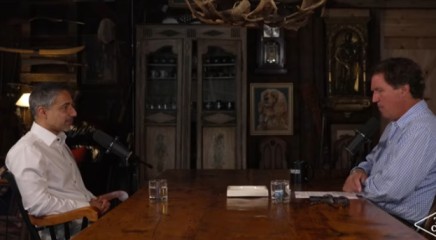
Read the full transcript of award-winning foreign policy expert Trita Parsi’s interview on Tucker Carlson Show, June 15, 2026.
Editor’s Note: In this episode, host Tucker Carlson sits down with Trita Parsi to analyze the complexities of a potential Iran peace deal and the significant internal and external forces working to shape or sabotage it. They also examine the strategic motivations behind the conflict and the broader implications for American foreign policy in the Middle East.
INTRODUCTION
TUCKER CARLSON: Thanks for doing this.
TRITA PARSI: Thank you for having me.
TUCKER CARLSON: Is this deal real?
TRITA PARSI: I think so. I think this is a significant achievement, but nothing is fully real until they manage to get to the final agreement. And we already have a precedent in which we also see that when there was a final agreement, which there was in 2015 that Obama struck, it didn’t mean that it necessarily would last because Trump walked out of that deal.
So if this is something we want to, we have to work at it. We have to work to keep it. These things are not part of the background that you can keep without putting any effort into it. And right now we’re not even halfway to the distance, but this is an important development.
Key Deal Points
TUCKER CARLSON: So what are the key deal points as they’re emerging, to the extent we know now?
TRITA PARSI: Yeah, first of all, we don’t know enough because at the end of the day, there’s been just so many different versions that have been floating around. And some of them, frankly, do seem to be sabotage efforts. There’s some of the hardline media in Iran that has been sending out these versions of the deal that I think deliberately were trying to raise people’s expectations in order to make the final deal look bad. And they’re doing it because they’re trying to sabotage the Pahlavi faction in Iran.
Super hardliners are dead set against it. In fact, there were protests that they organized — not huge ones in any way, shape, or form, particularly for a city of 10 million or plus in Tehran. But they were protesting outside of the Iranian Foreign Ministry and calling for the death of the foreign minister and the speaker of the parliament who’ve been negotiating this deal. So we should not for a second forget that there’s a faction in Iran that is really against this.
But based on what it seems likely to have included, there’s going to be an opening of the straits. It’s going to take some time. They have to do some demining, etc., to be able to fully make it safe. The US is going to lift its blockade of the blockade, which I think ultimately complicated this matter much more so than helped the US.
I think there will be some release of funds, but it will be done in a manner in which Trump can say that he never released the funds, and the Iranians can say they got some of their money back. And it’s going to be something that some of the GCC countries do in the middle to make sure that there’s some money going to the Iranians while they’re waiting for the actual Iranian money to be released.
And it’s very important to keep this in mind — this is Iran’s own money. They had about $120 to $150 billion in various banks around the world. That’s how you do international trade. You have the money there, and if you buy food or whatever from there, you use that money. These were frozen by US sanctions, so the Iranians could not access it.
Iran’s Frozen Funds
TUCKER CARLSON: For how long have they been frozen?
TRITA PARSI: Well, they were frozen first under the Obama era until they struck a deal, and then it was unfrozen. And then once Trump walked out of the deal in 2018, it was refrozen. So since 2018, almost 10 years, a lot of Iran’s money has been in these banks and they’ve not been able to access it.
Out of that $120 to $150 billion, the Iranian demand has been that for the MOU, they should get roughly 8 to 10% released at the outset and another $12 billion released by the time that the MOU is concluded.
TUCKER CARLSON: And this is their money.
TRITA PARSI: This is their money. So this is different. You know, the story about how Obama released $1.7 billion when he signed the JCPOA.
TUCKER CARLSON: Yeah, he sent the pallets of cash.
TRITA PARSI: That is true. But that was very different. That was not frozen money. That was because there was a lawsuit between the United States and Iran. Since the beginning of the revolution — because during the time of the Shah, we’re talking about 1977 — the Shah had ordered American weaponry. I don’t remember if it was airplanes or tanks or whatever, but he was the biggest purchaser of American weaponry back in the 1970s. But between him paying for it and them being supposed to be delivered, the Iranians had a revolution. They took 52 American diplomats hostage. So the US clearly and understandably never delivered the weapons. But also never returned the money.
So the Iranians took the US to court in The Hague International Court of Arbitration, and the US was about to lose that fight. So the Obama administration chose to settle it as part of the JCPOA. It was only supposed to be $400 million, but because of interest, it added up to $1.7 billion.
Here was the problem. How do you transfer the money to the Iranians when you have sanctioned every Iranian bank? Because of US sanctions, they actually had to put it on an airplane as cash and fly it to Switzerland, where another plane was on the tarmac taking the money into that plane.
TUCKER CARLSON: But that was also Iranian money.
TRITA PARSI: That was — well, it is Iranian money plus the interest, because the US had kept it for so long. There’s no deal in which the US will pay Iran any American money. There wasn’t in the JCPOA, and I don’t believe that that will be the case with the Trump deal either.
The Strait and Regional Ceasefire
TUCKER CARLSON: So the Strait gets reopened. How long do you think, if both sides decide they want it?
TRITA PARSI: It will be gradual, but I think you will start seeing ships going through the Straits in larger and larger numbers already from 5 days from now. But you have to remember, there’s a large number of ships that are stuck in the Straits, and they’re not in great shape by now because they’ve been standing still in extremely warm water. So as soon as they get out of the straits and get to their home, wherever they’re supposed to go, they have to go in for a significant cleaning. And that’s going to create another problem when it comes to the flow of oil, because there’s just not going to be enough tankers on the seas.
TUCKER CARLSON: Straits open, some of Iran’s cash gets unfrozen. What else in the deal?
TRITA PARSI: And then, of course, after that, the real stuff begins in terms of the negotiations over the nuclear issue. But one other thing that will happen before that is what the Iranians have insisted on, and I think the administration correctly agreed to, which is that there has to be a regional ceasefire. For this to be an end to the war, it cannot allow for other wars to continue in the region that can drag the US and Iran back into it.
And this is where also the biggest weakness or vulnerability of this deal is, because it means that the United States has to constrain Israel, and the Iranians are going to have to constrain Hezbollah. And we saw just hours before the announcement of the deal that the Israelis did everything they could to sabotage the deal by attacking southern Beirut, which they knew was a red line for the US and a red line for the Iranians.
Israel’s Attacks and Iran’s Deterrence Strategy
TUCKER CARLSON: Tell us about those attacks.
TRITA PARSI: So there had been exchanges of fire between Hezbollah and Israel prior to that, but the Israelis were striking southern Lebanon. The Hezbollah was striking both at Israel itself as well as Israeli forces inside of Lebanon, because the Israelis are inside of Lebanon right now.
TUCKER CARLSON: Yeah, they invaded it.
TRITA PARSI: Yeah, they invaded it. But it was not at a level that justified an escalation from the Israeli side to strike at Beirut itself, particularly after what happened about 10 or so days ago, in which they did strike Beirut, knowing very well that there had been a warning both from Trump and by the Iranians.
And this time around, the Iranians did strike back at the Israelis, which is a very important development because for the first time, the Iranians were striking at Israel for Israel striking Lebanon — not because Israel had struck Tehran. This was an attempt by the Iranians to essentially, after having established their own deterrence or reestablished their own deterrence, extend that deterrence to Lebanon.
They do so for a variety of reasons. One of them is, of course, that if the Israelis are allowed to just continue to bomb Lebanon and Gaza, etc., that war, that fighting will spill over into an Israeli-Iranian war at some point, and that will likely drag the US into it again. That’s exactly what already has happened twice since October 7th. So if you want to have a deal with the US, and the US wants to have a deal with Iran that ends this war in a durable fashion, then you cannot allow the Israelis to continue to be able to restart that war.
So on the one hand, the Iranians wanted to establish that deterrence in order to make sure that the Israelis didn’t do this. On the other hand, it is also a longer guarantee for the Iranians — what they call their forward defense — meaning that they want to have this presence or this support in Lebanon as a deterrent against the Israelis attacking Iran, period. Because this is what they had before Assad fell, before Hezbollah was really weakened by the pager attacks.
Let me give you a quick story. In 2006, as you recalled, you were there when Israel and Hezbollah went at each other. In the midst of that, I ran into Ephraim Sneh, who was at the time the Deputy Defense Minister of Israel. I had interviewed him on several occasions before, and he told me very explicitly that Lebanon and Hezbollah is just a pit stop. War with Iran is inevitable, but they have to essentially finish off Hezbollah first before they take the war to Iran.
But precisely because the Israelis never managed to defeat Hezbollah — in fact, the Israelis were defeated in that war — the war with Iran didn’t start in 2006. This was a manifestation of the efficiency of Iran’s forward defense. By being able to have Hezbollah there, they stopped the Israelis from taking the war to Iranian territory.
And the Iranians are now trying to reestablish that, which of course the Israelis are going to fight tooth and nail against, so that the Israelis will not be able to attack Iran again without knowing that they will have a very, very tough time with the Lebanese right on their own border.
What Motivated Trump and Iran to Make a Deal?
TUCKER CARLSON: So why would Donald Trump — I mean, this does not sound like a win for the United States relative to where we were in mid-February. Explain the pressures on both Trump and the Iranians that got them to this point. What’s motivating Trump? What’s motivating them?
TRITA PARSI: Yeah, look, I think this war was a mistake from the outset. I think so. I told the administration at the time, this should not have been done.
TUCKER CARLSON: It was the craziest thing any president has ever done.
TRITA PARSI: Craziest thing. And I specifically told them that you are misreading Iran. You think that the Iranians are much weaker than they are. I’m not saying that they were strong. In fact, I didn’t think that they’re going to be as successful as they frankly ended up being, but they were never as weak as the administration thought they were, or as the Israelis were telling the administration.
But also there was another major mistake, I think, in the administration’s outlook on Iran. They thought that the Iranians feared war more than they feared capitulation and surrender. And Trump thought that by just taking one-third of the US Navy there, all of this mobilization, the Iranians would realize that war was real, and as a result, they would surrender. It was a complete misread.
The Iranians feared surrender far more than they feared war. They believed that they could survive war, perhaps even come out on top in that war, which I think they have in some ways. Surrender would be the end of the Islamic Republic. They would never surrender. Their system is incapable of surrendering. Their system — who would ever surrender?
TUCKER CARLSON: Who would ever proffer an unconditional surrender?
Iran’s Need for the Deal and the Path to Peace
TRITA PARSI: Well, from Trump’s perspective, having just gone through Venezuela, he probably thought that the Iranians would be no different. But they were very, very different. It’s very important to understand right now the difficulty they have had in getting their system to agree to this deal. And as I mentioned, some of the ultra hardliners are dead set against this.
A surrender would require a full consensus, and there’s no way they could ever get that in that system, particularly if you don’t have a strong Supreme Leader that can actually push it through. And the new Supreme Leader is just weeks into his job and was not really necessarily expecting to get that job, particularly not in this way.
So surrender was never in the cards. And I try to make the case to them that this is going to lead to you— if you think you’re bluffing, but they are going to fall for your bluff, you’re going to actually actualize this bluff, and it’s not going to work out the way you thought at all. So I do think that obviously we’re worse off.
TUCKER CARLSON: So you gave that advice. I think you said that in public as well. I did, yeah. What kind of response did you get?
TRITA PARSI: Very little. I mean, they were taking note, but nevertheless never got a real response. And it seemed to me, of course, I didn’t have access to Trump himself, that his mind was set and that it was really difficult for anyone on the inside to be able to change his mind.
Why he had reached that position, I have less insight into. But I think over time, that perception he had of Iranian weakness had been reconfirmed over and over again because the Iranians did not respond as harshly as they could have against the attack on Fordow, for instance. I mean, the Pentagon called it a polite response. They gave a heads up, all of these different things.
TUCKER CARLSON: Yeah, they took the Americans off the airbase in Qatar.
TRITA PARSI: Exactly. Yeah. All of this just reinforced the idea that the Iranians don’t have what it takes to actually face the United States. And I think it created this overconfidence.
There was another thing in my view as well that reinforced this in Trump’s mind. And this is speculative on my end, but I do think there’s some truth in it. The Iranians committed a huge mistake before this war, which is they never agreed to talk directly to Trump himself. And from their standpoint, they thought that by refusing this, which they did for a variety of reasons, but nevertheless, by refusing this, they showed strength. They showed that they’re willing to say no to the superpower of the world.
But I think from Trump’s perspective, it was the opposite because Trump came in as president and said, “I’ll talk to anyone. I’ll talk to Kim Jong-un. I’ll hang out with the former founder of al-Qaeda in Syria. I’m capable of talking to everyone because I am strong, because I am stronger than all previous presidents.”
TUCKER CARLSON: Yeah, he had Tim Cook from Apple to the White House.
TRITA PARSI: Exactly. But the inverse of that, of course, is that if someone else is not talking to you, and are unwilling to talk directly to you, that’s not a sign of their strength, that’s a sign of their weakness.
TUCKER CARLSON: Yes.
TRITA PARSI: Because Trump, again, believes that talking to other people is a show of strength. So inadvertently, I think the Iranians actually reinforced Trump’s own view of them as being weak by refusing to talk to him.
And then obviously, there’s no guarantee that the war could have been avoided had they done so. But I think that if there was anyone who could have actually convinced Trump, “This is going to be a war. They’re not going to capitulate. You might want to rethink this, and you might want to rethink the entire idea that you’re going to get them to surrender at the negotiating table, or anywhere else.” The only ones that ultimately could have done this would be the Iranians themselves, and they stood up that opportunity. They had plenty of opportunities. And I think that, again, it reinforced Trump’s view that they’re weak, and as a result, he thought that he could have this war over with—
Iran’s Opaque Political System
TUCKER CARLSON: Well, one of the problems is Iran is not a dictatorship. I mean, there’s a very complex series of power-sharing agreements going on inside the country. Like, who runs the country? To outsiders, me anyway, I made a good faith effort to figure it out. I couldn’t.
TRITA PARSI: It’s deliberately opaque. That’s on purpose. Yeah, exactly. Back in the 2000s, the Iranians had a deliberate policy that they called simulated irrationality, in which they wanted— Simulated irrationality? It’s essentially their version of madman theory. In which they, on the one hand, wanted to make sure that they were seen as somewhat irrational. Because if you’re irrational, the other side has a greater difficulty calculating what your next move is. This is again what Nixon did, but they called it simulated irrationality. At the core of it, they’re extremely calculating and extremely rational.
But there was also another problem. Their experience in the 1800s, particularly with the British, interference in Iran is that the British never really had to spend much money collecting intelligence in Iran. The Iranians were just volunteering it all the time. And it enabled the Brits to really manipulate the system and manipulate Iran. They didn’t even have to colonize the country. They got exactly what they wanted from Iran without formally colonizing it.
A counter to that, a reaction to that has been for them to try to create as opaque of a system as possible because that opacity makes it much more difficult for outside countries to be able to interfere, manipulate, or use factions within the Iranian system. But it’s also a negative for them at the end of the day, because the more opaque you are, the more untrustworthy you will be in the eyes of other countries. You can’t really trust a country whose system you don’t understand, whose processes.
So whereas it may give them a degree of security in a very bad situation, in the long run, it doesn’t provide you with peace and security if everyone around you believes that you’re untrustworthy because they don’t understand your system. So the Iranians at some point hopefully will transition away from that, but I don’t think they will as long as this enmity between the United States and Iran is as intense and as existential as it has been in the last couple years.
Why Both Sides Need This Deal
TUCKER CARLSON: So again, what do you think drove both sides to this?
TRITA PARSI: I think at the end of the day, both of them absolutely need this deal.
TUCKER CARLSON: Why? I understand why Trump needs it, because the economy is going to fall apart if it’s not resolved quickly.
TRITA PARSI: Why do the Iranians need it? Look, the Iranians ultimately both need it because of sanctions relief. Their economy was in a terrible shape before this war. That’s before $300 billion of damage was inflicted on them as a result of this war. Beyond the loss of human life, you’re also talking about infrastructure, their steel industry, the petrochemical industry have taken huge hits. So this is going to be very difficult for them. So they need sanctions relief.
Look, the Israelis pushed the United States to sanction Iran already in the early 1990s because they saw Iran emerging as a rival to Israel in the region. Prior to that, they had actually had a long history of collaborating with Iranians and having a tacit partnership and alliance. But if you want to destroy and weaken a country, you can do so by bombing them, which is what we saw here. And you can also do so by having decades of sanctions on them that slowly but surely suffocate them, destroy their industries, etc. And this is what we saw in Iraq. This is what we’re seeing in Cuba right now.
So that type of a sanction, even though the Iranians have managed to resist it, even as the Russians currently are resisting a lot of these different sanctions, over time, it destroys the fabric of society. In Iraq, there was actually a study by the State Department, I think from 2004, as the US discovered how difficult it is to govern that country. And they did a study to try to better understand where the roots of the problems were. And one of the chapters dealt with the years of sanctions that had been imposed on Iraq. And it pointed out that Iraq’s economy under Saddam Hussein and the sanctions had shrunk to no more than $16 billion. Total. And as a result, you had a situation in which the incentive structure for ordinary people to even send girls to schools was no longer there. What was the point of educating the children when there is no economy?
So you had a plummeting of literacy in Iraq, particularly amongst the female population. So you tell me, how can you actually transition a country towards democracy when you have rising illiteracy? And this is Iraq, a country that historically has been the center of education and literacy in the Arab world. 50% of all books in Arabic used to be printed in Iraq. It’s a long, long history that even precedes the arrival of Islam in Iraq.
The Devastating Impact of Sanctions
TUCKER CARLSON: So sanctions slowly but surely destroys these countries. Why did the US— remind us, what were the pressures that pushed the US Congress to impose sanctions on Iraq?
TRITA PARSI: On Iraq? This is because of Saddam Hussein’s attack on Kuwait, and then later on, the suspicions of his nuclear weapons program. Right. And so you had UN sanctions, you had the Food for Oil program. I was working at the UN at the time in the Security Council. Iraq was part of my portfolio. This is when I was working for the Swedish Foreign Ministry.
And I remember those meetings where I remember the Brits objected to toilet paper and lipstick as a dual use technology. Could not send it into Iraq. I mean, it is the suffocation of a country.
And the Iranians need sanctions lifted. And from their standpoint, their best moment for the last couple of decades to actually have a real negotiation with the United States in which they do have leverage as a result of this mistaken war, to be able to get a deal that actually really lifts the sanctions, not the way it did in the JCPOA, but actually it also takes away primary sanctions. They’ve never been in a better position to do so.
Now, they may not entirely see it that way. Certainly some of the hardliners are opposed to it. They think the US is going to betray the deal, etc. But nevertheless, it is a strong position for them to have that negotiation. So I certainly think that they should. And I think they also recognize that at the end of the day, they cannot sustain this situation, the closure of the strait, etc., for a very long time without creating problems with other countries such as Russia and China and others who do matter to the Iranians.
TUCKER CARLSON: Yeah. And all of Asia. I mean, South Korea and the world needs it open. So what are the chances this actually works and what could derail it?
Israel’s Strategy and the Risk of Derailment
TRITA PARSI: The biggest risk of a derailment, of course, is from the Israelis. I mean, Netanyahu has been pushing the United States to go to war with Iran for more than 25 years. He finally got his wish, but it just didn’t end up the way he thought it would. But he’s not going to give up. And there’s plenty of opportunities for the Israelis to derail this, particularly by restarting a war with Lebanon. You know, at the end of the day, you just need a couple of successful attacks and the whole thing can fall apart.
So if Trump wants to keep this, and I hope he does, and I do think that he’s serious because as you pointed out, he needs to get out of this as well. It is not sufficient to just have an angry phone call with Netanyahu every once in a while, or to do so in reaction to Netanyahu actually violating some of the US’s red lines. There needs to be consistent pressure on the Israelis to make sure that they don’t do this.
And I would go one step further. Part of the reason why the Israelis would do this is because they believe that if they restart the war, the US has no choice but to reenter the war on Israel’s side. If the United States makes it very clear to the Israelis that that equation is over, if the Israelis start a war against not only a deal that Trump has struck, but what I think he hopes becomes part of his legacy, then the US is out and the Israelis are going to have to deal with the Iranians on their own, which I don’t think they can do without all of the support of the US, particularly the defensive support in terms of shooting down Iranian missiles that are heading towards Israel.
The Israelis cannot tolerate a war with Iran for very long. So if they know that they cannot drag the US in, their incentives for sabotaging the deal will also diminish because the outcome that they’re looking for is no longer secured in any way, shape, or form. So I think Trump has that ability, and I think proactively he should make it very clear. If Israel restarts another war with Iran, regardless of how it starts, the US is out.
TUCKER CARLSON: What do you think the chances are the United States would allow Israel to lose a war against Iran? I’m just going to say zero.
TRITA PARSI: All depends. I mean, I think you’re absolutely right. We’ve seen it so far that the US — there will be a tremendous amount of pressure domestically to support it. But I think also things are changing. I mean, right now, the standing of Israel has plummeted amongst the American public in almost every demographic except for boomer Republicans that watch Fox. Genocide hurts your reputation. It does. Who would have thought, right?
And also, I think on the Republican side or the conservative side, I think it’s become very clear, particularly to the younger demographics there, that Israel is a key factor as to why the United States has been involved in so many different wars. And since the anti—
TUCKER CARLSON: A key factor in the decline of the United States.
TRITA PARSI: And since so many of these young folks have completely turned against these endless wars, it’s always been a bit of an issue, I think, for some of the younger Republicans in the sense of being against the forever wars, being against an overextended United States, all of these bases around the world, while at the same time trying to stay neutral or positive on Israel. And that cognitive dissonance worked for a while. It doesn’t work any longer because it’s just so crystal clear.
TUCKER CARLSON: I’ve experienced it firsthand for many years. Yeah, you don’t want to fight about Israel. People are hysterical, totally hysterical and ruthless. It’s just not worth it. But when you see that relationship destroying your country, I mean, you have to say something.
TRITA PARSI: Yeah. And again, it’s going to take a while before that really impacts the politics of this. But I think it’s going to become increasingly clear. I think it’s going to be very interesting to see what happens in the midterm elections, both on the Republican and the Democratic side on this issue.
It will still take a couple of more years, and it will be a couple of more years needed in order to produce foreign policy thinkers on both sides of the aisle that have broken free from this conventional thinking about what the US’s role in the world should be, what the US’s role in the Middle East should be, and what the US’s relationship, not just with Israel, but any type of a special relationship — whether those should be kept or not.
What Is Netanyahu’s Endgame?
TUCKER CARLSON: I don’t understand what Netanyahu’s plan is. What’s Israel’s plan? So they want to keep the war going. Okay.
TRITA PARSI: So what does victory look like? This is a really good point because everyone else is looking at this. Every other country is like, okay, what’s the win here?
TUCKER CARLSON: Yeah. And best case, how does this turn out?
TRITA PARSI: Exactly. And I think on the Israeli side, there’s just been a transition to a completely different type of security thinking. This happened a long time ago, but it’s just become more blatant. I remember it was actually David Ivri, the legendary Air Force general in Israel, who was actually the lead pilot that struck the Osirak reactors in Iraq in 1981, who explained this to me.
He said, “Look, on the Israeli side, all other countries define a threat as being a combination of intent and capability. On the Israeli side, we assume that intent to destroy us is always there. So we only focus on capability, which means that regardless of whether a country is disposed negatively towards Israel or not, Israel’s only way of surviving in the region is to always outgun everyone in the region and every other combination of countries in the region, keeping them weak, keeping them at a much lower level.”
It’s deranged. It’s military hegemony on crack.
TUCKER CARLSON: But, and by the way, it’s also that worldview that — like, everyone hates us by definition. That’s just not true. It’s not true. People’s view of you is determined mostly by your behavior. That’s just a fact of life. That applies not just to Israel, but to you and me and every other living person. But if you go into any scenario, if you go to a cocktail party imagining everyone at the party wants to kill you—
TRITA PARSI: Yeah, you’re not going to have a good time.
TUCKER CARLSON: You’re crazy. That’s crazy.
TRITA PARSI: So look, there’s been an experience that they’ve had that I think has contributed to it. I agree with you that I don’t think it’s healthy. I don’t think it’s good. And also, historically, I don’t think we can see any examples of any country, particularly a small country, being able to pursue that doctrine successfully for a very long time. It’s not a good survival strategy. Now, they think it is the only way to survive.
But what this has done — and this goes back to your earlier question — I remember speaking to another Israeli military official. This is 2004, so this is 22 years ago. And he was very worried about Israel’s future. He said that when I fought in ’67, when I fought in ’73, I genuinely believed — we genuinely believed — that if we won this war against the Arabs, the Arabs would eventually realize they cannot defeat us militarily, so they will have to sue for peace. So the military victory, the best case scenario, as you asked, was a transition to peace.
But he said to me, “I look at the Israeli youth now,” — 2004, 22 years ago — “and I don’t see any belief in peace. They believe that we’re going to be in constant warfare all the time and that this is just normal, that there is no such thing as a victory. You just have to constantly fight, and that’s the only way for Israel to survive.”
And he said that this worries me because this is not sustainable and this is going to change Israeli society in a profound and very negative way. And I think he was proven absolutely right.
But it’s also — so when it comes to your question of what is Netanyahu looking for — he thinks that Israel is going to always be in an endless state of war. And as a result, you just constantly have to fight that battle and make sure that you have the tactical advantage.
Endless American Support: Israel’s Core Assumption
TUCKER CARLSON: But baked into that assumption is endless, literally limitless American support. That’s the thing.
TRITA PARSI: This is all presuming because Israel could never do this without this constant support, not for a week, from the United States. So they’ve structured their entire approach based on the idea that the US is some sort of a cash cow or intelligence cow or weapons cow that will just constantly end up giving. And that is one of the most important things that has now changed in the last 5 or so years and will change even further. So this is a strategy that simply does not work.
TUCKER CARLSON: So from the — because I think it’s important to understand other people’s perspective, it’s essential. We didn’t understand Iran’s perspective going into this and we lost. So it’s important to understand Israel’s perspective going forward. American, unconditional American support for Israel’s regional projects is the centerpiece of their security strategy. Like they can’t exist as a nation without that support. Is that correct?
Absolutely. And they know that. And that means that anyone who threatens that — it is like, what wouldn’t you do? It’s a literally an existential problem if somebody threatens that. Yeah.
The Saudi Precedent: What Happens When the US Steps Back
TRITA PARSI: And this is part of the reason why they’re so aggressive against anyone who questions that relationship. And again, you can question that relationship. I would, for instance, never argue in favor of having a negative relationship between the United States and Israel or between the United States and Saudi Arabia. I want the United States to have a sound and healthy relationship with as many countries as possible. But this is not sound. This is not healthy. And I would say a lot of this is also our own fault. At the end of the day, it’s all our own fault.
When we’re giving endless support without questioning, without any restraint on it, it actually fuels the worst instincts of any country. Israel is no exception in this. I would point to how Saudi Arabia was conducting itself up until 2017 to 2019. MBS came in and was extremely reckless. And he constantly thought that whatever he would do, the US would come in and bail him out.
And then there were these attacks by the Iranians against Saudi oil fields in 2019 over a dispute, with the effort that the Trump administration was doing to stop the Iranians from selling their oil. And the Saudis were stunned to see that Trump said this was not an attack on the US, this was an attack on Saudi Arabia, and “I’m not going to go to war with Iran over Saudi Arabia.” This was a betrayal of the Carter Doctrine that essentially said that the US would do this. But Trump, of course, being an unconventional thinker and probably didn’t even know about the Carter Doctrine, was like, “No, I’m not going to do this.”
This was stunning for the Saudis and for everyone else in the region. And what happened? The conventional thinking in Washington would be that if we are abandoning our allies, there will be more chaos in the region, there will be more war. The opposite happened. Once the Saudis realized that the US was not going to bail them out from every war that they would start or any reckless behavior they did, guess what they did? They secretly reached out to the Iranians and began a secret negotiation process that eventually led to, years later, the normalization of their relationship through the help of Oman, Iraq, and ultimately China as well.
They opted for diplomacy when they could no longer hide behind American military power. And if we do the same thing with the Israelis, eventually they will also come to that conclusion that they’re going to have to find a way to manage threats, manage relationships, rather than thinking that domination is the only way for them to be secure.
TUCKER CARLSON: It’s hard if you’ve got a country of 9 million with no resources and not actually a real economy, just an economy based on spy software. It’s kind of hard to maintain a dominance posture for very long.
Israel’s Regional Hegemony and the U.S. Presence in the Middle East
TRITA PARSI: It’s a completely fake domination. I mean, the talk— clearly there is a perception in the region that Israel is trying to become the military hegemon, and their attack against Doha, you saw how a lot of the GCC countries explicitly started talking about Israel’s attempt of establishing hegemony. But I think we have to be very frank, Israel doesn’t have the capacity to do so. This is a fake hegemony. This is the tip of the spear of someone else’s hegemony. It’s the US’s hegemony.
But the difference is the US has grown tired of being the hegemon of the region because it’s not particularly fruitful. In fact, I would not wish hegemony over the Middle East on my worst enemy. What’s the benefit of it? We’re not in the 1950s or ’60s, in which the geopolitical circumstances were different. So the US has grown tired of it. We have 4 or so presidents in a row promising the American people to bring troops home from the Middle East.
There was even a moment in which the Biden administration was considering— as you remember, there was that force posture review in the first year or so. They were considering closing down 17 out of 19 bases. They ended up not doing so, and the main argument against it was, well, if we close these bases, the Chinese are going to come in and replace us. The Chinese would never be so stupid to take on that role. There’s no benefit in it. They have completely benefited from the fact that we have taken on that stupid role, and they have been free riders on this, and they would never do anything like that. But nevertheless, that was part of the reason why the Biden administration didn’t do what they, at least at one point, were seriously considering.
TUCKER CARLSON: And now it’s been done for us. So when this is resolved, however long that takes, the United States will not have almost 20 bases in the region.
TRITA PARSI: Is that fair to say? I find it extremely unlikely that 10 years from now we’re going to have that many bases there. Because you have to also ask yourself, first of all, what was the use of these bases? Every time the United States attacked Iran, it emptied those bases because they knew that the Iranians have the capacity of striking all of those bases. And in order to minimize any casualties, bases were emptied. The material was— even the equipment was taken out. So if you can’t use the bases in a war, what are the bases there for?
And from the GCC standpoint, they thought that these bases were going to be a deterrent against Iran. It turned out that they were a magnet, the reason why they were being attacked. Now, American weaponry was very useful for the GCC states, but the bases were not. So I suspect that going forward, you’re going to see a scenario in which they will continue to buy and probably even buy more American weaponry, but they’re not going to invest in the bases. And again, many of these bases have been destroyed. Who’s going to pay for them being rebuilt? I don’t think the US will, and I’m not so sure that the GCC states will either. So if no one is paying for them, they’re just going to sail into the sunset one way or another. I suspect at least with most of them, that will be the case.
Here’s an opportunity. If the region now understands there is no such thing as an external security guarantor for them, similar to what I mentioned, what the Saudis realize, that the US is not going to come in and support them, they’re going to have to deal with their security issues on their own. They’re going to have to, through diplomacy, see if they can build a security architecture that intensifies economic integration and other things, perhaps transitions towards collective security thinking in order to create stability.
That, I think, is a blessing for the United States because it actually enables the US to also extract itself finally from the Middle East while supporting an effort by the region itself to create its security architecture. So we’re not leaving chaos or anything like that. It won’t be Afghanistan 2021, but it will be stable and is no longer on the shoulders of the United States. I think that would be very popular with the American public, and strategically it would be very, very good for the United States.
Israel’s Nightmare Scenario
TUCKER CARLSON: But it’s a nightmare for Israel. It’s the— it’s the nightmare.
TRITA PARSI: Because again, as you said, 9 million or whatever. The only way you can actually not— forget about the hegemony, but just have this type of extended maneuverability in the region is to have the United States artificially put its finger on the scales and tilt the balance in the favor of the Israelis. And if the US leaves, then Israel’s going to be faced with a completely different scenario. Now, I don’t think Israel will get destroyed at all, but Israel’s going to have to deal with the region in a completely different manner. Not based on domination or creating all of this chaos that they have helped fuel in order to keep everyone else weak.
TUCKER CARLSON: The goal of the war was not, in my view, was not to eliminate the Iranian nuclear program. That was not the main goal. The main goal was to eliminate rivals to regional hegemony.
TRITA PARSI: Absolutely. From the very beginning, this has been the case.
TUCKER CARLSON: Yeah. Including, I would argue, the United States. I do think there’s deep resentment toward the United States in Israel. They like Trump, I guess, or have liked Trump, but I know they don’t like the United States. Why would they? In the same way that teenagers resent their parents. But the opposite happened. So now you’ve got Arab states, which have really deeply resented, hated Iran for a long time, now making overtures toward Iran after getting bombed by Iran.
The European Model: From Conflict to Collective Security
TRITA PARSI: Look, what did the Europeans do after World War II? They realized that the effort to contain and isolate Germany after World War I only led the way, paved the way for World War II. So they shifted towards the European Union, the Steel and Coal Union, in order to increase economic interdependence between themselves, to create as many buffers as possible for another war, making it as costly as possible for the states to go to war.
TUCKER CARLSON: And Germany became more central even in Europe than it was before after the war.
TRITA PARSI: Absolutely. It took some time, of course, but it emerged as a major power and a force for stability in Europe as well. And I grew up in Europe. When I grew up, it was completely inconceivable that France and Germany would ever go to war with each other again. And that’s still despite the fact that 50 years ago they were butchering each other. That made Middle Easterners look good. That transition is a remarkable transition, and it is because they transitioned to collective security and recognizing that any country’s security is based on everyone else’s security.
And the region, I think it’s going to be very difficult. I don’t want to in any way, shape, or form put forward some sort of a naive picture, but I think they’ve had a close encounter with death, and that tends to sharpen your mind. It tends to make you a bit more mature. And despite the fact that there is a lot of anger, a lot of anger in Kuwait and on the GCC side, there’s a lot of anger on the Iranian side as well. Because they believe that there is plenty of evidence, and some evidence has been verified by independent actors. France 24 showed, for instance, that there were a lot of attacks on Iranian soil from the US, from Kuwaiti territory. And the Iranians believe that the Emiratis were far more involved in the war than they thought earlier during the war. So nevertheless, there’s a lot of common anger.
TUCKER CARLSON: And that Israel was using Arab states as staging grounds for attacks on Iran.
TRITA PARSI: Exactly. And they have two secret bases in Iraq, for instance.
TUCKER CARLSON: Yeah, we didn’t know that. How did the Israelis get bases in Iraq?
TRITA PARSI: I have no idea how that happened, but it makes me wonder how many more bases there may be. Because if it’s two that we know of now, how many more may there actually exist? And remember, for years, the Iranians were actually fighting, shooting missiles into Iraqi Kurdistan, saying that they were destroying Mossad houses. I don’t think they ever said that they struck a base, but nevertheless, and it was oftentimes dismissed. No clear evidence was provided by the Iranians, but it is unmistakable that the Israelis have had a very long presence in Iraqi Kurdistan. And this goes back before the revolution as well, in which, frankly, back in the ’60s and the ’70s, it was the Iranians and the Israelis together with the CIA that established Israel’s presence in Iraqi Kurdistan.
TUCKER CARLSON: One of the reasons that the Kurds get such great coverage in the United States— everyone loves the Kurds in the United States. Except Trump. Trump doesn’t like the Kurds for some reason, but everyone else, the American media loves the Kurds, the brave Kurds.
Israel’s Fear of U.S.-Iran Rapprochement
TRITA PARSI: By the way, on that issue that you mentioned, that is never about enrichment. I was at a Track 2 meeting. This must have been 2012, I think. And I wrote about it in one of my books. It was a remarkable moment because you had several Iranian officials, some of them former, some of them actual nuclear negotiators, together with a couple of American military folks, and then 5 people from the Israeli side, all military except one who was a top intelligence person. In fact, he was the former head of Mossad.
And at one moment, he just laid it out. He said, “This was never about enrichment.” This was about preventing Israel from becoming— let me see, remember exactly how he put it. He said, “Israel will not tolerate the United States making friends with Iran unless Iran first makes friends with Israel.” It was not going to allow the United States to resolve its tensions with Iran because the Israeli fear— and this is a very legitimate fear— if the US manages to resolve its tensions with Iran, one of the things that would happen, which is also what the administration is talking about now, we would potentially start leaving the region, as we should. The threat of Iran has been a key reason for justifying all of these bases.
And the Israelis then ask themselves a very valid question. If the United States reduces its tensions with Iran, does that mean that there will be a proportionate reduction in Israeli-Iranian tensions? And they conclude, I think erroneously, but nevertheless, they conclude no, the Iranian-Israeli tension will remain, but now the Israelis will have lost the support of the United States. And this is what they call the fear of abandonment. They need to keep the US in the region, prevent it from making friends with these different countries, because if it does make friends with these different countries, it will exit the region. The Israelis will have to deal with them alone.
TUCKER CARLSON: This is a very sick relationship. “You can only have one friend. We’re your only friend.” This is like 7th grade girls’ locker room stuff. But it’s diseased. But from the Israeli perspective, because I think this really matters, what’s happening right now and what’s almost certain to happen, whatever happens to this MOU or this particular set of negotiations, but ultimately it’s really clear that Iran is going to emerge as a major world power. How could it not? Because it has de facto control over one of the most important pieces of geography on the planet. So that alone.
Iran’s Strategic Control of the Strait
TRITA PARSI: Important development for them. And however yet it ends, even if there’s no— there’s not going to be any toll, but what potentially will be there, I suspect will be there, is some sort of an environmental management fee. And whether that is handled just by Iran and Oman or if it’s regionalized, nevertheless, something will be there.
But the important thing to understand is that their control of the strait is not because they have minesweepers or that they have a couple of islands there. That was the case 20 years ago. In all of the war games that the US did back then, the Iranians would close the strait by mining the strait. And it would take the US about 2 weeks to reopen it. What happened now is because of technology, the Iranians can shoot missiles and drones from anywhere of their 1,500-kilometer shoreline at any of these ships. And just the risk of being hit is enough for them to—
TUCKER CARLSON: You can’t ensure them.
TRITA PARSI: Exactly.
Israel’s Nightmare and Iran’s Resilience
TRITA PARSI: To ensure them. So it’s a completely different scenario. That capacity does not go away. That’s what I’m saying. So it will still be there. So this is a very, very important development. Even if without sanctions relief, I don’t see the Iranians being able to fully live up to their potential.
And on top of that, I have to say their political system is a huge inhibitor of their own potential. It is not a free system. It is not a dictatorship like Saddam or Gaddafi’s or Assad’s systems in Syria and Libya and Iraq. It is a weird system. It has democratic elements, but most importantly, the power is dispersed throughout a system. It’s not a family.
This is not— you kill— this is what I think Trump was sold. You kill Khamenei, the Supreme Leader, the whole system implodes. Not at all. This is not Saddam, in which you take him out and his kids out and the dynasty is over. This is a system that was designed specifically to be able to survive a counterrevolution because it was itself a revolutionary system. And it’s also assassination-proof. Yes. I mean, 135 or so senior officials have been killed. Immediately replaced. Immediately replaced. In fact, replaced by more hardline people most times.
TUCKER CARLSON: Well, that’s a durable system. Yeah. But even if you were to take out the entire infrastructure of government in Iran, even if you were to nuke Iran, you still couldn’t return to February 27th status quo on Hormuz. Because it could be closed by piracy. Yeah. So you have to have a powerful central government in Iran. The world needs that in order to keep the strait open.
TRITA PARSI: Look, bottom line, we need— it’s a very bad scenario if we have a weak central government. That’s what I’m saying. It’s terrible. It’s exactly a recipe for instability. It’s a recipe for a country turning into Lebanon, in which the state is so weak that you could have non-state actors performing the duties of a state.
TUCKER CARLSON: But even if it were to turn into Lebanon or Syria or Somalia, which would be a disaster for the people of that country and for the region, that’s a massive threat to the global economy. Definitely. That’s the difference. Yeah.
TRITA PARSI: And by the way, we had what, 25 to 30% of the Syrian population becoming external refugees as a result of that civil war. Yes. And a country of whatever, 20, 30 million people. And that profoundly changed the politics of Europe, right?
TUCKER CARLSON: So what if that happened to a country of almost 100 million?
TRITA PARSI: It would be an absolute disaster.
TUCKER CARLSON: I said this to Trump before it started. The migrations could be just really, really a big deal. And I think he understood. He did it anyway. But I guess what I’m saying is I don’t see a way that this is not the nightmare scenario for Israel.
TRITA PARSI: Totally is.
Iran’s Political Resilience and the Rally Around the Flag Effect
TRITA PARSI: No matter what. Yeah. And from the Israeli side, there will be— I mean, Netanyahu will keep on insisting that they set back Iran a decade or two. And absolutely, they really have damaged Iran’s infrastructure tremendously. There is no doubt about that. That can be rebuilt, however.
What they have done that is really difficult to undo is— I’m not saying that the system in Iran has necessarily gained popularity. I don’t think the actual support base of that system is more than 15 to 20%.
TUCKER CARLSON: 15 to 20?
TRITA PARSI: 15 to 20.
TUCKER CARLSON: Oh, it’s that unpopular?
TRITA PARSI: Yeah. 60 or so percent of the population absolutely would like to see a different type of government, but they’re not willing to risk war or revolution over it. They want to see gradual change. And then perhaps 20 or so percent of the population that are just so fed up with how this system has been so repressive, so corrupt, so incompetent in many different ways, mismanaging the economy, that they’ve gone so desperate that they’re willing to try almost everything.
But what has happened because of this war, which always happens in these types of wars, is that you have a rallying around the flag phenomenon. It’s not necessarily made the system more popular, but the performance of the Iranian military in all of this has made the confidence of the 15 to 20% of the population that do support the system absolutely skyrocket. It has made them think that they themselves had question marks about the viability of the system. It faced so many problems, so many of them self-inflicted, many of them also, of course, absolutely a result of the sanctions. But there was actually a very low confidence in that system in December and January of this year.
That has just completely shifted because now they feel that, as you said, they have become a global power. They have managed to not only resist the attack of two nuclear powers, one of them a superpower, but in some ways they may have come out on top and strategically inflicted a defeat on them. And this has just really boosted their confidence. And that is going to make the Islamic Republic much stronger, at least temporarily, than it was before February.
TUCKER CARLSON: It seems so obvious.
TRITA PARSI: Absolutely.
TUCKER CARLSON: And the rest of the world sees that. The rest of the world is to some extent dependent on Iran. Like, that’s what we all learned. Yeah.
TRITA PARSI: Oh, absolutely. They have the— South Korea needs Iran.
TUCKER CARLSON: Japan needs Iran. These are real countries with huge economies.
Iran’s Strategic Geography and the Strait of Hormuz
TRITA PARSI: And even if they try to reduce their dependency, first of all, they were not dependent on Iranian oil. They stopped buying Iranian oil 10 years ago because of the US sanctions. So they were not buying a thing from Iran. South Korea has been in the Iranian market for so long. It’s only during this last 10 years that they were completely chased out by US sanctions. Samsung was so massive. Oh no, no, no.
TUCKER CARLSON: I mean, now Iran controls the outlet to the Persian Gulf.
TRITA PARSI: Exactly. So now you don’t have to have any dependence on Iranian goods. Exactly. But you still need Iran because it’s a question of geography.
TUCKER CARLSON: Yeah. Only in America— I, as an American, I hate to say this, but only our policymakers are so stupid they don’t look at maps. No, I’m serious. They’re so caught up in this ideology. Rogue state, terror state, Hitler, Chamberlain, Churchill. It’s like they’re all in this weird fantasy world where no one consults Google Maps. It’s like, hey, guys, they could shut down a fifth of the world’s commodities.
TRITA PARSI: And I remember I was in some meetings where not formal government, but several people who were in and out essentially. And this question came up and I was actually quite stunned by the degree to which a lot of people actually thought the Iranians would not close the strait, that thought that that would be a suicidal move by them. And I had to remind them that they will see this as an existential threat. So all of the patterns we’ve seen in the past in which they responded politely, they didn’t even respond to certain attacks — you have to set that aside because if they’re actually faced with an existential threat, their behavior will likely be very different.
TUCKER CARLSON: We framed it as an existential threat. The president of the United States demanded in the first days, and I’m quoting, “unconditional surrender.” Yeah. Once you say that, it couldn’t be clearer. You’re fighting for your life. What wouldn’t you do?
Israeli Intelligence Penetration and Its Limits
TRITA PARSI: Exactly. Exactly. One of the things I think is also very interesting, and I don’t know the answer to it exactly what happened, but the Israelis were remarkably successful in penetrating Iran intelligence-wise. And they did that over the course of years. They had recruited a lot of Iranians. They had flipped them essentially.
And this is something the Islamic Republic absolutely needs to understand. That game is a game of numbers. If you have a lot of options, a lot of candidates that you could turn into a spy or turn against their own country to work for the Mossad, you will get a larger number of them successfully flipped. What determines if there’s a large number of candidates? Well, part of it is the repression of the Islamic Republic itself. Because it was so repressive, it actually created a very large pool of people that the Israelis could turn to and try to see which ones of them they could flip.
3 days before the war, those people had been extracted out of Iran and trained. 3 days before the war, they went back into Iran and they were conducting attacks from inside of Iranian territory, similar to the way that the Ukrainians have done it in Russia. In fact, the methodology seems to be identical.
In this war, we saw none of that. Whatever happened, either they expended all of their Mossad assets inside the country, or something else happened, because we just did not see that same repeat of a pattern in this war. And again, I don’t know the answer to it, but it is a very, very big question mark exactly what happened. How were they so successful in June and apparently achieved nothing in this war in terms of penetrating Iran?
TUCKER CARLSON: Well, the Iranians rounded up a bunch of people.
TRITA PARSI: They certainly did. Yeah. And I’m sure they also rounded up a large number of innocent people that were executed. I’m sure. But again, I don’t know if that’s the full answer.
TUCKER CARLSON: Well, attitudes change immediately during war.
TRITA PARSI: Yes, absolutely. But those people would not— it takes much more than 6 months to be able to recruit them and train them. So they would have to be recruited and trained for a much longer period of time.
Is Iran Truly an Existential Threat to Israel?
TUCKER CARLSON: So what does Israel do in the face of this? Because just with the stipulation that this is— they’re always talking about existential threats, everything’s an existential threat. This feels like an actual existential threat to Israel.
TRITA PARSI: I don’t think it is an existential threat. I think Israel’s own security doctrine is the real existential threat to Israel.
TUCKER CARLSON: I, of course, agree with you completely. I mean, if Israeli assumptions about that country’s place in the world, its own place in the world, remain unchanged, this is an existential threat to them. Like they have to change or else. They have to change.
TRITA PARSI: I agree with that. Absolutely. Will they? And I want to point out one thing. This whole idea that Iran is or was an existential threat was a talking point. I’m aware of that. It is a talking point that they always use in the United States because it was necessary to try to get the United States to make Iran its top national security threat, which in and of itself is absurd. Not to say that Iran is not a challenge, but to be the top national security threat. Go back to some of these—
TUCKER CARLSON: When the drug cartels control New Mexico, which they do, and parts of Texas and Arizona, and our own country’s collapsing.
TRITA PARSI: The biggest threat is Iran. Look at the debates in 2012. I think it was between Obama and Romney, or was it the vice president? I think it was Obama and Romney. And the ABC anchor asked him, “Iran is the top US national security threat.” I was like, how is this just accepted as fact?
TUCKER CARLSON: You just keep repeating a lie and people just start nodding.
TRITA PARSI: This is something the Israelis have been pushing for since 1994 or so. But the Israelis themselves internally were not necessarily saying this. Efraim Halevy, Pardo, Meir Dagan — 3 consecutive heads of the Mossad — openly said Iran is not an existential threat. Iran is a threat, but it’s not an existential threat. Ehud Barak, former prime minister and defense minister, already back then said, “To say that Iran is an existential threat is to diminish Israel’s own power.”
But it was a very effective talking point to push the United States towards believing that the United States needs to attack Iran or sanction Iran or just treat it as a top national security threat because it is an existential threat. And in the New York Times and all of these papers, it’s just repeated as religion that the Israelis view Iran as an existential threat. Never questioned as to whether that is really how they see it.
TUCKER CARLSON: Well, what’s never questioned is why that would be our problem, true or false.
TRITA PARSI: That’s an even deeper question that would never—
TUCKER CARLSON: Yeah, like, okay, I’m sorry that you don’t get along with one of your neighbors and you feel deeply threatened. Good luck resolving that.
Israel’s Strategy and the AIPAC Connection
TRITA PARSI: What do we have to do with that? I wrote my dissertation on Iranian-Israeli relations, and I spent some time in Iran and in Israel interviewing top officials about this issue. I wanted to get to the heart of the matter. I didn’t want to rely on secondary documents, and I couldn’t get access to the primary documents. Of course, they don’t have that type of transparency, so I needed to sit down with them.
And one thing that always came through with my interviews with the Israelis — I had been in Iran a couple of weeks earlier, so almost every door in Israel was open for me because in my email or letter, I told them I just came from Iran. I spent time interviewing top officials about Israel. Do you have time to chat? And they almost all did, including very senior people, including people in the intelligence community.
Some of the most valuable things I got from those interviews were not my questions of them. It’s that they almost always kept me for another 30 minutes, another 60 minutes interviewing me, trying to see what I had found out. And government officials, they always know how to conceal the true motives, et cetera, when you ask them a question. When they ask a question, they reveal what they’re actually looking for. I noticed.
And there you could clearly see the premise was not that Iran is an existential threat. The premise was not that Iran is irrational or that it is suicidal. It was exactly the opposite — that they were dealing with an adversary that was far more cautious, calculating, and rational. But in order to get the United States on your side, you have to portray a completely different image, that Iran was suicidal, that it was irrational. Because if they’re irrational and suicidal, it means diplomacy doesn’t work. Deterrence doesn’t work. And because they’re suicidal, the only thing that will work is to take preemptive military action.
TUCKER CARLSON: Killing them before they kill themselves and you. Yeah. But again, I just have to keep asking the same question. What option? I mean, in real life, this leaves Israel in a — you know, manufactured hysteria and hyperbole and lying and propaganda — leave that aside. It’s easy to be mesmerized by that. And all of Israel’s many agents in the United States are all hair on fire all the time. But in real life, I do think this is a major problem for Israel. Oh yeah. Yeah. Oh yeah. For real. Biggest, biggest problem since ’73, I would say.
TRITA PARSI: And I worried that by now they just don’t have the creativity to think in a different manner and adjust to it.
TUCKER CARLSON: Meaning if it’s not an assassination, it doesn’t even seem like a real solution to them.
AIPAC, Iran, and the JCPOA Fight
TRITA PARSI: I think, look, they have a track record of successfully not only preventing diplomacy between the US and Iran, sabotaging talks when they were happening, even when a deal was struck, fight tooth and nail against it in Congress. And even when they lost, two years later, convinced the next American president to walk out of it.
I remember I sat down with some folks from AIPAC after the JCPOA. I was very involved in that fight. And I thought I was going to come there and kind of see, okay, how are they going to adjust to this new reality? Iran had been a cash cow for AIPAC since 1994. In my first book, Treacherous Alliance, I spent a lot of time interviewing the AIPAC folks as well on how they started just becoming so anti-Iran and became the leading force pushing for sanctions, etc., although they never said that they pushed for war. It was very clear that they were.
And they said that once 1993, the Oslo process started, AIPAC was having an existential crisis. How were they going to raise money if their cash cow, Yasser Arafat, no longer was a terrorist but a peace partner? And I have it quoted from an AIPAC official saying that Iran was what saved them, because now suddenly all of the focus was shifted towards Iran. It saved AIPAC. It became a boon for fundraising, particularly once Ahmadinejad became president and started questioning the Holocaust, et cetera. It was massively helpful for them.
So I thought that once we were going to get there, I would see an AIPAC that was starting to have questions about how they were going to adjust to this situation. And I walked away realizing they’re going to fight tooth and nail to destroy this deal, even once it’s been achieved, even once it’s starting to be implemented. And I would suspect that the Israelis can’t think of other options than to do exactly that if there is a final deal.
TUCKER CARLSON: I don’t see how that works because the last reservoir of support for unconditional love of Israel in the United States is Trump loyalists. And Trump is now on the record attacking Netanyahu, on the record endorsing this deal. How do the Israelis blow that up? Everyone’s going to know if the deal falls apart, the Israelis did it.
TRITA PARSI: Well, at this point, the Israelis are not trying to hide their fingerprints in any way, shape, or form. Okay, very different from 20 years ago.
TUCKER CARLSON: Basically, they’re now on a course for open conflict with Trump. But their only supporters in the United States are Trump voters. Yes. Well, look, so I mean, I don’t—
Tom Cotton’s Intelligence Bill and the Structural Capture of U.S. Policy
TRITA PARSI: It’s a very different environment. And they’ve played the last card unless — I mean, look, they still have Ted Cruz and Tom Cotton and Lindsey Graham in the Senate. And Tom Cotton just introduced this bill or this amendment that would essentially more or less merge U.S. intelligence and Israeli intelligence by making it mandated for the United States.
TUCKER CARLSON: He’s the chairman of the Senate Intel Committee. Mandate the U.S. — one of the most evil things that’s ever come out of our Congress. It’s one of the most anti-American.
TRITA PARSI: Anyway. I encourage everyone, go to Responsible Statecraft.
TUCKER CARLSON: What is the Tom Cotton story?
TRITA PARSI: I don’t know the story. I don’t know exactly why he ended up — I mean, he was a protégé of Bill Kristol, and served in Iraq, if I’m not mistaken. I’m not really sure exactly how deep his ideological commitment to this is, or if it’s other reasons.
But Paul Pillar, former CIA — a legend in many ways, someone who really stood up against the manipulation of intelligence during the Bush years, trying to get us into that Iraq War — has a fantastic piece laying out exactly what this is on Responsible Statecraft, and showing that this is an extremely dangerous situation.
And what they’re trying to do, not only with that, but also with 224, is to — in which they’re trying to take away the aid because the aid is public, it’s scrutinized, et cetera — they’re all trying to do it in some sort of a procurement, accounting exercise. So it will continue to happen, probably even more money for Israel, but it will all be hidden in the bureaucracy with no congressional oversight.
So they’re recognizing exactly what is happening. They’re losing the American public, but they can use some of their last juice that they have in Washington to push through these different reforms. And it will become a structural impediment towards the type of healthy break, healthy detachment.
TUCKER CARLSON: They should be in prison, all of these people.
TRITA PARSI: This is happening right now. So when you’re saying that, look, they’re losing Trump — yes, you’re absolutely right — but they’re doing other things that will make it very difficult for future presidents and members of Congress to be able to break free from some of these things.
TUCKER CARLSON: So where is this process?
TRITA PARSI: It is right now in the NDAA. In the Senate, it’s going to be voted on — if I’m not mistaken, some parts of it have already been voted on, and now it’s going to go to a final vote. And this is happening in front of the American — pass? Most likely it will pass.
TUCKER CARLSON: What is it? Can you just summarize what it will mean?
TRITA PARSI: Well, the intelligence part is really devastating because essentially it means that it is mandated for the US to share a significant amount of intelligence with the Israelis, and it can only be prevented if the president himself goes in and stops certain things. The president does not have the time, should not have the time, to micromanage the intelligence relations.
TUCKER CARLSON: Why would the United States share any intelligence with Israel? Why would we be reporting on that?
TRITA PARSI: I mean, there’s always going to be sharing of intelligence. But it’s going to be very careful because we will get intelligence from them. I have no idea whether the intelligence we get from them is fundamentally untrue. Well, that’s for certain, particularly when it comes to some of the things that they try to sell us.
I don’t know if that relationship is sufficiently balanced, but we’re making it increasingly unbalanced and essentially saying that for something to be stopped, the president has to intervene. And this is also very problematic because it means we would have to share intelligence about other partners that we have with the Israelis — that actually could be betraying them in a way. So again, it’s once again putting the relationship with Israel above all other relations that the United States has.
TUCKER CARLSON: Above all other concerns, including the most basic concern, which is how is America doing?
TRITA PARSI: That’s subordinated to how do we support Israel? Absolutely.
And look, I think because they see that the writing is on the wall, that they’re losing the American public, they’re trying to do as much as they can now before they’re going to be faced with an environment in which a lot of these things are going to be completely unthinkable. And pushing for this war — I think Netanyahu also thought of it as probably his last chance. Of course.
Preventing Israel from Dragging the U.S. into Another War
TUCKER CARLSON: I just think that was clear in February. This was their last chance. I mean, they’re certainly not stupid and they’re laser focused on what they think their interests are. I think they are not good at assessing their own interests. I don’t think they’re long-term thinkers. I think they’re nihilists. I think they’re kind of crazy, actually, in their behavior. Bombing Doha. Yeah.
TRITA PARSI: On September 9th was — but again, we have to also take some responsibility when we have put forward so few consequences. We’ve created this. There’s no doubt about them doing things like this. We shouldn’t be surprised.
TUCKER CARLSON: When you see a child like this, you point to the parents and you say, you’re a bad parent for creating a kid like this.
TRITA PARSI: Oh, I totally agree. It’s our fault.
TUCKER CARLSON: I guess I just don’t see this getting resolved peacefully. And it feels like the United States is vulnerable to attacks from Israel.
TRITA PARSI: I can’t even fathom what that would mean. I think there’s precedent for it. Yeah, there is. There is. But I mean, that would be such a suicidal turn of events for — unless you lie about it and classify everything for decades.
I think there absolutely has to be ways to prevent that. And again, these are not technically difficult measures. It’s just making sure you don’t give any country — Israel, Saudi — if the US and Iran has a relationship in the future, I sure as hell hope that it doesn’t get structured like this, because it’s ultimately bad for both sides. It’s not good for Israel to have turned into this type of a — having this type of a security-appraised welfare case.
Yeah, no, I agree. So we just have to take away some of those things. And I think Joe Kent has been right on the money on certain types of restrictions that need to be imposed — in my view, now, not after they’ve done something, not even as a threat if they do it. Take it away now. Make it very clear they’re not going to be able to drag the US into another war.
So creating false flags or creating these things is not going to lead to the US reentering the war. Once that is entirely clear, the incentive to do so — or at least the incentive to use those methods to do so — is going to be significantly diminished.
Campaign Donors and the Republican Party’s Crossroads
TUCKER CARLSON: So I think there are a lot of means by which foreign countries exert influence in the United States, up to and including violence and blackmail. That’s all real. But on the most basic and powerful level, it’s campaign contributions. It’s the donors pushing policies that the public doesn’t want. That’s not good for the United States. That’s why Tom Cotton exists and Lindsey Graham and the rest.
So for the Republican Party to be a party that serves the interests of its own country — an America First party — it has to break with these donors. You can’t have Miriam Adelson, who’s not even an American, use her gambling fortune to hijack the political process. Do you think the Republican Party — the Democratic Party is hopeless in my view — but the Republican Party, there was hope. And now it seems like until they break that addiction, there’s no hope.
The Two-Party System and Political Reform
TRITA PARSI: I frankly don’t have any hope with any of the parties right now unless they fundamentally change the leadership. I think we need to move towards a post-partisan situation.
I have to say, I’m very skeptical about the two-party system when you have a public in which the spectrum of views are as wide as they are right now. If this was a European parliamentary system — I’m not saying it’s superior in all ways, in any way, shape, or form — but these two parties would at least have been 5 or 6 parties, and many of them would actually have been able to work much better together because they were in different parties.
But now you put so many different views in the same party and they’re supposed to have one line, it just creates all of this internal infighting. And it also shoots out, pushes out a huge amount of the spectrum that the American public holds today. There’s a reason why young people don’t watch mainstream media any longer. They don’t trust it. But it also is a very narrow set of views that are constantly being presented there. And those narrow views do not represent the majority of America. I don’t know.
TUCKER CARLSON: I want to believe, I want to agree with you, but I don’t see any liberal democracy representing its population. It seems like no matter how many parties you have, your options are neoconservative foreign policy and neoliberal economic policy. Both of which are just totally wrong. Don’t serve the populations, destroy countries.
TRITA PARSI: And they’re so intertwined, by the way.
TUCKER CARLSON: Yeah. And they’re also just basically immoral and anti-Christian from my perspective. So, monopoly capitalism and more wars in the Middle East for Israel. But that’s true. All European political parties support this, and the ones that don’t are called Nazis and prevented from even participating. So I think there are no options under our current system in any Western country. But correct me if I’m wrong.
TRITA PARSI: You may be in a darker place than I am, and it might be—
TUCKER CARLSON: Well, I’m just looking at the evidence.
TRITA PARSI: And maybe because I haven’t spent enough time thinking about it, I might be as skeptical or cynical or just pessimistic about the situation. I mean, I’ve said it before, in order to be able to make any change, you have to have a degree of irrational optimism. If you’re entirely rational about the processes, there’s no way you’re going to be able to succeed. You have to believe further. And again, this may be a case.
TUCKER CARLSON: No, that is wise what you just said. You’re absolutely right. But you also have to marry that irrational optimism with some realism. Let’s go to a rational understanding of what the problems are and what the structural impediments are. Definitely. Yeah, absolutely.
American Foreign Policy and the Quincy Institute
TRITA PARSI: There should be absolutely no illusion of what the problem is. And the problem is, as you pointed out, the neoliberal economic system that is just destroying societies left and right, atomizing them — combined, and again, there is a strong link between that and this essentially empire type of a foreign policy.
I helped co-found the Quincy Institute, and we named it after John Quincy Adams because we wanted to remind Americans that there’s a long tradition of American foreign policy that actually is nothing like what we’re seeing right now. He gave that speech on July 4th, 1821, in which he said, “America goes not abroad in search of monsters to destroy.” And later on in the passage, he points out, if she does, she can become the dictress of the world. But it will come at the expense of her own liberty and her own spirit.
That’s exactly what we’ve seen. The first thing that happened after 9/11 was the Patriot Act and the significant removal of Americans’ civil liberties. And it’s just been a trend that has continued ever since.
TUCKER CARLSON: Yeah. So we were told the war started, the attacks on New York and Washington were inspired by a hatred of our freedoms by 19 Arabs with box cutters.
TRITA PARSI: And then we took away those freedoms.
TUCKER CARLSON: The first thing they do is eliminate our freedoms. Yeah. No, it was not lost on me.
TRITA PARSI: But it’s important because so many people have been led to believe that the current foreign policy we have — this idea that we need to have liberal hegemony, we have to dominate every corner of the world, 750 bases around the world — that that’s what we always have been, that this is like written into the American DNA from the beginning. And it’s just not true.
TUCKER CARLSON: We have a very long history. American Revolution to get pride parades. And that’s kind of why we did it. Well, the good news is it’s so absurd that it’s going to come crashing down within my lifetime without question. And the only question is, what do we get in its place? And I just really want it to be a good thing.
But you don’t think there’s any hope that the Republican Party changes just in this one specific way, that it stops taking orders from people who don’t put America first? Look, the money—
Foreign Money in Think Tanks and Washington Corruption
TRITA PARSI: That’s a bit outside of my expertise, but the money in politics obviously — I mean, how could you not conclude that that’s going to be corrupting, particularly mindful of the manner in which the amounts are just so astronomical as it is right now? And then there’s also other areas that are not astronomical, but nevertheless are opaque, non-transparent, that it’s become a loophole.
So for instance, one of the things our team — Ben Freeman and Eli Clifton and Nick Cleveland at my shop — really work on is the manner in which American think tanks are taking huge amounts of money from foreign governments. It’s unbelievable. And there’s no transparency around it at all.
If you give $250 to an American candidate, it will be in the public record and people can see that. But you can give $10 million plus to a think tank that pretends that it is completely neutral, and then they produce all of these different reports in support of the country that supported it, or these weapon companies that are giving that money, and there’s no transparency at all.
Most of the people that are testifying in Congress are coming from these think tanks. They never have to announce in any way, shape, or form that “I’m coming here to testify about this specific problem, but you should know I’m funded by this country that is very much part of this problem,” or “I’m funded by the weapons company that is producing the very system that you’re having a hearing about.” That transparency is completely nonexistent. So there’s going to take a lot to be able to change this system given how much it’s essentially been neoliberalized. Totally corrupt.
TUCKER CARLSON: I remember when I first learned that Heritage was taking money from foreign countries or foreign interests, I was shocked by it. I couldn’t believe it. It was a long time ago, too. I couldn’t believe it. AEI and Hudson and Brookings. And I think there are smart people. I know people at all of those places and they’re smart and some of them are good people. But the system itself is just so rotten. It’s beyond redemption.
TRITA PARSI: But that is fixable. I mean, you could have a piece of legislation that essentially ensures — I mean, you have it in California. There are limitations on how much you can give to a nonprofit. You could just make sure that think tanks are a separate type of a category, or research institutes that have to have transparency about who they are funded from. You can have a situation in which if someone is testifying in Congress, they have to disclose any potential conflicts of interest. There are ways to fix these things, and they’re very simple. We just don’t do it.
Trita Parsi’s Background and the Deportation Threat
TUCKER CARLSON: It’s fascinating to me. You’re born in Iran, you grew up in Sweden, you spent most of your life in the United States, which is why you don’t have an accent, I think. But you have the most — but you’re a foreigner. I didn’t even know you weren’t a citizen. I just found out. And I want to ask you about this, but you have by far the most pro-America kind of take on all this of almost anyone in Washington, which is kind of weird since you’re not an American.
But I think objectively, you have a pro-America position on these questions. There was this story that emerged last week, which is why I called you initially, that there was a move to get you deported. Can you explain what happened?
TRITA PARSI: So there was this hit piece in Bari Weiss’s Free Press — very ironic name for that outlet — that just listed, I mean, it was 10 pages long, just listed this long list of lies against me that has been repeated by the neocons in Washington for the last 20-plus years. I’m an agent of the Islamic Republic, all of these different things in order to kind of cancel me, shut me down.
TUCKER CARLSON: You’re an Iranian agent.
TRITA PARSI: Exactly. I’m an Iranian agent, essentially. And all of that. But the only thing that was new is that they claimed that the State Department was now investigating me in order to have me deported. And it took only a couple of hours, but the State Department itself came out and denied this and made clear that they have no plans of doing so, at least not for now, they said.
TUCKER CARLSON: Obviously. So this ran in Bari Weiss’s Free Press, which exists to promote the interests of a foreign country, Israel. I mean, that’s the reason there is a Free Press — is to promote the Israeli government.
TRITA PARSI: The elements that have been constantly trying to silence me have come from that direction. And it’s a lot because of, I wrote my dissertation, which ended up becoming my first book, Treacherous Alliance, on Israel and Iran. And no one had written a book on it for about 20 years prior to me writing that book. But everyone was constantly talking about it. I mean, it was on the news all the time. Should we bomb Iran? Iran is an existential threat.
And I tried to get to the bottom of the story. And I did so by actually really spending time in Israel to try to understand their perspective, understand the perspective of the Iranians, and then do it as a dissertation. But it revealed a very different picture of what they were saying. And I got a lot of play in media, and that really threatened them. And they started to do everything they could to silence me.
Later on, when we started Quincy, that became an even greater threat because we were trying to build bridges between the anti-war left and the anti-war right. For such a long time — Andy Bacevich, Andrew Bacevich, the absolute legend, was our first chairman and then one of the co-founders.
TUCKER CARLSON: Who had been — I mean, I first dealt with him when I worked at the Weekly Standard run by Bill Kristol and he was writing for us at the time. I thought of him as a neocon, and then his son was killed in Iraq in a war that was waged on behalf of Israeli interests, not American interests. And he changed. This is my read as someone who doesn’t know him well.
Building Bridges Between the Anti-War Left and Right
TRITA PARSI: He changed before that. He was against the war from the outset. Towards the end of the 1990s, after he left the military, he started to — I mean, I think he’s one of the absolute sharpest and deepest American intellectual critics of American foreign policy.
And so the tragic loss of his son happened already after he had completely turned against that foreign policy. He was against the Iraq War from the outset. His son still deployed, went there, and sadly got killed.
But we were trying to build bridges between the anti-war left and the anti-war right. There had been collaboration between the two sides. Ro Khanna was working with Mike Lee in the Senate, for instance, to prevent and stop the support for the war in Yemen. But it was episodic. It was never something structural. And we thought that if we can establish this institute that tried to marry the two, it would be a real strong counter to the uniparty war machine, and that became an even greater threat to the—
TUCKER CARLSON: But it remained this kind of tiny island in a sea of people who disagreed with you in Washington.
TRITA PARSI: Well, at least there’s an island. There wasn’t an island at all before we founded Quincy.
TUCKER CARLSON: I guess what I’m saying is, even though you represent 0.1% of opinion among powerful people in DC, but probably 80% of public opinion nationally, within Washington it’s you and not many other people. They couldn’t tolerate that.
TRITA PARSI: No, absolutely not. They don’t tolerate anything. They don’t tolerate the slightest question marks because at the end of the day, if people start to question the very foundational premises of this foreign policy in a structured and rational way, it’s going to collapse. You can’t defend this. You can only silence the voices that are trying to question it.
TUCKER CARLSON: That is the truest thing. Right there. And the more reasonable you are, the bigger the threat you are.
The Attack on Trita Parsi and the Deportation Threat
TRITA PARSI: Absolutely. And I laid this out on my Substack, tried to explain exactly what happened here. And I think the most critical thing that has caused this significant spike against these attacks, because, look, they tried to silence me for a long time. They never elevated it to try to actually deport me. And I think a lot of that has to do with the fact that despite the fact you’re absolutely right, we’re a small island in Washington. But nevertheless, there is an island now, and we are making inroads, and we certainly have the support of the American public. That is a massive threat, that’s for sure.
TUCKER CARLSON: So this piece in Bari Weiss, who now I guess runs CNN and CBS— I gotta give her credit. I mean, she is just, mid-level IQ, zero talent, very charming, relentless. Great with people. She’s great with people and on the right side of the donors. And she has done— she has outperformed her ability like I’ve never seen it. Like, America still is a land of opportunity for certain kinds of people. Amazing. So she commissions this or runs this piece that claims something factually untrue, that the State Department is planning to deport you. Who wrote the piece?
TRITA PARSI: The guy’s name is Jay Solomon, who is a former— he was fired from Wall Street Journal for ethical violations. He was apparently involved in an arms deal. With one of his sources in the region. As a reporter? As a reporter, yeah. So they fired him in 2017, I believe.
TUCKER CARLSON: He was involved in an arms deal?
TRITA PARSI: Yeah, I mean, this is all public. If I remember the details correctly, he was involved in a lot of different business deals with this source that he was relying on a lot for his reporting. And at least some of those business deals were actually arms deals in the region. And he was covering the region. I’ve never heard of anything like that before. Wow.
But it’s funny. Again, you can commit something as egregious as that and still have a successful journalistic career afterwards, as long as you are on that side of the aisle, because that’s where the money is. Bari Weiss.
TUCKER CARLSON: Can run CNN. Zero experience running any news organization. I mean, the whole thing.
TRITA PARSI: And she made a name for herself countering cancel culture. And most of what she’s doing right now is exactly that.
TUCKER CARLSON: Actually, she initially made a name for herself as a proponent of cancel culture, canceling people critical of Israel. Exactly. At Columbia. So that’s when I first read about her. I don’t know. Next thing I know, she’s like a conservative hero, someone who shares not a single one of my beliefs or values at all. They’re all repugnant to me. Socially liberal, economically neoliberal. That’s not the program that I thought I was defending. It’s the opposite. Pride parades, monopoly capitalism, and bombing Iran. Okay, now, sorry. So I’m the third worlder. I’m the American, actually. Anyway, so she gets that guy to write a piece falsely claiming that the State Department is planning to deport you because you’re not enthusiastic enough.
The Deportation Campaign and Laura Loomer
TRITA PARSI: I don’t know if it was falsely in the sense that, again, I don’t have full insight, but we had a lot of conversations, as well as folk inside the administration that had made it clear this is not actually happening. And it may have been that there was a rogue element inside the administration who wanted to push this. Laura Loomer had been tweeting about this for weeks trying to get me deported. Really? Oh yeah, Laura Loomer had like 7,000 retweets on all of her tweets trying to get me deported. This has been going on for several weeks. Deported?
TUCKER CARLSON: Deported. How long have you been here?
TRITA PARSI: I’ve been here since 2001. I have 3 American kids. I love this country. I’m in the process of getting citizenship, but you’ve got 3 American—
TUCKER CARLSON: Do you have 3 kids born here? Born here?
TRITA PARSI: Absolutely. Born and bred here.
TUCKER CARLSON: Are you on the SNAP program? You taking welfare? No. What? Are you in MS-13?
TRITA PARSI: I don’t think I am. Last time I ever sold fentanyl, never even seen it.
TUCKER CARLSON: Okay, so you’re the priority.
TRITA PARSI: I’m the priority. Exactly. Exactly. Interesting.
So it seems like, again, a theory. I can’t claim that I have full evidence for it, that there were some people inside that wanted to get this done, who thought that this hit piece would further push the State Department internal process to move it forward. They even produced an AI video of me getting arrested by ICE. It’s actually— I mean, it scared a lot of my family members because it’s so realistic. They even got my bald spot right in the AI video.
And at the end of that video, there’s a smiling Marco Rubio. And it really made it clear he is the audience for this video because the statute that they’re using, he is the ultimate decision maker on this.
TUCKER CARLSON: What’s the statute? Are you in violation?
TRITA PARSI: I don’t know the full details of it, but essentially that the State Department determines that someone who is on a green card is acting against the US’s interest. And the case they would use for that in me is that I’ve opposed this war. I opposed it for 25 years. I’ve argued so strongly against— what we have now seen is no longer a theoretical argument. It’s practical. We’ve seen what a disaster this is.
I’ve argued in favor of diplomacy, argued in favor of a different approach to the region, a different relationship, not a hostile relationship to Israel, but nevertheless a different, much more healthy relationship. And that they are trying to say is a threat to US national interest and the basis for getting me deported.
TUCKER CARLSON: Well, this is what happens when you— this is the logical outcome of conflating Israeli interests and American interests. Or whatever Netanyahu says Israeli interests are.
TRITA PARSI: But remember, that very premise is something they would even disagree with because there’s no such thing as a difference between them. They’re one and the same. So you’re not conflating two different things. Israel and America’s interests from their perspective is the same.
TUCKER CARLSON: So you’re not getting deported that you know of?
TRITA PARSI: Not that I know of, but I don’t think this episode is entirely over. I think this first attempt by them probably backfired. There was also a lot of public support that came out that was completely organic. We had nothing to do with that. That I think was potentially a factor in all of this. I suspect that it was, but I don’t—
TUCKER CARLSON: Again, as we talked about— I want to add to that organic public support. Thank you. Because I think you’re one of the most reasonable pro-American voices on this question.
American Foreign Policy and the Endless Wars
TRITA PARSI: But as you said before, they’re relentless. And the work of Quincy is not designed to be against them. It’s designed to be in favor of a much better American foreign policy that actually serves US interests and serves the American people. It doesn’t serve the American people to be in these endless wars. It doesn’t serve the American people that so much of our involvement in the world is not even structured to be based on our interests, but is based on the interests of our allies.
I mean, if you take a look at it, any average think tank report in Washington, DC on the Middle East, if they even would bother to define what the US interest in the region is, and oftentimes they don’t even do that, but if they do, it would be a long list of things. And at the end, it would be “stand with our allies,” as if that is a core vital interest. What does that mean? That’s a catch-all variable that means whatever interest they have is now suddenly our interest because we have to stand by them.
This is part of the reason why we’re at war all the time, because the bar for us to use military force, the bar for what is a vital interest, has just essentially been pushed down to the very ground.
TUCKER CARLSON: Whatever some foreign politician wants. Exactly. Do you think Gaza changes everything? Can’t do something like that and get away with it. They will not get away with it. In the end, they will be punished for what they’ve done. Everyone knows what they’ve done. And anyone who defends it will be diminished at best, punished at worst, as anyone who defended the Nazis was in the end. And their memory is soiled for all time because you, whatever else you did, you defended the Nazis. And no normal person thinks that’s good. It’s awful.
TRITA PARSI: It’s absolutely terrible.
TUCKER CARLSON: And defending the genocide in Gaza is not different from that, no matter what they say.
Gaza, Accountability, and the Democratic Party’s Reckoning
TRITA PARSI: And we’re also going to have to reckon with our role in this. We made it possible. And it started under Biden, of course. Biden explicitly— well, I don’t know if he used the term, but they said that the strategy they had was to bear hug Israel. Give it everything it wants, and as a result of that, have leverage to be able to constrain the Israelis. It’s a completely nonsensical and idiotic approach.
First of all, it presumes that the US doesn’t have leverage with Israel unless it first gives Israel everything it wants. The United States has a tremendous amount of leverage with Israel. It’s just that we don’t have politicians with the backbone to use that leverage. But the idea that once you’ve given them everything, suddenly they would not go and act as recklessly as they did is of course also nonsensical.
It was obvious that if we never imposed any cost— in which the Biden administration even lied to Congress, Tony Blinken lied to Congress about the fact that the State Department itself had concluded in their reports that the Israelis were violating international law in a manner that would, according to US law, not make them eligible for military support any longer, but lied to Congress and said that that was not the case, that they have not come to any such finding, whereas in reality they had, but they suppressed those reports.
And you had several people resigning, of course, from the administration, not as many as I wish I’d seen. In fact, I think it was a big point of shame for the Democratic Party that there were so few of them.
TUCKER CARLSON: Men of power who wrote a book scolding the world for tolerating genocide in Rwanda in 1994, aided and abetted genocide. She did. Sorry. And then it’s very defensive when you ask her about it in Gaza. But it almost doesn’t matter. Like everyone’s internalized this upside-down moral structure where criticizing the killing of innocents is the crime. No, killing innocents is the crime. We’re supposed to object to that. And we’re just in upside-down world.
But everything returns to true north in the end because it’s nature. Exactly, exactly. And anyone who has defended this or participated in it, knowingly sent money to it, made excuses for it, attacked its critics, all of those people are going to at some point be treated as abettors of Nazism have been treated for the last 80 years, which is, accomplices to a crime.
TRITA PARSI: And we’re going to see the reckoning of that in the Democratic Party, I hope, because whatever yet happens, whether they win in 2028 or not, there’s going to have to be a reckoning. There’s going to be people rising up in that party, and their challenge to the existing leadership is very much going to center on Gaza. And the fact that the DNC reports—
TUCKER CARLSON: It’s a conversation ender. Exactly. It’s like, you’re lecturing me? Oh, I’m sorry, you support the genocide in Gaza? I don’t have to listen to you. What are you even talking about? Adults are talking, right?
TRITA PARSI: And you saw the DNC report that was going to be an autopsy of why they lost, and they didn’t even mention the word Gaza in it. So they’re still afraid of touching this subject. And that’s going to be, again, part of the reason why I’m skeptical about their ability to be able to make the type of changes that are necessary unless they have a complete overhaul of that leadership of that party. It’s just crazy.
Self-Righteousness and Moral Hypocrisy
TUCKER CARLSON: I’m sorry, I will stop after this, but it’s like the— I don’t like moral lectures. I regret when I give them. I really don’t like receiving them. The self-righteousness is disgusting. It’s prohibited in Christianity, by the way. But I just noticed a connection between the people committing or making excuses for the worst crimes of my life are also the most self-righteous and the most to call themselves victims and attack you. It’s like, what? Have you noticed this?
TRITA PARSI: Oh, absolutely. It’s a self-protection mechanism. Of course it is.
TUCKER CARLSON: And I guess we all do it.
TRITA PARSI: No, to have to deal with the reality that they supported a genocide. You’re right.
Closing Thoughts and Where to Follow
TUCKER CARLSON: And it’s not just supporters of Israel. It’s like, it’s all of us. We’re all that way. People are that way. I’m sure I’ve been that way. And I don’t want to be self-righteous in my attack on self-righteousness, because I do think people have that capacity. But it’s so ugly. Yeah. Yeah, absolutely, absolutely.
TRITA PARSI: And then when you make it into a foreign policy doctrine in which we’re going to run around and just lecture every other country, right, and think that all they’re yearning for in those countries is for us to come and save them and recreate them in our image— I mean, this is highly, highly problematic. And again, something I think the younger American demographic is not in line with at all.
Recognizing that we have plenty to learn from everyone else and they have plenty to learn from us. But you only learn it if it’s a two-way street and if it’s voluntarily. No one is running around really thinking that their 5,000-year culture needs some sort of Americanization and neoliberalism and McDonald’s on every street corner. We have to be humble about these things.
TUCKER CARLSON: We have to be humble about everything. So for people who’ve made it through these 2 hours and want to know more about your views and what you think the right path forward is, where do they go?
TRITA PARSI: They should go to the Quincy Institute’s website, which is quincyinst.org. We have also a foreign policy magazine online, responsiblestatecraft.org— that has really become one of the biggest. It sure has. And it’s frequently cited even by mainstream media now. And it’s really a home for this alternative restraint and realism line of thinking, which is getting so much support.
TUCKER CARLSON: You’ve been proven right, so that helps. Yeah.
TRITA PARSI: And they can go to my Substack, which is tritaparsi.substack.com, or to Twitter. But we’re out there, we’re going to continue to fight and get our views out there. And you mentioned that we’re an island, but that was the entire point. You have to take the fight to Washington at the end.
TUCKER CARLSON: Well, it actually worked, and I do think you have a reality on your side.
TRITA PARSI: It’s a good thing to have on your side. I know.
TUCKER CARLSON: Trita Parsi, thank you very much for joining.
TRITA PARSI: Thank you so much for having me. I appreciate it. Really appreciate it. Thank you.
Related Posts
- Transcript: Nepal PM Balen Shah’s Speech At UN General Assembly 81st Session
- Transcript: President Trump and the President Xi Remarks at a State Dinner
- Transcript: Israeli PM Netanyahu Addresses UN General Debate, 81st Session
- Transcript: President Trump and President Xi Deliver Remarks at Arrival Ceremony
- Transcript: Secretary Marco Rubio Remarks at Press Conference in New York City – Sep 23, 2026