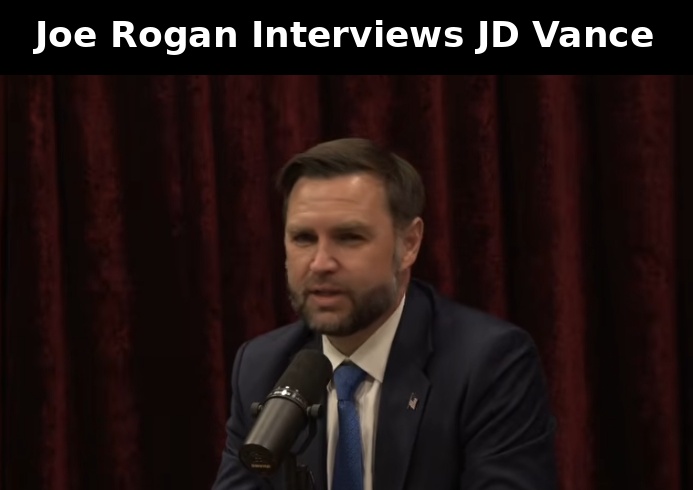
The following is the full transcript of U.S. Vice President JD Vance’s interview on Joe Rogan Experience #2526, July 15, 2026.
Editor’s Note: In this episode of The Joe Rogan Experience, Joe Rogan sits down with JD Vance for a wide-ranging conversation that touches on everything from the surreal experience of attending a UFC event at the White House to the stark realities of urban decay in cities like Los Angeles. The pair delves into complex political issues, debating the factors driving crime in American cities, the impact of current Democratic leadership, and the shifting demographics of the Republican party. Throughout the interview, Vance articulates his vision for the country, emphasizing his commitment to policies that prioritize public safety, economic stability for the working class, and the restoration of law and order.
The White House UFC Event
JOE ROGAN: So last time we talked, last time I saw you, we were at a cage fight at the White House.
JD VANCE: That’s right. That’s one of the craziest experiences of my life. It must have been one of the craziest experiences of your life.
JOE ROGAN: Oh yeah, it took me like 2 weeks afterwards to recover, just to go, did that actually happen? It seems so insane.
JD VANCE: The most insane part of it, which I guess was before you got there, to me at least, is like you come into work every day in the White House, right? I have an office in the West Wing. There’s the Oval Office in the West Wing and you look out the window and as this like 8-story complex was growing up, it was just the most unbelievable thing. It’s like the South Lawn of the White House but you’ve got the 8th Wonder of the World being built up around it. And every day I’d look at it and be like— it would take me a couple seconds. I’d be like, what the hell is going on? And I’d be like, oh yeah, it’s UFC. It’s UFC coming in a couple weeks.
JOE ROGAN: The whole thing was surreal. First of all, it was crazy that the weather just went around us. Like, there was a real moment where the fights would have been postponed until 10:30 PM to start, correct? And last minute, the storm just—
JD VANCE: That’s right.
Book Tour and the Weather
JD VANCE: Well, and this book that I have, that I guess we’ll talk about a little bit, the book tour started the next day. So I was flying to New York the next day to talk about it and all I could think about is every time we got the update from White House weather, oh, it might not start until 10:30, I was thinking to myself, holy shit, that means I’m going to go to bed at like 4:00 AM. I’m going to look like a total crazy person when I try to go talk about this book.
But yeah, it amazingly did work out. Honestly, it actually helped a little bit because, as you know, it was hot as hell out there. Yeah, super humid, mid-June in DC. And I think the weather actually helped cool it down a little bit because by about 10 o’clock or so, I was not thinking it’s hot as hell out here anymore.
JOE ROGAN: Yeah, it wasn’t too bad, but I talked to Justin Gaethje about it and he said it was a problem when he was fighting. He said the air was very thick. Like, right after the first round, he was like, yeah, boy, this is rough because that hot, humid air.
JD VANCE: Yeah, it’s fine walking around. It still feels— it is a swamp, right? That’s why people call it the Swamp. So obviously June 14th, that’s the—
JOE ROGAN: That’s not why they call it the Swamp.
JD VANCE: That’s one of the reasons why they call it the Swamp. They call it the Swamp because of my colleagues, because it’s filled with mud and water and gunk and shit.
JOE ROGAN: And swamp monsters.
JD VANCE: Oh, man. So that’s June 14th. So it’s the president’s birthday. That was also my 12th wedding anniversary.
JOE ROGAN: Oh, wow.
JD VANCE: And my wife— so that’s the one thing, like, if somebody runs in here, it’s because my wife’s going into labor because she’s like 39 weeks pregnant. But I remember we go out to dinner like right before the UFC fight and we’re, of course, checking the weather report to figure out what’s going on. And my wife normally likes to come to the cool stuff. Of being vice president, that was the one where she was like, it’s hot, I’m super pregnant, and I’m not going to sit out there for 6 hours.
The Atmosphere at the White House Fight
JOE ROGAN: Yeah, I couldn’t imagine. Also, it was just— there was so much chaos, and the potential for real chaos was always there. First of all, you have the Ellipse. So the Ellipse has, what, 85,000 people outside?
JD VANCE: That’s right.
JOE ROGAN: And for people that are watching at home, like, we could hear them. Like when the fights— when something would happen in like kind of a delayed way, right? You hear the cheers from the people that were near. So it was like 3,000+ people tightly close to the octagon, and then you had 85,000 people in the background. It was very eerie.
JD VANCE: Yeah, I actually loved that. Like, I love the delay reaction to where somebody gets a good punch in, or you get a takedown, and then it was almost like the wave. Because there was the initial center of it and then the people outside of it.
JOE ROGAN: It was pretty sick.
JD VANCE: It was pretty sick. It was very cool. I think Dana said not once in a lifetime or not once in a generation— a once in a lifetime experience.
JOE ROGAN: Yeah.
JD VANCE: Yeah.
JOE ROGAN: I don’t see any other president. I mean, if you become president, you’re not going to do that, right?
JD VANCE: I don’t know, man.
JOE ROGAN: I wouldn’t. I didn’t want to do it.
JD VANCE: It’s actually very cool. It’s a very cool thing.
JOE ROGAN: Get it over with. Do it once. It was the only time in the history of the sport where there’s been 7 stoppages. 7 knockouts. Like, every single fight was—
JD VANCE: Oh, I didn’t realize that.
JOE ROGAN: Yeah, every single fight. Okay, but the thing is, like, we’ve had 7 knockouts in a card. I think this last weekend we had 10 stoppages. But that was different because it was like 14 fights, right? Well, okay, all fights— every single fight was a knockout.
The Conor McGregor Fight
JD VANCE: So the last fight, when did you realize that was over?
JOE ROGAN: With Conor?
JD VANCE: Yeah.
JOE ROGAN: When he fell down a second time, I was like, oh, this is not good. The first time I thought he just slipped. It’s hard to tell. It’s wild. It’s in the moment. I thought he slipped. And then when he got up and he threw a kick again, I’m like, oh, I don’t like how his leg just gave out. That didn’t seem like— I’m still hoping he’s just slipping.
JD VANCE: Yeah, yeah.
JOE ROGAN: I’m hoping he’s just freaking out because he hasn’t been in the octagon in 5 years. And then he started moving around and he like grabbed his knee and buckled.
JD VANCE: Okay.
JOE ROGAN: And there was some conversation going on between him and Max Holloway, and I was like, Max is saying he can’t fight, like something’s wrong. And he’s saying, fight me. He’s like, get up. And so he lets him up, and then his knee buckles, then the referee stops the fight.
JD VANCE: Yeah, yeah. There— it’s always— so the very last fight where the ref tried to call it at the end of the 3rd round. And then because he was saying that there was a concussion issue. I mean, I couldn’t tell what was going on.
JOE ROGAN: This the Ilia Topuria fight? The Justin Gaethje fight at the White House?
JD VANCE: Yeah, the Topuria-Justin Gaethje fight.
JOE ROGAN: No, he couldn’t see.
JD VANCE: Okay.
JOE ROGAN: He was saying he couldn’t see well. Something was wrong with his right eye.
JD VANCE: Well, I mean, it looks like his whole face was puffed up so he couldn’t see anything. But okay, so I thought it was a concussion thing, but it was because of his vision.
JOE ROGAN: No, they never do that. I mean, the concussion thing would only be if someone had been battered. There’s a lot of times where fighters are fighting with concussions. Yeah, it happens all the time. Yeah, you get dropped in the first round, you probably have a concussion. Yeah, you get back up, you keep fighting, you’re fighting on instincts. There’s been many times where fighters wake up in like the 4th round.
JD VANCE: Sure.
JOE ROGAN: And they’ve fought 3 rounds and they don’t remember it at all.
JD VANCE: Oh my God, that’s pretty crazy.
JOE ROGAN: Not the best way to make a living.
Justin Gaethje’s Future and UFC vs. Boxing
JD VANCE: Not the best way to make a living, man. Yeah, so we saw Gaethje at the White House a couple of weeks ago and I asked him, I was like, so are you done fighting? And he kind of hesitated a little bit, and then I think it was his mom was in the Oval Office with him. She’s like, yes.
JOE ROGAN: Yeah, but if they offer him some life-changing money for one more fight after that performance, I have a feeling he’ll take it.
JD VANCE: Like, what could he fetch for his next fight? Like $50 million more?
JOE ROGAN: It’s a good question. I don’t know what his contract is. I don’t know how it works. I don’t know what the most anyone’s ever— I try not to pay attention to that stuff. Because I’m not on the business end of the sport.
JD VANCE: Yeah, it can color your perception a little bit.
JOE ROGAN: It can. I mean, I want them to get paid the most amount possible, right? That’s my perspective. But my job is just to analyze and to see what’s going on and to commentate and try to give color and life to what’s happening inside the octagon. And I try not to dwell too much on the money. I just want them to get paid a lot. I want them to be able to retire and never have to do anything ever again.
JD VANCE: Sure.
JOE ROGAN: I don’t know if Justin could do that.
JD VANCE: What’s crazy about it to me is just how much the sport has replaced boxing. And like, there’s still— obviously boxing is still a big deal and fighters still get paid a lot of money, but like, I remember when I was in high school, I feel like people would get really excited about the big heavyweight title bout. Now it’s the UFC thing.
JOE ROGAN: Yeah.
JD VANCE: So culturally, it’s like UFC has taken over boxing. And I don’t know how or why that happened. Like, I don’t know if it’s just good marketing or if just the fights are so much more real and intense. But it is a crazy shift that’s happened in 20 years.
JOE ROGAN: Well, I had some friends this past weekend that manage fighters. My friend Josh Dubin and a few other friends that actually manage boxers. Come to the UFC, and they were all like, oh my god, this is so much better than a boxing promotion.
JD VANCE: Yeah.
JOE ROGAN: Because all the fights are exciting. With boxing, most people are just there for the main event, and a lot of people don’t even stroll in until like 15 minutes before the main event. Like all the famous people that sit in the front row. In the UFC, that place is packed for the 5, 6, 7 fights in.
JD VANCE: Yeah.
JOE ROGAN: You know, there’s 14 fights in the night and all of them are amazing. It’s like in the beginning it’s usually like half full depending on where you are. If you’re in a place like Salt Lake City, it’s pretty packed like right away because they only get like one event every year or so. But it’s just a more exciting sport. There’s more ways to win. It’s more dynamic. More things happen.
JD VANCE: Yeah, yeah.
JOE ROGAN: And there’s more stars. There’s so many stars in the UFC.
Experiencing a Live UFC Fight for the First Time
JD VANCE: Yeah. So I’d never seen a fight live before. Like, I’ve watched them on TV, but I’d never been there live. So kind of crazy that it’s literally in the South Lawn of the White House. But the thing that I found completely shocking about it was, like, I would think those armbar takedowns are just done. Like, that’s it. You’re over. But there were a couple of times where somebody had another person’s arm.
JOE ROGAN: Yeah, that was Josh Hokid and Derrick Lewis. Bless you.
JD VANCE: And it’s like, holy shit. Yeah, he just had your arm broken off.
JOE ROGAN: He wasn’t—
JD VANCE: He didn’t—
JOE ROGAN: He wasn’t doing it right.
JD VANCE: Okay.
JOE ROGAN: Josh Hokid is a great wrestler.
JD VANCE: Yeah.
JOE ROGAN: And he’s an excellent fighter, but he’s not really a submission specialist. I mean, he did get the armbar, but he didn’t do it right.
JD VANCE: Okay.
JOE ROGAN: He was basically like pulling on— you have to elevate your hips and you have to create space so that the arm is bending back this way. Yeah, his arm is essentially flat to his chest, which is not what you want. What you want is a back arch like this where you see like how it is right there.
JD VANCE: Yeah, yeah.
JOE ROGAN: So what he wants to do here, what he should do instead of having his hips down, his knees up, what you’re supposed to do is heavy leg curls with the leg and elevate the hips up and pull it way back. So he’d almost be bridging it. He would be on the top of his shoulders and bridging, and then he would have broken his arm. The other option is you pull it off to the side like this.
JD VANCE: Yeah.
JOE ROGAN: And you put it to the side of your hip and you can break it that way.
JD VANCE: Okay.
JOE ROGAN: But it’s just bad technique. Yeah.
JD VANCE: Okay. So watching it—
JOE ROGAN: No offense, Josh.
JD VANCE: Yeah, yeah. Watching it, I didn’t realize that. I just could not believe that dude held out for like 30 seconds.
Michelle Obama Comment and the Outrage Economy
JOE ROGAN: Was that more shocking or when he said Michelle Obama is a man? Which one was more shocking?
JD VANCE: Definitely the armbar part. I work in politics, people say crazy stuff all the time.
JOE ROGAN: Well, he says that every fight.
JD VANCE: Does he?
JOE ROGAN: Yeah, yeah, he said that the last time I interviewed him.
JD VANCE: Oh man. Well, it’s—
JOE ROGAN: He’s like a pro wrestling character.
JD VANCE: Like, people lost their minds about it.
JOE ROGAN: I know.
JD VANCE: Lost their minds about it to the point where, again, I had The View either the next day or the day after to sort of promote this book.
JOE ROGAN: That must be fun.
JD VANCE: It was crazy. It was harder than anything I’ve done in politics, but to the point where all of my comms people, the thing they were most worried about was they’re going to ask you about Michelle Obama being called a man. What are you going to say about it? And I was like, what, an amped-up fighter told a joke after a fight? Said something after a fight and that’s actually national news? I’m still surprised. I’ve been in politics now for 3 or 4 years. I’m still shocked the shit that people get really fired up about. Well, I kind of understand it.
JOE ROGAN: It’s at the White House. First of all, a cage fight at the White House is crazy already. I mean, if he said Michelle Obama’s a man at the T-Mobile Arena in Vegas, it’s like, okay, less of a story.
JD VANCE: He—
JOE ROGAN: What he is, is he’s a very good fighter, first of all. But sometimes that’s not enough to get attention. And so what Josh has done is created this persona, like this pro wrestling bad guy persona. When you talk to him offstage, he’s like very normal. Yeah, smart guy. Yeah. It’s just like he’s decided, look, I want to maximize the amount of eyeballs that see me, and I’m going to create this crazy persona. He comes out to the Hulk Hogan song, “I’m a Real American.” That’s right. He has sunglasses on, an American flag bandana. That’s right. He’s—
JD VANCE: I mean, I love the presentation.
JOE ROGAN: Got character.
JD VANCE: I love the presentation, but again, like—
JOE ROGAN: Not the best thing to say at the White House. Michelle Obama’s a man is not the best thing to say.
JD VANCE: Fair. But the reaction to it to me was still totally disproportionate.
JOE ROGAN: Yeah, of course.
JD VANCE: Dude, people say stuff all the time and what I— okay. I work in a business where obviously people make life decisions, life and death decisions all the time and I’m always a little bit caught off guard by the culture that just overreacts when clearly the thing that Josh is trying to get is the overreaction in the first place.
JOE ROGAN: Right.
JD VANCE: So you give him exactly what he wants. And like the worst you could say is, “Oh, that was an offensive comment,” and you get on with the rest of your life. Like, that’s the worst that you could say. The people who really flip out about it and kind of lose their minds, I just— I don’t understand that.
JOE ROGAN: Well, first of all, I think a lot of it is there is an economy that is essentially based on getting reactions.
JD VANCE: Correct.
JOE ROGAN: And there’s a lot of people that are just, for a lack of a better term, they’re not real. Their reactions are performative. Like, a lot of what they’re doing is just trying to comment on things and get clicks and likes and views. And social media has ruined discourse in a lot of ways because people—
JD VANCE: It has—
JOE ROGAN: People are not having like real conversations about things. They’re reacting to things on Instagram and Twitter. And you know, they’re just— they look at an opportunity like that like, “Oh, I found a gold nugget. Like, this is going to give me money, or this is going to give me attention. This is going to get— oh, I can’t wait to have a take on that.”
JD VANCE: That’s exactly right. So, but okay, so my response to that is so many things is like, “Oh, he was being funny, he was being outrageous,” and I just move on with my life.
What I find very interesting is the people who say, “Oh, that was a joke.” When Kill Tony— do you remember he told like the Joker around the world in Madison Square Garden during the 2024 election? I remember getting into an argument with somebody about this and it may have even been like in an interview, but I don’t remember. It could have been private too. Anyway, I’m like, “He told a joke.” And the person’s response is, “Well, it’s not a very funny joke.” And my response to that is, you know what happens when somebody tells me a joke that’s not funny? I don’t laugh and then I move on with my life.
This whole industry around outrage, especially getting outraged around humor, I think is actually really hurting the country.
Tony Hinchcliffe and the Art of the Heel
JOE ROGAN: Well, in that case, first of all, I told Tony a long time ago that joke was going to get him stabbed. I really did. He even jokes around about it on stage. He talks about me telling him, “That’s the one, dude. That’s the one that’s going to get you stabbed.”
JD VANCE: Any good joke at least is going to run you some risk of being stabbed.
JOE ROGAN: A racial joke, and that joke being about Puerto Rico. By the way, no one takes a joke better than Puerto Ricans. Puerto Ricans are some of the best people at telling jokes. Like, there it is, a culture of joking and f*ing around with each other and talking shit.
JD VANCE: Absolutely.
JOE ROGAN: They’re great at it. Yeah. So like, yeah, I served some Puerto Rican guys in the Marine Corps, man.
JD VANCE: That’s absolutely true.
JOE ROGAN: They love him still.
JD VANCE: Yes.
JOE ROGAN: You know, like, even after that joke. Yeah.
JD VANCE: You advised him not to tell that joke?
JOE ROGAN: Well, I was kind of half joking, you know. Tony, that’s what Tony does. You know what, I just said that’s the one that’s going to get you stabbed. But I mean, that’s what Tony does. Tony is like the Josh Hokit of comedy. Like, he— but very talented, you know. He’s a really good— he’s a roaster. He’s like, roasting is his specialty. But it’s also like he’s trying to ruffle people’s feathers. That’s what he wants to do.
JD VANCE: Yep.
JOE ROGAN: He wants to piss people off. Yeah, that’s— he likes being a pro wrestling heel. He’s a huge pro wrestling fan.
JD VANCE: Well, so Tony, I’m a huge fan of his comedy. I’ve only met him a couple times. I don’t know him particularly well. But he’s actually more political, I would say, than most comedians. Do you think that’s fair? Yes.
JOE ROGAN: Well, very supportive of Trump.
JD VANCE: Like he’s on the Republican team?
JOE ROGAN: Yes. He’s on the Republican team? 100%. It’s because he’s experienced so many loony left-wing people in California, and that’s why he had to— well, somebody sent me a clip.
JD VANCE: I think it was Shane Gillis at a roast where the joke was they were roasting Tony and they’re like, “Tony Hinchcliffe is the only dude who would be excited if JD Vance was here.” And I was like, one, that’s a very good joke. And number two, I feel like I had made it. Like, there have been a few moments where I feel like I’ve made it. When South Park—
JOE ROGAN: You’re the Vice President of the United States. I think you made it.
JD VANCE: When South Park spoofed me, I felt it more than when I got sworn in as Vice President of the United States.
JOE ROGAN: That’s hilarious. That’s very funny.
Moving to Austin and California’s Decline
JOE ROGAN: Tony is— I mean, that’s his style. Like, he loves being the heel. He’s in Austin, right? Oh yeah. Oh yeah. He’s one of the first people that moved out here with me.
JD VANCE: Okay.
JOE ROGAN: Yeah. I mean, we’ve been here for 6 years now.
JD VANCE: Yeah.
JOE ROGAN: And every time we go back to California, we’re like, we were right.
JD VANCE: Yeah, absolutely right.
JOE ROGAN: It’s falling apart. It keeps going further and further down the toilet.
JD VANCE: Well, how do you feel like Austin is going? Because the criticism of Austin, call it 5 or 6 years ago, is that all the— like, it’s a cool town. It’s got its own unique culture. It’s Texas, but it’s also its own thing. But that all of the blue staters moving in were going to like totally change the politics and the culture of Austin. I actually don’t think that’s happened.
JOE ROGAN: I think the blue staters that moved here moved here because they recognized that wherever they were living was not tenable.
JD VANCE: Yeah.
JOE ROGAN: It was falling apart. And all of these places like New York and really California, like especially Los Angeles and San Francisco, they’re falling apart. And I have a bunch of friends that are stuck there that can’t move. Like maybe they have family there or maybe they have a business there.
JD VANCE: Yep.
JOE ROGAN: And they f*ing hate it. And then I have a bunch of people that are trying to move, but they can’t sell their house. Like it’s nuts there, man. I don’t think people— first of all, you get gaslit by Gavin Newsom. I mean, he’s just gaslighting everybody about how well, you know, the GDP of like the 5th largest country in the world. That’s what California is.
California’s Decline and Election Integrity
JD VANCE: It’s like, dude, hey bro, it was like that before you were the governor. Yeah, exactly. Also, how much does a U-Haul cost if you’re leaving California? How much does it cost if you’re going to California? Because that’s the real measure of whether a state’s doing well.
JOE ROGAN: Yeah, the state has more people moving out than moving in, and that has never happened before.
JD VANCE: Correct.
JOE ROGAN: California— when I moved there in 1994 until I left, it was always every year traffic got worse, every year more people moved there, every year. And I loved it. I loved it. I loved it from the time I moved there. I was like, this place is great. It’s warm all the time. The weather’s fantastic. There’s so much cool stuff to do. The people are great.
JD VANCE: Yeah.
JOE ROGAN: And then politics ruined it.
JD VANCE: That’s right. So my wife’s from Southern California, San Diego. And so we spent a fair amount of time there. And I just— I mean, I still feel a certain sense of like heartbreak over L.A. Oh, I do too. Because every time I’m in L.A., you can see why this was like the quintessentially American city. The architecture is beautiful. It’s got its own vibe going on. Like you said, the weather is amazing. And then you drive through Skid Row and you’re like, how could any state or any city let this happen?
JOE ROGAN: Skid Row is now 55 blocks. It was 50 blocks just like a year or two ago.
JD VANCE: Okay. So my first experience with Skid Row was— so Usha used to work at this like very fancy litigation firm. In Southern California. Before she was second lady, she was a corporate litigator. So there’s a Christmas party in downtown LA and you get these instructions from her firm and they’re like this really convoluted way of this is how you have to get to this Christmas party and I’m like, why do I have to follow these directions? Why don’t you just put it in Google Maps, right? This is like 5 or 6, 7 years ago.
So we realize that the reason why they gave you these convoluted directions was so that you could avoid Skid Row at night. And so you get to this party. You drive through Skid Row if you follow Google Maps’ directions. You get there and it’s like this beautiful facility with like fancy food and fancy wine and then there are armed guards outside of it and these gigantic walls and I realized when I was there, you know what this reminds me of? This reminds me of going to the US Embassy in Port-au-Prince, Haiti. Like super security, crazy wealth and privilege and status on the inside and squalor and misery on the outside. Like it’s the first time I’d ever thought America— like this part of America is actually more like a third world country than anything that I thought we’d ever become.
Why Big Cities Go Blue
JOE ROGAN: Let me ask you this.
JD VANCE: Yeah.
JOE ROGAN: Why is it that large population centers like places like Los Angeles and New York are almost always run by the Democrats.
JD VANCE: Yeah.
JOE ROGAN: Like, what is it about— first of all, what happened with the last election in Los Angeles, the just the primary, I think was crazy. So super sus.
JD VANCE: Yes.
JOE ROGAN: And here’s why it’s super sus. Not just super sus that Spencer Pratt, who was in second place, got overtaken by Nithya Raman in the mail-in ballots. But that the mail-in ballots also passed a tax hike. The people voted to pay more taxes.
JD VANCE: Yep.
JOE ROGAN: In a state where you have the highest taxes. That’s right. They’re like, we don’t pay enough. That is insane. And then when you have direct evidence that they were recruiting homeless people.
JD VANCE: That’s right.
JOE ROGAN: And they were getting homeless people and giving them cigarettes and cash. There’s evidence of this.
JD VANCE: Yes.
JOE ROGAN: To use their address and mail in ballots.
JD VANCE: Yeah, I wouldn’t be the Californian Joe who wakes up in the morning and says, you know what? I’m going to go and vote for higher taxes because I don’t pay enough taxes.
JOE ROGAN: I feel like we could fix this if I just paid 5 more percent. That’s right.
JD VANCE: If I just paid 5% more taxes. The crazy thing about it too is it’s that— okay, so after the initial ballots all came in, it was Karen Bass was number 1, Spencer Pratt was right behind her, and then number 3, whatever this woman’s name is.
JOE ROGAN: Nithya Raman.
JD VANCE: Nithya Raman, okay. So you would expect the mail-in ballots to be more or less like the original ballots in terms of 1, 2, and 3. I’m not saying Spencer Pratt is going to win the mail-in ballots, but it just so happened that the 3rd place person in relative terms did a lot better than the 1st and 2nd place person.
JOE ROGAN: Disproportionately better.
JD VANCE: Such that the Republican was actually kicked out of the race so that there’s not actually a real election in California. That to me was the crazy part. It’s like you were designing the vote share in order to kick Pratt out and put the third person into second place. That to me is like very, very bizarre because what is the theory of the mail-in vote that is somehow like so much more pro-Nithya relative to Karen Bass?
JOE ROGAN: Makes no sense.
JD VANCE: Makes no sense.
JOE ROGAN: Makes no sense. Why would it be? Why would it be? I mean, Karen Bass was ahead by every metric.
JD VANCE: Yeah. But I mean, okay, so you ask the question, why do all these blue states or why do all these big cities, population centers end up becoming blue? And I think it’s like very complicated, right? So one thing, and you said this a few months ago and like when you said it, I was like kind of annoyed by it. But then I like thought there’s like an element of truth to it, which is that Republicans still fundamentally have a cool problem, right? There’s something more charismatic, more cool about the Democrats as opposed to the right.
JOE ROGAN: Does it?
JD VANCE: So you said something about there are too many dorks or something on the right.
JOE ROGAN: There’s a lot of dorks.
JD VANCE: Fair. I’d say there’s a lot of dorks on the left too.
JOE ROGAN: There’s a lot of dorks on the left too. But it’s a different kind of dork.
JD VANCE: It’s a different kind of dork. But the point is that there’s something, if you’re a pop star, you’re a rock star, you’re an actor, you’re in all these cultural centers. You’re more likely to be left than right. So I think that a lot of young people who are attracted to these population centers, they sort of move along with the prevailing culture. I think that’s one thing that’s going on.
I think a second thing that’s going on is the people who are sort of attracted to a certain kind of right-of-center politics, they want the suburbs. They want the single-family home. They kind of want to be left alone. They don’t want sort of to be able to hear what their neighbors are doing. So I think a little bit of it is just cultural self-segregation. And that’s meant that a lot of these population centers have gone blue.
But it’s very complicated. I’ve thought about this a lot and I also just— man, I’m not one of these people who says we should just abandon California to the Democrats, like let them deal with their own problems. I think California is like a quintessential part of the American dream. Like if you just abandon California, you’ve like lost something very core to American culture. And I just— I don’t want to give up on it. Like, I’m not saying we’re going to win California in my lifetime necessarily, but I don’t like the idea of giving up on it.
Mail-In Ballots and Election Fraud
JOE ROGAN: Well, it’s not just giving up on— I mean, giving up on it would be terrible. It’s an awesome state. The real problem is it’s deeply corrupt. I mean, deeply, deeply corrupt. And what they’re trying to do is make it impossible for the other side to win. And there should be laws against that. First of all, the idea of mail-in ballots for anybody other than people who are invalids, who can’t leave their homes, or military, or people that for some reason they’re serving overseas, they’re doing something overseas, it should not be legal.
JD VANCE: That’s right.
JOE ROGAN: And the fact that it became ubiquitous during COVID is a giant problem.
JD VANCE: Yeah, so this raises one of my— total segue here, side point— but so if you remember in the aftermath of the 2020 election where there was all this like debate about was the election stolen, was the election not stolen, all the litigation that moved through. There was a case in Pennsylvania that like didn’t get very much attention and I’m going to butcher it a little bit but basically, it was a guy in a rural area of Pennsylvania saying, you’re undercounting my vote because we didn’t have the opportunity to do the mail-in ballots like they did in Philadelphia and Pittsburgh. Like the argument was a kind of disparate impact, right? The cities ginned up all the mail-in balloting and the ballot harvesting. You didn’t do that in the country. And that hurt sort of our representation.
So they take this case to the Pennsylvania courts, and what’s crazy is the Pennsylvania courts basically say, you’re making kind of a good point here. Like the ballot harvesting did affect Republicans in a more negative way. It did mean that certain people in the more rural parts of the state were underrepresented, but then the court conclusion was, this is not a problem a court can fix. Like that’s a political problem. Change your local elections leaders. Change your laws. Like that’s not a remedy that the court has to fix.
And so everybody saw that case, and they’re like, oh, the judge rules against Donald Trump, rules against Republicans for saying that there was something illegitimate. But no, actually, the judge kind of said, there is something kind of fishy here. We’re just the wrong venue to fix it.
JOE ROGAN: Well, it’s just very disheartening that you have to consider the fact that it’s really possible that the elections get stolen. And the California one was a big one for me.
JD VANCE: And why not just have mail-in, or why not just have voter ID? Yeah, you actually saw— that’s insane.
JOE ROGAN: Not only did they not have voter ID, you can’t show your ID. You’re not allowed to show your ID.
JD VANCE: You can in fact be like prosecuted if you try to force somebody to show their ID.
JOE ROGAN: Which is— that seems like you want people to cheat.
JD VANCE: Exactly.
JOE ROGAN: And is this from the same people that were saying you have to have an ID that shows you’ve been vaccinated just 4 years ago.
JD VANCE: To go grocery shopping or to go to a restaurant. Yeah. No, it’s definitely— that’s the part about it that I think makes most people of my political persuasion skeptical of what the Democrats are doing. Like if you don’t want to cheat in the election, then just make everybody actually show an ID.
Another thing people don’t realize is— I didn’t realize until a couple of years ago. The voter ID solves a lot of the mail-in ballot problems. Because if you have to show an ID in order to get a mail-in ballot, in order to actually confirm that there’s a real identification attached to that vote, that solves a big chunk of the problem too.
JOE ROGAN: It’s just logical.
JD VANCE: Yes.
JOE ROGAN: Like, I don’t—
JD VANCE: I’m not skeptical. Every country does it.
JOE ROGAN: I’m not skeptical. I’m accusing them. I think they stole the election. Yes. And I think it’s common. And this idea that elections can’t be stolen. I always say to people, okay, do you think that the amount of election fraud is 0%? No one thinks that. Yeah, no one thinks it’s zero. There’s always some overzealous person that works somewhere that’s doing something. There’s always crazy people that are like, blue no matter who, we gotta win, or red no matter what. There’s always people right and left that are going to try to rig the election because they think it’s imperative.
Our nature, like look, we saw there was people like Oprah Winfrey was saying it, like, “If we don’t win this election, you may never vote again.” Like, what the f* are you talking about?
JD VANCE: Like, why?
JOE ROGAN: Who’s going to tolerate that? Left or right? That’s crazy.
JD VANCE: That’s right.
JOE ROGAN: But that attitude allows people to justify cheating.
JD VANCE: Correct.
Voter ID and Election Integrity
JOE ROGAN: And I think they cheat, and I think they’ve been doing it forever, and I don’t think there’s any other reason why you would have no voter ID. And they try to say, “Oh, it’s racist to have voter ID.” Like, what are you talking about? Do you think other races are incapable of going to the DMV?
JD VANCE: That’s insane. That’s racist. It’s actually super racist. That’s really racist. The implication of their argument is literally like blacks and Hispanics cannot go to the DMV to get an ID. By the way, if you look at the polling, black Americans are as pro-voter ID— even though most black Americans vote Democrat, they’re still pro-voter ID as much as white Americans is.
JOE ROGAN: Most Americans want voter ID except for operatives.
JD VANCE: So I’ll offer on the Joe Rogan podcast this deal as vice president of these United States, that if Democrats really don’t think that there’s any cheating, give us voter ID,
JOE ROGAN: I just don’t know how it’s not—
JD VANCE: and we’ll stop talking.
JOE ROGAN: Why is that not a federal thing?
JD VANCE: We are trying to make it a federal thing. So we are right now trying to pass the Save America Act. One of its main provisions is a requirement that you do voter ID. And we actually have, I think, a majority of the Senate that would support it. But this is just weird Senate procedural bullshit.
There is a subsegment of people who want voter ID but won’t blow up the filibuster in order to achieve it. So they’re so married to these old-world Senate procedures that they’re going to make it impossible for us to pass Save America. Now we are, for what it’s worth, trying to fix that and trying to address these weird procedural archaic things.
It’s insane though. I’m sure you hear people talk about the filibuster all the time. I don’t want to go too far down this rabbit hole. Here’s what the filibuster is. It is a pure Senate rule. It is a creation of the Senate procedures which basically says that anything that has to do with the budget is a 50-vote threshold and anything that— everything else, non-budgetary, is a 60-vote threshold.
Now, as you can imagine, there’s some gray area on things that maybe count as budget issues and should be 50, or are not budget issues and count at 60. So what we have tried to persuade the Senate to do is to treat the voter ID as something that can fall within the 50-vote threshold, and there is no law, there’s no provision in the Constitution. It is legitimately that there are senators who are so attached to the idea that budget is 50, non-budget is 60, that they’re quite literally willing to prevent voter ID in America. God. It’s nuts, dude.
JOE ROGAN: It’s so crazy. And it’s also like the idea that somehow or another— like Kathy Hochul had the craziest take on it.
JD VANCE: She often does.
JOE ROGAN: Did you see her take on it?
JD VANCE: I have not.
JOE ROGAN: She was talking about Black people in inner cities not even knowing what a card computer is. Did you ever see that?
JD VANCE: No, I didn’t see that.
JOE ROGAN: Oh my God, it was so crazy. And then this one comedian, this Black comedian did this hilarious video where he was like circling around a computer staring at it, like touching it, like he didn’t know what it was. It’s just like, what are you talking about? Everyone has a phone. That’s a computer.
Democratic Talking Points and Gavin Newsom
JD VANCE: So many of these Democratic talking points presume that their own voters are actual idiots. There’s actually a big difference between— Republicans, we sort of presume that our voters are adults, and you don’t see that with— I’m not saying every Democrat, of course. I don’t want to cast too broad of a brush here.
But it’s like Gavin Newsom did this speech a few months ago. The president and I think it’s the funniest thing ever because he’s like speaking to a group of black leaders and black businessmen. But it’s like an audience that is 95% black. And they’re asking him about his dyslexia and his struggle with education, and he basically says, “Yeah, I’m not very smart like a lot of you.” And it’s like, whoa. “I’m like you, I can’t even read.”
JOE ROGAN: Meanwhile, there’s a ton of interviews where he’s talking about all the books he reads. Like, he’s so full of shit.
JD VANCE: Yeah, he’s full of shit, but it’s—
JOE ROGAN: Admirably full of shit. But I admire the f*ing sheer tenacity that he has in being full of shit because it’s amazing.
JD VANCE: It really is amazing. But it speaks to the incentives of— there’s kind of like— look, there’s a real populism that I’m very much a fan of because I think you should be responsive to people. But there’s like a faux populism of the way that I’m going to appeal to people is by assuming that they’re idiots and acting like they’re idiots.
JOE ROGAN: Yeah.
JD VANCE: And then— but if you’re committed enough to that bit, eventually it kind of leaks out what you’re doing. And I think that’s— that was sort of what Gavin did there, is he told on himself a bit.
JOE ROGAN: Well, it was just— he’s bizarre.
JD VANCE: I will say, I’ve only met Gavin— I think I’ve only met him one time in my life. And it was such a crazy experience. So the debate between Biden and Trump during the 2024 cycle, and I’m there, I’m actually doing an interview for a documentary when the debate starts. And there is this clip of me. The debate starts. I am in the middle of this interview. There is a big screen behind me as I am talking to the camera which is here, and I kind of freeze and I look back at the TV and I am like, “Oh my God! Like, this is actually happening.” Biden is imploding, because if you remember, it was obvious from the get-go.
So I go to the spin room afterwards and that’s where all these reporters and all the surrogates of the candidates— this is before I was the VP nominee. And I’m just talking about how great the president did, how bad President Biden did. I see Gavin Newsom there and he literally looks like he’s seen a ghost. Like, I’ve never seen a person who, as good of a bullshitter as he is, who realized there was no selling that performance.
But can you imagine— like, try to put yourself in the perspective of a human being. I always try to be empathetic where Joe Biden has just had that debate and you have to go on CNN to talk about how great of a job Joe Biden did.
Biden’s Cognitive Decline and the Media Cover-Up
JOE ROGAN: Well, my favorite is Joe Scarborough, because Joe Scarborough before it was like, “I’m going to say something and f* you if you can’t take it. This is the sharpest Biden we’ve ever seen.” Have you ever seen that?
JD VANCE: No, I haven’t.
JOE ROGAN: Oh, it’s amazing. And then after the debate, he’s like, “We got to get rid of him. He’s got to go. He’s got to go.” Hey, hey, hey, what did you say? You just said a couple of months ago this is the best Biden ever.
JD VANCE: That’s wild.
JOE ROGAN: Well, it’s like I wonder what was going on with that, because the debates were earlier than they’ve ever been before, and it seemed to me like there was a concerted effort to hide what was wrong with him.
JD VANCE: 100%.
JOE ROGAN: 100%. Everybody was bullshitting. Everybody was gaslighting us. We all saw it. I remember a friend of mine who’s super progressive, super liberal— when I talked about it on a podcast, I’m like, “This is crazy. Even if he wins, he’s not going to be the guy that’s the president. You’re going to have his cabinet that are running everything.” Turned out I was right.
And they were saying, “Oh, don’t you understand that he has a stutter?” And I said, “Where the f* was that stutter in the 1990s?” Like, that’s crazy. A stutter that only shows up when you’re 80? That doesn’t make any sense.
JD VANCE: Yeah, yeah.
JOE ROGAN: Like, this is a lie. You’re lying. He’s had 2 brain surgeries, like major brain surgeries, where they have to take the top of your head off. Literally, they have to take like a cap.
JD VANCE: Wait, Biden had 2 brain surgeries? Oh yeah. How did I not know this?
JOE ROGAN: You didn’t know this?
JD VANCE: I didn’t know that he had 2 brain surgeries.
JOE ROGAN: 2 brain surgeries. Jimmy, please look this up, make sure that I’m right. I’m 99% sure I’m right, but I know he had—
JD VANCE: Did he get a refund afterwards?
JOE ROGAN: Well, it kept him alive. It kept him alive. Here— “Biden has not undergone recent brain surgery. He underwent 2 successful life-saving brain surgeries to repair 2 intracranial aneurysms in 1989.”
JD VANCE: I did not know this.
JOE ROGAN: Yeah.
JD VANCE: That’s pretty crazy.
JOE ROGAN: “Medical professionals have stated that he made a full recovery and suffered no lasting brain damage or cognitive impairment from these procedures.” Oh, it’s from the Washington Post, so you know it’s accurate and definitely not biased at all. And these medical professionals, were those the same people that said that the COVID vaccine is safe and effective?
JD VANCE: That’s right.
JOE ROGAN: We live in a wonderful time for bullshit. It’s like, because they just bullshit you right to your face.
JD VANCE: We do.
JOE ROGAN: He had 2 brain surgeries, like major brain surgeries, because he’s having aneurysms. I don’t care who you are, that’s probably going to do some damage.
JD VANCE: Going to leave some aneurysms or leave an impact.
JOE ROGAN: A real problem.
JD VANCE: It’s a real thing.
JOE ROGAN: Your brain is bleeding.
JD VANCE: Yeah, people die from aneurysms all the time. See, that’s the crazy thing is I never even knew about that.
JOE ROGAN: How’d you not know about that? That’s nuts. I knew about it.
JD VANCE: Well, it speaks to how constrained our media environment is that even I had never heard that.
JOE ROGAN: Right. It was not a part of the narrative, certainly not from the Democrats. But yeah, it was clearly— I just don’t understand why they ran him in the first place. The whole thing made no sense. And then to have no primary and just stick Kamala in there, and then all of a sudden pretend that she’s the best thing ever. And like this idea— like a complete flip of her being the least popular vice president ever, always sticking her foot in her mouth, always saying crazy shit. “How dare we say Merry Christmas?” Remember that one?
JD VANCE: Like, what the f* is—
JOE ROGAN: What are you saying? Like, joy is bad? Merry Christmas is bad?
The Democrat Coalition and Biden’s Role
JD VANCE: Legitimately, when the campaign consultants told me, “Hey, we’re going to hit this line because Kamala Harris came out in favor of taxpayer-funded sex changes for illegal aliens,” I remember thinking to myself, “Come on, you guys. She didn’t really say that. It’s taken out of context.” And then I go and look at it. I’m like, “Holy sh, she actually said that.”
And she really was like the very worst version of what the Democrats were producing in 2020. The thing is they were all doing it because that was the incentives of the party. If you remember that debate where it was, “Do you want taxpayer-funded Medicare for illegal aliens?” Medicare is the program to provide healthcare to the elderly that people pay into for your entire working life. You see your little Medicare tax statement and the idea that we were going to give taxpayer-funded healthcare to illegal aliens, it was just insane. It was a 90/10 issue but their party in 2020 got kind of taken over by the radicals and I think actually maybe you’re seeing a little bit of that happening right now. Where it seems like the radical organizations, the nonprofits, the donors are pushing the party in a direction that most of the voters haven’t gone in.
Like you ask why Joe Biden was the nominee and I will say something in defense of Joe Biden. Was he the most effective politician? No. Had he had 2 brain surgeries? Yes, and clearly had shown the negative signs of aging. But he was kind of the only candidate if you go back to 2020 who could hold together the reasonable middle-class black American in the Atlanta suburbs with whatever is going on on the far left of the Democrat Party.
I think this is sort of the issue their party has. To be candid, our party has its own coalition problems and it’s always tough in a 2-party system to hold everybody together. I think it’s really tough on the Democrats because the core of their party, the most important voting bloc in the Democratic Party, is middle-class black Americans, socially moderate to even socially conservative, maybe a little bit more economically populist on certain business and tax issues. They don’t want to give tax breaks to major corporations. They also don’t want to trans the kids. That’s the base of their party. But then you’ve also got the crazy people and you have to kind of hold that together.
I think the argument for Biden was he was one of the only people who could hold that together, even though he was an awful politician in his own right, even before he was old.
JOE ROGAN: Well, it’s because he was Obama’s vice president.
JD VANCE: Exactly.
JOE ROGAN: And he’s established. He’s a known name and for the people that were kind of casuals that weren’t really paying attention to politics, he’s a proven commodity.
JD VANCE: That’s right. He doesn’t read as a crazy person to the general electorate, even though — “I got hairy legs.”
Biden’s Gaffes and Political Optics
JOE ROGAN: He would tell stories like, “Oh, I’ll tell you about Corn Pop.” Like, what the f* is going on?
JD VANCE: The thing I couldn’t get over with Biden is just bad staff work, man. The way that he ate ice cream — it’s like they would get him eating ice cream in the most ridiculous suggestive way imaginable.
JOE ROGAN: I never even paid attention to that. Oh my God. I never saw that ice cream.
JD VANCE: It was just such bad optics. There’s a clip I want to say from the 2016 campaign where somebody is campaigning in Iowa and it’s the Iowa State Fair, which is like one of the main things you go to when you’re running for president, and they give somebody a corn dog and somebody eats the corn dog and it becomes like a major news cycle for a long time. And I will never forget in 2024 —
JOE ROGAN: This is how immature we are.
JD VANCE: I know. You got to have a little fun sometimes though. But in 2024, somebody is holding up a sign at the Iowa State Fair at, I think it may have been one of Vivek Ramaswamy’s events. And the sign says, “Eat the corn dogs, you coward.” And it’s one of the best political signs I’ve ever seen.
JOE ROGAN: That’s funny. That’s funny. Yeah. You’d have to be a very manly man to be able to confidently eat a corn dog.
JD VANCE: I don’t know that I could do it, Joe.
JOE ROGAN: I eat them. They’re good. Yeah, but they taste good.
JD VANCE: Are you — I love corn dogs.
JOE ROGAN: I’ve been photographed.
JD VANCE: You’ve been photographed eating a corn dog?
JOE ROGAN: I’m sure someone has.
JD VANCE: What if —
JOE ROGAN: I’ve eaten corn dogs. The odds are —
JD VANCE: Much more interesting life than I’ve led. I try to eat my corn dogs. That’s between me and my kitchen.
JOE ROGAN: I’m not scared to eat a corn dog. I just think it’s funny that people — they’re so afraid of anything that looks like a dick. Bananas, corn dogs.
JD VANCE: You’ve got to be careful in your politics. This is an optics-based business.
JOE ROGAN: What are those popsicles? Yeah, yeah, yeah, I get it. I mean, that’s how crazy we are. That’s what weirds people out — the way someone eats a hot dog.
JD VANCE: Well, that’s where we are, man.
Defining the Extremes of Both Parties
JOE ROGAN: Yeah, the difference between the crazies and the real reasonable Democrats is so stark to me. And it’s also with the right — the party’s always defined by the worst examples of the right. You know, whether it’s Patriot Front or whether it’s Antifa.
JD VANCE: Okay, so who do you think is the worst example of our side? Who do you read about on our side and your reaction is “holy sh“? And don’t say J.D. Vance. This is going to be a very awkward interview. I’m screwed with you.
JOE ROGAN: Well, one of the things — I had James Talarico on the podcast, and one of the things that I think he has a really good point about, even though I know you’re Catholic and you’re very religious — putting the Ten Commandments in schools, I don’t think is the right way to do it. And this is a guy, Talarico, who was in seminary and is very Christian.
JD VANCE: Mm-hmm.
JOE ROGAN: He just thinks that even though he believes in the Ten Commandments, if you’re only representing the Christian faith in these schools, you’re forcing your religion into other people’s lives, and that this is going to push people away from Christianity rather than encourage them to pursue it.
The Ten Commandments in Public Schools
JD VANCE: Yeah, I mean, I think you never want to force things on people. And I do — I think one of the core Christian contributions to Western civilization is the idea of freedom of religion. It’s actually very much a Christian idea because you recognize the dignity of each individual and part of recognizing that dignity is that each person has to find their own pathway to God. You can’t force this on anybody. I don’t think putting the Ten Commandments up in school is like forcing things on anybody.
JOE ROGAN: But it’s public schools. So I mean, if you’re going to do that, why not put Buddhist scripture? Why not put Muslim stuff?
JD VANCE: You could make an argument why you should have a bunch of different religious tenets. I think in the Supreme Court, there actually are a lot of different sort of historical cultural legal documents that are up there and I want to say that Moses coming down with the tablet is one of them. But I think there actually are other cultural, maybe even other religious elements of this, where you recognize that a big part of the lawgiving tradition in Western civilization is some of these religious texts, not exclusively Christian religious texts. Obviously some Jewish. There’s an important contribution from the Muslim world in this.
So I guess I don’t think of it as exclusionary, while also recognizing that America is a society whose founders were people who were very much influenced — even if they weren’t Christians, and a lot of them of course were — by Christian culture in articulating American law. So my argument would be, even if you’re not a Christian, does seeing the Ten Commandments — let me put it a slightly different way. Does seeing the Ten Commandments force religion on a non-Christian child? My argument would be no, and I’d illustrate this by saying there are all of these ways in which you actually could try to force religion on a child, right?
JOE ROGAN: Well, it’s not the worst way to force religion on a child, but to have it and not represent any other religion — this is Texas, by the way.
JD VANCE: Sure.
JOE ROGAN: So what he’s talking about was that there are these Christian nationalists, these guys that are very wealthy, that are trying to fund Christian schools and trying to defund public schools or any other kind of religious school. And what they want to do — and they passed this — is to get the Ten Commandments in all public school classes. And he’s fundamentally opposed to that as a Christian because he thinks it’s going to force people to have this in their class, and it’s going to push people away from Christianity.
JD VANCE: I mean, I understand the argument. I just don’t see it that way. If I’m a non-religious student, and I’m sitting in there, and I see the Ten Commandments, at the very least, I think I can appreciate it. I mean, I talk about this in my book.
JOE ROGAN: What if you’re a Hindu? What if you’re a Muslim? And you are seeing that represented but not your faith?
JD VANCE: Well —
JOE ROGAN: It’s a public school.
JD VANCE: First of all, I’m pretty sure Muslims — I’m not hardly an expert on Islam, but I think all of the Abrahamic faiths recognize the Ten Commandments as a significant thing. But I think if I was a Hindu looking at the Ten Commandments — again, it’s hard for me to say this from my perspective, but I certainly went through an atheist phase in my youth. And what I would see that as, as a nonreligious person or a person of a different religion, is I would say this is an important cultural element of Western civilization, which is the foundation of the classroom that I am sitting in. And this idea that the law comes from and is sort of above any man, even if you don’t believe in God yourself, I think that is an important concept.
If you look at the Ten Commandments, probably 8 of them are something that I would hope everybody would agree with, even if they are not themselves religious. So here’s my view on it. I would not be offended if I sat in a classroom as a Christian, or if my kids sat in a classroom as a Christian, and saw a religious text that wasn’t Christian on the wall. I would encourage them to see that as a learning experience, try to understand things.
JOE ROGAN: What if it was from the Quran? What if it was a bunch of statements from the Quran?
JD VANCE: I guess it depends on what it was, right? If it’s something crazy, but no — if it’s something that is culturally interesting, I guess I don’t have a problem with my kid reading something.
JOE ROGAN: Because the problem is it’s mandated. Like if you have a classroom and the teacher is Christian, and the teacher wants to have it in their classroom, maybe that’s one thing. But if you’re mandating that you’re going to have the Ten Commandments in classrooms, that’s a different thing because now you’re pushing Christianity on kids. And this is Talarico’s position. And as a Christian, he’s saying, “I think this is going to push children away from Christianity.”
Religion in the Public Square
JD VANCE: So again, I understand what he’s saying. I just— I think that part of living in a society where you have different people with different perspectives, but you do have— I mean, Christianity is the majority religion of the United States. It is the religion that was extraordinarily influential to our founding, to the constitutional principles. Again, freedom of religion itself, not really a liberal concept. It was originally derived from a Christian idea about free will and the dignity of the person.
I think part of that is that you accept that you’re going to have exposure to different things and if a state legislator in a majority Christian state wants— it’s not like they’re putting the Ten Commandments in front of these kids and saying you have to read this and write it 500 times a day. They’re exposing kids to something and I’m comfortable with kids being exposed to a lot of different things. I think that’s part of living in a society where there’s a free exchange of ideas.
What I worry about with Talarico’s sort of perspective here is again I’m not saying that I don’t want kids to be exposed to anything that is outside of the Christian canon. Like I actually want my kids exposed to things— I write about this in the book— that I think it’s important to have a grounded enough faith that you can engage with a lot of different ideas and still ultimately sort of hold on to your Christian faith. But isn’t part of just living in a pluralistic democracy that people are going to be exposed to different things?
And I would kind of put it on Talarico in a slightly different way, that for a long time in this country, there were actually Supreme Court rulings that said that you cannot pray in a school, even a student organization led by the students, or that you cannot put the Ten Commandments up, even a teacher who chose to do it in their own classroom. And so I think you’re always kind of trying to strike this balance, you know, given that we have the First Amendment in this country between allowing the practice of religious faith in public spaces and possibly forcing religion on other people.
I think you have to strike that balance the right way. I guess I just say, is that if the Ten Commandments being in a classroom is the thing that you think is forcing religion on somebody, was he equally offended when the Ten Commandments were like quite literally prohibited from being listed in a public building?
JOE ROGAN: I don’t know if he was offended by that or if he was opposed to that. But the idea of being exposed to it is one thing. It being mandatory is another. And to mandate that in classrooms is a different thing because you’re promoting, clearly promoting Christianity. And his position is that promoting Christianity in that way is going to have an opposite effect on children. You’re pushing it on them. Instead, you’re not just exposing it to them, you’re pushing it on them. And especially if you’re pushing it on children who come from a household that has a different faith.
JD VANCE: I guess I just think the balance in our country the last 30, 40 years has actually been much more in the other direction. Which is that we try to completely remove religion from the public square. And I think that poses its own problems because people practice their faith in all kinds of ways.
JOE ROGAN: But don’t you think that that’s the responsibility of churches and synagogues and wherever— like if you want— and in the community, if you want to promote religion, promote it that way. But promoting in public schools should be just educational. And if you’re in a religious class and a class is teaching about religion, that’s a different story.
JD VANCE: Well, you’re right. It’s certainly the responsibility of churches and synagogues and mosques and so forth. But I also think that the late Supreme Court Chief Justice William Rehnquist sort of said this, that if your approach to religion in public life always and everywhere is to push it out of the public square, then you’re actually embracing a religion of your own in the public square, which is secularism. You’re just taking one religion and replacing it with secularism.
And I guess what I’m saying is I’m kind of comfortable with people of different faiths sharing the public square together. But part of that is that if I’m in a 95% Christian community and my local city council wants to put up a nativity display on Christmas Eve, I’m okay with that. And that was actually like for a long time in our country actually prohibited.
And so what I think is that we got— we sort of put ourselves in this frame in this country where we said, that every public display of religion is somehow illegitimate. But I mean I don’t know. I try to live my faith in a way that’s consistent across different spheres of my life. I don’t preach to people. I don’t like walk into the White House, tell my employees you need to be— you need to follow Jesus as your Lord and Savior. I just try to live my life in a way that hopefully makes people a little curious about what motivates me and what inspires me.
But I also don’t think that the expectation should be that we tell religious people they’re not allowed to be religious in the public square, because I think that’s what we’ve done over the last 30 or 40 years. I guess, you know, we can agree to disagree. I see the Texas thing as an attempt to correct that.
JOE ROGAN: Well, I think living by example is probably the best promotion of any good way to live your life, whether it’s Christianity or any other religion. I think that’s definitely the way to do it.
Bible Stories as Required Reading in Texas Schools
JOE ROGAN: But the point is that this is being promoted by very wealthy people who are Christian nationalists who want this to be— they want it to— what is going on here, Jamie? What do you got? Bible stories become required reading in Texas public schools. Yeah, see? Well, now that’s a— you’re taking it to another level. So this is June 26th. This is very recently. That is that kind of thinking, and that kind of mindset is what bothers me the most about some Republicans.
JD VANCE: I see what you mean.
JOE ROGAN: And then there’s the— there’s people that, again, they live their life in a very beautiful way, and they follow the teachings of Jesus Christ, and they’re very admirable, and I think that’s very attractive. And it makes people very curious about that religion. I think that brings people to Christ, and I think it brings people to religion.
But then there’s people like, did you read that report that came from at the start of the Iran War, where there was a guy who was an officer, noncommissioned officer, who was at a briefing? And this guy came in and was explaining to them that they didn’t need to be afraid because this war was important because Trump had been anointed by Jesus Christ to bring about his return. And the way they were going to— Jesus is going to return is by bombing Iran.
JD VANCE: I did not see that report. That sounds pretty far out there to me.
The Military Commander and God’s Divine Plan
JOE ROGAN: This is the kind of right-wing thinking. So here it is. “Military commander tells troops bombing Iran is part of God’s divine plan.” So we started getting calls in the wee hours of Saturday morning from people saying their commanders were just jubilant about this, trying to tell people, don’t worry, it’s all part of God’s plan. They promised a 200-mile-long river that is 4.5 feet deep filled with nothing but the blood that their weaponized version of Jesus will spill at the Battle of Armageddon, Weinstein says. But what was the one— there was an article where the guy was explaining the actual quotes that the one officer was telling him, the one commander. Yeah, but it’s not that. It was very specific. It was very specific what he said.
JD VANCE: I mean, for what it’s worth, my attitude on this stuff is, I mean, first of all, as a Christian, you sort of believe that everything is part of God’s plan. Even things that are ultimately very terrible. I mean, you kind of have to make a correlation.
JOE ROGAN: Hold up, let me read the quote. “He urged us to tell our troops that this was all part of God’s divine plan, and he specifically referenced numerous citations out of the Book of Revelation referring to Armageddon and the imminent return of Jesus Christ. He said that President Trump had been anointed by Jesus to light the signal fire in Iran to cause Armageddon and mark his return to earth.”
JD VANCE: Okay.
JOE ROGAN: If I’m in that meeting, I’m like, hit the brakes! Hit the brakes! What?
JD VANCE: That’s where you need some of the psychedelics we talked about at the last Joe Rogan/J.D. Vance conversation.
JOE ROGAN: That would definitely help.
JD VANCE: I mean, my response— first of all, like, obviously, do I endorse that? No. Do I think that it’s important that people rein it in a little bit? Because I’m sure you’re right. There were a lot of troops there, probably a lot of Christian troops there who were like, I’m not sure this is exactly right.
But the important point is I think it’s important as a Christian leader, as Christians period, one of the things we have to do is just have humility in the face of God’s plan. There’s a lot that we don’t understand. There’s a lot that we don’t get. And I think especially on matters of war and peace, the approach that I try to take is you try to make the best decisions that you can. You hope that you’re on God’s side. You don’t assume that God has taken your side. That’s a very famous Abraham Lincoln quote. And that’s the attitude that I take.
So for that, what I, you know, what I would encourage that NCO to say is, you know what, God is in control. We don’t know what’s going to happen, but let’s pray and try to do as good of a job as we can, trusting in God. If I was speaking to a group of Christian troops, that’s what I would say.
JOE ROGAN: But you’re speaking to a group of troops.
JD VANCE: Sure.
JOE ROGAN: You don’t know if they’re Christian.
JD VANCE: Yeah.
JOE ROGAN: I mean, you’re essentially letting these people know that you believe that Trump was anointed by Jesus to bomb Iran so that Jesus can come back first.
JD VANCE: So Jesus can come back in a firebombing.
JOE ROGAN: If I was there, I’d be like, can I get the f* out of here?
JD VANCE: Yeah, no, I hear you, man. I hear you. Look, yes, and that is the first that I have ever heard of this particular story.
JOE ROGAN: How have you not heard of this and Biden’s 2 brain surgeries?
JD VANCE: Apparently I live in a bunker, man. How do you not know about these things?
JOE ROGAN: That’s crazy. I—
JD VANCE: okay, here’s the other thing I’ll say is, having heard about this for the first time just now, to your point about the media, I do think it’s possible, let’s be honest, that whatever that dude said, maybe it was good, maybe it was bad, has been misreported by the press. So I always have a filter on this stuff. Like, I don’t automatically assume—
JOE ROGAN: it’s also possible that— this is the other thing— he said the commander supposedly had a big grin on his face when he said all this, which made his message seem even more crazy.
JD VANCE: And I think that’s, again, I don’t think anybody should have— look, war is sometimes necessary, but it’s never a good thing. And I think that’s like a fundamental Christian principle is there are just wars, there are necessary wars, but war is always something that you try to avoid.
JOE ROGAN: Right. But saying that this is what’s being referenced in the Book of Revelation.
JD VANCE: Yeah, dude, I think that is nuts. I also don’t know that that, you know, I want to be confirmed that this person actually said that before teeing off on it, because what that sounds to me is like somebody butchering or misrepresenting something that, you know, somebody that I know might have said.
JOE ROGAN: Quite possible.
JD VANCE: So I just— you got to be safe about these responses.
JOE ROGAN: Also quite possible that you got a really loony guy who is a Christian nationalist, who is a commander, and who is in this position where he’s actually excited because he does think that this is a holy war and this is going to bring back Jesus.
The Iran Campaign and Nuclear Negotiations
JD VANCE: Well, it’s certainly possible. I mean, America’s got 330 million people and we’ve got a lot of people who believe in a lot of things, but I can assure you that we don’t encourage people to talk like that. And again, all I can do as a Christian leader— I’ll look into that story certainly— but all I can do as a Christian leader is talk about how I think about questions of war and peace, which is we try to do the right thing. We try to figure out what it is that is consistent with Christ’s moral teaching and we try to comport our foreign policy with the cause of justice.
And that’s what we try to do, recognizing it’s always going to be imperfect, but I don’t think that we should ever have an attitude towards war like this is a great thing, I’m going to grin and smile about that. All I’m saying is I’m skeptical that anybody took that approach because the media misrepresents everything.
JOE ROGAN: Do you think that this, the way that you just described it, aligns with our campaign in Iran?
JD VANCE: Well, I think that the goal is certainly good, which is to prevent Iran from getting a nuclear weapon and I think that there are obviously a lot of questions about how best to achieve that. There’s both a short-term and a long-term piece of it. I think the short-term piece of it is effectively what’s already been done, which is you destroy the nuclear sites and you destroy and eliminate the ability to rebuild the nuclear sites.
I think there’s a longer-term thing which is where a lot of the debate is focused on right now, which is that building a nuclear program is hard but it’s not impossible and it’s expensive but it’s actually not even that expensive if you look at— I mean you could go on YouTube right now and find out how to build an atomic bomb. So part of our Iran policy and this is where I get frustrated with the people who say you should never negotiate with Iran. Part of our Iran policy is solving the long-term problem, that if we could create the sort of circumstance where Iran would commit not just to not have a nuclear weapon right now but over the long term to not try to rebuild that capacity, yeah, I think that is a good and valuable thing.
JOE ROGAN: If it was your call, would you have done exactly the same thing?
JD VANCE: Well, the president said publicly that “JD was less enthusiastic about it.” I think that was the exact phrase that he used. I mean my attitude towards this, man, as you know, is the vice president— I’m not a public commentator. My job is to give the best advice I can to the president of the United States. I think he’s said a little bit about what that advice was. But once the president makes a decision, so long as I think that it’s legal and ethical and all that stuff, and I certainly think whether you agree or disagree with it, what we’ve done has been legal.
My attitude towards it is I try to make it as successful as possible. And I’ve got friends, of course. I think you’ve expressed some skepticism of this. I’ve got a lot of friends both in private and public who have expressed skepticism of this who say, well, this is terrible. We disagree with the decision, et cetera, et cetera. I’m not a public commentator. My approach to this is not to Monday morning quarterback a decision that was made 3 months ago. My approach to it is to try to make it as successful as possible, which is why I poured my heart and soul into these negotiations, which is why I’ve tried to make that goal— Iran not having a nuclear weapon— something that’s not true both— not just now but is true in the long term and that’s the way that I try to approach it.
The Iran Deal: Stops, Starts, and Diplomatic Complexity
JOE ROGAN: So what is going on with Iran where it seems like the president keeps saying that a deal has been reached, negotiations have been successful and then it all falls apart and we start bombing them again?
JD VANCE: Yeah. So how long do we have here because this is a complicated issue.
JOE ROGAN: We got as much time as you need.
JD VANCE: So I have to explain a couple of things in the background so people fully appreciate what’s going on here. So number one, it’s a bit of a simplification but you have 2 elements within the Iranian system. You sometimes hear hawkish Americans say this— that they’re all crazy people. They want to bring about the 12th Imam and the apocalypse and all that stuff. There are people in Iran who believe that. But there are also pragmatists. You’ve got the crazy people and the pragmatists.
So when we struck this MOU— and it was misrepresented more than almost anything that I have ever worked on in public life— what it says is Iran is going to open the Strait of Hormuz, the violence is going to stop, and then we are going to negotiate to see if we can come to a broader deal on the long-term nuclear issue. That is what we wanted and what the Iranians wanted, of course, was long-term economic and sanctions relief.
Now, here’s the problem with where we are right now. My summary view, Joe, is that I of course can’t predict the future. I don’t know exactly where this is going to go. But I think fundamentally we are on the right trajectory. It’s just going to be really messy and there’s going to be a lot of stops and starts.
So what happens? The first week after we signed the MOU, we get 20 million barrels a day of oil out of the Strait of Hormuz. That’s what it was before the war. The price of oil comes way down and the hardliners in the Iranian system kind of freak out a little bit. They’re like, “Oh s*! Did we just give away our major leverage point? Screw nuclear weapons. We just gave away the soul in this MOU.” So there was this kind of freak out in their system. So they shot at a couple of ships. We responded. I think that’s entirely appropriate of course. If they’re going to shoot at ships, we are going to shoot at the people who are shooting at the ships or we’re going to destroy the facilities that they’re using to shoot at ships. So that happens.
And then the Iranians are like, “No, no, fine. You’re right. We shouldn’t have been shooting at ships.” So then they come back to the table and there’s a few more days of negotiation and then the phase that they’re in right now is the hardliners have really, really reacted strongly to all the oil that’s coming out of the Strait of Hormuz and they’ve basically said, “We’re going to try to shut this thing down. We’re scared about losing our leverage.” Now the pragmatists in their system are saying this was a mistake. Let’s keep on talking.
And again, do I know how this is ultimately going to shake out? Of course I don’t. But what we’re doing is a delicate diplomatic dance where we’re using economic leverage points. We’re using carrots and sticks. We’re trying to talk to the pragmatists. And then, of course, when they commit acts of violence, we’re responding to it. And all those things are happening simultaneously to get us on a better trajectory.
Now, that said, yes, right now there’s shooting right now. Last night, they shot at some ships. But with all that said, is their nuclear program still destroyed? Yes. Are the straits not necessarily fully pre-war traffic? But are we getting enough oil and gas out of the Strait of Hormuz to prevent a worldwide energy crisis? Yes. All of these things are happening in the context of the broader negotiation over the nuclear program. You never know where this is ultimately going to end up, but that’s where we are.
Then can I just say one other thing about this? Because there are people— you see Mike Pence who is sort of a super hawk, my predecessor— who say this. There are people who are super hawkish in the American system who have attacked the deal and frankly in some ways have tried to derail the deal and what I always say to those people is, what is your proposal? What is your actual argument?
So just take the Strait of Hormuz— the narrowest but in some ways the most important part of this back and forth right now. The Strait of Hormuz is a narrow waterway. To the extent you shut it down, you shut down 25% of the world’s energy supply. Joe, you could take $100,000 and go buy a bunch of drones on the black market and post yourself on an island in the Strait of Hormuz or near it and you could fire drones at those ships. Now what does that mean? Some oil and gas is still going to get out because some ships and some ship captains are going to say, “Screw you.” Now the United States can help that, right? We can shoot down some of those drones. We can shoot down some of those missiles and so we can facilitate the flow of traffic.
But the people who are like, “You cannot negotiate with the Iranians”— the reason why that’s fundamentally idiotic is because so long as you have some person who is willing to fire off a few cheap drones, you’re going to have some ship captains who say, “No, no, no. We’re not willing to do this.” We’ve got to use all tools at our disposal. The military is one tool, but diplomacy is another tool. And I’m very frustrated by the Americans and frankly by people in other countries who are like, “You cannot negotiate with the Iranians.” Well, then what is your proposal to get people to stop shooting at ships in the Strait of Hormuz? You can bomb them. You can take away their radar. You can take away some of their drones and some of their missiles. But it’s just too easy to fire at ships in the straits. So you’ve got to actually be willing to talk and to try to figure out the problem.
The Hawkish Alternative: Bomb and Bomb and Bomb
JOE ROGAN: What is their proposal, the people that think you shouldn’t negotiate with Iran?
JD VANCE: I think that their proposal is to bomb and bomb and bomb and the honest view, Joe, is that they do not actually have a solution. If you actually ask them, what do you want us to do? What is the goal that you’re trying to achieve? They will say things like, “We will just bomb them to oblivion.” We can do that. We can drop a lot of bombs. But what does that accomplish if there is still a crazy person who is still willing to shoot a few drones at the Strait of Hormuz?
What the president has done, I think very, very capably, is said, “We are going to use military force in this situation when it is connected to something we are trying to achieve.” So if you shoot at ships, we are going to shoot at the facilities from which you used to shoot at the ships. But we’re not just going to do something open-ended indefinitely. We’re not just going to bomb and bomb and bomb. We’re going to try to use our military force as one of the many tools that we have to solve the problem.
Obviously I’m biased but I think that’s exactly the right approach. You have to read between the lines a little bit because if you look at what Mike Pence or some of the conservative hawks— people who voted for us but have been very critical of me, very critical of the administration— if you actually look at what they’re proposing, they just want the military campaign to go on forever and they can’t actually identify what it is that they’re trying to accomplish. None of them can identify what it is they’re trying to accomplish and I read 2 things between the lines.
I think some of them want us to accomplish a complete change in the government of Iran, to topple the clerics and to replace those clerics with somebody who’s much friendlier. But look, what is our experience with doing that? It’s awful.
JOE ROGAN: Not good.
Iran Policy, the Hawks, and Israel
JD VANCE: It’s not good, right? So if the Iranian people want to rise up and change their government, that’s up to them. But we’re not going to send 150,000 ground troops in order to accomplish a change in a regime unless the people on the ground themselves want to accomplish that outcome. Now we’re not going to send the troops in regardless. But to propose sending in the troops, you’re basically saying that the US military should do the job for the Iranian people. We’re not in that business anymore. We’re just not.
Then I think a second outcome that people are — whether they’re aware of it or not — is what I call the Libya outcome. So if you look at the end result of our Libya policy after Gaddafi was killed by the Obama administration, by the way, again a very stupid decision. What happened? Libya basically turned into a failed state. You had a refugee crisis. You had people pouring into Europe, pouring into other parts of Asia, other parts of Africa. You had a lot of violence, a lot of terrorism come from that.
I do think that there are people who would like that to be the outcome in Iran. But then I say again, what is in our interest? How is it in the United States’ interest to have 94 million desperate people flooding into Europe, flooding into the United States? To have sort of the terrorist infrastructure that can get established when you fan terrorists all over the world. We have run this experiment before and so our policy right now, what we are trying to accomplish is get the Straits open, ensure the free flow of oil and gas. Obviously we want to keep the Iranians from having a nuclear weapons program and using the tools of diplomacy and military power to accomplish that.
JOE ROGAN: And Libya failing and the collapse of Libya is a lot of what’s fueled the migrant crisis in Europe as well, correct?
JD VANCE: Exactly. That and Syria, another failed state that was created by bad Middle Eastern policy. So there is precedent for the United States doing this. Every time that it has happened, it’s caused a refugee crisis, it’s caused a spike in terrorism, and it’s also not incidentally to the moral considerations, it’s led to a lot of innocent civilian deaths.
The $300 Billion Myth and the MOU
JOE ROGAN: Now what was the talk about — I think the number was like $300 billion in concessions to Iran to rebuild and —
JD VANCE: Yeah. So this is another just bullshit argument that the critics made against the deal and again, like I — just to back up a little bit. This is my own little hobby horse but look, we — the coalition that Donald Trump piloted to the 2024 election campaign, it was a landslide. We won 7 states. It was historic. Nobody, certainly no Republican had actually led a coalition like that at least since the days of Ronald Reagan. So like literally before I was alive, OK?
So Donald Trump wins this great coalition and look, it’s got — man, it’s got hawks and it’s got people who hate foreign wars, OK? It’s got people like you and people like Tucker. It’s also got people like Mark Levin and others, OK? I just accept that as a reality. That’s part of the coalition. I don’t say that anybody is welcome or unwelcome. I say that if you’re willing to sort of help us, you’re going to get a lot of what you want. You don’t get everything that you want.
What has really annoyed me about the hawkish side of this thing is they attack any effort to negotiate. They attack the president. They attack me personally. Donald Trump is betraying me. Wait a second. If you want to have like a hawkish policy towards Iran, the idea that Donald Trump has betrayed you because he’s also trying to negotiate to get a good outcome for the American people is crazy. So you’ve seen a lot of these people completely flip on him and that brings me to the $300 billion point.
What we did with the MOU is we actually worked not just with the Iranians but with the Gulf Arab states.
JOE ROGAN: What is the term MOU? What does it stand for?
JD VANCE: Sorry, Memorandum of Understanding. It’s the basic structure that we set up for the negotiation. So what would happen here is — OK. So people sort of think of the Middle East as like Iran versus Israel. I think a lot of people do. There’s also a massive number of Gulf states that are really important, good allies to the United States. You know, they and Israel don’t always see eye to eye but we’re obviously very close to both Israel and to the Gulf.
Gulf states actually came to us and said, you know what? If the Iranians are willing, really willing to change their behavior, we would like to invest in rebuilding their country. Now whether they change their behavior is something that is going to be determined over the long term, right? We want to see real changes. We want to see them just stop funding terrorist organizations and also of course none of that money comes from the United States.
But if Iran’s biggest enemies in the region are saying, we’d like to invest if they’ve changed their behavior, would the United States let us? Would we release the sanctions that would make it possible for the UAE and Saudi Arabia and other countries to invest in Iran? Our attitude was, well, isn’t that a victory for us? If Iran’s biggest enemies see that they have changed themselves so much that they’re willing to invest in the Iranian economy, isn’t that like the definition of a win-win?
Then you had all these people saying, no, no, no, no. You can’t give them $300 billion. It’s like we’re not talking about giving them $300 billion. We’re talking about letting other countries invest in Iran if Iran has changed the way that it treats the Gulf Arab countries. It’s fundamentally between them, meaning the Iranians and the Gulf Arab countries. So there’s this line in the MOU that basically says that if Iran meets all of its obligations then we will permit other countries to invest in Iran. That’s it.
And that — like again, the hawks attacked us and misrepresented this and lied about it and said the Trump administration is going to give the Iranians $300 billion and it’s totally fake. It’s completely made up and it was done purely in order to politically tank the negotiation.
So there has been this interesting dynamic here where, as we have been trying to negotiate, there have been these extraordinarily well-funded efforts to tank the negotiation, to prevent us from reaching a deal, to change American public opinion — which by the way, if you look at the public opinion, people love the idea of actually getting to a final resolution on this thing. Americans do not — they are not game for long-term open-ended regime change wars in the Middle East. They’re OK with us using the military to accomplish discrete objectives. They’re not OK with open-ended obligations.
The Hawks’ Motivations and Foreign Influence
JOE ROGAN: What do you think the motivation of the hawks is? Do you think this is — are they influenced by defense contractors? Are they influenced — what is — what’s the reason why they’re so keen on continuing to bomb?
JD VANCE: I think with any big group of people, you have — you know, you have a diversity of opinions. So sure, I’m sure that, you know, you have people who are influenced by defense contractors. You know, there’s a lot of talk about how much is the Israeli government influencing American politics and there are certainly certain people within the Israeli government who hate the deal and we see exact evidence. There was a Times story that came out yesterday that basically there are certain influencers in America who are being paid in order to attack the deal.
I think some of it, it’s just pure political ideology, right? It’s foreign policy perspectives that are much different from mine. They think that America should just — that we can basically — you can wave a magic wand with the military and accomplish whatever you want and it’s not that simple. You actually have to have a very clear objective. Military power can accomplish a clear objective. But you’ve got to have that clear objective. You can’t just say, we’re going to bomb until something good happens. That never works. The United States has tried that before.
So I think it’s a combination of things. But I definitely think you have seen this very discreet, extremely well-funded campaign to try to derail the negotiation and try to derail the deal. And, you know, there was — again, there’s this Time article that came out yesterday. A friend sent it to me. It’s like worth reading because it lists a bunch of people who have quite literally been paid by a former Trump campaign person who was himself paid by certain elements within the Israeli government. And those people are attacking me viciously for quite literally trying to accomplish the negotiation objective that the president set for the country. So —
JOE ROGAN: What is their position? Like, they’re attacking you how?
JD VANCE: Oh, it’s social media posts. It’s — they’re leaking to reporters. They’re attacking me obsessively saying that we should not be negotiating with Iran. We should just keep the military campaign going indefinitely and that is their explicit position and coming after me saying that — people have come after me and said that I’m influenced by Qatar, that I’m influenced by foreign governments, that I take my marching orders from Tucker Carlson.
And there is just so much bullshit out there when what I am actually trying to do is accomplish what the President of the United States told me to accomplish, which is a settlement of this that accomplishes our objectives. Iran doesn’t have a nuclear weapon. We have the free flow of oil and gas.
Like I should be clear, I don’t actually mind — I don’t mind that the — let’s say certain elements of the Israeli government want to criticize the deal or have disagreements about the deal. I don’t even mind an effort to try to influence — foreign governments try to influence the United States all the time. Israel does it. Other countries do it. It’s just sort of the nature of the beast. What bothers me is actually when Americans allow — meaning American leadership allows that influence to affect their judgment and to affect what they are advocating for. That’s what really bothers me.
People are always going to try to influence the United States of America whether they’re allies of ours or whether they’re enemies of ours. But again, when I open up the pages of Time Magazine and I see that there’s a literal foreign influence campaign being funded to tank the very deal that I was pursuing and — oh, by the way, many of the people who were receiving that money were actually attacking me in completely dishonest ways — you know, my response to that is, well, go to hell. I’m going to do what I have to do for the American people. I represent Americans first and that’s the way that I’ve tried to do this job.
And I — you know, Joe, the crazy thing is I’m like — people don’t realize this. I’m actually in this and there’s this massive pro-Israel, anti-Israel debate in the United States of America. I’m like the reasonable moderate. And I think that’s what so many people don’t realize is I’ve been accused of being an anti-Semite. I’ve been accused of —
JOE ROGAN: For what reason?
Accusations of Anti-Semitism and Israel as an Ally
JD VANCE: Quite literally for — I’ve been accused of trying to, I guess, some people say that I’ve insulted the Jewish religion, which is insane. Like I have a ton of respect for the Jewish religion. I mean if you talk about —
JOE ROGAN: What specifically did you say that —
JD VANCE: I don’t know. I’ve never heard a good compelling argument for why I am an anti-Semite even though I’ve been accused of being an anti-Semite by many people. But it’s — what always — what I say to these guys is look at public opinion. Look at the way young Republicans versus Republicans over the age of 65 approached this issue. Like right now, Israel is losing the public opinion battle in the United States of America. It is a simple and obvious fact. Donald Trump has said that publicly. It’s a simple and obvious fact. Why do you think that is? Well, let me finish this point because —
JOE ROGAN: OK, go ahead.
JD VANCE: OK, my attitude towards this is Israel is an ally like France or like the United Kingdom. We’re going to have disagreements with them. We’re going to have agreements with them. There are areas where we’re going to have similar interests and areas where our interests are going to diverge. So my approach to this is to say, you know what, when we’re partnered, great, let’s work together, and when we’re not, let’s just be honest about it.
And I, for that, people attack me for being an anti-Semite or anti-Israel and they don’t see the writing on the wall that I’m actually just the guy advocating for a normal relationship with a normal country that’s based around shared interest as opposed to based around something else. So why is Israel losing American public opinion?
JOE ROGAN: Well, the narrative is that Israel has a very disproportionate effect on American politics.
JD VANCE: Yeah, I see that narrative. I mean I actually think that I think that they — look, do they try to influence American politics? Yes. But like I said earlier, a lot of other countries do. I think some —
JOE ROGAN: To the extent that Israel does though?
Foreign Influence and American Politics
JD VANCE: I think some are better at it than others. I think the Israelis are definitely more effective at it than most. But I wouldn’t say that they are the only effective country by any means that tries to influence American politics. I just think you have to be self-aware about it. I mean why wouldn’t you? It’s a country of 9 million people. We have 330 million people and so of course, they’re going to try to persuade Americans. They’re going to try to move Americans in one direction or another. I think that’s just the nature of the beast.
JOE ROGAN: But it’s more than that. The concern is that they’re spying on American politicians, that they’re— there’s concerns about funding. There’s concerns about influence. There’s concerns about whether or not politicians are— whether they’re aligned with Israel or whether they’re aligned with the United States first.
JD VANCE: Well, there’s certainly— like I definitely get those concerns. But my sense is that the way that all foreign influence works in the United States is people try to manipulate American public opinion and then from manipulating public opinion, they try to get the outcomes that they want.
I mean this thing is a very good example of this. We know— I’m telling you beyond a reasonable doubt. We know that the negotiation strategy that the president has asked us to pursue, and again, with limitations, like when the Iranians hit ships, the president has been willing to knock the hell out of the Iranians in response. This is not just a negotiation. It’s negotiation. It’s military. It’s all these things.
But I know beyond a shadow of a doubt that there have been people within the Israeli government who are trying to actually shift us away from that policy because they want to continue the military campaign. By the way, there are people within their government that I love, I have good relationships with. I hope and I don’t think that they’re part of this. I mean the ambassador of Israel to the United States I think is actually a really good guy. Obviously, he cares about Israel first. I care about America first.
But there are some people within their system we know beyond a shadow of a doubt who are manipulating and trying to change American public opinion to keep the war going on indefinitely. Again, not towards any objective but just indefinitely. So does it happen? Yes.
But I guess what I would say to the Americans who sort of see this and are frustrated by it, my attitude would be you should be frustrated at American leaders who are persuaded by this, affected by this. Countries are going to do what countries do. I really don’t— it doesn’t bother me that Qatar tries to influence the United States of America and they do. I like a lot of the Qataris just like I like a lot of the Israelis. It doesn’t bother me that Israel tries to do this. Frankly, it doesn’t even bother me that Russia or some of these other countries do it. It’s just the nature of being a political leader in 2026.
What does bother me is when those operations, those influence campaigns actually affect American political judgment because they shouldn’t, because we should be thinking what is in the best interest of the United States of America.
JOE ROGAN: Do you think that Israel is affecting American political judgment?
JD VANCE: I mean I certainly think that there are a lot of talking points and there are a lot of arguments that make their way into American political discourse. I think there are a lot of social media campaigns that definitely influence Americans and affect Americans. Do I think that it has been dispositive on any particular issue? Like I think that is a much more difficult question.
JOE ROGAN: Do you think that we would have started this war in Iran without the influence of Israel?
JD VANCE: I think the president completely separate from any influence from Israel believes very strongly, and again, I agree with this, that Iran should not have a nuclear weapon.
JOE ROGAN: Right. But that was the reason he bombed them in June. Right. That was the initial attack, right?
JD VANCE: June of last year.
JOE ROGAN: Yeah.
JD VANCE: Midnight Hammer. Yeah.
JOE ROGAN: Right. Do you think he would have continued with the most recent campaign if it wasn’t for the influence of Israel?
JD VANCE: Yes.
JOE ROGAN: Yes, I do. Really?
JD VANCE: I do. Yeah. Look, I think again and I see this and I see it even from people that are in our coalition and this would be my flip side to the hawks who have been attacking me or the president mercilessly over negotiation. I would sort of turn this back on some of the doves or some of the realists who have been attacking the president of the United States.
JOE ROGAN: The doves? Those are the peace people?
JD VANCE: Yes, peace people.
JOE ROGAN: That’s what you call them, the doves?
JD VANCE: Hawks and doves. You never heard that phrase?
JOE ROGAN: I’ve heard hawks. I’ve heard hawks. I don’t think I’ve ever heard doves.
JD VANCE: Hawks and pigeons, hawks and— I don’t know.
JOE ROGAN: I think it’s more doves.
JD VANCE: Doves is good, right? So what I think a lot of people— I’ve heard this argument— is this idea that Donald Trump was sort of— I’ve even heard people say he was blackmailed into this.
JOE ROGAN: Yeah.
JD VANCE: By the Israelis. That’s not true, dude. It’s just not true. I’ve seen the decision-making up close. Again, whether you agree or disagree with our negotiation, or whether you agree or disagree with the decision to launch the campaign Epic Fury to begin with, the idea that Donald Trump is being blackmailed is crazy to me because again, I see the way that he makes decisions. I see the way that he processes this stuff. The idea that he picks up the phone with anybody and says, “Hey, I’m going to take orders from you.” No, that’s just not how Donald Trump operates.
The Epstein Files
JOE ROGAN: Could you understand though why people would come to that conclusion? Especially because of the Epstein files.
JD VANCE: What do you mean?
JOE ROGAN: Well, the Epstein files were supposed to be released, and there was a tremendous amount of resistance to those files being released, and that concerned a lot of people because if you’re talking about very wealthy, powerful people that were engaged in crimes—
JD VANCE: I see. So you’re basically saying the fear is that whatever’s in the Epstein files was used to blackmail the administration into doing the Iran thing.
JOE ROGAN: Or at the very least, the people that were involved in the Epstein files that didn’t want them coming out had undue influence.
JD VANCE: Well, again, I say this with all candor, we absolutely screwed up the comms of the Epstein files. But do I think the reason we screwed up the comms is because we were trying to hide something?
JOE ROGAN: No.
JD VANCE: I think the reason we screwed up the comms of the Epstein files is one, Pam— Pam Bondi said, “The client list is on my desk,” right?
JOE ROGAN: Well, see, they had binders. They were standing in front. 100%, right.
JD VANCE: But those binders were largely documents that had already been released, right? So let me try to defend it.
JOE ROGAN: Well, what was the purpose of that performative display of the Epstein files? And she was saying there’s tens of thousands of hours of film?
JD VANCE: I don’t know what the purpose of it was, but I know that the effect of it was to make people mistrust the entire effort. And I think— what I think was happening— look, I know Pam. I like Pam. I don’t think there was anything malicious going on. I think Pam was trying to respond to the political moment. I think she overstated what we had and what we didn’t have, and I think that she got roasted for it publicly by a lot of people including me.
You and I have talked about this a lot. I’m like one of the OG Epstein conspiracy theorists. I’ve probably gone down every single rabbit hole. We could go down most of them today.
Look, the original sin of the Epstein investigation, and obviously I’m biased here, but it was not what Donald Trump and the administration did in 2025. It was— you have to go back to 2007, 2008, the original Alex Acosta investigation of Jeffrey Epstein, where he basically dropped the federal charges. I think Epstein ended up getting prosecuted on some sort of local thing. But the original warrant, you go to the original warrant back in 2008, what was he looking for? What was he allowed to look for? What were they collecting? It was not looking at a broader conspiracy.
So that happens, OK? Epstein gets pinched. I think he goes to prison or maybe this is when he was on house arrest. But anything that existed from the ’80s and ’90s up to 2006, 2007, anything that existed that we didn’t get back then was disappeared, right?
So when people say, has what you’ve seen on the inside make you think that Epstein never blackmailed people or that Epstein never engaged in broader sex trafficking? No, absolutely not. What I have seen and I’ve looked at most of the files is that there just wasn’t dispositive evidence, and if that dispositive evidence ever existed, it was probably destroyed after 2006, 2007.
Now look, again, in our defense, yes, was there some bitching and moaning and was there some back and forth? Yes, but we eventually collected 6 million documents as part of the effort. The president— people say the president was forced into releasing the documents. The idea that Donald Trump could not have killed that legislation, especially with the United States Senate, is a joke. He absolutely could have killed it. What did he do? He actually said, “Nope, we’re going to release these files.” He was annoyed by the story. He was annoyed by the Democrats accusing him of doing things bad.
By the way, I’ve never seen a single piece of credible evidence that the president of the United States engaged in wrongdoing with minors. So when the president says “the hoax,” that’s what he’s talking about— this Democratic idea that he somehow was a pedophile. It’s absurd. There’s no evidence for it.
Now the Epstein law gets signed. We find 6 million documents. We find about 3 million of them are actually responsive, has something to do with the Epstein estate. We release all of them with the exception of a few things that are— the courts have said that we have to redact certain things or we can’t release certain files. But we did release all these files. Did it take longer than it should have taken? Yes. But we did release these files and again, the problem here is not anything that’s in the files or not in the files. The problem is if you go back to the original investigation, it was designed in a way that was way too narrow. If there was a broader conspiracy, and you know my view is that there probably was, the evidence that existed in 2007, that was the opportunity to get it.
JOE ROGAN: So when you say there probably was a broader conspiracy, what exactly are you saying?
The Epstein Files: Conspiracy Theories and Unanswered Questions
JD VANCE: I think there are a few different options. I mean look, man, I— like you could— you and I could literally do 2 episodes about this. I have gone down every rabbit hole. There’s this funny New York Times story that’s somewhat true, somewhat false, but where Susie Wiles, the White House Chief of Staff, says, well, we know JD is a conspiracy theorist on this. Like I am actually. I’ve gone down every rabbit hole here.
Look, so there’s the theory that whether it was American intel or foreign intel, that Epstein was sort of using— Epstein was using sort of the sex ring to blackmail rich and powerful people. There’s that piece of it. I think there’s a separate conspiracy that hasn’t gotten covered as much, which is that Epstein actually— OK. If you go back to the original Epstein guy, it was Les Wexner, OK, who Columbus, Ohio— was the wealthiest person in Ohio, maybe still is the wealthiest person in the state of Ohio.
The thing that everybody in Columbus— I lived there for a time— knew about the Wexner-Epstein relationship is that Epstein was his tax guy, that Epstein was like the genius at identifying weird tax strategies that would allow you to not have to pay taxes. But if you were being a little skeptical, would also say that it would allow Epstein to either blackmail people or to have a separate nexus of influence and control on rich and powerful people.
So I think there’s an underreported, underexplored story of— was Epstein doing a lot of tax stuff that was not on the up and up and is that one way in which he gained blackmail? Opposite of the sexual blackmail story but in some ways, you know, you could imagine both things being true.
I also just think there’s an element of he was a scumbag. He was a very sick person. He built relationships with a lot of other rich and powerful people who just didn’t have any real moral judgment about the fact the guy was obviously a scumbag and again, to go back to defending Donald Trump, I know people don’t want to hear this these days. But like, who was the guy— people say Donald Trump was blackmailed by Jeffrey Epstein. Who was the guy who narced on Epstein to the Palm Beach police? That’s in the Epstein Files, right? It was Donald Trump.
JOE ROGAN: He also kicked him out of Mar-a-Lago. He kicked him out of Mar-a-Lago.
JD VANCE: It’s just—
JOE ROGAN: Well, it’s obvious that Epstein was a sick man.
JD VANCE: Yes, but if people want to say we mishandled the Epstein release, guilty. We did mishandle, especially the communications of it.
JOE ROGAN: What do you think should have been done?
JD VANCE: I think that we should have just dropped everything at the very beginning and obviously it takes a little time to review the stuff, to find the stuff, to redact things where you have victims and so forth, but we should have just done it as quickly as possible.
JOE ROGAN: But some of the stuff that was redacted, some of the names that were redacted weren’t victims.
Victims vs. Co-Conspirators: The Gray Area
JD VANCE: So yeah, I’ve looked into this and my understanding of this, having looked at a lot of this but not all of it, is that it is sometimes hard to draw a distinction between victim and co-conspirator. And let me highlight this in a very sort of obvious way. Ro Khanna, who’s been one of the loudest voices on the Epstein file— well, he became very loud on the Epstein files the minute Donald Trump became president, didn’t seem to care about it during the Biden administration. He actually brought one of the Epstein victims I think to the State of the Union last year, or maybe it was year before last.
Well, that victim— and I’m not accusing— I’m not saying she wasn’t a victim. I don’t know anything about her particular case. She was also listed as a co-conspirator in some of these documents, right? So there’s an idea that some of the people who were engaged in the sex trafficking were also facilitating it as well.
JOE ROGAN: So they were incentivized to get more girls.
JD VANCE: Yeah. But yes, that’s right. But the idea is that it’s hard to sort of— it’s sometimes a little bit of a gray area between, you know, some of the people who were alleged victims were also alleged co-conspirators. And so what DOJ tried to do was kind of make that judgment as best they could and release as much as possible.
JOE ROGAN: But it’s clear that he was trying to get in contact with people that he felt were influential. It was clear that he was trying to get people to get together on the island and meet at parties. So there was something he was doing where he was trying to either influence people or compromise people.
JD VANCE: Correct.
JOE ROGAN: So it’s not— there’s some sort of an operation that was going on.
JD VANCE: There is a story there, and I will go to my deathbed believing there’s a story there, but I can’t prove it, and I promise you there’s not some document that at least I’m hiding that allows us to prove exactly what was going on and how.
JOE ROGAN: He was also trying to get scientists. And this is one of the reasons supposedly why he got that ranch in New Mexico.
Epstein’s Influence on Academia and Intelligence
JD VANCE: So a friend of mine has this element— sorry. I should step back. Conspiracy theories, one of the ways you discredit a conspiracy theory— I thought about this a lot— is try to hide it. Another way you discredit a conspiracy theory is by flooding the zone. So one of the things I’ve tried to do when looking at all this stuff is to try to understand sort of where it fits in and to separate the real from the fake.
But one really interesting element of the whole Jeffrey Epstein saga, OK? So he dies in 2019, right? This is at the very end of the first Trump administration. His death coincides very, very closely— this is not my observation. This is a friend, but I don’t want to reveal confidences here. It coincides very closely with the end of what you might call the era of censorship in academia.
So back in 2019, 2020, we reached sort of peak academic censorship where people wouldn’t publish a medical study because it might have sort of disparate impact racial undertones, or people were getting fired from academia for not doing land acknowledgments, stuff like that. I’m not saying that stuff has completely gone away. But Epstein, we know, was funding a ton of scientists. By the way, where did his money come from? He was funding a ton of scientists. But when he died, it’s almost like the era of censorship started to break because he wasn’t just— he was also plugged into a lot of— in academia, but also, you know, he’s plugged into the social media companies. Like this is a dude who knew everybody. He knew everybody. So look, I don’t know.
JOE ROGAN: So where did his money come from?
JD VANCE: Well, part of it is suspect tax advice and setting up tax schemes for a lot of very, very rich people.
JOE ROGAN: Right, but why was he motivated to influence academia and what was the purpose?
JD VANCE: I don’t know the answer to that question. I mean, I have theories. There’s of course the—
JOE ROGAN: Well, most people think he was Mossad.
Epstein’s Intelligence Connections
JD VANCE: Yeah, Mossad or CIA or some other deep state. Whether in America or Israel or another country— or both. Or both. Look, was he— he clearly had connections to the upper— the highest levels of American intelligence. He clearly had connections to the highest levels of Israeli intelligence.
In fact, one of the interesting things the Epstein saga reveals— and I try to make this point. One of the reasons why I’m always careful and I say there are some elements within the Israeli government who don’t like our peace process because there are a lot of elements within the Israeli government that actually do like our peace process. They recognize that this indefinite campaign is not good for them either.
The Epstein thing is interesting because as much as I know Prime Minister Netanyahu, not a particularly popular person in the United States of America right now, Epstein seemed to be connected to the elements of the Israeli deep state that were left of center. Like I’ve always found that fascinating. It wasn’t like he was super connected to the right of center of Israeli politics. America, he was connected across the board. Like he had Republican friends, he had Democratic friends. He had much deeper connections to the Israeli left of center than right of center. I don’t know what that means. I won’t tell you what it’s saying.
JOE ROGAN: He was hanging out with Steve Bannon and Noam Chomsky.
JD VANCE: Exactly. He had, again, in America, he had friends across the political spectrum in a way he didn’t necessarily have in Israel.
JOE ROGAN: I had one of my guests try to get me to meet him.
JD VANCE: Really?
JOE ROGAN: Yeah.
JD VANCE: When?
JOE ROGAN: 2017.
JD VANCE: See, that’s crazy to me because at that point he’d already gone down for at least one sex abuse thing.
JOE ROGAN: That was my position. I’ll show you the emails. It’s kind of— they’re kind of funny. Which guest? I actually read them on stage.
JD VANCE: You don’t want to say? Okay, fine.
JOE ROGAN: People could find it.
JD VANCE: Yeah.
JOE ROGAN: I don’t want to have the guy— the guy’s already ruined.
JD VANCE: Sure. But it’s—
JOE ROGAN: I googled it and I’m like, “What the f* are you talking about?”
JD VANCE: See, but this goes back to my original—
JOE ROGAN: But this is part of what he was doing, right? He wanted to get influential people.
The Peak of Epstein’s Power: The 1990s to 2007
JD VANCE: But you go back to the original 2007 warrant on Jeffrey Epstein. All of the really crazy stuff happened from the ’90s to 2007. That’s when he was at the peak of his power. That’s when he hadn’t yet gone down on a sex abuse scandal. Like, I mean, to your point, right? Even if you have some scumbags who are willing to introduce him to Joe Rogan in 2017, there are a lot of Joe Rogans, or at least some, who are going to say, “Wait a second, I’m going to Google this guy and find out that he’s a predator.”
JOE ROGAN: A lot didn’t.
JD VANCE: A lot didn’t.
JOE ROGAN: That was really crazy.
JD VANCE: A lot didn’t, but some did. And my point is that would limit his influence. But if you go back to like the 1990s, the early 2000s, that is the stuff— I think that is like the black hole of the Epstein saga. We don’t have nearly enough from that era and we had—
JOE ROGAN: Because you think it was destroyed?
JD VANCE: I think we had a prosecution that explicitly was so narrow that whatever existed would not have even been caught up.
JOE ROGAN: Right. So they were specifically going after him for underage sex. And they did.
JD VANCE: It was one case, but the case of the operation, they didn’t even try to. They didn’t even try to.
JOE ROGAN: Well, that was one of the things about the prosecutor was told that he was above their pay grade. I mean, it was one of the things that he said.
JD VANCE: He was like CIA or something.
JOE ROGAN: Yeah, right. He said he— I was told he was intelligence, right?
JD VANCE: And yes, I’ve asked whether there were documents connecting Jeffrey Epstein directly to our intelligence agencies or anybody else’s, and the answer is no. But if that stuff existed, it wouldn’t exist in 2026.
Being Vice President: Access to Information
JOE ROGAN: What is it like being the vice president? Like how much access do you have to information? Because—
JD VANCE: So I will give you another conspiracy. So I have effectively unlimited access to information.
JOE ROGAN: Unlimited.
UFOs, Aliens, and the Supernatural
JD VANCE: But I think that the— one of the things that I have learned about the job is it’s— you are doing so much on the day-to-day. Like you are calling senators and trying to get them to pass a piece of legislation. You are meeting with staff about what should go in the housing bill. You are negotiating with the Iranians or the Qataris or the Israelis about something that’s going on in the Middle East.
And a lot of it, like the UFO thing, like I have said that I am going to look into the UFO thing. And I’ve been saying that for a year and a half and I haven’t done it yet because I haven’t had the time. And so some of this is like you just have to have the time to actually punch through the walls and to like go to the gatekeepers and say, you have to open up that gate because I’m the vice president. And some of it is just hard to actually get to because I don’t have the time to sort of focus on that one issue for any particular period of time.
So the answer is you have unlimited access to information. The constraint is not people tell me no. The constraint is you’re just so busy doing other s*.
JOE ROGAN: The UFO thing, I think, would be something that I would want to pursue. I mean, just for my own personal information, I would want to know what is going on. So the question is, are these special access programs that are above top secret and that this is our own stuff, or is this something that’s far more bizarre and something that is interdimensional, from another planet, whatever? Fill in the blank.
JD VANCE: Is it foreign? And if it’s foreign, is it 6,000 miles away or like 6,000 light-years away, right? And that is— I will answer that question eventually.
JOE ROGAN: Really?
JD VANCE: Yes, I’ll get to the bottom of it.
JOE ROGAN: How are you going to have the time to do that? Like, what would that entail?
JD VANCE: Eventually I’ll have like a few weeks where I can just sit down and worry about that problem.
JOE ROGAN: You said something that I thought was very bizarre.
JD VANCE: Here’s an interesting thing though. I will say that is one of those conspiracy theories that there are a lot of people in our government who are interested in this, meaning our current political leadership who are interested in this question. And it has— like nothing has really happened yet, which makes me a little bit less interested in it because there are a lot of people with access to those files and access to that information. And nothing has changed since Biden left office, which makes me think other people have looked into it and they just haven’t necessarily found something.
But anyway, I eventually, I promise you, I’m going to like sit down and spend a couple of weeks trying to figure out what’s in these files. I just haven’t done it yet.
JOE ROGAN: You said something that I thought was very odd. You said that you thought that they were demons.
JD VANCE: Okay, I did say that.
JOE ROGAN: What did you mean by that?
JD VANCE: Well, first of all, there is not just in Christianity but in a number of world religions, there are a number of like mystical things that happened, extra-dimensional, extra— like I’m not one of these people who’s like a hyper-rationalist. Like I think that there are things happening in the world that we’re not always seeing. I believe in God. I think that there is a kind of— what’s the word I’m looking for? Not extra-real.
JOE ROGAN: Supernatural.
JD VANCE: Supernatural. There are supernatural things that are happening. So if you look historically at things that are similar to the alien phenomenon where, oh, some like strange being, it kind of looks like a human being but doesn’t look like— but it’s not human. And it shows a particular interest in human beings and then it takes the human beings and, you know, like does weird experiments on them.
I think my argument is that’s either bullshit, right? You’re either talking to a crazy person, which I don’t like— I’m not saying just because I believe in the supernatural doesn’t mean I believe in everything supernatural. But if we’re talking about an extraterrestrial being that is human-like but not human, that contains effectively infinite powers and is torturing human beings, you can call it an alien if you want, but I think there’s a lot of historical precedent to call that a demon.
JOE ROGAN: Well, a lot of these stories and these accounts—
JD VANCE: Oh, look, we have one right here on the poster.
JOE ROGAN: Yeah, that’s the Mothership logo. A lot of these accounts are not of beings being— or people being tortured. They’re people that are being exposed to information, like the Travis Walton story is a very famous case from the 1970s.
JD VANCE: I don’t know this one. I’m going to read about it on the way back though.
JOE ROGAN: It’s this guy right here. I got a Travis Walton bobblehead. He’s one of the most famous UFO abduction stories.
JD VANCE: Okay. There’s a movie with DB Cooper in the— and like, what is the information that they gave Travis Walton?
JOE ROGAN: It was DB Sweeney. DB Cooper was the guy who stole the money and jumped out of the plane. Fire in the Sky, there’s a movie.
JD VANCE: Of course, yeah, I remember this movie. I don’t think I ever saw it though.
JOE ROGAN: 1993, good movie, but sensational. And Travis Walton says they made a bunch of s* up and that’s not what happened. But yeah, the story was that he was a logger in Arizona, and he was leaving a job. They were all together in a truck, and these loggers saw this thing, this light, land in this forest, and they went to go investigate.
He jumps out of the truck, he gets close to it, and he’s hit by some beam of light and knocked to the ground. They take off, and then they realize, like, we’ve got to go back, we don’t know what’s going on. They turn around, they go back to get him. They freaked out and panicked. They go back to get him, he’s gone. The police interview them. They think that they killed him. There’s an investigation.
5 days later, he shows up wearing the same clothes, and he has this crazy story. And he had been in this spaceship for 5 days, is what he said. And that they had fixed him, they healed him, and then they had communicated with him telepathically, and he had had this very bizarre encounter with these beings that aren’t from here, or if they are from here, they’re very different than us.
JD VANCE: Okay, so I guess my response to that would be extra-powerful beings, in this case communicating telepathically, helping people. Sounds like an angel. So I guess I might— here’s— let me make the steelman version of my argument.
JOE ROGAN: It’s that—
JD VANCE: Okay, my dog— there’s no real difference between me and God to my dog. I can literally walk into a room and turn the light on. I can make food appear instantaneously. I can transport myself across time and space very, very rapidly. If you’re a human being with intelligence but not supernatural intelligence— I guess my point is again, this could all be bullshit. This could all be fake. That’s a possibility. But if it’s real, is there really a meaningful difference between an angel or a demon and a space alien with super technology? I just— to our perception, they would largely just look like the same thing.
JOE ROGAN: I think we’re capable of nuance and we’re capable of understanding that human beings are far more complex and evolved than chimpanzees and we could imagine a world where if we don’t blow ourselves up and there’s not a nuclear bomb and there’s not a— we don’t get hit by an asteroid, if we live another million years that we would have technology that’s indistinguishable from magic. Right?
JD VANCE: Exactly. That’s exactly what I’m saying. I mean, we could show up on another planet.
JOE ROGAN: It doesn’t mean that the aliens are demons. It just means they’re hyper-evolved, advanced civilizations from somewhere else.
JD VANCE: And what I’m saying is the perception of those beings to a more simple intelligence, there’s not a meaningful difference. So you’re asking— you’re like talking about what it is that these things actually are. And I guess what I’m talking about is, how would a human being with my level of intelligence or your level of intelligence in 2026 understand what’s going on?
JOE ROGAN: Right. But from a biblical perspective, there’s a very big difference between a demon and a hyper-intelligent being from somewhere else.
JD VANCE: I mean, a demon or a hyper-intelligent malicious—
JOE ROGAN: Well, if demons are real, if there really are dark forces in the universe and they’re disembodied dark forces, these things that exist, these—
JD VANCE: Yes.
JOE ROGAN: And then there’s also powerful light forces in the universe, that they don’t have to be mutually exclusive to the concept of hyper-intelligent other species.
JD VANCE: Absolutely. When you’re looking at an insanely vast universe, I don’t think they have to be. But I think that it is interesting to me that for most of human history, we would have understood supernatural, hyper-powerful, hyper-knowledgeable things as sort of celestial or—
JOE ROGAN: Celestial is actually a terrible word. We would have thought of a cell phone as being sorcery. I mean, it doesn’t— that doesn’t mean it’s sorcery. Maybe it’s not. Maybe it’s just technology. I just— that argument doesn’t make any sense to me.
JD VANCE: Well—
JOE ROGAN: And this is not discounting the possibility of demons or discounting the possibility of angels.
JD VANCE: Well, I guess I understand your point conceptually. I don’t actually disagree with it. So I don’t think we’re saying something different, that, you know, metaphysically, there could be 2 separate things going on. There could be extra-Earth, outside-of-Earth space aliens and there could also be angels and demons. These could be 2 totally separate things. One could be true and not the other. That’s— I totally concede and agree with that point.
I guess what I’m saying is it’s a distinction that is conceptually interesting to me. But if a space alien with like superhuman technology comes to the Earth, and has malicious intent, I don’t know how I’m supposed to tell the difference between that and a demon.
JOE ROGAN: If they have malicious intent, but I mean, isn’t that also the case with visiting people, right? Like, you could have a country and you get visited by the Peace Corps or you get visited by pirates.
JD VANCE: Yeah.
JOE ROGAN: You know, and are the pirates demons? Is the Peace Corps angels?
JD VANCE: No, but I think we’re talking about something much different.
JOE ROGAN: Are we? Are we talking about something different? Are we talking about a hyper-advanced version of that?
JD VANCE: We’re talking about— I mean, as I understand it, we’re talking about things that exist outside the United States— sorry, outside of the Earth, okay? Perhaps. And 2 different types of beings that could exist outside. I mean, okay, maybe—
JOE ROGAN: There’s a lot of people, you know, Tim Burchett thinks that they’re here.
JD VANCE: Is Atlantis or there’s something else out there?
JOE ROGAN: Well, that they’re somehow or another, they’re survivors of a long-gone civilization that live under the ocean.
JD VANCE: Yeah.
JOE ROGAN: That’s just as kooky as living in space.
JD VANCE: Here’s the way I would put it is like there’s also a difference between a demon and a ghost, right? These things are 2 very different conceptual things.
JOE ROGAN: Right.
JD VANCE: But if I’m a human being and I meet a malicious ghost, maybe I think it’s a demon and maybe all I’m saying is maybe there’s some point at which the conceptually interesting— this is such a weird conversation— at which point the conceptually interesting discussion of what it is is separate from how it appears to me and how I’m going to understand it as a human being in my particular social and cultural context in 2026.
But if you’re looking for me to concede the point that there is something different or could be something different between an angel, a demon, a space alien, a supernatural but non any of those other things beings, yes, I concede that.
JOE ROGAN: Yeah, the question is, what does— what do these special access programs— like, what is the information that’s available? Like, how— according to David Grusch and a lot of these other people, that there have been crash retrieval programs. Okay.
UFOs, Extraterrestrials, and Government Disclosure
JD VANCE: And I’ve talked to Dave before. I think I called him actually after he was on your podcast. So there’s like the crash retrieval stuff of whether that’s real or not. Where is it, et cetera? There’s the videos, right? There are all of these videos, some of which have been released and declassified that seem to me show some pretty weird stuff. And then there might be other pieces of evidence as well. I’m not saying there is or isn’t. I just don’t know. I try to keep an open mind about this stuff. All I’m saying is I’m fascinated by it. I don’t have like some secret sauce, at least not yet, that tells me what’s true and what’s false. I’m just saying this is something that I’m interested in, but it doesn’t— it’s because it’s like anything in life where do I have to figure this out this week?
JOE ROGAN: No.
JD VANCE: So I’m going to do the things that I have to, like negotiate with the Iranians and try to get this bill passed.
JOE ROGAN: So let’s imagine a world where the Iranian negotiations go swimmingly. Everything’s done. God willing. You know, all these Gulf Arab states decide, hey, let’s invest money in Iran, let’s change hearts and minds. Whew, okay, avoided a gigantic apocalyptic scenario. What could be done? Like, if we have information, who has this information and why are they holding on to this information?
And do you know the Hal Puthoff story? So Hal Puthoff, who used to work for NASA, said that he was brought in during the Bush administration where they were proposing disclosure. And they were saying— this is what they were saying. They were saying, we have biological remains and we have physical crafts. We’re proposing disclosure. And they brought in a bunch of thought leaders from different disciplines, different schools of thought, and they said, I want you to compile a list of pros and cons and put a numerical value on how this is going to affect society. How is it going to affect religion? How’s this going to affect government? How’s this going to affect economy? All these different things. And when they compiled this list, every one of them had more in the con than in the pro. And they decided against disclosure because of that.
Now, if that’s the case, what are we talking about? Like, who has this information, and what is this information? I mean, if that wasn’t just a thought experiment— if they weren’t really just f*ing with these people, which I don’t understand why they would do that, but let’s assume they— what is known, and why would they prevent that information from getting out?
JD VANCE: Well, that’s a big if.
JOE ROGAN: Have you seen the movie “The Age of Disclosure”?
JD VANCE: I’ve not.
JOE ROGAN: Okay. Well, a lot of people, including intelligence officers, different people in the government, are in this documentary. And one of the things that they’re saying is part of the problem with all this is if they have had these programs going on for so long, that means they’ve been misappropriating funds and they’ve been lying to Congress. So all these people that were involved—
JD VANCE: I’ve heard this argument. Yeah.
JOE ROGAN: So Lou Elizondo and all these other people have said, look, what we’re going to need is mass amnesty for people that are involved in this. It’s the only way you’re ever really going to get to the bottom of it. So the problem with that is, if you’ve got unlimited money and you’ve got misappropriation of funds and lying to Congress, I guarantee some of that money has gone to places it shouldn’t have gone.
JD VANCE: 100%.
JOE ROGAN: Like it always does.
JD VANCE: Yeah. So it’s always very hard to engage in these super general hypotheticals because, yeah, if— look, we’ve got remains of space aliens and we’re hiding them, then there are a million possibilities for that. What would explain it, how it would have happened.
I am skeptical that’s true, and the reason I’m skeptical that it’s true that we have the physical remains is not because I don’t think that’s something that is physically possible or that the government— like, the government is willing to do and able to do a lot of crazy stuff in our history and the history of all governments. I am skeptical of the competence. I actually made this point to Dave when we talked, and I think he’s a very interesting guy. So I don’t mean to insult him or say I disagree with him about everything, but I made this point to Dave when we talked. It’s like if we have literal space alien remains in the custody of the United States government, there is no way that that wouldn’t leak out in some way.
JOE ROGAN: Well, it has leaked out anecdotally.
JD VANCE: Well, that’s the counterargument.
JOE ROGAN: Yeah.
JD VANCE: But I think it would leak out more than—
JOE ROGAN: Do you know the Nixon and Jackie Gleason story?
JD VANCE: No. I want to hear that, but like with cell phones and every way that we have— like, it’s plausible you could hide that in an era where you have to have a giant camera the size of these antlers in order to take a photo of something. But dude, you have cameras now that are literally this tiny. That’s the part that I’m skeptical of, okay, that we’re hiding that.
JOE ROGAN: Let me push back against that, because you know that if you have any sort of top-secret— like, if you go into a SCIF, there’s no way you’re bringing cameras in there.
JD VANCE: Okay, you’re—
JOE ROGAN: Look, when I came here to this podcast studio, they had a dog.
JD VANCE: And it’s yours?
JOE ROGAN: And it’s your studio? My trunk? Yeah. Okay, I’m going to blow up my own studio.
JD VANCE: Yeah, but okay, so I’m saying— the counterargument though is they check that stuff on you. They don’t check that stuff on everybody.
JOE ROGAN: Everybody here, they did.
JD VANCE: Everybody here.
JOE ROGAN: Yeah, I’m saying, but they’re all—
JD VANCE: All you need is one official with like the highest security clearance. Now, okay, you’re right, certain devices emanate signals that they can pick up on, Bluetooth and all that s*. But like—
JOE ROGAN: To have access to go into a room where they have these things, and no one did have these things, I guarantee you they’re going to make sure no one’s got anything. They could easily scan you to make sure that you don’t have any kind of electronics, any kind of camera, any kind of recording device. That’s not hard.
JD VANCE: I mean—
JOE ROGAN: Especially if you’ve got something squirreled away at Area 51.
The Vice President’s Promise on UFO Disclosure
JD VANCE: In the next 2 and a half years, we’re going to run this experiment because I’ve got 2 and a half more years as VP, and I swear to you, if there are little green men, like body remains—
JOE ROGAN: Text me, please.
JD VANCE: Well, I’m not going to text you. I’m going to try to smuggle a camera and get a photo of these things.
JOE ROGAN: Well, how would you, the Vice President of the United States of America, have to have a camera smuggled in to do that?
JD VANCE: Well, maybe I wouldn’t, but again, I’ve seen— do you think that you have the kind of authority— like, look, let’s imagine you find out that at Wright-Patterson Air Force Base they have Hangar 18, a secure facility somewhere. Maybe it’s not there. Maybe they’ve kept it under wraps. Maybe it’s in the mountains somewhere.
JOE ROGAN: Yeah.
JD VANCE: And you find out that this thing exists. Do you think it’s as simple as you could just go out and tell everybody, or do you think that you get briefed on the implications of what would happen if you disclosed all this information?
JOE ROGAN: Well, I would definitely get briefed on the implications of what would happen if I disclosed this information.
JD VANCE: And they would probably tell you, hey, you have to bullshit people.
JOE ROGAN: Yeah, but dude, I’m not— you’re not going to bullshit people? Well, look, I have many skills as a politician and some vices, but one of them is I’m just not a good liar.
JD VANCE: Well, then they’re not going to show it to you. You just fed up. You just fed up on this podcast by saying that.
JOE ROGAN: What I am telling you—
JD VANCE: They’ll show it to the ladies on The View. That’s right.
JOE ROGAN: The intellectual leadership worldwide. Trust me, they show it to the ladies at The View, it will be said 2 hours later. Anyway, I am like—
JD VANCE: Maybe they show it to them just so that no one will believe it.
JOE ROGAN: I do want to look into this stuff. I’m just telling you, I have not yet seen the evidence that we have certainly extraterrestrial remains, but there’s a lot of stuff before extraterrestrial remains that’s also interesting. A lot like the flight patterns in some of these videos are super weird.
JD VANCE: Well, the Commander David Fravor stuff is bananas. It goes from 50,000 feet above sea level to sea level in like a second.
JOE ROGAN: To what people say, right? Like, because one of the arguments I’ve heard, for example, is, could this just be a visual error on the camera or something like that? Okay, that sounds to me plausible. I’m not an expert in cameras, but then what the pilots— their reaction to it— it’s not like they’re looking at a visual or on a camera. It’s like they’re looking at something else that’s really, really weird and difficult to explain given what they know about physics and aeronautical engineering, et cetera. So anyway, I am fascinated by this, but I just don’t want to tell people like, “Oh, I’ve uncovered the truth,” because I haven’t looked at it yet.
JD VANCE: Right. Well, if I was you, that would be the first thing I did. I’d storm right in there and go, let’s talk about tax policy. Is that what you want to talk about?
JOE ROGAN: No.
JD VANCE: We could talk about tax policy.
JOE ROGAN: It’s way more interesting.
JD VANCE: I would want to know. I mean, I think the world wants to know. I think it would fundamentally change our understanding of what it means to be a living organism.
JOE ROGAN: Okay, what do you think? Like, what is your— you know more about this than I do. I don’t think we’re alone.
JD VANCE: But okay, I don’t think we’re alone. I just don’t understand what it is.
JOE ROGAN: Okay.
JD VANCE: I don’t know if it’s—
JOE ROGAN: You don’t have like a strong view about what it is. You’re just—
JD VANCE: I don’t have any data. Right? So I don’t have any proof. So I believe Commander David Fravor. I believe Ryan Graves. Yeah, he was a fighter pilot that said that when they upgraded their equipment on these fighter jets in 2014, all of a sudden they started seeing these things that were staying completely motionless at 120-knot winds. And yeah, they were a cube inside of a sphere. A black cube inside of some sort of—
JOE ROGAN: Yeah. Well, okay.
JD VANCE: So this is—
JOE ROGAN: I know you’ve talked to Eric Weinstein.
JD VANCE: Yes.
JOE ROGAN: And I haven’t talked to you about this lately, but one of the things that Eric sort of persuaded me of a couple of years ago was—
JD VANCE: It’s Weinstein. They get very sensitive.
JOE ROGAN: They start with Harvey. Okay. Got it. Eric Weinstein. Good thought. Speaking of pedophiles. I guess Harvey wasn’t a pedophile. He had many sins, but not that one.
JD VANCE: Candace Owens says he’s innocent.
JOE ROGAN: Oh, interesting. Okay.
JD VANCE: Or not guilty of everything that they said he was.
Space Travel, Extraterrestrials, and the Nature of Advanced Civilizations
JD VANCE: So, Eric Weinstein, this is probably 3 or 4 years ago, persuades me of this actually. It’s an interesting theory. His argument is, in the same way that I would say, what’s the difference between an extraterrestrial and an angel or a demon depending on its intentions? From the perspective of a human in 2026. His argument would be, what’s the difference between a space alien and a human being, but just a human being with super advanced technology, right?
And so I don’t know if this is still his view, but he kind of was— he was like, let’s say you had human beings who just were super scientifically advanced. Like what we know of the laws of physics, as I understand it, is that light speed is sort of the upper limit of what one of our spaceships could travel.
JOE ROGAN: Okay?
JD VANCE: You can’t go any faster than the speed of light. Well, that’s a problem, because everything else that could support extraterrestrial life is much— is many, many, many, many light-years away. His argument to me, again, back in the day, was if you figured out a new physics, in the same way that you had an understanding shift from Newtonian physics to Einsteinian, if you have a new understanding of physics that allows you to travel much faster than the speed of light, you could just have human beings either from a different planet or maybe they went to Mars and started their own civilization and then that got old and they— at this point, they are many millions of light years away but they can move through space and time in a way that is quite literally like divine from our perspective or space aliens but they’re just human beings.
JOE ROGAN: It could be human beings from the future.
JD VANCE: If time travel is possible, why—
JOE ROGAN: But it also— we know that life exists on Earth. So if life exists on Earth, Earth is a planet. There are hundreds of billions of stars that have hundreds of billions of planets. We have no idea how many planets there are in the known universe that could potentially support life. And if these things live on these planets and they live far longer than we have, like, if you showed a nuclear bomb to someone from 100 years ago, they would say, “That’s the craziest f*ing thing I’ve ever seen in my life.” You show them a reactor, show them a cell phone, show them a television.
JD VANCE: It’s like my dog with a light switch, right?
JOE ROGAN: Just be able to FaceTime someone in New Zealand. Like, how— what is that? What are you doing? Now, advance that forward 1 million years.
JD VANCE: That’s right.
JOE ROGAN: And then instead of using propulsion, you are instead manipulating space-time.
JD VANCE: So that’s exactly right. And one of the things— I’ve talked with Elon about this, and Elon is obviously a super smart dude, but I’ve never heard a super satisfying answer to this. One of the things that worries me, I want humans to be a multiplanetary species. I want us to go to Mars and set up a colony and that’s sort of— I love humanity. I want it to continue.
And the problem with space travel that I have, again not heard a satisfactory solution to, is when we’re outside of the Earth’s gravity, our genes, like our actual DNA seems to not function as well. When it’s not on Earth-style gravity, which makes sense, right? We developed in these conditions with this gravity. So whenever you have somebody who goes to the International Space Station for like 3 months or 6 months, and they come back and they are totally jacked up, because literally the cells in their body are starting to discombobulate in response to a low-gravity environment.
I don’t— like we have to figure out a solution to that problem. That to me is sort of the most interesting part of space travel, of going to Mars, of setting up a colony on another planet, is if you set up a colony on Mars, but— and what it takes you like 2 years to get there and 2 years to get back or something like that. But in that time, you’ve gone from a functioning adult, healthy, to like dead if you’re in space for 4 years. That part of space travel is very fascinating to me, and I don’t know that I’ve heard any satisfactory solution to it yet.
JOE ROGAN: I don’t think conventionally there is a satisfactory solution. But if you’re talking about manipulating space-time and not traditional propulsion—
JD VANCE: You probably could figure that out.
JOE ROGAN: You could manipulate— you could essentially contain this environment in exactly the same way it is and travel to somewhere else with that environment. So this is the idea of them living under the surface of the ocean.
JD VANCE: I see, I see.
JOE ROGAN: How can they live in the depths of the ocean? Well, because they have a completely contained environment.
JD VANCE: Sure, sure.
JOE ROGAN: I mean, who knows? Yeah, it’s all just nonsense.
JD VANCE: Maybe they figured out how I can eat like steak and Graeter’s ice cream and have the blood profile of eating chicken and salad.
JOE ROGAN: Well, I don’t think chicken and salad is the way to go.
JD VANCE: I know you don’t.
JOE ROGAN: I’m a steak guy. I think so. I just eat a little bit of ice cream every now and then. By the way, ice cream is one of the very best desserts for you because it contains fat.
JD VANCE: It’s got a lot of fat and protein.
JOE ROGAN: Yeah, that’s right. A little bit of sugar, but it’s all— it’s a moderation thing.
JD VANCE: That’s right.
JOE ROGAN: Yeah. Well, anybody who doesn’t want you to eat ice cream is a communist. There’s nothing wrong with ice cream.
Socialism, Communism, and the Dangers of Radical Ideology
JD VANCE: Speaking of communists, the Democratic Socialists of America, that’s actually what they do at their events is they throw the ice cream into the Boston Harbor instead of the tea.
JOE ROGAN: Yeah. Those f*ing people scare me. I’m really concerned that people think that’s a good idea. And they think that socialism just hasn’t been done correctly. That drives me nuts because I think a lot of really well-intentioned, really kind and empathetic young people think that that’s the way to go. And I do not think they understand the dangers of this ideology because it always leads to one thing.
It leads to a very powerful, military government that controls the population, period, end of discussion. And if you play it out, it is literally the only way they can get people to give up their money. It’s the only way they can get them to give up their property. And when you’re hearing Mamdani talk about freezing rents and taking bad landlords and then confiscating their property, like, do you— this is step one of what’s happened in every communist dictatorship throughout history. This is what happened in North Korea. “Give the government the land and we’ll make sure that no one ever has to worry about food.” What a great idea. Look how it turned out.
JD VANCE: So I don’t know who said this, but the whole argument of communism is that you seize the means of production, but because the means of production, the most powerful means of production is the human mind, you ultimately have to get into totalitarianism. You have to have control of that most fundamental element of the human person.
JOE ROGAN: You also take away motivation.
JD VANCE: Correct.
JOE ROGAN: And there’s a thing that people don’t like, which is extreme wealth. But you have to understand that if it wasn’t for the motivation of extreme wealth, you would not have an iPhone. You wouldn’t have these things.
A Christian Framework for Political Economy
JD VANCE: Okay, so here’s— let me give you my Christian answer to this. And it’s a good plug for my new book, Communion: Finding My Way Back to Faith.
JOE ROGAN: Not to be confused with Whitley Strieber’s book Communion, which is all about aliens.
JD VANCE: Okay, well—
JOE ROGAN: Did you know that?
JD VANCE: No, interesting coincidence, Joe. Pull up the cover of Communion. I want all your listeners to buy.
JOE ROGAN: The problem is, you didn’t know about this book.
JD VANCE: I would have told you to come up with a different title. Seriously, that’s what these— oh, there we go. Okay, so we want— see, that is wild.
JOE ROGAN: And then there’s another one, My First Communion.
JD VANCE: Okay, yeah, that’s like a kid’s book. But yeah, we want people to buy the second one, the one that says JD Vance on it.
But yeah, one of the things I talk about in the book is like there is a Christian idea of political economy that’s actually been lost in American politics where it’s like we think of it as libertarianism, the hardcore free market versus socialism or communism, and there actually is a third way that has existed in pretty much all Christian economic thinking going back 2,000 years ago. Which is that, yeah, extreme wealth inequality does create problems, but you still got to have private property. You still have to have a state that protects private property rights and there’s a way to balance these things that I think we’ve sort of lost in our country a little bit.
And when I— okay, let me play devil’s advocate with the DSA because I think that their ideas are crazy and I think that you’re right. They will lead to a very totalitarian place. I’m not defending a single thing that they say, particularly their hatred of ice cream. What I am saying is— and maybe this is just sort of the way my mind works. I tend to be a little bit more empathetic. Why are young people attracted to socialism in 21st century America?
One of the best interviews that Charlie Kirk ever gave, it was right before he died. It was an episode that he did with Tucker Carlson where he talked about the fact that if you don’t give young people a stake, if you don’t give them ownership, if you don’t give them a sense of the American dream and of possibility in the future, they’re going to become socialists. Like if you have a zero-sum environment for a 25-year-old in this country, they’re going to start to say the only way for me to get anything is to take away from somebody else. So we have to get away from the zero-sum thinking. I think that’s the root cause of this.
But I also think that, look, we’ve ran an experiment in the United States of America and I think that we have undone that experiment, taken it in a different direction in the Trump administration where ship all the factories overseas and let low-wage foreigners make our stuff. That was a bad deal for American workers. Again, it takes a long time to reverse that trend but I think it’s one of the best parts of Trump administration policy is you do see that trend starting to reverse.
This idea that nobody should own anything. We should all become renters, whereas what we’re trying to do is lower interest rates. You actually have seen housing costs stabilize in the country over the last year and a half, frankly because of immigration. We had way too many people going after way too many homes. You closed the border. This is one of the reasons why rents and housing costs have stabilized a little bit.
So I think that unless you go down that pathway of allowing young Americans to own something, socialism is the inevitable outcome. Do I think that’s good? No. But I really do worry and I see this frankly more in my own party than I do on the other side. There is this revulsion to socialism that’s totally justified without enough thinking about how did we get here in the first place. And if— man, if we don’t fix that and I would say if we don’t get back to a more Christian sort of understanding of economics, socialism is the alternative. Like that is where this goes.
JOE ROGAN: Well, people don’t own anything.
JD VANCE: Exactly. And in some ways, Joe, the game is rigged.
JOE ROGAN: Yes.
The American Dream, AI, and the Future of Work
JD VANCE: I mean if you look at— I mean again, I just— I think so much of housing because this happened— I think it was during the presidential campaign. Maybe it was right before. But I was talking to some family members over Thanksgiving and just a sort of a younger friend of my wife’s. They were like 5 or 6 years behind us. They were just about to get married and this young woman, successful engineer, makes a higher salary than most Americans.
She just sort of tossed out there that when her parents’ generation was coming up, it was like possible to own a house and to raise a family and not be worried that much about things. And my thought was, OK, you’re an engineer. You make way more money than 75% of people your age, maybe 90% of people your age, and you think that it is like this ridiculous, unachievable objective to have literally what your parents had, which is a decent job, a nice house, and a safe place.
Like at that— literally that same dinner, another guy, another friend of my wife’s was talking about this. He— South Indian family, grew up— his parents immigrated. He was born and raised in San Diego and he was like, you know, when I was growing up in Oceanside— this is a suburb of San Diego where a lot of Marines live. It’s close to Camp Pendleton. So when I was growing up, all of the kids that I played with, that I rode bikes with, that I was playing street hockey with and football with, all of those kids were the sons of enlisted Marines.
Marines in Oceanside, California. Then we went and looked at Oceanside, California rents. Again, this is a couple of years ago, rents and housing prices. Like every house was north of $1 million on the street this guy grew up in. An enlisted Marine— frankly, most Marine officers could not afford to buy a $1 million house.
So does the socialism thing scare me? Yes. Is it the wrong solution? Yes. But one thing I try to persuade my fellow Republicans of is socialism is the alternative if we don’t have a pathway to give people a sense that the system is not rigged and that the American dream is attainable. That’s our job. That’s what we have to do.
I’m not saying Rome was built in a day. It’s not going to be easy to undo some of these economic trends. But man, we ran the experiment. We ran the experiment of offshoring all of our industrial jobs, of becoming a services and finance economy. And allowing Wall Street to come in and buy every asset of modern life and turn it into an investable line-goes-up asset. And what has that done? It’s created a generation of kids who kind of are attracted to socialism. You have to fix that problem.
JOE ROGAN: Well, with kids that do feel— and you’re correct and I agree with you— the system is rigged. Kids feel like there are no options other than to burn it down. Yes, and that’s the problem, because they feel very frustrated.
JD VANCE: And this is part of our job, is to provide an option that isn’t burn it down, but is not just doing the same things that we’ve done for the past 40 years.
JOE ROGAN: They’re also terrified about the future because of AI, because they feel like jobs are going to be taken away and there will be no place for people that have education in very specific avenues. Very specific jobs are going to be just irrelevant. They’re going to be completely wiped out by AI.
AI, the Industrial Revolution, and the Risk of Monopoly
JD VANCE: There is a huge fear over this. So let me kind of give my own spin on this. I was talking to a CEO, not of an AI company, but of a tech company, and he’s one of the few CEOs that’s sort of right of center. And I was like, well, what do you think? Do you think AI is going to come and take all the jobs? And his basic take was the real historical analogy is the Industrial Revolution. And did the Industrial Revolution displace or change a lot of jobs?
JOE ROGAN: Yes.
JD VANCE: It also created a lot of jobs that didn’t exist before. So he was like, my concern here is not that 50% of Americans are going to be unable to find a job. There will be some displacement, some sort of churn in the labor market, but that’s not the main issue. He said the main issue, if you go back to the Industrial Revolution, is that there was a lot of demand for workers. But the inequality in the country got completely out of whack. Like this is the era of the robber barons, and then the robber barons in both Europe and the United States led to fascism. It led to communism. Again, to this point about giving people an option, if you don’t give them a good option, then it leads to fascism and communism.
Now there is this fascinating encyclical written by Pope Leo XIII. I will send it to you. It is one of the best things that I think has ever been written by a Christian leader, where it’s written in the late 19th century and the basic argument of it is that in the age of industrial churn, there has to be a middle way between 6-year-olds working on the factory floor and socialism. Part of that solution is to give workers a sort of say in what’s going on. Give normal people some power in this system.
And I think that’s the thing we have to figure out with AI. I won’t say that I have all the solutions, but I think the fundamental question is how do you ensure that normal people have some control over this? Control over what their kids are seeing, control over the economic forces that are being unleashed by AI, some certainty that they’re not going to wake up in a world where they can’t buy a home but some other guy owns 35 mansions.
Pensions, right? That to me is the fundamental challenge of AI. It’s going to unleash a lot of wealth creation. But if that wealth creation all goes to some segment of people, you’re going to have communism. Like that is the choice before us. A lot of wealth is being created. That’s good, by the way. I like wealth being created. But if you don’t ensure that there’s some broader prosperity from that wealth creation, we have run this experiment before and it leads to—
JOE ROGAN: So if the system is fed, how do we unf it?
JD VANCE: So—
JOE ROGAN: You have a magic wand.
Rebuilding Worker Power and Reforming Institutions
JD VANCE: I mean, look, this is what I’m saying. I’m being honest with you that I don’t have a magic wand. I think there are a few things that we should sort of take from this.
The first is that we should give workers a real say at the bargaining table. So what really worries me about AI is the fact that private sector unions have largely disappeared from the United States of America. There are a couple of exceptions. But if you go back to why did the United States and Britain weather the Industrial Revolution better than literally every other Western country, I think you could make a good argument. Strong religious institutions. Right now we have very weak religious institutions.
Number two, I think you could say strong worker participation institutions. And not just private sector labor unions— that was a big piece of it— but people don’t realize that Hollywood major studios would actually work with community groups and churches to sort of help develop content. Now this was organic. This was a natural cooperation. This wasn’t mandated by some law, but where they would go and say, help us produce content that actually speaks to your membership, that speaks to your community. And there was this sense of participation in American society that I think we’ve lost and that’s the thing that I think we have to rebuild a little bit.
It’s interesting that the Trump administration, the president personally, certainly me, have been accused of being too pro-labor for Republicans. But one of the reasons why I’m pro-labor as a Republican is because— and I’m not saying unions are perfect. Some of them have very serious problems. I’m open-eyed about this. The alternative may very well be communism in the United States of America. Not next year, but down the road. You’ve got to give people a seat at the table and I think that’s one answer to the question.
I think a second answer to the question is competition. So if you go back again to what worked and what was broken about the Industrial Revolution, hyper-monopolist style companies had way too much power. I mean Teddy Roosevelt famously talked about how some of the steel trusts were more powerful than the United States government. So you could vote, but your vote didn’t matter as much because the corporations were more powerful than the government.
I think reining that in— what’s the most obvious way to give normal people participation? It’s democracy. But if a single corporation has monopolized an entire space, then you don’t have a real democracy unless you rein in the power of that company. I think that is another big risk with AI. It’s that we have a hyper-monopolist who dominates the space and then influences the government, influences the nonprofit sector, and then real people are effectively cut out of the bargain.
So again, I’m not going to pretend sitting here that I have all the solutions. I think about this more than almost anything else right now, but the solution has to be giving normal people actual authority over their own lives.
JOE ROGAN: But how can the government get involved in those steps? Like what could be done on a federal level to implement that?
Modernizing Unions and Antitrust for the 21st Century
JD VANCE: Well, one of the things— and we’ve looked at legislation along these lines. We haven’t yet pushed anything, but one problem with the private sector labor union— Democrats will say private unions are at super low participation rates because the government has been anti-union. There’s some element of truth to that. But the reality is that a lot of workers don’t see the utility in joining a union because in a lot of ways, it’s a 20th century institution when you need a 21st century institution. So I think updating the modern union to make more sense in the 21st century. I think that’s a part of the story. I think antitrust—
JOE ROGAN: How would you do that?
JD VANCE: Well, a friend of mine, his name is Oren Cass actually, very fascinating guy, sort of a right-of-center economic thinker. His idea is that 20th century labor law presupposes a sort of zero-sum conflict between the company and the union, and that where you’ve seen unions actually thrive, certain places in Europe, it’s a little bit more cooperative and the unions actually have a little bit more power themselves where they can negotiate with the corporation with a little bit more breadth and a little bit more freedom. Whereas in the United States, we sort of set a floor. We create a very small number of things the union can actually negotiate over. So a lot of people say, well, why would I join a union? Why would I participate in it?
So basically making the union a little bit more cooperative, which requires changing the legal form of it. I think that’s interesting. I think antitrust is a huge piece of the story. Now it’s a little early with AI because we don’t yet know which companies are dominant. But I think one of the big mistakes we made in the early 2000s is we should have gone after the big tech companies with antitrust. There is a trust-busting mechanism that exists in the US government. We just didn’t use it. We’re going to have to be willing to use it in the 21st century.
JOE ROGAN: And when it comes to unions, what is wrong with the current structure in terms of what power the unions have to negotiate for labor?
JD VANCE: So there’s a concrete example that Oren uses all the time. In some European countries, the union can actually cut a deal with the employer where you pay a brand new employee less than the minimum wage. Then you pay a more senior person higher than the minimum wage. But in order to pay the junior employee less than the minimum wage, you have to provide them job training and better benefits and so forth. So the idea is you turn the company, for the first couple of years, almost into an educational institution. But in order to do that, the union has to have flexibility. That kind of arrangement is effectively illegal in the United States of America. So it’s that you create the ability for the union to be more flexible in how it negotiates. You don’t set all the terms for it. You allow the union to figure out what’s in the best interest of its membership.
JOE ROGAN: But people are opposed— like the initial knee-jerk reaction to lowering wages and lowering minimum— I mean most people feel, and I agree, that minimum wage is almost impossible to live off of, especially with—
Workers, Wages, and Immigration Policy
JD VANCE: 100%. Yeah, it is. But what these unions are not asking for— I mean you have to kind of trust the labor representation of the people to sort of make the right arrangement for them. So it’s not, hey, let’s create a minimum wage or a wage floor that’s lower than the minimum. It’s what about taking for the first year of a person coming into the labor market where they work an internship for $0, right, at a company. Why don’t we allow our workers to work effectively in internship, get the training they need, get the benefits that they need and then join the workforce full-time at a much higher wage?
The idea is that you trust the union to come up with the standard or the labor organization, whatever you want to call it. It is you actually give the union the ability to sort of negotiate over this stuff on behalf of its members. You don’t assume— the way the United States, we do it is we basically take all that authority away from the union itself and we try to settle this stuff at the level of the government.
But again, where unions have been more successful, where they actually have higher membership and participation rates, what you see is because these organizations actually have much greater flexibility and that ends up meaning that more people want to join. That means these organizations have more power and then that means they can figure out the arrangement that works best for their membership. So you kind of have to trust people. You have to trust that people are willing to do this thing for their own benefit and so long as they’ve got the right authority and so long as they’ve got the right tools, you can trust people to do what’s in their best interest and these organizations to do what’s in the best interest of their membership.
JOE ROGAN: Well, the problem that people would have with that is that corporations have a responsibility to their shareholders and they always want to make the most money possible and they have to make more money next quarter than they made this quarter and one of the ways they do that is by paying people less.
JD VANCE: But that’s why I think that you have to give workers some seat at the bargaining table. There is a theory of economics that dominated in late 20th century America which is basically that the labor market was entirely efficient and maybe the corporation didn’t want to pay their workers more money but they would be forced to pay their workers more money purely because if they didn’t do that, then they wouldn’t be able to get enough workers.
Now I do think that there’s an argument for— like there are all of these ways why we should give workers more bargaining power. One of them— and we’ve spent a lot of time talking about labor organizations and that’s important— and one of the reasons why I’m such an immigration hawk is because it is really important not to flood the country with low-wage immigrants. Because if you give a corporation a choice between a low-wage immigrant and a native worker who’s going to require— by the way, a native worker of any race, they’re going to be forced to pay the native worker more if there’s not a pool of low-wage workers to go to. And this is like a consistent finding in the economics literature but also just common sense.
That when you flood the country with low-wage immigrants— this is why I think the DSA types are a little full of s* when they talk about helping normal people. If you want to help a normal person, don’t provide a corporation 9 low-wage migrants to compete against them when they’re bargaining for wages. You actually give workers more power when you have a more restricted immigration policy.
JOE ROGAN: Well, this is— that’s where the real con is, right? Because a lot of— yeah. You’ve told me that you had a conversation with someone who was the head of some corporation that was upset that they were trying to shut down illegal immigration because he said it’s hard.
JD VANCE: Head of a hotel chain?
JOE ROGAN: Yeah.
The Cost of Cheap Labor: Apple, Foxconn, and American Dignity
JD VANCE: Yeah, because he said basically I want to be able to pay my workers less money and it’s very hard because the native workers expect higher wages. It’s crazy. I mean there’s the story from a few years ago. It was the New York Times. It was unintentionally hilarious, and it’s talking about why Apple would choose to manufacture in Asia over the United States of America, and it’s talking about how the American workers— and it’s almost kind of judgy towards the American workers. It’s like, “Well, the American workers want to go home and see their kids and have dinner with their kids.”
And it’s like, by the way, you go to the Foxconn factory in China, the Foxconn factory that develops products for Apple in China, and what do you see? You literally see suicide nets around the top of the building because the workers work 72 hours a week and they sleep in little apartments, 4 to a bedroom, but they also are so miserable. You have to take steps to prevent them from killing themselves.
So what I want out of American life is a little bit more dignity. A little bit more, “Oh, you know, yeah, I can afford to feed my family. I can also go home and actually watch my kids’ baseball game.” And that balance— I think if you’re looking at it from a pure profit motive, maybe the corporation isn’t going to think like that, which is why you have to give the people real power to push back and advocate for their own interests.
JOE ROGAN: I think a lot of people in this country, if they had to choose— especially people that have— if they had to choose between a phone that was manufactured in America where people were paid a very good wage and had benefits, and you have an iPhone that has a little American flag on the back, and you have one that doesn’t, I think a lot of people would buy the one with the American flag on the back because they would feel better about their purchase. I feel weird when I’m holding a phone and I know that someone was working in some factory in some foreign country working 15 hours a day and being paid nothing.
JD VANCE: That’s right. I think that’s true of our food by the way too.
JOE ROGAN: Yeah.
JD VANCE: They’d much rather it be made locally. They’re willing to pay a little bit more so long as it’s healthier and it’s made locally. There obviously are exceptions to every rule but I do— again, I think that we have run the experiment where we just try to do everything with low-wage foreigners whether they’re in the United States via illegal immigration or whether they’re outside the United States via offshoring and outsourcing. And what it has led to is I think a society where socialism is a bit on the rise.
And one of our jobs in the administration— I think about this all the time— is how do you make things— I’m not saying we’re perfect and I’m not saying there isn’t a lot of work to do because there is. Like we were left in quite a hole by 40 years of bad policy. People always talk about the Biden administration inflation. Yeah, the Biden administration inflation was terrible. It got up to 9%. By the way, I think today’s CPI report is you had deflation in the United States. We actually had prices coming down, which is good because the Iran War, gas prices came down. But like—
JOE ROGAN: Gas prices have come down now because of the Iran War?
JD VANCE: No, no, no. Compared to where they were a month ago.
JOE ROGAN: Right.
Inflation, Bipartisan Failure, and the Rise of Socialism
JD VANCE: So they’re not down from the beginning of the war, but they’re down from where they were a month ago. So you had a good CPI report. A consumer price inflation report today. But my point is, yes, I don’t ever get to the 9% inflation of the Biden administration. Yes, the Trump administration has had a much better record on inflation than the Biden administration. Nothing close to 9% even in our worst month.
But some of this stuff is actually much longer term. This is 40 years of failed bipartisan leadership, which has created really a kind of shell corporation out of the United States of America. We don’t make enough of our own stuff. We don’t have enough self-reliance. Our workers don’t have enough bargaining power. That has led in a lot of ways I think to this kind of socialism fervor and we have to keep fixing these problems. Again, I think that we’re going in the right direction. Maybe people disagree. But it’s going to take years to fix this problem and if we don’t, we are going to end up with a socialist president in this country.
JOE ROGAN: And the narrative is stopping immigration is cruelty. And you’re racist or xenophobic, and that we should just instead give these people citizenship. And it’s not a coincidence that— I mean, what we dealt with over the last 4 years was insane, where they just opened the border and not just encouraged people to come across, but facilitated it, helped them, got them on Medicaid, got them on Social Security, got people— they told people, “Do you have a bad back? Okay, well, you’re permanent disability and you get free money.” Put them in a hotel, give them a phone. Like, that’s crazy. And then move them to blue states. And then you realize that that has a direct impact on congressional seats because of the census, which is also nuts. The census should only count citizens.
JD VANCE: It should only count citizens, but it doesn’t, and that actually steals congressional representation away from areas that have lower illegal immigration, which is its own problem.
The DSA, Open Borders, and the Betrayal of the Working Class
So yeah, it’s— the thing that I don’t understand about the Democratic Socialists of America, and obviously I disagree with a lot of their ideas, but if you go back to Cesar Chavez, one of the original founding fathers of the American workers’ rights movement, he was a hardcore restrictionist on immigration because he thought that the bosses would bring in low-wage immigrants to compete against his workers and that would drive down their wages. And yet the DSA, which says they care about the wages of workers, is quite literally like an open borders organization.
So I tend to think that it’s all BS, that they are actually pursuing a set of policies that are good for— that are like— corporations care way more about open borders than they do about any other policy the DSA cares about. So while these people say that they’re trying to fight for workers and they’re trying to fight for the working man, the actual end result of DSA policy is to flood the country with low-wage immigrants, which will destroy the middle class of this country. In fact, we have run this experiment for decades now and we have a much weaker middle class than we did before it started.
JOE ROGAN: And I think this is a part of the problem that this country has, that there’s this narrative that Republicans are cruel and they’re anti-worker and that they’re anti-lower-class people or lower-middle-class people.
JD VANCE: Yep.
JOE ROGAN: That narrative has to— someone has to do a better job of messaging.
JD VANCE: I’m trying to, man. I’m trying to. But it’s one of those things that it took a long while for it to set in. It’s going to take a long while to get out of it. But what I just— I try to remind people is that anybody who actually cares about the safety of your community is going to care about not empowering police brutality but empowering the good cops to do what they need to do. Anybody who cares about law and order is going to want to throw violent criminals in jail, not close down the prison. Anybody who cares about your wages and your safety is going to want to control the border.
So I just— all I can think to do is to remind people that I’m not saying Republicans are perfect and I have disagreements of course within my own party all the time. But fundamentally, our party is right now pursuing a much better set of policies when it comes to safety of your home, your wages, your ability to keep more of your money. I just got to keep preaching that message and the chips fall where they may.
JOE ROGAN: If you just look at the result of what you see in these cities where they don’t enforce crime, where they don’t enforce immigration laws, they provide sanctuary states, you see disasters over and over and over again.
JD VANCE: Yeah.
JOE ROGAN: And I don’t understand—
JD VANCE: Exactly.
JOE ROGAN: People who are voting for these things can’t see that. They can’t see that the results have been catastrophic year after year. They keep getting worse. And the idea of voting a new better person to do the same thing is just crazy.
Public Safety as a Class Issue
JD VANCE: Yeah, it’s totally crazy to me too. I think part of it is we haven’t done a good enough job of actually going to some of these places. Part of it is that it is shifting and sometimes these shifts just take a long time.
Look, the Republican Party under Trump’s leadership is way more working class, way more middle class than the Republican Party of 20 years ago. So these things are starting to shift.
But the public safety thing is very interesting to me because one of the promises of America is that every man, woman, and child, rich or poor, black or white deserves public safety. Every rich person ever has had public safety. Every rich person ever has been able to afford some security guard to make sure that somebody who comes and tries to steal their stuff or kidnap their kids, they’re protected against that.
What America did is we democratized public safety. Every person gets to keep their property. Every person gets to not be stolen from. Every person gets to walk down their neighborhood at night without being mugged, and obviously we have imperfectly applied that.
But what the left has done over the last few years, why I think the crime thing is — it’s not just a sort of public safety thing. It’s also a class thing. They have made working people less safe. If you look at my neighborhood, the neighborhood that my working-class grandparents raised me in, it became less safe over time, and really working-class neighborhoods had much higher rates of violence, much higher rates of carjackings and so forth. That happened during Biden’s administration. That’s not a coincidence.
JOE ROGAN: No.
Closing Remarks
JD VANCE: Anything else? Go buy Communion, Joe, and we can talk about religion and faith and the Ten Commandments next time. But thanks for having me, man.
JOE ROGAN: Thanks for being here. Appreciate it.
JD VANCE: Appreciate it.
JOE ROGAN: All right, wrap it up. Bye, everybody.
JD VANCE: Great.
Related Posts
- Transcript of Megyn Kelly Interview: Cornell 7 Case on Tucker Carlson Show
- Transcript: Suhel Seth Interview – WTF Is Going On With India? – Azzallure Podcast
- Transcript: TRIGGERnometry Interview w/ Historian Andrew Roberts on Napoleon
- Transcript of This Past Weekend #688: w/ Candace Owens
- Transcript: Dana White Interview on Diary Of A CEO Podcast