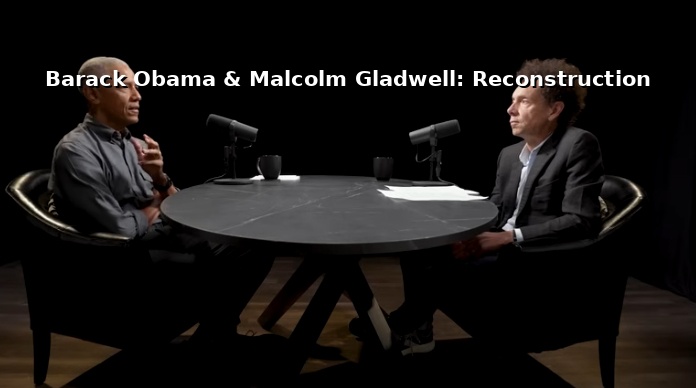
That’s how you feel it, right? The incapacity for people in the South, white people in the South, essentially, to embrace this new possibility of a multiracial democracy.
On the other hand, what we know of humans everywhere, what we know of human history, is that this idea that a group of people have been utterly defeated in a savage, bloody war and their entire lives have been upended, and their conceptions of themselves and their status and their role in the world has been shattered — and the notion that they would suddenly go, “oh, okay,” and that this would be an easy process that you could complete in 10 or 15 or 20 years, well, defies everything we know about people.
And so what is remarkable to some degree when I look at Reconstruction is how radical the experiment was. The fact that you had essentially a Northern occupying army backed by Radical Republicans in Congress, who are willing to consistently override the racist sentiments of Johnson, the president, and push through legislation and constitutional amendments that offer the promise of citizenship and equal rights to people who just 3 or 4 or 5 years earlier were slaves. Or if they were freedmen, according to the Supreme Court under Dred Scott, did not enjoy any rights that white people were bound to respect.
You have the highest court in the land just a few years earlier saying Black people in America have no rights that the courts or white people generally are bound to respect. And now suddenly you have a victorious union that is trying to impose on a big chunk of the population — we’re entirely rewriting the rules of your relationship between a group of people, which by the way, we think of as a minority with respect to the entire US population, but in places like Mississippi and South Carolina, were a majority. And throughout the South constituted 35, 40% of the population.
And white folks are sitting there, they’re aware how badly these people have been treated. They’re aware of what they’ve done to them. They’re harboring memories of the cruelties that have been perpetrated on these folks. And now suddenly they’re seeing them in Congress and they’re seeing them open up stores and they’re on the streets. And so in that sense, I actually always think of Reconstruction as, yes, a tragedy, but also a hopeful sign.
MALCOLM GLADWELL: A necessary tragedy.
BARACK OBAMA: A necessary tragedy. And one that — of course it wasn’t finished. Of course it wasn’t completed. It was inevitable that there was going to be this massive backlash and a violent one. And that in turn, you’d then see an ongoing struggle that would continue for decades.
The Backlash: Is It Unique to American Political Culture?
MALCOLM GLADWELL: Is there a case to be made that the intensity and the regularity of the backlashes that we see in American politics is something distinctive to our political culture and social culture?
BARACK OBAMA: I would say that there’s been a lack of a full reckoning in the United States that makes these issues come up again and again and again. And that some societies at least have done a better job in looking at their past and saying, that did not work. And a national consensus is then built around, let’s not do that again.
Du Bois said the issue of the 20th century, he said at the time, was the color line. Turns out the issue of the 21st century is also the color line. Probably the 22nd century, it may be. I wouldn’t say though that it’s unique to the United States. If you think about the experience of Indian democracy — you have partition and millions are killed and Muslims and Hindus in India are trying to figure out how to deal with this stuff. And now you have a rise of Hindu nationalism and struggles around that, issues that once you thought were resolved in India.
You look at Northern Ireland. The Good Friday Agreements have held, but anytime you visit there, it’s always interesting as an African American to visit a place like Northern Ireland and you listen to the degree of segregation and continued segregation, bitterness, anger, suspicion between people that to our eyes look exactly the same.
MALCOLM GLADWELL: They’re living in an area the size of— it’s like tiny.
BARACK OBAMA: Yes. But the now self-imposed segregation that remains is as powerful as anything we would see here. And it’s hard to understand, right? Because it’s not part of us.
Tentative Steps vs. Giant Leaps Back
MALCOLM GLADWELL: There’s a difference between— in that case, what you have are tentative steps. So you would say in Northern Ireland, there’s no question that the country is much better off today than it was in 1975.
BARACK OBAMA: Well, as we would say about the United States, there’s no question that you and I sitting here, having a conversation about Reconstruction, would not have been happening in 1880.
MALCOLM GLADWELL: But Reconstruction is a slightly— it’s not a tentative step. It is one step forward and then one, like—
BARACK OBAMA: A really big step back.
MALCOLM GLADWELL: A really—
BARACK OBAMA: Several steps back.
MALCOLM GLADWELL: Several steps back.
BARACK OBAMA: Yeah.
MALCOLM GLADWELL: The intensity of that is what’s so— and it’s the amount of violence. And it’s like it’s almost a second Civil War.
The Lost Cause and the Cultural Project of Justifying a Caste System
BARACK OBAMA: Well, it is— what you see in the backlash to Reconstruction is the degree to which you never changed hearts and minds coming out of the Civil War. There wasn’t the sort of — not just defeat militarily, but also a restructuring of the understanding that Southern whites had about what their privileges and rights were and how their society should be organized. And so they effectively retreated for a while, and then they waited out the federal government and waited until the occupation ended, essentially. And then they reconstituted a version of their society that they preferred.
And this is where the role of history comes in — how Reconstruction was depicted, the stories that were told in schoolbooks and in Birth of a Nation about how terrible these ignorant Black people suddenly taking over government and assaulting our women and running down our economies and how we wrested it back. The whole Lost Cause mythology, which we’re even now still reckoning with, because you have all these monuments to the valor of the Confederate soldiers, the romance of Gone with the Wind. These are all things that we grew up in, but it had to do with a very specific cultural project, which was to justify, solidify, rationalize the maintenance of a caste system. And that never fully went away.
When Did the Civil War Really End?
MALCOLM GLADWELL: I wonder — this is going to seem like a trivial suggestion, but I feel there’s great importance to these symbolic things. Part of the problem is we say that the Civil War ended with— we mark the end of the Civil War with the end of the initial military phase. Really, the Civil War ends in 1877 with the collapse of Reconstruction. If we thought about the war that way, then we understand it very differently.
The Compromise of 1877 and the Betrayal of Reconstruction
BARACK OBAMA: Because essentially what you have is an armistice. Essentially what you have is in 1877 with the compromise that year. That’s the real peace treaty between North and South. And the North essentially says, okay, you guys are readmitted and fully redeemed. The Union’s been saved. The initial project that Lincoln called for when he initiated the Civil War in the face of secession. That problem’s been solved. Technically, slavery no longer exists. The 13th Amendment survives. And otherwise, we’re back to you guys running things how you want down there, and we’ll run things how we want up here.
And that was the true peace treaty. And it obviously left Black folks in the South extraordinarily vulnerable and in part prompted the Great Migration. And it shaped our history. But you’re absolutely right that what it did was to allow for this obfuscation, this erasure of what the stakes were and what the possibilities were.
But that’s how our culture was structured, as I said, to justify, to reconcile this glaring contradiction at the heart of our self-conception. And the degree to which these really hard questions were never fully processed I think accounts for the reason why you can still get these fierce episodes of backlash. Because they’ve never really been talked about, surfaced, resolved. There hasn’t been both acknowledgement and accountability, which means there also hasn’t been the possibilities of forgiveness and reconciliation. It all just washes around.
MALCOLM GLADWELL: The Compromise of 1877, I mean, it’s such a Pontius Pilate moment, and it makes me wonder about the kind of psychology of the compromisers. I mean, it’s weird because you just went through a dozen years ago this unbelievably bloody conflict. I mean, you sacrificed hundreds of thousands of your countrymen’s lives. You devastated the entire country. And then after 12 years passed, you’re like, well, kind of shrug. Let’s just—
BARACK OBAMA: Never mind.
MALCOLM GLADWELL: Never mind. It’s like a never mind moment. It’s like they wash their hands. And they say, what does Pontius Pilate say? Take this from me? I’ve forgotten that. But I struggle to kind of understand what’s going through the minds of those when they shrug.
Race, Politics, and the Many Competing Interests of the Era
BARACK OBAMA: I think one of the things that is important to understand, we tend to look at all these issues through the lens of race entirely. And the truth is that there are all these other factors that in the minds of these politicians at the time are just as important and as relevant. There are notions of states’ rights, and there are notions of the limits and constraints on federal government power, and there are notions of commerce and money.
And all these things are happening in the midst of a really wildly unregulated, fluctuating, Wild West economic atmosphere. You’re getting these huge depressions and massive unemployment, and there are debates about labor rights in the North as people are getting into factories, and there’s agitation among workers for better working conditions and better wages.
And so you have elites who have a whole host of interests, and some of them think how Black people are being treated and how we restructure our democracy is of the highest priority. And other people are thinking, we need to stabilize the economy. And some are thinking, I’m trying to build a railroad here and I need a deal with this other legislator. And some of them are thinking, we can’t maintain taxes that are required in order for us to keep federal troops occupying these Confederate states in perpetuity because we have other expenses.
And so for us, looking back, we’re saying to ourselves, what other issue was relevant? But for them at the time, it was one of the issues that was relevant. And I think that part of what also makes the Compromise of 1877 so bitter in some cases, certainly for African Americans, when you know that history, is there is an echo across American history of at some point, even whites who are sympathetic to the cause of equality and human rights only being willing to carry out that principle so far.
MALCOLM GLADWELL: Yeah.
BARACK OBAMA: Right.
Frederick Douglass as a Founding Father
MALCOLM GLADWELL: Going back to this question of how inadequately we have accounted for this period. If we’re doing American history over again, not only do we say the Civil War ends in 1877, but Frederick Douglass is a founding father.
BARACK OBAMA: He really is.
MALCOLM GLADWELL: He really is.
BARACK OBAMA: And that’s why it’s so interesting to see today this contest over what is the dominant narrative of America? And you have an administration that is trying to change the plaques at national monuments and—
MALCOLM GLADWELL: Like they don’t have enough on their hands.
BARACK OBAMA: Yeah, right. But it does speak to the power of stories, right? Figures that because they hold political office, because they are men, because they are white, because they are titans of industry, because they hold traditional stations that we understand have power, we think of them as the history makers. And you have all these people who may not have occupied formal positions of power, who entirely shape or bend the course of our narrative.
MALCOLM GLADWELL: And this is why I think he belongs in that kind of pantheon of founding father, that he sees the best.
BARACK OBAMA: Yes.
MALCOLM GLADWELL: And he also is clear-eyed about who we are and what we’re capable of. And that’s, if you read the Federalist Papers, that’s what they are. Madison both has a vision and he’s also incredibly—
BARACK OBAMA: Correct.
MALCOLM GLADWELL: He’s aware of like, this thing could fall. What’s the famous Ben Franklin, “We have a republic if we can keep it?”
BARACK OBAMA: “If we can keep it.”
MALCOLM GLADWELL: Exactly, same thing. We get this grand thing, but it’s going to be hard.
Holding Two Ideas at Once: America’s Promise and Its Failures
BARACK OBAMA: And that’s what Douglass understands. Sensibility is what we want in our leaders. And it is a sensibility that we want our kids to learn from history. At least I do. And that is not some rosy-eyed, sanitized version of American history, but a clear-eyed understanding of, yes, we stole land, we took land from previous occupants. America was built on violence and subjugation and chicanery and confidence men. And shenanigans and corruption, but it is also this amazing expression of human possibility.
It is Thomas Jefferson. Yes, he had slaves, and not but, and he penned some of the most important words that were ever written in the annals of humanity. And being able to maintain those two ideas at the same time is what both can inspire you to keep going and make the world and the country better and not sink in despair, but also to understand the challenges and the persistence that will be required to overcome those challenges if you want to get to where we want to go.
What If Reconstruction Had Succeeded?
MALCOLM GLADWELL: Well, I want to go back to something that we skipped over that I’ve been thinking about, though, as you were talking about. Is it useful at all to wonder about what the country looks like if Reconstruction had not been defeated? Was that even a possibility?
BARACK OBAMA: I think you can imagine scenarios in which somebody other than Andrew Johnson is Lincoln’s vice president. Either Lincoln doesn’t get shot, Booth misses, or his vice president is somebody who is a wiser, more thoughtful leader.
MALCOLM GLADWELL: We should briefly pause on what a disaster Andrew Johnson— I mean, Andrew Johnson is terrible. He’s like, it’s really hard to find someone as bad as that. And there’s some stiff competition of late.
BARACK OBAMA: There is, just generally. But he’s terrible, right? He just— he’s petty, he’s small-minded, he’s a drunk. He is not particularly deft in handling his own party, the other party. And so he’s a disaster.
You can imagine a situation in which a better leader, a better statesman, is working with a Republican Congress, being more strategic about how are we going to institutionalize both the Reconstruction legislation that’s been passed? How do we make sure that the Freedmen Bureau efforts stick? How do we make sure that the 13th, 14th, 15th Amendments are carried out effectively? What can we compromise? Because we know there’s going to be resistance down there. What can’t we compromise?
You can imagine somebody working that through in a way that you did not end up with a violent, brutal reinstitution of caste and the restrictions on Black people’s ability to just live their lives. And the lynchings and the horrors of that era. And had that process been less violent, even if it wasn’t as quick as from modern standards we would now judge, let’s say that there was enforcement, but there were still social codes about no racial mixing, or we’re not going to take on anti-miscegenation laws. You can picture something that ends up being more gradual, gentler, not perfect, but ushering in maybe quicker the kinds of changes that we would end up seeing come about in the ’60s and the ’70s. It would be less wrenching.
But, you know, that’s speculation. That’s true about all of human history, right? I mean, there are all kinds of junctures and moments that we look at and say, ah, if humans weren’t so stupid or so venal or so greedy or so cowardly or ignorant, things could have been better.
The Role of Leadership at Pivotal Moments in History
MALCOLM GLADWELL: There is this thing, though, like, it is so often the case that at pivotal moments in history, we’re blessed with extraordinary leaders, right? We have FDR during the Depression. England gets Churchill, on and on. And we’re like, in this era, we’re two-thirds of the way there. We have Douglass, we have Lincoln.
BARACK OBAMA: And things—
MALCOLM GLADWELL: And then, the third leg of the stool is this— I mean, it is always—
BARACK OBAMA: It is a classic example of this debate about history and how much of it is determined by amazing individuals and how much of it is determined by just technological trends or societal trends that we have no control over. I think this is a pretty clear example that it’s both. It makes a big difference that Lincoln’s not there postwar. There’s no doubt.
Multiracial Democracy Then and Now
MALCOLM GLADWELL: How do you— I’m curious about how you think about this, the kind of general project of multiracial democracy now. It’s impossible to spend a lot of time thinking about Reconstruction without reflecting on the present day, right? Because these issues are—
The Legacy of Reconstruction and Its Modern Echoes
BARACK OBAMA: Well, they’re still there. If somebody is asking, why is it relevant to talk about Reconstruction? I have to describe for them the degree to which we’re having the same arguments. The issues of how are we going to help the freed people who’ve been enslaved? What are we going to give them to allow them to have a go at life? What does real freedom mean?
You trace that debate of 40 acres and a mule and public education, and you can trace it all the way through to debates about welfare and debates about DEI now, and do we as a society have an obligation to address past injustices that have been institutionalized or have left a legacy of poverty? So we’re having that argument.
When you look at issues of state versus federal power, and how do we protect the rights of all citizens, both against states that may be abusing the people who live there, but also against the federal government that at any point might decide it wants to bully people around? Those issues are still there.
Obviously, more directly, we’re having debates now about voting rights. And you’ve got a Supreme Court that has systematically weakened the possibilities of enforcing voting rights in our democracy. And we have a politics now that, at least one of our major parties has been captured by politics that is not that subtle about suggesting that “We the People” means a certain kind of people.
That when you have the vice president, the current vice president, making a speech that is basically a blood and soil version of “We the People” — that it matters who your parents were and how long they’ve been here. Despite him being married to a daughter of an immigrant himself. That echoes ideas about who can be a citizen, who belongs, who gets to make decisions. So all these issues are still being debated, sometimes not as bluntly and explicitly as they have in the past, but they’re still there.
And what I would say though is, in the same way that we were talking earlier about the Constitution — you get that equal protection language in the Constitution and it may not be observed, and we may be shocked and appalled by the gap between those words and the reality. And it may be frustrating that we have to file lawsuits to vindicate those words, but they still count.
In that same way, I would argue that the progress that we’ve seen over your lifetime and mine in creating a multiracial democracy — that stuff sticks. And that’s progress. And so I don’t get cynical and look back. I don’t subscribe to the idea that because this has always been a theme in America, because we will often be disappointed by how American society responds to racial discrimination and injustice, because at any moment that kind of caste thinking can flare up and be dangerous and violent and cruel — that doesn’t mean that we don’t have evidence of that better version of America. We have evidence of it. We’ve seen it.
From Malice to Hypocrisy: A Measure of Progress
MALCOLM GLADWELL: The example you gave is actually a lovely illustration of this. 100 years ago, a vice president could not stand up and make a nativist argument if he was married to the daughter of an Indian immigrant. But today he can. So we’ve moved from malice to hypocrisy. That’s progress.
BARACK OBAMA: It is progress.
MALCOLM GLADWELL: That is progress.
BARACK OBAMA: Listen, hypocrisy is progress.
MALCOLM GLADWELL: It is.
BARACK OBAMA: Because it means that you feel guilty enough to either lie to yourself or others. And that is better than not even being able to even think about the idea that maybe you’re doing something wrong. My mother, she used to always say — I think guilt’s a highly underrated emotion. And if I tell you to do something — you mentioned earlier the rule of parenting — if I tell you to do something, and you know it’s wrong and you hide it and then you kind of try to do it anyway. Well, at least I know I’ve planted the seed.
MALCOLM GLADWELL: You set the standard.
The Seeds Planted During Reconstruction
BARACK OBAMA: And that’s part of what — part of the reason why I don’t deem Reconstruction a complete failure. And somebody like an Eric Foner, a great historian who resuscitated and reevaluated this story that Reconstruction had been an utter failure — one of the important points he makes is all these seeds are planted and not all of them grow. Some of them are dormant for a very long time, for decades. But both you and I, and our kids, have benefited from the fruits of trees that were planted during Reconstruction.
You were saying earlier that the Civil War doesn’t end right at 1865. There continues to be resistance in the South. One of the best examples of something that was never taught in school were the Black Codes. And I always used to assign this when I was teaching constitutional law. You can read them — they’re still available — and you can see these laws that were passed by the Confederate States after having been defeated. And they give you a sense of the degree to which the entire possibility for freed slaves to live, survive, have a trade, work, was just completely blocked.
So they would essentially say, if you want to practice a trade, you have to pay a $10 tax. They would have vagrancy laws in them where they said, if you don’t have a job and you’re just hanging out listlessly, then the state has the right to put you to work on a field because you can’t be a vagrant. Black folks can’t practice a trade. They can’t enter into contracts. Obviously, you can’t serve as a witness, and you certainly can’t serve on a jury.
So what happens is that the ability of these so-called freed people to function in any way, to not be entirely vulnerable to the old system, is completely blocked. And the reason I guess that’s important is just — you were asking earlier about how does something like the Compromise of 1877 happen? We so underestimate — I’m not a materialist, I think ideas other than money and commerce matter — but the degree to which the economic underpinnings of the entire Southern economy had been based on slave labor, and the desperation with which elites, even post-war, are thinking, “If we don’t get that back, then the source of all of our wealth, economic power, and status will be undermined.” That, I think, is something that oftentimes doesn’t get talked about enough.
Education as Freedom
And then the other thing I touched on, but I just want to emphasize — one of the things I love when you read about Reconstruction is these narratives about teachers starting schools and how much Black folks understood literacy and education as integrally tied to freedom. That if I can read, if I can write, if I can do my arithmetic, that unlocks for me freedom and power in ways that can’t be taken away from me.
And the project of starting public schools — you see these, we were talking about all these Black members of Congress and state legislatures — the degree to which they thought our number one project here is let’s start a bunch of schools, to make sure that our people have a chance to learn how to read and write.
MALCOLM GLADWELL: And it’s the one thing that the white majority couldn’t constrain.
BARACK OBAMA: Learning.
MALCOLM GLADWELL: Yeah. Can’t block that.
BARACK OBAMA: We can lock this in our heads. And they understood that. And it becomes HBCUs, but it also influences generally this notion that then carries over to the broader society of public education — that citizenship, equality, power, all of that is tied to our ability to understand and communicate and analyze the societies that we’re in. That’s what gives us agency and that’s what gives us power.
And I think that that’s so important from my perspective, both to understand how much common sense these folks had coming out of subjugation. They were paying attention. They had good instincts about what it was that they should be striving for, about what would make those words on paper real. That was powerful.
And what it also reminds me is today, the degree to which not just the Black community, but Americans generally will devalue education — the degree to which you start getting an anti-intellectualism in our culture and our politics — why that is contrary to citizenship and equality and power. And you want young people to understand there’s a reason why folks who had just been freed wanted land so they could grow their own crops and feed themselves. They also wanted to be able to read. And so that’s something that now is available to all of us. We should try it.
Black Representation in Politics: Then and Now
MALCOLM GLADWELL: And part of the Reconstruction project is to populate politics with Black people. And when 100 some odd years later, you’re the only Black person in the Senate when you’re first elected.
BARACK OBAMA: Yeah, in 2004.
MALCOLM GLADWELL: 2004.
BARACK OBAMA: And at that point, I was the only African American out of 100 senators.
MALCOLM GLADWELL: Yeah.
BARACK OBAMA: In 2004.
MALCOLM GLADWELL: Yeah.
BARACK OBAMA: So it gives you a sense of how these issues that you talk about during Reconstruction, they don’t entirely get resolved even by the modern civil rights movement. Now, part of the Senate issue has to do with the inherent weirdness of our Senate system, right? Where Wyoming gets 2 senators and California gets 2 senators — it’s not apportioned based on population. But having said that, it’s still pretty striking that I was one African American. There were 2 Latinos in the U.S. Senate in 2005 when I was sworn in, 2006.
MALCOLM GLADWELL: Did you have the sense that your election would make it easier for others to follow, or that you were a kind of token?
BARACK OBAMA: My election to the U.S. Senate — I thought that it would be significant because Illinois is probably the most representative of the country demographically. It sort of matches America’s overall racial makeup and even regional makeup. It’s urban, suburban, rural. North and South, right? Southern Illinois is closer to Kentucky than it is to Chicago. And so culturally you’re different.
And so I thought that by me having been elected to the U.S. Senate from a big state that had the same percentage of Black folks as the country in general, at least sent a signal to other candidates who might be thinking about running in other states that they could pull it off. And in fact, that’s what happened. We started getting more African Americans in the U.S. Senate.
I’m not suggesting that it wouldn’t have happened anyway — if it hadn’t been me, it would’ve been somebody. But I think it signaled to the political system, to donors and political operatives: “Oh, if we have a talented Black person, it turns out maybe they can win statewide. We don’t have to assume that they can’t win statewide or that they’re a risky candidate.”
MALCOLM GLADWELL: We were talking — Edward Brooke from Massachusetts is the first post-Reconstruction, but he is a false start in a certain sense. He’s in the ’70s, and then nothing happens for a long time. For a long time.
Representing Everyone: The Bigger Leap
BARACK OBAMA: Yeah. Look, the truth is that the idea of not only African Americans having representation in Congress, but the idea that African Americans could represent everybody — that takes a long time. That first step, which is the step that Reconstruction was about, was simply to say, can at least we be represented by some of our own? And you get this huge surge of Black members of Congress and state legislatures and county commissions. But that was always based on this notion that we deserve to have a voice.
MALCOLM GLADWELL: One of our own.
BARACK OBAMA: Yeah. It takes a bigger leap to then say, “By the way, I could actually represent white people too, and I could represent Latinos, and I have enough empathy and understanding, and we have enough common concern and interests and aspirations that they can trust me to look out for their interests also.” That requires a whole other set of social changes that we don’t end up seeing until the modern civil rights movement and the breakdown of Jim Crow.
MALCOLM GLADWELL: It’s funny because no one on the white side ever had any trouble with the notion that a white person could represent everybody. The last thing you want to give up is this idea that someone can speak for everyone, right? It’s the last bastion of privilege.
BARACK OBAMA: Correct. Because now what you’re really saying is that my story, my vision, my capacities are universal in some way. They’re not qualified. There’s no asterisk to them. And that takes some time, right? I mean, that requires social changes. It requires Jackie Robinson, and it requires Sidney Poitier, and it requires Jesse Owens, and it requires Jim Brown. Exactly. My favorite.
MALCOLM GLADWELL: Yeah.
BARACK OBAMA: And it requires Jesse Jackson and John Lewis. And so you get this over time, a change in social attitudes. And part of what I think we learn from Reconstruction, the cautionary part of that, is not assuming all that stuff is permanent and that the battle is won at any given moment. It is an ongoing, constant contest between narratives that are deeply rooted and some of which are not unique to America.
The idea of caste hierarchy, pecking order, status, that is not unique to America. Race is the dimension or the phenomenon around which our whole caste thinking gravitates. But that’s something that was in the apple that Adam and Eve ate, right? That’s part of our original sin is this idea of we’re separate, we’re better. And I think if we’re mindful of the fact that we have these warring ideas inside of us, in our cultures, in our politics, then we can choose a better story.
MALCOLM GLADWELL: That moment when you were elected to the Senate, maybe that’s the moment that Frederick Douglass is like, “I’m finally happy.”
BARACK OBAMA: Yeah, but then the fact that I was in the minority and I couldn’t get any bills through the Senate because of the filibuster. Then you’d have to have a whole conversation about how this mechanism called the filibuster, which was primarily used for defeating civil rights legislation and anti-lynching legislation, and was the mechanism whereby Southern Democrats, Dixiecrats, were able to keep Jim Crow in place, how that became this honored, venerable tradition in the Senate that blocks all kinds of progressive legislation.
MALCOLM GLADWELL: There’s got to be a point — poor Frederick is over 200 years old at this point. I think he just wants to get on with his life.
BARACK OBAMA: He wants to go eat his applesauce.
MALCOLM GLADWELL: Yeah, he wants to. So maybe that’s the moment he was like, “Okay, all right, all right, all right.”
BARACK OBAMA: I’ll take it.
MALCOLM GLADWELL: I’ll take it.
BARACK OBAMA: Yeah.
Related Posts