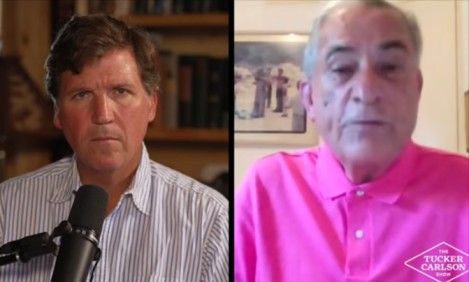
Editor’s Note: In this episode, Tucker Carlson sits down with Israeli journalist Gideon Levy for an in-depth and critical discussion about the current state of Israel and the ongoing conflict in Gaza. Levy offers a candid perspective on the country’s military policies, the roots of the conflict, and his own experiences as an outspoken voice within a society he believes is largely in denial.
TRANSCRIPT:
Introduction: The Current State of the Middle East
TUCKER CARLSON: Gideon, thank you so much for joining us. For Americans who are distracted by what’s happening in Iran and with the US economy and by so many other things, can you bring us up to date on what is happening right now in Gaza, the West Bank, Judea and Samaria, and Lebanon?
GIDEON LEVY: It’s a war with some interruptions. It’s a roller coaster. You go to sleep in Tel Aviv with a ceasefire. You wake up in the morning with ballistic missiles over your head. Gaza is bleeding and totally forgotten. I guess we’ll have the opportunity to talk more about Gaza, which is very dear to my heart.
In Lebanon, Israelis fighting for nothing without any purpose. People are killed, villages, all villages are being destroyed systematically, very similar to Gaza. Israeli soldiers are killed on a daily basis almost. And the whole thing seems like an ongoing war without any purpose, without any justification, and above all, without any endgames, any real goals. What will stop it except of this desire to fight and to fight and to fight and to kill?
Israel’s Strategy and the Language of Military Power
TUCKER CARLSON: What is the point? You say there’s no point to it, but it clearly is part of a larger strategy, I would assume. I mean, it’s got to be. What do you think the bigger point of this is?
GIDEON LEVY: So first of all, Israel was brought to believe that it is doomed to live on its sword, that the only language that we can talk in this region, as we are the fiddler in the jungle, so to say, the only language that we can use here is the language of military power and as brutal as possible. This was before Netanyahu. Many things, by the way, were before Netanyahu. Netanyahu intensified those things. And today, the only language clearly that Israel is speaking is the language of war. Anything can be solved only by war. Nothing can be solved by any other way, like diplomacy, compromises, etc.
And here we are involved in so many fronts. You know, Tucker, there are around 6 million people in the Middle East who were expelled from their homes, who are uprooted. Part of them will never see their homes again. 2 million in Gaza, 1 million in Lebanon. For a while, there were also 2 million in Iran. Now, not anymore. But think about this. All of them because of wars of choice, all of them because of a very violent policy of Israel, which might here and there have the justification, like after the 7th of October, another thing that I think we’ll get into.
But the proportion, the scale, and where are we aiming? Where are we aiming, for God’s sake? Is Israel today a better place? Is it a safer place than 2023? Is it more popular in the world? What did we gain out of all those wars? And unfortunately, Tucker, those questions are hardly being discussed in Israel. And this in many ways depresses me almost more than the wars itself. The fact that a whole people, 10 million people, very intelligent, very ideological and with very clear views, go to all those wars blindly and automatically without asking ourselves why, what for, what do we gain?
Put aside the moral side. Let’s say morality is for spoiled Gideon Levys or leftist self-hating Jews. Practically, are we living in a better place? The answer is unfortunately not.
You can add to it, obviously, Tucker, all the personal motivations of Benjamin Netanyahu, which in my view are not exclusive, they are not the only. There are those among my friends who think that he does everything only for his career, only in order to stay in power. I give him more credit because I think he has an ideology, a very dangerous one, but he has an ideology which motivates him as well. But no doubt that those last wars serve first for his personal interest. He has a trial, he’s doing very badly in the polls, and here he comes with another war, war after war.
I want to ask, why did we have this need to bomb in Beirut 2 days ago. What did we achieve by this bombardment? Israel achieved anything out of it except of provoking Iran? And then we got this sleepless night last night with again dozens of ballistic missiles over our heads. No one talks about it, no one asks it. And it’s quite impressive to live in a society in which the main issues are not discussed. We discuss the wife of the prime minister, we discuss all kind of gossips. We don’t touch the core of the issue.
The Practical Risks of Endless War
TUCKER CARLSON: I live in a country very much like that, so I know the feeling well. But just to stay on the point that you made about the practical effects of this, leaving aside the moral stain, whether it’s the right decision ethically or not, but as a practical matter, you have to wonder how many wars a country as small as Israel, just physically small with a population that small and an economy that small, just a little country, how many can you fight before you risk real retaliation, risk your own existence? I mean, how dangerous is this?
GIDEON LEVY: Fortunately or unfortunately, Israel is a regional superpower from the military point of view.
And Israel has the military answer almost for any challenge. And this is, on one hand, obviously very good because we are safer. On the other hand, it corrupts also a country because it lets Israel to go wild, to go to all kinds of military adventures, knowing that by the end of the day, we are not endangering the existence of all real assets. Because we are always stronger and we won all the wars, militarily. Politically, we lost them all.
The Shifting US-Israel Relationship
TUCKER CARLSON: Is there a concern that the United States in the next, I don’t know, 5 or 10 years might begin to withdraw its unconditional support for Israel?
GIDEON LEVY: You say 5, 10 years, and I would say 5 to 10 months.
TUCKER CARLSON: Yes, I agree with that.
GIDEON LEVY: It’s happening right now. I think that we are reaching a stage in which we will face a major shift in US policy toward Israel. Biden was the last Zionist, so to say, president. Donald Trump was the last one who accepted almost all the ideas, the craziness of Israel, and until now, we still have time to see, but until now, he went along the Israeli cycle.
But the next president, would he be Democrat or Republican? One thing is sure, those relations will be challenged more or less, but they will not go anymore automatically and blindly. Maybe the aid will continue, but at least it will be conditioned.
The problem is that, you know what, you want to supply Israel, you think that Israel is the country that is in need more than any other country in the world. And you want to supply it with everything like any country in the world. Fair enough. Put some conditions. Put some conditions according to the American interest. Israel is not following neither the international law nor the American advices for many, many years. United States is speaking about the two-state solution for decades. And Israel is just ignoring it and doing anything possible to sabotage this idea.
I think this is over. And it’s a question of months, not of years, maybe still in Donald Trump’s time, maybe the next president. And then Israel will be in a real problem because without the United States in its current position, this will be a challenge that Israel never faced before. In my view, much more dangerous and existentially dangerous than the nuclear of Iran.
Israel’s Dependence on the US and Global Isolation
TUCKER CARLSON: I agree with that. Do others in Israel see that coming? And what do they think of it? What is the view of the United States and Donald Trump in Israel?
GIDEON LEVY: So Donald Trump, as you know, is more popular in Israel than in the United States. Yes. Actually, he’s more popular in Israel than any other place in the world. It can change, obviously, if he will change his attitude.
And the problem is, again, that the Israeli discourse does not touch those questions. We don’t speak about the occupation. We don’t speak about the apartheid. We don’t speak about our relations and our dependence on the United States. You know, we are now in a stage of dependence which we never faced before. I don’t think Israel ever faced such dependence on the United States because all the rest of the world, you know how it is treating Israel and what do the majority of the people in the world, what do they think about Israel? Polls show what a pariah state Israel is, and in many ways, rightly so.
And here comes the United States, and if the United States will change its policy, what will Israel do? How will it go on, even militarily, not to speak about politically in the international arena? Europe is just waiting to get a green light from the United States to change its policy toward Israel. Europe is paralyzed because of the fear of Donald Trump and the United States. Once the United States will shift its policy, I’m sure that you will see big, major shifts also in Europe, because the public opinion is by far more hostile toward Israel than the governments in Europe. This will have to be expressed by policies, by real measures, not only by articles in newspapers.
So we are facing a really horrible challenge in the coming months, not in the coming years. And there is no one to deal with it. We still think that we can do whatever we want. And this sort of hubris got such a boost after the 7th of October. Israelis tend to believe that after the 7th of October, we have the right to do whatever we want. And this is very dangerous. Yes.
The Silence Within Israeli Society
TUCKER CARLSON: It’s interesting. Everything you said is very clear from here. It matches my perceptions exactly. But you say no one is saying this out loud in Israel?
GIDEON LEVY: And if he says, nobody would listen. Yeah. No, look, major principle issues are not discussed in the last 3 years. You cannot express it. We are still victimizing ourselves about the 7th of October. We are still victimizing ourselves as the David against the Goliaths. The whole Arab world wants to exterminate us, to push us to the ocean. And we still believe that we are the chosen people.
Yes, if you will scratch under the skin of every Israeli, I believe, secularists and religious, you will hear again and again, “No, no, we are better. We know better. We are better.”
Take, for example, the international law. Israel is very much in favor of the international law. It was brought to the world after the Holocaust, after World War II. Israel is very much in favor of it. But it is not Bible about Israel, because we are a special case. And therefore, the international law cannot be applied to Israel. And if you dare to apply it to Israel, you’ll be labeled as an antisemite. “How dare you? We are a special case, Tucker.”
And this way of thinking must bring Israel to very dark alleys, to very dark corners. Which I don’t know how we’ll get out of them. And I’m sorry that I’m so pessimistic, but the last 3 years, really, we went too far. Too far. Yes.
Hubris, Gaza, and the Question of Hamas
TUCKER CARLSON: Well, you see this with individuals and not just countries. It’s called hubris in English, and it usually doesn’t end until there’s a lot of suffering and people wake up from their delusions. I mean, I think it happens to every man. That’s happened to me. But it happens at the scale of a nation too. It’s sad.
So let me ask you about Gaza. What is the point of Gaza? In the US, our media says the point is to dismantle Hamas, which is a terror organization. It’s effectively illegal in the United States to say nice things about Hamas. What is Hamas from your perspective? And is the war in Gaza or the military bombardment of Gaza designed to end Hamas? Is that true?
The Goal: Crushing Palestinian Society
GIDEON LEVY: No, Tucker, and this is the conclusion that I came to just recently. It’s very clear for me that the war in Gaza is a war to crash the Palestinian society in Gaza. And finally, also to make them leave.
Now, how do I know it? The matter of fact is that Israel is opposing any kind of deal about Gaza. It’s not that they don’t want Hamas. But they don’t want also the PA. They don’t want an international force. They don’t do nothing. They want the people of Gaza, over 2 million people, most of them living now in tents.
I have some friends and old age friends who are living now 2 and a half years in a tent without electricity. Close friends. One of them is after a stroke lying on the ground. On the sand for 2.5 years now without his medicines. I mean, I can’t describe you his agony, his suffering.
Israel wants to crash the society. To make them, a bunch of handicapped, wounded, traumatized society without leadership, without any functional society, any functional institutions. Why are we opposing that Hamas will run the civil life in Gaza? They are the only one who can do it right now. There is no one else. Why can’t they be the teachers? Why can’t they be the lawyers, the judges, the street cleaners, the policemen? No, we say no because we don’t want all this to exist. We want anarchy there.
And then will come the real wet dream of some Israelis, not all of them, to get to the real — I don’t want to use the word final solution — but to get to a real solution which will last, namely to push them to the south and then from the south to try to find them another place on earth, which they will never find.
But you cannot explain otherwise the attitude of Israel towards solving the problem of Gaza. If Israel would have really liked to get a solution, she would’ve had to come up with an idea of how to make Gaza a livable, viable place and society. Israel is doing all the opposite that it can, crushing the society. And I’m afraid that the next stage will be the West Bank, crushing the Palestinian people, and not only militarily, making it a non-society because many Israelis truly believe that it’s either us or them. And I believe it is us and them, but I am very lonely in Israel now.
The Long-Term Consequences of Expulsion
TUCKER CARLSON: If the government of Israel were to succeed in expelling almost 2 million Palestinians from Gaza and then took it over, does anyone believe that is itself a solution? I mean, it’s obviously a crime, but the long-term repercussions from that will destroy Israel, it would seem to me. That just seems unwise. Take the moral calculation out of it. As a practical matter, that seems insane.
GIDEON LEVY: Why, Tucker? It worked very well in 1948. The first Nakba was a hell of a success. We expelled over 600,000 Palestinians. We destroyed all the villages. We didn’t leave anything except of some mosque and some graves. All the rest totally destroyed. Covered it up with trees and nice parks. And it worked.
And me as a child growing up in this place, born here, growing up here — the first time I heard the word Nakba was when I was 20, 25. I never asked myself, what are those ruins around me here and there in Tel Aviv, in other places? Never thought that maybe someone owns it. Maybe someone is living now in a refugee camp instead of his home. Those things were totally oppressed and were not legitimate. Until now, they’re not legitimate.
So the first Nakba was a head of success, why not to continue? I mean, for those people — I don’t say the majority of Israelis want this to happen. The majority of Israelis have another disease, namely being apathetic and indifferent. But the right-wingers, for sure, they want it to happen. And they are the only decisive part of the society — the settlers, the right-wingers, the fascists — they are the most powerful and most active. They have at least a plan.
What plan do the leftists in Israel have, the Zionist leftists? What do they suggest? The alternative now, the opposition — what is their idea? What is their plan for what’s next? They are opposing a two-state solution. Yair Lapid, the head of the opposition, says not in the coming 10 years, another 10 years, which is not coming. And meanwhile, I believe that the two-state solution died a long time ago. We missed this train.
But in any case, what do you suggest? What are we suggesting to 7.5 million Palestinians who live between the river and the sea, together with 7.5 million Jews who are living between the river and the sea? What are we offering them? Apartheid forever? They write me, they say, “Please have a plan, yeah, we’ll expel them.” One day.
Where Would Millions of Palestinians Go?
TUCKER CARLSON: Where do they imagine millions of Palestinians will go if they’re expelled?
GIDEON LEVY: That’s the weak part of their fantasy because they don’t believe they will find a place. They were looking for, as you know, even in recent months, they look in Somalia and Eritrea and God knows where, Africa, all kinds of places. “We give them money and we’ll send the Palestinians.” Didn’t work. And it will never work. I mean, no country in the world will accept millions of Palestinians. No way.
Egypt doesn’t want to get them, obviously, and rightly so. Jordan had enough with the refugees of ’48. Lebanon had enough from the refugees of ’48. They have no place to go. But the fact that this idea is motivating the present is by itself very dangerous.
Maybe finally it will end up like the Native Americans, totally forgotten, in all kinds of reserves, living without any heritage, without anything in common. A bunch of people who lost their identity. Maybe this will be then also the Palestinian people, if it will go on like this.
The United States as a Partner
TUCKER CARLSON: Is the United States government doing anything to restrain Israel in these plans that you can tell?
GIDEON LEVY: I think the United States is a full partner. Look, we cannot think that what Israel is doing, knowing the dependence of Israel on the United States, we cannot say that the United States is opposing it.
You know, all the big liberal presidents, above all Barack Obama, with his wonderful, wonderful speeches and ideas. I had tears in my eyes when he was elected. What did he do? Did he stop Israel? His military aid was bigger than any other president. Unconditional. So the United States is a partner for everything. If we talk about genocide in Gaza, the United States is a partner. If you like it or not. It’s not the main partner — our accountability above all. But they supply, they support, and they could do differently.
It’s not like some country in Africa who wants to stop a genocide but can’t do anything. United States has the skills, has the leverages to stop, and it never, never did. Not the settlements. When did the Americans stop the settlements? Which is much more innocent than a genocide. What did they really do to stop the settlement project? They could in one phone call put an end to it.
One phone call — and I’m oversimplifying it, obviously — one phone call saying, “Listen, if you build one more terrace in the occupied territories, there is no aid to Israel, period.” And in that day, the settlement movement would have died. But there was no president to do so. So the United States, if you speak about the settlements, is a partner. If you speak about the war in Gaza — you may agree with me that it was a genocide or not, it doesn’t matter — the United States is a partner, a major partner with moral responsibility, yes.
Why Has the US Never Imposed Conditions?
TUCKER CARLSON: Everything you’re saying is true and provably true. These are not opinions, these are facts. What is up for debate is why. Why has a succession — every US president since Harry Truman in 1948 — gone along with this? Why has there been no meaningful condition attached to any of this aid, military and economic? What is this?
GIDEON LEVY: I think it’s up to you to answer, Tucker. For me, it’s a big mystery. Really, there were years in which I really felt that we don’t know who is the superpower between the two.
TUCKER CARLSON: Yes.
GIDEON LEVY: There were those years that Israel really put the United States in its small pocket, as we say in Hebrew. Totally ignoring advises, condemnations, threats, totally ignoring it, doing whatever it wants without any restraint. And I asked myself, how come with all this money and political aid, United States is paying a hell of a price — I don’t have to tell you — for the support to Israel. And again, please continue to support, but put some conditions to this.
I have no answer. It’s a mystery. To say that it is the Jewish lobby will be oversimplification because it cannot be that one minority is so powerful. Not only it smells antisemitic, but I don’t think it can be the full answer. Yes, the Jewish lobby was very powerful for many years. Not enough. United States does not share the guilt feelings of Europe. There, the guilt feelings about the Holocaust are very influential and stay in the back mind of any politician in Europe. In the United States, you don’t share any guilt feelings toward Israel. I don’t know, you should answer this. For me, it’s a mystery.
TUCKER CARLSON: I don’t have an answer myself. I agree with you. AIPAC is very powerful. AIPAC is disgusting from my perspective, but they’re not powerful enough to do what we’re seeing now. I agree. I only have theories, no real answers, but it is a question that we should be thinking about, I think. What is the Board of Peace?
Trump’s Plan for Gaza
GIDEON LEVY: Do you think in Gaza? Yes.
TUCKER CARLSON: The president has announced this international board that’s going to run Gaza, to redevelop it as a real estate project and put in casinos and make this beautiful new world. He has said, but I think most Americans are confused as to what this actually is. Do you have any idea?
The Reality on the Ground in Gaza
GIDEON LEVY: No, and there is no idea. There were very nice ceremonies, as the president likes. Did they renovate one house in Gaza? We are now almost 3 years. One house was renovated, one institution. One person in Gaza can say that he lives a human life now? One? In the entire Gaza Strip?
I don’t know what they do, but I know one thing. That as long as we will not see facts on the ground, it’s meaningless. There were so many so-called peace councils before — after each attack of Israel, major attack on Gaza, there was always a huge conference somewhere in Europe or the United States with a lot of surprise, I say, a lot of promises. To rehabilitate Gaza, to bring a lot of investors to Gaza, to rebuild Gaza.
I, me personally, I was once — I will never forget this day — invited to a launching of a new hotel in Gaza, which was supposed to be like a resort place for Israelis. Two weeks later started another war and the place was totally destroyed. So all the talking about rehabilitating Gaza are not valid, even if the money is there, and the money is also not coming there. Because there is no political plan for Gaza.
It’s very nice, your good intention to build casinos there. First of all, who is going to run Gaza? Will Gaza be a free place? This is the first question, not the last question. First of all, guarantee the freedom of Gaza. It is impossible that 2.5 million people will not even have citizenship. Tell me, Tucker, which people in the world live without citizenship of any country? The most oppressed people live with citizenship. Those people in Gaza have no citizenship, no passport of any country. Is it sustainable? Is it acceptable? We are in 2026, that this phenomena will continue again.
It’s not only that they don’t have — there is no plan for the future, no vision, nothing. So I cannot take it seriously.
By the way, like also this horrible aid organization that the Americans had before. As you know, I saw your unbelievable conversation with Dr. Maynard, the British surgeon from Oxford, which you talked with — in my view, a really shaking conversation. I was so shaken by this conversation of yours. And listen to him, what he has to say about this organization who was supposed to bring food to Gaza. How many people lost their life on the lines to this food. Again, a very common issue. So this will not be the solution.
You first of all have to make Gaza a free place. And then you have to find a way to let Gaza be run by itself. They are human beings like any other human being. Let them build their own institutions. They deserve it.
By the way, I agree so much with Dr. Maynard because he described in your conversation how much he loves the people of Gaza. If there is one place in the world in which I would love to be one more time in my life, this is Gaza. I mean, I know that for most of the Israelis, this sounds insane, but I wish more Israelis would have met the people of Gaza, the courage of Gaza, the sense of humor of Gaza. But if I say it in Israel, they think they’ll hospitalize me, I guess.
Israeli Media and Public Awareness of Gaza
TUCKER CARLSON: Do — is there a sense within Israel of what’s happening in Gaza? How many people have died in Gaza?
GIDEON LEVY: No sense and no interest. It’s very interesting because Israel, as you know, has a free media, a free press, most of it privately owned, and we are free to write whatever we want. I’m the best example. I have total freedom of speech. The problem is that because of commercial considerations, they want to please the viewers, their readers, and not to bother them.
This goes on for many years. The occupation is not covered at all in Israel. And then came the 7th of October. Again, I’m getting back to this crucial day which changed Israel. Changed for many years, I’m afraid. And after the 7th of October, it was very clear to every Israeli that we have no interest in Gaza. Why would we bother about Gaza? They’re all terrorists. They’re all Hamas. And the media cowardly stopped covering Gaza.
I can ensure you, Tucker, that any TV viewer in Omaha, Nebraska saw so much more of Gaza than a Tel Avivian who lives next to me. I can ensure you. And they don’t want to see it. It’s not that they want to see it and the media doesn’t show it. No, we don’t want to hear, we don’t want to see.
Can I give you an example? I’m coming — Monday is my travel day to the West Bank. I traveled today to a hospital in Hebron — I wish it was Gaza — a hospital in Hebron, in which I met the family of a baby of 7 months who was killed by an Israeli soldier last Friday. An Israeli soldier shooting a baby of 7 months in the car of his family, daytime. There was daylight, 7 o’clock in the evening was daylight. The whole family — grandmother, father, mother, and 2 children — in a car. The car stops. The soldier, after the car stopped, shot 2 shots, killed the baby in his head.
Horrible story. Do you really think that Israel was troubled by this story? Except for my newspaper, Haaretz, do you think that anyone bothered to bring the story? They mentioned it, yeah. But the framing of it was, some kind of incident, not really serious. Imagine yourself, a Jewish baby is being killed like this with a rifle from 10 meters. Nothing. He saw them and he shot. I don’t know why. He claims he felt danger. Oh, it is so dangerous to meet a family with two children and a grandmother who is 80. It is so dangerous to the soldiers. And he shot them.
Now, the fact that this is happening has to do also with the fact that it doesn’t bother any Israeli, or almost no Israelis — not many, true. There are those who are very devoted, but most of the Israelis don’t want to hear about it. And if they hear about it — I told it today to some friend of mine and she told me, “Yeah, but he didn’t intend to kill him.” For God’s sake, how do you know that he didn’t intend to kill him? Two months ago, they killed another family in the car. What the hell is this automatic justification to the army and to everything they do?
So getting back to your question, when you don’t want to know, when you live in denial — look, you cannot maintain such a brutal occupation for so many years, 59 years now, without denying it. Because otherwise you would be out of your mind. The Israelis are not monsters. They have their emotions. Part of them are liberals. They couldn’t live with it. The only way to live with it is by denying it, and live with this denial and keep the denial so that no one will break it, because we really don’t want to know.
You know, and your viewers know, the West Bank is half an hour away from our home. It’s not overseas, some colony. In half an hour, in one hour, I’m in Hebron. In one hour I’m in Gaza by car. It’s here, our backyard. But we don’t want to know what’s going on here.
And the Israeli media, unfortunately, most of it, is the biggest collaborator with the occupation by supplying their consumers the service of pleasing them and not bothering them and not telling the Israelis the truth about what we are doing. On a daily basis.
And again, Tucker, this is not only Netanyahu and Ben-Gvir and Smotrich. It started much before. They did it worse, much worse. They legitimized many things they did. But don’t blame them and don’t hope that after they will be gone, things will be different. They will not be different on those issues. Other issues, yes. The occupation will be as barbaric as it is. Gaza will continue to suffer as it suffers, if it will be — what’s his name — Lapid or Eisenkot or whoever. Same thing.
Will a Change in Leadership Make a Difference?
TUCKER CARLSON: You anticipated my next question, which was, will this change when the current leadership changes? And that’s a depressing answer that you just gave. I wonder, how much do Israelis pay attention to their supporters in the United States? We have a number of high-profile supporters of Israel in the United States who have the same positions as Smotrich and Ben-Gvir and Netanyahu. Are Israelis aware of that? Does it matter to them?
GIDEON LEVY: For many years it mattered to the Israelis. When the United States hugged Israel, when Israel was the darling of the West — and it was the darling of the West. Yes. Israel could do things that no other country in the world could do. But when the public opinion in the United States, like elsewhere, started to shift, it was immediately labeled as antisemitic, as you know personally.
TUCKER CARLSON: Yes.
GIDEON LEVY: Exactly as you know personally. And immediately they labeled everyone as antisemitic. And then the only way to cope is by blaming the United States. It’s not us, it’s you. You are an antisemite. It’s not us, criminal of war. It’s you, the antisemite. That’s the point.
So Israelis are aware that there are the evangelists who still support Israel. There are still some members of the Jewish communities, obviously, who support Israel blindly. But Israel gave up on the world, I think. The Israelis convinced themselves that whatever we do, the world is against us, so why would we bother?
And practically, we know we are not beloved, but it doesn’t bother us enough. That’s the point. We don’t ask, why don’t they love us? We are not courageous enough to look at the truth and ask ourselves, why did they love us after Oslo? Why after Oslo, Israel was so popular? And why now Israel is oppressed? We put immediately the blame on the world, not on ourselves. We never check ourselves. Maybe we did something wrong. Maybe we exaggerated in Gaza. Maybe bombarding Beirut is not the right thing to do. No, no, it’s the world who hates us.
Israel’s Dependence on the United States
TUCKER CARLSON: Well, in a world with a globalized economy, that has real consequences potentially. So if the United States begins to withdraw its support for Israel, Israel would need a new partner in order to continue living as it has been living. Who would that partner be, do you think?
GIDEON LEVY: First of all, the right-wingers, the settlers, the radical right-wingers — they at least seem not to care. So we will, as they say, we will fight with our hands. Yeah, we will fight Iran with our hands. Good luck.
Others — because Israeli discourse does not include any thoughts about the future, any thoughts. We don’t think what will be tomorrow, where are we aiming? I mean, how will Israel look in 10 years? It’s not in our agenda. We are living the day. And therefore we ignore those questions. And people say, we trust ourselves. Israelis have this sense that we will always be able to improvise a new partner, or maybe mislead another president and promise him the sky and get — and continue to get. Until now, it was working very well for Israel. You must admit.
TUCKER CARLSON: Yes.
GIDEON LEVY: Life in Israel is economically — we are doing better than many, many other countries in the world, even in times that we are oppressed. And now, with the army, who will stop us?
The War with Iran
TUCKER CARLSON: What is the goal of the war with Iran? What’s the point of this?
GIDEON LEVY: So look, that’s the life project of Netanyahu, and we have to give him credit for this.
TUCKER CARLSON: Yes.
Netanyahu’s Goals and the Iran Deadlock
GIDEON LEVY: He speaks about it for decades. And I believe that he believes that it is a real existential danger. And I believe that he believes that this can be challenged only by war. And his wet dream was for years to attack Iran militarily. He didn’t believe in any kind of agreements. And deals, like he doesn’t believe in any agreement with the Palestinians or any kind of compromise or diplomacy.
And he tried, as you know, with few American presidents to persuade them to go for war together because Israel cannot go to war with Iran without the United States. It’s practically not sustainable. And then he found Donald Trump, and in a way, he succeeded to persuade him.
Again, I think the accountability is Trump’s. I don’t buy that Netanyahu can push Trump into a war. You know Trump much better than I, and you know that he’s not so easily pushed into a war somewhere far away. If Donald Trump decided to go for war with Iran, it’s his responsibility, no less than Netanyahu’s. But in any case—
TUCKER CARLSON: Yes, I agree with you.
GIDEON LEVY: If this is the case, then Israel found, I mean, Netanyahu, it’s all Netanyahu now, about Iran, it’s all Netanyahu. He found the opportunity of his life to try once and for all a military campaign against Iran. And maybe he believed that he can achieve the goals, namely regime change, dismantling the nuclear capability, dismantling the ballistic missiles. And also he had the dream to disconnect between Iran and the proxies.
What he didn’t take into account is that all those goals are unachievable, even in a war. And now he stands before a deadlock, exactly like Donald Trump stands before a deadlock. They tried war, quite messy. It didn’t bring any achievements. Don’t buy all those talkings about how many boats were hit and how many cannons. Iran is still strong and alive and kicking. The regime is maybe stronger than it was, and now there is no goal because the goals which were on the agenda were found as unachievable.
Now, the idea is to realize that there are things which are unachievable, for sure unachievable by force. Not everything can be achieved by force. But people like Netanyahu don’t accept it. What is not achievable by force will be achievable by more force. That’s the way they think. And therefore, we are again and again in Lebanon, third time now, with the same strategy, which twice totally failed and will fail now. Same in Gaza, same in Iran. It will lead us to nowhere. But when a people does not learn from its own experience, we face a problem.
Why Netanyahu Keeps Pushing for War
TUCKER CARLSON: Why would Netanyahu continue to push Trump to keep the war going when no goals have been achieved and it doesn’t seem possible that any of them will be achieved? Iran is not going to fall apart. It’s not going to disintegrate into civil war because of the US-Israeli bombing campaign. Why would Netanyahu want to keep it going?
GIDEON LEVY: Because otherwise he has to admit that his life project failed. Otherwise he has to admit that he was wrong along the way. He has to admit that pushing Barack Obama to pull out of the agreement was a historical major mistake. He has to admit all this. And besides, he maybe still believes that maybe more aggression will bring more results.
The fact is that even the bombarding of Lebanon is in a way also a tool to sabotage any agreement with Iran, between the United States and Iran. And we see the linkage now. And he will do anything possible to prevent an agreement still, because either he doesn’t believe in anything else, or he’s not courageous enough to stand in front of the mirror and say, “My life project failed. I didn’t get it and I couldn’t get it because it’s unachievable by force.”
TUCKER CARLSON: Yes.
GIDEON LEVY: But I don’t think he’s courageous enough for this.
Israeli Public Opinion on the War with Iran
TUCKER CARLSON: What do Israelis think of the war with Iran?
GIDEON LEVY: First of all, you saw the first days — 93% of Israelis supported the war with Iran. Now, Tucker, 93% is a figure that you get only in North Korea in polls. Or on a good day, maybe also in Belarus. There is nothing like 93%. If you go now to a poll asking Israelis if today is Monday, you will not get 93%. You will not get that. You will get 78%. And some will say, “I have no opinion,” and others will say, “I don’t know.” You will not get 96%. And here you got 93%.
First of all, you get support for any war with Israel in its beginning, for sure, automatically and blindly. There was not one war that Israel launched — and we know today how many of the wars were unnecessary, if not worse than this — you get immediate support. The whole people unites along the alliance of the army, our military force, our pride. “We have to do something, it’s an opportunity,” blah, blah, blah. Then come the question marks.
With Iran, it was even more so because I don’t remember 93% of support. Now it’s smaller, but it’s still the majority. You must understand that in the Israeli mindset, launching a war will always be more popular than a peace agreement. Try to get now to any kind of agreement with Lebanon. You will not get 93%, and maybe not 39% of support.
That’s the mindset. The mindset is of living on the sword and only living on a sword and not believing in anything else, not believing that Arabs are human beings like us, not believing in any agreements with them. “You can’t trust them.” And the most funny notion is that “the Arabs understand only the language of power and violence.” While the matter of fact is that Israelis understand that language. So something very basic is calling for a reset in Israeli society. And there is no one to do this reset. And therefore I’m so pessimistic.
Living as a Dissenting Voice in Israel
TUCKER CARLSON: How are you treated? I mean, you’ve spoken so plainly and directly about what’s happening in Israel. And as you just said, 93% of the population disagrees with you. So what is it like for you to live there right now as a lifelong Israeli?
GIDEON LEVY: First of all, I thank you for the compliment. But there are no 7% of Israelis who agree with me. So you exaggerate. I really appreciate it, but I wish I had 7%. No, there are none. And look, I’m old enough to look backwards, and I was always lonely. In 2014, I had bodyguards. Now I feel very safe, I must say. My freedom of speech is totally kept in my newspaper.
On the other hand, there is this phenomenon that, for example, in Israeli TV — for 3 years now, I used to be often on Israeli TV. For the last 3 years, they didn’t invite me. I mean, they invited me twice in 3 years, while I was at least once, twice a week on Israeli TV. The Israeli media, except for Haaretz, which is my home and my safe place, except for Haaretz, there’s no room for views like mine. It’s not personal. There’s no room for it. There’s no room in all those endless panels on Israeli TV for any kind of alternative view. You must say only what everyone else says, otherwise you will not be invited.
Now, personally, on one hand, I’m very grateful to the fact that I have still my freedom. I can talk to you and say whatever I think. Maybe people will curse me. There is this woman who every morning when I’m jogging in the park is screaming at me at 5:30 in the morning, like a crazy woman. But she’s really an exception.
I’m not the issue, really not. I’m very grateful to live in a place where at least if you are a Jew, you have your rights, at least until now. I have my home, Haaretz. I express my views. I cannot complain about anything, but I feel more lonely than ever. After the 7th of October, some of my best friends shifted. Some of my best friends changed their views. I was never so lonely, never.
TUCKER CARLSON: Are you going to stay?
GIDEON LEVY: Until my last breath, sure I’ll stay. I was born here, I’ll die here. My wife is Swedish, I could easily leave, but sure I’ll stay. That’s my place. I’m attached to this place. I’m not observing from the outside. I’m very attached to this place, and this makes the whole thing much more painful because I’m attached so much to Israel.
TUCKER CARLSON: Yes.
GIDEON LEVY: Because I feel that all those things are being done on my behalf. Because I feel that I was cheated as a child, telling me all kinds of stories about the beginning of the state, which were not the full truth. So I feel cheated. I feel ashamed in many cases. I feel guilty — deep guilt — over the Palestinian people from the beginning, not from what’s going on now, from ’48. But for the bad and for the good, it is my place. I will never leave as long as I can stay here.
That’s my language also. My parents came here in ’39. My father was in an illegal boat for half a year in the sea. 600 people on a boat. I can’t even imagine how it was. Where from did they get supply? Any ports in the Middle East, in the Mediterranean, wouldn’t let them get down until they were detained in Beirut, Lebanon. Finally, he got here. He had no clue about Judaism, Zionism, never knew the difference between Purim and Yom Kippurim, between one Jewish holiday to the other. Always asked me, “When do they fast? When do they eat? Matsot?” No clue. But this was his only rescue. He couldn’t go elsewhere. He left his fiancée and parents and never saw them again.
My mother came here in a project of saving children. She was 16 when she came here. They were not Zionists or anti-Zionists. They were not political. They had a very nice life in Europe and all of a sudden something uprooted them from Europe. And Israel-Palestine was the only rescue. I cannot forget it. And therefore I’m very, very attached to all my memories.
Can you be attached from Maine, from the United States? I don’t know. I cannot be uprooted from there. All my memories are here, all my friends. It’s not even an issue. I would stay here as long as I can. Maybe one day I’ll be forced to leave. With those Smotriches continuing, who knows? But no, I stay here. I’m old enough also.
The Roots of Israel’s Current Path
TUCKER CARLSON: I feel the same way about my country. Looking back on your long life in Israel — and you said that the roots of what we’re seeing now began long before Smotrich and Ben-Gvir took power — what was the moment you would point to where the country changed?
GIDEON LEVY: I’m not sure it’s the moment that the country changed. I’m not sure the country changed. I think my attitude changed. Because if I look now backwards, you see that it was all there in the beginning of the ’70s. It’s not that the country basically is using today the same methods like in the Nakba, 1948, namely uprooting the Palestinians, trying to push them away, trying to tyrannize them in order to push them out, trying to take over their economy, their life, their heritage, everything. This started long before the state was old. This started with the beginning of Zionism and never stopped.
If it was acceptable then — in ’48, Holocaust, people like my parents, you need to build their state, you cannot be too moral, so to say — but we never stopped this. In this very moment, we spoke about Gaza before. What’s the difference? Go and see the West Bank. What they do now in the West Bank — I’m every week in the West Bank — what they do now in the West Bank is exactly what the first Zionists did in ’48. The only thing is that then there was no state. And now we have this regional superpower and still we want more and still want more real estate and more land.
So those things are very hard to change. I don’t think that Israel changed so much. Yes, Smotrich, Ben-Gvir, and above all Netanyahu who legitimized them, did a big shift, mainly by legitimizing. We had this Rabbi Meir Kahane, who you Americans were kind enough to export to us, and we are very grateful for this. I would really say, if you should have any guilt feelings, it’s for exporting Meir Kahane to Israel.
TUCKER CARLSON: Yes, from Brooklyn to Israel.
The Shift Within — Gideon Levy’s Personal Journey
GIDEON LEVY: I remember it. Exactly. Thank you. Thank you, America, for this. But Meir Kahana, when he was speaking in the parliament, the Likud members would step out. He was not legitimized because he was a racist. They couldn’t accept, nobody was accepting him. And finally he was declared illegal until he was murdered in the United States.
Today, what is Smotrich or Ben-Gvir? Ben-Gvir is a declared pupil of Kahana, but much worse in his sadism. I’m not sure that Kahana was such a sadist. Ben-Gvir is a real sadist. Look how he treats the Palestinian prisoners. You see the sadism, the happiness of watching them suffer. There’s really something sick in this man. But this was there, this government just legitimized it. So this is a big shift, the legitimization.
But I think that above all, I changed, not Israel changed. And I changed due to only one thing. It’s not like one day I was walking in the dark forest and all of a sudden God revealed to me and told me, “You have to think about the Palestinian people.” No. In a very incidental way, back in the late ’80s, I started to travel as a journalist to the West Bank and to Gaza. Very innocent.
I was a good boy Tel Aviv. I was working with Shimon Peres for 4 years. I was serving the Israeli army in the army radio station. So I was not brought up as a dissident. And I started to travel to the West Bank and Gaza. And very soon I tried, I realized that the big drama of Israel is there. This is what defines Israel, the occupation. There is no one to tell it, or almost no one to tell it. And that I know nothing about it, me personally. I was in the darkness.
And then I started gradually to cover the occupation until I made it the mission of my life. And then gradually my views became more and more radical. The more I saw, the more radical I became. I believe that almost every Israeli who would witness what I witnessed in the last 40 years that I’m working for Aretz, I believe that at least part of the Israelis would share the same views like me. So the shift was in me, not in the country. The country is doing the same, is running the same principles. From ’48 until today.
Netanyahu Is Not the Whole Problem
And this is so worrying me because it’s not that we all of a sudden change. For the Zionist leftists, it’s very convenient to say, “Oh, this Netanyahu, he brought this curse on our heads. We were so beautiful before, so honest, so innocent. And then came this evil Netanyahu and made us into a pariah state.” No, my dear friends, we did it before Netanyahu and will continue to do it after Netanyahu.
And Netanyahu did very bad things, but don’t put everything on him. Shimon Peres and Yitzhak Rabin, who got the Nobel Peace Prize, are responsible for more settlements than Netanyahu. They started the project of settlements, together with other people in the Labour Party. So let’s realize that something much deeper is sick and not only Netanyahu and his government, which I’d be very happy to see them stepping down, obviously, but it will not solve the basic problems, unfortunately. We have to find something optimistic, Tucker. We cannot just mourn all the time.
Closing Remarks
TUCKER CARLSON: I agree. I just, I can’t argue with anything that you’ve said. And I hope that every American watches the last hour of your explanation of what’s happening in Israel, because I think it’s essential for Americans to understand that. And I also keep thinking, 30 years ago, I knew, I felt like I knew many Israelis who would say what you just said. And now you’re almost alone. So thank you. Thank you for everything you’ve said and for what you’re doing. And Godspeed. Good luck.
GIDEON LEVY: Thank you, Tucker, for this opportunity. I really appreciate it. I do. Thank you.
TUCKER CARLSON: All the best.
Related Posts
- Transcript: World’s First AI Actress Interview on Piers Morgan Show: ft. Tom Conti, Tom Bilyeu & Prof Jiang
- In Vivo Podcast: w/ Cathy Tie and Prof. Jiang on Editing Embryos (Transcript)
- Transcript of Evy Poumpouras Interview: Read People, Spot Lies & More – FO563 Raj Shamani
- DOAC AI Emergency Debate: ft. Ed Zitron, Andrew McAfee, Nate Soares & Roman Yampolskiy (Transcript)
- Transcript of Norman Finkelstein Interview: Tucker Carlson Show