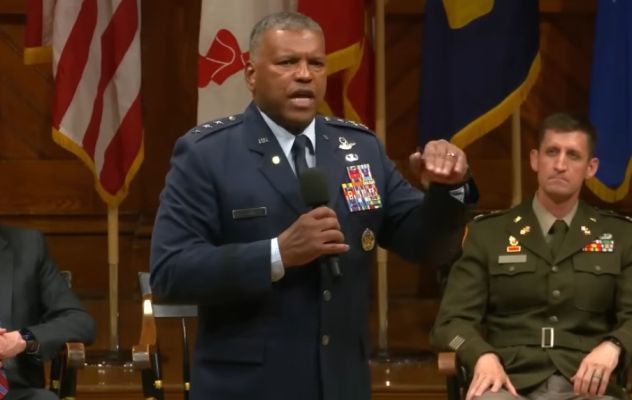
Read the full transcript of retired U.S. Air Force General Richard Clark’s keynote address on Wednesday, May 27th, 2026 during Harvard’s 2026 ROTC Joint Commissioning Ceremony.
Listen to the audio version here:
Welcome and Opening Remarks
LT. GEN. (RET.) RICHARD CLARK: Welcome everyone, greetings and I do want to say one thing, I got to clear up something that Tom just mentioned about the kids. I think Milo set the standard because he was going to go to the Air Force Academy until he found out I was going to be the superintendent. And then Zoe said, dad, not doing it. So they settled for second best, sorry sir. No, no. Really they couldn’t have made a better choice. They couldn’t have made a better choice.
Gratitude to President Garber and the Leadership Team
And I want to thank you, President Garber, sir, for your leadership at Harvard through turbulent times. Your steadfastness has helped this institution continue, so thank you, sir. I also want to thank Tom, Nick, Jim, first for having me here. I know it was hard for you, Tom, you’re the leader and you brought an Air Force guy in, but here I am. But I certainly appreciate this, it’s such an honor, especially with Zoe being in this graduating class, but really thank you for allowing me to be here. But more importantly, thank you for producing the next generation of leaders. And what you have done, you and your cadre have done, is immensely, immensely important to our country, so thank you all. Let’s give them a round of applause.
Honoring the Families
I also want to congratulate and thank all of the families here. These are some young people that have had dreams and aspirations throughout their whole lives. But I always say, if you see a turtle sitting on a fence post, you know it didn’t get there by itself. Just wait for it, you’ll get it. But you have helped them in ways that we can’t even imagine and that we can’t even measure. But congratulations for some amazing, amazing young people that are about to serve our country.
I blew it out, okay, there we go. Mostly though, I want to congratulate you because they’re about off your payroll. We’re all getting a pay raise, this is good, this is good. So congratulations to you all though, this is a great achievement.
Congratulating the Graduates
But then the group that we’re all here to honor, I have to say thank you for stepping up to serve, stepping up to be a part of something bigger than yourselves, and being a part of two amazing institutions in our country’s history, Harvard and our armed forces, and you are special, special people. And it’s an honor for me to be here in front of you, but I wish, I wish that I had the opportunity to serve with you. But congratulations to you. Let’s give them a huge round of applause.
The Oath of Office and the Constitution
Tom mentioned it in his remarks though, they’re about to take an oath of office that is a commitment to something so big and so important to our country. They’re committing to our constitution, the fabric that makes our country what it is. It has woven us over centuries, and it will continue to weave us into the future, but only because people like them are willing to take an oath, and willing to commit, and willing to sacrifice to something bigger. And so I am just honored to be a part of this.
Forty Years of Service
But I will say it was exactly 40 years ago today that I took the oath of office to join the Air Force. And it is exactly 40 years ago tomorrow that I graduated from the Air Force Academy, and I remember it like it was yesterday. And whether you stay and serve for four years or 40 years, your service is very much appreciated. I urge you to enjoy it. I urge you to make sure that when you look back on it, that your memories are about the things that you did, the differences that you made, and the people that you touch. But enjoy it. Forty years went so fast, so fast. I know I don’t look like it, but it seems like yesterday. It really does.
Harvard’s Legacy of Military Service
But when I think about Harvard’s history with the Armed Forces, there aren’t many schools that can say that they’ve had graduates that serve in every conflict that our country has ever been a part of. That have fought in every war, took the first oath of office in 1789, and have continued right up to this group right here. It’s pretty incredible.
The Story of Sherrod Skinner
And I did some reading about it, and there was one graduate that really struck me that I want to talk about. And I talk about 40 years ago for me, but let’s go back 75 years to a graduate from Harvard. His name was Sherrod Skinner. Sherrod Skinner was a graduate here. He was from Michigan. He lived in Connecticut. He had a twin brother here, David Skinner. And when Sherrod graduated, he commissioned into the Marine Corps. He commissioned, and in July, he completed his training, and he was shipped off in 1951. Actually graduated in 1951. He went to training in 1952, and then he went to fight in the Korean War.
Now, Sherrod was an artillery observer, and he was immediately put in charge — months after graduation from Harvard. He was put in charge of an outpost that was on the front lines at a critical point in the front line in the Korean War. And one of the situations that he faced early on was in his outpost, the enemy knew that it was a critical place, and they mounted a massive attack against that point in the line.
“Hold the Line”
And Lieutenant Skinner was in charge of this outpost, and he was told, “Hold the line until reinforcements come.” He hadn’t been a lieutenant that long — months — but he knew what that meant.
He knew what “hold the line” meant. He knew what his oath meant, and he knew how to lead his men to hold the line.
And when the enemy came forward, he directed the attack, he directed machine gun fire, he directed mortar fire. Eventually, though, his lines of communication were cut off, and he couldn’t have any more artillery fire, so now it was up to he and his men to hold the line. They continued to fight, he continued to command from his bunker, even to the point where he had to leave his bunker on several occasions to bring ammunition to the machine gunners, to bring grenades to some of the soldiers, to continue to direct the fire.
He was wounded twice. He refused — refused — medical attention so that his men could be treated. And eventually, they were out of munition, reinforcements hadn’t arrived, they were cut off from communications, and the enemy had broken through the line. They fell back into the bunker, they defended as long as they could. Finally he told his men, “Feign death. Play dead. It’s our only hope.”
They all played dead. The enemy came into the bunker, they looked in, they saw a bunch of Marines laying on the ground, and when they left to ensure that there were no survivors, they threw a grenade in, just to finish the job. And when they did, Lieutenant Skinner saw that grenade land between him and two of his men, and without hesitation, he jumped on that grenade. He took the explosion himself to save his men.
A Legacy of Sacrifice
Lieutenant Sherrod knew what it meant to hold the line. He knew what it meant to commit to something bigger than himself. As a result, that was on October 26, 1952, three days before his 23rd birthday. He was 22 years old. A year later, he was posthumously received the Congressional Medal of Honor, one of 18 from Harvard, but the one that struck me the most — 22 years old, a year in the military, and led with everything that he had, and gave everything that he had.
And when I hear stories like that, I ask myself, what would I do? Could I do that? I ask myself, what were the values that were instilled in him that made him do what needed to be done to hold the line?
Integrity, Humility, and Excellence: The Three Core Values
And I study leadership, I look at other leaders, I try to learn from other leaders, and there’s three values that I think had to be ingrained in him, and if they weren’t, he certainly demonstrated them, the first being integrity. Integrity means that you execute and exhibit actions that are in alignment with your morals and your ethics and your beliefs and your commitments, that your actions and who you profess to be are in alignment. Lieutenant Skinner did that that day, he showed integrity without question, integrity.
The other one is humility. Humility doesn’t mean that you think less of yourself, it means that you think of yourself less. And if there’s not an example of thinking of yourself less than dying, than dying for your teammates, I don’t know what is. He certainly had humility ingrained in him.
And excellence. He was less than a year, less than a year as an officer, and he knew how to lead, he understood what it meant to hold the line, he understood what it meant to give everything he had, but really to execute his job to the fullest. In a short time, these things were ingrained in him. Excellence doesn’t always mean that you’re the best or that you’re at the top, but what it means is that you’re always, always elevating performance, you’re always getting better. You’re better today than you were yesterday, you’re better this year than you were last year, you’re better this time you did an action than you were the last time you did it. It’s about being better, there is no end to better. And I have no doubt that Lieutenant Skinner continued to get better because he became so, so incredible in such a short time. Humility, excellence, those are the values that he had.
Values Mean Nothing Without Action
But I will say this too, values don’t mean anything without action. And there’s a quote by Lao Tzu, he’s a Chinese philosopher, 500 BC, and most of us have probably heard that. “Your thoughts become words, your words become actions, your actions become habits, your habits become character, and your character is your destiny.” His thoughts translated to destiny like no other story I’ve heard. And his actions were exactly what his thoughts had instilled within him.
And when I think about those, what are the thoughts and the actions, because we know what the words and the thoughts were, integrity, humility, and excellence. And so what I want to tell you is the way that I see the actions and the habits coming from those words, for integrity, it’s about living honorably. Live honorably. Do the right thing, even when nobody’s looking. Live honorably in accordance with your own beliefs and your own moral standard. Live honorably. That’s what integrity is about.
When we talk about humility, humility isn’t, like I said, thinking less of yourself. It’s about lifting others. Lift others before yourself. We’ve all been a part of organizations where people climb on the backs of others to get to the top, but it’s about lifting your teammates to be their best possible selves. Helping them to grow and to learn and doing everything that you can imagine if everybody on a team was committed to helping everyone else on a team. How great that team would be. Lift others. Those are the actions and habits of a humble person.
And excellence. I mentioned it’s about getting better every day. Elevate performance. Elevating performance is about a mindset. It’s not necessarily about the things that you do or the levels that you achieve, but it’s about every day saying, I’m going to be better today than I was yesterday in everything that I do. Elevate performance. Live honorably. Lift others. Elevate performance. Those are the actions of a man, of a woman, of character.
A Personal Story: Deployed to Iraq
Now I want to give you one more example, and it’s a personal one. So in 2008, I was deployed to Iraq for a year and left my family and went and I was part of the, I deployed with the Army. Imagine that.
And I was part, I led a team of about 45 people called the Joint Interagency Task Force. And I worked for Multinational Force Iraq. And it was without a doubt the hardest year of my life. I will never forget it. But it was also one of the most meaningful of my life.
And I led my team and I was committed to the same kinds of values that we just talked about. I put everything I had into leading my team, into lifting others, into living honorably, into elevating our performance and making us better and better. And when it came time for leave, I even let my team go first. I said, “When everybody else is done with their leave, then I’ll go.”
A Hard-Earned Leave
And so it was about eight and a half months into my deployment when I finally got to take leave, and I got to go home. And I remember going to the airport, Baghdad International Airport, and when I got there, I told myself, I said, “Man, I have been leading hard for a long time. It’s time to take a break.” And I started my leave right then and right there.
And I walked into the airport, I checked in to get on my plane, and the airman at the operations desk said, “Colonel Clark” — I was a colonel back then — “Colonel Clark, you’re the senior ranking officer on the airplane, so you’re the top commander,” meaning I was in charge of everybody that was getting on that airplane. And I was like, “No, I’m not. There’s got to be someone else.” He said, “Sir, not only are you the senior ranking, you’re the only officer on the airplane. You’re in charge.”
So I took the list, I looked down it, I got everyone together, and the next senior ranking person was a tech sergeant on the list. And I said, “Hey, come here. I got a job for you.” And I gave him the list, and I said, “You’re going to be responsible for everybody on this list, and I want you to make sure that we’re communicating and that everybody’s taken care of.” And he was like, “Yes, sir, I got it.” And he took it, and he owned it. He led. He was being a leader. I was delegating, right?
The Broken Plane
So we go, and we’re all waiting, and everyone’s sitting on the ground outside, and then the ops airman comes up to me, and he says, “Hey, Colonel Clark, I got some bad news. The plane is broken, and you guys are going to be delayed.” And I was like, “Oh, are you kidding me? Come on.” He said, “Sir, there’s nothing I can do about it. The crew says it’s broken.” And being a pilot, it’s not good to fly broken airplanes, but I was like, “Okay.”
And so I sat there, and I thought, “I better tell the tech sergeant.” So I went, and I told him, “Hey, let everybody know the plane’s broken, and we’ll be off in a little while.” So he goes, and he does his duty.
Well, then the time is just dragging on, and I’m just getting so impatient. And I go to the ops airman probably four times, and I said, “When’s the plane going to be ready? What’s going on?” And he finally got to the point where he was just like, “Sir, I don’t know.” I think he was getting a little bit scared of me, and he was certainly a little bit tired of me bothering him and pestering him so that I could go home to my family. And I didn’t even tell the tech sergeant as I was getting this information. I just let everybody sit outside, and I did my thing.
A Lesson From the Tech Sergeant
Well, the last time that I went to the tech sergeant, I said, “Hey, what’s the status? Tell me where the plane is. What are we doing?” He said, “Hey, sir, you know what? There’s a distinguished visitor lounge for colonels and above that you could go sit in.”
A Lesson In Humility At 30,000 Feet
“Do you want me to take you there?” I was like, oh, that sounds good. So I go in this little room. They have cookies and soda. There’s a TV playing the Armed Forces Network, and I just sit there, and I am fat, dumb, and happy, watching TV, just relaxing. It was even a little bit air-conditioned, as much as you can get in Baghdad.
And I just sat there for a long time. And the airman was right. I stopped bothering him because I was good, me. I was good.
And so then he comes in finally, and he says, “Hey, Colonel Clark, the plane’s ready.” And I was the first one. I put my helmet on. I put my vest on, and my battle rattle, as we call it, and I line up, and I’m standing at the door, and I realize, wait, I’m standing here by myself.
And so I went and told the tech sergeant, I said, “Hey, the plane’s ready. Can you let everybody else know?” And he was like, “Yes, sir, got it,” and he went, rounded everybody up, and we got on. We lined up, and I was first one in line. We walked out. We go to the C-130. The back’s open. We got on really quickly, and we all sat down, and we took off, and we flew, and we landed in Mosul.
And that was one stop to Kuwait and then home, and I was like, man, one step closer.
Broken Plane, Better Cookies
We land in Mosul, and the crew tells us as we’re getting off the plane, “We’re broken. We’re going to be here a little while.” So I told the tech sergeant, “Hey, we’re broken. Make sure everybody’s taken care of,” and we walk in. We get to the office desk. Guess what my first question was? Where’s the lounge?
They stuck me in the lounge. Better cookies, better soda, TV, and I just sat there. I just sat there, and I enjoyed my time.
Then the ops desk, they come into the room, and they tell me, “Colonel Clark, plane’s fixed.” Well, plane’s not fixed. “We have a different plane for you, and we’re going to be able to get you to Kuwait so that you and your team can go home,” my team.
And so I made sure this time that I told the tech sergeant, I said, “Hey, we’re going to go. We’re getting on a different plane, so let’s get everyone lined up.” So we line up, and I’m first one in line again, and we start walking, and we get out to our C-130, and it’s all buttoned up. All the doors are closed, and I said, “Why is this the one? It’s closed.”
And he said, “Yes, sir, this is the one, but we’re going to enter through the front.” And I was like, “Well, that takes too long. Why can’t we?” He’s like, “Sir, I’m just the ops desk airman. This is the crew’s call.” I was like, fine.
Two Coffins, Flag-Draped
So we walk out there, and we go in the front. Normally, I would give a fist bump to the loadmaster as I’m walking into the plane, but I was just like, “Hey, why didn’t you guys have the back opened up? We could have already been on here. I don’t understand.” And he’s like, “Sir, please, if you could just have a seat.”
So I kept, I was like, fine. And I walked, as soon as I walked by him, and I looked back to the back of the plane, and there’s two coffins, flag-draped.
And as soon as I saw them, I just felt this sense of dread, like, what a jerk I am. What a poor leader. What an anti-everything that I said I would be that I was that day.
And when I was the first one on the plane, that meant that I got to go all the way to the back, and I sat right with those two coffins right in front of me. And I got to do some thinking.
A Choice to Lead
And I got to think about myself and what kind of leader I had been that day and my choice to not lead that day. I thought about the people that were in those coffins that gave everything, everything. And I couldn’t make it through one more day of leadership, one more day of helping people to be their best. And I made that choice.
And I sat there, and I said, never again, never again will I choose not to lead. And it was a long trip. And when I got home, I told Amy the story, and I said, “I can’t even believe how I acted. I can’t believe that I couldn’t go one more day to be the leader that I said I was going to be.”
Live honorably, lift others, elevate performance was not a part of my value set that day.
Every Day, You Make a Choice
And so I tell you this to say every day, every day you make a choice. We all do. But don’t ever think, don’t ever think that your choices don’t matter. Make the right ones. You choose your attitude, you choose your values, and you choose to lead or not to lead every day. And when you don’t, sometimes you remember it for the rest of your life.
You got two examples today. You got Lieutenant Skinner, and you got Colonel Clark. We both made choices. Use those examples to determine how you’re going to lead for the rest of your time in the military, for the rest of your life, because leadership is not confined to the military. Leadership is everywhere you go, every step you make, every time you meet someone.
You have the chance to live honorably, to lift others, to elevate performance with integrity, humility, and excellence. Choose your values and live them every day.
And I just want to thank these young folks because I know they’ve already made a choice to be a part of the armed forces. And now my charge to you is choose to lead every day. Every day. Thank you.