Share & Care!
Episode Notes: In this special episode of The Oprah Podcast, Oprah Winfrey looks back on the profound life lessons she learned from her greatest mentor—mother-sister-friend Dr. Maya Angelou—twelve years after the iconic poet and author’s passing. Drawing from their deep friendship, archival conversations, and Angelou’s transformative autobiography I Know Why the Caged Bird Sings, Oprah shares timeless wisdom that continues to guide her and so many others. From the power of words and the charge to “believe someone when they tell you who they are,” to insights on courage, forgiveness, aging, and daring to love deeply, these teachings offer enduring guidance for living with purpose. Join Oprah as she revisits personal stories and the beautiful poem Maya wrote just for her 50th birthday.
TRANSCRIPT:
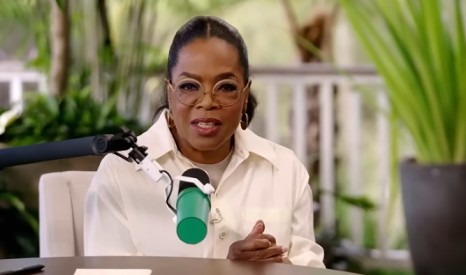
Oprah Winfrey: A happy hello to you. I thank you for taking the time to be with me here on the Oprah podcast.
One of my greatest mentors, mother, sister, friend in my life, Dr. Maya Angelou, passed twelve years ago. And I know you all feel this sometimes, for people who are close to you. It’s still hard to believe it’s been that long. Maya taught me more, I believe, than any other single human being that I knew on the planet. I learned so many life lessons from her.
Things that she actually said, but also how she lived and moved through the world. I think she is one of the reasons why I have embraced aging with such enthusiasm because she would say to me, “Girl, I’m telling you, the eighties are hot.” So I’m still waiting to experience that. I learned so many lessons from her. I could write a book about it.
And I know she had the same impact on so many of you. I first met her in my early twenties. I was working in Baltimore, and I had convinced my station news director that she was worthy of being on the evening news. They didn’t even know who she was. She was speaking at [Morgan State University], and I asked them if I could go and cover her and create a story from it.
And I met her backstage. I said, “Miss Angelou, if you would just give me five minutes of your time, five minutes of your time, I would really appreciate it for this interview.” And she agreed, and I held my hand out. I had a little Timex watch, and I watched that clock to make sure I didn’t go one second over the five minutes that she gave me. And when we were done, she turned to me and she said, “Who are you, girl?” And I was forever taken by her.
Our bond was immediate. It was profound. And I would go on to interview her countless times throughout the years. And when all of the craziness and disruption of life sometimes would creep in, I would call her. And I often go back to the lessons I learned from Maya Angelou to remind myself to get centered in who I really am.
And many times when things still occur, I think, oh, what would Maya do? What would Maya be doing in this time? It’s a blessing to me that I have so many of those conversations on camera. So for this podcast, I wanna share some of those great lessons with you because my intention right now is to do what Maya said in her poem to grandmother. She said, “When you learn, teach. When you get, give.”
So my intention is to share the wisdom I’ve learned over the years, to offer you a breathing space, a thoughtful place beneath all the noise of the world.
The Power of Words
Starting with Maya’s belief in the power of words. I got this lesson many times from her.
VIDEO CLIP BEGINS:
Maya Angelou: “Words are things. I’m convinced. You must be careful about the words you use or the words you allow to be used in your house. In the Old Testament, we are told in Genesis that in the beginning was the Word, and the Word was God and the Word was with God. That’s in Genesis.
Words are things. You must be careful. Careful about calling people out of their names, using racial pejoratives and sexual pejoratives and all that ignorance. Don’t do that. Someday we’ll be able to measure the power of words. I think they are things. I think they get on the walls. They get in your wallpaper. They get in your rugs, in your upholstery, in your clothes, and finally into you.”
VIDEO CLIP ENDS:
Maya Angelou’s Childhood
VIDEO CLIP BEGINS:
Maya Angelou: When I was three and my brother five, my mother and father separated, divorced, and neither of them wanted me and my brother. But my grandmother, my father’s mother, said, “Send them to me.” And so they sent us without adult supervision on a train with tags on our arms saying these children are to be given to Mrs. Annie Anderson, my grandma.
We actually arrived in the town. Dining car waiters and Pullman car porters took us off trains, put us on other trains. We barely arrived in this village about the size of a studio, to Stamps, Arkansas. My grandmother owned the only black-owned store in the little village in which we lived. She was an amazing woman. She lent money to the white businessmen in the town during the Depression. So she taught me so much, and I look like her and I sound like her.
When I was seven, we were picked up and taken from my grandmother to my mother’s people in St. Louis. My mother’s people were foreign to me. All of her brothers were highfalutin, you know, were so this and that. And my brother Bailey and I tried to learn and become city kids, but my mother’s boyfriend raped me when I was seven.
I told Bailey the name of the rapist.
So he told the family. The man was put in jail for one day and night and released. And two huge white policemen came into my mother’s mother’s house. Bailey and I were on the floor playing a game in her parlor. These huge policemen came in navy blue serge suits. And blue serge was about half an inch thick in the thirties, with big brass buttons. They looked like giants.
And they said, “The man has been found dead, and it seems he was kicked to death.” I thought my voice had killed him. That was my seven-year-old logic. So I stopped talking. My mother’s family and my mother did their best to woo me away from my mutism, but they didn’t know what I knew. My voice could kill. So I stopped.
And after a while, I think they just really got tired of the presence of this mad and sullen and silent child. So they sent me back to my grandma, to mama. The best thing that could have happened.
VIDEO CLIP ENDS:
Finding Her Voice Through Words
VIDEO CLIP BEGINS:
Maya Angelou: My grandmother, she was an amazing woman. She gave me a little tablet, a 5¢ tablet, and she took a pocket knife and cut a groove in a number two pencil and put a string in that groove. And then the other string she tied to the spiral of the tablet. And I kept that on my waistband. So if anybody asked me what I thought, I would write it.
Mrs. Flowers was a black lady in Stamps in my neighborhood, and she knew I didn’t speak. So she took me to the black school. There was a library about one tenth the size of my library in my home. But it seemed to me there were millions of books. And she said, “I want you to read from A to C, and make notes.” I was eight years old. I read every book. I read everything. I don’t say I understood that much, but I read, and I found that I loved poetry. I loved it. All of it. Just that which I understood and that which I didn’t.
She would come up the hill from the white school. I don’t know how she had that contact, but she’d come up with books for me to read, and I loved them. I’ve read [Paul Laurence Dunbar], [James Weldon Johnson], [Countee Cullen]. I memorized. I read Edgar Allan Poe. I love Poe so much. I called him “E.A.” to myself. I read Shakespeare, and at one time I memorized like 50 sonnets or something.
But I read one sonnet which made me think Shakespeare may be a black girl in the South who has been molested. How could he know? “When in disgrace with fortune and men’s eyes, I all alone bemoan my outcast state and trouble a deaf heaven with my bootless cries and look upon myself and curse my fate.” Shakespeare knew what it was like to be raped and scorned, you see. So of course, I thought he was a black girl, barefoot in the South. It spoke to me.
About four years after Mrs. Flowers started me to read, that was about [Clevedon House]. Mrs. Flowers invited me to her house, and she used to make tea cookies and lemonade. And she’d give me that to drink, and she’d talk about poetry and she’d read to me with this [mellifluous] voice.
And she said, “Maya, you do not like poetry.” I got my tablet. I said, “Yes, ma’am.” She wouldn’t even look at my tablet. And she pointed her finger at me. And really, black people don’t like to be pointed at. And she was so elegant. She knew better. She just shook her finger in my face. I ran out of her house. I ran back to my grandma.
And Mrs. Flowers came back there and pointed her finger at me in front of mama. She said, “You’ll never love it until you speak it, until you feel it come across your tongue, over your teeth, through your lips. You will never love poetry. Never.”
And she harassed me. She kept following me around and around for months. And finally, I went under the house where the chickens go and the dirt is so soft because they scratch under there. I went under that house and I tried to recite a poem. And I found I had left my voice. My voice hadn’t left me. So I started talking again. And not stopped. No.
VIDEO CLIP ENDS:
Oprah Winfrey: I thank Mrs. Flores. And aren’t we glad she didn’t stop?
I Know Why the Caged Bird Sings
Oprah Winfrey: Well, Maya Angelou is one of the world’s greatest poets and authors, and she wrote more than 30 books over the course of her life. And her seminal autobiography series began with I Know Why the Caged Bird Sings. It’s considered one of the best nonfiction books of all time. It’s been banned for years.
I’ve been a student of that book since I read that very first page where she says, “What you looking at me for? Didn’t come to stay, only came to say happy Easter day.” Well, I was just floored by that sentence because I grew up in the church just like Maya grew up in the church, raised by her grandmother. I was raised by my grandmother. And it was the first time that I’d read a book, I Know Why the Caged Bird Sings, where a young girl’s story was a mirror for my own. And I felt so validated by her story.
So when you wrote I Know Why the Caged Bird Sings, was that a cleansing and a proclaiming of yourself to the world?
Maya Angelou: I don’t think so. I’ve heard that that’s what it was supposed to be.
Oprah Winfrey: Really?
Maya Angelou: You know, that it was supposed to be in its own way cathartic, and I don’t know about that. I didn’t feel that I had doffed a particular mortal coil, you know. I felt I had tried to write the truth and write it eloquently. But I don’t know. I never agreed with Thomas Wolfe’s statement that you can’t go home again.
Oprah Winfrey: Really.
Maya Angelou: My belief is you never can leave home. You take it with you. Everywhere you go. So my past is my present.
Oprah Winfrey: And everything that’s happened in your past is what makes you who you are right this moment.
Maya Angelou: That’s right.
Oprah Winfrey: When you wrote that, did you know that it would do for me and everybody else who’s ever read it, particularly young black girls? I opened that book. First of all, when you open the first page — I grew up in the church, raised by my grandmother, doing speeches — when you open the first page and the first words are, “What you looking at me for? Didn’t come to stay, only came to say, happy Easter day.” When I read that, I thought, there is a world out there that’s about me. Somebody knows about this.
Maya Angelou: Right.
Oprah Winfrey: It was a — what it did to me —
Maya Angelou: Oh, thank you.
Oprah Winfrey: — it just amazed me, it changed my life. And I think that was the first piece of black literature I read. And after that, I couldn’t read enough.
Maya Angelou: Yes.
Oprah Winfrey: I couldn’t get enough.
Maya Angelou: I know. That’s why I send you the books by there. Yes. From that wonderful bookstore in Denver. Send it to me. Also, and have them have some books —
Oprah Winfrey: Let down. You do. Yes. Yeah.
Oprah Winfrey: Well, when you wrote it, I wanna hear from your mouth, why I Know Why the Caged Bird Sings.
Maya Angelou: Well, there are two, or maybe 2,000 reasons. The caged bird sings because it must. It must or die. It may be it must and die. I don’t know. But it must sing. Sometimes the melody arrived at in the cage is much more fetching, much more appealing, much more profound, much more poignant than the melody arrived at by the bird who’s on the loose.
“The caged bird sings with a fearful trill. Its song is heard on the distant hill, for the caged bird sings of freedom.” Freedom. Freedom. Let me out of here. Let me out of here.
And so there is something universal about that song, since all of us are caged in some way or another. And so people can hear it and say, “Oh yes, oh Lord, let that bird out.” You know, at least I feel for the bird.
Learning to Love Yourself
Oprah Winfrey: I ran across in my senior memory book not too long ago, my goal. In the senior memory book, it says, “Take a good long look at yourself.” And I ran across something that I had written. It said, “I want to be a genuine female woman, strong and confident in myself.”
I wanna come back and talk about what that means because so often on the show, we have psychologists every day who say, “You need to learn to love yourself.”
Maya Angelou: Yes.
Oprah Winfrey: It’s so hard when people are filled with self-loathing.
Maya Angelou: Yes.
Oprah Winfrey: And doubt.
Maya Angelou: And doubt. Sometimes it isn’t even strong enough to be loathing, which can be turned around. It’s just doubt. It’s indecision, confusion.
Approving of Yourself for Being Alive
Oprah Winfrey: Quite often, it’s just they can’t even ask the question, so it’s very hard to get an answer. But, you know, all the time we talk about loving ourselves. What does that mean? Well, you can’t love yourself all the time. But what you can do is approve of yourself for living.
Approve of yourself. For being alive. For being alive. You know, you can say, well, I’m alive, and I thank God for that. And so, I mean, I did something very dumb yesterday and I don’t like that.
Or I’m not seeing as profoundly or acting as nobly. And that’s a really important word. It is. It is, yeah. I’m not acting as nobly as I know I could or should or must, but I do approve of myself for being alive.
Now you see, as long as you do that, you leave yourself room to grow.
Oh, wow. It’s just — I can’t even tell you what it’s like. I remember that being her little garden room and sitting in that room and being in awe of her. Every time I was around her, I always felt like I was, like, 11 years old again or seven years old sometimes.
We spent many nights on the phone. I looked to her for words of inspiration and strength for most of my life. I mean, during the early years of the Oprah Winfrey Show, I was in the tabloids all the time being exploited, so many negative stories that were all made up and lies. And she was always, always, always consistently there. Sometimes I would call her, and I’d say, “Can you help me figure out what I’m supposed to do?”
And she said, “Babe, let me go pray on it. I don’t want to just give an answer straight away. Let me check in with the Lord and see what the Lord has to say, and I will get back to you.”
A Pajama Party with Maya
Oprah Winfrey: Well, we went to a dinner and a pajama party at her house with readers whose lives had been changed by her work. And I remember we were so moved talking with Maya. We all just broke down crying at one point. And after dessert, we decided to let the cameras film just the two of us chatting in bed in our PJs, and we discussed, again, many of life’s lessons, including those she learned from her own mother, [Vivian Baxter], as well as one of my favorites. Take a look.
VIDEO CLIP BEGINS:
Oprah Winfrey: Here we be in Maya Angelou’s bedroom, the big brass bed. Talking about life lessons. I’ve said this many times before that some of my greatest lessons have been articulated by you.
I had to learn them myself, but they were articulated by you. Before we get into that, I must say, to have you in my bedroom where we are from time to time as my daughter — it’s one of the sweetest things.
Maya Angelou: If I could have had birthed girls, I would have not had the wisdom or the creativity to make you. I don’t like to, but didn’t. But when I think of you and think of how much I want to tell you, I wish I could just take your ear and go and blow into your ear everything I know. Everything I’ve been through.
Oprah Winfrey: I wish you could too.
Maya Angelou: I do.
Oprah Winfrey: Do.
Maya Angelou: But it’s pretty wonderful to have a chance to talk to you about courage, about laughter. Now, okay, courage — that’s one. You can’t do anything without that.
When People Show You Who They Are, Believe Them
Oprah Winfrey: The other most important lesson — well, it’s hard for me to number them — but let’s say one of the most important lessons I ever learned from you. And I still — you know, I think I know the lesson and then I’ll walk into a situation and think, that’s that same lesson. And that is: when people show you who they are, believe them.
Maya Angelou: Yes. Absolutely. A person says to you, “I’m selfish,” or “I’m mean,” or “I am unkind.” Or “I’m crazy.” Believe them. They know themselves much better than you do.
But no, more often than not, those of us who don’t trust life say, “Don’t say a thing like that. You’re not really crazy. You’re not really unkind. You’re not really mean.” And as soon as you say that, the person — pow — lets you know. And shows you, “I told you.”
Oprah Winfrey: I told you I was unkind. So now why are you angry?
Maya Angelou: Beware of people who are at your feet. When the winds of fortune change, they will be at your throat. So whenever you see them at your feet, stop them right then. Say, “Stop that. I’m not influenced. You do not please me.”
“Oh, you’re the greatest. I adore you.” No. Don’t give me that. No. Adore God. Adore somebody. Don’t adore me. Don’t do that. I’m a human being just like you out here doing my best.
Loyalty to God is Liberating
Oprah Winfrey: This is one you told me today I thought was brilliant. We’re just at the breakfast table. Loyalty to things is addiction.
Maya Angelou: Yeah.
Oprah Winfrey: Loyalty to God is liberating.
Maya Angelou: Yeah.
Oprah Winfrey: That. That will live with me forever. I knew that. You know, it’s somewhere I know that is true. I tried to live that, but I hadn’t articulated it so well.
Maya Angelou: But there’s almost nothing I tell you that you don’t say right.
Oprah Winfrey: Yeah. Yeah. Of course. I mean, you already — I know — say that, then I go write it down.
Maya Angelou: Yes. That’s true. Because you wanna remember it that particular way. But what I mean is, you already know it inside yourself.
Oprah Winfrey: Inside myself.
Maya Angelou: Yeah. It’s just that I put it into words.
Lessons from Vivian Baxter
Oprah Winfrey: You talk a lot about [Vivian Baxter] in Heart of a Woman. What do you think are the greatest lessons she gave to you?
Maya Angelou: One of the greatest was when I was 17. I left her house. She said, “Alright. You leave this house. But know when you walk over my front steps, you’ve been raised. Don’t let anybody raise you. Your grandmother, your uncle, and I have taught you the difference between right and wrong.”
Now she said, “Every relationship you have, whether work or romance or in any kind of career, you would have to make compromises. That’s alright, but don’t let anybody raise you.”
I took that to mean that I was a woman. And that’s what she gave me — the idea that I was a woman. Who’d already been raised.
Oprah Winfrey: A woman who’d already been raised.
VIDEO CLIP ENDS.
A Rainbow in the Cloud
Oprah Winfrey: Well, living much of my life — certainly my adult life — in the public eye opened me up to all kinds of criticism. It was not like even today, because today the criticism is a million fold because of social media for everybody. But I think one of the hardest things I had to get through was there was a period of time where I’d been betrayed by people I thought I could trust. And then any of you who’ve ever been through that, you know. Is there any worse feeling in any kind of relationship than to be betrayed by someone you trust?
And one time, I remember being so hurt that I was in the bathroom, and I was sitting on the toilet seat — put the toilet seat down — and there was a house full of people when I had first heard about this betrayal. And I was, like, crying, crying, crying. That kind of crying. On the phone with Maya about something that someone had said and therefore had gotten published in a tabloid that wasn’t true.
And I was calling her expecting her to be sympathetic and say, “It’ll be alright, and don’t worry about it.” And instead, she said, “Stop it. Stop it. I want you to stop it.”
And I was like, “What? What do you want me to stop?”
And she says, “I want you to stop right now and say thank you.”
And I said, “But — did you hear what I said?”
And she said, “Yes. I heard what you said. But say thank you right now. Say thank you.”
So I mumble, “Thank you.”
She goes, “I wanna hear it louder.”
I go, “Thank you.”
She said, “You’re not thanking me. You’re thanking God, because God has put a rainbow in this cloud that you right now think is a storm. There’s a rainbow waiting in the cloud for you on the other side.”
And that calmed me and was life changing for me. So whenever something hits, I say, “Thank you,” because I know God has put a rainbow in the clouds and something better is on the other side.
I have to say, she didn’t always — most often didn’t — tell me what I wanted to hear, but was one of those people who was always available to tell me what I needed to hear.
A Handwritten Gift
Oprah Winfrey: I feel like I’m one of the most blessed people on earth for so many reasons. But one of the best gifts I ever received — that was just, I think, more than a gift — was a pleasure and joy and a blessing all wrapped in one. It was a handwritten book. See, this is her actual handwriting. Maya Angelou wrote to me beginning 04/06/1990. And they were just thoughts that Maya had that she wanted to share with me. It really is a treasure.
And they’re lessons that I had learned or things that you had said to me over the years. And I think the best lesson I ever learned — when people ask the question, “What is the thing you’ve learned the most out of life?” — is a lesson. Do you know which one it is?
Maya Angelou: You’re not in it.
Oprah Winfrey: Yes, exactly. You’re not in it.
Maya Angelou: Of course. I remember it. And I remember also telling you that a number of times.
Oprah Winfrey: Yes. Because no lesson is learned immediately.
Maya Angelou: Right. It took me a long time to get it, didn’t it?
Oprah Winfrey: Yeah. Well, you got it, but you get it on so many levels.
You Are Not in It
Maya Angelou: You see, there’s a phrase used in West Africa — “deep talk.” Meaning that anybody will understand on a certain level. People who are interested in really understanding more take that statement or that lesson a little deeper. Somebody else will take it even deeper. And the West Africans suggest you can never understand completely. Even at 80, as far down as you take that aphorism or as far down as you take the adage or the advice, you could still go deeper if you’d live long enough.
So when I told you the first time — you called, and some newspaper tabloid had just vilified you, or Stedman, or both, and you were really as close to losing it. You were so hurt by the erroneous and ridiculous and cruel accusations that you were just hardly getting your breath.
Oprah Winfrey: Mhmm.
Maya Angelou: And I said, “You are not in that.” And you said, “Yes, but you see, this is what they said.” And I said, “Yes, but you are not in it.” And then I heard you start to realize what I was saying — that that has nothing to do with you. That has all and everything to do with the perpetuator. And he or she or they are going to get their living out of you getting your dying. And so, obviously, you can’t give in to that because you are not in it.
Oprah Winfrey: And, you know, it happens to people who are in every walk of life — not just people who spend their lives like, you know, I do on television every day. But I hear little girls who are going to school and people are talking about them in class, or when people are making fun of you, or your neighbors. We did this show not too long ago where there’s a clique in the neighborhood or a clique in the office, but the lesson is always the same. You’re not in it.
Maya Angelou: It’s true. They would have done that without you. This is what you have to realize. And this is true of the rape victim. You see, it runs — that understanding is as broad as life is. So that the rape victim so often thinks that she is in it or he is in it. That same rapist would have done somebody else.
Pecked to Death by Ducks
Oprah Winfrey: Another one of the things you’ve taught me — I love that phrase that you say — that people will try to peck you to death like ducks.
Maya Angelou: Yeah. Most people don’t have the courage to just come out and —
Oprah Winfrey: And kill you.
Maya Angelou: And kill you. That’s true. They will take a little piece of your knee. They’ll take the flange off your nostril and a bit of the lobe of your ear, hoping that you didn’t even notice it, you see. And that’s called blow, bite, and blow. That means that you blow on something until it becomes anesthetized, quickly bite, and then blow again. And the person doesn’t even know he’s been bitten. You see, West Africans call that blow, bite, and blow. So people do that, and that’s my son’s phrase — pecked to death by ducks.
Oprah Winfrey: Oh, pecked to death by ducks. Have people tried to do that to you?
Maya Angelou: Oh, many times. Many times. I mean, it hasn’t stopped. I’m sure that it’s happened today. But the thing is, I encourage you and my — I have two other people who I consider daughters: [Dawson], the black rose in San Francisco, and a girl, a woman in West Africa, [Arabah]. If I could have had daughters, you three would have been the three I’d have chosen.
My encouragement is to stop it as soon as it happens, as soon as you hear it, as soon as you sense this person wants me dead. The person just walks in and says, “Oh, you’re putting on weight.” You say, “Stop it. Not me, you don’t. Not me, Jack. Not me. Out. Get out.”
Now, I have lost or left a lot of men who, you know, just in public would say something like, “Well, Maya, I don’t know why she wore that dress. This is not the dress that suited her.” I said, “That’s the end. That’s it.” So the man then, when we get home — because I start packing his clothes — he says, “You take everything to the max.”
Standing Your Ground and Setting Boundaries
Oprah Winfrey: I say, yes, because I know that once you take that flange off my nostril, pull one patch out of my hair, and I don’t say anything, the next thing you’ll have me bald. Oh, no. Oh, no. No. No. No. No.
Oh, that just happened to me the other day. Was someplace somebody was asking me to do something. This woman, I didn’t even know her, she says, “Oh, but you know me.” And I said, “But no, don’t really, I don’t. I’m not sure.” She says, “But I knew you when. I knew you when you were barefoot and you were walking back some—” And I was thinking, oh, she wants me.
Maya Angelou: Yeah. Exactly. She wants me dead. Exactly. She wants me dead. This is it.
Oprah Winfrey: But I didn’t have the courage to do that. I didn’t have the courage to say stop it.
Maya Angelou: You must. You do them a favor. Not only yourself. You do them the favor of not having to do that again to somebody who will actually knock their heads off. You understand?
Oprah Winfrey: Yes, I do.
Maya Angelou: You really do them a favor. The best thing to do is stop them in their tracks. She will stop you, babe. Just say stop it. Stop it.
Oprah Winfrey: Oh, she knew how to do that. I will say that.
Reflections on Aging and Wisdom
Oprah Winfrey: Yeah. I turned 72 this year, and I’ve never felt better in my adult life. What I do know for sure about this seventh decade is that you understand that while you may be closer to the end of your life, you value the time that you’ve had, and you have value for the time that remains, an even greater value, I think.
I feel I was here to earn my wings, actually, and I’ve paid attention and been observant. That’s one of the first things that Maya Angelou said to me when we met all those years ago. She said, “I can see that you are a girl, and what you are is obedient. You are obedient to the call.”
So I really felt that in my bones when she said that because I have been obedient to the call. I have a call. You have a calling. We all do. But the question is, will you be obedient to the call that brought you here to the planet, or will you resist that and try to tell it what you’re supposed to do?
So when Maya was in her seventies, I was approaching my fifties, and here’s what she had to say about aging.
Oprah Winfrey: What does 74 feel like?
Maya Angelou: It’s so wonderful. It is so good. I thought the fifties were hot until I reached the sixties. The sixties are out there. They’re out there. But then when I reached the seventies, I now know the seventies. You want to reach the seventies. Everybody stay alive. Reach the seventies. I tell you.
Oprah Winfrey: Because does it — do you feel age? You know, this is a society that so puts, you know, age and aging, and we’re so concerned about it. But do you feel — is there a point where you say, oh, yes, I’m now an older woman?
Maya Angelou: No. There are some things that have not escaped me. Pain has not. Ecstasy has not. Satisfaction has not. Disappointment has not. Fear has not. Courage has not. So there are some things which have not escaped me.
Oprah Winfrey: So that keeps you young.
Maya Angelou: If you start thinking that you know it and nobody can tell you anything, you found the one way and you can tell all others’ faults, it’s already over. It’s already too late. You have become old. At 18, at 25 —
Oprah Winfrey: When you think you know everything. When you really know a lot.
Maya Angelou: Well, I’ve been around a long time. You do know a lot. You’ve been around a long time and you’ve paid attention.
Oprah Winfrey: It’s so interesting, though, because people say to me, they say, “When you call her up and you talk to her, does she talk like she talks when she’s —” and it is true. Many times I call, and like, just the other day, Easter Sunday morning, I’m sitting at my kitchen table and she just starts a conversation. “Let me get a pencil. Write this down.” And while she’s talking, I mean — and then she goes, “Are you there, babe?” I go, “Yes. I’m here.”
It seems so clear on my end. Does it seem clearer as you get older?
Maya Angelou: We do. You get clearer. About, you know, a little bit, but not much. Listen. Don’t get older just to get wiser. If you get older, you will be wiser. I believe that. If you dare.
Oprah Winfrey: If you dare. Yeah.
Maya Angelou: But get older because it’s fun. It’s fun.
Oprah Winfrey: Yes. It’s great fun.
Maya Angelou: Now today, was so, yes. Well, you know, the body is going but, I mean, you know that — so what? No life lives forever. You know? So my knees are gone, okey dokey. And I find that, you know, my hair has changed a lot. And the breasts are very interesting.
Oprah Winfrey: Yes.
Maya Angelou: Because they are in an incredible race. They’re in an incredible race to see which one will touch my waist first. And it’s fun. Living is fun.
Oprah Winfrey: That’s fun?
Maya Angelou: Yes, that’s fun too. Watching them run for it.
Oprah Winfrey: Yeah.
Maya Angelou: But you know, if you put it in your mind that it’s fun. Yeah. It’s fun. It’s fun. But if you think, “Oh —”
Oprah Winfrey: Yeah. You know why it’s fun? Because you’re still here.
Maya Angelou: Still here. I’m still here. I’m still here and somebody is still calling me darling. Ain’t that the —
Oprah Winfrey: Hello. That’s the thing. Somebody’s still calling you darling.
The Power of Forgiveness
Oprah Winfrey: So in 2013, I spoke with Maya Angelou on Super Soul for a two-part special. It would be one of my last public conversations with her. We talked about so many of her lessons, including forgiveness. This is a big one.
Maya Angelou: Forgive everybody. Just forgive it. I mean, mind you, we ask the creator to forgive our stupidest actions, truly mean, mean-hearted things. And say, “God, forgive me. Forgive me.” Or people will say, “I’m not perfect.”
Oprah Winfrey: Yes. That’s right.
Maya Angelou: So then you forgive. And it relieves you. You are relieved of carrying that burden of resentment. You really are lighter. You feel lighter. You just drop that. Drop it. So I would encourage — forgive. That’s the first thing. Then you’re free to do other things, to have some ambition and so forth.
Oprah Winfrey: Because forgiveness — I know you often say love liberates us, but actually forgiveness does also.
Maya Angelou: Yes. But I mean, you can’t forgive without loving. And I don’t mean sentimentality. I don’t mean mush. I mean, having enough courage to stand out and say, “I forgive. I’m finished with this.”
I had to get to a place where I could forgive the man who had raped me when I was seven years old. I had to get there, and that was a matter of incredible mental gymnastics. And then I had to think of what I had done to other people and see how I’d been forgiven. Whatever I’ve done, I’ve been forgiven. And I have to get at least to a place where I can forgive. I don’t forget, and I will not put myself in a situation where that can be done to me again. But I understand.
A Life of Achievements and the Desire for a Daughter
Oprah Winfrey: So as we list all of your achievements — the first black streetcar conductor, dancer, singer, poet, playwright, film producer, director, actor, civil rights activist, professor of American Studies at [Wake Forest University], recipient of more than 70 honorary doctorate degrees, and author of more than 30 books — is there anything you wanted to have on that list but didn’t get a chance to do?
Maya Angelou: One of the things I wanted was to have a daughter. I have a son who is in my heart. Wonderful young man, wonderful person, good human being, daring and loving and strong and kind. I wanted a daughter. And I’ve taken people’s daughters. I have certainly taken you. I took my daughter-in-law. Because I know I’m a good mother. I care and I dare. I care enough to let you go, but I dare enough to follow you.
Oprah Winfrey: I will say that too. And I will say, you know, one of my — part of my nature is to be obedient. I’m obedient to God’s call. And over the years, when I would call you for advice, sometimes I would take it.
Maya Angelou: I know it.
Oprah Winfrey: Most often I would take it. Most often I took it, right?
Maya Angelou: Yes, that’s true.
Oprah Winfrey: And sometimes I didn’t. But you have never been the kind of mother that says, “I told you so.” No. So when I didn’t take it and the mistake inevitably happened, you were not the kind of mother to come back and say, “I told you.”
Maya Angelou: No, but you were the kind of daughter who said, “I was wrong.”
Oprah Winfrey: I was wrong. I should have listened. I should have listened.
Maya Angelou: Of all — have you ever tried and failed at something?
Oprah Winfrey: Yes, many times. Many times.
Maya Angelou: You forgive yourself for every failure.
Oprah Winfrey: Yes.
Maya Angelou: Because you tried to do the right thing. God knows that and you know it.
Oprah Winfrey: Yeah.
Maya Angelou: Nobody else may know it.
Oprah Winfrey: Yeah. Well, because one of the great lessons that I’ve learned from you — when you know better, you do better.
Maya Angelou: That’s the ticket. That’s the ticket. That’s it. And that’s why you forgive yourself.
Oprah Winfrey: Yes, ma’am.
Maya Angelou: Because if you’d known better, you’d have done better.
Oprah Winfrey: Yes. Of course.
A Certain Way of Being in This World
Oprah Winfrey: One of the things that strikes me most about Maya Angelou’s life is how at six feet tall — she was six feet barefoot — she moved through the world with an unshakable kind of calm and confidence. In one of her poems, she writes about another woman, and she says of that woman, “She had a certain way of being in this world,” and I think Maya also did. She had a certain way of being in this world, the way she moved and carried herself.
I’ll never forget the time that I was at a party at her house. I was at many gatherings at her house. She always used to have a big, huge Thanksgiving dinner with, you know, 100 people coming from all over the country. But I was there one evening when she actually kicked someone out of her house after they made an offensive joke. I mean, it was mind-shattering to see that happen because we’ve all been in the midst of somebody telling a joke that is an inappropriate joke. It shouldn’t be said, and you kinda — or you turn or walk away or whatever. But not Maya. She heard from across the room somebody telling this joke and comes across the room to ask them to leave her home.
Oprah Winfrey: Tell me this. You say words, or things, and that they’re so powerful. Do you have a favorite word?
Maya Angelou: Oh. Love.
Oprah Winfrey: Love is your favorite word?
Maya Angelou: Yeah.
Oprah Winfrey: Are there words that you, Maya Angelou, as a writer, just like the sound of and the humor?
Maya Angelou: I like murmur.
Oprah Winfrey: You like murmur. M-u-r-m-u-r.
Maya Angelou: Yeah. It sounds good, doesn’t it?
Oprah Winfrey: It does sound good. Murmur. You can’t shout murmur.
Maya Angelou: It is murmur. Murmur. You can’t shout murmur? No.
Courage to Confront Poison
Oprah Winfrey: The one thing that I think that I have admired and loved about you that I couldn’t articulate — it just occurred to me now. I remember once being in your house and somebody was telling a joke and you were on the other — we had a party. There was a lot of noise in the room, and they were telling a joke, and it was a racist, homosexual joke, and you stopped the party. First of all, I couldn’t believe — I was like, how can she hear that? And she’s all the way over there. But you stopped the party and asked the person to excuse themselves and leave.
Maya Angelou: Yes, exactly. I say, “Is this your coat? Did you come with anyone? Both of you come this way.”
Oprah Winfrey: I know. Oh, yes. No, no, no. No, no, no. And everybody else is like, “Whoa, what just happened?” And then you said to all of us, “I will not allow it in my house.”
Maya Angelou: That’s right. It’s vulgarity and it’s poison. And this is what a person must know. I know there are black people who say, “Oh, you can use the n-word to me because I’m black.” No. It is poison. All of that — any racial pejorative, sexual pejorative, any of that stuff — is created to make a person less than human. And that means it’s poison. Nobody can use it safely.
I mean, if poison is poison that you get from a pharmacy and it has P-O-I-S-O-N on it and skull and bones — you can’t take that content and pour it into Bavarian crystal and make it otherwise. It’s still poison.
Oprah Winfrey: Yes.
Maya Angelou: So you don’t want it clinging to the walls, getting into the upholstery, in your clothes, and sooner or later, right into you. Right into you.
Oprah Winfrey: Yes, ma’am. Okay. So this is what I want to know. Where did you get the courage to not allow it in your space? Because there are many — if you are watching right now — people say things that make you uncomfortable. They start a joke that’s going to be — you know it’s leading down a racial path or homophobic path or whatever. And people just sort of — people laugh nervously at it because they don’t know how to stop it. How do you stop it?
Maya Angelou: You don’t stop it by doing it immediately. You develop courage. Courage, Oprah, is the most important of all the virtues. Because without courage, you cannot practice any other virtue consistently. You can be anything erratically, now and then — kind, fair, true, generous, just — blah blah. But to do that thing time after time.
So what you do is you do it in small ways. I mean, if you wanted to pick up a 100-pound weight, you wouldn’t just go pick it up. You start picking up five pounds, then 10 pounds. Well, that’s the same way you do with courage. You do the courageous thing, a small one, and you like yourself. And then you do another, two or three, and you like yourself better.
Words as Things
Oprah Winfrey: And before you know it, you’re able to say, “Excuse me, not in my house, you don’t. You don’t paint my walls with poison and vulgarity. You will not do it in my house. Out.”
Is this your purse? Thank you. My goodness. I’ve seen it. I know. Because you believe that words are things.
Maya Angelou: Yes, ma’am. I know they are. They are things. Absolutely. You can put some words together and make people want to go to war. Put another few words and make them long for peace. Words are so important.
And this is what you take to God. Words. You may not frame them, but God knows your heart. So when you go down on your knees or in your bed or riding in a car and you pray, you’re using words — “I’m lonely, I’m hungry, I’m lost, I’m in pain.” Whatever your words are, “Help.” They are words. They inform not only God, but anybody around you how you really feel. You’re able to speak in nuances.
Oprah Winfrey: So be careful how you use —
Maya Angelou: Yes, ma’am. Because they carry the power.
Oprah Winfrey: Yes, ma’am. Indeed.
Your Legacy Is Every Life You Touch
Oprah Winfrey: Well, after I opened my school in South Africa in 2007, I told Maya that I really believe that that school’s going to be my legacy. Maya, because she wasn’t able to attend — I think she had the flu at the time and couldn’t come. So I left South Africa and came directly back to her house. And I was sitting there, and she was making biscuits.
And I said, “Oh, I’m so sorry you couldn’t be there because that school is just gonna be my greatest legacy.” And she said to me, “You have no idea what your legacy will be.”
I said, “Oh, no. I do think that the school’s gonna be it. Those girls are gonna go on and do really great things.”
And she said, “You have no idea what your legacy is going to be, because your legacy is never one thing. Your legacy is every life you touch. It’s everybody who ever watched a show and made a decision after watching that show and said, ‘I’m gonna leave my abusive husband. I’m gonna go back to school. I’m gonna buy a better bra.’ Whatever it may be, your legacy is every life you touch. It’s not one thing. It’s everything.”
So those profound words have stayed with me, and I hope that they resonate with you, because it’s how you live every day. It’s not just the big things. It’s not the big moments. It’s not the big awards. It’s not the plaque on the door. It’s not the promotion in your office. It’s not the acclaim.
It’s everything and every life you touch. It’s the woman at the checkout counter at the grocery store. It’s the way you treat the guy at the cleaners. It’s the way you handle the person who’s parked your car and brings your car back. It’s every life you touch.
God Loves Me
Maya Angelou: There’s a book called Lessons in Truth. And in the book, there’s a line which is “God loves me.” And when I came to read it to my then mentor, [Frederick Wilkerson], the late [Frederick Wilkerson], I read “God loves me.” And he said, “Read it again.” And I said, “God loves me.” He said, “Read it again. Read it again.” And finally, I said, “God loves me.”
It still humbles me that this force, which made leaves and fleas and stars and rivers and you, loves me. Me, Maya Angelou. It’s amazing. I can do anything and do it well. Any good thing, I can do it. That’s why I am who I am. Yes, because God loves me, and I’m amazed at it and grateful for it.
Carried by the Ancestors
Oprah Winfrey: Do you feel carried by the ancestors as I do? Do you feel carried by them?
Maya Angelou: Absolutely.
Oprah Winfrey: When we talked last week about “your crown has been paid for” —
Maya Angelou: Yeah.
Oprah Winfrey: — put it on your head and wear it. Do you feel that your grandmother and her mother before her —
Maya Angelou: And great grandmother.
Oprah Winfrey: — who have been born a slave —
Maya Angelou: Been born a slave.
Oprah Winfrey: — do you feel that you’re carried by them?
Maya Angelou: Absolutely. And I’m responsible to them.
Oprah Winfrey: Maya has spoken often about that responsibility. Listen to this from 2003.
VIDEO CLIP BEGINS:
Maya Angelou: Imagine it. Just imagine, any of us, if we could really think of our great grandfathers and grandmothers, and put them right in front of us today and say, “Here you are. Are you pleased with what I’m doing with my life? Am I making you proud? Am I doing all you would like me to be doing?”
Because a person could say, “You’re the reason I came over here on that boat. You’re the reason I stood on the auction block. You’re the reason I stuck it out, so that you could exist.”
Suddenly, life itself is richer. So wherever I am, I stand on the stage in front of 10,000 people, my great grandmother stands there with me.
VIDEO CLIP ENDS:
Oprah Winfrey: That’s the line in the poem — “Grandmother is a Chancellor” — one of my favorites. “I come as one, but I stand as 10,000.” Oh my gosh. Have I used that line for myself internally on many occasions.
Maya Angelou: Yes. Because that’s who you are.
Oprah Winfrey: I recited that to myself many times. “I come as one, but I stand as 10,000.” That’s it. The force of that.
Maya Angelou: That’s it. Yes, ma’am.
Oprah Winfrey: To know that none of us are alone.
Maya Angelou: No. Ever. Because you’ve been paid for. Already. Thank the Lord.
The Greatest Lesson: Dare to Love
Oprah Winfrey: Above all else, Maya Angelou lived her life as a teacher. She said, “When you learn, teach.” And during one of her last times on the Oprah show, I asked her about her greatest lesson of all, and here’s what she said.
But do you have a greatest lesson, Maya?
Maya Angelou: Yes. I suppose love is the greatest lesson. Dare to love.
Now by love, I don’t mean indulgence. I don’t mean sentimentality. I don’t mean mush. I mean that condition in the human spirit so profound that it allows us to dare to step out on the word of God, or on one’s own word. It is this condition that allows us to like somebody. With love, we may be able to look through complexion and see community. That’s only with love.
So I mean, it may be, Oprah, it may be that stuff that keeps the stars in the firmament or the blood racing through our veins. I mean, daring to care. Daring. That’s the greatest lesson.
Continue: A Poem by Maya Angelou
Oprah Winfrey: So thank you for joining me. Now you have some of Maya’s great life lessons in one place. I hope you come back to them whenever you need them.
She gave me many gifts. Every time I was with her, it felt like a special, enduring moment. And she knew that there was nothing she could physically give me. But for my fiftieth birthday, she wrote me a poem, because she knew how valuable words are to me. That poem — you can find it online, and you can find it in her book of collected poems. The poem is called “Continue,” and she wrote it for my fiftieth birthday. It continues to be one of the great gifts that she left behind for me.
So I’m going to read it for you, and you can find it for yourself. And I have to say that although she wrote it for me, I think it applies to millions of people. So I’ve offered it to people for their birthday gifts, especially for milestone birthdays or milestone moments in people’s lives. So this is Maya’s words to me.
Continue
My wish for you is that you continue.
Continue to be who and how you are, to astonish a mean world with your acts of kindness.
Continue to allow humor to lighten the burden of your tender heart.
Continue in a society dark with cruelty to let the people hear the grandeur of God and the peals of your laughter.
Continue to let your eloquence elevate the people to heights they had only imagined.
Continue to remind the people that each is as good as the other and that no one is beneath nor above you.
Continue to remember your own young years and look with favor upon the lost and the least and the lonely.
Continue to put the mantle of your protection around the bodies of the young and defenseless.
Continue to take the hand of the despised and diseased and walk proudly with them in the high street. Some might see you and be encouraged to do likewise.
Continue to plant a public kiss of concern on the cheek of the sick and the aged and infirm, and count that as a natural action to be expected.
Continue to let gratitude be the pillow upon which you kneel to say your nightly prayer, and let faith be the bridge you build to overcome evil and welcome good.
Continue to ignore no vision which comes to enlarge your range and increase your spirit.
Continue to dare to love deeply and risk everything for the good thing.
Continue to float happily in the sea of infinite substance, which set aside riches for you before you had a name.
Continue. And by doing so, you and your work will be able to continue eternally.
Oprah Winfrey: I thank you, Maya Angelou.
Our listeners tell us that the podcast is resonating with you and is serving as a bright spot in your day. That means a lot to me. So here’s the thing — I would really appreciate it if you like and subscribe to the Oprah podcast on YouTube or wherever you podcast. It’s just a quick tap of the subscribe button, and that way you won’t miss an episode. You don’t have to pay anything. I know “subscribe” usually means you’re paying something, but this time it means you just are notified when there’s something new. There are many more to come that we’re excited about, so thank you for watching and listening.
Related Posts
- Transcript of Neil deGrasse Tyson Interview: This Past Weekend #683
- Transcript: Elif Shafak and Robert Macfarlane Interview on Writing w/ David Perell
- Transcript: How Does Your Brain Know Where You Are? w/ Edvard Moser – World Science Festival
- Transcript: Should A Democracy Control the Right to Protest – Arghya Sengupta vs Saurabh Kirpal
- Transcript: Sebastian Kurz Interview on Figuring Out With Raj Shamani