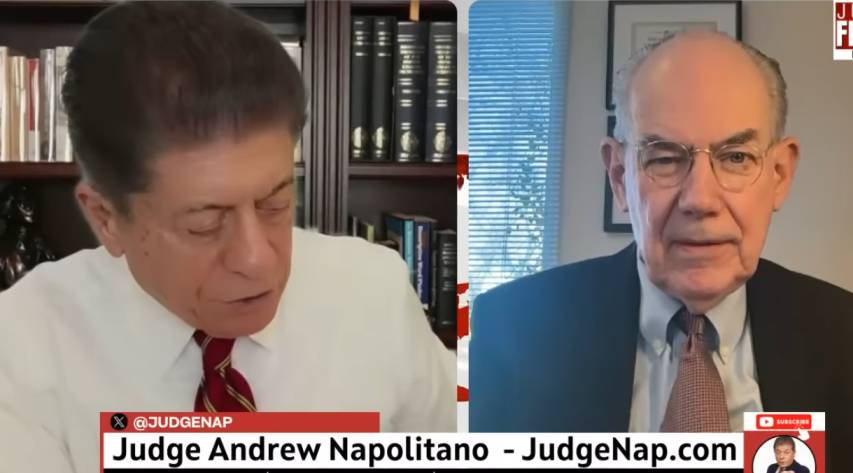
Here is the full transcript of Prof. John Mearsheimer’s interview on Judging Freedom Podcast with host Judge Andrew Napolitano, streamed live on January 16, 2026.
Brief Notes: In this episode of Judging Freedom, Judge Andrew Napolitano and Professor John Mearsheimer examine what they describe as a radical and lawless shift in U.S. foreign policy. The conversation highlights the President’s dismissal of international law in favor of personal “morality,” specifically regarding military interventions in Iran and the controversial kidnapping of Venezuela’s leader. Mearsheimer offers a provocative analysis of how these foreign strategies, aimed at regime change and resource control, mirror increasingly authoritarian domestic crackdowns on dissent. Together, they explore a shifting geopolitical landscape where traditional institutional checks are increasingly ignored in favor of unilateral power.
Opening Remarks
“Undeclared wars are commonplace. Tragically, our government engages in preemptive war, otherwise known as aggression, with no complaints from the American people. Sadly, we have become accustomed to living with the illegitimate use of force by government. To develop a truly free society, the issue of initiating force must be understood and reject it.”
JUDGE NAPOLITANO: What if sometimes to love your country you had to alter or abolish the government? What if Jefferson was right? What if that government is best which governs least? What if it is dangerous to be right when the government is wrong? What if it is better to perish fighting for freedom than to live as a slave? What if freedom’s greatest hour of danger is now?
Hi, everyone. Judge Andrew Napolitano here for Judging Freedom. Today is Thursday, January 15, 2026. Professor John Mearsheimer joins us now. Professor Mearsheimer, a pleasure, my dear friend. Thank you for joining us. How would you characterize the presidency of Donald Trump in matters of foreign policy?
A Radical Shift in Foreign Policy
PROF. JOHN MEARSHEIMER: I think what you see is that we have a radical foreign policy. There’s been a radical change between what came before him and what we’re doing now. That’s certainly true at the rhetorical level. If you look at how he talks about international law, you look at how he talks about his ability to use power whenever he sees fit. None of his predecessors would have ever made those arguments.
And furthermore, when you look at the actual policy, he’s a real break from his predecessor. We’ve had, I think, a radical change in our foreign policy. First of all, just go to Europe. Our policy towards Ukraine, our policy toward Russia and our policy towards NATO has done fundamental change. We’ve done a 180 degree turn there.
And if you look at his willingness to use military force, he’s very willing to use military force, but he uses it lightly. He goes in with limited strikes, what I call pinprick attacks, and then he gets out and declares victory. He has no interest in doing nation building. He has no interest in social engineering. And of course, his predecessors had a deep seated interest in doing nation building and social engineering.
And then finally, I would point out on the tariffs front, he’s a break with recent presidents. So I think what you see with Donald Trump is very different than certainly what you saw with Joe Biden. But even with Joe Biden’s predecessors.
“My Own Morality”
JUDGE NAPOLITANO: I was struck when he made that comment. Well, I’ll let you listen to the comment. But it’s the comment about his own mind and his own morality. My thought was, what morality? What president who murders people on speedboats and fishing boats would refer to this as his own morality. But here’s the clip.
VIDEO CLIP BEGINS:
UNIDENTIFIED SPEAKER: Do you see any checks on your power on the world stage? Is there anything that could stop you if you wanted to?
DONALD TRUMP: Yeah, there’s one thing. My own morality, my own mind. It’s the only thing that can stop. And that’s very good. I don’t need international law. I’m not looking to hurt people.
VIDEO CLIP ENDS:
JUDGE NAPOLITANO: I mean, can a president who believes that he can, I’m going to use a harsh word, murder people on the high seas, deny them due process, cheer his secretary of defense when he murders the survivors of these murders, claim to be guided by a sense of a cognizable, a recognizable sense of morality?
PROF. JOHN MEARSHEIMER: Well, a couple points here. First of all, when you talk about morality in Donald Trump, you want to remember that he is complicit in a genocide, which is considered to be the worst of all possible crimes. And that, to me, is much worse than what he’s doing with regard to those murders against speedboats in the Caribbean.
Second point is this has nothing to do with any or could be justified in terms of any sense of morality that you or I know. To argue that a genocide is moral or shooting people who may be innocent out of the water in the Caribbean is moral is not an argument that any serious person is going to make.
The third point I would make to you is I don’t think there is any president that has ever said the sorts of things that President Trump was just shown to be saying. It’s quite remarkable that he would say such a thing in public. It’s quite remarkable that he would dismiss international law. There’s no question that his predecessors have broken international law on occasion, but they’ve gone to great length in each of those instances to say that they’re really not breaking international law because they understand that international law is important. He doesn’t think international law is important at all. And certainly when it comes to his behavior, he feels he’s free to do whatever he wants.
The Dismissal of Law
JUDGE NAPOLITANO: So the law of the sea, the law of war, Senate ratified treaties, the Constitution, they are all secondary in his presidency to quote “my own mind and my own morality.”
PROF.
JOHN MEARSHEIMER: I think the evidence at this point is clear that that’s the way he thinks about the world, that’s the way he thinks about dealing with other countries, and it’s how he thinks about how he can behave here at home. The record is just quite clear.
Foreign and Domestic Authoritarianism
JUDGE NAPOLITANO: So one of these young thugs without a badge or a number or a nameplate and wearing a mask murdered a woman who was driving her car, even though she was trying to get out of the way of him. Trump’s people have demonized the woman. She’s in a same sex relationship with another woman. Four senior prosecutors resigned rather than investigate the background of the survivor. Because under the law, you can’t just investigate whoever you want for crime. There has to be some evidence there of criminality.
Do you see a dotted line between foreign authoritarianism and domestic authoritarianism?
PROF. JOHN MEARSHEIMER: Not really. I mean, what I see is a line between his willingness to completely ignore the law in terms of the execution of foreign policy and in terms of the execution of domestic policy. He just doesn’t think, as we were saying a few minutes ago, that the law applies to him.
But I don’t see him having a preference for authoritarians because it dovetails with what he’s doing at home. I think he has a preference for authoritarians abroad because he doesn’t want to get into the business of nation building, and he’s willing to live with an authoritarian leader who can maintain stability.
Venezuela is a perfect case in point. Most of his predecessors probably would have invaded Venezuela, and they would have gone to great lengths to turn Venezuela into a liberal democracy. He’s not interested in doing that at all. He’s perfectly content with the existing regime, which is an authoritarian regime, simply because he thinks they’ll maintain order.
So I think in Trump’s case, his main criterion for assessing how he thinks about a foreign leader is not whether that leader is a Democrat or is democratically elected, or that leader is an authoritarian. All he cares about is whether that leader can maintain stability and serve his purposes or our purposes.
A Monarch Rather Than a President
JUDGE NAPOLITANO: But I was asking about authoritarianism because his oath is to preserve, protect and defend the Constitution. He doesn’t seem to feel he has to pay regard to the Constitution. He’s imposed sales taxes on his own. He calls them tariffs. American consumers have paid billions in sales taxes that were never authorized by the Congress.
He used billions in military assets to kidnap the president of Venezuela. He’s not been able to stop the war in Ukraine, and the worst thing he’s done is to continue to fund the slaughter in Gaza. He doesn’t care about the laws, he doesn’t care about morality. He doesn’t care about the Constitution. He’s a monarch rather than a president.
PROF. JOHN MEARSHEIMER: Well, if I wasn’t clear, I was agreeing with you on that point. I think that in terms of foreign policy and in terms of domestic policy, he has little regard for the law. He does what he thinks is right for the United States and for himself. And he’s not interested in being tied down by rules. He just does what he wants.
The Venezuela Operation
JUDGE NAPOLITANO: How was the average American bettered by the kidnapping of Nicholas Maduro?
PROF. JOHN MEARSHEIMER: I’m tempted to say, is this a serious question?
JUDGE NAPOLITANO: It’s a good retort.
PROF. JOHN MEARSHEIMER: I mean, look, there was no threat from Venezuela. That’s all you have to know. Remember we used to talk about narco terrorism? That one went away because there was no narco terrorist threat. Then they talked about the Monroe Doctrine, and the idea was that maybe Russia and especially China were invading the Western Hemisphere and undermining the security of the United States. This argument is ridiculous.
And in the end, what did it come down to? Stealing Venezuela’s oil. Okay, but that’s not a threat to the United States. There’s just no threat to the United States. So however well you think this operation went, it didn’t eliminate a threat and leave us better off.
You may want to make the argument. I wouldn’t make it, but you may want to make the argument that all this oil in Venezuela is going to help the American economy. I don’t know any serious person who makes that argument.
JUDGE NAPOLITANO: Oh, no, no serious economist can make that argument. I don’t think the President understands oil on the international scene. He certainly doesn’t understand Venezuelan oil. I mean, he said the other day that Venezuela had sold us 500 million barrels of oil. They haven’t sold us anything. We may have stolen it. And if it’s Venezuelan oil, it’s as thick as tar. It’s not the oil we’re accustomed to importing.
PROF. JOHN MEARSHEIMER: Yeah, I mean, everybody who knows anything about Venezuelan oil says that it’s going to take a good decade and an investment of great magnitude to bring that oil online in sufficient numbers to have any kind of meaningful effect on the American economy or the international economy.
Iran: The Failed Game Plan
JUDGE NAPOLITANO: What are the likely consequences of an American and Israeli invasion of Iran? Whether it’s a decapitation of the Iranian leadership, whether it is a destruction of the Iranian air defenses, or whether it’s a full fledged invasion.
PROF. JOHN MEARSHEIMER: Well, there’s not going to be an invasion. Neither the Israelis or the Americans are going to invade. They’ll insert small numbers of troops in different places and they’ll put agents in there, both the United States and Israel. Mossad agents, CIA agents to help foment protests and ultimately revolution.
But the basic game plan here is quite straightforward. I’ll lay it out for you, but before I do, I will tell you it’s failed. And that’s the principal reason I don’t think that Trump is interested in using air power against Iran at this point in time.
The game plan here is to wreck the Iranian economy, just do enormous damage to the Iranian economy with sanctions, and that eventually creates a tinderbox, a situation that’s ready to explode because people are so desperate because of the economic situation.
Then what you do at some particular point in time, and I think we did this in late December of last year, is you foment and you fuel protests and you put small numbers of Mossad and CIA agents into Iran, and they work with local groups to foment violent protests.
Then third step is that you begin to spin a story. You begin to propagandize in ways that describe the protesters as noble. The government is evil. And that, of course, does two things. One is it ginnies up support in the west to protest and against the government, and it does the same thing inside of Iran. And you do everything you can to purvey the story that it’s inevitable that the regime will fall and the protesters will win.
And then as things begin to spin out of control, that’s when the American military and the Israeli military come in with cruise missiles, fighters, bombers, and so forth and so on. And it’s air power and missiles that finish off the government.
Now, what’s happened in Iran is that the protest fizzled out. And without protests that are really rocking the government, the incentives to use military force to bring in the American military to pound Iran makes no sense. And furthermore, you begin to realize that if you bring the American military in, you run the real risk that you’ll create a rally around the flag effect among the protesters. And of course, I think the administration recognized this, and this is why we backed off.
Pompeo’s Revealing Tweet
JUDGE NAPOLITANO: The former Secretary of State in Trump’s first term, and also he was also, prior to that, the Director of the CIA, Mike Pompeo, posted a tweet, an X, whatever you call it today. I don’t have to read the whole thing, but I’ll read the first line on the bottom. “The Iranian regime is in trouble. Bringing in mercenaries is its last best hope. Riots in dozens of cities,” etc.
And then at the end, professor, “Happy New Year to every Iranian in the streets, also to every Mossad agent walking beside them.” What could you imagine a statement like that? Why would he make a statement like that? Largely truthful, but he’s not in the business of telling the truth.
PROF. JOHN MEARSHEIMER: Yeah, it’s actually very foolish to say that. And by the way, there’s what is now a famous article that appeared in the Jerusalem Post on December 29 that reports that the Israelis themselves tweeted that they had Mossad agents inside of Iran.
JUDGE NAPOLITANO: When you said January 29th, you mean December 29th.
PROF. JOHN MEARSHEIMER: Yeah, I’m sorry, December 29th. Exactly. Right, yeah. We haven’t got to do that.
Mossad’s Public Boasting and Intelligence Operations
JUDGE NAPOLITANO: So is there something about Mossad that they want to boast about their ability to pierce the sovereignty of another country?
PROF. JOHN MEARSHEIMER: I think so. I think so. And again, I think it was foolish. I think that Mossad, the CIA, Mike Pompeo, they all should have gone to great lengths for their own selfish interest to remain silent. But they made it clear what was going on.
And by the way, and this is unsurprising, the Iranian government says it has abundant evidence of communications between Mossad and the CIA on one side and the Iranian protesters on the other. So the Iranian government was fully aware of what was going on.
And they, of course, have a deep seated interest, the Iranian government has a deep seated interest in making it public as to what the involvement of these outsiders amounts to, because that will help fuel a rally around the flag effect, which is obviously in the interest of the regime in Tehran.
Geopolitical Ramifications of War with Iran
JUDGE NAPOLITANO: What will be the geopolitical ramifications of a war? Whether it’s to decapitate the regime or destroy defenses? I suppose destroy the defenses comes first so that the decapitation mechanism, missiles, whatever they are, can come in second. But what will happen in the Middle East? What will happen in the Straits of Hormuz? What will happen to the sale of oil?
PROF. JOHN MEARSHEIMER: Well, if the United States and Israel were to attack Iran, Iran would do three different things. One is it would launch ballistic missiles, cruise missiles and drones at Israel. And I believe it would really pound Israel as it did in the 12 Day War last June.
The second thing is that the Iranians would strike at American military bases in the region. And I think we’re fully aware of that.
And then third, and very importantly, I think they’d try to close the Straits of Hormuz. And most people I talked to think they have the capability to shut down the Straits.
JUDGE NAPOLITANO: What does that mean economically, if they… I don’t mean numerically, but big picture, if they shut down the Straits of Hormuz?
PROF. JOHN MEARSHEIMER: Well, a huge amount of oil comes out of the Persian Gulf. And to get out of the Persian Gulf into the Arabian Sea, you have to go through the Straits of Hormuz. And if you shut down the Straits of Hormuz, that oil coming out of the Gulf has to stay in the Gulf. It can’t come out.
And almost everybody agrees that would have a devastating effect on the world economy. And this is not a time where any country wants to see a shock to the international economy.
The reports were that back in June, when we pushed forward a ceasefire, and remember, the war only lasted 12 days, one of the reasons the Trump administration was very anxious to shut down that war was we had an inkling that the Iranians were getting ready to try to shut down the Straits of Hormuz. And that panicked us.
And of course, the other reason was that the Iranians were getting very sophisticated, getting their ballistic and cruise missiles through Israeli and American defenses, and they were really beginning to have an effect in terms of pounding Israel. And the Israelis were interested in stopping the war after 12 days because they didn’t have enough missiles to counter all the ballistic and cruise missiles coming in from the Iranians.
Echoes of the 1953 Coup
JUDGE NAPOLITANO: Do you think that American intelligence officials and Israeli intelligence officials thought that they could duplicate the coup of 1953, where popularly elected President Mohammad Mossadegh was overthrown largely by MI6 and CIA?
PROF. JOHN MEARSHEIMER: Yes, I do think that. I think that starting in December, we began to put our foot on the accelerator and push hard. We were promoting the protests and the discussions that we’ve just had about the role of Mossad and the role of the CIA and what Mike Pompeo was saying and what the Jerusalem Post was reporting and what Trump was saying about turning the military, the American military, loose on Iran, all indicates that we thought the time was ripe to overthrow the regime in Tehran.
You want to remember here that what’s of huge importance are the economic sanctions. And these economic sanctions were designed to devastate the economy in Iran. And they have not completely done that, but they have done an extensive job of damaging that economy.
And the end result is that there are huge numbers of people in Iran who are desperate, who are angry, and who are easy to bring out for protests. Right. So you have a lot of kindling wood there. And what the United States and what Israel then tried to do was set a fire.
And they thought that once the protests began to spin out of control, we could then come in with air power, no boots on the ground here. This is regime change on the cheap, and we could help finish off the regime.
And one final point on this, you always want to remember that the principal goal is not regime change. As I was saying before, they’re not interested in promoting liberal democracy. They’re not interested in doing social engineering. What the administration and what the Israelis especially wanted to do was knock down the regime and then break Iran apart.
JUDGE NAPOLITANO: So chaos and break Iran apart, like Syria?
PROF. JOHN MEARSHEIMER: Exactly. And you want to understand that we played a key role in doing that in Syria. The Israelis helped a bit, but it was the United States and the Turks who played the key role in wrecking Syria.
And the Israelis especially, but even the Americans now, because we’re joined at the hip with the Israelis, we want to wreck Iran. And we thought starting in late December that we had found the formula for doing that. But as I said to you before, we failed.
Trump’s Message to Iranian Protesters
JUDGE NAPOLITANO: I wonder if Donald Trump cares more about demonstrators in Tehran than he does in Minneapolis. And before you respond, Chris, cut number five.
VIDEO CLIP BEGINS:
PRESIDENT TRUMP: And by the way, to all Iranian patriots, keep protesting, take over your institutions if possible, and save the name of the killers and the abusers that are abusing you. You’re being very badly abused if the numbers are right.
Now, I hear five different sets of numbers. I hear numbers, look, one death is too much, but I hear much lower numbers. And then I hear much higher numbers. But I say save their names, because they’ll pay a very big price.
And I’ve canceled all meetings with the Iranian officials until the senseless killing of protesters stops. And all I say to them is, help is on its way. You saw that I put tariffs on anybody doing business with Iran. Just went into effect today. And I say, make Iran great again. You know, it was a great country until these monsters came in and took it over.
VIDEO CLIP ENDS:
JUDGE NAPOLITANO: You can’t save the names of the killer in Minneapolis because they don’t wear name tags, badges, and they wear masks.
Double Standards on Protesters
PROF. JOHN MEARSHEIMER: Let me make a couple points about what President Trump just said. First of all, what he just said is solid evidence that he was committed to regime change in Iran. You don’t make statements like he just made there unless you’re interested in finishing off the regime, supporting the protesters, and then telling them that we will come in and finish the job. This is the playbook, right? But again, it failed.
And he’s now talking a different way about the Iran situation. And he’s saying the government’s not likely or is not going to execute the leaders of the protests, and therefore, there’s no need for American military action. And this is all recognition that the strategy failed.
Now, with regard to the protesters in Minneapolis, you have this very interesting situation where in Iran, he loves the protesters and hates the government, but here in the United States, he hates the protesters and loves the government.
And of course, that’s because he thinks that he is a king, he is a genius, and anybody who protests against him is fundamentally wrong and is a threat to the United States and therefore has to be dealt with in the most harsh possible way.
The Strike That Almost Happened
JUDGE NAPOLITANO: One of my podcast colleagues whom I have met, who’s Lebanese but broadcasts from Australia, Mario Nawfal, you may have been on this show. I’m not sure he has a huge audience. “US Strike on Iran reportedly Called off at last Minute. President Trump, apparently almost green lit a strike on Iran late last night,” that would have been Wednesday night, “then pulled the plug minutes before execution. Sources say Trump halted it because advisers couldn’t promise a decisive regime toppling blow and warned Iran could hit back hard and the US might not have enough regional assets ready to cope.”
Now, I don’t know if this is accurate. I’m sure the reporter of it believes it’s accurate. Combine that with the Guardian report that both Iran and Israel agreed not to do a first strike and that was mediated by Russia. One, who in their right mind would believe any agreement Netanyahu gave? Two, is it rational to believe that Trump was within minutes of ordering a decapitation strike?
PROF. JOHN MEARSHEIMER: I don’t know whether he was in minutes, but I think that he was clearly heading in that direction. He was confident that the protests were going to continue to spin out of control and the time would come shortly to turn the American military loose against Iran. I think the evidence is quite clear that he was thinking that way.
But then very quickly it became clear that the protests were not working and using American military force, as I said, was just going to cause a rally around the flag effect among the body populace. And I would imagine that this is the reason that his advisors told him that they couldn’t come up with a strategy that would ensure success. And that’s why he began to back down, because he would have slammed Iran and the end result would have been counterproductive.
I would also note to you, I’m not 100% certain of this because as you point out, you can never trust what the Israelis say completely. But if you look at the Israeli press and even look at some of the Western press, it does not look like the Israelis were going to participate in this attack. It looks like the United States was going to do it.
And I’ve seen one or two reports that the Israelis themselves, as well as the states in the Persian Gulf were telling Trump that the time is wrong for an attack.
The Gulf States’ Shifting Perspective
It’s very important to understand that leaving the Israelis aside, the Gulf states, including Saudi Arabia, did not want this to happen. The Saudis actually told the Iranians they would not participate in an American attack and they would not allow the Americans to use Saudi airspace.
And really, what’s going on here, this is quite interesting. What’s going on is that the Gulf states are becoming deeply suspicious of Israel. They think Israel is becoming too big for its britches. And this goes back. You remember the attack on the Palestinian negotiators in Qatar last year, late last year.
I think a lot of the Gulf states think the Israelis are out of control and the Americans are not only not reining the Israelis in, we’re actually supporting the Israelis at every turn.
And I think in a very important way, the Gulf states are beginning to see Iran as a force that balances against Israel. They don’t want to see Iran destroyed because that will make Israel much more powerful. They may not have any special place in their heart for Iran. And I’m talking about the Gulf states here. I fully understand that.
But at the same time, Iran is a bulwark in the Middle East against Israel, which, of course, is why Israel and the United States want to wreck Iran. But these other countries, these Gulf State countries, they don’t want to see Iran wrecked.
JUDGE NAPOLITANO: Professor Mearsheimer, your analytical skills are second to none. Thank you very much for all of this, for approaching this from unique and different sides and presenting it as you have. Deeply, deeply and profoundly appreciated as always. We’ll look forward to seeing you next week.
PROF. JOHN MEARSHEIMER: Likewise, Judge. Have a good weekend and I’ll see you soon.
JUDGE NAPOLITANO: You as well. Thank you. Brilliant, brilliant human being. Coming up tomorrow, Friday at the beginning of the day at 8 in the morning, Scott Ritter at 4 in the afternoon, the Intelligence Community Roundtable, Larry Johnson, Ray McGovern, Judge Napolitano for Judging Freedom.
Related Posts