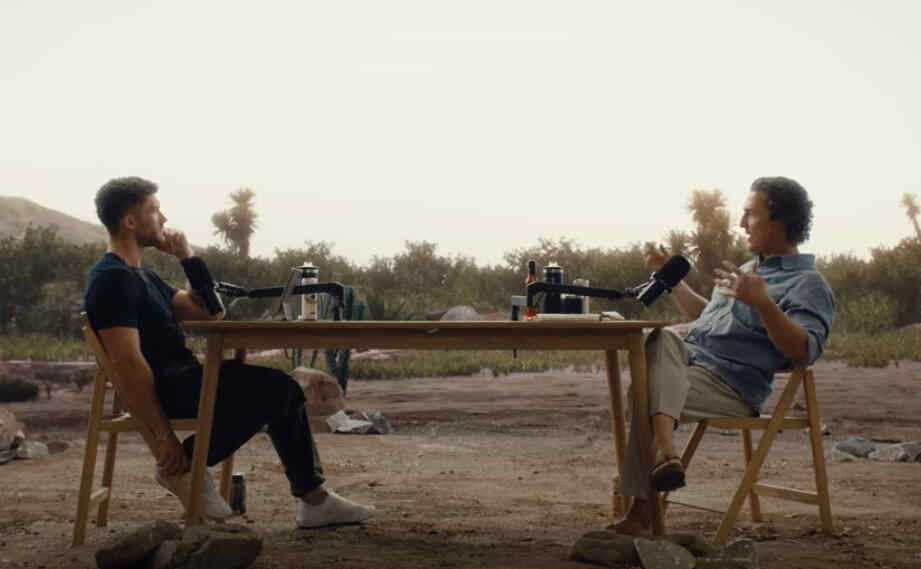
Read the full transcript of Academy Award-winning actor Matthew McConaughey’s interview on Modern Wisdom Podcast with host Chris Williamson, on “The Art of Living a Courageous Life”, September 29, 2025.
The Art of Living a Courageous Life
CHRIS WILLIAMSON: So I mentioned to you that this is episode 1000. It’s been seven and a half years. We just crossed a billion views the other day as well.
MATTHEW MCCONAUGHEY: Congrats, man.
CHRIS WILLIAMSON: And as a little surprise to you, we wanted to take you back to an environment that you probably know at least a little bit well, Cooper’s.
MATTHEW MCCONAUGHEY: Place, Alberta, Canada, where we shot it. We planted, production planted all those cornfields too there as far as the eye could see. And this is the road Cooper drives up on the way out. And that’s that Hans Zimmer Countdown. 10, 9, 8. Leaving children to follow a dream. Lift off.
CHRIS WILLIAMSON: I love how quick that is, that transition from him leaving to going. I think that’s so cool.
MATTHEW MCCONAUGHEY: Yeah, I think it was Chris’s version of tying the human drama. What would you do? A father leaving children to go do what they know they were meant to do and leave this earth. And then from there on, time changes.
At the end of this shoot, when it was wrapped and it was clear, we had no more shots, no more scenes on this location. My family and I were in my Airstream. On the set is where we lived. We got at the edge of base camp, we turned our Airstream to face out to the mountains. And right behind us is your medical and your food, whatever you need from production. But we stayed extra few days and just hiked it and stuff.
And one of the things that was fun is I let my son probably. I don’t know what. Levi was 7, 8 at the time. We got in my truck and I let him drive through these cornfields as fast as he was going. 360 all around. Because I had checked. I was like, they go, no, it’s for as far as you can see. It’s just like the salt flats hit it. And I’ve got some video of that and some pictures. It was unreal.
Why Life Rhymes
CHRIS WILLIAMSON: Why’d you say life rhymes?
MATTHEW MCCONAUGHEY: I think Mark Twain said that first, didn’t he? A version of that. History rhymes. Seems for as much as we go, our generation’s so different than the last one. And there’s never been anything like this. The ebbs and the flows, the debits and the assets. And for every new technology and old, there’s a debit and an old culture. And it seems like it always is right there, somewhat equalized and balanced. And there’s a rhyme in that, that sort of ecclesiastical, you know, “There’s a time for everything and for everything you reap that will you sow. There’s a time to kill. There’s a time to live, there’s a time to plant, there’s a time to gather, it’s a time to spread.”
It’s very Emersonian too, you know. And for every new technology, we lose an old culture, you know, and these things that we think are contradictory, heaven and hell, hate and love, that we think are like this, an imbalance where the truth of them I think is in that third eye where they overlap. And they all do overlap. They all sort of balance themselves out.
And I don’t know how much new under the sun we actually are doing. But we call it different names. I think we change the labels. I think you get some things that are extra strength and some things that are unleaded. But I think they all pretty much balance, pretty much balance out. And there’s rhyme and balance.
Coincidence and Serendipity
CHRIS WILLIAMSON: What’s your perspective on coincidence in life? Serendipity.
MATTHEW MCCONAUGHEY: Yeah, man. Well, first time I have it a deja vu and you have it twice. They call it budeja. Let’s flip that thing around upside and backwards. Both sides of the coin.
Look, in some ways it’s the beginning of an argument for God, a divine plan, fate, karma. In other ways, I don’t mean that’s fun to start doing that math to try and prove our way there. But it also feels like those are the swing backs. Oh, I’ve been here before. Was here before this life. It doesn’t have the period at the end of it. I mean, who knows how many, you know, many lives, many masters. I don’t know if that’s true. It just sure makes. It sure feels like it is sometimes. That’s a rhyme. That’s a real nice real time when life does rhyme.
And you look and you look for the math and you look for the science to add it up and it ain’t there. In that way I do think science is the practical pursuit of God of which we’ll never prove. And that’s the point. So there you have belief and faith for that which can’t be proven. But the pursuit of that is also why I think God loves an atheist scientist. It’s like, yes, keep it up.
Pursuit of that is why I think in my agnostic years where I said self reliance, it’s on me, man, forget fate. I’m not relying on God. I ain’t praying for nothing. It’s on me. Responsibility, self reliance. I believe that when I came back to my faith that I heard God applauding. “Thank you for having your hands on the wheel. Thank you for taking the self reliance and saying it is on you. Because you know what? I need that.”
Faith and Self-Reliance
CHRIS WILLIAMSON: What’s that wonderful idea that God doesn’t want to do everything. Some of it’s up to you.
MATTHEW MCCONAUGHEY: Amen.
CHRIS WILLIAMSON: Yeah. I think George Janko says every man knows God when he’s at his lowest. That there are reliable times when people turn toward faith and how many people.
MATTHEW MCCONAUGHEY: Turn at the end of their lives and I wonder, you know, if there is a God. Is that in the same way that, you know, Catholicism could say sin all week. But if you read, if you mean it and you ask for forgiveness on Sunday, you’re washed clean. Well, I see some people use that as a crutch and go right back to repeat offending. I’ve got appointment here. Going to forgive me, Father, for I know what I do and I’m curious.
CHRIS WILLIAMSON: Is that okay to just what’s that mean?
MATTHEW MCCONAUGHEY: Meaning there’s the “Forgive me, Father, for I know not what I do” and I’m writing about, well, “forgive me, Father.” There’s times I know exactly what I’m doing and I do it anyway.
CHRIS WILLIAMSON: That was an error of volition, not accident.
Forgiveness and Repeat Offenses
MATTHEW MCCONAUGHEY: It’s a choice I made. Now if I’m going to keep making that choice and be a repeat offender, I’m not ready to go. Yeah, but if I ask for forgiveness on Sunday, I’m all clean. We can do it all over again. I’m not ready. I’m going, no, no, no, hang on. Buck’s got to stop here, man. If you’re repeat offender, God’s going, yeah, no, you’re not going to sit there and tomfoolery with me here, bud. And I don’t want to do that with himself.
Just as if I steal from you and I come to you and I go, “I’m sorry, that was. I was. I don’t know where I was I was at. Horrible choice. I’m sorry. I’m asking for your forgiveness.” If you forgive me because you take the. My sincere want of reconciliation. The first thing on the docket between us should be me starting to do anything and everything I can not to have to come to you and say, “I’m sorry for the same damn thing again.”
If I do it once, twice, I’m a repeat offender. And I stole from you three times, I think. And I’m hoping you’ll still forgive me, but I wouldn’t. Trust me, you know? Yeah, I think that’s something that we forget sometimes, is that once you do the forgiving, which, let’s go. Let’s. Let’s the spite move out of us so we don’t get sick with that. The first thing responsibility is on the one who’s asking for forgiveness. To do everything they can not to have to come to ask for forgiveness or say I’m sorry again. I think we forget that. That’s. That’s on. That’s. That’s the debit. That’s. That’s what’s owed by the offender.
First, you gave the grace to say, “I forgive you.” So he called we. That doesn’t mean even money. That means I got work to do to make sure I’m not coming back to ask for it again.
CHRIS WILLIAMSON: As opposed. Again, as opposed to. There is no amount of work that you can do that will ever get you back to even keel. It’s someone saying, right, the ledger is still imbalanced, but the door’s open to.
MATTHEW MCCONAUGHEY: The bank, the door open, and it’s on me to go, come and repay. Look, I wish rehabilitation, like the jail system, I wish it was such that once someone’s out, they’re like you and me going to apply for a job. They’re not scarlet letters on them. Well, that means our. Our system of rehabilitation isn’t working. So if it works, you should get out. I paid my penance. Now it’s even money. Yeah.
Betrayal and Self-Forgiveness
CHRIS WILLIAMSON: How do you think about forgiving betrayal?
MATTHEW MCCONAUGHEY: I can’t think of what I’ve been betrayed when it’s clearly betrayal. I know it’s betrayal. And that person can look and go, yeah, that’s what I did. I’ve been asked for forgiveness for that before. And I’ve been also seeing people go, yeah, that’s what I did. And they’re not asking for forgiveness. They’re going, yeah, that’s what I did.
First response is, well, fuck you. The second one is, if that’s on my mind, if that’s keeping me up at night, that S.O.B. or whatever that is, I got to flush that. I got to wonder, why is that on my mind? I got to forgive that deed, that person for that deed, and again, not necessarily trust him, but do my best to forgive them. And that can take me a while.
And I think who it takes me the most time to forgive the betrayal is me. When and if I betray myself, forgiven myself. Because you know how it is, man. We forgive too quickly. We dust resilient. We hop up and dust yourself off and go, forgive you. Let’s do it again. We do become repeat offenders because we didn’t take the time to put ourselves or feel the guilt of the wrongdoing and pay a little penance to look at and go, “I don’t want to feel this again. I don’t want to do that action again to make myself feel this way. I don’t. It doesn’t. It doesn’t feel like me. I don’t want to. I don’t want that person to have that sadness or anger with me again or the world to have that sadness and anger from this deed. I don’t want to feel that again.”
And that takes some pause to then go, now I forgive myself. Let’s carry on and trust and be ready to do the work. To say we’re not going to just let that slide anymore. It’s not just going to be a way to do it.
CHRIS WILLIAMSON: Hold myself to a high ascendant.
MATTHEW MCCONAUGHEY: Yeah, because it didn’t pay off because the repercussions sucked.
Living Hell and Daymares
CHRIS WILLIAMSON: There is a unique sort of circle of hell that is reserved for when you keep on making the same mistake over and over again. That you’ve done it, you’ve had to pay the penance, say that you’re sorry, and then arrive straight back at the same place.
MATTHEW MCCONAUGHEY: Yeah, I think there’s a hell in the mirror. Then I think it can become a living hell. I got that poem in there. Daymares.
CHRIS WILLIAMSON: I love that one.
MATTHEW MCCONAUGHEY: I do too. You know, nightmares suck, but at least you wake up and they’re over. The ones that stick with you when you wake up and go through your day that are right there, those are the ones that’s the living hell. I think that’s what you’re talking about.
And you repeat offend enough. Word gets out circles gets out. You people doubt you on your approach. You’re like, yeah, but don’t do this for this guy. I mean, all of a sudden you’re going places and you got to look over your shoulder, you got to see who’s there that I didn’t pay back. Who do I owe? What bridge did I burn? What person did I betray to get where I am? That’s a life. That’s a living hell.
Losing Trust in Yourself
CHRIS WILLIAMSON: Well, forget that. In the modern world, you can move from city to city, at least you can, in some regard, leave your reputation behind. This is one of the issues of the West. Right. This was how the snake oil salesmen were able to keep going because they would bounce from town to town.
MATTHEW MCCONAUGHEY: Right.
CHRIS WILLIAMSON: However, if you lose your reputation with yourself, if you no longer trust you.
MATTHEW MCCONAUGHEY: Yep.
CHRIS WILLIAMSON: I don’t keep my own word. I know that I’m not a trustworthy person. I keep making promises to myself and to other people, and I keep on breaking them. I keep doing something that hurts other people or the same person. They don’t trust me anymore. And, oh, I don’t trust me anymore.
The Personal Nature of Character
MATTHEW MCCONAUGHEY: And you’re 100% right. It all comes back to being a very personal act. And what some people would say, “Oh, that person’s acting selfishly.” No, they’re actually being incredibly unselfish, I think, because they’re pinning themselves in a living hell and having to look in the mirror and going, “I don’t trust you. I don’t respect you.”
Now how long… And I know some people that can sleep quite well with that existence. I don’t know how long they can do it. Bound to be some comeuppance. The world’s got to get small. They got to get dizzy somewhere.
But, you know, where’s that come from? Where’s that come from for an agnostic, an atheist? Where’s that come from? From someone in power that could easily damage somebody but chooses not to be cruel. And they could so easily. Why not? Where’s that? What is that moral compass of some sort of fairness or integrity that keeps someone having that kind of character, even though they may not believe in God or religion?
That’s why I’m saying this. Is it about belief? Yeah, the book’s about belief. That’s what I’m peddling here. I need more of it. I personally believe in God, but the whole thing’s not for people that just believe in God. Believe in trying to pursue your better self, transcend itself. If you believe in the future, you believe in your kids, believe in the past, something. Don’t know what that is. Ask yourself what you die for. Start there.
Everyone kind of believes in something. There’s an argument that even nihilists who believe in nothing… Nothing’s even something. You know, I don’t know how you double down on nothing, but double nothing. Yeah.
When Doing Everything Right Still Isn’t Enough
CHRIS WILLIAMSON: There’s an opposite end to this scale as well, that continuing to sort of betray yourself. Sometimes you can do everything right and still not get the result that you wanted. And that seems like a really tough pill to swallow for people. I think that’s why people become uncomfortable with fully feeling their emotions.
MATTHEW MCCONAUGHEY: Yeah. So where do you go?
CHRIS WILLIAMSON: What do you think when I really gave it my all, I backed myself and I still got kicked in the nuts?
MATTHEW MCCONAUGHEY: Yep. Not only did I feel like I deserve it, I feel like I earned it and I still didn’t get it. “Wait a minute. But you said that’s the playbook and…”
CHRIS WILLIAMSON: I followed the playbook.
MATTHEW MCCONAUGHEY: “You said these were the rules and the regulations. I followed it and I was good at it. I still didn’t get it.”
Well, I suppose that’s why we have entrepreneurs and criminals and… I mean I have to, I think I naturally come back and look, I hustle, I’m a hustler. I’m not puritanical. I’m not trying to preach an absolute straight and narrow way to go about things. I bullshitted my way into things and faked my way into making things, pulled off stunts.
But I’ve never been able to really live with “By hook or by crook, I’ll get it how I can get it. I’ll lie, cheat and steal to get it. I got the prize and I’m still okay, I got it.” My own shadow chases me down in the middle of the night and those nightmares do become my own daymares.
The Problem with Moving Goalposts
Now the going for it and not getting it, which we see a lot now, right now I think we’re living in times where one of the indirect examples we’ll see from leaders, from leadership is “Who’s got the power? Winner.” Okay, so what are the ethics? Well, whatever the winner does.
“Yeah, but the winner lied and pillaged and lied and cheated to still get the prize.” “But he won.” “Wait a minute. You moved the goalpost while I had the ball in the air, man. Is that okay?” “They won.”
And I’m not buying… I’m not ready to purchase it. “Okay. That’s just how it is.” And I’m in no way foolish enough to think that everybody out there is on their best behavior. No, me neither. But I’m not ready for just “Hey, however you can pull it off and however many people you crumple along the way, there ain’t no rules, regulations. Oh and actually if you do follow the rules, you’re a sucker. Screw you.”
What’s the game for then? We’re going to get dizzy on that. That’s going to self-implode. That’s going to be… that’s not the wild wild West. That’s more than that. That’s upside down and backwards and the foot’s on the other shoe. That’s not going to last. That doesn’t have any long term ROI for us personally or collectively as humanity. I don’t think so.
We’ve got to police that ourselves. You know and I think that’s my hunch is that we start with that everyone, no matter how much they’re thinking globally or collectively, it all starts with something very, very personal and that’s where a revolution could begin. A revolution of evolution would begin that each person goes “I’m going to go one step further” as I talk about to salvage my character or one step further before I pull the parachute and quit. I think that’s how we really inch forward and evolve in a way.
Becoming the Hero of Your Own Story Again
CHRIS WILLIAMSON: Let’s say someone has been kicked in the nuts a good bit by life. How do you advise them to sort of become the hero of their own story again?
MATTHEW MCCONAUGHEY: Man, that’s a tough one. I’m going to pull something in here called “Heaven or Not” and try and find it and see if this kind of half answers that question. And you know, I don’t have that answer a lot of times.
Here it is, “Heaven or Not”: You know, tomorrow is not today’s measurement. When the misery is bad enough… These people don’t have to… the suffering. Consideration is a privilege, man. “I’m trying to put food on the table right now and pay my rent tonight. You want to talk to me about investing in my future?” Oh, yeah.
And I say, and that’s part of what faith and religion are for. To help those in misery hang on to a hope that will most likely not be served them in this life, to sell them belief and faith that they will be served in the next. And what if there is nothing there, man? What if there’s nothing to hope for? What if there’s no next? I don’t know.
But either way, in misery here or without a heaven there, not having any hope or faith in anything is a certain way to remain where you are forever. But if you can find something that you can keep going, something that no matter how small to look forward to and continually have faith in and chase, well, then your life here is going to be better. Now, heaven or not, that’s a great question.
You know, I sit here with a life where I have the luxury to project, to ask myself and ask others, “Make a sacrifice today. Sacrifice a plastic ring today for a gold crown tomorrow. Sacrifice something today for more freedom tomorrow. Sacrifice something today for a possible healthier future for your kids.” I understand that’s a luxurious position. I’m not going to apologize that I’m in it, but I understand to someone in misery, they’re going, “Good for you, man. I’m trying to feed the family tonight. I’m not thinking past that. I can’t think past that.”
What I’d ask them to do, my indirect thing I would say and understand is, well, if you don’t have the hope or believe in something, you’re definitely going to remain where you are. And if you have hope and faith in something, I’m not saying it’s 100% get out of jail, you’re absolutely going to get out, but you got the best chance to.
Peace Through Rage
CHRIS WILLIAMSON: “Peace is a gift of God and grace. To reach it, we must rage.”
MATTHEW MCCONAUGHEY: Yep. Yeah, I’m going to close my show that I’m doing when I’m on this tour with that, because… Amen. Kumbaya. I get it. I don’t think that’s how peace is coming. I think that’s a great place to hope for. But to get there or closer to there is going to take punk rock rage. It’s going to take getting wild. It’s not going to be necessarily logical. It’s not going to be tame. It’s not going to be whispered.
I don’t think it’s going to take… No emotion gets more done than rage. For good or for bad. It seems like rage really moves the needle, you know what I mean? And I think that that emotion and that approach shouldn’t be thrown out when you’re talking about a pursuit of peace or contentment.
I mean, it takes sweat equity. It would take blood being drawn. I don’t believe that we are as evolved enough as a species to just behave as we intellectually can agree we should be. I don’t see it happening. We don’t agree with it in an open forum. Enough of us go back on our own and make… we’re doing. You know, it’s a good idea. But boy, when we’re cornered and what we got’s being possibly trespassed on… Very primal.
CHRIS WILLIAMSON: Some lines need to be drawn.
MATTHEW MCCONAUGHEY: I believe so.
Model the Rise, Not the Result
CHRIS WILLIAMSON: I wonder whether we overpraise balance when greatness might demand imbalance.
MATTHEW MCCONAUGHEY: That’s an interesting one. That’s a fun one, man. Do we overpraise balance? Yeah. I think my first reaction would be we do overpraise balance a bit. It’s a great pursuit. I think a better pursuit is try and find the rhyme in the imbalance.
CHRIS WILLIAMSON: Well, let me give you what I think is the justification for why balance gets overpraised. Most of the people who have a platform which is sufficiently big with enough credibility for others to listen en masse have been through the rage and now burst out the top to reach exit velocity.
MATTHEW MCCONAUGHEY: Okay.
CHRIS WILLIAMSON: And what that means is they’re in a very different position now to what they were at the beginning. And the summary is model the rise, not the result.
MATTHEW MCCONAUGHEY: I like that.
CHRIS WILLIAMSON: Model the rise, not the result. Because the result is where they’re at now. Do not ask Warren Buffett about how long he spends reading the newspaper and poring over old books. That guy was a hustler. He was a hustler when he was young. What did you do when you were at the stage that I am at? Not what do you do now? Because I want to get to where you are. That means I don’t do what you do now. I do what you did to get there. Model the rise, not the result.
MATTHEW MCCONAUGHEY: Love that. The approach. Okay, I’m all over. I’m all for that. And the way… Especially the way you just explained it. And let’s just talk about overall the… And haven’t thought of it when thinking about aspirations with people and things. But the result, which we know there isn’t really one and we cannot imitate someone else’s exact result. We’re going to have our own thing. Way to get there.
The approach is all. I think that’s the best our life can get is one constant approach or with many different approaches. But knowing there is no result. That’s when I always say the metaphor. Life’s a verb. But that’s really fun to go. No, no, no. Don’t study the result. What was the person doing when they got there? And everybody who’s achieved something great was some sort of outlaw. Yep. Some sort of hustler. Out of balance, out of whack. Dark times. Still wakes up in the middle of the night and glad they went with a mouth guard because they’d have chipped all their teeth through that nightmare they were having about those things they did back then. I’m one of those.
CHRIS WILLIAMSON: Well, another question would be what virtue is there in balance if there was no such thing as imbalance to fight against?
MATTHEW MCCONAUGHEY: Yeah.
CHRIS WILLIAMSON: “Oh, I just reached equanimity.”
MATTHEW MCCONAUGHEY: Right.
CHRIS WILLIAMSON: “You know I walked out onto this tightrope. Yeah, exactly. And I don’t know. It just… I didn’t wobble once.”
MATTHEW MCCONAUGHEY: Well, now we’re going into… I have that. I got that thing in there. I said, “What’s better?”
The Art of Taking Risks
CHRIS WILLIAMSON: Take eight.
MATTHEW MCCONAUGHEY: Take eight. Big risk in life. Sin once, miss the mark once. But get seven, achieve seven. Seven out of eight. Or take a hundred risk and achieve eight of them. My hunch is that there’s a God. He’s saying go for the hundred and get eight rather than eight and get seven.
If you’re not taking enough risk to sin or miss the mark, which is what sin means to fail, then what are you doing? Don’t go back with even money. Come back with a safe bet. Which that can become a sort of recessive peace. Namaste. No, it’s almost a… I don’t think it’s what the mystics meant when they were like be detached. They give me go embrace.
But for highs and lows and pains and pleasures, understand that those outward things are not the things to be attached to for your own identity. You have, it’s got to be inward first. Enjoy those. Partake, but don’t become attached to those for your measure.
The Inner Citadel and Emotional Investment
CHRIS WILLIAMSON: There’s an idea from Isaiah Berlin called the inner citadel. He says when the world denies us that which we want, we retreat into ourselves in a kind of spiritual depth, into a sort of inner citadel. Basically, if you can’t get what you want, you teach yourself to want what you can get.
Okay, so for instance, you damage your leg in a battle and you can try to fix the leg, in which case you’re fine. Or if you fail, you chop your leg off and announce that the desire for legs is misguided and must be subdued.
MATTHEW MCCONAUGHEY: Right.
CHRIS WILLIAMSON: This is a retreat in spiritual depth. This is asceticism on steroids. By not trying to play the game, there is no risk of failure. And I think that the not making any bets. I see this a lot. I’ve been very obsessed with emotions since we last spoke a year ago, I’ve been very obsessed with emotions, with feeling. Feelings are trying to. And I get the sense that feelings are one of these strange bets.
Emotions investing ourselves, not holding a bit back, not putting one foot out, like putting it on the line, opening up, exposing ourselves.
MATTHEW MCCONAUGHEY: And.
CHRIS WILLIAMSON: That feels like a retreat in kind, but one that’s plausibly deniable when we just have one foot out. I didn’t fully commit myself to this project, this relationship, this friendship, this self transformation. I kept one foot back. Well, you know, I might not be able to do that right now because I’ve got this challenge or this restriction from before, this relationship, like I’m going to hold a bit back, I’m going to keep a bit. For me, this is my bit.
And it means that if failure comes along, it doesn’t hurt as much. But it also means that success is less likely. And if success comes along, you know that you didn’t really earn it, you didn’t really win it because you played the game. And that’s fine. In some areas of pursuit and at some stages of life, right early in life, I don’t think you can be left as culpable. You’re 12 years old, you don’t know what you’re doing.
In business, the outcome really is what matters. That is what you’re optimizing. For some people, business is a personal transformation vehicle masquerading as a wealth making pursuit. But for the most part, you’re there to do the business. Yeah, but in relationships and friendships, in the way that you show up for yourself and your personal transformation and your relationship to whatever you believe in. I don’t think that we should be having our inner citadel really play anyway.
Owner’s Mentality vs. Renter’s Mentality
MATTHEW MCCONAUGHEY: Hard to pull off, but it’s leave it. Similar to what I write about when talking about an owner’s mentality versus a renter’s mentality. So many people have the renters mentality. Relationships, businesses, transactional, they’ll flip it, get it, flip it. And they never give the relationship the chance to possibly be a friendship, possibly be a long term relationship, to possibly be a great mate, great partner.
They never give the real estate, the house a chance to actually maybe become a home. And that I think it’s the word’s better that to go in with an owner’s mentality. Meaning have you ever hired someone that you were like probably just need you for a few months? You have. Okay, you have. See, I, I’ve only hired or…
CHRIS WILLIAMSON: People.
MATTHEW MCCONAUGHEY: That I was like, I’m hoping this is going to be a lifer. I’m hoping you’re going to provide what I need and I’m going to get. You’re going to get from me what you need. That this could work out forever. Barely any of them do. Got a couple, a few, but that’s…
CHRIS WILLIAMSON: How you entered the relationship.
MATTHEW MCCONAUGHEY: But one I wouldn’t have known or I wouldn’t have got out of them. And they wouldn’t have got out of me as much if we would have gone into it with an owner’s mentality.
CHRIS WILLIAMSON: People can tell this is transactional or transient.
The Nature of Transactions and Transformations
MATTHEW MCCONAUGHEY: Let me ask you this though, isn’t. All right, basically every I know, it’s transactional, transformational. Those seem to be the two. Transactional, transformational. Every relationship’s transactional. But not only transactional. Some transactional relations can become transformational. But I mean we’re all using each other in a way that I can get this from you. You give this to me, my wife gives this to me, I give this to her. It’s a transformational relationship. But we’re always transacting.
So I don’t have the problem with the transaction. I had the pro. I have, I have the hold back when it’s like, oh, it’s merely for transaction. Oh, it’s merely for use. And how many people don’t even try to hide that they’re just straight up going like that’s, that’s, that’s all it’s for. What are you talking about?
Yeah, I mean I see it in, in, in, in. In Palo Alto, man, they raise all kinds of the startups are everywhere and everyone invests and you flip and it falls down and no. And they don’t even blink. Yeah. And you work for somebody and you become their CEO and they fire you and da da, da, da. And to hammer you and see it in politics. And they hammer your name and drag you through the mud. That’s how it is. No problem. Hey, Bob, how you doing? That’s the guy. Ah, that’s fine. It’s just business. It’s just politics. I’m like, hang on a minute. So that was that transactional. That’s water off the ducks back for you. And for so many it is. I’m amazed at how people do it.
CHRIS WILLIAMSON: They’re built different in the same way as doctors and nurses and firefighters. People that need to deal with trauma. You are dealing with interpersonal trauma. You are a soldier on the field of interpersonal battle. If you’re in politics or if you’re in business.
MATTHEW MCCONAUGHEY: Yeah. You also don’t necessarily do what you…
CHRIS WILLIAMSON: Believe you do what’s expedient or successful or effective.
MATTHEW MCCONAUGHEY: You. Effective, what’s that mean?
CHRIS WILLIAMSON: Effective.
MATTHEW MCCONAUGHEY: Okay.
MATTHEW MCCONAUGHEY: You betray a lot of people, a lot of ideals, including yourself. That doesn’t sound like very much fun to me. Not that betrayal part. I wonder if it’s inherent or if that’s me reading it from the outside and saying, now that could be different.
The Hidden Cost of Success
CHRIS WILLIAMSON: I wonder how much of that is people optimizing for the wrong outcome and only getting to see a very narrow aperture of other people’s outcomes too. Or this person seemed to step on some toes and break a couple of arms on their way up. They were okay. Everyone seems to be all right with this. You go.
You don’t know what the texture of that person’s mind’s like when they go to bed at night. They might not have spoken to their father in five years. They might never feel peace. They might permanently be anxious. They might hate themselves. Might not be able to get an erection.
MATTHEW MCCONAUGHEY: Right.
CHRIS WILLIAMSON: You want that. You really want that. But you want this. You want the outside success. The price that people pay to be somebody that you admire is one of the most fascinating questions, I think.
MATTHEW MCCONAUGHEY: Yeah. Yeah. Trying to think. I’m going through my head right now. Where have I sacrificed my own character to get ahead so then to be perceived as. And I know I’ve done it many times. Part of that hustling part I said I’ve done. You know. And I…
CHRIS WILLIAMSON: Well, that’s the rise, you know.
MATTHEW MCCONAUGHEY: Yeah. And being a marketeer Too, you know, gotten away with stuff, played games and. Da da da da da. Kiss the fire and walk away whistling.
CHRIS WILLIAMSON: A little Icarus light.
Icarus in Reverse
MATTHEW MCCONAUGHEY: Yeah, we talk about Icarus last time. No, I think, I think we’re more in need of Icarus in reverse. Meaning I. I think, you know. Oh, don’t get too close to the sun. It’s getting hot. It’s going to melt that wax. I think most of us are turning back and it’s 45 degrees Fahrenheit. I think he’s on. I was like, dude, where do you go?
Where do we get the arrogance to think that it’s actually getting hot? We’re not even close and not even close to getting hot. Maybe that close to the sun. It’s way up there. Arrogant pricks. You are thinking that you’re that close. You didn’t make it near as far as you thought you did or as you could go. I wish more people, I’m going to flip the word. Were more involved with themselves.
CHRIS WILLIAMSON: Embrace your Icarus instead of self involved.
MATTHEW MCCONAUGHEY: That has a bad term. I wish people were more involved with themselves. Yeah, I think that’s where we’re more deficient. Believe in yourself or invest in yourself. Do more of what you can to be great at a craft or a vocation or to get what you want.
Imagining Icarus Happy
CHRIS WILLIAMSON: You know the story of Sisyphus. Man that was cursed to roll the boulder up a hill for the rest of time. By the gods, this man gets cursed. I think he was a demigod. Gets cursed too. Roll a boulder up a hill, heavy, heavy boulder. He rolls it uphill and just as he gets to the very top, he stumbles and it falls down and crushes him. And he needs to walk back to the bottom, turn around, pick it back up and Camus’ famous line is we must imagine Sisyphus happy that this pointless pursuit, that he finds joy in the process of doing it.
I wonder if we can imagine Icarus happy. I wonder if we can imagine the guy that is flying toward the sun as well. He had a view that nobody else got from up there and he only did it once and the wings melted. But what if he’d run that experiment a few, a few times? And what if you had a little parachute that could have sort of brought him down?
MATTHEW MCCONAUGHEY: Yeah, yeah, yeah.
CHRIS WILLIAMSON: You might have realized that that was just a one off. And actually I think you can get closer.
MATTHEW MCCONAUGHEY: Right, Right. Yeah, yeah.
CHRIS WILLIAMSON: We must imagine Icarus happy, I think is a cool idea.
MATTHEW MCCONAUGHEY: Yeah. And you know, he regulated his breathing as it got so hot and sweaty. And he learned somebody swung by and he had a backpack with water on him. Next time.
CHRIS WILLIAMSON: Yeah, he’s the stronger glue. More feathers.
MATTHEW MCCONAUGHEY: Yeah, he stitched it, you know what I mean? Came down a little more tan than the time before.
CHRIS WILLIAMSON: I’ve always relied on logic to make sense of myself and the world. I’ve been finding that tougher to do lately. Seems to me the facts have become unreliably overrated.
The Search for Truth and Facts
MATTHEW MCCONAUGHEY: How so? What is a fact? Where do we go for the facts? What’s the truth? What’s where to go for that? That’s probably a bigger question than what’s a fact. I think a fact. I think the facts are an underdog right now. And I’m not sure where to go to find them. The math doesn’t seem to be adding up.
I’m not looking around so much. And part of the reason I wrote this for my own spiritual therapy. I was going. I found myself getting cynical looking down my nose, not giving people the benefit of the doubt, stereotyping, objectifying, full group people and groups. And then the scary part was I started to entertain the idea of “yeah man, it may just be how it is now.” And that scared me. And then I got angry at that.
And I’m still in the midst of some anger with that which is a bit of that rage thing which makes me act upon it and go “bullshit, not conceding.” And I don’t think anyone really wants to concede that that’s just the way it is. And if it is the way it is and the reality is not enough to get off to, let’s go to the dream, let’s flip that script.
I always have gone from non fiction to say let’s make that the dream. Just keep living. Art emulates life. And that’s in recent years it started to pay me back less. How much does that to do with my own eyes? Probably quite a bit. But whatever it is still seeing it and I want to fight against it.
So I flipped it and said let’s go to dreams. Let’s go to poems, prayers. These are pursuits of an ideal beauty. These are in between the lines. This is in between the math. This is not academic, this is not intellectual. These are ideals that we pursue the beginner’s mind that we have as a child before we know worse.
And I don’t want to be ignorant, I don’t want to be foolishly optimistic. Let’s look to those and believe that we can still make those real. Let that bring rhyme to the reason. Instead of looking to the reason to find the rhyme, let’s get the rhyme communicating with the reason. Because life around us is all like reason, reason. Neck up, man.
So I want to pull some weeds here on this pathway, open up that, this one lane dirt, top road with potholes. And it’s a one way going the opposite way. Which way I want it to go, it’s going away from the heart. Yeah, clean that up a little bit and go. Let’s get you to communicate a little bit. You’re not going to win every time, bud. Because we got, we like our reason. We want to mind ourselves.
But we make a decision, we have any kind of certainty or we make a judgment. Let’s have our heart be a two factor authenticator before we make that decision. And that goes for the compassionate side. That also goes for the consequences and of saying the buck stops here with ourselves and others.
Getting Below the Neck: Advice for Overthinkers
CHRIS WILLIAMSON: How do you advise perennial overthinkers to get below the neck?
MATTHEW MCCONAUGHEY: Perennial overthinkers get below the neck. Ah, record themselves all overthinking. Have a listen back, I do it, I overthink a lot. And when I’ve heard myself back, I’m not going, “dude, you’re kind of seeing so much significance that none of that shit’s significant.” Every detailed frame have. You’re giving it a proper name. Oh, if everything’s significant, there’s no significance at all, man.
Some shit’s just like, I don’t have a capacity to deal with it or I don’t really care. It’s just how it is. Don’t. Some of the inevitables and sometimes you got to let those ride. Go on. I’m not trying to. That’s just how it is. I’m going to deal with that now. I’m going to deal with what I can deal with.
I get the mental meditations on that and I listen to myself back and I’m like going, “whoa, you need to get some sleep, you need to have a drink. You need to relax.” You know, I got this funny poem in here. It’s called barbiturate logic. “I need to calm my brain to have half the thoughts per hour, 50% of the neural fragments, and therefore twice the power and one doubly meaningful story with half the words.”
You know, sometimes the snaps is. It’s just, it’s too much. It’s all treble. And if everything is significant, like you miss the main thing I’m missing. So focused on the drop, I didn’t realize it was raining. It’s the force for the tree thing.
So that’s the overthinking. When I’ve recorded myself, I can hear that there is some lagnop in my talk. And some of it is babble, some of it may be succinctly fine tuned and wonderful. Then I have to go, is that useful to my understanding? Is it useful to the story I can tell? Is it useful to my application in life? And a lot of times I’m like, “no, it’s clever. It’s like smart.” I don’t want to spend too much time in that head because that sounds like, you know, you broke a sweat in places you weren’t really getting exercise, mentally, spiritually or physically.
So that could. Sometimes listening. Listening back has helped me baseline some things. Again, slow the brain down, man. You’re missing me. Give more meaning. And you hear the smartest people, man. I love hearing the wisest people. Their stuff’s short, bro. It’s quick. And you go, “oh,” and you’re like waiting for more. And you’re looking around and they’re like, look at you, like, “oh, that’s it.” And you’re like, “perfect.”
My dad telling me when I wanted to go to film school instead of law school, and I thought he was going to go, “you want to what?” Him taking that pause and say, “is that what you want to do?” And I said yesterday, him going, “well, don’t half ass it.” I was waiting for so much more. That was it. And there’s no that was it. Nothing better he could have told me at that time.
It’s also, I think, remembering when we overthink things or over explain things, you’re stealing a lot of times in moments that you think maybe you’re teaching even ourselves, especially others, you’re stealing the dignity of leaving the truth in the asker’s kitchen. Like letting someone come up with, have a conversation, but you’re letting them come up with the answer.
It’s like what the best directors do in films. They don’t tell you what to do, they talk about and get you to go, “oh, oh, yeah.” So. And they go, “it is as you say.” Then we got ownership, then that’s our idea, whether we were manipulated into it or not. We’re going, “thank you, it’s mine.” Now we got fire. Now we got purpose. Now that you get the great performance in front of the camera.
And I think in life more too, when person feels like they came up with the idea. I always tell directors, I said, “man, I’m easy to direct. Just don’t tell me what to do. And if you can trick me into thinking all this shit to my idea.”
The Art of Making Others Feel Interesting
CHRIS WILLIAMSON: Yeah, There’s a wonderful insight about why we like people that’s similar to that.
MATTHEW MCCONAUGHEY: So.
CHRIS WILLIAMSON: Inverse charisma. A lot of the time we think that we want to be more charismatic because that would make us more likable. We want our stories to be engaging and our aura to be electrifying and our presence to be magnetic. And for us to walk into a room and for everybody sort of like, be compelled.
And then I looked at the friends that I liked spending time around the most, and they’re interesting, but that wasn’t really the common denominator. Some people are interesting and some people make you feel interesting.
And there’s this wonderful story about Jenny Jerome, Winston Churchill’s mother, and she gets to meet Benjamin Disraeli and William Gladstone on consecutive nights for dinner. And she leaves the first dinner, says, “I left that feeling like he was the cleverest man in all of England.” She goes to the second one. She says, “I left that dinner feeling like I was the cleverest woman.”
And this wonderful idea that some people are interesting, some people make us feel interesting. And kind of the same with this idea here that allowing the conclusion to be arrived at.
MATTHEW MCCONAUGHEY: Yeah.
CHRIS WILLIAMSON: Is often the best solution.
MATTHEW MCCONAUGHEY: Yeah. I have to continue to watch it. I love being in the know. I love giving advice. I love sermonizing. My kids would be like, “can you give us another TED Talk, dad?” Like, yeah, shut down. No, no, no, no, no, no. I’ve got slides. Let’s get a presentation. No, let him find it.
And, you know, I added a cool trick. It was just so simple, but one in talking and sharing something that you’ve learned that you think maybe applicable to other people. The use of I, you, or we, to use the “you” is dangerous because people are. You’re talking at me. You’re telling me what to do. “I” is safe because, well, that’s your. That’s your experience. Maybe you invite. Maybe people see themselves. They’re not.
But to say “we,” it’s. It’s. It’s closer to platitudinal because you’re going like, “are you speaking for all of us?” But it does welcome everybody in and it says that. And I always like to see this when I’m talking about things with people. I’m like. When I. When I say “we,” I mean, I’m including me. All right? Because I’m not.
CHRIS WILLIAMSON: We includes me.
MATTHEW MCCONAUGHEY: Yeah, we include me. I’m not. I’m working on this shit too, man. You know, and trying to. And, like, I have to be reminded. Don’t. Don’t be afraid to ask the question that I’m asking for myself that can open up someone else to go. “Well, I got an answer to that. What do you got?”
Deal with the similar with the kids last night, instead of saying, “Vita Levi Livingston, how are you doing?” Tough answer. Tough question to answer. I said. And my friend gave me this note. “Hey, what’s. What’s the life of a teenager like these days?” They took off and talked and shared all kinds of stuff because I wasn’t putting them on the spot or they didn’t take it as put on the spot. I found it so much more about how they’re feeling by asking.
CHRIS WILLIAMSON: It’s a broad question.
MATTHEW MCCONAUGHEY: Broad question. Yeah. Yeah, yeah. You know? Yeah.
CHRIS WILLIAMSON: It’s funny how we need license for that.
MATTHEW MCCONAUGHEY: Yeah.
CHRIS WILLIAMSON: In a strange way.
MATTHEW MCCONAUGHEY: Yeah. To be able to talk about is a lot of times how we best talk about ourselves. Yeah. Yeah.
CHRIS WILLIAMSON: But couched with enough distance.
MATTHEW MCCONAUGHEY: Yeah, yeah.
CHRIS WILLIAMSON: I have noticed. I have seen it.
MATTHEW MCCONAUGHEY: It’s the.
CHRIS WILLIAMSON: I’m asking for a friend.
MATTHEW MCCONAUGHEY: Yeah.
The Role of Courage in Life
CHRIS WILLIAMSON: Justification. Yeah, yeah, yeah, yeah. What do you think about the role of courage in life? We’ve talked so far about the balance of doing it and not doing it. We’ve talked about dreaming big and maybe dreaming even further. And then we’ve also had this idea of a little bit of relinquishing of control as well as we’ve got to apply the effort, we’ve got to have the vision, but we’ve also got to know when we’re going to let go a little bit. It seems to me like courage, the ability to feel our convictions and commit to them is a little bit of a common thread that sort of runs through them.
MATTHEW MCCONAUGHEY: Yeah. So I grew up only knowing sort of the courage of the persistent, be resilient, endure, get up, dust yourself off, go. The problem with that, the Achilles heel with that, is if you get up and get the courage to keep on going every time and get up and dust yourself off, you make the same mistakes each time around because you never backed up.
To have. What I’ve now learned, I’m still learning, is the courage to go, “no, I’m going to let some people pass me in the race right now because I’m going to look at why I keep stepping in that damn same pothole and twisting my ankle, the same spot. Why I keep failing when I try to get that next spot in this relationship or failing in this place to get this product of my craft to the next level.”
CHRIS WILLIAMSON: Would that be the relinquishing of the rom com era in a small part for you?
MATTHEW MCCONAUGHEY: Small part, yeah. Yeah, that was one. It also has to do with when I got married. My, you know, son comes to me at 4 years old and says, “why isn’t Mama McConaughey?” I’m going through my head, “you’re 4, dude.” I sat there, I was like, “did.”
CHRIS WILLIAMSON: Your mom put you up there?
Working Through Fear and Taking Risks
MATTHEW MCCONAUGHEY: It’s a great question, but I mean, we’re not. Because we’re not married. When you get married, switch your name. Okay. And then he just listened. And all of a sudden he goes, “Why are you scared four years old, dude? Again?” And I’m like, “Yeah, I guess I am.”
I remember going to a pastor and talking to a lot of different elder men who had had long term relationships, were married for decades and stuff. And my pastor goes, “Let me just ask you this, Mr. Risk Taker. What’s the bigger risk carrying on might get going it’s going well or taking the deeper dive into the sacrament. Covenant of marriage should be a covenant between you and her and God. The trilogy will go forward. That will be a whole new adventure in itself. What’s a big risk?”
I was like, “Oh, but getting married’s a bigger risk.” It was like he didn’t say another word. That was part of why I made the affirmative action and was what I was looking for as a way to play offense with that choice. I didn’t want to do it because that was what you’re supposed to do. It’s time. We’ve been dating for this long. We got engaged. I didn’t want to do it by the book and I was looking for the offensive reason to do it. And that did help me with that.
Breaking Away from Rom-Coms
The rom com time. That was definitely me doing the work I was doing and only being able to do the work I was doing and offer the roles I was getting. The rom coms was eating at me because I felt like I could. Life is good, man. I make good money. Feel like I can roll out of bed and do one of these tomorrow morning. That’s cool, man. I’m kind of number one. I’m the go to guy for this.
But I wasn’t. I was countered by, I had met Camila, fallen in love, she’s now pregnant with her first child. So that my life was extremely vital and I was alive. Cried harder, laughed louder, felt more joy, all those things. But my work was like, all right. And I was like, “Well, I wish my work could be as challenging or as vital as my life.”
And I remember looking in the mirror going, “Well, be glad right now. Appreciate that it’s not the other way around. But can I have my work challenge my lifestyle in this vitality?” Yeah. If I do some dramas I want to do, well, those aren’t coming. All right. If I can’t do what I want to do, let me quit doing what I was doing.
Now that was, I think, yeah, it was definitely courageous. I did, I did honestly think I’d written myself a one way ticket out of Hollywood. People close to me, basically almost everybody besides my wife, was like, “What is your major malfunction, little brother?”
CHRIS WILLIAMSON: You got it made.
MATTHEW MCCONAUGHEY: Why, why are you throwing a jackknife in this that way? You’re tripping yourself, running downhill, man. You did it. I had my wife and myself to remind myself of that 4:00am clarity that I had in tears when I was like, “No, I’m, I’m, I’m, I’m rolling the dice. I’m sticking with it.”
And yeah, man, I did think I wrote myself a ticket out of Hollywood. I did look at other vocations, become a teacher, a wildlife guide. I seriously look at those things. But over time, and it was about 20 months, it was gone long enough. Had found anonymity. Enough was not in your living room, in a theater, in a rom com. You didn’t see me on a beach, shirtless, where is he?
And then I think I told you the story, turning down the $14.5 million offer. Maybe people go, “Oh, shit, what’s he up to? You don’t just step out of Hollywood and enter unless you turn that down because you got a plan, you got somewhere you want to go.” And I think that made me more attractive as a new novel idea. But that was. Yeah, that risk took a. I think it’s fair to say that took a fair amount of courage from me.
CHRIS WILLIAMSON: For a lot of people, their work feels more vital than their life.
MATTHEW MCCONAUGHEY: Yeah.
CHRIS WILLIAMSON: Is that a shiny object mirage that they need to rid themselves of?
Finding Balance Between Work and Life
MATTHEW MCCONAUGHEY: If you can and you’re willing to. Yeah. Look, that’s part of why I started writing. The script flipped on me five years ago. I was like. I was feeling like my work was more vital than my life. I felt like I was going through the motions more in my life, but I was really getting major life experiences. And through my work I had the same question.
I was like, “Well, let’s see where I can challenge myself more in the documentary. The one life I’m living rather than the characters I’m going to play that somebody else wrote. Someone else directing. Someone else is lensing through their camera and editing. What are we doing on this one take we’ve had since the day we’re born and we cut the day we die.”
And so that was a challenge to myself, which led to the writing, which was a more direct experience. Kind of put a word down without it’s my script and without my performance on it, without music, without pictures. And so that was an inward journey that I’m. That I’m still on.
And now I think I’m trying to want to do both of them. I just did a couple movies. Jeez. I was reminded how much I love it. It felt like freaking vacation. Going to act again. To have a singular obsession like that was like. It was a vacation for me and I did good work. I don’t mean like it was laying back with the pina colada. I would getting what I wanted done each day and collaborate with somebody that I like to collaborate with and building this thing and building the character within the movie and being done was like. That was so much fun.
That felt like a vacation. Much more so than the two months I just spent in Europe. It felt like more of a vacation than that, which has led me to question myself. Maybe I need to learn how to vacation differently.
CHRIS WILLIAMSON: That’s also a skill.
MATTHEW MCCONAUGHEY: Yeah.
True Detective and the Art of Character Development
CHRIS WILLIAMSON: I hear True Detective season two, maybe coming back.
MATTHEW MCCONAUGHEY: That would be season probably five. I’ve with you. Oh, well, Nick’s got an idea. Pizzolato, the creator, and he’s brought it up to Woody and I. We talked about it and he says he’s got a line on and we both said, “Awesome, show us.” That’s as far as this has gone. I think we’ve talked about that.
I missed that. I loved that series. It was my favorite thing to watch on tv and I happened to be in it, but I just loved it. I watched it every Sunday night like everybody else. And in a series, it was the first time. Especially now because things are getting abbreviated. The first acts of stories are getting abbreviated more and more, I’m finding.
And I don’t know if this is because. Oh, people’s attention. Spanish shorter. Just introduce characters and let’s get on with the conflict. But act two starts on page 12. It used to start on page 37, 38, and now it starts on page 12. And I’m like, “Man, the actor’s favorite part is act one, because that’s where we’re going. Okay, maybe you’ve seen it before, but you hadn’t seen it with me. You hadn’t gone on this journey with this character. Let me introduce you before the conflict arises to this world and this character and my behavior, my relationships. So you can go on a journey with us, with me, like you’ve never gone through this before.”
Well, those are getting reduced. The series of True Detective. Eight series, eight hour episodes, man. I got three hours. I got, I got 190 pages of an act one. That’s a luxury and a beautiful thing to have sitting. Okay. No, it takes. Took me a lot of patience because I almost made some choices. I was, I remember sitting there after a month in thinking, like, “I think what I’m doing may be really boring.”
I was like, “No, trust, trust. When, when rust becomes crash, it’s going to split trust getting there.” But I was sitting there going, “I don’t know.” And I was going to Nick and Carrie on it says, “Boring what I’m doing.” They’re like, “No, stick with it.” I was like, “Okay.” I go, “You see stuff bubbling underneath.” They’re like, “Yeah, okay,” because I’m getting anti. You know. So if that came along, it was the right script. Be a great collaboration again.
Working with Guy Ritchie
CHRIS WILLIAMSON: Tell you who I had on a show last week in London. Bugsy Malone. And he was telling me a few stories about what he learned working with Guy Ritchie. Yeah, what have you learned working with Guy? Guy.
MATTHEW MCCONAUGHEY: Is great in the moment, but you ask Guy to work on anything or talk about what we want for dinner tonight, and it may be six o’clock, that’s too far in the future. That son of a gun, he wrote, he, he, he wrote the script. And I go in and I’ve. My character had great monologues and great things to say and it takes a lot of work to work on those things and work and understand them.
And I’d show up on the day and he. We’d always sit down, “Now let’s hear it.” And he’d be able to listen and all of a sudden be like, “Oh God, what did you say? Oh, geez, what was that line there? Oh God, that’s rubbish. Who wrote that?” Well, you did. It’s like, “Oh God, that’s shit. You know what?” And he starts spitting out different lines and he’s rewriting on the. Before, you’re supposed to do the scene. Not the morning of. And definitely not on a Sunday before the week.
I’d ask him to meet me on Sunday to go the script. He stood me up every time. Every time. But you get on set and now he’s in it. And the stuff he comes up with live, where I went from frustration to like, “Oh.” Because 95% of the stuff he comes up with, life is better than what was there.
And so I started to go, “Okay, it’s a meter. It’s a musical meter of speech patterns that he’s hearing. Pop, pop.” And there’s no ums in any of his stuff. It’s sharp, you know, it’s noun, verb, non verb, noun, verb. Maybe an adjective, adverb in there somewhere. Period. Bam. Pop, pop, pop, pop, pop, pop, pop. And he hears it in the moment.
And again, he’s funny. He’ll call out something that you’ll think I thought was some of this genius stuff he wrote, and he’d be like, “Oh, God, that shit. Who wrote that?” Well, you did. He’s like, “Well, that’s rubbish.”
CHRIS WILLIAMSON: He’s like the freestyle rapper of the director world.
MATTHEW MCCONAUGHEY: Yeah. And I loved after I got past frustration, I mean, I enjoyed him and working with. Enjoyed him before. I enjoyed working with him and then I understood the way he worked and continued to enjoy him and enjoyed working with him. I really enjoyed working with the guy and the way his mind works, his attention. When it’s live, when it’s time. Now we’re in it. Now we’re at the table. We are all here to shoot the scene. Let’s sit down now and read through this and how it sounds. But you want to do this an hour before you want to do this back in the trailer.
CHRIS WILLIAMSON: That’s exciting. That’s like a tightrope.
MATTHEW MCCONAUGHEY: Yeah. So I had to go between, you know what’s worth learning anything in the damn script to. No, no, no, no, no. You know, there’s certain.
CHRIS WILLIAMSON: Of course, you’re reading this thing the night before, thinking, I know 50% of this is going to be thrown out tomorrow.
MATTHEW MCCONAUGHEY: 60%, you know, but like I said, when you look and you hear it and you go in the moment, you go, “That is better.” Yeah. The hard part is right after you hear it’s better and you agree it’s better. It’s like, “Okay, let’s shoot it.” And like, “Well, hang on, I need to. It was a lot. Let me have a look at it. You know what I mean? Let me try and at least memorize some of it.”
CHRIS WILLIAMSON: You know, apparently you’ve shot at Stray Vista before. Did you have a cactus?
The Desert Experience
MATTHEW MCCONAUGHEY: I had many cactuses in many places that had a cactus. I was telling a story to someone a couple days ago. I think it’s the picture on the back of the book where my Airstream is there. I believe that’s in Utah. And I remember that place because I pulled off the side of the road about 5pm one afternoon and I went on this dirt road through this camp. That was crystal meth. They were hacking it up in the wandering eyes and the twitches. They were all out there watching me pull in.
And I’d learned from being on the road enough that it was me and my dog that when you go and you know some possible danger in the people that are around, you got to watch how you get out. You got to watch how you drive. You got to watch how deliberately you back that thing up. You got to watch how you get out of the car, how you walk deliberately, how you got your shoulders back. And you also, it’s a good idea to grab the baseball bat and do some stretches with it.
CHRIS WILLIAMSON: With your shirt off to remind everybody.
MATTHEW MCCONAUGHEY: You know, and your dogs out. And while you know, they’re over there half mile away with the binoculars just enough to hopefully have them go, “Well, maybe let’s pick the next guy,” you know what I mean? And that night I slept there and went to bed and I woke up at 4am to the sound. And of course, I already had on my mind in case they come down to break it, it wasn’t them. I, unbeknownst to me, it pulled up six feet away from a rail, train, rail, and a train came by at 4 in the freaking morning and I was 6ft from it. And that’s what I woke up from in that spot.
CHRIS WILLIAMSON: So you do feel it home. We just need a train going by.
MATTHEW MCCONAUGHEY: Train would be right on the backside. Yeah, right on the backside. In deserts, you know, you got me in the desert. This is my, this is where I feel most at home in deserts. I don’t know what it is. Deserts are like cats. They’re so feline, you know, everything’s incredibly clean. There’s no mildew, there’s no. The moisture’s not there. If something rots, it dries, it doesn’t. So bacteria. And I just love the cleanliness of a desert. I get a lot of energy in the desert.
Nice Guy vs. Good Man
CHRIS WILLIAMSON: What’s the difference between a nice guy and a good man?
MATTHEW MCCONAUGHEY: Yeah, right about that in there. But a nice guy has, a nice guy gets along. “Yeah, do that. Yeah, I’ll do that.” They don’t necessarily have discernment or judgment. Not sure what they stand for or stand against. It’s like, “Yes, yes, yes. Sure, yeah. Hey.”
A good man has ideals that they stand for and they’ll stand against. And when they’re tested. A good man is not a nice guy. That’s in the chapter of Manning Up. You know, that’s, I was, that time when I was doing the rom coms, that’s all I could do. I was feeling like my work was just me as a nice guy. And in life, I was not just a nice guy. Like I said, Camilla’s pregnant. I got a child coming. I was, I was feral with masculinity. And at my work, maybe I was feeling a bit neutered.
And I was like, “Well, I’m, I’m good guy and a good man in life, but I’m just a nice guy at work. Can I be a girls that can be a good man?” And that was dramas. Because in dramas, you can stand for or stand against something. You’re ceiling for pleasure and your basement for fame are up to you. How do you feel about it? And no direction can go that’s too much or that’s not enough. “You got too angry there. Oh, you meant that too much.” Those that didn’t come in a drama, those come in a rom com. Right?
Because the emotions and how you feel are compressed to be in a buoyant level, in a threshold that’s up, bouncing from cloud to cloud. Only dramas are as much pain, as much evil as you want to go. As deep, dark you want to go get there. Let’s see how far you go, how high you want to fly, how close to that sun you get for you, for you get burned. Go see how far you go. That’s what you get in drama. Much more like real life.
And so, you know, good guys, being a good, good. Being a good man’s a lot harder for good reason. Not going to be most popular, not going to be always most affable. It also doesn’t mean you got to be a dick or an asshole. Just means sometimes you got to go, “I believe in this. Is this for me? This is for me. And that is not for me.”
And because that is not for me, if you do trespass into my space, upon me and my family, there will be, I will do my best to cause consequences. And I’m going to let you know that. I hope that’s apparent because I’m not going to intrude on you. But if you trespass that, I mean, I’m, I’m going to stand up for it and that we can talk our way out of that. Great. None. Doesn’t always work that way. Yeah.
A good man’s not looking for trouble, you know, but if it comes and if he, or something he cares about, unless we’re susceptible to being trespassed on by trouble, a good man does what he can to do to stop that.
The Aaron Bugsy Story
CHRIS WILLIAMSON: So Aaron Bugsy tells this story. He famously had his house, a robbery attempt to code on his very nice house in Manchester. Manchester’s got some spicy individuals in it from a gang culture. And there is a CCTV video of him. Now by this point, this is I think 21 or 22, so he’s been in the first movie. He has had multiple huge albums, world tour, rapping, done all the things most played, fire in the booth, freestyle in history, all of this stuff.
MATTHEW MCCONAUGHEY: Right.
CHRIS WILLIAMSON: So you might think even though he came from below the streets, sort of he came from the sewers as a kid, he has a public image to keep up. Maybe he’s got soft, the sort of velvet prison silk pajamas problem. And he told me this story and his girlfriend rings, she’s in the house. These men are trying to break in. There’s a barricade.
So he’s driving back with his sister in the car. He’s driving back and there’s a guy by the side of the road and you can see he’s got a brick in his hand. So Aaron stops the car, opens the door and immediately says, “Mate, is that you? Blue shirt? That’s such a nice blue shirt.” And as he’s moving toward him, he puts his hands in the air like this. He’s moving toward him, he’s moving towards, moving towards the hits. This guy, brick drops, finishes him off, gets back in the car and this bit’s captured on CCTV and somebody overlaid it with the call to the police.
So there’s a 999 call going on from, I think his mum who’s in the house. “These men are trying to break in” and you see him pull up in this Mercedes. This guy been in movies and all the rest of it and it’s a van of dudes. It’s a van of men trying to break in.
MATTHEW MCCONAUGHEY: Yes.
CHRIS WILLIAMSON: Yeah, you’re trying to rob his house and see he’s rich, he’s got something that we want. He’s already dealt with one of them. Think he might have dealt with another one of them as well, and he pulls in in this fancy Mercedes. You see this guy who has got kind of world at his feet, opens the door to his Mercedes, pulls his shirt off and just sprints at this van. And it was fucking electric, he told me. This story is so electric.
MATTHEW MCCONAUGHEY: And that’s on CCTV. That’s great. There’s the best video he ever made right there. Huh? So hardcore.
CHRIS WILLIAMSON: It’s so hardcore. But yeah, that’s, you know, good man.
MATTHEW MCCONAUGHEY: Not a nice guy.
Defining Masculinity
CHRIS WILLIAMSON: I guess. Are there any principles or have you learned when it comes to the masculinity thing, are there any principles that you refuse to compromise on?
MATTHEW MCCONAUGHEY: Let’s define. Let’s have fun trying to define masculinity here. I think we’ve rightfully so come out of the chasm that macho is masculinity. I think through certain perceived and not perceived and realistic over compensations of say a MeToo movement that been some men felt shamed to be masculine good men. Not that way I know for a fact.
And again I want to say to all the women out there, this has nothing to do with being exclusive of the rise of the rights and power of women. But in that over conversation there are a lot of men that I know who are looking for that definition that.
CHRIS WILLIAMSON: Feel like I’ve been told what it’s.
MATTHEW MCCONAUGHEY: Not and now I don’t know what it is. And I just opened the door for her. I’m done certain. And I bring that up and sometimes “Oh, that’s frivolous.” No, but it’s part of it. It’s one example of like that’s not what, that’s not what me too meant in the over conversation. Especially when they said come one, come all. And Aziz Ansari got thrown up there with Harvey Weinstein. Is the same crime you go, “No, that’s not the same. Hang on a minute.”
There are a lot of men trying to understand what that is and like anybody they’re not going to go down. You know, anything to be corrected. Everyone over compensates, you know what I mean? And, but that there’s men looking for a redefinition of what masculinity is. And there is a difference. There are some wonderful, beautiful differences between men and women. Thankfully biologically not always exclusive of each other, you know, but there’s nothing did I see this is right up there at the top.
What’s one of the best thing for women all over the world is more good men. And a masculine, truly masculine man is not an oppressor. Truly masculine man is not macho, it’s not chauvinist, but damn sure masculine. Most masculine I’ve ever felt after the birth of my first child. Never were my head, heart and loins in such synchronicity. And the power that I had was, I mean it’s probably the best husband ever at that time too.
Men want to be and I don’t know this is biological because I’m not saying women don’t, but men want to and are looking for ways to be relied upon. And so we say “Yeah, but you always want to be the savior and you always want the solution.” Okay, cool. Something wrong with wanting to find the solution to things. Great, let’s work with that. Thank you women for saying “Glad you got the solution. But just listen to me for a second, Lauren, because I’m not looking for a solution actually. I just want to talk this out and I’ll probably answer my own question.” You know what I mean?
Doesn’t mean don’t be the male side of you that wants to find the solution or wants to be relied upon. It’s being redefined now and there’s a lot of, I talked to them and a lot of young men and middle aged men that are looking, you know, part of this role I got to play in this last film. The Lost bus. It was not, you know, invisible to me that I was also representing a large group of men who were middle age who woke up and looked around them like, “Oh, this isn’t where I thought I’d be. Oh, shit, I haven’t built anything.”
Failed marriages, failed jobs. Some of them did it all right too. A lot of them, when things got tough, they snuck out the back door, got the divorce, didn’t go one step further, didn’t show up, and that caught up with them. But that’s also a large group of the demographic of men going like, “What does masculinity mean? How and where can I be relied upon? That gives me dignity to be relied. That gives me significance.” Call it what you want, but do you think that’s true? I do. There’s nothing wrong with that.
So what is masculinity? You know, and I’m not going to, you know, let’s get past the. What are some of your definitions of understandings of what masculinity is? If we were going to say men, here’s something that you should expect of yourself and pursue as a biological male. You know, it seems like a lot.
The Balance of Masculine Traits
CHRIS WILLIAMSON: Of the definitions converge on similar sorts of traits. Emotional composure tends to be one of them. Competence tends to be another. The ability to be decisive is another of those. So we’re starting to build this sort of suite of traits that it is.
But as soon as you start to try and alter the edge cases, so I mean, you know, you’re going to have somebody who’s got emotional control that even slightly at its extreme is a denial of emotions and no vulnerability.
MATTHEW MCCONAUGHEY: Right.
CHRIS WILLIAMSON: Sort of all the bad bits of stoicism with none of the good bits.
MATTHEW MCCONAUGHEY: Right.
CHRIS WILLIAMSON: And then, okay, you want sort of competence, well, that very quickly sort of turns into a single minded progress at all costs, regardless of what anybody else thinks. And decisiveness turns into being domineering and certain. Yes. Yeah, I don’t need to listen to you.
So I think it is a very delicate balance. And I think it’s a good point to say MeToo was an important rebalance to men being able to use their positions of power to get access to women in ways that they shouldn’t have done. And the goal of MeToo was to sanitize the toxic elements of men’s behavior, but instead it just sterilized all of them. It sterilized all of the elements of its behavior.
MATTHEW MCCONAUGHEY: And I think it’s when it became. So many movements are right on when it’s a rifle. But as soon as they become general admission. It becomes the shotgun spread. And it’s like, well, we got to. Yeah, come on. Yeah. I don’t know if you’re telling the truth. Oh, it doesn’t matter.
The Asymmetric Absorption of Advice
CHRIS WILLIAMSON: Yes, that’s it. It stops being the opportunity to rebalance something and it starts being an opportunity to grind an axe and continue to sort of put your foot on the neck of somebody else.
So I think, yeah, you end up with this strange situation, especially around me too. This is a pattern I mentioned to you last time about type A people with type B problems and type B people with type A problems. And the theme of that is advice that’s given en masse is sometimes right. Even for the majority, but will be absorbed asymmetrically.
If you give everybody the same supplement, some people will be hyper responders and some people will not respond at all. And sometimes the hyper responders are the people who didn’t need it already.
MATTHEW MCCONAUGHEY: Right.
CHRIS WILLIAMSON: So an example when it comes to the me too thing is the men who really needed to heed “don’t be pushy” are precisely the men that that message will not work on. And the men who are most likely to take it to heart are the ones who probably needed a little bit more encouragement to go up to that girl in the bar.
So if you’re the type of guy who’s a little bit more insular and a little bit more concerned and you didn’t want to make her feel uncomfortable and you had approach anxiety and then like “believe all women do not the toxic male gaze,” you do not need to do the thing. You’re going to think, “oh, I knew, I knew all along that that was the case. I must not, I must not do this thing.” Whereas if you’re the sort of guy who was already being way too pushy.
MATTHEW MCCONAUGHEY: Yeah.
CHRIS WILLIAMSON: Unfortunately, this advice is there are hyper responders and those that aren’t. And unfortunately, a lot of the time the people that are most likely to respond to bits of advice, and this is the same thing when it comes to “men should be vulnerable. Men should show their emotions more” out of the panoply, the full spectrum of men.
Who do you think is most likely to take on board the message, “men should be more vulnerable”? Men who are already vulnerable, but they’ve got a disposition to be more vulnerable. The guys that have got the denial of emotions, you know, boomer, absent father, generational trauma, passed down thing, they’re not taking that on board.
And it’s just, I think it’s a fascinating challenge that we face when you say the people who most need to hear a message are often the ones that are least likely to hear it. And when you scatter gun it across everyone, you can actually not reduce down the bad incidents you’re trying to get rid of and further reduce down the good that you were hoping to hold on to. It’s a solvent that works in reverse and it strips away the stuff that you were trying to keep and doesn’t get rid of the bad stuff you wanted to evacuate.
Learning from the MeToo Era
MATTHEW MCCONAUGHEY: So what can we all learn? What can men learn and what can women learn back? Okay, what do we learn from that heavy Me too error where it was a toxic access that was. You were getting away with it. And all of a sudden I agree. But not to emasculate the good men or not have the ones that maybe were not offenders, but boy, right. You know, a little bit more macho to have them not puff the chest out more and go, “well, I’m going to double down on the macho to push that back.”
Because I’m probably see it as a little more progressive of a time in the way that I agree the ones that maybe we’re shy or trying to recede, we’re now going, “holy, I was right.” But I also do think that it did, oh for sure.
CHRIS WILLIAMSON: Did, oh for sure.
MATTHEW MCCONAUGHEY: Chop down the tree and remind it a lot that realize you go, “you better back off. Better back down, boy.”
CHRIS WILLIAMSON: One hundred percent. One hundred percent. It wasn’t. That’s not me saying it’s all bad, obviously, but it’s thinking about the asymmetry absorption when it comes to stuff like that.
MATTHEW MCCONAUGHEY: Yeah.
Chesterton’s Fence and the Balance of Change
CHRIS WILLIAMSON: I think one of the things that I would hope we’ve learned from that situation is, you know, the idea of Chesterton’s fence.
MATTHEW MCCONAUGHEY: No.
CHRIS WILLIAMSON: Okay, so GK Chesterton talks about a liberal and a conservative come across a fence post. Two fence posts in a field.
MATTHEW MCCONAUGHEY: Here.
CHRIS WILLIAMSON: Right in front of us. Is there a fence here? And I don’t have a fence, but you can imagine there’s a fence post.
MATTHEW MCCONAUGHEY: Yep. Yep.
CHRIS WILLIAMSON: Two fence posts with a little bit of, like, wire between them. And the liberal would say, “I see no reason for this fence. We should break it down.” A conservative would say, “hey, hey, hey, hold on a second. Someone put that there. Maybe it is there for a reason.”
And the tension between innovation, novelty, adventurousness, openness, and respect for tradition, stasis, status quo on the other side, this is the perennial push and pull. How much should we throw out these old traditions and how much should we. And I think we learned a lesson to maybe temper the throttle a little bit to just sort of feather it as opposed to whitewashing.
And you made a great point, which is women want eligible men. And this is why a zero sum view of empathy, that if you give a degree of empathy toward the plights of men, despite the fact that for most of human history they had some benefits that women didn’t, apart from the war and the death and the homelessness and the drug addiction and so on and so forth. If you say we can’t give empathy to these people because it’ll take away empathy, which is not how empathy works.
MATTHEW MCCONAUGHEY: No, it’s not exclusive of the other.
CHRIS WILLIAMSON: It’s not zero sum. It’s not a limited resource that we have. If you say “boohoo, poor patriarchy, sad complaining” in the same breath, “men do not deserve sympathy. They’ve had it good for so long, we don’t need to raise them up.” And in the next sentence, saying “where are all of the good men at?” Is mating logic. Seppuku.
MATTHEW MCCONAUGHEY: Right?
CHRIS WILLIAMSON: And yeah, I just, I get the sense if any group has an issue, almost any group in society, we spend billions of money in taxpayer funded dollars to set up surveys and initiatives. We don’t tell them to pull themselves up by their bootstraps. If men have a problem, it is treated in a very, very unique way.
Anybody else on the planet has a problem, we say, “what can we do to fix society?” But if men have a problem, we say, “what is it men are doing where they don’t fix themselves?” And this is just a price that we need to pay as guys. It’s a price we need to pay. I’ve kind of given up on fighting against it, but I certainly think after the last few years, maybe we can let stuff settle here. Okay, we’ve exorcised that demon. Let’s start anew.
Moving Forward Together
MATTHEW MCCONAUGHEY: Right? Yeah, I’m with, you know, I, I, one of the things I was questioning a lot of my friends of mine and some, many of them females that were around the leadership from the MeToo movement was “when are you going to start inviting the good men, you know, to these gatherings?”
Well, come on, that’s, it’s not, you’re not, it’s not a battle of the sexes, it’s a behavior that you’re getting, saying, “hey, no more of that,” that the male was doing great. Now that’s understood. There’s a lot of men that agree.
I remember, you know, it was like a lot of people in my industry, men that I knew were like, would Tweet out when it first happened, after the Harvey Weinstein stuff. “Well, I just want to go on record and let you know I don’t. I don’t believe in rape either.” And I was like, “what are you doing, dude? You’re kind of setting it up. Like, was that questionable before?” And then it was. If you didn’t write that or something like that. It was like. It was the. Well, that’s you.
CHRIS WILLIAMSON: The black square of me, too.
MATTHEW MCCONAUGHEY: I was never.
CHRIS WILLIAMSON: Yeah, the black square of me, too. Yeah, yeah, yeah.
MATTHEW MCCONAUGHEY: I was never. I was. I wasn’t on the fence about it before, you know, and that, you know, that was not more than different than just funny. But I remember that being an odd reaction. Yeah.
So, yeah, I hope the dust settles, and I believe it is settling now, because I know that a lot of people, women included, that are friends of mine, that were a large part of the MeToo movement would, I think, in some part, agree with what we’re saying. Going, “we don’t want to. We’re not talking about canceling men.” You know what I mean? That’s not. That was canceling masculinity. And that would be not a good thing to do for men or women. Correct.
CHRIS WILLIAMSON: It’s creating the exact dearth of eligible male partners that they say that they’re looking for.
MATTHEW MCCONAUGHEY: Yeah.
Quality Over Quantity in Life
CHRIS WILLIAMSON: You’ve got this great line where you say, “so many people are obsessed with how to live longer instead of how to live better.”
MATTHEW MCCONAUGHEY: Yeah.
CHRIS WILLIAMSON: How do you come to think about that?
MATTHEW MCCONAUGHEY: Quantity, success without the profit. Oh, how much more can I get? It’s. I’m for it. The longevity. I’m for it. But in the pursuit of it, are we measuring quality of life along the way? Some people aren’t.
And I personally don’t want to have the highest number, but then go, “I need fun. Or I didn’t enjoy that. Or I didn’t. That sucked.” I’m just trying to remind everyone that just like in business, when I say success without the profit, we have plenty of people that succeed. If you got the most money, the most toys, you succeed. And we talked about those people earlier that have the end of the day, have problems with the relationships or they can’t sleep or they can’t get the dick up. Whatever. They didn’t profit. They’re not profiting with their success.
Profit measures quality with the quantity. So I’m saying real success is when you have profit. Well, really great longevity would be for those quality years, quality time left in this life.
I also say that because while I’m not looking forward to it, I’m not really afraid of death or dying. Not looking forward to it, shaking my boots if I’m face to face with that great white. I mean, I’m not looking forward to it, but I see it as a. Obviously it’s inevitable and obviously I personally see it as a. Hopefully a comma, you know, not a period. So the number, the higher number, I don’t know. I think we all just watch being obsessed with that at the expense of quality of life.
CHRIS WILLIAMSON: Is it the trade off or do the two work in tandem?
MATTHEW MCCONAUGHEY: It was the trade off.
CHRIS WILLIAMSON: Obsessed with how to live longer than how to live better. Do you think it detracts?
The Balance Between Future Planning and Present Living
MATTHEW MCCONAUGHEY: No, I don’t think it necessarily detracts, but it can. I do think inevitably you might be if you’re so obsessed with the projection length that you’re going to miss a couple of really, really worthwhile parties now where you may learn something, have the great love of life, take a certain risk that, oh, you may not make it out of that, but we’re going to do it anyway.
And I’m all for projection. It’s a lot of what might get my jam. How far can we project in the future? Boy, the further we can project, the further I think we can see in the past, the more we have the ability to invest in ourselves today to get that more ROI tomorrow. I just think an obsession with the number can sometimes get in the way of seeing more of an obsession with the quality and the meaning of what we’re doing right here. What’s now and tomorrow.
CHRIS WILLIAMSON: Is there something you do to remind yourself to inject more fun into your life?
The Power of Humor in Difficult Times
MATTHEW MCCONAUGHEY: Oh, I mean, I’ve got some simple tricks. I’m not sure how to respond. Try to make the default to motion humor. And I’m a big fan, a big fan of humor and I wish we had more of it. And I think it’s how we’re going to get through a lot of these things that we have is we’re going to have to all giggle at a few things and go. And also at ourselves to be able to.
I’m still learning and getting better at the giggle at myself when I bogey. Just go, “Yep.” And to not be afraid of that failure and be able to fess up and go, “Yep, that was me. Oh, geez, that didn’t work.”
Laughter I think is taken as being discompassionate sometimes, or it’s being insensitive and it’s flippant. Like you’re making the crisis benign. You’re not giving the crisis credit. No, I’m giving the crisis credit. But I’m saying the crisis has happened, and now we got to deal with getting through this son of a gun. So it’s going to be tough. So, like, can we giggle our way through untying this knot?
I’m not patronizing the crisis at all. I just want to go have a. It’s why the greatest comedians, Chappelle, he says stuff while the wounds. People go, “You can’t say that now. The wound’s too fresh.” It’s why he’s so smart and why he’s so funny because he says it beforehand and calls it out.
CHRIS WILLIAMSON: Jimmy Carr’s got a bit about that where I think he says saying that there is a topic too sensitive to joke about is like saying there is a disease too serious to treat.
MATTHEW MCCONAUGHEY: I like that. Wow. Yeah. And humor as well, as a learning and a teaching tool and a true humility with our own selves. What we can learn and how we can learn what we know and what we don’t know. And it’s a great way to help someone understand. It makes it. It’s why I’m rhyming in here. It’s why some of these are ditties. That’s why I’m saying, “Let’s sell Sunday morning like a Saturday night. Let’s have a beer on the way to the temple.”
And I mean, it’s more digestible if we can dance to it. And the broccoli actually does taste like candy. It is the candy.
Life Lessons from Candy Crush
CHRIS WILLIAMSON: What’s that? You got a poem called “Life and Candy Crush.” Is there a parallel between the two?
MATTHEW MCCONAUGHEY: I love that game. I love Candy Crush. As I said it. You’re out there, you can send me some free lives or a whole bunch of prizes in there. Yeah. My kids always bust me for playing Candy Crush. I’m like, “This is a great game, and let me tell you why.” So I decided to put in there what I’ve shared with my children.
CHRIS WILLIAMSON: What you’ve learned from the great game.
MATTHEW MCCONAUGHEY: What I’ve learned from the great game of Candy Crush.
The Origins of Confidence
CHRIS WILLIAMSON: Yeah, that’s funny. I’m interested in where confidence comes from as far as you’re concerned.
MATTHEW MCCONAUGHEY: Yeah. Well, it definitely comes from belief, not hope. It comes from pulling something off. Comes from. I think I got an ability to do that. Let me work on that. We prepare to do that. Oh, I’m not sure. Bam. I’m in the game. Action. Cut. Life or movie? Ah, I did it. I felt it too. I know I did it. And you, who were the observer, go, “You did it.” I got confidence. I personally felt it. And it translated subjectively. I felt it. And objectively you went, “Yep, confidence.”
I make a big plan. I write something out, a plan for the day, the week, an event, a circumstance, a scene, or write out all this stuff, what my incentives are, what I want to do, what I hope comes from this. And I shut that. And a year later, I do that scene or I’m at that event and someone comes up afterwards and goes, “You know what that was, man? That was bop, bop, bop, bop, bop, bop, bop, bop.” And I’m like.
CHRIS WILLIAMSON: That’s exactly what I.
MATTHEW MCCONAUGHEY: Wrote a year ago. Yeah, that’s what I wanted to do. Pulled it off without saying one of those words. That’s what you got from it? Yes. Competence, identity, testing it out. And it can work. Confidence to go. Going to try and pull this off, maybe get away with it. Maybe it won’t work. Pulling things off, translating without saying the word or without manipulation.
Feeling when I am something that we have, when I have an innate ability for something that I believe I have the innate ability. And I learned to. The reason behind that instinct and how to. Where’s the right time, timing. Oh, and it’ll work, I think, right here. Who’s the audience I’m talking to? Oh, yeah, I’m going to make a plan for that cell. If it’s all sales for that transaction or whatever. And bam, it hits and it lands like I wanted it to dawn. Damn it. Was that deja vu. It happened. That’s how I saw it. That I get confidence from that I’ve still working on.
Redefining Humility
And now I think even more in this. I’m not going to say second half, whatever. The 50s humility, while still maintaining confidence. I had a really tough relationship with humility. The definition, until I heard. I think it was Jordan Peterson’s definition. “Humility is admitting we have more to learn.” And I was like, “Oh, whoa, I’m in.”
CHRIS WILLIAMSON: I can get on board with that.
MATTHEW MCCONAUGHEY: Let me sign up. Because before that, humility, to be humbled, to be humiliated, my shoulders would sink. I would be passive and wouldn’t speak up or there’s the opportunity and I miss it. And I was like, “Man, I don’t think that’s what it means, but I don’t know how to get around it.”
CHRIS WILLIAMSON: Isn’t it funny how we need the definition of words to change a little bit like that?
MATTHEW MCCONAUGHEY: And that could be just. That can be a 180.
A New Definition of Vulnerability
CHRIS WILLIAMSON: You know what I heard the other day? I heard a fantastic new definition of vulnerability.
MATTHEW MCCONAUGHEY: What was it said?
CHRIS WILLIAMSON: Vulnerability is saying your truth in spite of the consequences, especially when they’re scary.
MATTHEW MCCONAUGHEY: Oh, see, that sounds fun.
CHRIS WILLIAMSON: Get on board with that.
MATTHEW MCCONAUGHEY: That sounds fun. That’s a different kind of surrender.
CHRIS WILLIAMSON: You say what’s true in spite of the consequences, especially when it’s scary.
MATTHEW MCCONAUGHEY: I’ll be damned. Especially when it’s scary. Yeah.
CHRIS WILLIAMSON: Especially when it’s scary.
MATTHEW MCCONAUGHEY: Ah, I like that. It’s got offense to it. Yeah, yeah, yeah.
CHRIS WILLIAMSON: I feel like I’m on the front foot.
MATTHEW MCCONAUGHEY: Yeah.
CHRIS WILLIAMSON: I feel like it’s something that’s noble.
MATTHEW MCCONAUGHEY: Yeah.
CHRIS WILLIAMSON: Right. And it’s the same with this rework or perhaps the original work. Humility.
MATTHEW MCCONAUGHEY: Yeah.
CHRIS WILLIAMSON: I can step forward into this, not stepping back away from it. And I think specifically with men, it’s a, perhaps a very smart way to do a super secret squirrel technique. You know, Jedi mind trick to go. So this is not a step back. It’s actually Brazilian jiu jitsu dancing into you’re going forward now.
The Power of Positive Incentives
MATTHEW MCCONAUGHEY: But yeah, I think and, dare I say women out there. Did you hear that? Manipulate us to feel that way. Go for it.
CHRIS WILLIAMSON: Manipulated all day into that and call us childish for wanting and needing that. Play it, man. We’ll see. We’ll take it.
MATTHEW MCCONAUGHEY: These are the cheat codes.
CHRIS WILLIAMSON: Yeah.
MATTHEW MCCONAUGHEY: Let us lay them out in front of you.
CHRIS WILLIAMSON: Yeah.
MATTHEW MCCONAUGHEY: You know, one of the best, best bits of advice that I heard, this sort of reframe. It’s similar to that this guy was talking about he was in a relationship with a lady and he had to be clean shaven through the week and would leave his facial hair to grow over the weekend. By Sunday evening, you know he’s got enough stubble to really scratch. And his ex partner would say, “I just hate on a Sunday where your face is scratching me in my mouth. I’m so red and raw and it’s so annoying.” And needless to say, that relationship didn’t work.
And then he moved into another relationship and this new partner had the exact same preference, but said to him, “Honey, I find it so sexy when you’re clean shaven I think that’s just the hardest thing in the world.” Incentives. Incentives. Follow the incentives.
MATTHEW MCCONAUGHEY: Oh just lay out that little bread crumb in front of us.
CHRIS WILLIAMSON: We will chase that carrot, man. We’re lead pipe cinch. It’s so easy. Yeah, yeah, yeah.
CHRIS WILLIAMSON: Without complacency. Trust that time is on your side. What do you mean that?
The Art of Dancing with Time
MATTHEW MCCONAUGHEY: Yeah man. We’ll get a header behind it. I can get in a rush and I haven’t found look and I know how to hustle and let’s go. The clock’s ticking. We’re all behind. All hands on deck. We got to bust ass. No time for pause. There’s no sleep, no nothing. Get the caffeine out. Let’s go.
Sometimes we’ve got to do that, but that is usually because an unforeseen circumstance has happened that there’s a crisis we got to deal with, or we’ve procrastinated and I put myself in that position where we got to cram. But it’s not those two circumstances. We’re going to watch ourselves getting ahead of time and it’s on your side.
It’s a little what I mean about the living longer and living more quality. Time’s on our side and we’re forced to think and feel, especially today with how fast things move, that more productivity, faster pace, more information, faster pace. That’s better. We’re ahead, we’re ahead of time a lot, but time’s still moving at the same speed and they’re not given more than 24 hours a day. Even though me like a lot of people are looking for more. There’s not any more.
Unless you just want to change your workday and some people do. Me, I need my nine and a half hours sleep. I want to say I’m getting four hours sleep and get five and a half hours more of a workday to be more productive. I would not be making that trade off. It’s on our side. And when we’re feeling like we’re dancing with time, I know I’m usually getting as much or I’m getting more done at the same pace than if I’m.
It’s the John Wooden, a great basketball coach for UCLA. “Be quick but don’t be in a hurry.” That was his note to his basketball players. Be quick but don’t be in a hurry. You will miss things.
It’s the Lego set man. And you sit there and you get in a rush. You don’t read the directions. You get to the end and you’ve got 12 pieces left and you’re like, because you got in a hurry, you got ahead of time. Instead of just that feeling of, I’ve checked out what I need to do and it’s all adding up and this thing’s built right in the foundation, right? And boom, there’s the last piece. It fits. Voila. Was with time. Time’s on our side. It’s not an enemy.
The end. Death is not the enemy. I do believe that part of, not in a rush to get there and we can stave it. We want to stave it off sometimes. And that it can be a screaming fight and partially denial can help us get there. I understand that. But still, it’s on our side. It’s going to happen. And since it’s going to happen and this. That’s non negotiable. Might as well go, well, I’m not going to rush to try and make more of it than there is. I want to try and spend the time I got as well as I can produce, succeed, achieve whatever those things are, but also at a pace that I’m me, that I like to dance to. I like the give and the take. I like the reverb. I like the cause and effect of how things are happening at this pace.
The Information Age Paradox
How are we orienting ourselves now since time is speeding up so much faster? With AI I’ll ask you this. With AI, with all these podcasts, with all these wealth of information that people can get at all times, and no one’s listening to music anymore. They listen to everybody talk about this and reading up on this and they’re finding out the answers. And in 10 seconds that would have taken them 10 days to get before. Do people sound smarter to you?
No. Me neither. It’ll sound dumber. I do think so. We’re talking about significant. If everything’s significant, nothing significant at all. I do think that I talk to people that feel like they’re hyperly punching their information. Absolutely. Great. Just flushing out. But I’m going walk. Dude. What was the theme there? Do you have a bass guitar in your band? You need a bass guitar or at least somebody on percussion. Hold it down. Because I didn’t hear the theme. I didn’t hear the thread. It was digits. Where was the soul in that story?
Which goes back to the quality with the quantity, the quantity of information. But can we have the soul in it to where? Ah, I hear the rhyme. Ah, there’s rhyme to that. Those digits, there’s rhyme to those facts. Oh, I see how they add up. Oh, but what if you put them in this order? Ha. They add up to another thing. Or actually, they may add up to the same damn thing. Interesting. Now I’ve got a rhyme. Now there’s a song.
That happens when time’s on your side and you’re looking at it and I offer, I open that up without complacency. Like, start now. That doesn’t mean time’s on my side. Yeah, dude, inshallah, when it happens, it’ll happen. No, like, wake up, clock’s ticking. It’s on your side now. Just move with it, dance with it. Put some soul with the facts.
CHRIS WILLIAMSON: Matthew McConaughey, ladies and gentlemen. Dude, you’re great. You’re so fantastic.
MATTHEW MCCONAUGHEY: Super fun talking to you. Do it for hours. Did we just do that for an hour or so?
CHRIS WILLIAMSON: Two and a bit.
MATTHEW MCCONAUGHEY: Did we really?
CHRIS WILLIAMSON: Yet again, it flies. It flies when you’re having fun. New book.
Just Keep Livin’ and the Power of Belief
MATTHEW MCCONAUGHEY: “Just Keep Livin’.” That’s it. Some belief. Not just belief in God, but I think it’s in short supply, and I think more of us need it. And if we don’t have more of it, doubt’s going to win. If doubt wins, we all going to lose. And we got stuff out there to believe in. I think people are looking for it. I know I am. And I think it’s something we need. I know. Something I need.
And then I’m enjoying talking about it. I’m kind of understand this is sort of therapeutic spiritual therapy for me, because I’m getting to talk about it. I’m getting to talk with smart people about it. I’m getting questioned about it. I’m getting to repeat some of it. So it’s even becoming mantric for me. And then I’m going to go put a lot of this to music when I hit the road. Got some great musicians coming out to join me on stage, and they’re playing scores behind some of my reads. It’s going to be fun.
CHRIS WILLIAMSON: Unreal.
MATTHEW MCCONAUGHEY: Yeah.
CHRIS WILLIAMSON: Thousand episodes. Thank you for joining me. It’s a really special one.
MATTHEW MCCONAUGHEY: You’re welcome. My pleasure.
The Airstream Chronicles
CHRIS WILLIAMSON: So you’re an Airstream connoisseur.
MATTHEW MCCONAUGHEY: So the originals. This is the first time that I know of event. They partnered somebody based out of San Francisco and they said, hey, let’s modernize it up just a hair. So these were new. This was a new design, just a little cleaner. This is the one original one I had, I called it the Canoe. And that’s the one that I mainly were on the road with for about three years when I think it was early 2000s.
It was me and my dog just traveling around. And if you and I are meeting director, someone to work to meet, I’d be like, well, next Tuesday, let me see. And I’m going to head in Albuquerque. I’m kind of moving this direction to flying to Albuquerque airport. I’ll pick you up at nine in the morning. And then how about if I’m driving that direction, I’ll drop you off in Lincoln, Nebraska. How about 6 o’clock that night? Get to 6 o’clock out of Lincoln. We’d have our meeting on the road while I was pulling the Airstream. And every one of those meetings was a great meeting. It was like, yeah. And everybody was like, some people stayed tonight. And I did all my meetings. That’s when we had a BlackBerry. Not the colon you have now, but I was all over North America and this.
CHRIS WILLIAMSON: And I took this out, built my.
MATTHEW MCCONAUGHEY: Own table in Louisiana with the carpenter. I got given a paddle. The reason it’s called a canoe is I had this. I stayed with the Indian Squamish Nation Indian reservation in Vancouver. We’re talking about Film “Two for the Money.” And on that reservation, there was a paparazzi that had moved in. And he was hiding behind trees in the trailer park. And it’s the Squamish Nation in your reservation is their private property. The chief’s name, no shit, was Mike Hunt. Chief Mike Hunt went. And his brothers went to this guy and said, “You are not welcome here.” He’s like, “Get the free country and stay away from me.”
CHRIS WILLIAMSON: Stay away from me.
MATTHEW MCCONAUGHEY: He goes, “No, no, no. If you’re disturbing someone in our tribe or making them any way uncomfortable, you’re out.” They kicked him out. The guy got the boot for just taking pictures. And I would. They would catch. I had rib eyes, right? And they would catch their coho salmon in shopping carts down the river, set up the rocks where it would funnel the salmon into the shopping cart. They’d come up with the fresh salmon and I would trade them cooked ribeye for their salmon. It was our barter.
And he gave me the paddle when I left. He said, “In our nation, as we travel the rivers, the oar is the compass, the rudder for our canoe. And as you travel the rivers highway, Rivers of North America, may this keep you in your.”
CHRIS WILLIAMSON: Yeah, that’s sick. Well, you might not have noticed, but there’s balloons because this is episode 1000 today.
MATTHEW MCCONAUGHEY: Oh, all right.
CHRIS WILLIAMSON: You are episode 1000 on this show.
MATTHEW MCCONAUGHEY: Come on. Yeah. All right. Yeah. Look at that. I know.
Episode 1000 Milestone
CHRIS WILLIAMSON: Let’s get going. Let’s get started. Love it. Thank you very much for tuning in. Usually I have something to sell you. Typically another episode at the end of episodes, but that is 1,000 episodes of Modern Wisdom. The end of the first millennium, and getting to do it again with Matthew here on this video wall thing is really cool and beautiful, and it’s very meaningful to me.
And doing a thousand episodes of anything, doing a thousand of anything at all is a pretty big ask. If it wasn’t for the fact that they were all numbered and I’d recorded them, I would have imagined that it was closer to 300 or 400. So I’ve just compressed down time over the last seven and a half years.
But I want to say thank you very much for following me, for supporting the show. Obviously, this has been a labor of love. So as much as I whine and complain about how tired I am, I wouldn’t change it for anything else. I don’t want to do anything at 2:23pm on a Thursday in the middle of Texas than sit down and have this conversation. So thank you for joining me. And here’s to another thousand. All right, See you next time.
Related Posts
- Transcript: World’s First AI Actress Interview on Piers Morgan Show: ft. Tom Conti, Tom Bilyeu & Prof Jiang
- In Vivo Podcast: w/ Cathy Tie and Prof. Jiang on Editing Embryos (Transcript)
- Transcript of Evy Poumpouras Interview: Read People, Spot Lies & More – FO563 Raj Shamani
- DOAC AI Emergency Debate: ft. Ed Zitron, Andrew McAfee, Nate Soares & Roman Yampolskiy (Transcript)
- Transcript of Norman Finkelstein Interview: Tucker Carlson Show