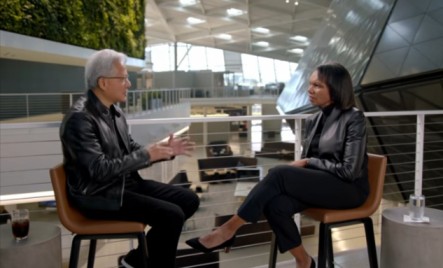
Read the full transcript of NVIDIA CEO Jensen Huang’s interview with Director Condoleezza Rice, June 10, 2026.
Editor’s Note: In this episode of Only in America, Jensen Huang, the founding CEO of Nvidia, shares his remarkable journey from an immigrant child arriving in the U.S. with very little to leading one of the world’s most consequential technology companies. Through a conversation with Condoleezza Rice, Huang reflects on the principles of risk-taking, the immigrant experience, and the vital role American freedoms have played in his pursuit of innovation and the development of modern artificial intelligence.
Introduction
CONDOLEEZZA RICE: America leads the world in technological innovation. This innovation taking place all around us in Silicon Valley is possible here because of our American freedoms. But to take advantage of the opportunities that freedom affords us, it requires taking risk and facing the unknown with courage and determination.
Jensen Huang, the founding CEO of NVIDIA, had a vision, took significant risk, and now leads an iconic American business driving change at the heart of global technology. His journey as an immigrant is fascinating, and it has so much to tell us about our country and what makes it exceptional. America presented the opportunities that enabled Jensen’s risk-taking to change the world.
Now, for Only in America, my conversation with Jensen Huang.
Welcome to the NVIDIA Campus
JENSEN HUANG: The amazing Condi Rice.
CONDOLEEZZA RICE: I’m in uniform. How are you? Good to see you.
JENSEN HUANG: Nice to see you. Nice to see you too.
CONDOLEEZZA RICE: Welcome. Thank you.
JENSEN HUANG: What do you think about our new building?
CONDOLEEZZA RICE: I think this is amazing.
JENSEN HUANG: This is a building that is only possible with science and a supercomputer.
CONDOLEEZZA RICE: Right. It’s fantastic.
JENSEN HUANG: This was completely built in a simulation first.
CONDOLEEZZA RICE: You’re kidding.
JENSEN HUANG: This building is designed so that we make maximum use of this incredible space called California. And so we decided, let’s use the space for the beautiful sunlight and the weather. And this entire space is very energy efficient, so we use the maximum amount of sunlight. And that’s why there are light wells on the roof. But when you have light wells in the roof, it is extremely difficult to remove the heat. And so notice where the triangles are — the light wells are only where it needs to be.
CONDOLEEZZA RICE: I see.
JENSEN HUANG: And the roof looks flat to us from here, but is undulated to track the sun, so it lets sun in just enough but doesn’t let any more sunlight in than is needed. Otherwise we’ll have to remove the heat.
CONDOLEEZZA RICE: So hot. So it’s completely efficient then?
JENSEN HUANG: Completely efficient. We simulated this building every single hour today, right, through a simulation of the entire year. And we moved everything until it was perfect, perfectly harmonious, mathematically.
CONDOLEEZZA RICE: Well, I would expect that of you, Jensen.
JENSEN HUANG: That’s an engineer trying to be an architect.
CONDOLEEZZA RICE: I like it. I like it.
JENSEN HUANG: And the undulation, this one creates a baseball cap. And the reason for that is because you could see during, in the afternoon when the sun’s about to set, it comes right into the building. And so I sloped the walls to move the offices further back in. And so this is the baseball cap of the building, and it fits right into the beautiful design. If you make me look too put together, everybody knows it’s fake. I’ve got to be a little wicky wonky. Something’s got to be a little off.
CONDOLEEZZA RICE: There it is.
JENSEN HUANG: Do we still call you Madam Secretary?
CONDOLEEZZA RICE: No, you don’t. Would you like to? I tell people — I’m good for now, thank you. I tell people Madam Secretary was a while ago. Dr. Rice was my father. And Professor Rice is with my students. So I think that leaves us with Condi.
JENSEN HUANG: My goodness, that’s a lot of good titles.
Arriving in America: An Immigrant’s Story
CONDOLEEZZA RICE: Jensen Huang, thank you. Thank you for having me here at this beautiful NVIDIA campus. You and I have known each other a very long time and have a lot of ties, Stanford ties and the like. So I’m really looking forward to our conversation.
But let me start with this young kid, what, 9, comes to the United States of America. America is in many ways one big immigrant story, very different stories, but one big story of people who come seeking a better life, people who believe that their children are going to do better. So talk about arriving here. It couldn’t have been easy.
JENSEN HUANG: I was born in Taiwan. When I was 5, my father got a job in Thailand to help start an oil refinery. And so we moved to Thailand. We were there for about 4 years. In 1973, there was a coup, as it happens every now and then, and my parents thought it was unsafe for us to be there.
My older brother was 1 year older than me. He was 10. I was 9. My parents wanted to send us out as soon as possible, and so they got our uncle who lives in Washington, Tacoma, Washington, to take us for a little while.
My first impression was I’ve never stood in a house with carpets before. And it was the strangest feeling. I felt like I was walking on my bed with my shoes on. And just everything from cereal and the morning television, Speed Racer, and in the afternoon, Partridge Family, and all the candy, the Snickers bars, everything — I couldn’t imagine what this amazing country was. And everything was so beautiful, the cars, everything was just incredible.
We were in Tacoma, Washington for about 3 months. And then they sent us to the most affordable accessible boarding school in America because my parents couldn’t afford much.
A wonderful school. They welcomed students of all backgrounds, many from difficult homes, some international kids. And that’s how we were able to come. They sponsored us and allowed us to come to the United States and stay in that boarding school. And I was there for about 2 years in Oneida, Kentucky.
CONDOLEEZZA RICE: I have never heard of Oneida, Kentucky till this particular moment.
JENSEN HUANG: If you look at Oneida, Kentucky in Google Maps, the beautiful thing is there’s nothing around it. It’s just one little dot. I think when I was there it was probably population 600. It’s probably population 600 now. Beautiful. Incredible. I had a wonderful, wonderful childhood there.
It was very difficult and very scary coming to the United States by yourself, but it’s amazing what my older brother did, frankly. I just followed him around. He was 10 years old. Could you imagine a 10-year-old bringing along a 9-year-old, traveled all the way from Thailand, never been to the United States, landed in Tacoma, Washington, and went to Kentucky, but laid over in Chicago?
CONDOLEEZZA RICE: Oh my goodness.
JENSEN HUANG: The Chicago airport is gigantic. And so we had to go find a connecting flight, and a 10-year-old did all that by himself. My older brother’s incredible.
Finding a Place in a New World
CONDOLEEZZA RICE: That’s amazing. So this was risky in a lot of ways, but your parents felt that the greater risk would be to stay where you were. How were you treated? Were people friendly? Were they surprised? How did that part of it go?
JENSEN HUANG: In 1973, United States, in Kentucky, the school had never seen a Chinese kid before. Wonderful kids there, but none of them had ever seen a Chinese before. And so there were all of the things that come along with being a stranger in a town where nobody’s ever seen someone like you before. There were biases and of course things like that. But kids are kids.
And so for us at the time, United States was amazing. I was part of the swim team and I was part of the soccer team. And the food was interesting — sausage and gravy, who wouldn’t like that? Hamburgers. And after the swim meet, the coach just took us to the most amazing restaurant in the world. And the food came in boxes and the menu was all lit up. And we sat in a restaurant that seemed like a spaceship, and it was McDonald’s.
CONDOLEEZZA RICE: McDonald’s, right?
JENSEN HUANG: And so I think it’s really all about expectations in life. When you came from an even more difficult circumstance — that’s the thing about immigrants — when you come to America, you came because of choice. You wanted to be here.
My dad sent us here, but in fact, when I was 4 years old, he had the opportunity to come to be trained in the United States, and it turned out the place he came to was New York. Could you imagine coming to the United States and it’s New York City from Taiwan in the ’60s? And so he always said that he wanted his family to eventually come to America, to come to this incredible place.
So the thing that’s really great about immigrants is you came with very little expectation. You came with great hopes and dreams. You appreciate everything.
CONDOLEEZZA RICE: And with a sense of gratitude for where you are and the new opportunities.
JENSEN HUANG: Exactly. And this miracle that you’re witnessing. I remember very clearly what it’s like to see America for the first time, this miracle and all these people and how welcoming they are.
Growing Up and Finding His Path
CONDOLEEZZA RICE: And to see it through those eyes is — but then of course you go from this little kid in Kentucky, you’re on the swim team, the soccer — it sounds like you were doing okay.
JENSEN HUANG: I was a good athlete. And so we met our parents back in Tacoma, Washington. They had nothing. And literally they put all their belongings on the plane. They came with literally the suitcase. That immigrant story. And they saved their way to build a life for their kids.
My mom was a maid at a Catholic school. And my father was an engineer. They saved everything they had. My dad bought a green truck, a van, and there were no seats in it. So he put a carpet in the back and put some milk crates. We got into that green van and he drove us all the way from Oregon down to LA so that we could go see Disneyland. And that was the one vacation of our family.
CONDOLEEZZA RICE: How did you end up going on to college and then Stanford? And how does working at Denny’s, which we have to cover at some point—
JENSEN HUANG: I know. I must be Denny’s best ambassador.
CONDOLEEZZA RICE: Yeah, I think you are, definitely.
JENSEN HUANG: I love Denny’s so much. It never occurred to me to be able to afford or go anywhere for college. And so it was always just my plan that I would grow up in Oregon. I loved math. I love science. And when you’re in high school and you love math and science, you’re only going to have 3 other friends who also love math and science. And so the 2 or 3 friends of ours, we were all in a club — we were in a math club, we were also in a science club, and then we were in a computer club.
CONDOLEEZZA RICE: All together.
JENSEN HUANG: All together. And then afterwards, after clubbing, we would go play arcade games, play pinball or go play arcade games. And that was growing up.
Meeting Lori and Heading to Oregon State
JENSEN HUANG: My best friend, Dean Verheyden, he said, “I’m just going to go to Oregon State University. My brother went there, my parents went there.” And I said, “That sounds great.” Oregon State had a good engineering program. That was just good happenstance. I loved the school.
And it turned out that there was another kid there, Lori. She was one of 3 girls in a class of 250 other boys. I was the youngest kid in school. I was only 16. And she was a year and a half older than me. And I was determined to meet her. So, statistically, I weeded out everybody by getting myself maneuvered into her lab class. So now I’ve reduced the competition from 250 to 4.
CONDOLEEZZA RICE: That’s quite clever.
JENSEN HUANG: That’s very clever. That was very strategic even when I was a kid. I knew odds. And then I gave her the ultimate pickup line. I asked her if she wanted to see my homework.
CONDOLEEZZA RICE: That was really smooth of you to do.
JENSEN HUANG: I cinched it. And so we’ve been together ever since.
CONDOLEEZZA RICE: That’s great. So that’s how you met.
JENSEN HUANG: Yeah, we met in college.
From Oregon State to Stanford
CONDOLEEZZA RICE: So you’re in Corvallis, Oregon State. You are doing well in school. How does Stanford come onto your radar screen?
JENSEN HUANG: I always wanted to go to a great school. I always imagined getting a master’s, but I never imagined that I could afford it. And so during Oregon State, the recruiters came from Silicon Valley. And so I took a job at AMD, and that was a really good choice because the work was really interesting. I had really great colleagues, and they had this program where you could go to Stanford and work at AMD and they pay everything. And so—
CONDOLEEZZA RICE: I see.
The Early Days: Stanford, Marriage, and the Birth of NVIDIA
JENSEN HUANG: And so it was an incredible thing. So when I was being— when they were pitching the offer to me, I said, hang on a second, I can go to— I can work at AMD, you can pay me a great salary and you’re going to pay me to go to Stanford at the same time? And they said, yep.
CONDOLEEZZA RICE: You said, that sounds good to me.
JENSEN HUANG: And that sounds like a dream come true. So I took that job. And then of course, a year later, Lori graduated. We got married. And then life started. So I took some classes, took some time off, took some classes, took some time off. And altogether, it must have taken me some 8 years to graduate— I’m probably the longest running student at Stanford. Nobody paid Stanford more, I guess, for the education.
And along the way, Spencer Madison came and along the way I founded NVIDIA. And literally during my entire tenure, during that time of being at Stanford, my life happened. When you’re going to school, you think that the schoolwork is awfully academic. And the reason for that is because you’re not sure whether there’s any purpose and any benefit in learning this. But the benefit of working and going to school at the same time, especially Stanford, I could see so much of the principles being taught and how important it is in everything that I do today.
And so it was a great privilege to have all of that happening to me at the same time. My family, my kids, my company, Stanford, working, all of it kind of in one giant soup.
CONDOLEEZZA RICE: People talk about Silicon Valley and the ecosystem and so forth, but you just used a really great term. It is really kind of a big stew, and you meet very interesting people and they change your thinking about something and that leads to something. It sounds like Stanford was a place like that for you.
JENSEN HUANG: It completely shaped my attitude and my perspective about computer science and its impact to industry and its industrial strategies. That entire intersection between technology applications, the fundamental science and the strategies of computer science really for me formulated during that time. And it was really cool.
Founding NVIDIA: The Kernel of an Idea
CONDOLEEZZA RICE: Now talk about the founding of NVIDIA. The early day founder stories are really fascinating because you have to take a chance, you take a risk, you don’t know if it’s going to work out. But what was the kernel that made you and your co-founders think, maybe we have something here?
JENSEN HUANG: During that time, it was at the beginning of the PC revolution. It was the beginning of really Moore’s Law, the beginning of the CPU era, this incredible technology engine that really changed everything. All of that in Silicon Valley was all about CPUs. Everything was about general-purpose computing. Everything was about CPUs. Everything was about Moore’s Law. Everything was about the PC.
And there were two simultaneous ideas that Chris, Curtis and I were considering. One idea, of course, is every application that’s interesting and meaningful, can it be run on a CPU? And we believe that there were so many interesting problems to solve, whether it’s real-time computer graphics, which is at the time one of the hardest problems to do in computer science, or simulation or other things beyond that, a normal computer like a CPU can’t possibly be the right format.
And so we imagined that there would be a way to accelerate the CPU, offload the work that is not suitable for general purpose things. It’s kind of like in your house, you only have one tool, one tool in the kitchen, or you go into your garage, there’s only one tool in your garage. You come to your company, there’s only one tool. There’s the right tool for the right job. And we believe that there’s another tool that could augment the CPU and make that computer essentially a supercomputer. So that’s one idea.
The second idea was how do we even get this company started? The problem is the CPU at this point, general purpose computing, as of today, it’s probably about 64 years old. And so the nature of the computer industry is that if you create an architecture that produces benefits to applications, the install base goes up, the sales goes up, applications use more of it. This positive virtual cycle would cause the two to reinforce itself. And so in fact, over the course of the last 64 years, so many applications are built on top of the CPU. How do you even cause the application developers to consider another architecture?
CONDOLEEZZA RICE: Another architecture, right.
JENSEN HUANG: That chicken or egg problem is incredibly hard to solve and has never been solved. In fact, aside from NVIDIA today, really everything else runs on CPUs. And so the idea that we would get this new architecture to be adopted by developers was incredibly hard. And so the question is, what’s the first application?
Which brought NVIDIA to its second idea, which was maybe the first application is computer graphics. But the problem is computer graphics was such a small market at the time. It was just Silicon Graphics. And Silicon Graphics was such a— it was a large company. But by the standards of computer architecture, it’s very, very small. And so the question is, how do we find an application that would, on the one hand, need this architecture, on the other hand, be sufficiently high volume to cause this architecture to proliferate?
And so we thought maybe 3D graphics for video games. Computer games are not only fun, but they perhaps more than any other application push the edge of computing power. Most PC upgrades for consumers are driven not by the grown-ups in the house, but by the kids who want a more powerful gaming machine.
VIDEO CLIP BEGINS:
UNIDENTIFIED SPEAKER: All right, so you’ve got the brand new GeForce 3 graphics card here.
UNIDENTIFIED SPEAKER: That’s exactly right. The GeForce 3 is the latest generation graphics processor from NVIDIA. So this product actually includes a 57 million transistor graphics processor. To put it in perspective, that’s more transistors than a Pentium 3 put together.
VIDEO CLIP ENDS:
I just described a business plan that is impossible to fund. And it was— I still remember explaining it and everybody’s going, yeah, but this and that, this requires this to be solved and have multiple chicken and eggs. And yet Silicon Valley right here, Sand Hill Road would finance me. Sequoia Capital and Sutter Hill would be investors in this company. And that we would be able to attract the brightest minds, the brightest computer scientists in the world to come work here.
But we were just determined that on first principle basis, the general purpose computer cannot possibly be the only computing platform. And that there were too many interesting problems that we could solve if we were to introduce this new idea.
VIDEO CLIP BEGINS:
UNIDENTIFIED SPEAKER: What’s key about this is it’s programmable, right?
UNIDENTIFIED SPEAKER: That’s exactly right. For the first time, the graphics processor is as programmable as the CPU. We have an instruction set, just like the Intel processors have an instruction set that you can program Microsoft Word or Windows with. We now have an instruction set that game programmers can program to create special effects on our processor.
VIDEO CLIP ENDS:
Swimming Upstream: Thirty Years of Perseverance
CONDOLEEZZA RICE: So you literally were swimming upstream on this. People you were trying to convince.
JENSEN HUANG: For 30 years.
CONDOLEEZZA RICE: For 30 years. Yeah. But then something happens and the problem that you’ve solved, it turns out, has many other applications.
VIDEO CLIP BEGINS:
UNIDENTIFIED SPEAKER: NVIDIA! The best way to play the netbook explosion. That’s right, NVDA. First of all, the company understands the netbook opportunity. “There’s more and more people proving that they want to be able to take their computer with them.”
UNIDENTIFIED SPEAKER: NVIDIA came to us many months ago and talked to us about an amazing graphics part that they wanted to build. And we said, “This is fantastic.” But we’d like to use it in a notebook. Can we work together on this? And we’ve been working together with NVIDIA for many, many months, and they’ve created something really great.
VIDEO CLIP ENDS:
CONDOLEEZZA RICE: I remember listening to you at Stanford at a talk, and you said, “We just kept trying to solve hard problems.”
JENSEN HUANG: Computer graphics is basically a simulation of the world. It’s a simulation problem. In a lot of ways, artificial intelligence is a simulation of the mind, simulation of the brain. And so the computation of simulation can be done not completely, but largely in parallel.
And so the architecture, the processor that you want to use for simulation versus the architecture used for task execution— a recipe is step 1, step 2, step 3. In the case of simulation, the world is happening concurrently and in parallel all at the same time right now. And so on that first principle, you would think that simulation of the world, whether it’s quantum, Newtonian, or otherwise, should be something that is a different architecture than recipe execution and instruction execution. So that’s the big idea.
Now the question then is, how do you manifest that idea in technology? Number one. Number two, how do you go find application for it? And so we found, of course, the first application, computer graphics. The second application was seismic processing or inverse physics, CT reconstruction, ultrasound, seismic, very similar problems. The next problem we found was molecular dynamics, Newtonian physics. And on and on and on. We just kept finding one problem after another.
And then one day some researchers— one at Stanford, Andrew Ng, Geoff Hinton at the University of Toronto, Yann LeCun over at New York University— they were all trying to solve for a similar problem, which is deep learning. And they reached out to us. And I, being alert, I realized that this is a problem that we could really make a contribution to. And I was happy to help.
And because of the work that we did together, it achieved a level of computer vision capability that no one had ever imagined. And because of its success, it triggered even further introspection. Why does it work? What else can it do? How far can it go? What is the implication to computer science? What is the implication to the whole industry that we’re built on?
And so step by step by step, we broke everything down to its first principles. And then we rebuilt back where NVIDIA is going to be in that world. How do we apply all of the techniques that we know? How do we navigate step by step so that on the one hand, we can pursue this unknown future?
And so all of this is about reasoning, vision, strategy, discipline, patience, belief, belief at the core of grit. We suffered our way here. We suffered every single step of the way. We suffered our way here because nobody believed in it. So we had the benefit of building all of this for a decade before anybody even paid attention. The hard part, of course, is that you’re endeavoring something that has no positive feedback, no external motivation.
Keeping the Faith: Inspiring a Workforce Through Uncertainty
CONDOLEEZZA RICE: How do you stay— and how do your employees stay motivated? Because there was this period of time where NVIDIA was not on the tip of the tongue of anybody here in the Valley. All kinds of other things were going on. How did you stay, not just you stay focused, but how did you keep a workforce believing, engineers believing that this was— that must have been a tough inspirational speech at some time. How do you do that?
JENSEN HUANG: First of all, we have to believe in what we’re doing. We have to go back to our core values. As you know, in almost everything great that’s done, you have to go back to your core foundations. You have to demonstrate that you are determined to go pursue that, that you see that future in your mind’s eye, even though nobody else can. You see that future in your mind’s eye. You have to tell the story so that everybody else could see it in their mind’s eye. And you have to believe it yourself.
VIDEO CLIP BEGINS:
JENSEN HUANG: Welcome to the world’s first conference dedicated to our industry, dedicated to the visual computing industry. Welcome to GTC 2010. GTC is all about the celebration of the wonderful discoveries and amazing inventions that are made possible because of the GPU computing revolution. GTC is a celebration of your work.
VIDEO CLIP ENDS:
It has to first start from what are your core beliefs? For what reason do you believe this future will happen? You could say that about America. You could say that about Stanford. You could say that about NVIDIA. America has core foundations. The American dream has a core foundation. There’s a reason why it exists. There’s a purpose that drives it. There’s a promise of it. There are pillars that keep it up.
When you see the world from my lens, when you see America from my lens, and when you see America now today, as I travel around the world and see America from the lens of everywhere I’ve been and the countries that aspire to be us, the industries that would aspire to want to be part of our industry, it is just genuinely a miracle.
The American Dream: Risk, Freedom, and Second Chances
CONDOLEEZZA RICE: It is a miracle. And I very often, I teach young people, of course. And sometimes I think that some of this has gotten lost. There is something about this risk-taking, this willing to fail, the fact that you are in a place where you’ll get a second chance, the role of free speech, the role of laws that are reliable that is really quite extraordinary.
JENSEN HUANG: Exactly. We have a word for that. We call it freedom.
The American Dream and AI’s Future
CONDOLEEZZA RICE: We call it freedom. And that freedom has enabled so much. That’s right. What would you say to these young people? Because there is, unfortunately, right now, among my students, there’s a kind of fearfulness. There’s a kind of sense of, “I’m not going to be able to achieve those things.” Maybe this world, whether it’s “I won’t have a job because of AI,” or is that American dream still really there? What would you say to them?
JENSEN HUANG: I would always retreat back to first principles. I would always reason from first principles when I’m uncertain about the future, when things are moving too fast. You always go back to first principles. What are my core values? What makes me great today? What do I aspire for?
And to go back to that, I would say to young people that it’s possible to have multiple feelings at the same time. It’s possible to be grateful for everything that you have, to be unsatisfied with where we are at, and to have aspirations for greatness. You’re allowed to have all of those feelings at exactly the same time.
During technology change, during world change, is the only opportunity for greatness. Status quo, it’s really hard to make a difference. And so I would deeply dive into the capabilities of artificial intelligence and use it in every possible way. And it’s not just about mastery of science, but it’s about mastery of using artificial intelligence in my field of science.
Your purpose, if you decide to go into medicine, is to care for people. It’s different than studying a radiology scan. Your purpose as an engineer is to either solve a known problem or discover problems that have never been solved, that are worthy to be solved. There’s a fundamental difference between the tasks that we do in our job versus the purpose of our job. Everybody’s purpose, every job’s purpose surprisingly consists of tasks but not defined by the tasks.
Cautious Optimism on Artificial Intelligence
CONDOLEEZZA RICE: Let’s talk about AI actually. Because you are foundational now to that entire revolution. But you’re an optimist about the technology.
JENSEN HUANG: Cautious optimist.
CONDOLEEZZA RICE: Cautious optimist. Well, just describe for me cautious optimism, because there are some people who are kind of — we’ve lived in the Valley a long time — there are people who are kind of wild-eyed optimists as well. But talk to me about what cautious optimism means and how you think about that.
JENSEN HUANG: Intelligence is foundational to every aspect of society, every aspect of industry, everything we endeavor. In almost everything that we do, the fundamental ingredient is intelligence. Now, of course, we have to be cautious. We have to be cautious so that we advance the technology as quickly as we can so that it works as we promised, so that it’s functional as we expect, so that it doesn’t produce intelligence that sounds like it’s intelligence, but it’s not. It’s flawed. Functional things are safer. I want my car to function as promised. AI needs to function as promised.
CONDOLEEZZA RICE: When you think about this whole question internationally and the like, what concerns you about where we are now?
JENSEN HUANG: I think that one of the challenges is to define what is AI. That is probably one of the most — there are a lot of different ways to think about the technology, but one way to think about it is it’s like a 5-layer cake and we have to win every single layer.
The first layer is just energy — energy, land, power, and shell. The second layer is the chips layer, where I’m at. The third layer is the infrastructure layer, which is kind of like cloud services. The next layer above that is the AI model layer. This is where everybody talks.
CONDOLEEZZA RICE: Yes, right.
JENSEN HUANG: But it’s not the only layer. Everything about that layer is very important. But ultimately, the most important layer to our nation is the layer above that, which is the application layer. Using AI for healthcare, using AI for military applications, using AI for defense, for cybersecurity, using AI for transportation, for manufacturing. That is what’s going to drive our industry forward.
But I do think that our nation also has to be very alert that this is a very important time. And although we are ahead, although we are the world leader, during an inflection in technology, this is exactly when leadership can change. And we have to make sure that as we come up with policies, we don’t hinder the most important layer, which is the highest layer, the application layer. That is the layer that whoever advances most will exploit this industrial revolution the most.
Only in America: The NVIDIA Story
CONDOLEEZZA RICE: Somebody comes here from Taiwan. They’re 9. They end up in Kentucky, of all places. They somehow go to Oregon State because their friend goes to Oregon State and the family’s there. And then they go to Stanford because somebody will pay for it. You meet a collection of people who are kind of intellectual geniuses, but they’re a push on your own. That’s right.
JENSEN HUANG: I’m the busboy at Denny’s that met up with Chris and Curtis, the two geniuses. I mean, that’s how the story goes.
CONDOLEEZZA RICE: That’s the story, right? And you found this company on an idea. Does that happen only in America because of some of those foundational institutions and ideas that you talked about?
JENSEN HUANG: I think that it’s a chain of extremely low probability events that leads to NVIDIA. And without the tailwind that America provides — America provides tailwind, not headwind. It provides tailwind, laws and rules that are understandable and that you can count on. A business environment, an industrial environment with people playing by the rules that you can understand and count on.
When everybody’s playing by the rules, because the rules and laws are for good reason, then at least you could find where there are segments of the market that are underserved. And that you can rely on that. You can rely on the fact that you can create something great and take it to market in a way that serves a market that has a demand. And that it won’t be foreclosed on you randomly, arbitrarily, unknowingly, unpredictably. Those things that entrepreneurs rely on are alive and well here.
As an immigrant, you come here by choice. You witness a miracle because compared to where you came from, the circumstances you came from, it is a miracle. The resources are incredible, are abundant. You want to work hard because you’re desperate to succeed. An entrepreneur, you’re desperate to succeed. If you don’t work hard every single day, you will perish. The entrepreneurial spirit, the immigrant spirit is rather similar, actually.
CONDOLEEZZA RICE: Very similar. Yeah, right.
JENSEN HUANG: You have the same feelings.
CONDOLEEZZA RICE: Yeah.
JENSEN HUANG: I am certain my feelings about NVIDIA and my constant desperation to do better is exactly the same feelings my parents had to secure a living for their family. They have nothing else to rely on, nothing to fall back to.
I can’t imagine another place where this is possible. NVIDIA genuinely is an only in America story. In a lot of ways, I’m an only in America story. This is in one lifetime. I’m not talking about a fifth generation thing. I’m not talking about a third generation thing. This all in one body, in one generation, with parents that gave up everything to be here. With no way to fall back. And they sacrificed their whole life to build a life for their children so that we could have more opportunities than they did.
And for a country to create the opportunities for me and all the resources, the systems, the institution, the foundation that makes a company like NVIDIA possible — I am the embodiment of the American dream.
Related Posts