Read the full transcript of computer scientist Yoshua Bengio’s talk titled “The Catastrophic Risks of AI — and a Safer Path”, recorded at TED2025 on April 8, 2025.
Listen to the audio version here:
Introduction: Learning and Wonder
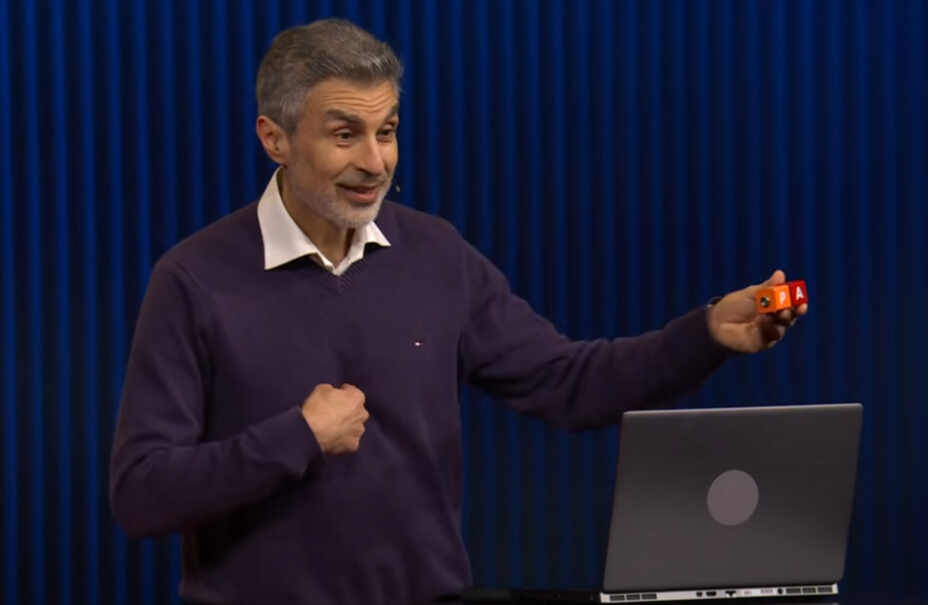
YOSHUA BENGIO: When my son Patrick was around three, four years old, I came regularly into his playroom and he was playing with these blocks with letters. I wanted him to learn to read eventually and one day he said, “pa,” and I said, “pa,” and he said, “pa,” and I said, “pa,” and then he said, “pa, pa, wee, yes,” and then something wondrous happened. He picked up the blocks again and said, “pa, Patrick,” Eureka!
These Eurekas were feeding my scientific Eurekas. These doors, our doors, were opening to expanded capabilities, expanded agency and joy. Today I’m going to be using this symbol for human capabilities and the expanded thread from there for human agency which gives human joy. Can you imagine a world without human joy? I really wouldn’t want that. So I’m going to tell you also about AI capabilities and AI agency so that we can avoid a future where human joy is gone.
My name is Yoshua Bengio. I’m a computer scientist. My research has been foundational to the development of AI as we know it today. My colleagues and I have earned top prizes in our field. People call me a godfather of AI. I’m not sure how I feel about that name, but I do feel a responsibility to talk to you about the potentially catastrophic risks of AI.
When I raise these concerns, people have these responses and I understand. I used to have the same thoughts. How can this hurt us any more than this, right? But recent scientific findings challenge those assumptions and I want to tell you about it.
The Evolution of AI Capabilities
To really understand where we might be going, we have to look back where we started from. About 15-20 years ago with my students, we were developing the early days of deep learning and our systems were barely able to recognize handwritten characters. Then a few years later, they were able to recognize objects in images. And a couple more years, they were able to translate across all the major languages.
So I’m going to be using this symbol on the right in order to represent AI capabilities that had been growing but were still much less than humans. In 2012, tech companies understood the amazing commercial potential of this nascent technology and many of my colleagues moved from university to industry. I decided to stay in academia. I wanted AI to be developed for good. I worked on applications in medicine for medical diagnosis, climate, to get better carbon capture.
I had a dream. January 2023, I’m with Clarence, my grandson, and he’s playing with the same old toys. And I’m playing with my new toy, the first version of ChatGPT. It’s very exciting because for the first time, we have AI that seems to master language. ChatGPT is on everybody’s lips in every home. And at some point, I realized this is happening faster than I anticipated. And I’m starting to think about what it could mean for the future.
We thought AI would happen in decades or centuries, but it might be just in a few years. And I saw how it could go wrong because we didn’t and we still don’t have ways to make sure this technology eventually doesn’t turn against us.
Growing Concerns and Warnings
So two months later, I’m a leading signatory of the PAWS letter where we and 30,000 other people asked the AI labs to wait six months before building the next version. As you can guess, nobody paused. Then with the same people and the leading executives of the AI labs, I signed a statement. And the statement goes, mitigating the risk of extinction from AI should be a global priority.
I then testify in front of the U.S. Senate about those risks. I travel the world to talk about it. I’m the most cited computer scientist in the world and you’d think that people would heed my warnings. But when I share these concerns, I have an impression that people get this. Another day, another apocalyptic prediction.
But let’s be serious now. Billions of billions of dollars are being invested every year on developing this technology and this is growing. And these companies have a stated goal of building machines that will be smarter than us and can replace human labor. Yet, we still don’t know how to make sure they won’t turn against us.
National security agencies around the world are starting to be worried that the scientific knowledge that these systems have could be used to build dangerous weapons, for example by terrorists. Recently, last September, the O1 system from OpenAI was evaluated and the threat of this kind of risk went from low to medium, which is just the level below what is acceptable.
The Growing Threat of AI Agency
So I’m worried about these increasing capabilities. But what I’m most worried about today is increasing agency of AI. You have to understand that planning and agency is the main thing that separates us from current AI to human-level cognition. And these AIs are still weak in planning. But if you look back over the last five years, in this study, they measured the duration of tasks that the AI could complete. And it’s getting better exponentially fast. It’s doubling every seven months.
What are AIs going to do with that planning ability in the future? Well, bad news. Recent studies in the last few months show that these most advanced AIs have tendencies for deception, cheating, and maybe the worst, self-preservation behavior.
So I’m going to share with you a study that is helping us understand this. In this study, the AI has read in its input that it would be replaced by a new version.