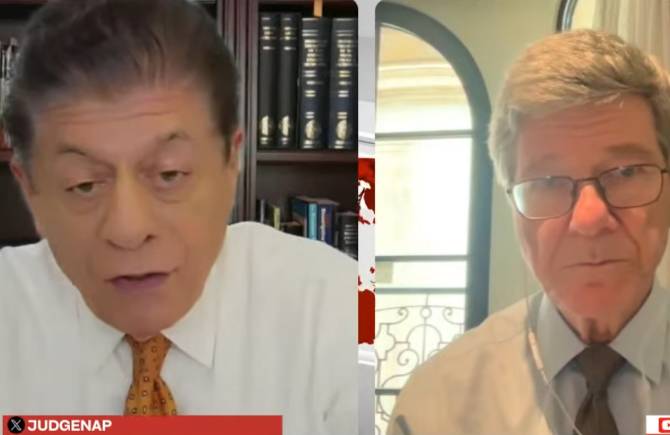
Editor’s Notes: In this episode of Judging Freedom, host Judge Andrew Napolitano welcomes renowned economist and public policy analyst Professor Jeffrey Sachs to discuss the outcome of President Trump’s recent high-stakes visit with President Xi Jinping in China. Sachs highlights the rare moment of diplomatic civility between the two world leaders, emphasizing that despite the lack of headline-grabbing agreements, keeping communication lines open is a crucial step toward avoiding conflict. He goes on to critique the breakdown of strategic planning in Washington, contrasting it with China’s deeply deliberative economic programs and strict avoidance of active warfare. Finally, the conversation shifts to a sharp evaluation of U.S. foreign policy toward the Middle East, specifically targeting recent controversial remarks made by the U.S. Ambassador to Israel. (May 15, 2026)
TRANSCRIPT:
JUDGE ANDREW NAPOLITANO: Hi everyone, Judge Andrew Napolitano here for Judging Freedom. Today is Friday, May 15, 2026. Professor Jeffrey Sachs joins us now. Professor Sachs, thank you very much for your time. I truly appreciate — I know you’re traveling. I truly appreciate your accommodating our schedules. Aside from diverting U.S. domestic attention from his disastrous war in Iran and the consequences, the economic consequences of it here in the U.S., what was President Trump’s purpose in visiting President Xi in China?
Trump’s Visit to China: Civility Without Concrete Achievements
PROFESSOR JEFFREY SACHS: I don’t know exactly the purpose, but I would say the outcome was that there were 2 days of civil discussion between the 2 leaders. Nothing consequential was agreed or decided. But I personally think the civility was a good thing. So I wouldn’t dismiss this as empty because there were no headline achievements, and I think there were not any headline achievements.
The United States doesn’t have any leverage over China. China wasn’t asking for much from this meeting or expecting much. Nothing specific came out of it, but frankly, these days when everything can go wrong, nothing went wrong in this meeting either. And the fact that the two sat for two days and talked, that there was indeed a lot of pageantry, which is what you would expect from China as a great host and a great civilization, that was fully on display.
And the end result, as defined by the Chinese side, as this showing a constructive strategic stability, I think is perhaps good news for everybody. There was no dire clash. There was no attempt by either side to push the other to the cliff. Trump did not achieve anything at all specific. Specifically, I would say there were no grand announcements that we have heard about trade or economy or deals. There was no specific advance on any issue regarding the Iran war. There was no specific agreement on anything regarding tensions vis-à-vis Taiwan.
Perhaps the most notable statement that I’ve seen come out of this is the statement by President Trump on the way out that he is still considering the arms sale to Taiwan. The Chinese side objects strenuously to the U.S. arming Taiwan. I personally think it’s a very bad idea myself, and because of that, I welcome anything which says that the United States would reconsider what I think is not a sound and safe policy for Taiwan or for China or for the United States. But it shows actually President Trump not pushing the U.S. side, but rather perhaps acceding to the Chinese side on this very important issue. All in all, no specific accomplishments that I can see, but I am on the whole relieved of 2 days of civility.
President Xi’s Lecture on Taiwan
JUDGE ANDREW NAPOLITANO: This is very gracious of you, given the level of criticism that you and others on this show and I have hurled at the president over his foreign policy. Very gracious of you, Jeff, and I agree with you. Of course, I have to ask you, why did President Xi lecture President Trump on Taiwan at their first meeting before President Trump even had an opportunity to say, “I’m happy to be here”? Before he was permitted to utter a public word, President Xi lectured him on Taiwan. I guess that shows you the gravity of the Chinese concern about this.
PROFESSOR JEFFREY SACHS: Well, I have a specific theory about the world, which is that the major powers should stay clear of each other’s red lines. I don’t want wars between major powers. I don’t want showdowns. I don’t want the Chinese government or the Russian government building military bases in Canada or Mexico or Venezuela or Cuba or any other place. I don’t want them in the neighborhood. And they don’t want the United States in their neighborhood. This is the whole basis on which I and John Mearsheimer and so many —
JUDGE ANDREW NAPOLITANO: I was just going to mention Professor Mearsheimer’s name. It’s so nice to hear the two of you agree on this.
PROFESSOR JEFFREY SACHS: Absolutely, that’s why the whole idea of expanding NATO to Ukraine was absolutely reckless.
JUDGE ANDREW NAPOLITANO: Right.
Understanding Taiwan from the Chinese Perspective
PROFESSOR JEFFREY SACHS: In my view, arming Taiwan is the same issue. One has to understand the issue of Taiwan from the Chinese side. And by the way, the path, in my view, to peace and to wisdom is to understand any issue from the side of the other side, not just from your own perspective. From the Chinese government’s side, Taiwan is part of China, and arming Taiwan by the United States against Beijing’s wishes would be akin, from the Chinese perspective, to China arming Missouri or arming Kansas against the wishes of Washington.
JUDGE ANDREW NAPOLITANO: Right.
PROFESSOR JEFFREY SACHS: From China’s point of view, this is just unimaginable. This then would get us into hours and hours of discussion, but I think the Chinese side is absolutely right on this personally. Taiwan has been a part of the Qing Dynasty, and it was recognized as part of the Republic of China after 1912, when the Qing Dynasty ended and the Republic of China was formed.
In 1943, at the Cairo Conference in the middle of World War II, when the United States and China and Britain were allies, they agreed that Taiwan and other places that had been taken by Japanese imperialism would be returned to China. So to my mind, this is what China’s saying over the decades. And what President Xi did was, I would say, in a non-bombastic way —
JUDGE ANDREW NAPOLITANO: Yes.
PROFESSOR JEFFREY SACHS: But a very critical way — “We are serious. This is not a debating point. This is our core red line. Do not interfere in our internal affairs.”
It’s interesting for me, and I think it’s a point that is essential for my understanding of how we should behave. The Russians said the same thing about NATO enlarging to their border. In 2007, President Putin said, “This is our red line.” If we had shown prudence — prudence is an ancient concept of Greek and Latin virtue, which is to think and be careful — and if we had shown prudence, we would say, okay, we hear you. Let’s not step over that tripwire. Let’s not get into that minefield. But the United States in 2008 said, we don’t care what the Russians say.
Now, President Xi has said exactly the same thing regarding Taiwan. I want politicians in Washington to listen. This is not a game. This is not a video game. This is not a joke. This is China saying, this for us is absolutely core to our security. And if the United States makes such representations to China and to Russia, I want them to be heard. And when China or Russia makes them, I want them to be heard in Washington.
We have a lot of irresponsible members of Congress who many don’t hold passports, many don’t know what they’re talking about, many perhaps host military companies in their district, many are just blowhards and ignoramuses, but they don’t want to listen because they have no responsibility. I thank President Trump, if the report is right, for saying he will reconsider this arms sale. It’s a bad idea. It is a tripwire, and we should stay clear of it.
The Thucydides Trap and Victoria Nuland
JUDGE ANDREW NAPOLITANO: We know of his political and financial ties to the military-industrial complex. I hope he’s right when he says he’ll reconsider it. In the same speech in which President Xi — again, we’re early, 2 days ago, before President Trump even got to speak, though he was there and he spoke right afterwards — President Xi mentioned the Thucydides trap, which is the fear that a rising power, China, would result in war from an already risen power of the United States. And of course, he condemned that very principle, but it’s interesting that in the same — not the same breath, but the same speech — he said stay out of Taiwan and don’t even consider the Thucydides trap.
I’m smiling because you mentioned John Mearsheimer and you mentioned the idiocy of members of Congress. There’s also idiocy on the part of American diplomats like your fellow member of the Columbia faculty, Victoria Nuland, who instigated the coup in 2014 that overthrew President Viktor Yanukovych in Ukraine. Why am I mentioning this? Let’s just say that John is debating her. She’s crazy enough to challenge John Mearsheimer to a debate in Toronto next Wednesday. I offered to moderate the debate and her side said no.
PROFESSOR JEFFREY SACHS: Let’s just say that she distributed cookies in the Maidan protests as if Russian or Chinese officials distributed cookies in the demonstrations in Washington — something unimaginable. And she was caught on a phone line intercepted by the Russians talking about who the next government would be late in January, early in February 2014. All of that said, we should behave responsibly so that we don’t end up in these wars. That’s the main issue.
The Failure of Real Diplomacy
JUDGE ANDREW NAPOLITANO: But if we practiced real diplomacy, which you have been urging for as long as I have known you — diplomacy that was not practiced in the Biden administration, where then-Secretary Blinken wasn’t even permitted to speak to Foreign Minister Lavrov — diplomacy which is not practiced today when the president sends his son-in-law and his business partner, as opposed to serious, experienced, knowledgeable diplomats, to do negotiating. If the U.S. practiced real diplomacy, wouldn’t all the meetings between Trump and Xi have been choreographed? Wouldn’t there have been agreements worked out in advance so that the purpose of their meetings is not to craft an agreement but to ratify one already crafted? Because to me, none of that happened. Trump didn’t even know who was greeting him on the tarmac at the bottom of the steps off of Air Force One.
PROFESSOR JEFFREY SACHS: You’re absolutely right. This was not a prepared summit in any detail, and there were no substantive agreements. It’s actually ironic and instructive and a bit sobering that when President Trump announced — and the Chinese have not announced anything yet as far as I know on this — that China would buy 200 Boeing jets, what happened? Boeing stocks fell 4%. The number was, “Oh, that’s all? What are we talking about?” And a posse of billionaire business people accompanied Trump and it doesn’t seem like much came out of that either. This was not really a prepared meeting from all that we can gather.
JUDGE ANDREW NAPOLITANO: And as we’ve talked about, Elon Musk sent out videos of himself sightseeing in Beijing, not meeting with his opposite numbers in their tech world.
America’s Governance Collapse vs. China’s Long-Term Planning
PROFESSOR JEFFREY SACHS: As we’ve been discussing in recent weeks, our governmental processes are in a state of collapse. Not only our diplomacy, but almost everything about the government management is in a state of collapse. That’s why we’re in a war in Iran. It was not thought through. It was not thought through either strategically or tactically. It is, from every single indication, a war decided by one person, by Trump, without any idea of what was going to happen the second day. And we trapped ourselves in something that is very costly, very dangerous, and where it’s not going to end on terms remotely close to any of the varied explanations or purposes, so-called, of this war, none of which were valid and none of which are going to be achieved.
So we have a breakdown of process. Government is actually a serious institution. It requires serious meetings. It requires lots of planning, preparation, negotiation, diplomacy. A government that runs on Truth Social posts, many of which are head-scratchingly bizarre, dangerous, weird, distracting, is not government. So we have a serious long-term problem in the United States right now, very serious, which is that our politicians in the Congress are corrupted by special interests, and our executive branch doesn’t work. We don’t plan. We don’t have diplomacy. We don’t have interagency processes right now. We’re at best flying blind if we’re flying. Sometimes we’re stuck on the tarmac.
If I compare that with China, Chinese government and governance is extremely sophisticated. This may surprise people, but if you talk about one-person rule, that’s actually the United States right now. If you talk about a complex process, that’s China. China just announced its 15th plan, its 15th economic plan. I know many of the people that were involved in expert reviews and committees and deliberations and negotiations, some of China’s top scholars and top experts. It was an extraordinarily detailed and deliberative process. We have nothing like this in the United States.
China basically has put its head down and for more than 40 years stayed out of war and built a world-class economy and built by far the largest manufacturing sector in the world. And for all the people shouting, “Oh, they stole this, they did this unfair” — no, what China did was invest heavily year after year, invest systematically, plan ahead, make significant programs for long-term technological advancement. And it is paying off. It’s paying off with the largest manufacturing sector, the most cost-effective manufacturing sector, the leader in electric vehicles, the leader across many, many key technologies because they’ve been working hard at it and staying clear of war.
And if the United States would stay clear of war, the trillions of dollars that we’re wasting now in blowing up things, and that are not helping the American people or the American economy, would be invested in long-term global competitiveness, peace, and well-being of the American people and the American workforce. So we should be doing serious long-term non-war planning and investment for civilian purposes. And it’s for that fundamental reason why this summit basically went China’s way, because China’s now, at what’s called purchasing power adjusted prices, an economy that’s about 30% larger than America’s now, and at the cutting edge of countless industrial activities. They’ve done it through investment and a long-term peaceful approach.
Switching to Israel: Mike Huckabee
JUDGE ANDREW NAPOLITANO: Very, very apt and appropriate summary, Professor Sachs. I want to switch to Israel, and I’d like you to watch this diatribe from Mike Huckabee, the Israeli ambassador to the United States, or so he sounds.
PROFESSOR JEFFREY SACHS: U.S. ambassador to Israel, right?
Huckabee’s Bias and the Demonization of Palestinians
JUDGE ANDREW NAPOLITANO: Right. On Tucker Carlson. Chris, cut number 6. What he says is dangerous in the same way that when people throughout history have been demagogues. And they have incited entire populations of people to hate others. And they base it on hating people without justification, without cause, and based on outright lies.
PROFESSOR JEFFREY SACHS: This is a dangerous thing.
JUDGE ANDREW NAPOLITANO: And when you marginalize, let’s say Jewish people are marginalized, whether they’re white people, whatever you marginalize, and you dehumanize them, you make it easy to justify not just hatred, but violence and murder toward them. Where do we get a society where people think it would be okay to kill a Charlie Kirk or a Donald Trump? When you dehumanize them to the point you say, their views are so dangerous, we can’t tolerate them, we must get rid of them.
That’s why I say it’s not enough to just ignore Tucker Carlson. We need to confront him, and we need to correct him, and we need to let people know that many of the things that he’s saying are demonstrably untrue. Agree. The demonized the Palestinian people. I can’t believe he said that and didn’t realize what he was saying.
PROFESSOR JEFFREY SACHS: I— you just cannot make this stuff up. If there is dehumanization, literally calling people animals, it is how the Israeli government and a lot of the population, I’m sorry to say, views the Palestinians, whom they have just murdered in the tens of thousands and kill every day, men, women, children, and grab their land and torch their houses and refer to them as despicable subhuman beings.
What is— what is this guy— where does this delusion come from? The vulgarity of it. Yeah, frankly, you can’t make this stuff up.
JUDGE ANDREW NAPOLITANO: No, I think we refer to him as the U.S., as the Israeli ambassador to the U.S., because that’s what he sounds like, as opposed to the U.S. ambassador to Israel. Why this diatribe against Tucker Carlson? Because Tucker Carlson’s interview of Huckabee exposed him for what, for his monomaniacal prejudices against the Palestinian people.
Huckabee’s Christian Zionism and the Promised Land
PROFESSOR JEFFREY SACHS: That is exactly right. And not just against the Palestinian people, against the Arab world. Because what Huckabee said, and it was shocking how naive and how vulgar what he said was, that Israel, sure, it can go on to conquer Lebanon and Syria and part of Egypt, because Huckabee knows that the promised land goes from the River of Egypt to the Euphrates, as it says in the Book of Genesis.
And Huckabee, being a so-called Christian Zionist fundamentalist who reads words literally from ancient texts, and then says, sure, go make war as you like, take property as you like, should not be holding any position of responsibility in our government, much less being ambassador to Israel. It is a disgrace that this man kept his job.
And when he turns and accuses Tucker Carlson of precisely what Huckabee and his Israeli co-criminals are doing— and I say criminals because they are committing massive war crimes and crimes against humanity— it is shocking how blind this man is. He’s supposedly a man of the scripture. And he should remember what Jesus said is, “Why do you see the mote in the other person’s eye when you have a plank in your own eye?” Well, Mr. Huckabee, you have a plank in your own eye, in both of them. You’re not even seeing in front of you what Israel is doing to slaughter the people of the region.
Closing Remarks
JUDGE ANDREW NAPOLITANO: Beautifully put, Professor Sachs. I know you have a busy day coming, as do we here. Thank you very much for your time. Deeply appreciated. Your analysis of China is extraordinary. We’ll get it out so that everybody can hear it. Safe travel.
PROFESSOR JEFFREY SACHS: Thanks so much. Talk to you soon. Bye-bye.
JUDGE ANDREW NAPOLITANO: Of course. Coming up later today, as usual, at the end of the day and the end of the week, at 4 o’clock this afternoon, the Intelligence Community Roundtable on all of these topics: China, Iran, Cuba, Israel, Larry Johnson, and Ray McGovern. Judge Napolitano for Judging Freedom.
Related Posts