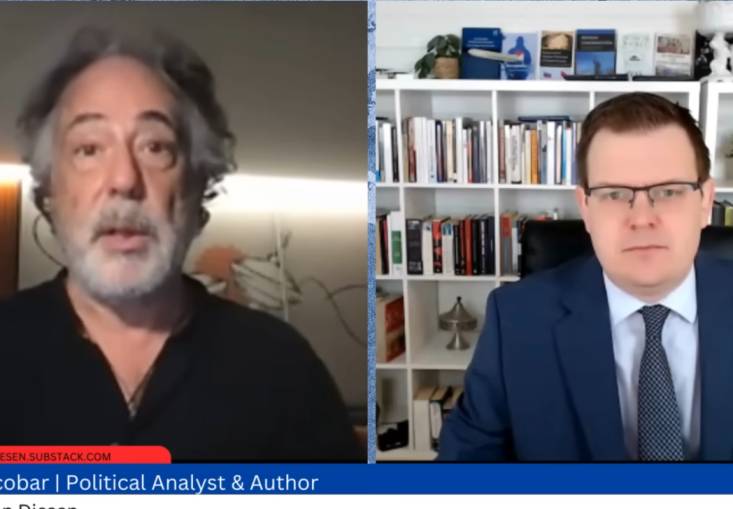
Editor’s Notes: In this interview, political analyst Pepe Escobar joins Glenn Diesen to dissect Iran’s current strategy of attrition warfare and its broader implications for West Asia. Escobar discusses the shift in Iranian military doctrine from defense to offense, highlighting the strategic significance of their “underground missile cities” and the exhaustion of American and Israeli air defenses. The conversation also delves into the internal fractures within BRICS, the role of Russia and China in backing Iran, and why the demands for a post-war settlement remain fundamentally unbridgeable between Washington and Tehran. (Mar 24, 2026)
TRANSCRIPT:
Introduction
GLENN DIESEN: Welcome back. We are joined today by Pepe Escobar, a political analyst and author focusing on the greater Eurasian continent. Thank you for coming back on.
PEPE ESCOBAR: My pleasure, Glenn.
The Long-Planned War Against Iran
GLENN DIESEN: So I wanted to ask about Iran, obviously, as the world is looking at shock and horror of what’s happening. And I often think about U.S. General Wesley Clark. He made this comment regarding what happened after the September 11 attack, arguing that they had a plan to take out seven countries — they were going to take out Iraq, Syria, Lebanon, Libya, Somalia, Sudan. And of course, the grand finale was Iran. And even Bush thereafter put Iran on this axis of evil.
And why is this so important to the Americans? Because this is a very different target than they had over the past 30 years. Everyone, all the US presidents, it seemed more or less wanted to go after Iran. They all shared the same rhetoric of Trump, but they knew that it would be too much, too big to try to take. But still, Trump went all the way.
What do you see as being the strategic significance here, besides liberating girls and all this, helping protesters, this nonsense?
PEPE ESCOBAR: No, Glenn. This is way more complicated. Iran is the Holy Grail.
Well, I am one of the last old school foreign correspondents on the planet. I was in Afghanistan before, during and after, including 9/11. And I was in Iraq before, during, and after. And I was going to Iran during the 2000s, many times, including at a time when Rumsfeld, the Cheney regime was talking about “bomb, bomb, bomb, bomb Iran.” That was John McCain’s refrain every week, in fact.
So we all knew Iran was the big prize. It always was, according to the Project for the New American Century, according to Clean Break, according to the Zionist influence in D.C. already in the 90s everywhere. So of course, they couldn’t do it before. And the famous Wesley Clark quote — in fact, they got everybody. And of course, the only missing piece was Iran.
So this war was planned — we can say that this war was planned since the late 90s, in fact, not only the past 20 or 25 years, even more than that, the previous millennium.
The Role of Kushner and Financial Interests
And of course, now they found the perfect messenger — what some of my Chinese friends, the scholars, call the baboon in the White House. I love it. The barbarian baboon in the White House. Totally controlled by Zionists, totally controlled, not only by Netanyahu, but the circle around Netanyahu, the International Zionist alliance, which is especially financial. And of course his inner circle, the people who he actually listens to. There are not many.
They are making a lot of money out of this war, and that includes everybody, starting with the ghastly Jared Kushner. This should be an investigation in itself, but obviously, because there’s no more investigative journalism in the U.S., you see this only in fringe Substack accounts, for instance. But how Kushner is profiting — even starting when he left the White House after Trump 1.0, when he got the first $2 billion for his Affinity Partners from MBS directly. Basically, MBS wrote a check for Kushner. And now the price is even higher — $5 billion. He’s getting $5 billion from the Saudis for pushing, of course, the father of Ivanka, let’s put it this way. And the real brains in that couple is not Jared Kushner, it’s actually Ivanka. He is absolutely ghastly — a low life, cheap real estate entrepreneur. But of course, Trump listens to him. That’s very, very dangerous.
So he was the main seller of this war, face to face to Trump, or ear to ear to Trump. And everybody is profiting — Lutnick, Chris Wright, Secretary of Energy, all these people, Bessent, all of them. So for them it is also a free ride financially.
Greater Israel and the Elimination of Iran
The big picture, of course, is Eretz Israel, Greater Israel. And that, according to them, is advancing fast if they can eliminate the only regional superpower, which is Iran, and the only competitor to Israel to be the number one power all across West Asia.
So there was never any planning about that. And they thought it would be a decapitation strike and the whole thing would be over over the weekend, and on Monday we would have “mission accomplished,” the Wall Street going through the roof and all that. So that was the planning.
Trump’s Pause and the Bond Market
When things started to be derailed half an hour after the decapitation strike on February 28 against Ayatollah Khamenei and a great deal of the leadership, they had no Plan B, and they still don’t.
And what just happened a few minutes before we started talking — which is something absolutely extraordinary — when we were all expecting the beginning of the real highway to hell of bombing the electricity grid of Iran, there was Taco Trump, always checking out all over again. And why? Because he looked at the numbers, he looked at the markets, he looked at gold, he looked at the bond market, and obviously panic set in.
So he had to back off. And by some time — for the moment it’s five days — we don’t know how this is going to play.
But the most interesting thing is that a few minutes later, the Iranians went online and basically told the whole planet that the President of the United States is a liar. There are no conversations going on at the moment. And this is something that we hear from Araghchi, Foreign Minister, from Qalibaf, the head of the parliament, from other political and official sources across Tehran. He made that up.
And the main reason — and this is simply when you talk to financial analysts, they tell you — the main reason is the bond market. When Trump saw that the bond market was going totally out of control, the yields for 10-year treasuries getting to 5% — actually went to over 5%, came back to 4.5%, and now I think it’s 4.4% or something, and it may go up again — the United States simply cannot survive with the bond yield so high. Simple as that. And they cannot finance anything. It collapses financially. You have mortgage rates in the US going to 7% or 8%. This is suicidal.
The Strait of Hormuz Toll Booth
So much more than the oil market — the threat to the oil market by the Strait of Hormuz being closed, but not closed, which is fantastic. In fact, it’s not closed. There is a toll booth. You have to pay the toll to get in. If you pay the toll, no problem. You navigate in Iranian territorial waters, and first of all, your cargo must have been settled in petrol. These are the imperatives. If you follow these, no problem. You can cross — anybody can cross, including the Japanese, which are saying, “Should I stay or should I go?”
But the most important thing, much more important than oil, is the bond market. So it’s all about follow the money. It’s all about money. And obviously the people who are making money out of this war inside the US are absolutely terrified because it’s getting out of control.
No Off-Ramp, No Deal
So that would be the number one rationale for some sort of deal. But Glenn, we know that a deal is impossible. When you look at the list of demands on the Iranian side and the list of demands on the American side, it’s absolutely impossible to find a common ground. And that’s why it’s still so dangerous.
So the inferno machine — which is an escalation machine for the past three weeks — which today we thought would be okay, and now it goes totally out of control, it’s just postponed for the next five days. But the escalation machine is still there and there’s no way out.
And there’s no off-ramp for Trump. If he chooses an off-ramp, that is in practice the end of the American empire. And even people with an IQ of 10 can understand that in the US. And at the same time, he cannot fulfill the demands by the Iranians. And some of them are really, really hardcore — no more US bases in West Asia anywhere, payment of reparations. Some figures floating around are $500 billion. And of course, “We continue with our nuclear program, our missile program, the way we want.”
All of those are, from the point of view of the US, out of the question. So it’s still a cliffhanger. The cliffhanger was supposed to be today. Now we have to wait for another five days.
Iran’s Weapons: Quality Over Quantity
GLENN DIESEN: I’m glad that horror show was postponed a bit. But it is interesting that as you framed it, what the Iranians are after essentially is the capitulation of the US in that region. But what the US is asking of Iran is their capitulation — that is, give up its regional allies, its ballistic missiles, its conventional deterrence, key components of its economy.
So given that this is the case, the only way this can be achieved is through victory. And so we seem to be locked in this war of attrition where the goal is to exhaust the other side. Now, Trump says that he has unlimited weapons, which of course is nonsense — otherwise they wouldn’t be pulling their missile defense out of Asia. It doesn’t make any sense.
But we have a general, somewhat, idea of what the United States has and also its ability to produce new weapons. But Iran’s weapons — we know a lot less. That is, the Iranians say they have a lot of weapons stored in their tunnels, tens of thousands, but it’s very difficult to get this verified. Not just the quantity, but also the quality. So what is it that we actually know about the weapons of Iran? Especially the quality. The quantity is a bit more difficult, I guess.
Iran’s Offensive Strategy and the Shift from Defense
PEPE ESCOBAR: The quality has been already proven. By the way, they employ some of their best missiles like the Khoramshahr 4 and the Fatah 2. They only started to use them in the past year, let’s say during the past week. And very parsimonious, not yet in huge quantities. And we don’t know, nobody knows what is in store in the underground missile cities, which are in the eastern part of Iran, in the southeast, Sistan-Baluchistan province, in the far east, near the Afghan border. And none of these areas has been touched by the Americans so far. The Americans don’t even know where these underground cities are.
So every time that they have a technological leap on the kind of missiles that they are using, it’s always very, very impressive. And now that there’s no protective shield over Israel, for all practical purposes, David’s Sling, Arrow 3, THAAD — most of it is all gone. They can bomb Israel the way they wanted and this is part of their new strategy. They keep tweaking their decentralized mosaic strategy, I would say week after week. And now they are saying openly, “Now we have an offensive strategy. So far it was defensive and now it’s offensive.” Why? Because they know that they have exhausted the response capacity of American and Israeli air defense.
So now they can choose their targets precisely. And for instance, when they didn’t attack the Dimona nuclear reactor, they attacked a building around 10km away from Dimona housing scientists. So this was a message. Basically, they’re saying, “Look, we can bomb Dimona anytime we want to, but we won’t do it. Now, if you bomb Natanz, we’re going to bomb Dimona.” That’s part of the message as well. And the Israelis bombed the vicinity of Natanz already and the Russians were absolutely furious about it. There are still a lot of Russian technicians over there.
So the Iranians, their deterrence is incremental and they always come up with new weapons that we never saw being employed in the battlefield. So we can say that they have not — it’s true — they have not shown everything they have, for obvious reasons, because they are planning for a long war. And when they say that they can last for the next six months, yes, they can. First of all, because we don’t know where most of these missiles and drones are. Second, every week they come up with new weapons that we’ve never seen before. Third, we have not even seen what they have to actually defend the Strait of Hormuz and the Persian Gulf, assuming the Americans get nearby.
So that’s what deterrence means and this is how you have a decentralized mosaic strategy that can be fine-tuned on purpose, progressively, methodically, meticulously, and it is extremely impressive. And on the other side, we see what the only thing that they do — bomb indiscriminately, bomb civilian targets, bomb residential neighborhoods in Tehran. But that’s the logic of, in fact, a terror syndrome — the terror regimes intertwined. These are two terror regimes that are walking side by side and bombing side by side with no regard to civilian life. They never had.
And the Iranians still — because everything, we can talk about Shiite theology and their ethics of resistance and their respect for human life — they are not attacking civilian targets. They are starting to attack civilian dual-use infrastructure in Israel. That’s another story. Because now they want to concentrate on basically smashing all the key nodes that make the state of Israel function. That’s what they call “the great constriction.” That’s their own terminology for it.
And this has started in the past three or four days and it will continue this week a lot. And you can count that they will continue to bomb Haifa refineries, military installations. Military installations are next to Ben Gurion Airport, there’s no question about that. So obviously the Israelis, even while there is enormous censorship in Israel, they cannot admit that. But now that some images are floating around everywhere, anybody can see that they are being hammered again, just like during the 12-Day War. Because for them, they simply cannot pick up the phone and call Trump again and get a ceasefire. First of all, because nobody wants a ceasefire. As it stands, it’s the logic of escalation on both sides — on three sides, if we count Israel as one side. They will continue to get hammered.
Iran’s War Aims and the Expulsion of US Forces from West Asia
GLENN DIESEN: Well, I also picked up on the Iranians making this argument that they are shifting from defense to offense. And I expected something similar after the US and Israel had spent a lot of their munitions and air defenses, for the Iranians to escalate. But what do we know yet about Iran’s strategy in the war, the ambitions, but also how they expect to achieve this? Because as you mentioned, the wish list of the Iranians in terms of a post-war settlement is quite high. I can’t see the Americans agreeing to essentially any of it. But how do you see them moving forward with this?
PEPE ESCOBAR: Yeah, the number one demand is of course no more US military bases all across West Asia. Well, they are already on it because from 70 to 80% of these bases are already completely destroyed. And with only three weeks of war, if we have three more weeks, they will destroy all of them, period.
And yesterday something beyond extraordinary happened, which nobody’s talking about, but the significance is stratospheric. 23 years after Shock and Awe in Iraq, the United States and NATO have been expelled from Iraq, period. They are not there anymore. That’s it, it’s over. They only have a base in Erbil, but it doesn’t count. Iraqi Kurdistan is basically a bunch of gangsters. It doesn’t count. It’s not even in Baghdad. But Iraq itself — there are no more US and NATO troops. It took 23 years. And because in the end they had to do a ceasefire because they were being bombed relentlessly by the different strands of the Iraqi resistance — Hashd al-Sha’bi, Kataib Hezbollah, and many other different groups and militias.
So it is possible — long term, relentless, and with clarity of vision, spiritual strength. You can put it in many ways, there are many declinations of how resistance works. And in the case of Iran, they have been preparing for this war. Not for 47 years — they have been preparing for this war since 2005, 2006, let’s put it this way, 20 years. You remember in the mid-2000s when there were active plans to really bomb Iran, coordinated by Rumsfeld at the time. But the Americans were thinking they didn’t have enough, because at the time they were also thinking in terms of a ground invasion. Everything that was gamed in Washington was a total disaster. So they abandoned it. They said, “No, we need to undermine the regime, the mullahs,” all that crap that they talk about all the time, for a few more years. And then when the time is right — which the way they see it, it’s now.
So it’s not only hardcore Zionists, but old-school neocons, the people from the Project for the New American Century, the remnants of the Project for the New American Century. Now is the right time. After they tried to undermine it through the so-called protests — which there were legitimate protests, but they were weaponized by foreign forces — the time is now. And they are in for a very rude awakening.
Mojtaba Khamenei and the Continuity of the IRGC
PEPE ESCOBAR: Because especially after the assassination of Ayatollah Khamenei, very few people in Washington know that Mojtaba was for years — for at least 15, 16 years — working very, very closely with the IRGC leadership. When I was in Iran last year, I was asking practically everybody that I could about the relationship between Mojtaba and the IRGC. And everybody said, “Yes, he’s very close. He’s the kind of bridge between his dad, who has so many dossiers to take care of, and the IRGC. He knows exactly how the IRGC works, he’s totally respected by the IRGC.”
And I remember that in May last year they were telling me, “Yes, he’s one of the top candidates to be the next Supreme Leader.” There were three contenders. But he was very well positioned, especially because of his relationship with the IRGC. So the fact that he was elected by the Council of Experts to be the new Supreme Leader, even if he’s not a top ayatollah — they are betting on the idea, on the symbology, on the fact that he is continuing the work of his father. And this is so powerful that even if it doesn’t appear in public, his aura and his reach is tremendous. And he’s universally respected from day one. So that in itself is extraordinary. He doesn’t need to come out and give fantastic speeches. That’s not the point.
So this implies a continuity of government, a continuity of an idea of resistance, with the difference that now the people who are completely in charge are the IRGC — there’s no question about that. They are running Iran at the moment. So obviously the survival of the Iranian state is inexorable. They’re going all the way. And of course, you should never forget they have the Shiite spirit of martyrdom fully incarnated. If they are martyred, they are dying for the cause. So you cannot break people like that. It’s out of the question.
Especially when on the other side, you see people who can barely read, who can barely string two sentences together, not to mention read a book by Kant — written by Ali Larijani, also assassinated. So the imbalance between the spirit of barbarism on one side and the spirit of Persian culture on the other is brutal.
And they learned something that they didn’t know before — the art of PR. Their PR is working very, very well all across the Global South now. They became hits in terms of public opinion. Support for Iran all across the Global South is practically unanimous now. Making those little funny videos with LEGO characters and all that works a miracle in terms of PR. Showing that they have a little bit of leeway. You have one of their spokesmen saying, “Donald Trump, you’re fired.”
Iran’s Soft Power and the Battle for Global Opinion
GLENN DIESEN: So bad.
PEPE ESCOBAR: Absolutely. They turned the whole thing upside down. So with young people in the US, across the West, in China, in Africa, in Southeast Asia — this is absolutely priceless. So the Empire Syndicate, they already lost the battle for public opinion on a global level, that’s for sure. And married to those who have learned how to play the soft power game as well. So when you put this all together, they have military cards, soft power cards, and pressure cards on their hands that nobody thought they would have three or four weeks ago. Nobody would bet that they would resist — first of all, that they would resist so long and counter-punch fiercely, like they’re doing. Of course, once again, they were underestimated. And that’s one of the traits of empire. The empire underestimates everybody. Everybody is by definition inferior. Not to mention that death cult in Tel Aviv — for them, the whole planet is inferior.
So it’s part of my personal thesis that Iran is fighting for the whole Global South in this war. It’s much more than a war against three BRICS. And we could talk a lot about the implosion of BRICS at the moment. BRICS now is in a coma. It pains me to say that — I dedicated a lot of work these past few years just to follow BRICS. And at the moment it’s in deep coma and we don’t know if it’s going to be resurrected. But basically this is a war — Iran is leading this war with the backup of Russia and China. And yes, it’s three BRICS trying to defend the whole Global South from that cancer, essentially.
BRICS in a Coma: The Geopolitical Stakes of the War
GLENN DIESEN: I also found it fascinating, the image of Iran. If you would have gone back 20 years, it would have been unthinkable to have this kind of sympathy for Iran around the world. Of course, two surprise attacks and this kind of savage destruction of Iran tends to whip up sympathies, but I think there’s more to it. But what you said about continuity — I think that’s also a very good point, because this is a problem when you demonize your opponent, to assume that they’re all weak, just one evil leader holding the whole house of cards together. The continuity, I think, was underestimated.
I’ve seen politicians and journalists make the argument after Khamenei was killed that, “Oh, well, now the Iranians finally have an opportunity for peace and freedom.” I’m not sure where to begin. It’s just very strange. They thought, you know, you killed this one guy and now tomorrow it’s a new country. I don’t understand it. I usually think, is it ignorance or malice? But I think I underestimate ignorance at times. What they actually thought would happen after killing Khamenei — I just don’t know.
But regarding BRICS though, I thought this was an interesting point, because given that it’s a war of attrition, it’s largely a war of all or nothing. The US hopes, of course, if it can knock out the Iranian government and maybe replace it with a pro-US government — otherwise just destroy Iran, Balkanize it, whatever it would be — this would also then weaken Russia and China. On the other hand, if the United States fails, you’re going to see a much more strengthened Iran locked in closer with Russia and China. So essentially this Greater Eurasian project will be much more powerful than it was before. But why is it then that you see BRICS being in a coma, and also the Shanghai Cooperation Organization? Iran is now a member of both. How do you see the future of them?
The Internal Splits of BRICS and the Eurasia Integration Project
PEPE ESCOBAR: But they didn’t say anything, the Shanghai Cooperation Organization, they released a statement, a pitiful statement for that matter. When we see one of their full members being directly attacked. BRICS is even worse because this is something, of course, that we had been discussing for years, the internal problems of BRICS. This is something that we discussed with the Russians a lot. And the Russians are always the agglutinators inside BRICS now. They are always bridging differences.
But how can you bridge differences now when you have the UAE prodding directly, the Epstein Syndicate, to go all out against Iran, full member of BRICS, when you have what India did to Iran, like a series of betrayals, everything, including the absolutely ghastly episode with the ship that was invited for that show and when it left Indian territory, water, sorry, was torpedoed by the Americans and nobody knows for sure. It’s still being endlessly debated if the Indians passed the coordination to the Americans or not. There’s a huge debate about that, including a lot of very well informed and prepared people in India.
And some of these analysts and scholars in India, they are absolutely appalled, embarrassed, and they said, “Look, we have no words to express to our friends all across the Global South how Indian foreign policy is betraying Indian values. This is. We are not that thing in government right now.” But there’s not much they can do. So the internal splits of BRICS are terrible. Brazil is a joke, I prefer not even to talk about it. And South Africa is irrelevant.
So we still depend on Russia and China for the moment. Two different strategies, but very effective. We all know how Russia and China are defending Iran diplomatically, including in the UN Security Council. There was a phone call between Lavrov and Iraq yesterday, very, very important. What was leaked from that phone call was the usual blah, blah, blah. But I’m sure they talked about very, very important bilateral issues, including this backup, short and long term.
Russia and China’s Support for Iran
And China is also helping Iran diplomatically and of course with intel, both Russia and China. I wrote about this in some of my previous columns in detail how Russia and China are helping Iran in terms of 24/7 intel, satellite intel in the case of Russia. Even better, those Shaheeds which went to Russia transformed into Geraniums and then went back to Iran and now they are in the battlefield, much enhanced compared to the original Shaheeds, not to mention the famous Astrakhan-Tehran shuttle where we have no idea what was inside those Ilyushin cargo planes coming from Russia to Iran in terms of hardware and software as well.
So they’ve got Iran’s back, there’s no question about that. But they are looking at the bigger picture long term and they know that the only way to constitute the project that we, all of us independent analysts, you yourself included, have been talking about and writing about for many, many years — Eurasia integration depends on these three actors, players which happen to be BRICS and SCO, the three of them, Russia, China and Iran. So they cannot possibly allow Iran to fail or to be dismembered or to be decomposed or to be blown up. So that’s the number one thing. This is what guides their strategic considerations in Moscow and in Beijing on the nitty gritty on a day to day basis.
It’s fascinating because for instance the Russians say, “Look, the Iranians are not asking for anything as they did not ask in the past, in the recent past. If they do, we’ll be there.” And of course the Persians, as we all know, they’re very, very proud. They would only ask if they are really against the wall and they are not at the moment. They are controlling the narrative. They have practically all the cards in their hands. Apart from indiscriminate bombing, all the other important cards, the Iranians have it.
And the Chinese of course they are looking at a strategic partner, one of their sources of energy, one of the key nodes of the Belt and Road, the new Silk Roads. And of course they do it the Chinese way in ways that none of us see. But it’s there. So this will be the future of the multipolar Eurasia integration world depending on these three actors. And at the moment we can say that BRICS is a non-entity completely. I hope it changes. I hope.
The Russians could tell the Indians a few things in the run up towards the BRICS summit in Delhi later this year. That’s a horrible year to have India as chair of BRICS this year because there’s no trust in India from many of the BRICS nations. But it’s going to be hard to come up from the dead. It’s going to be very, very hard, very different. I assume you have the same point of view. So let me ask you, Glenn, do you agree with this mini analysis at the moment or are you more auspicious or is it realistic?
India’s Behavior and the Azerbaijani Question
GLENN DIESEN: Well, I was also a bit shocked by the behavior of the Indians. That is the way they invited Iran to participate in this naval exercise and then see the Americans destroy the Iranian warship on its way home and then not even being able to condemn it in any way. I thought this is quite shocking. But then on the other hand you see now Iran giving access to India to pass in the Strait of Hormuz. So I’m not sure if some of these things are able to be fixed.
Also the International North-South Transportation Corridor, the one running from Russia and Iran to India at some point, this is just in the strategic interest of India to preserve. So if they don’t develop this with the Iranians then they’re not going to be able to connect properly with the Russians, which means that the Russians would then be leaning even more into China. And I think it’s in the Indians’ ambitions or interest to create more of a balance of dependence in Eurasia to make sure there are many centers of power, that China does not become too heavy, and the only way you can do that is to diversify. So you need Iran. If you don’t have Iran, Eurasia will be very, very China-centric. And this is why it’s not in India’s interest, it’s not in the US interest. So I don’t understand this obsession with trying to disconnect this corridor. It seems very foolish.
But yeah, my last question for you was about Azerbaijan, because I spoke to a common friend of ours, Professor Marandi, and he was making the point that it’s very likely that at some point in this war Azerbaijan will be pulled in, given that it’s in the past at least been more than indirectly involved in the attacks on Iran. How do you see this? Do you see Azerbaijan being pulled in, but also what will be the wider consequences? Because if you look at the energy architecture of Eurasia, Azerbaijan has this little energy corridor between Iran and Russia. This is essentially what Europeans look to for diversification. Even now they don’t have Iran, they don’t have Russia, they don’t have the Gulf states. I mean they can’t live without Azerbaijan. So it’s becoming more sensitive now than it was in the past.
Azerbaijan, Turkey, and the BTC Pipeline
PEPE ESCOBAR: Absolutely. And of course there is the BTC-BTS angle. The numbers vary, it’s between 30-something to 49% or so of Israel’s oil that comes from the BTC, the Baku-Tbilisi-Ceyhan pipeline, which is a story that I followed from the beginning. When Brzezinski went to Baku in 1995 to sell the idea to the Aliyev clan. That’s a very, very long story and at the time it was already the same story: “We need to bypass Russia and Iran. So why not build a pipeline that’s going to cost almost $4 billion?” So that’s what it is.
But the problem is Aliyev and Erdoğan, they didn’t do anything to cut off supplying Baku oil to Israel. It’s part of their shady, dodgy deals. Erdoğan and Aliyev. Aliyev is a pure gangster and Erdoğan is a hedger. He’s always hedging. Very, very, very complicated alliance. And from an Iranian point of view, they do pay enormous attention to everything that they do, in minutia. They know that they cannot antagonize Turkey and vice versa. Erdoğan cannot antagonize Iran. First of all, energy links as well as neighbors. And of course Turkey still has in the back of Erdoğan’s mind maybe to be a key Eurasian player. For the moment they are not, they are not part of anything important and they have their own strategy.
When I was in Istanbul, I went there, talked to them. They couldn’t explain what they want. The famous — what’s the name of the thing? Sorry, Glenn, it escapes me now. Foundation of Turkic States. Organization of Turkic States. I’m sorry. Headquartered in Istanbul. Basically it’s a real estate scheme of Erdoğan’s friends to build, to have real estate contracts all across Central Asia. That’s essentially it. So it’s not power projection. And in geopolitical terms, when you put Turkey competing with China and Russia in Central Asia — is this a joke? They don’t even register. But the ambition is there. And of course the relationship between Turkey and Israel, which is still extremely shady. Our friend Professor Marandi, in fact, he talks about it all the time. His position is very much aligned, I would say, with the ruling classes in Tehran, including military analysts: “You cannot trust anything about Aliyev. He’s always playing a double game.”
It’s true he plays a double game with everybody. But Azerbaijan is very complicated. If they would be dragged eventually, assuming this war goes on, if they are dragged to do something and allow for instance attacks against Iran coming from Azerbaijani territory, they’re going to pay a huge price. Because this is what happened during the 12-Day War and Iran didn’t do anything about it. And Iran had full evidence that drones were coming from Azerbaijani territory to attack Iran. If that happens again, Aliyev is going to be in deep, deep, deep trouble,
GLENN DIESEN: to say the least.
PEPE ESCOBAR: For the moment it’s a wait and see thing because they consider themselves, “Well, this war has nothing to do with us. And in the end, depending on how it goes, you may even profit from it.” But nothing is secure yet. But I got an invitation to go to one of these forums in Baku. I’m going to take it because I would love to place these questions to these people on the spot, assuming they don’t going to throw me in jail.
Iran’s Categorical Imperatives and the Unbridgeable Gulf
GLENN DIESEN: No, it’s just too many. I always make the point with this war in Iran. I think the reason why so many American presidents avoided this is because there are so many uncertain, unknown and uncontrollable variables — like what’s going to happen to Azerbaijan if it gets pulled in. This is huge. This is going to change part of not just the Eurasian, but the European landscape. So it just seems so reckless to have gone down this path.
But I think for the Iranians though, and this is the main miscalculation for the US, that Iran is not simply trying to get out of this war, get a ceasefire, and go back to normal. The idea is that for Iran, this is the time to clean up. Like after all these decades of sanctions, threats, attacks, proxy wars, it wants to settle some scores and do it on its own terms. So yeah, this was an easy war to start, but it’s going to be very, very difficult to finish because when it’s over, the world will look very different, I think.
PEPE ESCOBAR: Completely. And you see, Glenn, a part of their — I would say the most categorical imperatives of their list of demands: no more sanctions, meaning no more sanctions, period. Which is absolutely impossible because these sanctions will have to be abolished by the US Congress. And we know this will never happen. Payment of reparations — this will never happen. Can you imagine the empire paying reparations to Iran? And for the Iranians, this is a matter of faith. It’s part of the top three or four points alongside no more US military bases in West Asia.
So the gulf, literally, metaphorically and otherwise, between both sides is unbridgeable. Unbridgeable. And there’s nobody who could possibly mediate. The only possible mediator could be Russia. And this is something that, according to — if you look at what Ushakov did not say about the Trump-Putin phone call, of course they touched upon the subject and Putin might have said to Trump, “Yes, I can be the mediator. All the players over there, they respect us.” The problem is, do the Iranians want mediation? And for the moment, this is what we hear day after day from the Iranian leadership, including Ayatollah Khamenei: “No. No ceasefire, no mediation. We’re going all the way.” And that’s what makes it so volatile.
GLENN DIESEN: Yeah. Now the only thing the US can do, it seems, is offer a way out, a ceasefire, and to put pressure in this direction, or just escalate. But once they notice now that Iran can match their escalation, I don’t see where this is going to go. It’s again a foolish, foolish war to have begun to start off with. So, anyways, Pepe, it’s always good to see you and I hope to see you again in person again.
PEPE ESCOBAR: Thank you so much. All the best.
Related Posts