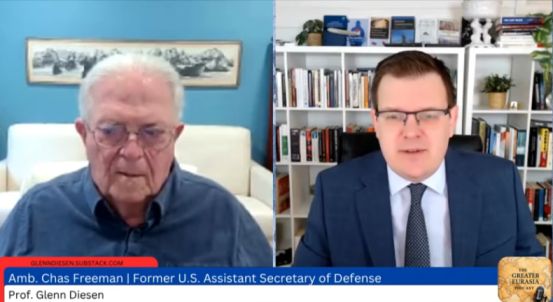
Editor’s Notes: In this episode, host Glenn Diesen is joined by veteran diplomat Chas Freeman to dissect the high-stakes 48-hour deadline recently issued by Donald Trump to Iran. Freeman, a former U.S. Ambassador to Saudi Arabia, provides a critical analysis of the current administration’s “maximum pressure” tactics and the potential for a catastrophic regional conflict. The discussion delves into the strategic miscalculations of initiating a war without clear objectives and the urgent need for a new security architecture in the Persian Gulf. Together, they explore whether recent efforts to de-escalate signal a genuine shift toward diplomacy or merely a temporary pause in a cycle of erratic policy-making. (Mar 23, 2026)
TRANSCRIPT:
Introduction
GLENN DIESEN: Welcome back. We are joined today by Chas Freeman, one of America’s great diplomats, who was the former US Assistant Secretary of Defense and also the US Ambassador to Saudi Arabia, among other positions. So thank you very much for taking the time.
CHAS FREEMAN: Good to be with you, Glenn.
Trump’s 48-Hour Ultimatum and the Iranian Response
GLENN DIESEN: So we saw two days ago Donald Trump gave his 48-hour deadline to the Iranians — that is, open the Strait of Hormuz, otherwise the US will destroy all of Iran’s energy infrastructure, beginning with its largest ones.
The Iranians responded by arguing, if you do this, we’re going to have our own list of targets to destroy — energy facilities, desalination plants across the Gulf states. And those 48 hours are almost over, and it looks as if Trump is making some efforts to walk this back. He’s arguing, since this announcement, they now had two days of good, productive discussions with Iran. However, the Iranian foreign minister just came out saying there has been no talks held at all.
I’m not sure which side is telling the truth, but the alternative to walking this back would have been war without any control. So I was wondering, how are you reading this situation? What do you see happening here?
Diplomacy vs. Force: Reading the Situation
CHAS FREEMAN: Well, I think Trump is trying to walk this back and I don’t believe there are talks going on. What appears to be happening is text messages between Stephen Witkoff and Foreign Minister Arakchi.
So you can draw several conclusions from this. The major one I draw is that the circumstances in West Asia were such that they convinced both Israel and Iran that the only answer to their conflict was the use of force and that diplomacy should not be implied. Ironically, Donald Trump agrees with that, but he’s now learning that diplomacy is irreplaceable.
In fact, the biggest issue here, probably from Trump’s point of view, is the price of energy — oil in particular, gasoline at the pump in the United States. I don’t think he cares much about the impact on allies or partners, even the producers who are being battered in the war. But he does care about the impact on his election prospects from gas prices.
And the biggest threat here that Iran made was they would totally close the Strait of Hormuz. At the moment, it is not closed. It is being operated like a toll booth on a highway — if you have the right license plate and are prepared to pay cash, you can get through.
Countries Employing Diplomacy
So we have quite a list of countries that have employed diplomacy to solve the basic problem, illustrating that diplomacy is not entirely a waste of time. These countries include China, India, Japan, and Turkey. And we know that the Italians and French have been talking behind the scenes also with Iran to try to work out a deal.
Escalation and Counterescalation
The second thing is that there is a clear pattern in this war in which escalation by Israel and the United States is met with counterescalation, tit for tat, by the Iranians.
The most recent and most frightening examples of this include an apparent American strike — the Israelis disclaim responsibility for it, but this war and any air war of this complexity has to be jointly choreographed. So the denial that this was coordinated with Israel falls flat. It’s clearly untrue anyway.
The attack on the Natanz uranium enrichment facility was answered by an Iranian missile striking just away from the research reactor in Israel at Dimona, and hitting apparently an apartment block where many of the people at Dimona worked — thus answering previous Israeli assassinations of Iranian nuclear scientists with the murder of, or the maiming at least of, Israeli nuclear scientists.
Iran’s List of Targets and the Gulf States
And I think, as you mentioned, Iran came out with its own list of specific targets. One of those was the Ras Al Khair desalination plant in Saudi Arabia, which is basically the sole water supply for the city of Riyadh, a city of some millions of people. In other words, Iran has demonstrated that it would be prepared in the end to utterly destroy the Gulf Arab societies.
I believe Kuwait is 90% dependent on desalinated water, Saudi Arabia about 70%. I don’t know the figure for Qatar, but it must also be very large. And I believe it’s about 40% for the United Arab Emirates. So Iran has just indicated that it is prepared ultimately to just destroy these countries, completely depopulate them.
One can be fairly sure that behind the scenes, these countries remonstrated with Mr. Trump, arguing, as they have from the beginning of this whole crisis, that there should not be a war, that there should be diplomacy, that there should be dialogue.
The Deadlock: Neither Israel nor Iran Ready for Diplomacy
But the problem is that neither Israel nor Iran — both of which feel an existential threat from the other — are prepared to enter a diplomatic dialogue or stop short of the annihilation of the power of the other.
In the case of Israel, it has not reacted publicly, as far as I know, to the Trump suspension for five days of his proposed attack on Iranian power plants.
In the case of Iran, it is clear that Iran does not see its objectives fully achieved. It wants to do much further damage to Israel. It apparently has the capability to do that. It is undoubtedly behind the scenes talking to the Gulf Arabs about a plan for the future which would not have American bases present in the Persian Gulf.
Diplomatic Channels and Iran’s Conditions
Here, if I may — it appears that the Iranian embassy in Riyadh and the one in Doha are both functionally closed, that is, have no personnel of consequence left. At least that’s the appearance. But of course, I don’t know whether the Saudi embassy in Tehran or the Qatari embassy in Tehran have been closed. I suppose they probably have been, but there are many other locales for a confidential dialogue that must be going on.
Iran is not going to stop the war while its objective of removing American bases threatening from the Persian Gulf is unmet. It is not going to stop the war when it has not taught Israel a lesson that is sufficient to deter future Israeli attack. And it is not going to demonstrate weakness to its own public by publicly acknowledging an exchange of views with the Trump administration.
A War Without Strategy or Vision
So there we are. We’re left with a war that, as has been said by others, has only tactics and no strategy, power and no purpose, violence without any vision, and an absence of any credible scenario for ending the conflict. This is a war that is its own justification. The basic premises on which it was started are all entirely and demonstrably false.
It appears to have put the final nail in the coffin of the Atlantic Alliance. So those of us who felt at the outset that this was a potentially momentous strategic error, I think, are being proven right.
Europe’s Response: Still Playing the Same Song?
GLENN DIESEN: Yeah, I’m a bit surprised — well, not surprised by the responses from the Europeans. I thought that after Greenland, they would be a bit more assertive. But listening to Mark Rutte, it appears that they’re still playing the same song. I was wondering—
CHAS FREEMAN: Well, if I may interrupt you — he is still talking to his daddy in the White House. Other Europeans are not. There is a serious move now in Spain to depart NATO and ban American bases. In your neighboring country of Sweden, there have been large demonstrations, even though Sweden is a new member of NATO.
I think we’re beginning to see the unraveling, but we haven’t seen it go its full course. And I think Mark Rutte is not faithfully reflecting the emerging attitudes of the members of NATO.
The Gulf States, Europe, and the Declining Hegemon
GLENN DIESEN: Well, the situation of the Europeans does appear to have some similarity with the Gulf Arabs — that is, if we want to find a possible solution to this. Because it seems as if they know that tying their security entirely 100% to a declining empire is not a good strategy.
The Gulf states are recognizing this. The Europeans are coming to terms with this as well. And it’s not as if the US is only in decline and still wants to hold on — that is one thing. But the US has signaled very clearly with the new security strategy that if it is a multipolar world, if we can’t be everywhere, then we have to make priorities. And the priorities should be the Western hemisphere and East Asia — we want to get out of Europe.
So if it’s a declining hegemon clearly stating you are no longer a priority, you can have J.D. Vance telling the Europeans to their face that we don’t need vassals, we need partners — they’re not a force amplifier. At some point you would think a strategy would have to be developed.
It just seems that much like the Gulf states, it is the same in Europe — there’s no strategy, there’s no political imagination really for anything else. So they’re just kind of reacting a bit. But I’m not seeing any grand strategy in terms of how the relationship with the US should be readjusted to adapt to this new world.
Because the Europeans are a bit either one way or the other — they’re either completely subordinated to the US or they begin to embrace this anti-Americanism. But there’s nothing in between, like where we just find a different relationship. I wish there would be more of this, because it’s either love or hate — there’s nothing normal.
And I’m wondering if the Gulf states can move in a different direction as well, because the US doesn’t want to be tied down in the Middle East either, if it wants to pivot to other places.
The Gulf States’ Dilemma and European Confusion
CHAS FREEMAN: Well, several comments about that. First, obviously there are completely different concepts of what the Atlantic alliance means in Washington and in European capitals. Europeans believe it’s to defend them, and Americans believe it’s to incorporate Europeans as auxiliaries in expeditions elsewhere, beginning with the severing of Kosovo from Serbia and then continuing the intervention in Afghanistan by NATO, which is either a defensive alliance or it’s not. And one of the great issues for European security architecture is the Russian conclusion that it is not a defensive alliance, but an offensive one. So that’s the first problem. The conceptual basis that used to unite the two sides of the Atlantic is no longer there.
Second, yes, I agree. The Gulf states have no way out of this dilemma other than diplomacy, which means some accommodation of Iran, which means some further distancing from the United States. And then the question is, since that seems to be what the most likely outcome is. Of course, for the time being, the Gulf states cleave to the United States because they have no other alternative. But they can’t publicly identify with an Israeli American attack on Iran because Israel is totally unacceptable as a partner in any public way.
Privately, they may benefit from access to the police state technology that Israel has developed to oppress the Palestinians. Privately, they may despise the Palestinians. Publicly, they can’t afford to be aligned in any way with Israel, even against Iran, their hereditary enemy. Publicly, they can’t afford to abandon the Palestinian cause. So they are really between Iraq and a hard place or between Iran and a hard place.
And I think the Europeans are in a similar position, but much slower to realize it, for the simple reason that so far they are not being battered by missiles from an enemy. Now, of course, some of them are working on providing a justification to the Russians for reaching beyond the Ukraine and challenging the unity of NATO. But the Russians have so far played a very cautious game in those terms.
But the Europeans are facing not only a dilemma that the United States is weakening, but the United States, from the European point of view, and I must say from my own point of view, is behaving insanely. It is doing things that can’t possibly yield any benefit to it, which are utterly irrational, unpredictable, erratic, and counterproductive. And so it’s not just the weakening of the United States, but the policy chaos in Washington that threatens. Threatens Europe. And I think it will in time. Europeans will awaken to this.
I don’t know what to make of the French elections which took place. I gather the right did very well, except in Paris, where someone on the left was elected. But European politics remain confused and confusing, and there’s no consensus emerging that I can see at present.
Diplomacy’s Indispensability and the Iran Negotiations
So all those things are true. And in the middle of all this, if Trump has finally discovered the merits of maintaining a dialogue with Tehran, even if it’s under the table and not acknowledged by Tehran, even if it’s conducted by Steven Witkoff, whom the Iranians have every reason to distrust, even if it’s conducted by Trump, who everyone distrusts now, the Europeans are still arguing about whether to talk to Russia or not, which is quite remarkable. So I think all sorts of interesting things are happening here. But for me, as a retired diplomat, I find it interesting to see the indispensability of diplomacy once again illustrated in the ways that it is being illustrated.
I haven’t talked about the global implications of this, but we’ve talked about that before. I mean, we’re looking for a global economic recession. Clearly, the Trump administration has just advised Israel that the war is, “going to go on longer than planned,” and may extend till September, which means that whatever remaining munitions we have to expand will be expended, which means that we will be incapable of doing things on a global scale as we once were.
Even if transit through West Asia, which is essential for the United States to remain a global power — I mean, we have to have the ability to travel through that corridor in order to get from Asia to Europe — even if the arrival of the U.S. Marines near the Strait of Hormuz toward the end of this week is not a forecast of reenactment of Gallipoli on the northern shore of the Strait of Hormuz, but is instead directed at less formidable and more reasonable political targets. For example, Abu and the Lesser Tomb Islands, which are the focus of a territorial dispute between Iran and the United Arab Emirates. It seemed to me to be a more intelligent target for the Marines than Kharg Island, which is way up the Persian Gulf, requiring American forces to run a gauntlet to reach it. Unless Saudi Arabia provided a staging area, which I don’t think it will.
When Trump threatens to destroy the power plants in Iran, as he has, if not today, then five days from now, I think, and is met with a counter threat to do the same to Israel and the Gulf Arabs, plus taking out desalination plants that are essential for the survival of these countries, I think he undercuts any possibility of actual cooperation from them.
Listen to What He Says, Watch What He Does
Finally, on the subject of the retreat to the Western Hemisphere, there’s a Chinese expression, ting qi and guanxi xing — listen to what he says, but watch what he does. What Trump says is one thing. What he does is entirely a different thing. There’s no way starting a war with Iran can be made compatible with either a focus on the Western Hemisphere or a focus on China, which are the two visions that remain competing in the schizophrenic American political mind. So I think there’s no clarity.
The five days will go by. Perhaps Witkoff’s texting to Aragchi will meet with something other than a reiteration of Iranian terms, which are essentially reparations, compensation for the damage, no American military presence in the Persian Gulf, assurances — credible assurances — that Israel will not again either attack Iran itself or connive in arranging an American attack, and so forth.
There is a further element here, and that is a requirement for a security architecture in the Persian Gulf. Iran has put forward proposals, as have the Chinese and the Russians. I imagine that an organization like the Organization for Islamic Cooperation, formerly the Organization of the Islamic Conference, to which some 57 Muslim countries belong, including some with real political prestige, like Indonesia and Malaysia, that are not in the region, but involving Turkey, which is a very important potential player in arranging some kind of peace here. I could see the OIC organizing a conference among the regional parties, minus Israel, to compose a proposal for peace with an invitation, I would hope, to Israel, whatever remains of Israel, to participate in mutual peace building and economic development projects. But that may be too idealistic in a region which is famed, justly famed, for its cynicism.
Trump’s Maximum Pressure Strategy and Iranian Retaliation
GLENN DIESEN: Well, it appears that part of Trump’s calculation was assets in all conflicts, which is maximum pressure. We saw this with what happened with the South Pars, that is the world’s largest gas field, that the U.S. — well, Israel, but I assume with the full support of the United States — struck these gas fields. And then Trump came back more or less saying he wasn’t us. But don’t you dare to retaliate. So the idea was that the Iranians would essentially bow, without going up the escalation ladder with the U.S. But that’s not what happened. We saw this devastating retaliation by the Iranians against the Gulf Arab states.
So what do you think happens, though, if Trump decides to go through on his initial threats — that is, either in terms of attacking Iran’s energy infrastructure, or if these ground troops he’s preparing would actually be put into play to occupy Iranian territory? Because we heard from Iranians they can go after the energy infrastructure, the desalination plants, which you refer to. But this would break the backs of the Arab states — or sorry, the Gulf states — wouldn’t it?
Iran’s Strategy and the Path to Negotiation
CHAS FREEMAN: Yes, but here again, maximum pressure policies are basically power without purpose, tactics without strategy. They’re the definition of a war which can’t succeed. We have the example of North Korea, and that should have been a predictor of what Iranian reaction would be.
Iran is a proud civilizational state with influence far beyond its borders, and maybe a multi-ethnic state, but it is a coherent state, and its reaction to basically bluster, blackmail and bombing is predictable. Rather like North Korea. The only result of the policy toward North Korea was that North Korea developed a nuclear weapon with an ICBM to deliver it — multiple nuclear warheads capable of reaching the United States. Iran is headed in the same direction.
We don’t know. Iran denies that it fired a missile at Diego Garcia and claims that this was an Israeli false flag attack on Diego Garcia, probably intended to keep the British in the war on the side of the United States. Since Diego Garcia is their property — the United Nations and the international community believe it’s part of Mauritius anyway — whatever that one. Certainly Israel has been conducting a lot of false flag operations intended to embroil others in the war against Iran. So far without success. There have been no actual movements other than diplomatic by the Gulf Arab states in reaction.
But what this illustrates — whether it was a false flag firing of an IRBM at Diego Garcia or not — is that the murder of Ali Khamenei, the late Supreme Leader, and his replacement by his son has removed the ban on various weapons developments that the late leader insisted on. He was the main opponent of the development of nuclear weapons or other weapons of mass destruction. Let’s not forget that there are biological and chemical weapons in that category too. He was the main opponent of extending the range of Iranian missiles beyond 2,000–2,500 kilometers. These restraints are now gone.
Iran is not ceasing to produce missiles even in the middle of the war apparently. And there is no indication that, contrary to the assertions of Israel and the United States, its war-making capacity has been taken out. In fact, missiles continue to land in Israel. Drones continue to attack the Gulf Arabs, who are very vulnerable to those. The attacks on Israel often include combined ballistic missile and drone movements.
Clearly Iran can get through the three-layered Israeli ballistic missile or rocket defense, which starts with the Arrow at extra-atmospheric levels, then David’s Sling in the high atmosphere, and finally Iron Dome for slower objects closer to the ground. But it’s not effective. Look at the attack on Dimona. That is the most heavily defended site in Israel, and yet Iran was able to hit it with, I believe, two missiles. So if this is a war of attrition, it is not working out to the advantage of Israel and the United States.
When we talked some time ago, I think I described Iran’s strategy as resembling that of Muhammad Ali in the boxing ring — rope-a-dope: allow your opponent to exhaust itself by firing everything it can at you, and waiting for the right moment to retaliate in a decisive manner. That moment of decisive retaliation may be coming, but Iran has not yet reached it in its own judgment.
Let me just add one other point here, which gets back to the necessity of a diplomatic resolution of this issue and the very unlikely prospects for that at present. Israel has had a very clear policy, exemplified by its assassination of Ali Larijani, of eliminating anyone who would be a moderate potential diplomatic interlocutor on the Iranian side. Israel does not want negotiations, which is one of the reasons that it is so nervous when Trump claims there are negotiations — I think incorrectly.
But it is fairly typical of Trump to exaggerate and misportray things that are going on in such a way as to manipulate public opinion — in this case, manipulate markets. The capital markets, Wall Street in particular, or the FTSE in London, have taken Trump’s assurances that this would be a short victorious war seriously, despite all the evidence to the contrary. So the price of shares on these markets goes up and down in response to frankly delusional, or at least imaginative, if perhaps hallucinatory, claims by the Trump administration.
There’s no evidence to suggest it’s anywhere near an end, or that Iran has achieved the conditions it regards as essential to agree to end it.
Two Possible Outcomes
So what is the prospect? I think there are two prospects.
One is that eventually there will be a negotiation of some sort, in which case Israel will have to eat crow. It will not be able to sustain the narrative it has purveyed for decades of a menacing Iran and itself as victim. Israel has been an actual threat to Iran in multiple ways over this entire period. Iran has been at most a potential threat to Israel, very much on the defensive. Maybe Israel will have to acknowledge that. If there are negotiations, perhaps the United States and Israel will part company on the issue of Iran. That is not easy politically for Donald Trump, given his dependence on the Zionist lobby and Zionist plutocratic campaign donations.
The other possibility is that we subside to a level of lower intensity continuing conflict. In effect, that would be a return to the status quo ante, because there was a low intensity conflict going on between Iran and Israel, and to some extent Iran and the United States — exemplified by the murder of General Soleimani in the first Trump term, and by the several Israeli attacks on Iran in the second Trump administration, including the June war last year.
So perhaps we’ll go back to a situation where Israel is in constant danger — as Iran has been — of being attacked by its enemy: missiles coming out of nowhere, assassinations. Iran so far has not reciprocated Israel’s policy of assassination. Will that refusal to do that remain intact? We don’t know.
Of the two alternatives, it seems to me a negotiated solution is far preferable to low intensity conflict, probably accompanied by continued terrorism by both sides.
GLENN DIESEN: Well, the low intensity — this essentially would put it on the slow burner, allow it to stretch out over a longer period of time. It just seems that if it lowers intensity, this would give advantage to Iran, because it of course can keep the strait more or less closed, which means that the pain for the United States will keep growing.
CHAS FREEMAN: I think that would be a relatively short term closure. But then I return to the toll booth operation — a toll highway: do a deal, reach an understanding, hand me your ticket along with some cash and you can get through. That’s basically what’s been going on.
All this business about mining the Strait of Hormuz has no real evidence behind it. And the real question is why Iran would want to mine the Strait of Hormuz when it basically sees the ability to open it to selected parties as a point of diplomatic opportunity and leverage. So I’m not convinced that there has been mining, or if there has been mining, it’s probably on the shore closest to the UAE, leaving the shore closest to Iran unmanned anyway. We don’t know.
The only people in the world, by the way, with an adequate force of minesweepers to deal with this are the Japanese, who are not interested in going into a combat zone. They did come in at the end of the 1990–91 Gulf War — once the combat had ended, they provided the capability to remove the multiple mines that the Iraqi side had released in the Persian Gulf. The United States, very foolishly — the US Navy, I believe in January — actually got rid of four minesweepers, which in terms of force planning is amazingly stupid.
What Would a Negotiated Settlement Look Like?
GLENN DIESEN: Well, the Iranian stick — the selective opening — is an interesting strategy, because now of course they can get reparations from the Gulf states for the attack. They can demand the Gulf states pay for access, essentially taxing them. They can demand the Gulf states decouple or expel US bases. They can demand selling in a different currency. So it does open up a lot of opportunities.
And the Iranians themselves claim they didn’t mine anything, but that they might do so if the US sends in ground troops — then out of necessity. But at the moment, it doesn’t make any sense.
In terms of the negotiated settlement, though, I was just wondering: where do you see the common meeting point? Because so far the US more or less demands Iran’s capitulation, while Iran wants US bases out of the region. I’m just thinking — if the US wants to pivot out of the region anyway, it could be an opportunity. But they don’t want to hand over leadership to Iran, obviously, and that seems fair enough.
But what could a middle ground look like? A new security architecture which allows the US to reduce its troops, that reduces the threat to Iran, but still doesn’t make Iran a regional hegemon or anything like this. Because if you look at what’s happening in Iraq, it looks as if in some places the Western troops are being pushed out anyway. So how do you see it — if there is a negotiated settlement, what is there to negotiate?
Iran’s Strategic Cards and Regional Security Architecture
CHAS FREEMAN: Well, that’s a very good question, of course, but before I address it, let me just mention that Iran has another card to play potentially by activating its relationship with the Houthis in Yemen to close the other sea corridor through which Saudi Arabia is exporting — the Bab-el-Mandeb — so it can shut down the only remaining oil that is basically coming out of the Arabian Peninsula, which is Saudi oil going out through Yanbu on the Red Sea.
As far as a reasonable settlement is concerned, I have no idea what’s in the mind of the Iranian leadership. It’s a new leadership, it’s not the old one. Araghchi is there. He’s obviously very capable as a diplomat. But it’s not clear to me — it seems to me that you need to have a conjunction of two things.
One, you have to have the kind of addressing of regional security architecture by people in the region that I suggested the Organization of Islamic Cooperation — OIC — might be able to convene. In other words, a plan for post-war order, even if it can’t be implemented immediately. That plan might include a progressive withdrawal of US forces, not an immediate one — that is designed to not humiliate the United States, but to remove the threat to Iran. It could include joint patrols between the Iranians and the Gulf Arabs. It might include — and Iran has actually proposed this — a regional management system for collecting the tolls in the Strait of Hormuz. That is, there would be a common commitment among countries in the region to keep the Strait of Hormuz open in return for benefits that would be shared.
Iran seems to be thinking about the post-war order in fairly constructive terms. If you are only looking at the interests of the Gulf Arabs, none of this would be a delight to the United States or to Israel. On the other hand, as you suggested, if in fact the United States is serious about pivoting away from the Middle East, away from West Asia, toward East Asia and the Western Hemisphere, this would facilitate that.
So you ask, what’s in it for everyone to have peace? I think clever diplomats could figure out some ways of achieving it, but that requires clever diplomats. There is no evidence of any such in our arsenal of diplomacy — the American arsenal. There’s plenty of evidence of strategic thinking in Israel and in Iran. I’m not sure how much there is in the Gulf Arabs. And the Gulf Arabs, as I mentioned earlier, are obviously quite justifiably furious with Iran for the beating that they’re taking, and very fearful, and also very dismissive now of the United States as a protector — because clearly the United States no longer has the ability, does not have the will, and doesn’t set priority on protecting them. It seeks to protect Israel and it can’t even do that, apparently.
The Information War and Israel’s Domestic Situation
I think I should close by saying that, as usual, the physical war is accompanied by an information war. Israeli military censorship, with few exceptions, is very effective and, with few exceptions to their discredit, is respected by Western journalists. So we have a lot of information about physical damage in Iran. We have a lot of information about physical damage in Lebanon. We have some information about the ferocity of the ethnic cleansing campaign unfolding in the West Bank. But we have almost no information about the actual physical and human damage of Iranian attacks on Israel.
Israel obviously is concerned about more than its physical protection — about the morale of its people who remain. Polling data suggests they are ardently supportive of the war, probably in part because they don’t understand actually what’s happening. I note that Ben Gurion Airport, the international airport in Israel, has now had a severe flight reduction imposed on it by the Israeli Ministry of Transportation in order to safeguard lives, the minister says. But this also cuts off emigration from Israel. If there can be no more than 50 passengers per plane, which is apparent, and the number of flights is limited, this bottles up a lot of Israelis.
And again, I think the Iranian calculus is that a settler colony will have a bolt hole for most of the settlers. And the settlers may be thinking about using their Spanish or Portuguese passports or German passports to get out and not come back. Because if coming back means that you’re going to face low-intensity conflict — more of the same — why would you want to come back? And of course, we don’t know what the level of emigration is during this war because that too is off limits for reporters. So we’re missing a key element here in evaluating the battle damage of the war.
Trump’s “Word Salad” of War Objectives
What we have, however, are clear indications of intent. And to go back to how the war might end — Donald Trump has offered an entire word salad, a smorgasbord of purposes for this war. Why not choose the pickled herring instead of the pickled radishes, or the lox? I gather, by the way, that “lox” is the oldest surviving word in the Indo-European language family. So Norway is at the center of the world in that sense.
Anyway, my point is that Trump is in a position to pick and choose. He obviously failed in a number of things. No regime change, no state collapse — that’s the Israeli objective, not the American one. No end to nuclear programs. In fact, their acceleration. A much wider danger of proliferation — as Iran goes nuclear, one might expect others: Saudi Arabia, Turkey, Egypt in the region, and others farther afield like Japan and South Korea to go nuclear. So the danger of nuclear war is likely to go up. The efficacy of the American nuclear deterrent is likely to be devalued — and that’s even if the Germans don’t go nuclear, which some in southern Germany are talking about.
So I think he can choose another objective. Physical damage. “We have knocked Iran for a loop. We have done basic damage to the Iranian economy.” Here, of course, the great irony is that Iran’s objective — one of them — was relief from sanctions. And the Treasury Secretary has just lifted the sanctions on Iranian oil exports. Bingo. For Iran. So I think, anyway, Trump is very inventive when it comes to finding ways to chicken out of situations that he’s created.
Saudi Arabia’s Dilemma: Vengeance vs. Strategic Thinking
GLENN DIESEN: You were the US Ambassador to Saudi Arabia. How do you see the thinking there at the moment? Because you get some impression they might be going both ways. On one hand, this whole experience convinces them they have to link themselves closer to the US. On the other hand, they also recognize that they have to decouple — not fully decouple, but at least reduce dependence — and the relationship with Iran has to change as well. So how do you see what is going on in Saudi Arabia?
CHAS FREEMAN: Well, I’m not there, and I would suspect that there are two reactions. One very short term, which is: “Let’s cooperate with Pakistan and exact retribution. Let’s get even with Iran.” And so they must be in a very vengeful mood in the short term. More thoughtful Saudis — and there are such people who think long term — probably are concluding that they must compose their differences with Iran on the diplomatic level in order to eliminate the threat.
They instinctively know what Abraham Lincoln said: that when you befriend an enemy, you gain a friend and lose an enemy. And that is the appropriate answer. Threat reduction is a primary task of diplomacy. And they had begun to try this. They have abandoned it now for the short term, clearly. I think they’ll return to it.
But they face a difficulty which they recognize. About 20-some years ago, I gave a talk called “The Arabs Take a Chinese Wife,” in which I pointed out that while they were kind of tired of the United States, they were too big, in fact, to throw out of the bed, but that Muslims could take more than one wife and that this was what was going to happen. And I think this is very likely the future. And it means — I’m not speaking solely about the Chinese — it means finding other friends and doing something very important. That is the focus of the Saudi-Pakistani defense pact, which is: build your own military industries so you don’t have to buy weapons from the United States or another demonstrably unreliable partner.
You can buy weapons from China, but they don’t come with a security guarantee attached. And if you buy them from the United States, the claim that they come with a security guarantee has been a major factor in making them attractive. That is now gone. So I suspect this is not good for US arms sales in any sense. Not only have the defensive mechanisms, the interception capabilities, proven inadequate and much less than is claimed, but the security guarantee that made them attractive is not there anymore.
So I think the answer is: in the short term, vengeance. There’s an Arab proverb — “Kiss the hand you cannot bite” — but I think in the long run, they will kiss the hand that bit them, at the instance of the United States. Let us remember that Saudi Arabia and other Gulf Arabs, including the UAE, apparently were trying very, very hard to persuade the United States not to accede to Israeli pressure to start this war. They knew, even if Donald Trump did not, what the likely result of the war would be in terms of disruption of their political economies and pressure on them and physical damage to them.
I saw an interview with the former intelligence chief of Saudi Arabia, Prince Turki al-Faisal, the other day, in which Christiane Amanpour asked him whether he was surprised by the Iranian attacks on the Gulf Arabs. And he said no — “They said they would do that. We’re only surprised that the United States took the action it did that produced this result.” So the more thoughtful people in Saudi Arabia clearly are thinking strategically, not just tactically, about how to deal with the new circumstances in the Gulf.
Long answer to your simple question — I apologize.
Can Trump Find a Way Out?
GLENN DIESEN: Well, let’s hope — even though it seems unlikely — that there will be some negotiations. So far, Trump’s claim that they are reaching in the negotiations seems to be not true. But at least we should take some reassurance that there is effort to walk this back, because this is really spiraling very quickly out of control.
CHAS FREEMAN: Well, the hopeful note is that Donald Trump may be in the process of discovering the utility of diplomacy rather than the use of force. But then one is never sure where his mind is. And I do not think that Stephen Witkoff is a credible interlocutor at this point, given his past involvement in deception and his inability to deliver Donald Trump into the agreements that he apparently hinted at — or perhaps even reached — at the negotiating table with his Iranian counterparts.
GLENN DIESEN: That’s my concern, though. Once Trump discovers the value of diplomacy, it’s going to be difficult — after what was done to the JCPOA and then two surprise attacks — there will be some trust issues.
CHAS FREEMAN: Yeah, well, that’s why I don’t think the Iranians are going to stop until they feel that they have the United States basically where they want us to be. And it’s clear that Donald Trump — even if he never recognizes mistakes that he makes — understands this is not going well, on multiple levels, and is concerned probably primarily about the domestic political impact. As I talked about a little, the price of gasoline at the pump. But there’s also the fact that the MAGA movement has split on this. His own backers are now splintering. Increasingly, there are polls that show that the vast majority of voters for Donald Trump — something like 70% of them — favor an immediate end of the war. They don’t approve of this war.
So I go back to the point that it was foolish to start a war that was authorized by Benjamin Netanyahu, not the United States Congress, as the Constitution demands. It was foolish to start a war with no clear objectives and no war termination strategy. And here we are in the midst of this foolishness. And the man who got us into it, Donald Trump, has got to now find a way out — for himself, for our country, for the world, for the participants in the region. Whether he’s up to it or not, we shall see.
GLENN DIESEN: Well, thank you for taking the time, and as always, really appreciate your insights.
CHAS FREEMAN: Thank you, Glenn.
Related Posts
- Transcript of Manish Tewari Interview: ANI Podcast with Smita Prakash
- Transcript of Annie Jacobsen Interview: Biological Warfare on Shawn Ryan Show #323
- Transcript: Mayor Mamdani Interview on Weekly Show
- Transcript: Tucker Interviews Dr. Chris Martenson on Global Energy Crisis
- Transcript of Arnab Ray Interview: ANI Podcast with Smita Prakash #EP-433