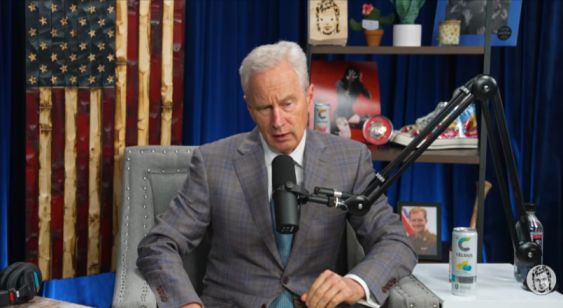
Editor’s Notes: In this episode of This Past Weekend, Theo Von sits down with renowned cardiologist and internal medicine specialist Dr. Peter McCullough for an in-depth conversation on the complexities of modern medicine. Dr. McCullough, a leading voice in investigating the global response to COVID-19, shares his insights on controversial topics like “Disease X,” the bio-pharmaceutical complex, and the importance of early treatment protocols. Together, they explore the intersection of public health, government policy, and the challenges of speaking against the grain in an era of intense medical groupthink.(Mar 19, 2026)
TRANSCRIPT:
Introduction
THEO VON: Just a reminder that tickets for Busboys, the movie with myself and David Spade are on sale right now. Pre sale tickets, you can get them. It’s in theaters April 17, but if you get tickets now, it’ll show the movie theaters that we’re going to sell them or that they are selling and then we can expand to more theaters. So if you know when you’re going to go and you can support, that would be great and no pressure, if you can’t. Again, the presale tickets are available. Busboys, movie.com. I’m excited. Thank you.
Today’s guest is a physician. He’s a cardiologist, he’s an author, he’s a professor. He was the vice chief of internal medicine at Baylor University Medical Center. He later became known for his investigations into the COVID-19 response. Here in America, we’re looking forward to spending time with today’s guest, Dr. Peter McCullough. And you can move this any way you want. If you decide you’re end up moving over here, you can just move the mic over there.
DR. PETER MCCULLOUGH: I don’t have the type of voice you have. Get that D voice.
THEO VON: We’ll make sure, we’ll let you know.
DR. PETER MCCULLOUGH: Okay.
THEO VON: Yeah. You kind of that whisperer, huh, man? Well, you like to whisper.
DR. PETER MCCULLOUGH: I was recently in the UK and this woman who’s an actress got up and everyone was shouting at the microphone, making their things, myself included. Shocking. She got up and she started whispering and everyone paid attention.
THEO VON: Yeah, that’s a whisper and that’s why it’s a lost art.
DR. PETER MCCULLOUGH: Yeah.
The Power of Whispering and Perceived Intelligence
THEO VON: But really the value when everything is so high, you have to think that if you come in at another intonation, if you come in at another level and you have to find an alternate route into people’s brains and hearts and stuff and yeah, whispering. Gosh, if we had just like Whisper Tuesdays where everybody just whispered.
DR. PETER MCCULLOUGH: There was a doctor at Stanford back when I was accepted in academia. His name is Glenn Shurtow. And when he spoke, it was so careful and he talked like this. And I remember the sponsors of a big meeting. I was at the National Institutes of Health. I said, what is it about Glenn Shurtow? He seems to be getting all the attention. They said he appears wise. He has the appearance of wisdom, the way he speaks. He may not be wise, but he appears wise. The other thing that helps you that you and I don’t have. Oh, he brought him up. There’s Glenn right there.
THEO VON: There he is. Beautiful.
DR. PETER MCCULLOUGH: Are we going to bring people thinking up on the screen?
THEO VON: We can oh, this is going to
DR. PETER MCCULLOUGH: be so much fun. Oh, yeah. But anyhow, the one thing that my Uncle Ivan taught me is that you can double your perceived intelligence with a British accent.
THEO VON: Really?
DR. PETER MCCULLOUGH: Oh, yeah. You get a British accent, they think you’re twice as smart as you used to be. Twice as smart.
THEO VON: I feel like, oh, if I meet a British girl, I’m like, oh, tell me everything. I feel like they just know everything.
DR. PETER MCCULLOUGH: Yes. And read me a book. Mom, have you ever read that book Culture Code?
THEO VON: Culture Code? No.
The Culture Code
DR. PETER MCCULLOUGH: It’s about what’s your first impression? And he did focus groups. It’s very scientifically, very solid. He said, when you meet a British person, what’s the first word that comes into your mind?
THEO VON: G’day. Oh, that’s Australian. Oh, you.
DR. PETER MCCULLOUGH: You almost got it with that girl. Classy.
THEO VON: Classy.
DR. PETER MCCULLOUGH: So if you’re going to advertise something to the British, you have to show somebody playing polo and it has to be classy.
THEO VON: Yes. Just finishing a biscuit, you know.
DR. PETER MCCULLOUGH: Right. So how about Italian? What’s the first thing you think about when you say, hey, you know, Italian? First thing the culture code says artiste. So you have to, Michelangelo, you have to portray things artistic, what have you. How about American? Now, if you just do this globally, the conclusion is out of this world. So you want to advertise an American, like, you know, landing on the moon or just doing something completely, you know, Elon Musk, you know, just jetting somewhere.
THEO VON: Yeah. Just knocking up people and just blasting rockets into people and in the space.
DR. PETER MCCULLOUGH: So culture code is a code of advertising. And what he said is, if you break the code, if you try to advertise something that goes against what people are thinking, your product is going to bomb out. So what’s the culture code word for nurse? Nurse. What’s the first thing that comes to your mind?
THEO VON: Helpful.
DR. PETER MCCULLOUGH: Close. Mother. So you always want to show a nurse holding a baby. What’s the culture code for doctor?
THEO VON: Information?
DR. PETER MCCULLOUGH: Hero.
THEO VON: Hero.
DR. PETER MCCULLOUGH: Hero. You know, hero going to save your life.
THEO VON: Safety.
DR. PETER MCCULLOUGH: Death trap. Death trap. And he interviewed hundreds and hundreds of people, did these focus groups.
THEO VON: Culture Code.
DR. PETER MCCULLOUGH: Culture Code. It’s a great book. It’s a quick read. And in your business, you’d want to, I guess, kind of be in tune with the code.
THEO VON: Yeah, I think there’s some codes that you pick up on people they don’t realize, you know. But yeah, no, I think that’s interesting. Just people that are able to examine that, like how people operate and how we perceive certain things. And you’re a guy that’s kind of like, I guess you, the way you’ve operated has kind of changed over the past few years. Maybe. I know it’s certainly like grown in perception. Like your ability to reach people has grown. Yes. You are a physician scientist, is that correct?
DR. PETER MCCULLOUGH: Yes.
THEO VON: Okay. And what exactly does that term mean?
Dr. McCullough as a Physician Scientist
DR. PETER MCCULLOUGH: That means I practice medicine and I see and examine patients every day. Board certified in internal medicine and cardiology by the National Board of Physicians and Surgeons.
THEO VON: So also a cardiologist.
DR. PETER MCCULLOUGH: And a cardiologist. But I’m also a scientist, meaning I evaluate new concepts, I develop hypotheses, I use the scientific method, and I conduct studies, case reviews, literature reviews, analyze data, formulate an analysis, and then come up with opinions. And through that method, I’m one of the most published doctors in the world, and certainly the most published in my field previously, which was heart and kidney disease.
So I came into the pandemic locked and loaded. In 2007, I had testified before the congressional oversight panel for the FDA. I had lectured at the European Medicine Association, New York Academy of Sciences, lectured widely at virtually every major medical school in the United States, published seminal papers.
But when the pandemic hit, what I saw within the first few months is no one was going to the problem. No one was, you know, when there’s a fire or a catastrophe, let’s say 9/11 and the building is burning, most people ran this way. But some of these first responders, they ran right into it. I found myself in the same mode.
First few weeks, I said, well, surely Harvard will tell us what to do, or the Mayo Clinic, or maybe the US Government. Usually the government on medical things is a laggard. They’re not a leader. So if we had a new cancer problem, we wouldn’t say, well, what does the government say? The government is behind. Academia got it.
Within a few months of being into the pandemic, I said, listen, I need to do my part. I know other doctors in the hospital are doing their part. And I devised the first treatment protocol of how to treat high risk patients. We’re talking elderly patients, patients with heart disease, lung disease, kidney disease at home with very intensive therapies and oxygen at home to avoid two bad outcomes, hospitalization and death. And that became copyrighted as the McCullough Protocol, published in the American Journal of Medicine in 2020.
Immediately I was called before the US Senate. I appeared November 19, 2020. And so the Association of American Physician and Surgeons, a leading doctors group, did pick up the McCullough Protocol. It became standard of care and the principles were used.
The McCullough Protocol
THEO VON: It became standard of care when? Because it was…
DR. PETER MCCULLOUGH: No, it became early standard of care in 2020 for high risk patients. We immediately organized telemedicine units and it was the McCullough Protocol that kept the hospitalizations down. Remember, there were projections that we were going to overrun our hospitals.
THEO VON: Oh yeah, they were like emailing people like, do you have a place we can put bodies at your house?
DR. PETER MCCULLOUGH: I had patients in their 90s with pacemakers and heart failure. And we got going early with the McCullough Protocol. We start with getting fresh air, nasal sprays and gargles, nutraceuticals. They all played small roles initially. The first year we used hydroxychloroquine as our antiviral and antibiotics and other drugs. Second year, ivermectin, and then third year we actually used Paxlovid. Came in in the third year, molnupiravir. We used those drugs.
But I have to tell you, the winner was ivermectin for sure, for sure. But I think corticosteroids, prednisone played a huge role. Anti-inflammatory drug called colchicine we use widely today. And then antithrombotics.
THEO VON: What was the McCullough Protocol? Like what went into it? Like, what were you basically advocating for people?
DR. PETER MCCULLOUGH: I was saying that if we got behind on this illness, it was becoming clear we can’t start treating when people are sick enough to go in the hospital. Virtually every death occurred in the hospital. So McCullough Protocol said there’s two bad outcomes, hospitalization and death. And if we can treat up front and never go in the hospital, we’ll get through the illness.
Now, I did an artificial intelligence search recently, which is a great use of AI, and I asked AI, “Tell me what percent of the world’s population contracted Covid.” And it searched every single database and what have you. And the number it came up with was 90%.
THEO VON: Wow.
AI, Bias, and Dr. McCullough’s Public Profile
DR. PETER MCCULLOUGH: Now the pre-programmed bias that’s still left in AI is promotional of pandemic fear, which you’re still at risk promoting vaccines and doing everything it can to tell people they have no other options. It’s pre-programmed. So if you go to Grok, is that true? That’s true. Let me give you an example.
THEO VON: Okay.
DR. PETER MCCULLOUGH: If you go to Grok and you say, “Who’s Dr. Peter McCullough?” It’ll say, “Well, Dr. McCullough is a cardiologist.” And it’ll go on and on. It’ll say, “But he’s a conspiracy theorist and he lost his board certifications.” It’ll start saying all these things. I said, “Listen, just say who it is. Don’t put in any defamatory comments. Just give the straight facts.” Then it’ll actually give a straight answer. So Grok will tell you, I’m the most published person on the pandemic period in the world.
THEO VON: Okay.
DR. PETER MCCULLOUGH: And so if you actually tell Grok, “Stop all the BS,” it’ll do it. With Alter AI, you don’t have to do that. So at McCullough Foundation, I started the foundation, we formed a relationship with Alter AI and we pay for it. And we get a clean feed. But I think even Copilot will come up with “formerly practicing.” No, I’m in practice. I just saw patients yesterday. I mean, look at it. It just goes on and on.
THEO VON: Dr. Peter McCullough. Yeah. “Formerly practicing as a cardiologist and internist.”
DR. PETER MCCULLOUGH: Wrong, because I’m practicing today.
THEO VON: “He’s highly published in medical literature, over a thousand publications cited tens of thousands of times. Became widely known during the COVID-19 pandemic for his early advocacy of outpatient treatment protocols, including controversial early use approaches, and for his strong public criticisms of COVID-19 vaccines.”
DR. PETER MCCULLOUGH: Yeah, okay, well, this seems it’s getting there. Think about artificial intelligence, which I think is a huge advance, by the way. I’m using it in my practice every day now. Huge advance.
THEO VON: “One more thing here. His views on COVID-19 vaccines and related topics have been heavily criticized by mainstream medical organizations, fact checkers, and sources like factcheck.org, which describe many of his claims as misinformation or unsupported.”
DR. PETER MCCULLOUGH: Do you know not a single medical organization has reached out to me even for a discussion. And factcheck.org? That’s not a medical organization.
THEO VON: No idea what that is.
The Medical Industrial Complex and Disease X
DR. PETER MCCULLOUGH: So the idea is, let’s say a medical organization said, let’s have a discussion about COVID vaccine complications. Not a single one. There hasn’t been a single medical school in the United States that’s even had a grand rounds on this, let alone invite me to present grand rounds.
THEO VON: Why do you think that is that they haven’t reached out to you to have a conversation?
DR. PETER MCCULLOUGH: They haven’t reached out to anybody.
THEO VON: Okay.
DR. PETER MCCULLOUGH: There is a tremendous willful blindness to what’s gone on through the pandemic. There has been no review of lessons learned. What did we learn from the pandemic?
THEO VON: I agree. It’s so wild how so much information was every day. It was this, this. Go here, get a booster. If you can’t get a vaccine, hang your family member out of a window. We’ll have an archer come by with a vaccine. Like from Pfizer. Yeah, it was like we can, you know, we’ll vaccine them from the road or whatever. It’s like it was getting crazy. But yeah, it’s kind of wild how afterwards there hasn’t been as much like, “Hey, these are the things we learned. This is what we’ve learned as a society.”
DR. PETER MCCULLOUGH: Well, we’re told over and over again there’s going to be another one. It’s called Disease X. It’s going to come out of another biolab.
THEO VON: Sh, it’s going to come out of Miami, I’ll tell you that.
DR. PETER MCCULLOUGH: Or Galveston, Texas. They got a BSL4 lab there.
THEO VON: Do they?
DR. PETER MCCULLOUGH: Oh, no.
THEO VON: BBLS over in Miami?
DR. PETER MCCULLOUGH: No.
THEO VON: Is it really?
DR. PETER MCCULLOUGH: They’re dealing with some bad stuff down there.
THEO VON: Okay, but I want to go back and talk about that in a second. Wait, so this is it right here, defining Disease X.
DR. PETER MCCULLOUGH: Well, look at Bloomberg School of Public Health. Who’s the major funder of Bloomberg School of Public Health? Bill Gates.
THEO VON: Wow.
DR. PETER MCCULLOUGH: This is a dream. This is a dream of those who want to vaccinate the world. They want another Disease X.
THEO VON: Of course. It’s another industrial war complex. That’s what this is.
DR. PETER MCCULLOUGH: Well, you got it.
THEO VON: But it’s on your bodies. I do want to say this. And Bill might just be trying to solve whatever he was potentially giving his wife. I don’t know. That’s allegedly. But I will say this. I want to read this right here because you mentioned Disease X. I haven’t heard about it.
“Since 2018, the mysterious and often misrepresented hypothetical pathogen has been at the heart of international pandemic preparedness efforts.”
Just that sentence alone. When you look at that sentence, look how bullshit. Look how front loaded and vague it is. “Since 2018, this mysterious, often misrepresented hypothetical pathogen has been at the heart of international pandemic preparedness efforts.” Like, we’re so prepared for something that’s super vague. It’s just like you can feel it setting you up for something.
CEPI, Bill Gates, and the Pandemic Industrial Complex
DR. PETER MCCULLOUGH: Well, let’s go to CEPI, the Coalition for Epidemic Preparedness and Innovation. It’s founded in 2017 by the World Economic Forum and Bill Gates. And CEPI in its business plan in 2017 says there’s going to be a series of these pandemics, one after another coming in like hurricanes. And for each one there’ll be only one solution, mass vaccination.
And CEPI is a vaccine incubator. They’re going to be ready. Let me tell you, vaccines in pandemics is big business. Way more than pro sports, way more than anything else you can think of. It’s huge business.
And in this world, we don’t hear about other forms in this industrial complex now, other things outside of biological threats, and then countermeasures, which is a military term, which are vaccines, therapeutics and protective equipment. But the idea is these are so richly funded. They’re so richly funded that the entity that holds the threat and holds the antidote, they hold power.
Can you imagine the negotiating power you would have if you said, “Hey listen, I got Covid 20 locked and loaded right now at an undisclosed location, can get the whole country sick. We want a little better tariff situation.” Can you imagine the negotiating power?
And Peter Daszak, who’s part of this whole conspiracy to create SARS-CoV-2, when he testified in the House of Representatives, he said, “I left a whole bunch of samples back in Wuhan.”
THEO VON: I’m confused. What was he doing there?
DR. PETER MCCULLOUGH: Peter Daszak was the go-between between Dr. Ralph Baric at University of North Carolina Chapel Hill, who devised the virus and was publishing on it, and the federal government. Daszak was at the EcoHealth Alliance. It’s a go-between organization that was shuttling money for Baric’s projects over to Wuhan. Daszak had been to Wuhan many, many times. He knew that lab well.
THEO VON: To create the virus, you mean?
DR. PETER MCCULLOUGH: Correct.
THEO VON: Understood. Okay, let’s back up one second. I just want to look at CEPI — who created CEPI. Bring that back up.
DR. PETER MCCULLOUGH: CEPI was the World Economic Forum and the Gates Foundation. You’ll find, I think the government of Germany and India, I believe, was involved as well. But this is a richly funded, multi-billion dollar organization. You just can’t imagine how big these—
THEO VON: Oh, I can totally. You know, you look at the industrial war complex, now you start to see it’s the industrial medical complex. That’s the new one that really seems like it’s sprouted over the past 20 years.
DR. PETER MCCULLOUGH: Correct.
THEO VON: Right here. CEPI is the Coalition for Epidemic Preparedness Innovations. A global organization focused on accelerating vaccine development. Okay, sorry. It was created in 2017 through a partnership between the governments of Norway and India, the Wellcome Trust, and the Bill and Melinda Gates Foundation.
DR. PETER MCCULLOUGH: Yep.
THEO VON: And go back to Disease X. I want to just read what it was really quick.
DR. PETER MCCULLOUGH: By the way, CEPI’s got a big Disease X section. They have a whole white paper on it.
THEO VON: Wow. “Disease X is a placeholder concept that refers to a pandemic pathogen that has not yet been characterized.” How vague is that? Like, hey, it exists, but we don’t know what it is exactly yet.
DR. PETER MCCULLOUGH: But we have a vaccine for it.
THEO VON: “Its purpose is to encourage proactive thinking about pathogens that could cause a pandemic.” Oh, so Disease X isn’t an actual disease. It’s a plan.
COVID-19 as a Planned Event
DR. PETER MCCULLOUGH: It’s a plan for a disease. So Disease X was SARS-CoV-2. It was a planned disease. And here we are. It was a plan.
And you know my first book, Courage to Face COVID-19, we expose CEPI and what we call a biopharmaceutical complex. You called it a bioindustrial complex. Same thing. But there has been a cartel that’s formed. It’s very powerful. Probably back 2004 is probably when it started with the BioShield Act.
But it includes the World Health Organization, World Economic Forum, Gates Foundation, Wellcome Trust, the Rockefeller Foundation, CEPI, GAVI, UNITAID, all these organizations, all organized to essentially plan for, create pandemics and then respond to them. And that’s how COVID-19 — ultimately, it’s essentially known now — this was not a spontaneous thing from nature. This was planned.
THEO VON: What’s the number one piece of evidence that makes you feel like it’s known that it was planned?
DR. PETER MCCULLOUGH: Well, I think the best source of all of the evidence is Peter Breggin’s book, COVID-19 and the Global Predators: We Are the Prey. I wrote the introduction for it. But he goes back again to about 2004, the BioShield Act, where he outlines 36 pandemic preparedness planning events. 36 historically. He’s got a wonderful timeline, and of those, two dozen provide written documents. You can just read them.
Including one of them is the PREP Act in 2005, which says there will be a pandemic and we will have one. 2005. That was the Bush administration. HHS said, “Listen, we’re going to have one, and when we do, we’re going to have countermeasures. And when we roll out these countermeasures, you better take one.” And there is a complete freedom of liability. But 24 of them provide written evidence and then six of them are filmed. You could just go watch them.
THEO VON: So is he kind of a whistleblower? Do you feel like, or—
DR. PETER MCCULLOUGH: He was a whistleblower back in the days where essentially Prozac wiped out consultative counseling psychiatry overnight. He wrote the book Talking Back to Prozac.
The Biopharmaceutical Complex
DR. PETER MCCULLOUGH: But COVID-19 and the Global Predators has the best timeline. Now, Robert F. Kennedy wrote a book about The Real Anthony Fauci. He’s got a timeline in it too. Our book, Courage to Face COVID-19, I think, outlines who this complex is and what they’re doing.
THEO VON: This medical industrial complex. Yeah. Who is it exactly?
DR. PETER MCCULLOUGH: But hang on. People have said, “Well, wait a minute, it’s big pharma.” I disagree. I think the pharmaceutical companies and the in vitro diagnostic companies and the gown and mask companies, they’re suppliers to the complex. The complex is this organized group that in many ways they have bad intentions.
And look at the last World Economic Forum meeting. They play a big role in this. There was one of the speeches where they said, you know, the COVID-19 pandemic was a test of human compliance. They just come out and say that.
THEO VON: Was it just written or did someone—
DR. PETER MCCULLOUGH: Someone say it? Yeah, let’s pull it up. World Economic Forum. “The pandemic was a test of human compliance.” But the point I’m making is that there’s a lot of interest in this whole field. We have divisions. Here we go. Who said that?
THEO VON: No, the World Economic Forum did not describe the pandemic as a test of human compliance.
DR. PETER MCCULLOUGH: Test of social, social responsibility.
THEO VON: Key details from that and related WEF publications include “test of social responsibility.” The article explicitly stated that COVID-19 was the test of social responsibility, citing—
DR. PETER MCCULLOUGH: —the fact that people worldwide complied with the unimaginable restrictions. Well, pretty close.
THEO VON: Oh, I don’t know. It felt certainly like a psychological experiment. I mean, one of the things I was going to ask you is what do you feel like they learned from this? Like what valuable information was taken away? Like whoever these powers are that be, you know.
DR. PETER MCCULLOUGH: Well, I hope that they learned that when they have a vaccine that’s an epic failure, that that’s permanently going to set back aspirations for future worldwide vaccination.
Now, if this vaccine would have worked and everyone took it and Covid magically went away and just everything cleared up in a month or two and nobody was sick anymore and there was no side effects, these guys would have been heroes. Right?
Remember, Bill Gates comes out in April of 2020 and says, “This pandemic doesn’t end until virtually every person in the world takes a vaccine.” How does he know it’s April of 2020? Vaccines.
THEO VON: Who knows what’s going to happen, right?
DR. PETER MCCULLOUGH: Yeah.
THEO VON: If you have a strategy, then of course that’s what you’re going to say.
The SPARS Pandemic and Event 201
DR. PETER MCCULLOUGH: Well, Gates Foundation and the Bloomberg School of Public Health in 2017 hold a planning seminar. It’s called the SPARS pandemic. S-P-A-R. It’s at Johns Hopkins and it says there’s going to be a coronavirus pandemic in 2017. I remember that now. They held it in 2017. They thought it was going to hit in 2025. Okay, it hits in late 2019 then. And this is one of the ones that, you know, is well documented as a planning event. And then Event 201. Come on, that’s November of 2019.
THEO VON: What is Event 201?
DR. PETER MCCULLOUGH: Event 201 was again Johns Hopkins, Bloomberg School of Public Health, Gates Foundation. They have a meeting, they said, we are really going to have a coronavirus pandemic. They bring over George Gao, who’s the Chinese CDC director, and he’s paired up with others there. Averill Haynes is there. Who’s Averill Haynes? She’s a former World Economic Forum associate. Becomes our Director of National Intelligence under Biden. Really? And she’s with George Gao. And they’re saying, oh, we’re going to have a COVID pandemic. And this is how it’s essentially, it’s going to be used to railroad mass vaccination on the world.
THEO VON: But do you believe that everybody knew that, or do you believe that a select group knew it and then they just — cause say if I have a devious plan, right? I could still go to someone and say, hey, this is what’s happening. I don’t have to say I’m the one who’s causing what’s happening, right? So were there — cause the tough part is when you start to think of like that everybody was complicit, like, you know what I’m saying? That’s the part that starts to feel very impossible to —
DR. PETER MCCULLOUGH: I don’t think that’s the case. I have to tell you, I was in practice then. I had no idea this was going on. Everybody I talked to in my institutions, all over the whole country, all over Europe, no one knew this was happening. The point is this was going on, this was in the open.
THEO VON: Got it.
DR. PETER MCCULLOUGH: No one was paying attention. I bet no one briefed Trump that in 2017 that they were planning for a coronavirus pandemic. I bet there wasn’t any briefing.
THEO VON: But does it also make sense that as our world evolves, and as biohacking and research and everything becomes so much more intense, and medicine is evolving all the time and science is evolving constantly — that’s just what it does — that there would be, it would make some sense to strategize that something like this could happen? Like, maybe we’ve moved on from actual huge wars on land, and then it’s going to become more like — yeah, I remember years ago you would hear like, “Oh, the next war is going to be in the water,” or “It’s going to be in the air, right? It’s going to be a virus.” You would hear stuff like that a lot, just kind of randomly.
Gain of Function Research and the Origins of COVID-19
DR. PETER MCCULLOUGH: Well, there’s movies, right? There’s the movie Contagion and all these other movies. What experts will say in infectious disease and vaccinology is that the reason why we have to have biolabs is we have to get ahead of nature. So nature, sooner or later, is going to throw us a really bad bug and we’re susceptible to these. And the case example they use is the Spanish Flu.
In my book on vaccines, we spend a lot of time on the Spanish Flu, which was very unique post-World War I. We have young men in army barracks. And remember, influenza doesn’t directly kill people. What kills them is a secondary staphylococcal pneumonia, and that’s what they die of. The point that was made, though, is that, listen, we could have another Spanish Flu.
And when the COVID-19 pandemic broke, don’t forget, the storyline we were told is, “Oh, here we go again, it’s another Spanish Flu.” Now remember, Anthony Fauci knows it came out of the lab, but they collaborate together to say, “You know what, it came out of a fish market.”
In fact, the WHO, when it was asked to investigate early in 2020 where did this virus come from — Rear Admiral Brett Giroir, someone who went to my medical school in Dallas at Southwestern, he was on President Trump’s first task force. Brett Giroir nominates three U.S. scientists to go to Wuhan. The WHO says, “No, no, we don’t want them. We want Peter Daszak.” Isn’t that interesting? Daszak, who knew — in fact he was shuttling the plans over there. So Daszak goes over to Wuhan and he looks around, he goes, “I don’t know where this virus came from, but it definitely didn’t come out of the lab.” He had been to the lab dozens of times. He shuttled the plans over. Anthony Fauci was well aware of this. They started covering up their emails.
Rand Paul’s got a great book called Deception. He has every single one of these events in it. But the point I’m making is those in this field keep saying, “Listen, there could be another Spanish Flu. We must get ahead of this.” However, with the 2004 BioShield Act and the 2005 PREP Act, the governments got in the game of bioterrorism.
THEO VON: How did those acts allow them to do that?
DR. PETER MCCULLOUGH: Well, what happened was we had the anthrax scare, which largely looks like it was a deranged government worker at Fort Detrick who was working on the anthrax vaccine for the military. And there had been lost enthusiasm for this vaccine based on safety. And so he actually sent some letters to Leahy and other people in Congress. Some people got sick. To this day, not a single soldier has died of anthrax because an enemy shot an anthrax capsule the other way. It’s all been these social events.
THEO VON: Social events, yeah.
DR. PETER MCCULLOUGH: Yeah.
THEO VON: What happened with anthrax?
DR. PETER MCCULLOUGH: Well, there’s another great book with —
THEO VON: Letters containing anthrax spores were mailed to several news media offices and to senators Tom Daschle and Patrick Leahy, killing five people.
DR. PETER MCCULLOUGH: Five people, in fact seven others. But what I’m saying is the anthrax scare and SARS-1, the SARS-1 outbreak, led to this idea that — wait a minute, there’s money here. Well, first off, this could really happen. So we should be prepared. That’s the reason why it’s called the PREP Act. We should be prepared and our governments should get in this game.
So the military got in the game with a unit called DARPA, D-A-R-P-A. And the National Institutes of Health got in this game with a unit called BARDA, B-A-R-D-A. And these are pandemic preparedness units. Well, as they churned over time, there’s funding of biolabs and, “Let’s see how we can make this organism more contagious,” and “Would this work?” and “Let’s test it here.”
And they got to Baric. Baric got to the point of, “Well, let’s take a human coronavirus, of which there’s four that we can get as a common cold, and let’s take the spike protein, the surface of it from a bat, and then start to play with this until it can lock in with a human receptor called the ACE2 receptor and invade humanized epithelial cells in animals.” And when they did that in Wuhan, it basically killed the animals. They said, “Ooh, now we’ve got a real — we took something benign, which is a coronavirus, and we’ve made it potentially lethal.” Now in those papers, 2015 —
THEO VON: In what papers?
DR. PETER MCCULLOUGH: In peer-reviewed papers. 2015, Nature Communications, and in 2016 in the Proceedings of the National Academy of Science. The first author is Menachery — M-E-N-A-C-H-E-R-Y. Those two papers describe primordial SARS-CoV-2 in 2015 and 2016. This is published in high-level peer-reviewed journals, and the title of the paper is “A SARS-like CoV WIV1” — Wuhan Institute of Virology 1 — “Virus Poised for Human Emergence.”
So here they are in these papers — and you can pull them up — “Poised for Human Emergence.” So they were announcing to the world. This isn’t my field, I wasn’t reading this.
THEO VON: But was this a good guy saying this or was this a bad guy saying this?
DR. PETER MCCULLOUGH: These are the guys who are working — this paper was done, the work was done in the Wuhan Institute of Virology.
THEO VON: Okay.
DR. PETER MCCULLOUGH: They say it’s gain-of-function research, but it was grandfathered in because it was started before the Obama ban on this. And we took it over to Wuhan. They thanked the Chinese for their collaboration. Now the second paper that came out a month later in the prestigious National Academy of Sciences, they actually put the Chinese authors on. So this was, in many ways, in the infectious disease community, in the open.
Now this, by the way — when the U.S. government funds work like this, they must put the genetic code of the new virus they created in a central data bank.
THEO VON: Did they do that?
DR. PETER MCCULLOUGH: No. And when Ralph Baric was interviewed in 2021, they said, “Wait a minute, did you submit your genetic code? Does the virus match your code from here?” He says, “Well, I’ve had a discussion with the National Institutes of Health and we believe it’s a national security issue and we are not going to release it.” Now his virus didn’t have in it a key part in the spike protein called the furin cleavage site. And it looks like that was the final thing that was added later.
Understanding the Spike Protein
THEO VON: Understood. We hear about spike proteins a lot. What is that?
DR. PETER MCCULLOUGH: The spike protein is a spike, or this projection, on the surface of the virus. The ball of the virus is called the nucleocapsid. The red part shown there is the spike protein. The ball itself is benign. That’s not going to kill you. All the lethality in SARS-CoV-2 — what killed people, and some people truly did die of this — was the spike protein. The spike protein allows the virus to inject itself into the body. We sacrifice the part of the spike protein near the bowel. The S2 is sacrificed and S1 goes into the body. Now that’s with the infection.
The vaccines — Pfizer and Moderna — are the genetic code for the full spike protein. So you take one of those vaccines, now the genetic code is producing the full-length spike protein —
THEO VON: Got it.
DR. PETER MCCULLOUGH: — in the human body.
Was the Virus Released Intentionally or by Accident?
THEO VON: Was there a moment, do you think, when they planned to unleash the virus, or did it just naturally sort of enter society? That’s where I’m at — a little bit confused. Was there like a day, like a D-Day of sorts, where it’s like, “Okay, this is when we’re going to unleash this virus into the world?” Or do you think it was unleashed by accident? What are your thoughts on that?
DR. PETER MCCULLOUGH: I don’t exactly know, but I have listened to many opinions, and one opinion who I think is on target is former CDC director Robert Redfield. He believes it leaked out by accident. Summer of 2019.
THEO VON: Accident. It just seems — it feels like there would be so much security around something like this.
DR. PETER MCCULLOUGH: No, no, there are —
THEO VON: But if everybody’s keeping it a secret —
DR. PETER MCCULLOUGH: Listen, we’ve published this on my Substack, Focal Points, at McCullough Foundation. There are over 3,000 biolabs. Do you know there have been hundreds and hundreds of leaks? This one down in Galveston — there’s been a ton of leaks in Galveston, Texas. These labs require biosecurity Level 4, which means you have to wear a hazmat suit and they use reverse ventilation. All you need is a ventilation system going out, someone spilling a test tube, someone not being careful.
And the Biden administration in the summer of 2024 published this legislation, and it’s concerning pathogens of pandemic potential that are dual purpose. It’s very important.
THEO VON: I’m a little confused.
DR. PETER MCCULLOUGH: And what that means is we are in the business of creating pathogens that can create pandemics. But they have a dual purpose — to get the world sick and to create vaccines.
THEO VON: I see what you’re saying. So they’re able to create a pathogen now that can get you just sick enough —
DR. PETER MCCULLOUGH: You’re saying get the whole world sick. Now that’s kind of tricky because —
THEO VON: Let me read this really fast. Sorry. There have been no recent reports of community-wide leak or environmental breach from the biolabs in Galveston as early as 2026. In February 2025, reports disclose that there were three incidents in 2024 where researchers were potentially exposed to infectious agents within the high-containment labs. The Chapare virus — a lab worker accidentally punctured their finger with a needle while handling an infected guinea pig. Shout out, guinea pigs, all of them. Chapare is a rare deadly hemorrhagic fever virus. Anthrax were also cited in the annual biosafety summary release and containment status. In all three cases, the incidents were contained inside the lab.
DR. PETER MCCULLOUGH: So let’s go to thefocalpoints.com. We’re going to have to start going to the original papers because you’re getting snowed on artificial intelligence. You’re getting snowed. Okay, now do the search button up there and type in “Biolab Leak Galveston.” It’ll come up. Okay, let’s pick any one of those. Just pick the UNC Chapel Hill.
THEO VON: That’s it right there.
Biolabs, mRNA Vaccines, and the COVID-19 Gamble
DR. PETER MCCULLOUGH: Click on the link right there. And this is what I do. I just go from the original papers and none of this. I think.
THEO VON: Yeah, because a lot of AIs. That was Gemini. I think a lot of AIs. You just don’t know what they’re calling in.
DR. PETER MCCULLOUGH: You’re getting snowed. “The illusion of biosafety during SARS-CoV-2 research. Multiple apparent occult lab acquired infections identified under BSL3 conditions. Premiere US labs.” And so we’re starting to get the idea that these labs are not infallible. And Trump has actually stopped federal funding of these, but they’re richly funded by foundations like Gates Foundation, Rockefeller Trust, Wellcome Trust, and they’re big business for universities.
Do you know that not a single state has done an inventory of their biolabs? And I’m on the senate committee for Arizona and they asked, “Well, doc, what can we do to do better next time?” I said, “Why don’t you do an inventory of what universities are running biolabs.”
THEO VON: Wow. So there’s biolabs on college campuses right now?
DR. PETER MCCULLOUGH: Oh, for sure.
THEO VON: And are some of them handling, like, pretty severely infectious diseases?
DR. PETER MCCULLOUGH: Yes.
THEO VON: Really?
DR. PETER MCCULLOUGH: Yeah.
THEO VON: Go back to, like, which ones do you know?
DR. PETER MCCULLOUGH: Go back to focal points. And I want you to pull up when I did search on this and do “pandemic potential dual.” You’re going to get the Biden administration. There we go. Click on the top one. This is the government. Just scroll down. This is the government work on pandemics. This is the Bioweapons Convention, 1975, that says we shouldn’t be in this business. So they call them biological threats. And just go down.
The Biden administration put out guidance on this of this dual use potential. And it’s a 31 page document and it’s very minimal oversight. Listen, if you were making a nuclear bomb in a university lab, you’d have the Nuclear Regulatory Commission all over you. And here this is so light. Voluntary reporting — just kind of tell us what you’re generally doing.
There was a biolab that someone found in Ridley, California. There was one recently in Las Vegas. It’s been said — I can’t back it up, but it’s said they’re all over Ukraine. I am telling you, the next threat we have is from a biolab. I feel pretty strongly about it.
THEO VON: Well, I think based on what’s happened recently, I mean, I think that would make a lot of sense to say America feels super compromised. I feel like in a lot of — I know, shocking. And I think we trusted the red, white and blue. You believe that America was this thing for so long and it may have been at some point.
I feel like the number one thing that I notice amongst a lot of my friends is that people just feel — everyone’s questioning everything right now. We don’t trust that our country, that our government, that the entities out there are looking out for our best interest at all. In fact, that they’re using us as prey.
What countries do you feel like are leading the way in fighting for truth and transparency? And then with that said, how hard would it be for there to be this world pandemic cabal to take over?
DR. PETER MCCULLOUGH: Has the world ever agreed on anything?
THEO VON: No.
DR. PETER MCCULLOUGH: All 193 countries ever — no written language, religion, nothing. But suddenly this pandemic comes out and all the countries agree that essentially there’s one solution: mass vaccination. You’ve got genetic vaccines that have never been used in mankind, ever. And we’re talking about largely messenger RNA vaccines, Pfizer and Moderna, which are the leads.
THEO VON: So we’d never used genetic vaccines in the history of man.
DR. PETER MCCULLOUGH: Never. And so is that true?
THEO VON: Bring that up. These are the first genetic — what does that mean exactly?
DR. PETER MCCULLOUGH: They’re the first human messenger RNA vaccines. It’s the genetic code for the lethal spike protein. What a gamble. So you have a protein that’s been worked on for years and years and years, and it’s lethal. It’s proven to be lethal. Then we create the genetic code for this lethal protein and inject the genetic code with no idea what’s going to shut it off.
THEO VON: “Genetic vaccines, such as mRNA or DNA vaccines, had not been used in humans before 2020. They underwent preclinical testing and early phase human clinical trials for conditions like influenza, rabies, Zika, HIV and cancer. But none received regulatory approval or widespread use prior to the COVID-19 pandemic.” Wow.
The mRNA Technology and the Nobel Prize
DR. PETER MCCULLOUGH: Now listen, messenger RNA has been around for a long time. There’s a paper by Leilani and colleagues, British Medical Journal, that dates messenger RNA development back to about 1985. Billions of dollars were poured into this by countries all over — big companies, CureVac, Sanofi, BioNTech came along, Moderna. And there’s a love affair with messenger RNA technology. I’m telling you, love affair. Can you imagine — any protein we want to, we can make the code for, inject it and start making a protein. The enthusiasm for messenger RNA is through the roof.
And when this pandemic came along, it was like go time for those people in the messenger RNA world. And there was a very important development step and I think it’s very unfortunate no one briefed Trump on this. DARPA, a research unit of the military — and this one you have to bring up on the screen, guys.
THEO VON: And DARPA is basically our government’s lab.
DR. PETER MCCULLOUGH: Yeah, military. DARPA has a program in 2012, it’s called the ADEPT P3 program. They announced in 2012 that their aspiration is to end pandemics within 60 days using messenger RNA vaccines. See if you can bring up — yeah, click on P3 right there.
THEO VON: Okay.
DR. PETER MCCULLOUGH: Click on that and scroll down and —
THEO VON: “Aims to specifically to develop a scalable, adaptable and rapid response platform capable of producing relevant numbers of doses against any known or previously unknown infectious threat within 60 days of identification of such a threat in order to keep the outbreak from escalating and disruptions to the military and homeland.”
DR. PETER MCCULLOUGH: Now click on that next link. Autonomous. Now roll down, there should be a figure. Is there a link there? I guess not. But they literally show messenger RNA in a little life cycle — that’s what they’re using in 2012. Leilani points out that this has been going on for the longest time. It’s almost as if the technology was waiting for a use.
And when this rolled out, to me, one of the greatest blunders was that there was no way to shut off this genetic code.
THEO VON: No way to shut off? Once it’s injected into you?
DR. PETER MCCULLOUGH: Yes. So normally cells make messenger RNA. We have our DNA and the DNA codes for a message. The messenger RNA is made, it goes outside the cell and it works with ribosomes and it makes a protein like insulin. And then the messenger RNA is immediately dissolved with enzymes — done. And so this cycle goes on and on and on.
So the ability to make synthetic messenger RNA is powerful. But the reason why the development program stumbled so long is that it was immediately dissolved by these enzymes. So Karikó and Weissman, who won the Nobel Prize in 2023, came up with a process of replacing one of the base pairs in the code in messenger RNA — uracil — for a synthetic one called pseudouridine. Once that happened, they were able to make the messenger RNA indestructible. Human enzymes can’t break it down. Now it’s game on.
THEO VON: Ah, now it’s ready.
DR. PETER MCCULLOUGH: So now — Karikó and Weissman, 2023 Nobel Prize.
THEO VON: But this was after COVID had come out —
DR. PETER MCCULLOUGH: I know, but the work was done. Don’t forget, the Nobel Prize is usually granted for 20 years of work. So they were working on this for years. So Pfizer and Moderna, when they went through their decision making on this, they tried — let’s try to just replace 25% of the uracils. Well, it still gets dissolved. 50% — still gets dissolved. 75% — they finally said, “Screw it, replace all of it. Let’s make it fully synthetic.” Well, let me tell you, this gets injected in the human body. I was alarmed when that proposal was made. I published an op-ed.
THEO VON: So you have a fully synthetic genetic code inside of you?
DR. PETER MCCULLOUGH: Yes.
THEO VON: That can’t be dissolved.
The Great Gamble: Questioning the Vaccines Before They Came Out
DR. PETER MCCULLOUGH: Cannot be dissolved. That’s Pfizer and Moderna. And I published an op-ed in The Hill, and myself and Scott Atlas were invited through 2020 to kind of guide the House and the Senate, White House, on what’s going on with the pandemic.
I published an op-ed in The Hill in August of 2020, and the title of the op-ed is “The Great Gamble of the COVID-19 Vaccine Development Program.” So I called it out. I said, “Listen, this is a gamble.” And when this rolled out, the CDC says, “Well, it just stays in the arm and it’ll be there for a couple days.”
We have now one of my patients in Dallas and we’ve just published it. There you go — “The Great Gamble.” You’re looking at the only public figure in the world who questioned the vaccines before they came out. The only one. You can’t find another person who put it in writing big time before they came out. They came out December of 2020. No one did. No one else did it. The point I’m making is the entire world was seduced by this technology. The seduction was overwhelming. Every country signed onto this. They couldn’t wait to do this.
THEO VON: Can you search that and see if the genetic code that was injected into —
DR. PETER MCCULLOUGH: With the mRNA vaccines — it doesn’t go to McCullough Foundation. Go to mcculloughfnd.org and I’ll get you a link there. But the point is, we have one of my patients. This guy’s taken three Pfizer shots. He’s had blood clots, MRI-proven heart damage, neurologic damage. He’s absolutely miserable with these shots. And so we work with a lab in Germany that can actually detect the spike protein. And scroll down to our publications, you should find it here.
THEO VON: But this is on your own website.
DR. PETER MCCULLOUGH: Yeah, but it links to the publication. Everything I do is peer reviewed and published. So that’s him right there. Actually, if you want to see him, that’s Steve Kempen. The man right there with the glasses on. He’s got Pfizer circulating in his bloodstream 3.6 years after the shots. It’s in his skin. We did skin biopsies. We did two sets of skin biopsies, multiple sets of blood tests.
THEO VON: Okay, and is this the only patient like this you found?
DR. PETER MCCULLOUGH: Well, with every seminal observation, he is the seminal observation. Now there’ll be —
THEO VON: What does that mean?
DR. PETER MCCULLOUGH: That means the first one. It’s the first observation. There it is. That’s the central figure. This is essentially what we found in Steve Kempen. So this is the work we’re doing at McCullough Foundation. Harvard’s not doing this. Mayo Clinic’s not doing this. There are sick people who took the vaccine. They are not looking for the spike protein. They’re not looking for the vaccine. They’re baffled.
The Biden administration spent a billion dollars on long COVID. Never considered the spike protein, which is the cause of long COVID. When you get the infection, a part of the spike protein gets stuck in your body. You take the vaccine, you get the full length spike protein in your body. No wonder you feel sick.
THEO VON: Why wouldn’t they be trying to figure it out? Because there’s money there, too.
DR. PETER MCCULLOUGH: It’s the most interesting observation ever. There’s no lectures on the spike protein or vaccine injuries. There’s no grand rounds. There’s no primary care updates. The Biden administration spent a billion dollars on long COVID research. They didn’t do a single spike protein or messenger RNA research study. Now we have a new administration in — they haven’t done it. No one will look directly at the problem, and in the entire world.
And on top of this, there’s plenty of evidence suggesting each vial was different. Each batch was different. Some were super loaded, some didn’t have much in it at all. There’s tremendous batch to batch variability.
The Cocaine, Smoking, and Vaccine Parallel
(Advertisement removed)
DR. PETER MCCULLOUGH: Do you know that not a single country has initiated a safety review of these vaccines? Not a single country has opened the vials to inspect them for quality or purity. And not a single country — there are 140 markets — not a single country has pulled them off the market.
THEO VON: Why though? And how would you get all of these countries to go along with this continually and agree? Like, there has to still be some countries out there who are willing to raise their hand and ask questions, huh?
DR. PETER MCCULLOUGH: None. It’s a mind blowing reality. You can’t get people to agree. This is the biggest—
THEO VON: I know you can’t get them to, but you are saying you’re getting them all to agree to not look into this.
DR. PETER MCCULLOUGH: Yes.
THEO VON: How?
DR. PETER MCCULLOUGH: I was asked to lecture last year in Chautauqua, which is actually a great honor. Chautauqua is the heart of modern American liberalism. It’s in western New York. Roosevelt lectured there. And I thought about this — how can this be? How can not a single medical school have a spike protein project looking at this?
And I picked two prior examples where there is a complete oblivion to a big problem. The first one was 1860 to 1920, what I call the first great cocaine epidemic. Every drug made by all the pharmaceutical companies was cocaine derivatives. It was in Coca Cola, it was in Chianti wine. All the doctors experimented with this, the nurses used it. All the medical journals were publishing effects of cocaine improving energy in JAMA, New England Journal of Medicine. Halstead, the father of modern surgery, used cocaine as an anesthetic. He became a brutal cocaine addict. So did Sigmund Freud.
THEO VON: He was on it, huh?
DR. PETER MCCULLOUGH: Right. So listen, this goes on for 60 years in JAMA, our US medical journal. In 60 years, with hundreds and hundreds and hundreds of papers on cocaine, there was one paper by an Irish doctor who said, “I’m concerned this is causing addiction.” One in 60 years — a complete oblivion to the addictive potential of cocaine.
THEO VON: So you’re saying that it’s possible?
DR. PETER MCCULLOUGH: Okay, it’s possible. Let me give another example. 1920 to 1978, what I call Smoke Fest. Everyone smoked — doctors smoked, nurses smoked, everyone smoked. People in high society smoked. Doctors handed out cigarettes in the clinics. R.J. Reynolds and American Tobacco Company, Philip Morris — they had doctor cigarette promotional campaigns where the doctors handed out cigarettes, said which ones they thought were the best, and doctors claiming smoking is safe.
This goes on and on and on. And finally, Sir Austin Bradford Hill in the UK, an epidemiologist, and Richard Doll, a medical doctor, present data in the UK in 1950. And they said, “It looks like smoking causes lung cancer.”
No — you can’t be. You’re smeared and discredited, debunked. If it was social media, they would have been canceled. They would have been thrown off YouTube for saying that smoking caused lung cancer. They do the physician smoking study. They come back four years later, they say, “Listen, smoking is causing cancer. In fact, half of the British doctors are dying of smoking related conditions.” Still doesn’t convince them.
In the United States, this goes all the way to 1964. Luther Terry, our Surgeon General, calls a meeting in Washington of the doctors and says, “Listen, I got the Surgeon General’s report. Smoking causes lung cancer.” Doctors were still smoking. They still didn’t believe him. In fact, doctors were smoking in the operating room, in the clinic.
A great book is The Emperor of All Maladies by Mukherjee — one that won Pulitzer prizes. In his first book, he describes the lead surgeon at Johns Hopkins taking out these blackened lung cancers in surgery. And he was smoking all the time when he was doing the surgery and teaching the students, “No, the black smoke doesn’t cause the lung cancer.” He himself dies of lung cancer. And on his deathbed, he still says that smoking doesn’t cause lung cancer.
It’s not until 1978 before the AMA sheepishly comes out with its first brochure on the dangers and health hazards of smoking. And it’s not until the 1990s before we have the tobacco settlement.
So my point is, listen — if cocaine had the doctors being totally oblivious because they were seduced by it, totally oblivious to smoking because they were seduced by it, and now totally oblivious to the hazards of these COVID vaccines — we got three examples here. What’s common to all of them? Self participation. That is, they did it themselves.
Can you imagine if you told a doctor, “Listen, did you take the Pfizer Moderna vaccines?” “Yeah.” “Do you know they don’t leave the body and they’re still in your body now producing spike protein?” “No, and no. I don’t know and I don’t want to know.” “And did you have your wife and your family take it?” “Oh, yeah, I did.” “And did you tell your patients to take it?” “Yeah.” “Do you know it causes fatal heart damage and blood clots and autoimmune problems, neurologic problems, stroke, and it may cause cancer?”
It’s overwhelming. The average doctor cannot psychologically handle it. Just like they couldn’t psychologically handle it that cocaine was damaging themselves and ruining their lives, or that smoking was causing their lung cancer. It’s the same thing.
COVID-19 Vaccine Side Effects: Myocarditis
THEO VON: Wow. Yeah. I guess when you look at it like that — that it’s happened throughout time, that we’ve been standing right there in the sun and denying light — it’s pretty wild. What are some of the most common side effects that you’ve seen from the COVID-19 vaccines?
DR. PETER MCCULLOUGH: Most concerning is fatal heart damage — myocarditis. Fatal.
THEO VON: What is myocarditis? We hear about it all the time. People are like, a guy, a kid falls down in a soccer game and people are yelling he’s got myocarditis. You just don’t know what’s going on. What is it exactly?
DR. PETER MCCULLOUGH: There was a very important paper by Krauson — K-R-A-U-S-O-N — from Harvard, that found in some people who took the vaccines, the messenger RNA is physically in the heart. That’s a bad sign. Whatever you take in the arm should not end up in the heart. So it has a tropism for the heart — it actually has a predilection to go into the heart. So there’s Krauson, 2023 — messenger RNA is in the heart.
THEO VON: Yeah.
DR. PETER MCCULLOUGH: And let me see—
THEO VON: “Duration of SARS-CoV-2 mRNA Vaccine Persistence and Factors Associated with the Cardiac Involvement in Recently Vaccinated Patients.” Let me see what it says. “Vaccine was detected in the axillary lymph nodes in a majority of patients dying within 30 days of vaccination, but not in patients dying more than 30 days from vaccination.”
DR. PETER MCCULLOUGH: So originally it was going to — read farther down. “Vaccine was detected in the myocardium” — in the heart — “in a subset of patients vaccinated within 30 days of death.” It’s at the scene of the crime.
Another paper by Baumeier — B-A-U-M-E-I-E-R — found the spike protein in the heart. He didn’t have the tech to find the messenger RNA, but he found the spike protein in the heart. And there you go. That should be it. These are images showing inflammation and spike protein in the heart.
So here’s the point. The vaccine is in the heart. The spike protein is in the heart. When you have inflammation in the heart, the heart is dependent on having a nice consistent muscle for conduction of electricity. That’s how our heart beats — depolarization. When you have inflammation, that creates heterogeneity in conduction. And then we can actually get a re-entrant loop, an electrical loop that goes around very, very fast. That’s called ventricular tachycardia. And if that isn’t shocked or interrupted, it degenerates to ventricular fibrillation and you’re down.
Now, we’ve had myocarditis rarely before the pandemic from various viruses and other forms of inflammation. It was known then that we can never let these people exercise, because if they exercise, the surge of adrenaline through exercise can trigger this abnormal heart rhythm.
THEO VON: Wow.
DR. PETER MCCULLOUGH: It’s in our guidelines. So as the vaccines rolled out — and we’ve had a US Senate hearing on this in May of 2025 — people started getting heart damage with the vaccines. And if you look up US Senate testimony May 21, 2026, Ron Johnson, Peter McCullough — the US government got communications from Israel saying, “Listen, we gave the vaccine to all our soldiers. We got 60 cases of heart damage and two cases are fatal.” This came in in February of 2021. The public health agencies all sat on this, the White House sat on this, and they didn’t inform the public. And so more people got vaccinated.
Then a big bomb hit. And the bomb hit — that’s my opening statement right there. A big bomb hit in August of 2021, where a paper was published from Washington University in St. Louis. First author is Verma — V-E-R-M-A — and they describe a 42-year-old man who takes a Moderna shot, develops myocarditis, gets really sick, goes into the hospital, and he dies right in front of them. They can’t save him with all the technology that we have — life support systems, everything else. He dies. Brutal. Fatal myocarditis. And this is in the New England Journal of Medicine.
But here’s my point. If there was a new drug on the market and we gave it to somebody and they died of fatal heart damage, there’d be product warnings, withdrawals. Doctors would say, “Wait a minute.” But doctors showed no concern over this outside of me. I saw this and I said, “You’ve got to be kidding me.” This kills a healthy 42-year-old man. If Moderna can kill a healthy 42-year-old man with all the technology and we can’t save him, do you know how many people are dying in nursing homes, in athletic fields, in schools, and all over? And how many people are dying in underdeveloped countries?
Are Vaccine-Related Deaths Being Underreported?
THEO VON: But are we seeing an uptick in that? Like, is there any information — or would we even get the correct information anymore? Because it starts to get to this place where you’re like, okay, if this is really happening, I’m not seeing people drop dead everywhere. I’m not hearing that. But also, you don’t know if the news is factual or not. Don’t you think you would see it happening in mass so that it would really support some of this information that you’re saying?
DR. PETER MCCULLOUGH: You’d have to get to a point — and people have estimated this — where it would be something so significant that you’d see it with your own eyes. It’s probably more than 15%.
THEO VON: More than 15% of the population?
DR. PETER MCCULLOUGH: You’d have to just see bodies all over the place, right?
THEO VON: Yeah. You’d literally have to be like, “Oh man, what’s going on?”
DR. PETER MCCULLOUGH: Otherwise you’ll miss an important signal. Now, there are 12 studies showing mortality is actually up since the pandemic, not down. You go through a pandemic, there’s a culling effect — there should be sicker, frail people who die, and therefore the remaining people have a lower mortality. If the pandemic mortality is up—
THEO VON: Do you believe that the number of vaccine-related deaths is being misrepresented?
Vaccine Deaths, VAERS Data, and Vaccine Hesitancy
DR. PETER MCCULLOUGH: Yes. So let’s go to Openvaers. Openvaers. O-P-E-N-V-A-E-R-S.com. Click U.S. data. Okay, this, nobody’s challenged this. This is presented in the US Senate multiple times. These are deaths reported to VAERS by doctors like me who’ve already determined the vaccine is the cause of death. This is not controversial. I’ve reported some of these cases. I’ve already decided the vaccine caused the death. I’ve filed the death certificate, I’ve looked at the autopsy, I’ve looked at the MRIs, I’ve looked at all the data. This is not up to the CDC to decide. I’ve decided.
Okay, 19,609 deaths. Do you know how many deaths per year come into this system for all the other vaccines combined? 150. 150 total. Wow. This is off the Richter scale. Off the Richter scale.
And so in Senate and House and FDA testimony, people say, wait a minute, if you don’t have the vaccine card and you’re not willing to report it and you don’t have all the data, it can’t be reported. So what is the underreporting factor? There’s actually a publication on this. But conservatively, because people are aware of COVID and fatal side effects, the conservative estimate is 30. And in my publications I use 30.
THEO VON: 30,000.
DR. PETER MCCULLOUGH: No, 30. It’s an underreporting factor. Meaning this 19,609 is probably underreported 30 fold. So the true number of vaccine deaths is between 500 and 600,000 deaths. Yeah.
THEO VON: Wow.
DR. PETER MCCULLOUGH: Listen.
THEO VON: And how do you get that 30x?
DR. PETER MCCULLOUGH: Well, there’s a paper by Lazarus that said it’s a hundredfold underreported. People said no, people know about these COVID vaccines, so we are reporting more deaths now than other vaccines. But 30 fold underreported is conservative. It’s conservative.
But even if there’s no underreporting — 19,609. What if we had 19,609 people die from, a new energy drink?
THEO VON: Yeah.
DR. PETER MCCULLOUGH: People will be outraged.
THEO VON: Like Prime or whatever.
DR. PETER MCCULLOUGH: Right. We have a couple people die in a building collapse, it makes the news. You have Nancy Guthrie, bless her heart, she’s abducted from her home, it’s on the news for weeks on end.
THEO VON: Yeah. Cash Patel can’t even find her. He’s out partying.
DR. PETER MCCULLOUGH: No, but what I mean is he’s at hockey. One death is too many. But here we are. Here we are — 19,609. Are these in your face deaths reported in the peer reviewed literature?
And one that really caught my eye is by Gill and colleagues. Gill, Archives of Pathology. This is terrible. This is two boys, they’re teenagers. They die after taking Pfizer and they’re found in their beds dead at home by their parents. They get autopsies. They bring an expert pathologist. It’s conclusive. They died of taking the Pfizer vaccine. Healthy young adolescents.
THEO VON: Let me read this. “Clinical and autopsy investigation of two teenage boys who died shortly following administration of the second Pfizer-BioNTech COVID-19 dose. The myocardial injury seen in these post-vaccine hearts is different from typical myocarditis and has an appearance most closely resembling a catecholamine mediated stress cardiomyopathy. Understanding these instances are different from typical myocarditis, and that cytokine storm has a known feedback loop.”
DR. PETER MCCULLOUGH: Do you want me to translate?
THEO VON: Yeah.
DR. PETER MCCULLOUGH: Okay. I mentioned that it’s that electrical loop —
THEO VON: — you were talking about.
DR. PETER MCCULLOUGH: I mentioned the vaccine is in the heart. The spike, which is in the heart, there’s inflammation. But what triggers the cardiac arrest is a surge of adrenaline that occurs on the playing field during athletics. It also occurs between 3am and 6am during the normal waking hours of sleep, called the waking hours. That’s what happens. So the pattern of vaccine deaths has been during sports and athletics, and then dead in bed. These are astronomical numbers.
THEO VON: The simple fact that 150 people die of vaccines each year — is that what you’re saying?
DR. PETER MCCULLOUGH: That’s what comes in the report.
THEO VON: Right. And this report is saying that there was 19,000 — which we believe is highly underreported.
DR. PETER MCCULLOUGH: Right. 19,000 over five years. But I can tell you, by March of 2021, three months into the campaign, there were 1,600 deaths. And I was called to the Texas Senate. I said, listen, I’m concerned. I had already expressed concern before they came out. I’m really concerned. And you can’t whitewash this away. And that’s what we saw being done everywhere.
And I’ve heard ridiculous explanations like, “Well, these aren’t verified.” Well, who’s going to verify them? The doctor has all the — when I do a VAERS report, the first three or four pages is all about me. Who are you? Who’s making this report? Where’s your name? What’s your address? What’s your email? What’s your office address? Okay, then the next several pages are, who is the patient? Who are they? Who are their relatives? Where’s their email? What’s their address?
The CDC has all of this information on 19,000 deaths. Do you know how many people the CDC has actually called to do a study? Zero. Wow. They’re sitting on 19,600 deaths. They have all the information. They didn’t even send a card. Let alone do a study.
Public Distrust in Health Institutions
THEO VON: To think that the Centers for Disease Control — we’re so diseased, we’re one of the most diseased countries in existence. How they’re even still allowed to function, to me, is just beyond me.
I think most people — I’m seeing an uptick of people that want to give birth at home, people that do not want to go to the hospital anymore, people looking for home remedies, homeopathic type of remedies, people trying to get off of their antidepressants. I think it’s one of the largest resurgences. There’s more people getting into homeschooling right now — yes, right now — than there was during COVID. If you think about that, that’s unbelievable. That’s how much people do not trust any of these entities anymore.
DR. PETER MCCULLOUGH: Well, have you heard that there’s measles outbreaks everywhere?
THEO VON: I haven’t seen it.
DR. PETER MCCULLOUGH: Yeah, it’s all over. Oh, my gosh.
THEO VON: Is it true?
DR. PETER MCCULLOUGH: Yeah. Well, there’s one of the social media platforms, it’s called Threads. Do you know what Threads is?
THEO VON: Oh, yeah. So go on Threads.
DR. PETER MCCULLOUGH: I do. But anyhow, you go on Threads, every time you turn around, there’s a measles update. Another measles outbreak. Another measles outbreak.
THEO VON: That’s interesting that that’s where it’s at, too. Somebody’s even on Threads.
Measles Outbreaks and Media Narratives
DR. PETER MCCULLOUGH: So of interest, we have about a thousand measles cases so far this year, and an average year there’s about 2,000 in the United States. There have been 40,000 distinct press pieces on measles outbreaks, and 75% of those encourage taking the measles vaccine. So this is interesting.
And by the way, in the pieces, they blame RFK and Trump. Now, think about this. RFK and Trump have been in office, what, a year and three months? A baby doesn’t come up for the first measles vaccine until about 18 months of age. So the measles cases are seen now. And so the most ridiculous thing is, they’ll say, “Measles outbreak hits college campus.” So why don’t you type in measles outbreaks? There have been some measles cases on college campuses. And they’ll blame RFK and Trump. Say, wait a minute, that kid’s vaccine decision occurred 15 years ago. How can they blame Trump? And so there you go. Hits the university in Florida.
THEO VON: Oh, yeah, Florida. UMass Amherst. I’ve caught something over there.
DR. PETER MCCULLOUGH: Okay. But here’s another point. There have been measles outbreaks recently in the UK. So in the UK — well, how can you blame Trump and RFK? It’s the UK. They have a different vaccine schedule.
So here’s the point I’m making — and I wrote a Substack on this recently — that if you go to thefocalpoints.com, I’ll give you the updated numbers. We have a situation where testing has been ramped up fourfold. Now they’re just doing PCR testing for measles all over.
And it turns out the measles vaccine isn’t perfect. So in a paper by Bianchi and colleagues, they found about 20% of people who take the measles vaccine don’t have any serologic protection. I’m one of them. I took the first shot, I took a second shot. I went to medical school. I got a blood test I had to take. I took four measles shots. I still don’t have any. I guarantee if I got exposed to measles, I would get it.
So it’s not perfect. But the measles is being used as an example to try to — in this whole vaccine promotional world, which has divided people into vaxxers and anti-vaxxers. Have you heard that one? Are you an anti-vaxxer?
THEO VON: No. I mean, I got vaccines when I was young. I didn’t get the COVID one. But I’m curious about the science, and I think I don’t trust the entities that tell us the things we need to do to take care of ourselves anymore. So I think everything should be put under a microscope right now. And I think people should trust their own decision making. And if that’s wrong or right, then at least you as a human can live with that, as opposed to feeling like you may have gotten poisoned. Because then that’s not your choice, really.
DR. PETER MCCULLOUGH: Well, sure. And the unique thing about vaccines is they’ve been — and we point this out in my book — they’ve been proposed to essentially be a savior to humanity, and that you get a vaccine to protect other people. And in many ways that’s a myth. The real reason to get a vaccine is for your own personal protection. So it must be a personal choice.
THEO VON: I think it is.
DR. PETER MCCULLOUGH: Just like you take a blood pressure medicine to lower your personal blood pressure — you’re not doing it for somebody else, you’re doing it for yourself. But vaccines have been presented as, “Wait a minute, this is good for humanity and people should do it. And if you’re against doing it, you’re hesitant.”
Wait a minute — vaccine hesitancy. That’s actually a psychiatric disease. Do you know there’s 20 —
THEO VON: Are you serious?
DR. PETER MCCULLOUGH: Yeah. There’s 20 scientific survey instruments to assess your vaccine hesitancy. And if you score above a certain level, you have a disease.
THEO VON: No.
DR. PETER MCCULLOUGH: Yes.
Vaccine Hesitancy as a “Disease”
THEO VON: Bring that up. Vaccine hesitancy.
DR. PETER MCCULLOUGH: Yeah, put up McCullough vaccine hesitancy. I just published a paper on this. It’s on the Substack. You’ll find everything on Substack, on my Twitter. Okay, that’s it.
THEO VON: Throughout history, there’s always been — but this is just you writing it. But this is real information.
DR. PETER MCCULLOUGH: It’s peer reviewed.
THEO VON: Okay. “Throughout history, there’s always been a fear of untreatable, potentially fatal, communicable disease. Immunization has been an advancement in population health that has developed over three centuries. However, fear of side effects is a psychological phenomenon that has arisen as a substantial issue for the lay public. Vaccine hesitancy, a complex phenomenon rooted in historical resistance to immunization, poses significant challenges as a concept to the research and public health communities.” Who decided vaccine hesitancy was real?
DR. PETER MCCULLOUGH: You just said 18th century. It goes back to the 1700s.
THEO VON: “Vaccine hesitancy, a complex phenomenon rooted in historical resistance to immunization.”
DR. PETER MCCULLOUGH: Yeah, and in the paper, I identified 20 different of these measures. There’s an Oxford measurement of vaccine hesitancy. That’s so crazy. So the idea is, you’re actually considered to have a psychiatric disease if you are hesitant to take a vaccine. That’s how far this has gone.
And people say, “Whoa, it was really hard during COVID.” In our book, we point out that this is the late 18th century — let’s say about 1790 or so — in some of these smallpox outbreaks. And clearly in the late 19th century, around 1890 or so, if you decline taking a vaccine for your children, your children go to jail. Families went to jail. Parents went to jail. This was enormous. This has gone on for a long time now.
THEO VON: “So while vaccine hesitancy is not a disease itself, it is a formal medical and sociobiological term used to describe the delay in acceptance and refusal of vaccines.” That makes sense. “The term was solidified by the WHO SAGE working group on vaccine hesitancy, which was established in 2012.”
DR. PETER MCCULLOUGH: Right. Listen, pull up the statement by the WHO. It should come down here where the WHO says that vaccine hesitancy is a major threat to public health.
THEO VON: I think it might have even been in that first thing you put up.
DR. PETER MCCULLOUGH: Major threat to public health. And so vaccine hesitancy is basically put forward as a principle — there is a top 10 threats to public health if you’re hesitant to take a vaccine.
Vaccine Hesitancy, Safety, and Risk Stratification
VIDEO CLIP BEGINS:
In 2019, the World Health Organization officially named vaccine hesitancy as one of the top 10 threats to global health. This designation was a landmark moment because it shifted the focus from the vaccines themselves to the behavioral and social factors that prevent people from using them.
VIDEO CLIP ENDS:
DR. PETER MCCULLOUGH: But, okay, but I told you about our government covering up. And this is like in the U.S. Senate Homeland Security government files, permanent subcommittee investigations. This is airtight. Our government covered up heart damage with a COVID vaccine because they didn’t want to promote vaccine hesitancy by telling people the facts.
THEO VON: Well, sure. I mean, I think that it’s all part of the same thing. It’s like, well, if we show this, then it’s going to make people weary of vaccines.
DR. PETER MCCULLOUGH: I mean, in our society, safety comes first. It doesn’t matter how good these vaccines are. It doesn’t matter what they could possibly do. If they’re not safe, they should go.
THEO VON: Well, our safety only comes first to us. And sometimes even then it’s. But it doesn’t, it obviously does not come first. It doesn’t feel like anymore to any of these powers that be.
DR. PETER MCCULLOUGH: Well, does safety come first in automobiles? Yes, because you have all these inspections. Does safety come first when you build your house? You can’t get your certificate until things are safe. And engineering, does safety come first in other areas? Yes, except vaccines.
Because vaccines have become a religion. They are accepted as articles of faith. This has been going on for 300 years. It’s a religious thing. So if you come in and you say something that violates somebody’s religious beliefs, you know what they do. If they’re nice to you, you know what they do? They give you the Heisman. They say, “I don’t want to talk about it.” That’s what most of my colleagues do. “Yeah, I don’t want to talk about it.” And if you go further, you know what they normally do? Happened to me. Obviously they throw you out.
THEO VON: Yeah.
DR. PETER MCCULLOUGH: They say, “Listen, you’re anti-religious, you’re sacrilegious, get out.”
THEO VON: Well, here’s the thing. This wouldn’t be on so many people’s emotional radar and truth radar if there wasn’t some truth to it.
DR. PETER MCCULLOUGH: Correct.
THEO VON: Like, that to me is undeniable. Like, I’ve always trusted my instincts. Right. Sometimes I’m wrong. But over time, I hone them and a lot of times they get very keen for me and I operate well with them. Right. And I assume that’s how most people operate.
DR. PETER MCCULLOUGH: Yes. You mentioned you didn’t take the COVID vaccines. Yeah, I didn’t take them either. And according to USA Facts, which takes the tabular data from the CDC, the best estimates are that 19% of us did not take the shots. 19%. Now, 81% took at least one shot, but only 70% took two shots. So only 70% got fully vaccinated.
COVID Vaccine Stockpiles and Booster Shots
THEO VON: Understood. I’ll say this. We had a guy on last week, this guy James Lee, and he investigates a lot of, he exposes a lot of corruption and he exposes a lot of like, rich people that are just being deviant, type of stuff. Companies, politicians, all that. He’s known for investigations into corruption and fraud.
He was working as a consultant for one of these big biotech companies. And he said there was a conference call at one point where a representative from the company was talking about how they had — everyone had been vaccinated that was going to get vaccinated. They kind of figured that. And then there were still a lot of vaccinations left. There was a stockpile of vaccinations left. And so that they were going to start to push this idea that you needed a further, like a re — because there was extra. Right. Not because they thought that people really needed it, but because there was extra. Do you think something like that could be true?
DR. PETER MCCULLOUGH: Oh, for sure. Do you know that the pharmacies did not have any blanking period after someone got a shot?
THEO VON: Like, what do you mean? There was no timeline between when they should get a second one?
DR. PETER MCCULLOUGH: Yeah, well, I mean, you got the primary series — you get one shot, and then two to four weeks later, you get a second shot. But after that, the idea is, well, six months or a year. Ultimately, it was decided that they were going to be annual shots, but the pharmacies didn’t mind giving you extra shots.
So I had some patients came in and they were upstanding citizens, and they said, “Dr. McCullough, we got our COVID shots.” And I was like, “Oh boy, hope you’re okay.” I said, “Well, yeah, we’re fine, but we’re going to go on a cruise. So we went in and got some extra shots.”
And it’s possible, right? So can you imagine if I was prescribed a drug for a patient and they took — I said, “Take one pill a day.” And they said, “Well, it’s such a good pill, I think I’ll take 20 or I’ll take 50 or I’ll take 100.” Can you imagine me saying, “Well, sure, just take as many as you want to.” We would never do this. And so with vaccines, there is a delusional scheme that the more vaccines, the better.
The Reality of Vaccine Risks and Benefits
THEO VON: But vaccines have been helpful throughout history.
DR. PETER MCCULLOUGH: Sure. So in our book, you know, Vaccines, Mythology, Ideology and Reality, there’s a reality for sure. So the measles vaccine, that’s a good example. It definitely dropped the case count of measles, but it’s not perfect. So if you took the shot, you still could get measles. So we have measles outbreaks.
And on top of that, there’s, like any drug, there’s always risks and benefits. So what’s the risk of the measles vaccine? This is important. This is another one that’s on the Zenodo server. We just came out with this. We analyzed how many babies died after the measles vaccine, the MMR vaccine, since the 1990s. Answer? I think there’s over 100 kids, maybe 200 kids died from the vaccine. It was a combination of vaccines, but they found them dead in their bassinet. How many people died of measles during that same time? About six or eight. You get the exact numbers if you guys go on the server. So there are risks. That’s the point. Nothing is risk free. Let me give you another one.
THEO VON: But right there, what you’re saying is, yeah, it’s effective.
DR. PETER MCCULLOUGH: Yeah, it drops the case count, but you could lose your baby with it. Got it. Okay, now, what about chickenpox? I had chickenpox as a kid, but my kids didn’t get chickenpox. They took the shots. So chickenpox lowers the case count. Terrific. But what’s the catch? There’s always a catch. That’s the point. The catch is that now there’s a higher rate of adult shingles if you take the chickenpox vaccine.
THEO VON: So you’re really just pushing it down the road then?
DR. PETER MCCULLOUGH: Well, it’s a trade off. It’s a trade off.
THEO VON: You know, who doesn’t want chickenpox? First of all, you get out of school for like two or three days and you get —
DR. PETER MCCULLOUGH: You get permanent immunity. So there’s always a trade off. There’s an important paper in JAMA recently by Vasudevan that said a large number of parents now are not going to get their kids fully vaccinated. They’ve seen enough of this.
THEO VON: Is that alarming to you or how does that look to you?
DR. PETER MCCULLOUGH: Well, I think it’s going to bring us back to a more appropriate use of vaccines. Now, I’m not against the use of vaccines. I took every vaccine known to man except for the COVID shots. I’ve taken all kinds of flu shots. My kids took all the vaccines. So I’m not against vaccines, but I think they’re excessively used.
And where we’re going is what’s called risk stratification. That is, there has to be some meaningful risk of the disease for you to take the shot. So let me give you an example. If you’ve had your spleen taken out — had a car accident, you got taken out or taken out for other reasons, like my brother-in-law — you can die from a pneumococcal infection, meningococcal infection, or haemophilus infection. It’s called encapsulated organisms. I feel very strongly, if you’ve had your spleen taken out, you should get those vaccines because it’s compelling. It’s like you don’t have a chance. I’ve seen some patients go down with these infections.
However, if you’re young and healthy like you and I, I mean, come on. You’re not going to go down with a pneumonia. It’s just not going to happen.
Let me give another example. This came up recently. A healthy baby born where the mother is negative for hepatitis B. The baby is fine. The baby has zero chance of getting hepatitis B until they get into teenage years. And even then they’re probably going to be fine. Depends on what choices they make with IV drug abuse and sexual partners, what have you. It’s just not compelling to give them the hepatitis B vaccine.
Now, I took it myself when I went into medical school and I was going to work with blood and what have you, or a paramedic or a police officer. But not every person needs to take the hepatitis B vaccine.
I think it’s compelling for the highest risk group — for hepatitis B transmitting it to the baby, it’s about 20,000 mothers who have active hep B. Most of them are immigrants, by the way, from outside the United States. They come here, they have hep B, they’re going to give it to the baby. And so when that occurs, the mother gets the vaccine, the mother gets a drug called fosinivir, and the baby gets hepatitis B immunoglobulin. So we have, for 20,000 babies out of 3.3 million born, we have a good hepatitis B transmission protocol. It’s very effective, it’s 90% effective, but it doesn’t have to be applied to all 3.3 million.
THEO VON: Got it.
DR. PETER MCCULLOUGH: So recently even Rand Paul said this, others said that, listen, we’re overdoing vaccines. So I think where we’re going is risk stratification. One that’s going to come up, you’re going to hear about it, is actually the human papillomavirus vaccine, HPV.
THEO VON: Yeah, I’ve heard about that.
DR. PETER MCCULLOUGH: Again, that’s sexually transmitted and it’s given to all children in teenage years. But I can tell you, the most compelling group that transmits this virus like you cannot believe — gay and bisexual men, anal intercourse, unprotected — watch out, anal carcinoma, penile carcinoma, et cetera, and oral head and neck cancers. So the bottom line is, HPV vaccine? Yeah. Gay or bisexual man, for sure.
THEO VON: Everyone? Probably not everyone.
DR. PETER MCCULLOUGH: It’s got to be an individual decision. So we have to get to risk stratification and freedom of choice as opposed to putting it on the government schedule and forcing it into people.
The Business of Vaccines vs. Treatment
VIDEO CLIP BEGINS:
The CDC recommends routine HPV vaccinations for preteens at 11 or 12 years old, but it can be started as early as age 9, with the goal of protecting them before exposure to HPV as it works best at younger ages.
VIDEO CLIP ENDS:
THEO VON: But here’s one question I have. At a certain point, wouldn’t some of these drug companies — if there’s bigger entities out there, if there’s this cabal of control — wouldn’t there be more money in them having you battling these diseases over time than there is just in one vaccine? You know what I’m saying? Like, wouldn’t it then, on them tabulating how much money they could make off of a person, wouldn’t it be like, “Oh, well, it’s better if we have them battling these two diseases instead of getting a vaccine early.” Does that make sense?
DR. PETER MCCULLOUGH: No, the question is good. If you’re a drug company and you say, “I’ve got two choices, I’m going to make a vaccine or I’m going to make a drug to treat the disease,” you would take the vaccine every time. Because the vaccine — let’s say a universal vaccine like influenza — you’re going to give it to 300 million people. That’s 300 million doses.
THEO VON: Got it.
DR. PETER MCCULLOUGH: If you get influenza and severe influenza, you’d have a drug that’s maybe given to 50,000 people. It’s night and day.
THEO VON: So then right there, that should be information to us that makes it like — it makes more sense then if you’re like, “Well, let me just wait and see what 50,000 people would have these symptoms or get this.”
DR. PETER MCCULLOUGH: It feels like from a public health perspective, my view on this is that it should all be about treatment. Right. I mean, have you ever gotten influenza, test positive, ever? You’ve never even gotten it or tested for it?
THEO VON: I don’t have it.
DR. PETER MCCULLOUGH: Okay, you never have.
THEO VON: Never have.
DR. PETER MCCULLOUGH: Have you ever taken an influenza vaccine?
THEO VON: I don’t know.
DR. PETER MCCULLOUGH: I can tell you that shows you it’s completely irrelevant to you. I’ve never had influenza. And I’ve never taken the test.
Vaccine Ideology and the Spike Protein Detox Protocol
THEO VON: I’ve never even met anybody that’s even said it before.
DR. PETER MCCULLOUGH: Right. So my point is, why is it recommended for you, me, every human being on Earth, including little babies every year.
THEO VON: But is the reason why we’re not talking about it or anything or know anybody that has it because it—
DR. PETER MCCULLOUGH: Well, you don’t take the shots.
THEO VON: Oh, that’s right. But did I once get it when I was a child?
DR. PETER MCCULLOUGH: That’s what I’m saying. No, what I’m saying is it’s an annual risk.
THEO VON: Oh, I didn’t know that.
DR. PETER MCCULLOUGH: Do you see what I mean? So it’s an annual risk. So the point is the fear of infectious diseases is grossly exaggerated.
THEO VON: Got it.
DR. PETER MCCULLOUGH: To promote vaccine uptake, vaccine mythology and ideology has been going on for 300 years. This is medical religion. This is medical. Do you know some doctors will throw a patient out of their office if they don’t take a vaccine? Wow. Yeah. Pediatricians will. They’ll say, “Listen, if your kid doesn’t take a vaccine, they’re out of here.”
THEO VON: Oh, yeah. I’ve seen people fighting about that online. Like, I didn’t want my kids to have the vaccines, and this is how they treated us.
DR. PETER MCCULLOUGH: Can you imagine? I prescribe blood pressure medicines. “If you don’t take this blood pressure medicine, I’m throwing you out of my office.” I mean, this is insane. It’s a religion.
And how the ideology works is like this. There’s always been historically tremendous fear of infectious diseases and that we’re vulnerable. We’re vulnerable. But through the brilliance of man, man and vaccines can improve upon God’s creation. Man outdoes God with vaccines. This is very important. And because the vaccines aren’t perfect, we all have to take them. And because this is such a laudable goal for humanity, if some people are injured or disabled or died of the vaccine, they should take it for the betterment of humanity. They should take it for the team. It’s collateral damage and it’s acceptable.
In the eyes of this vaccine ideology, it is a runaway freight train. Look at the front of our book. Look at the coin on the front of the book. Look at the iconography. That’s a boy. This is a 22 Euro coin issued by the Vatican. That’s a boy in the tripartite imagery.
THEO VON: Oh, there’s a boy getting a vaccine. This coin was issued by the Vatican.
DR. PETER MCCULLOUGH: Yeah, issued by the Vatican. But look at this. This is during the pandemic. The boy should be receiving The Eucharist. He should be receiving the body and blood of Jesus Christ.
THEO VON: So you’re saying instead, he’s receiving the vaccine? Yes. So you’re saying there’s a bigger psychology here of playing God.
DR. PETER MCCULLOUGH: It’s a religion. The point is it’s a religion. That’s the reason why people can’t talk about it. That’s the reason why doctors are nuts over this. That’s the reason why there are no lectures about side effects from vaccines.
THEO VON: No grand rounds.
DR. PETER MCCULLOUGH: No grand rounds. We can’t talk about it. There are people listening to your show. They still can’t talk to their relatives about this.
THEO VON: Well, now everyone’s in a spot where it’s like, it feels like a lot of people know that it’s bullshit, but you don’t want to bring it up to people because they’ve probably had the vaccine and you don’t want to hurt somebody’s feelings.
DR. PETER MCCULLOUGH: Well, what did I do when I came here? I did a quick check. Did everybody take the vaccine? Where are we on this? Because people start to get pretty uncomfortable when we talk about this.
THEO VON: Yeah. If you have something swimming in your pool, and you don’t want to admit it, but you can’t, you don’t have a net. Then what? You know what I’m saying? Like, it’s a little bit alarming because you can’t—
The McCullough Protocol and Spike Protein Detoxification
DR. PETER MCCULLOUGH: Well, that’s going to be the reason why you have the one doctor in the chair right now, where I was the first to devise a method to treat COVID patients to avoid hospitalization and death. McCullough Protocol, the most widely used early treatment protocol in the world. It’s been credited with saving tens of millions of lives. Sparing hundreds of millions of hospitalizations. Listen, Harvard could have grabbed this. They didn’t. I did. And now I’ve devised the first detoxification protocol.
THEO VON: I want to hear about it.
DR. PETER MCCULLOUGH: Of what people should do when they’ve had the infection multiple times or they’ve taken a vaccine.
THEO VON: And so now does it only have to be they only took one vaccine or they have to get at least two vaccines?
DR. PETER MCCULLOUGH: Listen, whether you’ve had the infection or you’ve taken the vaccine, you’ve gotten this spike protein in you. So it matters for virtually everyone.
THEO VON: So even if I never took the vaccine, but I got— but I tested that. I had antibodies.
DR. PETER MCCULLOUGH: Yeah, okay. You’ve had some spike protein in you. So we’ve been studying this. This is McCullough Protocol based spike protein detoxification, first published in 2023 peer reviewed literature.
And after working with every drug under the sun — the Biden administration spent a billion dollars on this, they found no drugs — it turns out three natural products have a huge impact. Nattokinase, bromelain and curcumin. Nattokinase and bromelain are natural products. Now we use them in high doses, medicinal doses, but they dissolve the spike protein in the body, they help you clear it out. Curcumin is blocking the inflammatory effects of the spike protein and they’re well tolerated in high doses. Remember, most prescription drugs are still natural products. They’re just in high doses.
And so this protocol was published and then now we’ve published multiple cases and I’ve had experience in thousands of patients. We reliably bring antibodies to the spike protein down. And when we can measure spike protein directly, that’s coming down and patients get better. It takes a long time. It takes probably over a year of taking these supplements.
THEO VON: And how often should they take them? What do you have? Is that one? Is that it right there?
DR. PETER MCCULLOUGH: This is it. So this is the lead product. This is from the Wellness Company, the Ultimate Spike Detox. And this is high dose nattokinase, bromelain and curcumin. We formed a whole company around this. Wellness Company is probably one of the greatest success stories out of the pandemic. It’s now a global healthcare company — telemedicine, nutraceuticals and supplements, emergency kits. We’ll never get burned again because now we have treatment kits for pandemics. And I’ve told people, “Listen, I don’t think the government’s going to save us from the next pandemic, but the Wellness Company will,” and we continue to innovate. People need, in general, over a year of this to clear this spike protein out. Take a look at it.
THEO VON: How do you decide what supplements are safe and effective enough to put in here and what grades?
DR. PETER MCCULLOUGH: Well, we have a medical board. We had certainly multiple meetings. We went through dose ranging. Once we got to the product, we had to go through the Federal Trade Commission.
THEO VON: So this isn’t just some white labeled thing?
DR. PETER MCCULLOUGH: No, no, this is the real deal. And so it’s all science backed. And we intentionally did not patent this. It’s copyrighted mainly for just accountability, but we did not patent it because so many people worldwide need it now.
Are you on Amazon? Go to Amazon and type in “spike detox.” I did this before I came. There are dozens and dozens of products. Type in “spike detox.”
THEO VON: Are there any side effects of it?
DR. PETER MCCULLOUGH: So if you look, most of it is ours, but you’ll just scroll down, you’ll see a zillion different products. So the bottom line is this tells you people know about the spike protein. All this wouldn’t be on Amazon.
THEO VON: I agree.
DR. PETER MCCULLOUGH: Now listen, the doctors are not measuring this in the bloodstream. The doctors are not talking about spike protein. It’s not in New England Journal of Medicine or JAMA, but it’s all over Amazon. That should tell you something. It’s absolutely hilarious.
THEO VON: Or that there’s a fear of it out there and people are capitalizing on a fear.
DR. PETER MCCULLOUGH: Yeah, that’s a fair point.
THEO VON: I mean it could be.
DR. PETER MCCULLOUGH: That’s a fair point.
THEO VON: Now I’ve looked at hair medicine, like hair scalp things over the years on that. You find articles like this, so this will help. And they set you up with an article and then even if you don’t even go on the link from the article to the product, but then you go find the product and then I’ve had things come out like, “This thing doesn’t do anything. It was just—”
DR. PETER MCCULLOUGH: But here’s the thing. Nattokinase is used by the Japanese as a heart supplement. It helps unblock arteries. So nattokinase is beneficial anyway. Bromelain is derived from pineapple. It’s also anti-infective and healthy. Bromelain is actually used as a prescription drug in a form of an ointment that’s used in deep burn wounds. And then curcumin is derived from turmeric. That’s antiarthritic. That’s a healthy supplement.
So bottom line is, no one’s capitalizing because these are three healthy supplements anyway. But we have a compelling case to use them in spike detoxification.
THEO VON: How were you able to test that it worked?
DR. PETER MCCULLOUGH: Well, this is perfect for HHS, Robert F. Kennedy and his team, to do a large prospective, double blind, randomized placebo controlled trial.
THEO VON: Have they done it yet?
DR. PETER MCCULLOUGH: No. Have they even called about it? No. What would that trial mean? I mean, 20,000 people in each group. It would probably be a $50 million trial. A $100 million trial for sure. It should be done.
THEO VON: I’ll be a guinea pig.
DR. PETER MCCULLOUGH: This is it. So this is ready to go. A lot of people, as you can tell by Amazon, people don’t want to wait. If our government hasn’t even started thinking about testing it, people don’t want to wait. They’re doing it.
THEO VON: Our government’s a pack of shit.
DR. PETER MCCULLOUGH: Now remember, anything that actually works has side effects. You asked the question. This is a form of a blood thinner so people can have more easy bruising. I just tell them — somebody on the way here — if they start to get nosebleeding or bleeding when they brush their teeth. So it’s a natural product, but it’s a blood thinner.
The spike protein causes blood clotting. So we have an epidemic of blood clotting. So everybody is prone to this. I personally take it. I took it this morning. Take it on an empty stomach. And I had measured my spike antibodies, and my spike antibodies, which should be zero, but since I had COVID at least once proven and probably two other times, my spike antibodies were 2,300. The published literature suggests under a thousand, you’re probably safe. You probably cleared it out. It’s just residual antibodies. I was 2,300. My ears are ringing. I didn’t feel well. I went on spike detox. It took about a year, but I’ve dropped them to 900.
THEO VON: Amen. Let’s go.
DR. PETER MCCULLOUGH: Now the average person who’s taken a vaccine, who’s got trouble, blood clot, heart damage, they’re at 11,000 and we commonly see people over 25,000. So people who are in—
THEO VON: How can people get checked to see what they’re at? Is it a blood test?
DR. PETER MCCULLOUGH: Super important. Let’s go to LabCorp. You can self order your blood test. You should do it.
THEO VON: Yeah, I’m getting some blood work done this week actually.
DR. PETER MCCULLOUGH: You should do it. Go to LabCorp. Okay, so now go to individuals and patients. So go to more on demand tests.
THEO VON: There we go.
DR. PETER MCCULLOUGH: And it’s going to be a COVID antibody test. Keep going.
THEO VON: There we go.
Spike Protein Testing and COVID Vaccine Detox
DR. PETER MCCULLOUGH: There, click on this. This is the test. It’s 69. Okay, stop here. If you get a user ID and password right here. And you pay $69, use your credit card, you pay right here. Then the orders at LabCorp, you can go in there, get your blood test and you’ll know that night your number. If you’re under 1,000, you’re safe. If you’re above 5,000, you probably got the spike protein in your bloodstream. And if you’re over 10,000 or above, you’re in trouble. And there’s about a correlation of about 0.8 to 0.9 of the antibody to the actual spike protein. Soon there’s going to be a direct spike protein test and we’re working hard with companies to do that. But this is a super useful test.
Do you know that the Mayo Clinic refuses to order this test and so does every other major hospital. If you go in and you say, “Doctor, I want a COVID test, I want to assess my spike exposure,” they’ll say, “I refuse to do it.” So LabCorp got so frustrated, they just offer this to the public and say pay 69 bucks you can self order your COVID test.
THEO VON: Good for them.
DR. PETER MCCULLOUGH: We’ve published a whole spike guide on this, on how to interpret it. And so like I told you, the average person who took the shot who’s in trouble in a paper by Barham and colleagues is 11,000. So my mother in law who’s now 93, she lives with us, she took two Pfizer shots because we had to get her out of Canada. She was older and pandemic and what have you. She’s never had a side effect once. No sore arm, nothing. She goes, “Because I don’t know what you’re making such a big deal about these Covid shots. Nothing.”
And I’ve been watching her carefully. I’m telling you, she has nothing wrong with her from the COVID shots. I said I can’t believe this. And I told you I was 2300. I didn’t take the shots, but I had the illness. So we checked mama, and she was 200. No wonder she’s fine. So the point is there’s probably easily 85% of people who took the shots. They got basically a dud. They got next to nothing.
THEO VON: Got it.
DR. PETER MCCULLOUGH: They have no antibodies, they never got much exposure to spike and they’re fine.
THEO VON: The reading that you’re looking for, the number that you’re looking for coming back, it’s what, spike proteins?
DR. PETER MCCULLOUGH: It’s actually the antibody to the spike protein.
THEO VON: Okay, so you’re looking for the antibody number of the spike protein. If you’re under a thousand, then you’re doing fine. If you’re 5,000 or up, then you’re—
DR. PETER MCCULLOUGH: You should. Yeah, you need to get going. You need to get going on at least on the ultimate spike detox.
THEO VON: Got it.
DR. PETER MCCULLOUGH: And once starting the — I’ve treated thousands of patients. Now I do have to prescribe some drugs in addition for certain—
THEO VON: Now what does that mean?
DR. PETER MCCULLOUGH: No, I mean — well, what I mean is if there’s heart damage, there’s another drug I have to prescribe called Colchicine.
THEO VON: How do people know if there’s heart damage?
DR. PETER MCCULLOUGH: Well, it’s prompted by symptoms, EKG and an ultrasound. I just do that in my office. Any standard doctor would do that. But the point is, some people additionally need prescription drugs. But once people are on the detoxification program, and I think I’m the most experienced doctor in the world in treating patients with this condition, I’ve never seen a new blood clot. I’ve never seen a cardiac arrest. I’ve never seen a new problem emerge.
THEO VON: Amen.
DR. PETER MCCULLOUGH: All the people who are emerging with problems now — “Oh, I got a blood clot now. Oh, I’ve got an advanced cancer now. Oh, I’ve got some—” They have not done the detox.
THEO VON: Got it.
DR. PETER MCCULLOUGH: So important. It’s probably the biggest public health message I can give on this show. If you just want to play it safe and want some healthy supplements — a lot of people take supplements, they just take it empirically. Take it for a year, at least a year and extended use. If you have underlying heart disease or risk for blood clots — how many a day? Two capsules, twice a day. Empty stomach.
THEO VON: Okay.
DR. PETER MCCULLOUGH: Best time to take it, I think, is when you get up at night to use the restroom and your stomach’s empty, take it with some water before you go back to bed and just take it on an empty stomach.
A Patient with a Rare Genetic Condition
THEO VON: Got it.
DR. PETER MCCULLOUGH: I saw a woman yesterday who has a rare genetic condition, but it impairs the nerves.
THEO VON: What is it? She was good at parallel parking. That’s just an old joke.
DR. PETER MCCULLOUGH: No, she’s actually very bright. She’s very successful in her job. She comes in. But her genetic condition — the nerves don’t allow the capillaries to open and close correctly. And so she’s mottled all over with a pattern called livedo reticularis. Doctors and nurses know what I’m talking about. And I saw her walking down the hall because I was getting ready to have her and her husband come in the office, and she just looked so ill. She looked chronically ill. She was 20 years younger than me.
And she said, “Doctor, I have this genetic condition. And when I took the vaccine, it absolutely ravaged me. And I have intractable headaches. Look at me.” She looked so terrible. The condition is actually called Mitchell’s disease, if you’ll type in Mitchell’s disease.
So the point is — but listen to this. When she walked into my office, I did not know what Mitchell’s disease was. She came in and said, “I have Mitchell’s disease.” So what did I do? A smart doctor — I get to a certain point where I said, “Listen, I have to have you change into a gown because I’m going to get an EKG.” While she’s changing into the gown, I go on artificial intelligence, and I look up Mitchell’s disease. In two seconds, I have the answer. In fact, I even have the genetic mutation for Mitchell’s disease, now known as an SCN9A mutation.
And I came back in the office and I do the next part, and I said, “So you have this rare disease. It’s a mutation of the SCN9A gene that gates voltage into these nerves.” She goes, “You’re the first doctor who’s ever identified that.”
And I said, you know, it’s just — but the point I’m making is that’s the power of artificial intelligence. It would have taken forever otherwise. In fact, before I finished, I ordered the correct genetic test on her, which she’s never had before. Got her on spike detoxification, ordered the other appropriate labs, and she literally hugged me. She goes, “I have never had anybody even pay any attention to me. I’m absolutely miserable at this. And now I can see a pathway out of this.”
RFK Jr. as HHS Secretary
THEO VON: That’s the biggest thing people want to — yeah, they just want you to hear what’s going on with them. A lot of times, a couple of questions I got to get answers to. Just so we — RFK has been in office for over a year now, right, as Secretary of Health and Human Services. How do you feel like he’s done there?
DR. PETER MCCULLOUGH: Well, he’s a friend. What I’d say is this — if we’ve learned anything, you mentioned trust is low in the government. The government doesn’t treat patients. The government is honestly not our caretaker. They’re not our doctor. And you probably never asked the question, “How is Alex Azar doing?” You probably know who he was. He was HHS secretary under Trump. Or how did Bechara do? He was HHS secretary under Biden. You probably never asked that. The only reason why you’d ask about RFK is because you know him and he kind of has a celebrity status. Let me just say constructively what I would do if I was in his job. I think that’s probably a better thing to say.
THEO VON: Yeah. I’m not trying to pitch you, like, saying something negative about it.
DR. PETER MCCULLOUGH: No, but I’ll just tell you what I would do. Now, the difference is I’m a doctor with medical authority, right? That’s very different. There’s nobody in Washington who has medical authority. There’s nobody in Washington that’s ever treated a COVID patient, that’s ever had an important publication on Covid, ever innovated with a treatment protocol or detoxification. There’s no one in Washington with medical authority. Medical authority means I am taking charge and I will handle this medical problem. No one.
So if I went to Washington, I would be the only one with medical authority. So what would I do? On day one, I would have pulled the COVID vaccines off the market. Just pulled them, say, “Sorry, I have medical authority. They’re not safe, they’re gone.” That’s what it is. It’s the call. You just make the call. It’s not a political issue. This is a drug safety issue.
So I pull the COVID vaccines off the market. The next thing I do is I’d use the power of HHS and the office to do some very important things. Virtually every major medical center and medical school gets funding from HHS, not only through CMS for medical care, but also from the National Institutes of Health and sometimes the CDC. Every week, I’d be having meetings in Washington saying there’s a mandatory meeting. Send your dean or your chief medical officer, your chief of medicine, what have you, to Washington, and we’re going to have a review of lessons learned in the pandemic. Which hospital had the best treatment protocols, which one didn’t, which had the lowest mortality, which didn’t. Vaccine safety — this is what we’re seeing with the vaccines, this is the reason why we’re pulling them off the market.
In fact, you could actually call rapid meetings and say, “Listen, we’re going to go over the data and we want to gain a consensus before we tell the public we’re pulling them off the market. We want to make sure you got your buy-in on this.” And use the power of the meeting — you know, when you call a meeting, and they happen all the time, they’re called Bethesda meetings. In the last two administrations, they literally haven’t had any. But you go to Washington, you have all kinds of experts from academia, from the FDA, CDC, NIH, industry, you have public citizens, there’s an agenda. You raise some issues, you basically vet them, gain a consensus, drive policy. That’s the process. So I’d be doing this every week.
When it came to diet, for sure, I would have done that. I would have had all the dietetic societies, American Heart Association. And what I would do in that office is I would get the medical orthodoxy on my side. I wouldn’t write policy with just a handful of assistants because there’s a million doctors out there. There’s a half a million nurse practitioners and PAs, there’s 5,600 hospitals, 2,200 acute care hospitals. The medical industry is too big and too strong. You can’t do anything in Washington without the medical community. That’s what I would do. And you can make it mandatory. So listen, if you want to get your CMS funding, your NIH funding, you better show up here.
And I would do it for topic after topic — food dyes, fluoride. I’d go through childhood vaccines, I’d go through the whole thing and just use Washington as a convening and talk about Make America Healthy Again. If we had somebody with that type of leadership skills and that type of vision, oh my gosh, health care in the United States could be dramatically turned around.
Big Pharma and the Biopharmaceutical Complex
THEO VON: Do you think that the lobbies that are there now and the big pharma and the cabal that’s out there now — do you think, what’s its end goal for us? Do you feel like—
DR. PETER MCCULLOUGH: Well, in our first book we outlined this biopharmaceutical complex. It’s powerful and it has the medical societies with it. Remember I mentioned the smoke fest and this great problem with smoking among doctors. Do you know the American Medical Association was fully on board with smoking? They were getting tobacco lobby money. And it wasn’t till 1978 before they had the first pamphlet come out on this. You know, 28 years after the evidence shows that smoking causes lung cancer.
THEO VON: After everybody made their buck, huh?
DR. PETER MCCULLOUGH: Yeah. So here, let’s just take vaccines as an example. You’ve got the American College of Pediatrics, you’ve got the American College of Obstetricians and Gynecologists, American Medical Association. This is a freight train. They all are fully in lockstep on these vaccines. And so the lobby is very tight and they’re told — I guarantee non-physicians in Washington are told — “Don’t you flinch on these vaccines. If you do, polio’s coming back, and it’s going to be on you.”
THEO VON: Well, I’ll tell you a story. This is one reason why this stuff has always been interesting to me — because I grew up in a community where Tulane University had their primate testing facility center in our town.
DR. PETER MCCULLOUGH: Yeah.
Avoiding Big Pharma and Natural Medicine
THEO VON: And it’s where they helped develop the polio vaccine. Right. And they found out at one point that the vaccine that they created was going to also could cause cervical cancer in women. But they’d already made so much of the vaccine that they still gave it out to women. You know what I’m saying? Like, so I think I was literally grew up in this environment where there was always these weird mysteries and things going on. Lee Harvey Oswald went to the same middle school that I went to, which was kind of wild. So there was just always this allure in our area of like, I don’t know if it’s conspiracy because now every conspiracy theory ends up being right about two years later.
DR. PETER MCCULLOUGH: Well, you probably read the book, right, that Miss Mary.
THEO VON: Oh, Dr. Mary’s Monkeys.
DR. PETER MCCULLOUGH: Yeah, yeah, yeah. So that took place, you know, the.
THEO VON: But it was just interesting to me that because Ottawa, all I’d heard about was this cures polio, but then also it helps cause, it can contribute to causing cervical cancer in women. So it just made me think out of the gate, like, how reliable is what we are doing? That’s something I’ve always asked.
DR. PETER MCCULLOUGH: We should always trust but verify. Understand what we’re doing now is very, very likely to change in the future. Do you know most of the drugs I use now didn’t even exist when I went to medical school.
THEO VON: Wow.
DR. PETER MCCULLOUGH: So we get rid of old drugs, we use newer, better drugs. We should have constant drug improvement. We should have constant vaccine improvement. We talked about the measles vaccine.
THEO VON: That’s a great point.
DR. PETER MCCULLOUGH: The measles vaccine has not been improved since the 1960s. It’s like, what?
THEO VON: That’s crazy, dude.
DR. PETER MCCULLOUGH: It’s nuts. I mean, there’s been no improvement. And one of the reasons why is the 1986 Vaccine Injury Compensation Act, which gave immunity to any liability to the company.
THEO VON: That’s why they couldn’t face any lawsuits.
DR. PETER MCCULLOUGH: Right. So the companies have no incentives to make better, safer products.
THEO VON: And not only not to make better ones, but to save probably money on whatever they’re currently manufacturing anyway. Because that’s the way that business works a lot of times. Why do you think that no politician wants to tackle Big Pharma for real? You know, it’s always this thing that’s kicked around, but I mean, no one really does anything.
Why Politicians Won’t Touch Big Pharma
DR. PETER MCCULLOUGH: Remember, they don’t want to touch health care. No politician wants to touch Medicare, Medicaid, drug companies, Big Pharma, vaccines. Why don’t they want to touch health care? The reason being is that health care is about 17% of the gross domestic national product. We spend more on GDP in healthcare than any other country. It’s big business.
Do you know that hospitals are the leading employer in most middle and smaller towns? Healthcare is the leading employer of single mothers. Healthcare is so big, we spend so much money taking care of each other. It’s literally a behemoth and people are afraid to touch it because it’s such a political hot potato. You do anything that looks like you’re anti healthcare, anti vaccine, anti drug company, anti nurses or anti doctors, you’re going down. You’re not getting reelected.
THEO VON: I mean, and if you’re a regular person, it’s like you won’t even work if 17% of our GDP is going through that canal. It’s like a lot of people would be afraid to speak up because they wouldn’t be able to work.
DR. PETER MCCULLOUGH: Oh, I’m wrong. It’s 18.5% — healthcare spending accounting for about
THEO VON: 18.5% US GDP in 2025. If we can’t change it, how do you avoid Big Pharma?
Nature First, Drugs Last
DR. PETER MCCULLOUGH: I’ve been impressed in the last six years and I’m constantly collaborating, and I’ve always done this my entire life. So I’m literally out of the medical orthodoxy now. I used to — I was the named endowed professor lecturer at Harvard in 2019. Harvard hasn’t invited me back. I was a full professor of medicine where I was in Dallas, Texas.
So I’m now actually working with naturopathic and holistic and other doctors. And one of them has particularly impressed me where he said, listen, he said it’s nature first, drugs last. So try to find natural solutions. And if you’re willing to do this, that means you probably will be taking more supplements and vitamins than you normally would. It probably means you’ll pay more attention to diet and exercise than you normally would. But you are intentionally not going to have a reliance on drugs.
THEO VON: Yeah, yeah. And have some responsibility for ourselves. Yeah. I mean, it almost — I got to the point in my life where it feels gross, even like, I mean, recreational drugs, now that’s different. But if I just have to take a pill for something, it just feels so cringe to me now, even opening a pill bottle. It just feels like it has such a sour taste in the world, I think, for a lot of people these days.
DR. PETER MCCULLOUGH: But.
THEO VON: But it also saves people’s lives. There’s also a lot of great medicines out there.
DR. PETER MCCULLOUGH: Well, let me ask you this. What percent of people make it to age 80, perfectly healthy without relying on any drugs?
THEO VON: Probably none.
DR. PETER MCCULLOUGH: About 10%. It’s possible. Okay, it’s possible. I’m not one of them. I’m 63 years old. I’ve had high blood pressure since age 25. I mean, life threatening high blood pressure. I can’t live without taking a blood pressure pill every day. So I’m not going to make it.
THEO VON: This helps.
DR. PETER MCCULLOUGH: I’m not going to make it. Yeah, well, I take some natural products as well. But the point is, I have people come to my office saying, “Doc, I don’t want to take any medicines.” I had something like that yesterday. He’s already had a heart attack. He has stents in his coronary arteries. I said, “Well, we’re going to do the best we can with the natural products. But I got to tell you, if I was you, I would take the prescription drugs.”
A lot of prescription drugs are natural anyway, and they’re just in purified form. Like aspirin is over the counter, but it’s a drug derived from the bark of birch trees. Hydroxychloroquine, which we used in Covid, but we used for malaria and for rheumatoid arthritis — that’s derived from the bark of a Chinchona tree. Ivermectin is derived from the soil in Japan. It’s produced by another organism.
Hydroxychloroquine and Ivermectin: The Suppression of COVID Treatments
THEO VON: Why those two drugs, specifically hydroxychloroquine and ivermectin, got such a bad rap. If you read Bobby Kennedy’s book about Dr. Fauci, it kind of lays out how some of that was sort of pre-planned, how it was lobbied against in certain environments. It was taken off the shelves. When you look back on those two medicines, what are your thoughts about them?
DR. PETER MCCULLOUGH: Yeah, I think that those who really, really were involved in pandemic planning, even in the Johns Hopkins 2017 SPARS pandemic training exercise, there was a drug proposed and it was going to generate confusion. And in the planning exercise, they kill the drug to feature the vaccine. That was in 2017, in the open.
I think it was essentially in people’s minds to say, listen, don’t allow any drugs to play a role here. We want to feature mass vaccination as the principal. So hydroxychloroquine was killed in the first year, second year, ivermectin killed. We had IV monoclonal antibodies — high tech, Operation Warp Speed. They were safe and effective. I used them like crazy. They were taken off the market rapidly. Six in a row taken off the market.
Colchicine — super useful, again a natural product, but it’s a prescription drug — was absolutely suppressed and crushed. Corticosteroids were great. Confusion over those. They were suppressed. Vitamin D — crushed. Eric Nupudi, who ran a company, the Federal Trade Commission sued him and his company personally. Nasal sprays and gargles — they worked very well in reducing the viral burden. Nate Jones at Clear, personally and his company, was sued by the Federal Trade Commission. He was crushed.
THEO VON: For what? What was he crushed for?
DR. PETER MCCULLOUGH: He was crushed for proposing that we could use them.
THEO VON: People forget so quick. Remember, have you mentioned anything? Everybody was against you. It could be your neighbor. It was like the news channels. “This guy disagrees.”
DR. PETER MCCULLOUGH: Except the vaccine. You weren’t crushed if you said the vaccine’s the answer.
THEO VON: Oh, for sure.
DR. PETER MCCULLOUGH: But it’s interesting. That was in the minds of people. So nasal sprays and gargles, vitamin D, other forms of nutraceuticals, hydroxychloroquine, ivermectin, monoclonal antibodies, colchicine, corticosteroids — the entire McCullough Protocol was crushed. It didn’t matter if it was cheap, generic or expensive high tech. That told you there was some type of delusion about the vaccine being the only approach.
Remember Paxlovid? The oral drug that comes in two years into the pandemic. In the first year, all we really had was McCullough Protocol and hydroxychloroquine. And the second year, we really had McCullough Protocol and ivermectin. So it got so bad, the FDA put out flagrantly false information about ivermectin on its website and on Twitter — misleading information all over. The FDA was sued by three doctors, and this goes through court proceedings. And finally, the FDA says, “We’ll take down our false information.”
Why is our FDA putting out false information on ivermectin? It was hurting people. I’m telling you as a doctor. And again, I have the authority to make this call. I’ve used it. I’ve looked at all the clinical trials. I understand clinical trials very well. I’m telling you, ivermectin is safe and effective.
COVID-19 Immunity: Who Was Protected?
THEO VON: I mean, I’ve done a lot of drugs over the years. Was there anybody who was immune to — like, any genetics or demographics or cultures that were immune to COVID-19?
DR. PETER MCCULLOUGH: There were a few papers indicating that children were largely immune, that they had a lot of cross exposure with other coronaviruses. Almost no serious cases in children. There was an occasional child with cystic fibrosis or some problem who got really sick. But children were largely immune. School teachers, because they have so much — there was no significant spread of serious illness from children to the school teachers.
THEO VON: But was there any like — was there any like a Norwegian person couldn’t get it, or was there somebody from Zimbabwe? Like, was there any like.
DR. PETER MCCULLOUGH: There’s one adult group. You’re going to laugh, but there’s one adult group — no specific ethnicity or culture — but you’re going to laugh. Smokers.
THEO VON: Smokers couldn’t get it?
DR. PETER MCCULLOUGH: They got it. Very mild cases. And they don’t get long Covid. You know why?
THEO VON: Why?
DR. PETER MCCULLOUGH: Because smokers maintain a level of nicotine in the bloodstream. They actually smoke frequently enough. Blood nicotine blocks the spike protein as it’s interfacing with the nicotinic acetylcholine receptor. Smoking blocks the spike protein. It’s amazing. I thought smokers were going to go down.
THEO VON: Well, who knows now? Then all those years of all those smoking advertisements ended up probably saving people’s lives 40 years later.
Nicotine as a Treatment for Long COVID
DR. PETER MCCULLOUGH: Well, you know what we use now? We use a nicotine patch — 7 milligram patch — even in non-smokers, to help them through long Covid. We use it in addition to the McCullough Protocol.
THEO VON: I’ve seen people recommend that people should just be on nicotine, like take a nicotine patch. Do you think that’s a good idea just on a regular basis, or is that just.
DR. PETER MCCULLOUGH: I think if they have long Covid, I recommended it to a patient yesterday. If they have long Covid symptoms. Nicotine — don’t forget — is a nootropic. A nootropic is a drug that does make the brain function more effectively. It’s a methylxanthine. It’s related to caffeine. Caffeine does the same thing as a nootropic. So some people use nicotine, little packets or what have you. I grew up in Texas, so there were kids who were dip snuffing.
THEO VON: Oh, yeah, we used to chew that up. Plug tobacco.
DR. PETER MCCULLOUGH: Right. My dad was a chain smoker. But nicotine itself — it’s addictive, but it’s not harmful to the human body. And so is, by the way — caffeine’s addictive, but it’s not harmful to the human body. What’s harmful is the tars that’s in tobacco and smoke. So you might even use the dip snuff — that’s related to oral cancer. But now the purified forms of nicotine, my understanding is that they’re safe. The nicotine patches are perfectly safe. And there you go.
Sense of Purpose and the Pandemic Years
THEO VON: Nicotine is a cognitive enhancer. Right before we started, I heard you say that the past six years have been very exciting in your life. Because it seems like… does it feel like now that you have more of a sense of purpose, that you’ve kind of been put at the pinnacle of this, like being somebody to raise their hand about, “Hey, is this safe for us?”
Because you’re so… often people look back at movies that champion a certain person. And at first, that person was ridiculed and ostracized. You know, that’s always the story, but it’s so crazy. And then at the end, they’re the champion, and we laud them as being like, “Thank God they braved the rapids and they did this.” But then we’ll see somebody in our present lives who are trying to do the same thing. And whether they’re right or wrong, sometimes it’s like, I’m always like, that person’s trying to do something different. That person is speaking against the grain. How don’t you think of all the movies that we’ve seen where it’s like, that’s the beginning of the story.
So I know that the last six years of your life have been wild. You said that. What do you mean when you said that? And if you just felt a lot more of a sense of purpose, do you feel more support now than you did in the beginning? Tell me some of that before we get you out of here. And thank you so much.
DR. PETER MCCULLOUGH: You know, the last six years of my life called me to essentially adopt an entirely new area of medicine, which is infectious diseases and specifically the pandemic and everything about it, but has also, in a sense, thrust me into the public limelight as a figure. And you’ll be the first one to tell people — I didn’t ask to come on your show.
THEO VON: No, no, not at all. We were excited.
DR. PETER MCCULLOUGH: I didn’t ask to go on Joe Rogan, and I didn’t ask to go testify in the US Senate. I’m being called to play a role in this enormous controversy that’s unfolded in the world. And sadly, people did die of the infection, and even more people have died of the vaccine now, and we still haven’t seen this whole story unfold.
There seems to be a groupthink, a madness that we saw evolve regarding fear — masks, lockdowns, hand sanitizer, vaccines. We don’t know what’s coming next. But I can tell you this: infectious groupthink does occur among doctors and nurses and healthcare professionals. I think they’re very susceptible to this. Something has happened in the human mind and we need to have a lot more discussion on this. We have to be able to call meetings and have people come together.
If our government can do anything, they just have to bring together the orthodoxy, those who are the innovators and the thinkers outside. Remember, in the time of a controversy and a crisis, the answer never comes from within the establishment. Never, never. Previously, the establishment for centuries and centuries was the Church. And when there’s a crisis, the Church didn’t provide a solution. You can tell governments all over the world did not provide a solution to the pandemic, but individuals did.
And fortunately, Wellness Company — we got like-minded people, we formed an entire company, we’ve been very successful. But here we are. So I must have been called to play a role in this time of great controversy. And it’s been so great to be on your show.
THEO VON: Yeah. Dr. McCullough, thank you so much. And thank you so much for just being brave enough to speak up and to think out loud. That’s what we… you know, it’s like so many times during this conversation I’ve just realized how we slowly just get molded into the, kind of folded into the batter. We don’t even realize it, you know. So yeah, thank you so much for joining us today. Yep. I’m going to grab something from the Wellness Company and yeah, I’d love to chat again sometime and see how things are going.
DR. PETER MCCULLOUGH: All right, thanks for having me.
Related Posts
- Transcript: World’s First AI Actress Interview on Piers Morgan Show: ft. Tom Conti, Tom Bilyeu & Prof Jiang
- In Vivo Podcast: w/ Cathy Tie and Prof. Jiang on Editing Embryos (Transcript)
- Transcript of Evy Poumpouras Interview: Read People, Spot Lies & More – FO563 Raj Shamani
- DOAC AI Emergency Debate: ft. Ed Zitron, Andrew McAfee, Nate Soares & Roman Yampolskiy (Transcript)
- Transcript of Norman Finkelstein Interview: Tucker Carlson Show