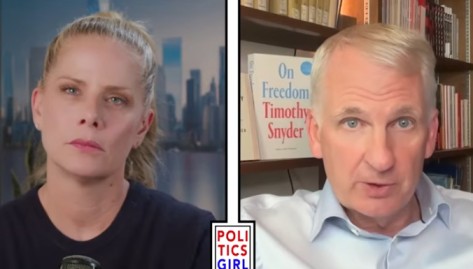
Read the full transcript of renowned historian and author Timothy Snyder’s interview on The PoliticsGirl Podcast, June 17, 2026.
Editor’s Note: In this episode of the PoliticsGirl podcast, host Leigh McGowan sits down with renowned historian and author Timothy Snyder to examine the current state of American democracy and the threats posed by the rising tide of authoritarianism. Throughout their conversation, they dissect the transactional nature of the Trump administration, exploring how it has undermined American power, institutions, and the rule of law. Ultimately, Snyder emphasizes that while there are significant reasons for anxiety, the situation is not inevitable, and he urges listeners to move from recognition to collective, joyful action to help turn the tide.
Introduction
LEIGH MCGOWAN: Hello and welcome to the PoliticsGirl Podcast. I’m your host, Leigh McGowan. Let’s get into it.
As today’s guest Timothy Snyder argues, freedom is the great American commitment, but we’ve lost sight of what it means. The New York Times bestselling author, Yale, and now University of Toronto historian is best known for his expertise on authoritarianism and his books On Tyranny and On Freedom. And while we can use the first book to recognize how far down the rabbit hole America has gone, it’s the ideas in the second book that he sees as our chance for survival.
So I’m having a conversation with Professor Snyder today for obvious reasons, because clearly American democracy is in deep crisis and we are not the only country in the world where authoritarians are rising. The world order is changing and we need to understand where we stand in that change and what we’re willing to do to avoid the worst-case scenario.
So without further ado, please welcome my guest, world-leading historian, now U of T professor, and award-winning author Timothy Snyder. Welcome back, Professor.
TIMOTHY SNYDER: Hey, glad to be with you.
From Recognition to Action
LEIGH MCGOWAN: Oh, I’m so glad you’re here today. Here’s what I’ll say. People are afraid right now. If you’re looking around and you’re seeing the news and you’re seeing what’s going on, they feel very anxious, but you aren’t someone who’s known to be a worrier. You’re someone who is known to see patterns and then reflect on those patterns. So what are you seeing right now? And what would you have us know about what you’re recognizing?
TIMOTHY SNYDER: That’s a really good question, because I think we have to move from recognition to action rather than from recognition to anxiety. And I’m not speaking to people who have good reason to be anxious, like people who are undocumented or for other reason are directly in the crosshairs of this regime.
But for many of us, we have this kind of luxury where we go from recognition of a problem to being anxious or worried or fearful about it. And the anxiety or the worry and the fear then displaces, unfortunately, the little actions that we could take. And it’s the little actions which are all we have to do in order to turn this all around.
So what I recognize is that we have a president who is trying to engineer a regime change towards a permanent authoritarian system. That is what’s going on. All the evidence is right in front of us. He talks about it pretty much every day in the words, in the tonality. Pretty much all the policy decisions point that way.
Just to give an obvious example, the idea of giving the military a trillion and a half dollars is just— I mean, on its face, it’s a bribe so that the military will support him as he tries to rig elections, stay in power forever. Like, that’s what he’s trying to do. And I realize that if we say that, then we might have emotional reactions to it. But what I’m trying to say is that if we don’t say it, if we don’t notice it, then we’re going along with it. We’re giving them time they don’t deserve. We’re giving them points they don’t deserve.
The stuff that they’re doing, they’re doing it, but it’s going to fail if we do our part. If we do a modicum, if we do the things we’re supposed to do, it’s going to fail and it’s going to fail badly. It’s going to fail embarrassingly. He’s not popular. The war in Iran is not popular. Giving billions of dollars of tax money to his friends is not popular. Corruption is not popular.
They want to rig the election, and that is also not popular, and that should make them less popular. And we should make sure that they will be punished if they try to do something like that.
So we have to recognize that, yes, they’re attempting something drastic, because without recognition, we become participants in it. But once we recognize it, we have to move to a position of action and victory because the victory is very much within our grasp. And the thing which is stopping us, the main thing which is stopping us from being victorious, is being anxious about what they’re trying to do. Yeah, they’re trying to do it and yeah, it has to be stopped, but it can be stopped.
Trump’s Military Dictatorship Budget
LEIGH MCGOWAN: Let me back you up to what you were talking about, about this budget for the military. You just wrote an article on this, which is what you call Trump’s military dictatorship budget. Can you expand a little bit on that? Because people often say, “Show me your budget and I’ll show you your priorities.” And Trump’s budget here seems pretty extraordinarily clear. He has a plan.
And just so people understand, Trump’s proposal is to increase the military budget by nearly 50%. And it is, as Professor Snyder has said, a bribe in many ways to officers and soldiers so they will side with him when he tries to overthrow the Constitution or stay in power indefinitely.
We know that Trump is a transactional person. And there’s sort of abundant evidence that he sees politics as a matter of people will do what they are paid to do. They will be okay being paid off. So is that what you see happening here? Can you expand on this a little bit?
TIMOTHY SNYDER: Yeah. Let me start by just saying a word about all the things this budget isn’t. It isn’t a rational reward for a military that’s performing necessary and useful things. Unfortunately, our military is being abused to fight wars that nobody wants. And it’s not a result of some kind of doctrinal or technological review. On the contrary, it basically keeps in place a lot of stuff that is essentially archaic at this point, which by the way, many people inside the military obviously know. And it’s not something which we can afford. This additional half trillion for the military will make the rest of the federal government dysfunctional. It will both wipe out social programs and force the average American breadwinner or family to pay thousands of dollars more tax a year.
So those are all the things it’s not. What it is, is, as you say, it’s a result of transactionalism. And I want to dwell on that point for a minute because for a long time I’ve been saying Trump has an urge, an aim, a desire to change the American political system. And then the answer is, “No, he’s just transactional.”
But this is a good moment for us to consider what it means to just be transactional. Because if I’m just transactional, then one transaction might be your tax money to pay my military to transform our political system so I can be military dictator forever. That’s a transaction, right?
And if you’re just a transactionalist and you have no attachment to your own country, or no attachment to the law, or no attachment to its republic or its democracy, then that’s a perfectly reasonable transaction, and that is exactly the transaction that Trump is calling upon us to perform— our tax money to bribe our military so suddenly it can become his country. That’s a transaction.
So when we say that Trump’s a transactionalist, we have to not say “just a transactionalist,” because a transactionalist is somebody who is a nihilist about everything else and is only concerned about his own interests and will be creatively coming up with transactions which will further his very specific interest of being in power indefinitely.
And as for this budget, the fact that it makes no military sense whatsoever, no fiscal sense whatsoever, no kind of sense whatsoever, also forces us into this interpretation that it’s just a bribe. And I just want to note that that is, as you say, where the evidence points, right? Everything we know about Trump is that he is transactional and thinks about politics only in terms of who is paying whom.
And so given that, and also given the purge of the military by Hegseth, given that both Hegseth and Trump talk about using the military in the homeland, which means you and me, against you and me— this interpretation is the obvious one. It’s the one which is right down the middle. And if we’re looking away from it, it’s because we, for whatever reason, are highly motivated to look away from what is pretty obvious.
The Rule of Law vs. The Law for the Ruler
LEIGH MCGOWAN: Yeah. I mean, you were recently saying, as we head into the midterms, we need to be really paying attention to who’s willing to break the law for Trump, because clearly this is the system he’s creating. He’s clearly testing the military to see how far they’ll go for him.
We know that the January Sixers got away with everything. They committed violence, they broke the law on his behalf, then they were pardoned for it. And if that deal with Todd Blanchard had gone through, they would have also been paid for it. We see people like Tina Peters, who clearly committed election fraud. She was pardoned for that. She’s out of jail now, thanks to a Democratic governor who bowed to pressure. And she’s showing no remorse, right?
The people that break the law on his behalf, they show no remorse. They act as if the law genuinely doesn’t apply to those who are able to work on behalf of Trump. And I feel like what we’re trying to set up here, if I was the Trump administration, is that old quote about, “For my friends, everything; for my enemies, the law.” The rest of us are still beholden to the law, but the people who are acting on behalf of Trump will not be.
TIMOTHY SNYDER: Yeah, I mean, what you’re describing is a different political system. It’s a political system in which— I would take it a tiny step further— the people who are close to the president are immune, and they’re rewarded for breaking the law on his behalf, not just because it’s in his interest, but because when they do so, it demonstrates that we’re in a different kind of system. Which is meant to be demoralizing for his opponents.
And then it’s not just the law for his enemies, but it’s the law directed and engineered and manipulated against specific personal enemies, which is also meant to be a lesson for the rest of us that we should be afraid because the law isn’t going to protect us. The law is just going to be used to come after us. And that is a system. It’s not our system.
Our system is very flawed and it’s unjust towards whole groups like African Americans. And there are all kinds of traditional injustices built into it. But in principle, we’re supposed to be about the rule of law. This is a different principle. I mean, I think it’s just worth emphasizing it’s not a change in degree, it’s a change in kind, where there is no longer the rule of law. There is the law for the ruler, which is an entirely different kind of system.
And it’s a system, by the way, in which not only people would have more reason to be afraid, but also the economy collapses. I mean, that may not be the argument which is most important to your viewers, but for a lot of folks who are business people or care about the stock market or care about the GDP— if you move from rule of law to law for the ruler, and this is a lesson of Hungary and Russia and the data just piles on, your economy’s going to collapse. Your economy’s going to be much smaller than it is right now.
I mean, the whole Russian stock market is like a block in Chicago. Your economy becomes much smaller and everybody is much poorer because you can’t look ahead to any kind of predictability because you have to design everything in terms of the expectations of how a few people are going to behave.
I think the opposition has to talk about enforcing the law, and not just in a general way, but like enforcing the law specifically on people who are breaking the law now. And that ties into November, because in order to prevent November from being rigged, the people who are thinking about rigging it have to at least consider the possibility that they might go to prison for doing stuff which is obviously terrible and illegal.
Superpower Suicide and Anti-Strategic Self-Slaughter
LEIGH MCGOWAN: Yeah, that they’re not all going to become Tina Peters who break the law and then get out of jail free. I think that’s a really essential part.
I mean, one of the things you’ve been talking about a lot lately is this thing called superpower suicide. And I want you to expand a little bit on that because you point out that empires rise and fall— they have throughout history. But in your knowledge, no state has ever chosen to kill its own power with such speed. And it’s the speed in many ways that makes it unable for regular people to see what’s happening clearly.
And even those of us who actively oppose Trump and the regime, I think people are still trying to come to some sort of conclusion in their mind that there has to be a national interest or a grand plan that he might have here. But that’s not actually the proper perspective— that it’s what you call anti-strategic self-slaughter. Would you mind expanding on that?
The Illusion of a Plan: Trump’s Foreign Policy and Superpower Decline
TIMOTHY SNYDER: Yeah, and I appreciate the way you’ve set it up because I think there is a kind of sleepwalking or pantomime when it comes to foreign affairs that somehow we want to think there is a plan or there’s an interpretation of national interest. And there is no plan, and there’s no interpretation of national interest, and none of the things that they even say they care about have they been consistent about.
Like, if they said that the one thing they claimed that they would be doing was standing up to China, which they have not — palpably not done — in fact, they’ve done the opposite. And the general thrust of the Trump administration is to hand the world over to China and to give the Chinese a lift which they can’t possibly even have expected from us.
If we just address this in terms of power — Trump is starting stupid wars. He’s losing them in ways that are spectacularly obvious to the entire world. Like, that it was a dumb war towards Iran, that it was prosecuted in a dumb way, and that we’ve lost it in humiliating fashion is obvious to everybody who’s not inside the borders of the United States. I realize it’s obvious to some of us inside the US, but it’s obvious to everybody outside the United States.
But that’s just a symptom, right, that you would fight bad wars and then lose them on your own terms very quickly when you’re supposed to be a superpower. That’s a symptom. It’s a symptom of not having a functional government where plans are reviewed. It’s a symptom of oligarchical politics where a few people are making decisions on the basis of either their emotions or how they can make a quick buck. It’s a symptom of a larger collapse of the state in which state assets like the military, which were built up by prior administrations, are now being consumed by someone who has a very specific talent that allows him to get to power but has no idea how you would manage power — and actually no concern about managing or preserving the power of the state.
He doesn’t think about the state, doesn’t think about government as a category. It’s just kind of playthings that make him feel better or might allow people around him to become richer.
Superpower Suicide: A Self-Inflicted Collapse
TIMOTHY SNYDER: And if we look at the longer term, the superpower suicide is even clearer because in driving away immigrant graduate students and undergraduate students, we’re undermining our own future in science. By making science grant-giving itself a function of what politically motivated bureaucrats think is correct, we’re undoing our own future in science. In attacking the universities and in sponsoring the wrong kinds of technology, we’re deliberately putting ourselves behind the Chinese and driving ourselves backward in terms of future life expectancy, future standard of living, future pretty much everything. In privatizing education and so on, we’re making it harder for parents and kids who are in K-12.
So, from the top to the bottom — from lost wars to the generational reproduction of power by way of science, technology, education — this administration is doing everything possible to collapse American power.
And that’s a weird historical reality. And I’m sure one of my colleagues will eventually correct me because that’s what historians do. They eventually correct one another. But I personally can’t think of an example of a major power that has, as a result of its own choices, lost so much power of every kind — from soft power to hard power — so quickly as the Trump administration has done.
So that’s what I mean by superpower suicide. It’s a choice. We chose Trump — not you and I personally, but we as a people chose Trump. Trump is choosing to destroy state power. In that sense, it’s like suicide. And you were starting from a high place, a superpower place, and we’re diving downward in a radical way towards a very hard surface.
LEIGH McGOWAN: Yeah, that’s what it feels like. And I think that’s why it’s hard for those of us paying attention who live here to watch it. It’s a little bit like being in the backseat of a car with a drunk driver who’s going 500 miles an hour. Like, you have to wrestle the wheel away from them. But there is a feeling of helplessness to it.
The Need for Transformation: Beyond Trump
TIMOTHY SNYDER: Yeah, I think we have to be thinking in terms of new beginnings. Superpower suicide is only possible because we’re in a political system and an economic system and a social system where somebody like Trump could come to power. And so what Trump is doing is terrible, but there are prior weaknesses in the system which allowed somebody like him to come to power.
And so if we get through November and if we have a big coalition and if we have a mandate for change — and by we, I don’t just mean the Democratic Party, I mean people who want the country to survive and thrive — if there’s a big coalition and a big victory along those lines, we have to be talking about how we transform the country.
Because the superpower suicide, it’s awful, but it’s also in its own way just a symptom of a larger problem, which is we’ve allowed it to become too easy for too much wealth to be concentrated in too few hands. We’ve made it too easy for small groups of people to make decisions that affect everybody else. We’ve allowed a concentration of power to warp everything for everybody. And as drastic as superpower suicide is, it’s really just a sign that everybody outside us in the world can see of what we’re doing to ourselves. And so we have to take in what we’re doing to ourselves and start addressing the fundamental problems.
Who Is Really Driving the Agenda?
LEIGH McGOWAN: Yeah. And like you’re saying, this isn’t really a Democrat versus Republican thing. This is people who would like to see America not die versus people who are fine with it happening. Because, like you said, the United States is spending billions and billions of dollars a day to lose a war, but it’s enriching the oligarchs, it’s impoverishing the citizens, it’s raising our prices everywhere, it’s sabotaging our alliances around the world, and it’s strengthening our enemies. Like, if you don’t want that, then you’re going to be on the opposite side of this.
I mean, because if I think about what is the end goal here for Trump — what’s his end goal? And is it even his goal? Because at the end of the day, I don’t think he’s the one making the calls on policies or what the plans are. It’s the billionaires and the technocrats and the Christian nationalists and the white supremacists and the Heritage Foundation, the Federalist Society. And Donald Trump, in many ways, is just a vehicle for them to drive to their end. What do you think the end goal is here?
Trump’s Vulnerabilities and Strategic Miscalculations
TIMOTHY SNYDER: I’m going to start from this relationship that you’re sketching out between Trump and other people, because it is important as a starting point. Just to note that Trump as a person is completely out of his depth with this stuff. One of our national fairy tales is that he’s a negotiator or he has some kind of negotiating skills. He does not. He’s a charismatic performer who played a negotiator on TV, but he does not have negotiating skills. He’s terrible at it. He lacks all the necessary attributes. He’s impatient. He always gives away the game.
When he calls his shots, I always think, yeah, like you’re calling your shots in the sense that you’re telling someone what you’re about to do. Like, in that sense, that’s the only sense in which he calls his shots. He’s like, “I’m going to shoot, I’m going to shoot a 10-footer off the bank.” Like, in that sense, he’s calling his shots. He lacks consistency and he lacks a sense of what the final goal is. And if you don’t know what the final goal is, you can’t really negotiate.
The second level of problems is that he believes the last person who talked to him. He’s psychologically incredibly vulnerable to people who are good managers of minds, like Putin, for example, or Yahoo. And he’s easily bribable and he’s bribable for comically small amounts of money, which makes the whole thing even more kind of petty and tragic and squalid. Like, you need much more money to bribe other foreign autocrats. On the scale of international corruption, you can bribe Trump for petty cash. And that’s just sad, and it’s not just evil, but it’s also kind of embarrassing at the same time.
So anyway, personally, he’s out of his depth. He does not understand anything about negotiation. He does not understand anything about war. He likes to watch things go boom. He has some films about big boats that he likes, but he doesn’t understand the politics of war. He doesn’t understand how war is politics. He thinks it’s like a video game or a movie where you push a button and then the other guy surrenders. But war is fundamentally an intense form of politics, and politics is not what he’s good at. He’s good at discourse. He’s good at framing things. He’s good at getting you to do stuff for him. But war is a much higher level of politics than he is prepared for. And you basically see that every day.
Trump’s Iran Strategy and the Pursuit of Showpiece Victories
So he is out of his depth. He’s gotten himself into a situation that even if all the other stuff you were saying weren’t true, he wouldn’t know how to handle all of this. I think his original idea — which, as you say, I also think was only very, very partially his, I think it was put into his head — but his original idea was Iran is going to surrender on day 1 or day 2 or day 3. It’s going to be an amazing victory for me. People are going to dance in the streets and then I’m going to move on to Cuba. I think he was thinking it’s like Venezuela was fun and then Iran’s going to be fun and we’re going to move on. And they have to surrender because we’re the bigger power or whatever.
So I think his goal was to pass through Iran on the way to a series of showpiece military victories which were going to lead him towards victory in November. I think insofar as he had any thinking, it was like that. But honestly, I think his call into Fox and Friends the next morning is what’s most revelatory. It was clear that after Venezuela he was on an adrenaline high or some kind of high, and that he just wanted more. When he said, “We can do this again, like, no one can stop us,” I think there was just a level of personal excitement there, which, if you are Israel or someone else who’s interested in a war, that psychology is just vulnerability. Like, you just know exactly what you’re pitching at to make this next war happen.
The Financial Incentives Keeping the War Going
The other thing I want to point out is that I think it’s hard for him to stop this war because people are making tons of money around it. And the people who are making money are his relatives, or they’re people he admires, like Putin. And so when the people you admire are making money, the people you listen to are making money, that makes it harder to stop the war. Because why are we in it? Who knows? But people around him are making tons of money.
It’s just a very simple political point that if you’re in a system which is about an oligarchical cluster of people, American and otherwise, if that oligarchical cluster is making money on something, that something is unlikely to stop anytime soon.
Is Trump Hoping for a Terrorist Attack?
And then a final thing I want to add — and there’s a taboo on saying it, so I’m going to say it — I think he’s also hoping for terrorism. He’s in a funny situation with the Iranians now where I think he wants the war to go on so that the Iranians will blow something up in the U.S. And I think the Iranians are aware of this and therefore not doing it. I think that’s where we are. It’s like the old joke about the sadists and the masochists — “hit me,” “no.” I think that’s where we are with Trump and the Iranians. He’s like, “hit me,” and they’re like, “no.”
I think he would very much like for something to blow up in the US because he would use that to try to change the nature of politics, to say that we can’t have elections or whatever. But I think the Iranians are on to him about this, and it’s not that this is beyond their capabilities.
I would add that the fact that Trump has completely gutted our intelligence establishment and diverted the FBI assets which were related to this kind of thing to immigration, that he’s put someone who’s totally incompetent in charge of national intelligence — all of this stuff is also like an invitation to a terrorist attack. So I think if we’re talking about Trump’s motives at present, as we get into summer ’26, one of them is that he’s, at some level, hoping the Iranians will blow something up in the US and that that would allow him to take advantage of the situation.
LEIGH MCGOWAN: Well, I think that actually makes a lot of sense. And I also think that it comes back to, a leader is only so good as the people they surround themselves with. So if I say, “Oh, it’s going to be really fun, we’re going to go into Iran, we’re going to shoot some stuff up, we’re going to blow up some bombs, they’re going to be so sad that we were there and they’re going to capitulate to us” — any of us that were paying attention were like, of course they’re going to close the Strait of Hormuz. We all knew that.
Except if you’re Secretary of Defense — in this case, Secretary of War — someone like Pete Hegseth, who also wants to make things go boom. If you’re on national soil and you’re like, “Who’s in charge of counterterrorism?” — the guy’s like 22 years old, he hasn’t had any jobs. And then the head of the FBI is Kash Patel, spending most of his time cruising around with his girlfriend on private jets. These are not the right people to tell him no. No one’s going to tell him no. He’s now surrounded with people that won’t tell him anything other than what he wants to hear.
I think it’s very possible he thinks he’s winning the war sometimes. I think people are telling him the wrong thing. Because for him, it’s all about face. It’s not just that he’s easily bribable, in my opinion, or that he’s bribable with small amounts of money. It’s that he will do anything for people that make him feel special. And I think that all of the people who are smarter than him know this. So you tell him, “You’re so smart and brilliant, and I love being around you, and aren’t you just the most wonderful leader?” And he’s like, “Well, he’s always been nice to me.” And you think, bro, you’re so easy to trick.
The Path Toward Authoritarianism: Late Stalinism and the Third Term
When Trump starts talking about his illegal third term and making the merch, and the Latin American countries are like, “Yeah, he’s going to be doing a third term,” it reminds me so much of what happened with Putin in Russia and how they changed the rules so he could continue to be president. Then he went down to prime minister, then was able to come back and be president again, and then changed the rules again so he could serve for longer. And now he can’t lose elections. That’s the path I think that Trump would like to see us on. But you’ve said that this really reminds you more of late Stalinism. Can you expand on that?
TIMOTHY SNYDER: I’m not sure there’s one historical analogy that captures everything. And I appreciate you mentioning Latin America because it’s a good example of how when people who have seen something look at our country, they say, “I’ve actually seen that thing before. I’ve watched this movie and I know what the sequel is like because we were there.”
So Russia can be helpful and Latin America can be helpful. Latin America is helpful for the basic point that people who try one coup tend to try another one. Coups are generally practiced. It’s not that your first coup attempt always succeeds, but if you let people try again — which we as a country for some reason have decided is the right thing to do — then you’re going to go for it. There’s nothing in Trump’s experience which has taught him he shouldn’t try again, because he tried the first time and literally nothing bad happened to him. He became president of the United States.
Breaking the Myth of the Indispensable Man
I want to take this question in a couple of directions. One is that Trump going for a third term is crazy and dumb, and the Republic would die first. But on the one side, we have to break up the confidence of the people on his side who think that he’s irresistible. A lot of his kind of politics — whether you want to call it strongman politics or authoritarianism or fascism — a lot of it depends on this notion of this indispensable man, like the nation just couldn’t possibly exist, we wouldn’t know what to eat for breakfast, without this one guy.
And so you have to break that. You have to laugh at him, you have to mock him, you have to bring him down. Not just because it’s enjoyable — in fact, when it’s too enjoyable, you shouldn’t do it — but because it’s necessary to reveal basic truths to people, including his supporters. The fact that this guy is ludicrously weak and everything he touches turns to loss. The Knicks hadn’t lost for how long before he went to Madison Square Garden?
LEIGH MCGOWAN: 14 games in a row they won, and it’s like—
TIMOTHY SNYDER: Yeah, but more seriously, he tries to help Russia win a war, and even there he fails. It’s sort of incredible, his power to turn people into losers. And so one has to get across that he’s not indispensable, that you could push him aside and actually the world would look a lot brighter.
Rejecting Inevitability — The Work of Winning
And then on the other side, there’s the problem of inevitability. This is not his supporters — this is more like middle-of-the-road people or our people. “Yeah, there was a situation and he took advantage and we just have to kind of wait it out.” No, we don’t have to wait it out. It’s not inevitable. We’ve got to actually think about victory. We have to think about winning. We have to think about overwhelming electoral victories. We have to think about crushing defeats for their side. And we have to think not about just winning a big victory for its own sake, but how we then transform things afterwards.
We have to take this present that he has and get beyond the present and into a different kind of presence. His kind of politics works until it doesn’t work, and you have to push it till it breaks. You have to show the weaknesses, and you have to use comedy sometimes to show those weaknesses. But you can’t just think it was inevitable that he rose and now it’s inevitable he’s going to fall. You have to push.
LEIGH MCGOWAN: You have to do the work to make that happen.
TIMOTHY SNYDER: Yeah, you have to do the work — the low-level organizational work, the protest work, the work that organizers are doing. You have to recognize them and support them financially and morally. You have to push that thing off the pedestal. And then you’ve got to be ready to replace that false statue with something real.
Can Voting Overcome Authoritarianism?
LEIGH McGOWAN: Yeah, I think people get frustrated because they’re like, if protesting ceases to work, if no one cares if we’re protesting, or if they’re giving us areas. I was watching a protest recently outside of the Delaney Detention Center, and they were saying, “This is the area for First Amendment rights.” And they were like, “What do you mean the area for First?” They’re like, “You have to be in the area to use your First Amendment rights.” And all the protesters were like, “That’s not a thing, man.”
So if protesting ceases to work, if laws cease to matter, if the government is no longer interested in its people and it’s trying to rig elections so it can’t lose, the question becomes like, can Americans do what, say, Hungary did and overcome all of these authoritarian sort of behaviors that Orbán was doing — you know, changing the constitution, changing the courts, changing the media? Can we do that with a mass turnout in our elections? Because there’s a lot of people right now who are worried that we can’t vote our way out of this. And I don’t think that’s necessarily true. But what are your thoughts on that?
The Necessity of a Bold Electoral Mandate
TIMOTHY SNYDER: I think voting is absolutely necessary and high turnouts are absolutely necessary and a big electoral victory is absolutely necessary. But I think a lot hangs on how you interpret that big electoral victory and what you think you’ve won and for whom you think you’ve won and why. So I would say it’s a necessary condition but not a sufficient one.
I think the sufficient conditions are: one, the people who win recognize that they’ve won as part of a big coalition and not just as the Democratic Party, and that their victory is on behalf of people who voted for them and also on behalf of people who didn’t vote that are super alienated and want things to change drastically. The Democrats, I wish they would recognize that public opinion is much more radical than they are on almost every issue. And then when they win, it’s not just because people don’t like Trump in like a middle-of-the-road Democrat way. It’s that people have started to see Trump as a part of the problem rather than as part of the solution.
I mean, I of course never saw Trump as part of the solution. I’m just going to try to be empathetic for a moment. It’s correct to think that there are structural problems in the US, and it was incorrect to think that an incompetent wannabe oligarch was going to be the solution. But it was correct to think that there are radical problems. And the way that public opinion is tipping against Trump now is not the way that Democrats think — like, “We always hated them and now people realize they should hate him too.” It’s that people continue to think there’s too much corruption, but now they’ve begun to realize, “Oh, Trump is part of the problem and not part of the solution.”
And if you draw that lesson, then you realize as the Democrats, you have to come out of the gate and say, “We represent a broad coalition and it’s a fighting coalition.” And what we’re fighting for is a country where money is not in politics, where everybody has a fair shake, where there will be an American dream. I’m not going to give up that term — where there will be an American dream where your kids can have a better life than you can, where there’s going to be fairness, where there’s going to be law.
You have to come out fighting with that and you have to have some demonstration shots. Like, we’re going to go after people who have broken the law, who have made lots of money. We’re going to investigate, we’re going to prosecute, we’re going to do the things that we can do — but also partly to symbolize that when we have more power, we will do more, to make this a country which is fair for everybody.
I think the Democrats are going to win big. My gut feeling is that Democrats are afraid of winning big, and that when they win big, it has to be with a mandate where the mandate is pretty radical. And by radical, I don’t mean like extreme left or whatever that would mean. What I mean is money out of politics, wealth redistribution, access to healthcare, public schools — things that there is a broad consensus for in this country, the achievement of which would actually radically change the way the country is run.
They’re going to try to rig things. I don’t think it’s going to work. We can hold it off by threatening them with the law and by having — and this goes back to demonstrations — one of the things that demonstrations are for is to deter. If you have a lot of protest potential, that makes it harder for them to think that they’re actually going to be able to rig stuff. So that’s one of the reasons why you demonstrate now and in the summer and in the fall.
They’re going to try to rig it. I don’t think it’s going to work. And for me, the big question is, what do we do next? Do we think we have a big mandate from a big coalition, or do we just treat it as a traditional midterm victory? Because if we treat it as a traditional midterm victory, then we’re really lost. I think then we’re lost as a country.
Moving Forward, Not Backward
LEIGH McGOWAN: Yeah, I agree with that. I think that we have to get past the leaders who think we’re going back somehow — that we’re going to go back to how things were, going back to normal. Or the concept of reaching across the aisle, or incrementalism, or centrism, or “we just have to all come together here in the center.” You have to say, no — the majority of the country wants a higher minimum wage. The majority of the country wants better public education. The majority of the country wants healthcare. 77 other countries in the world have been able to do it and we just can’t? No, impossible.
We have to say we got to this point because people were unhappy, and we’re going to acknowledge that people were unhappy. But instead of trying to go back, we’re going to go forward and try to deal with the unhappiness that goes from this end of the political spectrum to that end of the political spectrum. And the Democrats need to be bold in that. And if they’re not being bold in that, then we have to replace our leadership. We have to put in new Democratic representatives, because at the end of the day, this still is a two-party system and we’re not going to be changing that overnight. This idea that you can third-party vote your way out of this is absolutely not going to happen.
But I think I want to, before you go, I would like to just say — say we get to this point where we get past the midterms and the opposition is able to take back the House, maybe flip the Senate. We have 2 more years of Trump, which we would hope would be sort of a lame duck period where he was held accountable, where the Congress was having hearings on people that broke the law, people that broke the law on his behalf, instead of going after the Hunter Bidens of the world and the left-leaning creators and whoever else they’re going after now — ActBlue.
But even when Trump is gone, whether that’s because he expires or because he is voted out of power, I feel like the culture he created is still going to be here. This idea of loyalty first, law be damned, make sure you get yours, corruption is normal. And that is what I would like to see the opposition work against. And I think the important thing is what you’re saying — that the first thing they should do is get money out of politics.
Linking Corruption to Everyday Life
TIMOTHY SNYDER: The only way to be against corruption is to not be corrupt. And the only way not to be corrupt is to be in favor of getting the money out of politics. People are angry about corruption, but they’re only a little bit more angry about Trump than they are about everything else. So it’s like, is Trump corrupt? 76%. Is the system corrupt? 70%.
And so you have to start by saying we are not the system you’re talking about, because we want to pass laws so that we ourselves can’t get campaign finance contributions. We want to pass laws so that there are no PACs, there are no super PACs. We’re going to try to do that. And Trump can veto it for now, but we’re going to be the people who do that. And then you put some daylight between yourselves and the Republicans that way.
But also you tell people that we understand that you’re against corruption. We’re against corruption too. And the corruption issue really does matter to people. It matters deeply. And it’s a way to reconfigure politics so that it’s not so much right, left, so much us, them, because most folks agree that when all the money is in the hands of a few people, that blocks things for everybody else. It’s common sense that happens to be true.
The recent example of Hungary confirms this. I mean, that’s what Magyar ran on. He linked the issue of what the Democrats call— and I hate this word— affordability. He linked the issue of affordability with corruption. He said, “Look, there’s a reason why your everyday life is hard, and that reason is that the corrupt oligarchs are controlling the money flows.” And that happens to be true. It’s true in Hungary, and it’s true in the United States as well.
And if you can get people to see, the gas pump, the stuff that you know how to articulate, the stuff that you know every day is hard, that you don’t have enough money to go to the hospital, that that everyday stuff is because people are corrupt, it’s because wealth is in too few hands. If you can make that connection, then you’re winning on both affordability and democracy.
And this thing where the Democrats are like, “Well, it can’t be democracy because it has to be affordability.” No, it’s both at the same time. And if you can link them both, you win. But if you try to win on either one of them, like if you just say democracy, democracy, you’ll lose because people think democracy— I mean, I like democracy and I think we have to be much more democratic, obviously. But if you say democracy, what it triggers is the status quo and nobody likes the status quo.
Everybody hates the status quo. There’s no way you can’t go back. You can’t do that. So you can’t win on that. But you also can’t win on affordability because if you say affordability, affordability, and then you win, then you’ve told yourself that you have a mandate to try to drive down gas prices a couple cents, but you haven’t talked to yourself and your voters about the real reasons why affordability, or as I would prefer, quality of life, or the sense of a future, or social mobility. You haven’t talked to people, you haven’t talked to yourself about what the real reasons for all this is.
So you have to bring it together. You have to be able to say, “Life is hard because they’re corrupt and we have ways to fix it. And when we have the power, we’re going to fix it. And if we don’t have enough power, we’re at least going to fix it by going after a few targeted cases of obvious criminal oligarchs.” And that’s act one.
The White House as a Laundromat
LEIGH MCGOWAN: Yeah. And I think people can understand that. I don’t even think you need to be a big political nerd to follow that. I mean, you’re like, we can’t afford this because of that. We can’t afford this. We have enough money for a golden ballroom to cover these statues in gold leaf, to build a UFC thing on the lawn. All the people that are putting money towards the ballroom all got sweet government deals. The Trump family has all increased their wealth between 50% and 100% in the last 2 years, which is insane.
And I think people can say that. They can be like, “My wallet is empty, and their wallet is literally drowning. They’re buying islands in Albania.” So I think that is something that people can understand, even if they’re not particularly politically savvy.
TIMOTHY SNYDER: It’s very basic and it’s very commonsensical, but it also starts to touch on things that are symbolic too. Like the White House has been turned into a laundromat. They’ve turned the White House just like Trump Tower was. It was a laundromat. It wasn’t a real estate investment. It was a place for laundering money. And now they’ve turned the White House into the same thing. You put a little money into it and miraculously you get 1,000 times return on your investment.
Yeah, it’s not just a matter of people wanting to have their own lives back, but I think at a certain point it becomes a matter of, do you really believe that your country has any integrity? And there’s an emotional chord here too, which I think can be struck, that fairness isn’t just about me and my family, but fairness is also about, look, is the White House the people’s house, or is it just a laundromat for a rich guy and the people happen to be his friends?
LEIGH MCGOWAN: Yeah. I mean, if you look at the 250th anniversary, is that a celebration for the American people, or is it a celebration for the closest people to our president who pay him money to be there? Those corporate tickets are $1.5 million each, and you tell me who’s going to be collecting the ticket fees. It won’t be the American people.
I want to thank you so much for joining us today, Tim. I mean, before you go, do you have any last words for those of us who are terrified we’re losing our country to this madman, or any words that might encourage us to keep going and not give up?
Resistance, Joy, and the Path Forward
TIMOTHY SNYDER: Look, it has to be joyful. And I know that’s a hard word when there are reasons to be afraid, but when things could be much, much better than they are now. And this thing that we call resistance is also creating the conditions for that America where things are much, much better. Because as you’ve said quite rightly all the way through this conversation, it’s not all about him in various ways. The only thing we bring to what comes after is what we are now. That’s all we bring.
And so if we are joyful and cooperative and effective, and we understand that we can win, then when we get to the place which is and feels like a victory, we’ll be much better off. So yeah, there are reasons to worry, and yes, there are ways things can go horribly wrong. But their power position is not great on their side. They are very, very, very concerned, more concerned than we are. I would point out they just do a better— they share less, but they are very worried and they have good reason to be worried. Their position is a weak one.
LEIGH MCGOWAN: You wouldn’t be trying to change every single election and every single way we vote and taking away people’s votes and trying to pass the SAVE Act and changing the gerrymanders making—
TIMOTHY SNYDER: Having—
LEIGH MCGOWAN: if you were feeling like you had a winning position.
TIMOTHY SNYDER: Yeah, so they know that they’re in a losing position, and it’s up for us to call them losers, and it’s up to us to make them lose. But above all, it’s up to us, as we resist, to think about how we are going to make things better, and to be aware that that’s ultimately what it is all about. It’s about making things much better than they are. And that’s the joyful part of it.
I mean, there is a kind of special joy in all of this. History gives us a chance to make a difference. We have that chance to make a difference and we should be embracing that and accepting that as an opportunity, and as an opportunity to make things better for ourselves and for others.
LEIGH MCGOWAN: Yeah. Don’t just think we don’t want this. Think what do we want and how do we get that? That seems much more hopeful.
TIMOTHY SNYDER: Yeah. And what kind of a person am I making myself? Because if we all make ourselves a tiny bit better at local organizing, if we all make ourselves a tiny bit better at reaching out to other people, if we take advantage of this crisis to make something of ourselves in cooperation with others, that will be enough. That will be enough. And it will be a reason to feel good about ourselves later. Like, I did my thing. I came up with my thing to do and I did that thing.
LEIGH MCGOWAN: Yeah, so don’t isolate yourself, people. Find your community and work together and know that you did the thing when the victory finally does come. And when the victory finally does come, we got to deliver for the people. Thank you so much, Professor. I love seeing you, and I hope you will come back again soon.
TIMOTHY SNYDER: I will. Look forward to that.
Closing Thoughts
LEIGH MCGOWAN: So that was Timothy Snyder reminding us that we have to move from recognition to action, that we can see things are f*ed up. But the question is, what are we going to do about it? Professor Snyder reminds us that every action we take, every group we join, every act of resistance we partake in, no matter how small, helps. That while the people in charge are doing everything possible to collapse American power and could be wildly successful, they could also fail spectacularly. And it’s up to us to convince people of that, to make that real.
No more thinking that this man is irresistible or inevitable or untouchable. He’s not even smart, and the choices he’s making are hurting us. So we need to tie his corruption to our pain. We need to build a broad coalition against what he stands for and start imagining what this country could look like without his transactional way of thinking.
I want to thank Tim for joining us today and you for caring enough about this country to be here. Now start imagining what it could be rather than brooding over what it was. Until next week. PG out.
Related Posts
- Maggie Haberman: Trump’s ‘Unreality Bubble’ Meets the Midterms (Transcript)
- Transcript: President Trump Remarks on Healthcare, Sep. 18, 2026
- Transcript: Jonathan Swan’s Dive into Trump’s Reality: The Weekly Show
- Transcript: President Trump Remarks in Dublin, Ireland – Sep 12, 2026
- Transcript: President Trump Remarks at the Republican Midterm Convention – Sept 9, 2026