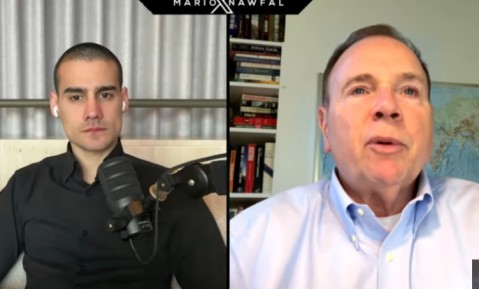
Editor’s Notes: In this episode, host Mario Nawfal is joined by retired Lt. Gen. Ben Hodges to analyze the ongoing geopolitical and military tensions between the U.S., Israel, and Iran. The discussion evaluates the strategic outcomes of the recent conflict, the impact of the U.S. blockade in the Strait of Hormuz, and the potential for an unintended confrontation with China. General Hodges also shares insights from past war games, the feasibility of “boots on the ground” in Iran, and how domestic economic pressures like rising gas prices could influence the U.S. administration’s long-term strategy. (April 14, 2026)
TRANSCRIPT:
Opening: Assessing the War’s Strategy and Outcome
MARIO NAWFAL: General, it’s a pleasure to speak to you. How are you, sir?
LT. GEN. BEN HODGES: Very good, Mario. Thanks for the privilege to come back on.
MARIO NAWFAL: So yeah, we haven’t— as I was saying earlier, we haven’t spoken since the war started. So before we look at what’s happening now, Trump’s blockade, the negotiations that are ongoing, I want to go back to the beginning. And what was your reaction when you saw the war happen? Were you expecting it? And how do you think the war went? What was the strategy behind it? Because I have different guests and everyone tries to speculate what the strategy was, and it’s all over the place. What do you think the strategy was and what’s the strategy now? Because I think they also pivoted out of necessity.
LT. GEN. BEN HODGES: Well, of course, I was impressed with what the military was able to accomplish, the U.S. as well as the Israeli military, the professional operations by the Air Force and the Navy and the special operators, the intelligence and all that. That’s impressive. But if it doesn’t lead to the strategic outcome that you want, then it’s also not relevant.
So I think the administration would like, and especially the Secretary of Defense, keeps pointing to the victories by the military. But most professional military know that there is no victory if it doesn’t accomplish the strategic objective. And that’s the part that is, I think, still missing. Most people were trying to figure out, as you alluded, what exactly is this about? What are we trying to accomplish? There were multiple justifications given, but nothing consistent. I think they still are looking for something to hang their hat on and then to get out of there.
Did Iran Win Strategically?
MARIO NAWFAL: Public justifications are never the real reason any country goes to war. Almost never. So I think speaking to politicians is one thing, and speaking to strategists behind the scenes is different, as you know from your experience.
I get a lot of slack for when I make the statement— maybe you don’t disagree with it— but I make the statement that Iran won the war strategically. Too early to say, depends how the negotiations go. But when I make that statement, people that are very supportive of the US or very critical of Iran, people against the regime, they’re up and out. Like, “What do you mean? Iran won? All their commanders are dead, their military is decimated, their country is decimated. The US and Israel had air supremacy.”
But as you said, it’s not about— militarily, everyone knew the US and Israel are going to win. Strategically, it’s a lot harder to call it a win when every single objective that people speculated it was, was to destroy their nuclear program. That’s not really it because it was there beforehand. All right, cool. Is it regime change? Because regime change— Israel would love to see that, but also the US would like a more friendly regime. It makes sense financially, it makes sense strategically having control of the Strait of Hormuz. Well, the regime is probably stronger now than it was before the war.
There’s no other real objective that makes sense. So is it too early to say it’s a strategic win for Iran, being able to survive but also being able to close the Strait of Hormuz?
LT. GEN. BEN HODGES: I would say, while it’s too early to make a declarative, definitive “it ended this way,” I would agree with you that at this point right now, of all the various justifications that were given for doing this, most of them have not been accomplished. I mean, for sure, thousands of launchers have been destroyed. The Iranian Navy doesn’t exist anymore. But this was never going to be a naval battle between the US Navy and the Iranian Navy anyway.
So the relevance of who is able to influence what happens in the strait, who’s still in charge, do the Iranians still have the nuclear weapon material, do they still control it? The answer is yes.
But I remember the last time you and I spoke, you said something that I had not thought about. And since then, I have come to believe more and more in the validity of it— that this was always about who controlled the oil, the global oil markets. And of course, the whole petrodollar system that was set up back, I think, in the ’80s, the United States has been the biggest beneficiary of that. So all these other things are perhaps justifications, but ultimately it’s about making sure that the world doesn’t get off of the dollar. And I think that’s what a lot of this is about.
Now, look, I always feel a little uneasy as a retired American officer being critical of what the US government might be doing. But we destroyed the enemy in Vietnam. We destroyed the enemy in Afghanistan. And we lost both wars. And we still have got to get straight in our head what is the strategic objective that you want, not to confuse that with tactical victories, no matter how great a job our Air Force and Navy are doing.
And then finally, Mario, if you’ll let me— I’m 68 years old.
In 1979, I was a cadet at West Point. And when the Iranians took our embassy, so for my entire adult professional life, Iran has been an enemy of the United States. So I have no pity for anybody in the regime or the IRGC. But what’s most important to me is: do we achieve what our strategic objectives are? And of course, that affects more than just the US, but also our friends there.
The Strait of Hormuz, China, and the Petrodollar
MARIO NAWFAL: I was speaking to the former CENTCOM commander, General McKenzie, a few days ago, and we had that same discussion with him. He’s extremely hawkish on Iran, and rightly so. Iran’s always been an enemy or a rival of the US— a rival is being generous, more of an enemy of the US. Their foreign policy hasn’t been friendly to the US either, and to Israel, but we don’t care about Israel right now. We’re talking about American interests, and I always like to separate the two.
He made one point though that’s really interesting, and I agree with him. He said the war is not over, or the mission is not over— not the war, the mission isn’t over. Now one could interpret it that we could go back to war. That was just a few days ago, 3 days ago. But I think what he meant was the negotiations are ongoing.
And if we go back to the point you’ve made, that this was all about the Strait of Hormuz and the petrodollar, having the dollar remain as the world currency, the global reserve currency, or the currency for trade, and also having influence over the Strait of Hormuz. So we know that China imports a lot of oil from Venezuela— well, Venezuela now is under US influence. They import most of their oil from Russia, but also through the Strait of Hormuz. Well, Russia— Trump is trying to improve the relationship there. It’s obviously very difficult with the war in Ukraine, but he’s tried. He gave it a shot and he talked about doing business with Russia and negotiations. The peace deal that was discussed in Alaska was part of a broader peace deal that involves doing business together beyond Ukraine.
And then it comes to the Strait of Hormuz. The Strait of Hormuz is extremely important for China. I was going through the numbers earlier. China right now— the blockade is costing Iran $400 million a day, and most of that is going to China. And people are giving China a lot of credit on how long it could sustain a closure of the Strait of Hormuz. I know they’ve got a lot of reserves and there’s also a lot of oil sitting on tankers, Iranian tankers in the sea past the Strait of Hormuz, kind of like floating reserves, but China needs that strait.
So if the goal was to get leverage over China by controlling the strait, maybe the general is right, maybe the war is not over. Because right now the US essentially controls who comes in and out of the Strait of Hormuz along with Iran, and there’s kind of a battle between the two. So a lot of it depends on how things will look like once this war ends, and we’re kind of getting into the negotiations now. But one could argue the war might have shifted from kinetic war to more of a geopolitical war and a war of maritime trade that may continue on. And we’ll see how the peace negotiations progress. So that’s one way of looking at it. It’s not over, but the kinetic part is over.
LT. GEN. BEN HODGES: Could be. A lot’s going to depend on how the Iranians respond to this blockade. Do they challenge it, or do they— it seems to me that they actually would like to get back into negotiations, that they’re willing to do some more negotiations. So I think we’ve got another week of the so-called ceasefire to go.
The Israelis— for me, it’s always been interesting to try and figure out at what point do the interests of the Israelis and the interests of the United States begin to diverge. Because I think Netanyahu has objectives that may or may not be in alignment with what the US wants to do.
And then, of course, there’s the practical challenge of when a Chinese-flagged vessel shows up and they’re stopped by the United States Navy— if they are— how does that play out? I imagine that the US and China both would like to avoid a confrontation here, especially with the president’s visit still just a few weeks away. So I hope that we’re not going to see any more kinetic. But the Iranians can see that we don’t have the patience that they do, I think.
China’s Growing Vocal Stance and Escalation Risks
MARIO NAWFAL: Yeah, exactly. And the world economy doesn’t kind of afford that patience either. The global economy. You talked about China. So China’s become a lot more vocal. They’ve been relatively quiet— relatively. They’ve made a few statements, but relatively quiet during the war. But since the blockade, the US blockade of the Strait of Hormuz, that’s when they became a lot more vocal.
The Chinese Defense Ministry said, “Chinese ships continue to move in and out of the waters of the Strait of Hormuz. We have trade and energy agreements with Iran, which we will respect and abide by.” And then they say, “We expect others not to interfere in our affairs. Iran controls the Strait of Hormuz and has opened it to us.”
It kind of brings to the other point— what happens if China begins escorting their own ships? So if the US turns around, doesn’t allow Iranian ships heading to China to go through the strait as a way to pressure Iran, but that’s also indirectly pressuring China. How could this escalate? And maybe what is the process, the blockade process? They could ask a vessel to stop verbally, they cannot try to board it, they can maybe fire warning shots, and then the last one is obviously sink the vessel, which is a worst-case scenario. But do you worry about potential unintended consequences in this blockade?
LT. GEN. BEN HODGES: I think this is where our civilian leadership has got to make the decision on what they would want the Navy to actually do. I mean, the Navy will be super professional. They will do everything they can to avoid a confrontation while still enforcing the law, or the blockade, I should say.
But this is where the president is the one that would have to say— what’s he willing to tolerate, or what does he want to have happen? I’m not going to predict how that plays out. That would really be such an unnecessary incident, though. I mean, this whole thing— the strait was open before this started. So now, because of our actions, we’re in a situation where you’re out there potentially going to try and stop or confront a Chinese-flagged vessel. That is a real problem.
Wargaming a War with Iran: Was Anyone Surprised?
MARIO NAWFAL: Can you tell me more about the wargaming that you guys did when you were in the military? Hillary Clinton said it’s shocking that Trump said nobody told him Iran might close the Strait of Hormuz. “Every war game I was ever involved in, that was the first thing we assumed Iran would do.” So that was Hillary Clinton yesterday or today.
Everyone I spoke to before, when there was that military buildup— even though the betting markets were against me, everyone was against me— I’m like, there is no way we’ll be in a full-blown war. At most, there’ll be some strikes, limited strikes, an attempt to perform Venezuela 2.0, but even that one’s unlikely because it just doesn’t make sense.
So first, do you think Trump means it, that no one warned him? And when you guys were wargaming a war with Iran, how did it look like and how did it unfold now relative to what you guys planned back then?
The Risk of a Ground War in Iran
LT. GEN. BEN HODGES: Well, part of our problem is that the president has said that he trusts his gut more than anybody else. And so he is so sure that he knows better than anybody and that he believes that as when he was doing real estate deals, he could just intimidate the other guy to give in to whatever it is he wanted.
And then because of the success he had in Venezuela, he was even more sure that all they had to do was kill the Ayatollah. Decapitate the regime, and then everything would collapse in Iran, and he would get what he wanted. And then, of course, he has surrounded himself with sycophants who are going to be very uncomfortable or uneasy to say, “Oh, Mr. President, you know, if this, then this.”
Now, that is absolute nonsense for him to say, “Well, nobody told me that the Iranians might actually do this.” I don’t believe that for a second. Even some of the sycophants around him would have said that this is a possibility, but he’s not the kind of person to accept responsibility when things begin to go wrong. I think that’s why he said that, but it sounded foolish when he said it.
The war games in which I participated, of course, you’re always looking at that geography, and the thing that stands out is the size of Iran. I think most of us, unless you are focused on this as a problem set a lot, you don’t realize how big Iran is itself. And with a population that it has, this is not Venezuela. I mean, it’s a whole different kind of a very difficult environment.
And the idea of putting troops on the ground there — I’m not talking about Rangers going in or special operators to seize a particular thing or Marines at Kharg Island, but a more broader land operation to seize terrain or maybe even Tehran — we do not have enough capability to do that. And I think this would be eventually a disaster. So I hope that the president is not seriously contemplating even doing that. Otherwise, though, you can’t defeat a country like Iran with air power only.
MARIO NAWFAL: Do you think the troops, boots on the ground, is still an option right now? We’re seeing the buildup. The buildup is still there, increased since the ceasefire. Some of it is necessary resupplying after the war, after the depletion of all the various air defense munitions. And all the radars that were destroyed, etc. So some of it is necessary, but is that still a possibility from what you’re seeing right now?
LT. GEN. BEN HODGES: So when we say boots on the ground, that does not mean these raids, special operators, Rangers, that kind of thing. I would separate that from a broader land operation like we did in Iraq where you had tens of thousands of troops trying to—
MARIO NAWFAL: Or even limited to, like Kharg Island or maybe Qeshm Island, like part of, or maybe it’s a buffer zone on the coast as well, not the full country. That’s pretty—
LT. GEN. BEN HODGES: Yeah, that’s what I’m saying. I would not put that in the category of boots on the ground because these would be more short-term, very specific, limited, almost like a raid for a specific purpose. And then you could extract more easily than if you had tens of thousands of troops somewhere inland in Iran. That’s the one when I think of boots on the ground, that’s what I’m talking about. That would be a real problem. But I don’t know how you defeat Iran without doing that. So finding an objective below that is more feasible, I think.
Is the US Military Ready for a Full-Scale Iran Operation?
MARIO NAWFAL: Is that even feasible? Is the US military equipped for a full-blown boots-on-the-ground invasion of Iran considering the territory, considering the state of the US military right now in terms of munition stockpiles? I was talking to General Randi earlier, 2 days ago, and he was telling me about how the US has depleted about a third or a quarter of their Tomahawk missiles. And that would take years to resupply, to manufacture again. It will take a long time to increase the manufacturing capacity in the US.
So putting all this together, and the fact that the Ukraine war is still raging and the risk of a conflict in China — I think it’s unlikely, but it’s still there when it comes to Taiwan, we can’t dismiss it — putting all this together, is the US military in a position to conduct a full-blown military operation in Iran? And what would it take to push Trump over the edge to consider that option?
LT. GEN. BEN HODGES: I just think that it would take everything that we have. You’d have to mobilize so much of our Guard and Reserve by design. Most of our logistics and engineers, for example, the things that are needed for sustained land combat are in the Guard and Reserve. That was done way back in the time of right after Vietnam when the military leadership said, “We’re never going to war again without the American public.” And so that’s why so much of the capabilities that were needed for a war that would last for months or longer were put into the reserve component. So every community would be touched. The Congress would have to be involved in that.
So we could not conduct a sustained land operation in Iran without huge mobilization of the Guard and Reserve. And then obviously the Congress becomes very involved in that. That’s why I think it is unlikely that, especially in the election year where the president, millions of people voted for him because he said, “America first, we’re not going to get involved in these endless wars in the Middle East.” I think politically it would be almost impossible for him to do that unless there was something that happened on the other side that all Americans could agree they had to do it.
Could Iran or China Drag the US Back Into War?
MARIO NAWFAL: Like a sinking of a warship, which would be a horrible mistake by Iran, because that would just rally people around the flag in the US, and maybe then it would offer Trump some justification for a wider operation. Maybe not a full-blown invasion, that would take a lot more.
But I’m worried right now, something General, is that — so I made a post today, I said I was very critical of Trump when the war started. I said, “I’m being critical about Trump. He started the war, that was a mistake, but he’s done the right thing now and pulled out,” especially with the people around him. You got Netanyahu in one ear trying to convince him to go back into Iran, finish the job. You got others like Lindsey Graham and others behind the scenes trying to say the same thing. The military-industrial complex is printing money, list goes on. So he still pulled out despite all that, despite what would look like a political — politically, it’s just been a — if you look at the odds of the Republicans winning the Senate in the midterms. The likelihood of the Democrats sweeping the Senate is 54% for Democratic sweep. And then Republicans winning the Senate is 35% and 13% — Republican Senate, House, and just the Senate. So he’s done the right thing and walked away.
But my worry is that if Iran is very emboldened from this war, General, and they start demanding very maximalist things and they want to control the Strait of Hormuz indefinitely, they want to keep their nuclear program, and potentially even build a nuclear weapon. So their demands increased to a level where they forced Trump back into the war. And one could argue that China may also encourage Iran to do so because this is a magical opportunity for China. I understand they need their oil from the Gulf. That is a problem, but they could find other solutions, other routes for that. But that is the golden opportunity for China to drag the US into another forever war, or maybe not even China there, maybe just some extreme factions within the IRGC. So do you worry Trump could be dragged into this war if the negotiations fail and Iran starts becoming very demanding?
LT. GEN. BEN HODGES: Well, I’m interested in your formulation. You said that he walked away, he left the war. And I don’t think that’s the case. I mean, there’s a ceasefire of 2 weeks, but this could be the famous Trump 2 weeks, which goes on and on and on and on. But I think, you know, they’re continuing to put capabilities in there. I don’t get the feeling that this is over as much as it is a ceasefire to allow for negotiation.
MARIO NAWFAL: At this point, can you expand on this? Do you think the war’s more likely to continue rather than not, kinetically?
LT. GEN. BEN HODGES: Well, not to put too fine a point on it, but a blockade is an act of war. So the Navy is there.
MARIO NAWFAL: That’s why I said kinetically, do you think it could become kinetic again?
LT. GEN. BEN HODGES: Well, it depends on how people react to the US Navy when they try to stop them coming in or out of an Iranian port. I can imagine, and the President said the other day that we may still see some airstrikes going in. I think all of this is designed to put maximum pressure on the leadership in Iran to negotiate and to make sure that they do not control the strait. And the thing the president keeps talking about is the nuclear weapon, whether or not that’s the real thing. That’s something that most Americans could get behind. So I think there’s a lot of factors at play. But that’s the strait.
MARIO NAWFAL: Just on that point, the nuclear weapon, do you mean as in — can you expand on what you mean?
LT. GEN. BEN HODGES: Yeah, the president keeps saying, like as if this was the main reason we’re there, is to make sure that they never get a nuclear weapon. And the way he said—
MARIO NAWFAL: OK, sorry, I misunderstood. My bad.
LT. GEN. BEN HODGES: OK, yeah. All right. So I think that he said that so much, it would be hard for him to just walk away and say, “The hell with it,” if Iran still possesses the 500 kilograms of the enriched uranium that’s out there, supposedly. I mean, he has talked about it so much. I don’t know. Some people think this is genius. Others think it’s reckless. Bottom line is, I’m not exactly sure.
And of course, the Saudis, I think, are putting pressure on the Americans also to get back to negotiation. I think they’re worried about what the Houthis are going to do down by the — between Djibouti and Yemen, the strait there. I mean, there’s a lot of wild cards still out there.
Assessing the Damage: Did Iran Exceed Expectations?
MARIO NAWFAL: If we do go back to kinetic war, can you maybe give me your thoughts on the damage that the US has sustained? Is that expected? So again, you’ve war-gamed Iran, you’ve been studying Iran for many, many years when you were in the military, and you continue to do so. So did they exceed your expectations? You’ve seen the damage to various radars, radar installations across the Gulf, various American bases. We’ve also seen drones. We’ve seen the footage of drones being able to fly over American bases as well, which shows that the US might have been ill-prepared for drone warfare. Is that fair to say, or do you think that the damage that the US has sustained relative to the expected capabilities of Iran were limited?
LT. GEN. BEN HODGES: A lot more aircraft damage than I would have anticipated. I think we have become accustomed to being able to park aircraft out on runways and not worry about it instead of having them inside revetments, for example. I did not anticipate that they would be able to react the way they did. And it’s a little bit embarrassing because the Ukrainians have been dealing with this for years, huge numbers of drones. And of course, the president said, “We don’t need anything from Ukraine.” Well, obviously we did.
Now I also have a lot of faith in the leadership there of Central Command. And they will have made the necessary adjustments quickly at this point. So we’re probably in a better place there.
I think we should be very realistic about the situation and that there is going to be more kinetic operations. It’s hard to imagine that we don’t have some incident at sea where a ship hits a mine or something happens. I hope that’s not the case. But the Iranians have impressed me with their resilience. I’ve read something — a guy who studies the area very closely said it’s obvious that the IRGC had been planning for decades that one day the Great Satan would finally attack. And they had anticipated that in taking huge losses and yet still be able to do what they’ve done.
So as long as they can occasionally hit a ship, then that strait — and insurance companies will be reluctant to insure vessels moving through the strait — then in effect, it’s still closed or controlled.
Trump’s Blockade Strategy and the Strait of Hormuz
MARIO NAWFAL: Do you think the blockade that Trump has announced now, is that a good idea? Do you think it strategically works? Because he’s trying to choke off the Iranian economy. And the Iranian economy will suffer. Let me see if I can find the numbers. I was looking at the numbers earlier. I’ll try to find them while we’re speaking. But despite the tankers that are already outside the strait that are sitting there, they could get some revenue from those. They do need the strait. China does need the strait. Reserves are limited. They’re significant but limited. So do you think it could work? Because the global economy is also going to be suffering.
LT. GEN. BEN HODGES: Well, what I don’t know is how long it takes for the effect to be felt inside Iran. Of course, it’s already affecting the rest of the world.
MARIO NAWFAL: Yeah, $400 million — I got numbers — $400 million a day, $13 billion a month. Now, obviously, your question is how long could they sustain that amount of damage to the economy? But that’s a lot of money.
LT. GEN. BEN HODGES: That is a lot of money. Now, perhaps somebody else may help keep them in there, may supplement or underwrite Iran that has an interest here. I don’t know.
But on the other side of the equation, of course, the pressure in the United States. Here we are, it’s middle of April and people are starting to — they’re either out on spring break or come June they’ll be taking summer holidays. So you’re going to have Americans driving all over the US and they’re going to be at that gas station every day filling up the family car. And when gas is up $5, $6 a gallon and diesel is very high, and of course, so much of our economy moves on trucks on the highways that use diesel.
In the summer, I mean, that’s going to be felt everywhere just before the November elections, and the summertime will also be peak campaign season for the midterms. And so I think what’s happening in the Gulf and in the Strait is going to be felt all over America over the coming months.
Who Blinks First — Trump’s Legacy vs. Iran’s Strategy
MARIO NAWFAL: That’s Iran’s strategy. And then the goal is to see who blinks first. Absolutely. Trump. And does Trump really — is he — does he care to blink? Is it more important for him to blink considering he’s not going to be running again as president, or is it more important for him to get that strategic win for his legacy, to say he beat Iran, he’s the president that managed to achieve American objectives in the region?
LT. GEN. BEN HODGES: Well, that legacy thing is a very real motivator for him, I think. I mean, there’s so much of what he does that — “Obama didn’t do this. Biden didn’t do this. I did this.” So I think that is a part of it.
But even though he’s not up for reelection, every member of Congress is, and one-third of the Senate. And so if the Republicans lose control of both House and Senate, you’re going to see impeachment. You’re going to see investigations. You’re going to see everything that Trump thinks he is going to do in the second two years of his term is going to be blocked. So he does have an interest in doing what he can to prevent a total Democratic takeover of the Congress.
Is Iran Pragmatic or Ideological?
MARIO NAWFAL: General, do you think Iran is pragmatic? Obviously, they’re pragmatic and ideological, but are they more pragmatic than ideological or vice versa? My bet would be they are more pragmatic. They’ve avoided direct conflict with the US since the assassination of Qassem Soleimani, the IRGC commander, and they’ve avoided it throughout since October 7th, the clashes with Israel, the 12-day war. They’ve avoided direct conflict with the US despite the US bombing their nuclear facilities with Operation Midnight Hammer.
So I feel like they’ve always tried to avoid war in the negotiations in the lead-up to this. They were happy, they were very optimistic, they were — they thought the negotiations were going well according to the Omanis, according to the Europeans. And even now we’re getting reports that depending who you trust, according to Axios, it was JD Vance walked out of the negotiations. They were close to a deal. I think this is all part of the process, part of the negotiations. We’ll see if they’re willing to concede. But do you think they are? How hardline do you think they are?
LT. GEN. BEN HODGES: I think they are very hardline, but they also are very practical. That Axios article was superb. And I think they showed up with their A-team and well prepared. And we didn’t. I mean, we are still paying the price not only here, but also in dealing with Russia, with having our lead negotiators being Mr. Witkoff and Mr. Kushner. And then the vice president kind of blows in and then blows out. So, I mean, it’s two different approaches to these negotiations.
And I think the Iranians have been at this for 3 or 4,000 years. And so, I think that they are practical and staying in power ultimately is their priority. And so I think you probably remember how long it took to get to the JCPOA. I mean, that was many, many, many months of hard negotiation. And if the Trump administration thinks that this is something that can be done in 2 or 3 days, then they are naive.
Israel’s Role in the Conflict
MARIO NAWFAL: What about Israel’s role in all this? As I said earlier, some people characterize it — again, I said this before — people smarter than me say it’s the reason for this war is Israel, including people like Joe Cantor, who I’m going to have on the show, Tucker Carlson, who’s been doing this for a lot longer than I. I just think that’s — I’ll just use the word lazy — where that’s kind of an oversimplification of the reason for the war. I’ve talked to you about my reasoning with the Strait and Hamas. I’m sure it played a big role pushing Trump over the edge, not for the reason for the war, but the reason to decide to go ahead with it despite the risks. Do you think there is a high likelihood? Are you worried they might sabotage it? Do you think they would?
LT. GEN. BEN HODGES: Well, the president himself said weeks ago that Israel did not push him into it, that it was his decision, because you remember Secretary Rubio kind of sort of blurted it out, or implied that Israel had been the real motivating factor. And the president said, “Absolutely not, I’m the one that does that.”
So I don’t doubt that the Netanyahu government made a very compelling case about what could be done. And I’ve been astounded at the quality of intelligence that they have provided that enabled some of these strikes. But I think the president is the one that believes that if they just decapitated the regime, it would all be over. It would collapse. And he would be the guy that did what no other president was ever able to do.
So I also think it’s lazy to somehow blame it on the Israelis. They certainly have their own motivations for doing all of this. But I don’t know that that’s useful for trying to understand what’s happening and what needs to happen. At some point, though, their objectives are going to diverge from the Trump administration, and then we’ll find out.
US Military Capability in the Strait of Hormuz
MARIO NAWFAL: A final question, General. How capable is the US military in controlling the Strait of Hormuz? Not a blockade. I think a blockade is not that hard. Correct me if I’m wrong, but in being able to control it, that means open it up, close it, but mainly open it up whenever they want instead of Iran doing so.
LT. GEN. BEN HODGES: So I think that they could do it. You’re right, it’s hard. But it’s practically very doable. And it seems to me that as I listen to Admiral Stavridis, the Navy has brought in enough assets to be able to do this.
But to do it — to do it for how long? This is resource intensive and you’re talking about a constant unblinking eye of surveillance ships at sea that are prepared to board a ship that doesn’t respond properly. They’ve got to figure out what if they do seize a ship, where do they take it? So you’re going to have to have support from the Emiratis and the Saudis and others there. They can do it, but I don’t have a good feel for how long they can do it.
MARIO NAWFAL: That’s the blockade. And what about controlling it, as in being able to open the Strait of Hormuz? So if Iran decides to close it — remember, a few weeks ago, Trump, all he talked about was opening the Strait of Hormuz and asking NATO to help him open the Strait of Hormuz. How difficult would that be if we ever get to that again? If Iran keeps the blockade because of negotiations, the global economy is suffering, Trump is suffering, and he decides to try to open it up, how difficult would that be?
LT. GEN. BEN HODGES: Okay. So it’s open until the Iranians are able to demonstrate that they can still hit ships with drones or missiles, or some of their small boats, or there’s mines that are out there that the US Navy has not been able to clear. So, a determination on that will come from the commander out there. I think that the Iranians will do this until they realize it’s in their own best interest to go back to status quo ante bellum, to allow ships to go through there without the toll or without paying.
MARIO NAWFAL: So it’s more of the economic pressure rather than militarily force them to open it up. Militarily, that’s the best way of doing it. General, thank you so much for your time, sir. Really appreciate it. Good to see you again.
LT. GEN. BEN HODGES: I enjoyed it. Thanks, Mario.
What’s Coming Up Next
MARIO NAWFAL: Thank you, General. All right, everyone, the next guest is coming in in half an hour. We’re going to be doing a marathon. We’ve got 4 interviews, one after the other.
We’re going to start with Admiral Mark Montgomery. We’ve had him on the show before. He’s obviously very hawkish against Iran. He gives us an overview of the blockade, how it’s going to work. Remember last time we talked about America’s ability in opening this Strait of Hormuz? That was the last time we did an interview, about 2 weeks ago. Now we’re going to be talking about the blockade and how that’s going to work, the potential clash with China, and just the general strategy moving forward.
Then we have Rula Jebreal. Rula’s been on the show before, extremely vocal against the Israeli government. You guys might remember her, very, very vocal. Very energetic and a great speaker as well. We had a nice debate last time, and I think we’ll have one again. I like to challenge anyone’s beliefs. So I think you’ll enjoy that back and forth, especially talking about what Israel’s doing in Lebanon, which I’m very critical of. So we’ll probably agree with a lot of what Rula has to say, but I’m definitely going to be challenging her on a few points.
Then we’ve got Trita Parsi, a regular on the show, to discuss all the latest developments. And we’re going to be ending the marathon with Lieutenant Colonel Karen Kwiatkowski, who’s a regular on the show. You all know Karen very well.
So it’s 4 interviews in a marathon that starts in exactly 30 minutes to discuss all the latest developments today from people with various positions on the entire war. So I’ll see you soon.
Related Posts