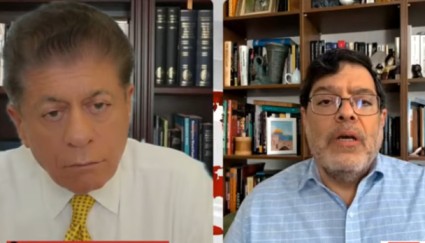
Editor’s Notes: In this episode of Judging Freedom, Judge Andrew Napolitano is joined by Professor Mohammad Marandi, who provides an exclusive “eyes and ears” report live from Tehran during a tense ceasefire. Professor Marandi, who traveled with the Iranian delegation to the recent negotiations in Islamabad, shares behind-the-scenes details about the atmosphere of the talks and why they ultimately failed to reach a breakthrough. The discussion also covers the current state of daily life in Iran, the strategic standoff in the Strait of Hormuz, and the potential for a global economic crisis if hostilities resume. (April 15, 2026)
TRANSCRIPT:
“Undeclared wars are commonplace. Tragically, our government engages in preemptive war, otherwise known as aggression, with no complaints from the American people. Sadly, we have become accustomed to living with the illegitimate use of force by government. To develop a truly free society, the issue of initiating force must be understood and rejected.”
JUDGE ANDREW NAPOLITANO: What if sometimes to love your country you had to alter or abolish the government? What if Jefferson was right? What if that government is best which governs least? What if it is dangerous to be right when the government is wrong? What if it is better to perish fighting for freedom than to live as a slave? What if freedom’s greatest hour of danger time is now.
Hi everyone, Judge Andrew Napolitano here for Judging Freedom. Today is Wednesday, April 15th, 2026. My dear friend Professor Mohammad Marandi joins us from Tehran, Iran. Professor Marandi, it’s a pleasure. Thank you for taking the time to be our eyes and ears in such a dangerous part of the world. Let me start by asking you, how are you? What is life like in Tehran during this so-called ceasefire?
Life in Tehran During the Ceasefire
PROFESSOR MOHAMMAD MARANDI: Well, thank you very much, Judge, for inviting me. It’s always an honor being with you. The situation in Tehran is more normal. There’s heavy traffic when you go out, and I made a couple of miscalculations because I was used to light traffic, and I almost missed an appointment on one occasion. So it’s almost back to usual. The traffic isn’t as heavy as it was, and of course businesses are much slower, but still it looks more like what it was before the war.
But people are quite aware that war could restart at any moment. We saw today that the Iranian armed forces stated that if the blockade carried out by Trump continues, Iran will block all shipping in the Red Sea, the Gulf of Oman, and the Persian Gulf. So people know that we could be going back to war.
And at night, people are on the streets. They continue to be on the streets across the country and in different parts of Tehran. Last night, when I went out to a studio to do an interview, on the way there, in multiple places, there were large crowds that had gathered, holding and waving the flag and chanting slogans in defense of the armed forces, the leaders, and condemning the United States under Trump.
Damage to Tehran
JUDGE ANDREW NAPOLITANO: What kind of damage did Tehran sustain now that you’re able to view it? Roads, bridges, hospitals, police stations, commercial areas, residential areas?
PROFESSOR MOHAMMAD MARANDI: Well, there has been substantial damage. Apartment blocks have been destroyed. Hospitals have been badly damaged. Banks have been damaged. Actually, not far from here, a bank was destroyed and apartment buildings above it as well. Excuse me.
But Tehran is a huge city. So if you drive around the city without knowing where the attacks, the airstrikes, the missile strikes took place, you probably wouldn’t see anything, or you may rarely see a place that has been wrecked. But there is damage. Since it’s a big city, you don’t see it easily. In my neighborhood, there’s only one building that’s like a 20-minute walk away from here, which was badly damaged. But other than that, there’s nothing visible as you drive around or walk around near where I am.
Essential Services and Daily Life
JUDGE ANDREW NAPOLITANO: All right, so the electricity obviously works since you’re communicating to us live right now. I assume water works. Do the police do their job? Does sanitation do its job? Are children going to school? Are universities open?
PROFESSOR MOHAMMAD MARANDI: Well, schools are not open. They’re online, and the same is true with university, because we could be back at war at any time. We are, after all, in a ceasefire. But other than that, yes, we have electricity 24 hours a day, we have water 24 hours a day, and we never actually had any problems during the war either.
On day one, when they bombed the school, the elementary school, and killed all those children and murdered the leader and carried out other attacks, there was no run on gas stations or in supermarkets or anything like that. And so right now, obviously, when it didn’t happen back then, it’s not going to happen now. So everything is normal, but of course inflation is up and some businesses are struggling, I’m sure, because of the lower demand under the circumstances. But again, if you walk around in Tehran, if you drive around, everything looks normal, but obviously life is more difficult, I’m sure.
What Happened in Islamabad
JUDGE ANDREW NAPOLITANO: Okay. What is your take? What is the Iranian take on what happened in Islamabad over the weekend?
PROFESSOR MOHAMMAD MARANDI: Well, on our way there at the airport, on the plane, and in the hotel in Islamabad, when I spoke to different members of the delegation and a couple of the negotiators, there was a very great deal of skepticism anyway. They never expected any breakthrough because of our past experiences before the 12-day war. We were negotiating and then Trump secretly was conspiring against Iran with Netanyahu to launch a war.
Before this war, the same thing happened. So no one here believed, no one on the delegation believed that there was a good chance of an agreement.
But the Iranians were willing to give it a try because obviously Trump is under pressure. The shortages of oil and LNG and fertilizer and petrochemicals and helium are obviously taking a toll, and things are going to get much worse soon. So they went to see if Trump is prepared to shift, especially since he agreed on the Iranian framework, the 10-point Iranian plan. True, later on, the White House spokesman said they threw it in the bin, but he did agree to it initially at the beginning of the war. He said unconditional surrender. And after 40 days, he reached the stage where he said he’ll accept this as the framework for negotiation.
So Iran went there to see if he is looking for an off-ramp or if he’s capable of looking for an off-ramp, but also to show the international community that we are here, we are prepared to negotiate. The problem is not on our side.
And then that’s basically what happened. During the negotiations, the Iranian team did not call Tehran. They had full authority. Dr. Goliba spoke with the leader, Ayatollah Sayyid Mushtaba Khamenei, extensively. He knew the framework of what was to be negotiated. But the other side was not prepared. On the one hand, Vance was surrounded by two Israeli firsters, but also he was constantly making phone calls. And one of those people who he was calling was Netanyahu, and Netanyahu himself said Vance reports to him, which is quite stunning for a tiny colony — the prime minister of a tiny colony to be saying that the vice president of the United States reports to him.
But I think that’s where the root of the problem lies. Netanyahu wrecked, and the Zionists wrecked, the negotiations, just like they wrecked the ceasefire, because we had a deal with the United States which included Lebanon. The Pakistani Prime Minister stressed this point, and then Trump said no, and that again was because of Netanyahu. And since Netanyahu is continuing with his genocidal attacks on Lebanon, Iran decided not to allow those extra number of ships to pass through the Strait of Hormuz during the last few days.
So what Netanyahu did by violating the ceasefire and forcing Trump to violate it, and also by wrecking the negotiations, he’s made the global economy suffer worse. And I think the coming recession and depression are going to hit faster and worse as a result.
Inside the Islamabad Negotiations
JUDGE ANDREW NAPOLITANO: You were in Islamabad with the Iranian delegation, correct?
PROFESSOR MOHAMMAD MARANDI: That’s right.
JUDGE ANDREW NAPOLITANO: And tell us about the atmosphere. I mean, did Vice President Vance sit across a table from either Foreign Minister Araghchi or the Speaker of the Iranian Parliament, and did they speak face to face, either in English or Farsi or both, with translators?
PROFESSOR MOHAMMAD MARANDI: There were translators. There were also the Pakistani mediators. On one side was Vance and Kushner and Witkoff, and on the other side it was Dr. Golibov, the Speaker of Parliament, who’s also a colleague of mine at the University of Tehran. He’s an associate professor. The Foreign Minister, Araghchi, and also Dr. Bagheri, who is another academic, and he is the Deputy Head of the Supreme National Security Council. He was the person who negotiated 4 years ago the nuclear program in Vienna.
Were the Iranians Duped?
JUDGE ANDREW NAPOLITANO: How did the Iranians even permit the 2 Israeli agents who had duped them in June and in February to even be in the room?
PROFESSOR MOHAMMAD MARANDI: I don’t believe that the Iranians were duped. I think that’s a myth, really. The Iranians knew that before the 12-day war, that the Israeli regime and the Americans were going to strike. But just like this time around, they wanted the international community and ordinary Iranians to know that they tried.
Of course, Iran didn’t know when they were going to strike or how they were going to strike, and they miscalculated probably about who they were going to strike, and that’s why so many generals were murdered during the first day of the 12-day war. But the Iranians knew there was going to be an attack. Again, they wanted everyone to know that Iran was not — because if Iran had not negotiated, one of the narratives that the West, the United States under Trump, would have put out — and of course even Trump’s opponents, because the empire, the different factions, they have the same policy towards the empire — they would have all said, “Well, if Iran had only negotiated, this may not have happened.”
So Iran wants to make sure they have no excuse. And then for this war, the same was true. So Iran wasn’t duped, but Iran wanted to make sure that people saw that Iran was at the table. But also Iran wanted to provide a potential off-ramp to Trump. Trump is unwilling or incapable of taking an offer.
Key Issues on the Negotiating Table
JUDGE ANDREW NAPOLITANO: Were offers exchanged back and forth? I mean, did they discuss issues like nuclear enrichment, Iran’s ballistic missiles, the Strait of Hormuz?
PROFESSOR MOHAMMAD MARANDI: I don’t think that the Iranian missiles were discussed, but the nuclear program, the Strait of Hormuz, and other things were discussed. The interesting thing was that despite Iranian skepticism, during the first half — or more than half — of the negotiations during the day, some progress was made. There were arguments and disagreements, but progress was made.
But near the end of the first day, suddenly the United States took a very hard position and their behavior changed, and it was reaching a dead end. And then they were supposed to have further negotiations the same day, but Vance, as we all saw, went and gave out a statement and left. He implied that Iran insisted on making nuclear weapons, which is of course not true. Again, Joe Kent’s resignation letter clearly indicates that Iran was not and is not pursuing nuclear weapons. This is just an excuse to justify their behavior.
And then he said Iran didn’t accept our demands. Well, of course Iran won’t accept demands because the United States didn’t win the war in order to be able to impose its demands. The negotiating table is to find solutions, not to dictate terms. And the Iranians feel that they won the war, they and their allies, and that Vance should have been serious, but he wasn’t.
But the Iranians believe that Vance did not have the authority. The fact that he constantly had to make phone calls, whereas the Iranians didn’t have to do so, showed that he was not the person who had the authority to be able to make decisions. And obviously his phone calls were preventing him from making any real productive decisions.
The Nuclear Enrichment Dispute
JUDGE ANDREW NAPOLITANO: The Western press, Mohammad, has reported that the United States demanded no nuclear enrichment — that Iran not engage in nuclear enrichment — which, as you and I know, they have a legal right to. But this is what the U.S. demanded for 20 years, and Iran offered 5 years, and it sort of stopped at that. Is that your understanding? U.S. demanded no enrichment for 20 years, Iran agreed no enrichment for 5, and it never got any farther?
Iran’s Nuclear Stance and the Path to Negotiations
PROFESSOR MOHAMMAD MARANDI: Well, the disagreements covered different areas. It wasn’t just nuclear enrichment. And we have to remember that the Americans accepted the Iranian framework for negotiations, and that for Iran is key. And one of the things that Iran will not accept is ending enrichment. Iran will not accept ending enrichment. It is willing to compromise and to give assurances that its nuclear program— even though Joe Kent’s statement reveals that this really never was an issue, it’s just an excuse.
But just like in the JCPOA, Iran is willing to put a cap on enrichment for a period of time, but it’s not willing to give up its sovereignty. That’s just not going to happen. The revolution, the Islamic Revolution, was about sovereignty. It was about independence. It was about dignity. And so the expectations of Trump and his colleagues are unrealistic.
I think it’s basically because they’re being either forced by Zionists to make these foolish demands, or they believe the fake intelligence or information or analysis that these Zionists are giving to them. And they think that if they try to bully Iran, that Iran will capitulate, but they can’t get anything at the negotiating table that they couldn’t get on the battlefield.
And there’s a good book, Judge, I’ve said this elsewhere too, a very good book called Going to Tehran, written by two former White House officials, Flint and Hillary Mann Leverett. And in the book Going to Tehran, they deal with a lot of the myths that exist in the United States, in the Western media, and in Western think tanks about Iran. But they also explain why the United States has to move towards rapprochement.
If American officials, instead of attacking these two authors — because they were hammered by the Democrats and the Republicans, all the think tankers — if they had read the book and listened to these two very knowledgeable people who worked under Condoleezza Rice in the White House, we wouldn’t be where we are today, and the world wouldn’t be rushing towards the cliff which is going to lead us to a global economic depression.
The United States, by listening to the Zionists, is being misled. It’s going down the wrong path, and it’s definitely not going to get its way with Iran.
The Strait of Hormuz: Who Controls It?
JUDGE ANDREW NAPOLITANO: What is the status of the Strait of Hormuz as we speak? Who controls it? What’s going in? What’s going out? Are the Iranians still collecting a toll? Are the Americans stopping ships that Trump wants stopped? What’s your understanding? Because we can’t seem to get a straight answer on that from the press here in the West.
PROFESSOR MOHAMMAD MARANDI: Well, not much is getting through the Strait of Hormuz, obviously, because on the one hand, the Iranians have imposed major limitations, and on the other hand, so have the Americans. So in an odd way, the Iranians and Americans are cooperating to keep it shut. But that is not going to help the United States. It’s only going to make the global economic crisis worse, faster than before.
Also, the Iranians have said just hours ago, as I said at the beginning of the program, the Iranian military has announced that if the United States does not lift the blockade, Iran will block all shipping in the Red Sea, in the Gulf of Oman, and in the Persian Gulf. And that, I think, is going to be a major, major move by the Iranians.
Obviously, Iran is going to do it with missiles and drones. So ships that go through — if, when the Iranians make the decision — ships that go through the Red Sea will be struck by Iranian missiles or possibly drones. And the same would be true in the Sea of Oman. And that will drastically make things worse. And again, it will push us much more swiftly towards economic, global economic catastrophe.
The Risk to Chinese Tankers and Global Isolation
JUDGE ANDREW NAPOLITANO: What happens if a Chinese tanker tries to get through? Is the US Navy going to board it and stop it?
PROFESSOR MOHAMMAD MARANDI: I don’t know, Judge, but one of the things that is happening is that the entire world is seeing that this looming economic catastrophe is being imposed upon them by the President of the United States and the Prime Minister of the Israeli regime and the Zionist lobby. And they’re going to have to take the blame. It’s going to isolate the United States.
By threatening countries across the world and warning them that they’re not allowed to do business and trade, and that their economies will have to suffer as a result, it’s not going to do the United States any good. It’s not going to do the Israeli regime any good either — they’re already despised across the world for the genocide in Gaza.
And now the ongoing genocide in Lebanon is truly horrific, what they’re doing in Lebanon, just like what they do in Gaza — targeting medics, bombing apartment blocks. Western media tries to hide this by saying they’re bombing Hezbollah strongholds and Hezbollah targets. They know they’re dishonest. There are journalists in Beirut. A couple of them, when I argued with them, they said, “I didn’t write this, our editors did.” But that’s no justification. They’re complicit in these atrocities by allowing people to be misled that these are military targets. They are flattening apartment buildings and slaughtering people inside, across the country.
But in any case, people are already coming to despise the regime. And now people across the world, even in India, which under Modi has been close to the Israeli regime, they’re suffering as a result of policies by Netanyahu. So I don’t think that this policy and the attempt to bully China, among others, is going to do the United States any good.
Iran’s Oil Reserves and the Looming Economic Cliff
JUDGE ANDREW NAPOLITANO: Let’s get back to Hormuz. Are any ships getting through that Iran wants to get through?
PROFESSOR MOHAMMAD MARANDI: Well, until yesterday, all of the Iranian ships were going through, and I think there was a rush during the final few hours to get as much out as possible. So it’s not really something that’s currently a concern to Iran. But again, if this goes on, the Iranian military has said that they’re going to shut down the Red Sea.
One thing that I should point out, which both shows that we’re approaching a global economic crisis very rapidly, but also shows how strong Iran’s hand is, is that for the last few months, since the US has been building up forces and the price of oil and energy has been going up, Iran’s sales have gone up. And then during the past 40-some days, Iran has been selling oil and making a lot of money.
Also, Iran had around 200 million barrels of oil in tankers on the seas. Half of that has been sold, and the other 100 million will be sold in the coming days. But the big issue is that the oil on the seas is running out. So we are really swiftly approaching a cliff.
Trump thinks that by manipulating the markets and making statements every now and then, he can keep the prices down. He can do that for a while, but the reality is that pretty soon things are going to get much worse. What we’re seeing right now is just the tip of the iceberg.
American Troops Near Isfahan and Iran’s Military Readiness
JUDGE ANDREW NAPOLITANO: Well, how did the Iranians feel when American troops were on the ground near Isfahan trying to steal Iranian enriched uranium?
PROFESSOR MOHAMMAD MARANDI: They were confident that they would fail. The Iranians had already been prepared for the Americans, and they’re prepared for any escalation in the Persian Gulf. And time is really not on the side of the Americans, Judge. You know this region well. In a few weeks, it’s going to get very warm and humid in the Persian Gulf and the Arabian Peninsula, with sandstorms. And US assets are not well protected because they were rushed in very suddenly. It was supposed to be a 2-day war.
So time is not on the side of those who want to carry out aggression. And right now, as we speak, the Iranians are preparing themselves for the next phase of the war. It’s not as if the Iranians are on vacation. The military is working 24 hours a day to prepare itself for the next phase. And I think if the Iranians begin striking ships in the Red Sea, that will be an entirely new phase of this war.
Western Media Myths: Iran’s Internet and the Islamabad Delegation
JUDGE ANDREW NAPOLITANO: So the American media — one of them is reporting as follows. It’s been more than — this is ridiculous, but I’ll read it. “It’s been more than 45 days since Iran’s internet went dark. And the Iranian regime is burning through millions in costs per day to keep 92 million people offline.” Yet here we are, you in Tehran, electricity working, internet working, and we’re having a conversation as if we were sitting in a cafe with each other.
PROFESSOR MOHAMMAD MARANDI: Well, what they say is not entirely untrue. During the war, there was a strict — people in Iran had access to the internet, but only for Iranian websites and Iranian social media and Iranian apps, for security reasons, because they didn’t want images of places that were bombed to be sent out. Also, cameras were being hacked and used by Western intelligence agencies to wage war against Iran and to use Iran’s own business infrastructure for their needs.
I initially had to go to a studio, but now I do have access to the internet from home. But I think it is gradually going to open up, unless there is another war — and if that happens, I guess it’s going to shut down. This is an issue about security. It’s not about freedom.
Iranians — first of all, many people at home, most people at home, have satellite dishes. They get all the Persian language propaganda channels that the West funds, and they get that information. People in Iran know what’s going on. And millions are on the streets. Before the war they had the internet.
But one thing that I’d like to add about Western media, and how the Western media likes to demonize the regime, as they call it — The Washington Post, when we were, I think, either on our way to Pakistan or when we had arrived, put out an opinion piece where it said the United States should assassinate — or probably the Israelis should assassinate — the negotiators.
And now we see a sort of competition in carrying out crimes against humanity between the press and the political establishment — the Trump regime itself. In Pakistan, we felt threatened, and the delegation believed that on the way back to Iran, there was a very good chance of the plane being hit by a missile. Of course, everyone boarded the plane. No one asked to stay in Pakistan.
The plane came and landed in Mashhad, near the border — instead of going to Tehran, they landed near the border between Afghanistan and Turkmenistan. And then we came to Tehran by land — about a 1,000-kilometer drive. I came by train.
But the point is, this is what the Western media is. They’re all controlled by the oligarchy, the Epstein class, the powerful Zionists. So whatever they say about Iran is propaganda from my perspective. And that’s why I think people should read that book, Going to Tehran, because it does bust many of the myths. These two experts, who are both academics, who’ve been to top universities and who had important jobs in the White House and elsewhere — I think their book is a very good read and would be very valuable to people who want to understand the real nature of the relationship between Iran and the United States.
Closing Remarks
JUDGE ANDREW NAPOLITANO: You have been very valuable to us, Mohammad, my dear friend. Thank you for your intellectual honesty and your personal courage. Thank you for being our eyes and ears. Be safe, be well, my dear friend. We’ll talk to you again soon.
PROFESSOR MOHAMMAD MARANDI: Thank you, Judge. You are valuable to the entire world, and I’m very grateful to you, and God be with you.
JUDGE ANDREW NAPOLITANO: Thank you. God be with you as well. A great man and a most eye-opening conversation. Coming up later today at 1 o’clock this afternoon, Pepe Escobar. At 2:15 this afternoon, Professor Glenn Deason. At 3 o’clock this afternoon, the great Phil Giraldi. Judge Napolitano for Judging Freedom.
Related Posts