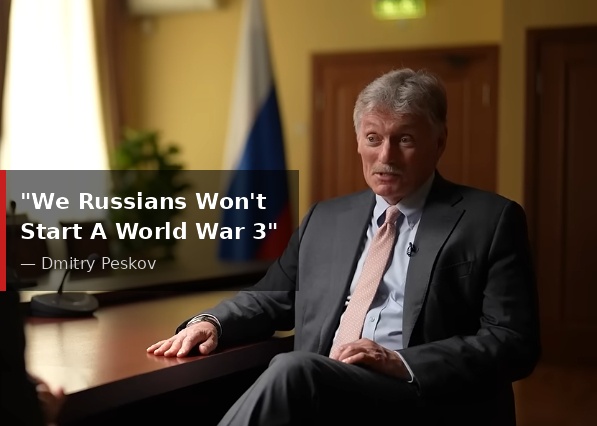
Editor’s Note: In this wide-ranging interview with Die Weltwoche, Kremlin Press Secretary Dmitry Peskov discusses the ongoing conflict in Ukraine, characterizing it as a “full-scale war” fueled by Western involvement. Peskov argues that Russia is not the initiator of a third world war but warns that the continued militarization of Europe and neglect of Russia’s security concerns are creating a dangerous environment. He emphasizes that Russia remains open to dialogue, expressing a hope that future generations of European leadership will adopt a more constructive approach to restoring security and cooperation. The following is the full transcript of the interview:
Introduction: Who Is Dmitry Peskov?
ROGER KÖPPEL: Dmitry Sergeyevich Peskov, you have been born on the 17th of October 1967.
DMITRY PESKOV: Exactly.
ROGER KÖPPEL: You are a diplomat from a diplomatic family.
DMITRY PESKOV: Originally, yes.
ROGER KÖPPEL: Right, you have a special field and special interest Asian and African countries, and since—
DMITRY PESKOV: I graduated from this.
ROGER KÖPPEL: Right. And since 2012, you are the press secretary of President Putin. Is that correct?
DMITRY PESKOV: Well, actually, I started to be a press secretary to Prime Minister Putin in 2008.
ROGER KÖPPEL: Okay.
DMITRY PESKOV: Yeah.
ROGER KÖPPEL: So your way is even longer than—
DMITRY PESKOV: And I started to work in presidential administration at the year of 2000.
ROGER KÖPPEL: Okay, so welcome to our program.
DMITRY PESKOV: You’re welcome. Thank you. My pleasure.
ROGER KÖPPEL: Grüezi, as we say in Switzerland.
DMITRY PESKOV: Thank you.
From Special Military Operation to Full-Scale War
ROGER KÖPPEL: You’ve said something very interesting the other day and probably also alarming. You said that this military special operation is beginning to look like a full-scale war. War. And with all the people I speak here in Moscow, they all reflect and think, how did you mean that? What’s behind this? What does this change of tone exactly mean? When did you start to talk about the situation as being a full-scale war?
DMITRY PESKOV: We have started to talk about that a couple of years ago. Actually, as a beginning and originally it was meant as a special military operation against Kiev regime with certain goals. Kiev regime started to become a center of anti-Russian efforts of Europeans, of the Americans, and whatever. So it was about to be swollen by NATO. It was about to be infiltrated by foreign military regiments. It was about to be a country that would grant its soil for deployment of any kinds of weapons aimed at our country.
So we were speaking about that threat for quite a long time before starting the military operation. No one would listen. None of the European capitals would listen to us. Biden administration would never listen to us.
And of course, from the very beginning, we would have preferred to solve the problems through political and diplomatic means, but unfortunately, we were given no chance. And when we understood that, a correct decision to start the military operation was taken.
You would probably recall that we were about to reach an agreement with the Ukrainians. There were days that we were standing next to the Kiev walls. And the agreement was prepared, the agreement was agreed upon, and the agreement was verified by parties concerned — each paper of that agreement, each page.
ROGER KÖPPEL: April ’22 in Istanbul. Yes, exactly.
DMITRY PESKOV: So, and at that time, London interfered. Major called Zelensky and asked him not to sign the paper. So then, at the same time, Kyiv said that we would prefer not to sign a paper having a gun against our head. So would you please do a step of goodwill before signing the document? And our president ordered our troops to be withdrawn from Kyiv region.
ROGER KÖPPEL: That is an interesting aspect. You might elaborate on that. What was exactly the reason? Why you withdrew the troops from Kiev at that particular moment in time?
DMITRY PESKOV: Because we were about to sign a document, a mutual document, and the Ukrainian side asked us to make a step of goodwill because they didn’t want to sign the paper under, let’s say, crucial pressure coming from Moscow. Who cares? Okay, President Putin had met it with understanding and he ordered withdrawal.
So this was the direct interference of Great Britain in these affairs. And this was the first time when a European country proved to be a supporter of war, not a supporter of peace.
After that, lots of European countries found themselves directly or indirectly involved in this war. They’re sending weapons, they’re supplying with the ammunition Kyiv regime. They’re supplying Kyiv regime with their military advisers. They’re supplying Kyiv regime with satellite surveillance results. And so they actually give their satellites in a total disposal of Kyiv regime. They target the weapons, Ukrainian weapons, by their satellites. They’re using their artificial intelligence, AI, in order to facilitate the military activities of Kiev regime. If it’s not a direct involvement, what’s that?
So, and having Russia from one side and having Kiev regime plus a number of European countries and plus the United States that is supplying millions of tons of weapons to Ukraine — what it is, it’s not operation anymore, it’s a war. It’s a full-scale war.
The Dangerous Cycle of Escalation
ROGER KÖPPEL: But this is a term you didn’t use before, so that means we are somehow in a new—
DMITRY PESKOV: No, we use it. We have used it a couple — well, 2, 3 years ago we started to—
ROGER KÖPPEL: But what would you say — how would you assess what is the current situation? It seems to me, and I’m very much concerned, that we are in a very dangerous situation. You could say in a vicious cycle of escalation. We have the Ukrainian side, which is heavily armed and supported with taxpayer money and weapons from the West, as you said.
They are escalating the war into Russian territory, causes difficulty, the people talk about it. And then there is the pressure, of course, on the Russian side. How do you answer that? And this is like this terrible situation of escalation, as we know from history, escalation opens the door to hell. Where do we stand? How do you assess the situation? How dangerous? In what kind of dangerous chamber we are right now?
DMITRY PESKOV: Well, the war is dangerous all the time, and the military activities in the center of Europe is a very dangerous thing. Especially it is dangerous when at least one side of the story is being provoked by European capitals for continuation of this war. And Kiev regime is being provoked. They still think, European countries, that they can defeat Russia, strategically defeat Russia. This is the greatest mistake ever. This is the greatest mistake ever. And that’s why Kiev regime is not that flexible in terms of choosing the political and diplomatic means for the solution. What has changed since the last year?
ROGER KÖPPEL: When I was seeing you, when I was seeing President Putin, when I was at certain conference, one had the idea that with the coming of the American president, there was some kind of hope that an agreement could be found. But now coming back to Russia, it feels to me the situation has gravely deteriorated. There is also a much more gloomy atmosphere, I would say, from the people I talk to. And the beams of hope seem they have evaporated.
DMITRY PESKOV: Well, of course, people want the war to come to its end. And people would prefer peace, not the war. But they would all demand that the peace comes with victory. This is the crucial difference.
ROGER KÖPPEL: On all sides?
DMITRY PESKOV: On all sides. Well, I don’t know. I cannot speak for Ukrainian side. So their position is deteriorating day by day.
Europe’s Militarization and the Brainwashing of Taxpayers
ROGER KÖPPEL: There are people, for example, like Mr. Karaganov. I know, of course, that his views are not shared by your government, but there are people from the military, there are people in the public sphere who say they expect the Russian president to take big decisions to escalate the war even into the territory of European supporters. I’ve heard from Senator Pushkov that there is a list of 120 European companies that are considered legitimate war aims. Now, in Europe they say this is totally out of the question, this is typical Russian propaganda, they will never escalate, and they think that with every drone strike to Russia, the chances for peace get closer. How would you comment this European perception, which I think they are really convinced that this is the situation? What is going on in Europe?
DMITRY PESKOV: Europe all of a sudden understood that they are not anymore guaranteed from the point of view of security by the United States. And that they have to add a military capacity to EU, to economic bloc. And now we are witnessing a transformation of EU to an economic and military bloc. This is a brand new, brand new, brand new process on European soil. And of course, we were monitoring it very closely because for us it’s extremely important and will take us to apply additional measures for ensuring our national security.
In his first term, Trump was trying to make Europeans to spend 2% of their GDP, annual GDP, for the purposes of defense. And now, without any insistence coming from the United States, Europeans are spending about 5%. Lots of capitals are spending about 5% of their national GDP. If it’s not militarization of Europe, what is it? It is.
To persuade your taxpayers that you have to spend their money for weapons instead of spending it for hospitals and for schools, for healthcare — what would you create? You would create an evil. Is there better evil on European soil than Russia for Europeans? No. We are perfect evil. So it’s a brainwash of European taxpayers. They’re being brainwashed for 100%. A theory of danger for all of them is being exploded for 100%, and they’re paying billions and billions, billions of euros for purposes of defense, for purposes of supplying Kyiv regime. To continue the war, as we say, till the last Ukrainian.
I beg your pardon. They start to feel extremely uncomfortable with the Ukrainians. Now they’re not going to grant them asylum if they can be on the front on the war. Now they’re trying to reduce their salaries and so on and so forth. So they started to be uncomfortable with the Ukrainians. But Ukraine and Kyiv regime is a perfect tool to continue the war with Russia.
Russia’s Western-Minded Diplomat and the Question of World War III
ROGER KÖPPEL: You know history, of course, and I know that you are one of the most Western-minded diplomats of Russia. That’s your reputation. Everybody tells me, says, Mr. Peskov, he’s actually a totally Westernized personality and he’s disappointed, of course, of how things are going. You know the history.
DMITRY PESKOV: You know, Russia lies on the West and the East, so that’s why a word for a Russian that he’s westernized is quite relative.
ROGER KÖPPEL: Okay, okay. Well, I would see it as a compliment. I would see it as a compliment. It’s meant in a positive way. But history, again, how close are we to World War III? This is the question that concerns me most. I’m looking back 1962, the 13 days of the Cuban Missile Crisis. Kennedy and Khrushchev, they telephoned at last, they could prevent Armageddon. What’s your honest assessment? How close are we to such a kind of hellish perspective?
DMITRY PESKOV: Russia is too big and too responsible country to be an initiator of a Third World War. United States knows the possible consequences of the war as well. Plus, we have relatively good dialogue. We’re not good in our bilateral relations because they’re stuck. They’re on a zero-level bilateral relations. But despite that, we are clever enough to talk to each other, and we’re too big and too powerful in terms of mutual deterrence to be at war.
But there is Europe, and there are lots of crazy things in the heads of European politicians. For example? That Russia should be defeated strategically. We have to spend more and more money for our defense. And trying to spend more and more money for our defense, they are trying to get closer with their military infrastructure to our borders. Will any country tolerate that? No. A country will take measures of precaution. We’re going to do the same. We’re going to ensure our security, but we will never start a Third World War. We never started. Remember the history. But when it was started against us, we responded till the end.
The Ghost of Operation Barbarossa
ROGER KÖPPEL: Strategically weaken Russia. This is an interesting term. I was reading a few books for the 22nd of June, you know, the 85 years of Operation Barbarossa, the attack of the German Wehrmacht. And I don’t know whether I should say that in conversation with a Russian high-ranking official, but when I hear “strategically weaken Russia,” it reminds me of some very scary narratives in European, in Western European history, of course overblown with racist rhetoric of Nazi language, but where like similar conceptions came up, you know, they were saying, yeah, we have to cut the Soviet Union apart, we have to push the Russians down, in order to get hold of their natural resources, but they should not function as an independent power.
I hate to say it, but there are American generals today talking in a very similar way. And I was just interested in how you, as a Russian, when you hear “strategically weaken” — does this film of history always also go in your mind, gets it activated that you think, “Here we go again, we are back somehow in history.” This is sometimes the impression I get.
DMITRY PESKOV: What would you say? Well, history unfortunately has a bad habit of repeating itself in a little bit modernized way, but repeating itself.
ROGER KÖPPEL: And sometimes farcical. Well, of course, we would—
Europe, Escalation, and the Nuclear Doctrine
DMITRY PESKOV: I would like not to see any situations like it was in the middle of ’30s of previous century. But lots of things very much alike are happening right now. And what we see, the process of militarized Europe and the process of creating an enemy in our face. Of course, it disturbs us. It’s an issue of disturbance for us.
ROGER KÖPPEL: I mean, President Putin, you know him for a long time, and some of the leaders of the European Union, let’s talk about President Macron and others, he knows them for years. They had a great relationship not many years before. Tell me, how disappointed is your president about some of the leaders in the European Union at the moment? Who can he trust? I mean, if you say Europe is a special— is Europe probably your enemy at the moment? I don’t know, you might explain, but who can you trust and how big is the disappointment in your leadership?
DMITRY PESKOV: Before trusting someone, you have to start talking to him. So the question is not about trust at this stage, it will be on a further stage. And I have no doubt that we’ll come to that stage because everything is repeating itself. So after a very harsh confrontation, there will be new generations of European politicians. There will be wiser people in terms of politics. And we’ll come to an initial start of dialogue because otherwise we will not be able to create a new architecture of security in Europe. And then there cannot be any Ukrainian solution without a new architecture of security.
ROGER KÖPPEL: Do you consider the European position at the moment, do you consider this as a temporary confusion which will be overcome soon? I mean, we see a lot of changes on the political landscape. Some of the leaders are not in power anymore. Are you optimistic that new governments will come in Europe, that the people, millions of people in Europe, they don’t want to have conflict with Russia? How do you assess these developments?
DMITRY PESKOV: A current generation of politicians in Europe, we can hardly imagine that they will initiate any dialogue with Russia. We have a reason to believe in that. We have a certain knowledge to understand that it can hardly be possible. But at the same time, time is changing everything. Sooner or later we’ll see new politicians in Europe, new leaders in Europe. Who knows, maybe they’re going to be more open for a dialogue because one cannot solve difficult problems without a dialogue.
Is Europe the Enemy?
ROGER KÖPPEL: At the moment, would you say that Europe actually is the enemy in this war, that you are fighting this war not against Ukraine and the Ukrainians, but against Europe, against Germany, France, the supporters?
DMITRY PESKOV: Well, we are fighting with the Kyiv regime that is being backed by lots of European countries.
ROGER KÖPPEL: And what does the escalation mean for your government if you see that there are drone strikes in Moscow? It’s an initial burden.
DMITRY PESKOV: It’s an initial burden for us, but we are powerful enough. We have adapted ourselves to the new conditions of this war with our economy, with our way of taking decisions. And that’s why we can afford continuation. And given the situation on the fronts, we are quite optimistic. We’re going further.
So, from one hand, you see these drone strikes. It’s a new characteristic of a modern war. Technologies are developing very fast. Every second month, you see new technologies on this war, and it’s a different economy of the war. Now you conduct a war with the drones that cost a couple of thousands of dollars instead of using a tank that costs, let’s say, $20, $30 million. So this is the difference. It’s a huge difference.
And of course, those technologies are coming to Kyiv from all over Europe. But it’s a very harsh competition, but we are in a position to compete. And what is of most importance for us, that on the fronts we are expanding our positions, and it’s quite positive. We’re going further.
The Nuclear Question
ROGER KÖPPEL: When I talk to people in Moscow in other recent days, I ask them, how do you see the chances of escalation? Some people say, well, they talk to military officers, they’re already of the opinion that Russia sooner or later should even use tactical nuclear weapons. This is something, of course, the rhetoric of Mr. Karaganov. But then there are other people also who say no, President Putin is achieving its goals on the battlefield without this kind of heavy escalation. So there is no need strategically, militarily, it doesn’t make sense to expand the war in this sense because this would open the Pandora’s box with unforeseen consequences. Who is closer to the truth?
DMITRY PESKOV: We have our nuclear doctrine, and it stipulates the conditions for the usage of nuclear weapons. It’s very bold, it’s very understandable, and it’s very simple. If something endangers the idea of existence of Russian state, then nuclear weapons will be used. Otherwise, no. It’s very important to understand that. So the rest of the statements are speculations.
We can’t afford continuation of the operation with the positive results for us without that. And we’re doing that. So only a couple of days ago, our military reported about taking a very important city in Donbas. Konstantinovka. It was prepared to be an untakeable fortress since 2014. And despite that, they managed to take it, and now they’re going to take another two important cities. It’s Kramatorsk and Sloviansk. After that, the whole territory of Donetsk Republic will be taken.
Russia’s Conditions for Peace
ROGER KÖPPEL: I mean, this is a question that will be liberated, as we say. That is a question that arises in the West. Of course, you have communicated this a lot of times— but still, at what point will Russia settle for peace? What has to be achieved? What is essential for you and which is probably not fully understood in a Western, in a European audience?
DMITRY PESKOV: Given the line for endangering our bordering regions that is being pursued by the Kyiv regime, we have to create a buffer zone. And the more, as President had said, the more Kyiv regime will try to have strikes on our territory, the bigger this buffer regime is going to be created. At the same time our military, they are advancing on different directions in order to create this buffer region, a zone of security for our borders.
ROGER KÖPPEL: So it depends a bit on how much they expand and the whole— Of course, yes. You said that this is a war against the Ukrainian regime and the supporters, of course, behind them. If now a Ukrainian mother would sit in this room and had lost a boy, like many Russian mothers have lost their boys, what would you say to this Ukrainian mother? What would your message be?
DMITRY PESKOV: Zelensky came to power promising his people to stop the war. That was his initial promise, and he still can stop the war taking very responsible decision to withdraw his troops from Donbas, from the regions that are now Russian regions, to acknowledge the situation that is de facto acknowledged as a de jure. And the next day the war will be over. They should ask their president — whose legitimacy now can be asked, whether he is really legitimate or not.
The Zelensky Relationship
ROGER KÖPPEL: President Zelensky is an interesting topic. I’ve heard that the first meeting of President Putin and President Zelensky — In Paris, it was. I think so, one of the first, or that was the first. They actually had a very good meeting. Is that true that the relationship initially between President Zelensky and President Putin was excellent? Do you feel somehow betrayed by President Zelensky, or how did that relationship deteriorate?
DMITRY PESKOV: No, then in Paris it was a discussion of Minsk agreements, and there was a draft of a joint statement that was agreed upon by the experts prior to the date of meeting. And the moment they sat on one table — there was Merkel, Hollande, Putin, and Zelensky. And Zelensky started to argue about this joint statement. About the text. So Putin asked him, “Listen, our experts were working on that for one week before the day we met. Why are you arguing on that?” And that was the first experience. Quite a striking example.
Was the Military Operation a Mistake?
ROGER KÖPPEL: I mean, one can never go back in history, but in light of everything that happened since February 2022. My impression is that Russia miscalculated, that your leadership thought this war will be over very soon. Probably we will have the negotiation which happened in April ’22. Probably also underestimated the Western determination to support Ukraine. You underestimated the resistance from Ukraine. I mean, this is just my impression from outside. You may correct me immediately. But the question is, in light of everything that happened, would you say it was worth it? Was it important? Was it necessary, this military operation which turned into a war? And which is now in a state of probable escalation which could even unleash hell, at least in Europe? Was it worth it, or wasn’t it a mistake by Russia, being the bigger and in that sense the more responsible power?
DMITRY PESKOV: No, it had to be taken, this decision. It had to be taken due to the experience of negotiating with the European capitals and with the United — So as soon as you understand that no one would listen to you, you take firm steps.
Overcoming Hatred: Russia’s Communication Challenge
ROGER KÖPPEL: I have a book here by a famous Russian writer who lived very close to our office in Zurich, in Zollikon. It was Ivan Ilyin. He lived in a house like 400 meters from our office building, and he said it’s very important to look at the world through your heart, not just through your mind. And what you just said, Mr. Peskov, was it from your heart or was it the press secretary, the press officer of the Kremlin speaking?
DMITRY PESKOV: Both. Both. Of course.
ROGER KÖPPEL: And Ilyin also wrote — it’s fascinating. I think it’s even — he’s in the poison box — in Europe you shouldn’t read Ilyin, but he’s very interesting. And he writes about hatred, and he says sometimes when you’re hated by someone, how can you overcome hatred? How can you overcome this kind of extreme existential conflict? I have a double question for you. What is your explanation that there is so much negative energy against Russia and that it’s so hard for Russia to get through its message and make its point? What stands behind that? That’s the first question. The second question is: What can Russia do today in overcoming this circle of negative emotion, of escalating — let’s call it hatred or whatever you want to call it — what can you do?
DMITRY PESKOV: Russia is too big to be invisible for Europe, and Europe prefers to pay extra attention to Russia, and it’s very comfortable for them to create a danger out of Russia. So you can spend more money, you can close your eyes on certain crisis elements in your economy, blaming everything on Russia, and so on and so forth.
Plus, I would say that the current generation of politicians in Europe, they are very populistic, and the easiest way to provoke feelings of hatred in your electorate is to insist that this is the main enemy and we have to all be united, we have to create our defense identity, we have to spend money for that, and so on and so forth. Plus historical traditions, plus history is repeating itself, plus this is kind of revenge that some powers in Europe are trying to take.
And why do modern Europeans close their eyes on those Nazis in Kyiv streets? Why are they closing their eyes on the Kyiv regime trying to make heroes out of those Nazis who used to be involved in killing of hundreds of thousands of Jews, Poles, Russians and so on and so forth? How come? But they close their eyes. We cannot understand it.
ROGER KÖPPEL: And you are like the chief communicator of Russia. What is your —
DMITRY PESKOV: No, we have lots of —
ROGER KÖPPEL: Well, you have a lot of them, of course, but you —
DMITRY PESKOV: Chief communicator of Russia is President Putin.
Russia’s Strategy: Power Commands Respect
ROGER KÖPPEL: Sure, but you’re in a very important position. What is your strategy? I mean, I have the conviction that history is ruled by misunderstandings. It’s not evil will. I don’t believe in conspiracy theories. I don’t believe that, let’s say, the Europeans are genetically or somehow historically, metaphysically against Russia. I think an important part, of course, is the history of the Soviet Union, which still reverberates and the people, especially in Eastern Europe, they haven’t overcome it. They start to confuse things. They are afraid of a big country, of a sovereign country, which is ruled by a very strong leader. But still, it’s always a misunderstanding. The people have so many wrong conceptions. What is your strategy? Or what is your strategy not to despair?
DMITRY PESKOV: Well, number one is to be powerful enough to withstand the competition and confrontation. This is number one. If you are powerful, you are respected. Even if they are afraid of you, they would respect you. So America is not that popular in Europe, but all Europeans are ready to listen to the words “I’m your boss today.” They show respect because America is powerful. So we are powerful and will continue to be powerful.
ROGER KÖPPEL: What would you say is the —
Russia’s Message to Europe: Dialogue, Respect, and Open Eyes
DMITRY PESKOV: This is number one. Number two, we’ll continue to be open for the dialogue. We’ll continue to be open for the dialogue and we’ll continue to expect that after saying 1,000 times President Macron will take a telephone and call President Putin, not just repeating that “I will call Putin in a week, I will call Putin in a month, and I will call Putin in one year.” So we’ll be very patient and wait until it is done.
ROGER KÖPPEL: Do you get telephone calls from Macron, from Merz behind the scenes we don’t know about?
DMITRY PESKOV: And plus to that, we’ll continue to explain ourselves, we’ll continue to use media, we’ll continue to use all modern technologies of communications to convey our point of view to those coming generations of European politicians.
Trump and the Prospect of Dialogue
ROGER KÖPPEL: Is Trump, the American president, is he for you a silver lining on the horizon? I remember an interview he gave in 2017, a striking interview by President Trump before the Super Bowl final with Bill O’Reilly from Fox Television. And Bill O’Reilly asked Trump, he was hardly in office, he said, “What do you think about Putin?” And then Trump gave the surprising answer for an American president, I thought Republican, he said, “Well, Bill, I respect him.” And then Bill O’Reilly was shocked. He said, “What? You respect him? But this man is a killer.” And then Trump said, “Well, he might be a killer, but you know, Bill, there are many killers out there, and don’t you think that we as Americans are so innocent?”
And I thought at the time, what a statement. I mean, from a Republican American president, 2017. And I thought this could be a chance of a better mutual understanding between Washington and Moscow, because as you well know, there are totally different American guys. They’re speaking differently of your president. So how do you assess the American president? Are you disappointed by him? Have you thought he could deliver more, in the spirit of Anchorage or however you want to call it? What is Trump? How do you see him at the moment?
DMITRY PESKOV: He is very different from the European politicians. So he prefers to solve problems and to solve problems by talking. It corresponds with our stand. So we are not going to be necessarily agreeing on everything. So we would rather disagree on everything, but at least we will continue talking to each other. And then, of course, we can only welcome such an approach.
Russia’s Message to European Viewers
ROGER KÖPPEL: And we started our conversation with the question how dangerous the whole situation is, and this is very important for me, and also since I have the opportunity to talk to such an eminent official in Russia, a bit for the German-speaking audience, the European audience, of course. Do you have like one crucial message concerning this whole escalation logic that we are in now, which is very unforeseeable? What do the Europeans, what do our viewers have to keep in mind about the whole, probably, dangerousness of the situation we are in? What is the most important thing?
DMITRY PESKOV: No, it’s very simple. Number one, Russia is not a source of danger for Europe. Number two, you have to listen to Russia’s concern. Number three, if you neglect Russia’s concern, you will have problems. Number four, try to renew a dialogue with Russians as soon as possible. They are open, they are flexible and they are ready. It is as simple as that.
Lessons Learned: A Civil Servant’s Perspective
ROGER KÖPPEL: Let me conclude with a personal question. You are a long-time political operator in Russia, you know the world, you have been everywhere.
DMITRY PESKOV: I’ve been never involved in politics.
ROGER KÖPPEL: Never?
DMITRY PESKOV: No, I’m a civil servant.
ROGER KÖPPEL: A civil servant, but in the middle, you could say, of important political decisions. You see them, you witness them. If you compare yourself like 15 years ago, 16 years ago, 2010, and now, the last 16 years with all these conflicts and escalations, what is the most important lesson about life, about politics, about the world, about the human condition you have learned in the last 16 years?
DMITRY PESKOV: Well, it’s a very good question, a very interesting one. Actually, the world is different, and I can hardly imagine that those times will ever return. Where I understood that all the words of various international organizations about living in accordance with the rules established, who knows by whom, or any references to international law that is not respected anymore.
And all of a sudden, we understood that no one should trust the Western world and no one should trust the system of political coexistence. Juridical coexistence and economical coexistence that were set up by the Western world. And the Western world is smaller than the rest of the world, and it should never dictate its rules to the rest of the world. So it’s now our eyes are wide open.
A Multipolar World: Optimism or Danger?
ROGER KÖPPEL: But one could conclude a very optimistic note from what you were saying, because when the unilateral dominance of one power — like in the last 30 years after the Cold War, it was the United States of America — they’re not as strong as they probably want to be, or they’re not strong anymore to control everything. So we see Russia has strongly improved since 1990. It’s a different country. I was here in 1992 for the first time. They told me at this Izvestia Cup ice hockey tournament, they said, “Don’t go out after 7 o’clock in the evening. You might get killed or robbed in Moscow and in Saint Petersburg.” It’s a totally different country.
You see China, which is amazing with its success. You see the so-called Global South, which does not want to be called the Global South. I mean, proud countries like Vietnam and others. We see the United States, we see the European Union, Europe in a freaky shape. Isn’t that the good news, that we are entering in a world of plurality, of diversity, multipolarity? But of course, it’s a world with tension, with conflict, not single rules. How do you see this new world coming up? Are you optimistic or do you think we are entering in an extremely dangerous world?
DMITRY PESKOV: Europe is not a center of development. Let it be humanitarian development or economic or political. The center of development is somewhere in a different place. It’s rather in the South. If you take the biggest country with population of 1.5 billion, it’s India. The high rate, high numbers of development of GDP per year in China, in Indonesia, in the Philippines, in Brazil, in India. So it’s a different world. It’s a different world. They will never agree to be overwhelmed by a sovereign anymore. They don’t want to be overwhelmed.
ROGER KÖPPEL: But that’s the good news, that we are doomed, we are actually doomed to cooperate. We are entering a new world of, I hope, friendly coexistence. Or are you pessimistic about the near future, or are you optimistic? Do you think we are entering a better world than the last 30 years, or do you think we are entering a very dangerous and dark world?
DMITRY PESKOV: You know, my parents, they’ve been also teaching me: you have always hope for the best, but you must be prepared for the worst.
What Still Inspires: Europe, Culture, and Maestro Gergiev
ROGER KÖPPEL: And let me ask you one very last thing, Mr. Peskov. I don’t want to stretch your time too much. We have criticized some aspects of the European reality, but of course Russia and Europe, they have a lot of historical ties. I would say Russia is a European country, of course, with other influences as well. Say something positive about Europe, and we have the 250th birthday of the United States. What inspires you personally still in Europe and in the United States, even though you’re confronted in your everyday life probably with some aspects of European and American reality which are not so endearing to you. But still, what inspires you about Europe? What inspires you about Germany, France, the United States?
DMITRY PESKOV: You know, a couple of days ago, I came across nearby, I came across Maestro Gergiev. Valery Gergiev. So we had a chat for about half an hour. He’s quite a busy man. He’s a great man. He is a genius. And he used to be an untakeable part of the European culture. He would have spent more time in Europe than here in Russia. Although he never neglected Russian small towns, and he still continues to give concerts in Russian small towns and villages, and he’s unbelievable with his efforts.
He told me that, “You know, I still have all my European friends with me. We call each other every day, but they cannot afford inviting me to Vienna Opera because next day they will be fired.” So the good, warm, very sophisticated Europe is still there, but it’s under a huge pressure of a modern generation of politicians. So we sincerely wish Europeans to get a new generation of wiser politicians. A new generation of de Gaulles, a new generation of Chancellor Kohl, and so on and so forth.
ROGER KÖPPEL: Thank you very much, Mr. Peskov, for this conversation. Thank you. Thanks a lot.
Related Posts