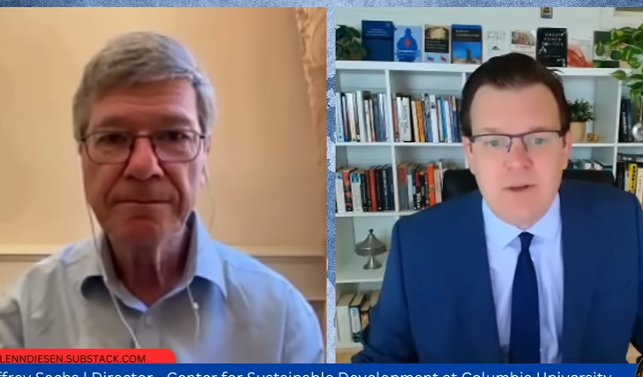
Read the full transcript of American economist and public policy analyst Jeffrey Sachs’ interview on Greater Eurasia Podcast, June 15, 2026.
Editor’s Note: In this episode, Professor Jeffrey Sachs joins host Glenn Diesen to analyze the recently announced ceasefire agreement between the United States and Iran, mediated by Pakistan. They explore the fragility of this deal, given that Israel is not a formal party to the agreement and may attempt to undermine it. Ultimately, the discussion examines how this conflict highlights the limitations of U.S. hegemony and the ongoing shift in global power dynamics.
INTRODUCTION
Glenn Diesen: Welcome back. Today is Monday, June 15th, and we are joined today by Professor Jeffrey Sachs to discuss if, well, peace could break out in Iran. So thank you for coming on.
We see now— of course. Well, we see that Trump announced that a deal has been reached. Again, one would like to be optimistic, but how do you see this deal? Well, how sustainable is it? Because it implies some painful concessions. I know many people in the US as well as possibly the majority in Israel do not want this. So if we add to the fact that the US does not have a great history in terms of implementing these kind of agreements, especially with Iran, how, I guess, how justify this optimism now?
The Framework of the Agreement
Professor Jeffrey Sachs: Well, of course, we have to be extremely cautious because the details of what has ostensibly been signed. And now all parties, Iran, the United States, and Pakistani mediators have said that an agreement has been signed. We don’t know the details. And it comes in many stages. And from what we do know, and in any event, it could fall apart quite easily.
So what do we know? We know that the three sides have said that there will be a ceasefire. And the three sides that have talked about this — I should say two of the antagonists, the US and Iran, and the third being the mediator, Pakistan. This does not include Israel. So Israel is not a formal party to this agreement as far as we know.
The agreement seems to call for an end of hostilities. The phrase that the Pakistani announcement used was “a permanent end to hostilities.” It ostensibly comes in phases, two broad phases. One is to reopen the Strait of Hormuz and the international oil and gas traffic. And the second phase is about the nuclear issues.
It seems, according to the announcements, that the agreement does not include other kinds of demands that the United States had once upon a time put on the table about Iran’s missile systems or its support for other groups in the region such as Hezbollah. So it seems to be a two-stage agreement — one to open the Strait of Hormuz, and second, to then negotiate over a period of 60 days some kind of resolution on the nuclear issue in which Iran would, in some sense, irrevocably not produce or procure through purchase or other way a nuclear weapon. And US and other international sanctions, economic sanctions, would be dropped.
Unanswered Questions and Vague Details
So that’s the basic framework. Within that, there are many statements, but not so much clarity. How will the Strait of Hormuz be governed going forward? It seems from the Iranian side that Iran says this is not an international waterway, it’s a waterway shared by Iran and Oman, and we will have co-responsibility for that. Whether that is somehow inscribed in the agreement or not, we don’t know.
President Trump said that there would be no tolls charged, and this may be one of the terms of the agreement because Iran was claiming tolls of $1 a barrel of oil on the ships passing through, and maybe that has been dropped. On the other side, there are statements that the US will unfreeze Iranian assets that are frozen, and a number that is mentioned is $25 billion. Which assets? Why? How? Who? Under what authority did the US freeze these? What is really being counted here is not clear.
But there seems to be some kind of arrangement where the physical traffic will open, some kind of nominal — or maybe even more substantial than that — Iranian and Omani control over the strait will continue. And if the rumors are correct, tolls will not be charged on trafficking of oil and gas, but on the other side, the US will unfreeze a significant amount of assets that were frozen beforehand.
Israel’s Role and the Fragility of the Deal
Now, Israel is not part of this agreement, and certainly the Netanyahu government would not agree to one of the crucial terms that’s claimed about this agreement — that it covers a cessation of fighting in Lebanon. Exactly what has been agreed regarding Lebanon is also unclear.
But if the past is in any way predictive, and of course it should be, Israel may try to undermine or destroy the agreement by continuing the bombing in Lebanon or finding a pretext or claiming that Hezbollah shot a drone or missile into Israel. And now the bombing of Beirut will continue.
All of this is to say that this is extremely fragile. It essentially, at the core, from what we can gather, returns the situation more or less to the situation ex ante, before the February 28th attack by Israel and the United States on Iran. With some significant changes perhaps on formal control of the straits, perhaps with some unfreezing of Iranian assets, or perhaps not.
Sorry to be so vague, but our main media don’t even pretend to tell us what’s in the agreement. We have some limited reports from the Iranian media, but other than that, lots of details remain vague.
A War That Accomplished Nothing
I think there’s one overriding truth that we can say even at this stage.
This war accomplished absolutely nothing. It was useless. It was stupid. It was a Mossad operation, principally sold to the United States. It killed a lot of people. It created a lot of harm. It is the result of essentially irresponsible people being in charge in Israel and in the United States. Nothing good came out of this, not an iota of substantive achievement of any value for the US.
It weakened Israel, to be sure, diplomatically. How many times now has Trump himself called Netanyahu crazy, in expletive-filled terms, including again yesterday? Israel’s image in the world, rightfully so, is in a catastrophic condition because Israel is truly a rogue state and a murder state incorporated, and it’s a disgrace how it behaves. So Israel’s the clear loser.
The United States has certainly lost any aura of strength and invincibility in all of this. I wouldn’t say Iran is the winner, though. It’s battered. It has suffered thousands of deaths, tens of billions of dollars of damage. Wars can produce just losers, and this is what this war did. This was a lose-lose war stupidly launched by Israel and the United States. It accomplished absolutely nothing.
And whether it’s over, of course, remains to be seen. This is hardly a new day in the Middle East breaking out, as Trump’s sycophants have said. But maybe it is a fragile ceasefire that will hold. My inbox is already filled with people saying it will fall to pieces within 48 hours. It’s a pretext. It’s a ruse. I would not myself go that far to make that conclusion.
Both sides, Iran and the United States, have a good reason for the fighting to stop. And so maybe the fighting will stop. Israel never seems to stop fighting, but Israel is in a state of open collapse in terms of the support that it has in the United States and the rest of the world.
So maybe this time Israel won’t defeat the peace because maybe what Trump is very visibly saying in public — that “you’re a f*ing crazy bastard,” to quote the president of the United States. Otherwise I wouldn’t use the language. I’m just quoting from the White House. Maybe that actually reflects the fact that with the American politics the way it is and with an upcoming election and with Trump’s approval ratings in a steep descent, there isn’t a mood for Israel to play its typical disastrous games.
The Vagueness of the Deal and Its Political Minefield
Glenn Diesen: Well, you mentioned this vagueness in terms of what the deal would entail. I think that’s almost required now because there’s a lot of painful concessions. For example, in the Strait of Hormuz, they say, yes, there won’t be a toll, but a toll suggests it’s mere cost for entry, but there will be a fee, which would suggest, I guess, operational support.
I mean, legally it’s not nothing. It entails the navigation assistance, rescue operations, environmental protection, different security issues. There is a legal distinction between a toll and a fee, but at the end of the day, the fee did not exist before this war and it will exist after. So for—
Professor Jeffrey Sachs: Exactly.
Glenn Diesen: Trump, it will be a concession, it will be a loss. So it’s just going to be hard the way he talks about, has talked about this war and outcome over the past few months. You would think he would meet a lot of opposition once the details start to come out to the front. I mean, it would be a minefield.
Opposition from the Zionist Lobby and Congress
Professor Jeffrey Sachs: But yeah, and two kinds of opposition. Of course, we have the Zionist lobby, which will openly attack the deal as a concession to the evil regime. And there will be, of course, eventually, if our media ever get around to it and if there are at least a few politicians that are not pathetic in our country, questioning what the hell just happened. Why did we do this? What kind of absurd war was this launched single-handedly by the President of the United States without any public backing, without any congressional backing, without any clear explanation?
With the statements at the beginning that the goal was regime change and unconditional surrender, and all of the claims that were made, and none of those was achieved. So in this sense, of course there deserves to be and will be criticism, but we certainly are not at the end of the Zionist lobby in the United States either.
Strategy Replaced by Tribal Loyalty
Glenn Diesen: Yeah, well, I think people always get lured into these wars because of the way political discourse is now. I mean, you notice when they went in, when they attacked Iran, essentially the logic was, well, if you support it, then you’re pro-Israel. If you’re not supporting it, then you’re pro-Iran. This is how people talk. No one began with the point of departure being, what should we achieve and how can it be achieved? You know, an actual strategy.
I would do the same with the war against Russia. That is, the language in use — if you support actions, that should signify whether you’re for or against, or pro-Russian or pro-NATO. But at the end of the day, it doesn’t mean anything what your position is if you can’t achieve your objectives. And it’s very hard to explain why this was a pro-American or pro-Israeli war to begin with. It didn’t serve their interest.
The Limits of American Gangsterism
PROFESSOR JEFFREY SACHS: But I think a couple more things I would add. First, there are no operative norms against war in the US executive branch, and certainly not in Trump’s mind. So the idea that you bomb places, kill people, assassinate people, this is a norm. There’s no sense in which any single American official would say, “Oh, but the UN Charter doesn’t allow that.” That statement doesn’t exist. We are led by gangsters, and with a gangster mentality. Do what you can, get away with what you can. Anyone else is a sucker. Don’t be stupid. There’s no international law. So first, there are no norms against this. There’s no moral compunction, legal compunction, need to justify other than victory itself.
Then comes the very pragmatic question, well, will this succeed? And I think it’s probably the case that Trump was on a delusional high from Venezuela, in which some kind of inside operation between the CIA and the Venezuelan government agreed to the removal forcibly of the president of the country. It left a regime intact, but it changed the government and it changed politics in a way because it was the cover for the US to remove sanctions that had been put on Venezuela beforehand and start shipping Venezuelan oil to the United States, and the Venezuelans were in a rather desperate need of cash, and so they went along with this as well.
And I think the Iranian gambit was not aiming to be a war. It was aiming to be a one-day operation, and everything we know about it tells us that story, that there was a plan to install a leader. Trump said as much. Kill the leadership, decapitation, and everything will be all right the next day. So this is also the behavior of very naïve, very arrogant people. It does show, to my mind, a complete breakdown of politics in the United States. Our institutions don’t work. We don’t have institutional review. We don’t have a functioning National Security Council, national security apparatus. We certainly don’t have a republic in the sense of a constitutional order in which Congress would either declare war or have oversight over the actions of the executive branch or control through the budget. We have none of that. We have a small, gangster mentality group running things right now.
It didn’t work for them. They face some constraints as a result of the failure of this one-day operation. This is essentially trying to find a way out. I think it’s not a surrender. It’s not a victory. It shows how useless entirely all of this gangsterism was and how much it hurts everyone else, us, especially the Iranian people, the 160 schoolgirls killed on the first day of the strike in Minab. It’s been a disaster for everybody.
The one place where it’s not been a disaster is in big tech, which has tried out its weapons, gotten expanded Pentagon contracts for AI systems, made a few mistakes like mass murder of schoolgirls. But, you know, that’s all in the machine learning process and the systems learning process. Palantir has won. The Israeli stock market has won. So the warmongers, they came out ahead. The world suffered much, much larger losses from a military, strategic, and foreign policy point of view. This was not only useless, it was a loss. The United States lost any claim to protect countries in the Middle East or to have military dominance, or to have any kind of hegemonic control.
One more point, Glenn, that I would add, just as in these early hours of trying to assess this, the Iranians were hurting badly economically. The blockade did hurt them. But more than that, the US has been on an economic war against Iran, and that war has been years underway. Our Treasury Secretary Scott Bessent is also very much a gangster mentality, and talked about how economic statecraft had crushed the Iranian economy. And I think, I’m guessing, that the Iranians wanted some kind of deal to release some of the assets, which is interesting because what was being released was assets illegally taken by the United States in the first place. But the US was using that as bargaining leverage.
I do think that this shows that while the US military might does not have the strategic leverage, neither in Ukraine nor in Iran, and certainly not in East Asia, that Americans might pretend that it does. The US chokehold on international transactions remains not insignificant, I have to say. I think it’s a real puzzle to me why the BRICS nations by this point have just not made a full workaround from the US unilateral economic warfare because it’s illegal and it can be circumvented. But so far, the US continues to deploy its economic warfare with some effect in Venezuela and in Iran.
A Turning Point? The Shifting Distribution of Power
GLENN DIESEN: Well, you mentioned before that your inbox was full of people who were warning or dismissive of this being a temporary de-escalation, and I think that’s fair as well. But what you said now though, do you think this could be a turning point in the US, not just its Middle East strategy, but overall? Not because this is a moment of moral clarity, but the recognition that the distribution of power has shifted. That is, if you try to do everything and you end up being punished, then at some point you have to change course.
I mean, same as with the US-Israel tensions as well. Some argue that it’s a bit theatre, but I have a hard time seeing that as pure theatre given how it’s treated in the Israeli media, how it’s fueling dissent in the US. Again, it could be extended to the war against Russia. That is, if it didn’t— first of all, if a war isn’t successful, at least one can lean back usually in Washington and argue, “Well, at least we weakened our adversary, we destroyed a lot of things, we killed a lot of people.” But at the end of this, it looks strategically that not just Iranians but the Russians will come out on top, and then NATO, the US, they all come out in a very weaker position. This is not how the wars were supposed to work.
Do you think it’s a possibility that, especially in the Middle East, that this war could compel the US to fundamentally change its strategy? I mean, its bases have been harmed, its alliances have been harmed. At some point, they must, I guess, adjust to reality. That is, what can actually be achieved to enhance your own security?
The End of the Unipolar Moment: Lessons from History
PROFESSOR JEFFREY SACHS: I think, yes, at a fundamental level, the world is changing and the sense of US power is changing in a definitive way. The US remains a powerful country, but after 1991, it claimed the mantle of global hegemon. It claimed that it was the unipolar power of the world. It claimed a writ over the entire world basically. And it was spelled out most clearly by Zbigniew Brzezinski in 1997 in The Grand Chessboard. And the subtitle of The Grand Chessboard was essentially Preserving American Primacy.
And the idea of that book, very influential and reflecting, even more importantly than its influence, reflecting the mindset in Washington, was that the United States needs control over Eurasia to ensure control over the world. And the way to keep control over Eurasia was essentially to weaken Russia, surround Russia with NATO, prevent any kind of alliance between Russia, China, and Iran, and play the different states off against each other. And by taking Ukraine, essentially that would be the pivot, the geographic pivot for all of Eurasia because Russia would be weakened. Russia would have no alternative but to turn to the US and the West.
In that book, it’s interesting, Brzezinski says this is the way the world will go. The US will remain the hegemon because of its technological and economic dominance. And that fundamentally is over. The rise of China itself changed that. Geopolitically, Iran, China and Russia are aligned in a way that Brzezinski said could never happen. Militarily, the US is at a stalemate. It cannot impose its will militarily on Russia. It could not even impose its will militarily on Iran. That’s one of the clear lessons of this. There’s not a chance in the world it could impose its will militarily on China.
I think maybe the United States has recognized that in all three theaters. In Ukraine, it’s washing its hands of the Ukraine war. In China, Trump rather openly said vis-à-vis Taiwan, “We don’t want a war. We don’t want you to declare independence. And we’re holding our weapons sales to Taiwan in abeyance.” This is basically what he said as he left Beijing from the summit last year, that we can’t impose our will on China. So in a sense, I think what is being seen is the US does not have any kind of hegemonic control over the vast realm of Eurasia — or I should be careful — over Asia in particular and over the non-EU part of Eurasia. It still has influence. It still has the ability to impose pain and sanctions, but it cannot impose military victory. And I think increasingly its ability to impose even economic compulsion is fading away. Though I would say it played some role in what we’ve seen now vis-à-vis Iran.
So if I could put it in ancient terms, the Roman Empire was an expansionist empire through Augustus and through the 1st century AD. And then it reached its limits. Of course, it reached its limits in Germania early on in the Battle of Teutoburg Forest. When the Roman Empire decided “we won’t conquer Germania,” that painful loss happened early on. I think it’s in 9 AD, if I remember correctly. But after that, the Romans said, “We’re not going to really fight in Germania, we’re going to hold a line.” Then by the time Hadrian became the emperor, I think it’s 117 AD, he said, “We’ve reached the limits of the empire. We’ll live in peace, or maybe we’ll battle on our borders a bit, skirmishing, but we’re not going to expand.”
If I could make a crude analogy, maybe in Washington they’ll learn: stop. You cannot control, divide, weaken, or defeat Russia. You can’t control the Middle East hegemonically, certainly not West Asia with Persia or today’s Iran, and certainly not with China. This doesn’t mean that games won’t continue. Economic statecraft, as Bessent, our Treasury Secretary, calls it, using ugly and illegal tools will continue. But I think, Glenn, you’re right that essentially in the three main theaters that Brzezinski himself talked about — US and Russia, US and Iran, and US and China — the limits have been reached.
People should view the experience of the Ukraine war, this stupid, useless war with Iran and the failed trade war with China as all showing America is certainly not the unipolar power. It’s certainly not the world hegemon. It does not have its writ over the world, maybe from 40 degrees east longitude to the Pacific, to China. And maybe it will learn some lessons, stop being so gangsterish, because basically the US has used gangsterism to try to extend, prolong, enhance its power. But gangsterism wears very thin. There’s no cooperation. There’s no trust. There’s no respect. There’s no real power from it, only tactics and maneuver. And I think the US has been exposed in that way.
Again, the US is still powerful and very nasty in our own hemisphere. Events today could be followed by an invasion of Cuba at any moment. We could see more terrible things. The US has not turned into some kind of beneficent international law-abiding state. It remains an ornery, nasty, gangsterish empire in the Washington mentality, but limits are being understood more than before, even if they are not openly acknowledged, and certainly they are very much disliked.
GLENN DIESEN: Well, on the unipolar moment, I think the key criticism in the 1990s was that the unipolar moment would unavoidably be temporary because the US would exhaust itself, and then it would incentivize adversaries to collectively balance the US. I think now the war against Russia pushed the Russians in closer to China. The war against Iran pushed Iran even closer to Russia and China. So at some point, I think the lessons have to be made that the hegemonic peace does not reflect reality. And when policies do not reflect reality, it has very unfortunate consequences.
The Myth of Western Technological Dominance
PROFESSOR JEFFREY SACHS: Exactly, Glenn. And I think there are two things that people should keep in mind about this. One is that you get balancing. So you push so hard on adversaries, they join forces together, and you turn out not to be as powerful as you think.
And the second is the myth of the US technological dominance. This is still a continuing myth, certainly in the US stock market. But the idea that ultimately — and Brzezinski said it very clearly in 1997, and he was suffering from that myth — the US ultimately will triumph because ultimately Western technology is superior and the other countries will have to face that fact either on the battlefield or in the economy. And that is, in truth, a core reason for the failure of the unipolar moment.
China absolutely competes and in many ways outcompetes the United States technologically on a very, very wide range of activities, but it’s more than that. Look at Iran. This is a sophisticated country that can make sophisticated weaponry. And that was completely not understood, or felt in Washington. Same with Russia.
Technology has spread. Advanced weaponry, digital technologies, AI — these are not the preserve of Elon Musk himself or Palantir or Israel or the United States. These are worldwide technologies and they have spread to many power centers. And there are a lot of smart people in a lot of places. And so the idea that the ultimate control of the Western hegemon is its technological superiority needs to be put aside. And if it were put aside, there would not only be peace and mutual respect, but a lot more economic gain as well.
Because one of the things that I completely, completely reject, and I would laugh at, but I find it so tragic, is that the global economy has been taken over by the military strategists who now view trade and finance as strategic weapons rather than as the ways of mutual gain and economic progress. So I want the economists who believe in open trade, finance, and mutual benefit to reclaim these tools from these economic warriors like our Treasury Secretary and others and our Commerce Secretary and our trade representatives who view everything about the economy in warfare terms.
GLENN DIESEN: Thank you for taking the time. Actually, if I can just add one note, I think what you said about the technology is quite important because it shows that these wars don’t just signify the end of the post-Cold War hegemonic era, but also centuries of Western technological dominance. And, well, you can put it, well, at least, yeah, international leadership over the past 500 years since the Western maritime power set out to reconnect the world. So it’s yeah, interesting times. So thank you very much again.
PROFESSOR JEFFREY SACHS: Of course, see you again very soon. Thanks a lot.
Related Posts