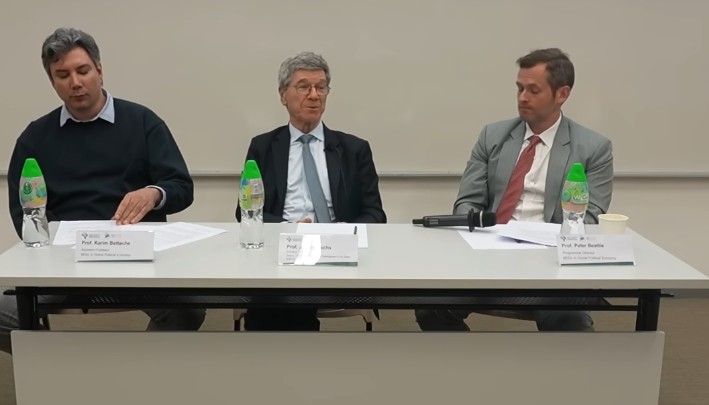
Read the full transcript of Jeffrey Sachs in dialogue with Karim Bettache & Peter Beattie on “Geopolitics, Iran and the World”, April 1, 2026.
EDITOR’S NOTE: In this compelling dialogue, economist Jeffrey Sachs sits down with Karim Bettache and Peter Beattie to dissect the escalating geopolitical crisis involving Iran, the United States, and Israel. Sachs delivers a sharp critique of U.S. foreign policy under President Trump, warning of unchecked presidential power, the risk of nuclear escalation, and the deeper systemic failures driving endless conflicts. Join them for a candid exploration of why the current moment may be the most dangerous since World War II—and what paths remain for de-escalation.
INTRODUCTION
KARIM BETTACHE: Please welcome him, Professor Sachs.
Opening Remarks: Comparing Iraq and Iran
PETER BEATTIE: Now to get into much more depressing topics. This time reminds me a lot of the early 2000s. I don’t know if you probably were living in New York City at the time as well.
JEFFREY SACHS: And we remember Boston and 9/11.
PETER BEATTIE: Oh, okay. But around that time, at any rate, that was the last time our government committed the ultimate international crime, which the Nuremberg Tribunal called the crime of aggression, because it contains within it all other war crimes themselves. Back then, we saw a concerted propaganda campaign to try to get the US public on board with the war on Iraq. This time we haven’t seen that. There really hasn’t been any campaign. And I wonder why that is. It could be changes in the media system. They could have done focus group testing and found that nothing worked to get people in the US to buy into this war. I don’t know. The majority of people in the US are opposed to this war from the very beginning, quite unlike the war on Iraq. So I’m just wondering, what can we learn, do you think, from the similarities and dissimilarities between this war of aggression on Iran and the earlier one against Iraq? And besides betting as much as one can on oil to push the price up to put pressure on Trump, what can people, US citizens and people from outside of the US, do to try to help bring this war to a conclusion?
Trump’s Psychology and the Broken American Political System
JEFFREY SACHS: Yeah, well, thanks very much, and thanks for the chance to have a discussion about what is going on.
First of all, things are opaque, as is obvious, because we don’t have a word of honesty from the United States government or from the Israeli government. Everything is propaganda morning till night. Also, any statement by Donald Trump contradicts itself before the end of the sentence. So he’s absolutely impossible to even understand on his own terms, much less on geopolitical terms.
So the situation is very strange, very dangerous. I think probably the most dangerous moment in the world since World War II, probably even including the Cuban Missile Crisis. I say that with two psychologists here. I’ll say it. You’re not responsible for me — maybe you’ll regret that you invited me. But I think Donald Trump is literally mentally ill to a very serious extent.
He is, from a personality point of view, a malignant narcissist, I think, is the right definition. Or if you want a more classical diagnosis, a dark triad personality, which means that he is personally narcissistic. He is Machiavellian, which means, in psychological terms, that he is manipulative, untrustworthy, deceitful. And he is psychopathic, meaning that there is no empathy for how many people he kills or how much damage is done. The malignant narcissist definition adds paranoia and confabulation to this list.
So I personally think we’re dealing with a psychologically deeply debilitated individual who happens to have a lot of power. And according to one psychologist I was listening to yesterday, that I thought made a lot of sense, there’s an element of frontotemporal dementia added to this, which you see through the incoherence of the sentences, the drift of thought, and even the confusion of words, so that the words don’t even end as they begin.
There’s real signs of dementia on top of what is a lifetime of antisocial personality disorder. A man like this should not be president. This is the most basic point. He is president because of much deeper problems in the American political system. So he is a symptom as well as a cause. You don’t elect a person like this in a healthy political system.
The American political system is deeply corrupted. The ability of a man like this to have the power that he does to order a war is a profoundly broken political order. It has nothing to do with our constitutional system, where only Congress has the ability to declare war. We’re so pathetic right now in our politics that the only thing Congress does is vote repeatedly that they don’t want to have anything to do with overseeing this war. It’s not a choice that they have under the Constitution — it’s a complete abnegation of responsibility. How can the Senate say now, in three votes, “don’t ask us, it’s none of our business, that’s just Mr. Trump’s business”? That’s exactly what the U.S. Senate has said.
So I think there are very particular circumstances right now. My own feeling is that Trump has actually — again, now I’m completely an amateur psychologist — but he seems to have deteriorated and lost any kind of self-control in the last three or four months. So there’s a degree of impulsivity which is absolutely beyond anything that I’ve seen before.
By the way, this is the second time in a row that we have had a president suffering from dementia. And what’s interesting also is that with Biden, who had dementia for the last two years at least of his administration, it was all covered up until he stood there gaping in front of a camera, drooling, to all of the American people watching in a debate, and no one could hide it on camera.
So I just want to say we’re dealing with psychology here in the most individual sense. This is denied every moment of public discourse. It’s just amazing. Take what happened in the last three days. First, the president said, “I’m going to blow up everything, I’m going to kill all of you.” That’s normal — oh, then you have the commentators: “Oh, will he kill everybody? Well, that’s an interesting question.” Not “are we in the hands of a madman?” Nothing like that. Not one commentary says that’s a little strange for the president of the United States to be talking like that — talking like Adolf Hitler. No, not even a mention that this is a little strange.
Then two days later, when he decides he’s not going to kill everyone, he says, “Oh, we’re close to an agreement.” And of course, there was no negotiation, period. But what does the press say? “Oh, well, will Donald Trump be able to get an agreement?” Not “what a loon, what a liar.” Nothing. It’s a complete normalization of something completely abnormal. I’ve never seen anything like this. Who’s crazier, Trump or us? How can we not be grown-ups and say, “That man’s a loon, get him out of there before he kills us all”? Nobody says this.
Sorry, this is not a partisan statement. I’ve hated all our recent presidents, because they don’t make us safe, they don’t tell the truth. But this is something absolutely different, what’s happening right now. And it’s all normalized. And the New York Times story today — all I do these days is write irate letters to the reporters whom I’ve known for decades, and they don’t write back, because they don’t have the dignity to get into a serious discussion on anything. Sometimes, by the way, they write back and they say, “Yeah, I agree with you, Jeff, but higher-ups edit my articles.” So that’s the main thing — it’s a complete shutdown of truth at the New York Times, which used to be my go-to place to get just a straight story. It’s useless, completely useless right now.
But anyway, this story was, “Yes, will Donald Trump be able to negotiate a deal,” without mentioning how weird it is that there were no negotiations. But he said that there were. That’s the real story of the last day. That’s the really interesting story: were there negotiations? The story said — this is David Sanger, an experienced journalist, 40 years — he says, “Well, Donald Trump didn’t tell us who he was negotiating with.” David, come on, are you serious? You’re going to write that to me? He didn’t tell who he was negotiating with? Maybe, David, he wasn’t negotiating with anybody. Maybe he made it up. Can’t you ask a question as a grown-up writing for the New York Times who’s been doing this for 40 years?
So I wrote to David this morning. I will not hear back from David. I’ve known David for probably 40 years, because they don’t talk — because we’re in really a crazy land right now where anything goes. And the whole story is, “Well, what will Donald Trump do next?” — as if this is a spectator sport, not your life and not my life. I’m more interested: when are they going to take him away before he does more harm to us? When is some grown-up going to say this is a very bad idea?
Decades of US Military Intervention
Okay, so that’s the immediate issue. But the system is more deeply broken. There are no checks on presidential power to launch wars, and there haven’t been for decades, actually. Congress basically doesn’t exist when it comes to foreign policy — it basically doesn’t exist, because we live in a security state. Foreign policy is carried out by the CIA, the National Security Agency, the National Security Council. It’s not carried out by anything resembling democratic institutions at all.
You may say, “Of course, Jeff, I had to come here to learn that.” But it’s rather alarming, actually, because it’s not only 2003. We’re in nonstop wars. Nonstop. It’s not just the Iraq War.
In 1999, we bombed Serbia for 78 days and broke the country apart, and created Kosovo as a country, and then put the largest NATO base in Kosovo, Camp Bondsteel. And then we say, by the way, we have sacrosanct borders in Europe. Yeah, sacrosanct borders, except when we decide to change them, when the US military decides to change them. Okay, so that was 1999.
Then, yes, in 2001, we invaded Afghanistan. Clever move — we had to invade because of al-Qaeda, which the US had created starting in 1979. Who created al-Qaeda? Zbigniew Brzezinski and the CIA, because they wanted to lure the Soviet Union into a war in Afghanistan. Very clever — yeah, the operation worked. It destroyed Afghanistan for the next several decades. But this is 2001 — we went in to clean up our own mess that had either boomeranged or just continued, and we had to clean up what we had done.
Then 2003, a war under completely phony pretenses. But don’t forget, 2011, the United States overthrew Libya. 2011, the CIA was tasked with overthrowing the Syrian government — they thought this would be quick, it took them 14 years and hundreds of thousands of lives. But that’s all in a day’s work. In 2014, they overthrew the Ukrainian government. We called it a revolution of dignity. The dignity was my colleague Victoria Nuland handing out cookies and millions of dollars to organize the protests.
So this is nonstop. It’s been this way, but it’s getting worse because there is absolutely no self-control right now. Kidnap presidents, invade, declare that a port service operation is a security threat to the United States if it operates in Panama. That’s normal? No, this is not normal. This is deranged. And if you go long enough with derangement, we’ll blow up the whole world. And Trump is just the kind of guy that can do it, because he has no self-control. And apparently no one around him gives him a warm cup of tea in the evening with some honey in it and puts on some slippers and says, “It’s going to be all right, Donald. Don’t post tonight on Truth Social.”
Why Does the World Defer to a Psychopath?
KARIM BETTACHE: Can I jump in on this for a moment? So you talk about nobody pushing back on Donald Trump — yes, and that is exactly what I also wanted to ask you today. You were talking about “my country is pathetic,” you said. I come from the Netherlands. That’s even more pathetic.
JEFFREY SACHS: Well, your former prime minister, right?
KARIM BETTACHE: That’s what I was going to talk about.
JEFFREY SACHS: Yeah, exactly.
KARIM BETTACHE: So I was going to talk about our very pathetic former prime minister, Mark Rutte, who is the head of NATO right now. And I’ve noticed something, and not only with Mark Rutte, but also with other people around the world — world leaders, etc. There is something about human psychology where people start to bow and be so servile in the face of a psychopath. There’s something uniquely strange about how people deal with Donald Trump, from the Gulf states to Asia to Europe. Everywhere you will see that: “Oh, Donald Trump, you’re such an amazing man and peacemaker.” There is something very weird about human psychology when you are confronted with a psychopath.
So my question is: what is it that makes Europe so incredibly servile to the United States? Structurally, actually, I’m very curious — what is it structurally that makes Europe so pathetic and unable to push back? What’s going on here, and how can we get out of this?
The Psychology and Structure of European Servility
JEFFREY SACHS: It’s a very good question, and I think your observation is right at a personal level, that there is something unusual. Even, I think, in Max Weber’s terms, there’s an element of charisma to a psychopath. A psychopath is so self-assured, so bullying, so threatening, that it taps something deep — of fear, or of hierarchy, or of magnificence. A lot of the great conquerors of the world in the past have been psychopaths, and they get a lot of support because there is something quite deep in this.
Trump has a lot of support. He has the ardent support of about 25% of the US population. About 60% think he’s a nut, but about 25% would go to the sword for him. Some think he’s a messiah. This is real. It’s a minority, definitely not a big minority — maybe 20 or 25%. But it’s an ardent following. So this is something quite unusual, what psychopathy is able to generate in terms of political following.
And I think there’s a personal element in it. I speak to lots of world leaders, and many of them know what they’re dealing with in some sense, but almost none of them say publicly a word about it. Of course, partly they think that’s prudent, partly they’re cowards, partly they’re bought off, partly it’s a free rider problem — who’s going to bell the cat? Not me, let someone else play that role. But it’s really, really alarming how far the bully can get.
We’ve had a genocide in Gaza, so we’re losing lots of lives of the most brutal kind. We’ve had mass bombing of Iran, and thousands and thousands of people dying in short order, but nobody says a word almost. And Rutte said just on Sunday that this is a hugely important war and we have to get behind the president of the United States. And he’s the one that called Trump “daddy.” Where does one start with this?
So there’s a personal element that is very interesting. There is, of course, the structural element, and the structural element is very simple: NATO is the US military alliance. It’s not an association, it’s not a treaty organization of various sovereign countries. It’s the United States military that operates in Europe and that occupies Europe militarily to an important extent.
And it’s interesting that Europe has been militarily occupied since 1945. Europe never had the gumption to say, “Okay, it’s 80 years, 81 years since the war ended, why don’t you go home?” And if Europe had sovereignty, it would say that. But after 80 years, all of the politicians have been cultivated to be US vassals, basically. You cannot be an anti-American politician in Europe above maybe the mayor of a small town, because you’ll get your head chopped off well before you reach anything higher than that.
This is an American-occupied continent and has been for 81 years. Maybe in the past we would just draw the continent as American territory. But in our world today, you don’t need to do that. I call it regime control rather than territorial occupation. So the American empire operates across Europe. It’s uncontested, and it’s not on the map shown as the United States. But if it were a map from, you know, 1200 AD, you would show it as American territory, because it would be basically indirect imperial control. We would call it a satrapy if it were the Persian Empire. We would say that the US is suzerain, so that there’s no independent foreign policy, if we used the language of the past. But Europe has no independent foreign policy at all.
The previous Secretary General of NATO was Jens Stoltenberg, whom I knew when he was Finance Minister of Norway, and then when he was Prime Minister of Norway, and we were friends. And then he became Secretary General of NATO, and I could not stand one word that he said. Just everything he said I thought was horrible. And the poor man had to sit next to me every September at the UN General Assembly because our seats were next to each other. So we’d greet each other and then I’d start complaining and he’d get up and leave after a little while. I don’t blame him.
But in any event, then he stopped being Secretary-General, and the next week he said something sensible. So I spoke to a leader in Europe, a prime minister, and I said, “Stoltenberg said something sensible. Why didn’t he say that when he was Secretary General?” And the person said to me, “Jeff, what was his position?” And I said, “Well, he was NATO Secretary General.” He said, “Who did he work for?” I said, “Oh, you mean the United States?” “Yes, Jeff. Now he doesn’t work for the United States.” So these are not independent voices — these are employees of the US security state.
It’s painful to hear, because Europe is about at least 3,000 years old in civilization. The United States is 250 years old — it has been civilized very few years of that. And yet the 250-year-old power runs the 3,000-year-old civilization. So I think it’s probably a little bit of the feeling of Europe when the Huns invaded or something, but nobody says it. It’s not normal. This is the most fundamental explanation.
Inside the UN Security Council on the Day of the Attack
When you said the UN Security Council is paralyzed, it’s actually not even that good as being paralyzed — it’s actually right now in the hands of the United States, which is very weird. Of course, there’s China and Russia, which are the only independent voices.
The Security Council meeting that I attended four weeks ago — this was at the very start of the US-Israel war of aggression — was completely surrealistic, because that day the US and Israel attacked, Pearl Harbor style, attacked Iran as the negotiations were supposed to take place the next day in Vienna. So they made their surprise attack, they killed 40 leaders, and there was a Security Council meeting that afternoon at 3 p.m.
I got called that morning by some of the governments and said, “We’d like you to testify, Mr. Sachs.” And I said I would be pleased to do so, and I prepared testimony. And then when I arrived at the Security Council, I was told, “Well, the UK, which chairs that month as president of the Security Council, has ruled out your testimony, so you won’t be able to testify.” I thought, “That’s nice, let’s have a good grown-up discussion.” But they didn’t want that.
Okay, so the Security Council meeting started, and the first ambassador that spoke was from Bahrain, which has a two-year seat. This was, by the way, a Security Council session called by Iran — they had just been attacked by the United States, and there was no conceivable justification under the UN Charter, which says, under Article 2, Paragraph 4, that no state may use force or threaten the use of force against the territorial sovereignty or political sovereignty of another state. It’s very clear — it’s the essential purpose of the United Nations.
So Iran called this emergency session, and Bahrain started, and Bahrain’s first words were, “We are here to condemn the unprovoked attack on us by Iran.” Well, it’s true that Iran was bombed, and then Iran launched missiles against the US naval base in Bahrain. You would think a grown-up might say, “Well, it wasn’t exactly unprovoked — there was a reason that today Iran struck us.” So you could say, “We are here to protest that Iran has bombed us, but we understand that Iran was attacked this morning.” No — not one word, not one sentence that Iran was attacked by the United States and Israel. Not a sentence. I thought, this is really unpleasant. Not a complete surprise, but unpleasant.
Then the next speaker was the French ambassador. The French ambassador said, “We are here to condemn the attacks by Iran on the Gulf countries, which we stand by.” Didn’t mention that Israel and the United States had attacked Iran — not even a sentence. Ladies and gentlemen, this went on for eight countries. It was Latvia, Greece, Denmark — I don’t even remember. Britain, of course. The United States. It’s surrealistic — you can’t even believe this. How are we not going to blow up the world if you can’t say, on the day of a massive attack, that there’s a problem here coming from the massive attack? Not even mention it. That’s the state of affairs that we’re in.
Well, it is simple, by the way. It was also Colombia and Panama on that list. All you had to do was look at the list of where the US has military bases. That’s all. If you have military bases, then Iran made “unprovoked attacks” on its neighbors, because you’re an occupied country, because that is the American empire, because you have lost your sovereignty and you’re basically an instrument of US imperial policy.
So that’s our situation right now, and it’s extremely dangerous, because there’s no adult conversation in the world. By adult conversation, I mean anything honest. You don’t say that the president is a lunatic, that he’s confabulating, or a pathological liar. We don’t exactly know, statement by statement, whether it’s confabulation or lying. The psychiatrist that I listened to yesterday, or the clinical psychologist, said it’s actually confabulation — he can’t tell the difference between what he’s saying and the truth. So it’s not simply lying his way out of a tight spot, it’s making it up, because that’s what a malignant narcissist has to do when he faces a limit. But no discussion — not in the media, not by governments, not by anyone else calling any of this out.
Assessing the Military Balance
So to my mind, this is extraordinarily dangerous, because we have no rationality in a process in which there’s no rational discussion, in which there’s no honesty about what we’re even talking about, in which everybody hides every word or is programmed to hide every word because that’s their job. And the result is extraordinarily dangerous.
Why is this so dangerous? Well, this now comes to the question of what actually the real shape of the battlefield is, which I don’t know — I’m an economist, I barely know anything. But when I listen to people talk, and when I try to reason about what’s happening, and when I look at the 12-day war last summer, and when I listen to experts that know a lot more about this than I do, I’m inclined to believe a simple fact, which is that Iran has a lot more missiles than the Gulf has, and Israel has missile defenses. That’s my basic assumption — in other words, that the air defenses are basically depleted and Iran’s missiles are not depleted. If that’s not true, then the situation is different from what I think. But that’s my basic assumption.
If that’s true, I think that Iran can do lasting damage to the Gulf countries. It can destroy the oil and gas fields, it can destroy the physical infrastructure, that will have a legacy of 5 to 10 years or more of what is a third of the world’s oil supply and about 12% of the world’s natural gas supply.
Second, my guess is that Iran can do massive, massive harm to Israel. Of course, Israel’s the aggressor in this. Everything I’ve said about Trump, I would say is true about Netanyahu, although perhaps not with the dementia — but everything else, I think, is true. He’s a malignant narcissist, he is a fascist, in my view, and he’s a very dangerous person, one of the most dangerous in the world.
And so my guess is that Iran can continue this fight, and I think they’re probably tired of getting bombed by the United States and Israel — that would be my assumption. I met with Iranians for many years in New York and in other places, and all they wanted to know was, “How can we negotiate with your government? Do you know anyone that would talk to us? What do you recommend? We want to negotiate.”
And the president of Iran, President Pezeshkian, is a heart surgeon, and he speaks like a heart surgeon, which is: “I want to save lives, I want peace, I don’t want war, I want to negotiate.” All I could think about when I listened to him is, poor man — he’s dealing with Trump and Netanyahu, and it’s not going to go well.
Iran’s History and the Roots of Western Propaganda
PETER BEATTIE: And a world, of course, that has been propagandized against Iran.
JEFFREY SACHS: The world’s propagandized against Iran because Iran escaped from the US empire in 1979. Iran is a very interesting place — it is, by some counts, an older civilization than China’s. It’s arguably 5,000 years old in some recognizable form as at least proto-Persian — it’s debated, it’s at least 4,000 years old. It was an absolutely great empire from at least 2,500 years ago.
In the Jewish part of the Bible, the Hebrew Bible, the emperor, or the Shah, of the Achaemenid Empire, Cyrus the Great, is regarded as the greatest savior of the Jewish people. It’s quite interesting, because around 530 BC, he let Israelite captives that had been taken into captivity in Babylon go free, to go back to rebuild the temple in Jerusalem. And so he was called a Messiah by the Hebrew Bible.
So this is not a new country formed out of some post-colonial settlement — this is one of the great civilizations of history, and it’s also nearly 100 million people. It is mountainous. They’ve known that they’ve been at war with the United States for a long time, they’ve been preparing for a long time, and they’ve been cheated by the United States nonstop for decades.
But just to say: in 1953, the United States empire brought Persia into the US orbit by overthrowing the government at the time and establishing a US-backed police state under the Shah, Pahlavi. And that lasted until 1979. And then the Shah was dying of cancer, left the country, there was a revolution that brought in this government structure. And the United States ever since has been trying to punish Iran for its insolence of leaving the American Empire, because it’s a strategic country, lots of oil and gas reserves, on the border of Russia, or the Soviet Union, and it wasn’t supposed to escape the US empire. So this is, from the US point of view, a war of revenge, and they’re going to get their revenge.
So Iran has been demonized in the Western media ever since then. America’s greatest soft power is the English language, by the way, because it is the ultimate soft power — you get to tell the story more than anyone else. And so Iran is the “evil country,” the one that “commits genocide” — that’s the one we’re defending. It just goes on and on, absolutely, in a bizarre kind of way. But this is sheer propaganda.
The Failed Path to Negotiation
And what I’ve seen with my own eyes is Iran wanting to negotiate for the last dozen years, desperately trying to negotiate. They succeeded in negotiating with the UN Security Council — the JCPOA, the Joint Comprehensive Plan of Action, in 2015. And that was because they didn’t want nuclear weapons — their Supreme Leader said that this is against Islamic law — and they wanted UN inspections, and they wanted the punishing sanctions by the United States lifted.
But of course, what happened is the United States and Israel are not interested in peaceful relations with Iran. They’re interested in overthrowing the government to retake it into the US empire, and to make sure that Israel has full military hegemony in the Middle East and West Asia. And so they didn’t want peace. So Trump ripped up the JCPOA. The US and Israel started a campaign of assassinations of leaders, scientists, political leaders, military leaders, negotiators, government leaders. Attacked repeatedly power plants and so forth, always rejecting negotiations.
And then, when Trump came back in again, I was called by several Iranian officials — not that I’m important in this, but I’m sure they were reaching out wherever they could — “Do you have any idea how to get to Mar-a-Lago? Do you have any idea who we can talk to?” And of course, they didn’t want to talk. So the first round of negotiations, they bombed them two days before the sixth round. This time they didn’t even get to the sixth round — they only got to the Omani negotiators saying how much progress is being made. Then it was especially urgent to kill them all, because they don’t want a negotiated agreement — they want surrender.
So here’s the issue: Iran, I think, has figured this out. I think so. They didn’t figure it out the first two times — they thought this is too crazy, they really thought they were negotiating, not just getting killed. I think they figured out right now that they can’t negotiate, that they would just get killed if they negotiated again. So they want something different this time. They want the American bases gone. They want Israel to stop its nonstop wars for the last 30 years across the Middle East, because every war that I mentioned is an Israeli war together with a US war. Israel is, on a per capita basis, by far the most violent country in the world. Nonstop, absolutely, without self-restraint. This is the reality.
So I don’t think they want to stop until they have some result other than just stopping. I don’t know what Donald Trump really wants to do. I know what Netanyahu wants to do, which is to have World War III if necessary, because Netanyahu, as he said, he’s been dreaming 40 years of this war — he’s not going to let this one go. Quickly, he’s finally got the US doing what he wants, which is a full-scale commitment of the US military. And he’s about to have a land invasion by the US military in the next few days, as thousands of Marines come. So Netanyahu wants the war to continue.
So to my mind, it depends on the military reality more than anything, because the war will continue militarily. Even if the U.S. and Israel were to stop, Iran wouldn’t stop. And the U.S. and Israel aren’t going to stop, actually. And then the question is, who’s right in this military analysis? Are there more missiles than missile defense? Or are there enough U.S. bombers that they can blow Iran to smithereens? Usually the answer is the first one, actually, because countries can take a lot of bombing, for some reason — it’s counterintuitive, but the history of aerial bombing is that it rarely leads to surrender.
Even Serbia, which is a tiny little country without much military, basically, it took 78 days of bombing to get Serbia to basically surrender. 78 days. If we go 78 days, there’s no more oil coming out of the Middle East for years and years to come, would be my guess. And probably a lot of Jerusalem would be blown up by then, and it’d be pretty damn bad. 78 days. But we’re on that path right now. We’re really on that path right now, because it’s hard to see stopping. And Donald Trump, if I’m right about the psychology, he’s not going to stop.
The Nuclear Risk
KARIM BETTACHE: How close to nuclear do you think?
JEFFREY SACHS: We’re always close to nuclear war right now, because we’re led by absolutely crazy people, and lots of nukes around. And Israel, if they felt sufficiently threatened, would probably use nuclear weapons. And if Iran was about to go down, who knows who would fire a nuclear weapon on their behalf — I don’t know. But I think we’re quite close.
What about Europe also? Because they’re crazy — I mean, not crazy, they’re completely dependent. And the US is crazy — “Oh, they’re going to sink Russian vessels,” they’ve already declared it — “No, the Shadow Fleet, we can sink any Russian vessel we want.” And I was just reading a moment ago that, well, they may well sink some Chinese ships coming. Come on, at some moment this is going to turn serious, you know. But there doesn’t seem to be a stopping rule that’s very, very clear. So I’m extremely worried about this. I don’t feel that we’re in ultimately rational hands right now in the US.
And my recommendation on this is that the grown-ups in this world — President Xi, number one; President Putin, number two; Prime Minister Modi, number three — they need to explain to Donald: “Okay, you’ve got to stop, no more.” And they need to actually help end this thing, because I don’t think it’s going to end from the internal dynamics. So that’s my feeling. And I don’t know whether that’s going to happen or not, because everyone’s got complications.
China’s very, very, I think, very responsible, very clear — they steer clear of war. That’s been China’s great strength for decades, which is: don’t waste your time on this, build your economy, build your technology, build your society, don’t do what the United States is doing — that’s crazy. And that’s China’s baseline.
India is kind of a swing vote right now. Modi was in Israel two days before this war started — why? Because Israel provides a lot of the military and intelligence equipment for India. This is not a good thing for 1.5 billion people to be trapped in this crazy situation that India has put itself into. So I’m saying all the time to Indian media, and to anybody I can talk to in India: get out of this trap that you’re in. You are not a vassal of the United States — they don’t have military bases in your country. You’re 1.5 billion people, you’re 4.5 times the size of the United States, you’re a great power. Israel — are you kidding? Are you really going to get dragged into that?
And I hope that they understand that this is a dreadful mistake. If they do, this war could end, because if President Xi, President Putin, and Prime Minister Modi together very clearly spoke to Donald Trump and said, “It’s enough, it’s enough, no more risking the whole world,” the US would have to stop, actually.
Looking Ahead to US Elections
PETER BEATTIE: Well, that is a wonderfully optimistic point for me to ask you a question that requires some optimism on your part. So therefore, it’s a question I would not want to receive myself.
But when you look at US politics — I know that you, in 2016 and 2020, were on the same page as me in having some hope that if we could get Bernie Sanders to win the Democratic primaries, the general election would be relatively easier, and then the hard part would be organizing and creating a kind of counterweight to the political establishment and the “blob,” or the foreign policy establishment in the US, which of course is a big question.
But looking forward to the next few elections in the US, we have seen a major change in the US media system. For instance, you’re on the Judge Napolitano Show — this is a guy that used to have a show on Fox News, which is the most right-wing cable channel in the United States. Now he has Jeffrey Sachs on regularly, former Ambassador Chas Freeman, Aaron Maté, the journalist who used to only be on left-wing media back in the 2000s. That’s just one example. But the media system is changing massively.
And I notice you can look at polls and see that the younger generation’s opinions are radically different from older generations. But there are plenty of examples of older folks that are clearly tuning into the same sources of information — to use the term that Joe Kent recently used, which I used in my book a lot, “information ecosystem.” They’re getting a different information ecosystem, and they’re starting to think differently.
So do you see concrete steps toward a more optimistic political future for the US, wherein the US perhaps exhibits “a decent respect to the opinions of mankind,” which is a line from our Declaration of Independence, which apparently most of the leadership has completely forgotten, or perhaps starts following its Constitution, wherein the UN Charter is literally the supreme law of the land? Do you see any chance of that happening? Perhaps, as the years go on, people like Trump and his supporters start to die off, we start to see the Planck principle in action — you know, science progresses one funeral at a time. Maybe politics in the US will work the same way. Do you see anything optimistic coming in the US?
Signs of Hope Amid Institutional Collapse
JEFFREY SACHS: Yes, if we can survive the interim. What we have right now is not supported by the public at all. Trump’s approval rating is about 35%, and his disapproval rating, depending on whether you’re allowed to say “no opinion” and so on, is somewhere around 60%. So this — and the war, similarly, is not supported by the American people, even with whatever kind of propaganda they’re doing. And young people, far more so, are against both Trump and against these wars.
They’re worried about whether they’re going to have a job, because the job market for young people is absolutely terrible right now also. So they’re very practical issues. The American people are basically worrying about how they’re going to pay their healthcare bill, because the whole system is completely broken down. And every day, people have to worry about their medicine prices, or a dental repair, or getting a doctor’s appointment. So really, daily life is not easy in the United States. That’s true even quite high on the socioeconomic ladder — people do not feel good. I’d say up to, you know, the 90th percentile or something, the mood is not really very positive or very good.
There is a difference of opinion, as I said — maybe 25% of the public, or 20% of the public, ardently thinks Donald Trump is their savior. That’s a different matter. But in terms of the feeling about the United States, this is not what the public wants. Trump, remember, campaigned on, “I will not do exactly what he’s doing right now.” So he didn’t say, “I’m going to come in and make America the world’s empire, and we’re going to beat the crap out of Iran,” and so forth, and get support on that basis. He said, “I’m not going to go to war, they’re going to go to war, I’m not going to go to war.” That’s literally what he said in the campaign.
So in this sense, what we’re observing is the fact that foreign policy and military policy is completely outside of constitutional bounds, and has been for decades. So it’s not that the public has to change its opinion. The question is, will this get back under control? And essentially, can voting in some way change the dynamic of all of this?
Trump will lose the election in November if the ballots are counted properly, which is an 80% chance. There’s really a chance that the feds break the voting process — it’s not small, they’re aiming at that, they’re working on that quite actively right now. I don’t think they will. We really have a complete break in the internal order, and a violent election and violent demonstrations and repression afterwards — this is really possible this November. But if there’s a normal election, Trump will lose at least one of the two houses of Congress, and that means the lower house much more likely. And if he loses the lower house, he’ll be impeached also, which means that we’ll spend two years on politics inside the United States, on paralysis and fighting and everything else, which could be better than war all the time, because there may be too much distraction — or I don’t know.
So all of that means that the struggle to regain the instruments of power of actual military power and foreign policy is much more significant, though, because basically the foreign policy blob, or the military-industrial complex, has been out of control for many decades. And the job of the president is to prevent it from getting completely out of control, and we don’t have a president that’s going to rein it in right now. So there could be a wonderful, brilliant president in 2029 who has the backing of the American public to try to regain some public order and some control over the military, and that person would have a lot of public opinion backing. There’s no one like that on the horizon right now, but the American political scene is sufficiently unstable and unpredictable right now that you’ve got to give that a real possibility that could make a difference.
One footnote is that the last president that tried to constrain the military-industrial complex was President Kennedy, and I think it’s becoming more and more clear that he was killed for exactly that reason. So this is one of the reasons that we’re in the situation that we’re in, which is that we had a coup, almost surely, back in November 1963. And the coup was that the CIA and the military, and the FBI domestically, took over government, and presidents have basically gone along with that more or less since then. And so in this sense, maybe we became an empire in full-fledged form already 60 years ago. And the Roman Empire never returned to the Roman Republic. So the question is, can the American Empire return to the American Republic? And I think the answer is, it’s possible, but it’s not certain at all.
But it is possible. It’s not going to happen based on November elections, though they’re significant. If we have them and they’re peaceful, Trump will lose, and then his ability to do damage won’t go away by any means, but he will be distracted with impeachment proceedings. And I hope that he doesn’t, in his spare time, launch a nuclear war.
KARIM BETTACHE: Oh, absolutely.
JEFFREY SACHS: He will have a much harder time mobilizing large military efforts. He will still be somewhat unconstrained in doing the ultimate damage, but he will be constrained in doing what he’s doing in Iran. If the Congress were under control right now by the Democrats, he would not be able to have a free hand in this current insanity.
So all in all, no desperation. My general view of the world, though, I just have to add, is that the real solutions for the world are going to come from China, they’re going to come from India, they’re going to come from Russia, they’re going to come from the BRICS. And the real issue is, if the United States doesn’t blow up everything, it’s going to have to get along with the majority of the world, so that the real change is going to come from here, rather than from the US leading to change.
In other words, China is just so good at being stable, making progress, building the most efficient economy in the world, building a manufacturing sector that’s about three times the size of the US right now, defeating the entire auto industry worldwide, which is basically giving up. So I hope you like Chinese vehicles, because that’s all we’re going to be driving for the next 30 years — made-in-China vehicles — because basically the European and US industry is in a state of collapse, because we can’t go on with internal combustion engines, and they can’t compete with electric vehicles.
Audience Questions: Grand Strategy and LNG
KARIM BETTACHE: On that positive note, maybe we can go to some of the audience questions for the last 20 minutes. I have one — I must say, I had one question, I’m not going to ask it, don’t worry. But it was about — I saw that you said that the United States is currently engaging in very irrational behavior. I personally saw a very, very convincing argument by a journalist called Richard Medhurst, that there is a grand strategy behind this all, starting in Syria and Venezuela, etc., etc. I’m going to leave that now, but I really wanted your answer on this, so I hope I can email you about that.
JEFFREY SACHS: But I would just say there is a grand strategy, but it’s completely irrational. That’s my feeling. In other words, the grand strategy is global hegemony, but it can’t be achieved. And in this sense, it’s irrational. That’s my short answer.
KARIM BETTACHE: And what about LNG dominance? Dominance in the LNG market?
JEFFREY SACHS: That’s absolutely what they want. They want to corner the world petroleum and natural gas market, but they can’t. So this is why I would consider it irrational. But yes, there is a grand strategy. Yes.
KARIM BETTACHE: Thank you. And with that, I think we have to end it here. Professor Sachs, thank you so much for being with us, and hope to see you again.
JEFFREY SACHS: Of course.
KARIM BETTACHE: Can we give you a small token of appreciation?
JEFFREY SACHS: Thank you. Of course.
Related Posts
- Transcript of Munk Debate: Russia-Ukraine War – Stephen Walt, John Mearsheimer v Michael McFaul, Radosław Sikorski
- Transcript: ‘A Man Like This Should Not Be President’: Jeffrey Sachs
- Transcript of John Mearsheimer Interview: Is Putin’s Patience Paying Off?
- Transcript: Dr Shashi Tharoor on India-China Relations – The Return of Chindia
- Douglas Macgregor: Russia’s Patience Is Over – NATO & Ukraine Face New Reality (Transcript)