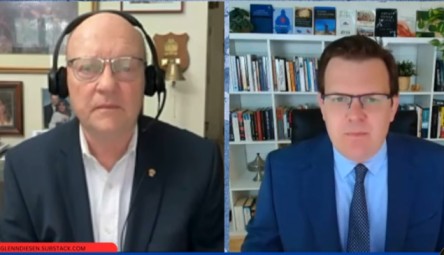
Read the full transcript of Colonel Lawrence Wilkerson’s interview on Greater Eurasia Podcast, June 9, 2026.
Editor’s Note: In this interview, Colonel Lawrence Wilkerson joins host Glenn Diesen to analyze the escalating tensions between Israel, Iran, and the United States, arguing that current strategies are failing to address the core issue of Palestinian statehood. He contends that U.S. policy is becoming dangerously intertwined with Israel’s military objectives, potentially alienating global partners and risking broader conflict.
Israel, Iran, and the Escalating Middle East Crisis
GLENN DIESEN: Welcome back. We are joined again by Colonel Lawrence Wilkerson, the former Chief of Staff to the US Secretary of State. Thank you for coming back on. I wanted to ask you today about what’s happening now with Israel, Iran, and the United States.
We’ve seen something quite remarkable, I think, in that Iran has essentially extended its deterrence to Lebanon. It attacked Israel because it had attacked Lebanon. I mean, this is, I guess, on some level, quite extraordinary. That is, Israel didn’t have to attack Iran directly, and Israel appears to refuse to accept this extended deterrence. But again, it doesn’t seem to get a vote, so it can only go to war. How are you assessing the situation now?
Netanyahu Caught Between a Rock and a Hard Place
LAWRENCE WILKERSON: Getting worse with every minute. Just to note, Ehud Barak, whom you know, former Prime Minister of Israel, said, “Neither military pressure nor flattening southern Lebanon can topple Hezbollah.” You’re right, former Prime Minister.
But he’s caught — Bibi’s caught — between a rock and a hard place. The hard place, if you will, being Trump, and the rock being those people who are campaigning against him on the very issue that he’s not tough enough on Israel’s national security. And oh, by the way, bows to President Trump. So he can’t win for losing, and I think he’s going to lose. I think he’s looking at his first dramatic loss in his long-lived political career.
So it’s become, as my students used to say, as much if not more a domestic issue for Israel and a personal political issue for Netanyahu, as it is an issue of either the US or Israel’s, or for that matter Iran’s, security.
The Real Issue: Palestine
And in all this — I was just on another podcast and this came up — all of this misses the real point in this entire struggle, in this particular aspect of it. The struggle is about a Palestinian state and about what Israel has done in the interim to the Palestinians. And I don’t just refer to what started on October 7th or October the 8th. But the whole history of the Nakba and the relationship between Israel and the Palestinians, increasingly one of occupied and occupier, which has, as you know, a very distinct set of rules and regulations that goes along with it, which Israel is absolutely ignoring and has ignored for the entire time this situation has existed.
So if we can’t get to that issue — we don’t seem to want to get to that issue. In fact, what’s happening right now is the Palestinians are dying at the rate of about 30 to 35 a day still, and they’re dying of all manner of reasons. They’re dying from bullets and bombs and brutality, but they’re also dying because Israel’s got a humanitarian situation that it is supporting that is everything from mafia-like and costing the Palestinians $250 for a dozen eggs, for example, and making lots of people, including many Egyptians, rich in the process.
And all this is just over there on the sidelines. We’re looking at Hezbollah, we’re looking at Dariya, we’re looking at Beirut, we’re looking at what Israel’s doing in Lebanon, which is unconscionable. Of course, it always is when Israel does it, especially to Lebanon or the Palestinians. And we’re being distracted from what is, I think, the real issue here, which is summed up in that Haaretz headline I used to like to quote: “All Iran has to do to win is not lose. All the United States and Israel have to do — and this includes Bibi Netanyahu’s future, I think, in jail or a hero — win spectacularly.” And we’re not going to do that. We’ve already lost, really. In effect, we’ve already lost.
Iran’s Three Nuclear Weapons
No matter how much Bradley Cooper disputes it, no matter how many new reverse-engineered drones he buys for attacking Iran with them, no matter how many bombs he calculates dropping, we’ve lost. There’s another piece out in the Jerusalem Post which belabors the Mackinder theory, if you will, but nonetheless makes some points.
It says Iran doesn’t have one nuclear weapon, it has three. The first nuclear weapon it has is the Strait of Hormuz, and we’ve demonstrated conclusively we don’t know how to handle that weapon. The second weapon it has is its relationship, Mackinder-like, with the heartland power — Russia and China. On top of that, talk about the heartland. And then the third nuclear weapon is the nuclear weapon it probably is making right now, or has already made and could test at any moment, or that Pakistan may have given it, depending on whose version of the rumor you believe.
Domestic Disaster and the Ukraine Blind Spot
So where are we in all of this? We’re at the point where President Trump makes a statement that he never said he was the president who wouldn’t start a war. Are you kidding me? I mean, your lies are many and replete with every issue you speak about. But this one, it’s just baffling.
And I don’t think we have — at the same time, I have to mention the domestic situation here in this country. We’re headed for disaster, I think, with regard to the midterms. And I have no idea what he’s going to do for that disaster.
And today, right before I went on with you, I said, I think I’ll review my YouTube menu, because I have this thing I’ve set up. And I’m looking at it and I’m going down all the interviews of the last 24 hours with people like yourself, Doug McGregor, John Mearsheimer, Jeffrey Sachs, a host of others that I have listed and look at. Not a single one on Ukraine. Not a single one on Ukraine. Not identifiable in the titles anyway. Maybe they mentioned it in the body of the podcast.
So where’s Ukraine right now? Where’s it gone? It has gone nowhere. In fact, it’s getting increasingly dangerous. And I wouldn’t expect Putin to use a nuclear weapon tomorrow morning, but I might expect him to use one eventually if we keep on this path with these idiots in Europe. Brief summary.
Sleepwalking Into Disaster: The Ukraine Question
GLENN DIESEN: Well, on the Ukraine issue, I very much agree. After this meeting now at the St. Petersburg International Economic Forum, Putin yet again had this very low-key, non-confrontational tone. But I get the impression he’s more and more standing alone on this. His National Security Council is not with him. All the people around him appear to be arguing that enough is enough.
You know, the Europeans are openly expressing the intent of continuing to attack us. We know they’re using the territory of NATO countries to attack us. We know it’s their weapons. We know they’re doing the targeting. Why do we not do anything? Essentially, inaction is becoming much more dangerous than action, the way they see it.
But I’m not sure how long Putin will hold this back. And I think for many in the West, this is something difficult to appreciate because they’ve been taught that Putin is evil himself, but he’s essentially the one holding the Russian restraint, which is now becoming very damaging to Russia to the extent it’s being abandoned soon.
So no, I think we’re sleepwalking into a massive disaster. And I’m not sure you used the phrase “idiots in Europe,” but that would be a very appropriate term, I guess, for the political leadership and their stenographers in the media.
The Folly of European Leadership and the Ukraine Crisis
LAWRENCE WILKERSON: But I look at Starmer. I bet you couldn’t walk out of a building in London or anywhere in England, maybe even in Great Britain, you could walk out of that building and say, “Are you for Keir Starmer?” And find someone who would say yes. And yet he’s still the leader. And you could say similar things about Macron. And as Alice Elizabeth Weidel, I guess, AFD leader in Germany, as she gains more strength, and I’m very interested in where she is finally going to wind up, you wonder about Germany, the most significant country in Europe, in my view.
And your wonderment is punctuated with what you just described very well. The fact that they don’t seem to care. They don’t seem to understand what they’re setting up. They don’t seem to understand, for example, that they could cause something to happen, like maybe Putin hits a target that is clearly associated — and I have no doubt his intelligence can tell him this — easily with attacks on Russia or support of attacks on Russia in Lithuania, Latvia, Estonia, you name the country really, and attack it directly.
And then what’s going to happen is they’re going to meet in Brussels and beat their chest, and they’re going to say, “Okay, Article 5, Article 5.” And the United States is going to look at them and say, “Kiss my ass. I’m not joining you in Article 5.” I mean, after all, he hit something that was a danger to him. Even if it was us he hit, it could well be us, or us and the British and whoever else.
Like you said, this is — I borrow Barbara Tuchman’s terms — it’s a March to Folly, it’s wooden-headedness, but it’s entirely different in terms of the consequences and the circumstances, even looking back on the disaster World War I was and even more World War II. Still, this has nuclear consequences tied to it with a red ribbon and perfume sprayed on it. You can’t discount that.
Putin’s Restraint and the Russian Calculus
And I like what you said about Putin because that’s my appreciation of him too. He’s holding back the water in the dam right now. It’s not like people are saying in this country that he’s got major opposition to what he’s doing. They want the war over, blah blah. Yeah, maybe they want the war over, but they want it over on strictly Russian terms. And they’re holding him back in terms of his prudence, his circumspection and his willingness to do whatever he can short of going directly to war with NATO.
Even though I think in his mind, sometimes he says things and Sergey Lavrov says things that make me think they’ve had meetings and they’ve said, “Well, eventually we’re going to have to go to war with NATO.” And I’ve no doubt in my mind that the Russian general staff is beavering away with plans for that from one end to the other, probably starting in Kaliningrad. But this is a very dangerous situation, and we just don’t seem to be cognizant of it.
American Public Opinion and the War Machine
You look at our media here, Glenn, and you would think that Ukraine was a sideshow that one reports on maybe once a week or so and tells what a bastard Putin is, and that what’s going on in the Levant, although it has some huge ramifications because it looks like Trump’s losing, but a lot of people in this country, I’d say probably 50 to 60% of people in this country who are sentient, don’t mind that. That’s hard to say, but I really believe that. They’re not very much in favor of this war. Certainly the youth aren’t. The youth that have just registered their views with this new system we’re putting in place for selective service and for conscription.
And most of the polls and the results of the polls are pretty, I mean, even shocking to me that 18 to 24 year olds not only say no, they say, “Yeah, I’ll be Mexico or Canada. I’m not going in for this.” And you can’t hardly blame them under the circumstances.
And you watch veterans come out, as I did this morning, and veterans — this particular individual is a veteran of Afghanistan a couple of times and Iraq once — and he’s saying, “This is what we did. This is what we did for corporate America. This is what we did for Lockheed Martin. This is what we did for a president who didn’t know what he was doing, for presidents, plural, that didn’t know what they were doing. This is what we were doing for the war machine. This is what we’re doing for the military-industrial complex. We know that.”
And these 18- and 24-year-olds who are about to be drafted may not know that in a way that they can articulate it. But they damn sure aren’t going to go to war for Donald Trump. So why are we even talking about this?
Iran’s Strategic Position and the Mackinder Theory
And why are we looking at, as I’m told Admiral Bradley Cooper is, a reverse-engineered Iranian drone that we think is going to be a game changer in Iran? Ain’t nothing going to change the game in Iran. No drone, no anything like that, no accoutrement of war is going to change that, because this Mackinder theory, I think, is right. One nuclear weapon is the Strait of Hormuz. The second nuclear weapon is the relationship with Russia and China. And the third nuclear weapon is the one they’re building or going to be given by Pakistan. So that’s what you’re up against, Donald.
Maybe you know that because you seem of late to be looking for ways out solidly and carefully and constantly looking for ways out without tarnishing your reputation as being the greatest president that the free world has ever seen. Nonetheless, I think he wants out, but they’re caught. Bibi and he are caught.
Bibi’s caught in the political context that says to him from his opposition, who are likely to beat him if he falls back a second, they’re saying, “You’re not being hard enough in Lebanon. You’re sacrificing Israeli security to Donald Trump. You’re not doing what you should be doing in Gaza. You’re not finishing them off. You’re killing them, but you’re not killing them at a fast enough rate, and you’re not killing Hamas.” And Trump’s telling him to slow down, even not to do this, not to do that, especially bombing in Dahiya, the southern part of Beirut.
So what does he do? He does the one, he probably loses the election and goes to jail and lives in ignominy for whatever portion of his life he has left. If he does the other, Barack says you’re not going to accomplish anything. I think Barack’s right. He’s not — Hezbollah has the advantage on him, I think, now.
Iran’s Allies Are Not Proxies
And this morning, one of the people I was talking with was saying, “Proxies, proxies, they’re proxies. The Houthis, the Hezbollah, the Hamas, they’re proxies.” And I said, “They’re not proxies, they’re allies. They’re allies just like we have allies. And they’re not terrorists either.”
I can make you a good legal case under the international regime and even domestic. I can make you a good legal case for occupying power and occupier, occupying power and occupied, and make an excuse for Hamas. It’s not really an excuse. They’re freedom fighters in Ronald Reagan’s view. “One man’s freedom fighter is another man’s terrorist,” I think he said. And I can make the same case for Hezbollah, and I can make the same case for anyone fighting on Iran’s side. They are allies of Iran.
And they’re allied ultimately — and this is a point we keep missing. This media in this country will not talk about it in a lucid meaningful way. We’re missing what MBS, for other reasons than benevolence, doesn’t miss, and others like him — the Palestinians. This is all about the Palestinians and a viable state and a way to get to that state for them. It’s been about that for so long. It all boils down to that, and Iran is now the premier defender of the Palestinians. And so are its allies like Hezbollah and the Houthis.
Characterize the conflict properly so you can deal with it properly is a fundamental principle of Sun Tzu, Clausewitz, you name it. But we’ve refused to characterize this conflict properly. And therefore we make mistake after mistake after mistake. There’s my lecture.
GLENN DIESEN: Well, since you’ve mentioned, I think, yeah, so resolving the Palestinian issue, I think that is obviously at the core. And if Israel would do a fundamental shift in its foreign policy, that is abandon this clean break strategy of simply dominating its neighborhood, I think it would have to —
LAWRENCE WILKERSON: Even Kagan has abandoned it apparently. I know.
GLENN DIESEN: Well, I think at that point it does have to find a way of getting along with Iran. But to do this, it has to try to resolve the Palestinian issue, because I can understand to some extent why the Israelis have done what they’ve done the past 30 years. If you have the all-powerful global hegemon, the US, standing behind it, telling it you don’t really need to make any compromise, then why would you make any compromise? But when you see that the hegemon is in decline and you will be in a weaker position tomorrow than you are today, surely this is the time to strike the deal. But this is some —
Section 224 and the US-Israel Military Embrace
LAWRENCE WILKERSON: They’re shoring it up. They’re shoring it up with Tom Cotton in the Senate and Johnson in the House, Section 224 of the 2027 NDAA, and gluing Israel and the United States in an embrace that can’t be broken. So you’re right, you’re right. But these people are fighting a rear, rear guard action that’s going to disrupt this country majorly, I think.
GLENN DIESEN: Yeah, that’s what I want to ask, because we see now the Iranians extending their deterrent to Lebanon, but I also saw today a report by the political spokesperson of Hamas, Hassem Qassem, who made the point that the Iranians contacted him and let them know that any ceasefire will now include Gaza as well. That is, Israel can no longer have a ceasefire with Iran and continue the slaughter in Gaza. So this is essentially — yeah, they’re putting real pressure.
The Humanitarian Catastrophe in Gaza
LAWRENCE WILKERSON: That’s truly — I was reading up on it last night, as much as I could. That truly is a hideous situation still. There are so many people — a dozen eggs can cost as much as $200. A pint of fuel can cost $75, $80 US equivalent. It’s because the Egyptians, the Israelis. Yes, many Israelis of course are involved with it, particularly those running various aspects of the so-called “humanitarian operation.” They’re making a fortune off this, a fortune off the plight of the Palestinians just to drink a little clean water, just to have a little electricity, just to have some food. And the prices are just extraordinary, and the black market is extraordinary, and Israel’s supporting it all. And as far as I can tell, there’s a huge segment of Egypt that’s supporting it too.
It reminds me of what we had to do to get that woman out. Back up just a little bit. We had a family in Rafah that was the family that Rachel Corrie — whom you may recall, I certainly do, as chief of staff of the State Department, trying to get Israel to admit they’d murdered her. I knew they’d murdered her. I saw the evidence. They had murdered her. I saw the video of the bulldozer. But they never would fess up. They never would do an investigation that mattered to anybody. They wouldn’t even answer Secretary Powell. They answered him with a pro forma answer: “We do these investigations,” et cetera.
But we were trying to — this was the same family that Rachel was protecting that day when she was killed by the Israeli bulldozer. We were trying to get them now, increased somewhat, and a woman with them that was pregnant, out into Rafah. And the price of getting them out with the Egyptians being the principal intermediaries just kept climbing. By the time we got through, it was over 100 grand. Everyone is taking advantage of this now in a sordid sort of way to make money. And Israel is one of the biggest moneymakers in it and perpetrating the whole thing, really making it possible. So I applaud Iran. Good on you, Iran. Bring it back to the real issue.
GLENN DIESEN: But on that real issue, that is on restraining Israel a bit, we see that one of the things that — well, it’s restrained in many ways. It’s being balanced by the Iranians. They are also struggling in their fight with Hezbollah. They’re not being successful against the Palestinians. But I think a key, possibly the most important issue where it’s in decline will be its international standing. And most importantly in the United States, because the US supplies the money and the weapons to do these things and the intelligence for that matter.
But now we see as the support for Israel is declining, there’s an effort now to essentially embed Israel legally within the US military-industrial complex. And this is with this new Section 224. I was wondering if you can unpack what this actually means. I mean, what is at stake with this?
The Dangers of Section 224 and Unchecked US-Israel Ties
LAWRENCE WILKERSON: It’s very dangerous, I think. The first thing it does— let me back up just a little bit and take it back to Donald Rumsfeld and Colin Powell. When Donald Rumsfeld made a similar effort in a very narrow way to gain State Department authorities that Congress had for years handed out to State and not to Defense, although Defense was the spender of the revenue. State determined for what purpose and to what country, if countries were involved, the revenue went.
And when Rumsfeld went to Congress with Powell having pre-briefed our committees in the Congress, the Congress said, go home, go back to the Pentagon. We’re not going to do that. And I give you that little rehearsal because what it meant for the Congress was they would then lack visibility over the spending of that money, because they knew if State were the arbitrator, so to speak, and DOD just the dispenser, State would at least do a reasonable job.
Its political military affairs section, for example, which Josh Paul resigned from recently — you may recall, because of Biden and Blinken and Sullivan’s violations of this oversight — State would at least let Congress have visibility over what was going on through its various committees and so forth.
Well, what they’re trying to do with Section 224, and even worse though I haven’t read it yet, the section that Tom Cotton is pushing in the Senate, which will complement this when the bill comes to conference and goes together for passing, is even worse. It means essentially that everything that was done before by a 10-year or some length of time memorandum of understanding, which would have in this case been agreed to for 2027, and would say in essence that $3.8 billion per year, or $4 billion — Netanyahu wanted to go up to $5 billion — would be codified for 10 years, but it would be under this procedure.
Every penny of it, so to speak, would have to be met by the laws that we have. You can’t use this equipment to kill civilians, men, women, and children, and so — now, yes, Biden, Blinken, and Sullivan became very, very illegal. They broke the law in terms of that dispensation and oversight at the beginning of this conflict. But at least it was there. Now it won’t be there at all.
There will be no oversight of this expenditure of money, and there will be no real guarantee that the money won’t rise precipitously. Inside this arrangement and the sharing that’s going to take place of intelligence, of technology, of everything involved with the security complex in both countries. And I give you one guess on who will get the most out of it. They always do. The Israelis on a 24/7 basis.
And if that’s not bad enough, DOD and the other security apparatus in America through DOD will be locked at the hip with Israel. So will Lockheed Martin, RTX, Boeing, Grumman, and the other defense contractors of note, to include their technology, their laboratories, and so forth. Now, people will say, well, so will Israel. So I’ve got news for you. Despite the boasting of Israel’s mighty vaunted security complex, they haven’t made anything really worthy of squat in a long, long time. Look at most of the things they use and use relentlessly. They’re made in the United States or they’re made in Israel under contract with the United States. So this changes everything and they know it.
Netanyahu’s Role in Shaping US Legislation
Bibi actually used a US congressman. We have a tape of the telephone call. He actually used a US congressman to write this Section 224, to introduce it, and to do his dirty work for him in the US Congress. And in the conversation that took place, Bibi thanked this guy for what he was doing for Israel, because what this guy did was essentially put something in motion that he knew would get the attention of all of his Israel-biased colleagues. And he did it. And Tom Cotton is doing the same thing in the Senate.
Now, I don’t know if Tom got a call from Bibi Netanyahu either, but I do know that he was probably prompted to it by contacts that he has in Israel. He’s almost a defense contractor for Israel in many respects.
So you plug in all of these things and you take away all the oversight and the relationship is even more dramatic than it would be, say, with the United States in California or the United States in Texas. Israel is not just the 51st state for all security purposes and intelligence. You can bet on that. It is inside the White House 24/7, inside the legislature 24/7. This is insidious, perfidious, and deadly, especially for the United States.
And it also — last point — it goes against, which is why it’s happening, it goes against at least 57 to 60% of the American citizenry who are vouchsafing their views on this. And on the war and on the relationship in general. The same thing Charlie Kirk was assassinated for. It’s a terrible development, but it’s understandable from Bibi Netanyahu’s point of view because he was losing it otherwise.
Remember, he started prepping the ground for this by saying, “We don’t need it, the MOU anymore, we don’t need the United States anymore, we’ve got our own complex, we can do whatever we need to do.” This was his jargon. Well, he knew what he was doing underneath the covers. He knew this was going to be changed from an MOU, renewable every 10 years and subject to oversight, to something that was going on all the time with very little, if any, oversight.
GLENN DIESEN: It’s quite extraordinary that the USA is prepared to—
LAWRENCE WILKERSON: It is—
GLENN DIESEN: —the USA is prepared to—
LAWRENCE WILKERSON: I doubt there’s ever been a relationship in a modern state group. I mean, NATO — one critic, not necessarily a critic of Israel, but he was saying to me the other day, an Army general — he said, “We don’t even have this with NATO.” Bingo, we don’t. We don’t have it with anybody else in the world.
The Risk of Deepening Resentment
GLENN DIESEN: But everything will have a reaction then. I mean, if the US is trapped legally in such an arrangement with the Israelis where they have this kind of access and no oversight, it might do the exact opposite. It would further fuel the resentments. That is, there’s a growing faction, it seems, within the US now who would like to have a little bit of distance, at least some sunlight between the US and Israel, especially among the America Firsters. Well, I was just wondering, but it won’t build—
LAWRENCE WILKERSON: It won’t. I don’t dispute you in the long term, but we might not have a long term. It won’t build rapidly enough because just what I said, there’s no oversight. The American people will have no way of knowing what’s going on.
Now, at least they got to watch Josh Paul resign and to resign under protest, from Political Military Affairs at State, which had the responsibility for this oversight. They got to see that. They got to understand him when he came out and protested and became a speaker and formed a PAC that is really an anti-AIPAC PAC. And it’s doing business right now. It’s gathering people in, it’s backing candidates. It’s won with several of its candidates. So it’s a slow accretion of anti-AIPAC power, if you will. I should say anti-FDD power too, because FDD is just as bad as AIPAC. But it’ll take time, and this is all going to be in the dark, so the American people will not see any effects of this in real time.
The Future of Israel
GLENN DIESEN: Well, what do you see as being the wider future now of Israel though? Because this is giving it a lease on life, it seems, this Section 224. But given the problems it has now, especially now the Iranians are extending the deterrence to Lebanon, Gaza, or Palestine in general, where is this headed? Because they’re also now with this Greater Israel initiative, they’re alienating Turkey and the Saudis. I mean, they’re not really doing anything significant just yet. But with all of these variables all at the same time, how do you see the future of Israel looking?
LAWRENCE WILKERSON: Very bad. I think — you know, I’ve said for some time — I gave a talk at the National Press Club in 2016, I think it was, and I titled the talk “Is Israel a Strategic Asset or a Strategic Liability?” And I came down hard on the latter.
I even resurrected the Joint Staff and the chairman of the Joint Chiefs of Staff report for George Marshall on the situation in ’48. And of course, the recommendation to Harry Truman was, “Don’t do this, don’t recognize Israel when they stand up.” And if you can, and you go back a little bit further, don’t go for the petition. This is the British trying to lure us into taking over their responsibilities and thereby restoring their imperial interest through us. It was a very good report, and almost everything predicted in that report has come true.
It’s very difficult anymore with the Cold War having ended and not needing an unsinkable aircraft carrier, as it were, at the end of the Mediterranean. Very difficult to even justify why Israel and the United States have a relationship. Extremely difficult when you divorce the Holocaust from the considerations. And I don’t know anyone with any logic, sentient nature that could say that a duplication of the Holocaust is not now created in Gaza and environs by the people who went through the original one. I mean, that’s just a reality, I think. And yet we can’t seem to back away from that.
Now, as I was doing my research for “Is Israel a Strategic Liability or Asset,” I had to go through and look closely at the Cold War years and maybe come up with an idea based on strategic realities that as long as we thought the Soviet Union was the danger that they were, as long as we thought Nasser was a danger, for example, with his United Arab Republic, as long as we thought Egypt was pre-Sadat a problem — eh, maybe Israel was somewhat of a strategic asset.
I even had my doubts then though, because of what the Joint Staff report said about basically 400 million Arabs and whatever number of Jews there were at that time. It doesn’t compute. It really showed a hangover British hatred, disgust, whatever you want to call it, for the Arabs. That’s what it showed.
And the fact that, as Moshe Dayan said after the ’67 War — apocryphal or not, it was like Moshe Dayan — when someone asked him, “How did you win that war so fast?” He said, “Well, it helps to be fighting Arabs.” That kind of disdain has been there. And is still there.
A Shifting World Order and America’s Strategic Dilemma
So if you look at it really closely now, and you think about what the United States ought to be doing in this time of post-Cold War upheaval and a shift of power from the West to the East that’s dramatic, it’s very difficult to justify us even being in Southwest Asia, in my view. Very difficult to justify.
As Iran has shown with its control over the Strait of Hormuz and our inability to really contest that control — that’s the real arbiter of that strait that Jimmy Carter in 1978 said was absolutely essential to US national security. Open parentheses, he really meant to Japan’s and others, because even at that time it wasn’t really essential for our security, but it certainly was essential to some of our allies’ security. But that said, that’s no longer the case. And Iran has put a period to that being no longer the case.
Why can’t you get along with Iran ultimately? Why can’t you negotiate an end to this war? Why can’t you come to some kind of conclusion that would deal with what is the real problem here, Palestine? Well, you can’t because of that liability. I mean, that’s what we’re doing. That’s what we’re proving.
So the first thing you need to do is change that liability to either neutral or an asset. Anybody think Donald Trump has the finesse and the capabilities and the diplomatic skills and all the rest that goes along with it to do that? No. So we’re stuck. We’re stuck, and we’re stuck at a time when our domestic situation is looking fraught and deadly as well.
So I have to conclude that this shift of power, as it were, in the world is going to go a lot more speedily and rapidly than I thought, and that maybe even Ukraine will wind up contributing greatly to it, and we’ll wind up with a freaking global conflict. That puts sort of a coda to this shift, at the end of which, of course, we will be a shadow of our former self. We being the United States of America. Our physical situation right now seems to offer an exclamation point for that.
The Strait of Hormuz, Red Sea, and the Escalation Ladder
GLENN DIESEN: Well, the Strait of Hormuz obviously has been a key — well, as you said, a nuclear weapon as such against both the US and Israel. But we learned something else today though, that is after the attacks by Israel against Iran, we heard from Yemen that they announced from now on Israel would also — will have all its access to the Red Sea banned, that is in the narrow strait, they’re going to essentially cut it off. And the Americans are seemingly put in a difficult spot because if they were going to contest this with military force, they would end up on that list too.
So you can already see how the escalation ladder has been set up. And it makes the question, how do you see this playing out? How will this affect, I guess, the deeper problems for not just for Israel, but the US commitment to defend Israel no matter what?
Because we are, well, there’s no good pathway here. I think what Trump has been trying to do is to essentially control the escalation ladder, tell the Iranians, okay, we have a ceasefire, then you begin to cut out certain spaces. We can do a blockade on you, we can continue killing people in Gaza. The ceasefire still holds in Lebanon, we pretend. But this is, when the Iranians go up the escalation ladder, it is often disproportionate. There’s a problem that they can continue to go up there with the United States. So where does the US go from here? Because this is an interesting card to play at this point in time.
Key Straits and the Militarization of Global Waterways
LAWRENCE WILKERSON: It is an interesting situation, apart from what I think is a building colossal disaster. It’s an interesting situation, especially for someone like me who taught this at the Naval War College and the Marine Corps War College, and to a certain extent in two civilian universities, such as one can teach military matters to 18 and 19-year-old civilians.
What we’re looking at in many respects — and that’s why I say this is curiously interesting — is a reversal of 30 years of that teaching, at least in certain aspects. We were always worried, and I actually wrote a paper on this, all the key straits in the world, all the key narrow passageways in the world. I included in that a couple of fjords, I included in that the Sea of Okhotsk, the Strait of Hormuz, the Strait of Malacca, the Red Sea, Bab-el-Mandeb, of course the Suez Canal, the Panama Canal, and others.
As I was doing this, I let a couple of papers come off for military consumption and postulated as to how these waterways, such as they were, were going to be used one day to teach the world a lesson. And predominantly what was taken out of that for wargaming and other things was that we could get into the Straits of Malacca, where at that time 65%, I think, of the traffic flowed through the Strait of Malacca in order to get to China or points east. And we did some computations on how much it would cost to go around and found out they weren’t all that expensive trips, and that maybe the Strait of Malacca was not quite as essential as it seemed. It was just very convenient. It shaved a little money off and such.
But some of the others were dramatic, and we postulated how we were going to put — I know you won’t believe this, Marine Corps actually has adapted some of this, adopted some of it, adapted and adopted. We were going to put small units on these critical land masses, and those units would, because of technology and increased ability to, from a very small unit and a space, control a vast area, especially of sea, control them, and thus choke off all our enemies whenever we went to war.
And that’s really all to say that what has come out of this is really interesting to a person like me who was involved in that to the degree of detail I was, and how it’s been used against us, and how in the future certain of these waterways might again be used against us and cut us off to the point where we are in the Caribbean and a Pacific coastline and an Atlantic coastline. The rest is verboten to us, or highly dangerous to travel in.
The Golden Dome and the Militarization of Space
Could easily happen, and it certainly could happen if we start space-based weapons and things like that, which is part of the Golden Dome deal. People aren’t realizing what we’re doing with this Golden Dome thing. All the money we’re putting in it is not going to be wasted in terms of the people who want to militarize space. And you’ll be able to control a lot of these points as you were on the shoulders of the water, so to speak. In my theory, you’ll be able to control them from space, and you’ll basically be able to control maritime traffic.
All to say, look at what’s happening in response to these kinds of prospects. What’s happening — and it’s not congealed yet in a real way, except perhaps with China and perhaps with Russia in a regional way — everybody’s going to pipelines and highways and rail. They’re going back to the past in a certain respect.
The Rise of Pipelines and Land Corridors
Hell, I was painting Texas gas and oil pipelines when I was 16 years old. So we’re going back to north, south, east, west pipelines. We’re getting away from the maritime environment because of all these things I just so inexpertly described, but also because space-based weapons are going to make it difficult. And you say, well, space-based weapons can hit pipelines too. Well, that’s fine. You repair the pipeline. Pretty hard to get your ocean liner back out of the bottom of Davy Jones’s locker or get the oil off the ocean surface.
But these pipelines are going up everywhere. They’re going up with a rapidity I never thought I would see. And yet I went with Powell to ExxonMobil’s headquarters and looked at the pipelines — pipelines pumping, pipelines contemplated, and pipelines under construction. And I said, and Powell agreed, “Future of the world right there, future of the world” — ExxonMobil’s map. And now that map is probably 10 times as dense with pipelines.
And look at what MBS has just done, supposedly with his sovereign wealth fund investment in the pipeline that was going to run out of northern Saudi Arabia to Haifa, onto Cheyenne, and on to Europe, and relieve some of the problems with Russian oil and so forth. That was the original plan. It isn’t going through Haifa anymore because of what Israel has done. He’s changed the plans. It’s going through northern Syria. So that’s a just a tactical move, if you will, but it could become strategic. This is the future. This is the future. And what Russia and China are doing, in my view, Central Asia in particular, is recognizing that future and making their plans based on it. We’re not. We are still stuck to the old regime.
GLENN DIESEN: But this is the old Mackinder goal of establishing physical transportation corridors by land to deprive the maritime powers of their dominance. And well, you can draw again parallels to what’s happening in Europe. Only today or yesterday, the EU announced that its naval missions in the Mediterranean would now be expanded to also allow them to board what they call the Russian shadow fleet tankers. But at some point they’re going to realise, I mean, it’s very strange to do this as the world becomes multipolar because the Russians and others can now begin to retaliate. They can also put sanctions on Western ships, they can also begin to board them. So undermining the freedom of navigation now seems a bit destructive, especially as the Eurasian powers have land corridors while the Westerns do not. So I think this is a very foolish development.
LAWRENCE WILKERSON: And all it takes for that to evolve into, say, the slave trade across the Atlantic and what that bred in terms of piracy — that’s all it takes. We’ll have rogue fleets out there flying the high seas, picking off whatever targets they can pick off, because there’ll be no one to stop it. It’s going to be very difficult to put together everything that’s being broken at the moment.
GLENN DIESEN: I think this is one of the flaws.
LAWRENCE WILKERSON: As you intimated, it will be a huge change in the pathways of global commerce because people won’t want to ship globally, they won’t want to do things globally, they’ll want to do things internal to their landmass or whatever. Or more safely and cheaper. Usually the arbiter — at least the way I read Frankopan’s book about the New Silk Road — it’s always cheaper to do it over land. I mean, you can say that as a maxim, and it might not be correct here, there, or wherever, but basically it’s always cheaper to do it over land.
Energy Transit, Blockades, and the China-Russia Partnership
GLENN DIESEN: It’s also because the great powers will always have some power from interrupting international trade. This is something the Germans always learned, that is towards the end of any war, the British would come and put the blockade on their ports and they could starve to death. But also 22 years ago when they had the Orange Revolution in Ukraine, very much NATO-backed in 2004, what worried the Russians was that the vast majority of gas going from Russia to Europe would transit through Ukraine, which meant that if the US and its partners could essentially hijack Ukraine, then they would be able to unify the energy consumers with the transit states against the energy supplier, which is Russia.
But now, of course, you see, when you look at the required land corridors for stability, the Russians are looking towards China. I mean, the massive border — and there’s no countries in between. Yeah, you have Mongolia on the side, but you can circumvent this one. And also, it’s not easy to hijack Mongolia. But essentially, this is part of the calculation which is pushing now China and Russia together, that they can stand back to back. There’s no way of disrupting this partnership. And I just think a lot of what we have been doing goes very much against our own interest.
The New Silk Road and a Shifting World Order
LAWRENCE WILKERSON: But if you look at Frankopan’s book in a sort of global way, and you look at the maps he has in that book and other maps that are now available — finally someone has discovered the railroads and started making maps — you look at, I think, almost an autonomous system, and certainly with enough money and enough energy resources to be autonomous.
And if they wanted to — they don’t want to right now. China in particular doesn’t want to say goodbye to South America, with whom I think it has 60% of the economic trade now. But if they wanted to, they could say, okay, draw a line down the center of the Atlantic and the GIUK gap all the way down to Antarctica and say, “Go away. We’re going to live over here because we have 60, 65% of the world’s population, about that percentage of its GDP, and it’s mostly generated and can be made to totally be generated in our area.”
Our area is pretty vast when you look at it. No, I agree. Looking at that railroad coming into Iran, the one that comes in directly into Tehran, and I’m looking at the map — I got my map spread out here. It needs a 20 by 30 room to be spread out, and it still doesn’t have the level of detail I would like. But I’m looking at it and I’m thinking, holy mackerel, look at all the capitals that that railroad connects. And listen to history in terms of those capitals. They’re replete with history, and now they’re back. They’re back.
In many cases, they have hotels, for example, and Frankopan points this out, having just been there himself. They have hotels that rival anything in Paris, anything in Berlin, anything in New York, anything in Los Angeles or San Francisco — rival and surpass them both in terms of luxury and in terms of how much a room costs you. And yet they have people there, they’re packed. It is the New Silk Road, it is the new world aborning.
GLENN DIESEN: Well, that is the wider idea, that is, along these transportation corridors, this is where civilizations grew. Power accrued, and then of course, when the ancient Silk Road was disrupted, this was the rise of the Western maritime powers 500 years ago, connecting the world. And with this, of course, this was the source of our 500 years of dominance. Well, speaking on behalf of the political West.
LAWRENCE WILKERSON: And it also put together the economic structure, at least 50% of it, that saved Britain’s possession, but they lost it. The slave trade.
GLENN DIESEN: Yeah, but now with the reconnection or redeveloping the ancient Silk Road — not just with the physical corridors by railroad, ports, but also the digital Silk Road and connecting with this industrial cooperation, technological hubs, trading through banks, payment systems, national currencies — it’s really all fun and rupee.
LAWRENCE WILKERSON: Yeah. The Indian currency. What’s the Russian currency? I just lost it in my head. Rubles. Rubles.
GLENN DIESEN: Yeah.
LAWRENCE WILKERSON: Rubles, rupees, and yuan. Remember. Keep it all Rs. Make it alliterative. Rupees, rubles, and remember.
Will Iran Target US Ships Directly?
GLENN DIESEN: Well, let me just ask a last question before I forget, because the Iranian pushback and again, not ceding the waters to the United States, which is a huge development, one could add. Do you see the Iranians more prepared now to also attack the US ships directly? Because so far it appears they’re going more heavily after Israel and the Gulf states. Do you see any shifts to that regard?
Israel’s Gamble and the Domestic Fallout
LAWRENCE WILKERSON: I think that’s smart. I think that’s smart. We still have a capacity to bring a lot of pee — in a military term — on Iran with just iron bombs, even if they’re dumb with a JDAM kit hung on them or whatever to make them precise. And Iran doesn’t need to suffer that if she can prevent it. And so why do that? If she has to, I think she will.
You know, I’ve seen video that I believe is real of hits on Abraham Lincoln, of hits on destroyers and cruisers. These aren’t hits that are sinking hits, but they are hits that hit the CIC, the Combat Information Center. And they are hits that have hit crucial areas of certain ships. And look what CENTCOM’s doing. They’re not telling the American people any of that. We don’t hear any casualties. We don’t hear any casualties in terms of humans. And maybe there weren’t any, but I doubt it very seriously.
And they have not used their most powerful missiles. It’s almost as if they’re saying, “See what we can do if we want to. We can hit you. We can get through your magnificent array of surface, subsurface, and air defenses. And we can hit you.”
If they were to fire one of those hypervelocity missiles, or several of them — I would suspect it would be several of them — at a major target like an aircraft carrier, and sink her, it would be a whole new dimension to the struggle, I think. Because Trump then might could turn to the American people and say, “See, you got 5,000 Americans dead.” I don’t know. I can’t read that well. I don’t know if the American people would be appalled by it and then demand that he get out of this stupid war, or if it would raise their dander up. The MAGA people, it certainly would, and demand that he drop a nuclear weapon on Iran or something like that. So I wouldn’t take the chance for Iran if I could do it with other things at a lesser damage level.
GLENN DIESEN: So, sorry, I will squeeze in one last question there. What do you think Israel is going to do now? Because it is in a difficult spot, and for people in Israel who say that this could turn into an existential threat, it’s not really that exaggerated. They are struggling internally with political divisions. They are losing key allies. They are egging on some large powers.
I saw in the Financial Times today — even the Financial Times wrote that Netanyahu, after 30 years of trying to get a war with Iran, bet everything on this and lost. And I thought that summarized it nicely. So what is it that Israel can do now?
Israel’s Isolation and America’s Domestic Crisis
LAWRENCE WILKERSON: I think you’re right. I was looking at this Pew Research Center poll of adults across 36 countries. I didn’t read the whole thing, but I read enough of it to think that it might be right. 67% of the people essentially believe Israel’s wrong — for the first time in this kind of polling. Wrong in basically everything it’s doing. And I think that reflects, well, if it’s accurate, that’s 36 countries, two-thirds of the people. That’s a real change, I think.
And I don’t know if it’s happening fast enough in America to do things that would really shift the relationship. It’s not going to act fast enough to do anything about 2024 and whatever its equivalent is in the Senate.
But I’m worried more about our own situation domestically and what Trump is going to do if in fact the midterms turn out to be uproariously against him and against the Republican Party. And I’m sad to say, I wonder what the legislative leadership is going to do, because I don’t put Trump’s behavior and his more authoritarian nature beyond Thune and Johnson — the two leaders. I do not. Senator Thune may be less so than Johnson, because Johnson is convinced that Armageddon is upon us and the rapture is going to happen. That taints his belief system, I think, majorly.
But I don’t see a lot of opposition to many of the things that Trump is doing. In fact, I see a giddy acquiescence to it behind the scenes amongst my formerly Republican counterparts, which is as alarming to me as Trump is. So the domestic situation in this country is a toss-up.
GLENN DIESEN: Well, thank you for sharing your insights, and we’ll wrap it up there. So thanks again and have a great day.
LAWRENCE WILKERSON: Thank you for bringing me into the heart of Europe. Take care.
Related Posts
- Transcript: Nepal PM Balen Shah’s Speech At UN General Assembly 81st Session
- Transcript: President Trump and the President Xi Remarks at a State Dinner
- Transcript: Israeli PM Netanyahu Addresses UN General Debate, 81st Session
- Transcript: President Trump and President Xi Deliver Remarks at Arrival Ceremony
- Transcript: Secretary Marco Rubio Remarks at Press Conference in New York City – Sep 23, 2026