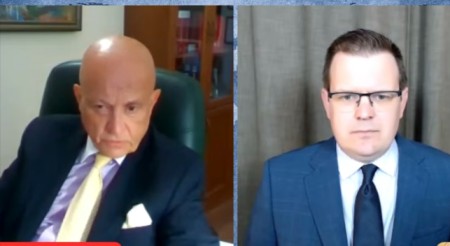
Read the full transcript of Russian foreign policy scholar Sergey Karaganov’s interview on Greater Eurasia Podcast, May 10, 2026.
Editor’s Notes: In this episode, Glenn Diesen sits down with Professor Sergey Karaganov, a highly influential Russian foreign policy scholar and former advisor to Soviet and Russian leaders, to analyze Russia’s position in what he describes as a “New World War.” Karaganov outlines his provocative and controversial proposal for Russia to restore deterrence through the escalation of its nuclear doctrine, including the potential for “punitive” strikes against European elites. The conversation explores the breakdown of diplomacy, the strategic significance of the conflict in Ukraine, and Karaganov’s vision for Russia’s future as a sovereign Eurasian power independent of Western influence. This interview offers a rare and intense look into the hardline geopolitical thinking currently shaping Russian foreign policy and its response to NATO’s involvement in the region.
Introduction
GLENN DIESEN: Welcome back. We are joined today by Professor Sergey Karaganov, the head of the Council for Foreign and Defence Policy, also one of the more or most influential Russian scholars on Russian foreign policy. Professor Karaganov has written speeches for Brezhnev, advised Gorbachev, Yeltsin, and of course, President Putin, and was also a leading advocate for changing Russia’s nuclear doctrine. From what I understand, President Putin pushed back before eventually adopting a lot of these suggestions. So thank you for taking the time.
SERGEY KARAGANOV: Thank you, it’s a great pleasure. And I have been following your podcasts for quite some time. And also, of course, I remember our conversations when in Moscow and elsewhere. This is a pleasure.
The Escalation of the Conflict
GLENN DIESEN: Thank you. I wanted to ask you about how this conflict has evolved and changed, because over the past 4 years we’ve seen some incredible developments which were unthinkable during the Cold War. So for example, we’ve seen NATO countries participating in missile attacks on Russia, we see NATO countries backing the invasion of Kursk, again Russian territory, and seemingly assisted also in the attack on Russia’s nuclear triad, as well as the early warning system.
Again, all of this is, well, used to be unthinkable, at least during the Cold War. So I was really looking forward to a Russian perspective on what you see going on and where we’re all heading, because unfortunately in the West at the moment, we don’t really discuss security concerns much of opponents anymore, and there’s not really that much discussion about the direction and the risks that are being taken by going down this path. So how are these developments assessed now in the Kremlin?
SERGEY KARAGANOV: Well, we have been procrastinating for too long, and I have been criticizing my fellows in the government for tolerating Western aggression for too long, hoping that we could find a solution. The solution is nowhere to be found at the juncture. So I’m returning back to what I have been proposing since ’23-’24, and this time I hope my suggestions will come true, though not in full.
We have to escalate and to punish our, this time, European enemies for conducting an all-out war against Russia. They say there are different calculations. I believe that it is a Fourth World War. If you take the Napoleonic War with 25 nations joining Napoleon invading Russia as the first, then it was the first and the second, now we have the third.
The problem is not exactly on the battlefields of Ukraine. The problem is that overall the systematic change of the world system brings about something like a Second World War. Actually, it has started. It has started at first in Ukraine when Americans, willing to undermine Russia, unleashed it, and then Europeans greedily went into the abyss. But now it is also Middle East and Southeast Asia, South Asia, and we see that that is a Third World War. I have decided to write about that already in the open, and you’ve got probably one of my first articles, and then also several will follow.
How Russia Can Win a World War
GLENN DIESEN: Yeah, I always argue that this is a very dangerous time because whenever you see a massive shift in world order, it usually leads to a lot of instability. So as the world navigates from this unipolar moment for the collective West towards a multipolar system, you would hope that a lot of countries would be very careful in navigating and avoiding war and conflict. And this is why the absence of diplomacy has been concerning, to say the least.
But I did read your article, “How to Win a World War,” and I was wondering if you could possibly flesh out the argument. And again, I hear this argument quite often as well, that we are likely in another world war now. So how do you see Russia’s position in this world war? And well, how can Russia win this?
SERGEY KARAGANOV: Well, the problem is that we have to win, and we have to win for two reasons. One is to stop this bloodletting war in Ukraine, which goes nowhere but towards more and more victims on our side, and 10 times more, 5 times more, 3 times more on the Ukrainian side, etc., etc. And it is endless, but sooner or later it would end, it should escalate.
But the second element of this war is the prevention of the horizontal escalation, which has started already. Because as I have said, a couple of months ago, our American partners, enemies, whomever they are, following all predictions, started to destabilize South Eurasia, and that is the Middle East. It is not about Iranian nuclear weapons. It is about destabilization of the huge area, starting from Maghreb and going down to Southeast Asia. And that they have started to do. And we have to think how to stop that.
On the Ukrainian front, it is relatively clear for me, but it is a much more deeper and profound task as to the whole international system.
The Nuclear Deterrence Dilemma
GLENN DIESEN: But throughout this conflict, or at least over the past 4 years, there’s seemingly been always a dilemma in Russia.
That is, as the NATO side escalates again — and the NATO side did recognize they escalated — I always point out that Joe Biden once argued that sending F-16s would mean World War III. But we kind of crossed all these lines. And for the Russians, I guess they always have to choose. They want to keep things stable, or either risk a world war by retaliating, or not retaliating, but then essentially emboldening the other side, and then see further escalation. So you’ve argued for the need to actually use nuclear weapons in order to essentially restore its deterrent. Is that correct?
SERGEY KARAGANOV: Yeah, this war has brought a lot of benefits to Russia. It had recuperated from its idleness. We have restored our soul and our honor. We have started to value those people in our society which are truly valuable, meritocratic elites, scholars, doctors, officers. So the country is becoming more healthy. But for that, we are paying for too many bodies.
So my advice to my government at this juncture is that we should stop this war, at least in Europe, by going up the ladder of escalation. First, attacking by conventional weapons certain symbolic or logistical points on the European soil. We do not need an inch of Europe, as you might understand. And then if they do not succumb, we should follow with nuclear strikes, relatively massive, with of course offering some kind of ultimatum. If they do not succumb, well, some of the countries of Europe should perish.
That is my suggestion, though I pray God, and I’m a believer, that wouldn’t happen. But I believe that these people have lost their minds, lost a sense of history. These elites are totally irresponsible and they should be punished. That’s why, in addition to many other things, I proposed that our military nuclear doctrine should concentrate not only on deterring attacks against Russia proper, but it should concentrate against punishing European elites, including with special munitions which would do away with their bunkers. And the first waves should go there.
The European elites, which are senseless, which are irresponsible, should suffer first, not the European peoples. But we are debating this issue, and sooner or later this debate will come to fruition.
Shifting Mood in the Kremlin
GLENN DIESEN: Well, I remember you made this argument a while back already, but do you get a feeling that the mood in the Kremlin is shifting now more towards your arguments, or has it not moved that much?
SERGEY KARAGANOV: I am not here to talk about the mood in the Kremlin. When I started 3 years ago to put the idea on the table, I was the proud voice of a minority. Now I am a voice of overwhelming majority, both in the military, in the political circles, and in the society.
But again, I am not calling for massive nuclear strikes, because I know that they would take away innocence. But the problem is that we have to stop this war, at least in Europe. All the more, as I’ve said, the war is already expanding, and it is engulfing South Asia and Southwestern Asia. And then it will spread, because the attack against Iran was predictably brought about not only curtailment of oil transactions, but also curtailment of the flow of fertilizers and many other things. And it was absolutely predictable. And that means that we will have a new wave of instability also in the so-called Third World.
I must say that from my point of view, what is happening now is that the historic West, which has been losing its historic predominance in culture, politics, economics, which allowed it to rob the world for 500 years, is on revenge. And the Europeans don’t quite understand what they’re doing. But Americans, I think, do. And while Mr. Trump, with all his jumps and jerks, looks to be a fine person, he leads his country as he had been told to, exactly in the direction of a historic revanche. We will not allow it.
The Spirit of Alaska and Negotiations
GLENN DIESEN: Yeah, I wanted to ask about this as well because it seemed for a while that the United States was looking to, as the Ukraine war wasn’t going their way, unload it or at least outsource it to the Europeans and attempt to improve their bilateral ties with Russia. But this doesn’t really move much forward. And also, the negotiations over Ukraine haven’t really moved forward either. What do you make of the negotiations now and what they refer to as the spirit of Alaska?
SERGEY KARAGANOV: Spirit of Alaska is a joke. Of course, at some point in the course of the continuation of this war, we could agree to a truce. Some kind of truce, but it would not be peace. The peace could be achieved only when and if at least European elites are thrown away by their peoples and by their deep states, because they are mad and they are leading the countries towards a big war.
The Invasion of Kursk and Western Support
GLENN DIESEN: I was wondering about what I initially said about the invasion of Kursk, and we were surprised by the very open support it got, at least rhetorically, but as we know, also in terms of weapons and intelligence to support this. And as I said, this would have been unthinkable during the Cold War. I was wondering, how do you see this development?
SERGEY KARAGANOV: And this is my criticism to my own government and my own political class. We did not understand what kind of a conflict we are in. I would hope that it was superficial. It was about Ukraine, et cetera, et cetera. It is a world war. And it is about an attempt of a revanche of the Old West towards — I mean, it will be futile because the Old West will be destroyed if it continues, or the world will be destroyed. Hopefully not.
But we were thinking about how to avoid, how to agree, how to find piecemeal solutions. We played with the Minsk process for 3 years, which was an oscillating mistake. Now we are talking about this spirit of Alaska. I am smiling. And it is about nothing, because if and when we agree something which is close to what President Trump proposed in Alaska, then that would mean that in a year or so the war would be resurrected and in full scale, and of course with nuclear weapons.
So the spirit of Alaska is a trap on one side or a mistake on the other side. I do not trust the spirit of Alaska, though I hope that eventually Americans and Russians would agree on some rules of behavior towards each other, but Europeans would not be a part of that game.
Attacks on Russia’s Nuclear Early Warning System
GLENN DIESEN: Well, at least that’s something, the US and Russia trying at least to improve relations, although I’ve also limited optimism for how far this can go. I was speaking two days ago with Professor John Mearsheimer, and he told me I should ask you something he had been wondering about, which was the attack on the early warning radar system of Russia, the ones that were essentially used to detect a nuclear strike, something that would give Russia some time before a retaliatory strike, essentially.
This seems like it’s in everyone’s interest for each side to have some warning time, unless you’re planning a first strike, of course. But then also in June of last year, the attack on Russia’s nuclear deterrent, which I heard from FSB had assistance from the British MI6. I was just wondering, how are you reading this? Because for me, it’s a very concerning development.
Russia’s Nuclear Doctrine and the Path to Escalation
SERGEY KARAGANOV: They are pushing to the limits. Russian government waited to avoid an all-out confrontation, and I think we made a mistake. We should start to punish our enemies full-scale, hopefully without unleashing an all-out nuclear war.
But first, of course, I mean, these crimes which they have committed, which have been unheard even in the worst days of the Cold War, should be punished. And there are many ways, and we are planning them. First, of course, attacking, I mean, serious targets on the territory of Europe proper.
But let me remind you that we don’t need an inch of Europe. We have to be as away from this Europe as we could be. But before that, of course, probably we have to crush this regime in Kiev. And without climbing the ladder of nuclear escalation, that looks to be impossible or too expensive in terms of spending our human material, our best men.
So my advice to my compatriots, and I fully support it, is to escalate, first by striking with conventional weapons, symbolic and also important targets, like logistical centers or military bases. And then if they do not stop, we should go nuclear, with a series of limited strikes.
Before that, we have to change our doctrine, which is outdated by 40 or 50 years. Let me remind you that our nuclear doctrine believes that there will be no victors in a nuclear war. That’s stupidity. There will be victors. Could be. Are victorious and will be victorious in a nuclear war. I beg Almighty that it wouldn’t happen, especially in Europe.
I think that eventually we could even produce an ultimatum to some of our European neighbors, especially in the northwestern part of Europe, so that they will succumb or surrender. But before that, we could probably look for possibilities of limiting casualties on the European side. But we are tired of spending our best men on this junk, which — I’m sorry, you are European and I’m European too — on this junk which is called Europe.
Arms Control and Changes in Russian Policy
GLENN DIESEN: In your article though on how to win a world war, you did advocate for many policy changes for Russia to essentially begin to change course and begin to restore the deterrent, which kind of slipped gradually over the past 4 years. One of them was walk away from arms control as well. I was wondering how that fits into the wider argument?
SERGEY KARAGANOV: Well, now we have to change our policies on many directions. One, which I have not yet mentioned, is of course we have to change our doctrine of using nuclear weapons. And for that, we should put there a dictum that if we are attacked by a group of countries which have a preponderance over us in economic and technological and demographic potential, we are not only have a right, we have an obligation to use nuclear weapons.
The second proposal which I have pushed forward is that the commander-in-chief should delegate some of his power to the Commander-in-Chief for European theater, a general who would be supported with officers and generals with field experience, and that he would be responsible for a possibility — one necessity — to use all means, including nuclear weapons, against certain European countries, which have unleashed and are continuing to unleash an aggressive war against Russia.
I don’t want Europe to be eliminated because I’m culturally European, but I am reminding my own compatriots that unlike many of our dreams, Europe is the source of all evil, of all wars, of all genocides, of all everything worse in human history. It is returning back to its normal situation. And I hope that we will be able to prevent that for the sake of Europe, for the sake of us, and for the sake of European people. But Europeans have to understand that their countries are — the leaders of those countries are — leading them towards oblivion.
Germany, the UK, and the Origins of the Ukraine War
GLENN DIESEN: Yeah, that’s one of the things I usually have difficulty to understand. It seems like this escalation, if we follow a clear track over the past 4 years, it’s leading us very predictably into an all-out conflict with Russia, which would likely involve nuclear weapons. Yet there doesn’t seem to be much discussion or efforts to have any course correction. Indeed, there’s a demand around, consensus around one policy, and everything else is dismissed essentially as taking the side of Russia, if one calls for some restraint or recognizing the security concerns of the other side.
But a colleague of mine, Jeffrey Sachs, he often puts a lot of the blame on the Ukraine war on Germany and the United Kingdom, in addition to the US, of course. You also tend to focus more on both Germany and the UK as being the leading aggressors against Russia. I was wondering if you can elaborate how you see this.
SERGEY KARAGANOV: Well, this war has been unleashed by the United States. You will read a series of my articles since 2 or 3, 2 or 4. Then it escalated. Then Europeans jumped into this game. And now Germans, the Brits, of course, playing their usual game — that is igniting war in Europe to weaken the continental, ignite their continental neighbors and weaken them. That has been their bad habit for several centuries.
Now, unfortunately, we in Russia have not yet understood that we are turning back to the worst, worst times in our history. And as to Germany, when, as I’ve said, a German chancellor calls for the strongest army in Europe, that means that he calls for elimination of Germany totally. I mean, evaporation. And German burghers, who have common German friends, they should understand that.
Diplomatic Pathways and the Kyiv Regime
GLENN DIESEN: Well, you mentioned though that the spirit of Alaska is a joke and is dead, but do you see any other possible pathways to a diplomatic solution? Because, well, a year ago when the Trump administration returned, there was some talk from the United States that we had to find a peace. They recognized that expanding NATO up to Russia’s border had been a mistake. They argued then for a neutral Ukraine. They argued for accepting territorial concessions. But again, this seems to have gone nowhere. Indeed, it appears to, to some extent, walk this back. But is there still any pathway to a diplomatic peace instead of this war?
SERGEY KARAGANOV: Of course, let diplomacy have a chance. But from my point of view, the endgame should be elimination of the Kyiv regime. First, second, the restoration of our lands in the south and east of Ukraine. We don’t want to take, and we should not want to take, all of Ukraine because it is a breadbasket.
But the main thing now, in addition to what has been proposed, is to break the will of European elites for aggression. They have started an aggression, they’re conducting an aggression, and they should be punished for that, or eliminated by their deep state, hopefully, obeying their people.
When a president of France calls for extending deterrence, feigned deterrence, to other countries, he’s not only a blatant stupid liar — he should be treated by the French as a traitor, because that means that he wants to sacrifice, or is ready to sacrifice, Paris or Lyon for the sake of, say, Berlin or Poznań. These idiots, which have lost the sense of history, the hands of — I mean, simply the level of senses — should be either punished or eliminated.
Better that should be done not by Russian missiles, not troops. We will not invade Europe under no circumstances because there’s nothing we need there. But by European people, who have also lost the sense of self-preservation. They are led by mad dogs. Hopefully Europeans will be able to throw them away, but I’m not trying to intrude into internal affairs of European countries. It’s up to you to decide.
The Baltic Sea and Russia’s Shadow Fleet
GLENN DIESEN: Well, it seems to me that one possible avenue for escalation into a massive direct war would be possibly unleashed in the Baltic Sea. That is, over the past months now we’ve seen blockades on Venezuela, Cuba, hijacking of Iranian tankers. And of course, first it began with referring to Russia’s civilian fleet as a shadow fleet, and then this effort of boarding them. And now we see talks of a naval alliance, that is the UK plus 9 others. Essentially, the task is to confront what they have now labeled Russia’s shadow fleet. Do you see this as a possibility?
SERGEY KARAGANOV: In our internal discussion, I’m criticizing my government for being too soft on the acts of piracy. And if and when the Dutch channels are, or could be, closed, then it would simply mean there will be no Denmark anymore. But I love Denmark. It is a nice country. And this is close to your country and also to Sweden. We should be serious about returning these idiots back to senses.
Nuclear Exchange as a Possible Savior of Humanity
GLENN DIESEN: Well, yeah, again, I’m hoping there will be a way of restoring deterrence again, as you said, God forbid, without any nuclear exchange. But it—
SERGEY KARAGANOV: Well, nuclear exchange — limited nuclear exchange — if it happens, and if it brings these mad dogs to senses, could be a savior of humanity. Because overall, we are living in a multiple crisis world where there are many underlying notions of our life that are crumbling. Modern capitalism has exhausted, or has been exhausting, its life. Now we see that this modern capitalism plus informational revolution is undermining the sense of the human, dehumanizing the human. But it is very deep.
Now we’re going to the geopolitical level. On the geopolitical level, that is being reflected by this revanche of the West, which tries to restore its previously prevalent position in the world, which allowed it to rob the world. But it will never happen. Hopefully, we could somewhere along the road arrange a world of multipolarity, of mutual respect, and a world which is much more peaceful. But we are in for 20 years of wars.
Russia’s Future: Turning Away from the West
GLENN DIESEN: Just my last question is, how do you see Russia’s future after this war? Because, you know, since Peter the Great, the past 300 years, Russia modernised by looking west, and indeed Gorbachev had this greater European home idea as well. But as you said, with the rise now of the east, the modernisation is no longer monopolised by the west, and Russia has all these partners in the east as well. How do you see Russia’s future after this?
SERGEY KARAGANOV: First of all, I’m, of course, a historian of Russia too. Russia has never been a European country. Originally, it had been a Eurasian country from the beginning. We took our external cultural roots not from Europe. We took them from Palestine, from the brilliant Byzantium, from the Muslim world, and from the Buddhist world. And their political and external political cores of our society and of our culture came from the great Mongol Empire.
Now, the European journey by Peter was useful because at that juncture, for the time being, we were lagging in technological progress and technological knowledge, and our army was not that well organized because Europeans were much better organized. But the European journey of Peter the Great had to be stopped about at the end of the 19th century. By that time we took everything positive which we could have taken from Europe, both military organization — though in terms of artillery and military tactics, we became the first country in Europe by the end of the century.
Now we engulfed great European culture. Without Europe, we wouldn’t have had Dostoevsky, Tolstoy, Mussovsky, Tchaikovsky, etc. But we should have stopped that journey at the end of the 19th century. After the end of the 19th century, we continued, unfortunately, with the journey and got two world wars and communism from there.
We have to finish our European journey, but Mozart, Beethoven, and Shakespeare are our writers and our composers, and they are very deep in our souls. But Europe should be thrown away from our history, but kept as a very interesting and useful element.
Dostoevsky, Europhiles, and the March East
GLENN DIESEN: Yeah, as you mentioned Dostoevsky there, I was thinking you sounded a bit like Fyodor Dostoevsky, because in the second half of the 19th century he was making a similar point, that the Russians had for too long attempted to mold themselves into being like Europe, into being Europeans, and they only gain the contempt of the Europeans. So he essentially said the same — the Russians should march east.
SERGEY KARAGANOV: Yeah, I’m going further than Dostoevsky, and although he’s my most favorite writer in Russia — though of course I love Tolstoy, Pushkin — I’m saying that Europhiles and westernizers in Russia now, after what has happened, are either intellectually impotent or morally corrupt. This is an idiocy. You have to be a moral idiot in Russia to follow the European way.
GLENN DIESEN: Well, thank you for taking the time. I appreciate your views.
SERGEY KARAGANOV: Absolutely. However, Professor Diesen, you know that I have a lot of friends in Europe and I cherish our friendships and I do not want to totally cut our ties with Europe, now with Europe of decent people. There are some still, they are brainwashed, and I hope that some of the markets could be restored.
But Europe for Russia is passé, is something which should be kept away. We don’t need an inch of Europe. The farther we get away from Europe now, the better it is for Russia, for its future development.
Related Posts