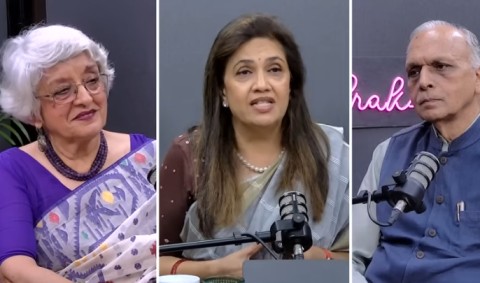
Read the full transcript of ANI Podcast #413 with expert guests Ambassador Veena Sikri & Dr. Arvind Gupta on Collapse of Global Order, May 10, 2026.
Editor’s Notes: In this insightful episode of the ANI Podcast, host Smita Prakash explores the seismic shifts in global geopolitics with esteemed guests Ambassador Veena Sikri and Dr. Arvind Gupta. The discussion delves into the perceived collapse of the traditional “rule-based order,” examining the internal cracks within NATO and the waning influence of international institutions like the UN and G20. The experts offer a deep dive into India’s strategic multi-alignment, the rise of regionalization over globalization, and the evolving security dynamics in West Asia and the Indo-Pacific. This conversation provides a comprehensive look at how emerging configurations and new military doctrines are shaping a turbulent, yet opportunistic, new world system.
Introduction
SMITA PRAKASH: Hello and welcome to another edition of the ANI Podcast with Smita Prakash. My guests today are Ambassador Veena Sikri and Dr. Arvind Gupta.
Over the past year, the world has watched the United States act unilaterally on major security questions, especially during the war in West Asia, raising fresh doubts about the role of global alliances and institutions. If the biggest powers still choose to move alone when crises erupt, what real influence do organizations like the NATO, Quad, the United Nations, and others actually have? Are these bodies still meaningful instruments of collective security and diplomacy, or have they become forums for statements rather than action? Even the GCC and the OIC have major fissures.
In an era shaped by power politics, shifting loyalties and transactional diplomacy, are international institutions losing relevance? Today we ask whether the old architecture of global order still works or whether the world has really moved on.
My guest today, Ambassador Veena Sikri, is a career diplomat with 35 years of experience in academia and diplomacy. She has served as High Commissioner to Bangladesh and Malaysia, Consul General for Hong Kong and Director General of the Indian Council for Cultural Relations.
Dr. Arvind Gupta is the Director of the Vivekananda International Foundation in New Delhi. He served as Deputy National Security Advisor and Secretary of the National Security Council, Government of India, from 2014 to ’17. Earlier, he was Director General of the Institute of Defence Studies and Analysis, Ministry of Defence, New Delhi. He’s also served in the Ministry of External Affairs and in Indian missions abroad.
Miss Sikri, thank you so much for being part of the podcast. Mr. Gupta, thank you so much. I’ve been wanting to have you guys on the podcast for a long time, but I wish it had been under pleasanter circumstances.
But we are in the midst of a war which we neither started nor are we part of, but it’s a war which has engulfed the entire world and befuddled everybody who has been looking at international systems, rule-based order, thinking that some of these systems are going to be kicking in when anything like a disruption happens. But the Ukraine war and now the West Asia crisis, both of them have shown that this rule-based order has been overturned completely.
So I’d like to ask you both that this decades— we were served by this system, where at least the big powers did not disrupt it. Maybe they disrupted it in small manner, in a covert way, not an overt manner. But here it is overt use of brute power that we are seeing, which has impacted the entire world. So I just want to know this from you, both of you, that were these frameworks so weak that they were obsolete and they didn’t serve their purpose? What would you say, ma’am?
Are the Old Alliances Cracking From Within?
VEENA SIKRI: I would say this is indeed an unprecedented situation. We are in an age after 80 years of the Second World War. The alliances have all been in place for these 80 years, but now there is no one you can turn to because the alliances are cracking from within. I think that is one of the major issues.
Let’s take the biggest of them all, NATO. Now NATO has been the mother of all alliances, the strongest. It’s a military alliance. I mean, there are many others you can talk of as economic or regional alliances. This is a military alliance. But today the biggest weakness of NATO is, when we saw in the Gulf War what is happening, when the Strait of Hormuz came under closure by Iran, and America asked the NATO alliances, “You guys are depending on the Strait of Hormuz, why don’t you come in?” They said no, because they felt they had not been consulted at the very start when Israel and USA attacked Iran.
So I think that this has been a big shock to the system. And as of yesterday and day before, we are hearing that America is thinking now, “What do I do?” Spain did not allow overflights of American aircraft going to bomb Iran. And now what can America do to Spain? Can we take them out of the alliance? NATO says no, there’s no provision for anybody to go out of the alliance. But at the same time, because under Article 5 of NATO, because these countries were not consulted, so they don’t feel an obligation.
And I think if you look at Prime Minister of UK, Keir Starmer, the UK-US alliance has been one of the kingpins in the post-World War II period.
SMITA PRAKASH: That has unraveled.
VEENA SIKRI: It has unraveled. And Keir Starmer is saying directly that we are not going into this war, we are staying out of it.
The G20 and the Search for New Answers
So I think that this is really a key moment, and I can give several other examples. Let’s take, for example, a grouping like the G20. It’s not a military alliance, it’s a very strong economic grouping.
And we’ve seen when India had the G20 chairmanship, we had a very good G20 summit. It went well. We could find answers to them. But now this year, President Trump has said he’s not going to invite South Africa to the G20 summit at Miami. Now, this again puts a big question on the effectiveness, because today if one person is left out— he says that he has invited President Putin, and President Putin may be there, but not— so these questions have come up in a big way to test the effectiveness and resilience of these alliances which have been there for, NATO for 80 years, G20 for less than that, but for a sizable time.
And I think that we have to look for new answers. This is the key. We have to look for new answers and we have to be prepared for that.
And if I may say so, just the last line, I think India, by maintaining its multi-alliance and strategic autonomy right from the very early days, post-World War II days, when we first had non-alignment and we had the non-aligned summit and we had the partnership between Nehru, Nasser, and Tito— but now that has evolved considerably. We’ve now gone into strategic autonomy and multi-alignment, which is a very important refined aspect of the earlier non-alignment, which was at one time condemned as immoral.
And I think this is the key to the future. Because it gives you the resilience to deal with different people at different times depending on the situation.
SMITA PRAKASH: Okay.
VEENA SIKRI: And this has been— I think this is a great thing that India can show to the world. Vishwa Mitra, ye hai, sabse ab mitrata banay rakhi hai. And that will give you the key to meeting your national interest under every circumstance. But military preparedness is a must. Yes, military atma dhyan barta is a must.
Was the Rule-Based Order Ever Truly Fair?
SMITA PRAKASH: I think West Asia is waking up to that fact, that you can’t really outsource it completely.
Dr. Gupta, as Ambassador Sikri said, that everybody is seeking new answers. I want to look at the old questions and the old answers. Was it never truly applied uniformly to everyone? Because that’s what many people in India felt, and in the developing world felt, that it’s been unfair. These older groupings were kind of unfair. They seem fair now to us as India has started flexing its muscle a little more ever since our economy has been doing well. But we were always among the countries which felt that these groupings did not treat everybody with the same yardstick.
And because of that, when crises like the current ones have come up, we’re witnessing a near collapse of, say, NATO or G20 or the UN, if you want to see that. Do you agree with that view?
DR. ARVIND GUPTA: I agree with that. The collapse is not sudden. It started soon after the collapse of the Soviet Union. You had this unipolar moment, and you had the Americans beginning to treat the world as their fiefdom.
SMITA PRAKASH: Okay.
DR. ARVIND GUPTA: And if you look at the NATO bombings of the ’90s in Kosovo and other places, the various countries, including India at that time, were worried because this way they were breaking the international law. So those who made the international rules, global rules, they started breaking it because they thought that now that Soviet Union has disappeared, this new Russia, we should now control it basically, or it’s incorporated in our system.
And of course, the Iraq War— that was a totally illegal war. They went inside without any— so they were breaking it. And if you look at the 2007 speech, but NATO held on.
SMITA PRAKASH: NATO was still there.
Putin’s 2007 Warning and the Unraveling of the International Order
DR. ARVIND GUPTA: NATO will reinvent itself even now. It will reconfigure itself. But let’s just give a little— 2007, if you look at Putin’s speech at the Munich Security Conference, it was a very hard-hitting speech with some very unprintable words that he used for the West, because he realized at that point of time that he was trying to collaborate with the West to build this new order which was inclusive and which was rule-based order where the international law and the UN, etc., was at the center of it. But the West was playing its own games.
And I think the Iraq War and following that, there are so many other things that happened, Libya for instance. So Putin had seen this and he started saying that the West is now behaving in a very, very imperious manner and this is bad for the system.
So 2007, and then you have 2014 when Putin goes into Crimea, and 2014 leads to this Russia-Ukraine war in 2022. So if you see the sequence of events, everywhere you see the same— the system which they made, they were diluting it. And the Russians had understood it, the Chinese understood it, but they were gaming the system because they had gone into the WTO around 2000 or so, and they were benefiting from it.
So many countries were keeping quiet where it suited them, they kept quiet, otherwise they— so you see the number of vetoes that have been used in the last few years. So the system was breaking down, and I think the current phase really begins with the Russians going into Crimea, and then it gathers speed.
And then of course, because they were not able to incorporate Russia into a European security architecture— and this is the failing of NATO. NATO should have wound up when the Warsaw Pact wound up. It didn’t happen.
SMITA PRAKASH: It didn’t.
DR. ARVIND GUPTA: NATO reinvented itself, and they do some new programs, NATO partnership programs. They try to get Central Asian republics with them, and so on. And they were expanding. The most important thing is they started expanding eastwards, and now they have, I think, 32 countries. And this was seen as a big, big challenge by the Russians, and they reacted the way they have reacted.
SMITA PRAKASH: Sure.
NATO’s Future: Dysfunction or Reinvention?
DR. ARVIND GUPTA: So the rule-based order started fraying soon after the Second World War, and now it has reached this stage. Now it is very difficult. It has become dysfunctional because all the P5 have been breaking their own rules. So you see, in this whole thing, UN Security Council is nowhere except for passing some resolutions here and there, and the debates are totally one-sided and they are all vetoed. Now what do we do?
So NATO, as Madam Veena Sikri said, is now under great stress. But let’s not underestimate it, it will reinvent itself. Today Germany is talking about a more European NATO.
SMITA PRAKASH: Yeah.
DR. ARVIND GUPTA: Trump has put NATO on notice— your defense expenditure should go up by 2 or 5% of GDP, etc. And for the first time, I think they have already gone up to 2% since 2014, the target that they had kept in 2014. Now they have reached 2%, and they will probably— some of them at least will reach a greater share.
So NATO is to reinvent itself. And let us also see the trends within the NATO countries. While US is distancing itself, but it’s not gone. But look at Germany today. Germany is undertaking a massive rearmament program. I think there is about a €300 billion program of remilitarization. Today Germans have placed troops in Lithuania and Latvia. They have deployed Patriot systems in Poland. And Germany is now— just a few days ago they have come out with a complete revamp of their plans to revamp their army by about 2035 or so.
SMITA PRAKASH: And after the World War, this is the first time this is happening. Not a comfortable situation.
VEENA SIKRI: Absolutely.
DR. ARVIND GUPTA: So then you look at what will happen.
SMITA PRAKASH: So I think France inviting Germany to be part of a nuclear umbrella— yes, which is— I mean, who would have thought that?
Shifting Security Architectures: West Asia, Russia-Ukraine, and the Indo-Pacific
DR. ARVIND GUPTA: So now I think we should see this particular episode, that is the West Asia and so on, and Russia-Ukraine war, as a continuum which will— this trend will continue. You will see more conflicts, more violence, and more breakdown of the system. And under these circumstances, clearly the old alliances will either wither away or they’ll reinvent themselves, and a totally new security environment will come up. New configurations will arise.
And this, we are seeing seeds of it happening in all the major areas, whether it is in the Indo-Pacific where you have AUKUS, or now you have the Japanese supplying— a $10 billion, they will be giving, I think, frigates to Australia. Or you see it now in West Asia where Pakistan, Saudi, and Turkey, they are all kind of exploring the various possibilities. And today in the post-war, the Strait of Hormuz, etc., some kind of an arrangement might be arrived at. But this will be a trigger for massive reorganization of the security architecture in West Asia. While the reliance on the US will remain, I think some diversification will also happen because the Gulf countries have realized that the US is not highly reliable.
SMITA PRAKASH: A supplier. Okay, supplier in the sense reliable, not just supplier, but even security.
DR. ARVIND GUPTA: Security guarantees.
SMITA PRAKASH: Do you want to add to that?
VEENA SIKRI: Yeah, I’d agree with that. I definitely agree with what—
SMITA PRAKASH: Because I think all the countries now in West Asia want to hedge their bets because they have become sitting ducks where they were, especially UAE, if you see, just because they had American bases out there— I don’t know whether they gamed this or not, but as a result of that. So I think each of them is now thinking about whether to rely completely on the US as a security guarantor.
The Deception of JCPOA and the Destruction of Iran
VEENA SIKRI: You know, I think this process of attacking Iran, which happened on February 28th— first of all, it is a process of deception which began even with the JCPOA, which was signed in 2015 after 2 years of negotiation. The very first line of that said that Iran will not have a nuclear weapon. So today we’re talking about the same thing after abrogating the JCPOA, which was abrogated during President Trump’s first term. After that, even last year when the attacks took place on Iranian nuclear facilities, there were negotiations before that and it seemed they might work. They didn’t.
SMITA PRAKASH: And here the bombing happened while negotiations were on.
VEENA SIKRI: Exactly. The foreign minister of Oman was reporting that there’s a breakthrough, not a breakdown, and the bombing took place. So I think the attempt to destroy Iran is completing the Middle East destruction that has taken place with Iraq, with Syria, and Libya. And now it’s Iran. Iran would have been the last big country in the Gulf standing. And if they had succumbed, then it would have been absolutely complete, and you could have said that America would then have gone back to this.
But because Iran has resisted so effectively, they have shown their strategic resistance as well. They have shown that they have enough resilience left in them even now to take on those Gulf countries. So the same Gulf countries who were telling America from February 28th onward, “Go for it, let’s weaken Iran because we’re getting attacked and we don’t want it to happen anymore,” are now telling the Americans, “Stop the blockade of the Strait of Hormuz.”
SMITA PRAKASH: This is the GCC you’re talking about?
VEENA SIKRI: The GCC and the individual countries— Saudi Arabia, UAE, Saudi Arabia primarily.
SMITA PRAKASH: I’m just looking at that— even the GCC has fissures in it now.
The Collapse of Collective Security and the Rise of Multi-Alignment
VEENA SIKRI: Of course. I think that is my main point— these groupings will lose their relevance. Even NATO, they will reinvent themselves, they will get America back on board, but the cracks are going to always be there. It’s like porcelain, like China, where you can repair it, but the cracks are always there. And I think this trust— this lack of trust in the post-World War II security architecture of the world— has actually broken down.
And to get back the trust, you find individual countries— Germany, as you’ve said, and Japan. Look at Japan also. Japan now is looking at rearmament, looking at getting into technology. They’re going into military technology deals.
SMITA PRAKASH: They’re going nuclear. People— I mean, whoever thought that Japan would explore that? The last we know of a bomb which has fallen is in Japan. And if they are talking about weaponization and if there’s a conversation at least beginning— it was a red line that Japan always had, but now they are talking in terms of—
VEENA SIKRI: Because the word nuclear— what they have done with Iran, getting to the brink of an agreement and then breaking it off— this shows that really there is no collective security anymore.
SMITA PRAKASH: Anymore.
VEENA SIKRI: I think that concept of collective security— remember in Russia, right from Brezhnev’s time, they used to have this collective security in Asia concept. Now they’ve got their CSTO, which is a small group of countries. The collective security concept which was developed in the post-World War II phase— you had NATO and the Warsaw Pact. The Warsaw Pact has withered on the vine, but NATO has been going on. Now the cracks are showing in NATO. They will come up with something. I don’t think they will ever abrogate that, but there will be a weakness for some time.
But the other countries— let’s say the Gulf countries including Saudi Arabia, who are depending on the USA— are now looking for their own. As Dr. Arvind Gupta said about Saudi Arabia, Pakistan, and Turkey joining in, they’re talking of the Islamic NATO as well.
But I am saying that actually India’s path that we have shown, where we have talked about multi-alignment— which means that we are talking about our internal strength, developing our economy, making sure that we have a robust rate of growth for enough employment and specific area-wise growth, including Atmanirbharata and defense production— I think our defense production growth is really a remarkable success story. Because if you can achieve the Atmanirbharata in defense, that is where you don’t wait for any engines coming from anywhere. So that is a great way to go, because then with economic strength and military preparedness, you can then be everything to the Global South and to many other countries as well.
And I think India’s leadership of the Global South that we saw during our G20 chairmanship— where we got the African Union included as a member, the African Union as an institution included as a member of the G20, now G21— that was significant because they felt involved. For the African Union to be part of the G20, the richest economies of the world, was a great confidence booster for them. And following it up, now we’re going to have an India-Africa summit in Delhi very soon, maybe a month or so from now. So that itself will show to the African countries that that leadership remains.
Because while we keep talking about the top 10 or 15— whether it is the USA and NATO, whether it is Germany and then Japan and the European Union— it is these countries of the Global South who have the maximum population, who have the maximum potential to contribute to economic growth.
India’s Strategic Silence and the Question of Narrative
SMITA PRAKASH: I’m going to come to India’s role. I’m going to come back to you, Ambassador Sikri, because there are many op-eds which have come out that India is no longer at the table. India, because of its strategic silence— or just putting its head down and working on its economy and its defense— in the past 6 months to a year, or being taken up with a whole host of domestic issues as well as Operation Sindoor, has lost the narrative. I’ll come back to that whole thought.
Before that, I want to ask you, Dr. Gupta— Ambassador Sikri talked about this collective security concept and the cracks that have appeared, which are there for everybody to see. And especially talking about regional powers in West Asia— Saudi Arabia, UAE— everybody now wants to hedge their bets. How do you think China and Russia are viewing this right now? Do they want to step up and be the— because China doesn’t want to overtly— they talk about G2, but they don’t want to replace America. At least overtly, they won’t do that. Maybe covertly they will be giving satellite help to Iran, to some other countries in times of conflict. But how are China and Russia viewing this? Would they want to replace America as the hegemon of the world?
How China and Russia Are Reading the New World Order
DR. ARVIND GUPTA: No. Let me just first make this point about collective security. She’s absolutely right. The days of collective security are over. And hence, the earlier we understand that this is the case, the better we can look at our partnerships in a different way— more functional partnerships, more mission-oriented partnerships. Those things we can certainly look at. But collective security is over. That’s why I think things like the Quad, etc., we have to revisit what it really meant. Today, the next phase of alliances or partnerships is—
SMITA PRAKASH: What— dead? May I just ask?
DR. ARVIND GUPTA: I’ll come to you in a second. Yes or no, it’s very difficult to say. But let me just make this point that the next phase of alliances— so-called alliances— will be more task-oriented, more mission-oriented, more flexible, and perhaps a little diffused also. Some people can come in, some people can go out, some people can join in. So that’s why collective security is— but they will be there. Something has to come in to fill the vacuum.
The next question is about China and Russia. Now, China and Russia, I think they are going to draw many lessons from this, and these will be slightly different lessons for each country.
First, for Russia— the Russia-Europe rivalry, the Russia-Germany rivalry, Russia-Poland rivalry, Russia-East Europe rivalry, Russia-Baltic rivalry— these various subsets of those rivalries are going to be enduring. The war has endured for about 5 years, and if you look at it since 2014, you can say for 12 years the war has been going on. And the way Germany is rearming itself, or the militarization of Germany is happening, they are all preparing for a Russia threat. So Russia will have to prepare for an enduring rivalry which would have some military component with NATO and with the European Union itself now becoming more structured. Whether they succeed or not is a different matter, but this is what is on the Russian mind. That’s why the war is not ending, and this will continue. That’s why they’re looking for a far broader settlement which is not coming. So on the European side, no matter what is happening in the war, they are all looking at Russia as an enduring rival with which probably a military conflict might happen. So right now they’re talking about deterrence, but in future, who knows what will happen.
China— China would be very worried at this point of time.
SMITA PRAKASH: Really? I wouldn’t think they’d be happy.
DR. ARVIND GUPTA: No, from the Indo-Pacific point, China would be very worried because of the Japan factor that Veena ji mentioned. Now, if Japan becomes— you mentioned about nuclear, although it’s not happening right now, but yes, if Japan begins to remilitarize itself, then it’s a big threat to China.
SMITA PRAKASH: They are the only hegemon in East Asia. So the presumption that—
DR. ARVIND GUPTA: Or all of Asia, if you see it in that manner. And I think the Americans will also— although the American defense strategy and the national security strategy, etc., is trying to say that the Americans are withdrawing from these parts and putting more focus on Latin America, etc.— but they’re still there. They cannot simply disengage themselves. So the Chinese would be seeing— and now you have these long-range weapon systems with all the AI and technology-driven wars, etc. And tomorrow, supposing the Malacca Strait is blocked.
SMITA PRAKASH: Yes.
DR. ARVIND GUPTA: How will the Chinese react to that? I don’t think they have really the answers if that kind of thing happens. So they would be gaming several scenarios, a range of scenarios, and they will be worried about the worst-case scenarios which might happen. Because I think the Indo-Pacific itself is going to undergo a major shift and change due to the happenings in Europe and in West Asia. And in the end, they are all interconnected. NATO is also taking more interest in the Indo-Pacific. All of these European countries— Germany has some strategy for the Indo-Pacific, France has something. So the Indo-Pacific is a very crowded place. I think they would not be complacent.
Sea Lanes, China’s Strategy, and India’s Diplomatic Choices
SMITA PRAKASH: And in fact, all the trade routes, sea trade routes, everybody is now— because everybody is invested, I think these countries, the population at least of those countries, are now waking up to the fact that Hormuz, you know. So now the people will put pressure on their governments that if that is happening in Hormuz, what about Malacca? I think all countries now, right, those who are democracies, are asking of their representatives, have you gamed it? Have you gamed the system about securing our supply lines? So each country—
VEENA SIKRI: Yes, but you know, there is something here that there is a collective interest. Because while Malacca, of course, is the next threat, every country including America wants their goods to be exported.
SMITA PRAKASH: Yeah.
VEENA SIKRI: So if they want the economies to grow, they want to export, and somebody wants to import, the seas have to be safe. So sea lanes of communications have to be safe. That conversation has to take place, and it’s a very important conversation, and the world has to actually get together on that. How are we going to ensure— because it’s in everybody’s interest. So I think the discussion about the sea lanes of communication haven’t really taken place in a collective, broad way.
But coming to China, I want to say something about China. I have always felt that a lot of what President Trump has been doing— Venezuela and now Iran in the last 6 months— has a strong China link, has a strong link to his forthcoming visit to China, which is now taking place very soon, because Venezuela was also China’s big source of supply for energy, and Iran was also a big source of supply for energy. And now I believe even in the Strait of Hormuz blockade, Chinese ships are going through and America letting it happen. So, you know, there is this thing going on that when that summit takes place between China and the US—
SMITA PRAKASH: Yeah, America has just got postponed twice.
VEENA SIKRI: Yes, America wants to have the upper hand, but will it happen? Because a lot of people are saying, as you said, that China feels they have the upper hand now after this imbroglio, beginning February 28th, within the Gulf, and Iran’s response, and Iran having destroyed American bases in Saudi Arabia and UAE and Bahrain and Kuwait and so on. So this G2 question is a big one. Does President Trump have a G2 on his mind and he wants to negotiate a G2 with him having the upper hand, with the USA having the upper hand? But China feels—
SMITA PRAKASH: Certainly the narrative they’ve lost, America’s lost the narrative on G2, which was not the case 6 months ago. It’s only now that— I mean, that’s my view— that China seems like a more, what should I say, less of a hegemon when it comes to security for countries in West Asia. That weaponry, this is the mindset which people have.
VEENA SIKRI: But I don’t know, I mean, I think China keeping quiet has been their greatest strength. Yeah, so they’re keeping quiet, so everybody thinks it’s okay for them. But I do think that China has such a huge commitment on the sea lanes of the world because of their huge amount of exports, which they want to further increase. So for them, and you know, their research— so-called research vessels are all over the place in the Indian Ocean and others. So I think for them, they would be looking to a global deal on ensuring sea lanes of communication being kept open for trade and this whole business of—
India’s Missed Opportunity and Pakistan’s Rising Profile
SMITA PRAKASH: Okay, so this keeping quiet and keeping your head down and just doing things in a covert manner, which is China’s specialization. Now, you know, what is happening is that a number of articles coming out, a lot of people having these muted conversations saying that India somehow lost the plot in being somebody who could have stepped up and played a role, a leadership role in resolving this crisis.
You talked, sir, about diffused mission-oriented partnerships that are going to happen post-war. Maybe India is looking at that. Maybe India did not step up right now because just keep quiet, let this thing sort itself out. We need our trade deal to go with the US, we need our supply lines to come in, we need to resolve our relationship with China, so just lie low.
But in doing that, Pakistan has increased its profile in the world and certainly in West Asia as this person who— which Oman had at one point of time resolving crisis. Pakistan, Afghanistan, our importance is there in the world because of Afghanistan time, they have now suddenly become the person to go to for the Iran crisis. They see opportunity in that because of their geographical position. They have a border with Iran, they can be a negotiator, Islamic nation, they can talk to the GCC countries. So Pakistan stepping up is India losing out. I want to ask you both your view. Dr. Gupta first.
DR. ARVIND GUPTA: So I think Pakistan has been very nimble, and they took advantage of the opportunities which came their way. Although I still feel very surprised that Iran has put so much trust in Pakistan because Pakistan is not an innocent mediator. But still, probably there was no other option.
And if you look from that point of view, I think I also feel that India missed a trick here. And I’m not saying because of Pakistan. Pakistan is an outcome of, you know, the way things developed. What India should have done was to take a principled position in terms of the international law that you mentioned. In terms of the Global South and the way we were being impacted, and in terms of also balancing our relationship in the region, which is the Gulf on one side and Iran on the other side.
And also, I think our quietitude on the Maduro abduction. Yeah, that also later on kind of constricted us in taking the positions which could easily have been taken based on simply the principles. And the principles, when the situation is very fluid, the best thing to do is to take recourse to the principles.
SMITA PRAKASH: You could have, for instance, would we have jeopardized the trade deal if we had done—
DR. ARVIND GUPTA: Because there’s an erratic person, we have no idea whether the trade deal will happen even today or no. But in the end, I think this is a choice which the policymaker has to make. There are of course always— you see, this is the bad situation. You have to choose the best of the worst, that is least of the— so I think here, because otherwise now your options are closed. The Iranians were looking for Indian support, at least when their top leadership was wiped out. If we had made a certain statement on that, I don’t think it would have jeopardized the trade deal, and trade deal can still be jeopardized. So this is one point.
Now Pakistan has taken advantage of this, and it started, as she was saying, you know, the cryptocurrencies and Ops Indore, etc., that we were discussing earlier. So they have been building upon this, and they have now come in. And in a way, we should also say, if they are instrumental in getting some resolution of this, at least you should accept it. Okay, you should accept it because if the Strait of Hormuz opens as a result of these talks and somebody takes credit for it, so be it. It’s good for us, it’s good for everyone, but opportunities will come your way. India is very large. India has invested so much in our diplomacy, etc.
SMITA PRAKASH: No, yeah, I kind of get what Dr. Gupta is saying, that it’s time to be pragmatic and say that we are getting our supply lines going. So there are many who say that this is— if they want to take advantage of the narrative right now, and if they can get benefits, so be it. We will do our thing. What do you say, ma’am?
Pakistan’s Role in Iran Talks: Credit or Caution?
VEENA SIKRI: You know, I say that, agreed, if something is happening, if it happened. But where I become very skeptical and where I am not prepared to give as much credit to Pakistan— because as I said a little earlier, this business of America saying that Iran must not be a nuclear power, this has happened so many times. When they abrogated the JCPOA, it was there in the JCPOA. Now you’re struggling to get that same sentence in another context.
Then when even on February 27th this year, the foreign minister of Iran was saying that, look, it’s a breakthrough. Iran has given maximum concessions. They have agreed to everything that America is asking for. But still the bombing started on February 28th. In the 21-hour talks in Islamabad, which took place on April 11th, even there the Iranian statement afterwards said that we were very close to an agreement, and Iran had a 70-member delegation with them, which means they were ready for serious talks and looking at all aspects.
And then they said that suddenly America— maybe there was a phone call and nobody knows what happened— suddenly the American delegation started taking maximalist positions, and Iran decided to just break it off and go. So what I’m saying is that I feel that this using Pakistan for the Iran situation just to go any way that the Americans want them to go, this has been on since that infamous lunch between President Trump and Asim Munir. Yes, they’ve been planning the Iran thing since then.
SMITA PRAKASH: Ma’am, just to interrupt you, there are some Pakistanis who are saying that India doesn’t give Pakistan the respect that Pakistan deserves, right? Whatever it might be. But what the neighboring countries now are saying is that, look, Pakistan has increased its profile in West Asia, it’s increased its profile with the USA right now. So let’s now get realistic, let’s talk about SAARC, let’s be realistic and say that this India-Pakistan rivalry that is going on in SAARC, put that aside. Put your domestic fight with Pakistan aside. Give Pakistan the respect, which is that now the rest of the world sees Pakistan as an important power. Don’t see them as this keeda which is troubling you, and get SAARC going.
VEENA SIKRI: No, I must say that all that Pakistan has done, I am not at all not giving them the credit. What has happened, fine. Suppose they had actually been able to finish that 21 hours in Islamabad on 11th of April with an MOU, which is what Iran said was very much on the cards. Fine, would have been a great achievement, agreed. What I’m trying to say is that they’re not doing it. They’re being driven by only one interest.
SMITA PRAKASH: But is it going to be a loss for India or a win for India?
VEENA SIKRI: I think India has established its credentials by speaking to everybody, all the players. President Trump telephoned Prime Minister, had a 40-minute discussion, second time it was. He’s spoken to Masoud Pashinyan of Iran. He’s spoken to Saudi Arabia, spoken to UAE. So we have kept our doors open. We are open with everybody, and they know that we are ready at any time.
As we come to SAARC, I want to say one point. Whatever has happened with Pakistan, it does not take away their use of terrorism as an instrument of street power. So I think that position that there can be no talks with terrorism— if they’re willing to abrogate their stand on terrorism, fine. I think that will be a great progress. If America can get them— force them into that, or somebody can, that’s fine. Then we really can get it going. But we know that every time you have a SAARC meeting, before or after there’ll be a terrorist deal, what do you do? Pahalgam was not even barely a year ago.
SAARC, Bangladesh, and the India-Pakistan Impasse
SMITA PRAKASH: But that— nobody disagrees with that. But Ambassador Sikri, you’ve been High Commissioner in Bangladesh. Bangladesh is another country which is now saying that let’s revive this, just like ASEAN. We need to go beyond these rivalries, this India-Pakistan wars, conflicts, terror, cross-border terror, tum suljate rao, but this will happen.
And the new regime really wants to get going. Because you know it, the current Prime Minister, it’s his father who started SAARC. I mean, he was one of the earlier first members who— so for him, he’s very invested in this because Sheikh Hasina carried the legacy of her father. Now the current Prime Minister carries the legacy of his father, right? And his mother. But now Bangladesh is going to say this too. So when Bangladesh says this, Nepal has a new leadership altogether. These countries are going to say, tell India, get out of this mentality of dealing, of not wanting to deal with Pakistan.
VEENA SIKRI: No, we don’t have that mentality, please. I think we do have— no, I think we have made it clear, no talks with terrorism. I think blood and water cannot flow together. If we have the commitment and a visible commitment.
SMITA PRAKASH: And I think that, you know, no regime in Pakistan will give it to us.
India’s Narrative Challenge and the SAARC Impasse
VEENA SIKRI: But then, but then that’s the point. That’s what has happened. And we know that every time we see the situation in Kashmir calming down and so on— last year suddenly you had Pahalgam, and so we’ve had a very important time working again with the people and getting it back to some kind of normalcy. Tourism is still about 50%. So they don’t want Kashmir to be normalized. They don’t want the situation to be normalized. They want— so I think if we can have a clear understanding on terrorism.
SMITA PRAKASH: Because let’s also face it, how many times have you seen India trying its best to get, how many dossiers have we given them, how much talk has happened, how much of water has flown in the Indus where we are trying to get them to accept it?
VEENA SIKRI: Realistically, I think the decision by India to put the Indus Water Treaties in abeyance was a strong and good decision. And that is now what they’re trying to unravel. You know, there are articles coming in, chatterbox and so on, trying. But that was a very important decision because terrorism hurts India the most too. I mean, when all those innocent people die—
SMITA PRAKASH: I cannot disagree with you.
VEENA SIKRI: So then I’m saying that even in SAARC— all right, you’re talking about SAARC. Let me come to SAARC. SAARC did not achieve anything because of the problem of terrorism. There’s a board of terrorism. There’s a center in Sri Lanka. Nobody ever gives information. The trade that SAARC is supposed to do, MFN, they don’t want to give you MFN. They don’t want to use the term sabse pasandida mulk. They say, “NDA mein karo, non-discriminatory market access.” You know, they don’t even want to tell their people that we are doing trade with India on the MFN basis.
SMITA PRAKASH: Whereas we gave them unilaterally.
VEENA SIKRI: Exactly. All these years. Now we have withdrawn it, but all these years it was completely unilateral. So I think India has shown good faith and I strongly believe that because I’ve seen the impact. I’ve seen in the UN how the narrative is changed to show that India is the hegemon and not allowing.
I think maybe we need a little more narrative control on that. We maybe need a stronger narrative on that to point it out, and to show that what did SAARC do even in its heyday, and why did it not happen? Why did trade not happen? Why has MFN not been given? All these decades MFN has not been given, and we know that so many Indian goods are actually going via maybe Sri Lanka, via Dubai, and actually reaching— they say every truck in Pakistan has a Polo tire or something like that. All that is happening, but those are vested interests that have built up there.
So I think that India’s principal stand on terrorism is an important one. I would like to adhere to it because if you don’t adhere to it, tomorrow again there’ll be a terrorist attack. Where are you going to be? Back at square one, minus minus. So I think there is a strong sense of needing to adhere to that and explaining this effectively to the world, that saying please let us stop this. We’ve just not even had 12 months after Pahalgam.
Narrative Control and the Indus Waters Treaty
SMITA PRAKASH: Dr. Gupta, I want to speak about this narrative control and the Chatham House article that Ambassador Sikri was talking about. What happens is that Indus Water Treaty, India decided to take that stand, a stance, and we said blood and water cannot flow together. It’s a year since that decision has been taken, right? Suddenly now articles are starting to appear. Pakistan is upping the ante, talking to international players, saying that this is wrong, it’s a humanitarian crisis as a result of India’s stand. Water war, it’s wrong, it’s against human rights. You will find now countries which want Pakistan to do their bidding will take the side of Pakistan, will up the ante. Now, you had a think tank. Why is India not able to establish its narrative as strongly as Pakistan does?
DR. ARVIND GUPTA: That’s because we have not informed people. There is not enough information about what Indus Water Treaty is for many, many decades. In fact, in the sense that what was wrong with the Indus Water Treaty— we did not prepare the country. We were having this PIC meetings, Pakistan-India Commission, continuing to have this. We continue to say, this kind of a narrative had been built for decades, that it was a good thing, and so on. And a lot of people were applauding us, people in the World Bank, people in IMF. Then the same articles, they were applauding us, and now suddenly they are worried about this.
So I agree, there are certain principles to be involved and we should stick to them. You are a big country and you live with it. But in terms of narrative control, how many of our people are there going and explaining our viewpoint in various countries? You’re talking about think tanks. Which of our think tanks have that bandwidth where they can be there everywhere? It’s not possible. Simply, they don’t— our think tank is very small.
SMITA PRAKASH: But in a country of our size, and we are like 4th, and okay, now slipped a little bit in the economy, Pakistan, but their narrative plays everywhere.
DR. ARVIND GUPTA: This is a different debate now as to why Pakistan’s narrative succeeds. Pakistan’s narrative succeeds because they have invested in that narrative for decades. Because they were very clear in mind, so the result is there are Pakistani professors who are sitting in various universities, there are Pakistani and ISPR, ISI, and various other people, they are there everywhere, you know it. We have not invested in that because we have never given enough credence to narrative. And look at our— we don’t have our media people, the presence in most of— we don’t have global newspapers. So today, in this warfare where narrative plays a very important role, you need to invest as much perhaps as you need to do in economics.
SMITA PRAKASH: And it’s not a coincidence that you have Pakistani nationals who have studied in international universities of repute in the Western world now strategically working for media outlets around the world writing on India-Pakistan issues as residents of those countries working for those. How come even the Indians who have studied in those universities, working in those outlets, take that line rather than India’s line?
DR. ARVIND GUPTA: Because we have not approached them. Today we don’t have a list of how many such Indians are there. And Indians have a different way. Somebody is working, etc.
SMITA PRAKASH: My point is, it is done covertly, sir. China does it.
DR. ARVIND GUPTA: But Pakistan does it, we don’t do it because it was not part of our strategy.
ISI, ISPR, and the Limits of Democratic Narrative Control
VEENA SIKRI: Also, may I say one point that I think there is a very important point in Pakistan? All this is done, controlled by the ISI. All this narrative control is one point. ISPR has this huge center where they control it all. In our democratic system, it’s not possible to have that kind of an ISPR. We also need to do a lot of narrative spreading within India itself because you have a lot of discussion within India going off in different tangents.
Let me say one point about the Indus Waters Treaty. Why can’t we tell the whole world that Pakistan keeps talking about Jammu and Kashmir? Many of the projects that they have prevented India from implementing under the Indus Waters Treaty and saying no, no, no all the time, they are the projects for the people of Jammu and Kashmir. So actually they’re harming the interests of the people of Jammu and Kashmir.
SMITA PRAKASH: Like hell they care, right?
VEENA SIKRI: But the point is, yes, they don’t, but on paper they do. But you don’t—
SMITA PRAKASH: You never had chief ministers of Jammu Kashmir also raise that point.
VEENA SIKRI: But that is what we are talking about, dosti with Pakistan, right?
SMITA PRAKASH: That is going to resolve every issue. But when Pakistan was blocking programs and projects which were going to be for the benefit of the same people who were electing them, they didn’t say that. You didn’t have either Mehbooba Mufti or Farooq Abdullah ever saying that. Yes, now Omar Abdullah is saying it, but they didn’t.
VEENA SIKRI: But there is— that’s what I’m saying, the narrative of creation within India itself is important, and spending that effort to convince the young—
SMITA PRAKASH: Because the central government did not ask its own chief minister in Jammu Kashmir to take that line, isn’t it?
VEENA SIKRI: Yeah, even then, at that time, yes, at that time. But I think that this is very important. It is significantly more important now than ever before because all these pressures are coming in, as we have said about the articles on the Indus Waters Treaty are coming in, the articles on SAARC are coming in.
Bangladesh, BIMSTEC, and the Terrorism Principle
VEENA SIKRI: And I think about Bangladesh, I’d like to say also about the whole narrative. It’s not just this narrative of SAARC that has begun immediately after Sheikh Hasina left. Mohammad Yunus for 18 months has been using this as a point to needle India. And we are saying it’s not that we are against SAARC, we are very much in favor of regional cooperation. We’ve created BIMSTEC, and BIMSTEC extends into Southeast Asia. Bangladesh is an important bridge between South Asia and Southeast Asia, so we would like Bangladesh to also step up its own work under BIMSTEC and take the initiative in bringing those countries— there’s Nepal, there’s Bhutan, there’s Bangladesh, everybody, Sri Lanka, going into Thailand and so on, and Myanmar.
And this is what we have to also make sure, that yes, by all means, let’s talk about SAARC, let’s work with Bangladesh on getting a common line that yes, we support India’s position on terrorism. We want to get countries to say that. That is important. We support India’s position on terrorism. SAARC, everything will follow. But let us get agreement on terrorism. For years we’ve been trying to get a treaty on counter-terrorism in the UN, and we’re not even— a definition on terrorism is not even worked out because everybody comes with its own version of it.
So it is a very important issue, but terrorism not only just the act of terror, but behind the act of terror is finance. Behind the act of terror is supply of weaponry. Where is the weaponry coming from? Mostly from China. So I think this business of making the narrative clear, that it’s not just the terrorists, it’s the money, it’s the weaponry. Let’s get all those lines clear as to who is doing what, and then we’ll be able to get the narrative clear on that and say that we are not holding up SAARC just for the sake of Pakistan. No, we are holding up SAARC on the principle issue of terrorism, and we would like this issue to be solved. To give that importance.
DR. ARVIND GUPTA: This needs to be supplemented by other efforts also.
SMITA PRAKASH: Such as?
DR. ARVIND GUPTA: Such as today there is a change in Bangladesh, in Nepal, etc., and the new generation is looking for mundane things— technology cooperation, scholarships, markets, people-to-people contact, issues of climate change, etc., where India has huge, huge potential.
SMITA PRAKASH: Okay.
DR. ARVIND GUPTA: And our capabilities today, we can mitigate these issues of SAARC and the Indus Water Treaty, etc., by first sticking to our positions— very, very important, as she said— but also offering something much more than what they were not having earlier. And this will bring it together. So I think SAARC was one thing which was invented in the 1980s and it hasn’t worked. It hasn’t worked. It doesn’t work. The reasons— we stick to our reasons. There’s no reason for us to change our view or—
SMITA PRAKASH: Instead of—
India-Bangladesh Relations: A Closer Look
VEENA SIKRI: No, let me give you one example of how SAARC— let’s take just within SAARC, India and Bangladesh, okay? Now, under the 15 years when Sheikh Hasina was Prime Minister, all she did was she said, “I will respect India’s security red lines,” which means that even the current regime is saying— no, they’re not saying that at all. Let me tell you, I was there when the BNP government led by Khaleda Zia was in—
SMITA PRAKASH: Yeah, but that was then.
VEENA SIKRI: But now let me explain the support for the Northeast Indian insurgent groups, which was the biggest problem then, which Sheikh Hasina did away with. It’s come back again. Parashuram has been seen in Bangladesh in the last 18 months, and at the moment there is no statement.
SMITA PRAKASH: That was with Mohammad Yunus. I’m talking about the current— even the current government, they said we will never allow Bangladesh to be used by anti-India forces. It’s being said. I’m just appreciative of the current noise that is coming out from there. It doesn’t seem to be so anti-India as one expected it to be.
VEENA SIKRI: I am absolutely willing to take that up at its face value. I’m absolutely all for it, and I’m all for having detailed discussions. But when the foreign minister was here last week, he said this is a stopover for me. So I think that there has been no visible change yet.
BRICS, Bangladesh, and India’s Strategic Positioning
SMITA PRAKASH: What is making them uncomfortable, ma’am, is also our domestic politics right now because of the election going on with so much of anti-Bangladesh rhetoric is being used, and some of the language is really very difficult for Bangladesh to accept. Yes, there is a problem, nobody denies that. There’s illegal migration which is happening, they have to deal with it from their land. There’s also the terrorism aspect, there is a whole lot which is happening. I get that this is a complex situation which they have inherited. I think they don’t want to be saddled with the earlier BNP backlog issues. They want to move beyond that, I feel.
VEENA SIKRI: Anyway, we’re getting sidelined from whatever we were planning, but it’s important because of what we started talking about — Pakistan, and Pakistan for the last 18 months has been trying to influence Bangladesh in every which way. They’ve opened where there was a large number of ISI offices. The Jaish-e-Mohammed and the Lashkar-e-Taiba is very active in Bangladesh. Asim Munir has already said the next attack is coming from the east.
So all these security issues — I must tell you that respecting security red lines is vital. And I’m sure if that happens, there will be no problem. I’m quite sure of that. And I think on SAARC also, terrorism is a security red line. I think when I was there, I used every terrorist act in India that time had a Bangladeshi footprint. Pakistan would come to Bangladesh, and we don’t want that to happen again. If it does not happen again, it will be very good. We can have very good relations with the new government in Bangladesh, but they have to respect the minorities. Again, 2 days ago, another priest hung from the tree, etc.
The women of Bangladesh, they have been fighting against the Jamaat-e-Islami for the last 18-20 months, but now again there’s a big situation because Jamaat-e-Islami wants to come back. Being left out 30-40% of the World Bank — it’s not a democratic country if you leave out a political party.
SMITA PRAKASH: I think the line there also is that the BNP sees Awami League as terror enablers. So it’s a whole new way of looking at things.
India’s Approach to BRICS Under Trump’s Presidency
But let me come back to what we were discussing earlier. We’ve talked about China, we’ve talked about the Quad, we’ve talked about NATO, we’ve talked about the UN, we’ve talked about periphery, about ASEAN countries. I want to go to BRICS before we come towards the conclusion. There’s an allergy that President Trump has with BRICS. Do you see all the BRICS nations saying, “Let’s pipe down, let’s wait till the midterms are over and then talk about BRICS,” because otherwise it will get him to erupt again over this? So is there some kind of a tacit understanding among the BRICS nations that let’s keep quiet about BRICS for some time?
DR. ARVIND GUPTA: Well, we have had some interaction with BRICS think tanks in the last few days, and I think this is exactly what they are saying. They don’t talk about geopolitics at all. So they’re talking about — in these think tank discussions, they’re talking about everything else. So probably that is the approach.
But I think BRICS is an important forum, and India has the presidency. And India has a responsibility to keep BRICS intact. And if it means for the moment keeping low, let it be so. And this forum is expanding and probably will expand in the future also as the security environment changes. And it has many other issues which are of very great importance to the Global South, and India should play its role in keeping the BRICS flock together.
VEENA SIKRI: I agree fully with Dr. Arvind Gupta. I think India has an important role to keep BRICS together, not necessarily by making large statements. We tried to get a statement maybe on Iran, but it was very difficult. And that is why we don’t even talk about geopolitics.
But let’s look at one very important aspect, not just through BRICS but through many other organizations — finance. We are doing these currency swap arrangements, we are doing trading in our own currency, which I know when we were posted in Moscow decades ago, it was such a big thing, the rupee-ruble trade, the rupee-ruble agreement that we had. And today it’s come back in a very important way — that countries can actually use this in a big way. For example, even the trade when President Putin was here, then the agreement on trade. Moscow is importing so many things that India is exporting, but we’re not doing it with each other. They are importing from somewhere else, we are exporting. So there’s a lot of nitty-gritty that India can do to create that resilience of supply chains.
We don’t have to be worried about a trade agreement with the USA or anywhere else. We’ve done something good with the UK. Many good trade agreements have come into force. The EU one, I hope, will be concluded very soon.
I think ASEAN is another very important region of significance for us because ASEAN also, if you notice, has kept very quiet, but they are affected deeply by Myanmar. And I think Myanmar is one of the big areas of US-China rivalry. And that is where again Bangladesh comes into play. The US-China rivalry — and Russia too. Russia has developed a very close relationship with Myanmar and they are giving defense cooperation and so on. But America is very keen because the control over Myanmar — if it’s going to be totally with Russia and then China in a very big way — China is, of course, China has a separate ambassador, and it’s our neck of the woods too. Yes, of course, very much in the woods, very much.
SMITA PRAKASH: We have to —
VEENA SIKRI: The Bay of Bengal is very crucially — and now because of the Arakan Army having taken control over the Rakhine State, more or less it’s become very complex. So I say that the moving towards the Indo-Pacific, I think Quad does have a certain resonance, an important resonance, but it has to again wait. It’s not — maybe there’s talk about Marco Rubio is going to come, Secretary of State is going to be here next month. Is he going to prepare for a visit by President Trump? Is he going to prepare for a summit?
SMITA PRAKASH: President Trump might just go to Islamabad before he comes here. Well, he said that his favorite, favorite, favorite great, great, great field marshal is his friend currently. So he might just go to Islamabad first.
VEENA SIKRI: But I think that we have to very seriously consider all these relationships, but not necessarily talk about them. BRICS is going to remain important.
SMITA PRAKASH: Important.
VEENA SIKRI: I don’t minimize BRICS at all.
DR. ARVIND GUPTA: I want to say that we have to use these forums, BRICS particularly, to also not only build larger partnerships but also bilateral partners. Some of these countries are very important for us. And we have to start investing even quietly.
Russia, Energy, and Long-Term Strategic Partnerships
SMITA PRAKASH: Yeah.
DR. ARVIND GUPTA: And one country which often is missed out in our discourse, particularly in the media, is Russia. Today, if you are looking for a balanced and multi-aligned foreign policy, look at Russia. Now, people say Russia, half your GDP, etc., what importance is it? I think that is a wrong way to look at Russia today. Russia is giving you an opening.
If you are today looking at LNG, why can’t we have, for instance, to build our resilience — energy resilience — a long-term contract of supply of Russian gas to India, say a 30-year contract? Today we are looking for fertilizers. During Putin’s visit, they offered major offers on that and so many things. So we have looked at it only from the security point of view, right?
The entire Russia’s Far East and the Arctic — Arctic is going to be the next hotspot. You better be there, and Russia is giving an opening. And then you have this Chennai-Vladivostok shipping line or corridor, which can open up, which will give you some additional influence in the Indo-Pacific. So we are not really looking at these things in a strategic sense, and these are long-term. These relationships will take you 30, 40 years from now.
On the nuclear side, the Russians have capabilities on the nuclear. They have already built Kudankulam. They are waiting for government’s clearance for another batch of nuclear plants that they can build.
SMITA PRAKASH: But the reason we were not doing it is because we were inviting sanctions from the US, and that’s why we were not going ahead with it, right?
DR. ARVIND GUPTA: BRICS gives you certain options, as she was saying.
SMITA PRAKASH: So we have to be more nimble-footed now, is what happened.
DR. ARVIND GUPTA: And as you said, if the rule-based order is breaking down, which means it’s also giving you new options, right?
India’s Nimble Diplomacy: Canada, Vietnam, and ASEAN
SMITA PRAKASH: Coming towards a conclusion — these kinds of situations that we are seeing, India has shown, would I say, just like maybe one example of nimble-footedness is how it has reworked its relationship with Canada. This crisis has shown that we could open ties there. Canada, disenchanted with its relationship with the US, is now rebuilding its relationship with many other countries, right?
VEENA SIKRI: I would think that — absolutely. I would say Canada is a very good example because Canada is now trying to say, “Can we become a member of the EU?” I mean, they’re willing to look that far ahead because the Canada-US relationship breaking down is a huge geostrategic change, which I think is not even being appreciated significantly yet. Because Prime Minister Mark Carney’s last statement said, “We are no longer going to spend 70 cents of every Canadian dollar in the USA,” whether it is in defense or just people going as tourists. And people are ready to do that.
And we have — we are prepared to have the relationship with Canada. I think Vietnam is another country that we should look at. Vietnam is another very significant —
SMITA PRAKASH: ASEAN, as you said, that we have to relook at.
VEENA SIKRI: ASEAN also — I think at one time, Singapore was playing a very big role in ASEAN, punching way above its weight. Now within ASEAN also, relationships have changed a lot ever since the Myanmar crisis and before that the Rohingya crisis. These two have really changed a lot, and so ASEAN is lying very low at the moment. But still, our bilateral relations can go ahead. With Singapore it’s now picking up, with Vietnam it’s picking up.
So I think quietly we have to build up these relationships and then our own version — what we are going to gain from the new world order, where the rules are changing. And there are going to be many opportunities for India. Even with Iran now — whatever you may say about Iran, Iran still included India in the group of 5 countries whose ships can pass through the Strait of Hormuz.
SMITA PRAKASH: The Vishwa Mitra concept that you’re talking about, I think is very important.
VEENA SIKRI: And I would also say that even in this context, while we may talk about SAARC as being a problem, please see what we have done with our neighborhood-first foreign policy. I mean, look what happened with the Maldives. There was an India-out campaign and then it was able to totally rehabilitate itself after that. Look at Sri Lanka.
SMITA PRAKASH: No, but these are all the pre-crisis situations. Right now we are talking about a post-crisis situation.
VEENA SIKRI: These pre-crisis relationships will stand in very good stead. And I think even with the new government in Nepal, for example, he’s showing very much an open mind, and he’s said that he’s willing to look at — and we have to take advantage of that. Because yes, China does put pressure on Nepal in an enormous way, but on a day-to-day basis, how much can China give to Nepal? In terms of daily supply, in terms of people coming and studying, in terms of your open border.
SMITA PRAKASH: I think they are positioning themselves pretty sharply. But anyway, concluding remarks — I want to make 3 or 4 points.
Building Resilience in a Turbulent World
DR. ARVIND GUPTA: We have generally discussed in the context of diplomacy, but today diplomacy is to be backed by many other things. And I want to say 2 or 3 things.
One is that in the post— what is it— Iran War or whatever situation, new world disorder that we are confronting, we really need to go back to the drawing board and there we’ll need new diplomacy backed by new military doctrines. Otherwise, your diplomacy— because today, unfortunately, it is geopolitics which is now leading geoeconomics. This balance keeps changing because the globalization phase is over and you have geopolitics which is now heavy, okay? And geoeconomics has become a subservient geopolitics. So which means that new military doctrines are today needed, because whether it is our own South Asia— terrorism was mentioned— terrorism is morphing itself. Technology is coming in a big way. Then geo— all the supply routes are being weaponized, finances are being weaponized, critical materials are being weaponized, etc. And today, with this long-range weapons which are driven by AI, nobody is safe. You don’t know who will strike you when. And then you have this whole non-state actors who are now becoming very militarized, and they can make light of all these agreements that you might reach in Islamabad or anywhere else. So new military doctrines are required. I think enough of old one. So a drawing board, a look at our foreign policy, diplomacy, and military doctrines is required.
Then I think we also need to be prepared for coming instability and turbulence. We’re talking about narratives. You see today narrative in any part of the world. I’m not talking of America because I don’t understand what narrative he puts in, but practically everywhere, whether it’s in Europe, whether it is in Singapore, whether it is in Russia, the leaders are telling their people that be prepared for an unstable and a turbulent world, so that people then begin to pull their efforts. So resilience becomes very important.
The third point is, and which is a big lesson from the recent thing, and which is that just analyze your dependencies and vulnerabilities in order to build your resilience. You cannot totally obviate them, those dependencies, but if you rejig your economy, defense, and so on, and put in some reforms, etc., building our own capabilities, maybe you can reduce it. Energy is one such thing, but connected with that is food and water and those kind of issues.
VEENA SIKRI: Issues.
DR. ARVIND GUPTA: Climate change— we don’t now talk about climate change, but it is very much there, right? And climate change, for instance, and food and water, etc., could be some areas which will bring the South Asians together and where we have a huge amount of capabilities.
So the era of heightened geopolitical tensions has arrived, and deterrence and resilience— these are the two issues that we should really be working on, and we should be educating our people. This is not— everything is hunky-dory. It’s not hunky-dory. The world is changing, and you are going to suffer from it, right? And today we have— you’re entering a phase where we were taking off, but suddenly you find that maybe we will have a half a percent, 1% GDP coming down.
SMITA PRAKASH: It’s as much of a shocker as probably COVID was. The world was unprepared for it. And I think this also—
Regionalization as the New Pathway
VEENA SIKRI: Yes, thank you. I think that, in support of what Dr. Arvind Gupta said, the period of globalization is definitely over, but that is now being replaced by regionalization. So I think we have to focus on regionalization for building up these new shorter supply chains, for building up that deterrence, and not to have any more shocks. And that’s why I want to once again mention that your neighborhood-first foreign policy has a great significance because although in many circumstances you think, oh, my neighbor is always going to be a problem. No, but we are trying to turn that challenge into an opportunity. And I think we have shown it, and we can with Maldives and Sri Lanka, and I hope with Bangladesh it will work out well if the security issues can be sorted out. But regionalization is going to be the answer.
SMITA PRAKASH: New pathways.
VEENA SIKRI: New pathway is regionalization, whether it is ASEAN.
SMITA PRAKASH: ASEAN is also— even with Canada, even with EU, we’ve signed a trade deal which took 20 years in the making.
VEENA SIKRI: Exactly.
SMITA PRAKASH: With the UK we’ve done it. So these are new pathways that we have come up with.
DR. ARVIND GUPTA: I want to just put it in one sentence, which is that we should begin to look at the non-Western world now more intensely.
SMITA PRAKASH: Okay.
DR. ARVIND GUPTA: That is where our possibilities— because the West will behave more or less, ultimately they’ll come around to the same equilibrium. It is the non-West world which we should be really looking at. And that’s why the Africa thing that you mentioned is so very important.
VEENA SIKRI: Africa is very important. I think we are— all these are good signals from us. We are showing that resilience. The Western world— we have also signed trade deals with them.
SMITA PRAKASH: We just need to be a little more impactful in putting across our point of view, I feel.
AI, Technology, and India’s Economic Future
VEENA SIKRI: Also, the fact that even if it’s AI— now let’s say today, yesterday, this huge new bill in the American Congress about the H-1B visas, all kinds of new restrictions are coming in and so on, maybe a 3-year limit. So there’s going to be a huge churn on that, but the churn on that can be turned into an advantage if you get those big companies to invest in India. But it’s for us to take the Amrit, and it has to be in India.
SMITA PRAKASH: Then might as well, right?
VEENA SIKRI: Get the people to come back to India and invest here, set up your data centers here, use a nuclear reactor, small nuclear reactor agreement with Russia, get it to supply the data centers with the energy they need, and get the people to get the jobs here. They don’t have to go running looking for it in the USA.
DR. ARVIND GUPTA: No, nuance, and which is this, that today all these big companies— they are the new hegemon, and we have already become the slaves. Those who are peddling AI, those who are peddling this and that, because big companies— I mean, we take great pride in these global capability centers, half a million people, etc. But we are now again perhaps coming back to the ’90s situation where our software industry, etc., grew, but we became essentially the provider of services. And today, if you look at this AI summit and so on, the biggest focus was on that top layer of the AI infrastructure, which is the services, but nothing on the ground level where you have to make chips, where you have to make your own.
SMITA PRAKASH: That’s also happening, I think, simultaneously. The scale.
DR. ARVIND GUPTA: Today, what a big company puts in one month, we cannot put it in 10 years.
SMITA PRAKASH: That’s because companies which are situated in Taiwan and China had already started investing in it decades ago, which we didn’t. So as a result of that, abhi, I think for our— we are looking at job creation also. We need jobs in this country for our youth. Otherwise, disaffected youth, we know what it’s done to in many countries. But that’s a conversation for another day.
VEENA SIKRI: The big companies and the youth can come together. Because our education should be geared up in universities to be ready for the new technical jobs that the companies want in India.
SMITA PRAKASH: Cannot emphasize more that the solution for all this will lie in the private sector so long as they get the job orders from the government.
DR. ARVIND GUPTA: So it’s not those American big companies, it is our own big companies, our own SMEs will, and also some neglected sectors. AI is too much of a buzz. It’s happening, but it’s too much of a buzz. But we are forgetting that we have a huge agriculture sector, huge health sector, education sector, and we have forgotten about the ecology, which can generate so many jobs here. I mean, if you have to really look at the job creation, then you have to look at these sectors also and start investing there and perhaps create more jobs than—
VEENA SIKRI: And I think women’s empowerment overall, particularly in the rural areas. I’m working on that in a big way with my own group.
Closing Remarks
SMITA PRAKASH: And I think that’s significant because we should have a conversation on these issues, on AI, women empowerment, education, and job availability, because these are going to be challenges for our policymakers in the coming years. Thank you, Dr. Gupta. Thank you, Ambassador Sikri, for having this conversation with me. Our viewers and listeners will greatly benefit from listening.
DR. ARVIND GUPTA: Thank you.
SMITA PRAKASH: Thank you so much. Thank you for watching or listening to this edition of the ANI Podcast with Smita Prakash. Do like or subscribe on whichever channel you’ve seen this or heard this. Namaste. Jai Hind.
Related Posts
- Transcript: Western Dominance Ended 25 Years Ago – Jeffery Sachs
- Jeffrey Sachs Interview: Europe as a Frontline in a Multipolar World? (Transcript)
- Transcript: Israel and Nuclear Weapons – A Talk with John Mearsheimer
- Alex Christoforou: Zelensky–Trump Conflict Transforms the War (Transcript)
- Chas Freeman: Trump–Zelensky Conflict: U.S. Cuts Kiev Intel (Transcript)