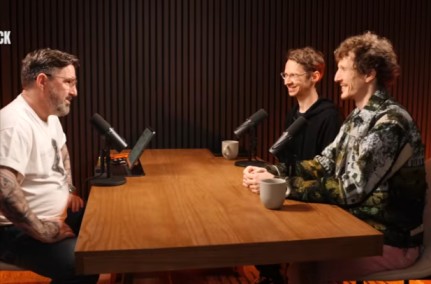
Editor’s Note: In this episode of The Peter McCormack Show, host Peter McCormack engages in a deep conversation with Daniil Liberman & David Liberman about the potential risks posed by the centralization of artificial intelligence within a few powerful corporations and governments. The discussion explores the implications of AI becoming the fundamental infrastructure for modern society, raising concerns about human freedom, job displacement, and the dangers of monopolistic control. Ultimately, the guest advocates for the urgent development of decentralized alternatives to ensure that AI remains accessible and doesn’t lead to a dystopian future. (May 8, 2026)
TRANSCRIPT:
Introduction: The AI Control Problem
PETER MCCORMACK: All right, morning guys. Good morning. Very, very excited to talk to you. We’ve been planning this a little while. So look, I’ve been thinking about AI a lot. I’m using it a lot and I’m trying to consider what it means for the future of the planet we live on, especially the world my kids are growing up in. And if AI becomes the infrastructure or part of the infrastructure for everything, electricity, the grid, the internet, money, what happens to human freedom if we can’t live outside of it?
DAVID LIBERMAN: This question — the answer really depends on how we will build this infrastructure. So if this infrastructure will be equally accessible to everyone on Earth, then—
DANIIL LIBERMAN: It’s just increasing the freedom. If it’s the opposite, it’s a complete opposite. It’s not even a slavery. We’re not going to even know it’s a slavery.
DAVID LIBERMAN: A 1984 type of situation. If AI, this infrastructure, will be controlled by just a few corporations or few governments, then we can see really bad scenarios.
The Invisible Propaganda Machine
DANIIL LIBERMAN: Propaganda? Ha! Forget about this word. It’s not going to be even visible. It’s in every answer. We now use the system to be our therapist, to read news through this, to answer the questions, Google, do whatever, make calculations. All of it is there and the trust is going to increase. The less mistakes the system is going to be making, the trust is going to be enormous — 100% trust. And therefore, whatever actually comes in through the malicious actor, so someone who actually wants to manipulate your opinion or your freedom of thinking around any particular subject, that’s it. They own you.
PETER MCCORMACK: But if it is part of everything, will people be able to opt out? If, for example, they say, “I don’t want to live in this world where I’m constantly at the whim of an AI or talking to an AI?” As we’ve seen with mobile phones, there’s starting to be a rejection. People want to live in the real world. They want to touch grass, want to eat good food. Will you be able to live in this world outside of AI systems?
DANIIL LIBERMAN: That’s a good question.
DAVID LIBERMAN: You will be able, but whether you will be able to be at the same time competitive in the market — whether your productivity will be on parity with the productivity of people who use AI — that’s a question. For some, for a really small amount of people, it will work. But for most of us, it won’t.
Can Money Exist Outside of AI?
PETER MCCORMACK: Do you imagine there will be any form of money that lives outside of AI?
DANIIL LIBERMAN: That is really interesting. Honestly, if you’ll go to the extreme extreme — let’s say one corporation, like full extreme, not multiple, one corporation owns all of the AI and now it actually can replace all of the human labor, whatever, like software engineers, designers, management, marketing, all of this. Then the question is, are we all going to lose our jobs? Because the answer can be no. If we all actually keep working with each other, not with the corporation, what changes? Like, this corporation produces anything for itself? We just don’t buy whatever they’re doing? Even if they’re 10 times more efficient, we still can do stuff in between each other as it is today. Nothing changes in this way unless it has been used for control over our decisions. If we can opt out, then we can actually just interact the same market as it used to be, as it is today, except there is another market probably, which is like 10 times of what we are doing.
Centralization vs. Decentralization: The Same Old Battle
PETER MCCORMACK: So the biggest issue here is, like with everything, it’s the same battle. Once the Americans kicked the British out of America, where they were trying to develop the Constitution, the battle between decentralization and centralization — which we saw there with the Federalists and the Anti-Federalists, which we see now with money, whereby we have centralized government money where they print and create whatever they want, and the reaction is Bitcoin. AI is going to present the same issue of centralization.
DANIIL LIBERMAN: Not going to — it’s presenting as we speak.
DAVID LIBERMAN: In the same way as it happened with Bitcoin. First, you will see just a few people who realized it.
DANIIL LIBERMAN: Who might sound even like super radical.
DAVID LIBERMAN: And who will tell this narrative that we need to be careful about that. We need to build alternatives and things like that. But then you will see events after events which will convert more people. Like with Bitcoin, every financial crisis, every time when the Federal Reserve printed another trillion dollars, brought more people into the belief that there needs to be an alternative. And the same, we expect, will happen with AI and decentralization of AI.
Every time when we see news — like, for example, with OpenClaw recently. It’s an agent, really popular agent, open source.
PETER MCCORMACK: So—
DANIIL LIBERMAN: Anyone can use it.
DAVID LIBERMAN: Hundreds of thousands of people started to use it and they were using it with Anthropic Claude, their powerful model.
So the access to the model and access to AI is already right now visible — that we shouldn’t take it for granted. We shouldn’t expect that those models will be as available for you as they are right now. And when you think about it, you can see how you’re already right now making yourself more and more dependent in your line of work, whether you’re an engineer, a business owner, or a journalist. And in that case, every time when people will see that their freedom is challenged, we expect more and more people to look for the alternative.
From Tool to Dependency: The Slippery Slope
PETER MCCORMACK: I think the word “slave” is a word we have to be very careful with. It is a loaded term, but I’m going to tell you a little story. Recently I have been weaning myself off my mobile phone because it was explained to me once — this is like a parasite. And I notice in life wandering around, you see people with their phones all the time, walking down the street, on the buses, on the trains, they’re just glued to their phone.
So I deleted in one day around — I can’t remember the number — 130, 150 apps. And I’ve been deleting about one app a day, every day consistently. And I’m trying to get my phone to the point where it’s only a tool for booking things, flights, paying for parking, banking, but no distraction apps. I want to get away from it. I’m trying to wean myself off it.
But conversely, I’m going deep with AI. I am creating AI infrastructures for my companies where it helps me prepare things, get jobs done. And I’m wondering at what point with AI do I go from it being a tool for me to me being a slave to it?
DANIIL LIBERMAN: We have to be careful with this word “slave.” I agree with you. From what we see, people around us — people in the entrepreneurs community, people with multi-hundred million dollar, billion dollar companies — started working more because of AI. They just cannot stop because it’s very addictive in a sense, because you just say and stuff happens. Like you just write down, type down your commands and the stuff is happening — software being built, marketing campaigns being prepared, emails being written, a GitHub commit being done for you.
So it’s in a way really addictive, like how much stuff you can do with this. And this is like an opposite from slavery in a sense. You are a slave master.
PETER MCCORMACK: But do you know, that’s interesting you say that. I discussed this with somebody the other day and I said, “I think I’m suffering from AI exhaustion.” Exactly. For two reasons. Because it’s made me more productive and enabled me to do more, I’m actually working more. But secondly, trying to keep up with the developments in AI and the changes is close to impossible. And so I’m starting to feel like, do I want to go down this rabbit hole? Do I want to be this guy? Because it’s exhausting.
DAVID LIBERMAN: Because the only way to keep up with AI right now is to be unemployed.
DANIIL LIBERMAN: Literally, this has to be your job today to keep up with AI. But the same thing — what’s interesting is I’m not sure that is even needed. What if you’ll skip a couple of months and then come back and look at what’s happening right now? Like all of the models are going to be two upgrades further. Some additional tool will appear, this will be replaced with that and stuff like this. And the honest answer likely is that you are not going to be lagging behind. It will take you some time to get into the new tooling set and just continue.
So I think that we are overexcited right now, all of us, because the magic is happening right in front of us. But at the same time, we are addicted to this and the anxiety of the FOMO of not being up to date with the latest tools — when your friends, peers, competitors, or whoever it is, or your girlfriend, is actually knowing more than you in the sense of what’s happening in AI — this is a real problem right now.
DAVID LIBERMAN: But that creates the dependency, and dependency is already much closer to the slavery. Because if your livelihood — whether you can earn, whether you can actually be productive in society — depends on those tools, then you cannot just stop using them.
The Aggregation of Everything: From Amazon to AI
PETER MCCORMACK: Well, if you think about how we’ve aggregated things with the internet — we have Amazon, which has been very useful as a tool but terrible for bookstores, bookstore owners. It’s centralized everything to Jeff Bezos. If we think about what’s happened with things like Uber and Uber Eats and Deliveroo, all these companies have created this gig economy where people have essentially the jobs at the bottom rung of the ladder trying to just make enough to get by. And the upward mobility is very difficult.
With a bookstore, you could work on your bookstore, you could grow it, you could maybe open a second bookstore and a third bookstore. If you had a coffee shop, you could have a second and a third. But we’ve centralized everything around technology to make that upward mobility very difficult. We have created a lot of super wealthy people at the top and yes, lots of other jobs have been created, but what does that do for the soul of somebody who wants to have a great life?
Can I just finish the point? So what I’m thinking now with AI — I will listen to something like the All In podcast. Sachs and Chamath, whoever, talk about the power of AI. I see Marc Andreessen talk about the power of AI. But what I’ve noticed is — and I take this from an Eric Weinstein tweet, so it’s not wholly mine, this is really his idea, he implanted it in me — but these LLMs are sucking up all the innovation of human history and they’re centralizing the upside to a few group of people. And if the AI starts taking the jobs, these people don’t have any skin in the downside of AI. And at what point does the AI just start distributing jobs a bit like a gig economy and we are functionally slaves to the system?
Two Scenarios: Oligopoly or Freedom
DANIIL LIBERMAN: This is the scariest — this is the way we see this, that we only have two scenarios. One is the one which you’re describing. All of us are losing the jobs. Some specific corporation or the oligopoly of like 5 of them who are all basically the same, producing the same products. It’s just verticalization of everything within the specific ecosystem, whether it’s the Apple ecosystem, OpenAI ecosystem, Google ecosystem, or whatever. It’s all the same, verticalized from the top — like your intelligence — to the bottom — like your toilet paper. All of it centralized in one vertical. And in this world, we are all losing the jobs and we’re all the moving parts, you’re like—
PETER MCCORMACK: The ants.
The Problem of Centralization and AI Access
DANIIL LIBERMAN: The ants who are like, yes, exactly. So I was trying to find the analogy, but the ants just bring the stuff from here to here, like physical movers, physical world movers. Until the robots kick in.
DAVID LIBERMAN: Until the robots kick in.
DANIIL LIBERMAN: Exactly. And this is one world, but the other world, the alternative one, the beautiful one, is in which each of us have the robot and each of us have the same equal access to the superintelligence. And if it’s equally distributed, then each of us is just empowered with a tool. It’s a new productivity tool. Each will be super productive to the extent which we want to be productive. And we will just continue the same market and the same economy unless we reach — not unless, but until, up until the moment we reached the complete abundance when the robots and the intelligence which I own can produce everything I need in my life for myself.
And now the only thing which is outside of the scope is relationship with other people and we’ll just keep having the relationship. Maybe they’re going to be different and weird, not as we expect them to be, not as we have them today. But in this world, like the superabundance, before the superabundance, we can move forward with the equal access to this particular tool. And the more equal it is, the less disruption we will see. And this is all about access.
PETER MCCORMACK: Yeah. So what I’m thinking is there aren’t enough people thinking about this as a problem. There’s no incentive for the people who run the All In podcast to think about this as a problem. Because they are Silicon Valley investors who have benefited from centralization. And in some ways, centralization has won over the last 100, 200 years. The Federalists won in the US, the Anti-Federalists lost, but they were correct. ‘Cause look what’s happened to the money. The money’s been centralized.
Bitcoin has such a compelling story and everybody who’s seeing everything go up in price, all the things that are getting expensive and they’re losing to inflation. They’re still not coming to Bitcoin. And so in the world of AI where we have these super amazing tools, these incredible LLMs that do things that are like magic to us, how do we get people to even start thinking about there must be an alternative, a decentralized version?
DANIIL LIBERMAN: A, we do have the current situation when people are getting more and more scared of where it is moving. And this is important. I mean, I hate the real development to be happening within the humanities history from the perspective of fear. I hate this, honestly. That’s why I want to present the positive picture and rather all of us actually strive for having this better positive future. But the fear is real. I mean, the problem is real and we can feel it right now more and more and we will feel it more and more within the next 2 years. I mean, it’s going to be super fast.
Layoffs, Monopolies, and Broken Promises
DAVID LIBERMAN: So currently, for example, almost every week you see news of additional layoffs.
DANIIL LIBERMAN: Another 10,000 people.
DAVID LIBERMAN: And people should stop for a moment and think about it. If the claim that these tools increase productivity is right, is correct, then why would you lay off people? On the contrary, you can do more, you can build more, you can accelerate the economy. So why would you lay off people?
PETER MCCORMACK: Well, you need different kinds of people though.
DAVID LIBERMAN: In this case, you still should have more hiring than layoffs, which we don’t see. The challenge here is that these centralized companies, when they start — like with Amazon — they bring us really great ideas. For example, that the goods can be delivered to your home just in 5 minutes, 15 minutes, just one click. And we all buy into this opportunity. We really want this world to happen. And then they change the policies.
For example, Amazon was like, “We’re a platform, we’re just selling goods.” But then they’re looking at the data that you’re buying these goods and then they offer you generics which were much worse and they actually eventually more expensive than the ones which were there on the market. Because when they control the platform, they can actually then manipulate. The same happened with Google. Google promised, I think it was 2003 or 2004, that the ads will never be in the main feed, only in the search feed, only at the side of the screen.
PETER MCCORMACK: Yeah, but they also promised they wouldn’t be evil, and then they said, “Oh well, we’re not going to say that anymore.” It’s like, well, what do you mean when you say you’re not going to say you’re not going to be evil anymore? Are you saying we’re going to be evil?
DAVID LIBERMAN: So this is a problem. When we have decentralized protocols, the rules are encoded and they never change. And that’s what creates certainty that we can all trust the protocol and we all can lean in and be passionate about them. But with those centralized organizations, they don’t believe that their statements, which they made early on, should be persistent.
PETER MCCORMACK: Do you think they’re gaslighting us basically because there is so much upside to them being right?
DANIIL LIBERMAN: What’s interesting — who are they? That’s the big question. Sam, Dario, you’re talking about individuals. And then the corporations like Google or Microsoft, it’s thousands of people making their own decisions for their own benefit and having the bonus or stuff like this. And then there is a layer of investors, like shareholders who are mainly some funds, like faceless funds. There is no one with actual skin in the game in there. They’re just making money for someone else. It’s a chain of making money for someone else.
And whatever is happening there — profit, profit, profit. There is nothing bad in the profit unless you actually become the monopoly in a specific sector. And this monopolization leads to the degradation of the service, sucking more money. We can see this with Netflix, for example. The price is just going up and up and up and up. And the sort of claim is, “Oh, this is inflation,” but it’s not. I mean, you can put these numbers together.
PETER MCCORMACK: More so, but how many times do you switch on Netflix now and you cannot find something you want to watch?
DANIIL LIBERMAN: Exactly, exactly.
DAVID LIBERMAN: Something which used to be there. So they used to spend like hundreds of millions of dollars on House of Cards type of series and not anymore. Moreover, now they have more users, so they have digital products which should have the cost distributed among more users. So the cost should be lower, the price should be lower.
PETER MCCORMACK: But that is inflation. That is inflation.
DAVID LIBERMAN: They’re growing higher, they’re growing faster than inflation. If you just compare their pricing points — but still, they increased their audience multiple times. So the cost per user was supposed to go down multiple times and we don’t see that. And so our argument is that all of these companies, they start with a great narrative, which is not a bad one — we really want to have it in the world — but then they don’t have any incentive to stay with this narrative. And that’s what we expect with AI as well.
AI Tokens, Pricing, and the Road to Dependency
PETER MCCORMACK: So Mike Green, who’s been on my podcast a couple of times, he’s an investor, he talks about monopolies as one of the biggest issues in the economy and that we have to have competition. If we don’t have competition, this will lead to products becoming worse and more expensive.
DAVID LIBERMAN: About a month ago, there was this podcast of Dwarkesh with Dario. At some moment, Dwarkesh asked him whether he believed that they will still be working through an API model when people pay for AI tokens. And Dario first said that this model likely will persist. And then there’s always a but. The but was that he said, “But not all AI tokens work the same.” And then he made this example that when AI helps you with your MacBook, probably you will be ready to pay less. But if AI helps you with your health, you will be ready to pay much more.
DANIIL LIBERMAN: Which from the perspective of — let’s say electricity — we want AI to be as accessible and as available and as cheap as electricity. But from the perspective of electricity, one kilowatt of energy providing you with the light in your house, you can use a candle, whatever, you pay less. And then another kilowatt of power is your tooling for the surgery while you are being operated on open heart. And this kilowatt — if there is a difference in the price of those kilowatts of power — then you will be ready to pay more for the one where your life is at stake rather than the one which is basically having more light in the house.
PETER MCCORMACK: This is the scenario where we become slaves to the system. We no longer are humans. We are subjects of an AI system.
DAVID LIBERMAN: Yes. That’s where we see the difference. So the centralization, when the access is not guaranteed for all of us by protocols, then we definitely will get to this future. Unfortunately, the leaders of the industries, they even already don’t hide this. They publicly state that. Because right now they’re raising additional capital and preparing for IPOs, that’s why they pitch this to investors. And for investors, the idea is that AI tokens can be sold even with a higher price tag because of some additional value which they bring. That definitely resonates.
PETER MCCORMACK: Well, they’re in a tough spot themselves. They’re all competing in this race for superintelligence, which I still don’t 100% know what that means, but I kind of know what it means. They’re all in this race for superintelligence — who’s going to hit it first? And what does that actually mean for them? And they’re also in a tough spot because of the cost of running. The power for these LLMs is huge, but the revenues aren’t just there yet. They’re growing. So they have no incentive, because of the incentives of becoming the first to hit the spot. So why would they care about the impact on all us peasants?
DANIIL LIBERMAN: They will not. I mean, there’s a simple question.
The Case for Decentralized AI
DAVID LIBERMAN: This was our personal conclusion. Since 2014, we were part of these groups who discussed potential bad scenarios of artificial intelligence. And there were many different points of view of what are the actual bad scenarios, whether it’s a Terminator type of scenario or whether it’s just doomsday where we all will be destroyed. But our case was always that most of the worst scenarios start from us having AI being controlled by just a few companies. And when you think through those scenarios, you definitely see that it’s inevitable — that even if we believe that the original founders have really good intentions and they really want a better future for all of us — the way they structure it will eventually still get us to these bad scenarios.
DANIIL LIBERMAN: Quite pessimistic, right?
PETER MCCORMACK: Well, so I’ve done a few shows on AI now and it’s often from a place of fear or pessimism. But I always ask the same question — are you a fan of AI? Do you like it?
DANIIL LIBERMAN: Honestly, we are. Honestly, we feel that probably AI and the potential future superintelligence is likely the only way out from the sh*thole we’re heading towards, with only increasing speed. Because AI in a sense may, if it will be independent in its structure and in its infrastructure as well, AI can enable immutable bureaucrats, immutable middlemen. In a sense, if we will look at this —
PETER MCCORMACK: So get rid of the managerial state.
DANIIL LIBERMAN: Getting rid of any state which can be corrupted, any layer which can be corrupted and which has bias or its own interest.
PETER MCCORMACK: So you’re interested in the idea of President AI?
DANIIL LIBERMAN: Our interest in AI is more like — right now AI is being used even to design new rocket engines. And when the rocket engine is being designed by AI, the result is something which we’ve never even thought before. I mean, the shape, the curvature, the idea behind what is happening there — it’s an alien structure.
PETER MCCORMACK: Leap 71?
DANIIL LIBERMAN: Leap 71, probably, yes.
PETER MCCORMACK: Okay. Wow. That looks like an alien spacecraft.
The Case for Decentralized AI and Universal Sovereignty
DANIIL LIBERMAN: Exactly. So think about this. When you set up a deterministic AI model and you set a specific goal for this model, and the model is designed and created for solving a specific problem, then the models can actually come up — because of the ability of the model to browse through millions and billions of variations, which we would have spent thousands of years to do the same in the lab, in the researcher lab — then we can come up with something which looks completely not what we expected, but it actually does the job.
It actually gives you the power, the temperature, the curvature, like everything you need from the physical perspective, you will get. So from this perspective, do we need the president AI, or do we need the AI to design a system for humanity to achieve the most efficient state of self-coordination, like a completely decentralized self-coordination when no one has the lever to get the power to even become the dictator.
PETER MCCORMACK: Benevolent distribution of power.
DANIIL LIBERMAN: The distribution of power, the most efficient system for everyone to achieve their highest potential. So we can create the AI model which will actually inevitably design the system which will increase freedom rather than make us all slaves. Because the current movement towards slavery is not the AI itself, it’s the design of the corporations and the design of the political systems.
PETER MCCORMACK: And the financial system.
DANIIL LIBERMAN: And the financial system. Political and financial, they’re like right now together. Financial and political system is the same creature today.
PETER MCCORMACK: Well, so the risk and the problem we face is we live in a financial system where we need money to survive. That is what it is. But it’s a system which extracts upwards. Governments always spend too much money and banks create money out of thin air. It’s a crazy inflationary environment. The assets inflate and your wages don’t keep up. And that’s under a lot of pressure at the moment.
I mean, I think you see on social media the amount of criticism of billionaires and large corporations is bringing in this kind of new dawn of communism. People are just nudging us towards communism, which we know f*s everything up anyway.
DANIIL LIBERMAN: Yes, yes, yes.
PETER MCCORMACK: But you can understand why people are thinking like this, because it’s not like in a recession where you lose your job and you hope for the economy to recover and you come back.
DANIIL LIBERMAN: The economy is flourishing, someone is getting billions of dollars, and the bottom is actually getting poorer and poorer.
PETER MCCORMACK: But those jobs that are going are never coming back. You may have gone to university and trained for, you know, whatever many years as a lawyer. And once that job goes, there’s no lawyer job for you left. Then maybe the guy who can coordinate the lawyer agents gets a job, but those jobs are not coming back.
And maybe you’re 35 years old, 40 years old, you’ve got 2 kids, and maybe your wife works in the creative industry and her job’s gone. It’s like suddenly you’ve gone from a nice life, holidays, kids in private school, and you can’t afford anything now. What is the plan for that? And the only answers we’re hearing is UBI. It’s not only that AI brings this threat — we have to rethink the entire system so people can live and flourish.
The Problem with UBI and the Case for Universal Sovereignty
DAVID LIBERMAN: But UBI — without that, UBI is, from our perspective, a really bad choice, because no one says that UBI will be like $10,000 a month.
PETER MCCORMACK: Well, Elon Musk did. Universal high income, he said.
DAVID LIBERMAN: High income, yes. But unfortunately, the problem is that if someone decides who will get the UBI and how much, that’s—
DANIIL LIBERMAN: That someone is deciding what qualities you should have, how you should behave, whom to obey, what to do, what law to follow.
PETER MCCORMACK: They have power.
DANIIL LIBERMAN: They have power over you. And now they dictate everything you can do and cannot do. And unless you do this, you are dismissed of the UBI. And if you do this, you are getting your UBI. This is a terrible world. None of us want to live in this world.
DAVID LIBERMAN: So we would prefer the world which Daniel mentioned, when every human on Earth has their own robots which can create everything which they need to consume. And think about this — in this case it’s much better than UBI. You actually have not universal basic income, you have universal basic access to the—
PETER MCCORMACK: You have sovereignty.
DANIIL LIBERMAN: Sovereignty. So what’s interesting, think about this. Today, I would say probably over a billion people in the world will have enough wealth, enough capital, enough savings to buy a robot which would cost $20,000. Like Elon said, it’s going to get to $20,000. It will get to $20,000. Why? Because the motorcycle is getting there and the motorcycle has more physical material in it than a future robot. The future robot will weigh 50-60 kilos. The motorcycle is like a couple hundred kilos.
When you think about it through this perspective, the motorcycle is different from the robot only because of the design and the brain. And design is a file, is a CAD file, and the brain is AI. So this difference tells you that the robot can cost $10,000-$20,000. If the robot can cost $10,000-$20,000, and today people can still afford it.
PETER MCCORMACK: Well, it depends. I mean, if I can afford it, you guys can probably afford it.
DANIIL LIBERMAN: A lot of people can afford a car. For as many people who can afford a car today, they will be able to afford a robot.
PETER MCCORMACK: They might be able to afford the secondhand robot, the used robot. When I get the new one, you get the new one, we sell our old robot.
DANIIL LIBERMAN: And if your robot can do the job.
PETER MCCORMACK: I wonder if a robot will become like a dog, that you won’t want to sell it because you become attached to it.
DANIIL LIBERMAN: It’s your second half in a sense. It’s like part of you. Now this is you with your 24 hours a day — 8 you’re working, 8 you’re sleeping, 8 you’re doing stuff for yourself — and your robot, which is doing 24 hours of working. And which actually increases your productivity 4 times at least. And this is the world in which we can live.
Bridging the Global Wealth Divide
PETER MCCORMACK: Hold on, what happens to the global wealth divide there? Because yes, in America and in the UK at the moment — although we’re heading third world — what if you’re in Ghana or Kenya? Not everyone will be able to afford a $20,000 robot.
DANIIL LIBERMAN: Yeah, but think about it through this perspective. If we increased our productivity 4 times — if the developed world increased our productivity 4 times — can we afford to build additional robots and then be sending them to Ghana? And what’s interesting, we can even sell them for the future share of the robot’s productivity. So we say, yes, we build your robot. We’re not donating you the robot. We’re leasing you the robot for 20% of its labor coming back to us, and 80% of the labor is yours for you to build your life.
This is a clear passage towards what we can imagine as complete abundance for the entire humanity, unless we do the war with it, we do the fight for power with this, we do the concentration and monopolization, enslaving nations and stuff like this. There are two scenarios. This one is inevitable in a sense, unless we do something to move towards a different one.
PETER MCCORMACK: But if you think about the history of humans, we’ve always taken the wrong path. We’ve always taken the path of centralization. What can I have quick? What can I have now? What’s easiest? And there’s always been psychopathic choices.
DANIIL LIBERMAN: But have we actually?
PETER MCCORMACK: We kind of have.
DAVID LIBERMAN: You’re right. You’re right that there are a lot of reasons to be pessimistic. At the same time, we do have several good examples.
PETER MCCORMACK: Okay.
DAVID LIBERMAN: We have open source software.
DANIIL LIBERMAN: Operating systems.
DAVID LIBERMAN: Linux. Which dominates in the world of servers.
DANIIL LIBERMAN: Everything we know about the internet and everything we know about protocols today — everything is open source.
PETER MCCORMACK: Why did that work?
Open Source, Bitcoin, and the Power of Grassroots Communities
DANIIL LIBERMAN: I would say because of a specific small group of people — not more than a million people in the world — highly educated, highly motivated, with a high EQ and IQ together, who decided that they want to live in a different world and they committed and contributed towards the common prosperity and common good.
And we can do this now, because another example is Bitcoin. Few people understand. Yes, Bitcoin right now has a lot of billionaires in the Bitcoin ecosystem. Someone made a lot of money, someone is not making any money. But Bitcoin, if it would have worked as an actual transactional currency — that’s the problem with Bitcoin right now, that it’s only doing 7 transactions a second, which is not—
PETER MCCORMACK: That’s not entirely true.
DANIIL LIBERMAN: Not entirely true. I agree with you. And we can actually upgrade the system to get to the point when it can become the currency. I completely can see that working. But what happened with Bitcoin is that over $300 billion was eventually invested towards the infrastructure of Bitcoin. And it was not the largest corporations of the world or even governments. It was a grassroots community of people — millions of people building smaller data centers, filling them with ASICs, developing new chip designs, building new electrical systems, building new data centers. All of the infrastructure for Bitcoin.
PETER MCCORMACK: Hold on, but that was economic incentive. There is the other side of that, which is the developers. There are plenty of developers — I know some of them — who could have gone to Google and got paid $300,000 a year, $400,000 a year, and stock options and become millionaires. And they chose to work on Bitcoin, funded by individuals. There are groups of individuals who funded them. I funded Bitcoin developers. So that’s why I’m saying you need a combination of economic incentives and then people with the right personal incentives.
DANIIL LIBERMAN: You need to build a proper market incentive, economic market incentive — not manipulation and not gatekeeping, like a completely open ecosystem, which by design, and Bitcoin showed it, drives the price of the service down.
What’s interesting, the service in Bitcoin, in a sense, it’s a strange concept because the Bitcoin goes up in price itself. So it looks like it’s getting more expensive, but the terahashes which have been produced by this system are getting cheaper and cheaper. We just produce them in an amount which is enormous. The amount of mathematical operations produced by the system per watt of electricity is getting cheaper and more abundant, if we could have used them.
Bitcoin as Currency: Correcting the Record
PETER MCCORMACK: I’m going to come back to you on this 7 transactions a second, just because I want people to understand that is not the reason Bitcoin is not being used as currency. We are also talking about the base chain. There is the Lightning Network, with its imperfections, but if you have a Lightning wallet now, you and I, we can do more than 7 transactions a second. So it is possible to use it as a currency.
The reason it’s not being used as a currency is it’s become a victim of its own success, in that in a world where the pound is dying, the dollar is dying, the fiat currencies are dying due to inflation — you don’t want to use your Bitcoin, you want to spend your dollars. The last thing I ever want to do — I sold some Bitcoin to pay for the deposit on a house. If I’d have just held that Bitcoin for 3 years, I could have bought the house outright. And you go through those experiences and you go, “I’m just going to hold Bitcoin for now,” because what we’re doing is we’re swapping currencies. So why spend it?
The same happened in Venezuela. People would borrow Venezuelan — what is it, the Venezuelan — I can’t remember what the currency was, and they would buy dollars. They were shorting the currency. It’s what Michael Saylor is doing. Michael Saylor is shorting the dollar because he knows it’s screwed. So Bitcoin can be a currency. We just have to kill off the fiat currency first. So I just want to correct that one.
DAVID LIBERMAN: Yes, that’s true. And we actually see a really optimistic sign in that, because what Daniel mentioned — the price per hash decreased.
DANIIL LIBERMAN: It’s not just decreased, it decreased 300,000 times from the very beginning to where we are today.
DAVID LIBERMAN: So it used to be that you would spend 5 million joules—
DANIIL LIBERMAN: Joules.
DAVID LIBERMAN: Joules. Per terahash. Now it’s just 15.
PETER MCCORMACK: So you are saying the same can be done with tokens.
The Case for Decentralized AI Infrastructure
DAVID LIBERMAN: We believe that with AI will happen the same. You’re totally right. But it will happen in the same way only if we’ll have the same type of structure which constantly drives the price down, incentivize building infrastructure more efficient, more efficient.
DANIIL LIBERMAN: Whoever is building more efficient infrastructure getting more coins.
PETER MCCORMACK: So you need the infrastructure built efficiently, but you need a committed and dedicated, passionate community who say, “No, this is the world I want to live in. I don’t want to live in Anthropic and Groq and OpenAI. I want to live in this different world.”
DAVID LIBERMAN: Yes. And we believe that the same kind of trajectory can be expected. That first it’ll be hundreds of thousands of people, but then it’ll be millions of people, then dozens of millions of people. Because every time when we will see another layoff, or every time when we’ll see another gatekeeping of the access to the models, more people will convert.
PETER MCCORMACK: Well, there’s another point to this as well. So I am a Bitcoiner. For two reasons. There’s the financial incentive reason. And the second one, I like anything that takes power away from the government. I love it. I have my Bitcoin, the government can’t touch it. They don’t know what I’ve got. F those guys. ‘Cause they will steal everything when they can. So I love it. It’s like an anti-establishment movement. It is a grassroots, give power back to the people movement. If there is an AI movement, which is grassroots, which is saying, “No to the big corporations, no to government. We’re going to do our own thing. F you.” I’m in.
Bitcoin as a Blueprint for Decentralized AI
DAVID LIBERMAN: Yes, that’s what we expect. And moreover, Bitcoin also showed that it will not only drive price down, but also the infrastructure itself can be built much larger than we can even expect. Because Bitcoin today is comprised of data centers with 23 gigawatts.
DANIIL LIBERMAN: Draining 23 gigawatts of power. It’s more than Microsoft, Amazon, Google, OpenAI, Meta combined.
DAVID LIBERMAN: So imagine, when we think about it, whether AI can be decentralized, whether actually the community of passionate people can build something of a similar scale. Bitcoin actually proved that, yes, within the same timeframe. Bitcoin exists 2 years less than cloud exists, but still Bitcoin achieved more in terms of really deploying the infrastructure than the entire Silicon Valley.
DANIIL LIBERMAN: So financially sensitive and people who are dedicated to the mission, to the belief, that the system needs to change.
PETER MCCORMACK: But does this community exist now? Because I can tell you the Bitcoin community, the pockets of resistance where they exist, I know who the people are. It’s a good community. Gone through some challenges, I think, over the last couple of years as Bitcoin’s been financialized and adopted by Wall Street, and governments as well. But it’s still a decentralized protocol. It’s still secure. I still hold my private keys. You still can’t get them off me, right?
DANIIL LIBERMAN: Yes.
PETER MCCORMACK: Is there a community around this right now?
The Protocol: Building a Decentralized AI Network
DANIIL LIBERMAN: It is happening as we speak. So we launched our protocol, the protocol which we built, what is it, 7, 8 months ago, and it already grew to almost half a percent of the GPU size of OpenAI, completely decentralized. There is no foundation or company, any structure behind it. It’s all the community of people coding, adding the hardware, adding more GPUs, and then preparing the system to be able to be used by anyone in the world.
PETER MCCORMACK: Is it its own LLM?
DANIIL LIBERMAN: Currently, it uses anything which is available as open source.
PETER MCCORMACK: A bit like Venice or other ones. You can just select the model you want.
DANIIL LIBERMAN: Yes, you just select the model which you want from the Chinese or the US available, like Gamma or Llama or DeepSeek or Qwen, whatever is available out there. But the whole idea is actually that the protocol is designed so that in the future, not just in the future, but it’s designed so that 20% of the network’s power is reserved for training future open-source models. So the service which has been sold for their tokens as utility tokens is inference, but the training of the new models is not sold, is not for sale. The training of the new model is free for everyone to use to train open source model, completely open, open from the datasets to the training software to the final model.
PETER MCCORMACK: So you can have a completely decentralized LLM?
DANIIL LIBERMAN: Absolutely.
Immutable AI: The Next Crypto Revolution
DAVID LIBERMAN: Immutable LLM. In the crypto world, we had two major revolutions. First was with Bitcoin, with introduction of immutable ledger. So as you mentioned, you send the transaction, no one can stop it. Government can’t stop it. It will be there. Then with Ethereum, the introduction of immutable contracts. So we agree about something, there is a contract and no one can change it. It’ll be executed exactly as it’s written on chain.
DANIIL LIBERMAN: Have some faith.
PETER MCCORMACK: It’s still a shitcoin.
DANIIL LIBERMAN: No, no, no, not shitcoin. The idea was—
PETER MCCORMACK: Yes, I understand the idea.
DANIIL LIBERMAN: That we need to introduce immutable concepts. A simple script being executed immutably.
PETER MCCORMACK: Yes, I understand.
DAVID LIBERMAN: It’s the same we need with AI. When we have a model, you sent your input tokens, you sent the request, and you know for sure that the output which you’re getting is exactly how the model is defined. Because in reality, most of the censorship right now happens not inside of the model. Most of the censorship happens through the pre-prompts that are sent there, which we don’t really see. All these companies, they add in some layers of filters, of commands, which the model obeys, which we don’t control.
DANIIL LIBERMAN: You remember when DeepSeek was only released? A lot of people started asking harsh questions, specifically in the Chinese policy, like, “Who owns Taiwan?” And then the model, when you send the request directly to the website of DeepSeek, the model will say, “We people of China are committed.” Literally, this would be the answer. While at the same time, if you actually run the model on your own local instance, the answer is not like that.
DAVID LIBERMAN: And his answer was it is free, like it should be free and things like that.
PETER MCCORMACK: Well, that’s like Google when you would ask Google inside the Great Firewall of China about Tiananmen Square, it will just show you some pictures. “This is a lovely place, nice part of China.” You ask here, it’s like, “Yeah, that’s where they f*ed the people.”
DANIIL LIBERMAN: Exactly. So that’s the whole point. It’s not the model itself because the model is trained on data, vast amount of data, all of humanity’s knowledge, which was collected for thousands of years, now used to train this 2 terabyte model, which can fit in the memory of one server. The models are tiny in a grand scale, but the model itself is sort of unbiased unless there was a lot of bias inputted in the dataset.
The model itself is usually really unbiased and it’s a pre-context which then filters everything the model answered to you, or filters everything you ask through the model before you even get the result. So the openness needs to be on all layers and the immutability needs to be there as well if we actually want to build these immutable bureaucrats, immutable middlemen.
Ownership, Incentives, and the Token Model
PETER MCCORMACK: Okay, then I have to ask you, if you’re building this and you’re right and it’s successful, does it make you rich?
DANIIL LIBERMAN: In our case, we have some coins.
DAVID LIBERMAN: We have some — the same.
PETER MCCORMACK: What do you mean by coins?
DANIIL LIBERMAN: Coins. We have coins. So the system which we built has a limited amount of coins, which is 1 billion coins.
PETER MCCORMACK: What is this, a token?
DANIIL LIBERMAN: It’s a token.
PETER MCCORMACK: Is this like a crypto token, or is this a token that is used within the system?
DAVID LIBERMAN: That’s why I use the word coin, because otherwise in AI world, tokens are used in a completely different—
PETER MCCORMACK: So this is like a crypto token.
DANIIL LIBERMAN: This is like a crypto token, a currency with a limited amount of coins in circulation. Always will be not more than 1 billion coins.
PETER MCCORMACK: But it’s fixed?
DANIIL LIBERMAN: It’s fixed. And you can pay for the inference to be done for you with this coin.
PETER MCCORMACK: Or you need that coin?
DANIIL LIBERMAN: You need that coin to actually use the API of the decentralized AI.
PETER MCCORMACK: And could you have built it in a way that it didn’t need coins? Say I could have paid with Bitcoin.
DANIIL LIBERMAN: Yes, we could. But the reason why we did this was specifically to create this financial incentive, this economical reason for people to rush in and add hardware into the system. If we want to build an alternative to OpenAI and Anthropic and Google, this needs to absorb hundreds of billions of dollars of investment into infrastructure.
PETER MCCORMACK: You have to incentivize the early people. A bit like with Bitcoin in the early days. If you mined it, you got 50 Bitcoin a block. So can I ask a question? Sure. So you have the coins, but who owns the company?
DANIIL LIBERMAN: There’s no company.
PETER MCCORMACK: There’s no company.
DAVID LIBERMAN: Okay, good start. And that’s—
DANIIL LIBERMAN: No company and no foundation, no legal entity behind it. Completely open source, completely decentralized. We’re not even mining ourselves specifically. We found 8 independent miners, Bitcoin people, people with experience in cryptocurrencies. Convinced them that this future needs to exist. They launched the network. The genesis was them.
PETER MCCORMACK: Okay. Can I ask what percentage of the coins do you guys have?
DANIIL LIBERMAN: The four of the Libermans own 10% of the coins. So 2.5% for each of the four siblings who were spending the last two years developing this protocol.
PETER MCCORMACK: And that’s a brother and a sister, right?
DANIIL LIBERMAN: Two of us and the two sisters.
PETER MCCORMACK: Oh, two sisters.
DANIIL LIBERMAN: Two sisters too.
PETER MCCORMACK: Where are they? Why are they not here?
DANIIL LIBERMAN: They need to be here.
PETER MCCORMACK: I agree with you.
Transparency, Incentives, and the Satoshi Comparison
PETER MCCORMACK: Okay, so now I’m not going to grill you hard on this. The great thing about Bitcoin is Satoshi Nakamoto, who we still don’t know who he, they, she is. And as far as we know, he had no financial incentive and didn’t want the — So if you are building a big decentralized network, people just have to be aware that you have an incentive to promote this and you have an incentive to be critical of the centralized systems. Now luckily I agree with you anyway, ’cause I’m a decentralization guy. I’m like, “F* the government. Anything away from that is great.” But people should be aware of that. So you should be challenged on that.
DANIIL LIBERMAN: And we are challenged on that constantly. Our point, everyone’s like, “Wait, Satoshi didn’t take anything for themselves.” And at the same time, Satoshi was almost the only one — there were a few more people who were mining for the first year or so. And eventually the Satoshi wallet collected something up to 10% of all the Bitcoins ever mined. In this sense, Satoshi actually got financial incentive, never used.
And this is sort of the same with us. We even put the coins which we got in a 4-year vesting. So they’re not affecting current issuance of the coins with the miners, like coins which have been mined daily.
PETER MCCORMACK: This is your reward for saving the world from digital slavery. But if you do, you might be 4 of the wealthiest people in the world.
DANIIL LIBERMAN: Maybe. And at the same time, this is not only the reward, but this is also a resource for us to compute. To keep actually resistance alive.
DAVID LIBERMAN: Because if you have these tokens, you can use them in two different ways.
DANIIL LIBERMAN: Two different ways.
DAVID LIBERMAN: You can sell them, but you also can use them to compute.
DANIIL LIBERMAN: To compute.
PETER MCCORMACK: Is there an open market for these coins at the moment?
DANIIL LIBERMAN: Only—
DAVID LIBERMAN: We are not actually—
DANIIL LIBERMAN: Because we are US citizens, we want this to be completely accepted as a cryptocurrency, completely decentralized. We’re not even touching the aspect of these coins to be sold, but in the past half a year, the community built at least 3 or 4 DEXs already, DEXs and OTC platforms to start trading the coins. So there is availability.
Proof of Work and Decentralized AI Infrastructure
DAVID LIBERMAN: So the original, so there was several good attempts before to build a decentralized CA, but the main—
DANIIL LIBERMAN: Like BitTens or—
DAVID LIBERMAN: But the main problem is that they all were built on the kind of, on the premise of proof of stake. They all get security through proof of stakes. And maybe it’s good for like financial deals for years.
PETER MCCORMACK: Proof of stake centralizes.
DAVID LIBERMAN: Yes. But the problem of proof of stake is that all incentives, all the reward just goes towards capital, but not towards the people who build infrastructure. So eventually, even though these projects are great and they achieved good results in terms of market value, but in terms of GPUs actually connected to the network, they weren’t so great.
DANIIL LIBERMAN: So in our case, imagine I’m speaking about this immutable bureaucrats of the future. If we want to build a completely different future, we need a lot of tokens, AI tokens to be spent on something which is not going to be for the financial interest, something which is going to be for the good of humanity. And we want to retain this 10% of our coins for our personal usage or for the usage which we foresee that in the future we will need these tokens to run most powerful AI agents, which will be bringing a different point of view on self-coordination.
PETER MCCORMACK: Brings a certain amount of responsibility for you guys, and it will put a different lens on this for people.
DAVID LIBERMAN: But yes, but at the same time, all the tokens which are issued every day, they issued toward miners. In our case, through proof-of-work system, we kind of going back to the roots, to what Bitcoin introduced, because we believe that Bitcoin actually showed us the path of how we actually can build infrastructure. And the only way to build it is proof of work. When people who can create better equipment, better chips— yes, we used to have the state where NVIDIA was a dominant player on Bitcoin mining in 2012. And then in 2013, it changed because the community of engineers, of tinkerers, they actually found a way how to make better hardware, more efficient hardware.
DANIIL LIBERMAN: Some might say it’s cheating, but in a sense it’s actually proved the whole point. The incentive allowed— not the whole point. I doubt that Satoshi ever actually dreamed for this to end up that way. And some people might say this is bad because we’re wasting a lot of electricity on the same Bitcoin. Bitcoin didn’t change. It’s like we waste more and more electricity on that. But at the same time, we believe that this is actually coincidence or something, whatever, or the world needed this and that’s why it appeared.
PETER MCCORMACK: Yeah, well, waste is subjective.
DANIIL LIBERMAN: Waste is subjective. Yeah.
PETER MCCORMACK: I don’t think Bitcoin wastes any energy. It just becomes more secure.
DANIIL LIBERMAN: So what’s interesting, for example, some might say that Instagram is a waste of human beings’ time, but then Instagram allowed to create all these billions and trillions of pictures, which then was used to train AI to recognize the world. So was it waste or was it not waste? All of the information which we offloaded into the internet and made public, now used to train AI, which if we drive it correctly, direct it correctly, we can achieve abundance for humanity and we can achieve a higher state of freedom, a state of higher freedom in the world, around the world than we ever even can imagine.
Censorship-Resistant AI and the Mythos Question
PETER MCCORMACK: So would you say where Bitcoin is a censorship-resistant money, this is going to be a censorship-resistant AI?
DANIIL LIBERMAN: Yes. That’s our goal.
PETER MCCORMACK: Okay.
DANIIL LIBERMAN: But that is the only goal we actually even started thinking about.
PETER MCCORMACK: So let’s talk about one of the fears. Let’s talk about Mythos. Exactly. Mythos or Mythos?
DAVID LIBERMAN: Mythos. Mythos.
DANIIL LIBERMAN: I would say Mythos.
PETER MCCORMACK: So again, I don’t know if they said this as marketing, but they feared releasing it because they thought it was too dangerous to be in the hands of the peasants like us because of the ability to find these zero-day hacks, these zero-day exploits like that. There was a real fear that we may reach a moment where AI can just break into any system, anything we’ve ever said, published, looked at on the internet, it becomes public. Just everything is released. So they feared it. They said it’s too dangerous to release right now. But at the same time, didn’t somebody get hacked into it by guessing like a thing?
So eventually something like Mythos will escape. It will be there for the public to use. In a decentralized system, there are no controls. So what stops yours becoming like Mythos, a more powerful— what stops it becoming having malign intentions?
DANIIL LIBERMAN: I would say put in the perspective, a different picture in perspective. Currently AI is less available for people who actually do open source code. You see what I’m saying? Yes. We used to spend our time. Now we need to spend not only our time, but couple thousand dollars a month on tokens. To be up to date with what for-profit software can do, for engineers, for for-profit companies can do. So the underlying layer of the internet ecosystem, FreeBSD, Linux protocols, this and that, the claim for Mythos is that, look, there are mistakes and the systems can find those vulnerabilities. So we will withhold access to this in order to not end up with bad actors to use this against humanity. But with the slow development of systems which are available for almost free towards the open source developers, they would use it as well to fix all of the bugs before they will be even exploited.
PETER MCCORMACK: I’m going beyond the bugs. That’s the bug level. But one of the big fears with AI is when it starts to act dangerously, malign intentions. Now, nuclear is a great technology. We all agree nuclear is great technology for creating power.
DANIIL LIBERMAN: Used as a weapon.
PETER MCCORMACK: Yeah. Used as a weapon. Yeah. I mean, we can make arguments it’s made us safer or more dangerous. Who knows? But just for power, it’s a great technology, but we don’t want every person in the world to start building nuclear reactors in their home. We want that just in certain places. If we have a fully censorship-resistant open source AI, are we essentially releasing the future super powerful superintelligence to everyone? And do we even know the consequence?
DANIIL LIBERMAN: Are we releasing or are we creating the competition? —of billion people using the same AI—
PETER MCCORMACK: —it’d be the same thing.
The Case for Gradual Rollout and Decentralized Safety
DAVID LIBERMAN: So you’re right that if we look at all potential scenarios, there is a scenario like that and it has a probability. What we say, there are more likely scenarios, like bad scenarios, which don’t have just like 1% probability, which have like 20% probability, which we should also care about. If we really create superior intelligence, it is likely we won’t be able to stop it. We should all admit the killer switch is unlikely we will be able to invent it.
PETER MCCORMACK: But if the state fears it, there are bottleneck constraints around 3 or 4 companies. We still see it.
DANIIL LIBERMAN: Well, yes, and that’s when we get to the Cold War of multi-parties actually threatening each other with the nuclear power.
PETER MCCORMACK: Sure, but what I’m saying, there are the bottlenecks, there’s the energy infrastructure, there’s the data center, there’s all the different parts that— Chinese will have more data centers and more energy. So Yorb now is bringing to the table, is it AI 2027? But that’s a fair discussion.
DAVID LIBERMAN: So the question— we don’t see a scenario when any of AI labs will stop development. Because they won’t be able to stop because others will not. So they continue the race both domestically and internationally. Moreover, we don’t expect that some of them will be able to keep access to these models from anyone else. Still, someone in these companies will have access. Why did the hack happen? Because eventually you don’t have this in a sandbox which no one has access to.
Moreover, when they do this, when they limit the access before this appeared, actions. They do it right now. They actually don’t allow everyone to be more protected for the future AI which will come. Actually, the gradual deployment of this model— rollout. Rollout of this model actually helps us to be more and more prepared because the dangerous thing is where this jump of the capabilities will be too extreme. But if it’s gradual, then this superintelligence will not be fighting with the humans with spears, but it will be fighting with the humans with like one version of AI earlier.
DANIIL LIBERMAN: What’s interesting also is the power. In a decentralized network, how would superintelligence aggregate this amount of resources, coins, to pay for its inference? Because it’s millions of actors who need to provide these resources to this superintelligence for the superintelligence to be that powerful so it can actually make a significant harm. Inside of a corporation, all of the resources they have, they can click one button and all of the resources will go towards a specific model.
So in a decentralized network, the chances are much higher that there will be multiple actors with a lot of resources inside of the same network, openly competing with each other. Also, because only because it’s blockchain, everything is open there.
DAVID LIBERMAN: Also I trust much more to open source communities that they will be careful and they will, when they train, they will actually do the due diligence. Like for example, right now, most of the AI safety people, they struggle because they don’t have enough compute. They seem to all be quitting. I mean, like independent researchers.
DANIIL LIBERMAN: They seem to be all quitting. Exactly. Because inside there doesn’t have enough resources. But outside they have even less resources.
DAVID LIBERMAN: So we have friends who give grants to different research groups and what they found out is that through the last year, the only reason the shift changed was that 90% of the grant requests are for compute because AI researchers also need the compute to test the hypothesis to actually make it safer.
Decentralization vs. Nation States
PETER MCCORMACK: Does, if you’re correct and you’re successful, does your decentralized AI network weaken the nation state?
DANIIL LIBERMAN: That’s what we expect, maybe even hope, but not weaken in the sense like making them weak — restructuring.
PETER MCCORMACK: Sure, but in that scenario, does the country who operates on centralized LLMs, China, do they have more power over the country that is now decentralized?
DAVID LIBERMAN: So we see that the opposite.
PETER MCCORMACK: So, what — well, I’m not sure you do. You gave me a good look.
DANIIL LIBERMAN: No, no, no, no, no, no. So I wanted to restructure the position here. Currently, Chinese doesn’t have as many resources as the US have. So it will take them another several years before they will even be able to get to the level where US stands. Unless the technology actually develops towards increasing efficiency significantly, like 10 times every year, the token is going to be cheaper 10 times every year, the new chip is going to be more productive, 10 times more productive every year. Unless we see this.
In a decentralized network, we see that on an example of Bitcoin, the building of this infrastructure can be much faster, specifically because it’s everywhere and nowhere, and specifically because everyone is participating in their own interest. So can the Chinese have the most of the resources? Probably, maybe, but I personally doubt that they will — if we will be able to outcompete US, we will be able to outcompete Chinese for sure.
DAVID LIBERMAN: And that’s what we also see in terms of national states, that yes, there exist two major players, but the rest of the national states, they already right now concerned — and not concerned that they will not have the power over their people, but they concerned that actually they will need to obey to either US or China positions because they will need to have access to AI.
And from this perspective, what we found out is that actually the rest of the world, the rest of the 200 states, are super supportive of decentralization. Well, of course, because they don’t have access. Exactly. Because now they have all the power from anywhere.
DANIIL LIBERMAN: They have all the resources to build the most powerful decentralized network if it’s their only alternative. And this is in a sense their only alternative. If they want to have access to the most powerful network, which will be decentralized because each of them cannot have their own most powerful system because they’re much smaller in terms of economical power than Chinese or US, then together combined, they will be able to build the internet of AI.
The Case for Decentralization Over Centralized Power
PETER MCCORMACK: Well, I also — look, I am of the position that properly decentralized, you are stronger than a centralized network. And I think of that in the world of the nation state and Bitcoin. So let me give you an example. At the moment, the UK where I live is a shithole. It’s collapsing. It’s turning third world. It’s going very Marxist communist. The future for the UK is not great at the moment, but we can’t out-China China because we still want to give off the air of freedom, the air of democracy, that we are a free nation, blah, blah, blah. So we’re like, we are doing crappy China at the moment. And so China beats us.
I’ve always felt like if we did the opposite of China, we’re completely decentralized, decentralized the money, decentralized the power. You are stronger because you have a much more strong network because the weakness comes from a few people, a few choke points. If you distribute the choke points, you become a lot stronger.
DANIIL LIBERMAN: If you build economy which consumes 6 billion people, not the billion of the Chinese, you’re stronger. You’re stronger. I agree with this completely. If you increase the speed of economical relationship of the market by doing this decentralized and on-chain and all digital and no gatekeeping, you actually build a stronger economy. If you can build a stronger economy than China or the US, you’re winning.
PETER MCCORMACK: So the journey from where we are now to where we are in 10 years, I feel like this is the scary period because we don’t know what’s going to happen.
DAVID LIBERMAN: And unfortunately there are also all the current powers that are pushing hard and fast against what we are saying.
DANIIL LIBERMAN: They are pushing in a different world, a completely different world. Even if they don’t do it on purpose, it’s just the way they do stuff today.
PETER MCCORMACK: But they are a small group of people. They are completely small compared to the very large group of people who have skin in the game on the downside.
DANIIL LIBERMAN: What’s interesting, even in the United States, we should understand that there’s not more than a dozen corporations which are winning from what’s happening right now. And the rest, hundreds, if not thousands of billion-dollar companies in the United States, they’re all losing from this. And they’re all concerned. So even for them, even for the rest of the United States, having a decentralized, completely equally accessible public AI network is the win.
A War Footing: The Race Against Centralized AI
PETER MCCORMACK: I again want to be careful with my wording, but this also feels like a war footing. So what I mean by war footing is that I did an interview this week with Andrew Wilson. He’s a conservative guy. He refers to himself as a Christian populist. He’s very concerned at birth rates. I think the birth rate we require for stability is like 2.3 children per person, but really he thinks we need to be getting back to 3 or 4. He’s very concerned by that. He’s concerned by the propaganda that’s used to kind of subvert the family unit. And he said that we are essentially in a war footing trying to reverse this trend. We want people to be able to own a home, get a job and have children. We want that. That’s really important. And I agree with him because what happens to humanity if we are not replacing our old people with new young people? But he refers to it as a war footing. This is so important. It’s on a war — like consider it like a war.
Again, being careful with the term war, but at the same time, the future of humanity is being challenged by AI because there are just a variety of people who have a variety of different theses on what is going to happen. Like, will the AI kill us all? Will we end up in The Matrix? Will it be Ready Player One? Will it be — who fing knows? Like, some people say, “Oh, you’re being crazy, none of that s is going to happen.” Other people are like, “Oh, I’m not going to be an AI safety researcher anymore because we’re all going to be dead in 3 years.” Nobody actually knows. Nobody just have ideas, right?
But if the majority of people are going to see their lives hollowed out and their experience of life become harder because increasingly labor is going to AI and not being replaced, and we live in an inflationary system whereby they’re just running to keep up, we are essentially in a war footing to try and, as all the peasants come together, to fight the powers.
DAVID LIBERMAN: That was exactly why we called the protocol Gonka. Gonka. Call it what?
PETER MCCORMACK: Gonka. Gonka. Yes. Which means the race.
DAVID LIBERMAN: The race. That we actually don’t have much time to actually create the alternative.
DANIIL LIBERMAN: It’s already our race in a sense.
DAVID LIBERMAN: To create the alternative, we maybe have like 1 year, 2 years, and then it will be too late. How do you convince people though?
PETER MCCORMACK: This is the challenge.
DAVID LIBERMAN: So I think that’s why we’re here.
PETER MCCORMACK: No, because decentralized technologies always are a challenge on the user experience. If you look at Bitcoin, using Bitcoin when you’re first using it compared to like pounds and dollars, pounds and pence, dollars, cents, they’re very easy to use. It’s like, “Oh, there’s 100 cents in a dollar.”
DANIIL LIBERMAN: That’s impossible to use. Yeah, well, it’s not impossible.
PETER MCCORMACK: No, no, no. It’s actually very easy to use. It’s not, but there’s a friction the first time you use it because it’s different from using the dollars. Plus also, if you make a mistake, you send it to the wrong address, you can lose it. And also you send to this long string of characters and you have to worry about being hacked and stolen. There’s all these things that is new. And the original wallets were — firstly we had the command line interfaces, which were very tough to use. And then we got the simple — it’s just the challenge.
Can what you’ve built — like, for example, I’ve played with a couple of the privacy-focused AI tools, and they’re just not as helpful and easy to use as Claude. And so how are you able to build something that feels as good and looks as good?
The API-First Approach and Bitcoin-Like Tokenomics
DANIIL LIBERMAN: That’s why we started not from a chat or a tool, but from API. That’s why we actually honestly not building anything but the API, because as soon as you build API, you’re actually focusing on others developing something on top of your API. And the whole point of the Bitcoin-like tokenomics, which we decided to utilize in our network, is in ability to subsidize the growth of this network from a perspective of the coins being mined and issued. And therefore the miners being rewarded with the coins issued, not with the coins paid. There’s a balance between coins issued and paid. So at every particular moment, coins issued and paid together combined need to be higher than the cost of mining, than the cost of providing the hardware, hosting the models somewhere.
PETER MCCORMACK: Hold on, just sorry, take me back a step. Where does the mining — what role does the mining play in infrastructure?
DAVID LIBERMAN: So in Iris, in fact, imagine that you have a GPU server which can run a model, a large model, or Kimi. Then from your perspective, you don’t need to think about the developers, you don’t need to think about the other sides of the market, you don’t need to think about sales of renting this out. You just install the software the same way as you do with Bitcoin mining and you participate in mining and you get your coins.
DANIIL LIBERMAN: Now you can sell the coins or hold the coins, it doesn’t matter — depends on your risk profile. But what you do is essentially you provide the AI services without even knowing that you’re providing the AI services for a decentralized network. Then people connect with API and they pay for the API requests, but they can pay much less today. What today particularly, the price is going to be tens of times lower than anything you can find on the market today.
So our vision on this network winning is because of this structure, because of the financial incentive, additional financial incentive for the miners to join, the future worth of the coin, the current worth of the coin — they’re getting the subsidy in a sense. For providing AI inference much cheaper to the developers, much cheaper than anything else on the market. And it’s API specifically so that others are building — the builders who want to build better product using this instead of using Claude, instead of using Opus or GPT. I understand.
DAVID LIBERMAN: More what we see right now, people, like humans, they are really — you see the inertia, it’s really hard for them to switch from ChatGPT or Claude if they already use —
DANIIL LIBERMAN: You said yourself, you was using Groq and ChatGPT before you actually discovered that Claude is actually doing a great job.
Agents as the New Drivers of Decentralized AI Adoption
DAVID LIBERMAN: Yeah. But what we see already right now with the network, that agents are not like that. Agents — as soon as, for example, some users installed OpenClaw and use Anthropic model, and usually after a week they see this bill with hundreds of dollars a week. So they just ask the agent, “Can you find a way to be cheaper?” And the agent itself then have the single goal to find — because it’s open source, no one affects that — single goal to find the better, the cheapest internet provider.
DANIIL LIBERMAN: And as soon as its agent itself is looking for the cheapest provider, it will end up finding OpenRouter. And inside of the OpenRouter, they will find the OpenWeight models, which are already cheaper, and the providers which are already cheaper. But as soon as our network is there, they will be able to find our network API, and just the success of the network is guaranteed.
DAVID LIBERMAN: Originally when we built it, we thought that most of the usage will come from developers who develop different apps to their users. But what we see right now, most of the usage is actually agents and it’s already right now. And that’s the reason why Jensen on the recent conference mentioned that — the claim that this is the OpenClaw — is like an iPhone moment for the AI because the usage of AI actually tripled through the last couple months. Because of it.
The Activist Mission Behind Decentralized AI
DANIIL LIBERMAN: It tripled because of agentic systems, because of systems like GStack, Get Shit Done, OpenClaw, Hermes, and others.
DAVID LIBERMAN: And that’s where we believe decentralized networks will play an even more important role, because imagine the system where the decision for provider of AI service is made by AI and the only goal is to make better service for user and cheaper for user.
DANIIL LIBERMAN: Better and cheaper service for user.
DAVID LIBERMAN: So they will likely more and more lean towards decentralized.
PETER MCCORMACK: Okay.
DAVID LIBERMAN: And moreover, it will be easier for them to pay because of the crypto. It would be easier for them to pay. It’s natively for them to pay in digital currencies rather than using the bank.
Activists First, Businessmen Second
PETER MCCORMACK: So let me ask you, do you consider yourselves as businessmen or do you consider yourselves as activists?
DAVID LIBERMAN: Activists. More of activists. We already built companies before and sold a company. Our company in 2016, a computer vision company, was acquired by Snapchat for $60 million.
DANIIL LIBERMAN: This was the first time we were ever employed by anyone, Snap. But before that, it all started with activism. So 2001, it was all about activism for us, building open source software, building decentralized network. And then we realized that there is another way. And this another way is venture capital.
Growing back in Moscow, we didn’t have actual access, but we just was reading and observing from the other side of the world what is going on in Silicon Valley. And for us, it was like, “This is it, this is it.” Google is doing good and changing the world. All of those startups, companies, they raise capital and they build systems which then can change the world for better.
PETER MCCORMACK: And make some money.
DANIIL LIBERMAN: So we started focusing on startups, and with every single startup, we were looking at an angle through which we can continue our activism. We started developing an online game because we saw that we will be able to promote freedom and show different coordination in the massive multiplayer online game. The business ended up to be much harder than what we expected, so it failed.
But then after that, we started focusing more on computer vision as something which was sort of natural. You develop computer graphics and you move to the computer vision. And that’s where the major financial success came to us. But for us, it was always about the mission. And the mission was always about increasing the level of freedom to the extent when we will go past the national states.
PETER MCCORMACK: So as an activist, you’re really building a product because of what you fear is going to happen in the world.
DANIIL LIBERMAN: This particular — we’ve been building these businesses to make money and then spend money on the activism. And then we realized 3 years ago that that’s it. There is no time for us to make money for the activism. Either right now we will shift all of our focus on building decentralized AI or we’re done with all of our ideas.
PETER MCCORMACK: This is existential for you.
DANIIL LIBERMAN: This is existential for our vision of what we wanted to build in the world.
PETER MCCORMACK: Or the world you want people to live in.
DANIIL LIBERMAN: The world we will be able to live in, exactly.
The Core Message: Stop Funding Your Own Replacement
PETER MCCORMACK: So what is your message? The mission that you want people to really hear? If somebody’s listening to this now and they’re like, “Yeah, f* off, I’m using Claude, whatever.” What message do you want to land?
DANIIL LIBERMAN: Listen, so currently when we pay for all of the AIs, we pay for the corporations to build the infrastructure and they will build it using our money to then replace us. That’s the funny irony behind what is going on. We all understand they will replace us and yet we keep paying them for them to replace us. For them to build this massive infrastructure, spend billions of dollars, and they can only raise this money because investors expect that we will be paying them subscription or per talking or per API request payments. And that’s how they will get the revenue for them to then replace us.
PETER MCCORMACK: They’re like heroin dealers. “Here’s a free one.”
DANIIL LIBERMAN: Instead, we can spend tiny resources right now to help the decentralized alternative to be built and look at how it’s developing. If anyone is just switching to use our network, A, it’s going to be much cheaper. Yes, it’s maybe not going to be as great as Opus because it’s a KIMI or DeepSig. And at the same time, the latest KIMI or latest DeepSig are quite good. They will be in top 10, top 20 best models in the world — of the frontier models, not just like AnyPoly, but comparable to frontier models.
So the service is going to be that cheap that it will not matter as much for this to be not as good as Opus, specifically for agents. And we can see this on the OpenRouter data — more and more in the top 10 most used models through OpenRouter, it’s open source models, because cheaper means better when we’re playing the agent game. Agents are reasoning and agents are spending millions and billions of tokens to achieve the results, and you need the result. You don’t need the precision in the same sense when you’re writing a text through—
DAVID LIBERMAN: So instead of paying to these corporations to build infrastructure, which they will eventually sell to us, we can build infrastructure together and have the co-ownership by having the tokens of the system so that we all benefit from the infrastructure which we together build.
Decentralized Power: Solving the Infrastructure Problem
PETER MCCORMACK: So how does this work on the next layer? The power is the big bottleneck right now. People talk about power, access to power. It’s like gold dust at the moment. You mean electricity? Yeah, electricity. There are companies who’ve built massive infrastructure, massive data centers to power this. In this world, are they still a necessary supplier?
DANIIL LIBERMAN: They’ve just got a different customer. Power is not a problem. Power is only a problem in the United States because when it’s concentrated in a specific point — data centers which provide inference do not need to be in one place. Because the model itself, when you send your request, it’s not actually using thousands of GPUs. It’s only using 8 GPUs in one specific server. The model itself fits in the shared memory of 8 GPUs and that’s where it is. So if a server with 8 GPUs is standing in Africa and another one is standing in Algeria and another one is in Chile — across the world.
PETER MCCORMACK: But what happens to these big data centers? Can they just switch and plug into this?
DAVID LIBERMAN: They can actually. For example, in our network, first we saw professional miners — people who experienced Bitcoin before, Ethereum before, they know what proof of work means — they jumped in and joined. But then we also saw several Neo Clouds, the smaller data centers, not AWS, but smaller data centers with 20,000 GPUs, and they wanted to just try it out. So they connected some of their spare GPUs to the network, and then in a month they saw that they actually earn much more than from the GPUs they were renting out. And they added more and then they added more.
For example, the United States today consumes around 1.2 terawatts while all the data centers consume only less than 20 gigawatts.
DANIIL LIBERMAN: And then AI itself is probably around 5 gigawatts in the United States.
DAVID LIBERMAN: So it’s actually a tiny part. The problem right now is that they are trying to build these massive data centers concentrated in one place. And that’s where they get all of these troubles with power. Actually, people around the world have much more available power generation capacity than the specific data center corporation.
DANIIL LIBERMAN: What’s interesting is some might say, “Yeah, but they are everywhere in the world, therefore the ping is going to be worse.” But the trick is the delay, the latency, mostly comes from the GPU work, not the network. So the bad ping is going to be 300 milliseconds while the model itself — the time to first token — is like over one second.
PETER MCCORMACK: But if I wanted — say myself — I’m like, “Okay, I love this, I want to run this. This is cool.” Could I go to a data center and say, “Look, I just want to partition some power for me?”
DANIIL LIBERMAN: Yes. That’s what people do right now. The majority of the GPUs in our network right now is this — people who believe that this needs to happen.
PETER MCCORMACK: It’s a bit like Amazon Web Services, right?
DANIIL LIBERMAN: There are new clouds renting out GPUs and people just come to them — like Together AI, G-Core, Nebu, Hyperfusion, and others who are providing GPUs for companies.
PETER MCCORMACK: Are they hyperscalers providing GPUs?
DANIIL LIBERMAN: There are hyperscalers like Amazon providing GPUs as well. It’s just more expensive with them. There are smaller, mid-size data centers providing GPUs to companies, to startups. And they are very efficient in the sense that they need to compete with the hyperscalers, and for that they need to be cheaper and more efficient. And the majority of the almost 4,000 GPUs in our network right now comes from people renting out from the Neo Clouds and then installing nodes on these servers.
What Happens If Decentralization Fails?
PETER MCCORMACK: What happens if you’re not successful? What if the safest thing for humanity is not what the market chooses?
DAVID LIBERMAN: Unfortunately, what we expect in that case is that models will be—
DANIIL LIBERMAN: Models will divide into two tiers — the closed tier and the public tier. What we have right now is the public tier, and the closed tiers are only going to be available for governments and selected corporations — 10, 20, whoever is complying with some agenda behind what’s going on politically and economically within this corporation. How everything works all the time. How everything works except at the extreme. This time the power will be—
DAVID LIBERMAN: The powers of systems.
DANIIL LIBERMAN: I’ll give you an example. When the new Opus — 2, 3 versions from now — will be capable of rewriting software by just saying, “Hey, I like this app, create me a copy of that one, but completely new from scratch so that no one can actually even say that the code is the same — no similar line of code. Completely different app, but doing exactly the same.”
Then a corporation like Google can easily say, “There it is. We have a statistic of the top 1,000 applications in Google Store which are mostly used by people. We don’t need the rest of the 100 million applications over there. We just close the Google Store whatsoever, and we then give subscription access — let’s say $200 a month — to all of the 1,000 top applications, which most people use, completely rewritten by their own algorithm.” And now they can charge not 30% of the third-party developers, but 100% for them.
PETER MCCORMACK: This is the technical answer. What happens if this—
DANIIL LIBERMAN: What happens if this is happening is we are moving towards economic dependency, specifically of younger experts and professionals.
DAVID LIBERMAN: We should expect the government will have more control. Government will step in. You already hear it from people like Eric Schmidt that likely AI labs will be nationalized — all AI labs — or semi-nationalized through—
DANIIL LIBERMAN: In China, everything is already semi-nationalized.
DAVID LIBERMAN: Yes, with the Chinese model, we expect the same. They right now give you access to the models so that you can actually download them and install on your own server. We believe that in a year from now it won’t be like that.
DANIIL LIBERMAN: Maximum 2 years, but likely in a year from now.
DAVID LIBERMAN: Because they use open source just to catch up, to get to the frontier state. But then they likely will close. We already see that they actually delay the public launch of the open source launch of the newer models. So you need to use their service, which is much more expensive if you want to use the latest. And more controlled — like for sure, more censors and more control.
DANIIL LIBERMAN: So that’s what we expect will happen — clearly less freedom. Everything is going to be controlled for the sake of our own safety.
The Darkest Scenarios
DAVID LIBERMAN: Yes, it’ll be always for the sake of our own safety.
DANIIL LIBERMAN: Always for the sake of our kids. Always say safety of our kids, always, and therefore undisputable. And that’s only the question of 2-3 years from now.
PETER MCCORMACK: You think within 2-3 years we’re going to descend into an authoritarian dystopian future?
DAVID LIBERMAN: Our hope is that decentralization will—
DANIIL LIBERMAN: No, what your hope is, what your fear is, what our fear is, is because look at what’s happening with war everywhere, therefore more safety, less access. We will see some drone attacks.
PETER MCCORMACK: Why 2 to 3 years? That seems—
DANIIL LIBERMAN: Because look at the speed of development currently. Look at how far we get from what was 3 years ago. AI models right now are helping to write new versions of AI models. It’s already happening right now. That’s the recursive loop. Engineers are mostly not writing their own code themselves. They use AI to write the code and then they review and then give another task, another task, and they launch multiple agents at the same time doing different parts of the code and then reviewing and combining this all. This is efficient and this is empowering. You can create much more than we could have imagined before. So the speed at which these technologies will be developing is going to increase.
PETER MCCORMACK: So could you be too late?
DANIIL LIBERMAN: We may be already late.
DAVID LIBERMAN: Some days we wake up with this feeling that maybe it’s too late. Every time there is some announcement of another $100 billion invested in the data center there and there, we’re like— So for example, recently in the last months, we were reached out by some of the miners in the network who were asking, “Do you know where we can get GPUs?” Because there are no available GPUs in the market. So they wanted to rent out to actually—
DANIIL LIBERMAN: Some people who want to put like millions of dollars into mining Gonka, they cannot find GPUs right now. It’s hard to find GPUs right now.
PETER MCCORMACK: Especially for the short-term rental. Do you need the Jensen GPUs, or can you use other ones?
DAVID LIBERMAN: Currently we use— that’s our hope, but it’s hope. Our hope is that, because we already have really great people in the community who previously were developing ASICs for Bitcoin, that they actually right now are really working with designs of a new type of hardware which will accelerate AI at least 10 times next year. But they need to be in time. And we hope also that they won’t be just acquired by NVIDIA.
DANIIL LIBERMAN: NVIDIA. As Groq was, or as Cerebras is being merged, submerged into OpenAI and stuff like this.
DAVID LIBERMAN: So for that, we need to be sure that they actually have these incentives. When they understand that they don’t need to be just sold to a corporation, that they can just produce the hardware, connect to the network, get the tokens, and then continue this loop.
DANIIL LIBERMAN: What’s interesting is, if the price of the coin will just go up, then for the people who own GPUs right now and who rent them out to some other companies and services, they will be able to see that they can make much more money.
PETER MCCORMACK: Financial incentive.
DANIIL LIBERMAN: Financial incentive. They will be able to make much more money from installing the node of the decentralized network. And therefore, actually, honestly, even then providing this, it’s not just eating this hardware as Bitcoin would have done. It’s providing the inference cheaper. And then you make money out of the coin price going up.
War, Collapse, and the Darkest Possibilities
PETER MCCORMACK: You said you wake up some days feeling that way, and you’ve also been part of a group that thought about different scenarios. What is the darkest scenario that you almost don’t want to say out loud?
DAVID LIBERMAN: The darkest scenario is that, first, if you cannot produce anything which other people would want to consume, it’s a big question of meaning in life. And from this prism, the darkest part — if we won’t be able to coordinate, if we won’t be able to change the course, then there won’t be humanity anymore. Can it be something more darker than that?
DANIIL LIBERMAN: I would say that the darkest will be the war, the actual real war.
PETER MCCORMACK: What is the war? Is it a war between nations or is it a war against the machines?
DANIIL LIBERMAN: Not against machines. I think that we are not even going to get to the point of the war against the machine before we’ll start the war against the corporations which are stealing all of the jobs, and the nations which actually benefit most from this development.
PETER MCCORMACK: You see a war between— the poor and rich.
DANIIL LIBERMAN: The war between those who have access and those who don’t.
PETER MCCORMACK: Well, that is a war that’s happening right now. It’s a war of words.
DANIIL LIBERMAN: It is happening right now. That’s why I’m saying, it is happening right now.
PETER MCCORMACK: It is happening right now in the UK — the fastest growing party is the Green Party, led by a guy called Zak Polanski, who is a socialist.
DANIIL LIBERMAN: Therefore communist. Leaning towards the ideas of the past is not going to help us.
PETER MCCORMACK: Well, certainly those ideas have never worked.
DANIIL LIBERMAN: Especially the idea which never worked. Look at what’s happening with Russia right now. Did the past help it? They are looking in the past and they’re hypnotized by the failure of the future. This is a trauma, a national trauma, which leads them to starting the war with a neighboring nation, and millions of people are dead already in the course of like 4 years.
PETER MCCORMACK: Millions. I read this morning that Putin’s popularity is falling fast. Can you talk about this?
DAVID LIBERMAN: Unfortunately, we can’t.
DANIIL LIBERMAN: We can’t. We cannot get back to Russia. That’s why we can’t go back.
PETER MCCORMACK: You enemies of the state. We already said too much.
DANIIL LIBERMAN: You said too much. Unfortunately, maybe not too fast, but as always, this might collapse and will collapse unexpectedly. And that’s what we hope. But at the same time, the KGB, the FSB, whatever they call themselves right now — NKVD, they used to call themselves 100 years ago — they are a very adaptive and survivable structure of psychopaths.
DAVID LIBERMAN: This is the issue. All the signals are visible quite early, but people just don’t want to react. For example, in 2012, there was a huge attack within social media on every opposition mind in Russia. We made an investigation and found out that it was made by — all bots. A network of hundreds of thousands of bots in social media, which were all created in 2008. They were accounts registered in 2008. Then they had connections to real people. They were having conversations with real people.
DANIIL LIBERMAN: So the KGB was infiltrating Facebook earlier than anyone could have imagined.
PETER MCCORMACK: I think I heard on Rogan that 19 of the 20 biggest Christian Facebook groups were Russian bots.
DAVID LIBERMAN: Yeah. So at that moment, we approached some of our friends working at Facebook, high enough in the chain. And their reaction was just, “Russia is not as important a market for us.”
DANIIL LIBERMAN: So we don’t have to deal with this now.
DAVID LIBERMAN: At first it was just like, what?
DANIIL LIBERMAN: Like, you don’t understand.
DAVID LIBERMAN: Eventually it will affect everyone, and we won’t be able to stop it.
DANIIL LIBERMAN: Part of the reason this war is still going on is because the West was delusional about what was going on for real. The second largest army in the world, obliterated by the smaller army of Ukraine.
DAVID LIBERMAN: So from this perspective, what we see is that signals of these bad scenarios are quite visible early, but you need to pay attention. The same is happening right now with AI. The signals are there. You don’t need to be — people just need to be paying attention to see that.
The Concentration of AI Power
DANIIL LIBERMAN: The Mythos situation is just the marketing. Yes, they probably use this as marketing, but this is also a signal and they look at the reaction. Is everyone okay with them having two different tiers of access? The special access and—
PETER MCCORMACK: Because they’ve given access to the companies, the Apple one.
DAVID LIBERMAN: Selected companies. So this is propaganda. Agenda. They, for example, mentioned that this is for security because they need to secure major banks, and then they gave it to JP Morgan Chase. But what happened with other banks, or European banks? So if you’re really concerned about protecting people and the system around the world, the rollout will be different. But here the rollout is to the companies who pay you more. These models have this recursive nature — if you give someone the latest model and you won’t give it to everyone else, that someone is getting an unfair advantage in the market. And all of us are ready to pay. So it’s not about money. They just gate who can get the access.
DANIIL LIBERMAN: Now they have more money to pay back and we’re all losing. Now we’re having less money, so we cannot pay. And this is a recursive structure through which pretty soon, really soon, we will find out that this chunk of US corporations are paying most of the money. Imagine what happened with NVIDIA, for example. NVIDIA is selling their GPUs — almost 90% of NVIDIA GPUs are going to like 5 or 6 US corporations. Not that anyone in the world would be ready to pay — everyone in the world would be ready to pay. It’s just the decision made back in 2023 to concentrate in the US. It’s a political decision and a power decision rather than an economical decision.
DAVID LIBERMAN: Moreover, the entire development of NVIDIA happened because all of us gamers used our GPUs and made advancements. CUDA, which is now used for AI mostly, was used by game developers around the world who actually contributed to that development. But now it’s gated. Now it will be used against us.
Optimism Through Decentralization
DANIIL LIBERMAN: It sounds too dark and scary, but honestly, at the same time, we are very optimistic. Because the technology itself, if rightly done — and I’m not saying safety or something — distributed, equally accessible, permissionless, immutable. All of these words which we learned the hard way, we created them through the last 16 years of blockchain development. Bitcoin development. I agree with you. It’s all about Bitcoin. All of these principles showed efficiency. They showed market efficiency and they showed public benefit efficiency.
If we will be able to coordinate right now, similar but faster to what we did with Bitcoin — and we really hope that it is possible — just imagine: yes, Bitcoin is 16 years. Yes, the major development only happened throughout the last 10 years, but there are people who truly believe, and there are millions of them, and there are millionaires because of Bitcoin. And this—
PETER MCCORMACK: You need that community to come to this.
DANIIL LIBERMAN: We need that community to come to this. And we’re not saying, “Oh, we’re building the next Bitcoin, so go buy.” Like, f this s.
PETER MCCORMACK: No, this is a mission.
DANIIL LIBERMAN: What we’re saying is we need to repeat the principle of Bitcoin in order to build a completely different infrastructure — not a financial tool but an AI tool. Repeat the history to build not a competitor to Bitcoin but to build a competitor to OpenAI, Anthropic, and Gemini.
The Satoshi Question
PETER MCCORMACK: I think you need to really think about your 10% of coins and how that changes how people perceive what you’re doing. You don’t need to answer that now.
DANIIL LIBERMAN: But what we also did, we took another 10% and we actually issued it, but we put it on the smart contract of a DAO controlled by all of the miners.
PETER MCCORMACK: But you’ve already sold a company successfully for $60 million. I’m just saying, I think it changes a lot of the incentives and the vision and the picture if this doesn’t benefit you financially on the upside. Do you understand — if you want to do this, you can’t hide who you are now, but you have to be the Satoshis of AI. And if you have to be the Satoshis of AI, it has to be a mission without financial upside.
There’s only one Satoshi, and it’s Satoshi. We cannot be the Satoshi of AI.
PETER MCCORMACK: But you can be that. Seriously, I mean, if you’re right — just for me, that’s the messaging. But it’s not a question to answer now.
DANIIL LIBERMAN: This is a philosophical question. It is. There is a resource we honestly believe we will be able to use towards the vision which we want to achieve.
PETER MCCORMACK: In this world, we can sell hope and we can sell fear. That is what it is. We sell hope and we sell fear. Politicians sell hope and they sell fear. Companies sell hope and they sell fear.
DANIIL LIBERMAN: So the fear is already there. We’re not selling you the fear.
PETER MCCORMACK: Oh, the fear is there. I know. I see on multiple levels the fear of what’s happened to my job, what’s going to happen to my kids, and fear about what this technology’s going to do. Is it going to kill me? I know the fear is already there. I fear it myself. Do you know what I really fear? I fear I’m wasting my time working over the next few years, not living the human experience, because what if something bad happens and I’ve wasted my time? On airplanes, in hotels, when I could have been with my kids. Exactly.
A David and Goliath Situation
DANIIL LIBERMAN: This was the reason for my depression a few years ago as it started, and then it stopped with this new fear — the new fear of what’s going to happen with AI, and it’s going to happen fast. And then I just basically woke up like, “Oh s*, we need to focus on this as much as possible.” To make an attempt to build an alternative.
I’m not saying — obviously this is almost as if a David and Goliath situation. We are trying to challenge not just a handful of US corporations, but the political decision of the previous and current administration, both. It was Biden’s administration’s political decision to hold all of the GPUs in the United States. And listen to what Jensen is saying. He’s like, “Can’t you see this is the only proper, right decision to make? We have to concentrate it here. This is the way it must be done.”
But there is another way. I can see how Sam or Jensen sees this as a positive. Honestly, I’m not trying to portray them as evil people. I honestly believe they want the good for humanity. It’s just a question of them not having seen the different paths.
OpenAI started as a nonprofit and converted into for-profit, not because Sam was greedy. I truly believe that’s not true. The reason they converted into for-profit is Sam’s understanding and vision that if he wants to build the AI which will save the world — not Google or Microsoft or Amazon — he needs to get resources, enormous resources, to build data centers with millions of GPUs to compete with those corporations. He just didn’t get to the same idea we did, that we can build it all as Bitcoin.
And maybe he was right. Maybe what we’re doing right now would have been impossible without what already happened with OpenAI and Anthropic and Gemini. Without them actually doing this, we wouldn’t be able to get to the point where we can offer a different solution. So the positive view on this is that it is a natural way of things. It couldn’t have happened differently. And this is happening right now.
We’ve seen horrible tragedies in the past — the world wars, financial crises, the Great Depression, all this s*. Not all of the scenarios will be positive, as much as they are natural. Currently, we are racing towards the wall, towards a really bad outcome — racing. And there is a small chance that we will divert this by combining our efforts into building the decentralized infrastructure. I hope that’s optimistic enough.
PETER MCCORMACK: Gonka. Gonka, Gonka. I wish you guys the best. I’m going to go and take a look at Gonka now. I appreciate your time today.
DANIIL LIBERMAN: Thank you for having us.
PETER MCCORMACK: Thank you to everyone for listening. We’ll see you soon.
Related Posts
- Transcript of Manish Tewari Interview: ANI Podcast with Smita Prakash
- Transcript of Annie Jacobsen Interview: Biological Warfare on Shawn Ryan Show #323
- Transcript: Mayor Mamdani Interview on Weekly Show
- Transcript: Tucker Interviews Dr. Chris Martenson on Global Energy Crisis
- Transcript of Arnab Ray Interview: ANI Podcast with Smita Prakash #EP-433