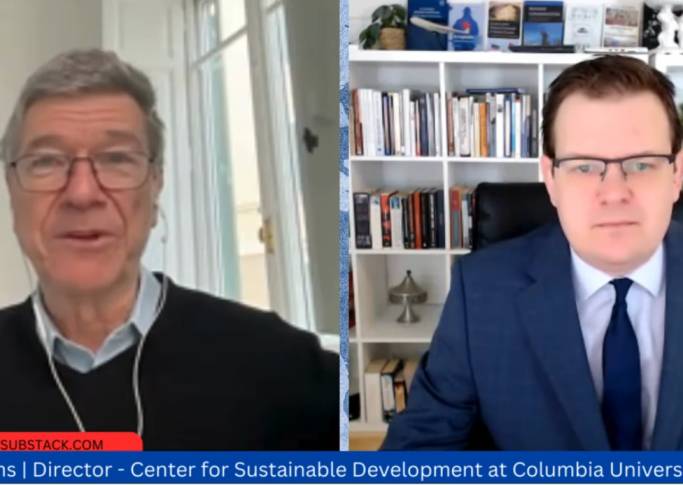
Editor’s Notes: In this compelling interview, Professor Jeffrey Sachs joins Glenn Diesen to discuss the alarming escalation of global conflicts and the potential onset of World War III. Sachs analyzes the current war in the Middle East, the continued tensions in Ukraine, and what he characterizes as a dangerous decline in international law and the role of the United Nations. He offers a critical critique of U.S. foreign policy, describing it as a delusional pursuit of global hegemony that risks economic collapse and nuclear catastrophe. This conversation provides a deep exploration of the shift toward a multipolar world and the urgent need for diplomatic pragmatism to avoid further disaster. (Mar 7, 2026)
TRANSCRIPT:
Introduction
GLENN DIESEN: Welcome back. Professor Jeffrey Sachs joins us today to discuss, well, seemingly the unraveling of the world. So thank you very much for coming back on.
PROFESSOR JEFFREY SACHS: These are dramatic moments, no question about it. Absolutely unbelievable.
The War Against Iran and U.S. Strategy
GLENN DIESEN: Well, we are seeing now that we’ve entered the second week of the war against Iran and, well, the regime change operation is not going as planned, obviously. What do you see being the strategy of the United States now that they failed in the initial objective?
PROFESSOR JEFFREY SACHS: Strategy is a big word when it comes to Donald Trump. I don’t think there is a strategy. We don’t really know. And of course, at wartime, we will not be told what is going on behind the scenes. But what we can gather is a tremendous amount of confusion — a confusion about expectations of what would happen, a confusion about war aims, a confusion about the real situation on the ground.
So fog of war is the usual simile. I think we are absolutely befogged right now when it comes to Washington. The only public outlet we have is Donald Trump’s posts on Truth Social. These are the ravings of a madman. And this is also part of what we are experiencing. We have a war with great danger and complexity, and we have a president that is, in my view, mentally unhinged.
Are We Already Moving Into World War III?
GLENN DIESEN: I’ve repeatedly warned that the illusion of escalation control is what could take us to a Third World War, because this war is spreading fast and it’s very much out of control. Indeed, it’s not just war in Iran. We see, of course, Iran taking credit for hitting U.S. bases in several countries, yet it also denies the attack on Saudi Arabia, Azerbaijan and Turkey, which doesn’t seem to make much sense and could be, of course, the U.S. and Israel attempting to pull in proxies.
Well, we don’t know. But we do know that the U.S. is arming and pulling Kurdish fighters as a proxy into the war. And there’s now arguments that Russia is giving Iran intelligence, which I’m not sure is true, but it seems likely, as the U.S. gives Ukraine intelligence. And also after the decapitation strikes on Iran, there is immense pressure on Moscow now to restore its deterrence from further NATO attacks, while the Europeans talk about more nuclear weapons in quantity and spreading it around. Are we already moving into a World War III?
PROFESSOR JEFFREY SACHS: We are probably in the early days of World War III, and the question will be whether it is contained. But we’re already in a global war because there’s a war in the Western Hemisphere underway. And even as the attention is on Iran, Trump is signaling in his not so subtle way that the U.S. will take Cuba. This could very well happen. The war in Ukraine, of course, continues. The war in the Middle East is now across the Middle East. The war between Pakistan and Afghanistan is perhaps somehow related to this. An Iranian naval vessel was sunk off the coast of India. For all of these reasons, fighting is across the world. The fighting is at least loosely linked. We don’t know how closely linked it is.
Part of American strategy seems to be to try to corner and control the energy markets. This is not playing too well because the energy supplies are being blown up by the hour. And so we’re entering also a worldwide energy crisis that is likely to be extremely serious. And as they say, it’s not yet been priced into the markets. This is the usual way that cataclysmic global events are turned into financial jargon. But the point is we’re going to enter an energy crisis that is extraordinarily severe as well. This will hurt Europe considerably. It will threaten Asian countries deeply. It will probably mean spreading war.
There’s no doubt — and by the way, I shouldn’t say no doubt — I’d be shocked, absolutely, if Russia and China were not supporting Iran. Why wouldn’t they? They have a strategic relationship with Iran. China depends on Iran for oil. The United States is basically at war with China. And much of what the United States is doing is really aimed at China. For example, cutting off Venezuelan oil supplies to China, now aiming to cut off Russian oil supplies to China — though the waiver was just lifted because of the chaos — aiming to cut off Iranian supplies to China.
So if China isn’t supporting Iran, something’s wrong with all our textbooks, that’s for sure. If China were to stand by and let the U.S. take over the world, that would be quite strange.
The Attack on the United Nations and International Law
GLENN DIESEN: Well, this effort to take over the world energy markets, it’s very blatant. I mean, I just watched a clip on Fox News where they have an interview going, “Well, yes, any price we’re paying in this war will be outweighed by the massive benefits once we get control over Iran’s oil as well.”
And it made me think about the article you wrote recently arguing that the U.S.-Israeli attack on Iran is also an attack on the United Nations.
And indeed, well, international law obviously has been violated in the past, but now there doesn’t even seem to be a pretense to abide by it. Indeed, there seems to be a pride in it. For example, Hegseth dismisses the rules of engagement as being politically correct and weak. So there seems to be almost direct efforts to dismantle international law. As you know, the Board of Peace more or less makes this clear. I was wondering if you can flesh out that argument.
PROFESSOR JEFFREY SACHS: Well, the U.S. government under Trump — but I would say more generally, but still to a dramatic extent under Trump — despises the UN, wants to kill it, is aiming to kill it both through a thousand cuts and through a devastating blow. If you believe that you are the world’s hegemon, as Emperor Donald believes, then anything that tries in Lilliputian ways to hold you down is pathetic. So they want to smash the United Nations and they’ve been absolutely clear about it.
Earlier this year, the United States walked out of more than 30 UN agencies. The U.S. has repudiated fundamental UN treaties and objectives. We’ve had an end of the nuclear arms control agreements which were part of the UN system. The U.S. doesn’t pay its bills to the United Nations. The U.S. doesn’t respect the institutions of the United Nations. And it’s clear, at least Trump and this U.S. government, and I would say the CIA and the deep state more generally, aim for global hegemony. And the UN is the opposite of that — well, not quite the opposite of it, but it’s co-responsibility with other countries, and the U.S. does not accept co-responsibility with anybody.
So everything that is being done completely sneers at the UN, and if the topic is raised, those are — as you said, whether it’s by Hegseth or by the White House — those are pathetic niceties in a world of power. We’ve not really seen this kind of brutality of sentiment, of rhetoric and of action since 1945 by anybody, by the way, whether it’s by the Soviet Union or by the United States in an earlier vintage or by any other country. Nothing remotely close to this.
I calculate each year with my colleagues an index of UN-aligned multilateralism, which we report annually in a report called the Sustainable Development Report. And even before this war, the United States — far and away, and not even close, Glenn — was the least aligned with the United Nations of all 193 UN member states, in terms of engagement with UN processes, including votes in the General Assembly, where the U.S. almost always votes in a tiny minority with Israel and Paraguay and a couple of other countries against the will of the rest of the world, and in terms of not signing treaties or leaving treaties. The U.S. is simply rogue, or out to destroy the UN — let’s put it that way. And this has all accelerated in recent weeks.
What is disturbing — if I could use a light term, because I love to use the stronger terms — Europe is completely complicit in this. Europe doesn’t show one morsel of support for the UN system processes or, most importantly, the UN Charter. The core of the UN Charter, the very purpose that you find in the preamble and then in the opening articles, is to stop the use of force and the threat of force by one nation against another nation. This is the essence of the whole UN system.
Article 2, paragraph 4 of the UN Charter — which I encourage people to go online and read — says that no nation may threaten force or use force against another nation. It’s simple. And as the opening words of the UN Charter make clear, this is to prevent the scourge of war.
Well, we have a U.S. president who does believe that the U.S. rules the world and that violence is a core instrument of ruling the world, and that if countries don’t accede to U.S. demands — what Trump calls unconditional surrender, with Trump picking the new leader of Iran — well, then force will be continued until that outcome occurs.
It’s in the mold of Hitler or Napoleon or other delusional actors who thought that they could rule. But even in those earlier cases, they did not believe that they ruled the world. They aimed to rule their neighborhood, they aimed to rule Europe. Hitler aimed for living space in the Slavic lands. Trump’s rhetoric and behavior is that he believes that he rules the world — by the way, he believes it at a personalistic level as well as at a political level. And I’m not exaggerating, and it’s not Trump delusion syndrome. It’s just the overt behavior. The demands are loony, and you can watch it. He’s got every trait of megalomania, grandiosity, narcissism.
And it’s quite clear, by the way, that U.S. governmental processes — U.S. foreign policy is typically run by the CIA — is a little bit being run ragged right now because they can’t keep up with this madness. So there’s a lot of unpredictability and a lot of danger in what’s happening, because we have a mix of U.S. normal grandiosity, which is a deep trait of the United States. It was true during Bush Jr., Obama and Biden. But with Trump, it adds the usual U.S. institutional grandiosity and militarism with a personal-level delusion of leaders.
We know this through history. This is not for the first time. It is for the first time, though, in the nuclear age. We’ve never had a circumstance like this in the nuclear age, and I would say the world is in a more dangerous situation than it has ever been, period.
Europe’s Response and the Collapse of the Peace Project
GLENN DIESEN: You mentioned the European response to this and, well, we see that Germany is trying to position itself as the number one supporter of Trump, hoping almost explicitly that obedience over Iran would be rewarded with deeper U.S. involvement in the Ukraine war, also for the U.S. to make no concessions towards peace in Ukraine. While the UK and France are looking now to enter the war in a more direct way. And this of course comes at the backdrop of Macron arguing that the reason why they need more nuclear weapons is because for France to be secure, it has to be feared — same as Europe. They have to be feared. This is the path to security.
PROFESSOR JEFFREY SACHS: Right.
GLENN DIESEN: How do you make sense of this? This is very different than the peace project that I was teaching students only 15, 20 years ago.
Europe’s Collapse and the Erosion of the Rule of Law
PROFESSOR JEFFREY SACHS: Yeah. Europe has completely lost any identity in any sense. I would say that just as the UN is dying right now, the European Union project is not coming together in strategic autonomy. The European project is falling to pieces as a vassal of the United States. We have the weakest leadership in Europe in generations.
Again, we have the worst German leadership in particular. And Germany is key to the European project. If you think about German chancellors, I’d known several of them. Do you think about Willy Brandt or Helmut Schmidt or Helmut Kohl or Schröder or Merkel? These were personalities. They were also decent. They understood German interests, but they also understood the idea of Europe as an aim of peace after centuries of European devastating war.
The last two German chancellors have been out of this approach. Scholz was simply the weakest chancellor, a complete non-entity. People said that the US had the goods on him so that he was suborned in one way or another. I don’t, I have no idea whether that’s true. And with Merz, you get the idea that — oh my God — you get the idea that this man wants a reversion to German militarism.
I could be less polite, but when you look at Merz, you see somebody who seems to know nothing of modern history. He’s belligerent, ignorant, a mix of fawning to the US on the one hand and warmongering on the other hand. Incoherent and not in Europe’s interest or Germany’s interest in the slightest. He doesn’t understand his job. I’m sorry to say his job on the first day should have been to pick up the phone and called his counterpart in Russia, President Putin, and begun to discuss this vital relationship between Germany and Russia to head off disaster and to rebuild some kind of collective security on the continent. He hasn’t lifted a finger one time, hasn’t even crossed his mind that this is his job.
So between Trump’s madness and Europe’s subservience, it’s really an extraordinarily depressing scene. I was at the UN Security Council last week after Israel and the US attacked Iran, and there were the — I’m sorry, not the German — the European ambassadors, excuse me, at the UN Security Council, one after another, on the day that the US and Israel had attacked Iran, all of them berating Iran, most of them not mentioning the Israel-US attack on Iran. You can’t even believe, Glenn, how surrealistic it is.
I was especially perturbed and bemused by the Danish ambassador. Denmark is a country that will be invaded by the United States sometime soon with very, very high likelihood. The US will declare that Greenland is America’s because of national security. Watch that space — that is basically underway right now. So you might think that Denmark would have some notion that international law might be important because someday they’re going to come crying to the world, “Look how unfair Emperor Donald is to us. He’s taking away our territory.” But there was the Danish ambassador, full out fulminating against Iran without mentioning the war that Israel and the United States had started against Iran. I went up to her afterwards to exchange my concern about this, but she looked at me and turned around and walked away. They don’t want to engage. They don’t want to have a discussion.
But the pathetic nature of this is really something sad. For Europe to simply completely fall into line with American and Israeli madness is something that you would not have thought of Schuman or Monnet or the other architects of Europe, people who knew what World War II had meant and who aimed to stop a World War III. They would have behaved differently, as would generations of leaders in Europe. Again, whether it was Willy Brandt or Helmut Kohl or de Gaulle or Mitterrand, you would have had a completely different idea. A Europe that’s Europe — that is the heir of thousands of years of civilization that knows a thing or two, that has seen war and wants peace.
But this is not at all what we see. We have Von der Leyen, we have Merz. You just can’t make this up right now. How this project has collapsed. And that’s why we’re in the early days of World War III, because nobody has the sense right now to say to Emperor Donald that this is not a good idea.
The Rule of Law Under Threat
GLENN DIESEN: Well, not only is it becoming more warmongering, but we also see, as in many wars, the rule of law weakens. And I want to ask how you see the rule of law and the division of power being weakened, because again, unlike continental Europe, the US has strong traditions on democracy and the division of power. And I ask because democracy and freedom don’t tend to fare well under wars, as we saw during the Cold War — this was not great either for liberalism. And during times of external threats, we see governments often develop authoritarian tendencies.
And we had this now for more than a decade. It went from Russiagate to the Ukraine war, we have the economic war with China. None of these things actually stop, by the way. They just stack on top of each other. And now of course, the Middle East is set on fire. Under these conditions, one would expect that the rule of law would weaken. Certainly I see the case here in Europe as well. We have the EU sanctioning its own citizens. We have any dissent or criticism of the government’s wars essentially treated as standing with the enemy, and you will be punished accordingly.
But how do you see it in the United States? Because if it’s game over there under the rule of law, then it doesn’t bode well for Europe.
The CIA, the Security State, and the End of the American Republic
PROFESSOR JEFFREY SACHS: I think in the United States, foreign policy has been in the hands of the CIA as lead for many decades. And the CIA is convenient because it can be completely secret. It is operating through a network of so-called intelligence agencies. These are not intelligence agencies. These are off-the-books militaries. And this has been true for many decades, especially as the US government’s foreign policy is an imperial policy of regime choice and regime change.
Trump just says out loud, and in a crazier way, I have to say, what has been US policy. Trump, because he is really what he is psychologically, says that he will pick the next supreme leader of Iran. Okay, this is rather startling. Of course, I have to add — no European leader murmurs a word that this is at all strange, that this is a good way to have a war escalate and continue. And on its way to getting us all killed, not a single European leader scratches their head to say, “Oh, that’s our ally saying the weirdest goddamn things you could possibly imagine.” No, they don’t say that.
But in any event, that mindset you might think is a little odd, but remember, the CIA has always had that mindset. And in 1953, without public scrutiny, without explanation, the US did choose who would lead Iran. They installed the police state that overthrew a democratic government in 1953. And the US backed that police state until 1979, when, lo and behold, the public revolted against it as that police state leader was dying of cancer. That’s where the Iranian revolution came from in the first place in 1979 — not out of the blue, but out of a US-imposed police state.
Well, you look all over the world, including in Europe, the US imposes governments of choice. And that means that the rule of law in the United States when it comes to foreign policy has always been a veneer.
I find it very notable — I think it’s very important for historians and analysts to reflect on the famous farewell address of Dwight D. Eisenhower, who was the supreme allied commander, the top general of the United States, who became President from January 1953 to January 1961. And in his farewell address of 17 January 1961, he warned famously of the military-industrial complex. We should understand that farewell message in a different way. What Eisenhower was saying to the American people is: “It’s already happened. This is already a military state. The institutions of government have already been fundamentally weakened.”
I think, Glenn — and not to take us too far aside — but I think the evidence is quite overwhelming that the CIA killed Kennedy in 1963. And that’s not meant as a flamboyant remark or as conspiracy theory or something else. It’s meant in an explanatory way that no American president since Kennedy took on the security state. Johnson reversed all of Kennedy’s peace initiatives, and every president since has essentially gone along with the agenda of the US security state, including nice people like Obama, who came in and then presided over several regime change operations. Obama thought, “Yes, I’ll choose who leads Syria, I’ll choose who leads Libya.” They didn’t put it that way. They had manners. Trump has no manners. Trump has grandiosity.
But it was the same with Obama and his deputy, who is now my colleague Victoria Nuland, and Hillary Clinton, also my colleague at Columbia University — and I say it with interest — they decided who would lead Ukraine in February, actually probably late January 2014. Victoria Nuland is picked up by the Russians on a phone call on an open line to the US Ambassador, talking literally about who would lead Ukraine. And she picks a man named Yatsenyuk, who became the leader after the coup.
So when Trump says he’ll choose who the supreme leader is, it sounds outlandish — and it is — and it is a step toward World War III, but it’s also US behavior. It just is the usually unsaid part of US behavior.
So I’m unfortunately not very impressed with the so-called checks and balances of the US system or with the constitution. We’ve had a military state for decades. I often think that just as the Roman Republic became the Roman Empire, the US Republic has become the US Empire. What is the actual date of that happening? In the normal discourse, people point to Roman history as a warning to the US: “Don’t let this happen.” But I think it’s quite arguable that not only has it happened, but that it happened several decades ago.
And I wonder if we were in Rome in 27 BC when Augustus declared himself Princeps, whether we would have felt that that was a dividing line. That’s the historians’ dividing line. But there was still the Senate, the senators still wore togas, there were still consuls. It looked like the Roman Republic’s institutions were still intact. And I have a sense that this is the US situation — that maybe the US Republic ended in November 1963 with Kennedy’s assassination, and since then we’ve been in the US Empire. I don’t know, but I just raise the point to say that Trump is outlandish.
He has this dark triad personality of extreme Machiavellianism, malignant narcissism, and psychopathy, which we can see when he expresses absolute lack of interest in who’s dying. There is no feeling there. So we know that this is a very unusual psychological character, but he’s on top of a machine that already existed.
Hegemony, Multipolarity, and the Refusal to Let Go
GLENN DIESEN: On this issue though — and this is the last question — this insistence on choosing other leaders of other countries and the reluctance to find peaceful solutions with adversaries, primarily other rising powers, be it Russia, China, Iran: to what extent do you think this is linked to the reluctance or the unwillingness to see hegemony go away?
Because the Europeans at least very much bought into the whole idea after the Cold War about a world order based on the collective hegemony of the political West led by the US. I remember this whole unipolar moment when it was introduced as a concept by Charles Krauthammer back in 1990. He framed it as, “This is the distribution of power. All power is in America.” But he was making a point as well in this article — once the world shifts to a more multipolar international distribution of power, then we shift away — as if this would be a rational decision that would be made.
But after 35 years of having this political class raised on the ideology that the dominance and perpetual hegemony of the West would essentially be — this democratic peace theory — it would stabilize the world, it would transcend the chaos of the past. So essentially the hegemony was humanity’s salvation. After you had 35 years of politicians like this, there won’t be a peaceful transition to multipolarity.
Do you see this as being the reluctance to even accept having other powers, that the West won’t dominate anymore, as to why there’s no alternative to plunging the world into World War III? Because a lot of people criticize Marco Rubio at the Munich Security Conference, but I don’t see this as essentially different from the logic I hear from political leaders across Europe as well — well, not all, but many.
The Roots of American Hegemony: From Roosevelt to the Present
PROFESSOR JEFFREY SACHS: Well, I think this is another case where this is a profound process that has been underway actually for 80 years. The idea of multipolarity was both born and died in 1945 for the following basic reason.
The brainchild of the United Nations was also the brainchild of the victory in World War II. And that was Franklin Roosevelt who understood that he and Stalin and Churchill, and with Franklin Roosevelt’s insistence, Chiang Kai-shek, who was head of a struggling and invaded China in the 1940s, invaded by Japan, of course, jointly had to operate to defeat Hitler. This was a collective enterprise. It was an enterprise of the United Nations, a term that was used early in World War II.
And Roosevelt believed in that unity, that these nations together had to stick together to defeat Hitler and then afterwards to make the world safe. And he really believed in world peace and safety.
Now on the ground, the Soviet Union bore the brunt of defeating Hitler by far, losing 27 million people and being the key to breaking Hitler’s war machine. And Roosevelt knew that the United States played its particular role as the industrial backbone of the defeat of World War II, providing weapons, airplanes, technologies, radar and so forth that helped this. But the Soviet Union bore the brunt of the war.
Roosevelt was absolutely intent and capable of cooperating with Stalin throughout the war, often pushing Churchill to the side. Roosevelt wasn’t much taken with the British Empire. Roosevelt saw that major powers, and that there really would be major powers after the war — four in particular: the US, Britain, Russia and China. France was let in late in the day for tactical reasons. But the idea was that these countries would cooperate, not fight each other, not veto each other in the UN, but cooperate to help keep the global peace.
And Roosevelt believed that lesser powers, the rest of the world, should have its place. And he was the opposite of US arrogance. He introduced, from the first moment he came in as president, the good neighbor policy towards the Americas. He said we’ve got to stop invading the Americas, like Trump has done recently in Venezuela and is about to do in Cuba. So that’s how the UN was born.
Just one problem. Roosevelt had untreated high blood pressure and he died on April 12, 1945. And that was the end of the American multipolar vision. Because Truman, his successor, was a much lesser person, not experienced. FDR was a gifted individual also. And Truman bought in immediately to the idea that this is now a war with Bolshevism.
FDR wasn’t much impressed with these labels, I have to say. He was just a great pragmatist. He didn’t care who called what whom, what labels, titles, ideologies. He was going to get along and he was going to be practical.
But already in the second half of 1945 — and that’s why the bomb was dropped twice on Japan, to impress Mr. Stalin — the US was now at war for global control. The idea of shared responsibilities was already out the window in the American mentality. And this was of course put most vividly in NSC Memo 68 in 1950, that this was going to be the US battling world communism for dominance.
The Post-Cold War Descent into Hegemonic Madness
I say all of this, Glenn, because when the Soviet Union fell in 1991, the insanity of a country of 4% of the world population deciding it would run the world went into overdrive. And it’s been in overdrive since 1991.
The US has viewed itself — and by US I mean the CIA, the military-industrial-digital complex, the ones that make the war decisions, that have brought us nonstop into war, that allocate the trillions of dollars and so on — they believe they run the world.
When China rose in power over several decades, and that was noticed by the United States sometime around 2010, this freaked out these would-be hegemonists. Now there’s an enemy. Russia was dismissed as anyway useless, so not really to worry. So we don’t have to listen to anything Russia says. But the attention turned to China, and we have to defeat China the same way. That’s been the US foreign policy for the last 15 years.
Just quickly, a couple of flies in the ointment. First, all of this is delusional. That’s the first starting point. The idea that the US runs the world, rules the world, dominates the world, can have its way, is a madness. It’s been a madness for decades, but it’s been a repeated madness that leads to millions of deaths all over the world, whether in Vietnam or across wars of the Middle East.
Second, the misjudgment about Russia is the reason for the Ukraine war. The US never expected Russia to resist NATO enlargement, never expected Russia to be able to stand up to the United States for one moment. This is both a denigration of Russia and a profoundly delusional exaggeration of American power. Both go hand in hand. But the war in Ukraine is fundamentally the result of an American delusion, spelled out helpfully by Zbigniew Brzezinski in 1997, because he spelled out in The Grand Chessboard exactly what the delusion is. And he concluded Russia could not resist the eastward enlargement of NATO and Europe.
Israel and the Descent Toward World War III
And then the other fly in the ointment is Israel. Israel is a crazy rogue state, with half its political leadership in the mindset of the 5th century BC, reading some text from King Josiah. And there, Israel has just plunged the world into probably the Third World War, but into a phenomenal economic crisis. The timing, the instigation is Israel’s. The fact that the US goes along with it is because it’s completely coherent with the US hegemonic project. But this is Israel’s complete madness. And because of the hold of the Israel lobby in the United States, that madness isn’t even examined.
Excuse me, the US has an ambassador in Israel named Mike Huckabee, who is, let’s just say, a minor Protestant evangelical theologian, if I could put it that way. But that’s a very polite way to put it. And he said two weeks ago, yes, Israel owns the land from the Nile to the Euphrates. And when Tucker Carlson asked him, excuse me, they own the land, could they take it? He said, “Sure, yeah, sure, they could take it.”
This is again what’s sometimes called by psychologists or psychiatrists, folie à deux. This is a craziness of Israel matched by a craziness of the United States. Israel wants to be the hegemon from the Nile to the Euphrates or beyond. The United States wants to be the hegemon of the world. That’s a long-standing project. And here we are in the early shooting of World War III.
Unless, unless somehow somebody stands up and stops the madness. The ones that are most likely to do it in the end are China and Russia, because they are mature, aware and not really so happy about this US hegemonic project.
If India would recognize its own interests clearly, it would also play a very major role in this. But India has signed on to the US project to some extent, and it raises a big question. What is India thinking? What are the Indian leaders thinking? They had the British Empire for a couple of centuries — it should have been enough. They should have good instincts to know: don’t follow the US Empire in this kind of madness.
The Virtue of Dominance and the Hobbesian Trap
GLENN DIESEN: Yeah, well, I think pragmatism, as you say, is what we need. In 2003, Condoleezza Rice made the comment that multipolarity — she called it a theory, not the distribution of power about competing interests and competing values. So she said, no, no one should want this at all, because if you value freedom, you don’t want to put a check on it.
So this is kind of the logic that we need to have dominance. Without dominance, there can’t be freedom. And I think this is the Europeans as well. We buy fully into this. When I listen to our politicians and journalists, this is why they’re willing to go to war with Russia, they’re willing to go to war with China, they’re willing to go to war with Iran, and burn down the world, because otherwise there can’t be freedom. There has to be dominance. This is kind of the virtue of dominance that is selling us freedom.
PROFESSOR JEFFREY SACHS: Absolutely. And incidentally, I’ve been thinking about this from the special Anglo-American mindset, because Britain and the US have done the most to wreck things for a couple of centuries in this way.
The mindset goes back to the philosophy of Thomas Hobbes, who said that in the state of nature, life is solitary, poor, nasty, brutish and short. And Hobbes said that to get out of the war of all against all, you need a Leviathan, he called it. You need a superior power. And that was his theory of national government — that people would give up their sovereignty, their freedom to kill each other, to a sovereign who would then keep order, and everyone would be better off because they wouldn’t be killing each other.
Then you turn that logic to the global order. And the way that is turned into the global order by the CIA, or by MI6, or by these intelligence agencies in the West, is to say, well, we don’t have a supreme ruling Leviathan. So it is a war of all against all. And we have to be brutally realistic. It’s us or them. And sometimes you have to strike first, like Israel and the United States striking Iran. That’s the mindset.
But another part of the mindset is the United States saying, “We’ll be the Leviathan, thank you.” Britain was the Leviathan in the 19th century. The only way to be safe is if we are the Leviathan. In other words, there can only be one that runs the world, and we will be the one that runs the world.
Now, there is another way in life, which is that you get along with each other. You make some common rules, you share the sandbox. We teach our five-year-olds to do this. It’s not impossible that you don’t need one ruler of the world to have peace. And this is what the American hegemonists or supremacists cannot understand. But I think it’s partly that they’re trapped at an emotional level, maybe before age five, I don’t know. They don’t really see that there is another way, that in a multipolar world, we actually really could get along. We could make some rules of the road, we could have some cooperation.
The Legacy of Roosevelt and Kennedy
The one who understood that, as I said, in the United States, was Franklin Roosevelt. Another one who understood that more recently was John F. Kennedy. And probably he died because he held that belief, and he was killed from the inside because he held that belief.
So this is a tough struggle, and we’re in an extraordinarily dangerous moment in the world. If this continues, if Mr. Trump continues to believe that he will pick Iran’s next leader and that this is going for unconditional surrender, of course things will then depend on military outcomes. But one real possibility is an economic crisis globally, instigated by Israel and the United States, the likes of which we’ve not seen for a long time.
GLENN DIESEN: I wish you could have finished on a more optimistic note, but thank you very much for taking the time. I know you have a busy day in Rome there, so try to enjoy it in these perilous times. And yeah, I hope to see you soon.
PROFESSOR JEFFREY SACHS: See you soon. Thank you.
Related Posts