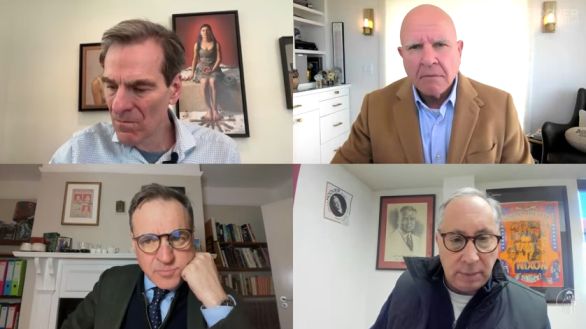
Editor’s Notes: In this timely episode of GoodFellows, Hoover Institution fellows Niall Ferguson, John Cochrane, and H.R. McMaster join moderator Bill Whalen to dissect the escalating conflict with Iran and its global ramifications. The panel explores whether the current situation signals the beginning of a second Cold War or a third Gulf War, examining the military strategy, economic shocks to energy markets, and the potential for regime change in Tehran. With sharp insights into the “Axis of Aggressors”—including Russia and China—the “GoodFellows” offer a masterclass in the geopolitics and history currently shaping our world. (Mar 6, 2026)
TRANSCRIPT:
Introduction
BILL WHALEN: It’s Friday, March 6, 2026. And welcome back to Goodfellows, a Hoover Institution broadcast examining history, economics and geopolitics. I’m Bill Whalen, I’m a Hoover Distinguished Policy Fellow. I’ll be your moderator today. It’s my great honor to be joined by three very distinguished gentlemen here at the Hoover Institution. Our good fellows, as we like to call them, referring to the historian Sir Niall Ferguson, economist John Cochrane, and Lt. Gen. H.R. McMaster, former Presidential National Security Advisor. Niall, John and H.R. are Hoover Senior Fellows.
Gentlemen, this is the Domino’s version of Goodfellows. Today we’re going to try to deliver a show in 30 minutes, so here goes. I want our listeners and viewers to know that Niall has written a tremendous piece in the Free Press. Its title is “Could This Be the Start of World War Three?” And in it, Niall details 10 questions related to the situation in Iran. I’m not going to read them all, but H.R., I want to go to you and I want you to answer questions six and five, which are: how widespread will the war get? And at what point does the Iranian regime alteration happen? Keeping in mind that the president today, President Trump, moved the goalpost and called for Iran’s unconditional surrender. Go ahead.
How Wide Will the War Get?
H.R. MCMASTER: I think it’s reached its peak in terms of how wide it’s gotten. I think now the capacity of Iran to widen the war, to continue to attack new countries or to even sustain the attacks on the 10 or so countries it’s attacked with ballistic missiles and drones is going to be greatly diminished. I think also their ability to affect shipping in the Straits of Hormuz in the Persian Gulf is also going to be greatly diminished.
But what else can they try, what else are they going to try to get going? Well, trying to expand the use of their proxies. We see that with Hezbollah already, and Hezbollah now promising yesterday, “Hey, we’re going to try to attack U.S. assets in the region,” with the franchises that Hezbollah has in the region. So we’ll see a continued terrorist threat. You see countries in the Gulf and in Europe acting preemptively against these cells associated with the IRGC and the MOIS, the intel arm of the Iranians.
But I think in terms of the geographic scope of this war, it’s waning. And what you’re going to see is their capacity to continue to strike is just going to drop off a cliff here with the sustained air campaign and now the ability to have, as the chairman of the Joint Chiefs Dan Kane said, the stand-in attacks of having fourth generation fighters and bombers patrolling continuously across the country, striking these missile launch storage facilities, the underground Shahed drone storage facilities.
So I think we’re going to be okay. And I think also in terms of the air defense, it’s going to be okay as well. Estimates vary — maybe 1,500 interceptors fired, about one fifth of the stocks of the U.S., Israel and the Gulf states against maybe 2,000 drones so far and 600 or so ballistic missiles. But again, that’s going to drop off, and you’ll have a reopening of shipping. I think we’ve hit the nadir of the crisis on gas and oil supplies.
Is This the Start of World War III?
BILL WHALEN: So, Niall, to the question, will it be the start of World War III? The answer is what? A definite maybe?
NIALL FERGUSON: No, it’s not World War III, though I don’t think it’s a stupid question. As I point out in the piece, World War II didn’t just begin with a bang. It was several distinct wars that coalesced in late 1941. And we already have one more raging in Eastern Europe. Now we have a war that began really in 2023, but really escalated in the past week.
But I said in the piece, and I think this is where I stand, this is Gulf War III. And it has to be understood in the context of Cold War II. Gulf War III, I think I wholly agree with H.R., is going to look a lot more like Gulf War I than Gulf War II. That is, it’s a Desert Storm type scenario. It’s something that takes weeks, as opposed to what happened after 2003, where we ended up with eight years of being bogged down in the Iraqi insurgency. So this is going to be much more like 1991.
I think H.R. is dead right that the total dominance of the skies has now been established, and it’s going to be very, very hard for the various different armed elements of the Iranian regime to survive. And I think in short order there will be a steep — there already is a steep — decline in the missiles that they can fire, and I think the drones too will tend to dwindle. So I agree with H.R.’s military analysis.
What is harder is to say anything clear about the political future of Iran. Unlike Desert Storm, where the goal was to kick Saddam out of Kuwait and restore the Kuwaiti regime, what we’re doing here is we decapitated the Islamic Republic.
And we’ve not just killed Khamenei, we’ve killed a substantial part — I say “we,” I should say the U.S. and Israel have killed a substantial part — of the leadership elite of the regime, and more will be killed. But we have not specified what comes next. And it’s very hard to get any Iranian expert to say with any degree of confidence what will come next. That’s the part that’s uncertain.
Cold War II and the American Way of Intervention
BILL WHALEN: John.
JOHN COCHRANE: Yeah, let me chime in. I agree. This isn’t World War III. It becomes World War III if a major power comes in on the side of Iran. And no one’s doing that, not even China, who’s losing access to a lot of oil here. That’s when World War III breaks out.
And more importantly, nobody likes China. In our great fight against Communism — World War II, Cold War II — Cold War I is different from Cold War II. There was an ideological component. Some people liked the Soviet Union’s model. Nobody likes the Chinese model. It’s a military confrontation.
I do think, though, the focus on what’s going to happen next is misplaced. The lesson I’m getting from this is how America operates in the absence of an ideological competition with China. We are happy to let you screw up your country — Afghanistan, Syria, Somalia — do whatever you want. Your country, no matter how horrible it is, we don’t like it, but we’re not going to interfere unless you start causing trouble internationally. And then we’re going to come in and we’re going to kick you out of power, and we don’t care what happens next.
I think it’s pretty clear the U.S. doesn’t really care what happens next. And if you’re going to actually interfere and say, “Look, you’ve got to stop causing trouble to your neighbors,” you can only do it if you have a plan to restore democracy. You’re never going to do it. And the U.S. has figured out that it’s not in our interest. In our interest is we can come in — regime modification, regime change, whatever you want — we don’t care if we leave a mess behind, so long as you don’t bother your neighbors. This is not a very moral, ideological, beautiful thing, but it is the way that the U.S. will now be able to fight these little things on the edges of the world scene.
Can Air Power Alone Achieve the Goal?
BILL WHALEN: Well, H.R., John is suggesting we will essentially cut and run at some point. And here’s my question. Can you achieve what we want to achieve with air power alone? Our experience in Iraq in 2003 — we had shock and awe, but then we sent in a quarter of a million troops after that. What if the regime does go down? And then what if Iran turns into a version of Iraq where you have sectarian violence and a civil war? Would we be compelled to go in at that point?
H.R. MCMASTER: Well, I see three alternatives here. Alternative one is that there is a weakened Islamic Republic — a theocratic dictatorship that stays in power — with the IRGC running for their lives, operating as they are now out of schools and hospitals, because all of their headquarters are getting blown up and they’re being hunted down.
The second alternative is that there’s a fissure, a fracture within the security apparatus, and then somebody emerges and says, “Okay, enough of this,” contacts the United States and says, “Hey, I’m your guy. I’ve put together this group to splinter off and we’re going to establish an alternative, a transitional government, something like that.” And I think the CIA — I would hope, I’m sure they are — is working overtime to identify those people who can use existing security force capacity to transition away from the Islamic Republic into something else.
The third would be a devolution into some form of civil war. And I think the first and third of those are bad options. And what we want to make sure we don’t do is set conditions for a destructive civil war, kind of like in Libya, except many orders of magnitude larger than Libya.
This is why I’m concerned about this idea of arming the Kurds — not a new idea, the Brits tried it in the early 20th century — but I think what that will do is create deep anxiety among the Persian population and other elements of the population, and really reduce their enthusiasm, which they have now, for just ending the Islamic Republic.
Anyway, it’s tough to do this remotely. You can’t control it, you can influence it, but you’ve got to find essentially somebody on the ground, groups on the ground, who can begin to affect this transition as you continue to weaken the repressive arms of the regime. And that’s the new class of targets that are coming on now — really going, as Niall alluded to already, to weaken the security apparatus.
The Venezuelan Analogy and the Strait of Hormuz
NIALL FERGUSON: The challenge, it seems to me, is the Venezuelan analogy doesn’t fit too well. Because that’s kind of what has motivated at least a part of President Trump’s thinking — that what worked in Caracas can work in Tehran. Now, I give great credit to Dan Kane, the chairman of the Joint Chiefs. He clearly warned the president this would not be like Venezuela. It would be a great deal more difficult. And it’s worth just pondering as to why that is.
I think it’s partly that there is a degree of ideological radicalism which is greater — the Chavista regime had its ideology, but it wasn’t remotely like the radical Shia Islam on which the Iranian revolution was based. The other difference is the neighborhood. It’s the fact that chaos in Iran spills over into the Gulf.
And I hope you’re right, H.R., that we’ll see normal service resumed in the Strait of Hormuz pretty soon. If we don’t — and I’m throwing this to John Cochrane — if we don’t see normal service resumed in the Strait of Hormuz pretty quickly, then the world is going to be on the receiving end of one of the biggest energy shocks of our lifetimes. The potential supply disruption is much greater than anything we have seen this century. It would be greater than anything that occurred at the time of Desert Storm. We’re looking at the 1970s, because of the sheer volume of oil, not to mention natural gas, that goes through the Strait of Hormuz.
So the reason it’s not Venezuela is that the stakes are much, much higher. It’s going to be hard to find a Delcy Rodríguez amongst the IRGC generals. Maybe at some point somebody comes out and says, “I’ll sign the instrument of surrender. Where do I sign? I’ll do that over getting killed.” But that person is immediately going to be denounced by the surviving remnants of the theocratic regime.
I think the tough thing, H.R. — if you agree — the tough thing here is to make it sufficiently stable that the traffic in the Strait of Hormuz can resume. And my impression is that the shipping and insurance interests are nervous as hell. It’s not like a ton of ordnance was raining down on the strait, that many people were hurt or ships were damaged. There’s just a fear of what can be done. And until that fear is removed, there’s going to be a significant economic shock. Actually, I want to get John’s thoughts on this.
The Economic Impact: Are We Heading Back to the 1970s?
BILL WHALEN: Yeah, John, let me add here — in Palo Alto, my gasoline is already up 10%. There are dire prophecies of gasoline going to $8 and $9 a gallon.
NIALL FERGUSON: But yeah, this is the nightmare for the inflation hawk — that we end up getting, on top of all the monetary and fiscal kindling, the gasoline of an oil price shock à la 1973-74 or 1979. John, are you worried that we’re about to revisit the 70s because of this?
Economic Fallout and the 1970s Parallel
JOHN COCHRANE: Well, always, especially considering the bad fashions of the time. So I do think this partly explains. I think the military objective is simply either that they’re unwilling or unable to get rid of all their military assets, and then who cares if they turn into another Libya — as I think the attitude — but boy, it’s hard to get rid of all the. It only takes one swarm of drones to keep an oil tanker out of the Straits of Hormuz. So I’m not sure if maybe we keep putting this one around, but I’m not sure you can do it by just removing all of their military assets and then letting them rot.
So let’s do the economic front. Niall posted a great graph that I copied and passed on, on how inflation in this recent period looks exactly like the 1970s, and here we are just about at the exact time when the Iranian revolution happened and set in a big oil price shock. So yeah, there’s reason to worry. I think less so than in the 1970s. Our economy is less dependent on oil than it was in the 1970s. We are an oil exporter, so although higher world prices hurt our economy, they also help our balance of trade. We make money. We weren’t as export dependent. China is the one who — they got most of their oil from Iran or Venezuela, also some from Russia. So it’s going to hurt them in the short run more than it hurts us.
And my hope is that this doesn’t last as long as the last one did. But yeah, if the Straits of Hormuz close for a long time, I think it could be — and you’re seeing the beginnings of stagflation now. The latest jobs report is weak and the latest inflation is up. So get out those bell bottom jeans. Still, I don’t think that’s baked in. And I do think the resilience of the American economy, the fact that we produce a lot, we’re less dependent on oil, lots more domestic production, means the outlook is not as severe in nature.
The Ethics of Targeting Foreign Leaders
BILL WHALEN: I’m going to defend the 70s. It gave us the birth of funk. So it wasn’t all a tough thing. But I have a question for you, General McMaster. Roaring Lion — the Israeli operation — the first wave of Roaring Lion takes out the Supreme Leader and 40 of his friends who, for reasons historians will one day tell us, decided it was a good idea to have a meeting above ground in Tehran. Not a good idea, fellas.
But this is a departure we are used to — shanghaiing foreign leaders we don’t like. We take Maduro out of Venezuela, we take Noriega out of Panama, we put him on trial. Now we’ve been part of an operation that dropped a missile and killed a leader. So two questions, as Niall would say — is this cricket? And secondly, H.R., there are probably people out there thinking, well, if we did this to the Supreme Leader, a lot of other bad actors should probably go too, so why aren’t we doing it to Putin? Why aren’t we doing it to Kim Jong-un?
H.R. MCMASTER: Yeah, I think what would change the calculus for probably President Trump and those around him — although it was an Israeli strike that took out that large group of leaders — was that they had just murdered over 30,000 of their own people in a 48-hour period. I mean, I think that really changed the perspective, you know, from the period of the 12-Day War when President Trump was like, “Hey, let’s get a ceasefire after the strikes against Fordow.” And really a lot of Iranians were up in arms about that because they’re like, “Why did you guys stop?” And so I think that the biggest difference was the degree to which the regime had inflicted so much suffering and death on their own people.
JOHN COCHRANE: You don’t assassinate foreign leaders in two circumstances. One is when they could assassinate yours — and this is sort of an agreement, we don’t go this way — or when you can’t do it. I think we would have happily dropped a bomb on Hitler’s bunker in World War II if we had precision munitions, and it would have saved an enormous number of lives in doing so.
H.R. MCMASTER: And they did try to kill President Trump also. I mean, you know, right. And he did say, “I got him before he got me.”
JOHN COCHRANE: Zelensky and Putin — it’s just the lack of means rather than politeness that’s stopping that one.
China’s Silence and the Unintended Consequences in Asia
NIALL FERGUSON: Let’s bring it back to the Cold War freeze. Because China’s situation, in many ways, is the thing that people aren’t talking enough about. I do believe that part of what we have seen this year has been a conscious flexing of American military might — in Venezuela, now in Iran — both, in effect, client states of Beijing, both suppliers of contraband sanctioned oil to China. And it seems to me that a part of the goal here is to communicate to the Chinese Communist Party: do not mess with America. And I think that message has got through.
But there is a kind of another side to this which I think H.R. will have thoughts on. We are conducting extraordinarily fast-paced naval and air operations as we dismantle the military capabilities of the Iranian regime. We do not have an infinite supply of the precision weapons that are being used. John’s right — this is a kind of precision that didn’t exist in the first age of air power, didn’t really come into existence until quite recently. The problem is these are beautifully and extremely expensively made weapons, and there’s a finite stock of them.
The Chinese are sitting thinking to themselves: do we rely on the United States to keep the Strait of Hormuz open and our flows of oil and gas coming? What does that mean? Are we simply going to accept that position? Are we going to be next? And this is an important question that I am sure they’re asking themselves in Beijing. Is the United States now so unbound, so unrestrained, that it may contemplate preemptive action against us too?
If that’s their thinking — and it wouldn’t surprise me, given what we know about Xi Jinping and communism generally — then they will say to themselves: we should not hang around and wait for that preemptive strike. On the contrary, we should be acting when the United States has depleted its capabilities, before they’ve been replaced, and while it is entangled not only in Iran, but entangled in its Western Hemisphere strategy and still playing some role in the war in Ukraine.
So I worry about how this is going over in Beijing. And you know what’s really, really kind of eerie? They’ve said so little. By comparison with the wolf warrior diplomacy we got accustomed to, they have been very quiet indeed. All of the flights that they have been doing in recent years and months in the vicinity of Taiwan have stopped. Now there are a bunch of explanations for this, none of them wholly compelling. Are they just making nice because there’s a summit coming up at the end of this month between Xi and Trump, maybe? Or is something else going on here?
And I think it’s the unintended consequences of military action that you need to worry about. The consequences of a war between the United States and Iran were entirely predictable — Iran was going to lose. I think we underestimated the impact on the energy markets and the insurance plans. I thought John’s was cobbled together and wasn’t convincing. I think we underestimated the Shaheds, which we did not have defenses against, nor did the Gulf states. So the unintended consequences in Asia are the thing that I’m thinking a lot about. Xi Jinping’s very quiet. What’s he thinking? Nobody knows.
Industrial Capacity, NATO, and the Military’s Performance
JOHN COCHRANE: May I add to that? You said the word “preemptive,” and that’s right. People talk about why now. I think it was very clear that Iran was arming itself quickly and it was making ballistic missiles — not drones, ballistic missiles — faster than we could make interceptors. And it was kind of now or never. And you’re right, that points to a now-or-never moment for China on the other hand.
Two thoughts on this. Where are the Europeans? This sort of seems to signal the end of NATO — they are busily getting together to have a meeting to talk about a joint declaration maybe some couple of weeks from now. But we certainly have cleaved a big one between us and NATO here.
And a final thought — you know, in the last decades, too many institutions of American government have shown themselves completely incompetent. But the amazing job our military has done is just worth calling out, and the Israelis on top of it. H.R., I don’t know how your buddies stay so amazingly good at what they do, but hats off to it.
H.R. MCMASTER: Well, it’s cultural, you know, in our organization, in our military, to just be at a high level of readiness, and we train really hard and realistically in our training centers and so forth. And in this case, we’ve had decades of preparation in terms of planning against this particular enemy.
I’ll just say, for Niall’s point about capacity — we are rushing to triple the annual manufacturing capacity of some of the key weapon systems. The big ones here are the Patriot missiles, the PAC-3 interceptors, the THAAD systems, the SM-3s, SM-6s. So we’re racing to do it. But back-of-the-envelope math here — and this may not be accurate — but we might have fired about one fifth of our interceptor stockpile in three days. That gives you an idea of how much you have to build up now for stockpiles to recover.
But I think China would make a mistake if it thought to act now, because we still have a pretty significant amount, especially with this about 90% reduction in the launch rate, which is probably going to fall off the cliff even further here in the next couple of days. I think it does highlight the lack of depth in our industrial base — the degree to which we need to make our supply chains more resilient, stockpile some of the components and precursors for some of these weapons systems. And all that is underway under the Trump administration right now. It’s just — hey, will it be too late? We don’t know. So we’ve got to keep rushing to build up this capacity.
But also I think overall the capacity of our armed forces is too small. We assumed for way too long that we could just do one thing at a time. And what you’re seeing now is how interconnected these theaters are. Venezuela was China and Russia’s main platform — and Iran’s actually too — in the Western Hemisphere. Now we’re seeing this is of import, as Niall has mentioned, to China, because China doesn’t want us to have the keys to its gas station. And I think from a geopolitical perspective, these two actions have been very beneficial. I hope we can capitalize on that diplomatically.
I would like to see a lot less of the chest beating in briefings, and a lot more of just a clear-headed articulation about why this was necessary. Hey, well, ex post facto — they just fired 2 million drones and 600 ballistic missiles in 10 different countries. So was that a threat? Hell yeah, I guess it was. So maybe it was smart to do something about this.
But then also — now what you’ve seen is, because of the attacks on the Gulf states, the US is seen as really the only reliable partner for security in the region. China — one of its big entrées in the Middle East was, “Hey, I’ve got influence over the Iranians, you need me in the Middle East.” That’s gone now, or potentially gone.
So I just think that what has happened is, under the Biden administration, the axis of aggressors coalesced. They were the protagonists. They were setting the terms. Go back to April 2023, when Xi Jinping turns to Putin and goes, “Oh, Vladimir, we’re seeing changes like we haven’t seen in a hundred years, and you and I, we’re driving those changes.” And Putin smiles and goes, “Oh yeah, you’re right, you’re right.” Hey, man — they’re not in the driver’s seat anymore.
And I think what Trump deserves probably the most credit for is regaining the initiative over this axis of aggressors who thought they could act against us with impunity — that we were weak, decadent, divided, feckless. So there’s a huge opportunity here. I would like us to be a little more diplomatic and understand our audiences.
And on Europe — hey, Europe, better get a wake-up call here, because those Iranian missiles could reach Europe. What is the state of European missile defense? Not as good as it needs to be. The drone threat Niall mentioned — this goes back, there’s continuity here. This is the V-1, V-2 threat to London in many ways, but now it’s coming home to everybody. And so we have to be ready for this kind of emerging and new threat to all of our security.
Looking Ahead: Exit Questions and Final Thoughts
NIALL FERGUSON: Couple of points that I just want to make, which are important. I don’t think John’s right about NATO, because actually, Friedrich Mertz, who’s the Chancellor of Germany and therefore in many ways the most important NATO leader, has made it clear that he’s supportive of what the US and Israel have done.
The leader who’s most out of line is the British Prime Minister, Keir Starmer, who has had a disastrous week in diplomatic terms because he’s playing to a domestic audience that is largely opposed to the war. But this is going to really hurt relations between the US and the UK.
The second point that’s important is the law of unintended consequences. Once again, one of the main beneficiaries of the events of the past six days is Russia. First of all, because we don’t have a ton of spare crude oil to take the place of that which is no longer flowing through the Strait of Hormuz. We’ve had to ease sanctions on the Russians, make it possible for the Indians to buy Russian oil. Russia’s already reaping a benefit in the higher oil prices. There’s a dual benefit in the sanctions being eased.
Secondly, Ukraine is a loser because Ukraine’s access to air defense systems was already compromised. They need them desperately because they’re attacked nightly by Russian missiles and drones. Ukraine can say goodbye to any sophisticated air defenses like the Patriots, because those are going to the Gulf if they’re going anywhere.
So although I agree with you, H.R., the Axis of Authoritarians has had a terrible 12 months. And President Trump has changed the game. He seized the initiative. He’s undone much of the damage of the previous administration. But there are ways in which the big players in that axis, Russia and above all, China, are not necessarily beaten here. Venezuela beaten, certainly. Iran beaten. Russia not so much. China — watch very carefully what comes in the next weeks.
I think it’ll be a relatively harmonious summit because I think the Chinese are still biding their time and they have absolutely no military leadership at this point. So I think we can probably rule out a Taiwan crisis this year. Next year, I’m not so sure.
H.R. MCMASTER: And then Taiwan election again, being a huge turning point for that decision.
NIALL FERGUSON: Maybe 2028’s the year.
BILL WHALEN: Running out of time here, guys. Let me ask you one quick exit question before we go. We’re doing another Goodfellows in five days, so tell me one thing you’re looking for between now and the next five days.
H.R. MCMASTER: Well, I’m looking at some sort of a diplomatic outreach from some element within the Iranian government, or reach out to one of our intelligence agencies to sort of negotiate some kind of an end to this. Because I’ll tell you, the strikes are going to go up by orders of magnitude until they just run out of targets. And they’re going to be relentlessly hunting down the IRGC.
BILL WHALEN: John?
JOHN COCHRANE: Yeah. Some sense of what the end game is. I was cynical about going in and not caring what the end game was, which I think we went in not caring, but it matters tremendously. So does this turn into, you know, Kurdistan gets established in the north, ethnic dismemberment of the country, civil war, some horrible part of the IRGC manages to stay in place. I think we’ll learn a lot more about that in the next five days, and I hope it’s good.
NIALL FERGUSON: I’m counting tankers. I’m just counting tankers in the Strait of Hormuz. There’s a reason for them to start risking sailing again, and that is the depletion of the regime’s destructive capability and the gradual emergence of some kind of solution to the insurer’s problem. If that volume starts to really pick up and it turns out that you can get through the straits safely, then I think this is all going to turn out pretty well. If not, then we go back to John’s nightmare of flares and kipper ties returning.
BILL WHALEN: Right, gentlemen, great conversation. We’ll leave it there. As I mentioned, we’re doing another Goodfellows — I will record on March 11, and our guest will be the Hoover Institution’s director, former Secretary of State Condoleezza Rice. So you don’t want to miss that. On behalf of the Goodfellows, Sir Niall Ferguson, John Cochrane, Lt. Gen. H.R. McMaster, hope you enjoyed the show. Till next time, take care. Thanks again for watching.
Related Posts