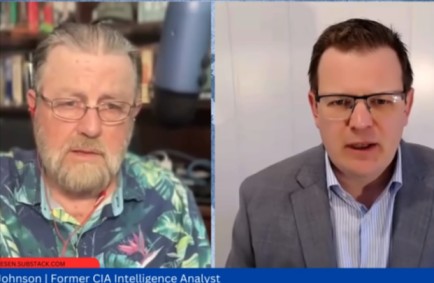
Editor’s Notes: In this episode, Glenn Diesen is joined by former CIA analyst Larry Johnson to discuss the escalating military tensions between the U.S. and Iran following reports of downed U.S. aircraft. The conversation delves into President Trump’s recent ultimatum to Iran, the strategic implications of the closing of the Strait of Hormuz, and the potential for a wider regional conflict. Johnson also analyzes the political purges within the U.S. military leadership and the devastating economic ramifications that a prolonged war could have on global energy markets and supply chains. (April 6, 2026)
TRANSCRIPT:
Introduction
GLENN DIESEN: Welcome back. We are joined again by Larry Johnson, former CIA analyst and author at Sonar 21. And again, a great place for information. So I will leave a link to Sonar 21 in the description. So thanks again, Larry, for coming back on the program.
LARRY JOHNSON: Hey, boy, I wish we had other things to talk about, such as great vacation spots in the world or wonderful cuisine to cook on Easter Sunday, something like that. Good God, we’re in the midst of madness.
Trump’s Ultimatum to Iran
GLENN DIESEN: Yeah, we were just talking before we started recording here that Trump may have lost his mind. I mean, I often make the point, I was the one who was one of the people who were excited or optimistic about his reelection. I kind of bought into the whole peace ticket and ending the Ukraine war, ending the forever wars. I mean, he was bringing on Tulsi Gabbard, I thought it was a good reason to be optimistic, as the alternative was essentially more Washington, more war.
But yeah, I guess it doesn’t matter who you vote for, but except Trump appears to be— yeah, the rhetoric, it’s quite concerning. He just gave an announcement saying that Iran has until Tuesday to make a deal, and then, and this is a direct quote, otherwise, “I am blowing up everything.” I mean, it’s—
LARRY JOHNSON: Read the rest of it too. I mean, the language that he used was just unbelievable. Let me see if I can find it and get the quote exactly right. He said, “Tuesday will be power plant day and bridge day all wrapped up in one Iran. There will be nothing like it.” And then, “open the f*ing strait, you crazy bastards, or you’ll be living in hell. Just watch. Praise be to Allah. President Donald J. Trump.”
I mean, people, I woke up to this this morning, went, what in the— I mean, this is crazy territory. This is madness of King George. I mean, it’s like that scene. There was a movie with George Clooney years ago, and I forget the name of the actor who played this lawyer who was representing this young woman who had been violated by a pharmaceutical company. And in the midst of the deposition, the lawyer starts taking off all of his clothes and screaming and ranting. That’s what Donald Trump just did here. He might as well have just taken off his clothes and run around the White House outside naked.
The time for the 25th Amendment to be enacted has come. Trump’s cabinet, they need to say, okay, let’s get him into a nice white coat that the arms wrap around the back. He can give himself a big hug. And walk him out of the White House. He has completely gone off the rails.
Trump’s Maximum Pressure Strategy and Its Consequences
GLENN DIESEN: Well, I guess this was always a risk of the Trump presidency, that this whole strategy was always the same, that is, do maximum pressure and then get a deal. Well, his maximum pressure on Iran was war, and now he doesn’t know how to get out of this. And I think this is why the panic has set in, because he can’t stay. I mean, this is going to result in disaster. And also, he can’t leave because without the Strait of Hormuz, the whole region would be reshaped to Iran’s advantage, and it would be also the end of his presidency. So he really got himself trapped in this, and it should have been predictable, I think.
I mean, there was no real justification for this war. It’s a low chance of success and of course extremely high risk, especially linked to the lack of an exit strategy. Again, very similar to a lot of these forever wars. But how do you see things going with the ramp-up? I mean, I can see that he’s going to blow up everything that’s possible. He might even go for Karg Island. I mean, Iran’s retaliation goes against the Gulf states, not directly against the US. It might be a price he’s willing to pay. It’s a bit like with the Europeans, they’re willing to fight to the last Ukrainian. He might be willing to do the same with the Gulf states.
But over the past few days, what do we make of the planes being shot down, the rescue missions? What is your takeaway from this? Because the skies were supposed to be unimpeded, they were supposed to have air dominance. That’s what he told everyone.
U.S. Military Losses and the Failed Rescue Mission
LARRY JOHNSON: So let’s differentiate between what Trump wants to do and what the US military can do and what the US military is willing to do. I think those are three different areas.
The chess pieces prior to Friday morning in Iran were all lined up for a US ground operation. It may have involved something such as — I guess they had found an airfield, an unused airfield that was about 200 miles in Iran, 100 miles plus inside the Iranian border, that was near Natanz, so that they would go in there, land, and then helicopters would be refueled at that site and then would continue on with special operations forces to hit Natanz and try to take control of enriched uranium that they believe might be there.
But I think as sort of preparation for that operation, that’s where this F-15 gets shot down. Now all of a sudden, boom, the entire plan starts to fall apart, or it has to be delayed.
One of the guys I worked with for years, he was the last colonel to command AFSOC, Air Force Special Operations Command that was located up at Hurlburt Airfield in the armpit of Florida. And he was involved in Vietnam in what they call CSAR, combat search and rescue missions. A lot of what happened in those — a pilot would get shot down and you’d send out 2 or 3 different aircraft back then, 2 or 3 different helicopters and such to try to affect a rescue. And more often than not, some of the rescuers get shot down. And so instead of losing just one person, you end up losing 6, 10 more.
Well, that’s exactly what happened on Friday. Now, the Pentagon’s saying nobody else was killed. I personally think they’re lying because there was one video that looked to be a C-130 Hercules that was hit in the air, caught on fire, and the fire could be explained because that C-130 also carries a load of fuel that can be used to refuel helicopters. But it crashed and exploded.
But what we do know is that even according to the Pentagon, in addition to the F-15, an A-10 Warthog was shot down, pilot got out. Looks like they lost an F-16. They lost at least 2 Black Hawk helicopters, or advanced ones — they’re called Pave Hawks. They lost 2 of those. And then they admit they lost 2 C-130s that were on the ground and stuck. And so the Pentagon claims we blew them up. Again, I think those two may have been even connected with that operation.
But when you sit down to try to rescue one pilot, we lost at least five other types of aircraft — airframes, fixed wing and rotary wing. If you had that many losses, just one, and they were consumed — the US command headquarters at MacDill Air Force Base, the CENTCOM headquarters, the combined air operations center there, I think it’s still up and functioning at Al Udeid Air Force Base in Qatar and other locations — were just all hands on deck trying to find and locate that pilot because they didn’t want him to be captured by Iran.
So this was more about the political optics — we can’t have Iran celebrating the capture of a US prisoner. But in the course of it, we lost close to half a billion dollars in aircraft, something like that, between all the different aircraft that went down just to save one guy. This is the absurdity of it.
Iran’s Air Defense Capabilities and U.S. Planning Challenges
LARRY JOHNSON: So if their plan is to put more aircraft into Iran now that they know that Iran’s air defense is active — they have a loitering missile, rocket, call it what you will. They launch it and then it’s like a glider who just sort of hovers around until it hones in on a target and then boom. And it’s not readily detected by conventional means that US aircraft use to detect threats. So now they’ve got to take that into account.
So Trump wants to launch a ground operation. I don’t know whether it is to take Karg Island alone or take Karg Island and then hit Natanz or Bushehr, one of the nuclear power plants, with a special operations raid, maybe try to hit an underground missile factory in Kashemayeh. I don’t know if it’s one or all three, how ambitious it is. But he wants to do it.
The military, I think right now, based upon the losses that they incurred on Friday, are stepping back and saying, I’m not sure we can do this. Because as part of their planning, they’ve got to assume, okay, we’re going to lose 10%, 20% of our airframes. Do we have enough CSAR — combat search and rescue crews — available to carry out that kind of mission if it unfolds? And I’d say the answer there would be no. It would be almost a nightmare of how many aircraft we’d have to put into the area, and that again would be vulnerable to getting more shot down.
And then there’s a question of, are the senior officers willing to do this? And I think there’s growing doubts on that front. The early optimism and enthusiasm that accompanied this mission when we launched the attack on February 28th — that’s gone. The sort of excitement that fueled particularly the younger guys, the lieutenants and captains who have never really experienced anything like this — they’re all jazzed up. Yeah, man, we get to go to war. And now all of a sudden the reality of war is starting to hit home.
And we don’t know how many were killed. Again, in this attempt to rescue this pilot, I believe that there were probably at least 6 people killed and then several wounded, maybe more than 10 wounded. So it’s a pretty heavy price to pay for rescuing one pilot.
The Debate Over Combat Pilots in Modern Warfare
LARRY JOHNSON: And it gets back to this — this is now the debate, goes back to the debate of our combat pilots, the Tom Cruise Top Gun model. Does that even make sense anymore given the technological advances that have taken place and the capabilities to do remotely piloted aircraft where you don’t actually — you could fly an F-35 remotely. You don’t need a pilot in that. In fact, if you don’t have a pilot in that, that plane can actually do more performance-wise without a pilot because a significant expense in these combat aircraft is to build in life support systems because a human body can only stand so much G-force.
I don’t know what the point is where it basically shuts down the blood and the body — you just can’t survive it. Whereas the aircraft without a human being, man, it can do a lot of maneuvering. And that’s not just the US, that applies to the Russians and Chinese.
But here we got this system — it’s still an anachronism of the 20th century. If you go down, we’re going to come save you. And it’s an honorable thing. Listen, the PJs, the parachute — the Air Force pararescuers — they are terrific. They are an incredible lot. The pilots that are flying, particularly I think there was a lot of Task Force 160 pilots engaged in this — a lot of very brave, capable people being asked to do something incredibly stupid.
Purging U.S. Military Generals
GLENN DIESEN: Maybe something good can come out of this, though. I mean, when the US had the success against Venezuela, it fueled this hubris which led to that attack on Iran. Maybe some humbling is good before the US starts a war with Russia or China, which might end the world.
So that being said, of course, this is already spiraling very quickly out of control. And as you said, the optimism is largely gone, which means either one can adjust to these realities or one can restock the chairs on the Titanic. And it appears that that might be something being done.
I’m not sure how you read this current purging of US generals. I saw a hearing with Pete Hegseth where he was asked, how many do you know how many you fired? And he didn’t know — apparently it was 8. And then he was asked why, what was the reason for it? And he more or less didn’t answer this. So what do you make of this? Because it is an interesting time to begin to purge your military leadership. I’m not sure if it’s related to a ground war or — yeah, actually, I don’t think it is.
Political Purge and Military Leadership
LARRY JOHNSON: I’ve been fortunate to have a conversation with a friend of mine who’s a— he was a retired— he was a senior officer in the Joint Special Operations Command arena. And so, what he shared with me, let me just read this.
He says that George, Randy George, the general who’s the chief of staff of the Army, and Hodney were glorified administrative clerks, nothing else. They’re not warfighters at all. Zero real influence in Iran. Both are big-time military-industrial corporation supporters. Both are Obama-Biden appointees. Both are responsible for force development and new weapons fielding since the Ukraine and adversary wars. Complete failure over 4 years. The best they could do is say it is possible to shorten off-the-shelf and new technology for drone warfare in 3 years.
Well, he said, but basically none of these guys that were fired, the chaplain, Hodney, and Randy George, they’re not at all in the chain of command for operational decisions relative to the war in Iran. They’re not in a position to be asked to deploy forces to support an operation. Now, that doesn’t mean that they did not voice a strong disapproval. That’s possible. But I would feel more comfortable reaching that judgment if, since they resigned or have given up their jobs, that one of them would have come out and spoken out.
Instead, I think more of what we’re seeing with this is it’s a political purge. Hegseth and Trump, they’re going after minorities. They’re going after Black women, Black men. I mean, it really comes off as a racist tent. They’re assuming that these people had these positions because of DEI. Maybe they did, maybe they didn’t, but what this continues is a trend that started really in earnest under Barack Obama of politicization of the senior military ranks, that you want people that are loyal to the president.
But when they take it, their oath is sworn to uphold, protect, and defend the Constitution. Not the political career of Barack Obama, Joe Biden, or Donald Trump. But instead, that’s what it’s become. We saw it back under Obama when they went after General Stanley McChrystal. And the irony there is McChrystal is just a, he’s sort of a dyed-in-the-wool Democrat. He’s very supportive of the kind of policies that Obama was pursuing. But he got accused of having said something unkind about Obama.
So this is when you start changing military leadership because, number one, the military leaders shouldn’t be out in public making any kind of public statement about policy. Their job is to come up with and lay out military strategy and advise the president on what appropriate courses of action are. But if given an order to do something that they feel is wrong, immoral, illegal, resign. Resign in protest. You can do that. But none have done that over the years.
And so what we’ve got is sort of the creation of a Praetorian Guard where you get rid of the old guard that was loyal to Joe Biden and you bring in new guys who are going to be loyal to Donald Trump. And I don’t want anybody in leadership who’s loyal to one guy or the other. I want someone who’s going to uphold the damn Constitution. So what we’re seeing going on here is more of a political purge. I think it’s not directly connected to the war.
The Strait of Hormuz and Iran’s Position
GLENN DIESEN: Okay, well, I guess that’s good, to some extent. Well, you mentioned the problem with the United States, directly with Iran, that is, it can’t leave without the Strait of Hormuz open. He can’t open it by force. So Trump is left with now threatening to destroy the country, bring it back to the Stone Age, or blow up everything in his words, unless they do as they want.
But as the foreign minister of Iran said, humbling or disciplining America, it’s something they won’t have an opportunity to do again. They can rebuild the bridges and everything. But also, I think the leading concern for them is that if this can be seen as a success for the US, then the US will be back to finish the job later. So the US is in a dire strait. Of course, the Iranians are suffering greatly too.
But what do we know about the Israelis here though? Because there’s very tight control on information coming out. They put a lot of restrictions and the Western countries, at least their media, very obediently follow this. But still sometimes we see some pictures coming out and they’re not untouched either.
LARRY JOHNSON: Yeah, they’re taking serious damage. Yeah.
GLENN DIESEN: Well, what do we know?
Israel Under Fire
LARRY JOHNSON: We know that Iran has been targeting now their oil refinery. They’ve essentially shut down the port at Haifa. Jerusalem and Tel Aviv. They have hit targets in and around Dimona, the nuclear reactor, the site where most folks believe they keep their nuclear weapons.
And then, before we came on air, I just got another heads up from somebody who follows this that apparently an Iranian missile just hit a major building in Haifa, and that building has collapsed. And apparently there were some key Israeli military political figures in that building.
So Israel’s going out of its way to try to pretend that nothing’s happening. But what information does come out, you’re beginning to see videos where they go into the subways in Tel Aviv, and people have actually set up tents on the subway platforms because they’re spending so much time in these bomb shelters that they don’t have time to live above ground very easily.
And it’s that Israel, by virtue of its size, it’s a very small country. And population-wise, it doesn’t have a lot. They’ve now run into grave difficulty with their offensive in southern Lebanon. The Hezbollah is inflicting tremendous losses on them, both in terms of machinery as well as personnel. And Hezbollah now has FPV drones that are fiber optic. So they can’t, they’re not subject to the normal detection and interference of conventional drones. They didn’t have that back in 2006.
So on top of RPGs and other systems, it wouldn’t surprise me that they’ve got some advanced US equipment courtesy of the Ukrainians. The weapons that have been stolen out of the largesse of the US have made their way into the hands of Hezbollah.
Israel’s Manpower Crisis and Strategic Miscalculations
GLENN DIESEN: Yeah, I think the troop levels in Israel is really their Achilles heel for them because they’re not— there’s no lack of political will, it seems, and they get a lot of weapons which they need, but it’s mobilizing the required troops. I’ve seen some comments from the head of IDF as well saying that the IDF could collapse on itself if they don’t resolve the manpower issue.
So given this, it’s a bit strange they choose now to discuss occupying Lebanon, given that this will require a lot of troops. But beyond this though, I’ve also heard now that all these claims by Joe Kent, at least, that Israel is deliberately attacking and killing the people who will negotiate on the Iranian side with the United States. This is— well, I’m just wondering, how do you make sense of this?
Because the more the US is humiliated in this war, and again, the longer it goes on, the more the US will be humiliated. This will have a backlash within the US. I mean, that is the people rising up saying, why do we allow the Israelis to pull us into these wars? And it just seems like this isn’t really in Israel’s interest to put the US in such a vulnerable position. So how do you make sense of this?
Extremist Ideology and the Israeli Reserve Army
LARRY JOHNSON: Yeah, well, there was no thought given to a strategy and then coming up with a plan to implement said strategy. It’s more like feelings, it’s emotion. Israel is guided by this extremist Zionist mentality right now. Now, Bibi Netanyahu’s not really a believer. He’s just going along with it because it’s politically convenient at this time.
But the people like the Ben-Gavirs and the Bezalel Smotrich, they are true believers on this and they believe in fact what they’re trying to do is create the conditions in which it will put the Jewish people in danger of being exterminated so that the Messiah will return. I mean, it is this insane, ridiculous theological crap, but they really believe it. So they are trying their best to manufacture Armageddon in order that the Messiah will come to save them, and then saving them will destroy all the Amalek, finish the destruction of the evil Gentiles, get rid of those Christians and Muslims. That’s really what it’s all about in their mind.
So we can’t dismiss that as a factor. We can’t ignore it and pretend that it doesn’t matter. It absolutely does matter.
But then you confront the reality. And as you pointed out, the Israeli military, it’s a reserve army. And it really was modeled after, if you will, a little bit after the Soviet army in some aspects, because the Soviets never had the concept of a strong noncommissioned officer corps. And when we’re talking noncommissioned officers, we’re talking basically sergeants, whether it’s a staff sergeant, sergeant major, senior enlisted personnel who’ve been in the Army for 10 years or more. And by virtue of being at that longevity, they learned a thing or two about how to survive both bureaucratically and in combat if necessary.
And what happens is when new officers come in, you’ve got a lieutenant who shows up who’s like 22 years old, just got out of West Point, graduated college. They don’t know anything. And that’s where they start to get indoctrinated. And they’re usually with a company like in the US Army with a staff sergeant who’s 30 years old. So this 22-year-old is accompanied by a 32-year-old man, and if that young officer is smart, they’ll listen to what the 30-year-old has to say.
Well, in the Israeli Army, you get a 22-year-old captain and a 22-year-old staff sergeant. I mean, you get people that at their ages, they haven’t even really had the experience. It’s more like a political promotion. And so that’s what the Israeli army lacks. That’s why they are so poorly disciplined. That’s why they are terrible with their tactics in the field, because they’re led by people that don’t know what the hell they’re doing. And we’ve seen this over and over and over throughout the years.
Now the talk of trying to— they had activated 300,000 reservists for the war in Gaza, and they haven’t won that. They haven’t defeated Hamas after now 2 and a half years. And now they’re talking about the need to call up an additional 400,000 reservists. I don’t think they have that many people that would actually do it.
I mean, the total population of Israel right now is reportedly around 10 million. It may have been reduced with people leaving the country. But even with 10 million, when you’re talking roughly calling up 10% of your total population, that’s almost the entirety of men and women between the ages of 18 and 40. It doesn’t work because that’s supposed to be sort of the heart and soul of your workforce too. So if they’re getting pulled out, who’s left there to try to carry on what minimal economic activity is occurring?
Iran’s Strategy and the Escalation Ladder
GLENN DIESEN: Well, the US has trapped itself. Israelis are exhausting themselves. What do we know about the direction Iran is taking? That is the second economy now and the overall strategy of the Iranians. Because, well, on one hand, it looks like one of the things which are really notable is how Iran is just following the US up this escalation ladder. That is, whatever the US does, Iran shows they can do the same.
And I guess this is the biggest deterrent, that is, it’s very predictable. And one of the reasons I think Trump hasn’t yet burned down all of Iran, as he now threatens to do on Tuesday, is exactly because they can do the same against America’s allies. But what do you see being their wider strategy? Is it just to force the US to leave without the Strait of Hormuz, or how do you see this?
Iran’s Strategy: Economic Control of the Persian Gulf
LARRY JOHNSON: Yeah, no, I think Iran’s now ultimate strategy, and one I believe that both the Russians and Chinese endorse, is breaking the US control and influence in the Persian Gulf. That so many of the Gulf Arabs, particularly the Emiratis, Qataris, Kuwaitis, Saudis, and Bahrainis, they’ve been dependent upon the United States, and the US in turn has been dependent upon them.
So especially with the Saudis and the Emiratis buying a large number of US, they have a fairly significant control over a number of US Treasury bills. Trump was always seeing them as sort of, because they’re accepting payment for oil in dollars. And so this Persian Gulf oil became an important source for money flowing into the US coffers, trying to help keep our economy afloat.
But, you know, Trump, one, Iran’s strategy, I think, is twofold. Show these countries that there is a serious physical economic cost to being friends with the United States and allowing the United States to conduct military operations from your territory. The Saudis, Kuwaitis in particular, Bahrain, they’ve paid a heavy price on that, Emirates as well. So that’s number one.
Number two, maintain control of the Strait of Hormuz so that you will economically squeeze those countries to the point that they’re going to have to make a deal with Iran, not just Iran, but also now Oman, because Iran is also shrewdly working with Oman to say, “Okay, hey, let’s basically create a cover charge. You want to come into the Persian Gulf? Got to pay a cover charge. You want to sell anything in and out.”
But to that end, Iran right now says, “We’re not going to let anything go out that’s going to benefit the United States or Europe. Anybody that’s aligned with Israel and supporting Israel’s attack on us, they’re not getting a dime out of here, including the governments.”
There are serious concerns about food supply in the United Arab Emirates. It may, the situation may not be as dire because so many people that lived there previously have left. So you’ve got a substantial reduction in the number of people needing to be fed in the Emirates. Same applies to Qatar and Kuwait, Kuwait and Bahrain, any expatriates living there that they bailed out.
The US bases that used to be in Bahrain destroyed. They’re in the process, Iran is in the process of destroying what remains of the presence in Kuwait. Same in Saudi Arabia. The Prince Saud Air Base has been repeatedly struck and a number of aircraft, the pictures are emerging showing CH-47s. That’s the big helicopter that’s got like two big propellers at either end. At least one of those has been destroyed, if not more, in Kuwait on the ground.
So Iran’s strategy is to take control of the Gulf, take control of the oil, liquid natural gas, anything else, and the fertilizer coming out of that, that because of the world’s need for that, they’ll be able to get control over who gets in, who gets out. And candidly, there’s nothing the United States could do about that.
And China, some think that China, because China has investments in the UAE and in some of these countries, that’s true. But what has happened now with the Iran has shifted the game so that people that want to come out, they got to pay for the fee in yuan, not in dollars. So it’s actually strengthening the Chinese financial sector. And we just saw yesterday, day before yesterday, that the Deutsche Bank has now started to offer Chinese bonds in lieu of US Treasuries. So China is now beginning to forge some economic relationships with the West that actually are detrimental as far as the United States is concerned.
So I think that’s what Iran is seeing as part of this strategy, that cut off, get the United States out of the Persian Gulf, shift the Gulf to where it’s going to benefit China and Russia, and Iran sees itself as a critical future partner with both Iran and Russia in economic growth. So I think that’s sort of the broader strategy here.
The Economic Dimension of the War
GLENN DIESEN: Yeah, the economic war, I think that’s a bit overlooked and an interesting component of this whole thing because in most wars there’s always a strong economic incentive. That is, we always see when the US goes to war, the oil companies, the stock value goes up, the weapons manufacturers go up. We see also economic benefits. That is, for example, the war with the proxy war against Russia. As the war goes on, the Europeans of course become even more dependent on the US. They’re willing to sign horrible trade deals. They buy the weapons from the US. The Ukrainians can be stripped of their natural resources. There’s a lot that can be done to pursue economic benefits in the time of war.
But with the Iranians though, they appear to have really gone directly at the throat here. That is, going after the economic benefit of this whole war, not just by shutting down the Strait of Hormuz, but now as we see, selling the oil in yuan. This is already being done. It’s quite extraordinary. And there’s not much that can be done. I mean, except for completely destroying Iran and hoping that mass brutality will compel it to take the knee and do whatever America says. But it’s very hard to imagine this as well.
So yeah, it begs the question of where exactly is this going? Because on Tuesday, Trump will either need to back down in a very humiliating way, or he will burn down the entire Middle East. So it’s hard to say. Which one will it be?
The Cascading Economic Costs for Americans
LARRY JOHNSON: Well, we do, there is room for confusion on that because we know in the past where Trump made similarly dire threats against Hamas. “If you don’t release the hostages by Saturday, there will be all hell’s going to be brought down on you.” And nothing happened. So I’m hoping that this is actually the course of action, the outcome here, that he’s just blowing smoke, blowing steam.
If he does decide to go after, try to destroy Iran’s oil, the ability to export oil, he is then compounding the economic pain that the US citizens are already suffering. The price of gas going up is accelerating, not decelerating. Here in Florida, on February 27th, we were paying $2.54 a gallon. As of a week ago, it was $3.64 a gallon. So it had gone up $1.10. And then yesterday when I went to fill up again, it’s gone up another 30 cents. So it’s now actually up to $3.95. It’s going to break $4 very soon.
And I know there are some places in the world people say, “Oh, that’s cheap.” But I’m telling you, this is Florida, which is used to relatively inexpensive gas. That’s happening across the country. In fact, there are some places here in Florida, they ran out of gas. There was no more to be had.
So the unhappiness among the Americans over the economic costs that are accompanying this war, and what they don’t understand is, let’s assume that under the magical thinking in this world, that the Iranians on Tuesday say, “Okay, we give up. The straits wide open, anything can come in and out. We’re sorry.” Okay. The damage that’s been done to the production facilities in the United Arab Emirates, in Saudi Arabia, in Kuwait, in Bahrain are significant. So it’s not just a matter of going back on and turning on a faucet and the oil starts flowing. There’s going to have to be some significant repairs and that could take months, or in the case of like the aluminum smelter, years, just years to get some of that back online.
So, and then even if the flow of oil starts, those ships right now, the ships that are on the sea, they’re charging $140 a barrel for that oil that’s out there on the sea right now. The oil future for Brent is lower. It’s like $111 per barrel. But that, because they’re betting in the future that this price surge is going to end. So that $140 a barrel right now, it’s going to probably go up to $200. And so the cascading effects of this kind of boost in the fuel is enormous.
The Impact on International Air Travel
And then we start getting into the complications of what has this war done to international air travel. So there are a number of airlines that may very well go bankrupt because number one, they’re faced with higher fuel costs, they’re going to have to pay, they’re going to have to boost the prices of tickets for passengers. Qatar Air, they used to fly regularly in and out of Doha, not doing that right now. Similarly for Emirati Air. God, and that is a great airline, I got to tell you. I’ve flown on that before. Fly business class, it’s luxurious. But they’re not doing too much.
And so that has put an end to those kinds of flights. The European airlines that used to fly to China, now how the hell do they get there? Because they can’t fly, they don’t fly across Russia because of sanctions. So what this has opened up to is a whole other economic window for China. Chinese airline, man, they fly direct to Europe. You want to get to Paris or Rome, go out of Beijing, Shanghai, because they fly directly across Russia. They don’t have to worry about sanctions. So they can now, the Chinese now can fly places that US and European airlines can’t.
So we haven’t even seen that shake out. That’s why I say there are so many layers and levels in the economics of this that even financial analysts really aren’t paying much attention to it yet. I don’t know if Iran understood that at the outset when they closed down the Strait of Hormuz, but if they didn’t then, I’m pretty sure now they’ve got a pretty good grasp on it.
Europe’s Energy Dilemma and the Wider Ramifications
GLENN DIESEN: Yeah, well, once you shut down the Middle East and as well as having no transit through Russia, there’s not that many ways the European flights can get to Asia. I mean, you can go through Turkey, that little thin corridor, but it’s still pretty narrow.
And I know British Airways, they said that it was unfair, the competition, the competitiveness of China, because, let me cry crocodile tears. I thought that as well. I mean, nobody told you to stop flying through Russian territory. You’re the one that put the sanctions on. Yeah. But again, if you fly Chinese Airways, then you can fly from Beijing to London, but the British can’t operate the same flights because they have to go all the way around Russia. It’s much more expensive, that’s longer time, that’s more fuel cost, and overall they can’t compete with the Chinese. And it just has a lot of levels to it.
But just as a last question, what do you see as being the wider ramifications here? Well, for example, the Europeans, they seem very much locked into the sanctions. They won’t walk away from it. But I saw now that in an interview, the former Prime Minister of Italy, Romano Prodi, he was also the former EU Commission President. I actually had an opportunity to meet him once in Kazakhstan. Interesting, like one of the good leaders in Europe before, this class of horrible political leaders took over.
He was making the point that Europe will yet again begin to restore the importation of Russian gas and oil, but it will do so when the Americans come in, take over some of these assets, the pipeline infrastructure, whatever it is. And once it’s under American control, then the Russian gas will begin to flow again. And I think it’s a very good prediction. And so you can kind of see what’s happening, that the Russian gas will yet again come to Europe, but it will have to be under American administration.
The Europeans, if they just do something to do it today, if they do it today, then they can salvage their economies, they can prevent this deindustrialization, at least slow it down. They can be in control of their own energy infrastructure, but they know it. If they don’t, they know what they’re going to end up with. That is, they will lose their economic autonomy. But yes, there’s no course correction. It’s very predictable the direction we’re going, yet nothing will be done.
How do you see, though, the wider ramifications of what’s happening in Iran? Because you said it’s not just the energy. It’s the air travel. Well, it hits all sectors now.
The Road Ahead: Economic Fallout and the Risk of World War
LARRY JOHNSON: Yeah. I think that the Europeans are having a Thelma and Louise moment. They don’t realize it. And that I’m referencing the movie where Thelma and Louise, they drove off the cliff and they’re in midair and nothing usually good comes of the landing. But the Europeans right now are pretending like they’re still on the road. That they’ve still got a— that they’re traveling the highway with a destination and it’s just now a matter of choosing which route to go. That, oh, we don’t have anything to really worry about. Yeah, we got some minor problems here, but those can be adjusted. No, they’ve driven off the cliff. They just don’t realize it. The crash is coming.
They’re not producing enough of their own fuel, oil, petroleum, petrochemical products to survive. They’re dependent upon a large portion that comes out of the Persian Gulf. Well, that’s not coming. They are paying much higher prices now for oil and natural gas from the United States. They could have had cheaper from Russia at one point, but even Russia’s now playing hardball.
You saw Japan talk. You know, I wonder what the Japanese word for chutzpah is, you know, the Yiddish word for, you know, being pretty ballsy and asking for something. But the Japanese went to the Russians and said, okay, you know, those sanctions where we wouldn’t buy oil from, we’ll buy now, but we want to buy at the sanctioned price at $47 a barrel. And the Russians went, niet. Yeah, no, no, no, that’s not happening. If you want to buy, you’re going to pay the market price. And the Japanese are like, oh, well, we need some gas and can we come talk to you about it? And the Russians basically said, if you’re coming to talk about a sanctioned price, I tell you what, you lift all sanctions. If you’re going to keep sanctions on us, we’re not selling you a damn drop of oil. So you figure it out.
So from that standpoint, Russia’s in the driver’s seat in this in a big way that they can now push back against these countries that want to keep sanctions, but they’re going to have to have oil and natural gas. And when they discover that the United States, which, you know, what happens in, you know, 3, 4 weeks when the United States puts an embargo on any further shipments of oil and liquid natural gas overseas because we’ve got to have it for ourselves. All of a sudden, these people who are counting on this coming in, what do they do? The lights get turned off.
So that’s where I think a large number of people in Washington and in the European capitals are still in some denial. They believe their own nonsense about, oh, we’re winning this war against Iran. Iran is on the ropes. Any day now they’re going to collapse. And no, Iran’s— we’re now in the 6th week of this war. And I think this war could easily go on for another 3 to 4 months. And in the process, and they say, okay, well, at the end, Iran will be ruined. The world will be ruined. Okay? The world, the disruption of supply chains is going to take place. It’s going to lead to famine, hunger. I mean, this is, I don’t mean to sound so apocalyptic, but this is not a minor bump in the road. This is a major emergency, and the world still refuses to accept it as such.
And if Trump goes through with the threats that he made this morning, this is going to really spin this thing up into a new level and raise, in my view, the likelihood of an actual world war where other countries will be involved.
No Off-Ramp in Sight
GLENN DIESEN: Yeah, well, I have a hard time imagining us getting off this escalation elevator now. But what’s really required is usually what one has after great wars, that is the great powers, or large powers at least, sit down together, come up with an agreement. That is what we should be discussing now, have our leaders sit down, say, listen, the whole unipolar moment’s over, the whole idea of the political West, you know, dominating the world after the Cold War — this system has obviously come to an end. We have to negotiate something new. So the Russians, we’re not going to continue to expand NATO, we’re not going to continue to push our military infrastructure closer to your borders. The Iranians, we will recognize you’re a legitimate actor.
I mean, if it’s just that this is never done, you know, ahead of wars, it always comes after. And so it looks like they’re — yeah, there won’t be any off-ramp anytime soon. So, sadly, no positive note to finish on this time. But yeah, I share your pessimism though. There’s— even if the war will be over today, the economic ramifications now, they’re already, yeah, entering the system.
LARRY JOHNSON: So yeah, yeah, it’s going to be difficult. The only good news out of this — we’ll still have something to talk about next week.
GLENN DIESEN: Trump is keeping us busy. Oh my God. That’s one thing. Jesus. Okay. Well, thanks again. And yeah, have a lovely weekend, what remains of it.
LARRY JOHNSON: You too, Glenn. Enjoy your holiday spot. Try to work less. Get some rest and relaxation with the kids.
GLENN DIESEN: I’ll work on it.
Related Posts
- Transcript: World’s First AI Actress Interview on Piers Morgan Show: ft. Tom Conti, Tom Bilyeu & Prof Jiang
- In Vivo Podcast: w/ Cathy Tie and Prof. Jiang on Editing Embryos (Transcript)
- Transcript of Evy Poumpouras Interview: Read People, Spot Lies & More – FO563 Raj Shamani
- DOAC AI Emergency Debate: ft. Ed Zitron, Andrew McAfee, Nate Soares & Roman Yampolskiy (Transcript)
- Transcript of Norman Finkelstein Interview: Tucker Carlson Show