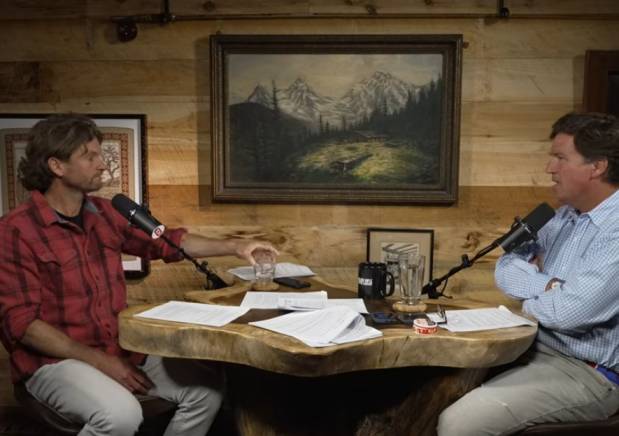
Editor’s Notes: In this episode, Tucker Carlson examines the complex relationship between Donald Trump and American Christians, questioning whether the former president remains a reliable protector of their values. He critiques recent rhetoric and policy decisions, specifically focusing on a controversial Easter weekend message and discussions regarding military action in Iran. Through a deep-dive into the intersection of faith, politics, and spiritual warfare, the episode serves as a warning about the potential manipulation of religious institutions for geopolitical gain. Carlson is joined by guest Nathan Apffel to further explore the theological implications of these current events and the necessity for believers to remain vigilant. (April 7, 2026)
TRANSCRIPT:
Tucker Carlson’s Easter Sunday Monologue: Faith, War, and the Soul of America
TUCKER CARLSON: Millions of American Christians voted for Donald Trump when he ran for president in the last election, and millions more Christians around the world rooted for him to win. Many still do root for Donald Trump. Now, why is that? Because of his personal piety? Well, of course not. Trump, to his credit, has never claimed to be personally pious, especially religious in any sense.
They voted for him and they still support him because he seemed like a protector. He seemed like someone who might save them from the growing and highly aggressive agnosticism, if not atheism, of, say, the technology class or the bureaucratic class. Godless nations, nations of other religions that oppose us. Donald Trump seemed like someone who would protect Christians from that, who was committed to the free exercise of religion in this country and who was also committed to ending abortion.
Whether or not he himself opposed abortion, whether he was pro-life in any meaningful sense, didn’t seem to matter. He would appoint justices that opposed abortion, that thought Roe v. Wade was unconstitutional. He did that. And that he would basically carry the flag for their issues and that he was sympathetic to them, and they supported him on that basis.
Can Christians Still Support Trump?
Can they still support him? That’s the question, and that’s a question Christians should have begun to ask themselves on January 4th of this year. And that was the day that the president announced the capture, the arrest of the president of Venezuela, Nicolás Maduro, who was no question an anti-American leader and a socialist, not someone most Americans liked or really had cause to like.
So the problem is not necessarily that Trump was against an anti-American leader. In fact, that was a benefit in the eyes of most of his voters. The problem was why we did it and why the president told us he did it, and that was for the oil. So in the days before that operation in early January, the president tweeted out, sent out on his Truth Social account, and also said in public, we’re doing this because we want the oil, because that oil belongs to the United States.
He never explained how exactly the United States would own the natural resources of a foreign country. Apparently American oil companies helped develop the oil fields in Venezuela, therefore we own the oil. That was the idea, and they stole it from us. But there was no real effort to explain how that works, how that makes any sense at all. Instead, you had the president of the United States say, we need the oil, oil’s really important. True and true. Therefore, we’re going to take it. And therefore, apparently we did.
In the days after that operation, the successful removal of the president of the country and the installation of his vice president, Delcy Rodriguez, as president, our president, Donald Trump, held a widely publicized on-camera meeting with the heads of American oil companies and talked through how we’re going to split up the natural resources of Venezuela. And why this is great for America.
The Moral Question of Theft
So why should Christians have paused at exactly that moment and asked, can I still support this? Is this what I voted for? Is this what I want? Is this acceptable? And the reason is really simple, because Trump at that moment revealed that the motive was taking something that we wanted, and that’s not acceptable for Christians. In fact, that’s not acceptable for Americans or any civilized people, because taking other people’s stuff by force cannot be allowed.
In fact, preventing that is the basis of our legal code. If there’s one thing that every person knows, that is, in a civilized country, you can’t steal without penalty. It’s not allowed. That doesn’t belong to you. You can’t shoplift. You can’t rob banks. You can’t embezzle. You can’t invade countries to steal their stuff because they’re all varieties of the same theme, which is theft. And theft is wrong. It’s wrong under the American legal code, but it’s also wrong under the Christian legal code. Theft is wrong, spelled out really clearly. It’s also intuitive. And here was the president saying, we’re just stealing this because we can.
Well, as a practical matter, that’s quite a thing to say out loud, given that we know from history that the things you do will be done unto you. Once you set a standard, you will have to live by that standard. Write a law, you’ll be judged by that law. So if the new law is, I can take it because I want it and I have more power than you, at some point we can rest assured the tables will be turned and the things that we want and cherish and have earned and that we own will be taken from us by force at the moment when some other power has more force than we do.
It’s really simple. Sometimes called the law of the jungle, and it may be the law of nature, but people don’t want to live under that law because it is a brutal and unforgiving law. So they create higher laws, or they appeal to the highest law of all, which is God’s law, which prohibits that.
So this was a profound moment in American history, probably in the history of the modern world.
And it’s at that point that a lot of people should have spoken up and said, I’m out. Not that I hate Trump or don’t like his entire program. Lots of things about it I love. I’m grateful. I’d maybe vote for him again, but I can’t support theft because it’s immoral. But they didn’t. Maybe some did, but certainly the leaders of the American Christian churches by and large said absolutely nothing.
The Bible and the Oath of Office
And maybe because they said nothing, this accelerated. These are the same people who sort of didn’t notice somehow that on Inauguration Day, the president did not take his oath of office with his hand on the Bible. His wife stood next to him holding it. I was about 15 feet away and saw it, but he did not put his hand on the Bible.
And that should have been maybe a clue that we need to pause and think about what is this. Why wouldn’t you put your hand on the Bible if you don’t believe in the Bible? You think it’s just a book. There’s no cost to you to putting your hand on it, just kind of following the protocol, going along with the tradition. All presidents do it. Why aren’t you doing it? And you’re not doing it intentionally. You’re choosing not to put your hand on the Bible when you take that oath.
That suggests not that you don’t believe it’s real, because if you didn’t believe it was real, why would you care? You’d put on the costume and take it off. Doesn’t matter. That suggests you know it is real and you’re rejecting it intentionally. You know what you’re doing and you’re doing it anyway. But pretty much nobody did ask questions about that either. I didn’t. I’ll admit that. I saw it and didn’t say one word. Bothered me ever since.
But right around January 4th, it became clear that maybe he didn’t put his hand on the Bible because he affirmatively rejects what’s inside that book. And what’s inside that book are limits on human behavior. Because if there’s one theme that spans all 66 books in the Christian Bible, it’s that you are not God and you cannot assume his powers because you don’t have them. You may convince yourself you have them, you may want them, you may have been promised them, but in the end, they’re not yours and you’ll never have them. And you can only destroy yourself and the people around you by pretending that you do.
That is the consistent message that spans from Genesis to Revelation. And people who ignore that law are punished, just like people who ignore gravity or freezing temperatures are punished, because these are laws that were not created by people. They supersede people.
But on January 4th, when the president of the United States told us he was stealing, that our country was stealing something that didn’t belong to us, people should have piped up and said something, but they didn’t.
The Easter Morning Tweet
And that got us all the way to yesterday, which was Easter Sunday. Easter Sunday is not just a holy day on the Christian calendar, it is the center of the Christian calendar, is the holiest day in Christian life, because the day that Christians remember the whole point of their religion, which is not that Jesus was killed, but that he rose from the dead, that he beat death, unique in history. And this is the day that Christians celebrate his resurrection.
And in this country, that celebration has been watered down effectively to candy and Easter bunnies. But globally, and certainly historically, Easter is the focus. It’s preceded by Holy Week and Lent, 40 days of self-denial and prayer, all leading up to yesterday, Easter morning. And for faithful Christians, it is still the biggest day of the year, and it’s a day of joy.
The thing every person fears most is death. We’re born fearing it because we’re born knowing it’s coming. And Christianity, unique among religions, promises victory over it. And Jesus’s resurrection is proof that God can beat death because only God creates life. And so the morning of Easter is a uniquely joyful and peaceful moment.
And yet that peace yesterday was shattered. That’s not an overstatement. It was shattered for many observant Christians by a statement that the President of the United States put out at 8:03 AM Eastern time on Easter morning that said this, and we’re going to read it in its entirety, not in outrage or self-righteousness, but honestly in horror.
“Tuesday will be power plant day and bridge day all wrapped up in one in Iran. There will be nothing like it!!! Open the f*ing Strait, you crazy bastards, or you’ll be living in hell. Just watch! PRAISE BE TO ALLAH, President Donald J. Trump.”
Now, a lot of people reading that imagined, of course, this can’t be real. Did the President of the United States really just write that? And it is real. It is maybe the most real thing this president has ever done, and also the most revealing on every level.
A War Crime Promised in Plain Sight
It is vile on every level. It begins with a promise to use the U.S. military, our military, to destroy civilian infrastructure in another country, which is to say to commit a war crime, a moral crime against the people of the country. Whose welfare, by the way, was one of the reasons we supposedly went into this war in the first place. They’re being killed by their government. We have to rescue them.
And now here’s our president, not even a month and a half into the conflict, which we are not winning, by the way, because the Straits of Hormuz are not open — there’s one way to keep track, that’s the measurement — saying that we’re going to use our military to kill the civilians of this country who didn’t choose the war. They got nothing to do with it. They’re like civilians everywhere.
Blow up their bridges. Bridges on military bases? No, no, just bridges. Bridges that people cross every day to go to school and work and to worship. And yes, church, because there are over a million Christians in Iran. This is their Easter too.
And power plants. Not the power plants attached to missile factories, but civilian power plants in a country of almost 100 million people. What happens when a modern country — and a country that has a nuclear program is a modern country, sorry, Iran is a modern country — what happens when it loses power? Well, people die. Babies connected to incubators die. People in hospitals die. And those are the first level effects. And then people begin to starve. And then you have refugee crises. People leave the cities looking for food. And yes, they move into other countries. In the region, in Europe, in the United States, you cause chaos and death, mass suffering and death when you do that.
And we have done that. We have intentionally bombed civilian infrastructure in Iran. It’s totally unacceptable, not under the phony laws of some international body, but under moral law, God’s law. Killing noncombatants, people who did nothing wrong, who didn’t choose this war, who were just people created by God. That is immoral. That will never be moral. That can never be justified. That is always wrong.
It can be expedient. We need to do this. It doesn’t mean that’s right. It’s the most wrong thing. And we should always remember that what we do will be done to us. Live by the destruction of civilian infrastructure, live by the killing of children, the bombing of elementary schools and colleges, and you will die and your children will die by those same things. That’s just a fact. That’s never not been true. We don’t want it to be true. It’s the last thing we want to be true, but it is nonetheless true. And everyone knows that on an animal level. You can feel that that’s true. Ooh, shouldn’t do that. You’ll be punished for it. In this life or the next, or maybe both.
For the president to say that and not bother to tell us, oh, it was an accident we did this — well, one, it makes you reassess the bombing of the girls’ school attached to the IRGC naval base where the children of Iranian military officers were incinerated in a bombing. Not one, but two. A double tap. Every person has assumed that was a mistake. No American could ever believe the US government would do that on purpose. I still don’t believe it. But after this, you have to kind of wonder, how did that happen? Was it bad targeting coordinates given to us, we hope, by Israel, another country? Maybe it wasn’t. Who knows at this point?
For the president to call for that, it’s worth stopping and saying, no, this is not acceptable under any circumstances. You haven’t justified it. You couldn’t justify it. And it can’t be done in our name.
The Logic of Escalation
And the point, of course, is to get the Iranians to open the Strait of Hormuz. Well, no sane person thinks that’s going to work, at which point you have to ask, why would we do it anyway? Well, there are a bunch of possible reasons, but the darkest of all is for the sake of doing it, for the sake of killing, for the sake of exercising the most obvious form of power, which is extinguishing life. That’s why we’re doing it. The thrill is in the killing. The power is in the killing. The exertion of force is the point. You don’t want to think that, but after a message like this, what could possibly be the reason? There’s nobody who thinks that if we do this, and we pray we don’t, for our sake as well as the sake of noncombatant innocent Iranians, nobody thinks this is going to work.
But then the tweet continues. Pardon me, the ironically named Truth continues. “There will be nothing like it. Open the f*ing strait.” How dare you speak that way on Easter morning to the country? Who do you think you are? You’re tweeting out the F-word on Easter morning? “You’ll be living in hell.” As if hell is a place. Hell is a condition, and this is an example of that condition. “Just watch. Praise be to Allah.”
So obviously you’re mocking the religion of Iran. If you seek a religious war, that’s a good idea. But by the way, no decent person mocks other people’s religions. You may have a problem with the theology — presumably you do if it’s not your religion — and you can explain what that is. But to mock other people’s faith is to mock the idea of faith itself, and we should never mock that, because at its core is the acknowledgment that we are not in charge of the universe. We did not build it. We won’t be here at the end of it. We can destroy life. We cannot create it because we are not God.
The message of all faith at the biggest picture level is the message in our Bible, which is you are not God, and only if you think you are do you talk this way.
But it’s not just mockery of Islam, and no president should mock Islam. That’s not your job. This is not a theocracy. We don’t go to war with other theocracies to find out which theocracy is more effective. We are not a theocracy. And God willing, we never will be, because theocracies corrupt the religion.
No, this is a mockery not just of Islam, it’s a mockery of Christianity. To send out a tweet with the F-word on Easter morning promising the murder of civilians and then saying praise be to Allah without explaining any of it, you are mocking me and every other Christian because we’re Christians. We can’t support that. Under no circumstances can we support that. Doesn’t mean you have to hate Trump or take the opposite position on every issue from Trump. You shouldn’t. A lot of his positions are the right positions, but you cannot support that. That is evil. That is an intentional desecration of beauty and truth, which is the definition of evil.
The Path Toward Nuclear War
And you have to ask,
Tucker’s Monologue: On Comparing Trump to Jesus
UNIDENTIFIED SPEAKER: Jesus taught us so many lessons through his death, burial, and resurrection. He showed us great leadership. Great transformation requires great sacrifice. And, Mr. President, no one has paid the price like you have paid the price. It almost cost you your life. You were betrayed and arrested and falsely accused. It’s a familiar pattern. That our Lord and Savior showed us. But it didn’t end there for him, and it didn’t end there for you.
TUCKER CARLSON: It’s hard to believe that’s real. That is so vile. It’s such a sacrilege standing in front of American flags in the White House with some kind of beta evangelical leader nodding along as you liken the president of the United States to Jesus, the Christian Messiah, God in human form.
How could you say something like that? How could the rest of us sit by and not protest when she said something like that? How could any Christian watch that and not feel revulsion?
Well, because people didn’t pay attention or they didn’t think about it. Oh, it’s just the praise that Trump demands. Fine. Not the first vain president, not the first vain leader, that’s for certain. But to compare him or any president to Jesus has got to be a deal killer. That is the end. You cannot allow that in good faith.
If you’re a Christian, you have to say no to that. Doesn’t matter whether you voted for Trump, campaigned for Trump across many states, defended him for 10 years, still like him. Doesn’t matter. You cannot compare a president, a secular president of the United States, or anybody, any human being, to Jesus.
Why? Well, because again, it is sacrilege prima facie, but because it distorts who Jesus is. It is a lie about Jesus. Did Jesus command the disciples to go out and kill people? Where in the New Testament is that?
Well, most people probably don’t even know because they don’t read it. Because their understanding of Christianity comes filtered through people like Paula White and Franklin Graham and many others of varying levels of good faith, or maybe entirely good faith, but they don’t read it themselves.
Kind of weird if you think about it. It’s a great story. You don’t have to believe in it to enjoy it, to learn from it, to love it actually. And if you’re a believer, you need to read it, and it’s not hard to read it, by the way. It’s on amazon.com.
Try this: New Living Translation, NLT. Just probably the most modern colloquial English translation of the Bible. Easiest to read. It’s great. It’s $4.30 on Amazon delivered to your house. NLT. Just read it. Just read the four gospels. You don’t have to believe it. What do you think of that?
What’s the picture that emerges? Matthew, Mark, Luke, and John. There’s four stories about Jesus from slightly different perspectives. Is the man that you read about, the Messiah you read about, recognizable as you listen to these people talk about him? Does he send his disciples out to kill?
Well, I’ll answer the question, having just read him. No, he sends them out to be killed. He says to them, go out, tell the truth, the world will hate you for it. Take no weapon, take no food, take no money, take no talking points. I’m not going to tell you what to say, just tell the truth. God will speak through you.
Totally unprepared. Doesn’t give them a map, doesn’t give them a plan of any kind, and he gives them no defense. And he says point blank again and again, you could be killed for this, probably will be. In fact, they all were. So far as we know, they were all killed. That’s the Christian message.
Now, you may think that’s absurd. Many have. Nietzsche was revolted by it. But that is what Jesus said. He did not say bomb the bridges and the hospitals and the power plants to, what, bring my kingdom? No, he said just the opposite. If you want to change the world, you cannot kill. It doesn’t work anyway. It never works. You have to be willing to be killed. You have to lay down your life. And that is the message.
You think God couldn’t come and throw the Romans out of Jerusalem? Oh yeah, of course. He chose the opposite. He chose to submit to them. Why? Because in that submission is victory over death. That’s the true victory. That’s the whole story right there.
And anyone who perverts that is doing a grave crime against the faith itself, and that actually matters. You can argue about all kinds of points of doctrine and transubstantiation and a million things you can argue about, and Christians have argued about them for 2,000 years. But you can’t argue that Jesus sends his people, God’s people, his disciples out to kill. He sends them to do the opposite thing, to die. And they do, and the world is transformed because they did. That’s the message.
And anyone preaching the opposite gospel of any Christian denomination is saying something vile and dangerous and should be called out for saying it, because the message is not of conquering, it’s of submission.
Put your hand on the Bible when you take that oath, because in doing that, you acknowledge, I am submitting to a law greater than myself. My own desire, my own whims, my will is not the final word. There is a limit to what you can do, and that limit is set not by you or any other person, but by God. That’s what that means. Submit.
There is time to fix this. There is time to prevent whatever is coming next, whether it’s the murder of civilians and children by air, or whether it’s something even worse than that. There is time to fix it. All is not lost.
But the first step — and this is also the first step toward faith — is submission. There are things I want to do that I will intentionally not do. I will submit to a law higher than my own desire. That’s the first step towards civilization, and it is the first and absolutely mandatory step toward averting the true disaster that is coming.
And we pray that the president will take that step and that those around him will take that step because everything hangs in the balance. And with that, here’s our conversation with Nathan Apfel.
Interview with Nathan Apffel: Who Is Paula White?
TUCKER CARLSON: So thank you for doing this.
NATHAN APFFEL: Yeah, thanks for having me. I think you will unravel many mysteries.
TUCKER CARLSON: I’d never heard of Paula White. I ran into Paula White for the first time, heard her name for the first time when I ran into her in person right outside the Oval Office last winter, right after the inauguration. And she introduced herself to me and said, “I’m the head of the Religious Liberty Commission,” or something. And I remember thinking, I’m so glad there is such a thing because we need it. We need religious liberty almost more than anything.
And I said — I felt moved to say, just like escaped from my lips — “Thank you. And I really hope that you will do something to protect the Christians of the Middle East, particularly in the Levant. There are a lot of great Christians there and they’re being hurt and nobody seems to care.” And she recoiled. I remember thinking, she doesn’t like this at all.
That was my first and only experience with Paula White. And so I’ve wondered ever since, who is Paula White and how did she become the president’s main spiritual advisor? You told me this morning that you went to church on Easter Sunday, which was yesterday, at her church. And so before you give us the overview, can you just describe what that was like?
Easter Sunday at Paula White’s Church
NATHAN APFFEL: It was an interesting experience. When you see Paula on stage next to Trump or you see any big evangelical leader, Kenneth Copeland, Franklin Graham, you’d expect their church to be massive.
TUCKER CARLSON: Yeah.
NATHAN APFFEL: Thousands and thousands of people.
TUCKER CARLSON: They’re pastors. They have a church. They’re pastoring people.
NATHAN APFFEL: Pastoring. They’re shepherds.
TUCKER CARLSON: Exactly. They’re the shepherd.
NATHAN APFFEL: Yeah. And so we pull up and I expected a very big building.
TUCKER CARLSON: Where is it?
NATHAN APFFEL: It is in Apopka — I think I’m saying it right — Florida. So just north of Orlando.
TUCKER CARLSON: Okay.
NATHAN APFFEL: And I’ve been to Joel Osteen’s church, thousands, tens of thousands of seats. I’ve been to Second Baptist, 93,000 members in that church. I know big church, right? It looked like one of those metal sheds, one of those big like 5,000 square foot, looked like an airplane hangar basically. And I was like, this is just awkward. The parking lot probably fit 50 cars. And so it was just an overflow in a dirt lot.
They just had a simple coffee maker, like a standard pot coffee for their entire congregation. And so I walked in, I counted about 400 chairs. And when I got there, which was the time the service started, there were 7 people sitting.
TUCKER CARLSON: On Easter Sunday?
NATHAN APFFEL: Easter Sunday. And so we walked in, they put us 2 rows from the stage. And ironically, Paula’s daughter-in-law approached me. I was there with my girlfriend and she approaches us and goes, “Who are you?” And I’m wearing a floral shirt, yellow sunglasses and an Alabama hat. Like, I try to be awkward in these situations.
And she comes straight up and she goes, “I’m Paula White’s daughter-in-law.” And I’m like, “I’m Nathan.” I don’t hide who I am. And she’s like, “Would you take a photo in front of our Easter display?” And I’m like, “Sure.” And so I walk over and Paula White’s daughter-in-law is taking a photo of me. And I’m like, okay. And I wouldn’t be surprised if it’s on their Instagram this morning because it was for their Instagram.
So we go and we sit down and it packs out to about 200 people on an Easter Sunday. One of the two biggest — Christmas and Easter, the two biggest holidays for Christianity. 200 people show up to this thing, mostly African-Americans. I was one of 6 white people. And then you got this white woman on stage, and that was the setting.
TUCKER CARLSON: That’s her church. Her church.
NATHAN APFFEL: Yeah. Well, don’t get me wrong, they got the lights and the fog machine and the jib arm that flies over the crowd. It’s a production studio is what I would call it. Production stage.
TUCKER CARLSON: So the point is not to minister to the people in the church, take care of their problems, counsel them, bring them closer to Jesus. The point is to produce a TV show. Is that what you’re saying?
A Production Stage, Not a Church
NATHAN APFFEL: That’s what I would say. Similar to Joel Osteen. He’s a TV producer by trade. Kenneth Copeland, same thing. When I went to Kenneth’s church, it was very small. Sat maybe 400 or 500 people, and it was a massive studio with multiple jib arms, multiple cameras, security, massive stage. I produce TV like they produce TV.
TUCKER CARLSON: Yeah, that’s fascinating. So did she preach?
NATHAN APFFEL: No, her son preached. So she got up and gave a little message in the morning, a little prayer. And there was a really weird dynamic between her and her son. And I’ve got their bylaws, which I think explain why.
But her son got up and gave honestly a really sound message. Like, I give a shout out to Brad. That dude knows the Bible. And it was very interesting to me because I saw him visibly wrestling with this idea of shepherding and then the idea of the institution. And there were times where he would look at his mom and just throw daggers at her about corruption, power. It was a very interesting dynamic. And she would belittle him too.
TUCKER CARLSON: During the service?
NATHAN APFFEL: Yeah, on Easter Sunday. And then she — once he finished the sermon, which, hey, Brad, great sermon until the very end, because then he’s like, “I don’t want to do an altar call, but I’m a charismatic, so I have to do an altar call.” And I’m like, well, you don’t have to do an altar call.
TUCKER CARLSON: What’s an altar call?
NATHAN APFFEL: It’s basically him saying, “Hey, if you’re not a Christian, come down to the stage. You’re going to say, Jesus is my Savior, I’m a sinner, and boom, you’re a Christian.” And that’s a relatively new technique in Christianity. 200 years ago, altar calls were not a thing. And so altar calls are just a kind of a new tool that churches use to read metrics, because at the end of the day, how are we performing? Oh, here’s how many salvations we’ve had and how many baptisms we’ve had.
And so he’s not for the altar call, but you can tell he’s wrestling with the institution that his mom gave him. And then after the altar call, she got up and I’ll quote her here. She goes, “I’m going to speak for 60 seconds.” She spoke for 8 and a half minutes. I have the recording. How to give her money.
TUCKER CARLSON: And she did an 8 and a half minute money pitch in church?
NATHAN APFFEL: Yeah.
TUCKER CARLSON: At the end, what did she say?
NATHAN APFFEL: She said she had an envelope and she goes, “My son moved me so much. In this envelope, I have a sacrificial gift for him in this church.” She didn’t tell us what it was or how much it was. And she goes, “If I could, I’d sell my house, but I can’t sell my home.”
TUCKER CARLSON: Why?
NATHAN APFFEL: I don’t know. I would ask her the same thing. And she goes, I have shoes and jewelry, but I can’t sell those. And so this is my sacrifice. And then she looked out and she goes, you guys need to sacrifice. She goes, that nice Easter dress you’re wearing, your sacrifice should be more than that dress. And she goes, Christ was the sacrifice and the offering and the tithe. But that doesn’t mean it stops with Christ.
TUCKER CARLSON: Oh, this is a hard sell.
NATHAN APFFEL: Hard sell. So you need to sacrifice.
TUCKER CARLSON: Jesus died, so send me money.
NATHAN APFFEL: Well, and then it was cute. She goes, oh, and we do so much for the community, which they do things for the community. She goes, we do a food pantry and we give away food. Well, you don’t pay for that food. That food is delivered to the church and then the church distributes it. So you’re raising money for a food pantry that you have, but you don’t have to buy the food.
And so it’s the carrot. I always say churches will use a carrot, or organizations will use a carrot to get you to give. And out of your gift, let’s say it’s 100 carrots that they get, and they’re going to use that one carrot to kind of dangle in front of your face.
Paula White: Pastoral Care and Background
TUCKER CARLSON: Did you get a sense that Paula White was leading, like, any kind of pastoral care? People have problems in churches as in everywhere else. And one of the main jobs of a pastor is to be the shepherd for that flock, right?
NATHAN APFFEL: It sounds like her daughter-in-law likes to do that. Charismatics are very charismatic, so she prays in tongues and they do all that. So they’re very into that. But Paula walked in after the service started. I saw her come in and she walked out before it ended, and she left.
TUCKER CARLSON: Actually?
NATHAN APFFEL: Oh, yeah, yeah. I wouldn’t say there’s any on-site shepherding that Paula does.
TUCKER CARLSON: So who is Paula White exactly? And pardon my ignorance, but it’s just she’s become this figure. She’s one of the people who prayed over the president and encouraged this war with Iran, a country with over a million Christians in it. But she has played a role in our foreign policy. And of course, she’s been used and has allowed herself to be used to justify this war and violence in the name of Jesus. So I think it’s worth asking, where does she come from? Who is this person?
NATHAN APFFEL: I don’t know her upbringing, but I’ll start with this. I will give Paula the benefit of the doubt that she came into the church space wanting to do good.
TUCKER CARLSON: Yes.
NATHAN APFFEL: She wanted to save souls. She wanted to preach the gospel. I believe that. But I also believe—
TUCKER CARLSON: I think that’s— we should always extend that benefit of the doubt to people.
NATHAN APFFEL: Okay. So when she’s presenting that gospel, she has to play in a certain legal realm, which is religious institutions, corporations in America. I firmly stand on my word that that legal architecture will corrupt anybody that goes into the mission or that ministry full-time.
So she started a church in Tampa called Without Walls with her husband Randy Knight. I went to the building Saturday because I wanted to see where that was. So I drove up to Tampa, and now it’s a bar. It’s like a restaurant bar. And so I went in—
TUCKER CARLSON: The church is a bar?
NATHAN APFFEL: Well, so I went in and talked to the restaurant. I’m like, hey, was this Paula White’s Church Without Walls? And the manager was like, yeah. She’s like, we get this question a lot actually, which is fascinating. So I don’t know the financial exchange or the real estate side of things, but the original Without Walls church was bulldozed and then that restaurant bar was built on the property.
TUCKER CARLSON: So she and her husband started a church in Tampa.
The Without Walls Church Scandal
NATHAN APFFEL: They started a church in Tampa called Without Walls. There’s some scandal wrapped around that church. They used to work, or they’re very loudly talking about how they work in prostitution. They help prostitutes, they help the needy in that area.
I talked with a past employee who said that, and we’re getting the tapes right now, we found some old VHS tapes from Paula back in the day. So those are actually just— they just arrived at my house, very excited to look at those.
But they said, oh, there’s a rundown hotel on the property next to us. We bought that hotel. We’re going to turn it into a rehab facility for prostitutes and drug addicts, and that’s going to be our main witness. Awesome. That’s right where I think Christ would be, is hanging out with the hurting, the needy, the prostitute, the widowed.
And so they started raising money for this hotel that they had built, and they raised— I don’t have the exact amount, but hundreds of thousands of dollars. And some of their congregants mortgaged their homes for it. Well, come to find out, they never even bought the hotel. This was just all theory and a good-intentioned idea. And so that really crippled the church.
And at the same time, her husband kind of fell off the wagon. And so they got divorced. And her spiritual advisor was T.D. Jakes. Do you know who T.D.
TUCKER CARLSON: Jakes is? Yes, I’ve met T.D.
NATHAN APFFEL: Jakes. So her spiritual advisor, famous black preacher, built like a linebacker. Yeah, huge. Yep. He was her spiritual advisor. He was also another pastor’s spiritual advisor in Opopka. And unfortunately, that pastor in Opopka OD’d in a bathtub.
TUCKER CARLSON: On drugs?
NATHAN APFFEL: On drugs, yeah. And he was with a prostitute. The prostitute made the call, the emergency call. He died. And so T.D. Jakes, as Without Walls is crumbling, T.D. Jakes is the spiritual advisor. Tells Paula to go take over this church in Opopka. So Paula White moves to Opopka, takes over that church, which they rebranded to StoryLife Church, and that became her home church.
How Paula White Became Trump’s Spiritual Advisor
TUCKER CARLSON: So I don’t want to judge her as a person. There’s a lot written about her personal life. I don’t know what is true and what is not true, so I don’t want to repeat it. But it’s kind of defined by personal scandal.
NATHAN APFFEL: Correct.
TUCKER CARLSON: True or not.
NATHAN APFFEL: There’s a lot of personal scandal that I won’t even go into.
TUCKER CARLSON: Well, of course, because I don’t know, and I don’t want to repeat things that are not true, but it’s sexual scandal. Those are the allegations. So there’s that. And I do think in order to maintain credibility, I also think your faith requires you to explain that and show people that it’s true and repent, apologize, be better, or prove it’s not true. But that seems all kind of unaddressed. So how did she wind up, given all that, the President of the United States’ chief spiritual advisor?
NATHAN APFFEL: I’ve talked to a past employee of hers who— Paula is a very bold woman, very loud. I had never seen—
TUCKER CARLSON: I don’t consider that a compliment at all. I just want to be clear.
NATHAN APFFEL: But bold and loud.
TUCKER CARLSON: Yeah, I’m not into it.
NATHAN APFFEL: No, neither am I. And so I had never been around her before, but when her son was preaching and her son would say something, she would always be the loudest one. Yell, “Amen, brother! Go, go, son!” You know, she just wanted to own.
TUCKER CARLSON: I find that awful. And we’re told we have to think that’s great. I don’t think it’s great at all. Yeah, but sorry, “well-behaved women really make history.” I don’t know about that. I mean, stop.
NATHAN APFFEL: Yeah, but excuse me, I would agree with you. But so the stories that I’ve heard from her employees are she— Trump was a mark from the early 2000s. So she would go down to Mar-a-Lago and hang out at Mar-a-Lago just waiting for Trump to pass. And when Trump would pass, she’d approach him. And she’s a very bullish, bold woman. So she kind of had a mark on Trump for decades.
And then same thing in New York. She rented an apartment in Trump Tower and she stayed in Trump Tower waiting to have face time with Trump. So she’s been playing the long game with Trump.
TUCKER CARLSON: Has she— I mean, is she like a well-known theologian?
NATHAN APFFEL: No, no.
TUCKER CARLSON: But I guess all I’m saying is there are all kinds of predators around all power centers, including the White House. Right. That’s the nature of power. It’s like a bug light. It draws the Michael Cohens of the world into your orbit. Right. People who want power and money. But if you’re going to be the spiritual advisor, you would think there would be some track record of, I don’t know, Christian living.
Paula White’s Church Bylaws: A Monarchy in Disguise
NATHAN APFFEL: So I got a question for you, Tucker. Can I call you Tucker?
TUCKER CARLSON: Call me whatever you want.
NATHAN APFFEL: So should your business model, if you’re a pastor, should your business model emulate Christ?
TUCKER CARLSON: I think your whole life is supposed to emulate Christ.
NATHAN APFFEL: Perfect. So here’s her bylaws, which are marked confidential, by the way. So her church cannot read her bylaws. The people who fund her cannot read her bylaws. The only reason why they came out was because of a lawsuit.
I’m going to jump to page 2 really quick about membership. Members of the congregation are non-voting, members of the board of directors are voting. So congregants who fund it have no say over anything.
We’ll jump a few pages further, about removing officers. So if for some reason she had a scandal, right, usually we remove officers from corporations that have scandals or abuse their control and power, but not for her. Ready?
“Any officer except the pastor-president— she is the pastor and president— may be removed from his or her office by the board of directors. The pastor-president shall have the authority to remove any officer from his or her office at any time at her discretion.”
So she cannot be removed because any officer except the pastor-president can be removed, and then she can fire anyone at any time for anything. So she has unilateral control. It gets better. Ready?
“Section 5 is resignation, removal, succession of pastor-president. If the pastor-president voluntarily resigns, she may designate her successor. The pastor-president shall serve as president and a member of the board of directors until her death or resignation, without need of election or appointment. She shall not be subject to removal.”
TUCKER CARLSON: It says that.
NATHAN APFFEL: It says that.
TUCKER CARLSON: Is this a monarchy? What is this?
NATHAN APFFEL: It’s a monarchy. It’s a monarchical power. Upon her death, the pastor-president shall be succeeded in the office of pastor-president and as a director by her son Brad Knight. It’s a dynasty in bylaws that congregants can’t see.
TUCKER CARLSON: Is this a Christian principle?
NATHAN APFFEL: No. And then this is the banger. Ready? Powers of officers. The senior pastor is the president of the corporation. And this is a sticking point for me because most pastors will say, my church is not a business. Well, no, it’s a corporation registered with the state. It’s very much a business, right?
So the senior pastor is the president of the corporation and is referred to within these bylaws as pastor-president. Here’s the drum roll. The church finds its headship under the Lord Jesus Christ in its pastor-president. So you don’t find your headship in Jesus Christ. You find it under the Lord Jesus Christ in Paula White. So if I want to get to Jesus Christ, I have to go through Paula White.
TUCKER CARLSON: I believe we had a Protestant Reformation to get away from this idea.
NATHAN APFFEL: You can keep that copy.
TUCKER CARLSON: That the leader is infallible and the leader speaks always and everywhere for God himself. Yes. Isn’t that why we had the Reformation 500 years ago?
NATHAN APFFEL: Well, that’s the point of Christ. Christ came to remove middlemen, to remove the Levitical priesthood.
TUCKER CARLSON: That’s what I thought.
NATHAN APFFEL: Yeah.
TUCKER CARLSON: Well, that’s so— how unusual. I’ve never heard of anything like that. How unusual is that?
Second Baptist Houston: $1 Billion in Assets and the Removal of Voting Rights
NATHAN APFFEL: That’s pretty aggressive bylaws. But here’s Second Baptist bylaws. So I had a fun interaction in Houston the other week. This is a church with $1 billion in assets. In Houston. A billion. It’s 98 years old. So that means generation after generation of generous Christ-centered Houstonians have funded this building.
TUCKER CARLSON: Some of my favorite people in the world and relatives of mine who I really look up to as Christians, you know, have spent a lot of time in that church and helped fund it and whatever. So I know that there are true amazing people, Christians in that church.
NATHAN APFFEL: 93,000 members had voting rights. And voting rights are, hey, just like a democracy, just like America, a republic, we want to have a say in how—
TUCKER CARLSON: Just like the church in Acts.
NATHAN APFFEL: Yes, we want to have a say.
TUCKER CARLSON: Earliest church.
NATHAN APFFEL: And that’s what we should probably be modeling ourselves after, right? We want to have a say in how this all operates. A couple years ago, one very interesting lawyer from Dallas who I’ve had multiple interactions with. And then the Young family decided to, in a shady back-end deal, remove voting rights of 93,000 members like that.
So $1 billion in assets where that was voted on by 93,000 members in a single meeting on page 7, removed the voting rights. “As such, members are not entitled to vote in person, by proxy, or otherwise.” So $1 billion in assets were put into the hands of 6 people, 5 of which are related.
TUCKER CARLSON: When did that happen?
NATHAN APFFEL: 2023. And now there’s an ongoing lawsuit because the congregants are suing for their rights back.
TUCKER CARLSON: How can you do that?
NATHAN APFFEL: You can’t. But shady lawyers. So this is a big thing that we talk about in The Religion Business in season 1. The church was never meant to be a capitalistic endeavor.
TUCKER CARLSON: No, it’s not a business.
NATHAN APFFEL: Yes, but capitalism has crept into it. And shrewd, smart businessmen and women and lawyers have realized it is the perfect legal architecture to either scam people or build empires in the name of Jesus.
The Corruption of Institutional Structure
TUCKER CARLSON: And your point is, and you’ve devoted— I mean, I think people can watch your documentaries and look you up, but your point is the problem with a lot of American Christianity is not the faith. Of course you are a Christian, but is the structure that corrupts by its nature. It’s like almost, I think you said to me this morning, it’s like almost impossible to get out of this without being corrupted if you’re leading a church with a structure like that.
NATHAN APFFEL: Correct.
TUCKER CARLSON: Is that fair?
NATHAN APFFEL: 100%. I say that you can go in with the best of intentions, but if there’s no external accountability on the system, that system will inevitably eat you alive and corrupt you. Your sermons, their messaging will all tilt to protect that institution. And I’m going to give them the benefit of the doubt. They’re doing it unconsciously, whether that be the idea of tithing, whether that be Zionism and Israel. It all tilts towards protecting the status quo of the institution.
TUCKER CARLSON: Boy, you see this in all institutions, though. Isn’t the point of every institution over time to protect and enlarge the institution itself?
NATHAN APFFEL: 100%.
TUCKER CARLSON: That is the mission.
NATHAN APFFEL: But that’s the need for reform. Everything. The Bible story is so beautiful because it’s a story of birth, death, and resurrection over and over. And Christ talks about when the seed falls, it has to die in the soil for rebirth. But what we’ve created is institutional structure that can’t die. We can’t reform this because too many people feed off the system. There’s too many parasites. But if we killed systems and reformed them, which we need for new birth and regrowth, then people lose power. People lose their control, and it’s baked into human nature.
TUCKER CARLSON: And loss of power and control is a prerequisite for letting— well, for religious transformation, for letting God take control.
“It Is Finished”: Breaking Down Power Structures
NATHAN APFFEL: Correct. Yeah. So that’s a big deal. Christ literally gave up all control and hung on a cross. And this is one place I want to get to. Whether you’re a Christian, my 160 million self-professed American Christians out there, my brothers and sisters out there, we can see the Bible as the word of God, and I can speak to it on that. My atheist and agnostic friends, let’s see it as a history book.
And today I want to talk with you about when he said, “It is finished” on the cross, the last words that came out of his mouth. He meant it. So if you’re a Christ follower, we’re going to break down a lot of scriptures that, depending on your theological approach, you will have to say it isn’t finished. And so that’s what I want to get into. And power structure is one of them. When he hung on that cross, he broke all power structures. He is the only way, the truth, and the life, and no one gets to Jehovah the Father except through him.
TUCKER CARLSON: So what does that mean? I mean, I always understood Jesus to be talking about his life on earth, but you’re saying that when Christ said “it is finished,” he was talking about the old covenants, the Abrahamic covenant and the Mosaic laws, all 613 of them. Is that acknowledged by churches?
NATHAN APFFEL: No, because if you acknowledge it, then your church structure, modern-day church structure, has to really rethink and reform.
TUCKER CARLSON: And what are you left with?
NATHAN APFFEL: The gospel, the saving grace of Christ, love.
TUCKER CARLSON: So it’s interesting when you look at even churches that you agree— I’ll speak for myself— that I agree with and love. You’ll love the liturgy, love the people. The people, I mean, you can have pure-hearted people in a corrupt system, the congregants. Or as I just said, it’s about Second Baptist in Houston. But the church itself is like, it seems like almost all of them have deep corruption in them.
NATHAN APFFEL: Christ said in multiple gospels, it’s one of my favorite lines. He says, “You’ve taken traditions of men and you call it doctrine.”
TUCKER CARLSON: Yes.
NATHAN APFFEL: Our churches today are nothing but tradition. And they’re based off of a 14-point checklist that the government put forward. They’re based off the nonprofit sector created in 1913. That’s all just traditions of men. That’s not inherently bad. This room, there’s no inherent goodness or badness to it outside of what we apply to it.
TUCKER CARLSON: Right.
NATHAN APFFEL: And so we’ve taken traditions of men and call it doctrine. One of those traditions is the legal architecture of the nonprofit sector, and then the religious exemptions applied to all churches, mosques, temples, you name it. They play by the same rules in America.
That legal architecture, there’s only one conclusion to it, and that’s corruption. There’s only one. When you look at how it’s structured, there’s no external accountability from an exterior source to hold the institution accountable. The government does not hold religious institutions accountable. So what it means is we hold ourselves accountable. That’s the stupidest thing I’ve ever heard scripturally.
Like, we can’t hold— should we just sit around and be like, hey, Tucker, you and I, we’ve got $1 million sitting on this table. What should we do with it? Well, let’s just hold each other accountable with what we’re going to do with it. No, we need some outside pressure saying, hey, let’s oversee what we’re going to do and how we’re going to steward those resources. And the best part about that million, or the ironic part, is it’s not even yours and my resources. It’s the donors who gave it to us. And so the system right now is just set up for failure.
The 1913 Nonprofit Structure and the 14-Point Checklist
TUCKER CARLSON: And you think it’s uniquely bad in this country because of the nonprofit structure devised in 1913, same year as the income tax, I think, correct?
NATHAN APFFEL: Same thing, same year as Jekyll Island and all sorts of interesting things.
TUCKER CARLSON: And then you made reference to the 14-point checklist. Can you just fill us in on all of that since I’m ignorant?
NATHAN APFFEL: Yeah, so in 1913, the IRS carved out, or the government carved out, the nonprofit sector. It looked at all the institutions in America and it said, wow, there’s really brilliant institutions that help social good. And this is a big one, they build local social capital in their community. 1913 is pre-unruly technology. Your life was like an 80-mile radius, basically.
TUCKER CARLSON: Yes.
NATHAN APFFEL: So you cared about your local community. And so the government said, hey, these businesses do things that we can’t. Salvation Army was a great example. So the Salvation Army does things for its local community that the federal government and state government cannot do. So we’re going to carve out these businesses and say, hey, you don’t have to pay taxes. You have more freedom to pursue your mission, which is building social capital in your community, helping the homeless, the needy, basically Matthew 25, which is who Christ told us to help.
Flash forward to today, there’s 1.9 million nonprofits. So it went from 12,000 organizations in 1913 to 1.9 million. And you have to ask, why the jump? And most arguments are, “Well, Nathan, population increase.” Okay, population increased 4.3% in America from 1913 to present day. If you do the math, that’s around 50,000 organizations today. So population increase didn’t increase the nonprofit sector.
So how do we go from 12,000 to 1.9 million? Well, I think a lot of good-intentioned people wanted to help people, but the lack of accountability in the system has turned the nonprofit sector into an opportunity for massive abuse. An inurement. An inurement is— I don’t have the definition in front of me, but it’s basically no founder, family member, or executive can inure themselves by the benefit of the organization’s net assets or net resources. So I can take a salary, but I can’t use it like a personal piggy bank, right? And these guys use it like a personal piggy bank. And most people use the nonprofit sector not like a personal piggy bank.
TUCKER CARLSON: How do they do it?
NATHAN APFFEL: From a church perspective?
TUCKER CARLSON: Yeah.
The Church Loophole: No Approval Needed
NATHAN APFFEL: Well, you can, Tucker, start a church right now. You can just say, “I’m a church.” And because you say you’re a church, you get that designation from the IRS immediately. They don’t have to approve you of it because of what I would argue separation of church and state. And that’s like a double dip. They love to say separation of church and state until they want the state to help them out. It’s an interesting rabbit hole to go down.
But then you just file with the state, you file your articles of incorporation, so you are a business, but you never have to tell the Fed what you’re doing at all. And then if you’re in the evangelical world, in the non-denominational world, there’s no denominational hierarchy. So then it’s the sky’s the limit. It’s how charismatic are you? How good of a teacher are you? How good of an entertainer are you? And at that point, it just becomes how quickly you can scale.
And we call it religious economic theory in the religion business, because it’s now if I start a church, Tucker, down the street from yours, now we’re pitted against each other for consumers. And so I’m going to get a better stage than you, and then you’re going to get a better lighting system. So I got to outcompete you. And naturally the system just becomes a production, just a production. And we need consumers in, so we got to keep them entertained.
And so the nonprofit sector has just corrupted over time because of the lack of accountability. And from the secular side, nonprofits used to look local, and that’s why it was carved out originally, right? A nonprofit was supposed to build their local community. Well, now with globalism, nonprofits want to look global. It’s way more appealing for me to put a starving kid from Africa on the cover of my newsletter than a white kid who needs some school books down the street. And so the secular side went global, so they forgot about the local community, and then the church started pitting against each other for consumers. And so the nonprofit sector just naturally is corrupted and it’s never been reformed.
TUCKER CARLSON: So that’s how you wind up with churches — “air quotes” — that are actually TV studios.
The 14-Point Checklist and the Homogenization of Religion
NATHAN APFFEL: Correct. Correct. And ironically, the 14-point checklist, which I originally thought came from the IRS, because there were so many churches popping up. Someone was like, “How do we define what a church is?” There was a big lawsuit. I can’t remember. It was in the ’50s or ’60s, and it was literally a wine distillery was registered as a church. And so there was a lawsuit about it because they’re like, “You’re not a church, dude. You’re just selling wine.” And so the word on the street is the IRS was like, “Hey, we got to put some structure to this.” Out popped this 14-point checklist. And the checklist came from that lawsuit. It was in California.
And it’s really simple. You need a house of worship. You need a place. You need a physical building. You need a congregation. That congregation has to— what do they call it? It’s basically a faith statement. Your congregation has to have a specific faith statement to itself. And then you have to meet once a month physically. And most churches already acted like that somewhat. And so boom, you get the exemption.
Well, what that does is it shoves all religion and faiths into that simple box. And so Islam, Christianity, Judaism, Hinduism, Buddhism, you name it, Scientology, they just play by the same rules now. And so that was—
TUCKER CARLSON: They want the tax exemption, they have to behave.
NATHAN APFFEL: They want the tax exemption. But what does that do?
TUCKER CARLSON: So that’s not really separation of church and state. That’s actually the state constraining church.
NATHAN APFFEL: Correct. And you have to ask, why? Let’s talk about— okay, we’ll give everybody the benefit of the doubt. Why? What happens? What’s the byproduct of that 14-point checklist? Every mosque looks like every Christian church looks like every Jewish synagogue. It’s the same thing. The exterior might be looking a little different. Your message from the pulpit might be different, but structurally they’re all the same.
And what it does is it pulls all resources inward. It calcifies the institution as opposed to going out. And the beautiful part about Christianity is it was an outward gospel. It was help your neighbor. It was go out and make disciples.
TUCKER CARLSON: Of course, Jesus sends the disciples out.
NATHAN APFFEL: But now it’s “come in.” And naturally, what does that do? If I’m bringing everybody into my church, hierarchy starts building. We need resource to do this. And it’s just a natural conclusion to what happened in 1913. And then the 14-point checklist.
The Wealth of Churches: From Tax Exemption to Billion-Dollar Empires
TUCKER CARLSON: That’s amazing. So some of these churches have become very rich, it sounds like.
NATHAN APFFEL: Very. Yeah. The LDS, the Mormon Church, they’re sitting at like $350 billion in net assets. Billion with a B. They’re the second largest private landowner in the US now. They’ll hit $1 trillion in market assets if they keep their profit, the market profits, in the next 15 years.
TUCKER CARLSON: Why? What’s the point of a church, any church, having that much money?
NATHAN APFFEL: Well, they’ll say it’s for a famine, and they’ll say it’s for the second coming. That’s literally their argument.
TUCKER CARLSON: Yes.
NATHAN APFFEL: And so you go, “Okay, I’ll even give you that.” Ready? So they use the story of Joseph and the famine in Egypt as an example.
TUCKER CARLSON: They have the largest farm, largest ranch in Florida.
NATHAN APFFEL: Well, they’re turning it into a city.
TUCKER CARLSON: Deseret? Yeah.
NATHAN APFFEL: Yeah, they want to build a— I can’t remember— 133,000-acre city. Yeah, they’re working on that right now.
TUCKER CARLSON: Interesting.
NATHAN APFFEL: But so what they say is they point to Joseph. Well, Joseph only stockpiled for 7 years, right? The Mormon Church has stockpiled indefinitely. So they’ve reached something that the Widow’s Mite Report calls escape velocity. They make so much in the market in interest alone, they could fund the global LDS Church just off a fraction of the interest and grow in perpetuity. They would never have to ask a dollar from any congregant again, but they still ask you for your money.
TUCKER CARLSON: It’s interesting that they point to Joseph. I mean, it’s a wonderful, amazing story. I mean, it’s a huge chunk of Genesis, right?
NATHAN APFFEL: Yeah.
TUCKER CARLSON: And a great, great story. But it’s kind of the opposite of the way Jesus commanded his own disciples. He sends them out with nothing.
NATHAN APFFEL: Correct.
TUCKER CARLSON: With no preparation whatsoever, no food, no arms, no extra sandals, no extra clothes. He doesn’t even send them with talking points. He doesn’t tell them what to say.
NATHAN APFFEL: Well, and can I ask you, why do you think he sent them out with nothing?
TUCKER CARLSON: So they would rely on God. He says, “When you’re hauled into court, don’t think about what you’re going to say. The Holy Spirit will speak for you. Just open your mouth and start talking.”
NATHAN APFFEL: Amen. And so they would rely on the generosity of others.
TUCKER CARLSON: Yes, and of God.
NATHAN APFFEL: Yeah.
TUCKER CARLSON: Like, put yourself out there and God comes to the rescue. Display weakness and God will become your strength. So he’s like telling very explicitly people not to prepare for that eventuality. I mean, all of us disobey it. I certainly do. But I hope I’m not sounding self-righteous, but that’s not the message of the gospels that I can tell.
Selling Jesus: The Commercialization of Christianity
NATHAN APFFEL: I agree. So what have we built? We’ve just built corporations labeled with Jesus on them. We’ve built products labeled with Jesus. We’ve built energy drinks labeled with Jesus. We’re selling Jesus, man. Does he talk about selling his name and his Father’s name?
TUCKER CARLSON: He does.
NATHAN APFFEL: Yeah.
TUCKER CARLSON: Explain.
NATHAN APFFEL: Well, there’s a story, and it’s right before they want to kill him. He walks into the temple and he starts flipping tables over, and he has this whip, and he’s whipping people, like whipping people. And he goes, “You’ve turned my Father’s house into a robber’s den.” The place of worship where you’re supposed to worship Jehovah my Father, you’ve turned this house into a robber’s den. You’re making money in my Father’s name.
And what are we doing? We’ve turned the entire religious structure in America, Christian structure, into a money-making endeavor. Even well-intentioned denominations, they have to accept money to keep the machine moving. It’s a hungry machine financially. And so I believe the model is totally backwards. Americans are good at— well, all humans are good at building, but Americans are really good at building. And we’ve just built things to the point where they’ve corrupted. And the casualty of that is the true body of Christ is now chained to the pews of the institution because they have to be.
TUCKER CARLSON: Yes.
NATHAN APFFEL: Yeah.
TUCKER CARLSON: Yeah. I grew up in a church like that, a church that built buildings that were so beautiful that you could not go to them even when they became pagan. It’s like such a beautiful church. I mean, there aren’t many of those left in the United States, but the Episcopal Church built the prettiest buildings probably in the whole country.
NATHAN APFFEL: Some of my— I love cathedrals. I travel a lot, and my favorite thing are cathedrals. But during the Protestant Reformation, they burned most of them down. They broke the stained glass. They were overbuilding things. Because when Christ came, he goes, “You are the temple. The Holy Spirit dwells in you. There’s no more physical temple.”
TUCKER CARLSON: Right.
The Mormon Church’s Financial Empire and the SEC
NATHAN APFFEL: And so what are we building? We’re building physical temples. And the LDS side of things is fascinating too, in regards to the temples they love to build. And you have to ask why they want to build those temples. And that just goes into the history of Joseph Smith and Mormonism.
But I tip my hat to the Mormon Church in regards to— you figured out the cheat code. Like in any video game, you figured the cheat code out in the religious exemption side of things, because the only reason why they got rolled and busted by the SEC is they had so much money invested and they weren’t filing what’s called a 13F. So when you have $100 million invested in the market, you have to fill out an informational 13F, which is just an informational filing saying, “Hey, here’s our stock portfolio,” because you could technically sway the market.
TUCKER CARLSON: Of course.
NATHAN APFFEL: Yeah. And they have billions, tens of billions invested in the market.
TUCKER CARLSON: Do we know where? Can you know where?
NATHAN APFFEL: Yeah, you can now. They fill out the forms now. And so they’re heavily invested in pharmaceuticals. They’re heavily invested in machinery of war. So the LDS Church actually profits from war and from COVID.
TUCKER CARLSON: Is that true?
NATHAN APFFEL: Yeah. How from COVID?
TUCKER CARLSON: They are heavily invested in Pfizer and Moderna and all the vaccine companies.
TUCKER CARLSON: That’s verified?
NATHAN APFFEL: Verified. Yeah, verified on their 13Fs.
TUCKER CARLSON: So when the government under Biden— a very liberal, anti-Mormon, you would think— government starts pushing, commanding the population to take the vaccine, how does the Mormon hierarchy respond to that?
NATHAN APFFEL: They put out a marketing video saying you should get the jab, you should get the vaccine.
TUCKER CARLSON: Actually?
NATHAN APFFEL: Yeah. And the prophet got a shot live on camera. I don’t know if it was a real vaccine or just a dummy.
TUCKER CARLSON: For his sake, I hope it wasn’t.
NATHAN APFFEL: Yeah, but yeah, they encouraged their church congregation to get the vaccine.
TUCKER CARLSON: That’s true. True fact.
NATHAN APFFEL: Fact on camera.
TUCKER CARLSON: I mean, it’s only been 5 years, but that’s like so shocking that any church would do that. But they weren’t the only church that did that.
NATHAN APFFEL: Yeah, lots encouraged it. Churches have become political, whether right or left. And churches have become a weapon of the political parties. It’s a box on a shelf. When I need that evangelical vote, I’m going to pull it off.
LDS Church Investments in Weapons Manufacturing
TUCKER CARLSON: So you know for a fact that the LDS Church is invested in weapon manufacturing?
NATHAN APFFEL: Yeah, they’re heavily invested in Northrop Grumman and multiple other—
TUCKER CARLSON: How can a church invest in weapons that kill innocents?
NATHAN APFFEL: I think it’s extremely antithetical to what they believe, but their argument is, “Nathan, we’re just following the status quo of the market. Whatever the index is, we just invest in.” They don’t care about what they’re invested in.
TUCKER CARLSON: Then they’ve said that? I just want to be clear. I like a lot of Mormons, just like I like a lot of—
NATHAN APFFEL: I like a lot of— let me be very clear, Tucker. There are so many good Christians, Mormons, people are awesome. Institutions are what I can’t stand because they corrupt. So it’s how do we bring accountability and reform into institutions, whether that be religious institutions or government institutions? There has to be accountability, transparency and accountability in that.
TUCKER CARLSON: Right. No, it’s totally right. I mean, you run into, the longer you live and the more you travel and the more people you meet, you’ll run into people in institutions that you revile that are just obviously evil. CIA, FBI, IRS, who are just great people. And you’re like, wow, I feel sorry for you. But it’s also just important to make the distinction between individuals in whatever institution they’re serving.
NATHAN APFFEL: 100%. I love people.
TUCKER CARLSON: Yeah, I do too.
NATHAN APFFEL: I love people.
Franklin Graham and Samaritan’s Purse
TUCKER CARLSON: I do too. Franklin Graham, how much money has Samaritan’s Purse amassed?
NATHAN APFFEL: Franklin, Billy’s son. So Samaritan’s Purse does great work. They work with refugees, they work immigration, they work natural disasters. They do good work. And I want you to think about that carrot. There’s always that carrot that nonprofits dangle.
This is their 2021 990, which is just an informational sheet that churches do not have to file. So the beautiful part about the 990s— these are the first 2 pages— a 990 is just an informational sheet that every secular nonprofit files annually, and it shows the IRS and then their donors roughly where the money goes.
So there’s 2 things I want to bring up, and if I forget, I want to talk about Alaska. Just say, “Let’s talk about Alaska.” This is 2021. Up in this top right, there’s two numbers highlighted. What’s the first?
TUCKER CARLSON: And then the first number highlighted— holy smokes— is $923,718,989. The second number is $1,222,610.
NATHAN APFFEL: So from 2020 to 2021, their net assets jumped from $900 million to $1.2 billion, right?
TUCKER CARLSON: Yes.
NATHAN APFFEL: This is their 2024. So remember, guys, $900 million in 2021. This is 2024.
TUCKER CARLSON: A few years later, it jumps to almost $2.5 billion.
NATHAN APFFEL: $2.5 billion.
TUCKER CARLSON: What does that mean? How can a charity have $2.5 billion in assets?
NATHAN APFFEL: They’re building a war chest. It’s the same thing with the LDS Church. They’ve realized that the nonprofit can do some good with a carrot, but then just stockpile money. And so donors are giving, looking at the carrot, saying, “We’re doing good work,” as the nonprofit itself, as the corporation just stockpiles resources.
TUCKER CARLSON: But to what end?
NATHAN APFFEL: To the LDS Church’s end. They figured it out to the point where there’s no end in sight.
TUCKER CARLSON: At least the Mormons have a consistent theology where there’s going to be a famine and we’re banking against it.
NATHAN APFFEL: I get that. Okay, for 7 years. But you’re talking about indefinitely. They’re banking on an indefinite famine, right?
TUCKER CARLSON: Then I don’t really see where God fits into that.
NATHAN APFFEL: No, he’s not there, bro.
TUCKER CARLSON: Okay. But why would Samaritan’s Purse, which is not a Mormon organization, why would they have $2.5 billion banked? I don’t know. In assets.
NATHAN APFFEL: In assets. I don’t know. It’s a great question for Franklin.
TUCKER CARLSON: So how much do they spend a year on helping the needy?
NATHAN APFFEL: Estimates are $60 to $100 million. But they’re raising hundreds of millions annually, so they’re building this war chest. And this is—
TUCKER CARLSON: How can Franklin Graham be raising that much more than he’s spending on the needy?
NATHAN APFFEL: Because he’s a good fundraiser.
TUCKER CARLSON: Yeah, but isn’t the money— don’t people give to him to do good?
NATHAN APFFEL: Yes. So what I see is nonprofits— the nonprofit structure right now is just draining, and taxation is draining the American populace of resource, of wealth. For what end, I don’t know. But life’s getting more expensive. Nonprofits are cheerleading, saying they’re doing more, as homelessness rises, as poverty rises. The entire system and architecture is broken. Institutional religion and politic in America go hand in hand, even though they say they don’t.
The Nonprofit Problem
TUCKER CARLSON: I mean, I always gave to land trusts because I don’t like ugly development and I really love nature so passionately. But then you realize the land trust— not all land trusts, but a lot of land trusts exist for their own benefit. And then they gate the land and you can’t use it. So you can’t hunt or fish on their land. So what’s the point of this exactly?
I hunt and fish on timberland, paper company land. But the second some nonprofit from Vermont takes over, you can’t go on the land. So why do you exist exactly? And they own all the land in a lot of places.
NATHAN APFFEL: Why does the nonprofit sector exist? It’s a great question for itself. Yes, that’s what it’s corrupted into.
TUCKER CARLSON: So can I ask you, and I don’t want to focus too much on Samaritan’s Purse because I know that there are many groups like it, but they’re at $2.5 billion, clearly one of the biggest. A lot of these guys fly private. And as someone who flies commercial, often coach— because you should, because why would you be wasting money on a private plane all the time— how does a Christian organization justify having a private jet?
NATHAN APFFEL: It’s usually their schedules are too busy, Tucker. That’s their rationale. Copeland, Duplantis, they say, “No one could fly public with my travel schedule.”
TUCKER CARLSON: Maybe you slow down your travel schedule a little bit.
NATHAN APFFEL: Maybe.
TUCKER CARLSON: I only say that because I’ve flown private enough to know that it’s next level expensive. Like there’s no way to even— for businesses, rich people don’t buy their own planes because I just can’t justify that. I’ll charter if I need it.
To have a private jet that you own and pilots whose retirement you pay, fuel costs that you shoulder, the endless maintenance on the plane— incredibly expensive. Ask any rich person. That rich people don’t do. I mean, some do, but most rich people are like, “I’m not rich enough for that.”
NATHAN APFFEL: There’s a great story.
TUCKER CARLSON: I know a lot of rich people, trust me. They’ll be like, “I’m rich, but I’m not that rich.” Then you see some preacher who’s got a private jet. It’s like, what world are you living in? What is this?
NATHAN APFFEL: Well, and the congregation will justify it too. That’s what’s so backwards.
TUCKER CARLSON: Sorry, that makes me mad.
NATHAN APFFEL: “The blind lead the blind into a ditch,” as the scripture.
TUCKER CARLSON: But how common is that? You’ve got your own jet.
NATHAN APFFEL: I wouldn’t say it’s that common. There’s some, a lot of pastors try to get into that space and then their congregations do sometimes push back. And so who was I just talking to?
TUCKER CARLSON: If I had a pastor in a church that I was attending on Sunday say, “We need a private jet,” I mean, I’d stand up in the middle of the service and say, “Son, I know more about this than you do. You do not need a private jet. Jesus didn’t fly private. He rode a donkey. What are you doing?”
NATHAN APFFEL: Well, then they’ll say, “Oh, but the donkey was literally—” I’ve had someone say that was the fastest mode of transportation.
TUCKER CARLSON: It wasn’t. It was the most humiliating form of transportation. That’s why he chose it.
NATHAN APFFEL: Yeah. But they’ll justify it. Samaritan’s Purse has— I didn’t print their entire 2024— but last year they had, I think, $134 million in plane assets.
TUCKER CARLSON: What?
NATHAN APFFEL: Let me see.
TUCKER CARLSON: Dang it.
NATHAN APFFEL: Yeah, it’s not on this doc.
The Prosperity Gospel
TUCKER CARLSON: I’m way more comfortable with the pastor sleeping with his assistant, which is totally immoral, than I am with him having a private jet.
NATHAN APFFEL: I agree. I agree.
TUCKER CARLSON: Because at least everyone realizes, you’re not supposed to sleep with your assistant. It’s totally sinful. It’s wrong. Well, the planes are the same, but a plane is like a subtle kind of evil. It’s like no one even notices. “Oh, we’re so important, he’s got a plane.”
NATHAN APFFEL: Well, that’s the prosperity gospel message creeping in, right?
TUCKER CARLSON: What is that exactly?
NATHAN APFFEL: This is Paula White. This is Kenneth Copeland. Duplantis. This is, if God favors me, I will be prosperous. And it comes from Malachi 3.
TUCKER CARLSON: Malachi 3.
NATHAN APFFEL: Yeah. “Opening the windows of heaven and you’re going to be prospered.” Malachi 3 is talking about one thing. It’s talking about rain for their fields. It’s saying, “If you bring into the storehouse, I will open the windows of heaven to you and pour out a blessing like you’ve never seen.” Malachi was talking about rain falling on the land so you could refill your storehouse. He wasn’t talking about a private plane.
TUCKER CARLSON: Well, especially for a Christian to be like, “Well, you know, why are you doing that? Malachi 3.” It’s like we’ve got a whole New Testament and 4 gospels in that. And why don’t you read those and tell me if you should have a private plane at other people’s expense?
NATHAN APFFEL: Well, this goes back to our conversation earlier about Malachi 3. If you don’t read the scriptures in its entirety and see it as one book and one glorious story, you can bastardize a couple verses and have detrimental effects on the global church, the body of Christ.
A Closer Look at Franklin Graham
TUCKER CARLSON: When I say the church, I’m sorry to do this now. I just want to be totally transparent and say that Franklin Graham called me an anti-Semite. So I’m obviously annoyed with Franklin Graham. So I should just say that just so people understand that I probably have mixed motives in doing this. I’m not a pure person.
But I also think it’s worth just pausing on Franklin Graham for a second because his father was a great man. I think Franklin Graham is a sober, serious person in a lot of ways. He’s not a transparent, ridiculous figure like Paula White. I mean, it’s almost too easy to beat up on Paula White. Okay, yeah, the great theologian Paula White. Franklin Graham is a much more serious person, and he’s always on Fox News and all that. And so that’s why I do think it’s worth pausing and having you restate. How much do they own in private aircraft?
NATHAN APFFEL: Around $130 million.
TUCKER CARLSON: That’s just très bonkers, as the French say. That’s just beyond— $130 million.
Franklin Graham’s Alaska Property
NATHAN APFFEL: And this is a great track to move into Alaska. So he bought a piece of land with his wife on Lake Clark in Alaska. Very remote. I’d been to Alaska a few times, so I understand how remote.
TUCKER CARLSON: Me too.
NATHAN APFFEL: Alaska is beautiful. Some of the most pretty country in the world.
TUCKER CARLSON: Hard to get to, though.
Franklin Graham’s Alaska Operation
NATHAN APFFEL: Very. And this is what gets interesting. So I believe— I don’t have the document in front of me. He and his wife bought this little lakefront, half-acre, I believe it’s half-acre or maybe even a quarter-acre, very small property on beautiful Lake Clark. A few years— and they purchased it personally because Franklin loves Alaska. He loves fishing. He loves bear hunting. He’s a sportsman.
TUCKER CARLSON: Yeah, no, I like that about him.
NATHAN APFFEL: And I’m a big outdoorsman. You are. And well, what happened was a few years later, Samaritan’s Purse bought the lot next to him. And flash forward, in the little town called Port Alsworth, there’s only a couple hundred people that live there full time. There’s no signals. You can’t drive to it. There is no road that gets you from Anchorage or any other city to Port Alsworth. The only way to get there is by flight, private plane, and there’s a dirt runway. There’s two of them. Or by boat, by barge up these rivers.
And this is a good story for backstory. So I was up in Alaska probably 4 years ago. No longer than that. 5 years ago. And we’re in the middle of nowhere. I’m with Inuits. Like we’re going backpacking in on floatplanes to find a property that my friend was inheriting from her parents. I’m like, I’ll go with you. This sounds awesome, right? So I’m carrying a tag out of 10mm strapped to my chest, a shotgun, a bear gun. And I’m like, we’re going. We’re in the middle of nowhere. We’re sitting with this Inuit. We’re staying at her cabin and she’s making us a meal. And she asked what I do. And I say the religion business. And I give her this, the story. We’re filming it.
And she goes, “Oh, you won’t believe it.” Her husband owns a barge and barges equipment up and down these rivers. And she goes, “We just barged a soft top Ford Bronco, brand new 2021.” So it’s right when the Ford Bronco came out. And I’m like, what is a soft top Ford Bronco being barged up a river in the middle of nowhere for? And this is when you couldn’t get them. They were very hard to get. And she goes, “Yeah, we barged it up for Samaritan’s Purse.” And I was like, what? And she goes, “Yeah, here’s the invoice.” And she put the invoice in front of me that said Samaritan’s Purse.
TUCKER CARLSON: This is so corrupt. I can’t believe this is real.
The Heal Our Patriots Camp
NATHAN APFFEL: And this is where it gets crazier. So I was like, wait, what do they do? And she goes, they have this camp for— which is awesome. My brother’s a Marine. My best friend’s a Marine or military. My business partner’s retired military. I have massive respect for our armed forces. So they started a nonprofit up there called Heal Our Patriots, and they bring couples, husband-wife couples up there to reinvigorate their relationship and retune them to Christ. Awesome idea, right?
But I’m like, what’s a soft top Ford Bronco doing in the harshest environments in the world? I mean, no one takes nice things up there because they all rust and get destroyed within a few seasons. So I start doing some research. Sure enough, I find it. They bring a couple hundred people up there a year for 3 months out of the year. They have these massive lakefront cabins now. They bought— I said there was 2 dirt runways. Samaritan’s Purse bought one of the runways, so now they have their own private airstrip. And so Franklin and his wife have a house, and they bring a couple. Mike Pence has been there multiple times.
TUCKER CARLSON: Of course he has.
Visiting Port Alsworth
NATHAN APFFEL: And so ironically, I’m like, I’m going. So a camera operator and I, we went to Anchorage, took a plane to a little Cessna to somewhere else. Then we got on a float plane and we landed. We’re in the middle of nowhere, Tucker. And all of a sudden, have you seen the movie Truman Show?
TUCKER CARLSON: No.
NATHAN APFFEL: Great movie. But it’s about a fake world. It was a fake world. There wasn’t a blade of grass out of place. Like the amount of upkeep and care to make this place look perfect. And then the crazier part is, this is where I go conspiracy theory. There’s these massive fuel storage tanks, massive, 20,000 gallons at a time. And this plane would fly in and land and just refuel these tanks. And I talked to the pilot and he’s like, “Yeah, this place is like a bunker, basically, to just camp out.” And I’m like, oh, this is like Franklin Graham’s World War III-like hideout. Like if things go south, he’s going to ping up here. He’s got— they’ve got gardens, they’ve got full greenhouses. I’m like, this is like the bug out zone. And that’s just my conspiracy theory.
TUCKER CARLSON: But it’s not— I mean, every rich person in the world thinks that way.
The 990s and Financial Transparency
NATHAN APFFEL: So the reason why I’m saying this is this organization is paid for by donor dollars. It is a multimillion dollar a year operation. Franklin Graham— I have his flight logs— flies his private jet back and forth from North Carolina to Alaska during this 3-month window. If you really wanted to run a successful, humble nonprofit—
TUCKER CARLSON: Crazy—
NATHAN APFFEL: This is where it gets crazier. Like, you live in North Carolina, almost on the water. You could start a great operation there in your backyard. But here’s my kicker: their 990s show donors where the money goes. This isn’t their full 990, so you wouldn’t be able to see it. But in the back of a 990, they line itemize where you’re supposed to line itemize where your money goes. There is nothing in their 990 that has anything to do with Alaska. So it’s buried in another line item that no donor knows about.
TUCKER CARLSON: So I just get— I get this story specifically because that’s every rich guy. In the world wants, as a sportsman, wants a camp on a remote lake in Alaska, easy access, and wants a bug-out spot. Everybody wants that. I mean, I would know. And that’s what everyone talks about.
NATHAN APFFEL: Yeah.
TUCKER CARLSON: And that’s the opposite of a conspiracy theory. That’s like the thing people want most. And if you can find a way to get your nonprofit to pay for it and a way to morally justify it to yourself while “I’m helping wounded warriors keep their marriages together.” That’s just— that is so corrupt. I can— if what you’re saying is true, that’s like—
The Bronco and the Food Truck
NATHAN APFFEL: I’ve been there. We filmed there. We got— this is the best part. So there’s so many good parts of the story. So at the end of the runway, there’s a food truck that they barged up. Get this, they barged this food truck up there to be there too. And it’s called— oh, what’s Franklin’s daughter’s name? Cece? Or she goes by—
TUCKER CARLSON: I don’t know.
NATHAN APFFEL: Can’t remember her name. It’s named after his daughter. This food truck, they serve a very specific hamburger that’s Franklin Graham’s favorite hamburger, his favorite meat patty. And so we just picked a random date to go. Like, I didn’t coordinate this or anything, but you can only go in the summer. And so I’m sitting there and it’s the only place to eat. So literally, we ate there every day.
And we’re sitting there and we had hiked this ridgeline to get a shot looking down. And Franklin Graham pulls up in the Bronco and I’m like— my camera operator’s like, “Dude, that’s the Bronco.” And I was like, what? And out drives from this side road, this soft top Bronco pulls up, gets out, walks straight into the food truck, not goes up to order, walks into the back of kitchen and starts making himself a burger. And we have a camera. And so I just put the camera on the table and it starts rolling. And there’s only 2 picnic tables. And so I’m looking this way. Franklin makes his burger, walks out, sits in the other picnic table staring right at me.
TUCKER CARLSON: Wait, can I ask, like, where is there to drive?
NATHAN APFFEL: There’s nowhere to drive. The runway.
TUCKER CARLSON: So the Bronco is to drive from the runway to the camp?
NATHAN APFFEL: The Bronco is to drive from his house down the airstrip to the main set.
TUCKER CARLSON: How far is that?
NATHAN APFFEL: Probably a quarter mile, third of a mile.
TUCKER CARLSON: What? Yeah. And they barged a brand new Bronco in to drive a quarter mile?
NATHAN APFFEL: Yeah. Most people use quads or golf carts, because there’s nothing there.
TUCKER CARLSON: Walk.
NATHAN APFFEL: There was one other car that I saw. It was a 1988 Chevy Suburban, and I know it because that was my first car. Great vehicle. 454, that big old— yeah, big time. But that was the only other car, and then a brand new Ford Bronco soft top. Wow.
TUCKER CARLSON: I don’t think most really rich people who actually made the money honestly, or not honestly, but who made it themselves and didn’t just like not pay taxes on donor money designed to help starving Africans, I don’t even think they would go to that expense.
NATHAN APFFEL: It was impressive.
TUCKER CARLSON: That’s very extravagant.
NATHAN APFFEL: Well, and he’s using donor money to justify it. And then on their 990s, you can’t find the line item cost of the operation. That’s the problem I have.
Public Reaction and Justifications
TUCKER CARLSON: What do people say when you tell them? I’ve never heard any of this, but I would say it’s 50/50.
NATHAN APFFEL: The people who don’t like abuse are like, “That’s incredible, but I would never— I don’t think that’s Franklin Graham,” because they look at Billy Graham, who I respect, and they go, “He’s the son of Billy Graham.” But again, all systems corrupt, and anybody who goes into this system eventually gets eaten by it. And the other side actually try to justify it. So many people try to justify this type of abuse.
TUCKER CARLSON: Really? How?
NATHAN APFFEL: “Franklin’s a godly man, Tucker.”
TUCKER CARLSON: A godly man is a humble man. That’s the first sign of godliness is humility, because you’re not God. So that was the model that Jesus left us. That was the model of the early church, was humility.
The Marketing Machine
NATHAN APFFEL: Well, I find it ironic, too. We have the shot. In the show. Oh, to get the veterans and their wives up there, they need private planes, too. So they bought these other aircraft that they look like military transporters almost. And they land and they circle around because it’s a small runway. And so they circle around. Who’s the first person off the plane?
TUCKER CARLSON: Who?
NATHAN APFFEL: Their staff photographer. Because they got to get the marketing photos of these wounded veterans getting off the plane. And I just laughed. And the best part is I’m there waving an American flag because they bring out the whole town because there’s so few people on this little strip, they want it to feel like it’s something. So cooks, everybody are coming out with a little American flag, waving it. So I’m sitting there waving my flag with them, and it’s all in the show. And the first person off is the staff photographer, just making sure they document it to get all the shots.
And then ironically, I told you I spent 6 years in Maui during the Lahaina fires, which was awful. I have really close friends in Maui. A couple of my friends are firefighters that worked at the airport there. Samaritan’s Purse flew their jet or their jumbo, their cargo plane from North Carolina to Lahaina. I’m sorry, to Lahaina, Kahului. They landed at Kahului. And the first person off that jet, too, staff photographer. They’ve got to get the shot that they’re bringing in materials to help the people of Maui. And then Edward Graham, Franklin’s son, walks off. And I was told what was on that plane, all of it could have been bought at Costco down the street. Water, blankets, just— but they spent tens of thousands of dollars in fuel to get the marketing shot.
TUCKER CARLSON: Hundreds of thousands.
NATHAN APFFEL: So they could raise—
TUCKER CARLSON: Hundreds and hundreds of thousands of dollars so they could get the marketing shot.
NATHAN APFFEL: So they can raise money saying, “Look at us, help the victims of the line of fire.” And those victims still— like, I have such a heart for Maui and what happened there. But Samaritan’s Purse, I would confidently say the majority of it is all just smoke and mirrors at this point. They do good work. They do some good work.
TUCKER CARLSON: Well, $2.5 billion where you’re not spent— if, you know, I mean, just do the math. That should be billions a year spent on the poor.
NATHAN APFFEL: I agree.
TUCKER CARLSON: Yeah, just by definition. Yeah.
NATHAN APFFEL: And there’s the silver lining here is American Christians and global Christians, but American Christians in particular are so generous.
TUCKER CARLSON: Yes, they are.
NATHAN APFFEL: That we could solve through the money we give most social issues in America. The church could do it, but the money is not being stewarded properly. It’s being shelled up in massive corporations, and people are leveraging donor generosity to build their bug-out spaces in Alaska, all in the name of Jesus. People don’t fear God very much anymore.
AA: The Most Christian Thing in Most Churches
TUCKER CARLSON: Well, the most effective Christian mission I’ve ever seen, I think, that exists in the country is not even explicitly Christian, but it is Christian. And it’s AA, and it raises no money. They won’t even take money from you. And no one gets paid. There’s no one in charge. And they take people who are killing them, literally killing themselves, and they change them completely. Not all of them. But they have a better success rate than any other rehab by far. And they accrue zero power.
It’s the most Christian thing that happens in most churches. You’ll have some, like, rotting congregational church. No one goes. You got a trans preacher lady or something. And then on Wednesday, they’ll have the AA meeting and Jesus will fill the room. Cost nothing. It’s amazing.
NATHAN APFFEL: When I was traveling back in the day, I traveled to developing nations because I worked in the action sports world. So surf and snow. And so you usually go to pretty remote spots. And I would always want to go to churches and seminaries in those regions.
TUCKER CARLSON: Oh, I bet.
NATHAN APFFEL: And so I’ve gotten to worship in tin roofs and the back rivers of Honduras, in the favelas in Brazil, like the most beautiful things. And that’s what really started the religion business for me, is I would— these people would never ask for money. They wouldn’t have coffee and donuts. They were huddled under a tin roof as the rain was pouring down. There was no instruments. Most of the time they were just singing a cappella. And someone would pull out a little Bible and read some scriptures. And I believe God just filled those rooms.
TUCKER CARLSON: I believe that.
NATHAN APFFEL: And then I’d come back to the megachurches that I would go to, and I’d walk in and I’d be like, oh, it’s just fog machines filling the room for sure. But it was just performance. And so that really made me rethink what is a church.
TUCKER CARLSON: Yeah. I mean, especially since Jesus is pretty tough on the rich and on money. And it’s a challenge to any of us who have excess money. It’s like, what is he saying?
NATHAN APFFEL: Well, money is the root of all evil, right?
TUCKER CARLSON: Well, that’s the love of money. Yes.
NATHAN APFFEL: Love.
TUCKER CARLSON: The love of money is not the money, right? That’s what Paul said. And Jesus says famously, it’s harder for a rich man to get to heaven than a camel through the eye of a needle. So yeah, the idea that like you follow God and get rich is like a perfect inversion of what he said.
Capitalism, Christianity, and the Early Church
NATHAN APFFEL: But that’s capitalism creeping into the church. And I would actually argue, and this is a bold statement, a democratic republic is the greatest government experiment in the history of humanity.
TUCKER CARLSON: I would say I’ve enjoyed it.
NATHAN APFFEL: You enjoyed it? Yeah. So we enjoy it. We love— I love America. You love America.
TUCKER CARLSON: I do.
NATHAN APFFEL: Capitalism should not be anywhere near Christianity. You think Christianity is more— and I don’t like the word socialist with the weight it carries, but Christianity in its— is socialism at its core.
TUCKER CARLSON: Non-authoritarian.
NATHAN APFFEL: It’s the marker to build social capital. You look at that early Church of Acts and it transformed Rome within a couple hundred years, the greatest superpower of its time, to where Constantine was like, I’m a Christian hanging out with these dudes. They had no money, they had no buildings, but somehow the love of their neighbor transformed the greatest superpower of its time. That’s dangerous.
TUCKER CARLSON: And today it needs to be constrained, right?
NATHAN APFFEL: Today it’s just we’ve let capitalism and Carl Truman, he’s a Reformation thought expert, brilliant guy from England. He calls it the rugged American individualistic experience. And he goes, that has detrimental effects on Christianity.
TUCKER CARLSON: How about greed? I mean, it just looks like greed to me. But yeah.
Christian Zionism and Dispensationalism
TUCKER CARLSON: So let me ask about— I never paid any attention to any of this stuff ever. Just didn’t ever encounter it at all, because America is like a collection of cultures that don’t sort of meet each other very much. But the only reason I became aware of any of this is because of its effect on foreign policy, which I have followed closely for a long time.
So all of a sudden you see these preachers endorsing violence. And my understanding of the gospel, it’s like Jesus does not command anyone to go kill anybody else, like just the opposite. So I’m like, what is this? So you press a little bit. And you find that they’re serving this theology or ideology or demonic influence. I mean, I don’t know what it is, but this conflation of the nation, modern nation-state, secular nation-state of Israel with biblical Israel, whatever that was, you find this thing called Christian Zionism. And I still don’t understand it. It’s not Christianity. But what is it? Where does it come from? And is it as widespread among the leaders of these institutions as it seems to be? Let’s start last question first. They all seem to be— the people you’re talking about all seem to be Christian Zionists.
NATHAN APFFEL: Yeah, I would argue it’s dispensationalism. Okay. Is the bedrock of it, right? So I feel like Zionist, anti-Semite, all these hot button words are just thrown around.
TUCKER CARLSON: That’s for sure.
NATHAN APFFEL: So yeah, dispensationalism. I don’t care what anybody calls me. Like, I’m going to reach— oh, and I have my business partner and I have something for you because I’m going to go back to this right now. This is a preacher’s Bible from 1668.
TUCKER CARLSON: Wow.
NATHAN APFFEL: So preachers, this is what a preacher carried around. And a good friend of mine is one of the biggest Bible collectors in the world. So 1668, right on the spine there. And this is what you and I are going to reference for this time to understand dispensationalism, Zionism, anti-Semitism. Yeah. Printed in 1668.
TUCKER CARLSON: And it’s amazing. In England. Yep.
NATHAN APFFEL: In England. And yeah, I just figured it’s whenever anybody starts talking about subjects like this, I will always refer to the scriptures for truth, nothing else. Not popular belief, not opinion.
TUCKER CARLSON: It’s incredible.
NATHAN APFFEL: Just the scriptures. So that’s for you from Chris and I.
TUCKER CARLSON: Well, that is so kind. Thank you. I love that. Yeah, I’ll actually read it.
NATHAN APFFEL: Yeah, it’s a good one. So it’s a good book, guys, whether you see it as a history book or the word of God, it’s a great book.
Dispensationalism is a very new thing. It’s only a couple hundred years old. A guy named Darby kind of spun it up. The Scofield Reference Bible had it in its margin notes. And so it’s the idea that the world is broken into dispensations or periods. And so Darby had this idea that Israel, the 12 tribes which came from Abraham, are different from the body of Christ that Christ talks about in the Gospels and that Paul pushes for and really closes down in the epistles. And so dispensationalism is Israel, the tribe of Israel is set apart from the body of Christ. And part of that is this idea of reclaiming the promised land, the physical promised land.
TUCKER CARLSON: Where does that— I mean, Paul, who wrote the majority of the New Testament, who was a Jew, was a Pharisee, a persecutor of the church, and then met Jesus. He goes out of his way to say the opposite of that.
NATHAN APFFEL: Romans, he destroys that argument. Like, he levels dispensationalism with a sledgehammer in Romans. Hebrews, same exact thing. Galatians hits on it too.
TUCKER CARLSON: Oh, I know.
NATHAN APFFEL: Yeah. And so it goes back to this idea when we don’t see the scriptures. And this is what I want to encourage everybody out there, Christians, atheists, agnostics, I don’t care. Like, it’s the greatest history book of humanity. We can see it as that, and you have to see it as one story. It’s not 66 different stories for the 66-book canon. It is one story.
When we dive into this book and start cherry-picking verses or parables and applying it to our life, that’s a very dangerous practice because we become our own storyteller, which is idolatry.
TUCKER CARLSON: Yes.
NATHAN APFFEL: And so you have to see this book as one complete story of birth, death, and resurrection, or creation and fulfillment in redemption. And so dispensationalism is the 12 tribes of Israel still deserve this land. And so I don’t know where we want to—
TUCKER CARLSON: And don’t need Jesus?
NATHAN APFFEL: And don’t need Jesus, no.
Do Some People Not Need Jesus?
TUCKER CARLSON: Okay, so that’s the— leaving aside the land and what you do with the Levant and all that, and what the boundaries of that land are, I mean, these are all questions I tried to get answers from in my conversation with Mike Huckabee, to no avail. But that’s secondary as a theological matter to the core question, which is how do you get to heaven? How are you redeemed?
And I think the New Testament could not make it clearer. Jesus couldn’t make it clearer. Paul, the Jewish Pharisee, couldn’t make it clearer. It’s through Jesus. It’s an exclusive claim. It’s that or nothing.
NATHAN APFFEL: Correct. And Jesus—
TUCKER CARLSON: That’s what it says, right? Am I missing something? 100% a chapter I don’t know about.
NATHAN APFFEL: “Jesus is the way, the truth, and the life. No one gets to the Father—”
TUCKER CARLSON: Okay, so then you have people just arrive out of nowhere 150 or 200 years ago and they’re like, well, actually, there’s one group that doesn’t need Jesus. Is that what they’re saying?
NATHAN APFFEL: Correct. And this goes—
TUCKER CARLSON: Where does that come from?
NATHAN APFFEL: It comes back from pride is where I’ll take it. So there was only one church, and it’s not the Roman Catholic Church, it’s not the Orthodox Church. Those are great traditions. I respect those traditions.
TUCKER CARLSON: I do too.
NATHAN APFFEL: But there’s only one church, and that’s the Church of Christ. That’s the body of Christ. And in 1054, you have the Great Schism, the original split, right? Denominational split. Boom. Now you have Catholicism in the Vatican, and you have Orthodoxy. Well, today there’s over 40,000 denominations. And you have to ask why, Tucker.
If you and I preach the same gospel, what does that mean? We’re equal. There’s nothing different about you and I. We have the same God, the same Christ. We believe in the same healing power through the resurrection. And we are here to help the hungry, the sick, the poor, the naked, the prisoner, the sojourner, the orphan, and the widowed.
But I don’t want to be like you, Tucker. I want to be unique. I need something different. So I’m going to go to this book and say, oh, these guys— Tucker got it wrong. Like dispensationalism, then I have a new message to sell, and I can sell it, and I can package it and sell it. So power and money is at the root of all of this. Power and money.
TUCKER CARLSON: But if all the new messages— I mean, that just seems like an explicitly anti-Christian message that some people don’t need Jesus to be saved.
NATHAN APFFEL: I 100% agree.
TUCKER CARLSON: If you were to summarize— I mean, you can believe it or reject it. Most people reject it. That’s fine, it’s not my job to save people, but the Christian message is you need Jesus.
NATHAN APFFEL: Correct.
TUCKER CARLSON: So if you have Christian preachers all of a sudden saying, well, actually not really, then they’re not Christian preachers, are they?
NATHAN APFFEL: No, they’re dividing the body of Christ.
TUCKER CARLSON: Right. But on the basis of theology, that’s the 180-degree opposite of the Christian message.
NATHAN APFFEL: Correct. I would say—
TUCKER CARLSON: What is going on?
Talmudic Judaism and the Roots of Christian Zionism
NATHAN APFFEL: I would say most Christians, especially dispensationalist or Zionist Christians, are Talmudic Jews wrapped in Christianity.
TUCKER CARLSON: What does that mean?
NATHAN APFFEL: Okay, so where should we start? Can I start in the Bible? Because I want to lean on scripture here. So we have Abraham, Isaac, Jacob. Jacob becomes Israel. Israel has 12 sons. Those are the 12 patriarchs, right? Ironically, the word Jew, do you know what it means?
TUCKER CARLSON: It comes from Judah.
The Promised Land: Fulfilled or Ongoing?
NATHAN APFFEL: Of Judah, right? So who are the 11 tribes? There’s so many muddled terms here that is so ironic to me. But so the story goes, Moses leads them through the Promised Land 40 years— or I’m sorry, leads them to the Promised Land. They wander through the desert for 40 years, and Moses is about to lead them into the Promised Land.
This is the land that in the Abrahamic covenants, and then the Mosaic laws, the Israelites are going to inherit this land, right? This is the story. So they’re about to cross into the Promised Land. Moses does something silly first, and he slaps a rock to get some water out, and he doesn’t give credit to God. He takes the credit instead. And so Jehovah says, hey, you’re not going to enter the Promised Land, and I’m going to give you someone who will. Ends up being Joshua.
So Joshua is the next book of the Bible after the Torah. Joshua leads them into the Promised Land. So in Joshua 21, it says, “All has come to pass.” I actually want to read it because it’s such a powerful line. But this is the fulfillment of the Abrahamic covenant, and Joshua himself says it. And so the Abrahamic covenant, remember, is Israel deserves the land. Let’s see where this—
TUCKER CARLSON: This—
NATHAN APFFEL: Sorry, I’m a big note taker. Where’s it on the back? Oh dang it, it’s not in this copy. I have so many copies of things.
So in Joshua 21, he says, “I’ve given you peace in the land, no one’s warring with you. God has given us everything. All has come to pass,” which means that covenant is fulfilled. Jehovah had given Israel the land. They settled in it. And so dispensationalists will go, “No, well, the Abrahamic covenants are still in effect.” Well, no, the very man that led them in, in the Scripture says all has come to pass.
And then on the cross, Christ says, “It is finished.” And what the whole story of this book is, the Old Testament is a physical reality and it’s a shadow of a future spiritual fulfillment. And so the promise says this repeatedly, repeatedly. So the promised land — God did fulfill his covenant with Abraham.
TUCKER CARLSON: Yes.
NATHAN APFFEL: Joshua led them in and he said, “All has come to pass.” And then what did they do? They didn’t listen. They fell out. They bred with other nations, Philistines. And boom. Okay. That doesn’t mean you get the covenant over and over and over and over again. Right. And so Christ comes and he takes what is a physical nation. And Romans is clear on this. And that if physical Israel becomes a spiritual nation, it becomes the body of Christ.
TUCKER CARLSON: Jesus calls himself the temple.
NATHAN APFFEL: Yes. So Israel today is the body of Christ. Christ-believing Christians, Christ-following Christians. Israel, the nation-state, is something else entirely. And there’s a geopolitical argument to be had that, yes, they deserve their country, they deserve the land.
TUCKER CARLSON: Sure.
NATHAN APFFEL: That’s a great conversation. Don’t use this book, though, to justify current geopolitical—
TUCKER CARLSON: Well, exactly. I don’t think the Bible commands you to hate modern Israel. I don’t think that. And I don’t hate modern Israel. But the claim that the Bible tells you you have to support Bibi is so deranged that it’s a threat to our faith.
NATHAN APFFEL: Correct. The physical promised land is fulfilled in a spiritual promised land. The physical nation tribe of Israel becomes a spiritual nation that all are invited into. This is the story in this book. So the only reason why you would dip back into Old Covenant theology, dispensationalism, Zionism, is for two things: power and control.
Our God Christ is a unifying God. He’s not a divisive God. He doesn’t divide. He doesn’t say you’re different than you. Nope. All are my children. All come under me. And so the only reason why you divide is for power and control.
TUCKER CARLSON: That is so wise. That is true. That is true. I mean, that’s the story of history.
“It Is Finished”: The Cross and the End of Old Covenant Theology
NATHAN APFFEL: And so when Christ said, “It is finished” on the cross, he meant it. Anybody who dips back into Old Covenant theology, it is not finished on that cross. And that’s what Talmudic Jews think.
TUCKER CARLSON: So how did it wind up becoming not just like this eccentric boutique view, non-Christian view, but it became the dominant position of evangelical— no, they don’t all think this, and I think it is changing, but for the past 40 years, it’s been the dominant view. How did that happen?
NATHAN APFFEL: I think there’s a very nefarious— I’m going to call them “they” right now— behind all of this. And I’m going to go down some called conspiracy theory rabbit holes or whatnot. I think the church, and especially the evangelical church, is being used as a tool for a far greater agenda that most people can’t see or fathom at the moment.
TUCKER CARLSON: I feel that so strongly. I can’t see it either, but I feel that it’s so obvious. So what is that agenda?
NATHAN APFFEL: Huckabee said the quiet part out loud in your interview. He said if they were to take the promise, you positioned it, “Hey, well, why don’t they just take all the land?” And he said, “Well, maybe they should.” Or I’m paraphrasing there, but whatever he said, that was the quiet part out loud.
There is a group that wants to reclaim that promised land, the original Nile to the Euphrates, and rebuild the Third Temple. And there’s only one thing that does in this book, and it ushers in the Antichrist. So why in God’s name would anybody want that?
TUCKER CARLSON: In God’s name. That’s right.
NATHAN APFFEL: Yeah. And I’m here to present this argument that right now the evangelical church and most Christian leadership is being used for something far more nefarious than they understand and can fathom. They’re all blind. The blind lead the blind into a ditch, and they’re being walked into a ditch rapidly in the name of Jesus and in the name of this book.
TUCKER CARLSON: What does that mean, ushering in the Antichrist?
NATHAN APFFEL: Well, I’d get into my opinion because I don’t know. I personally think— is that where we want to go?
TUCKER CARLSON: I want you to tell the truth as you understand it.
The Antichrist, Power, and the Reclaiming of the Promised Land
NATHAN APFFEL: Okay. This is my truth. I think the Antichrist is power and ultimate power and authority. It’s institutional power. When you look at the world, we were a conquering world. People were moving out. Well, once you conquer the world, it’s all conquered. Where do you go back to? We’re not that smart. We go back to this. Well, we need to reconquer the promised land. That’s what I think — there’s a group that wants to retake that promised land. They do believe this book has significant power, and so they want to reclaim it. And they’re using dispensationalist arguments to do that.
TUCKER CARLSON: For the sake of controlling the world.
NATHAN APFFEL: For the sake of controlling the world.
TUCKER CARLSON: Yeah. I mean, that’s just so clearly true. Yeah. It’s so clearly true. And it grieves me to say that I think the president of the United States may not fully understand that theology or that argument, but clearly sees this war in Iran as a way to achieve power over the world. There’s no doubt in my mind. Yeah.
NATHAN APFFEL: And this book, the beautiful saving grace of this book, is being weaponized to do it.
TUCKER CARLSON: So do you believe that there’s a spiritual component to this? It’s not just like—
NATHAN APFFEL: 100%. I do firmly believe there’s a demonic component to this behind it all. And the church — again, the church and its resources are being used to do it.
TUCKER CARLSON: That’s kind of obliquely described in the New Testament, right? In the deception that Jesus promises will come at some point. The people you think are going to save you are actually working to destroy you.
NATHAN APFFEL: Well, Satan came as light, and then he says, “My workers will come as light also.”
TUCKER CARLSON: Right.
NATHAN APFFEL: That’s a very, very terrifying—
TUCKER CARLSON: So if you’re hoping to understand the nature of evil, which I think a lot of people are trying to understand, like what does it look like? It’s not just the obvious monster under the bed stuff. No. True evil seems like salvation.
NATHAN APFFEL: True evil comes as a half-truth. It comes looking like Christ, sounding like Christ, but it’s not Christ.
TUCKER CARLSON: And how do we know? How do we know the difference between Christ and something that looks like Christ?
NATHAN APFFEL: You have to know his word, his scripture.
TUCKER CARLSON: What are the fruits?
NATHAN APFFEL: Love, joy, peace, patience, kindness, goodness, gentleness, faith.
Judging the Tree by Its Fruit
TUCKER CARLSON: It seems to me that people who are coming in the name of God and doing God’s will, who are holy, throw off around them kind of an umbrella of peace, and they don’t leave chaos in their wake. Like, we can judge the tree by its fruit.
This is just my half-baked thought of my living room theology to myself. But I’ll be running against you with deeper knowledge that we know when someone’s on God’s path because that person is at peace. That person is not seeking power and control over others. That person is not besotted by greed or lust or pride, obviously. And that person can admit fault. He’s humble. And that his world, the people around him, are at peace. They’re not filled with— right?
NATHAN APFFEL: I mean, if the message is you’re a good baker, I would hear he baked it well.
TUCKER CARLSON: No, I mean, that just all seems super— I understand everything on the most obvious level.
NATHAN APFFEL: So it’s not rocket science, the book.
TUCKER CARLSON: Well, it kind of feels that way. It’s not. Well, because we’ve— so if you claim you’re acting in God’s name and speaking God’s word, then the people around you should be at peace, right? The leader should have— a good father has happy children.
NATHAN APFFEL: Correct.
TUCKER CARLSON: Right?
NATHAN APFFEL: Yeah.
TUCKER CARLSON: And a bad father has screwed up children. It’s kind of that simple. It all flows down from leadership. So the world around a true Christian leader should be a harmonious, peaceful world, and the people should be thriving. By which I don’t mean they’re all getting rich. They may be poor, but they should be joyful.
NATHAN APFFEL: 100%. And they should be content.
TUCKER CARLSON: Yes.
NATHAN APFFEL: I think contentment is such a big part of this book.
TUCKER CARLSON: Tell me, flesh that out. I know that you’re right, but I don’t quite understand how contentment is.
NATHAN APFFEL: There’s this term called shalom, but contentment is just being at peace in the position you’re at.
TUCKER CARLSON: Right.
Contentment, Fatherhood, and Reading the Bible Cover to Cover
NATHAN APFFEL: And it wasn’t until I had my daughter that I actually started to understand that. Because I realized, hey, this isn’t about me. This isn’t about Nathan anymore. This is about something so much more profound and beautiful. And when her mom had my daughter, our daughter, it’s when I went back to this book. And that’s where I started finding contentment and fulfillment.
And you find fulfillment in Christ. He said, “I have come to fulfill it all. I have fulfilled the Old Testament. I have fulfilled the old covenants, the Mosaic laws.” And everybody goes, “Oh, Nathan, that doesn’t mean he abolished them.” I didn’t say he abolished them. I said he fulfilled them into something greater, which is Hebrews. It’s what the book of Hebrews is all about. “Where of necessity there takes place a death of a priesthood, there is a change in covenant also.” Christ ushered in an entirely new covenant. And that’s right through him. It’s through his teachings. He is the way, the truth, and the life. And no one gets to Jehovah except through him. That’s the only way.
And I didn’t understand it. I was raised in the church my whole life. I didn’t understand it until I had my daughter and I started reading the Bible cover to cover. Here’s the problem, Tucker. Only 13% of American Christians have ever read the book.
TUCKER CARLSON: How?
NATHAN APFFEL: How about I show you a trailer of a movie, a 2.5-minute trailer, and you go, “This is my favorite movie of all time,” done? You wouldn’t do it.
TUCKER CARLSON: No, you wouldn’t.
NATHAN APFFEL: You say, “Hey, I need to see the whole movie because the other 90 minutes might be total crap.”
TUCKER CARLSON: Or it might be completely different from what the trailer portrays.
NATHAN APFFEL: Yeah. Or maybe Nathan’s description to you of the movie is totally wrong. Worse. So a pastor’s description of this book might be totally wrong.
TUCKER CARLSON: But it just seems obvious that if you’re calling for violence against innocents, what you’re saying has no connection to what Jesus said at all. Right? Or am I just being too autistic about this?
NATHAN APFFEL: No, no, you’re on it. I voted for Trump.
TUCKER CARLSON: Oh, well, yeah, I campaigned for Trump. It was a lot.
NATHAN APFFEL: When I look back on it, I was sold a straight lie.
TUCKER CARLSON: You think?
NATHAN APFFEL: Yeah.
TUCKER CARLSON: Yeah.
NATHAN APFFEL: And I want no more — no wars. I believe in Christ’s teaching of peace and love and loving your neighbor. And again, I’m going to go back to something positive because everybody always says everything’s negative about my conversations.
But the generosity of Christians can transform our nation. We don’t need to give more. We need to be better stewards, which would be the biggest light to the world. And right now it’s going down a really dark path really quick.
And in one breath on Easter Sunday, we have pastors claiming similarity from Trump to Christ in regards to the beatings and the lies. And then the next day he’s threatening to blow up power plants and bridges, hurting civilians, saying f*, like literally the most disgusting evil in a tweet that I’ve ever read.
TUCKER CARLSON: Totally agree.
NATHAN APFFEL: From a president. And I’m like, wait, wait, but our Christian leaders are still going to try to protect that and justify that.
TUCKER CARLSON: How dare they?
NATHAN APFFEL: Yeah, I agree. It’s disgusting at all levels. And we were talking about spiritual war. I think there’s a massive spiritual war going on in the White House right now, and it starts with the spiritual leaders that are standing next to and over Trump.
Spiritual War and the Corruption of Christian Leadership
TUCKER CARLSON: I think a lot of us were too cynical and approached this as theater, which it may have been intended to be. Get whatever money-hungry dispensationalists or fallen, screwed-up people who don’t have real congregations and get them to sort of put the imprimatur of the New Testament on what is clearly in violation of basic Christian principles. And let’s get the evangelicals on board for this.
I don’t think that’s the whole story. I think these are instruments of spiritual war, these people. This is not just theater. This is real.
NATHAN APFFEL: 100%. When we look at the Old Testament — the tabernacle, the Holy of Holies, and then the outer rooms — there was a veil that separated the spiritual from the physical. When Christ died on that cross, what happened to that veil? It was rent in half, tore down, which meant the spiritual world and the physical worlds combined, and hence the bridge from physical nation Israel to spiritual nation. We are bridged now through something far greater than physical nationality, genealogy, all that.
But that also brings deadly things with it, which is there’s a darkness in the spiritual realm as well. And we live in that right now. And again, the devil comes as light. What better way to completely steer off good, generous, Christ-following Christians than sell something that kind of looks like Christianity. Create institutions that have literally all the resources of the world but will keep you chained to their pews.
Again, we’re going to go back — Christianity is dangerous. The book of Acts, that church was dangerous to power and institution. Right now, the current institutional church structure is being used as a weapon for ill-gotten gain against God’s people. Against God’s people. We’re being used. The evangelical church, most Christians are being used to kill children, women.
TUCKER CARLSON: Ah, yeah.
NATHAN APFFEL: And all in the name of this old covenant. Pete Hoekstra, or whatever his name is, he’s quoting that. Trump’s quoting it. That’s why you have to read this thing as one story. It’s one complete story of redemption.
And so if you’re looking to Trump and looking to what we’re doing and looking to the nation-state of Israel and saying, “Oh yeah, this is why that’s justified,” instead of geopolitical reasoning, you are being duped, and you are saying it is not finished on that cross.
Closing Remarks
TUCKER CARLSON: Amazing, amazing conversation. Thank you.
NATHAN APFFEL: Yeah, I’ll be thinking about it. Yeah, think about it. I don’t know. I don’t know what I’m doing. I’m just doing my thing, bro.
TUCKER CARLSON: You’re speaking the truth. I know that. Nathan, thank you very much.
NATHAN APFFEL: Yeah, thank you, Tucker.
Related Posts
- Transcript of Elizabeth Lane Interview on Propaganda Network: Tucker Carlson Show
- Transcript of Justice Ketanji Brown Jackson Interview: IMO Podcast
- Transcript: Mary Talley Bowden Interview on Tony Fauci’s Diary @ Tucker Carlson Show
- Transcript of CIA Whistleblower Jim Erdman Interview: Tucker Carlson Show
- Transcript of Shawn Ryan Interview: Trump’s Betrayal – Tucker Carlson Show