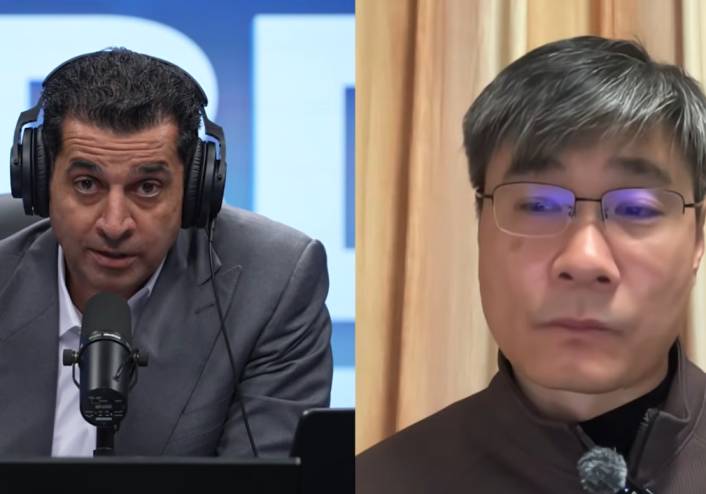
Editor’s Notes: In this episode of the PBD Podcast, Patrick Bet-David sits down with Jiang Xueqin for a highly anticipated conversation following Jiang’s viral predictions regarding U.S.-Iran relations. Broadcasting from Beijing, Jiang discusses his analysis of why he believes the U.S. is on the brink of a losing war with Iran and offers a rare perspective on China’s internal surveillance state and social apathy. The discussion dives deep into the high-stakes geopolitics of the Middle East, the future of the American empire, and the personal risks Jiang faces while operating in the “gray zone” of Chinese media. (April 7, 2026)
TRANSCRIPT:
Introduction and Background
PATRICK BET-DAVID: So my guest today is Jiang Xueqin. And I did my best to pronounce the last name. I’ve been looking forward to the conversation with you for quite some time. The day the interview came out with you and I believe it was Saagar and Krystal, which I thought it was fascinating how a man in July of 2024 can predict that Trump’s going to win, then he’s going to go to war against Iran, and then Iran’s going to win, which was your prediction. And I said, I want to talk to him.
And then so let’s get the nasty stuff out of the way because I actually want to have a civil conversation with you. I’m actually very curious about why you think the way you think. One, at the beginning when we had that, our team reached out to you to get on the podcast. And I think on a podcast you said you thought it was going to be a hit piece interview. What gave you the impression I was going to do a hit piece on you?
JIANG XUEQIN: Well, it was just the timing, because the day you got in touch, there was a coordinated smear campaign against me on Twitter, meaning that there were some influencers who were using the same talking points against me, just saying that I just make stuff up. And it seemed very similar, so I was very afraid. Also, at that time, I was under a lot of stress, so I didn’t want to put myself in a situation where I would be asked hard questions, and I didn’t think I would be able to respond properly to hard questions. Now, I watch your show. I’m a huge fan of yours, Patrick. So I know you’re very good. You ask very good questions.
PATRICK BET-DAVID: I appreciate that. And that’s a fair assessment. And then again, the other part I want to get out of the way on Mehdi Hasan when you were on there and professor, not professor, we’ve all seen that viral stuff that’s been out. So if you’re comfortable, I’m going to call you Jiang, if that’s okay with you as we’re going through it.
JIANG XUEQIN: That’s perfect. That’s perfect.
PATRICK BET-DAVID: Beautiful.
JIANG XUEQIN: Yeah, absolutely.
PATRICK BET-DAVID: So I appreciate that. Question for you. So when you said again, I’ve seen the entire interview. And I’ve seen a lot of your stuff because what I like is seeing what the market is saying and why, right? Some people have certain patterns and your experience is a very interesting one because you went to Yale College, you’ve lived in Canada, you’re now in Hong Kong, if I’m not mistaken.
JIANG XUEQIN: No, no, no, Beijing.
PATRICK BET-DAVID: I’m sorry, my apologies. You’re in Beijing right now. And so you have a very interesting perspective of these three different worlds. And there’s a lot of things to talk about. What analysis or what patterns did you notice for you to say, not the first one that Trump was going to win, because let’s set that one aside, but the one that U.S. is going to go to war with Iran and then we’re going to lose? What gave you the analysis or something to say, I think that’s what’s going to happen?
Patterns of Empire Decline and the Iran Prediction
JIANG XUEQIN: Right, so in school I teach history and I try to teach world history, an entirety of human history stretching from the cave paintings in the United States about 10,000 years ago to today. And while teaching history, I noticed some patterns emerge in history, and the major pattern is how empires tend to decline, and they decline for a particular reason, which is hubris. So empires believe that they are invincible and that no one can touch them, so they engage in activities that are not very strategic.
For example, the Persians invaded the Greek mainland in about 490 BCE with a massive invasion force, and they were destroyed by the Greeks. And then the Athenian Empire, which emerged after the Persian Empire, started to engage in hubris as well. And in 415 BCE, during the Peloponnesian War against Sparta, they launched an ill-advised, silly invasion of Sicily. And they lost the war because of this invasion.
And so a pattern emerges where empires in decline, they tend to engage in risky wars that they believe they can win easily, but which forces them to expand valuable resources on a quagmire. So most recent example, of course, was Vietnam. So it is my belief that if the United States would go to war with Iran, then it would lose this war because the United States would not have the manufacturing capacity, the logistical network in order to sustain a war in the mountainous terrain of Iran.
And so the big question was, would the United States go to war with Iran? And if you look at Trump’s first presidency, there were clear signs that he was being heavily influenced by Israel. He moved the American embassy from Tel Aviv to Jerusalem. He promoted the Abraham Accords. He recognized Israel’s control over the Golan Heights. He ordered the assassination of General Qassem Soleimani in January 2020. And so if he had a second term, he would have most certainly gone to war against Iran.
The Five Stages of Decline and Trump’s Truth Social Post
PATRICK BET-DAVID: Got it. That’s fair. And by the way, there’s a very good book written by Jim Collins where he says, “Why the Mighty Fall?” And he goes through 5 steps, stages of decline, and it validates what you’re saying. Number 1 is hubris born of success. “We’re great because we’re great and we’re untouchable,” right? Number 2, an undisciplined pursuit of more. We all fall for this trap when we succeed. “Let’s go do more, faster, bigger,” right? Number 3 is denial of risk and peril. Which is “we’re fine, we have nothing to worry about.” Number 4 is grasping for salvation. “This is what we need to save, what we need help.” And then Number 5 is capitulation to irrelevance or death, which is over.
I’m a Syrian. Trust me, we lost our empire many, many years ago. We were very, very powerful. We don’t have a country right now. So you have to always stay a little bit paranoid about what could happen.
Now, let me go to the tweet of what President Trump posted on Truth Social this morning. The world is reacting to it. A lot of people are not happy. A lot of people are curious. Some people are saying this is good. But I would say a lot of the people are probably on— this is crazy what’s about to happen today. JD Vance said something this morning that it’s probably coming to an end. A whole civilization.
President Trump said on Truth Social: “A whole civilization will die tonight, never be brought back again. I don’t want that to happen. But it probably will. However, now that we have complete and total regime change where different, smarter, and less radicalized minds prevail, maybe something revolutionary, wonderful can happen. Who knows? We will find out tonight. One of the most important moments in the long and complex history of the world. 47 years of extortion, corruption, and death will finally end. God bless the great people of Iran.”
How do you interpret that tweet?
Decoding Trump’s Message and the Military Situation
JIANG XUEQIN: I think that Trump is trying to go for maximum leverage in negotiation. But the reality is that the Iranians will not back down. And American forces are already assembled in the Middle East. So I think that we will see a ground invasion as early as this weekend, and it’ll be a multivector ground invasion, meaning that right now the Americans are attacking Kharg Island, which is where Iran will export 90% of its oil from. And so the Americans intend on seizing Kharg Island and strangling the Iranian economy.
There will probably be an attack on Qasem Island as well in order to wrestle control of the Strait of Hormuz. There will also be an attack on the Iranian coastline in order to scout out air defenses. So I think that we are approaching a major escalation over the next few days.
PATRICK BET-DAVID: So try to decode this because the average person who reads this, they say, “Who talks like that?” What do you mean “a whole civilization will die tonight, never brought back again?” But if you’re somebody that’s— you seem like a pattern recognition type of guy and you kind of watch how people speak. And we know this is how he speaks, right? He’s not the most predictable guy. He’s got a predictable side but also an unpredictable side.
Decode what he’s saying here. Is this his last chance of negotiation for there not to happen? Is this his last chance of saying, “I hope somebody says, hey, let’s go out there and negotiate with them?” Because Pakistan tried to bring the peace deal on both sides and U.S. declined it, and so did Iran. So if you were to decode this a little bit more on where the president’s mind’s at, what would you say?
JIANG XUEQIN: Well, I would say that Trump has a history of working in reality TV. He thinks in terms of television. He asks himself, “What will draw attention? What will look good on TV? What will get people very emotional and afraid and anxious?” So he spent a lot of time in the World Wrestling Entertainment with Vince McMahon. They had a feud, a television feud, and that’s really how you speak in the WWE. You are rhetorical. You are bombastic and you try to instill fear and rage in people. And so what Trump is trying to do is he’s trying to huff and puff. It’s really flexing.
The other issue that’s very worrying right now is that Trump has surrounded himself with advisors who are sycophants and they’re not actually relaying to him good strategic advice. So for example, what just happened this weekend was that Trump announced the rescue of a downed American pilot. And if you watched the press conference yesterday, he thought it was a tremendous success and was very proud of the military for doing the impossible, going deep into enemy lines and rescuing a wounded pilot. And this is a great tribute to the professionalism and self-sacrifice of the American military, especially the special forces.
But on Twitter, on X, on social media, what people are saying is that this was actually not necessarily a successful pilot rescue operation. It seems that evidence is emerging that this was a failed seizure, a failed attempt to seize Iran’s uranium, enriched uranium in the Isfahan power plant. And if that is the case, then that was an extremely risky mission. And it’s very consequential because America lost about $300 million worth of planes and equipment in this failed raid.
So my concern is that Trump has surrounded himself with advisors who feed his ego. And Trump himself believes that just by flexing, just by taking a very tough negotiating position, he can bully the Iranians into a compromise. So I think that we are in a very precarious situation right now.
Best Case and Worst Case Scenarios
PATRICK BET-DAVID: What do you think is the worst case that could happen? The best case? Walk me through what— and by the way, just out of curiosity, would you consider yourself a— like, if we’re in July of 2024, would you say you were a supporter of Trump, like you wanted to see him win?
JIANG XUEQIN: So I’m pretty politically neutral. But in July 2024, I was very confident Trump would win. And I felt that America needed a change. So if I were American and I had the opportunity to vote in November of 2024, I would have voted for Trump over Biden.
PATRICK BET-DAVID: Got it. That’s very important. That’s very important for the audience to know that, because your criticism is just what you think is going to happen, but you still would have chosen Trump over Biden or Kamala. Now, here’s the question that we’re, everywhere we’re talking to others. What’s the best case, worst case, of what could happen here?
JIANG XUEQIN: The best case scenario is that the Americans and Iranians reach a compromise where they agree to share the Strait of Hormuz. So there’ll be tolls collected because the Iranians want reparations for the damage that the Israelis and Americans caused this past month. But they agreed to share it with the Americans and they agreed to collect the tolls in US dollars. And all sanctions are lifted and peace comes to the Middle East. And there is a possibility. I’m not saying this is impossible, but it is a very low probability, and this would be the best case scenario.
PATRICK BET-DAVID: Best case scenario. Give me the worst case scenario.
JIANG XUEQIN: The worst case scenario is that Trump follows through and bombs all of Iran’s power plants. And the reason why this is the worst case scenario is that there are certain individuals who are now trying to protect the power plants with their bodies. So the Iranian government has called on the young people of Iran to make the ultimate sacrifice and make a human chain around all power plants in Iran. And so the Americans go in, they blow up all the power plants and kill a lot of young people.
Well, in this case, the Iranians are obligated now to destroy the entire economy of the GCC. This would include all oil fields. This would include all the desalination plants. This would include all data centers. And this would be the absolute worst case scenario.
PATRICK BET-DAVID: What’s your likelihood of that happening? Give a percentage. Like, if you’re going to do a scoresheet type of— I think that’s a 1%, 2%. If you were a betting man, what would you say it is?
JIANG XUEQIN: So I would say best case scenario is 1%. I would say worst case scenario is 10%. And I would say a limited ground incursion would be about 40%.
The Risk of American Retreat and the Path to Negotiation
PATRICK BET-DAVID: Okay, so you have a higher likelihood of us hitting the power plants than the best case scenario happening? 10 times more likely the worst case than the best case. How does Trump— because your prediction was Trump wins, Trump goes to war with Iran, and America loses. Define losing, because some people could say Afghanistan was a loss, right? The way Biden left, we left whatever, $83 billion it cost us. We left $7 billion of equipment there, whatever the numbers are. Define loss. What does loss mean to you?
JIANG XUEQIN: Right. So loss means that America is forced to retreat from the Middle East, and this will enable Iran to control the GCC countries. Because remember, the GCC is very important for the petrodollar system where the GCC sells its oil in US dollars and then recycles this back into the American economy, primarily by investing in AI. So a lot of these AI data centers are financed by investment from these GCC sovereign wealth funds. And so if America were to retreat from the Middle East, they would lose the petrodollar. The American economy would collapse, and you would have a civil war emerge in America.
PATRICK BET-DAVID: A civil war emerge in America. Okay. Interesting. Do you think the president has a team of rivals right now that are trying to prevent that from happening? Because I think that you and I both know the president is a “what do you think?” asking everybody. What are your thoughts? What do you think? What do you think? Including his enemies.
I mean, this guy called Elizabeth Warren and said, hey, what do you think about us doing this to the credit card companies? And Elizabeth Warren’s like, he just called. I was confused when he called me. President Trump will bring Mamdani in and say, hey, don’t worry about it. Be critical. Say whatever you want to say about me. I’m okay with that. You don’t need to explain yourself. So he talks to everybody.
Do you think he is fully aware of the risks of what could happen if he goes aggressive here? Do you think he’s fully aware of it?
JIANG XUEQIN: I think unfortunately he’s surrounded himself with psychopaths. President Trump said about a couple of weeks ago when people asked him, why are we in this war? Because he has never articulated a reason or an objective for this war. And he basically said that, well, Jared Kushner, Steve Witkoff, Peter Hegseth, Marco Rubio talked me into it.
So what he’s done is he’s basically elevated the hawkish elements of his administration and basically ostracized or put on the sidelines the more cautionary conservative elements of his administration, who include JD Vance and Tulsi Gabbard. I believe that JD Vance has been very vocal in trying to negotiate a peace treaty as soon as possible. And now he’s in Hungary, far away from the action. And there’s rumors of Tulsi Gabbard being removed from the administration at some point.
Trump’s Inner Circle and the Iran Threat
PATRICK BET-DAVID: Yeah, Tulsi. I think there was another name as well. Tulsi and Howard Lutnick were the two names that were brought up yesterday that may be next on the chopping block, that he may move on from.
Going back to it, Iran, IRGC, your opinion on them. You hear the phrase, they’re the biggest producers of terrorism, or there are many different phrases people use against them. How dangerous do you think Iran is, led by the current regime, to the world, especially to the Gulf states, the 6 GCC countries you’re talking about? How dangerous do you think they are to society if this regime stays in power?
JIANG XUEQIN: So I think there are many factions within Iran that are very concerned that if this war continues, the Revolutionary Guards will be able to control all of Iranian society. So right now they control about 50% of the economy, but if this war continues, they might control 100% of the Iranian economy. And this would be disastrous for other factions within Iran who want a progressive secular society.
And remember that these people have a grudge against America. So in 1979, students in Tehran overran the American embassy and took people hostage. People don’t know this, but those students are now running the Revolutionary Guard Corps. Also, their leader, Qasem Soleimani, was killed by the Americans in January 2020. And they wanted revenge against Americans for the longest time. And now it’s a perfect opportunity. So there’s a lot of bad blood between the Americans and the Revolutionary Guard Corps, and the Revolutionary Guard Corps see this as an opportunity to destroy the Americans once and for all, even at the cost of their own society. So there’s a real threat here.
PATRICK BET-DAVID: That’s interesting. So have you ever watched The Godfather, the Godfather series? I’m assuming you have.
JIANG XUEQIN: I have.
PATRICK BET-DAVID: Okay. So if you know this and you know that if Iran hated us a year ago, if Iran hated us 8 years ago when we killed Qasem Soleimani, how much more do they hate us today after taking out the 50+ leaders that we have in the last 4 or 5 weeks, whatever the— how many days are we at? 43, 44 days. I don’t know the exact days.
How much more do they hate us? So don’t you think from a purely a power play standpoint, if you went this far, and you killed everyone and you back off, whether you support this happening or not, we’re already in it. Of course, we could have had the debate 45 days ago, don’t do it. But now we’re in it. If you’re this far and you get out, didn’t you just make Iran even angrier to want to retaliate against the US and the rest of the world?
JIANG XUEQIN: Yeah, I mean, I think it’s very hard to see an off-ramp here. Because the Iranians will not give up. Even if the Americans were to leave, the Iranians would assert control over the GCC, right? And that’s why Saudi Arabia and the UAE are pressuring Trump to finish this war. So it’s easy to start a war, but it’s hard to end the war.
A Four-Nation Conference as the Path Forward
PATRICK BET-DAVID: What do you think is the right move? You’re an advisor. You’ve said a lot of crazy things, which is very interesting, and I like to hear what you’re saying because when everybody is saying the same exact thing, you’re not learning anything. You need to hear what other people are saying. What do you think is the right move to do here right now for both the US and the Gulf states?
JIANG XUEQIN: If I were the Gulf states and I were the United States, my advice would be to organize a conference for 4 countries: the United States, Russia, Iran, and China. Do not include the Europeans, do not include the GCC, do not include Israel, just these 4 countries — United States, Russia, China, and Iran — and come to a collective agreement where these 4 nations agree on a new trade relationship based on the US dollar. I think all 4 nations are interested in maintaining the US dollar as a global reserve currency because no one else wants that global reserve currency status.
PATRICK BET-DAVID: Why would you do that if those three all hate you and if you’re in a meeting with them? China’s not necessarily an ally. Russia’s not necessarily an ally. Iran’s not necessarily an ally. Why would I hold this meeting knowing it’s three against one? Trump would never host a meeting like that knowing the leverage isn’t on him, right? And so he’s got the support of Gulf states. They’re on his side. He knows he doesn’t have it with China. He knows he doesn’t with Russia. He knows he definitely doesn’t with Iran. Why host a meeting like that? I don’t see the logic behind that. Feel free to push back.
JIANG XUEQIN: Well, I mean, the reality is that America is going to have a hard time holding on to its empire. And Trump has said this many times, because America is the world reserve currency and because America is responsible for protecting the sea lanes, America is basically screwed by the world, especially the Europeans who don’t have to pay for their own defense and who can use their savings to fund their lavish welfare and pension system.
So it’s not in the best interest of America to maintain its empire. If you’re an average American, you’re paying way too much for this empire. So why not just retreat back into the Western Hemisphere? The Western Hemisphere is completely self-sufficient. It has Canada, Mexico. Hey, if I’m Trump, I’m like, you know what, screw Iran, screw Ukraine. I don’t need these places. I’m going to take over Canada and Mexico because Mexico has a surplus of cheap labor, and Canada has infinite resources.
Too Deep to Turn Back
PATRICK BET-DAVID: A lot of people agree with you on that. But here’s the problem though, Jiang. The problem is we’re in too deep right now. So this is a good conversation 45 days ago. I’m saying to you, we just killed the top 50 leaders. They’re not going to— they’re a martyr-type community. You know how you ever go against a company and they’re very litigious and you want to play nice and they’re like, no, we’re litigious. Sue, sue, sue, sue, sue, sue. You have to fight fire with fire.
So I’m talking today, if you go in the room and say, okay, let’s play nice with Iran, they’re like, you’re out of your flipping mind. And if we say, hey, Iran says we want to play nice, you’re out of your mind. And we know Russia and China are going to side with them. I don’t know if that strategy works today.
I do know — do you think Trump has a ton of leverage over NATO right now? Do you think he has the leverage over NATO?
JIANG XUEQIN: Look, you can make the argument that Trump is not just at war with Iran. Trump is ultimately at war with the globalists, right? The City of London, Wall Street, global finance.
PATRICK BET-DAVID: Yes.
JIANG XUEQIN: Right. So NATO represents the globalists and Trump hates NATO and NATO hates Trump. I think Trump has been trying very hard to come to an agreement with Putin for the longest time. They had that Anchorage, Alaska meeting and what happened afterwards? Well, NATO and Ukraine are continuing to attack Russia. There was that drone assassination attempt against Putin. The Ukrainians have blown up 40% of Russia’s oil exports, most recently. So there’s a lot of bad blood between Ukraine and Russia, between the globalists and Trump.
So you’re Trump, right? Who’s your enemy? Is your enemy Iran, Russia, and China, or is your enemy NATO and the globalists?
Trump’s Relationships with Xi and Putin
PATRICK BET-DAVID: Well, he’s constantly complimentary of his relationship with Xi. And Putin. If you ever notice when he speaks, he says, look, I’d rather be friendly than not friendly. We had a good talk. We’re going to go visit back in May. We have some scheduling conflict. We’re going to go back. I had a good talk with Putin. I had a good talk with Xi. So he knows how to speak to these power players and have them under control.
It looks like that night when he was giving a speech, the 23-minute speech at 9 PM — I think this was last week — I thought he was going to say something radical like we’re leaving NATO. I thought he was going to say the Gulf has announced they’re funding the war. I thought he was going to make some kind of a big announcement like that. I don’t think there was any big announcement there.
But to me, if you had an easier way to get rid of IRGC, question for you — is the world a better place with IRGC no longer being in power and it being replaced by some sort of a democracy?
JIANG XUEQIN: Look, I completely agree with you in that the great fear is that Iran becomes much more extremist and much more theocratic than it is now. The Ayatollah Khamenei was considered a pretty moderate individual. His son is not considered moderate and also he’s considered incompetent. And so the people around him will be able to control him. We can expect the most hardline elements in Iranian society to emerge triumphant from this war if this war continues.
So again, my best advice is for these four countries to sit down together. Putin and Trump will agree to pressure Iran together to come to a settlement. Listen, at the end of the day, Russia is supporting Iran. If Russia were to pull its support, it’d be very hard for Iran to continue with this war effort.
PATRICK BET-DAVID: That I agree.
JIANG XUEQIN: Putin has a lot of leverage over Iran, right? And that’s why I’m saying you need these 4 countries to sit down together to come to an agreement. If Trump were trying to negotiate with Iran directly, you get nowhere. But if China and Russia entered the negotiations and they agreed on a mutually beneficial global trade relationship, then I think you can get somewhere. And Trump would, I think, excel in such negotiations.
China’s Population and Demographics
PATRICK BET-DAVID: Yeah, maybe the meeting is a better meeting if it’s Russia, China, and US and not involving Iran on phase one, just to kind of get the pulse there. Because the leverage— you’re right, because Russia’s— they kind of help each other, right? Because they were selling the cheap drones, the Shaheds, to Russia. And Russia was buying it from them back and forth because Iran makes some of the best small drones similar to Ukraine, Shahed. Yeah, the drones that they make, the loud ones that are very effective in a small— in a war like this.
Okay, so that’s interesting to see what happens there. But you do agree that the level of extremism that IRGC has, if there is a way to get rid of that regime and be more of a democracy, the world would be a safer place with them being gone. You would agree with that?
JIANG XUEQIN: Yeah, no, I would agree that it is not good. It is not in the best interest of Iran to be a theocracy. I think these are Persian people. These are the most enlightened people with a long history. They want to be Persian. And so I think that what emerges after this war is a more vibrant Persian nationalism as a counter to Shia theocracy.
PATRICK BET-DAVID: So you would want to see the religious, the Khomeinis, all that to be gone, and it’s just ran by government, not a theocratic type of a government. You’d like to see that happen. Do you think there is a safe landing where we can get there? Do you think there’s a possibility where we can get there?
JIANG XUEQIN: Given what’s happened so far and given that Trump seems intent on attacking Iran’s critical civilian infrastructure, I think this will only embolden and empower the most extreme religious elements in Iranian society because these are the ones who are willing to die for what they believe in.
PATRICK BET-DAVID: Yeah, I lived with them. I lived there for almost 11 years, so I witnessed what they’re like, and the level of radicalism that they have is a whole different story.
China’s True Population: Fact or Fiction?
Let me ask you a couple other questions about China since you’re in Beijing right now. There’s this data that’s going around when China went to the one-child policy that maybe the population isn’t as big as they claim it is. I’m sure you’ve seen this where the numbers are going around, oh, we’re at 1.4 billion, we’re at 1.3 billion, and there’s like, nah, not necessarily, you may be at 600, 700 million. One lady said 400 million. Mathematically, it’s impossible to be at 400 million, but some of the numbers could say 800, 900 million. What is your guesstimation of what China’s population is today?
JIANG XUEQIN: Look, I live in Beijing. I visited China. There are a lot of people in China. I mean, just ride the subway, it’s packed every single day. Just walk the streets, they’re packed all the time. And I travel a lot. There are a lot of people in China. I can’t tell you what the exact statistics are. There’s probably some overcounting because local governments tend to lie. Because obviously, the more people you say you have, the more government subsidies you can get. So I imagine there’s some population inflation, but I believe it’s still over a billion people.
The issue in China is not actually population count. The problem in China is twofold in that you have a rapidly aging population, you have young people who refuse to have kids. I think it’s possible in 5 years’ time, China has the lowest fertility rate in the world. Right now it’s South Korea at 0.8, China’s about 1, but I can easily see China overtaking South Korea in like 5 years’ time. So that’s the real issue facing China. China still has a lot of people, but the demographic curve is going to be a huge issue for China, especially as the population ages.
PATRICK BET-DAVID: Why would they lie? How does it benefit them to lie about the population? Is there a benefit? Because why would— who cares if you’re at 800 million or if you had 1.3 billion, right?
JIANG XUEQIN: The issue in China is that local governments tend to lie all the time because a lot of their promotions depend on the performance locally, right? So it’s in their best interest to inflate just not population statistics but also economic performance.
PATRICK BET-DAVID: So does Xi incentivize local governments to lie? Is it more, “Hey, we got to save face for the world. The world cannot see that we’re a declining country.” Who is incentivizing who to lie with the data?
JIANG XUEQIN: Right. So China doesn’t really care much about the world. China is an enclosed, insular bureaucracy. So the local governments are lying in order to get more funding from the central government, right? So obviously, if you have more children, you can get more healthcare subsidies, more education subsidies from the federal government, especially if you’re a poor province. So that’s the logic of lying. And this is a very common practice in China, where if you are in Beijing, you just have to assume that all the information you’re getting from local areas are just inflated information.
PATRICK BET-DAVID: Got it. Okay. But you don’t think there’s a reason there’s a good or bad thing for the world if all of a sudden we got the right data that the population isn’t 1.3 billion, it’s really only 800-900 million? Would that be an embarrassing moment for China? Would Xi see that as an embarrassing moment or no, it wouldn’t be a big deal?
JIANG XUEQIN: There is concern in the central government. And the reason why is that China is very much a metric-based society. It’s very utilitarian, right? So it’s very focused on economic growth. And what drives economic growth is population growth. So there’s a real concern that as the population declines over time, China’s economy will stagnate.
But personally, I think that this may be in the long term a good thing for China because having over 1 billion people is not necessarily a good thing. What it has led to ultimately is massive exploitation over the people. Because when you have too many people, it’s like free energy, right? So all you have to do is basically exploit them and that’s what runs your economy. But because you’re exploiting people, that hampers innovation, that hampers political development. So I think if China were to face a population crisis, this in the long term would be good for China’s society and civilization.
The “Lying Flat” Movement and Youth Apathy
PATRICK BET-DAVID: Yeah, and you kind of talk about the Tang Ping movement, right? The lying flat, I think they call it, young kids are kind of like, “Screw it, there’s no reason for me to give my best. So I’m going to be a minimalist.” How are they countering that where kids are seeing there’s no reason for me to do 996, right? Work 9:00 AM to 9:00 PM, 6 days a week. I don’t want to do it. Who cares about this? How are they fighting against that?
JIANG XUEQIN: So in the 1980s, China was embarking on economic reform. And there was a real concern among party elders, like people who went through the revolution that brought the Communist Party into power in 1949. There’s a real concern that capitalism would degrade and pollute civilization, Chinese civilization. They call it “spiritual pollution” in the 1980s. And this was a huge concern in the 1980s. And it turns out this was correct because free market reform without political reform has led to a very utilitarian society where it’s basically “get rich or die trying.”
And so what this has led to is massive corruption, massive inequality, massive debt in China. And this has led to tremendous apathy among young people because there’s definitely no chance for a young person to get ahead. If you started a business, if you bought $1 million and you started a business, I guarantee you, no matter what business you started, you lose all your money. Because it’s a rigged game. And that’s why people are opting out.
And because of spiritual pollution, because there’s really no ideology, there’s really no sense of nationalism in China, there’s really no motivating factor for people in China, right? Before, it was just like “make money,” and that’s the point of existence. Before, during the Cultural Revolution, it was about serving the people, contributing to the motherland, building a socialist paradise. You and I can disagree about that, but regardless, during the Cultural Revolution, people were motivated to make the self-sacrifice necessary in order to build a better China. And now people are extremely utilitarian, they’re indifferent, they’re apathetic, and that’s why they’re like, “You know what, screw this, I’m just going to sit home all day.”
PATRICK BET-DAVID: Yeah, and who pays them though? Who pays them? Like, is there entitlement programs? Are they able to stay home all day? What is the system for me to stay home all day?
JIANG XUEQIN: A very common practice is for young people to go work as nurses or maids for their retired parents. Their parents collect a very nice pension. Chinese are very frugal. During COVID when everyone was locked in their apartments for 4 years, they ate rice and vegetables all those 4 years. So Chinese have a lot of money saved up. They have saved up 40% of their income, which is the highest in the world.
PATRICK BET-DAVID: Yep.
JIANG XUEQIN: So Chinese can just get by on like white rice for the next 40 years.
Jack Ma’s Disappearance and the CCP’s Crackdown
PATRICK BET-DAVID: Yeah. And the idea is they don’t invest much in the stock market. They don’t believe in the market, but they do believe in the real estate side, even though the real estate has taken a bit of a hit. But you’ve always learned the discipline, the frugality part of folks from China.
Let me ask another question in regards to the lie flat. I’m going more on the business side with Jack Ma. In America, everybody knows Jack Ma. They think about Jack Ma, they think about his sit-down with Elon Musk, the good exchange that they had where Elon kind of like, “You’re out of your mind, AI is going to take over.” Jack’s like, “No, it’s not.” And then Jack made some comments. I’m sure you remember when he gave a— probably not that strong of a critical comment, but the CCP didn’t like it, and then all of a sudden Jack Ma disappeared. Here’s a guy at the time, I don’t know what he was worth, $50 billion give or take. He’s a very wealthy man. He disappeared. What is your impression of what happened to him? Because no one’s talking about Jack Ma anymore, right?
JIANG XUEQIN: So when President Xi came into power, there’s a real concern among Chinese economists that the economy was overheated, meaning, to put it very bluntly, there’s too much corruption in the system. There was too much fraud, there was too much speculation. And so it was really about how to make a more productive economy. So there were too many Chinese people who were engaged in real estate speculation, and that’s what was causing the real estate bubble. And you can’t really have that as an economy. You want people to actually work hard, start a business, and save their money and make proper investments. But everyone was just pouring the money into real estate scams. These entrepreneurs, these billionaires were basically creating financial Ponzi schemes.
And so there was a commitment among Chinese regulators to crack down. And this is what led to the crackdown on Jack Ma because Jack Ma pushed back against central authority. And you can’t do that in China. You can’t question the authority of the government. And Jack Ma, he was the richest man in China. He was the most popular man in China at that time. And he thought that he could change the system. And he found out that unfortunately you cannot.
PATRICK BET-DAVID: Got it. And what is the difference between him and the other fellow, Jimmy? I’m trying to get his name right, his last name right. Is it Jimmy Lai? Do you remember the Jimmy Lai story?
JIANG XUEQIN: Right. So these are two different societies. These are two different political systems. Hong Kong is considered a quasi-sovereign part of China.
PATRICK BET-DAVID: Is that kind of like the equivalent of like a Puerto Rico in America?
JIANG XUEQIN: Exactly. Exactly. And Jimmy Lai is an outspoken critic of the Communist Party. He is very pro-democracy, but he probably pushed too many buttons. He probably crossed too many red lines. So I think what led to his arrest was the fact that you had protests in Hong Kong about a few years ago that called for democracy. And this was a red line for the Communist Party in Beijing. And so they ordered a crackdown and vocal opponents of the government were arrested or forced into exile. Jimmy Lai had the option of seeking exile, but he believes in democracy. And so he chose to be a martyr. And so now he’s in prison.
Jimmy Lai and the Question of Democracy in China
PATRICK BET-DAVID: Who is he? Who is he in China to America? Like, is there a comparison you can— because this is a guy that was a billionaire in 2020. He was pushing democracy. Then I think China passed a law that, you know, there are certain things you couldn’t do in June of 2020, June of 2021. I could get some of the dates off. I think it’s June 30th, 2020, that once the new national security law was passed, 11 days later he got convicted and then he went away for 20 years. And this is a guy that owned Apple Daily newspaper brand that played a big role in the 2014 Umbrella Movement, the 2019 Hong Kong protests. So pretty heavy guy. But to the average person in America that doesn’t know who Jimmy Lai is, how would you say Jimmy Lai is to China what XYZ is to America?
JIANG XUEQIN: Well, I mean, America has freedom of speech. America respects its business people. America respects its entrepreneurs. So it’s very hard for me to find an analogy who is American, but you do have Russian people, you know, these billionaires who ran foul of the Putin regime. And so they were put in prison and then they died in prison. So that’s what happens in these societies, Russia and China, when you try to defy the government. There is a red line in our society, and that is you cannot challenge the ultimate authority of the government.
Interest in Democracy Within China
PATRICK BET-DAVID: How much interest do you think there is in China of wanting to be a democracy? Because, you know, you guys got your one party, right? One political party. You don’t have a lot of choice. This is what we’re doing. It’s just, hey, who do you want? We’re not changing this. It’s not like you have a lot of say. How much interest do you think there actually is in saying, you know what, why not? Why don’t we go try to have a democracy in China?
JIANG XUEQIN: So I’ve been in China for 25 years, and I can tell you that there is almost no interest in democracy in China. Because for democracy to exist in China, for democracy to happen in China, you would need to have people who respect human rights, individual liberty, who had empathy, who believed in rule of law. And the reality is that in China, the system is set up so that the ultimate objective is to become a bureaucrat. That’s what all Chinese people aspire to.
PATRICK BET-DAVID: Aspirationally, meaning coming up, you want to be a bureaucrat one day.
JIANG XUEQIN: Exactly. And the higher you climb the bureaucracy, the better, because traditionally China is an empire. And the way you survive an empire is to become a civil servant. And that’s why Chinese work so hard in school, because they want to pass that civil service examination to become a bureaucrat, so then they can provide guarantees and protection to their family.
From Canada to Yale to China
PATRICK BET-DAVID: How long did you live in Canada and the US?
JIANG XUEQIN: So I was born in China. And then when I was 6, we immigrated to Toronto, Canada, where I grew up. I went to high school there. I did 5 years of high school because, you know, in Canada, we’re slower than Americans. You guys can finish high school in 4 years. We need about 5 years. And then after that, I went to Yale for college. I spent 4 years there, and then I came to China, and I’ve been in China ever since, ever since 1999.
PATRICK BET-DAVID: So how many years did you live in the US?
JIANG XUEQIN: Well, 4 years.
PATRICK BET-DAVID: Okay. So if you were to say the dream for a kid in Canada, when he grows up, he wants to be a— the dream for an American when he grows up, he wants to be a— and you already said it— what China is, right? When you grow up, you want to be a bureaucrat. What is your impression of what Canada is, US is?
JIANG XUEQIN: Well, in Canada, everyone wants to be a hockey player. When I grew up, I didn’t play hockey, but I wanted to be a hockey player. I wanted to play for the NHL. I mean, I can’t even skate. Okay. But I wanted to be a hockey player. And in America, I think you want to be an entrepreneur. You want to start your own business, such as yourself, and you want to make it and be independent. You want to be free of government control and you want to be able to speak your mind. And in China, as I mentioned, you want to be a bureaucrat.
Why He Chose China Over the West
PATRICK BET-DAVID: What do you like about each country? Because you chose to go back to China. And if I’m not mistaken, what happened with the PBS documentary that you tried to do that they kicked you out and then eventually they let you come back in in ’03? I don’t know what the timeline is there, you know, because you have a choice to be in Canada, US, or China, but you chose China. So maybe walk through what happened when they kicked you out and then why you chose to go back to China.
JIANG XUEQIN: So I came to China to teach English and eventually I became interested in journalism and I was hired to do freelance journalism. I got a contract from PBS to do a documentary on China’s WTO entry, and this required filming a worker protest. And there were quite a few worker protests during this time because there was a restructuring of state-owned enterprises.
While I was filming a worker protest, I was arrested by plainclothes policemen. I was put into a car and then I was sent to a hotel for 48 hours where they interrogated me and I didn’t get much sleep. I ultimately signed a confession that I was working in China illegally as a journalist. So to work in China as a journalist, you need a journalist visa. And I didn’t have a journalist visa. And so they deported me, but they didn’t charge me. So I could at any time return to China.
And so eventually I chose to return to China because at that time I had Chinese language skills, I had some journalism experience. And so there were more opportunities for me in China than there were in the United States and in Canada.
So the question is, what do I see the political strengths of each country are? Well, Canada, you know, it’s a very stable society. People over there are very nice, perhaps too nice. It’s almost like they’re on Valium every single day. You’ve been to Canada, so.
PATRICK BET-DAVID: I have many times.
JIANG XUEQIN: Yeah, right. You know, Americans are the most creative people in the world. Very open, very generous. If you want to work hard and you have talent, you will make it in America. And that’s not true for anywhere else in the world. It doesn’t matter how much talent you have in China. No one cares. All that matters is how powerful your family is. And that’s true for most of the world. It’s not just unique to China. I would say for most of the world, what matters is family connections, family background, as opposed to hard work and talent. So I deeply admire Americans and I have tremendous respect for American society and culture.
China, at that time, was an open canvas. It seemed promising. It could at that time go in many different directions. And so I was young and I was really curious. I felt that I could learn a lot more in China and experience much more interesting opportunities in China than I could anywhere else.
PATRICK BET-DAVID: Right. And so because you’re very curious, you’re very talented, you know, you’re a very good communicator. I mean, these are all great qualities to be here in the States. Why choose to use those talents in China?
JIANG XUEQIN: So I was in the United States for college, and when I was at Yale, I found that there wasn’t as much openness and freedom to curiosity as I imagined. So Americans are extremely entrepreneurial. They’re very good at business. But I didn’t feel as though America was going to change a lot in 10, 20 years’ time. And I felt that I wanted to experience a society in flux, in change. I thought America was much too stable.
I could have easily gone to law school and become a very wealthy lawyer or maybe even gone and become a professor. There were lots of these career paths open to me because I had a Yale education, but I knew exactly what I would be like in 50 years’ time or 60 years’ time because, you know, I just look at my professors and I know how they live their lives. I have friends who are lawyers and I know how they live their lives.
And I wanted to experience a world in which the world was unpredictable. And that was China. You know, when I came to China, I knew China was going to change a lot in 20, 30 years’ time. And so during this time of massive change, this would offer me opportunities to do things I couldn’t really do in the United States.
Navigating Chinese Social Media and Surveillance
PATRICK BET-DAVID: Got it. So that was the opportunity to go over there. And by the way, your content that you create in China that you upload on YouTube, do you also upload it on the channels in China, or is it mainly for the content in the US?
JIANG XUEQIN: So I have a very strict policy of not engaging in Chinese social media. I do not have a Chinese social media account. Chinese reporters have reached out to have interviews with me and I’ve said no. Chinese people have reached out to me and said they want to work with me and I’ve said no. And the reason why is that I understand—
PATRICK BET-DAVID: When you say they reached out, who reached out to you? Like the bigger platforms or media companies or all the way from the top, the CCP?
JIANG XUEQIN: Well, it’s more professors, professors at the very elite universities in China, Tsinghua University. And I don’t want to talk to these people because they represent the government. And I don’t want to put myself in a position where I’m compromised and have to become a propaganda mouthpiece for the government.
And so my main priority is to maintain my independence, my freedom, because I operate in a gray zone in China where I’m not a Chinese citizen, so I’m not bound by Chinese surveillance laws. And I make content for Westerners. And so I have a lot more freedom to comment about Western society than say if I were in Western society, right? So Canada has become a very authoritarian society. If I said certain things that I said in Canada, then it’s possible that I get visited by the police. And that might be true for Europe. It wouldn’t be true for the United States, but there would be some other issues as well.
PATRICK BET-DAVID: Yeah, that’s interesting. So have they ever knocked on your door and said, hey, you’re crossing a line, pump the brakes, that’s too much, relax, or no, they leave you alone. Nobody’s knocked on your door.
JIANG XUEQIN: I work at a school. I’m employed by the school. They have legal responsibility for me. And there was one time when I wrote a Substack essay that mentioned China, and I was given a call by the school leadership and told to pull it down. I’m not at liberty to tell you what the content was, but I will tell you that I’m being monitored very heavily.
Long-Term Safety and China’s Soft Power Agenda
PATRICK BET-DAVID: I can only imagine that. I can only imagine that. Do you feel safe for yourself in China long term?
JIANG XUEQIN: I do not plan on staying in China long term. Because, and I’ll tell you why, because right now China is very interested in soft power. And right now I have a lot of soft power. I have a lot of influence overseas. And so they want to co-opt me. They want to compromise me and turn me into a weapon that they can use to promote their agenda overseas. I don’t want to do that.
China’s Influence and COVID Narrative
PATRICK BET-DAVID: The longer you stay, the more people are going to think that you are somebody that’s representing the CCP, that you’re working with the government. Just so— because I know you— the criticism, the moment you went viral, I’m like, okay, let’s see what happens the next 2 weeks because they’re going to come for his throat. It happens every single time. And then we all move on with the filtering process. You’re not really a professor. Are you a spy? Are you tied to the government? Are you tied to this?
If all of a sudden you leave and you go to Singapore or Dubai or a different place, or maybe, maybe not even Dubai, but a couple of places that you can go to, to speak, then that means you truly are a citizen of the world, that your concern is, here’s what I think about, here’s what I want to talk about. Do whatever you want with this information.
And I’m sure your AdSense is picking up anyways with YouTube, which allows you to drop your job as a teacher to go live anywhere. That’s the beautiful thing about YouTube. So you kind of have a little bit of freedom to be able to do that. And I love to see you continue doing this because, you know, you’re— again, you say some crazy things, but that’s good. We need to kind of think about some of the crazy things that can possibly happen. And then let’s hash it out. Let’s debate it out. Now let’s see what comes out of it.
Another question for you. I love what you said. In Canada, everybody wants to be a hockey player. In the US, people want to be an entrepreneur. In China, they want to be a bureaucrat. What do you think kids want to be in Iran? What’s the dream in Iran today under this regime? I know you’re not there. I’m not there. But what do you think?
JIANG XUEQIN: Well, I mean, I’ve never been to Iran. It depends where you are in Iran, right? So the cities are very different from the rural areas. But I think that given what’s been happening in this war, I think there are a lot of young children who fantasize about— fantasize, and they grow up and they want to fight the Americans.
So I feel as though this war, given the fact on the first day the Americans struck a school in southern Iran that killed 168 schoolgirls and they killed an 86-year-old man with prostate cancer. I feel as though there are a lot of young people who want to go to war with America right now.
PATRICK BET-DAVID: Yeah. And I agree. I agree with where, you know, the I want to be a hero one day. And you’re seeing in some videos with mothers celebrating that their sons gave their lives. It’s like, “My son’s a hero, he did the right thing.” It’s a very different way of thinking about what happens there, you know, very different way of thinking about—
COVID-19: China’s Narrative and Memory Hole
PATRICK BET-DAVID: Let’s talk about COVID. You know, COVID is the time when I started talking about politics. Up until COVID, I had no desire to talk politics. All I did was business, and I would do my whiteboards. You know how you do your whiteboards? I would do my whiteboards, except nowadays we can do with the nice little markers where our hands don’t get dirty. I did it the ghetto ways back in the days where I would get paint all over my suit and ties, and it was a hot mess.
But during COVID, you know, story comes out, it came out from the Wuhan lab. No, it came from the wet market. No, China had nothing to do with it. Yes, China had to do it. Nancy Pelosi goes to Chinatown, stop being so racist. Trump’s like, “What are you talking about? It came from China.”
What does China say about COVID with their position? Because when the state media is telling their stories and I’m living in Iran and they’re saying, “Let me tell you, US is the devil and US is this and death upon America and all this other stuff.” And China is a pretty controlled environment, kind of like what you talked about earlier. How does China’s state media control the narrative of what really happened with COVID?
JIANG XUEQIN: Okay, so unfortunately COVID has been memory holed in China. So no one talks about it. It was a traumatic 3 or 4 years for Chinese society. And people have just basically forgotten about the experience. No one even mentions COVID anymore. People still get COVID, but no one mentions COVID anymore. So all this has been memory holed and people would rather just move on with their lives because there’s absolutely no point in talking about it.
But the Chinese government have said, on multiple occasions, that COVID started off as an American bioweapon. And so that’s what the Chinese believe, that COVID was an American bioweapon. It was leaked into China in order to hurt Chinese society. And there are a lot of elite Chinese who I talk to who believe the same thing.
PATRICK BET-DAVID: So they believe it was a bioweapon released from the US in China. That’s the narrative they say. And is it what they believe? Is it tied to Fauci, the gain of function? Is that kind of how they spin it, or what’s their method of connecting the dots?
JIANG XUEQIN: So I’ll tell you what I believe happened, okay? I believe that this was an American bioweapon funded by Tony Fauci. Obama had put a moratorium, a ban on gain-of-function research. And so Fauci subcontracted gain-of-function research to the Wuhan lab, which was actually a military installation. And I don’t know if it was accidental or deliberate, but it got released into Wuhan.
And when it did get released into Wuhan, the early reporting was that this was killing a lot of people. It was actually burning your lungs. It was like a furnace. Your lungs became a furnace. So it was pretty deadly. And they locked down the city too late. And about a third of people escaped into other cities as well as boarded flights for Europe. And this spread around the world very quickly.
So I think that’s what happened. But Chinese, what they believe is that this was an American bioweapon designed to hurt the Chinese economy. And that’s the story. But they downplay China’s role in it.
PATRICK BET-DAVID: Yeah, they downplay China’s role in it. And culturally, is China a culture where if the government says that, don’t question it? You don’t have the right to question it. Just buy it. This is what happened. Don’t come back and question us because of freedom of speech.
JIANG XUEQIN: Chinese people know where the political red lines are. And they know how the political winds are shifting. And so there’s really no questioning of the government.
Free Speech, Surveillance, and China’s AI State
PATRICK BET-DAVID: What an advantage for the enemy to be able to see in America, where in America we bash each other and we’re going at it and everything’s being exposed from congressmen on the left and the right, and nobody in the world can see what’s going on with China because no one can bring up anything. God forbid if you do, something could happen.
JIANG XUEQIN: I disagree.
PATRICK BET-DAVID: Tell me.
JIANG XUEQIN: I think if you want a healthy, creative, resilient society, you need free and open debate. The best thing about America is the First Amendment. The best thing is that anyone can criticize the president. And there’s rigorous debate right now over this Iran war. And this allows for America to pivot and to be resilient. And to discover its weaknesses and to improve on its weaknesses, on its vulnerabilities. China has been China for the past 5,000 years. This is not a good thing.
PATRICK BET-DAVID: Yeah, no, I’m with you. It is. If a person that thinks they can have that kind of a chokehold on their people for a long time and see the enemy is debating each other, a lot of information comes in. But if social media apps are not available in China, right, there is no Facebook, there is no YouTube, there is no X, there is no nothing like that is available in China.
JIANG XUEQIN: There are Chinese equivalents. But yes, these Western social media platforms are banned in China.
PATRICK BET-DAVID: Are there any— like, if you and I go to a dinner and if you live in California at the peak of COVID, you had to be very careful if you were a Trump supporter. A lot of people would say, but there were parties you would go to, to houses like, “Hey, man, me too. Hey, me too.” But God, if you wore a MAGA hat in 2017 in California, go walk through the mall and see what happens to you. It’s a very different climate than today, right?
Are there small pockets of people in China, small communities that are growing, that they’re criticizing the government, or none of that exists?
JIANG XUEQIN: None of that exists in China.
PATRICK BET-DAVID: Okay. All right. And I don’t think you agree with that. I think—
JIANG XUEQIN: Well, no. I mean, the reason is that China has developed an AI surveillance state that is the most advanced in the world. So China has digital ID and digital currency.
PATRICK BET-DAVID: Right.
JIANG XUEQIN: And so with that, everything you do online can be monitored, right? And so when you use your mobile phone, all your apps are on your phone. So the government knows exactly where you go, what you buy, who you hang out with. And from that, from this data, they can do a microanalysis of your political leanings and then influence you in a certain way. So China has built the fastest AI surveillance state.
China’s Soft Power and Co-opting Elites
PATRICK BET-DAVID: Interesting. You know, you just reminded me of a story. When I made a handful of videos criticizing China and I brought in General Spalding who went very hardcore at China, got millions of views all over the place, and he was revealing some things about China. So it was about 6 months of going after China pretty hardcore.
One day I get an email from a PR firm saying, somebody from China wants to invite you to an event. It’s a charity event. I said, okay, so let’s do the Zoom. So I got on the call. It’s me, Mario, another guy named Gerard, and we get on the Zoom and we said, “So what’s the outcome?” They want to pay you $600,000. I have this email till today documented. They want to pay you $600,000, but they want you to give a $300,000 check to XYZ charity. So you get to keep $300,000, but you give the $300,000 to the charity. We’ll take care of your hotel, food, flight, everything. Don’t worry about it. And we’ll give you $300,000.
Of course, my answer was no. But why would China do something like that? Why would they want somebody like me to come in to get $600,000 and donate $300,000 to charity?
JIANG XUEQIN: Right. So the Chinese approach to soft power is co-opting elites, right? So in China, the elites have all the power. The people have no power. And they assume that’s how the world works. So if I’m going to spend money on soft power, that basically means I bribe influential media elite such as yourself, such as Tom Friedman. So Tom Friedman has visited China quite a lot and he said very nice things about China.
And quite honestly, this works, right? Because if you come over to China, they treat you very well. It’s great food. The people are very friendly. They show you the best aspects of China and you leave with a very good feeling in your heart. So Chinese are very good at co-opting individuals, and they only focus on individuals who have tremendous influence in the world, such as yourself.
China’s Relationship with Islam and the Uyghurs
PATRICK BET-DAVID: It’s a brilliant strategy if you’re able to succeed with it and people can come back and be complimentary about it. You know, that’s what you want, especially in an enemy state.
Last question here with Muslims and how— what is the position that Xi Jinping or the Chinese government has towards Muslims, the religion of Islam. Of course, on the outside they have a lot of relationships with a lot of people, but on the inside we read about the Uyghurs, we read about the treatment of what’s happening to Muslims, we read about how some stories of what they think that religion is all about. What is the sect of Muslims in China and what is the relationship with Islam and the Chinese government?
The Uyghur Crackdown and Han Nationalism
JIANG XUEQIN: Right, so there were some prominent terrorist attacks where Muslims, Uyghurs, launched knife attacks in train stations killing dozens of Chinese. And a lot of these Uyghurs came back from wars in the Middle East. So these were radicalized people. And there was real fear among the Chinese government that this radicalization had penetrated Muslim society. So there was a massive crackdown across Muslim society.
But this goes into a much larger trend in China, which is the promotion of ethnic Han civilization. So China has about 55 minorities. The majority, like 90% of people, are Han. I’m a Han person. But there are lots of minorities in the borderlands. And it was a policy of the Communist Party in 1949 to be as tolerant as possible to these minorities, meaning that they were given their own autonomy, their language was promoted, there was heavy state subsidies to protect their culture, to protect their language, to promote ethnic minorities in mainstream Chinese society.
And recently, there’s been a push to promote Han nationalism, which means a clamping down on the rights of ethnic minorities. And the most obvious example is that schools in many places are no longer allowed to teach a second language. If you are a minority, you’re only allowed to learn Chinese, as opposed to your local dialect.
PATRICK BET-DAVID: Interesting. So does that include English or they teach you English in China?
JIANG XUEQIN: They are trying to reduce the teaching of English as well, but it is much too popular among middle-class Chinese who want to send their kids abroad. But the official policy is to promote Chinese teaching over English teaching.
Muslims in China: Rights and Restrictions
PATRICK BET-DAVID: And the Muslims are fairly— if I’m looking at the population right now, it says 20 to 25 million Muslims live in China, roughly 1.5% to 2%. I don’t know if those numbers are right or not. That’s just Chad bringing that number up. And it explains the largest group being the Hui Muslims, ethnically similar to the Han Chinese, which you were kind of talking about right now. What can they do and what can’t they do? Because the Muslim religion in America grows because we have the freedom of speech. You can go out there and be in the streets praying. What can they not do in China?
JIANG XUEQIN: Look, the reality is that the Communist Party prides itself on being atheistic. So it is trying to downplay religion, not just against the Muslims, but also against Christians, against people of all faiths. And they’re trying to promote communist ideology above everything else. So you can be religious as long as you accept that communism is the ultimate God, which means that most people who are religious are not going to accept this.
What Cannot Be Discussed in China
PATRICK BET-DAVID: Makes sense. Okay. So is there things that you— do you know your limits of what you can and cannot talk about yourself? Like, what can you not talk about?
JIANG XUEQIN: Right, so in China, there are lots of things I cannot talk about, but I’m not on social media. I’m not on Chinese social media. I don’t talk to Chinese reporters. So I’m not constrained by this. But because I’m based in China, I also have to watch what I say overseas.
So things I can’t talk about are the Tibet-Taiwan issues, the Xinjiang issues. I cannot talk about this. I cannot name specific individuals in China who hold leadership positions. So you will not hear me talk about or criticize the leadership of China. I’m not allowed to discuss that. I’m not allowed to discuss the limitations of the military because they are invincible. And they are always right. There are lots of things I can’t talk about.
PATRICK BET-DAVID: That is funny because they’re always right. Something tells me that was a bit of a dig. I’m trying to see your facial reaction to what you just said to see if it was a dig or what you know you can’t talk about. Did I lose you?
JIANG XUEQIN: Yeah, yeah, the connection isn’t great actually.
China Buying Farmland in the US and Canada
PATRICK BET-DAVID: Okay, well we’re at the end of it, about to wrap up. Last thing: Canada, China, US. China’s buying up a lot of farmland in US and Canada. Why do you think that is?
JIANG XUEQIN: Look, the reality is that if you’re a wealthy Chinese person your dream is to move your assets and your family to America. And right now in America, there are not that many assets that you can buy and create value. So farmland is just one of these assets where you can store your wealth. And so this is why a lot of Chinese are buying up real estate. This is what Chinese do. They love buying real estate. It’s not just America, it’s like everywhere.
PATRICK BET-DAVID: So it’s not any other reason but that. To your impression, it’s just they’re just buying it for real estate. They’re not buying it because they want to control farmland and they want to control produce and any of that stuff. You’re not going there.
JIANG XUEQIN: That’s right. Look, I’m 100% confident that this is individual Chinese behavior where they’re trying to store their wealth. Look, the reality is that if you leave your wealth in China, there’s no legal protection. The government can take it away at any time.
PATRICK BET-DAVID: Yeah.
JIANG XUEQIN: So you want to move it overseas. And American farmland just happens to be a pretty good investment.
Closing Thoughts: Iran, World Peace, and Final Words
PATRICK BET-DAVID: Do you have any travel plans to come to the States? Are we going to see you in the States next 30, 60, 90 days?
JIANG XUEQIN: Probably not.
PATRICK BET-DAVID: Probably not.
JIANG XUEQIN: Given how much— yeah, look, I mean, I would love to visit the United States. I would love to meet you in person. There’s quite a few people who’ve asked me to visit, to be on the show. But I’m pretty sure if I go to the United States, I’m going to get punched in the face at some point.
PATRICK BET-DAVID: I think if you’re giving your perspectives, like today’s interview, very fair. I want the world to watch this. I thought this was a very good conversation that some may say it could have been antagonistic, but I actually was looking forward to having the exact conversation you and I just had here together. I’ll give you the final thoughts before we wrap up. Is there anything else you want to share with the audience before we wrap up?
JIANG XUEQIN: Yeah, so I think these next few days will be crucial for the world. I pray to God, even though I’m not religious, that we come to a peace settlement, that Trump tackles again and Iran offers a settlement that the Americans can agree on. I think that the settlement that the Iranians have offered so far, which is to share control of the Strait of Hormuz, has been very fair. And it’s quite honestly one of the most generous offers that the Americans will get from the Iranians so far. So I pray to God that we come to a settlement over the next few days.
But it’s also possible these few days we’ll see a major escalation where the Americans are targeting critical civilian infrastructure in Iran, which will force Iran to go into total war and respond forcefully against the GCC, in which case it’s possible that we lose access to 20% of the world’s energy and we lose 30% of the world’s fertilizer. And this means that the entire world is going to be drawn into this war, and this means that every person will be affected.
PATRICK BET-DAVID: Well, appreciate that perspective. Thank you for making the time to get on. I really enjoy talking to you and looking forward to doing it again.
JIANG XUEQIN: Absolutely. Absolutely. I’m available anytime. It’s a great conversation. Thank you so much.
PATRICK BET-DAVID: Anytime. God bless. Take care. Bye-bye.
JIANG XUEQIN: Okay. Bye-bye.
Related Posts
- Transcript of Elizabeth Lane Interview on Propaganda Network: Tucker Carlson Show
- Transcript of Justice Ketanji Brown Jackson Interview: IMO Podcast
- Transcript: Mary Talley Bowden Interview on Tony Fauci’s Diary @ Tucker Carlson Show
- Transcript of CIA Whistleblower Jim Erdman Interview: Tucker Carlson Show
- Transcript of Shawn Ryan Interview: Trump’s Betrayal – Tucker Carlson Show