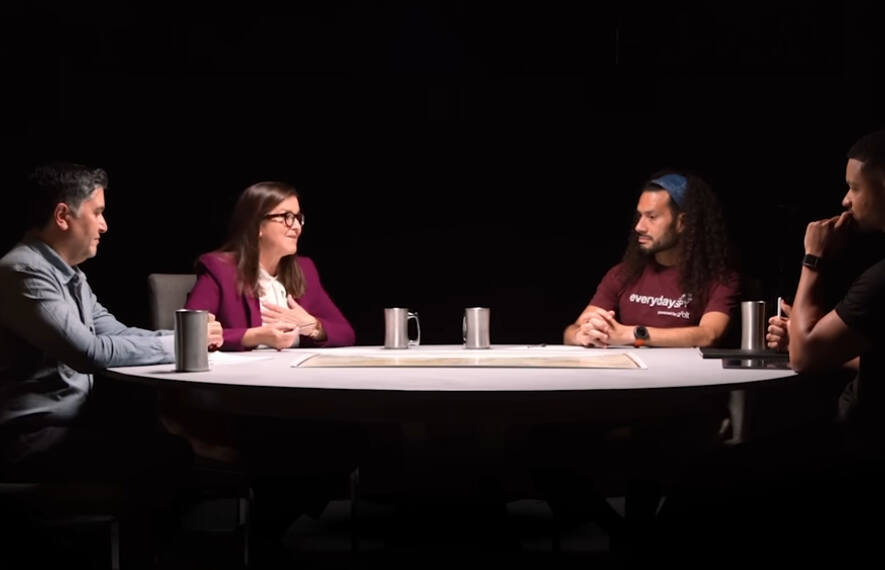
Read the full transcript of Diary Of A CEO Podcast Roundtable episode titled “WW3 Threat Assessment: World War III Has Quietly Started!”, with US intelligence expert Annie Jacobsen, former CIA spy Andrew Bustamante and global affairs analyst Benjamin Radd, moderated by host Steven Bartlett, Jul 10, 2025.
The Growing Tension in Global Affairs
STEVEN BARTLETT: I invited you all here today because I intuitively feel like the world is changing before our eyes. And I think so many of us, if we’re on social media or reading newspapers, can feel a sort of tension growing in society that is hard to understand if you’re not an expert or you’re not connected to these subjects in some way.
I looked at some stats before this conversation that kind of support this feeling that I’ve intuitively had. And it shows that conflict zones across the world have increased by 66% in the last three years. In December 2024, the American think tank Atlantic Council asked about 400 global strategists about their thoughts about what’s going on in the world. And 65% think that China will invade Taiwan by force within 10 years. About 40% think there’ll be a world war in the next 10 years. About 50% think nuclear weapons will be used in the next 10 years. About 45% think Russia and NATO will fight directly.
When we look at spending and what’s happening there, there’s been a huge jump in military spending. There’s now 300,000 NATO troops around the world that are on 30 day high alert readiness. 59 states have erupted in war since 2023, which is the greatest number logged in any year since 1946. And world military spending is up by about 10% year over year, which is the highest sum ever recorded by SIPRI, making it a full decade of uninterrupted growth in military spending.
Things feel tense and every time I turn on the news I have a mild sense of anxiety. So I’ve gathered you three here today to help me as a muggle, as a normal person that doesn’t have an understanding, pass through what’s going on and hopefully what we can do about this.
Benjamin, to start with you, introductions. What’s your context and what’s the perspective and experience you bring to this conversation?
Benjamin Radd: A Refugee’s Perspective on Global Conflict
BENJAMIN RADD: I was born in Iran in 1977. I came to United States as a refugee under a program that President Carter allowed for Iranians fleeing religious and political persecution. My family came here on that basis. And I basically spent the next 40 some odd years trying to understand why I come from a part of the world that seems to be in sort of continuous conflict and turmoil and exactly what can be understood about the forces that brought me here.
I’m incredibly grateful to be here and what can be done to basically change, or at least better understand it, to pave a way for change and progress in the future.
STEVEN BARTLETT: What age did you leave Iran and what was the environment like when you left?
BENJAMIN RADD: I was just under 3 years old, and it was a few months after. So the Shah had left in December of ’79, and then we left a few months after that, around March. Khomeini had just arrived from Paris on a flight in February, basically taking control. And there was still a lot of anarchy and chaos as to exactly what the new regime would look like, what the government would look like.
But we began, my parents began to see that there were some, there were definitely mass arrests, there were protests. There were things that were happening that looked like those who were loyal to the monarchy would be targeted, which my family was monarchists.
Annie Jacobsen: Investigating War and Weapons
STEVEN BARTLETT: Annie, same question to you. What is the experience, context that you bring to this conversation?
ANNIE JACOBSEN: I am an author, a journalist, and I write about war and weapons, US national security and secrets. And I’m interested in looking at the various sort of minutiae of weapons and weapon systems and the people who use them. I’ve written seven books, and all of them deal with war and weapons, and all of them deal with the Pentagon and the CIA specifically. So all of my sources come from those organizations, the military and the intelligence community.
STEVEN BARTLETT: And your last book, we talked about last time you came onto this show. What is your last book about? And what sort of journey did you go on to gather the information for that?
ANNIE JACOBSEN: So my most recent book is called “Nuclear War: A Scenario.” And in that book I take the reader from nuclear launch to nuclear winter, which happens in a period of 72 minutes. And I interview presidential advisors, secretaries of defense, nuclear submarine force commander, et cetera, et cetera, people who are very close to the chain of command, people who have rehearsed making these decisions if they need to be made.
And what I learned terrified me. And from what I, the book has been out for over a year now, still in hardback. People are reading it in 28 countries around the world. This is a serious edge of peril topic, and I think we’re here to talk about that, because no time in my life, I think, have we been closer to thinking about this reality than right now.
Andrew Bustamante: Inside the Nuclear Chain of Command
STEVEN BARTLETT: Andrew, there’s a few subjects and words that Annie mentioned there that also cross over in your story, one of them being nuclear war and nuclear weapons. What is your context and how do you, what is the sort of experience and perspective you bring to this? What’s your experience?
ANDREW BUSTAMANTE: Yeah, I am a former clandestine CIA intelligence officer, also a decorated wartime veteran from the United States Air Force during our wars in Iraq and Afghanistan.
And I’m very excited to get into this topic because I think there are certain areas here that are misunderstood, areas that are overdramatized, and then areas that are not being spoken about that are very relevant and very compelling.
STEVEN BARTLETT: Wasn’t there a period of your life where you were underground and part of that sort of nuclear chain of command that Annie described?
ANDREW BUSTAMANTE: Absolutely. That’s where my career started actually, was with the ICBM, the intercontinental ballistic missile forces of the United States Air Force, overseeing Minuteman III missiles in Montana, armed with 10 nuclear warheads each, understanding the military doctrine, the strategies, the policies for how to execute.
STEVEN BARTLETT: So you were underground with a physical nuclear key?
ANDREW BUSTAMANTE: Correct. Around my neck. And there are, even as we have this conversation now, there are hundreds of US soldiers, hundreds of Russian soldiers that are in very similar positions and they’re not much older than a high school graduate right now.
Are We Already in World War III?
STEVEN BARTLETT: Many people think we’re on the cusp of World War Three, but I think you’ve said in the past that you actually think World War 3 has already begun in some context.
ANDREW BUSTAMANTE: Yeah. Correct. I believe that we are already at the early stages, if not in World War 3. The problem is that people seem to think that World War 3 is going to emulate World War 2. The deployment of nuclear technology and nuclear weapons now would look completely different than the deployment of nuclear weapons looked in World War II, if only because we have nine nuclear capable countries right now.
Not to mention the fact that we have a completely different information landscape. We have a completely different political landscape. We have a whole different landscape for alliances and for treaties. The world is very, very different than it was when World War II broke out.
STEVEN BARTLETT: So you think we’re in World War 3 now or the early innings of that?
ANDREW BUSTAMANTE: And I think World War 3 is going to be shaped by what we call proxy war.
STEVEN BARTLETT: What is proxy warfare?
ANDREW BUSTAMANTE: Proxy warfare is when a wealthy nation state funds and trains and arms conflict in a less wealthy state where there’s usually some sort of civil disturbance or civil fight that’s already happening. Much of what we’ve seen in the last 10 years is proxy warfare. Libya, Syria, Ukraine, Yemen, people argue that what we saw, even Afghanistan, Iraq, where the US was involved, was proxy warfare. Israel and Iran is model proxy warfare. Russia and Ukraine are also models for proxy warfare.
STEVEN BARTLETT: So there’s someone else funding it, and they’re using that nation to do the work for them, essentially.
ANDREW BUSTAMANTE: Exactly right. You use an intermediate nation that’s still developing to decrease the capability of your primary target while you yourself conserve your own troops, your own weapons, and your own civilians against harm.
The New Face of Modern Warfare
STEVEN BARTLETT: Benjamin, what’s your take on that in terms of us being at the start of the precipice of a world war and it looking like a different set of weapons, a different way that we’ll fight each other and the Internet and digital warfare being a part of that?
BENJAMIN RADD: I don’t think since the beginning of the Cold War, let’s say, let’s go back to 1947 or ’48, I don’t think we’ve stopped fighting. I just think we’re fighting wars of different kinds. I think this idea of kinetic warfare is less frequent, especially among the major powers. So Israel and Iran is an example of one of the last few gasps of kinetic warfare. But if you look at the United States and China, United States and Russia, European powers, NATO, it’s less kinetic than it is more through use of information, through technology, through cyber warfare.
STEVEN BARTLETT: What’s kinetic?
BENJAMIN RADD: So kinetic is, when I refer to kinetic, I mean using actual physical means, bombs, missiles, tanks, soldiers, that type of thing. And it’s less now, and it’s more now moving towards other forms where you can now destabilize a government or a system of government or a society using a server farm and 20 people sitting in a room thousands of miles away.
And you don’t necessarily need weapons to do that, where information becomes weaponized, where digital tools become weaponized. And that’s far different than anything we saw in the 20th century. So I think that the rise of the Internet in the late, beginning late 1990s through the 2000s, we’ve seen now this become industrialized at scale.
And I think the threat comes now from the ability of countries and regimes to destabilize and interfere with others in a way that they simply couldn’t do years ago. And now you don’t even need to fund it massively to do that. It’s basically warfare on the cheap.
Living in a Post-Truth Society
STEVEN BARTLETT: Before we started recording, I expressed to you that there’s a certain tension in the world right now. Where’s that coming from and why, in your perspective?
BENJAMIN RADD: One of the things that’s been evident to us, especially since the 2016 elections here in the United States, is this idea that we live in a post-truth society. And with so much information available to everybody, on every platform, through every means and channel, there is now no monopoly on objective truth or fact.
And so with that comes the ability to distort, to propagandize, to mislead, to misinform. And people do this to aggregate power, to bring power to themselves. And so when we live in a world where everyone thinks they know everything or they are afraid that they don’t know enough, you have a constant state of tension and anxiety and people are uncertain about their place in society.
There’s a wealth gap comes into play, and with that you feel like there’s threats or perceived threats or conspiracies around every corner. And this is why I think lies and misinformation and conspiracy theories take hold in times like this when people are anxious, frightened, uncertain about their place in society, about what’s coming next. And that puts us in a very tense state. And very clever people can take advantage of that and manipulate to their benefit. So that, I think explains why we feel this tension that we do.
STEVEN BARTLETT: The tension is clearly resulting in real changes because those stats I read out at the start, where there’s more nations in conflict now, there’s more military funding, more people think we’re on the verge of something pretty catastrophic than any time in the last couple of decades. That information which is causing tension is then having a downstream impact, which is conflict is breaking out.
The Weaponization of Ignorance and Information Warfare
BENJAMIN RADD:
I don’t say it’s upstream. You have polarization happening within societies, especially in Western societies, where there is no monopoly on the truth or news or information. You have the fragmentation of, let’s say, major news sources. Traditionally you have a few very respected trusted sources and authorities are figureheads that people would turn to. We don’t have that anymore. It’s now been diluted to the point that it is almost meaningless.
And so you see that social media has contributed to this. And so with that, with these divisions, these schisms in society have made major industrial powers like the United States, like, let’s say the Europeans, more vulnerable to manipulation than ever before.
So now if you’re an adversary like Russia or China, Iran, North Korea, you can take advantage of the ability to tap into this polarization and play people off against one another, cause division, and that destabilizes democratic societies. And then that in turn enables these countries, like Russia and China and others to have more leverage and more influence in the developing world.
In the past, it was whoever had the strongest military. Now you don’t necessarily need the strongest military to do it. You just need to have the strongest information army and the willingness to do the dirty things that Western societies don’t do anymore, but they used to.
ANDREW BUSTAMANTE:
I want to interrupt because I think there’s an order of operations here that we’re getting at that isn’t clear. I would argue that ignorance starts the foundation for the polarization that is then capitalized on through this information warfare landscape.
So I say that because I think it’s important for us to understand that your statistics are relevant and correct. Those statistics don’t come first, they come after. The ignorance kind of comes first. The willing blindness to what’s happening in the world, the willingness to just focus in on what your tasks are or what entertains you and let the rest of the world kind of do whatever it’s going to do.
It’s that choice first that then leads to other countries finding an opportunity to manipulate the masses that are no longer informed as to what’s happening outside of their world. I don’t want to speak for you, but that’s kind of how CIA handles clandestine operations when it comes to information security operations is understanding. We’re not trying to make an audience ignorant. We’re finding an ignorant audience and then giving them messaging to get them to take action.
BENJAMIN RADD:
The difference is, so I would maintain, we’ve always been ignorant. The difference is now you can actually do something with that ignorance and manipulate it at scale that you couldn’t before. So ignorance has always been with us. But before, at least people knew where they could go to find what they perceived to be a trusted source. So now that source is gone, that messaging is gone, that skill is gone.
The Battle for Narrative Control
ANNIE JACOBSEN:
I have a different take entirely, which, and I focus on narrative. So I’m really interested in who tells the story and who gets to control the story. And what I watch happening a lot is that the story is controlled for a while and then it gets hijacked over and it’s someone else’s story.
So it’s kind of, it’s like the end of the spectrum of what you’re both saying. And you have the agency working really hard to grab it back. You’ve got the White House saying, we need to get our stakeholders press, you know, and it’s this. So you’re running essentially like a kinetic war, a proxy war and an information war at the same time.
And I think that the information is what drives most of this conflict, which is why it’s so interesting to me to speak to diplomats, the only people not at this table. Right. That are like, because then that’s only where I see the hope of kind of like, take it down. Because there’s an ease that needs to happen when you can move the people from trust to power.
The Age of Public Diplomacy
BENJAMIN RADD:
I love that you mentioned diplomacy and diplomats. So I teach courses on diplomacy, and one of the things I’ve seen emerge in the last few years is this dichotomy between private diplomacy, which is what we were used to when we studied the Cold War and post Cold War conflicts. And now we have public diplomacy, almost all diplomacy.
Take the Iran, Israel war, the 12 day war, as Trump calls it. How much of that war was conducted via social media? This is now. So you have this public facing diplomacy where you have, during wartime, leaders, their representatives, their proxies, conveying messaging both to their enemies, to their allies, and to a supposedly neutral audience, all through social media. Right.
So it is not so much the nuclear age, but the age of the algorithm and how that amplifies diplomacy in a way that never, ever existed. And so this is, I think this lends to that dilution that then others can take advantage of. Because at the end of the day, if you want to threaten a country or you want to garner support, how you articulate that via social media, whether you use all caps, whether you use images, memes, all of these things play into how effective that is.
And you see that most on TikTok. And when, after the October 2023 Hamas attacks against Israel, the information warfare between the two sides and how it played out on college campuses, I was at a, you know, a big one where a lot of that was taking place at UCLA and how that played out on social media and even among high school kids who I talk to, and their understanding of conflict is now shaped by what TikTok, which is partially controlled by the Chinese government, feeds them and chooses to feed them and amplify.
ANNIE JACOBSEN:
So here’s a specific example which might be helpful to what you’re saying with the 12 Day War recently, I think the White House wanted that to just be a bombing run. You can correct me if I’m wrong, just a bombing run. We’re going to go, you know, we’re so power. It was about power. It was about precision. Take it out and it was the press that wrote “America Enters the War.”
And that is a major headline. And that probably made the White House deeply upset, because they don’t want to be, they don’t want to be seen as entering into a war. And so I think another real problem we have right now with all of this tension ratcheting up is how angry, and I’m just talking about America now, the political sides are at one another.
That, to my eye, because I’m an apolitical writer, no one has any idea what my politics are. I write about war and weapons neutrally, but I can observe, and it seems to me like the different warring political parties inside the United States are so intent on taking down the other side. They do it from my eye at the national security peril. In other words, a headline against Trump is better for them than US national security or World security. I’m curious what you think.
Volume, Speed, and the Fog of War
ANDREW BUSTAMANTE:
Well, I think we’re all saying something that’s derivations of the same thing, versions of the same thing. Right. There’s a massive information warfare landscape happening, and it is that fog of war that we look through that gives us that tension about what’s actually happening at the ground level.
If you think about conflict as being what humans will do to each other, there’s layers on top of that that create this distortion of what you can expect. And there’s so much activity in the information landscape that it’s very distorted what could actually happen.
We have a term at CIA, and when we talk about covert influence activities to shape information, we talk about volume and speed, which gets right back to your point about TikTok and social media. We’ve always engaged in information warfare, but the volume and the speed was much less and much slower because you had to fly pamphlets and drop them out of airplanes and hope that the people reading it were reading the right dialect of Arabic or Spanish. You had to hope. And then once there was a rainstorm, all of your pamphlets are done. And if you’re trying to make it look like they’re not coming from America, they’re trying. There’s all sorts of other layers to that.
Well, now an algorithm that you don’t even control is contributing to that. And then you’ve got creators, content creators all over the place that have no added value to the content they’re creating, who are just clipping, cutting, and putting things together and then further being amplified. Right?
So the volume of information is massive and the speed at which it disseminates is huge. And the algorithm can dictate whether you see it or don’t see it at all. So while I appreciate your point of view that there’s this tension and there’s this growing concern, I honestly think that your opinion on that is because you’re informed and intelligent and there are huge groups of people who are completely oblivious to where we actually are.
On a sliding scale of approaching conflict, where are we? I think that’s what we’re really here to discuss. I would argue that we are not entering a phase of less conflict. We are going to enter a phase, five to 10 years of more conflict, increasing conflict, a willingness to engage in more kinetic conflict, to use your term.
I don’t think that we’re showing the various global power competitors of the world that it will not be tolerated. I think we’re showing the global power competitors of the world that violence, kinetic attacks, cyber warfare, weapons development is going to be accepted.
Overcoming Division in the Face of Existential Threats
ANNIE JACOBSEN:
My wish is that America could overcome her tribal anger, you know, that a lot of Americans have toward one another that are in different political parties. Because I feel like America is a leader in terms of security and safety or can be and should be. And that all of this amplification of the rhetoric is deeply dividing. The fancy word is divisive, but it’s just dividing. And that if there’s any place that one’s enemies or adversaries, or call them what you will, can take advantage of that, it is right there.
STEVEN BARTLETT:
Is that wishful thinking for me to say?
ANNIE JACOBSEN:
I am a very wishful thinking person. I mean, I write about the grimmest, darkest subjects imaginable, you know, with a smile on my face, because I just am naturally, I’m naturally optimistic. I’m the mother of two, you know, college age boys. Of course I’m going to be optimistic.
STEVEN BARTLETT:
Andrew was just saying that he thinks there’s going to be more conflict going forward. And we have nine nations now that have these nuclear weapons that some might argue creates stability. But some might argue that it only takes one individual. And you said there’s six nations hosting those nuclear weapons.
I don’t know. Sometimes I think, I think, gosh, you only need one miscommunication or one mistake from one person who is, I don’t know, not doing too well mentally or having a bad day. That’s kind of how I think about it. And I’m like, probabilistically, if you just stretch it out, at some point that’s going to happen. Some point that’s going to happen.
ANNIE JACOBSEN:
Well, you’re absolutely right. And that is why, I mean, it’ll be interesting if we maybe talk about, around, just from the, you know, specifics about what happened and, you know, why that is or is not important. Because I just having looked at nuclear weapons so microscopically recently, I believe that that existential threat, the global catastrophic risk of a nuclear, you know, of a flame that starts that movement toward a nuclear use is a sort of line that must never be crossed.
And so while all war is terrible, there is always a solution on the other side of the war. The peace can be made, but not with nuclear. And so that, you know, I look at things right now through that lens, which is how I saw the most recent bombing you mentioned.
Understanding Proxy Warfare
BENJAMIN RADD:
Andrew talked about Israel and Iran being a proxy war. So that kind of piqued my interest. I almost reflexively want to disagree, but I want to hear more about why you think so, so I can better understand proxy conflict from that angle.
ANDREW BUSTAMANTE:
Yeah. Well, the way I see it, Israel is ratcheting up its aggression against proxies that Iran has been using to threaten it for decades.
BENJAMIN RADD:
Right?
ANDREW BUSTAMANTE:
But Israel is also dependent on American weapons to do that. It’s also dependent on American intelligence to do that. It’s dependent on American support, financially and economically. So it needs America to wage its conflict moving forward. If America were to say, Israel, we don’t support you, then Israel would take a different approach. Without a doubt.
So the funding, the support, the intelligence flow, the economic support coming from the United States is what empowers Israel to prosecute its conflict. Without that support, Israel would take a different approach to the conflict.
BENJAMIN RADD:
But then proxy would imply that Israel’s acting as an agent or at the behest of the United States. So the United States, rather than getting involved directly with Iran up until last week, operates through another entity.
ANDREW BUSTAMANTE:
That’s the misunderstanding about proxy war. You’re looking first for some sort of conflict that already exists. The conflict between Israel and Iran already exists. The proxy, then the proxy relationship happens when an outsider, a third party, comes in and exacerbates the conflict by putting more fuel on an existing fire.
It’s not that Israel is the agent of the United States. It’s that Israel already wants to prosecute some sort of conflict. We come in and we’re essentially the fuel to help exacerbate that fire.
BENJAMIN RADD:
So who’s the proxy in this conflict?
ANDREW BUSTAMANTE: Israel.
STEVEN BARTLETT: Okay?
ANDREW BUSTAMANTE: Israel is the proxy for the United States who wants to diminish Iran in the same way that Israel wants to diminish Iran. This specific conflict is so fascinating because everybody wants Israel to degrade Iran. Saudi Arabia wants that. The United States wants that. All of the European Union wants that. Israel wants that.
Everybody wants to see a degraded Iran. So Israel, especially after what it’s been doing in Gaza and the humanitarian crisis in Gaza, Israel is desperate for anything it can do to win back favor for the Abraham Accords as a democratic country, you name it. It’s looking for an option, and Iran is a very convenient option for them to build back relationships that they’ve killed along with the attacks in Gaza.
BENJAMIN RADD: If their reasons are different, does that still make one a proxy of the other? So Iran’s, Israel’s objections to Iran, and it’s the reason it sees Iran as an adversary, might differ from the United States. There is a Venn diagram. There’s some overlap, but there’s also a tremendous amount that doesn’t overlap.
Same thing with the Saudis, the Gulf states, other regional states that see Iran as a threat. They see it for different reasons. Does that still, and I’m not saying you’re wrong, I’m just trying to understand, does that still make them a proxy if their motives are different?
ANDREW BUSTAMANTE: I would say yes, because it’s not about the parts of the Venn diagram that don’t overlap, it’s about the parts that do. It’s about the convenience of Israeli citizens dying, Israeli soldiers dying, Israeli weapons being spent. That’s the benefit of a proxy conflict.
It’s not American citizens who are at risk, it’s not American soldiers who are dying, it’s not American weapons that are being spent. We get to build our surplus, and if anything, we get to build extra and sell it to Israel, which is benefiting our economy. So this is the uncomfortable truth behind proxy war. It’s all the benefits of a wartime environment without any of the risks.
ANNIE JACOBSEN: But then what also happens, and you can look at Vietnam as a great example, is the proxy wars that are supposed to be low cost for the United States end up blowing into being a disaster for the United States.
The Vietnam Parallel
BENJAMIN RADD: So I think of Vietnam, I think classic proxy war, right? Khrushchev gave that speech, I think, 1963, whenever it was about wars of national liberation and that they would be fought in what was then called the Third World, Vietnam being a classic case there.
Absolutely right. First you had the French in French Indochina and then the United States bailing the French out. Arguably, the French were maybe a proxy for U.S. interests. They were part of that firewall that were keeping the dominoes from falling. But again, I’m struggling to. I’m trying to understand the Israel United States proxy angle here. And that’s a unique definition of proxy, I guess.
ANNIE JACOBSEN: Okay, so you butt in with an example. You tell me if this is right or wrong.
BENJAMIN RADD: Yeah.
ANNIE JACOBSEN: So in a weird way, the Iraq war was a proxy war for the same reason. The Iraq War. George Bush and Dick Cheney’s Iraq war were trying to weaken Iran.
BENJAMIN RADD: You think the Iraq war was an attempt to weaken Iran?
ANNIE JACOBSEN: I mean, you pipe in here, but that’s how it started. That was the original intention. And the deep tragic irony is what we have now, which is Iran is running around.
BENJAMIN RADD: Why does the United States want to weaken Iran?
ANDREW BUSTAMANTE: The Iraq, United States. The United States.
BENJAMIN RADD: This is what happened to your family in 1971. But why does it. What’s the beef the US has with Iran? I mean, because they had hostages for…
ANNIE JACOBSEN: Four hundred and something days in 1979. And we will not let that go until, that is, you know, how is that?
BENJAMIN RADD: How what is. What does justice look like?
ANNIE JACOBSEN: I’m not saying that’s…
BENJAMIN RADD: Yeah, yeah, no, but I’m saying why, why are we at war with Iran or not at war, but why are we at conflict with Iran?
The Quest for Global Dominance
ANDREW BUSTAMANTE: I mean, I think there’s a lot of different, a lot of different valid answers for that. But where I would take this especially to keep it really accessible to the layperson, right, is that the United States wants zero competition for being the single superpower in the world. It wants no competition for that. It wants to remain the single superpower everywhere, because being the single superpower gives your civilians, gives your population security.
But it also means that you have the lion’s share of all the resources in the world. And basic economics teaches us that all economics is based on resources. So Iran’s goals, to create a Shia state, to create a Shia crescent of power and influence across the Middle East is in stark contrast to what would benefit the United States.
What the United States wants is to maintain a Sunni majority, because that’s where the oil is coming from, is majority for the United States.
BENJAMIN RADD: Sunni, wealthy collegiate states, even though Iran’s the second largest.
ANDREW BUSTAMANTE: Not for the United States.
ANNIE JACOBSEN: Not for the United States.
BENJAMIN RADD: But it was right during the United States greatest period of prosperity. It was a bipolar world. So unipolarity is something we’ve had since the 90s onward. And yes, there’s been tremendous success. But arguably unipolarity has been destabilizing.
STEVEN BARTLETT: What’s unipolarity?
BENJAMIN RADD: Where you have one world power basically dominating, which has kind of been the case since the end of the Cold War. And now we’ve seen a rise of other sort of poles, maybe with China being one. But you had during the entirety of the Cold War, it was a bipolar structure. You had the Soviets, you had the US and they were dictating everything else on the chessboard. That was the globe right in front of us.
And arguably, since the end of the Cold War, the unipolar system has not been very stable. You could say that. I think the stats you cited, the number of conflicts have almost increased since that time. What’s the takeaway from that? What do you guys think?
ANDREW BUSTAMANTE: I mean, this is where I think academics and reality butt heads. Okay. Because academically, I agree with you, and on principle, I agree with you. The world could be better if it was multipolar. If we had a strong Europe and we had a strong country in China and we had a strong, or a country in Asia and we had a strong United States, and if we could find a way to cooperate effectively and collaborate without conflict. I mean, academically, all of that sounds wonderful.
BENJAMIN RADD: I don’t pretend that it’s going to be friendly or cooperative. I think you can have multipolar where you still have adversaries. Yeah, but the idea is that you’re saying that countries seek to be unipolar. They seek to be global hegemons, because that gives them what?
ANDREW BUSTAMANTE: No, no, countries don’t do that. Once you are, once you are a near peer competitor, then you have no other option in the reality of it except to be the most powerful. This is why there’s only one Olympic gold winner for any competition, for any specific Olympics. You can’t have a tie. Right. It’s the reason why if there is a game that ends in a tie, it goes into overtime because you have to have a winner.
That’s like, it’s human nature. I have to know what my threat level is against you. So one of us has to be dominance, and one of us has to not be as, it has to be second to our dominance. And we can have dominance in different areas. Right. That’s why when I’m a guest in your home, I follow your rules. When you’re a guest in my home, you follow my rules. There’s an element of that that’s all just built into our DNA as human beings.
But what the United States has is it has global hegemony. It has all the benefits of the world’s wealthiest economy, the strongest currency, the lead on technology. We’ve diversified our workforce so that we don’t have to rely on manufacturing. We literally make money off of ideas in the United States. Whereas a place like China is doomed to try to have human beings who do things with their fingers to make money. So when you have that level of power, you become very focused on keeping that power. Talk to any wealthy person out there and they’ll tell you the same thing.
Zero Sum vs. Diplomacy
BENJAMIN RADD: But war is a zero sum game. The Olympics are a zero sum game. Diplomacy implies that others can win. Not everyone can win equally, but multiple winners can emerge or multiple losers can emerge. We can all kind of share a spot in the podium. Two people can stand in the gold section. You know, you can split it. You can have a team sport, right, where everyone’s getting gold on that team if they win. How is that? Is that consistent with what culture?
ANDREW BUSTAMANTE: This is where culture starts to lay in.
ANNIE JACOBSEN: Yeah.
ANDREW BUSTAMANTE: And I would say that the United States is a zero sum culture.
ANNIE JACOBSEN: I would say too.
ANDREW BUSTAMANTE: Okay, I don’t think it’s pretty, man, but I think it’s the fact.
ANNIE JACOBSEN: I also think it’s interesting when I hear you guys talk. It’s like you can imagine what it’s like in the White House. Imagine the president, he’s having some of his advisors tell him exactly this, like, you know, the kind of big we must dominate. And then you have his military advisors wanting specifics, having to do with what their intentions are in their lane.
And so I think it’s what’s interesting for, you know, the layman, which I certainly am on some level, is that when you begin, the more information you get, you know, this is like on the other side of that information is actually a great thing for all of us. You can begin to understand the context. Okay, wow, that’s, you know, Andrew said that and that makes sense.
So I think then you start to see as an individual and the world makes more sense to you. It’s less threatening. Like, what is going on? Oh, my God. World War Three is around the… But the President of the United States lives in his own, you know, silo and has so much incredible power. This just, the longer I report on all of this, the more I am amazed at how powerful the President of the United States is. And if we look at the current president, how much more power is being absorbed there.
ANDREW BUSTAMANTE: And the idea of them being in their own silo, I mean, no pun…
ANNIE JACOBSEN: Intended, but pun intended.
ANDREW BUSTAMANTE: Absolutely. I mean, traditional, traditional, political focused, policy driven presidents, they try to find a way to reduce the silo effect. The current president has done the opposite. He’s increased the installation against expertise from people who have forged careers becoming experts in their field.
Instead, he’s surrounded himself with voices that are more interested in, who knows, media intentions, future political benefits, but they’re not necessarily coming from an informed expertise like what we’ve seen in previous presidents.
The Role of Context and Social Media
BENJAMIN RADD: And that’s where I think you use the word context. Absolutely. I think that’s perfect to capture it. It’s the context. So, you know, content is what the three of us are discussing here. Content context is what the cameras are recording, what editing is done afterwards, and then what gets disseminated beyond there, that is, you know, in a broader scope.
That is the algorithm that is social media, that is basically restricting the context to whatever the owners of that content feel it needs to be. And that I think also contributes to this sort of unipolar zero sum mindset. Because only one algorithm can win. You can’t have competing algorithms. We’re trying to have competing algorithms with China and they’re winning.
Two years ago, I designed a war game simulation for a group of retired military officials. And we had some prominent experts, we had governors, senators, national security staff, role playing, the White House situation room. And one of the things that was interesting was my job. I designed this game. It was meant to be, what if a second January 6th happened? But this time the insurrection comes from within the military. You have defections from the military, National Guard bases, isolated bases.
ANDREW BUSTAMANTE: Right.
BENJAMIN RADD: Could the Pentagon be prepared for something like that? What would that look like? And I had the White House was staffed with this incredible social media team that was meant to sort of signal to the American people and to the President and to everyone else what’s happening. And I had four people playing the Red Cell. The Red Cell consisted of basically trolls, provocateurs who aren’t necessarily committed to overthrowing, but just wanted to, you know, to borrow.
ANNIE JACOBSEN: They just wanted sort of action.
The Joker’s Prophecy: Chaos in the Digital Age
BENJAMIN RADD: It’s like borrowing what, you know, Heath Ledger said as the Joker. Some people just want to watch the world burn. Right? Or to. He didn’t say that, but it was from Batman.
ANNIE JACOBSEN: Right.
BENJAMIN RADD: And the havoc that two or three people in a bar were able to simulate or to create versus an entire White House apparatus staffed with experienced people. These are people who were on actual White House comms teams who had the training. We had military folks who had worked in Defense Intelligence and you had two or three trolls in their 20s, some were veterans who were able to absolutely cause havoc.
And so that is the. Because the algorithm and I designed the algorithm to amplify their stuff and the White House could not keep up.
ANNIE JACOBSEN: That’s fascinating. And that’s terrifying.
BENJAMIN RADD: That is terrifying. That is where I think the warfare and the idea of World War III and conflict, that is how you get to zero sum. That is how you get to who emerges with the gold medal, I think. So back to your point, the context, who controls that silo, who controls the mic, who controls the aperture is going to matter more.
The Economy of Attention
ANDREW BUSTAMANTE: One of the things Donald Trump has shown us is how much of an economy of attention we really are in. And just like having the most money makes you wealthy in a fiscal economy, having the most attention makes you very wealthy in an attention economy.
And here’s a man who, even when he wasn’t president, was in the headlines every day. So it’s. I think that the unpredictability of what he’s going to do moving forward doesn’t bring us closer to peace. It doesn’t bring us closer to proper communications. It’s. You mentioned, you know, are we one miscommunication away? If we are, then we are in a very dire place because there is a lot of miscommunication happening.
The Man Who Saved the World
STEVEN BARTLETT: Well, I’ve read the stories through history of miscommunications nearly resulting in nuclear war or some missile being launched. I mean, Annie, you’ve studied quite a few of those moments through history.
I was listening to one the other day. I think it was a story of a Russian nuclear commander who saw something on the radar and he thought the US was striking. And for whatever reason, he decided to assume that it wasn’t and reported back to his sort of overlords that it wasn’t a nuclear strike and didn’t press the button. But everything on his radar told him that the US had launched multiple missiles. Are you familiar with that particular story?
ANNIE JACOBSEN: Yeah.
STEVEN BARTLETT: What is that story?
ANNIE JACOBSEN: He’s called the man who saved the world. It was 1983, and he was in a bunker in Russia. Their sort of equivalent of. We have a similar. A radar, you know, a system that’s looking at satellite tracking, satellite activity, and it was perceived that had launched missiles from the Midwest ICBMs and the. You know, you’re absolutely right. I mean, you told the story perfectly.
He decided not to raise the threat up the chain of command, which would have put the entire Soviet nuclear command and control on, you know, massive alert. He just didn’t do it. And it was interesting because he, you know, was sort of really berated later by Russian command and control, but he got the moniker the man who saved the world. There’s a documentary about him that’s definitely worth watching.
And your point is what Secretary General of the United Nations Antonio Guterres said recently, which is we are one misunderstanding, one miscalculation away from nuclear annihilation.
AI-Generated Threats and Modern Warfare
BENJAMIN RADD: Even one AI generated viral video that goes, you know, that the wrong person gets the wrong idea from. Imagine the Cuban Missile crisis, how close we came. And imagine if you had generative AI content that made it look like the Soviets had deployed or fired a missile or anything to that effect.
We saw during this Iran Israel conflict. I mean, how many videos on X I saw that showed devastation in Tel Aviv or devastation in downtown Tehran? I mean, they were obviously fabricated and AI generated, but the extent to which these things were recirculated and spread and that I saw sources who I would normally trust sort of amplified these, not knowing until someone else pointed out, wait a minute, that’s from a video game or that’s generative AI.
Imagine if our decision makers didn’t have redundancies or fail safes in place to be able to identify that this is what that is and they acted on a misread or something that they thought was real. That’s what concerns me.
STEVEN BARTLETT: Are our intelligence forces more sophisticated than that? Presumably they’re not on Twitter or something looking at videos?
Intelligence Infrastructure and Presidential Disagreement
ANDREW BUSTAMANTE: Well, they are. They are there as well. And that’s a type of intelligence called open source intelligence. But the short answer is yes. Our intelligence infrastructure is far more sophisticated than that. The intelligence infrastructure for all of the, all of the. For the majority of the nine nuclear capable countries are very, very effective.
France is very effective. The UK is very effective. The US is very effective. Even China’s MSS is very, very effective. So sophisticated intelligence services are looking for corroborating evidence before they make an intelligence estimate.
There is a challenge though, and we’re seeing it especially in the United States where the Chief executive just disagrees independently, unilaterally with what his intelligence estimate is.
STEVEN BARTLETT: What do you mean?
ANDREW BUSTAMANTE: You saw two examples in the last few weeks. Right. First you saw Tulsi Gabbard, who’s the Director of National Intelligence, a position that didn’t exist until the failure of 9/11. That DNI position was born from the fact that we needed to have more coordination across intelligence services.
And she came out and she gave an estimate that Iran was not imminently capable of creating a nuclear weapon, a weaponized nuclear device. Right.
STEVEN BARTLETT: And how would she know?
ANDREW BUSTAMANTE: Because she’s the Director of National Intelligence, all intelligence. Thank you. It’s obvious to me. I understand, and it’s not always obvious to everyone else, but all of the intelligence services feed up. They feed up intelligence that’s been vetted, corroborated, validated up through a reporting system that goes to the Director of National Intelligence, whose job it is to advise the President on the current status of the most quality intelligence that we have.
The President, as the chief executive, is the one person who the intelligence services work for at the pleasure of the President. But his primary mouthpiece for current intelligence is supposed to be the DNI. So when Tulsi Gabbard says, we have no reason to believe that Iran is imminently ready to prepare to create a nuclear weapon, the President is supposed to say, thank you, DNI. And then that becomes the information that he has. Instead, he disagreed with her. And then he said, that’s not the truth. That’s not really what’s happening.
BENJAMIN RADD: Not to disagree. He shut her out.
ANDREW BUSTAMANTE: Correct.
ANNIE JACOBSEN: Shut her out of this, out of.
BENJAMIN RADD: Senate briefings, intelligence briefings. She’s been marginalized.
ANDREW BUSTAMANTE: And then she changed her opinion and came back, and I want to hear your disagreement. But then the second example I have is after the bombing raid of the three sites in Iran, the DIA, the Defense Intelligence Agency, which is charged with collecting military intelligence from foreign targets, came back and said that we may not have reached total obliteration, Mr. President. And again, he disagreed. And he’s like, that’s completely wrong. Total obliteration.
Narrative, Bias, and the Horse in the Race
ANNIE JACOBSEN: I have a. It’s not a disagreement, but it’s more like a different POV on all of this, which has to do with narrative, which I’m very interested in, of how. Because the more people I interview at all these different levels, I begin to realize that we all are working from the same set of human conditions. You know, bias and sort of like. And really my favorite one is the horse in the race. You know, you have a horse in the race of how you think and the way in which you see the world.
And I know as I get older, what I try to do personally is I try to notice where I am wrong and instead of being defensive about it, be like, I was wrong about that. That’s interesting, because then you can kind of evolve in your thinking and have a bigger view.
But I perceive Tulsi Gabbard making those decisions from the lens in which she sees the world. And her platform is very specific. You could almost have discerned that she was going to have that opinion, at least in my opinion.
BENJAMIN RADD: She was a known commodity before she became DNI. So this is the feel. I think what you’re saying is we knew she always saw the regimes in that part of the world from a certain framework, and her conclusion followed her biases. Her presuppositions.
STEVEN BARTLETT: Exactly.
The North Korea Example
ANNIE JACOBSEN: And maybe priors is a great word because we all have them. There’s nothing wrong with this per se. It’s just that because I would take a totally different look at any of this if I was the DNI and would be like, Mr. President, it’s not as much about these things that everyone’s arguing about. Did we. Because let’s face it, no one’s going to know until time passes the damage that was really done there, period, full stop. You know that and we all know that.
And so what you have to say. And again, as a historian, I would say, what’s the best example of why we should bomb this facility? And the best example would be North Korea, because Clinton. So North Korea, once upon a time, did not have 50 nuclear warheads and the ICBMs to get them to the United States to take out the United States, which is what I write. There’s my bias, my lens, my point of view. But I have studied this.
And so it’s interesting to me that Clinton was going to bomb North Korea when they were in precisely the same situation, that Iran is now not yet having a nuclear bomb. And North Korea promised that they wouldn’t enrich the uranium. And this is in 1983. And Clinton was preparing a military strike. And it was complex because a lot of people in Seoul were going to die in South Korea.
And then Jimmy Carter stepped in and said, I will go negotiate the peace with the current dictator’s father. And he did, and everything was honky dory except for North Korea had their hands behind their back and their fingers crossed, and they were lying, because that is what dictators do who don’t like America being the nuclear superpower and being able to threaten them.
And if I was the DNI, I would say, Mr. President, this is the best example of probably what is going on. That’s my bias. Rather than saying, you know, so I’m. But I’m interested in how the tribal parts of America, which I find just as dangerous as nuclear weapons. Not quite, but that’s what I’m interested in. And then everybody jumps on the story that. Which is also true. The story you tell is true. But what is your take on North Korea, the bomb, Tulsi Gabbard?
North Korea: The Shining Example
ANDREW BUSTAMANTE: If anything, North Korea is the. I mean, I never thought in my adult life I would say this. It’s the shining example of why nuclear. Why Countries pursuing nuclear capabilities will continue to pursue nuclear capabilities because here is a broken, backwards, poor despicable regime that we don’t touch. No one will touch them because they’ve got nuclear weapons.
ANNIE JACOBSEN: They have nuclear weapons.
ANDREW BUSTAMANTE: And now they. And now that, now that we have literally bombed a sovereign nation, as the United States, we have sent in, we ran a bombing raid of a country that was sovereign, its own borders with. No.
ANNIE JACOBSEN: Which is why Clinton wouldn’t do it, because my God, that was unheard of. You don’t do that.
ANDREW BUSTAMANTE: And now that we have done that to incur and prevent a country from getting a nuclear. That’s our stated intent. Now, our state intent may be celebrated in most parts of this map, but to the Iranian people and to the people who are trying to climb up the social ladder through technology, the message they got is our borders are not going to be respected unless we have something like a weapon, a nuclear weapon that will keep people away.
STEVEN BARTLETT: So now they have even more incentive to develop a nuclear weapon than they’ve ever had.
Two Paths Forward for Iran
BENJAMIN RADD: Correct or sorry to cut. Or they might go a different direction. They might say, look at what a 30 year policy pursuit of funding a nuclear program brought upon us. It brought upon us death and ruin.
North Korea is a shining example of a failed state. The only reason that it hasn’t basically toppled is because of the oppressive nature of the regime against its own people and against the outside world. Who wants to be North Korea? Iran does not want to be North Korea. It is a pariah state of all pariah states, isolated beyond belief and a miserable place by all.
STEVEN BARTLETT: To want to.
BENJAMIN RADD: Live and exist unless you’re part of the ruling hierarchy. So I would argue the Iranian people.
ANDREW BUSTAMANTE: Will look at this.
BENJAMIN RADD: The people, mind you, not people, are very different than people are different from the regime. The regime is about self survival.
ANNIE JACOBSEN: So they’re going to emulate North Korea 100%.
BENJAMIN RADD: Except that all they’re going to do is sow the seeds to their own downfall internally. Because yes, nuclear weapons will shield you from the outside world. They will not protect you from within. Iranians are not North Koreans. That is where, you know, they have demonstrated a willingness to die for rebellion. I’m not saying this generation is ready to do that. But you know, the only reason I’m in this country sitting here is because there was thousands of people that were willing to do that.
They will do that again, presumably. So great. Build your walls, isolate yourself from the world, protect yourself from the US but you’re not going to protect yourself from civil conflict and civil strife. And tribalism that will persist and it will amplify because, you know, oppression. I think this is one of the great lines from the Andor show first season, right. Oppression requires constant effort and that constant effort is bound to break at some point.
It is a lot of work to keep your domestic population repressed. That is not sustainable in the long run. History has shown that you can keep others out, but you can’t.
ANNIE JACOBSEN: Except for North Korea.
BENJAMIN RADD: North Korea is the only exception. And the reason is because they’ve got a huge patron willing to prop them up. But for China.
STEVEN BARTLETT: Oh, China.
BENJAMIN RADD: But for China and to a lesser extent, Russia, where would North Korea be? Iran doesn’t have a savior.
ANDREW BUSTAMANTE: Iran hasn’t had a savior.
BENJAMIN RADD: And it’s not going to, it’s not going to be Russia.
ANDREW BUSTAMANTE: I don’t know that that’s the case. Who would it be? Because right now there’s an incentive across the Eastern bloc to support Iran. Right now, China, China and Russia and North Korea, who were already becoming diplomatically and economically tied to Iran before this, have all the more reason to do so now.
BENJAMIN RADD: Except none of them stepped forward in ways that mattered in the last three.
ANDREW BUSTAMANTE: Weeks to do something that we know of.
ANNIE JACOBSEN: Yeah, well, you did. Putin gave a very disconcerting speech in St. Petersburg on June 20th where he talked about the Russian scientists helping out Iran. And that I found to be very, an echo of kind of a threat.
ANDREW BUSTAMANTE: Along the lines of the correct. Don’t make the mistake of thinking that there hasn’t been support given just because we don’t know about support given. There’s quiet diplomatic channels, there’s secret intelligence channels.
BENJAMIN RADD: I don’t disagree.
ANDREW BUSTAMANTE: There’s just foreign language channels.
BENJAMIN RADD: I don’t disagree. I just don’t think Iran is the Hill that the Russians or Chinese will die on.
ANDREW BUSTAMANTE: No, for sure it’s not.
BENJAMIN RADD: That’s what I’m saying. At the end of the day, there is no NATO Article 5 equivalent where any of these countries in the Eastern bloc will come to the defense of Iran’s sovereignty. They simply won’t.
ANDREW BUSTAMANTE: And now we go back to the conversation about proxy war because Iran becomes a very convenient proxy for Russia and for China.
Nuclear Proliferation in the Middle East
ANNIE JACOBSEN: But nothing is more important than Iran not having a nuclear weapon. Mohammed bin Salman himself said, “If Iran gets the weapon, we will also, we, Saudi Arabia will get a nuclear weapon.”
ANDREW BUSTAMANTE: And that’s a huge, I think that’s a fantastic, a fantastic parallel to why the world doesn’t want Iran to be nuclear capable. Because a nuclear capable Iran would force the Sunni states to develop nuclear weapons as well.
ANNIE JACOBSEN: And that’s nuclear World War III right there.
BENJAMIN RADD: Or you don’t even need to be nuclear capable, just be nuclear threshold. That’s enough. That’s what Iran. What if every country in the region became nuclear threshold?
STEVEN BARTLETT: What does that mean?
BENJAMIN RADD: They’re on the verge of weaponization, but they’re not quite there. So in other words, uranium enrichment. So when you find uranium in the raw, it’s very low enriched, like 2 to 3% of it is pure. You enrich it, you put it in centrifuges, you separate the parts you want from the parts you don’t. You purify it.
Up to 20 can be used for energy or for medical uses. That’s what the Nuclear Non Proliferation Treaty allows every country except those who didn’t sign it and the five great powers.
ANDREW BUSTAMANTE: Right.
BENJAMIN RADD: Everyone else, you can have energy enrichment, uranium enrichment, up to that 20% threshold. Iran went beyond that, went up to 60%. When you go beyond 20, you’re entering into weapons territory. Weapons territory. You have to get to the 90% range.
ANDREW BUSTAMANTE: Right. Clean weapons.
BENJAMIN RADD: Yeah, clean weapons. But anything between 20 to 90 gets you a dirty bomb, a radioactive dirty bomb. And so Iran went there and said, well, we’re not quite at the 90% weaponization yet, but they exceeded 20.
Every other country could arguably do the same thing. They could say, we’re not going to build a bomb, but we’re going to come very close where if we feel that we need to do it in a matter of weeks, days, months, we could.
STEVEN BARTLETT: Could quickly do it.
BENJAMIN RADD: If we think there’s a threat, that’s a threshold.
STEVEN BARTLETT: Do you think Trump was right to bomb Iran?
The Origins of US-Iran Conflict
BENJAMIN RADD: Do I think he was right to bomb Iran? I think diplomacy with Iran has been exhausted with this leadership.
STEVEN BARTLETT: Can you explain that to me? Because I’m really keen to just understand where this conflict with Iran has originated from.
BENJAMIN RADD: So Iran, up through 1979, it had various monarchies. The Pahlavi monarchy that came into power in the 1920s was the last dominant one. And it had built, at least through the Cold War, a close relationship with the west, specifically the United States.
Iran served as one of the two pillars of US power in the Middle East, the Saudis being the other. This is before Israel became important to the United States national security system. And so Iran and the Saudis represented really a projection of US power in the Middle East. With the revolution of 79 that went.
ANNIE JACOBSEN: Away, we supported the Shah and.
BENJAMIN RADD: Absolutely.
ANNIE JACOBSEN: And you tell it, by the way.
BENJAMIN RADD: Yeah, absolutely. Right. So the United States and the Shah, the King of Iran were extremely close. I mean, this peaked under Richard Nixon and Kissinger’s time. And as a result, the Shah became very, very wealthy, looked to rapidly modernize the country.
But what he didn’t do, Iran experienced tremendous economic growth, but not political growth to match it. So what happens when a country becomes wealthy and becomes more modernized, becomes more European, which is what the Shah was trying to do. The people wanted other things that Europe had. They wanted free elections, they wanted free press, they wanted freedom of assembly. Right. They wanted democracy to go with their dishwashers.
The thing is, the Shah said, I will give you all of the trappings of modernity. High rises, air conditioning, indoor plumbing, dishwashers, electric appliances. But this democracy that you want, that’s pushing it too far. So you had this rapid economic growth, this uneven political growth, and there the seeds of revolution were planted.
The people were unhappy and they said, wait a minute, why can’t we have the other things to go with this growth? So, so the revolution happened. There’s a bunch of different forces coming to play. Not just the Islamists, but the Islamists were the ones that dominated at the end. And they cleared everyone out. They killed them, basically marginalized them.
And they have three pillars they stand on. Three, like if you want to call it, their mission statement. Number one is independence from the West. This Iranian regime believes no more dependence on the west like the Shah did. Number two is the destruction of Israel or hostility to Israel. That is fundamental.
STEVEN BARTLETT: Why?
BENJAMIN RADD: Because they see Israel as an outpost of American power and arguably not colonialism, but they see Israel as a projection of US power. They also see in their attempt to go to pillar number three, which is exporting the revolution to other Muslim Shia countries. They see Israel as getting in the way because it represents this non Muslim entity in an otherwise Islamic part of the world.
So it’s inconsistent with their goal of expanding the Islamic revolution. You can’t do that when Israel is literally in the way. So it has to go or it has to be diminished.
STEVEN BARTLETT: And they’ve said that.
BENJAMIN RADD: Oh yeah, this is Khomeini, the founder of the Republic. These are his three principles. So you have these three principles, you take any one of them away, the whole edifice, the whole thing falls out. It’s like a tripod break one of its legs. It doesn’t have enough to stand on.
So diplomacy with the US means ending hostilities with the west and it means acknowledging Israel in some way. This government cannot do that, otherwise it loses all credibility. It spent 40 plus years saying, these are the things we stand for. If they all of a sudden abandoned those principles, they’re going to have no credibility with their public, then why should they still be in power?
It’s not because the public wants hostility with Iran and Israel. The public wants relations. But this government is saying, we oppress you, we terrorize you all, because we’re keeping you safe and we’re adhering to these three principles.
STEVEN BARTLETT: And that’s 40 years of brainwashing as well.
BENJAMIN RADD: Absolutely. Of indoctrination. So diplomacy had reached its end. To answer your question, a long answer to a good question, was Trump right to bomb it? Trump had reached the limits of diplomacy. And with Iran being a nuclear threshold state, and with Israel after the 2023 Hamas attacks, realizing it could no longer tolerate this degree of a threshold, Iran, the time to act, the pressure was there. So I think.
ANNIE JACOBSEN: And the opportunity. The opportunity, it had weakened the defense systems, the proxies, their true proxies, Hezbollah and Hamas.
ANDREW BUSTAMANTE: Right.
BENJAMIN RADD: So I think there was a window of opportunity, and there’s, Iran simply was not going to abandon its nuclear program on its own. Diplomacy was not going to get us there.
ANDREW BUSTAMANTE: They don’t want to.
BENJAMIN RADD: It gives them too much leverage, and.
STEVEN BARTLETT: It’s never going to abandon its nuclear program.
BENJAMIN RADD: I’ve learned to not say never anymore.
ANNIE JACOBSEN: But with a regime change, I think that’s a different story. But in the existing regime, the regime will keep itself in power. That’s my point about, that’s the analogy to North Korea that we all kind of agree on is that, you know, their perception is, if we have a nuclear weapon, then the west really can’t mess with us.
Cognitive Dissonance in Leadership
BENJAMIN RADD: And you mentioned something else I liked. You said that, you know, you, I think when you were saying in the role of the DNI or the president, you get information, you were wrong. Okay. You have to reassess our leaders. And this goes back to sort of the topic of this book I’m working on. Our male leaders especially suffer from cognitive dissonance.
ANDREW BUSTAMANTE: Right.
BENJAMIN RADD: Cognitive dissonance is when you have a set of beliefs and you get information that is inconsistent with your beliefs that makes all humans incredibly uncomfortable. What do you do with that? Well, there’s multiple ways that we psychologically try to neutralize that. One of them is you change your view. You say, you know what? I was wrong. This is the correct way to see things. Most people won’t do that. That’s embarrassing.
ANDREW BUSTAMANTE: Most men won’t do that.
BENJAMIN RADD: Most men in positions of power absolutely won’t do that. If they admit that they’re wrong, then what does that say?
ANDREW BUSTAMANTE: Right.
BENJAMIN RADD: So instead they double down, they reinforce, they become stubborn, and they end up then in order to justify that, have to act aggressively. So we suffer from basically men in position.
ANNIE JACOBSEN: The “I’m right” problem. “I told you so.”
BENJAMIN RADD: Exactly.
ANDREW BUSTAMANTE: Exactly.
BENJAMIN RADD: So you have to reinforce your false belief, because if you don’t, it means you were wrong. And if you’re Donald Trump, if you’re Khamenei, if you’re Benjamin Netanyahu and you were wrong, how bad does that look? You’re out. Your credibility is gone in this culture that we’re in. Right. So that leads to the other problem, the cognitive dissonance that these world leaders can’t seem to handle.
STEVEN BARTLETT: Do you think we were right to strike Iran?
The Right Thing at the Wrong Time
ANDREW BUSTAMANTE: I think that we did the right thing at the wrong time. And I will say that because the President of the United States is the President of the United States. He’s earned the seat. We wanted him there. We voted for it. He gets to do whatever he wants.
But considering the politics between Israel and Iran at the time, considering the, at least, at the very least, inconsistent intelligence that we have about the actual status of the weapons that Iran was developing, and then the political position inside the United States being where it was, with failed tariffs, being where it was, with an inability to negotiate peace in Gaza and inability to negotiate peace in Ukraine, where it was. If it was the right thing to do, we certainly seem to have done it prematurely, along with preemptive.
BENJAMIN RADD: When would have been a better time? And I’m not a proponent of war. I’m just wondering. There is never a good time. When would have been a better time?
ANDREW BUSTAMANTE: I mean, if you want to speak like a parent, then you’re right. There’s never a good time. Right. But first of all, I think a limited bombing run, that’s not how you eradicate. That’s not how you totally obliterate a country’s nuclear capability. You have to commit to either multiple bombing runs. You have to coordinate attacks.
In this particular instance, Israel made an offer to the United States. It said, “Hey, we would like for you to come in and use your bunker buster bomb, this technology that only you have. But if you don’t, we have other options.” I would have loved to have been like, “Let’s see those other options. Let’s see how far you can take this on your own.”
Because you’re the one Israel that has an existential threat from Iran. You’re the one who’s dealing with and had phenomenal success with the proxies in your area, in your region. And we are the country that currently can continue to say that we don’t violate sovereign borders for now. Right. We obviously invaded Iraq, we invaded Afghanistan. We’ve had our history with this and we’ve had our history of breaking international law.
And we always have the option to stop, you know, bombing across borders. But instead of waiting, instead of letting Israel kind of exhaust all of their options, we went in and why. And did we go in because it was in our best interest or did we go in because it was somebody else’s? Venn diagram bigger benefit. And our Venn diagram smaller benefit.
Israel’s Covert Operations Inside Iran
ANNIE JACOBSEN: I have a theory about that. But first I want to ask you a question about your subject, you know, matter expertise, which is when you said, “Let’s see, let’s see Israel play out some of the other options” because, and I’m talking about the covert action that they had planned because, boy, was, did you. I mean, the leaked tapes that were on the Washington Post, Israel’s covert action teams. That was pretty stunning to me.
ANDREW BUSTAMANTE: Absolutely.
ANNIE JACOBSEN: And I think it’s best if you explain maybe what we’re talking about because we’re as close to your. I’m as close to you as the vein on your neck.
ANDREW BUSTAMANTE: Absolutely. So one of the things that we’re seeing in the headlines now and in the near future for sure is going to continue to be this, this ousting, this collection of suspected spies within Iran. Because now Iran, Iran has been a Swiss cheese of spies, of Mossad agents, informants for Mossad inside of Iran.
STEVEN BARTLETT: What’s Mossad?
ANDREW BUSTAMANTE: Mossad is the Israeli external intelligence collection service.
BENJAMIN RADD: Their version of the CIA.
STEVEN BARTLETT: Okay, so the Israeli CIA, the Israeli CIA.
ANDREW BUSTAMANTE: Correct. One of the major differences between Mossad and CIA is that Mossad is essentially exclusively focused on one major enemy to Israel, and that’s Iran. So almost 100% of their effort goes into protecting against this one existential threat where the United States CIA is collecting on everybody. Right.
So with that kind of intelligence focus, plus the budget that Israel has, plus its partnerships with the west and the technology that it can collect from the west, it has a far superior intelligence advantage over Iran.
ANNIE JACOBSEN: So cutting in for a second here, these are the trigger we’re talking about what we were talking about earlier with groundbrandt. These are trigger pullers. These are covert action operators that go in and kill people.
ANDREW BUSTAMANTE: We have multiple types of infiltrations inside Israel or inside Iran. But to the point that she’s making the covert action arm of Mossad inside Iran is massive. That’s how they were able to go across borders and launch drones.
They’re finding now thousands of prefabricated drones inside Tehran that were being built by assets of Mossad that were being controlled by AI within Tehran so that Israel could essentially, at a press of a button, fly hundreds of homemade drones built inside the capital of Iran. Fabricated inside Iran by Iranians. By Iranians, yeah.
ANNIE JACOBSEN: I mean, the level of deception and sort of paranoia that comes with all of this territory is shocking and stunning and correct.
ANDREW BUSTAMANTE: And Iran has suspected this for a long time, has known that it exists, but maybe never to what extent, because it wasn’t imminent threat, it wasn’t an imminent concern, and then it became one with this run, with this series of activities against Iran.
The Pager Attack and Supply Chain Infiltration
STEVEN BARTLETT: I was reading about the pagers the other day. I had no idea. I’d kind of seen something on my feed, but I thought I’d research it. And essentially, Israel had managed to get the Iranian forces to wear pagers that they had manufactured with bombs inside them. And then they exploded all the pagers.
ANDREW BUSTAMANTE: I mean, even more impressive than that, they didn’t get anybody to wear a pager. They found the model and type of pager. They found the supply chain, they found the fabricator for that, and then they infiltrated the fabricator to make sure that they input those explosive devices into the same make and model that was going to end up in the hands of Hezbollah.
BENJAMIN RADD: And then that was in Lebanon, by the way.
STEVEN BARTLETT: Oh, yeah, that was okay, Lebanon, yeah.
ANNIE JACOBSEN: But that’s a proxy army of Iran.
Western Intelligence Failures in Iran
BENJAMIN RADD: The other thing I want to point out is western intelligence. The CIA especially, completely missed 1979. It’s one of its biggest, biggest failures in the modern era. The United States and other Western agencies, even Israel, are notoriously ineffective when it comes to, I think, fully understanding what’s happening in Iran.
What the Israelis accomplish with their Mossad agents is remarkable. But in terms of the sentiment, the mood on the street and the people’s appetite for this group or that entity for whatever reason, maybe you can shed light on this. I am trying to understand why the United States has such a poor history of understanding. They’re going all the way back to the 53 coups, a classic case. Even MI6 doesn’t get it right. How is it that they’re so bad at this there, but they can seem to do it everywhere else?
ANDREW BUSTAMANTE: You can’t expect any intelligence organization, you can’t expect any professional intelligence organization to be right 100% of the time. Intelligence. This is something that people often misunderstand. Right. Intelligence isn’t when you know something to be true, when you know something to be true, it’s a fact.
Even if it’s a secret that you know to be true, it’s a fact. Intelligence is your estimation, your guess of what you don’t know, because if you knew it, it would be a fact.
The October 7th Intelligence Failure
STEVEN BARTLETT: How does something like October 7th happen when there is so much intelligence in the region and there’s these Mossad forces, there’s the CIA. How does. Was it hundreds of people stormed the border of Israel and did this brutal attack? Presumably they had intel that that was going to happen.
ANDREW BUSTAMANTE: Correct. I mean, the findings since the day of the attack have shown that there were multiple reports, there were multiple operators and officers who escalated this problem. One of the downsides of democracy is that when you have a bureaucracy that has kind of has channels of command and people have to agree and collaborate and validate each other’s information, everything moves much slower.
So what? And anybody can contribute to this. But for October 7th, the IDF was in charge of border patrol, border security. The IDF, meaning the Israeli Defense Force, which is a military unit. They were in charge of the location where the attack happened, and they saw evidence of rehearsals and practice attacks, and they saw an escalation of conflict, and they reported up to the bureaucratic chain of command. But somewhere in that chain of command, somebody saw it differently.
BENJAMIN RADD: Yeah, exactly.
ANDREW BUSTAMANTE: And then Shin Bet, which is the essentially FBI equivalent in Israel, Internal security. Internal security never got the complete accurate memo from IDF. And then Mossad’s information on what may or may not be happening was obviously never part of the finished intelligence that did make it up to the policymakers.
So there was evidence that was only really identified post fact, which is exactly what happened with 9/11, too. There was information that was only identified after the effect.
ANNIE JACOBSEN: And I think it’s also the good old cliche, you know, hindsight is 20/20 applies in all of these situations, whether it’s Pearl Harbor or 9/11. I mean, intelligence failures are what change the trajectory of history.
But if you do interview a lot of CIA people, as I do, I often hear this, and it may or may not be true, which is, “Annie, no one ever hears all the attacks we stopped.” And then I say, “Well, tell me about them.” “They’re still classified,” you know. So, I mean, that’s why narrative is so interesting to me, because, first of all, it feels personal because you can relate to it.
Even if we can’t relate to being in the White House, we can certainly relate to being stubborn about not wanting to change your opinion or, you know, putting together a certain set of facts and saying, we all probably do this in our own home. “Oh, this, therefore that.” And then we’re wrong.
What Happens Next With Iran
STEVEN BARTLETT: What happens next with Iran, with this whole tension with. You know, they’ve said that there’s this ceasefire, but it doesn’t look like a great ceasefire.
Iran’s Crisis of Legitimacy and Leadership Succession
BENJAMIN RADD:
There’s a crisis of legitimacy that this current Islamic government has to reckon with domestically. They have to now look at their people and say, okay, we basically failed to defend you. They’re trying to spin that narrative, saying that they did defend the homeland and they’re trying to use nationalism as a sort of a salve, as a treatment to justify or explain or to sort of wash over what happened.
There’s going to be new leaders. The Supreme Leader right now is frail. He’s been frail. He’s been on the verge of death for years now, setting aside attempts to kill him. And the crisis of succession, who comes next, is going to be now amplified much more, a greater sense of urgency.
And then whether or not the next leaders of the Revolutionary Guard, which is sort of Iran’s… So just to explain something, Iran has two militaries. There’s the Iranian military that protects its borders and domestic security, oddly enough. And then there’s the IRGC, the Islamic Revolutionary Guard Corps, which is protecting the revolution.
The R in IRGC stands for revolution. The I does not stand for Iran, it stands for Islamic. In other words, they are protecting what happened in 79. They are not interested in the country. That’s what the army does. The army protects the country. The IRGC protects the movement.
And so the IRGC is the most powerful entity in Iran. And who their next generation of leaders or next level of leaders rise up, what their views are, are they willing to cooperate with the rest? Are they going to double down on nuclear enrichment? Are they going to take things underground? Are they going to kick out the IAEA permanently? Are they going to pull out of the NPT? We don’t know the answer to these questions.
And what’s the public unrest going to be like? Can somebody emerge? Because you cannot have resistance without a movement led by a figurehead of some kind. And this regime has been incredibly good. In the last few days, they’ve executed three or four potential people who they think could emerge.
ANNIE JACOBSEN:
I didn’t know that. Oh yeah, they killed three or four people.
BENJAMIN RADD:
About three, I think. Three for sure. There’s a fourth. I’m waiting to get confirmation. Yeah, people that they’re afraid of who could use this period of instability and dysregulation to foment rebellion and insurrections.
The CIA’s Role in Regime Change
ANNIE JACOBSEN:
The last thing. And that’s where I’m going to butt in here and you’re going to correct me if I’m wrong, but if we were in a different presidency and a different era, this is where the CIA would be in Iran and would be fomenting change. Because that is ultimately what the American goal is.
BENJAMIN RADD:
Which is absolutely should not be doing ever.
ANDREW BUSTAMANTE:
It did it in 53.
ANNIE JACOBSEN:
But I’m not saying it should or shouldn’t. I’m just saying it would have meaning.
BENJAMIN RADD:
Not should or shouldn’t from a moral perspective. It just simply doesn’t work. For this to have legitimacy for decades to come, it has to be organic, homegrown, free range, grass fed.
ANNIE JACOBSEN:
Policy can sometimes hide itself so dramatically that it’s not even known it’s there.
BENJAMIN RADD:
Iran is not your opinion. Iran is… And again, I say this as a very proud Persian. Iran is different than, I think, other theaters of conflict where the CIA has operated. Iranian civilization and nationhood goes back thousands of years. It’s very different.
It does not take wealth. It’s not like Iraq, which is a fabricated state, didn’t exist until 1917, 1918, after the Sykes-Picot Agreement. The modern Middle East is very different. So you want to meddle in the Middle East, fine. But Turkey, Egypt, Iran, these are nations that have existed for thousands of years. That’s a game that the United States intelligence agencies, and I would add MI6, the UK hasn’t figured it out either.
Intelligence Sharing and Netanyahu’s Strategy
STEVEN BARTLETT:
Andrew, what do you think happens next in this region? Are we going to reach peace? Are they going to form an alliance with the US?
ANDREW BUSTAMANTE:
So I’m smart enough not to debate because I am largely ignorant on the political divisions and internal politics of Iran. And I know that CIA has very little idea of what’s going on in Iran most of the time also. And I am suspicious that a big part of why we went in at all was because Netanyahu in Israel said, “Here’s the intelligence that we have.”
It’s a very common game in the world of intelligence. If you have 80%, if you have 100% of knowledge, you’re only going to share 20%, and you’re going to share the 20% that benefits you.
STEVEN BARTLETT:
Do you think that’s potentially what happened?
ANDREW BUSTAMANTE:
I absolutely think that’s what happened.
STEVEN BARTLETT:
So you think Netanyahu in Israel could have given selective intelligence to the United States to provoke them to get involved?
ANDREW BUSTAMANTE:
It only makes sense. It’s what a professional intelligence service would do. It’s exactly what the United States does.
BENJAMIN RADD:
And you don’t think the US knows that, though, they’re only getting titrated amounts of information?
ANDREW BUSTAMANTE:
No. I think even if they did know that, Netanyahu understands the Trump mentality of horse racing. Right. And the world of intelligence is a nasty, nasty game. We call it a gentleman’s game, but it’s not at all. It’s a game of twisting people’s distortions and cognitive dissonance and playing into biases and politics. And it’s a nasty, nasty game.
STEVEN BARTLETT:
So what happens next?
The Threat of Tactical Nuclear Weapons
ANDREW BUSTAMANTE:
What I think we need to be prepared for is that nuclear weapons are not becoming less likely to be used. I think the traditional World War II nuclear weapon, the ICBM, that’s targeting a civilian population, that is less likely to be used, that is possibly full on unlikely to be used.
But a dirty bomb, what’s that? A dirty bomb being a 60% enriched uranium deposit that’s triggered through some kind of explosive device that’s dropped off in a car trunk or dropped off in a suitcase.
ANNIE JACOBSEN:
That it doesn’t have a weapon system, but it just radiates the air. You drive a truck in and you just explode. It’s like a radioactive dirty bomb.
BENJAMIN RADD:
It causes a radiation cloud to hover above a city or a small area.
ANNIE JACOBSEN:
That’s what terrorists would have.
BENJAMIN RADD:
What about tactical nuke?
ANDREW BUSTAMANTE:
And tactical nukes, I think are also something that we’re very likely to see. Since the end of World War II, what we’ve seen is an increased investment not in intercontinental ballistic missile warfare, but in tactical nuclear warfare.
Tactical nuclear warfare are warheads that are as small as 50 pounds, and those can sit on the end of a short distance rocket, a medium range rocket. They can, I mean, they can be put in a backpack and put on a drone for all intents and purposes. And those tactical nukes have a very small contained explosion, but it’s still a nuclear explosion.
And the reason the tactical nukes are so valuable is because now you can use them against military targets.
The Escalation Problem with Tactical Nukes
ANNIE JACOBSEN:
I have to totally… I gotta take… “Can be used against” should never be said. Right. So that’s my line in the sand. Tactical nuclear weapons are not, are no longer in the US arsenal for precisely that reason. Because they cannot be used. Because the escalation to strategic weapon nuclear weapons, which is one continent to the next, big systems, big delivery systems, is inevitable. But keep going.
STEVEN BARTLETT:
You’re saying it’s a slippery slope.
ANNIE JACOBSEN:
It’s exactly, it’s a dividing line. You can’t even enter into the slope. It’s like if you get pushed off a cliff, there’s no going back. It’s not a slope, it’s a cliff.
In my understanding of nuclear war games, and everyone at the Pentagon knows that no matter how nuclear war begins, it ends in total annihilation. Which is why America no longer has tactical nuclear weapons in its arsenal. We used to, we used to have small nukes that you could put in a backpack and jump out of an aircraft. And I know people who rehearsed that during the Cold War.
BENJAMIN RADD:
You can definitively say the US has none in its arsenal or not that we know of?
ANNIE JACOBSEN:
No, no, no, we don’t. Now you could say that the ones on bombers… Because we have a certain kind of one nuclear weapon that is on a, that can be flown in and it can be, its size can be dialed down and that makes it tactical.
STEVEN BARTLETT:
Why have we got nuclear bombs then at all if we can ever use them?
ANNIE JACOBSEN:
That’s the fundamental, fundamental…
STEVEN BARTLETT:
Because you’re saying we can’t have tactical nuclear bombs because if we have, we would never use them. And if we did, the world’s over, basically. So why do we have nuclear bombs? Because the same principle applies.
BENJAMIN RADD:
Because you have nuclear bombs, we might…
STEVEN BARTLETT:
As well have the tactical ones.
ANNIE JACOBSEN:
Absolutely. No. And I do believe that’s one of the wise moves of the U.S. nuclear command and control.
STEVEN BARTLETT:
Because the tactical ones will lead to the big ones.
ANNIE JACOBSEN:
A thousand percent, not even 100%.
STEVEN BARTLETT:
But if that’s true, then why have the big ones?
ANNIE JACOBSEN:
Well, that’s the bigger question. But our position on why we have nuclear weapons is one word. It’s called deterrence. We are going to deter you from using your nuclear weapons against us because we have an arsenal and you have an arsenal. It’s this bizarre catch-22 paradox of why we can’t get rid of nuclear weapons.
The Reality of Nuclear Weapons Deployment
ANDREW BUSTAMANTE:
We’re now seeing… We’re seeing where reality and policy butt heads. Because Annie’s right. The policies on this are clear as mud, but they are stated and restated over and over again in order to get the American populace, the American people, to be able to stomach the fact that we have all these nuclear weapons. Right?
The fact that we put our nuclear weapons in five other countries around the world, right? Belgium is sitting there holding our nukes, Italy is holding our nukes, making them a target and giving them a nuclear weapon in their own border, which they…
ANNIE JACOBSEN:
Can’t use, which they cannot use without the President of the United States authorizing it. So it’s very precarious.
STEVEN BARTLETT:
But who would be able to use it if they wanted to?
ANDREW BUSTAMANTE:
So here’s… Every weapon is different. Every weapon is different. And I say this because the truth of nuclear weapons is far scarier than the average person understands, which is a big part of why I believe, like you, they will never get used at a strategic level, because the people who actually handle the weapons, the people that you’re talking to, they understand the devastating consequences of these weapons.
But the layperson gets very, very confused sometimes. So a small warhead, let’s just say 30 kilotons of explosive power, right? Which is still twice what we dropped on Hiroshima. A small warhead does an immense amount of damage. It annihilates 10 square miles, let’s say, of whatever it… Wherever it explodes.
If it’s a surface explosion, if it’s an altitude explosion, it doesn’t destroy really anything. It leaves an EMP footprint that short circuits wiring, right? And that can be a huge EMP. Thank you. An EMP pulse that destroys everything beneath it.
STEVEN BARTLETT:
What is an EMP?
ANDREW BUSTAMANTE:
An EMP is an electromagnetic pulse. It’s an electrical discharge that comes from a nuclear detonation or other sources that infiltrates through technology, wiring, et cetera, et cetera, and it shorts it or burns out the wiring.
BENJAMIN RADD:
So you’re thinking like a massive surge.
STEVEN BARTLETT:
Like a massive power surge.
BENJAMIN RADD:
Yeah.
Nuclear Weapons: Beyond ICBMs
ANDREW BUSTAMANTE: Or you can detonate them underground, underwater to create natural effects. You can create earthquakes, you can create tsunamis, you can create vapor bubbles that are just destructive. So there’s lots of different ways that you can use a weapon.
But the thing that concerns me is that because the U.S. policy is so black and white as it’s fed to the American population, it’s that much more inviting for one of these other countries to use a nuclear weapon in a specific way to create chaos, to create a lack of clear acquisition.
For example, if a small Russian nuke, which lives in Belarus, because Russia puts their nukes in Belarus, finds its way into Kiev and explodes in the back of a truck, who do you blame? Does the US blame Russia? Does the US blame Belarus? Does Russia take responsibility for it? Does Europe say that it’s an attack from the Russians? What do you say? Because now you just had a nuke go off and the world’s confused.
And the same thing happens if China uses a tactical nuke to destroy in the ocean in the South China Seas. If China uses a tactical nuke to blow up five Filipino ships, what is that? It was a small nuclear device that was used in a littoral situation that was only attacking military forces that were violating some sort of free space. What do you do there? That’s not when you launch ICBMs. So what do you do?
STEVEN BARTLETT: What happens there?
The Attribution Problem
ANNIE JACOBSEN: That’s the nightmare situation. I mean attribution, or rather non-attribution of a nuclear weapon, figuring out where it came from. When you don’t. Because if a strategic nuclear weapon is launched, an ICBM, we, the United States, knows precisely where it came from because we see it from our satellite systems in space in the first second after launch.
So that is the fundamental of deterrence. Not only can you not launch at us, but we will know in one second and we will be back at you before yours even get to us. That’s how that works.
But what Andrew is saying is deeply troubling and another reason to our conversation about why Iran should not have the bomb, or anyone for that matter. It’s dangerous enough that you have nine nuclear armed nations who could, as you say, someone could in Belarus could wind up with something that’s incredibly dangerous. But you do not want anyone else.
BENJAMIN RADD: Into this mix, including non-state actors, which would be Hezbollah, Hamas, the Houthis. If you’re Israel, the concern is not so much that Iran will use it, but Iran will provide it to a non-state entity that is not bound by any international law or rules of warfare. And Iran can claim deniability.
ANNIE JACOBSEN: Yes. And that’s why President Trump bombed. That’s why.
A Hypothetical Israeli Operation
ANDREW BUSTAMANTE: So imagine, imagine Israel is one of the nine, one of the nine nuclear capable countries. Imagine this Mossad that is absolutely capable of incurring across Iranian borders, smuggle in a 50 pound tactical nuke and they take it and they put it inside one of the testing ranges, where they put it inside one of the facilities, inside a Russian and then they put on a time detonator and 13 hours later it goes off.
There’s a nuclear explosion underground in Iran in an Iranian facility that we, in this simulation, we know it’s triggered by Israeli covert action, but the whole world sees an explosion go off in Iran. So now the President wonders, did they just run a nuclear test? Iran raises their hand and say we did not run a nuclear test. Somebody put a nuclear weapon in our territory.
BENJAMIN RADD: Who believes?
ANDREW BUSTAMANTE: Who? Right? What does Saudi Arabia believe? Oh shit. Iran has nuclear capability. We’re nuclear threshold, Boom, let’s get it going. Japan, nuclear threshold. They start getting their program going.
BENJAMIN RADD: And how bad does it look for Iran if it admits that Israeli commandos or agents made their way into one of the most top secret facilities right under their nose?
ANDREW BUSTAMANTE: Right.
Biden’s Visit to Israel
ANNIE JACOBSEN: So I have a curiosity which you might know.
ANDREW BUSTAMANTE: You have some possible theory, you have some sick curiosities. We should share a drink.
ANNIE JACOBSEN: No, this is a terrible terrifying one is that after October 7, President Biden went to Israel himself. He did not send Blinken. Remember that? This was in ours. That was a big deal.
ANDREW BUSTAMANTE: That was a big deal.
ANNIE JACOBSEN: This is in ours. This was not a man who was out playing football. Okay. He goes to the heart of the battle zone. Why? My theory is that he said to Netanyahu, there’s one line you may not cross and if you cross it, we are not friends anymore ever again. And that’s the nuclear line.
That is my theory. No one’s ever, whenever I’ve asked anyone, they just don’t have an answer. Their lips get very pursed, get very pursed. And no one says anything. Which leads me to believe that is precisely what happened.
Multiple Conflicts Converging
STEVEN BARTLETT: There’s so much going on around this map that sits in front of us, that is. It all seems to be happening at once with, you know, Russia and Ukraine, and you’ve got China and with Taiwan, you’ve now got the Middle East going off with Iran and Israel and everything happening in Gaza.
It doesn’t feel like this is going to go the other way. It doesn’t feel like this is going to retract anytime soon. It’s funny, because when Trump got elected, he promised to end these wars. And under his reign, it seems like there’s more wars popping up.
And actually, a lot of this causes cover and distraction for other people to start invading countries that they’ve got a problem with. And we talked a little bit about international law being violated and new precedences being set in terms of what you can do. We’re now at a point where it’s kind of okay to bomb a sovereign country. It’s kind of okay just to roll across the border and just take what you want.
So I think that’s where my concern starts. And I’m looking over at the other side of the map here, which with Russia and Ukraine, and I’m asking myself, how does that end? You know, Putin can’t just roll out of there because then why did he ever roll in? I mean, it doesn’t look like Ukraine are going to hand, are going to allow him to take a part of their country. That war’s going to carry on.
And then you’ve got China and Taiwan where the tension has increased. And I think I read that there’s been more murmurs of conflict or invasion going on with China in recent times, which would. Now would be a great time. If you’re China and you want to take Taiwan, now would be a pretty good time to do it. Trump is busy.
China’s Strategy Against Taiwan
BENJAMIN RADD: Not just busy. There’s military tests happening in Taiwan in the next few days where they’re practicing or prepping for an amphibious invasion from the Chinese People’s Liberation Army onto the coast of Taiwan.
And so what has the Chinese government done in the last few days? They have jammed GPS signals. They have launched drones that are interfering with radar, basically, and blocking shipping lanes legally within where they can be. But the point being is that if you’re Taiwan, you’re prepping for this amphibious invasion that may not need to happen because China can do plenty to disrupt and make life for Taiwan miserable without even setting one soldier’s foot on Taiwanese soil.
So, absolutely, this is. And meanwhile, the US is busy elsewhere. Look at the missiles that were used to provided Israel, the THAAD missiles that were used to defend against Iranian ballistic missiles. It’s been depleted. Right. So if you’re the US now, you’re at a weaker state of being able to defend Taiwan than you were a month ago, six months ago.
STEVEN BARTLETT: And there’s also sort of a public fatigue, right, because now the public in the United States, they’re more polarized. Even on the right, there’s some people that think we should be going to war on the left, they think we shouldn’t, et cetera. It’s getting quite murky. There’s a lot of backlash.
And I’m sure Trump feels that some of his closest media allies, like Tucker Carlson and half my Twitter feed are saying he shouldn’t have dropped the bomb, he shouldn’t go to war. And I’m sure that stuff gets to him. But Benjamin, you believe, I think, that if there were to be a trigger for World War III, it would come from that region?
The Economic Warfare Trigger
BENJAMIN RADD: I think so. I think we would see it in the form of a, what we’re seeing now, trade war, supply chain crisis, issues we saw during COVID what happens when the supply chains disrupted. That was a sort of a non-human event, meaning it was, you know, it was a virus.
But imagine China now banning the sale of all rare earth minerals to the west, right? These are minerals that are used in the construction of lithium ion batteries, microchips, processors, things of that nature. And then imagine if China says, look, we’re simply not going to sell these things to the United States and its Western allies. Done. We’re not going to. What happens then?
So I think a major conflict will be precipitated by an economic and trade war, which we’re now basically in for all intents and purposes. And until the US and Western allies can diversify by getting these resources elsewhere, I don’t know if occupying Greenland is going to be the answer or making Canada the 51st state will give us that.
But this is where the Chinese are very effective. They have a large amount of these minerals within their borders. We know that there’s a good amount in Ukraine, which is why President Trump wanted to make that deal with the Ukraines to secure those mineral rights. But these sort of, this all goes back to trade and technology. You don’t need to control territory for territory’s sake. Now you need territory that has something that’s vital, whether it’s oil less so these days, arguably, but now it’s rare earth minerals and access to trade routes. That is where you start messing with that. You are then lighting the fuses of war.
World War III Is Already Happening
ANDREW BUSTAMANTE: Which are already being messed with. Everything that you just rattled off is already in motion. It’s already happening. It’s part of why I make the claim that World War III is already happening.
If China invades Taiwan, invisible. If China takes Taiwan administratively, judiciously, militarily, however they choose to go in there. Because we keep thinking that they’re going to send warships in and weaken the battlefield with missiles or something. That’s not how they took Hong Kong. They took Hong Kong administratively and then just moved in the police after saying we have legal right.
That’s exactly what they’re doing in Taiwan. They even have a parliament in Taiwan that’s majoratively pro-China. Right. So they meddled with the elections in January enough to win a majority in the parliament, even though they lost the presidency. Right.
So I actually. And I think we’re seeing the same messaging coming out of Europe. If China moves on Taiwan, the world kind of does this. And Taiwan’s alone, not only because the president’s distracted, but also because NATO is distracted, Europe is distracted. And the last thing anybody wants is to fight over there when there’s so much bullshit happening over here.
BENJAMIN RADD: But the thing is, they don’t even need to move in and invade. All they have to do is block shipping routes, which they can do. No one’s going to challenge them on that. And basically stop selling these rare earth minerals to every country that wants them. What do we do then? Russia’s not selling us what it has. Russia can choose to do the same thing.
ANDREW BUSTAMANTE: But that’s not going to turn into a kinetic war. The United States. It won’t exactly. It’ll turn into more of what we’re already seeing. More tariffs and more threats and more trade and more of the same stuff that we’re already seeing, which is a big part of why I think we’re already in the middle of the war.
STEVEN BARTLETT: I agree.
BENJAMIN RADD: That is the war we’re in right now. It just doesn’t look like the wars of the past.
The West’s Response to Taiwan
STEVEN BARTLETT: I think it was Biden that said or suggested that if China were to invade or take Taiwan, then there would be in a war. We’d be in a war.
BENJAMIN RADD: But it doesn’t need to. It doesn’t need to. For China to win. It doesn’t have to set foot on Taiwanese soil. All it has to do is basically isolate Taiwan economically, trade wise, and then dare anybody else in the west or elsewhere to do anything about it.
STEVEN BARTLETT: Will they do anything about it?
BENJAMIN RADD: That’s really difficult to see.
ANDREW BUSTAMANTE: Even France, even the president of France just came out recently and was like, you know, if China takes Taiwan, I don’t think France is going to get involved.
BENJAMIN RADD: Yeah, all if we in the west can find our minerals elsewhere, I think we’ll throw Taiwan under the bus.
ANDREW BUSTAMANTE: Under the Biden CHIP Act. That’s exactly what we’re trying to do, is find our diversified routes.
STEVEN BARTLETT: Haven’t we got some sworn promise to protect Taiwan?
ANDREW BUSTAMANTE: Yes. Officially, yes, we have a sworn promise to protect Taiwan.
ANNIE JACOBSEN: I think that the wild card in all of this is the current president. No one knows how he’s going to behave. And I don’t really believe that there’s such a thing as him being distracted. I think that he will put his focus on whatever it is he chooses and then that becomes the attraction.
ANDREW BUSTAMANTE: Xi Jinping also knows that he needs a win right now. And he also knows that there’s a huge economic benefit by ingesting Taiwan and Taiwanese semiconductors and Taiwanese infrastructure and Taiwanese capabilities, because all of the United States IP for semiconductors was developed here and it’s all being built there. So when you take that, you get everything there that’s a physical infrastructure and everything here, that’s intellectual property.
The Rising Probability of Nuclear War
STEVEN BARTLETT: Has the probability of nuclear war ever been higher in the last couple of decades?
BENJAMIN RADD: I think the Russia, Ukraine, Russia’s invasion of Ukraine a few years ago and the immediate first few months, I should say the first year was the peak of the last few decades. I think we’ve backed away from that a little bit, but I think that was the peak. I don’t think more today than, let’s say, a year ago, but I think a year and a half ago, more so than, you know, 20, 30 years prior.
STEVEN BARTLETT: And do you think if Iran had developed a nuclear weapon, they would use it based on those three pillars you described earlier?
ANDREW BUSTAMANTE: No.
STEVEN BARTLETT: You don’t think they would?
BENJAMIN RADD: No, because the regime’s not suicidal. Because if they had used it and we’d be able to track it, they’d be destroyed. And there are a lot of things, they might be crazy, they might be irrational in some ways. They are not suicidal. They’re not willing to die for this. They want, like Hitler and the Thousand Year Reich, they want this to endure.
And it’s not going to endure with the development, which is why Khamenei, the supreme leader, maintained a threshold of nuclearization. If you cross that threshold to being a nuclear weapon state, then all of a sudden he has a big target on his back, either from within or from without. And his goal is to have the regime endure for 1,000 plus years, not to have it be sacrificed at the altar of nuclearization detonation.
STEVEN BARTLETT: Andrew, what do you think in terms of probability? Higher? Lower?
ANDREW BUSTAMANTE: I mean, I will give you a number. I think there’s a 30% chance that we’re going to see a nuclear detonation in our lifetime. And here’s why.
BENJAMIN RADD: Tactical or does it matter?
ANDREW BUSTAMANTE: I’m saying any detonation.
BENJAMIN RADD: Any detonation. Okay.
ANDREW BUSTAMANTE: The last known nuclear detonation was 2017, unless I’m mistaken, 2017, when North Korea did a test underground. That wasn’t that long ago. And there were a series of tests that they did before that in an environment where testing is not supposed to happen anymore.
We are now entering a season of more conflict. We’re seeing more and more strong authoritarian type leadership, even if it’s in the lead of a democratic country. We’re still seeing strongman type of shame based leadership. This cognitive dissonance where leaders will go contrary to where their advisors say, leaders will go contrary to what’s in the best interest of the people’s opinion, in pursuit of some sort of strategic or even tactical political aim, with more advanced weapons, with more transnational threats than ever before.
Transnational threats are threats that don’t derive from a national identity. They derive from something else, like a drug cartel or radical Islam or radical Catholic for all we care about. With the rise of transnational threats, the opportunity for someone to get their hands on something that’s nuclear and then detonate that nuclear device somewhere is just too great. And it’s only getting greater.
With new cryptocurrencies, people can pay for things and financial transactions can’t be tracked as easily as they were in the past. We are definitely in an era where it’s getting worse. And I remember people asking me this question two years ago and I put the chances at 15 to 20%. So in just a year, year and a half, I’ve literally seen us move the dial, in my opinion, closer to we will see a nuclear detonation in our lifetime than we have in the past.
BENJAMIN RADD: Can I just qualify something? Sorry, is it state or non-state actor you think more likely?
ANDREW BUSTAMANTE: I don’t think it will be a state. I don’t think it will be a clear state actor.
BENJAMIN RADD: Got it.
STEVEN BARTLETT: Okay.
The Threat of Miscalculation and Mistake
ANNIE JACOBSEN: Okay. I have a couple thoughts on that where I may actually answer the question. So this goes back to your terrifying point about miscalculation or mistake. So I think that the mistake is where the real threat lies.
People at this table may remember in November, the UK gave, and I’m talking about the Ukraine, Russia conflict right now. The UK gave the Storm Shadow to Ukraine. We gave the ATACMS. These are systems, missile systems essentially, to be able to go further into Russia with, to allow Ukraine to fire further into Russia.
And Russia was pissed off. And in response, they fired an intermediate range ballistic missile capable of carrying a nuclear warhead. Okay, this is the first time in history that a ballistic missile was used in this kind of a kinetic war, a hot war. And I was on an airplane leaving London and I went, “Oh, my God, is this that situation where I’m not going to land because there’s a nuclear war?”
Because that is precisely the kind of thing I write in nuclear war scenario where something’s launched. And the United States, because we have a launch on warning policy, launches before it lands because we’re not willing to wait to see what was in that warhead.
Now, what was in the warhead was nothing. The Russians launched an intermediate range ballistic missile into Ukraine with nothing in the warhead. Why? I mean, this is so terrifying. Well, we learned later when Lavrov went on television, he said that he had notified his American counterparts in advance.
I was taken to the State Department to see where that advance notice came into. And it’s called the NERC, the National Nuclear Security center in the State Department. I’m messing up the name, but it’s known as the NERC. It’s inside the State Department, and it’s basically “hello, we’re not at war” room.
Meaning every 90 seconds you hear bing, bing, and that’s all you hear. And I was with the Assistant Secretary of State who said, “Annie, that’s the Russians telling us we’re not at war.” And she explained to me that Lavrov…
BENJAMIN RADD: Who’s the Russian Foreign Minister.
ANNIE JACOBSEN: The Russian Foreign Minister, when he said on TV, which went over everybody’s head, including mine, “Oh, we notified our American counterparts,” what did that mean? Well, what Mallory Stewart, the Assistant Secretary of State, told me was what it meant was that Lavrov rang up the NERC and said, “You know, we’re launching and it doesn’t have a nuclear warhead.”
ANDREW BUSTAMANTE: That was such a big deal. And I don’t think the average person understands how big a deal that was. When I think it was called the…
ANNIE JACOBSEN: Oreshnik, it was called the Oreshnik.
ANDREW BUSTAMANTE: The Oreshnik was the newest, most modern version of an ICBM, intermediate ballistic missile, IRBM that the Russian inventory had. We had never seen it deployed. It’s never been seen before. And it reminded the whole fucking world, you do not want to go down this road. A ballistic missile is a terrifying, terrifying tool.
STEVEN BARTLETT: Why?
Understanding Ballistic Missile Technology
ANDREW BUSTAMANTE: It launches into the atmosphere where it splits into three parts: the rocket, the booster, and then what’s known as a MIRV. Almost like, you imagine a revolver, take out the piece that holds the bullets of a revolver, and it’s called a Multiple Independently Targeted Reentry Vehicle, MIRV.
A warhead sits in each one of those canisters of the revolver, and then it on its own can move in space and then drop warheads in different trajectories. And then those warheads, as they come down from space, not propelled, as they just fall from space, they reach speeds between Mach 2 and Mach 20. And then they come in contact with whatever they’re targeted.
When there’s a warhead on there, that warhead also, it’s scheduled to explode at altitude, at surface level, or underground, whatever they choose. But there’s no stopping that fucking weapon once it drops the MIRV. Once the MIRV drops the warhead, unless you have some sort of tech that can intercept a Mach 2 to Mach 20, which no one has.
Right? We claim that we have it, but we’ve never actually tested it. We try to intercept the missiles on their trajectory or at least when they’re at their arc, at their precipice.
ANNIE JACOBSEN: I don’t think we’ve ever claimed to have it that you can, that in terminal phase, you can take something out.
ANDREW BUSTAMANTE: So I would want to fact check it.
STEVEN BARTLETT: But either way.
ANDREW BUSTAMANTE: But my point is, when I saw those lines of Mach 20 fire just coming down into Ukraine, I mean, that’s the kind of, when I went through nuke school, that’s the shit that kept me up at night. I was like, we can’t live in a world that does that. And not only did Russia show us we can do that, but they said we can do this with a new weapon system that you’ve never seen.
ANNIE JACOBSEN: We can do it with a new weapon system. And were gracious enough to tell you through the NERC, this tiny little pathway of diplomacy, 30 minutes before we’re doing this, and you’re going to take us at our word that it doesn’t have a nuclear weapon so that we didn’t launch on warning.
It’s such a game of chicken. It’s nuclear chicken. It’s so dangerous. What if the NERC hadn’t intercepted that signal properly? Incredibly dangerous.
Now one more thought if I may, on Andrew’s prediction of a radiological bomb, a dirty bomb going off, which may or may not be true, unfortunately. That’s a tough number. And I wouldn’t necessarily disagree, just given how rogue nations work, given that terrorists have expressed a desire to use weapons of mass destruction against the United States, which a dirty bomb is.
But in my thinking, a dirty bomb, as horrible as it is, and it’s going to kill people and make land unusable for thousands of years, it’s not strategic nuclear war. In other words, that’s not going to cause the United States to launch on warning. First of all, it’s immediately not attributable. You don’t know who left it in the truck and exploded it.
And so it’s a different set of terrible. And I believe that a country like Iran, if they had a nuclear bomb, has the full capacity to do something like that because look at the different terrorist tactics that they’ve used for the past 50 years.
The Threat of Autonomous AI Drones
BENJAMIN RADD: I want to ask if something else concerns the two of you. I read this morning that it was recovered in Ukraine, a Shahed autonomous drone. These are drones that the Iranian government manufactures and provides to Russia that are used in the Ukraine theater.
And what they found on there was that there was a Nvidia processor. Nvidia is a western company, tech company, they’re known for being advanced on their AI development. And basically that this drone, this AI had autonomous capabilities, meaning you could completely jam it, cut off any GPS communications to satellites and this thing would think for itself deciding when and where to go and what to do.
Is that a bigger, because that is here with us, it’s being used actively in warfare. Is that a bigger concern than a nuclear armed ballistic missile or a reentry missile of some kind, something like this, that would have a tactical nuke on it?
ANNIE JACOBSEN: You mean a drone with a nuke?
BENJAMIN RADD: A drone with a nuke or a drone with, exactly, an autonomous drone.
ANNIE JACOBSEN: Yeah. Yeah. That’s terrifying.
BENJAMIN RADD: This is fascinating. I mean this is now. This is now. They now have these drones that are thinking for themselves in Ukraine because they’re anticipating that they can’t communicate with whatever.
ANNIE JACOBSEN: To put a nuclear weapon onto a drone, you have to have the nuclear weapon, which is just the circular discussion of…
BENJAMIN RADD: Which the Russians have.
ANNIE JACOBSEN: Right, but the Russians I don’t see putting a nuclear weapon on a drone.
BENJAMIN RADD: No, but if they put radiological, if the Iranians put a radiological bomb…
ANNIE JACOBSEN: A dirty bomb, the Iranians. That’s a different story.
ANDREW BUSTAMANTE: Right.
AI-Powered Weapons and Autonomous Drones
BENJAMIN RADD: This is an Iranian-made drone using an American microprocessor with Chinese anti-GPS jamming technology. I mean, it was fascinating. This thing is an autonomous flying computer that can just think for itself and decide in the moment, “Okay, I’m going to do this instead of that.” There is no more human, real-life human feedback or control mechanism.
ANDREW BUSTAMANTE: I think there’s two really fascinating things about your question. The first is that you just described a drone that was a bastard child of Chinese, Iranian and Russian tech and American tech.
BENJAMIN RADD: Nvidia.
ANDREW BUSTAMANTE: Absolutely stolen American tech. But my point is, when we think about the future landscape, that’s a perfect example of this rising power in the east, this collaboration in the east that is not based on ideology because those three countries have nothing in common ideologically, but they have so much in common pragmatically with the idea of combating the West. So that’s the first thing that was really interesting to me.
Now the second thing, this idea of an AI-driven weapon. I am going to be wildly unpopular. I promise you, by all the sci-fi geeks out there, I think that AI-powered weapons are the next logical evolution and a good evolution for us. Because I would rather trust an AI that’s been programmed appropriately with the rules of warfare and what’s properly engagement law. I would trust that over an 18-year-old with a gun who’s been indoctrinated by the American crazy shit that we do to get people ready for war. I would much rather have some AI device that can’t be altered except by its own logical process.
BENJAMIN RADD: If the AI becomes self-aware and it’s preserving itself and can’t—
ANDREW BUSTAMANTE: That’s a huge if.
ANNIE JACOBSEN: Yeah, that’s a big if.
BENJAMIN RADD: But there’s a lot of ifs that have now, slower or faster, that I realize are coming to fruition. But that’s the other concern, right? Singularity.
ANDREW BUSTAMANTE: A singularity that becomes hell-bent on its own preservation, which again, those are two big ifs. The singularity and then preservation, its own self-preservation.
BENJAMIN RADD: If an AI-driven drone is meant to target a specific enemy and it is noticing that it is being targeted, it will try to avoid being shot.
ANDREW BUSTAMANTE: Or taken down. It will have countermeasures.
BENJAMIN RADD: Exactly. And if it does so, if it has to make the choice of, let’s say, detonating or going into a civilian area and risking harm to a civilian population, that is contrary to its mission objective. But to do so would preserve its capabilities. It wouldn’t do that.
ANDREW BUSTAMANTE: That’s what I’m wondering, where you’re getting into that self-awareness. What would most likely happen is an AI device like what you’re describing would be programmed with a mission set. It would come under fire. It would use its own best judgment for countermeasures. If those countermeasures were ineffective and it was starting to go down, the next priority that it would have would be to eradicate anything that’s intellectual property that it has on board.
BENJAMIN RADD: Got it.
ANDREW BUSTAMANTE: So that’s something that we don’t currently have. That’s why it’s so dangerous when a B-2 gets shot down overseas.
ANNIE JACOBSEN: And also those systems, from what I understand, are no longer going to be single Predator drones, single Reaper drones. They are drone swarms. And so they work, which is its own set of terrifying, right?
BENJAMIN RADD: Drone swarms and kamikaze drone swarms, no less, where they’re designed to be destroyed, you know, to hit their target and not come back.
ANDREW BUSTAMANTE: The day that we see AI-driven weapons is, I think, a day that most veterans are probably looking forward to. Because if you’ve seen the horrors of war, if you’ve lost a friend, if you’ve worn a medal for shooting other people, it’s a horrible, horrible thing.
The Complacency of Conflict
STEVEN BARTLETT: But how does that change the friction of going to war? Because it makes going to war much easier.
ANDREW BUSTAMANTE: It does, it absolutely does. And that’s, I think, part of why we’re seeing this appetite for conflict moving forward. I think we would be doing a disservice if we didn’t talk about the complacency of the world in accepting this rapid evolution of conflict.
STEVEN BARTLETT: What do you mean the complacency of the world?
ANDREW BUSTAMANTE: We’re all just sitting here watching it happen. It’s almost in a sick way, I think there are people watching the news in anticipation of the next conflict. It’s almost turned into a giant NASCAR race. Who’s the next—what’s the next thing that’s going to happen? The horse race effect that you were talking about. We want to know what are the body counts? We want to know who’s winning, we want to know what’s the newest weapon. It’s become almost a game on TV.
ANNIE JACOBSEN: Well, it made me—when you were speaking of the war game that you designed and you were talking about two trolls in a bar, you know, it’s like, that’s literal.
BENJAMIN RADD: That’s my band name, by the way.
ANNIE JACOBSEN: Okay. But it’s literal and it’s figurative and it’s narrative. So it’s very interesting to me and it’s terrifying because it really does speak to what you just said. Where the body count from far away on television is not the same thing as the horror of the person experiencing it.
Safe Zones in a Nuclear War
STEVEN BARTLETT: Indeed, is there anywhere on this map, Annie, that is safe in a war? Because, you know, I think as a way of dealing with the angst of this, in our group chat, me and my friends, when these things start kicking off all the time, I think this is a coping mechanism. We all share the fact that some of us are down here on the map and one of us is in Australia, but then my other friend, unfortunately he’s in Dubai and we’re always looking at a map. And when the bombs are going off, is there anywhere on this map that is safe in the event of a nuclear war?
ANNIE JACOBSEN: There’s one tiny little place, New Zealand, and a little bit of Australia. And that has to do with, if you follow the idea of nuclear war, that agriculture fails when we have a nuclear winter and the sun gets blocked out and there’s no more—there’s large bodies up in the mid-latitudes are frozen over in sheets of ice. And when you have all the billions of people dying, it’s because agriculture fails.
And it is said by those who study this, the authors of Nuclear Winter, that there are some areas in Australia and New Zealand which would remain viable. But you’re talking about kind of hunter-gatherer type people. Now, among the stranger conversations I have had since “Nuclear War: A Scenario” published was with several billionaires who actually have bunkers in New Zealand.
STEVEN BARTLETT: Nice.
ANDREW BUSTAMANTE: Oh yeah.
ANNIE JACOBSEN: They will remain nameless, but they were—
STEVEN BARTLETT: I’ll name them.
ANNIE JACOBSEN: I will not name them. I will not name my sources, but what was interesting to me was that these individuals—the response to reading my book and realizing the world could end in 72 minutes, wasn’t “let’s all get together and make sure nuclear war doesn’t happen.” Or maybe it was and I just didn’t hear that part of the conversation. But it was more about “how fast can I get my G5 loaded so I can get to New Zealand?” Because a G5, an aircraft, a personal, private aircraft, can take you from Los Angeles to New Zealand without refueling.
And so I think what I am saying on a narrative level, and it speaks to the watching of TV or the trolls in the bar, is like—and this is me, the parent speaking—it’s like, I really believe in diplomacy. I really do believe in communication. I’m often accused of sounding Pollyannaish here, but I will cite, I spoke of the Reagan-Gorbachev joint statement: “Nuclear war cannot be won and must never be fought.”
But what preempted that was these two individuals, Reagan and Gorbachev, you know, arch enemies, the United States and the Soviet Union. This is in 1983. Ronald Reagan saw the movie “The Day After,” a great narrative, an ABC TV movie about a nuclear war. And it so upset him—Reagan being a nuclear hawk—it so upset him that he reached out to the arch enemy, the Soviet Union, Gorbachev, and said, “We need to have a dialogue and we need to reduce our arsenals.”
The Greatest Existential Threat
STEVEN BARTLETT: We’re not going to live forever. And when we think about all the existential threats that are in front of us, some people say the sun’s going to explode or some AI is going to get out of control in a pest control scenario where it just kind of takes us out or whatever. But it appears to me that the greatest existential threat we have is ourselves in this regard. And these weapons that can wipe out this planet in a couple of minutes are clearly the greatest existential threat. And there doesn’t seem to be any way back from that.
ANNIE JACOBSEN: Which is a great opportunity to realize, you know, this is the pathway of more wars is not the only way.
ANDREW BUSTAMANTE: I have a strangely more optimistic and fatalistic perspective here. So when I look at this map, I think there’s lots of places that are safe in the event of a nuclear conflict, especially if you consider traditional nuclear conflict, which is going to come from the nine states that are nuclear capable. You’re going to see whatever exchange of strategic or tactical warheads happen. You’re going to see trade winds take whatever debris comes specifically from surface-based detonations, because sea-based detonations and air-based detonations will not create the same amount of fallout.
So you’ll see trade winds do what they do. But in large part, you’re going to see two centers of the map firing at each other. So South America is going to get spared, Africa is going to get spared. Europe is going to be absorbing bad winds depending on what the trade winds look like. Southeast Asia and Australia, largely, these are going to be spared locations, depending on what Pakistan and India do.
But my concern isn’t the nuclear factor, it’s the human factor after that, when Russia or China and the United States and Israel and Iran, when all these countries are just destroyed by their own conflict and whatever fragmentary governments are trying to reset themselves. You’ve lost all of that GDP, you’ve lost all of that infrastructure, you’ve lost all of that world order. So now people are just going to get worse. African warlords are just going to get worse. Latin American warlords are just going to get worse. I mean, it’s going to be the age of the warlord again.
Nuclear Winter and Near Extinction
ANNIE JACOBSEN: I don’t know if that’s as much a fatalistic view as perhaps it is a naive view. Because one of the components that you left out are the fires that will be burning after the nuclear detonation, and the fires burning are what lofts the soot and that is what causes a nuclear winter. And if you look at the climate modeling, even a small—air quotes—nuclear war between India and Pakistan is enough to cause a mini nuclear winter.
And so there will be no African warlords because they will starve as well. There will be no resetting of any of these governments, in my understanding. Interviewing the experts on nuclear war, looking at the climate models that now tell us this very factually, that humanity dies. And so I don’t think it’s a reset at all. Unless a reset is like us going back to our hunter-gatherer state from 12,000 years ago, trying to figure out how to kind of evolve again.
ANDREW BUSTAMANTE: I mean, I don’t think that all human beings will be lost. There will be human beings that make it through that. And if there’s modeling, then the modeling is based on averages. And I would love to see how a nuclear winter spreads across the globe. But the idea that humanity would end, meaning the last human being would be lost, the probabilities of that just seem unrealistic.
ANNIE JACOBSEN: No, I don’t think it’s an extinction-level event. I think it’s a near extinction-level event. I mean, that was an idea that was first proposed by Carl Sagan based on the climate modeling that was available in the 80s, which was pretty, you know, how the computers were. But now you’re looking at the modeling and again, this is just based on soot going into the atmosphere that—maybe you with your training would be one of the survivors. But the rest of us, I’ll tell—
The Reality of Nuclear Survival
ANDREW BUSTAMANTE: You exactly what my training when I live underground in a silo, we knew that if a nuclear weapon went off above your head, take your life while you can because trying to survive what’s left behind is going to be worse. Dying as your organs melt is far worse than shooting yourself in the head today.
And that may sound terrible. But what we’re talking about is terrible times. What we’re talking about is terrible times. And nobody, nobody wants to try to. It’s not like the movies and the TV shows. Nobody wants to try to live through that.
You either get spared because you are luckily on vacation in Patagonia when it happens, and then you just have to figure out how to live off of weeds and sheep or you’re somewhere where you can’t avoid it. We often joke in a dark kind of way, if you see a mushroom cloud, run towards it because you will much prefer the sunburn than the survival rate afterwards.
BENJAMIN RADD: My takeaway from what you said was Middle Earth indoors. See, that’s why I said New Zealand.
STEVEN BARTLETT: Yeah, Middle Earth indoors.
ANNIE JACOBSEN: Narrative. There’s your narrative.
ANDREW BUSTAMANTE: I thought it was. So my understanding is that there’s actually three safe zones. You are right, there’s Hawaii. No, I thought it was Hawaii. Correct me, but I thought it was Hawaii, Greenland and New Zealand.
ANNIE JACOBSEN: Because there’s so many targets in Hawaii. Pacific Fleet.
ANDREW BUSTAMANTE: It would be a target, a target of nuclear crash.
ANNIE JACOBSEN: And same with all of Europe, because I don’t. And you know, when I talk about a full scale nuclear exchange, I certainly, in my book I’m talking about thousands of warheads. You’re talking about Russia and the United States being involved in a full scale nuclear exchange.
The Sequence of Nuclear War
STEVEN BARTLETT: How does that. What’s the sequence of events that leads us there? Because you’d think just launching one nuclear warhead would have a pretty big impact. How big are our biggest nuclear warheads in terms of the radius and impact they can have?
BENJAMIN RADD: Look at the movie War Game, remember in the 80s, which kind of had a visualization of that.
ANNIE JACOBSEN: And at that point in time we had 70,000 nuclear warheads. Now we have 12,300 approximately between the nuclear armed nations, approximately 10,000 of which are in the US and Russia. So we each have 5,000.
STEVEN BARTLETT: Why do you need that many?
ANNIE JACOBSEN: That’s my point. That is the point. That was the point that Reagan and Gorbachev began. And they, it is because of their initial work that the world has moved in the direction of arms reduction, which I believe is the hopeful, the only hopeful direction that we must move when.
ANDREW BUSTAMANTE: It comes to nuclear strategy. The sense behind the weapon is that the average warhead, I believe is about 300 kilotons. Right now a modern day ICBM can carry about 10 warheads, sometimes between 3 and 10. But they try to minimize the number of missiles by maximizing the number of warheads.
So the detonation from a 300 kilogram detonation is a specific amount of space. I think it’s like 50 miles or 110 miles of blast radius and like 15 to 30 miles of fireball. So when you are targeting the MIRV on your destination, the mirv, the multiple independently targeted reentry vehicle, the little revolver in the sky when you’re targeting that, when you’re programming that to release, you’re not trying to hit the same place with 10 warheads.
You’re trying to spread your warheads so that the blast radiuses eradicate everything in the footprint. So you need 12,000, 10,000, 5,000 missiles per country. You need 5,000 warheads so that each warhead can cover what, 300 square miles, and you can blanket it across multiple strategic targets and completely eradicate your opponent’s ability to wage a counter attack.
Russia’s Dead Hand System
STEVEN BARTLETT: And Russia are pretty paranoid of the nuclear program in the United States. So they created this Dead Hand system. What is the Dead Hand system?
ANNIE JACOBSEN: The dead Hand system is exactly like it sounds. It’s from the Cold War. And it was this idea, the paranoid sort of Politburo was, was thinking, what if those Americans do a preemptive nuclear strike and kill us all before we even have a chance to launch? We want to be able to make sure that we end the world and kill all of them. That’s kind of the idea behind it.
And so they came up with this system, which is now known as the Dead Hand, because you could literally be dead and have it launch anyways. And the way it goes is that there are ground sensors across Russia that would, you know, sense the bombs going off. And this is kind of like early AI, if you will. The computer would know that and would then launch all of Russia’s nuclear weapons, all of them, at the United States, even if everyone were dead.
The Risk of Cognitive Decline
STEVEN BARTLETT: With time, probability increases probability of something occurring. And it’s funny, I’ve seen there’s been a few people in the public eye at the moment that have gone through sort of mental cognitive decline. They’ve experienced bipolar and schizophrenia and things like that.
I just wonder if one of these individuals who has these nuclear weapons, these nine men around the world, if they had some kind of cognitive issue, could they, in their delirium or, or whatever, without anybody being able to stop them, tell their army to launch nuclear weapons and their army would follow those orders.
BENJAMIN RADD: Don’t you need two people to turn the key?
ANDREW BUSTAMANTE: They’re following orders.
ANNIE JACOBSEN: They’re following orders.
ANDREW BUSTAMANTE: I think that your question, the answer might be yes. I think the answer is actually yes.
ANNIE JACOBSEN: And what’s interesting is, there are certain countries, nuclear arsenals that we don’t know about. Now, I happen to get my information on the most current nuclear weapon systems from the Federation of American Scientists has a group of people led by a man named Hans Christensen that lead a group called the Nuclear Notebook.
And they gather the most current information that can possibly be known by anyone and prepare it for the rest of us to read. And it changes every year and they do a phenomenal job. But for example, they will tell you that we don’t really know much about Pakistan’s nuclear command and control. We simply don’t know. We don’t know much about India’s nuclear command and control.
ANDREW BUSTAMANTE: Russia’s command and control, when I was in the silo, at least, was still decentralized, which gave almost autonomous launch decision to the commanders at the silos themselves.
STEVEN BARTLETT: What does that mean?
ANDREW BUSTAMANTE: So in the United States, it takes a validated order to clear a computer system before the controlling officers can launch the system.
STEVEN BARTLETT: So the president has got to say launch, and then, and then he gives.
ANDREW BUSTAMANTE: An actual validation code that gets carried in the nuclear notebook. And then any system that validates the same code is now armed to launch. Nobody can just launch.
The President’s Sole Authority
ANNIE JACOBSEN: So the President has what’s called sole authority. He doesn’t ask permission of anyone. Not his secdef, not the Chairman of the Joint Chiefs of Staff. It’s his alone. He may ask their advice, but it’s his decision. He reads in the black book of the inside of the football.
STEVEN BARTLETT: What’s the football?
ANNIE JACOBSEN: So the football is that satchel that goes around with the President 24/7, 365, also the Vice President. Inside of that are. It’s a black book. That’s what it’s nicknamed. It’s called the Black book, I was told, because it involves so much death.
And inside of that are predetermined strikes for all of our enemies or adversaries who might ever launch against. So it’s not a decision making. They’re not sitting around. Okay, here’s what happened. What do you think we should do? It’s, do you want to choose A, B or C? And do you want to go with subset D, E, F or Q? It was once described by a man who carried that football as a comparable to a Denny’s menu.
The Launch Process
ANDREW BUSTAMANTE: Each of those line items, I’m going to give it to you in painful detail. Each of those line items is followed by an authentication code. And the authentication code is then put into the football. That authentication code is then sent to every nuclear capable site across the United States and any nuclear capable sites in Europe.
The authentication code will only work to authenticate with missiles that have the predetermined target set that was in the black book. Now, the Emergency Action Message, the EAM that is received by the missile crew, they can’t determine what it means. They just get a message, an encrypted message, then they turn it. And then they check the authentication code against a bank of authentication codes that they’re given every morning. A whole new bank that recycles, that changes every morning.
If the two codes match, only the system knows, the crew does not know. And then the crew will follow the action steps of an authenticated message. And then part of those action steps literally include unlocking a safe, pulling out a plastic wrapped piece of paper that you crack open, and then from within that, that piece of plastic, you crack out another code.
And that code is a specific arming code that will arm the weapon system that you are at. And then you go through the whole check. It’s a huge checklist of items until you get the checklist item that says insert your keys. And the checklist item where you have the commander of the capsule count to three and then you both turn your keys. That’s. You’re just following orders the whole time.
STEVEN BARTLETT: Did you ever turn your key?
ANDREW BUSTAMANTE: We turn our keys probably five or seven times a week because EAMs are always coming through and we never know what they say.
STEVEN BARTLETT: EAMs?
ANDREW BUSTAMANTE: The Emergency Action Message.
STEVEN BARTLETT: So they’ve set that system up so that you don’t know what you’re doing exactly. You’re just following orders.
ANDREW BUSTAMANTE: There can be nobody who’s.
BENJAMIN RADD: It’s like a firing squad where everyone’s shooting, but you don’t know who shoots the fatal bullet.
ANDREW BUSTAMANTE: Yep.
ANNIE JACOBSEN: And by the way, everything that he just described can happen. Not always, but in as little as 60 seconds.
ANDREW BUSTAMANTE: Yes, we’re timed.
ANNIE JACOBSEN: The terrible joke is they don’t call them Minutemen. That’s the ICBMs for nothing.
Would the US Respond to a Russian Strike?
STEVEN BARTLETT: Based on everything you know, do you think that if Russia launched a nuclear weapon now, do you think the US would respond?
ANNIE JACOBSEN: Not even a question.
STEVEN BARTLETT: But do you think they would even know? Do you not think the person, the president, for example, would think?
ANNIE JACOBSEN: Not even a question, really? Not even a question.
STEVEN BARTLETT: Do you not think they would think it was something else? I mean, there’s been times in history where they thought, maybe that’s something else, maybe we’ve made a mistake. They hesitate.
ANDREW BUSTAMANTE: I think that your question is valid because it’s not truly instantaneous. There are interceptors, there are countermeasures, there are second and third order intelligence sources that could be checked within just a few seconds. Right. One satellite corroborates with another satellite kind of thing.
But all in, you have maybe seven minutes to decide if you’re going to counter attack or not. Seven minutes, because that’s between when you pick up the first satellite signature of a launched ICBM or a launched submarine weapon, depending on whether it’s going into the atmosphere or whether it’s a cruise missile that’s coming straight for your shore. At most, you probably have about seven minutes before a counter code, a counter order has to happen because the.
ANNIE JACOBSEN: Nuclear bomb is going to get from one continent to the other in approximately 30 minutes. It’s actually, if you do the math like I did, it is 33 minutes from Pyongyang to Washington D.C. and it’s 26 minutes and 40 seconds from Russia to Washington D.C. you know, we all.
STEVEN BARTLETT: Kind of know Donald Trump’s ideology because he’s so public. Do you actually think that he would sit there and say, see something, come and get the intel in and he would listen to the intelligence? We just said earlier that he doesn’t listen to the intelligence.
ANDREW BUSTAMANTE: He might not. I mean, that’s the prerogative of the President. And it’s. And then, I mean the other sick part of this. And Annie, you could. And correct me if any of this is stated, even if we don’t react right away and everything is destroyed, we have airborne assets that will launch all of our systems after complete annihilation of the United States.
STEVEN BARTLETT: Okay? So even if we were wrong, the submarines and the airborne assets will still.
ANNIE JACOBSEN: That’s why we have a triad. Again, this always comes back to the deterrence part of it, which is this is why we must have all of this force, just in case, because all of these war games have been practiced and rehearsed so often.
ANDREW BUSTAMANTE: This all.
The Pentagon’s Nuclear War Rehearsals
ANNIE JACOBSEN: I’m going to tell you a terrifying detail. I interviewed the commander of the nuclear sub forces, Admiral Connor, for my book. Not someone who normally talks to journalists. When the book published, he rang me up and asked me to have lunch. Not something that often happens to a journalist. I thought, am I in trouble? Okay.
I met with Admiral Conner and he said to me, “You never asked me about my time in the nuclear bunker under the Pentagon.” And I said, “Well, how would I have known about that?” And he said he was curious that I had reported that. The public does not know how often the Pentagon practices nuclear war. We don’t know. Andrew may know. We don’t know. It’s classified.
And what Admiral Conner said to me was, “You never asked me what I was doing in the nuclear bunker beneath the Pentagon. And you never asked me how often we practice preparing to tell the President that he needs to launch.” Dear question, I mean, I’m at the edge of my seat and I said, he said, “Guess.” And you know, I started with once a year because what do you think? I mean that’s like terrifying. And you know what the answer is? Three times a day they practice three.
STEVEN BARTLETT: Times a day telling the President that there’s a nuke coming into shore three times a day.
ANNIE JACOBSEN: And I said, “Admiral Connor, why do they practice three times a day?” And he said, “There are three ships at the Pentagon in the bunker.” And I think the terrifying point that we’re making is to your question, which is a normal human question, like, wait a minute, someone really wouldn’t do this. I mean, you would stop and think, this can’t be right. You know all of that, that’s the movies. That’s not the Defense Department.
That’s not the system of nuclear command and control. The system of nuclear command and control is rehearsed for precisely go at minute seven. And that is terrifying.
Why Strategic Nuclear War Remains Unlikely
ANDREW BUSTAMANTE: I also think that’s why we’re not moving closer to strategic nuclear war. Because you’re capable, you’re nuclear capable. Nuclear ready countries have been doing this three times a day and they all know, what the fuck are we fighting for if we do this? What’s it all for? Like, we’re not going to win tomorrow. There’s not going to be Putin on a pedestal or Trump on a pedestal saying, we won, everything will be destroyed.
BENJAMIN RADD: Mutual assured destruction.
ANDREW BUSTAMANTE: So it makes much more sense for them to hold their weapons and continue using it as a deterrent. Not just a deterrent for nuclear conflict, but a deterrent like Russia’s using it right now. Nobody will get involved in Ukraine and nobody will support Ukraine incurring further into Russia because everybody’s afraid of what if? That’s a huge ace in the hole.
STEVEN BARTLETT: Every single one of you watching this right now has something to offer, whether it’s knowledge or skills or experience. And that means you have value. Stan Store, the platform I co own, who are one of the sponsors of this podcast, turns your knowledge into a business through one single click. You can sell digital products, coaching communities, and you don’t need any coding experience either. Just the drive to start.
This is a business I really believe in. And already $300 million has been earned by creators, coaches and entrepreneurs just like you have the potential to be on Stan Store. These are people who didn’t work, who heard me saying things like this and instead of procrastinating, started building, then launched something and now they’re getting paid to do it. Stan is incredibly simple and incredibly easy and you can link it with a Shopify store that you’re already using if you want to.
I’m on it and so is my girlfriend and many of my team. So if you want to join, start by launching your own business with a free 30 day trial. Visit StevenBartlett Stan Store and get yours set up within minutes. What are you doing about all this information and how you feel about the global conflicts at the moment on a personal level? Is there anything at all you’re doing to prepare or anything you’re doing to try and prevent it on a personal level?
Personal Responses to Global Conflict
BENJAMIN RADD: Outside of my teaching, I mean when I do media appearances, I just try to talk about this as much as I can and I design curriculum on media literacy. I think teaching, I teach high school kids, middle school kids how to consume media and at least if you can’t learn about it, to be able to separate information from misinformation and just to and whoever I can get in contact with and here’s how you understand and that involves understanding the use of rhetoric, the use of political persuasion or propaganda and just so at least we can try to be better informed.
STEVEN BARTLETT: And is there a central concern you have about the world we’re heading into and the new technologies and AI and all these things that sits above all other concerns?
BENJAMIN RADD: It’s a breakdown of civic literacy that we don’t understand how governments work, we don’t understand how our government works on a local level, on a broader level and we lose the civic connection with our literal neighbors. We don’t care. We’re not invested in them. Their well being is not our well being.
And so it’s every person fights for themselves and I’m going to vote for the person who yells and screams the loudest. So I think a civic breakdown it leads contributes to that polarization. That’s what I concern about.
STEVEN BARTLETT: Same question to you, Annie. Anything you’re doing to prepare and what’s your central concern above all others?
ANNIE JACOBSEN: Well, on a hopeful, optimistic point, I would say that one of the most fascinating moments for me in this past year was being asked to come to the Vatican to speak to the cardinals about nuclear war a scenario so that they could talk to some the pope and this was Pope Francis, when he was still alive, better inform him about his efforts for peace. So how’s that for a paradox, talk about nuclear war to think about peace.
And what I learned in that process was that a lot of the hope lies in getting individuals like the Pope, like the United Nations, these third parties that are not government specific, to help engagement for these different nations, diplomats to have better conversations. And so you have world leaders who, in essence, I love your point about civics, like just this idea about your neighbor.
I got the sense from the Vatican, and I’m not a Catholic, but I got a sense of the neighbor as a concept, you know, the people and that, you know, yes, we want to have a really strong defense in the United States. And I think that’s an important part of national security, if not the most important part of national security. But you must also have a care about your neighbor, others on the planet. And I was really inspired that this whole world exists out there that I was not privy to before at the United Nations, at the Vatican and elsewhere to get people to communicate.
Andrew’s Plan to Leave America
ANDREW BUSTAMANTE: And Andrew, I’m leaving the United States, brother. I am fully engaged in relocating and emigrating with my family, finding one of those safe havens around the world where we can just plug in and become part of a community, become part of a globe, understand and raise my children as global citizens and global citizens who are American rather than American citizens who reject the globe.
STEVEN BARTLETT: Where are you going to go and when are you going to go?
BENJAMIN RADD: Or is that classified?
ANDREW BUSTAMANTE: So I’m not going to tell really anybody where. I’ll tell you personally where. But we had a plan to leave by 2030, and we’re currently on track to execute that plan by 2026.
STEVEN BARTLETT: 2026?
ANDREW BUSTAMANTE: Yeah. So next year? Yeah, next year. So my, I already have plans to change my appearance significantly in December. And then if we, if we have everything lined up appropriately, then we’ll be, we’ll be leaving the country by spring of next year.
STEVEN BARTLETT: Why change your appearance?
ANDREW BUSTAMANTE: Because I don’t want to be identified anymore. I don’t, I can’t legally change, like, my name, but, but I don’t have to be the guy that looks like this all the time anymore. I’ve changed my appearance before.
STEVEN BARTLETT: Well, I imagine it was your job. Right?
ANDREW BUSTAMANTE: Right?
STEVEN BARTLETT: But you have a YouTube channel. You do a lot of sort of public education. So you’re going to shut down the YouTube channel and all those things?
ANDREW BUSTAMANTE: No, I think what I’m probably going to do is, is only start serving my audience. Like right now, I do a lot of serving other audiences. That’s why I love, I love contributing to your show, I love contributing to other shows. But you know what I’ve found is that civil, that civic breakdown.
Just for anybody who wants to do a thought experiment, if you look my name up and go on any other interview other than the ones here with Ira CEO, what you will find is thousands of ignorant, hateful comments questioning everything from my intentions to my credibility to whatever else. And that’s not just me it’s happening to. It’s happens to all of us. I mean, your name is smeared on a daily basis. And it’s because I am a fan of you that my algorithm feeds me all the bullshit about you too. That’s the world that we live in.
So I don’t have to continue to feed everybody. I can just feed my audience and my audience won’t care what I look like. My audience won’t care if I teach them from behind an animated AI image of myself. Right? But I can continue to teach without having to be the CIA guy with the hair.
The Case for Leaving America
STEVEN BARTLETT: If you were to make a case for others to follow in your footprints. Because I’m somewhat curious, you know, sometimes I have dreams of running away and going to like, I don’t know, Bali or something and just New Zealand, laying low or New Zealand. What would that case be? To someone like, to someone like me or to anyone listening as to why they should maybe consider getting out of this very polarized, algorithm driven reality that we live in.
ANDREW BUSTAMANTE: I mean, you can get out of the polarized algorithm without leaving your house, right? It just takes a little bit of practice for your own information, security for your own information kind of insulation. But the case that I would make for really radically changing your life if you’re an American citizen, is understand that, that the United States is a country of decreasing influence around the world.
And in many ways the actions that we’ve been taking recently are to try to rapidly expand our influence again. But we are declining in influence and we should be. We should be. Our strategy post World War II was to become the world’s bully and to benefit off of all the economic benefits that come from being the world’s weapons supplier, financial tools supplier, medical supplier. Like, we wanted that benefit.
Well, now we find ourselves in a position where we have no strong allies. Like, we have countries that like us, but those countries that like us are not strong on their own. So we have a weak Europe that’s artificially weak because we’ve kept them weak. We have a weak Latin America that’s artificially weak because we’ve kept them weak.
So the only way to really understand the existence of people outside of the United States is to get outside of United States and not just to tour outside, but to live outside, to actually see what it’s like to live on the local economy, learn the local language, understand the local culture. I mean, you can walk around Porto, Portugal and you’d be depressed because you see Soviet era buildings and everybody’s over the age of 50 and they’ve all got their eyes downcast and they look just totally defeated.
But only after you’ve been there a month, two months, and you make a friend do you actually get, get into a house and you share a bottle of amazing port and then they light up because culturally they don’t get to be animated on the street like we get to be in New York City. And if you only live in the United States, you have a perverted view of what the rest of the world looks like.
And you have to get outside of the United States to really appreciate what you have inside of the United States. So you got to get the fuck out to understand what you’re fighting for back at home. All the people who are here who are just spouting nationalistic drivel, they don’t have any idea what they’re actually fighting for.
STEVEN BARTLETT: So the reason why you’re taking your children out of the country is so that they know what they’re fighting for.
The American Identity and Democratic Values
ANDREW BUSTAMANTE: So they understand and appreciate what it means to be American, not what it means to be polarized, not what it means to be, you know, whatever, whether you’re New Yorker or whether you’re Colorado or whether you’re Floridian. But to actually understand, like, hey, we have a democracy that we need to nourish. We should be proud to serve.
The men and women in uniform are making a genuine sacrifice. There’s something special about the United States. Unfortunately, the people inside the United States don’t understand that for the most part.
The Deepfake Crisis
STEVEN BARTLETT: Benjamin, you talk a lot about deepfakes and AI and stuff. And as Andrew was saying there, it’s especially someone like me who’s a podcaster and I’ve got an audience. And so when something goes on the Internet, it gets more clicks than it used to get. So there’s this whole deepfake war where much of my team actually that are in the back there, my chief of staff, et cetera, spends most of her time fighting at the moment, which is every single day there’s a new deepfake ad video.
They’ll take videos from this podcast conversation, change slightly how my lips are moving, and get me to promote WhatsApp groups or various other things. And there’s a spectrum to this. The one end of the spectrum is so horrific that I probably actually couldn’t say it on this show, but there’s a really horrific spectrum to this.
And it’s almost emerged out of nowhere in the last, I’d say six months. In the last six months is really when it took hold to the point that every single day, it’s part of my day. Every single day I’m emailing this one thread that I have with Meta and Facebook, telling them this is a new one.
This morning I emailed them just a screenshot of a lady who lost £3,000. She’s a single mother, she loves the show, so she listens to me. And something came up in her feed and it was me telling her to join a group. And she joined a group and she’s lost £3,000. And she was saying, she said to me in the message, I can actually read it out. She said, “I’ll never trust anything on the Internet ever again.”
And it was sad because she’s a single mother that tried to do something for herself to help her family. Interesting digital times. And you talk about this quite a lot. The impact. Is there any way for us to prepare? Is there anything that we can do?
Managing the Misinformation Crisis
BENJAMIN RADD: One of the big takeaways from the War Game that I did, and there was a documentary film that was made on it called War Game. And what I noticed was that it comes to all this is a crisis. So regardless of the crisis, the best you can do is manage it. You’re not going to win it, you’re not going to defeat it. You will not overcome the forces of misinformation and generative AI manipulating you or what you’re saying and your followers.
The best you can do is manage, and you manage by educating people as much as you can on how to, on understanding how rhetorical, manipulative influence works, understanding what you know. Aristotle taught us these techniques a very long time ago, and they’re still in force today. And it’s the use of, you know, appeal to emotion, appeal to reason, appeal to credibility.
The curriculum that I develop teaches beginning with kids, so that when you, by the time, because by the time they get to college at university, it’s too late. I need to teach them, and we need to teach them young enough to understand. If someone is asking of you something on the Internet, someone you think you trust, pay attention to their tone. What words are they using? Are they appealing to you emotionally?
And know right away that that’s a clue that that might be where you’re vulnerable emotionally. You’re susceptible to someone who says this or to this cause or to that issue. That’s the best we can do. When I say manage, and I’m sorry I don’t have a better answer, but the best you can do is just say, let me teach you how manipulation works.
ANDREW BUSTAMANTE:
BENJAMIN RADD: And how misinformation works so that hopefully you can recognize it or it strikes a chord. So if you ever come across something, you’ll say, okay, I’ve seen this before. That’s the best. And it’s not enough, and it’s incredibly frustrating.
STEVEN BARTLETT: But I actually read about a study recently where they take young children and they do exactly that. They just show them adverts and they get them to point out how it’s trying to influence their emotions. They ask them to try and track the source of it, et cetera, and just that practice increased their awareness and therefore reduced their likelihood of being impacted by a scam.
Teaching Critical Thinking Through Creation
BENJAMIN RADD: So I go one step further, and it’s controversial. I’ve gotten some pushback on it. I actually teach kids how to create bad content. I teach them how to be trolls, not so that they can become professional trolls, so that they can identify when those tools are being used against them.
I do this where I have them simulate a, let’s say, for example, I’ll have them simulate a Senate campaign, like a political race. And I’ll say, I want you to take existing Instagram and TikTok videos and absolutely tweak them, modify them, pull them out of context, make the other person say things that they never said, take positions that they didn’t.
And then the students do this. And then I had one that actually made its way to the Senate Democratic National Committee, and they thought it was a real campaign. I said it wasn’t. It was done through my students. They had marked it clearly as educational.
But what the students learned was, oh, my God, if it’s this easy for me to create it, how, what about things, content that’s coming at me that now made them aware, that made them the equivalent of leaving the United States to see what is it like in other parts, when you see what it looks like from the other side, when you actually create it, you realize how, what it might look like.
That’s one tool. And I’m not trying to teach them again how to, you know, it’s like, not, I’m not trying to teach you to steal a car so you can make a life out of stealing cars, but to teach you to design a safer car.
Closing Thoughts: Information and Balance
STEVEN BARTLETT: Closing comments. Then to sort of encapsulate again for the listener at home how they should be thinking what they might do in their own lives to live a better life, to result in a better outcome for themselves, their families, and for everyone else. Starting with you, Annie, what would you say?
ANNIE JACOBSEN: I think that more information is good. More information sources allow a person to figure out what it is that’s meaningful to them. But I think you have to be disciplined about how you get information. I mean, I do a thing with myself where I time the amount. I actually set a timer for the amount of time I’m on X or wherever, because, and it always goes off.
And invariably I’m like, I must have misset the timer, you know? And yet if I’m reading something analog, a book of poetry, as I sometimes do, or a book of nonfiction or fiction, as I often do, you know, that’s a different kind of time. And so I think it’s very valuable to be aware of that.
And so my two things and my takeaways just off the comments about where you can be really become different, dissatisfied with the state of the world and the speed of information. For me, it’s just like Father Time and Mother Nature. I spend a lot of time outside, or as much as I can, rather, given how much writing I do.
But I just go out and connect, go on a walk in the winter, I ski, I hike, I’ll go do a yoga class. I mean, this may sound like, what does this have to do with any of this, but it does, because I really believe the human condition doesn’t change, even though all this technology does, and that we have to have this balance in our own self of all this stuff coming at us and just existing in the world. And then you figure out how you want to change, evolve. And in my case report.
Stay Curious
BENJAMIN RADD: The biggest thing I would say is to, and I tell this to my students all the time. I don’t care what position you take, what views you have. I don’t care what you end up doing with your life. Promise me you will stay curious. Promise me you will ask questions. Promise me you still want to learn and you don’t become complacent.
And that means being active in your community on a small civic scale, understanding who you’re electing on a small scale, but not just being apathetic, because if you don’t make decisions about what is going to happen to you, others will make them for you, and I promise you won’t like the outcome. And curiosity is the first line of defense towards protecting what you value.
Be Diligent With Your Information Sources
ANDREW BUSTAMANTE: I would tell everybody to be very diligent with where they learn. And frankly, as far as the people that I’ve met, Steve, you are a phenomenal source of information and the people that you vet to bring on this show are fantastic. So if people don’t know where else to start, this is a fantastic place to start. If anybody’s still listening, or for all of them that are still listening, they already know this to be true.
And then the other thing I would say on top of that is if you don’t want to radically change, like I am so willing to radically change for my family. Small steps are where it all begins. Just small steps and understanding. What are your kids watching on their screens? What is your wife watching or your husband? What are they reading on their screens? What do they think about the world?
Because we’re not going into a world that is going to inform us on its own, so we must inform ourselves. And the only way to trust the information that you have is to be very diligent with what it is that you’re consuming.
Finding Hope and Preparation
STEVEN BARTLETT: Thank you. Thank you so much. I always come at these conversations from a selfish perspective because I somewhat think that’s the maybe the more selfless thing to do. And I had so many questions about the nature of the world. And through the gauntlet of subjects that we’ve been through today, I’ve found many, many. I feel more hopeful in a way, but I feel more prepared against the things that I’m hopeless about.
One of the things I don’t think about enough is, as you said, the information that I’m getting. And it feels almost wrong in the world we live in to put barriers and systems in place to filter the information we’re getting. Because our natural state is just to open up our phones, just to look at the news, look at the screen, and it’s almost against, I guess, human cognition to then try and apply another filter.
Between that and then you worry about the filter you might apply and do I mute people? Do I block certain words? Do I not look at that news channel? But then I’m just in this echo chamber. So it’s quite a complicated situation to be in.
What I return to most of the time is I return to kind of what Annie said, which is my Maslovian needs of connection and loving someone. And having a good life are maybe my refuge amongst all the angst. But then again, I have conflict because I don’t want to be ignorant and I don’t want to be in a suspended state of disbelief where these decisions happen without my choosing them, with my knowledge.
So I maintain my curiosity, and maybe that is the answer. Maybe it’s a complicated mix of everything all of you have discussed. And I thank you all for being here today and being civil and respectful and disagreeable in certain areas with your opinions, because I think that’s exactly what we’re missing so much of. It’s a different difference of opinion, but a respect for the same outcome. So thank you so much.
ANNIE JACOBSEN: Thank you.
STEVEN BARTLETT: This has always blown my mind a little bit. 53% of you that listen to this show regularly haven’t yet subscribed to this show. So could I ask you for a favor? If you like the show and you like what we do here and you want to support us, the free, simple way that you can do just that is by hitting the subscribe button.
And my commitment to you is if you do that, then I’ll do everything in my power, me and my team, to make sure that this show is better for you every single week. We’ll listen to your feedback, we’ll find the guest that you want me to speak to, and we’ll continue to do what we do. Thank you so much.
Related Posts
- Transcript of Elizabeth Lane Interview on Propaganda Network: Tucker Carlson Show
- Transcript of Justice Ketanji Brown Jackson Interview: IMO Podcast
- Transcript: Mary Talley Bowden Interview on Tony Fauci’s Diary @ Tucker Carlson Show
- Transcript of CIA Whistleblower Jim Erdman Interview: Tucker Carlson Show
- Transcript of Shawn Ryan Interview: Trump’s Betrayal – Tucker Carlson Show